JAN TERRI – “Losing You” (1993 JT Records music video)
While Jan Terri and her immense talent are the stuff of legends, you just don’t hear her songs on the radio. You don’t gaze upon her limousine riding skills on music video shows. Are there music video shows anymore? There should be, because Jan Terri and video go together like peanut butter and meatballs.
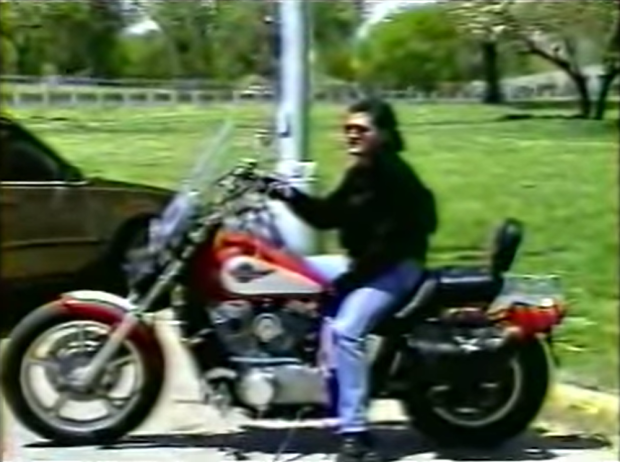
“Losing You” is a melodic symphony; Jan’s dulcet tones not at all harsh to the ear. Plus she knows how to rock a leather jacket. She likes her dudes with mullets n’ ‘staches. And motorcycles. That’s all she needs. A leather jacket, a song, and a dude with a ‘stache. She doesn’t even need the cameraman to stay focused. Jan Terri doesn’t need anyone to carry her bags either!
If you think you know a smash hit when you hear it, then you were wrong all this time. “Losing You” is the proof.
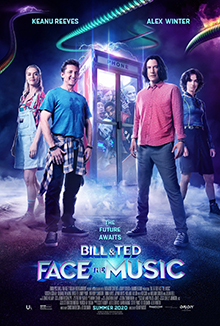
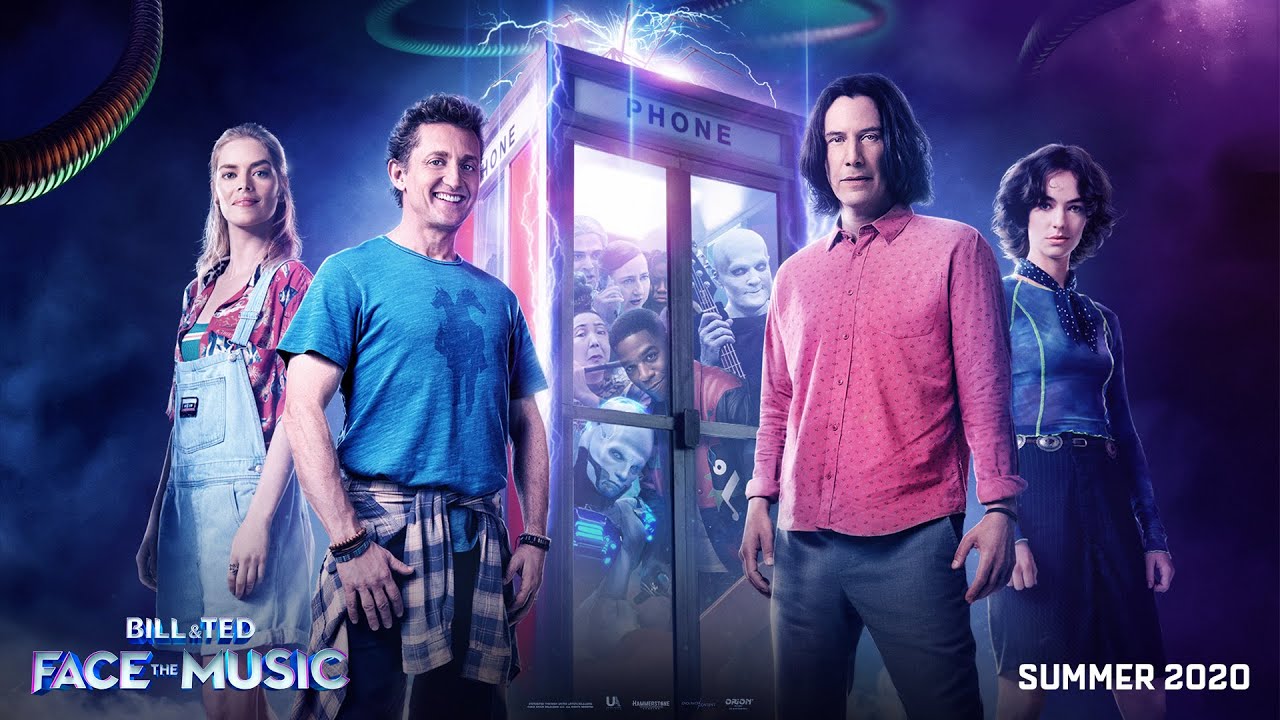
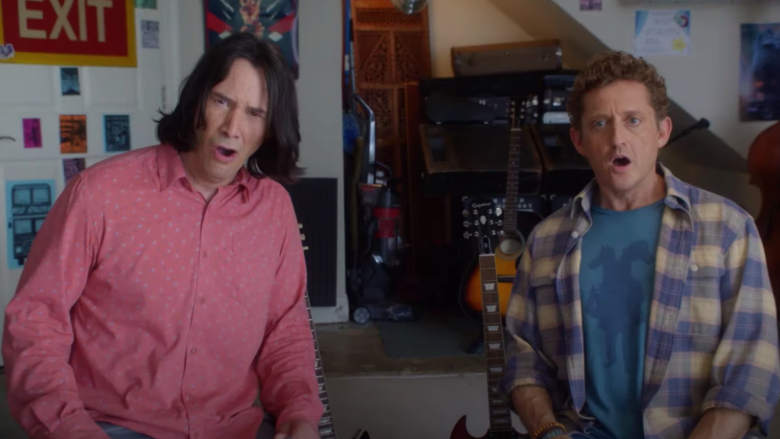
Bill & Ted Face the Music (2020 United Artists) Directed by Dean Parisot
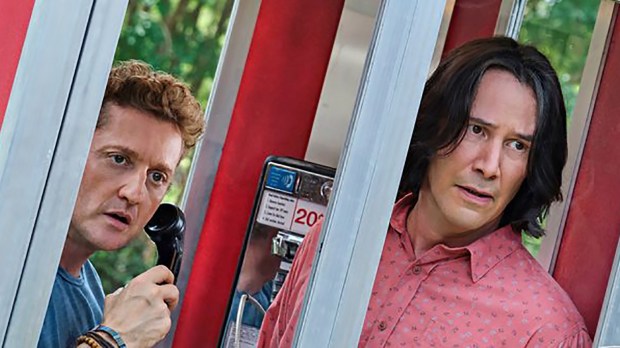
I went into Bill & Ted 3 not expecting much, due to the poor reviews and long-ass time since the second movie (1991). I came out thinking everybody else got it wrong, and Bill & Ted Face the Music could actually be the best of the series.
Keywords: “the series”. This isn’t The Godfather we’re competing with. Once you shed the rosy glow of nostalgia, realize one thing: Bill & Ted were never great. They were always fun, headbanging nonsense. There was some wit and some great performances thanks to George Carlin and William Sadler, but Bill & Ted were never great. The movies didn’t make a lot of sense where time travel is concerned, and were essentially just vehicles for the two dumb guys to have dumb adventures.
What is amazing is that the two “dumb guys” (Keanu Reeves and Alex Winter) wanted to come back. They seemed to be having fun making the movie, which means it’s fun to watch. What’s new in the last 30 years? Not only are Bill & Ted still together, but they are still together with their medieval princesses too! And they even have children — Thea and Billie. And they are chips right off the old blocks.
One catch though. Although Bill & Ted’s band Wyld Stallions achieved some early success, they quickly dropped off the map* and never wrote the song that would bring the world together. And if they don’t do it before 7:17 PM, the universe will cease to exist! (That doesn’t make sense? Well neither did the first two films!)
The movie splits into two tangents here, both equally entertaining. The affable Bill & Ted decide to go into the future, and just steal the song from their future selves. Meanwhile, Billie and Thea have their own idea: form the band that will back their dads when they play the song. They borrow a time machine from Kelly, who is the daughter of Rufus (George Carlin). Kelly is trying to warn their dads about a time travelling assassin robot (named Dennis) sent back to kill them.
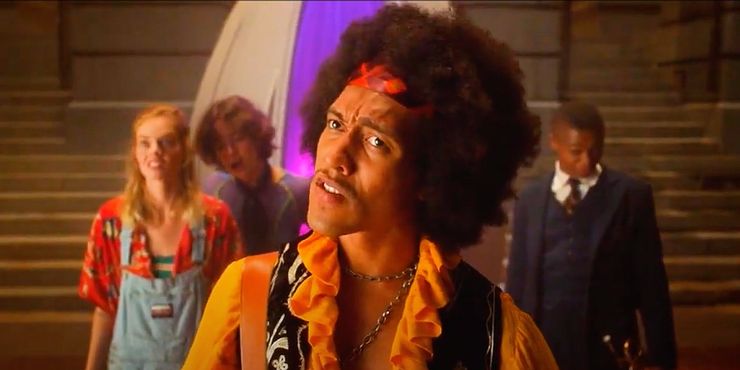
While Bill & Ted encounter increasingly older versions of themselves as they travel further trying to find the song, Billie and Thea recruit Jimi Hendrix, Louis Armstrong, Mozart, legendary Ling Lun, and a cave drummer from the stone age named Grom — the greatest musicians in history. This is where Bill & Ted Face the Music really surpasses its forebears. While it was fun seeing Bill & Ted recruit historical figures and going to hell in the past, this time it’s actually about the music. For three movies, we are told that Wyld Stallions will unite the world in music. Only in the third is the music actually a significant part of the movie. It’s fun seeing Hendrix jam with Mozart despite the language (and time) barrier.
Spoilers from this point. Bill & Ted screw up worse and worse the further they go. Their future selves try to trick their past selves into stealing a song from Dave Grohl, which backfires and ends up with future Bill and future Ted in the slammer. Their princesses abandon them. Dennis lasers everybody to death (including himself) and they all end up in a familiar landscape: Hell. But that’s OK. Turns out that Bill & Ted’s former bassist lives nearby. Yes, it’s William Sadler as Death, who we learn quit Wyld Stallions to go solo years ago. (We couldn’t get George Carlin back, but we did get William Sadler, and that’s just awesome.) The clock ticks on and all seems lost, but don’t worry — Kid Cudi shows up to help with the quantum mathematics.
But what about the song? As Mr. Holland’s Opus proved adequately, when you build up a piece of music in the audience’s mind, nothing will meet that expectation. And as Dave Grohl is well aware “this is not the greatest song in the world, this is just a tribute.” Given that no piece of music will ever satisfy an audience when you build it up as “the song that will save the universe”, this movie took an interesting turn. It is revealed that the song itself wasn’t as important as getting everyone in the world to play along simultaneously. It’s like a big “I’d like to buy the world a Coke and sing in harmony” situation. And our heroes have a time machine, so they can make sure they get the message (and an instrument to play along) out to everyone in the world. Don’t think about it the time travel stuff too hard!
End spoilers.
Keanu Reeves, and Alex Winter in particular, are so much fun to revisit as these characters. Keanu is a little more laid back, but Bill & Ted are in their late 40s (while the actors are in their 50s). They’re not as enthusiastic as they once were. But they are still Bill & Ted, bonded at the hip, and going to couples therapy as a quartet with their princesses.
Because of its focus on the music, Bill & Ted 3 surpasses the previous two movies. There’s little “wheedly-wheedly” air guitar and shenanigans. They don’t run around saying “excellent” and “bogus” all the time. The endgame of Bill & Ted has always been that one day they would save the world with their music, yet the previous two movies didn’t focus on music. The first one was about collecting historical figures to pass the highschool history exam. A fun and fresh premise indeed. The second went dark, having them assassinated by future robots and journeying through hell. The third combines the two ideas, but this time with historical musicians. Rock, jazz, classical, and I had to look up Ling Lun!
You get the sense that Keanu and Alex realized that there is a certain innocence to Bill & Ted that requires younger characters. Their daughters (played by Samara Weaving – niece of Hugo, and Brigette Lundy-Pain) fill those roles and do it, pardon the pun, excellently. You need that wide-eyed excitement. Bill & Ted have already travelled through time, met Socrates and did it all twice — they have nothing to be wide-eyed about. To them it’s old hat, even ending up in Hell one more time.
The Bill & Ted movies are, objectively, dumb movies. The two lead characters are, objectively, dumb. But dumb can be classic, as Stooge aficionados know, and updating a classic is really difficult to do. Just ask the Farrelly brothers. Ted Theodore Logan and Bill S. Preston, Esquire managed to have a third adventure appropriate to their ages, while finally saving the world as George Carlin promised they would. Nothing new added to the stew. By finally focusing on the music, potential is fulfilled.
3.5/5 stars
* Their experimental opus “That Which Binds Us Through Time: The Chemical, Physical and Biological Nature of Love; an Exploration of The Meaning of Meaning, Part 1” is not a hit.
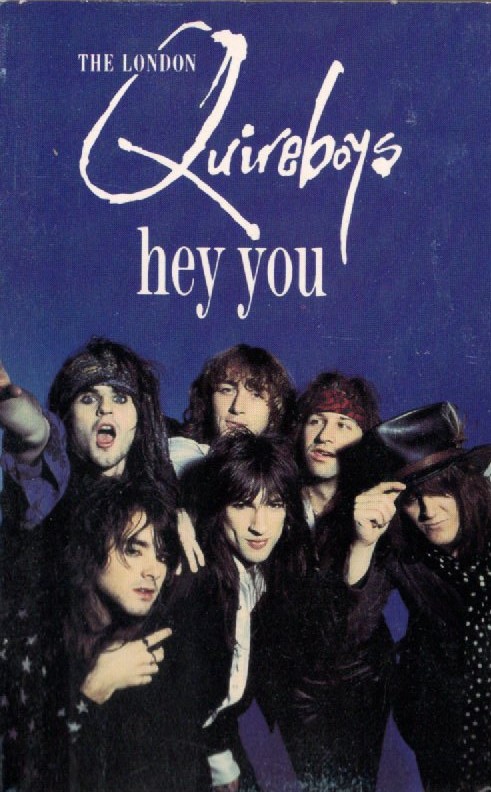
THE LONDON QUIREBOYS – “Hey You” (1990 Capitol cassette single)
A curiosity unique to cassette. The UK 12″ single for “Hey You” included a live “Hoochie Coochie Man” on the B-side. It and the 7″ single also contained the album track “Sex Party”. You could get these same tracks on the CD single, but the cassette went with a different route.
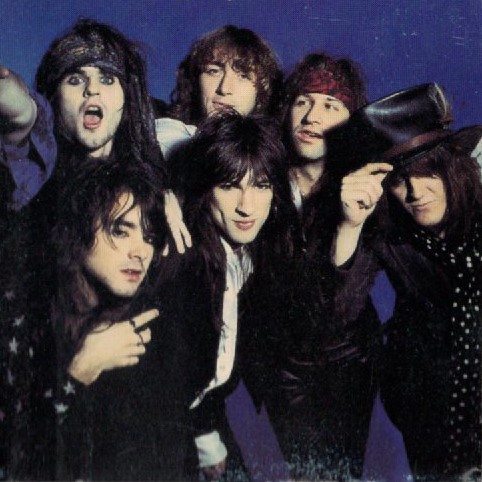
The A-side common to all is of course “Hey You” from the hit debut album A Bit Of What You Fancy. It sounds classic from first crash of guitar. The Stones-y Faces vibe is immediately apparent, and fondly recalls the summer of 1990 when the need for such a sound heralded in the Quireboys and Black Crowes. It was completely unlike everything out by Motley Crue, Bon Jovi, and Warrant. Its refreshing reliance on slide guitar still sounds great in the speakers, but the rasp of singer Spike is its most defining trait.
The first B-side is the roudy “Sex Party” from the album. The boogie piano keeps it kickin’ hard. But then the cassette goes its own way with two additional tracks. They are severely edited versions of hit singles “I Don’t Love You Anymore” and “7 O’Clock”. Both fade out prematurely just as the songs are getting awesome!
The whole thing repeats on both sides. The idea is to give the kids incentive to go out and buy the album next time. Save your allowances and buy the album to get the full songs. Such teases! Just as Spike is telling us what time it is, adding that it’s also “time for the party”, the song fades and the side ends!
Can’t realistically rate something like this very high. While the two full tracks are both awesome, it’s hard to justify buying this tape today as anything other than a curiosity. The cassette still sounds good after 31 years though!
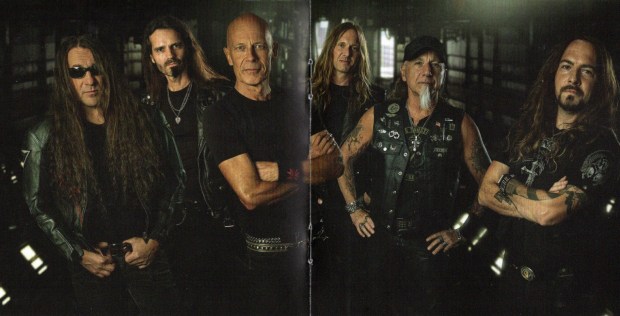
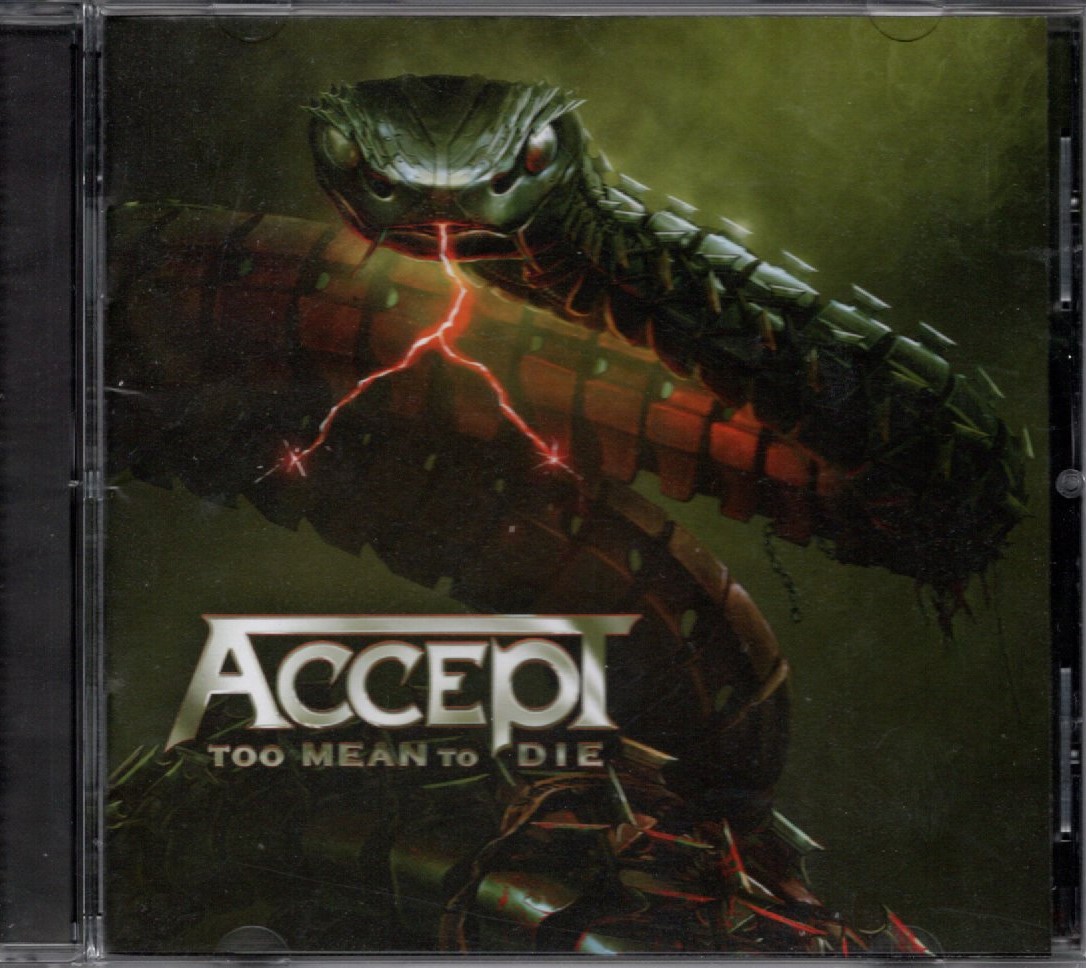
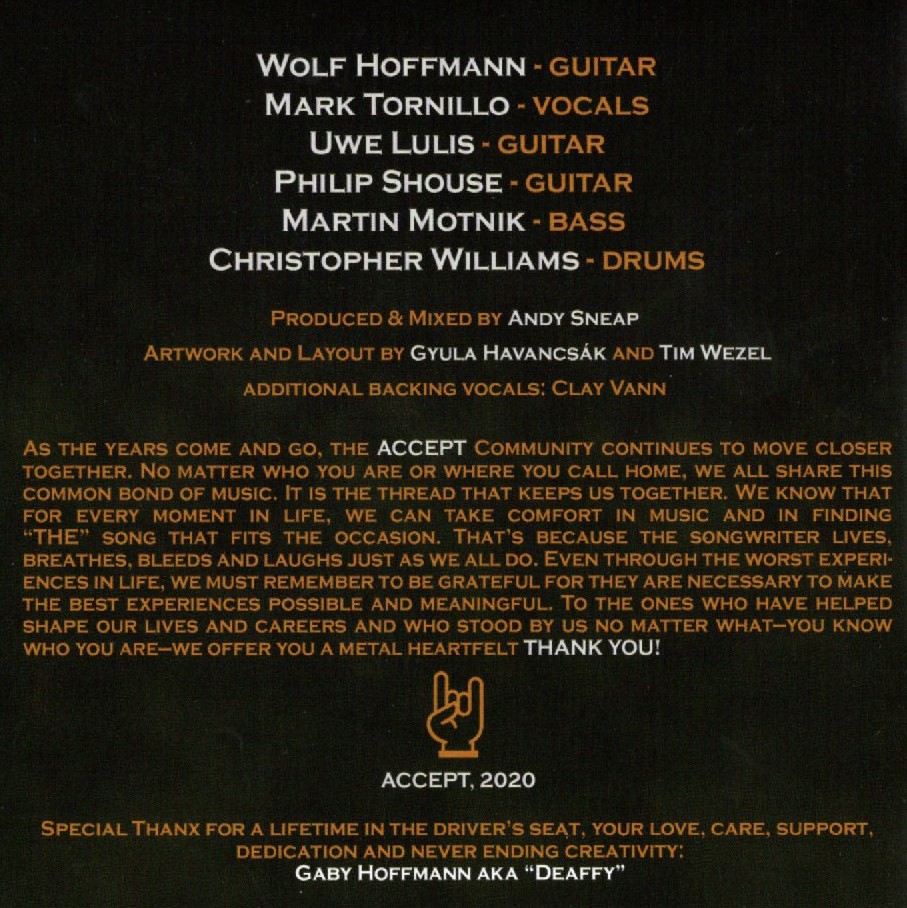
Tornillo-era Accept has been a pretty even field; a level grid of Sneap-sharp production and Hoffmann’s razor-riffs. If you expected change just because there’s a new bass player for the first time ever, you’d be wrong. Accept may be down to just one original member (Wolf Hoffmann himself) but it doesn’t matter much. What Accept deliver on Too Mean to Die is the same as they have done for every album since 2010’s Blood of the Nations. Reliable, like AC/DC…or a comfortable leather jacket.
Nothing wrong with this. Accept found a formula that works in their post-Udo world and it works well. It’s difficult to remember what songs are from what albums, but Accept haven’t stopped putting out solid quality metal.
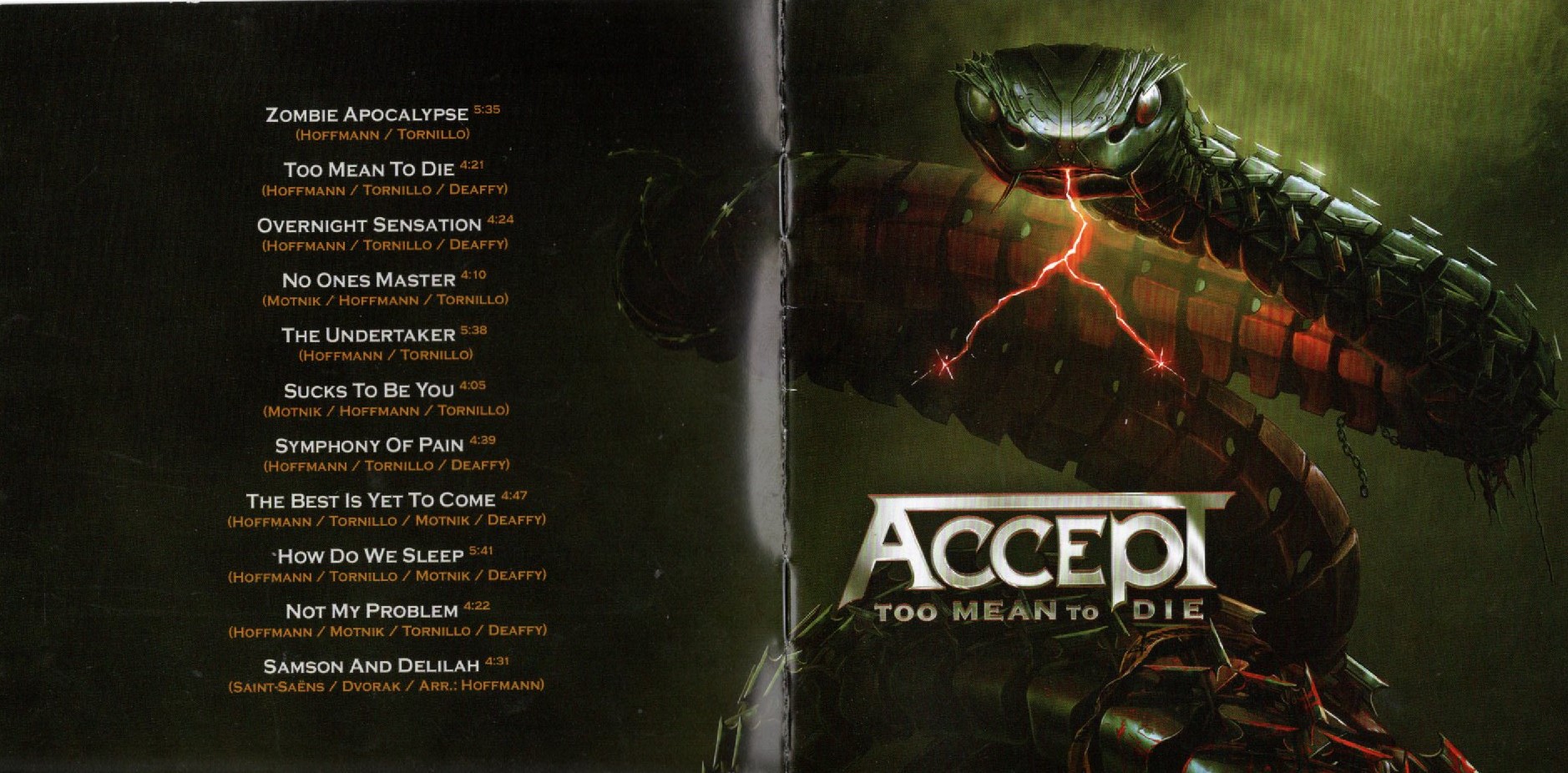
There’s the song about zombies (“Zombie Apocalypse”), one about never giving up (“Too Mean To Die”), the mid-tempo one (“Overnight Sensation”), the one about the media (“No Ones Master”), the single* (“The Undertaker”), the one with the funny title (“Sucks to be You”), the classical influence (“Symphony of Pain”), the ballad (“The Best is Yet to Come”), the one about the state of the world (“How Do We Sleep”), the angry one (“Not My Problem”), and the instrumental (“Samsom and Delilah”).
The riffs keep hammering in the capable hands of Wolf, and Mr. Tornillo on lead vocals never stops givin’ ‘er. Hooks on every track. The energy is no less than their first together. Wolf’s guitar tone remains as tasty as it has been for over four decades. One more album to add to your collection, as the Tornillo era blends together like a monolithic five-CD box set. Too Mean To Die could have been titled Disc Five, so if you need to complete your set, do it now.
4/5 stars
* The single for “The Undertaker” features a non-album live track on its B-side, of a non-album single called “Life’s a Bitch”!
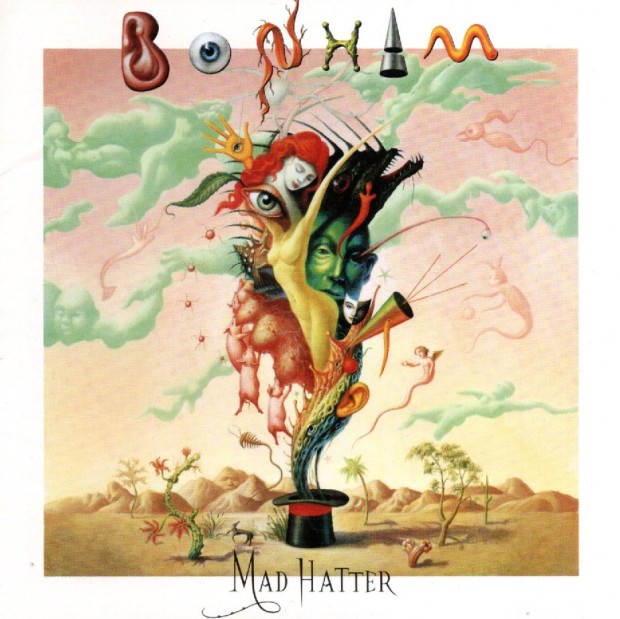
The first Bonham album in 1989 was a critic’s darling. Produced by Bob Ezrin, it sold well enough and made plenty of year-end lists. For the year 1989, it was a breath of fresh air compared to the Motley Crue, Bon Jovi and Def Leppard tracks dominating the airwaves. Those who thirsted for the rarified air of Led Zeppelin got some of that with Jason on drums and the incredible Canadian Daniel MacMaster on lead vocals. It was easy to imagine that “Wait For You” was a new Zeppelin single built for that year. But every band has to grow, and where would Bonham take it? Further down the Zeppelin road, or try and find their own identity?
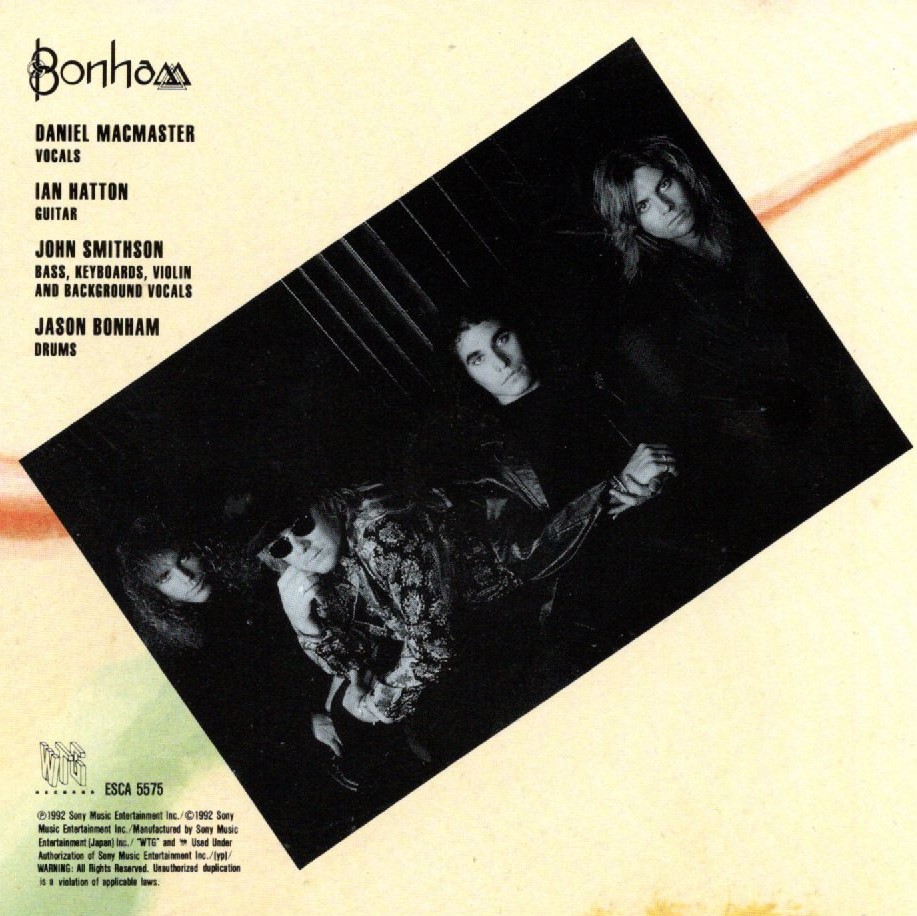
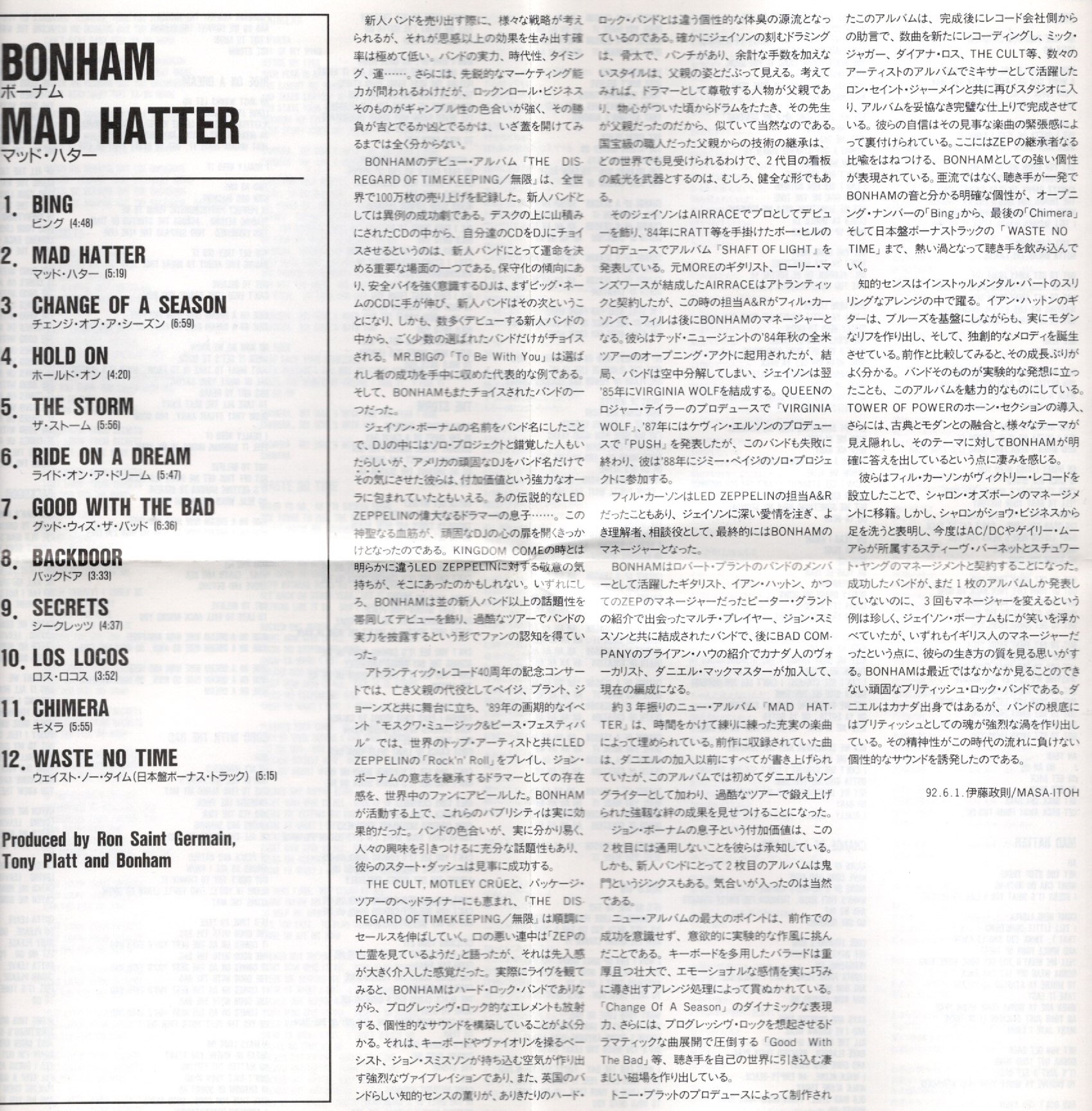
Bob Ezrin did not return, and most of the followup album Mad Hatter was produced by Tony Platt, with the rest produced by Ron Saint Germain. The band grew from the debut, establishing more of their own groove. It was a more diverse and challenging platter. Unfortunately, the album arrived in 1992, amidst the Pearl Jams, Soundgardens, Nirvanas and the rising tide of grunge. Despite the strong single “Change of a Season”, the album tanked.
What an opener “Bing” is, a word that doesn’t seem to be in any of the lyrics. At first, it has a very old school Zeppelin groove, akin to “Candy Store Rock” meets “Black Dog”. But then it goes to a completely different place on the chorus. The sonics are clearer and sharper than the debut. Jason’s drums are huge as the should be.
Yet it’s the title track that really shocks the system. Opening with a blast of horns, “Mad Hatter” goes one of the few places Zeppelin never went: full-on funk with horns. This would be the Tower of Power horn section. It would be lazy to compare “Mad Hatter” to “Get the Funk Out” from a couple years past, as it has its own vibe. Ian Hatton on guitar proves himself to be diverse talent with licks-o-plenty.
Another direction is explored on “Change of a Season”, the shoulda-woulda-coulda single that would have been huge a year or two prior. The melancholy ballad was simply the wrong temperature for 1992. The gothic tone of the video was cool, but the video got zip for airplay. It’s the backing strings (synth) and epic chorus that make this song. It sounds less like Zeppelin and perhaps more like something from David Coverdale’s Reptile Emporium.
Another cool direction is explored on “Hold On”, a unique song with elements from multiple genres. Funk, soul, progressive, blues, and even bluegrass. This is followed by another song with epic overtones, “The Storm”, a six minute track that takes the Zeppelin influences to the craggy progressive peaks of another land.
Although there’s no side break on a CD, there are a natural place for it as you can pause for a breath before plunging into “Ride on a Dream”. A breaknace pace and metallic riff make it unlike anything else on the album. Perhaps a band like the Scorpions could do “Ride on a Dream”, but even Klaus would be challenged by the outstanding MacMaster lead vocal. This plutonium-fuelled track would give anyone a run for their money.
But after all that drama, you need something a little more laid back. That would be “Good With the Bad”, a jazzy piano ballad and the longest song on the album. It doesn’t remain in ballad territory forever, going to the swamps of Florida where Savatage reside halfway through. The comparisons are easy to hear. Next, we go to a bluesy, funky blast of Zeppelin-flavoured ale on “Backdoor”. Another cool tune with a different vibe from the others. Things drag a bit on “Secrets”, which tries to marry the funky side with a “Kashmir”-scale chorus but doesn’t really follow through.
Moving on to the end, it’s “Los Locos” in second to last position. This is a tender blues guitar/violin instrumental with dark piano accents. That would be bassist John Smithson handling those wicked violin licks and a lot of the keyboards. Perfect track for this spot, setting up for the closer. It’s up to “Chimera” to take you out, and it does with a shiny upbeat vibe. Although it’s probably sheer coincidence, it sounds a bit like Marillion circa the same period.
Lo and behold, that is not all! The Japanese fans got a little bonus on their CDs called “Waste No Time”. It’s definitely not an also-ran. It has a heavy bass groove that isn’t like the other tracks on the album. MacMaster really lets it blast on the chorus too. Definitely Zeppelin vibes come solo time.
This album was available with two covers. The majority of copies have the surreal Dali-esque landscape that you see here. The alternate cover was plain white with just the new Bonham logo. Which looks rather silly without the proper cover art for context. That’s the cover that retailers such as Columbia House sold in the 1990s.
In 1994, Jason Bonham reconvened with Ian Hatton and John Smithson, but not Daniel MacMaster. The new singer was Marti Frederiksen — yes, that Marti Frederiksen, the one that writes massive hits for everyone today. The band took on a new modern grunge sound, and renamed themselves Motherland. ☮︎ For Me was the pretentious name of that album. As a sad final coda, Daniel MacMaster died too young at age 39 from a strep infection that he thought was a cold.
At least we can say that Bonham with MacMaster really did outgrow the Zeppelin tag by the second album. Still a part of the DNA, but expressing itself more rarely. It’s a shame about the timing of the album, because had it sold like the first one did, maybe we wouldn’t have had the Motherland debocle. Mad Hatter is a pretty fine second album that does all the things that second albums should do. Shame it was the last.
What a strange time the dawn of the compact disc was. Even at the end of the 1980s, vast catalogues of music had yet to be released on CD. It was a hit and miss affair, with some early discs sounding wonderful and others sounding like a thin, tinny facsimile of the original vinyl. The longer running time of CD was a bonus that many bands took advantage of, while other heritage groups were considering the ways they could re-release their music on this new format.
Before Jimmy Page took his first crack at remastering the Led Zeppelin catalogue for CD, ZZ Top took a different route.
Now, granted, ZZ Top’s music spans a longer time period than that of many of their rivals. They’re also notable for starting the 1970s as a dirty raw blues and ending the 80s as clean space-age rock. While this took them from one success to an even more massive one, it unfortunately meant that the ZZ Top camp felt it necessary to “update” their music for the CD age. Make the catalogue sound more on an even keel with Eliminator and Afterburner.
And so the six ZZ Top albums that were so-far unreleased on CD were remixed: First Album, Rio GrandeMud, Tres Hombres, Fandango!, Tejas, and El Loco. Only Degüello was spared, having been released on CD earlier.
Apparently, updating the ZZ Top catalogue for CD was of “overriding concern” for all parties involved. ZZ Top were aware that there were complaints about early CD transfers for classic albums. The goal was “return to the original analog tapes and consider what steps were needed to render the music appropriate to contemporary digital playback equipment without compromising integrity.”
The answer was none. No steps were necessary. The remixes were not what the old fans wanted to hear on their brand new CD players. Rhythm tracks were updated with sequencers, drums treated digitally, and the whole thing came out sterile and flat. Adding echo didn’t add depth. Doing an A/B test with a remix vs. an original track makes you wonder why you even own the ZZ Top Six Pack.* It just…doesn’t sound right. Like a disorienting time displacement.
As of 2013, you can get all the original ZZ Top albums on remastered CD as they should have always sounded.
While it is nice to have six ZZ Top albums on just three CDs, and there is no denying the booklet is hot, you do not need the ZZ Top Six Pack anymore. The charm of the originals is that they are a document of those hot Memphis studios where ZZ Top laid down the original tracks fast and dirty. The remixes sound like a digital mixing board trying to tame a wild animal. Wrong, and unnecessary. “Francine” is actually awful.
The booklet is truly valuable (nonsense justifying the remix aside) and worth a point on its own. The ZZ Top songs in and of themselves are always incredible, so they too are worth a point.
2/5 stars
* It was a gift from Kevin. He also rates it 2/5 stars. I asked him for a quote for this review. All he had to say about the ZZ Top Six Pack was: “I’m glad Mike took this crap off my hands.”
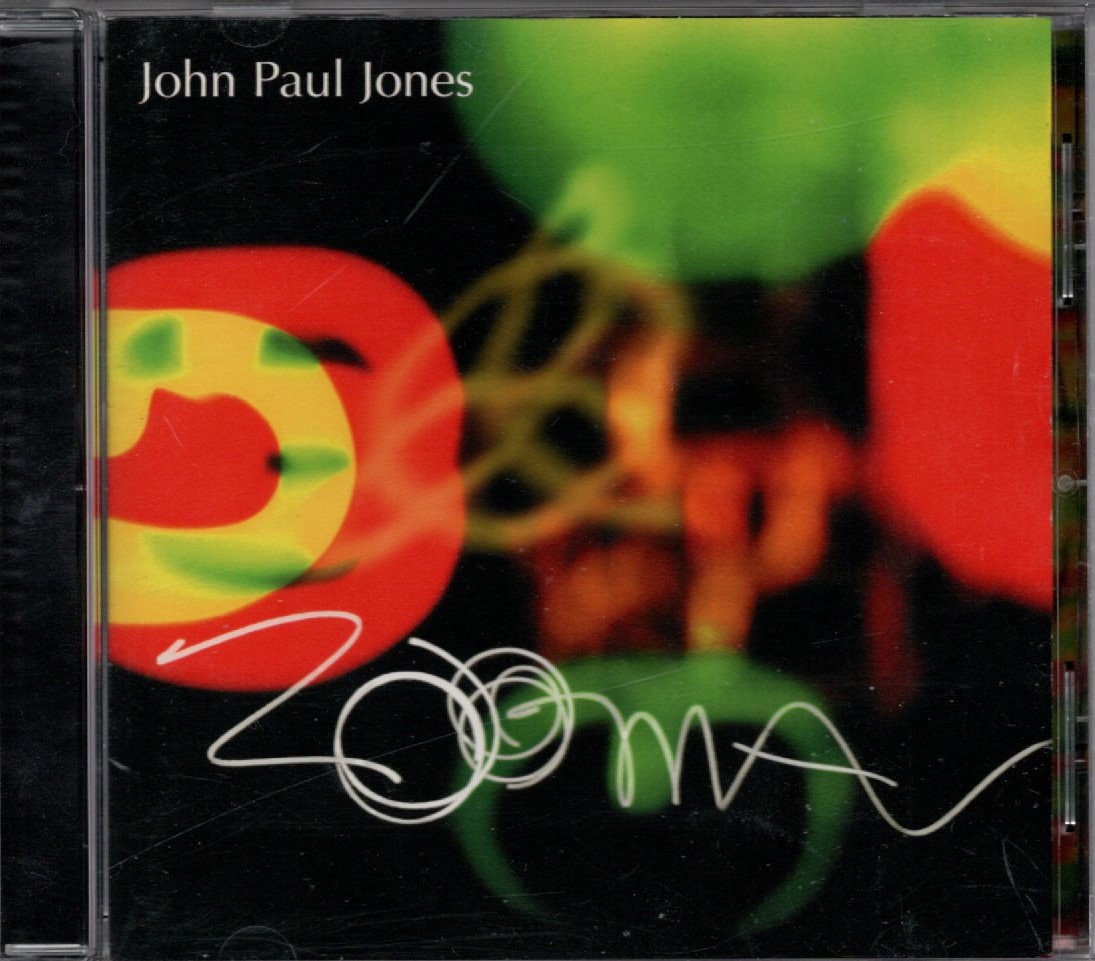
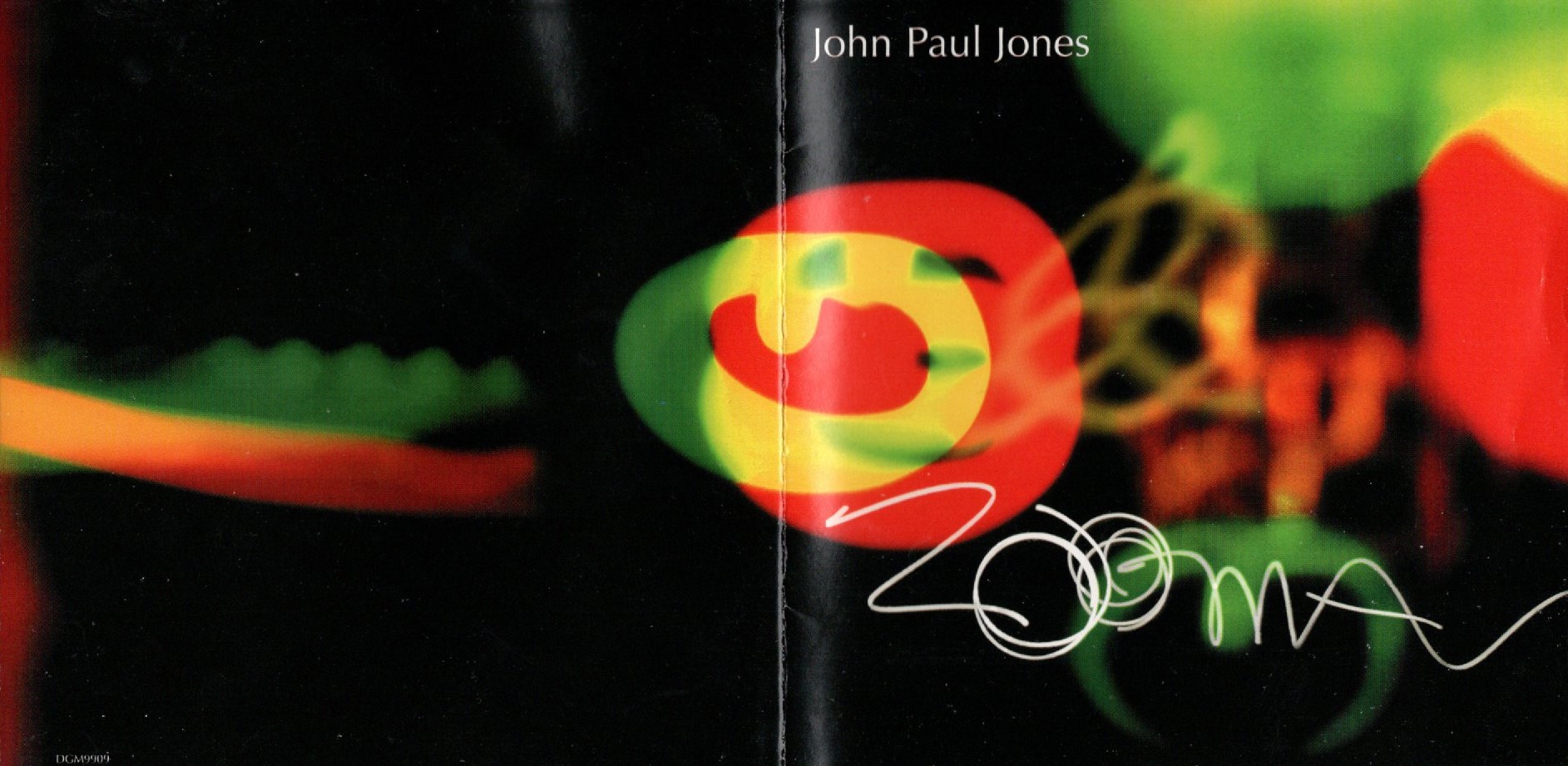
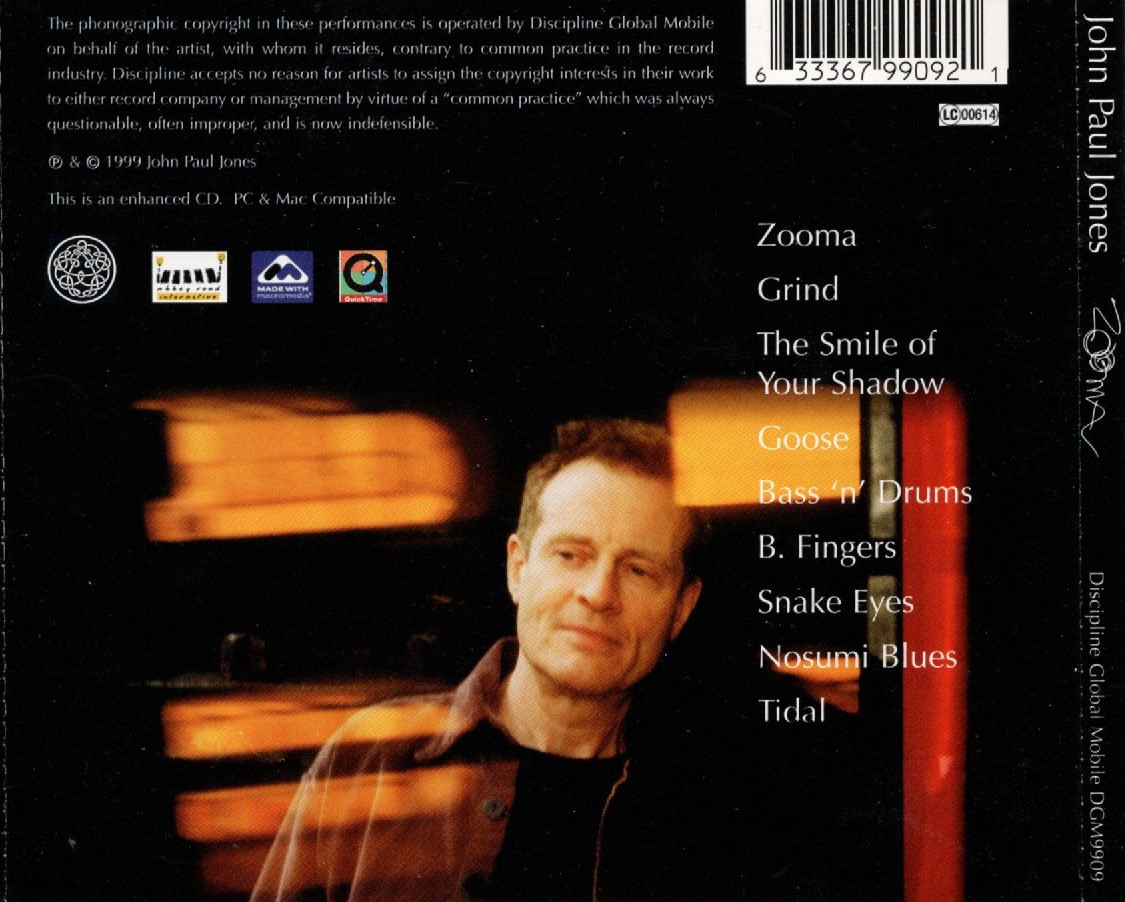
JOHN PAUL JONES – Zooma (1999 Discipline Global Mobile)
Three words: “Bass”. “Heavy”. “Groove”.
Purchased at Encore Records a short time after its release, Zooma by John Paul Jones blew me away from first listen. If you’re wondering who the heavy influence in Them Crooked Vultures really is, it was Jones this whole time. Just listen to the title track on Zooma. You could be fooled into thinking it’s a brand new jam by the Vultures, so heavy is it.
Zooma is an entirely instrumental solo album, featuring Jones on most of the instruments. On drums is Pete Thomas. Trey Gunn and Paul Leary drop in for some guest appearances. Otherwise it’s largely the JPJ show and his 4, 10 and 12 string basses! What a heavy sound they make.
The second track “Grind” (featuring Gunn on touch guitar) is contrasted by bright highs and the deepest lows of the 12-string bass, all within a killer groove. This track could blow a subwoofer, it’s so bass heavy. The next track “The Smile of Your Shadow” takes things down to the acoustic level, with instruments like bass lap steel, mandola and djembe. It’s the most Zeppelin of the tracks due to its acoustic, quieter nature. “Goose” brings back the heavy groove again, this time on a 10-string bass. The drums have that Zeppelin kind of beat to go with it.
But Jones is so much more than just groove (and Zeppelin references in reviews). “Bass n’ Drums” brings out his jazzy side. Denny Fongheiser on drums this time, and John Paul keeping is single with just four strings this time. But that doesn’t limit his pallette at all, as he plays in a combination lead/rhythm style. That’s just the one track though — Jones is back to 10 strings and a maniacal groove on “B. Fingers”. It’s sonic controlled chaos…with a beat.
As tasty as the bass and grooves are, Zooma is not an easy album to digest. It’s big, it’s large, and the tracks tend towards long and jammy. The longest is “Snake Eyes”, with bass lap steel, organ solos, and members of the London Symphony! It’s easy to imagine “Snake Eyes” as a modern day Led Zeppelin number, and it’s moments like this that will make the Zep diehard weep for what could have been. But it goes on a long time, including a long orchestral outro that sounds like a soundtrack. Brilliant but not for those with short attention spans.
“Nosami Blue” bears some superficial resemblance to the intro to “Absolution Blues” by Coverdale-Page, but this is just because both have the same roots: the blues. Most of the work here is being done once more on a bass lap steel. After a long freeform blues jam, the drums kick in and we get back into a groove. It’s like two songs in one. And that brings us to the final song “Tidal”, which a manic and exhaustive bass workout to take the senses to the final extreme. It is bonkers!
As a quaint leftover from the 1990s, this disc is “enhanced”. That part of the package no longer works, but judging by the contents in the readme.txt file, it was a digital catalogue for DGM records – Robert Fripp’s label. It appears you could actually order CDs from their catalogue right from this program.
In the Record Store days, I was instructed to stop playing this album as some tracks were too heavy. That’s both an endorsement and a warning to you!
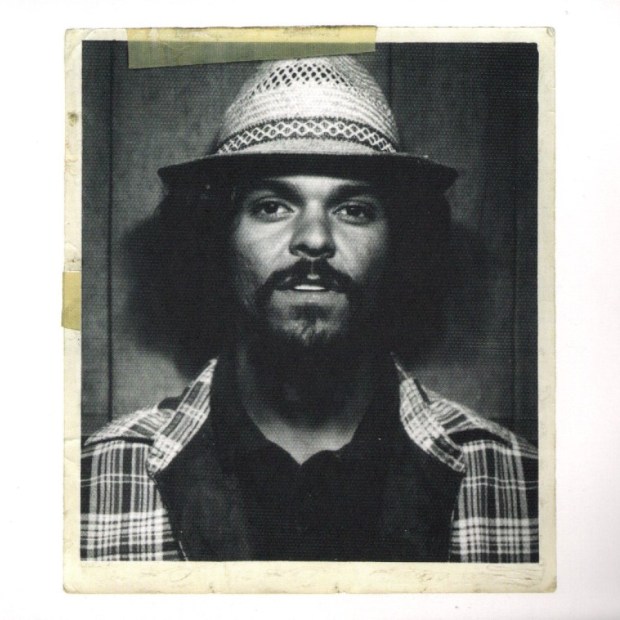
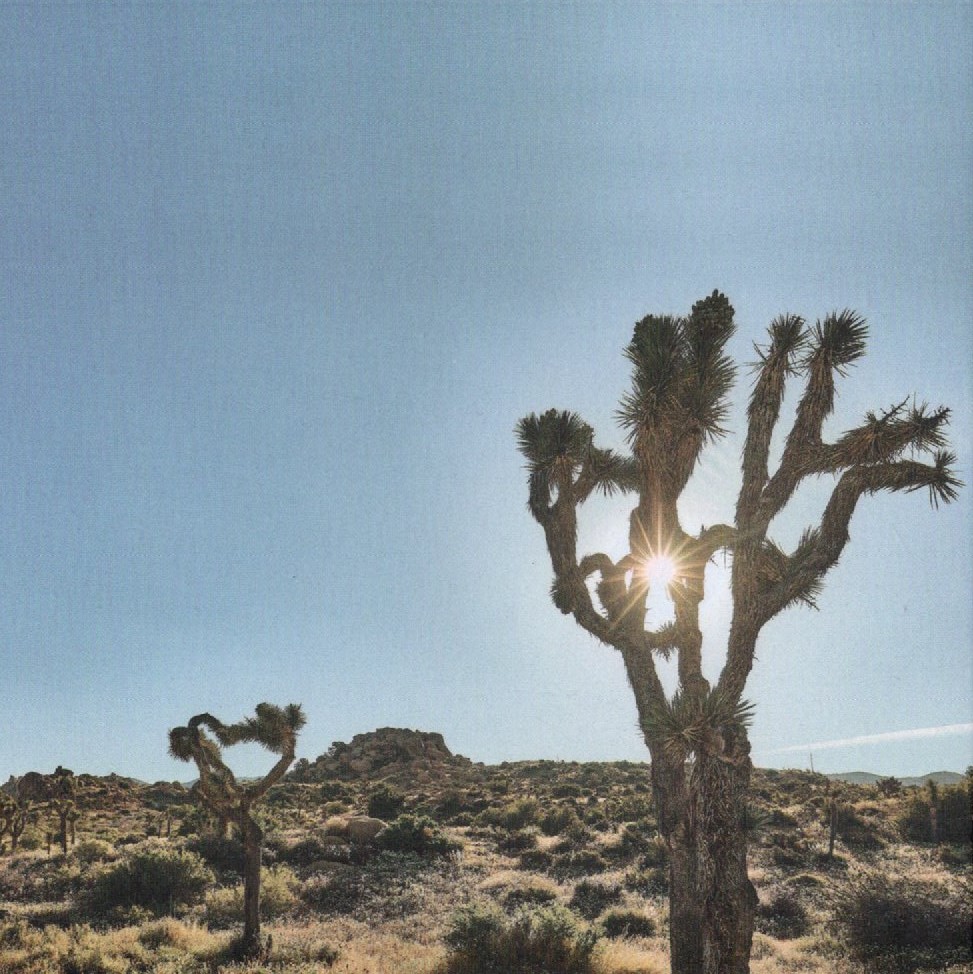
BRANT BJORK – Jalamanta (Originally 1999, Remixed and Remastered 2019 Heavy Psych Sounds)
When the needle hits wax it won’t be long, You got your radio tuned but it won’t play this song.
20 years ago, Jalamanta was one of my favourite albums in the world. This is my third copy. Partly instrumental, partly vocal, but 100% Brant Bjork. It was his first solo album, and he played virtually everything himself. The laid-back desert vibes are perfect for a summer evening chill-out. Humid, sparse, exotic, varied compositions take you across a hazy landscape.
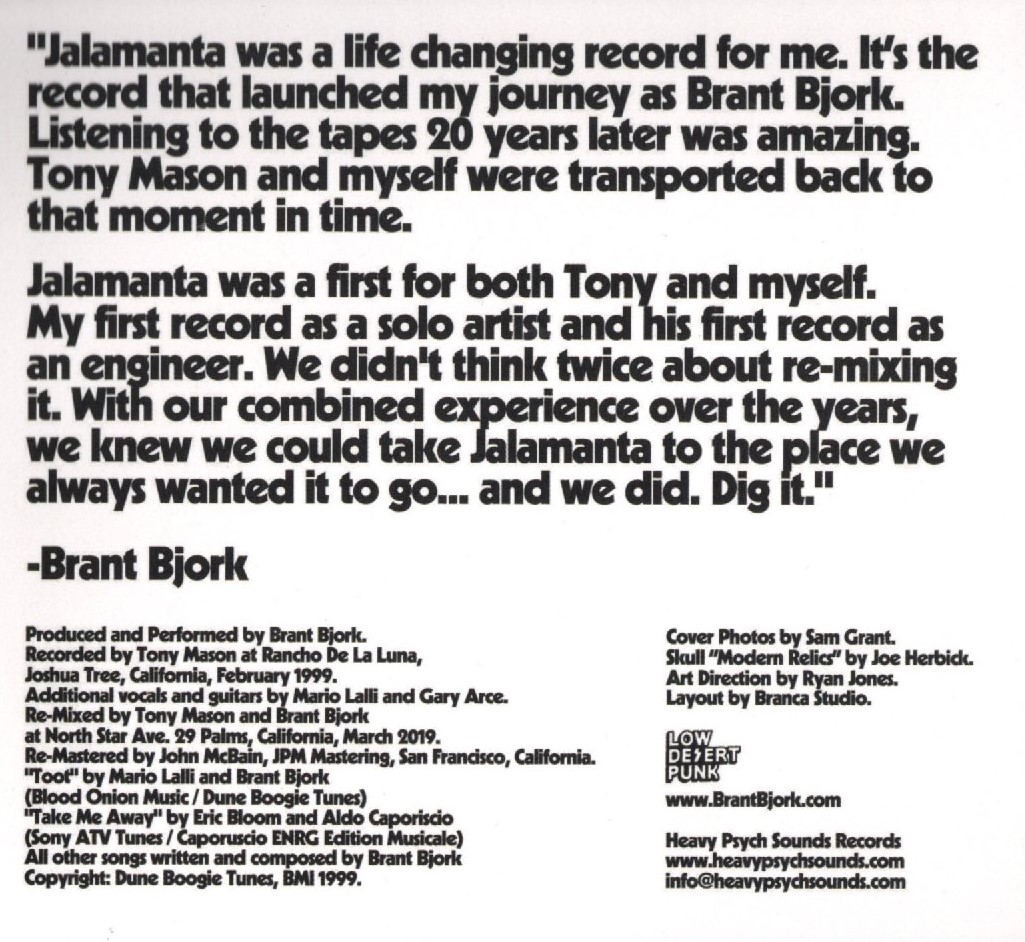
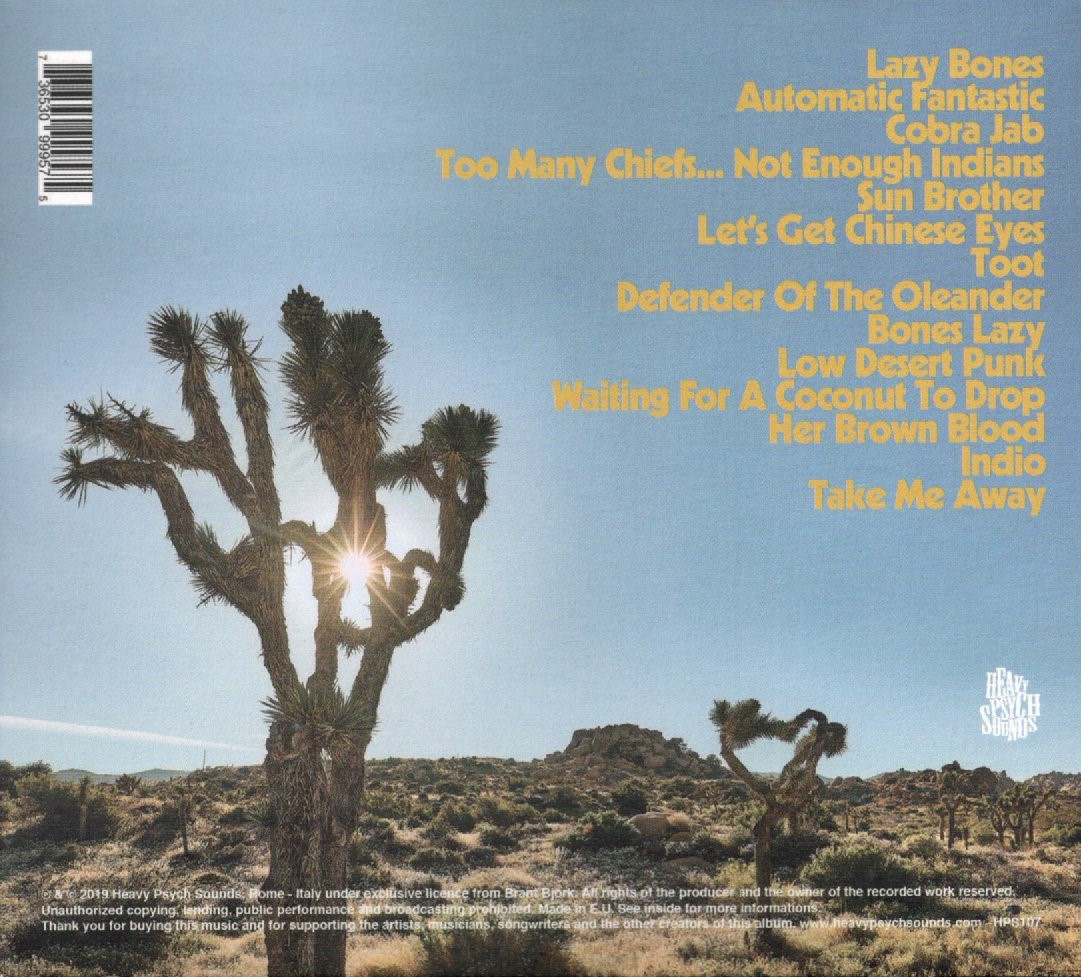
In 2019, Brant and engineer Tony Mason remixed Jalamanta, to take it the place they “always wanted it to go”. The remixes are largely subtle, just making the album sound bigger in your ears. The vocals might be a little less buried. It’s still raw, and sparse, and all the things you always liked about Jalamanta. Some songs have more noticeable differences. More guitar on “Toot”. Tracks tend to run longer than their previous fade-outs. But there are things I enjoyed about the original that aren’t here. The echoey lead vocal on “Toot” — “Cat scan, cat scan…” That echo is gone, maybe so the sonic field wouldn’t be too crowded with that louder backing guitar?
This remix will never replace an original, especially when it was one of my favourites 20 years ago. What is “Jalamanta” made of that makes it so tasty? Only the most basic of ingredients. Rolling bass and drums, simple unaffected guitar parts, and Brant’s laid back singing style.
Yeah, the man shakes me down and that’s why I’m broke. The rich man’s got all the green but it ain’t the kind you smoke.
So we turn up the rock, and we roll it slow.
We’re always flying high, and the ride is always low.
Snakey guitars jab in and out of the speakers — one song is even called “Cobra Jab”. Other tunes are more aggressive. “Too Many Chiefs… Not Enough Indians” has a relentless and simple riff, with the snakey guitars carrying the melody over it like a wave. Brant’s quiet vocal is hypnotic. By contrast, “Defender of the Oleander” has a barely-there main riff while the snakey licks do all the brilliant melodic work. Brant goes for hypnotic again on “Her Brown Blood”, a speedy run through the desert, with a cool monotone vocal right in the middle of your head.
Whichever version of Jalamanta you happen upon, you are guaranteed an incredible listening experience. The new remix is certainly more three-dimensional, and will sound better on your big system. But you will lose some of the charm of the original. The 2009 vinyl used to be the way to go, with a beautiful full-colour booklet and Blue Oyster Cult cover “Take Me Away”. But now you can get “Take Me Away” here on CD, albeit remixed. Another bonus is exclusive to this CD — “Bones Lazy”, which segues out of “Defender of the Oleander” into the brilliant rocker “Low Desert Punk”. And with the title “Bones Lazy”, you won’t be surprised that it is “Lazy Bones” backwards! Like you’re watching Tenet. Cool though. Even though I knew what was likely coming, I felt like it fit right in.
Get a load of this, man.
Well I’m gettin’ up when the sun goes down, And I shine ’em up and I hit the town. Well I trim it clean and I roll it up, And then I take it nice and slow…so what the fuck, man.
Jalamanta makes me feel that California sun way more than any Desert Sessions CD ever has. You can taste it. Let it sink into your lazy bones. And as great as this new CD is sonically, it also makes me want to hear the original. Nothing can truly upgrade a 20 years love affair with Jalamanta. As a complimentary piece, I don’t regret owning or listening to it at all. Hearing guitar parts that used to be beyond the fade is the kind of bait that we nerds line up for. The 2009 vinyl, with the gorgeous embossed cover and all that delicious photography inside, will remain my preferred way to experience Jalamanta. The 2019 remix will be the one to play when you want to examine it in more thorough detail.
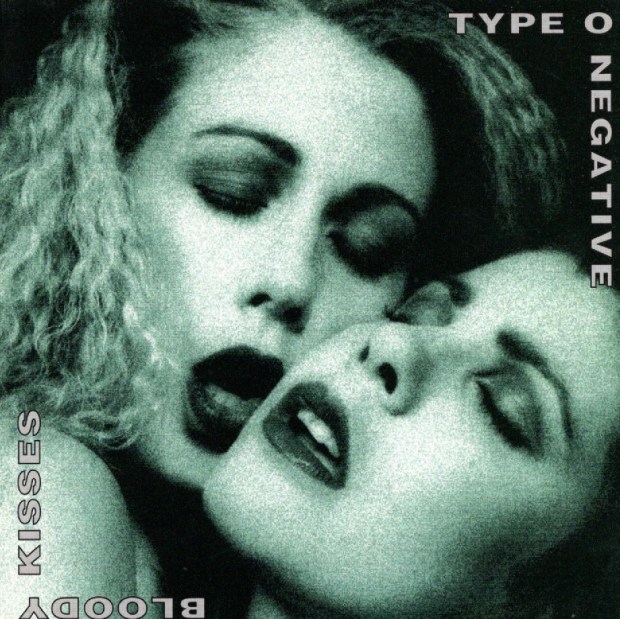
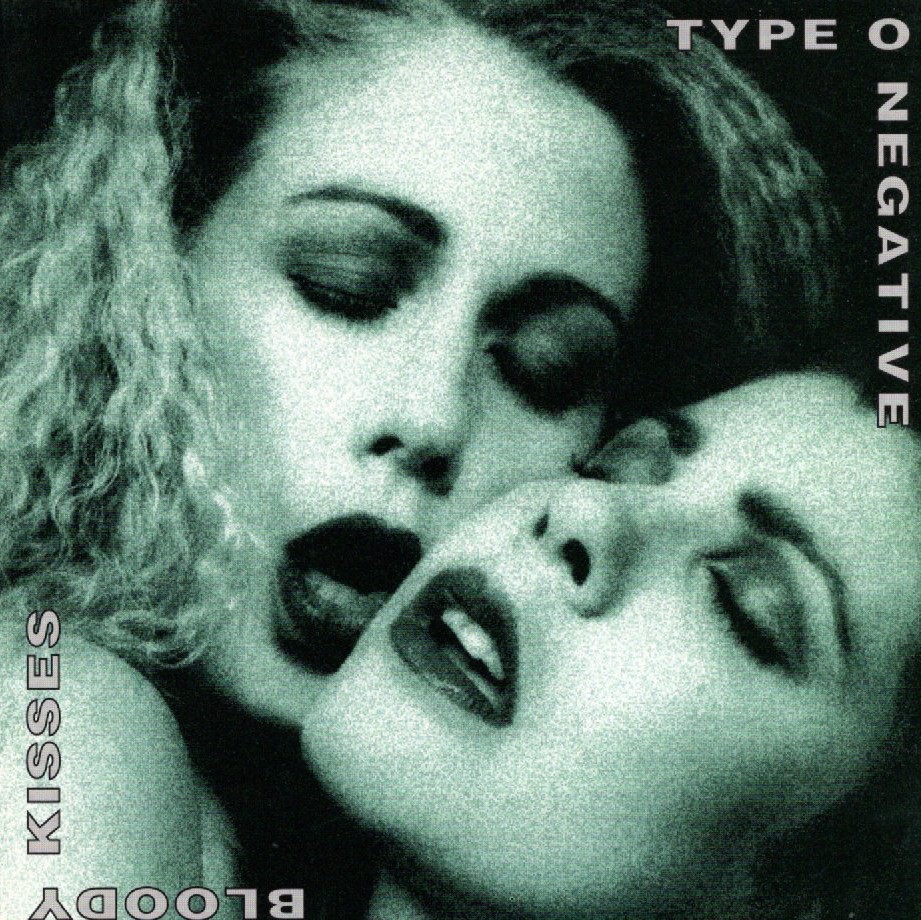
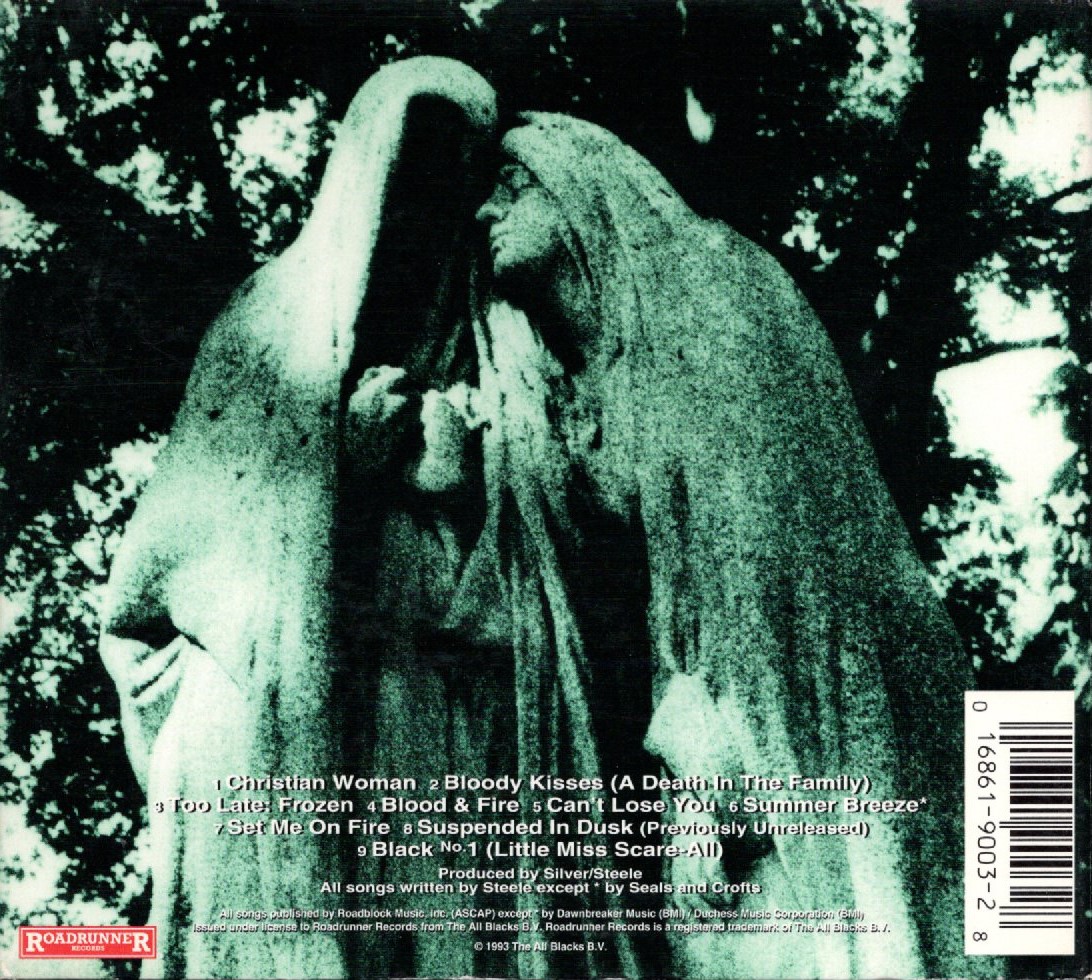
TYPE O NEGATIVE – Bloody Kisses (1993 Roadrunner, original and digipack re-release)
“If you like Black Sabbath,” said the security guy at the mall, “then you have to hear Type O Negative. They are one of my favourite bands right now. Do you have it?”
We checked the racks, and we did — Bloody Kisses, the recent re-release in a smart looking cardboard digipack.
There were two security guys at the mall. There was Trevor Atkinson, the laziest guard in the world, who I knew from highschool. The other guy had more the look of the cop-wanna-be, the way you picture the cliche of mall security guards in your head. He was the Type O fan.
The year was 1995, still early in the winter, and fresh working at the Record Store (for about six months). I had been collecting Black Sabbath for years, and in 1995 I was still mad for them, trying to acquire the rare stuff on CD like Born Again and Seventh Star. Knowing my infatuation with Black Sabbath, the cop-looking guard recommended Bloody Kisses. I was also about five months since my first big breakup, and I was still bitter and angry. It clicked.
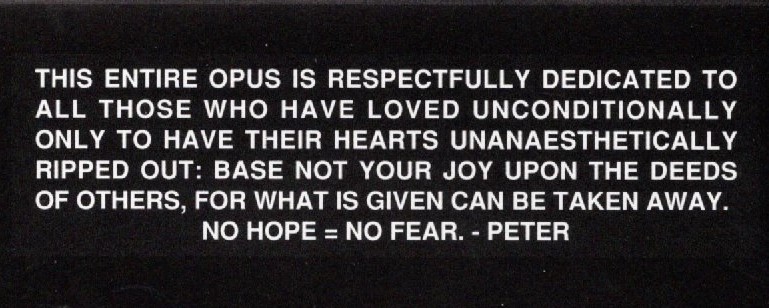
I mean, read this dedication in the inner booklet.
I wouldn’t recommend Type O Negative to any old Sabbath fan like he did. In fact a few months later, I saw Type O Negative with a bunch of Sabbath fans, and they couldn’t have given a shit. But I got why he did. The gothic imagery, the heavy guitars, the keyboard accents. Certainly, the comically deep vocals of Peter Steele were nothing like any of the higher-pitched crooners that Sabbath have ever had in their ranks. But Type O did sooth my angry, heartbroken soul when I hit “play” on my brand new copy of Bloody Kisses. I didn’t know, but I had bought a recent reissue featuring a new song called “Suspended In Dusk”, while losing a lot of the instrumental bits and novelty songs on the first edition. The reissue, with only nine tracks instead of 14, is an overall better listening experience. (There is also a deluxe edition with all the material from both, plus remixes, and their cover of “Black Sabbath” from Nativity in Black.)
Both versions open with the same song – “Christian Woman” – although the original makes you wait through 40 seconds of metal machine music and moaning called “Machine Screw”. Cutting to the chase is better. Soft, subtle keyboards welcome you in. The nine minute track is laid out in three parts in the booklet. A: “Body of Christ (Corpus Christi)”, B: “To Love God”, and C: “J.C. Looks Like Me”. Each is a distinct section with its own riff and hooks, with “To Love God” being a soft interlude between two harder parts. If anything is Sabbathy here (besides the title), it’s the varied arrangement, the keys, and the Appice-like drums of Sal Abruscato. Guitarist Johnny Hickey sings the higher vocals in contrast to Steele’s ridiculously low baritone. This is a truly great song, though the naughty lyrics aren’t poetry. It’s solid all the way through, which you can’t say for every long song on this album. The track was pointlessly edited down to four and a half minutes for single release, losing all its grandeur.
The reissue and original differ drastically in running order here, but the more concise reissue blends seamless into “Bloody Kisses”, a very slow dirge that goes on for 10:56. A bit of a slog, with highlights here and there, but get to the point, right? In the booklet it is subtitled “A Death in the Family” and that’s exactly what it sounds like. In the quiet parts of the song are sounds which create the image of a gothic castle during a storm, so you have to give Type O credit for caring about their craft. “Too Late: Frozen” is another long one, distinguished by it’s goofy “too late for a-pol-o-gies-ah!” chant. It has a lo-fi punk vibe and is quite enjoyable for all its disperate ingredients. Of course one of those parts is a big dark dirge-y gothic breakdown. It’s really two songs in one, with “Frozen” bookended by “Too Late”.
Type O goes for straighter riffing on “Blood & Fire”. This is about as conventional as songs get on Bloody Kisses. Some of the lyrics resonated with my sad-sack-of-shit broken-hearted persona that I found myself projecting.
I always thought we’d be together, And that our love could not be better, Well, with no warning you were gone, I still don’t know what went wrong.
It sounds as if a natural side break was inserted after “Blood & Fire”, because there is a respite before the bizarre sitar-inflected “Can’t Lose You”. It’s a very long buildup, but this sets up their version of Seals & Crofts’ “Summer Breeze” on the reissue. (We’ll get to what they do on the original running order in a bit.) “Can’t Lose You” sounds like a gothic parody of the Beatles’ “India period”, but “Summer Breeze” is more like Ozzy’s cover of “Purple Haze”! Guitars distorted to the max, Pete croons about the jasmine in his mind. On both versions of the CD, “Summer Breeze” is paired with “Set Me On Fire” as a sort of high-octane organ-centric outro. Dig that backwards flute. (Flautist: uncredited.)
A sudden break here leads to a dark cave where Peter Steele can be found breathing heavily and taking a deep drink from a bottle. “Damn me father,” he says, “for I must sin.” It’s the reissue bonus track “Suspended in Dusk”, a frankly dull song about a vampiric creature. The slower-than-slow approach, paired with the spoken word vocal style does not hasten the blood. Some clear chordal homages to Black Sabbath catch the ear. That said, the lyrics are cool. “Four centuries of this damned immortality. Yet I did not ask to be made. Why?” Too long, too long, goes on forever. Shame.
Closing the reissue is the other big single, “Black No. 1 (Little Miss Scare-All)”, a tribute to the goth girls of the 90s. This is a great tune, and it’s hard to believe this hit is an 11 minute tune. Granted, it was shaved down under five for its single release, which is a shame since you miss great hooks.
“I went looking for trouble,” begins Pete. “And boy…I found her.”
It’s all Hallow’s Eve, and she’s got a date at midnight with Nosferatu. Peter taps into everything sexy and cool about Halloween on “Black No. 1”, named for the hair dye colour. “You wanna go out ’cause it’s raining and blowing, she can’t go out ’cause her roots are showing. Dye ’em black.”
Terrific ending to the reissued album. Hit ’em hard with a single on the way out. Epic, fun, hook-laden and conclusive. So why did they re-arrange the tracklist and cut so many from the original? “Sacrebleu!”
The band were fully involved with the reissue, which also featured an alternative cover photo. One has to assume they saw the potential of a better listening experience in the revised tracklist, and they were correct. If Bloody Kisses has a primary flaw, it’s that too many songs take a while to get to the point (if they get there at all). With all the original additional material, the album is too uneven in tone and quality.
“Machine Screw” doesn’t take long to get out of the way, but the jokey opener isn’t necessary. The original tracklist then gets the two biggest tunes out of the way right at the start, albeit a combined 20 minute start, “Christian Woman” and “Black No. 1”. It then segues into “Fay Wray Come Out and Play” a minute of what sounds like a woman being sacrificed by some kind of jungle tribe. It’s a sonic filler that doesn’t enhance enjoyment of the album, just contributes to a jokey novelty quality. As does the next track, a punk thrasher called “Kill all the White People”. The lyrics are pretty simple — “Kill all the white people, then we be free!” Is that why they wanted to sacrifice Fay Wray? I’m getting confused here. In an abrupt change of pace, “Summer Breeze”/ “Set Me On Fire” follows. It’s a very different setup from “Can’t Lose You” on the reissue.
Back to “Set Me On Fire”, (which ends abruptly on both versions). On the original set, the next track is the birthing noises of “Dark Side of the Womb” followed by “We Hate Everyone”. This is a cool tune, but perhaps the lyrics were considered too jokey for the reissue. Who does Type O Negative hate, for example? “Right wing commies, leftist Nazis”, and most importantly “We don’t care what you think!” The punky tempo and melody are at odds with the majority of the album, but this is one track worth having the original version for. The song straightens out into a mid-tempo rocker by the middle, before reverting back to its punk origins. It’s the one they shouldn’t have cut.
The final piece of exclusive music on the original album is “3.0.I.F.” which bridges “Bloody Kisses” with “Too Late: Frozen”. It’s a bizarre sonic collage of chanting, engine noises, whispering, and the word “negative” repeated before the crash of a highway accident. While it does serve as an interesting intro to “Too Late”, you don’t miss much by not having it in there. The original running order goes out on the ballad “Can’t Lose You” which is cool. And just to avoid any sort of flow or outro, it ends abruptly as the sitar peaks. When the same thing happens on the reissued version, it sounds more like a setup into “Summer Breeze” than a sudden end.
Get both, or get the deluxe with the bonus CD, or don’t get it at all. It’s almost like they never wanted you to buy it in the first place. On the back of the original CD, instead of a tracklist, is just a warning: “DON’T MISTAKE LACK OF TALENT FOR GENIUS”.
Original: 3.5/5stars
Reissue: 3.75/5 stars
1. “Machine Screw” 0:39
2. “Christian Woman” 8:57
3. “Black No. 1 (Little Miss Scare-All)” 11:14
4. “Fay Wray Come Out and Play” 1:02
5. “Kill All the White People” 3:23
6. “Summer Breeze” 4:49
7. “Set Me on Fire” 3:29
8. “Dark Side of the Womb” 0:27
9. “We Hate Everyone” 6:50
10. “Bloody Kisses (A Death in the Family)” 10:55
11. “3.0.I.F.” 2:05
12. “Too Late: Frozen” 7:50
13. “Blood & Fire” 5:32
14. “Can’t Lose You” 6:05
THE MIGHTY MIGHTY BOSSTONES – Let’s Face It (1997 Mercury)
Once upon a time I thought Dicky Barrett was the most ridiculous singer I ever heard. That still might be true. His low growl is part Tom Waits and part Sherman tank. Fortunately the three piece horn section of the Mighty Mighty Bosstones is capable of delivering all the good clean melodic hooks. This leaves Barrett to deliver verbal gut punches while gargling glass mixed with sandpaper. 1997’s Let’s Face It was their breakthrough. It’s a fine honing of their frantic ska-punk rave ups with a commercial understanding.
All the tracks are dance-able, it’s just a matter of slow or fast. Most are fast! “Noise Brigade” starts the party with some serious skanking, but the Bosstones give you a chance to breathe on hit “The Rascal King”. You can sing along while you get down: “The last hoorah? Nah I’d do it again!” Gentler reggae picking soon gives way to a chorus full of punch. The horns (Tim “Johnny Vegas” Burton – sax, Kevin Lenear – sax, and Dennis Brockenborough – trombone) are a major part of another big hit, “Royal Oil”. Great trombone solo, and upbeat chorus despire its dire anti-drug message.
This cluster of hits concludes with the big one, “The Impression That I Get”, #1 on the Canadian rock charts, was all over the place in ’97-’98. For good reason. If you could distil the Bosstones down to a chewable concentrate, it would probably taste exactly like “The Impression That I Get”. Written by Barrett and bassist Joe Gittleman, it’s simply impossible not to move to this one. The hooks that the horns deliver are just important as the chorus. Both are equally timeless. Nate Albert on guitar is the rhythmic master of ceremony, with the tricky offbeat reggae stylings mixed with metal pick slides. While we’re handing out kudos, drummer Joe Sirois hits hard, but check out his cool shuffle at the end of the song. Meanwhile, dancer Ben Carr makes his biggest impression (that I get) in the music video, as the newspaper-reading dude in a suit just dancing through various shots. Brilliant video, too — cool use of backwards photography at the start. The stark white background with the sleak dark suits matches the whole image and vibe of the Let’s Face It album. Barrett looks about to burst of blood vessel when delivering that yell before the chorus. The video was always in heavy rotation in Canada that year.
It doesn’t matter that there aren’t any singles left, because this is an album of great songs from top to bottom. The title track could have been a fourth single. Upbeat with hooky horns and a very important message: “We sure weren’t put here to hate, be racist, be sexist, be bigots, be sure. We won’t stand for your hate.” Two decades before “woke” culture”, the Bosstones were already leading the charge. And the message is as true then or now.
They take it heavy again on “That Bug Bit Me”, but with the horn section to the melodic rescue. Nate Albert’s penchant for the odd metal hook makes a return, but the horns dominate “Another Drinkin’ Song”. It starts slow and ominous but picks up and turns on the party hooks once more. “Numbered Days” lets a guitar riff stand out, but Barrett’s barrelling baritone is a force to reckon with here.
Through to the end, there are no low points. It’s just a matter of style and what hooks are the ones that stick. “Break So Easily”, “Nevermind Me”, and “Desensitized” all hit the mark. But closer “1-2-8” is mental. And that’s the party in 33 minutes. Over before you know it. A perfect album.


















 mikeladano.com