What a strange time the dawn of the compact disc was. Even at the end of the 1980s, vast catalogues of music had yet to be released on CD. It was a hit and miss affair, with some early discs sounding wonderful and others sounding like a thin, tinny facsimile of the original vinyl. The longer running time of CD was a bonus that many bands took advantage of, while other heritage groups were considering the ways they could re-release their music on this new format.
Before Jimmy Page took his first crack at remastering the Led Zeppelin catalogue for CD, ZZ Top took a different route.
Now, granted, ZZ Top’s music spans a longer time period than that of many of their rivals. They’re also notable for starting the 1970s as a dirty raw blues and ending the 80s as clean space-age rock. While this took them from one success to an even more massive one, it unfortunately meant that the ZZ Top camp felt it necessary to “update” their music for the CD age. Make the catalogue sound more on an even keel with Eliminator and Afterburner.
And so the six ZZ Top albums that were so-far unreleased on CD were remixed: First Album, Rio GrandeMud, Tres Hombres, Fandango!, Tejas, and El Loco. Only Degüello was spared, having been released on CD earlier.
Apparently, updating the ZZ Top catalogue for CD was of “overriding concern” for all parties involved. ZZ Top were aware that there were complaints about early CD transfers for classic albums. The goal was “return to the original analog tapes and consider what steps were needed to render the music appropriate to contemporary digital playback equipment without compromising integrity.”
The answer was none. No steps were necessary. The remixes were not what the old fans wanted to hear on their brand new CD players. Rhythm tracks were updated with sequencers, drums treated digitally, and the whole thing came out sterile and flat. Adding echo didn’t add depth. Doing an A/B test with a remix vs. an original track makes you wonder why you even own the ZZ Top Six Pack.* It just…doesn’t sound right. Like a disorienting time displacement.
As of 2013, you can get all the original ZZ Top albums on remastered CD as they should have always sounded.
While it is nice to have six ZZ Top albums on just three CDs, and there is no denying the booklet is hot, you do not need the ZZ Top Six Pack anymore. The charm of the originals is that they are a document of those hot Memphis studios where ZZ Top laid down the original tracks fast and dirty. The remixes sound like a digital mixing board trying to tame a wild animal. Wrong, and unnecessary. “Francine” is actually awful.
The booklet is truly valuable (nonsense justifying the remix aside) and worth a point on its own. The ZZ Top songs in and of themselves are always incredible, so they too are worth a point.
2/5 stars
* It was a gift from Kevin. He also rates it 2/5 stars. I asked him for a quote for this review. All he had to say about the ZZ Top Six Pack was: “I’m glad Mike took this crap off my hands.”
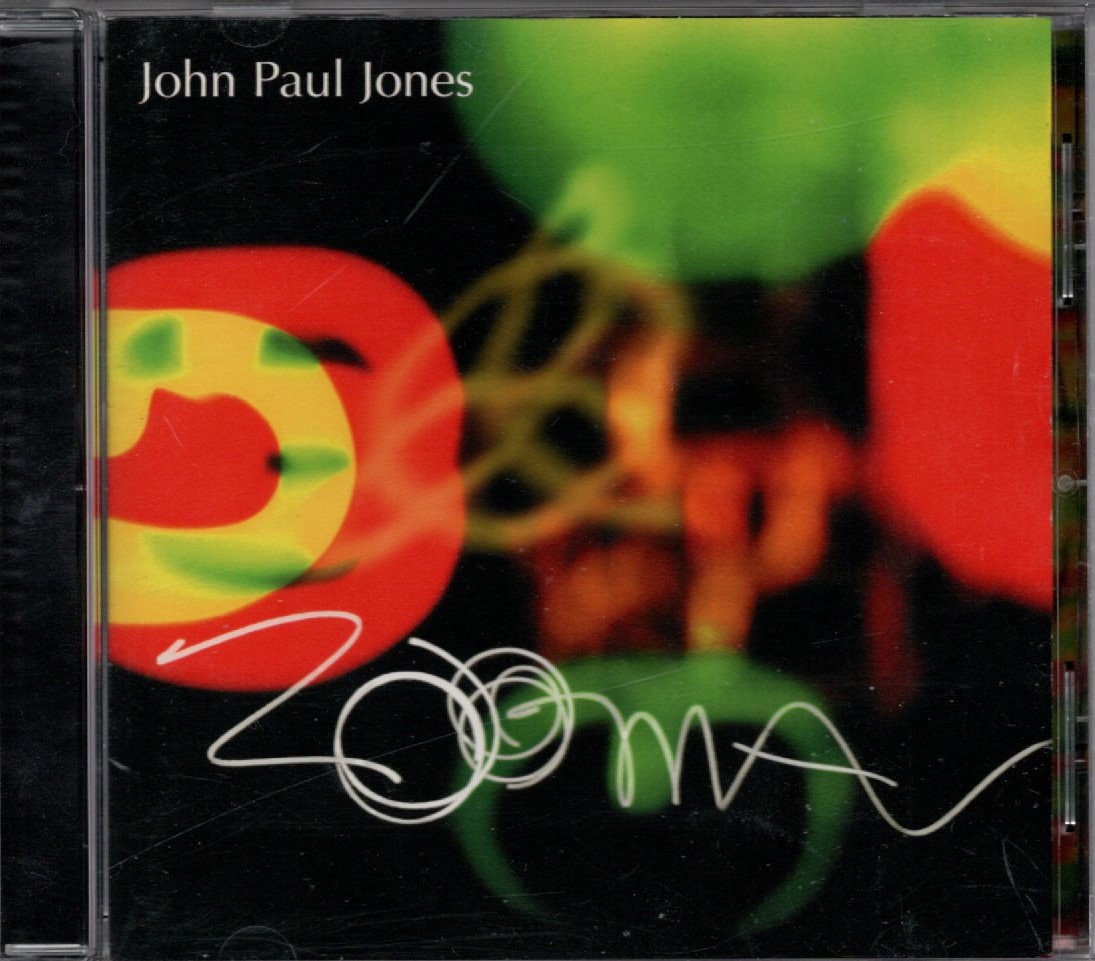
JOHN PAUL JONES – Zooma (1999 Discipline Global Mobile)
Three words: “Bass”. “Heavy”. “Groove”.
Purchased at Encore Records a short time after its release, Zooma by John Paul Jones blew me away from first listen. If you’re wondering who the heavy influence in Them Crooked Vultures really is, it was Jones this whole time. Just listen to the title track on Zooma. You could be fooled into thinking it’s a brand new jam by the Vultures, so heavy is it.
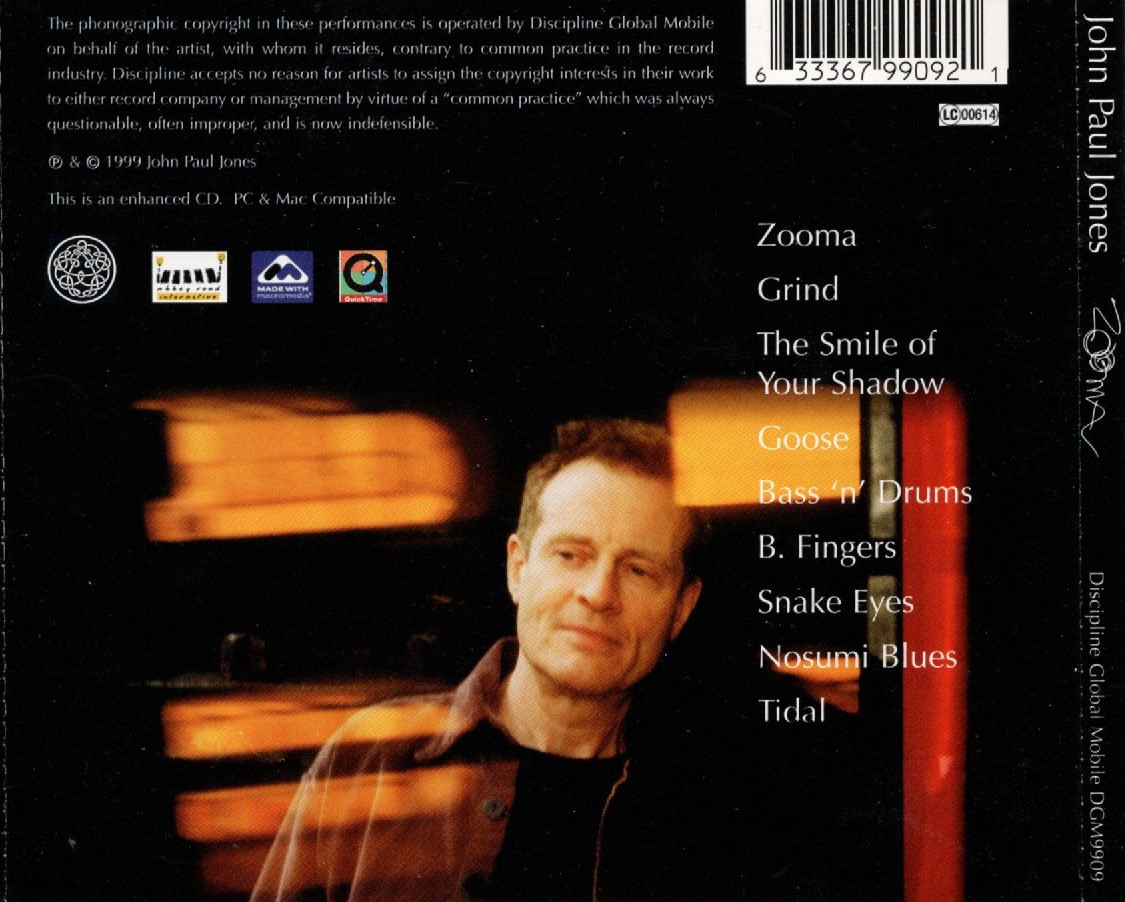
Zooma is an entirely instrumental solo album, featuring Jones on most of the instruments. On drums is Pete Thomas. Trey Gunn and Paul Leary drop in for some guest appearances. Otherwise it’s largely the JPJ show and his 4, 10 and 12 string basses! What a heavy sound they make.
The second track “Grind” (featuring Gunn on touch guitar) is contrasted by bright highs and the deepest lows of the 12-string bass, all within a killer groove. This track could blow a subwoofer, it’s so bass heavy. The next track “The Smile of Your Shadow” takes things down to the acoustic level, with instruments like bass lap steel, mandola and djembe. It’s the most Zeppelin of the tracks due to its acoustic, quieter nature. “Goose” brings back the heavy groove again, this time on a 10-string bass. The drums have that Zeppelin kind of beat to go with it.
But Jones is so much more than just groove (and Zeppelin references in reviews). “Bass n’ Drums” brings out his jazzy side. Denny Fongheiser on drums this time, and John Paul keeping is single with just four strings this time. But that doesn’t limit his pallette at all, as he plays in a combination lead/rhythm style. That’s just the one track though — Jones is back to 10 strings and a maniacal groove on “B. Fingers”. It’s sonic controlled chaos…with a beat.
As tasty as the bass and grooves are, Zooma is not an easy album to digest. It’s big, it’s large, and the tracks tend towards long and jammy. The longest is “Snake Eyes”, with bass lap steel, organ solos, and members of the London Symphony! It’s easy to imagine “Snake Eyes” as a modern day Led Zeppelin number, and it’s moments like this that will make the Zep diehard weep for what could have been. But it goes on a long time, including a long orchestral outro that sounds like a soundtrack. Brilliant but not for those with short attention spans.
“Nosami Blue” bears some superficial resemblance to the intro to “Absolution Blues” by Coverdale-Page, but this is just because both have the same roots: the blues. Most of the work here is being done once more on a bass lap steel. After a long freeform blues jam, the drums kick in and we get back into a groove. It’s like two songs in one. And that brings us to the final song “Tidal”, which a manic and exhaustive bass workout to take the senses to the final extreme. It is bonkers!
As a quaint leftover from the 1990s, this disc is “enhanced”. That part of the package no longer works, but judging by the contents in the readme.txt file, it was a digital catalogue for DGM records – Robert Fripp’s label. It appears you could actually order CDs from their catalogue right from this program.
In the Record Store days, I was instructed to stop playing this album as some tracks were too heavy. That’s both an endorsement and a warning to you!
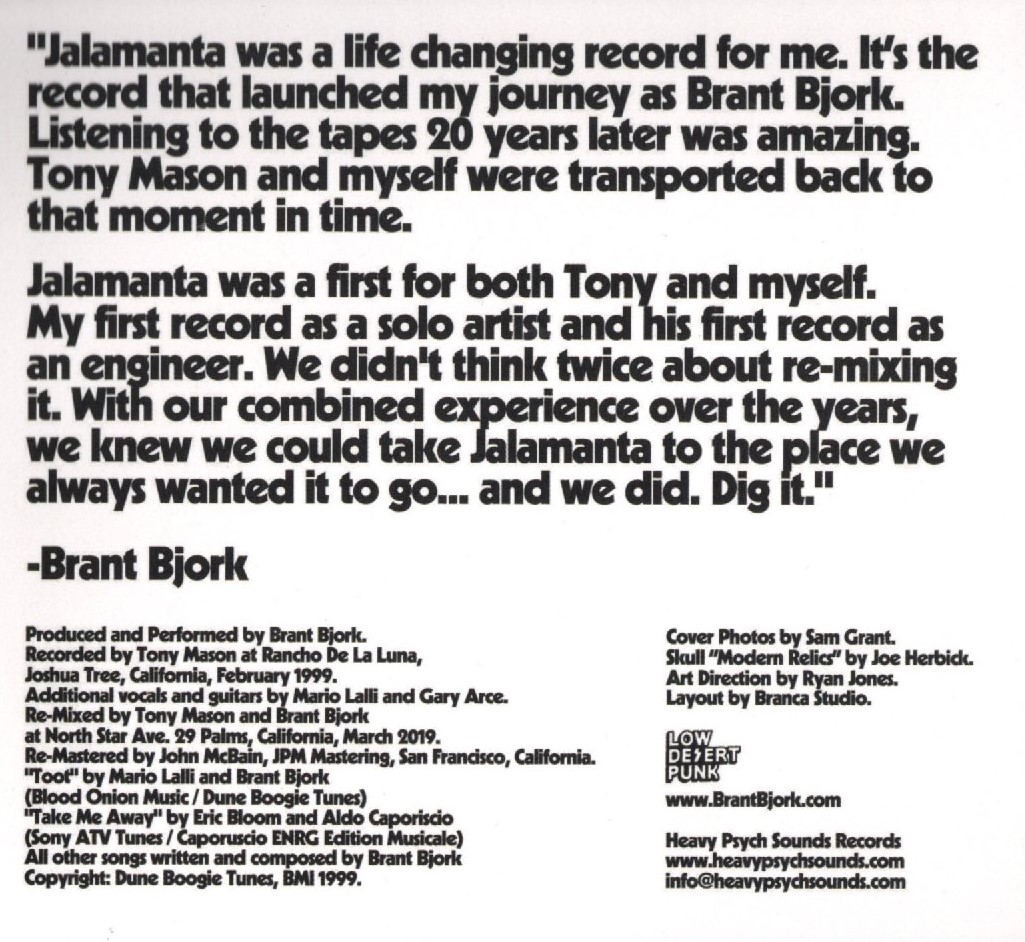
BRANT BJORK – Jalamanta (Originally 1999, Remixed and Remastered 2019 Heavy Psych Sounds)
When the needle hits wax it won’t be long, You got your radio tuned but it won’t play this song.
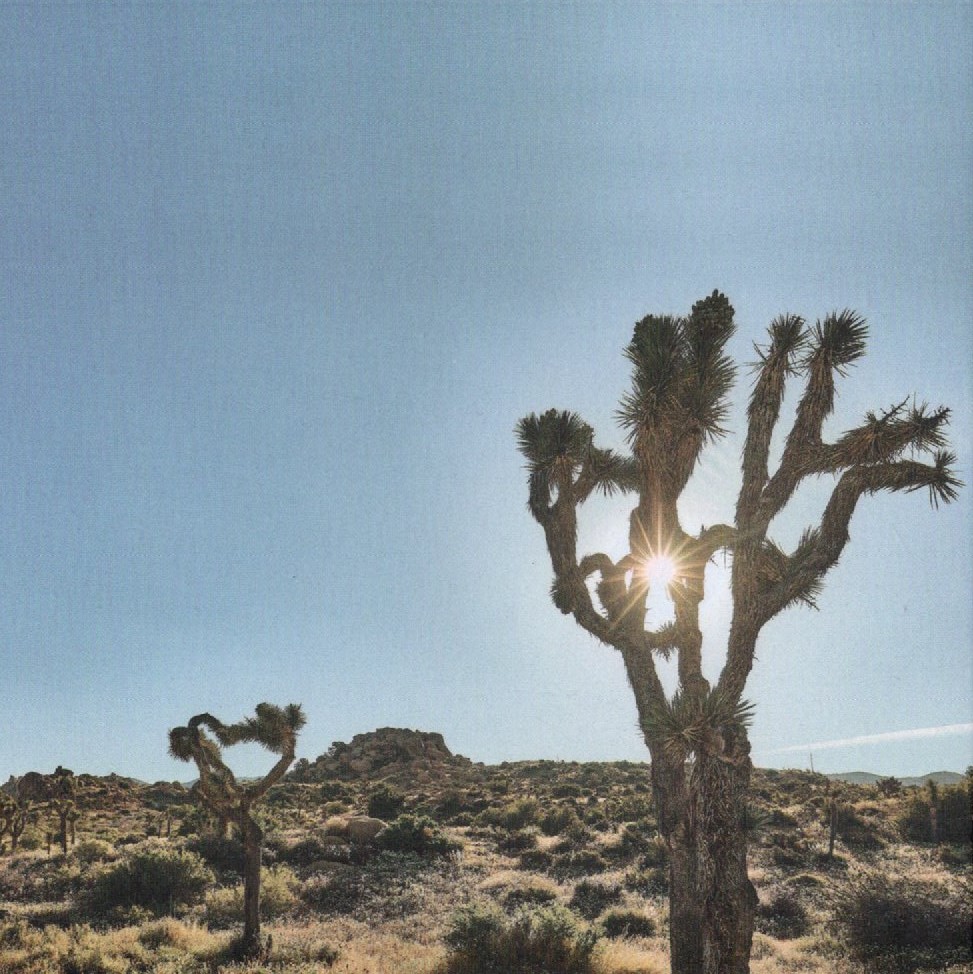
20 years ago, Jalamanta was one of my favourite albums in the world. This is my third copy. Partly instrumental, partly vocal, but 100% Brant Bjork. It was his first solo album, and he played virtually everything himself. The laid-back desert vibes are perfect for a summer evening chill-out. Humid, sparse, exotic, varied compositions take you across a hazy landscape.
In 2019, Brant and engineer Tony Mason remixed Jalamanta, to take it the place they “always wanted it to go”. The remixes are largely subtle, just making the album sound bigger in your ears. The vocals might be a little less buried. It’s still raw, and sparse, and all the things you always liked about Jalamanta. Some songs have more noticeable differences. More guitar on “Toot”. Tracks tend to run longer than their previous fade-outs. But there are things I enjoyed about the original that aren’t here. The echoey lead vocal on “Toot” — “Cat scan, cat scan…” That echo is gone, maybe so the sonic field wouldn’t be too crowded with that louder backing guitar?
This remix will never replace an original, especially when it was one of my favourites 20 years ago. What is “Jalamanta” made of that makes it so tasty? Only the most basic of ingredients. Rolling bass and drums, simple unaffected guitar parts, and Brant’s laid back singing style.
Yeah, the man shakes me down and that’s why I’m broke. The rich man’s got all the green but it ain’t the kind you smoke.
So we turn up the rock, and we roll it slow.
We’re always flying high, and the ride is always low.
Snakey guitars jab in and out of the speakers — one song is even called “Cobra Jab”. Other tunes are more aggressive. “Too Many Chiefs… Not Enough Indians” has a relentless and simple riff, with the snakey guitars carrying the melody over it like a wave. Brant’s quiet vocal is hypnotic. By contrast, “Defender of the Oleander” has a barely-there main riff while the snakey licks do all the brilliant melodic work. Brant goes for hypnotic again on “Her Brown Blood”, a speedy run through the desert, with a cool monotone vocal right in the middle of your head.
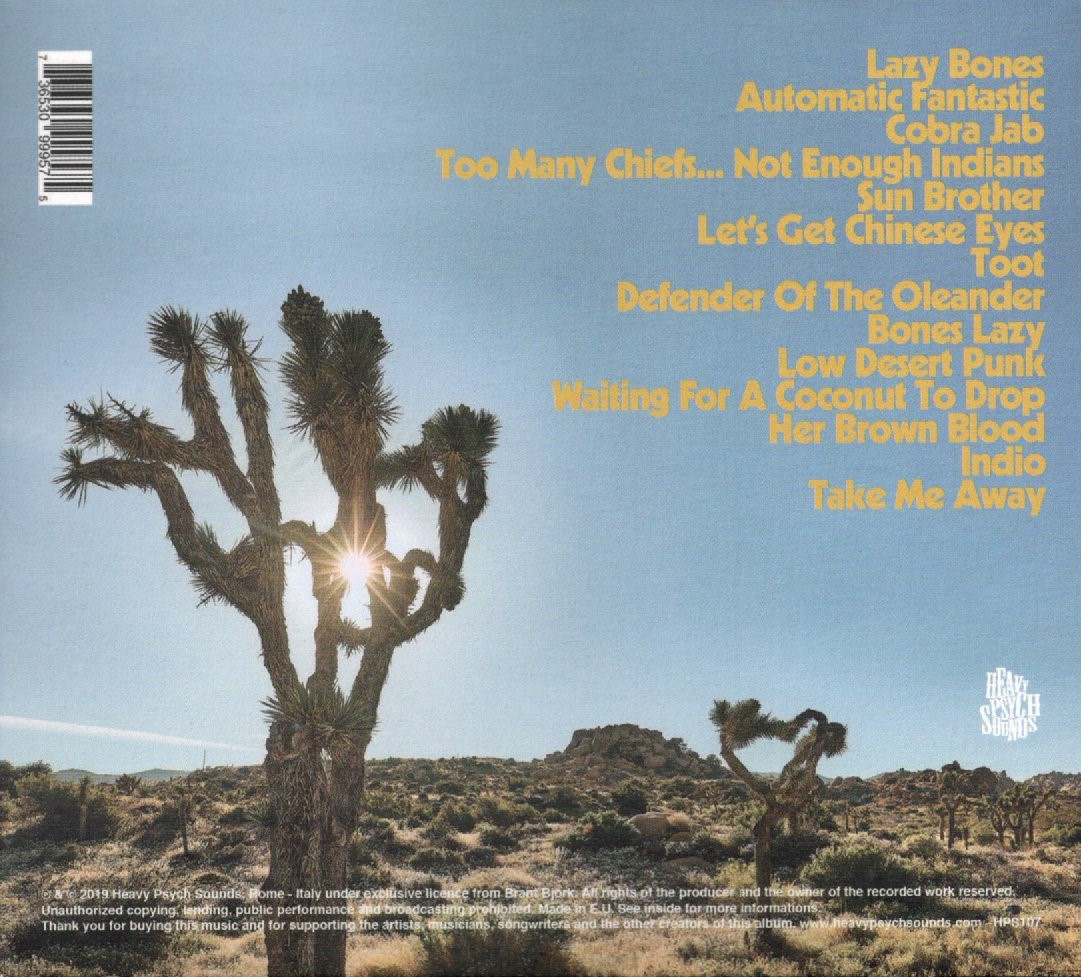
Whichever version of Jalamanta you happen upon, you are guaranteed an incredible listening experience. The new remix is certainly more three-dimensional, and will sound better on your big system. But you will lose some of the charm of the original. The 2009 vinyl used to be the way to go, with a beautiful full-colour booklet and Blue Oyster Cult cover “Take Me Away”. But now you can get “Take Me Away” here on CD, albeit remixed. Another bonus is exclusive to this CD — “Bones Lazy”, which segues out of “Defender of the Oleander” into the brilliant rocker “Low Desert Punk”. And with the title “Bones Lazy”, you won’t be surprised that it is “Lazy Bones” backwards! Like you’re watching Tenet. Cool though. Even though I knew what was likely coming, I felt like it fit right in.
Get a load of this, man.
Well I’m gettin’ up when the sun goes down, And I shine ’em up and I hit the town. Well I trim it clean and I roll it up, And then I take it nice and slow…so what the fuck, man.
Jalamanta makes me feel that California sun way more than any Desert Sessions CD ever has. You can taste it. Let it sink into your lazy bones. And as great as this new CD is sonically, it also makes me want to hear the original. Nothing can truly upgrade a 20 years love affair with Jalamanta. As a complimentary piece, I don’t regret owning or listening to it at all. Hearing guitar parts that used to be beyond the fade is the kind of bait that we nerds line up for. The 2009 vinyl, with the gorgeous embossed cover and all that delicious photography inside, will remain my preferred way to experience Jalamanta. The 2019 remix will be the one to play when you want to examine it in more thorough detail.
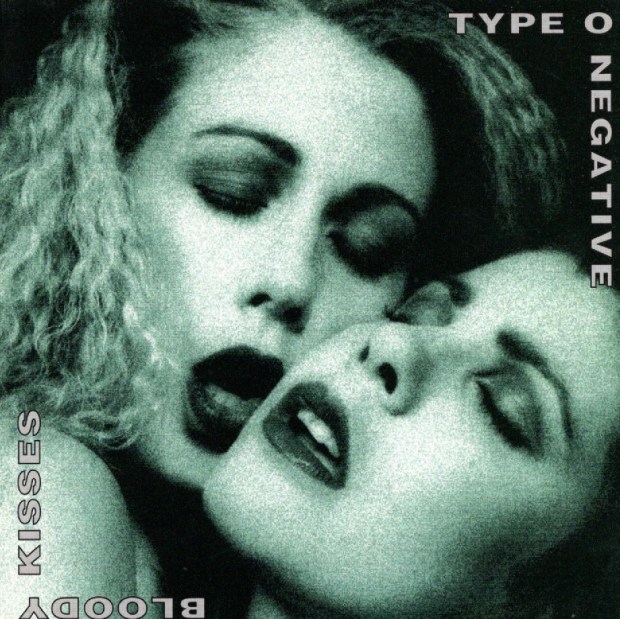
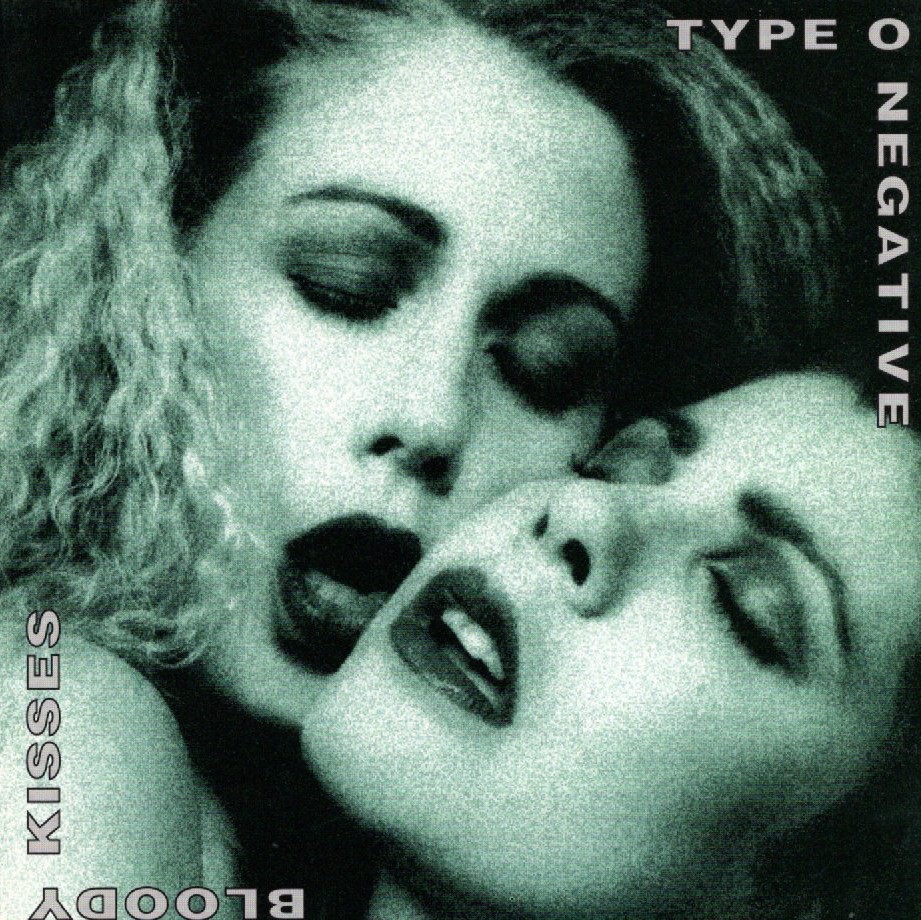
TYPE O NEGATIVE – Bloody Kisses (1993 Roadrunner, original and digipack re-release)
“If you like Black Sabbath,” said the security guy at the mall, “then you have to hear Type O Negative. They are one of my favourite bands right now. Do you have it?”
We checked the racks, and we did — Bloody Kisses, the recent re-release in a smart looking cardboard digipack.
There were two security guys at the mall. There was Trevor Atkinson, the laziest guard in the world, who I knew from highschool. The other guy had more the look of the cop-wanna-be, the way you picture the cliche of mall security guards in your head. He was the Type O fan.
The year was 1995, still early in the winter, and fresh working at the Record Store (for about six months). I had been collecting Black Sabbath for years, and in 1995 I was still mad for them, trying to acquire the rare stuff on CD like Born Again and Seventh Star. Knowing my infatuation with Black Sabbath, the cop-looking guard recommended Bloody Kisses. I was also about five months since my first big breakup, and I was still bitter and angry. It clicked.
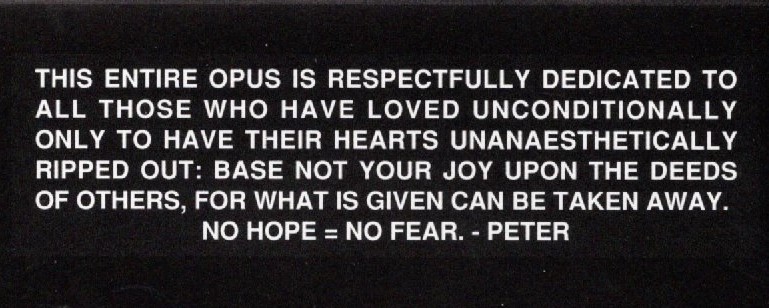
I mean, read this dedication in the inner booklet.
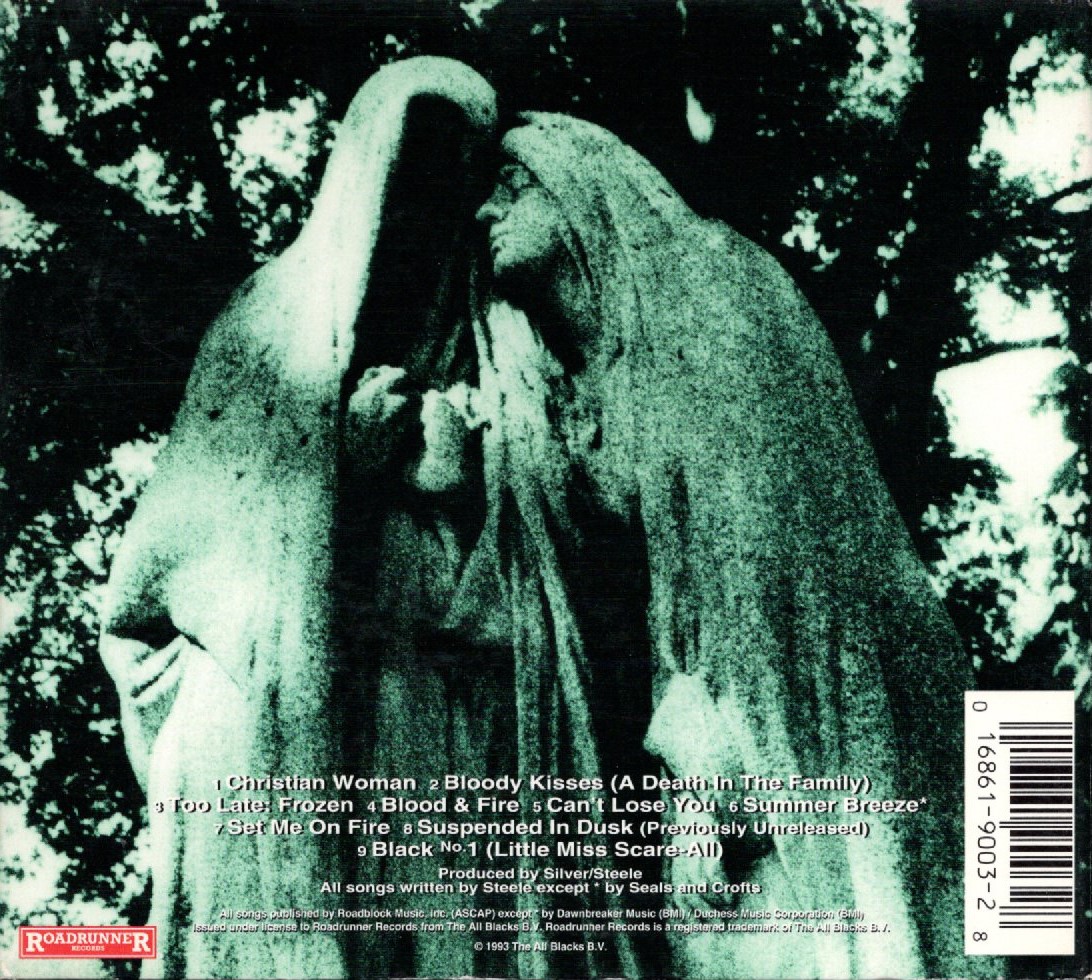
I wouldn’t recommend Type O Negative to any old Sabbath fan like he did. In fact a few months later, I saw Type O Negative with a bunch of Sabbath fans, and they couldn’t have given a shit. But I got why he did. The gothic imagery, the heavy guitars, the keyboard accents. Certainly, the comically deep vocals of Peter Steele were nothing like any of the higher-pitched crooners that Sabbath have ever had in their ranks. But Type O did sooth my angry, heartbroken soul when I hit “play” on my brand new copy of Bloody Kisses. I didn’t know, but I had bought a recent reissue featuring a new song called “Suspended In Dusk”, while losing a lot of the instrumental bits and novelty songs on the first edition. The reissue, with only nine tracks instead of 14, is an overall better listening experience. (There is also a deluxe edition with all the material from both, plus remixes, and their cover of “Black Sabbath” from Nativity in Black.)
Both versions open with the same song – “Christian Woman” – although the original makes you wait through 40 seconds of metal machine music and moaning called “Machine Screw”. Cutting to the chase is better. Soft, subtle keyboards welcome you in. The nine minute track is laid out in three parts in the booklet. A: “Body of Christ (Corpus Christi)”, B: “To Love God”, and C: “J.C. Looks Like Me”. Each is a distinct section with its own riff and hooks, with “To Love God” being a soft interlude between two harder parts. If anything is Sabbathy here (besides the title), it’s the varied arrangement, the keys, and the Appice-like drums of Sal Abruscato. Guitarist Johnny Hickey sings the higher vocals in contrast to Steele’s ridiculously low baritone. This is a truly great song, though the naughty lyrics aren’t poetry. It’s solid all the way through, which you can’t say for every long song on this album. The track was pointlessly edited down to four and a half minutes for single release, losing all its grandeur.
The reissue and original differ drastically in running order here, but the more concise reissue blends seamless into “Bloody Kisses”, a very slow dirge that goes on for 10:56. A bit of a slog, with highlights here and there, but get to the point, right? In the booklet it is subtitled “A Death in the Family” and that’s exactly what it sounds like. In the quiet parts of the song are sounds which create the image of a gothic castle during a storm, so you have to give Type O credit for caring about their craft. “Too Late: Frozen” is another long one, distinguished by it’s goofy “too late for a-pol-o-gies-ah!” chant. It has a lo-fi punk vibe and is quite enjoyable for all its disperate ingredients. Of course one of those parts is a big dark dirge-y gothic breakdown. It’s really two songs in one, with “Frozen” bookended by “Too Late”.
Type O goes for straighter riffing on “Blood & Fire”. This is about as conventional as songs get on Bloody Kisses. Some of the lyrics resonated with my sad-sack-of-shit broken-hearted persona that I found myself projecting.
I always thought we’d be together, And that our love could not be better, Well, with no warning you were gone, I still don’t know what went wrong.
It sounds as if a natural side break was inserted after “Blood & Fire”, because there is a respite before the bizarre sitar-inflected “Can’t Lose You”. It’s a very long buildup, but this sets up their version of Seals & Crofts’ “Summer Breeze” on the reissue. (We’ll get to what they do on the original running order in a bit.) “Can’t Lose You” sounds like a gothic parody of the Beatles’ “India period”, but “Summer Breeze” is more like Ozzy’s cover of “Purple Haze”! Guitars distorted to the max, Pete croons about the jasmine in his mind. On both versions of the CD, “Summer Breeze” is paired with “Set Me On Fire” as a sort of high-octane organ-centric outro. Dig that backwards flute. (Flautist: uncredited.)
A sudden break here leads to a dark cave where Peter Steele can be found breathing heavily and taking a deep drink from a bottle. “Damn me father,” he says, “for I must sin.” It’s the reissue bonus track “Suspended in Dusk”, a frankly dull song about a vampiric creature. The slower-than-slow approach, paired with the spoken word vocal style does not hasten the blood. Some clear chordal homages to Black Sabbath catch the ear. That said, the lyrics are cool. “Four centuries of this damned immortality. Yet I did not ask to be made. Why?” Too long, too long, goes on forever. Shame.
Closing the reissue is the other big single, “Black No. 1 (Little Miss Scare-All)”, a tribute to the goth girls of the 90s. This is a great tune, and it’s hard to believe this hit is an 11 minute tune. Granted, it was shaved down under five for its single release, which is a shame since you miss great hooks.
“I went looking for trouble,” begins Pete. “And boy…I found her.”
It’s all Hallow’s Eve, and she’s got a date at midnight with Nosferatu. Peter taps into everything sexy and cool about Halloween on “Black No. 1”, named for the hair dye colour. “You wanna go out ’cause it’s raining and blowing, she can’t go out ’cause her roots are showing. Dye ’em black.”
Terrific ending to the reissued album. Hit ’em hard with a single on the way out. Epic, fun, hook-laden and conclusive. So why did they re-arrange the tracklist and cut so many from the original? “Sacrebleu!”
The band were fully involved with the reissue, which also featured an alternative cover photo. One has to assume they saw the potential of a better listening experience in the revised tracklist, and they were correct. If Bloody Kisses has a primary flaw, it’s that too many songs take a while to get to the point (if they get there at all). With all the original additional material, the album is too uneven in tone and quality.
“Machine Screw” doesn’t take long to get out of the way, but the jokey opener isn’t necessary. The original tracklist then gets the two biggest tunes out of the way right at the start, albeit a combined 20 minute start, “Christian Woman” and “Black No. 1”. It then segues into “Fay Wray Come Out and Play” a minute of what sounds like a woman being sacrificed by some kind of jungle tribe. It’s a sonic filler that doesn’t enhance enjoyment of the album, just contributes to a jokey novelty quality. As does the next track, a punk thrasher called “Kill all the White People”. The lyrics are pretty simple — “Kill all the white people, then we be free!” Is that why they wanted to sacrifice Fay Wray? I’m getting confused here. In an abrupt change of pace, “Summer Breeze”/ “Set Me On Fire” follows. It’s a very different setup from “Can’t Lose You” on the reissue.
Back to “Set Me On Fire”, (which ends abruptly on both versions). On the original set, the next track is the birthing noises of “Dark Side of the Womb” followed by “We Hate Everyone”. This is a cool tune, but perhaps the lyrics were considered too jokey for the reissue. Who does Type O Negative hate, for example? “Right wing commies, leftist Nazis”, and most importantly “We don’t care what you think!” The punky tempo and melody are at odds with the majority of the album, but this is one track worth having the original version for. The song straightens out into a mid-tempo rocker by the middle, before reverting back to its punk origins. It’s the one they shouldn’t have cut.
The final piece of exclusive music on the original album is “3.0.I.F.” which bridges “Bloody Kisses” with “Too Late: Frozen”. It’s a bizarre sonic collage of chanting, engine noises, whispering, and the word “negative” repeated before the crash of a highway accident. While it does serve as an interesting intro to “Too Late”, you don’t miss much by not having it in there. The original running order goes out on the ballad “Can’t Lose You” which is cool. And just to avoid any sort of flow or outro, it ends abruptly as the sitar peaks. When the same thing happens on the reissued version, it sounds more like a setup into “Summer Breeze” than a sudden end.
Get both, or get the deluxe with the bonus CD, or don’t get it at all. It’s almost like they never wanted you to buy it in the first place. On the back of the original CD, instead of a tracklist, is just a warning: “DON’T MISTAKE LACK OF TALENT FOR GENIUS”.
Original: 3.5/5stars
Reissue: 3.75/5 stars
1. “Machine Screw” 0:39
2. “Christian Woman” 8:57
3. “Black No. 1 (Little Miss Scare-All)” 11:14
4. “Fay Wray Come Out and Play” 1:02
5. “Kill All the White People” 3:23
6. “Summer Breeze” 4:49
7. “Set Me on Fire” 3:29
8. “Dark Side of the Womb” 0:27
9. “We Hate Everyone” 6:50
10. “Bloody Kisses (A Death in the Family)” 10:55
11. “3.0.I.F.” 2:05
12. “Too Late: Frozen” 7:50
13. “Blood & Fire” 5:32
14. “Can’t Lose You” 6:05
THE MIGHTY MIGHTY BOSSTONES – Let’s Face It (1997 Mercury)
Once upon a time I thought Dicky Barrett was the most ridiculous singer I ever heard. That still might be true. His low growl is part Tom Waits and part Sherman tank. Fortunately the three piece horn section of the Mighty Mighty Bosstones is capable of delivering all the good clean melodic hooks. This leaves Barrett to deliver verbal gut punches while gargling glass mixed with sandpaper. 1997’s Let’s Face It was their breakthrough. It’s a fine honing of their frantic ska-punk rave ups with a commercial understanding.
All the tracks are dance-able, it’s just a matter of slow or fast. Most are fast! “Noise Brigade” starts the party with some serious skanking, but the Bosstones give you a chance to breathe on hit “The Rascal King”. You can sing along while you get down: “The last hoorah? Nah I’d do it again!” Gentler reggae picking soon gives way to a chorus full of punch. The horns (Tim “Johnny Vegas” Burton – sax, Kevin Lenear – sax, and Dennis Brockenborough – trombone) are a major part of another big hit, “Royal Oil”. Great trombone solo, and upbeat chorus despire its dire anti-drug message.
This cluster of hits concludes with the big one, “The Impression That I Get”, #1 on the Canadian rock charts, was all over the place in ’97-’98. For good reason. If you could distil the Bosstones down to a chewable concentrate, it would probably taste exactly like “The Impression That I Get”. Written by Barrett and bassist Joe Gittleman, it’s simply impossible not to move to this one. The hooks that the horns deliver are just important as the chorus. Both are equally timeless. Nate Albert on guitar is the rhythmic master of ceremony, with the tricky offbeat reggae stylings mixed with metal pick slides. While we’re handing out kudos, drummer Joe Sirois hits hard, but check out his cool shuffle at the end of the song. Meanwhile, dancer Ben Carr makes his biggest impression (that I get) in the music video, as the newspaper-reading dude in a suit just dancing through various shots. Brilliant video, too — cool use of backwards photography at the start. The stark white background with the sleak dark suits matches the whole image and vibe of the Let’s Face It album. Barrett looks about to burst of blood vessel when delivering that yell before the chorus. The video was always in heavy rotation in Canada that year.
It doesn’t matter that there aren’t any singles left, because this is an album of great songs from top to bottom. The title track could have been a fourth single. Upbeat with hooky horns and a very important message: “We sure weren’t put here to hate, be racist, be sexist, be bigots, be sure. We won’t stand for your hate.” Two decades before “woke” culture”, the Bosstones were already leading the charge. And the message is as true then or now.
They take it heavy again on “That Bug Bit Me”, but with the horn section to the melodic rescue. Nate Albert’s penchant for the odd metal hook makes a return, but the horns dominate “Another Drinkin’ Song”. It starts slow and ominous but picks up and turns on the party hooks once more. “Numbered Days” lets a guitar riff stand out, but Barrett’s barrelling baritone is a force to reckon with here.
Through to the end, there are no low points. It’s just a matter of style and what hooks are the ones that stick. “Break So Easily”, “Nevermind Me”, and “Desensitized” all hit the mark. But closer “1-2-8” is mental. And that’s the party in 33 minutes. Over before you know it. A perfect album.
RECORD STORE TALES #883: Live! Bootlegs – the Prequel
I didn’t discover “bootlegs” right away. But inevitably, I had my first encounter and was confused by what I saw.
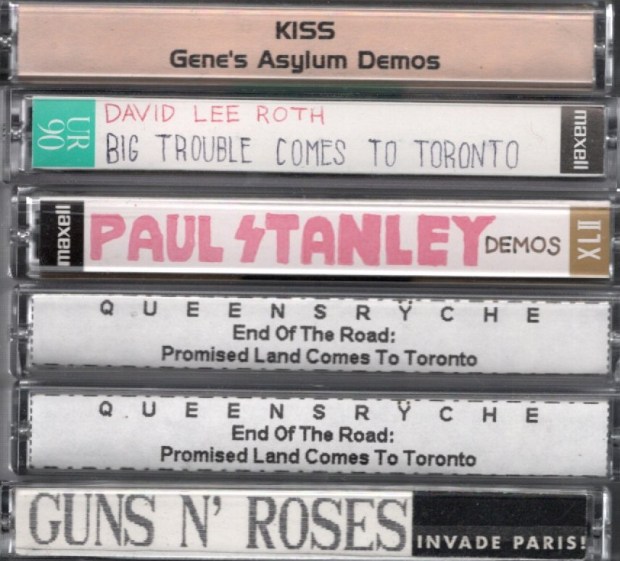
The setting: Dr. Disc, 1988 or ’89. Downtown Kitchener. In the store with best friend Bob and one of his friends. Browsing in the cassettes, I had worked my way over to Guns N’ Roses, a band I was still learning about. Something about an EP that came before Appetite? But what I saw was not that. In fact, there multiple Guns bootlegs in their cassette section, only I didn’t know they were called “bootlegs”, or what that even meant. Each one seemed to have a different member on the front. One had Slash, one had Axl, one even had Izzy. They were printed on different coloured paper. They had songs I never heard, like “Knockin’ on Heaven’s Door”. Live shows from the last few years.
Were they official releases? They had to be if they were sitting there in a store, right? But A&A Records at the mall didn’t have these.
I didn’t get of the Guns tapes. I didn’t have the money, and even if I did, I wouldn’t have taken a chance.
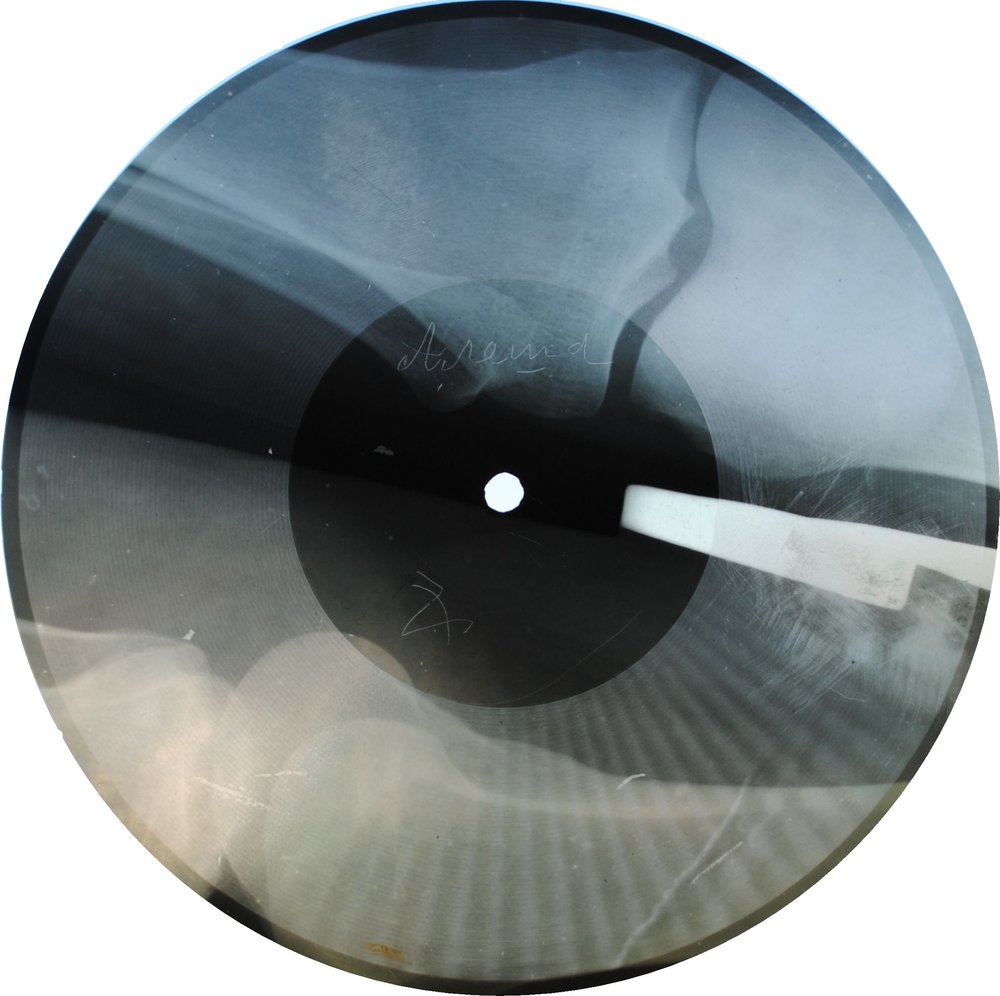
My knowledge of bootlegs was limited. In my mind, I associated the word with the kind of bootleg records they had to buy in communist Russia. Since you could not buy American music in the Soviet Union in the time of the Iron Curtain, fans got creative. There is a famous series of Beatles bootleg records, etched into X-ray photographs. It was the right kind of material to cut the music on. Like a flexi-disc. When I heard the word “bootleg album”, I associated it with an album that was illegal to own, but somehow you got a copy of a copy. Not live recordings smuggled out of a gig and sold for profit.
I finally put the pieces together when I bought the book Kiss On Fire on December 27, 1990. In the back: a massive list of live Kiss bootlegs, from Wicked Lester to the Asylum tour. Tracklists, cover art, the works. Suddenly, it clicked.
“These must be bootlegs!” I whispered to myself in awe.
“We must have them,” said my OCD to my unconscious self.
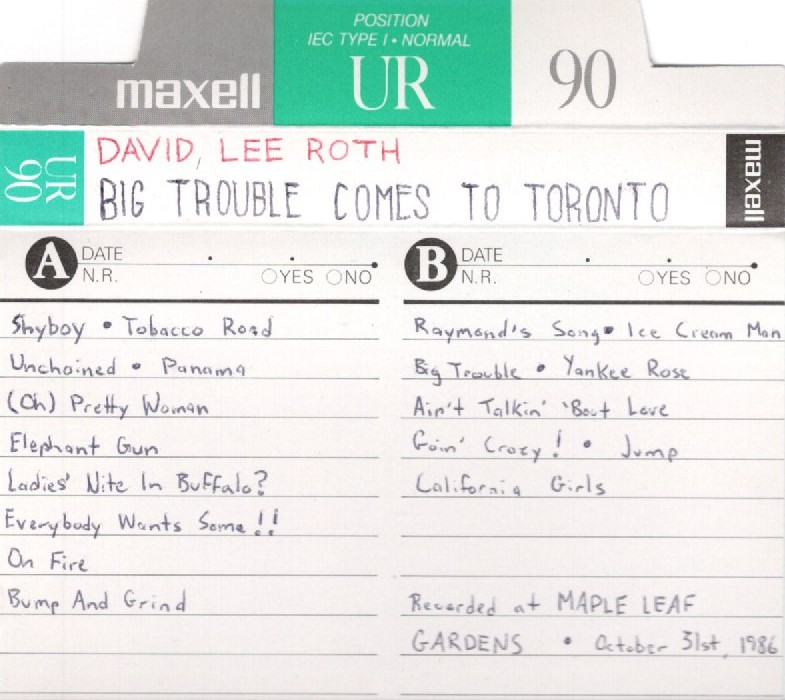
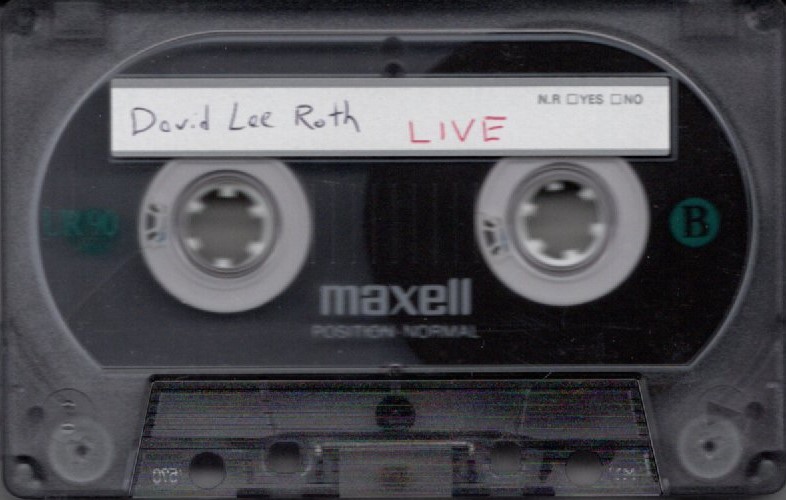
I acquired my first live bootleg from Rob Vuckovich in 1992. It was David Lee Roth live in Toronto on the Eat ‘Em and Smile tour with Steve Vai. It was just a taped copy on a Maxell UR 90, but it was my first. My sister got an early Barenaked Ladies gig on tape shortly after, including the rare “I’m in Love With a McDonald’s Girl”. Then in 1994 she bootlegged her own Barenaked Ladies show on the Maybe You Should Drive tour!
Around this time, my sister and I also started attending record shows a couple times a year. Bootlegs were now available on CD. And there were many. Who to choose?
Black Sabbath with Ozzy, or with Dio? Def Leppard before Rick Allen was even in the band? Deep Purple, Led Zeppelin, Motley Crue’s final gig with Vince Neil…so many to choose from!
Interestingly enough, the idea of one band member being on the cover art carried into the CD age. By my side at one show was Bob once again. I flipped through the Kiss. There were so many! I picked one out with Gene on the cover. Not knowing what bootlegs were himself, Bob thought they were solo albums. “Don’t get one with just Gene!” he advised. It wasn’t something I wanted anyway — it was from the Animalize tour, which I already had represented on VHS at home. I wanted something I didn’t have anything from yet. There it was! The Revenge club tour! Unholy Kisses, they called the disc. Stupid name, great setlist. I only hoped it sounded good when I got it home. They used to let you listen to it before you bought it, but I think I was too shy and just bought it. As it turns out, I loved it. Every thump and every shout.
That’s the thing about bootlegs. You really never knew what the sound was going to be like. Or even if the gig advertised was the gig you were buying. Or just because it sounded good at the start, will it still sound good at the end? Or did the guy recording it have to move to a different seat next to a loud dude? A soundboard recording was almost a too-good-to-be-true find. One thing you were certain not to hear: overdubs. No overdubs on a bootleg! They were raw and authentic.
I had made a good “first bootleg” purchase. A whole new world opened before me. There were not just live bootlegs, no! Also demos, remixes, even B-sides. And among them, some great, and some dreadfully bad choices!
Hear about some of the great ones this Friday, February 26 on the LeBrain Train: 2000 Words or More with Mike Ladano
DAVID LEE ROTH – Big Trouble Comes to Toronto – Maple Leaf Gardens 10/31/86 (bootleg cassette)
This cassette is a second generation, recorded from a buddy (with good equipment at least) in 1992. My first bootleg. It opens with a Van Halen-era interview with David Lee Roth about “precision rock”. The crackle of original vinyl is audible.
A nice fade-in brings Steve Vai’s guitar to the fore, and then it’s wide open into “Shyboy”. High octane, even though it’s just an audience recorded cassette with not enough volume on the guitar. Without pause they rock into “Tobacco Road”. Gregg Bissonette’s toms a-thunderin’. Vai certainly needs no help in hitting all the guitar hooks that he baked into the vinyl, just with more flair and energy.
Dave has never shied away from Van Halen hits or deep cuts. “Unchained”, “Panama” and “Pretty Woman” are the first three. The bass rumblings are unlike anything Michael Anthony played on the original. The backing vocals are far more elaborate. Like in Van Halen, “Unchained” is interrupted part way, but this time it’s so Dave can ask what you think of his new band! Pretty hot. After “Unchained” he stops to talk to a “pretty Canadian girl”. “Panama” sounds a little odd with Brett Tuggle’s keyboards so prominent in the mix. And it’s also way way way too long, with Dave trying to figure out who is reaching down between whose legs, but that’s Dave. You don’t go to the show just to hear the music. You go to see the whole schtick. You put in the quarter, you gotta let the jukebox play the whole thing out.
“Pretty Woman” is zipped through fairly quickly (with one audience participation stop), going into Dave’s rabid “Elephant Gun” and the slick “Ladies’ Night in Buffalo?” “Elephant Gun” features solos galore that would have been pretty awesome to see up close. It sounds like there’s a vinyl side break before heading into “Buffalo”. Vai’s guitar is the star here, in an extended solo backed only by Tuggle. This turns into a dual bass/guitar call-and-answer.
When Bissonette starts on those tribal beats, you know it’s Van Halen’s “Everybody Wants Some!!” This great version includes a drum solo. Next it’s “On Fire” from the Van Halen debut. Dave asks for the guitars to be turned up – we agree. “On Fire” with keyboards and Vai noodling is a different animal. After Dave’s original “Bump and Grind”, it’s time to flip the tape.
Side two opens with some of Dave’s acoustic strummin’, and a story called “Raymond’s Song”. It’s just an excuse for him to say “Toronto” a whole lotsa times before introducing “Ice Cream Man”. Which completely smokes. Vai puts his own space-age spin on it, and Tuggle adds boogie piano, but this is one wicked version!
Dave’s solo track “Big Trouble” has plenty of atmosphere and fireworks for the Toronto crowd, but “Yankee Rose” is just nuts. Nothing but the hits from here on in: “Ain’t Talkin’ ‘Bout Love”, “Goin’ Crazy!”, “Jump” and “California Girls”. The heavy riff of “Ain’t Talkin’ ‘Bout Love” sounds great in Steve’s hands, who doesn’t go too crazy with it. Of course there has to be another long break in the middle (too many breaks at this point now). This time it’s so Dave can get Stevie to make his guitar say “Toronto kicks ass, because the chicks are so fine”. The rest of the songs are somewhat fluffy, the pop stuff, and rendered a little sweet with the added shimmer of Brett Tuggle. “Jump” misses the deeper tone of Eddie’s Oberheim OBXA.
It’s worth noting that Roth closes with “California Girls”, not “Jump”. His solo career is the point, not Van Halen, he seems to be saying. This is the cherry on top. Roth hands it to his new band several times in the show — he knew they had to deliver, and they did. And he wants people to know that he has a band that can compete with his old group.
The show is complete, and apparently Dave didn’t play “Just a Gigolo” on this tour. The opening act in Toronto was Cinderella, supporting Night Songs.
Sometimes you wish Dave would get on with it and play the next song, but that’s only because this is a cassette bootleg being played on a Technics RS-TR272. If you were there in Toronto on the Eat ‘Em and Smile tour, you’d be eating up every word Dave laid down. He is the master of the stage. Sure, it doesn’t always translate to tape but that’s the nature of Dave’s live show, isn’t it? It’s precision rock — visually and audibly combined.
4.5/5 stars (for what the show must have been in person)
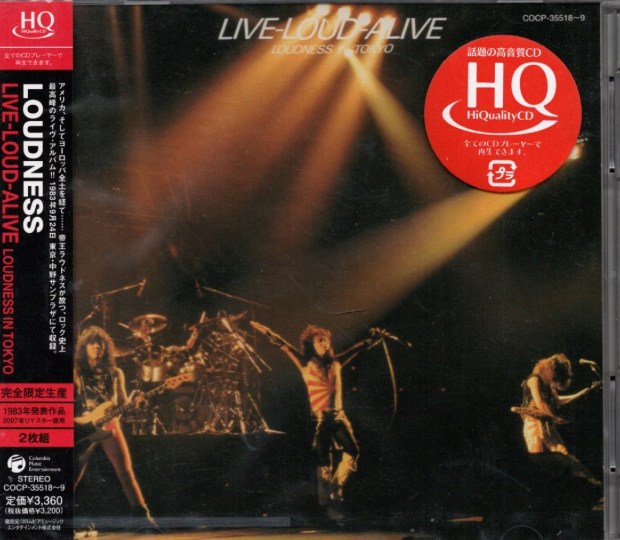
LOUDNESS – Live-Loud-Alive – Loudess in Tokyo (1983 Columbia)
Like many classic rock bands, Loudness waited three studio albums before going double live. The Birthday Eve, Devil Soldier and The Law of Devil’s Land were ripe and ready for live album immortality. English is minimal, but you don’t need a Japanese dictionary to enjoy the metal within Live-Loud-Alive. It is the most galvanized of the metal; Loudness’ integrity uncompromised, with Akira Takasaki in lead shred mode.
With a double length album so early in Loudness’ career, they played plenty of non-album material to fill it. And it’s good!
Opening with a recording of Holst’s “Mars, the Bringer of War” the band rip right into the riff for “In the Mirror”. That guitar sounds so classic, you’ll be questioning which Scorpions or Metallica album it’s from. A heavy chug named “Road Racer” (originally a non-album Loudness single) is paired with one of Minoru Niihara’s most melodic lead vocals. Only the thick and shimmery (probably embellished) chorus is in English. On guitar, Akira Takasaki’s solo sounds like he is re-entering the atmosphere after an alien/robot conference in space. “I Was the Sun” has a slower beat, pounding sheet metal into lethal form, with an elementary riff. Ordinary as the riff may be, it isn’t the highlight this time. The chorus takes center stage. The first side of the original vinyl ended on “Fly Away”, a mammoth of a song mixing the delicate and the heavy.
“Black Wall” opens on what sounds like bass synth, but Akira soon takes command with a melancholy and precise guitar pattern. Then, like any good Sabbath song, he breaks into a completely different lick, just as catchy. An instrumental track from Akira’s solo album follows, including a wicked drum solo by Munetaka Higuchi. This side of the record blows out with “Mr. Yesman”, a complex track like “2112” crossed with “Children of the Damned”.
On side three, a new song is previewed: “Exploder”, a Van Halen-like guitar instrumental destined for album #4. This transitions into another instrumental called “Heavenward”, similar to Akira’s solo work. It’s all just good music that flows track intro track. Guitar shrieks tell us that “Loudness” is next, a brilliant mid-tempo rocker of radio-ready nature. It sounds like vintage, early 80s Scorpions. Another killer riff in “Sleepless Night” brings the side to a solid close.
“Speed” does what it says. That’s no surprise. What may be surprising is the quality of the non-album B-side “Shinkiro”. This cool track has some great melodic twists and an absolutely brilliant and varied Akira solo. One of his best! From volume-knob twists to full-on speed, it’s brilliant. The only way to end it is by going back to the beginning, and “Burning Love”, the first non-album single by the band. It’s a blistering way to go out.
Though not singing primarily in English yet, their musical influences were clearly the same ones from North America and Europe that we know and love too. While you may not recognize the songs, many will sound familiar because they draw from the same pool. It’s the best of early Loudness, void of commercial ambition. While you do lose the ability to sing along, you can at least slam to the riffs. One can hear why this album is held in such high esteem by the faithful. It sounds like an experience.
CHANTAL KREVIAZUK – Friday, February 12, 2021 (via Sessions Live)
I’m going to preface this review by saying that at the start of the pandemic, I spoke openly about how I didn’t like virtual concerts and didn’t think they could ever replace live concerts. While I still feel that virtual concerts can’t and won’t replace live concerts, now, after viewing a number of virtual events, I’m seeing that they are simply different animals. And the best virtual concerts I’ve seen are the ones that embrace the fact that it’s a different and new platform. In other words, the ones that aren’t trying to be replacements for live concerts. Friday night (February 12 2021) I attended Chantal Kreviazuk’s live-streamed concert presented by Sessions Live, which definitely falls into the category of digital concerts that embrace the platform, and in the process give you something new and innovative, and in this case, really intimate as well.
Chantal’s concert was streamed from her own home. We got to see her perform on her own piano with a simple black background with three of her own paintings in the background with a couple of candles in front (we learned during the concert that the artwork was all painted by Chantal and put on display for the live concert by her husband, Raine Maida of Our Lady Peace). There was a single camera being used that allowed the audience a side view of Chantal and her piano as she performed. The format was very unique: She had no pre-determined set list going into the concert. Instead, she asked for audience requests via social media leading up to the concert, and then also took requests via the chat option on the Sessions Live platform. You really felt that you were witnessing something new and special. Nothing was pre-planned, which meant that Chantal would get requests for songs that she hadn’t played in decades. What I loved about this was that instead of just skipping over those requests, she tried to play the songs anyway – even when she couldn’t remember the lyrics and wasn’t sure of the melodic or harmonic material either. As an artist myself, I can say with certainty that I wouldn’t have even attempted to play something for an audience that I wasn’t 100% confident in my ability to do – so I really, really admire her for doing this. The music was all about the fans – not her image, not her vanity, not to display her skills as a pianist or singer. I feel that this is exceptionally rare, and it was one of the things that made the night so special.
In addition, doing the concert from her home meant that you got a little glimpse into Chantal’s life. At one point she wanted some water, so she grabbed her phone and texted Raine upstairs, asking him to bring down a glass (during the middle of her live stream!). Raine arrived a couple minutes later with a glass of white wine instead of water. While Chantal wanted him to appear on camera, he refused and all we saw was his hand as he handed over the glass of wine. During her performance of “Before You”, which she sang right after receiving the glass of wine, and she referred to as Raine’s song, she tried to keep herself composed as her 12-year old son mimicked and did impressions of her off camera. These are the types of things that may seem trivial, but you’ll never see them as a part of a live show. As I said earlier, this show was just about the fans and what they wanted to hear, as well as creating an intimate and unique experience from home.
While I am most certainly fan of Chantal’s music, I must be perfectly honest and confess that I am primarily a fan of her first two albums. I own the first four, but I mostly just listen to the first two. When she first emerged in 1997 with the album Under These Rocks and Stones, her music hit me hard at a pivotal moment in my life. I was in my early 20’s and the raw and angst-filled themes in those songs resonated with me in a way that no other music did. The first album does have some happier themes, but it also deals with loss, low self-esteem, feeling that one lacks in social prowess, death, unhealthy relationships, and feeling like one doesn’t deserve to be treated well by others. Chantal is only 2 years older than me, so I believe she was likely writing about what young women of that age feel and experience – and boy did it speak to me. Her second album, Colour Moving and Still was also a big favourite of mine. At this point in her life she was with Raine (she got married to him the same year the album was released), and you could begin to hear the influence of those “happier” themes in her music (such as in the song “Before You”). While this album wasn’t as dark thematically, it still had some very powerful material and still dealt with themes of death, loss, separation, and uncertainty. While the first album was more emotionally raw, the second album was more musically strong. Chantal is a classically trained pianist and you can really tell – there’s no doubt that she has chops. As someone who was studying music performance in university at the time, this was another reason why her music resonated with me. The music and the piano playing were so much more sophisticated than most of the other popular music I was hearing at the time. As I said earlier, the first two albums are what I’m mostly a fan of. That’s not to say her later music isn’t as strong, it just didn’t impact or resonate with me the same way, so I’ve found myself less attached to it (even though I love many of the singles from her third and subsequent albums). Chantal writes from within – from her own life. And I think that when she got into a happy marriage and had kids, her music shifted along with her lifestyle, and I just didn’t exactly shift with it. I couldn’t relate to it the same way.
That being said, last night’s concert was a real treat because many of the fans sending in requests were asking for songs from the earlier albums. While I think I may have forgotten a song or two, I do recall the following songs being performed: “Feels Like Home”, “Time”, “Green Apples” (she couldn’t quite remember all of this one), “Souls” (she also couldn’t quite remember all of this one), “Before You”, “Unforgivable”, “All I Can Do”, “What if it All Means Something”, and “Surrounded”. She also sang a rendition of “Happy Birthday” to an audience member named Jennifer. This is where I learned that Chantal’s real name is Jennifer, and Chantal is actually her middle name. She mentioned that this concert was one in a set of three that will be coming up over the next little while. She also ran out of time and promised that the next performance would feature “Wayne” from the first album (the song that hooked me as a fan), and “Wings” from her most recent album. I also have a song named “Wings” on my latest album! But they couldn’t sound more different from one another.
In addition to the concert ticket, I also purchased a one-on-one meet and greet with Chantal following the show. It was very brief, but really great (each person had only 3-minutes, but she did go a little over with most people I think). I was very nervous and while I had several questions and comments pre-planned, I didn’t actually get any of them out. Instead I asked her about her dog who jumped into her lap during our chat. She is very personable though and I really appreciated even just having a couple minutes to talk to her like anyone else. I did want to tell her how much her first two albums impacted me, but I didn’t get that out either. All in all, it was a fantastic experience and I will definitely be attending the next live-stream in mid-March.
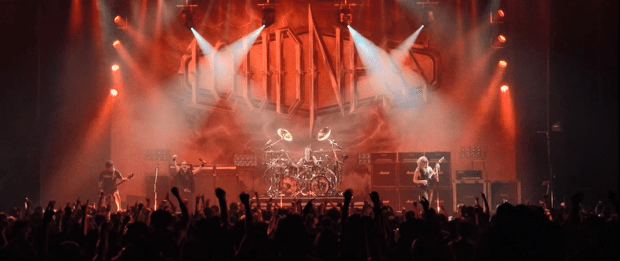
LOUDNESS – World Tour 2018 – Rise to Glory – Live in Tokyo (2019 Ear Music)
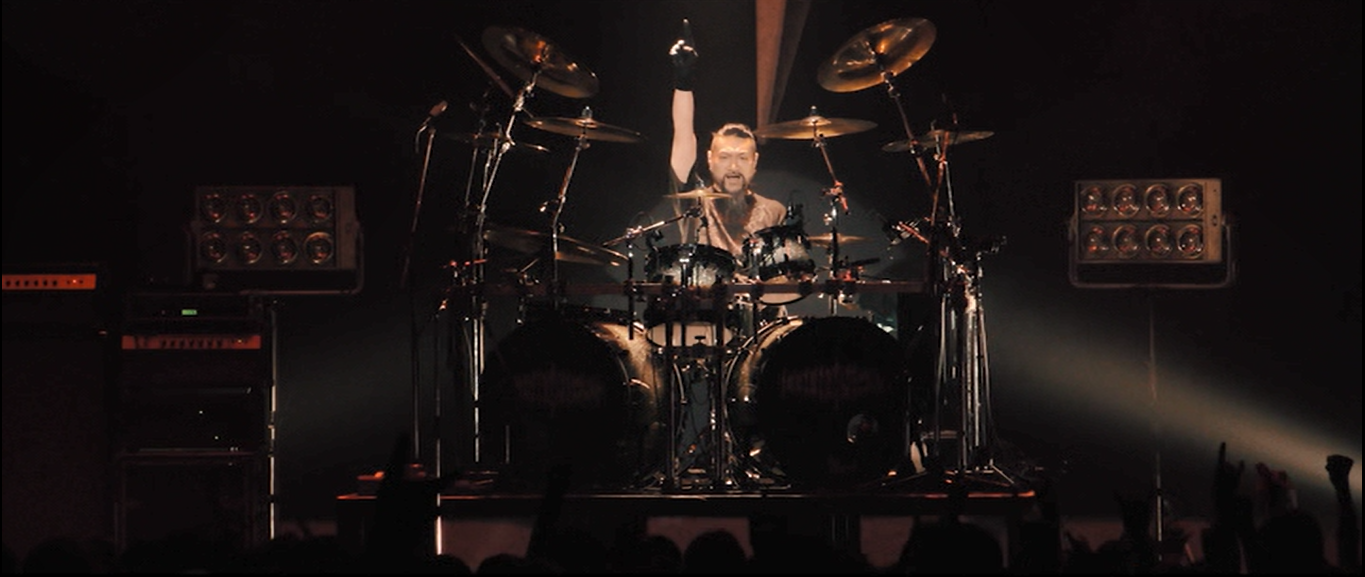
In an unfortunate twist of events, Loudness drummer Masayuki Suzuki was sidelined by stroke and could not perform on the Rise to Glory tour. Ryuichi “Dragon” Nishida filled in beat-for-beat and appears on the live album World Tour 2018 – Rise to Glory – Live in Tokyo. This 2 CD/1 DVD combo set is compiled from three days in Tokyo, with a bonus: the DVD features one track with Masayuki Suzuki from the fourth day. His performance on “Loudness” is as if there was nothing wrong with him, and he appears delighted to be playing live again.
Live in Tokyo is an energized performance, focusing almost entirely on early Loudness. This being a hometown crowd, many of the songs are performed with their original Japanese lyrics. 1985’s Thunder in the East takes the early focus on disc one with the first six tracks all being sourced from the “big” album. These tracks are intense, with solos by Akira Takasaki that melt the face. Classic Loudness with jagged riffs and still-powerful vocals from Minoru Niihara.
Oldies abound. Disc 1 also includes “Loudness” (the version with Ryuichi Nishida on drums) from the 1981 debut The Birthday Eve. A slick, well-received version. There’s also a punishing “In the Mirror” from third LP The Law of Devil’s Land, and the memorable “Crazy Doctor” from 1984’s Disillusion.
The second disc spotlights two lesser-known albums. First is The Law of Devil’s Land from 1983. The first five heavy numbers (including a second version of “In the Mirror”) all come from that platter. This is the heavy proto-thrash that Loudness were peddling at the start of the 80s, and vicious stuff it is. But not without hooks! The last five originated on Disillusion, regarded by some aficionados as Loudness’ best. From “Crazy Doctor” through the ballad “Ares’ Lament” and the finisher “Esper”, these are some great metal songs.
Impressively, the third disc (the DVD) highlights another batch of songs missed on the first two discs: newer material. “Soul on Fire”, “Go For Broke”, “Until I See the Light”, “I’m Still Alive” and a pair of instrumentals from the new Rise to Glory (2018) stand up to the earlier material. The awesome “The Sun Will Rise Again” from the 2014 album of the same name rounds out the freshest material. The new tunes are still heavy, riffy and melodic, but with a very slight modern edge. “I’m Still Alive” goes thrash metal, but that’s part of Loudness’ origins. Besides the return of Suzuki on drums for one song, the highlight of the DVD is a ballad. After so many brutal songs, Minoru breaks out an acoustic guitar for an unplugged “Ares’ Lament”. This is completely different than the version on CD 2, which was done fully electric.
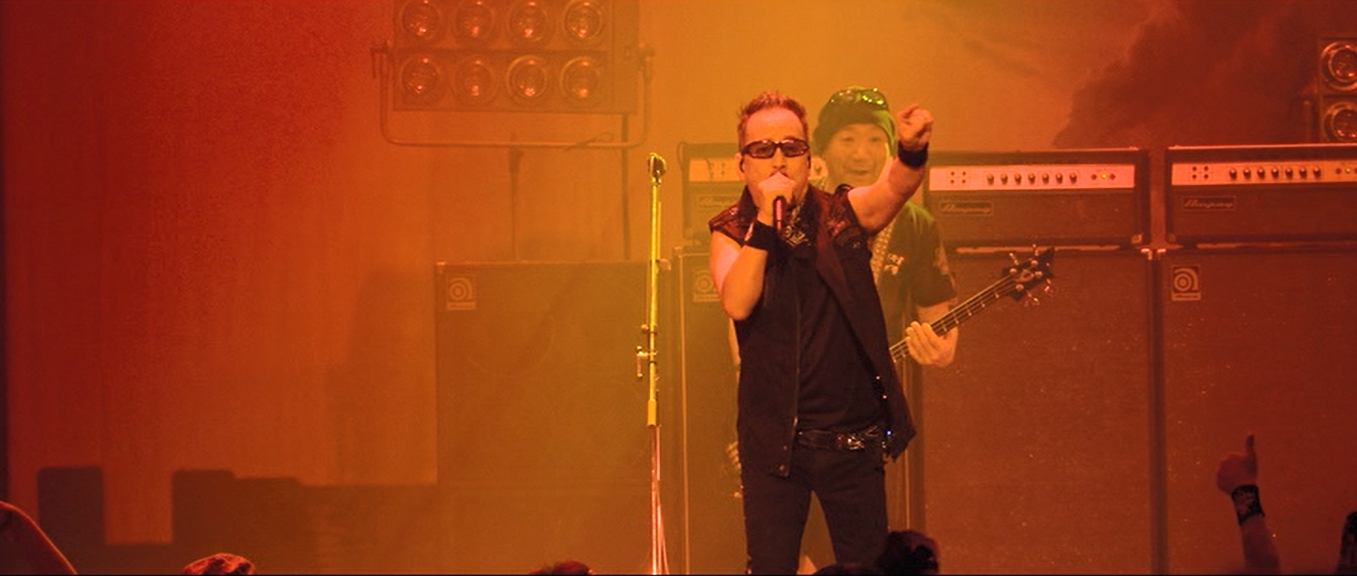
Any classic band from the 80s or earlier, still trying to pull it off today, has the same question to answer: How good is the singer? Minoru Niihara is excellent. As if no years have passed. None of the material presents a challenge.
Considering the mixture of material over the three discs, Rise to Glory – Live in Tokyo would be a suitable entry point for any rock fan wanting to check out Loudness. You’ll get the hits from Thunder in the East, ample early deep cuts, and a sampling of quality new stuff. Value for the money and time invested.

 ZZ Top – The ZZ Top Six Pack (1987 Warner)






















You must be logged in to post a comment.