You can always count on lil’ Stevie Vai to deliver something completely off the wall…except when he’s trying to play it straight.
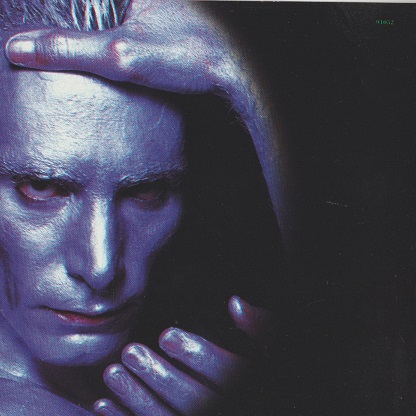
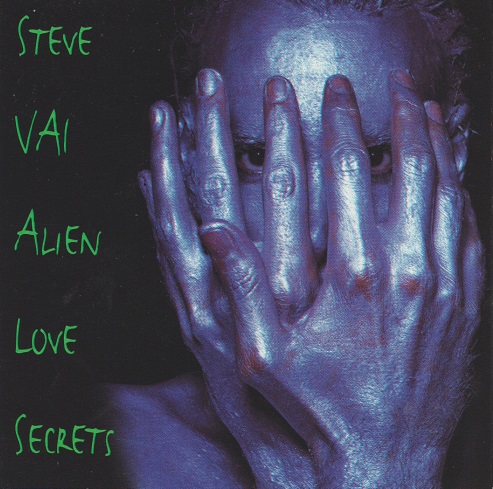
Compared to Passion and Warfare and Sex & Religion, Steve plays it remarkably straight on the stripped back mini-album Alien Love Secrets. Remarkably straight for Steve Vai, that is. This is a guy who is known to make his guitar sound like anything except a guitar. There’s plenty of that here (check out “Bad Horsie”, which sounds like some kind of bad horsie at times), but there are also actual grooves and riffs too. Alien Love Secrets is an instrumental mini-album that doesn’t take itself too seriously.
Steve’s music has always been an alternative to the mainstream, but grunge and heavy rock play an influence on “Bad Horsie”, one of the heaviest Vai riffs in existence. Former Ozzy/Journey drummer Deen Castronovo is there to help cement the grooves (Deen also played on Ozzy’s Vai-written song “My Little Man”). Alien Love Secrets is the ideal starter for people who don’t think they’re Vai fans. The heavy rock continues on “Kill the Guy With the Ball”, featuring Deen doing some serious steppin’.
It’s wall to wall shred, but if you’re looking for something even more straight-ahead, you’ll dig “Juice” which is just a classic Van Halen shuffle done a-la Steve. What about ballads? From the very beginning, Planet Steve has included ballads. “Die to Live” is a stock Vai ballad, melodic with tricky lead parts. Some of the licks remind of “Hina” from David Lee Roth’s Skyscraper. “The Boy From Seattle” would also be pegged as a ballad, but it’s definitely a bit more challenging. Then there’s the beautiful closing track “Tender Surrender”, which is blues for the intergalactic age.
People who don’t like Steve’s goofy side will loathe “Ya-Yo Gakk”, a duet between infant child and lead guitar. Steve has always experimented with guitar imitating the melody of a human voice, like “So Happy” from Flex-Able. This is more of a song, but still a matter of taste.
Alien Love Secrets will still be incomprehensible to some, but it’s probably Steve’s most accessible release overall. Without the layers upon layers of tracks, you can get in there and just listen. If you want more, there is a cool DVD release, with a video for each track on the album!
Do you remember your first Guns N’ Roses? I sure do. I skipped Appetite and went straight to GN’R Lies. We were heading to the cottage one spring weekend and my parents offered to buy me a new cassette. “Patience” hadn’t even been released as a single yet. I knew no songs. But I was intrigued by the idea of a half-acoustic EP. I fell in love with the acoustic guitar around that time, and I wanted to check out Lies as my first Guns. I’m kind of proud that my first Guns wasn’t Appetite.
The acoustic side was the second; first I was assaulted by the jet-propelled electric “live” side. Which wasn’t really live. It was recorded in the studio with crowd noise dubbed in from the 1978 Texxas Jam. If you listen to the vocals, knowing that Axl is always in motion on stage, you can tell they are not live. This is, of course, with 20/20 hindsight. This electric side was a reissue of the first Guns EP, Live ?!*@ Like a Suicide. Fans had been paying ridiculous amounts of money to acquire it, so Guns decided to beat the dealers by simply reissuing it with some new songs on top.
“Reckless Life” dated back to Hollywood Rose. Even though it’s not from Appetite, it sure could have fit on that album. It had the energy and the hooks to make it. It speaks to the strength of the album that songs like “Reckless Life” were left off. A slick and groovy tune, “Move to the City”, is also included on Lies. It’s obviously different from the direction of Appetite (horns!), but not all that dissimilar to the Illusions albums. The electric side is rounded out by a couple covers, something we later learned that Guns really excel at…or fail completely. There is no in-between with Guns N’ Roses covers. They either rule or suck. Both covers on Lies rule: “Nice Boys” (Rose Tattoo) borders on punk, foreshadowing the future. Finally, Axl announces that “This song is about your fuckin’ mother!” Not exactly the kind of thing parents enjoy, but a killer track: “Mama Kin” introduced many youngsters to the Aerosmith classic for the first time.
That first side felt dangerous. We were used to bands like Def Leppard. Suddenly this guy is talking about our fuckin’ mothers? Live ?!*@ Like a Suicide aka “side one” is also catchy as fuck, so we kept going back for round two, three, and more.
It was actually quite genius of them to pair Live ?!*@ Like a Suicide with four acoustic tunes on side two. The contrast works, and when you flip the record it feels fresh when you drop the needle again. In fact it’s easy to just flip back to side one and listen again. The quality of the acoustic songs didn’t hurt. The side progresses from softest to hardest. “Patience” is first, which eventually became one of Guns’ greatest hits. You didn’t hear acoustic guitar solos often back then, or a ballad with no drums. Even though ballads were all the rage, few bands had a song like “Patience”. The brilliance of “Patience” isn’t the melody or the whistling. It’s the minimalist arrangement.
I still remember my dad watching the “Patience” video with me. “That guy’s not a very good guitar player!” he scoffed as Slash solo’d. He never liked Guns N’ Roses.
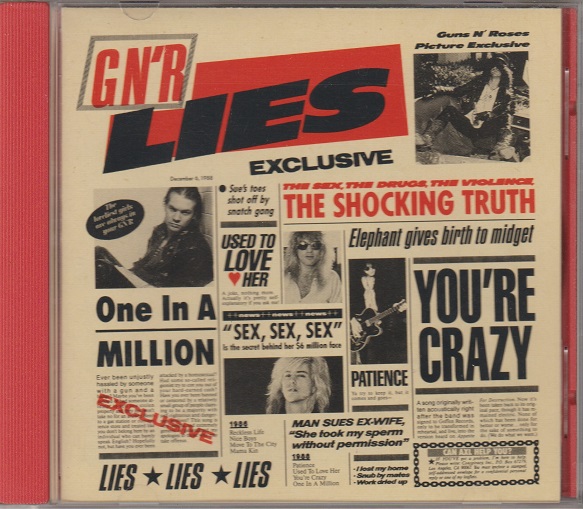
“Used to Love Her” was always a bit of a novelty, but even so, a good novelty track. “A joke, nothing more,” according to the cover. It’s about a dog, in case you didn’t know. “Used to Love Her” is upbeat, catchy and easy to sing along to. Regardless of what my dad may think, Slash’s (electric) solo work on it is tops.
One of the most interesting songs is “You’re Crazy”, a re-recording of the Appetite for Destruction favourite. The cover states that it was originally slow and acoustic, before being cranked up on Appetite. Because it’s unique, the Lies version is the better of the two. It was notorious in the highschool halls for its refrain of “You’re fuckin’ crazy.”
Even more notorious however was the closer, and for good reason. Certain words in certain contexts are unpalatable. Context is the key. It matters who is saying the word, and why. Words in themselves are not offensive, it is their usage that can be hurtful. “One in a Million” is an ugly, angry song. Axl’s pissed off at the cops, religion, and seemingly homosexuals and the black community as well. Some of the harshest words are levelled at foreigners:
Immigrants and faggots, They make no sense to me. They come to our country, And think they’ll do as they please. Like start some mini-Iran, Or spread some fucking disease. And they talk so many God damn ways, It’s all Greek to me.
Later on, Axl has the gall to state, “Radicals and racists, Don’t point your finger at me. I’m a small town white boy, just tryin’ to make ends meet.” Here we are in 2017, three decades later, and the world is still infested with angry, small town white boys. Although Axl smugly apologized for the lyrics in advance on the front cover, “One in a Million” can’t be excused that easily. Axl has since worked with gay and African American artists…hell, Slash’s mom was African American. As a fan of the music, I would like to hope that Axl has learned more about the world since 1988. We are shaped by our experience, and I hope Axl has had more positive ones.
Moving on from the lyrics, the interesting thing about “One in a Million” is that it was album debut of Axl Rose’s piano, on a song solely written by Axl. It’s simple and guitar based, and Slash’s acoustic solo is utterly fantastic.
Finally, one of the most appealing aspects of GN’R Lies is the cover. Taking a cue from Jethro Tull, the cover looks like a newspaper replete with dirty articles. Open it up, and there’s a naked woman inside. “The loveliest girls are always in your GN’R L.P.” says the headline. I quickly folded up the cover to hide it from my parents.
Lies was a good stopgap for Guns, considering the five year gap between Appetite and Illusions. It demonstrated growth, and cool roots. It will always be remembered for “Patience”, but also a couple ill-advised words that had lasting repercussions.
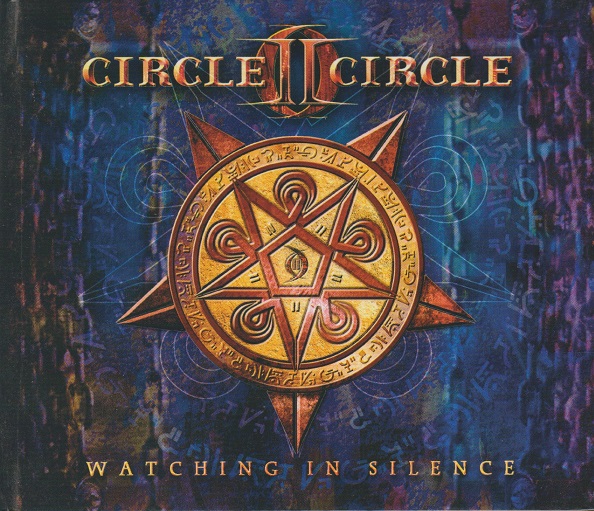
There are some good reasons why Circle II Circle’s debut album, Watching in Silence, is a dead ringer for Savatage. First and most obviously, singer Zach Stevens is best known from the Florida progressive metallers. When he left the band to form Circle II Circle, he had some Sava-help too. Jon Oliva and Chris Caffery wrote or played on every single song. Oliva co-produced. They’re just a helpful kind of band.
Fans of Stevens-era ‘Tage will adore Watching in Silence from start to finish. It has the heavy, it has the soft, and it has the drama. There are even the layered operatic vocal arrangements (“Forgiven”), though used sparingly. Circle II Circle utilise keyboards and piano, but don’t go for the full-on conceptual direction that Savatage did.
Though the album can drag from time to time, there are a number of exceptional tracks. “Into the Wind” is the first to boast one of those unforgettable Stevens choruses. The single “Watching in Silence” has the patented Sava-power, composed in equal measure of riffs, piano and killer vocals. The easiest comparison is to “Edge of Thorns“, Stevens’ first single with Savatage. Virtually every song has a memorable chorus to go with it.
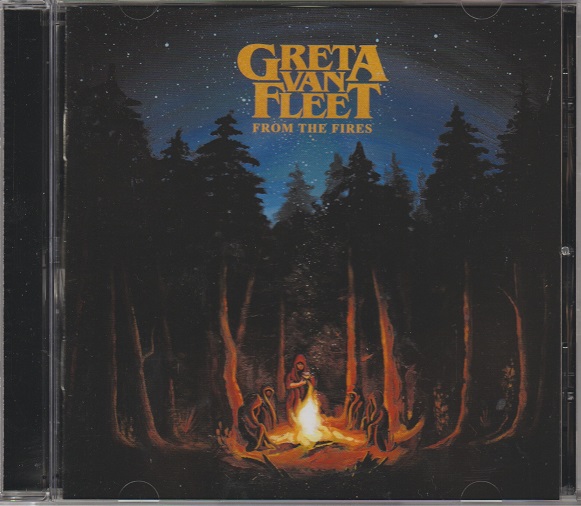
GRETA VAN FLEET – From the Fires (2017 Republic Records)
Got 32 minutes to kill? I have just the thing.
Frankenmuth, Michigan’s Greta Van Fleet won’t be disappearing any time soon, not with the release of their new “double EP” From the Fires. Double EP? For simplicity’s sake, we’ll just call it an album. From the Fires has all four songs from their last EP, Black Smoke Rising, along with four new tracks. Whatever you want to call it, if you missed Black Smoking Rising, then you’ll wanna get From the Fires ASAP!
Of course you will get their smash hit “Highway Tune”, which is still as exciting as the day we first heard it. Current single “Safari Song” is first on the new CD. Greta’s biggest influence is the mighty Zeppelin, and “Safari Song” certainly has that bluesy Zep stomp. Lots of “oh mamas”. This mid-tempo rocker is quickly becoming a favourite of the airwaves.
The new “Edge of Darkness” sounds less like Zeppelin, although singer Joshua Kiszka bleeds Robert Plant. “Edge of Darkness” recalls newer blues rock bands, but the voice immediately sounds like Plant. Then “Flower Power” brings us back to hippy-era acoustic Zeppelin. It’s more than a little derivative, but this band is young and only starting out. Joshua Kiszka really blasts on the slow soulful “A Change is Gonna Come”. What a singer — someone to keep an eye on!
Some of Greta’s more dramatic tunes appear closer to the end. “Meet on the Ledge” has a plaintive, epic quality. Then “Talk on the Street” goes upbeat, with a brilliant thrilling rocker. These new tunes indicate that Greta is indeed still growing, and we haven’t heard what they’re capable of yet. Yes, they can do vintage 1969 Led Zeppelin to a “T”, and they have the acoustic bases covered too. The songwriting is growing, and their musicianship is already there. Their playing sounds like a group who have several records under their belts already.
“Black Smoke Rising” has become a personal favourite Greta tune. This closer boasts incredible vocals, melody and riffs. It’ll put goosebumps on your arms if you let it. It sounds very little like Led Zeppelin. It actually recalls Triumph more than anyone, and that’s just fine.
Now is the time to get some Greta Van Fleet. This release has all their studio recordings; a compact 32 minutes. Double EP? Van Halen had classic albums shorter than this. From the Fires is an album. Get it!
STAR TREK: Discovery Season 1, Chapter One (episodes 1-9 CBS All Access 2017)
The difficulty in adapting Star Trek to a new generation, while still being commercial enough for 2017’s television screens is enormous. Creator Gene Roddenberry had rules he wanted adhered to within the Star Trek universe. Perhaps most difficult was his “no conflict” mandate. Roddenberry reasoned that when humanity reaches the technology in Star Trek’s future, there will no longer be need for Earthly conflict. Food replicators mean nobody will go hungry. Warp drive means infinite access to resources. Antimatter provides unlimited energy. All Earth’s problems are solved. Exploration is the new adventure. This was true of the original Star Trek in 1966, and Star Trek: The Next Generation in 1987.
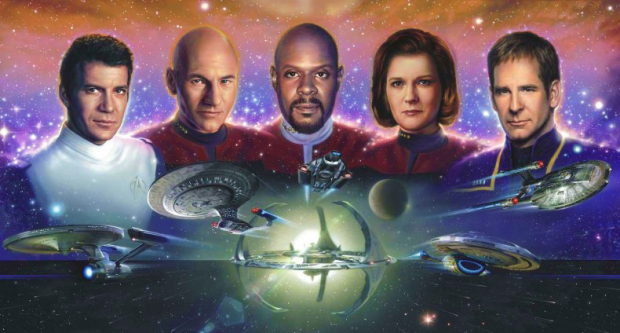
After Roddenberry died in 1991, Star Trek’s new “Great Bird” Rick Berman introduced conflict in clever ways, side-stepping Roddenberry’s mandate. For dramatic purposes, 1993’s Star Trek: Deep Space Nine was set on an alien space station on the frontier. It was run by a mixture of humans and aliens, and hosted a virtual space city of diverse travellers and residents. Then Star Trek: Voyager broke the mold again in 1995. A starship’s bridge was the main setting once again, but this time they were stranded on the other side of the galaxy with a crew made up of Starfleet officers and Maquis rebels. The last Star Trek series under Berman’s control, 2001’s Enterprise, was a prequel set 100 years before Captain Kirk. The Federation, Star Trek’s peaceful governing body, did not yet exist. It was a transitional period between the Third World War and the familiar Star Trek we remember.
The first five
Over the past 50 years, Star Trek has been popular, but was surpassed by other franchises in financial success. Star Wars and the Marvel universe both dwarf Star Trek today. Some poor theatrical movies, such as Star Trek: Generations (film #7, 1994) and Star Trek: Nemesis (#10, 2002) did not help. By this time, Star Trek’s continuity had become so huge and entangled that writers struggled to come up with new ideas that a) hadn’t already been done, and b) didn’t contradict established Trek history.
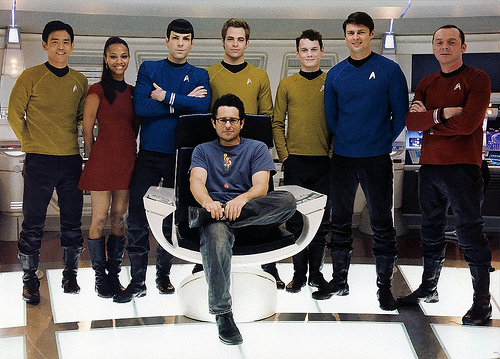
JJ Abrams wisely rebooted Star Trek in 2009 by creating an alternate timeline. Mr. Spock (Leonard Nimoy) was thrust back in time with a Romulan named Nero (Eric Bana), triggering a series of events (including the premature death of Captain Kirk’s father, George Kirk) that re-wrote Star Trek history. This allowed a clean slate based on the original classic trio of Star Trek: Kirk, Spock and McCoy. Largely, it worked. Star Trek (film #11, 2009) did the trick. 2013’s Star Trek Into Darkness (film #12) tried again by re-doing Star Trek II: The Wrath of Khan in this new timeline. That was less successful. Re-doing the gimmick of destroying the Enterprise in 2016’s Star Trek: Beyond (film #13) was far too soon and really seemed to derail the series. It was the third destruction of the Enterprise on screen and it hadn’t been earned yet.
JJ Abrams and crew
The JJ Abrams universe is continuing with the 14th Star Trek film, somehow resurrecting George Kirk (Chris Hemsworth) and perhaps undoing that timeline completely. We shall see.
Meanwhile and with less fanfare, Star Trek has returned to television. This seems an even bigger challenge than making a good Star Trek movie. After all, television is nothing like it used to be. Reality shows, serialised dramas, and sitcoms own TV now. Attention spans are shortened and cerebral tales are fewer to be seen. What does a new Star Trek look like, and what would the story be?
Fans haven’t been shy about what they wanted to see in a new Star Trek TV show. Most would have loved a series set far into the future, as far beyond Picard as Picard was from Kirk. But Star Trek isn’t being made for fans. Today it needs to appeal to anyone and everyone, and simply not alienate too many fans. So instead, we are getting another “prequel” series set before the time of Kirk. 10 years prior, in fact, and set in the original universe. And as an added twist, the main character was to be Spock’s never-before-mentioned…adopted sister?
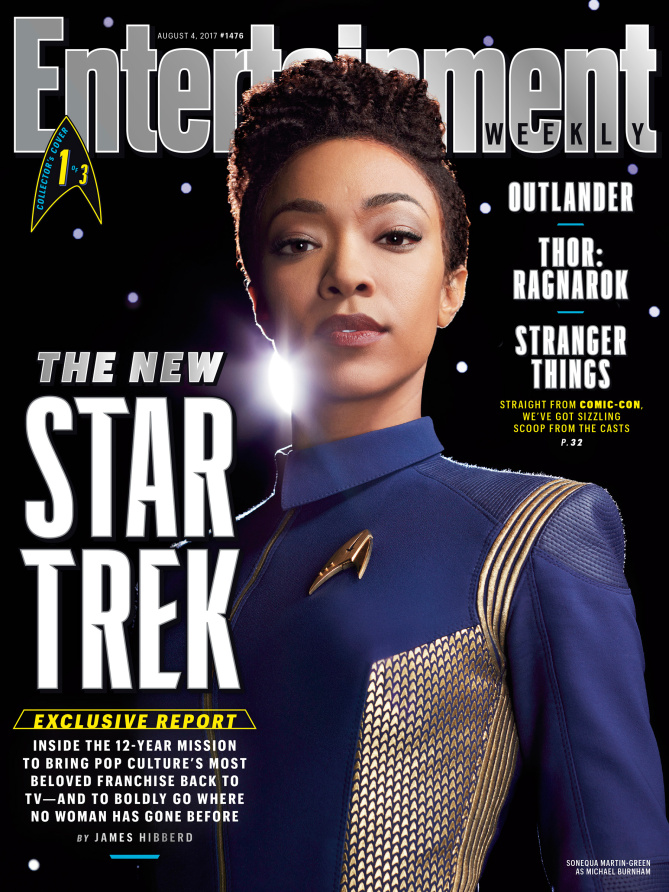
Sonequa Martin-Green as Michael Burnham
Fans shit the bed.
Star Trek: Discovery has faced (and continues to face) a lot of scepticism. After all, this is hallowed ground. You can’t just piss all over the history. 50 years of Trek, and we’ve never heard of Michael Burnham, the girl raised as a step-sister to Spock?
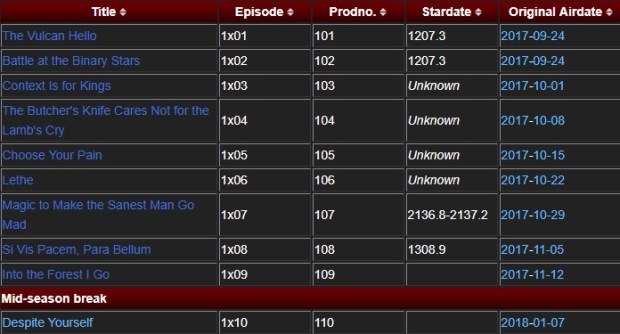
Fear not. Trek lore has not only been respected in Discovery, but enhanced. The Vulcan-centric episode “Lethe” is an emotional backstory to who Michael Burnham is, and even colours in the blanks behind Spock and Sarek’s estrangement. It does so in such a way to soften even the hardest fan’s heart.
Burnham’s parents were killed in a Klingon attack, and she was raised on Vulcan by Sarek (James Frain) as his ward. She was trained in the Vulcan ways, with logic as a tool to govern her human emotions. This background also sets up her fall from grace. Burnham is not the typical Star Trek main character. In the series pilot “The Vulcan Hello”, first officer Burnham commits mutiny on board the USS Shenzhou. Her actions in the first two episodes (including “Battle at Binary Stars”) set up the balance of the series: war with the Klingons!
Being a mutineer making some pretty obvious blunders in spite of her supposed excellent Starfleet record, Burnham is a difficult character to like. Fortunately, actor Sonequa Martin-Green was the right one for the job. Formerly as Sasha on The Walking Dead, she was little more than a background character. Martin-Green was largely untested, until now. She has done an excellent job in her first half-season on Discovery. She remained cold and difficult to like, until finally thawing a little bit in episode 4, “The Butcher’s Knife Cares Not for the Lamb’s Cry”.
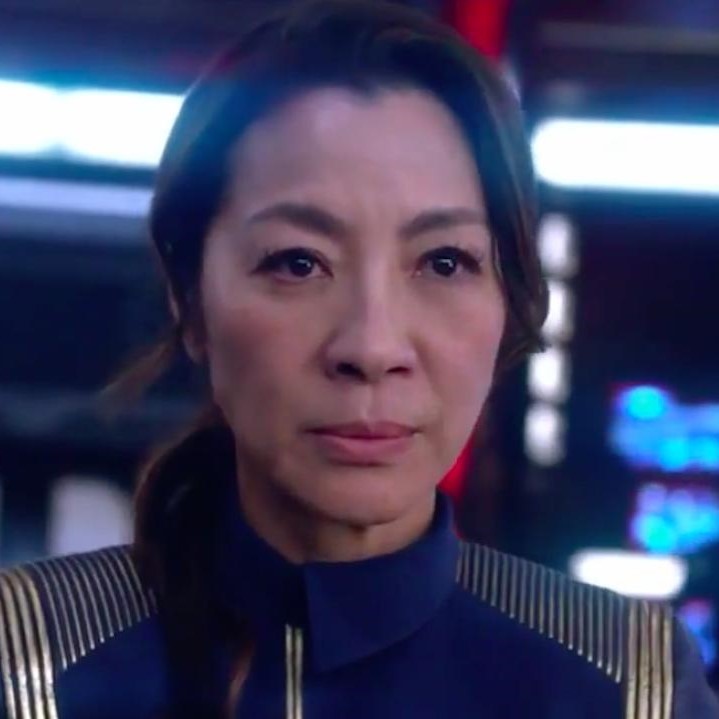
Michelle Yeoh as Captain Georgiou
Being difficult to like is intentional. Discovery is not like other series. It begins on the USS Shenzhou, captained by Phillipa Georgiou (Michelle Yeoh), a cool new ship with its bridge under the saucer section instead of on top. Georgiou and first officer Burnham begin as scientists and explorers, but Burnham’s mutiny creates war and a new reality. Episode 3, “Context is for Kings”, introduces Burnham’s new surroundings: The USS Discovery NCC-1031. The titular ship doesn’t even appear in the first two episodes.
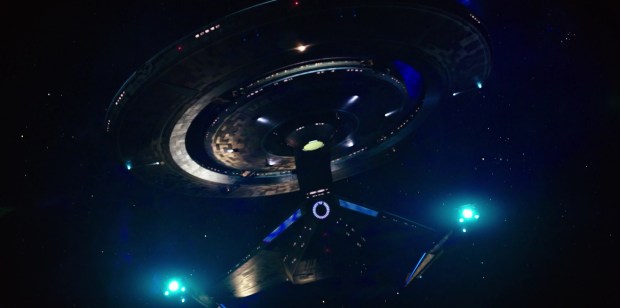
The USS Discovery’s on-screen design is based on old concept paintings by Ralph McQuarrie, for the first Star Trek movie. You’ll notice its Star Destroyer-like main hull. McQuarrie designed all the ships in Star Wars too, and because this starship design is decades old, the USS Discovery fits the classic starfleet look. This ship is bad ass. The USS Enterprise, under command of Christopher Pike, is out there somewhere, but the Discovery is fresh off the line. It has all the latest gadgets. It’s a black project and a testbed for new technology, now needed desperately. Over 8000 Federation citizens have died in the war in the first six months. Defeat is not an option, and Discovery is rolled out to unleash war-winning technological breakthroughs. It’s the Manhattan Project of the 2250s. Top secret, high level shit going on here, folks.
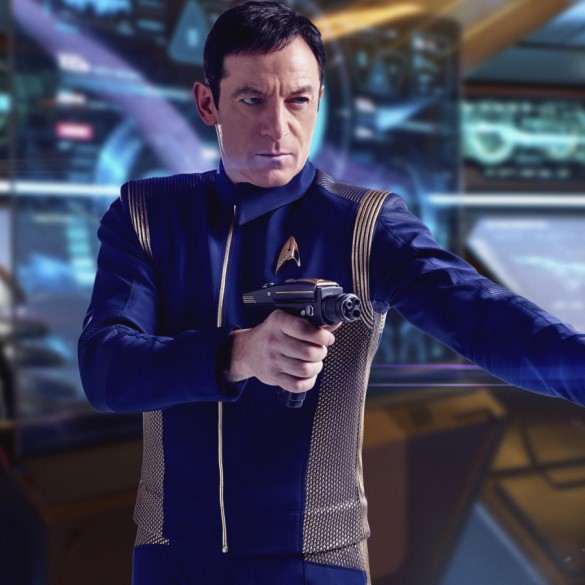
Jason Isaacs as Captain Lorca
How did Burnham, a mutineer, get such a cool assignment? Well, first off, it might not seem that cool once you see what Discovery is up to. And second, her captain, Gabriel Lorca (Jason Isaacs) is not a typical Starfleet captain. He is single-minded and obsessed: victory is the only option and he will stop at nothing, no matter how unethical, to win the war. Lorca is damaged goods, but he’s also very smart and because it’s a black project, he manages to operate under the radar with minimal oversight. Bottom line: He thinks Burnham will be useful, and so he uses her. If you are stationed on Discovery, that means Lorca thinks you’re useful.
This setup enables some very different Trek dynamics. Do you think the crew of the Discovery are happy to have a mutineer on board? One who was responsible for the war in the first place? Highly unlikely. First officer Saru (Doug Jones) is one of her old shipmates from the Shenzhou. Saru, a Kelpian, comes from a planet where his species are only food for other species. Kelpians can sense the coming of death, and let’s just say that Saru’s spidey-senses start tingling when Burnham pops back in his life. Doug Jones embodies the alien Saru perfectly, who is the series’ placeholder for a Spock or Data. In a cool touch, Jones’ height is made abnormally alien with a pair of hooves.
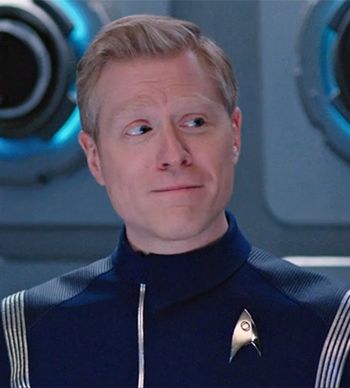
Anthony Rapp as Lt. Stamets
Michael Burnham begins with only one friend on board, her geeky roommate Cadet Tilly (Mary Wiseman). Tilly warms up to the audience when she confides that she’s going to be a captain one day, but she has a lot to learn first. Burnham and Tilly work in engineering under Lt. Paul Stamets (Anthony Rapp), Star Trek’s first openly gay main character (not counting John Cho’s Mr. Sulu, based on George Takei’s original Sulu who wasn’t written or portrayed as gay).
I want to pause here and say something that probably doesn’t need to be said. It took 50 years for Star Trek to finally have an openly gay main character. Star Trek has been so far ahead in many respects over the years, but way behind in this one way. And I love it. It’s been done so well. As an added bonus, Stamets’ relationship with Dr. Culber (Wilson Cruz) is critical to the overall plot of the first season. Without getting too much into spoilers, they are both put into impossible situations because they care about each other. Rapp and Cruz have turned their characters into favourites, and it’s way overdue and I love it.
Rapp’s Stamets could be the show’s most important character. He was essentially drafted to serve aboard the Discovery, as the inventor of the top secret and experimental “spore drive”. It is an organic propulsion system and if Stamets can refine it, Discovery will be able to be anywhere in the known universe in a blink — it is a game changer. But it requires super-computing the likes of which doesn’t exist…unless Stamets can think outside the box.
Presiding over this is Captain Lorca; no-nonsense all the way. He’s been given this ship, its crew of “polite scientists”, and a blank cheque. His orders: end the war in victory. Lorca has his own deeply buried demons. These come to light in “Choose Your Pain”, in which he is captured by the Klingons.
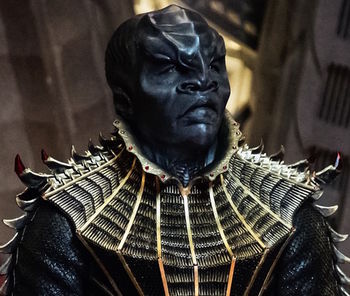
Chris Obi as T’Kuvma
Ah yes, the Klingons. They are Star Trek’s most iconic villains…and in some cases, heroes. They have an established culture, design and hierarchy. Star Trek: Discovery takes its least successful leaps with the Klingons. New ship, costume and makeup designs are really out of place. Remember, this series takes place 10 years before Captain Kirk and “The Trouble With Tribbles”. Klingons looked like humans in that era. It’s a complicated mess of contradictions, but Discovery should not have made it worse by adding in yet another new Klingon design.
The Klingons are problematic in more ways than one. The momentum of the show screeches to a halt any time we cut to Klingon drama. Until recently on the show, they spoke Klingon with English subtitles almost all the time. This changed in the last episode. Never before on Star Trek have we had to endure this much Klingon language. On original Trek, Next Generation, and Deep Space Nine, they had esteemed stage actors saying these lines mostly in English, and it was all very Shakespearean and perfect. Christopher Plummer played a Klingon, fer frak’s sakes. The first bald Klingon, I might add, and now on Discovery, they all seem to be bald. And also bland. The Klingons, with the exception of one, have not been remotely interesting. The exception is L’Rell (Mary Cheiffo), a master of deception and spies.
Mary Chieffo as L’Rell
It is L’Rell who tortures Captain Lorca in “Choose Your Pain”, an important episode that also introduces Lt. Ash Tyler (Shazad Latif) and Harry Mudd (Rainn Wilson). Mudd is a fan favourite character, going back to season one of the original series. As a con man played by Roger C. Carmel in 1966, he is remembered as both comedy relief and a threat. When we meet him on Discovery, he’s a prisoner of the Klingons. Wilson was a casting boon. His Mudd is more dangerous and deadly than Carmel’s, but no less enjoyable. Count on seeing more of Harcourt Fenton Mudd, particularly in the series’ best episode “Magic to Make the Sanest Man Go Mad”.
That episode, “Magic to Make the Sanest Man Go Mad” can also be used to highlight a show weakness. That is recycling previous used Star Trek story devices. “Magic to Make the Sanest Man Go Mad” features a time loop that is very similar to one in The Next Generation’s “Cause and Effect”. There are others as well. A planet that changes the personality of an alien character: “Si Vis Pacem, Para Bellum” is like “The Other Side of Paradise”. You can keep going.
However there have also been sparks of originality. Lt. Stamets’ spore drive opens up some new concepts previously unexplored in Trek, inspired by more recent discoveries in the quantum field. A few episodes challenge ethics in the face of emergencies. The format of a serialised story is unusual in Star Trek. Long story arcs were previously used in Enterprise and Deep Space Nine, but not to this degree. This is what audiences today are familiar with. Sonequa Martin-Green is now an expert thanks to her time on The Walking Dead.
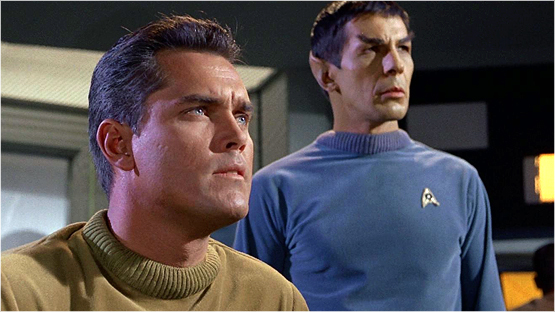
Star Trek: Discovery will return in January for Season 1, Chapter Two. It has also been renewed for a further season beyond this. This mid-season break will give them a chance to address some problems. Pacing is an issue when we cut to Klingon scenes. The language issue might have been rectified recently with the introduction of a universal translator. It would also be nice to settle some continuity problems, especially visually. Will we see traditional Starfleet uniforms, for example? We know they are being used around this period, due to their appearance in 1965’s pilot episode “The Cage”, which actually takes place two years prior to Discovery in the timeline. (This also raises the possibility of a future meeting between Captains Lorca and Pike, and a reunion of Spock and Burnham.)
Jeffrey Hunter and Leonard Nimoy as Captain Pike and Mr. Spock, in original uniforms (1965)
Star Trek series typically have a bumpy first season as kinks get worked out. If we assume this pattern will continue, then Discovery should turn out to be an exciting show for Trek fans. Certainly the space battle action scenes have been highlights. Let’s see more of that.
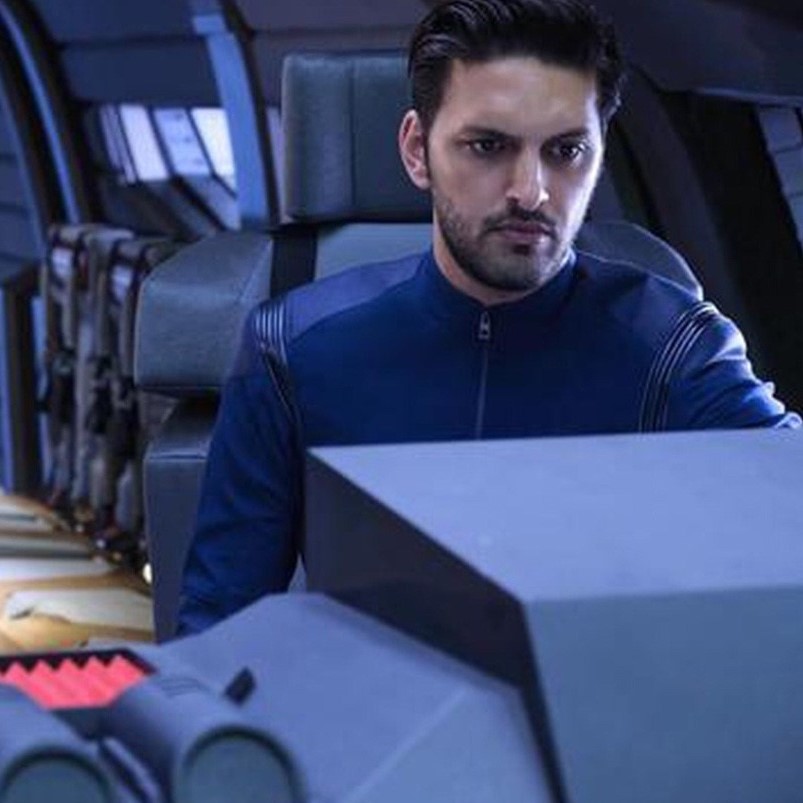
Shazad Latif as Lt. Tyler
Let’s also see more of characters like Dr. Culber, Paul Stammets, Captain Lorca, and Ash Tyler. Tyler, by the way, is one of the most controversial characters. There are fan theories (too many spoilers to discuss!) that suggest Tyler may not be who he thinks he is. Season 1, Chapter Two promises that his backstory will be further revealed, including his torture at the hands of Klingon L’Rell.
Even if certain continuity problems are never addressed, Discovery has made it an exciting time to be a Star Trek fan again. Old Star Trek always had its problems with continuity, far too many to list. If we can accept those, then let’s remain open minded.
Yes indeed, it is a great time to be a Trek fan. In 1987, I remember fans thought The Next Generation was stiff, and we complained that it copied original Trek a bit too closely at times. Everyone thought Jonathan Frakes looked like he was supposed to be Shatner. Their pajama-like uniforms and Wil Wheaton made us all cringe, remember? You hated Wesley too — don’t lie just because he’s on Big Bang Theory.
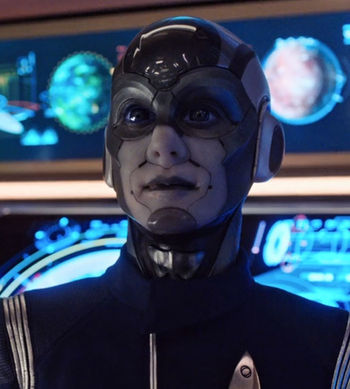
Sara Mitich as Airiam
Today, The Next Generation is revered by some as the best series of them all — or certainly the one with the best captain, right Patrick Stewart fans? Things change, and we know we have two seasons for them to get things running right. I’d like to see more of the background cyborg character, Lt. Commander Airiam (Sara Mitich). We already know there are episodes coming directed by Jonathan Frakes (Star Trek: First Contact and Star Trek: Insurrection). And we expect that Lt. Stamets’ experiments with the spore drive has opened some kind of portal to the Star Trek “mirror universe”…where good is evil and evil is good. Can you picture a bearded Stamets? Lorca, perhaps. Or would the mirror Lorca be the good one?
See? It’s a great time to be a Trek fan.
This could just be the excitement talking, but I think Discovery is getting better and the best is still coming.
IRON MAIDEN – The Book of Souls: Live Chapter (2017 Universal)
Not many bands can get away with releasing so many live albums so late in their career. Iron Maiden can. They can for three main reasons:
1: They still kick enormous amounts of ass. 2: Their setlist changes tour after tour and there will always be songs you won’t get to hear again. 3: See #1.
It doesn’t hurt that their new albums are as acclaimed as their old. Ever since Maiden’s 1999 reunion with Bruce Dickinson and Adrian Smith, we have been treated to an abnormally solid stream of brilliant records. Deal with the devil, perhaps? Faustian bargain #666?
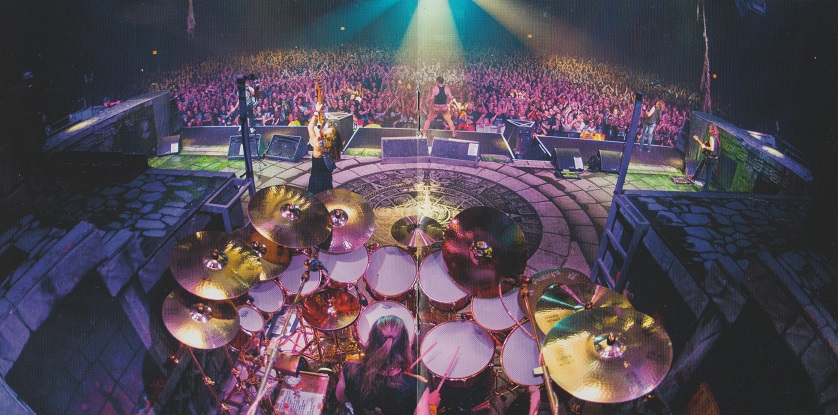
The atmospheric and shadowy intro to “If Eternity Should Fail” is a perfect way to begin an Iron Maiden concert. This track is magnificent. It also serves as a dramatic way to open what is sure to be the greatest live experience on Earth. “Scream for me, Sydney!” yells Bruce to rile up the crowd. Yes, The Book of Souls: Live Chapter is taken from a number of different shows, which is a format Maiden have succeeded with before.
Another thing Maiden do successfully is top-load their live set with new songs. The first two songs here are the same two as The Book of Souls itself. Single “Speed of Light” really kicks up the excitement level. To go from the epic drama of the opener to the taut single immediately causes an energy surge. From there, we travel back to 1981 with “Wrathchild”. It’s like a time machine to the London stages that young Maiden once trod upon. Bruce’s scream is unholy.
Jump cut to Canada and “Children of the Damned”. Bruce speaks French for the raving Montreal crowd, a nice touch of respect for the province of Quebec. Maiden never sagged in popularity there. In Quebec, Maiden’s 1995 album The X Factor (with lead singer Blaze Bayley) went Top 10. Back to new material, “Death or Glory” is another energetic shorty. The triple guitar solo slays. Then it goes to epic, “The Red and the Black”, 13 minutes and the longest track on the album. Riff overload! Unabated, we launch into “The Trooper” and “Powerslave”, both old classics that remain as amped up as they were in the 80s. It is pure joy to listen. (Only qualm: backing vocals on “Powerslave” sound like tape.)
A pair of top-notch new songs, “The Great Unknown” and “The Book of Souls” kick off the second CD. These are not short tracks. In a way this is the “meat” of the set. It is a run of 17 combined minutes of epic Maiden, and it’s a lot to swallow. Savour every bite; this is prime stuff. And will they ever be played live again? Who can say?
You know the show is drawing to a close when you hear the opening chords to “Fear of the Dark”. This favourite has been in the set since 1992. It’s the crowd’s chance to really sing along and be a part of it. More favourites follow: “Iron Maiden” and “The Number of the Beast”. (Absent is “Run to the Hills” which is on plenty of other live Maiden albums of recent vintage.) “Blood Brothers” from the reunion album Brave New World seems oddly placed in the second-to-last slot. The crowd at Download festival are thrilled to sing along. On CD, you can hear Steve on backing vocals clearly, and appreciate how he and Bruce complement each other. Then finally, it’s a terrific “Wasted Years” from underdog favourite Somewhere in Time.
The mix here is just dandy. There are variances in sound from track to track and city to city, but these are minor and only natural. You can clearly pick apart the instruments in the stereo field, and it’s pure delight to do so. Once again, Iron Maiden have released a quality product. You cannot go wrong by investing in any version of The Book of Souls: Live Chapter.
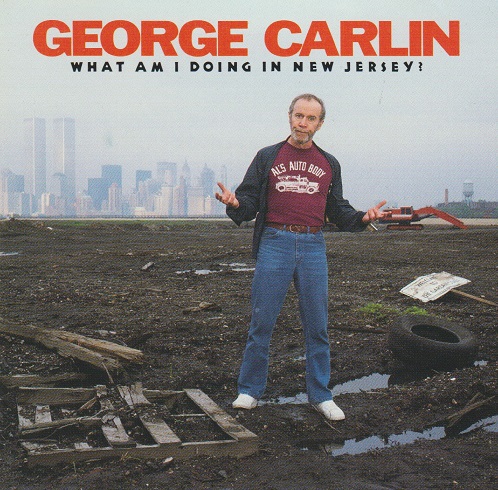
GEORGE CARLIN – What Am I Doing in New Jersey? (1988 Atlantic)
Why do we still look to the wisdom of George Carlin today in memes and videos? Because his comedy was timeless. What worked in 1988 is still topical in 2017. On the government, Carlin blasts: “They’re against street crime, unless the street is Wall Street!” Still true, just change the names. Listen and you might even learn something, but you’ll be too busy laughing to realise it.
It’s actually incredible how applicable this 30 year old comedy show is. Freedom of choice, freedom of speech, government telling you what you can and can’t hear. I don’t think George Carlin would think much of the year 2017. What is most appealing about George Carlin’s comedy is simply how he observes the absurdities of life. If he makes you uncomfortable, that’s too bad, because the rest of us are laughing.
It’s not all topical observations. Sometimes it’s helpful advice. “Here’s one to try. Go in to a gift shop, and ask for your gift.” You’ll also enjoy his list of people he could do without. “A proctologist with poor depth perception.” True, true. “Anyone who mentions Jesus more than 300 times in a two minute conversation.” Yes, yes. “A brain surgeon with ‘born to lose’ tattooed on his hands.” Dear God yes. And…”couples whose children’s names all start with the same initial.” Say no more, my sides hurt!
The last 20 minutes of the album is dedicated to “More Stuff About Cars and Driving”. From this, I gather there are many toll roads in the state of New Jersey. Carlin goes after bumper stickers too. Imagine what he’d think of today’s window sticker families!
Not for everybody, but possibly just what you need.
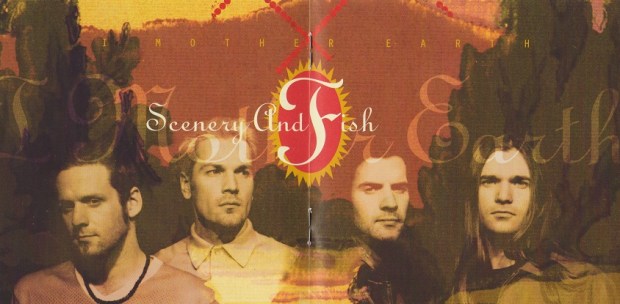
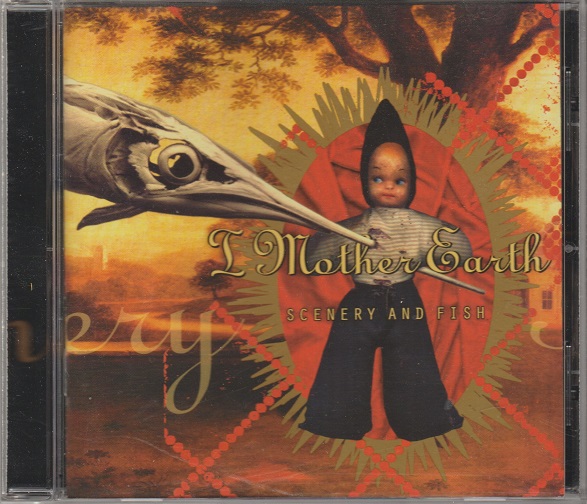
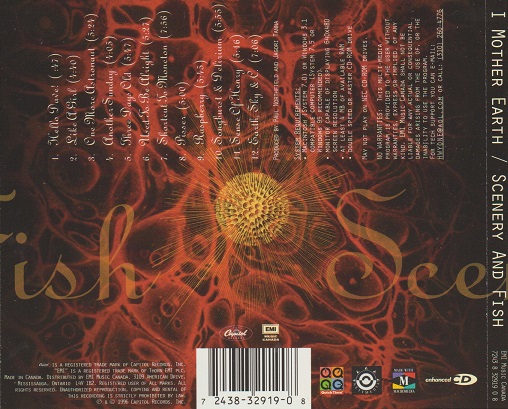
Some albums that mean everything to some, can mean nothing to others. Take a look at Scenery and Fish.
I Mother Earth’s second album gets a slew of 4 and 5 star ratings on the Canadian Amazon. Yet I don’t get it and never have. I was on the I Mother Earth train very early, before their first album came out. I loved the modern heaviness of the band. With the tribal and funk influences seeping through, I Mother Earth put out a seriously impressive debut album: a Canadian classic. As any band should, they mixed it up a bit on the second album.
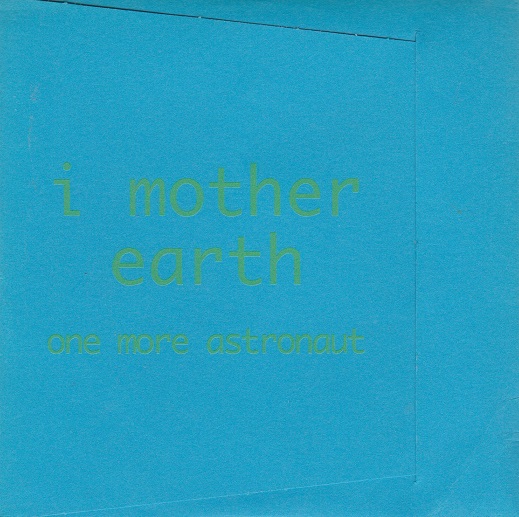
In early 1996 I received a promo CD for the first single from the second album, “One More Astronaut”, with the album version and a 4:35 edit. It didn’t seem too different, maybe just a bit more concise than some of the first album’s longer jams. This isn’t indicative of the album in general, which is a wild ride of different styles.
The exotic percussion (by Luis Conte and Daniel Mansilla) is still intact, melded with the funk bass, but the overall sound is very different. Paul Northfield’s production is cleaner and slicker than Mike Clink’s on the first LP. He still enables to band to exercise their instruments unfettered, but perhaps with a more radio friendly backing.
Although I’ve tried over and over again through the past two decades to let Scenery and Fish “click”, it just won’t. Other fans certainly have their favourite tracks: “Like a Girl”, “Raspberry”, “Used to be Alright”, “Another Sunday”. These are indeed some of the best tracks on the album, yet I struggled to remember how they go. “Another Sunday”, for example has an incredible blast of hooks for a chorus, but no memorable verses. Maybe this album is too thick with musical ideas and passages for the average mortal.
But that’s just me. You might think I’m nuts. There are those who think I Mother Earth can do no wrong, but fans in general love Scenery and Fish, while I simply don’t get it. I’ll always enjoy “One More Astronaut” and “Like a Girl”, which by the way features a friend of theirs named Alex from some band called Rush.
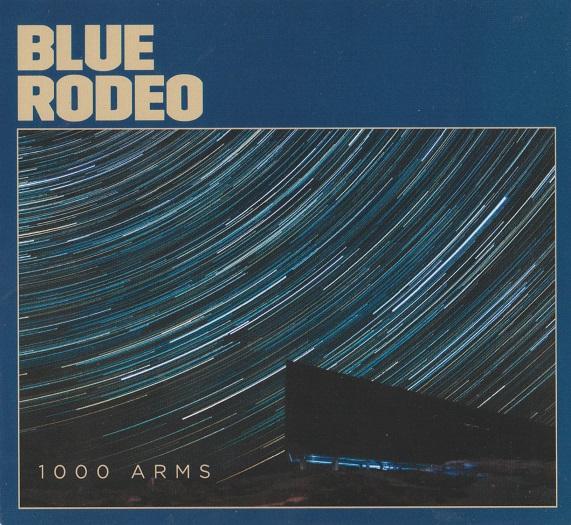
It’s hard keeping up with Blue Rodeo! They’re always working, either as a band or on their own projects. They’ve released new albums consistently without gaps. That’s 15 studio albums (one of them a double) spanning 30 years. Countless amazing songs…but mathematically their growth have kept me from growing with their new music as much as the old. There are only so many hours in a day, and days in a week, and it’s hard to imagine the day that 1000 Arms will surpass Five Days in July for number of spins. It’s inevitable that when listening to newer Blue Rodeo music, it doesn’t feel as close to you as the early stuff.
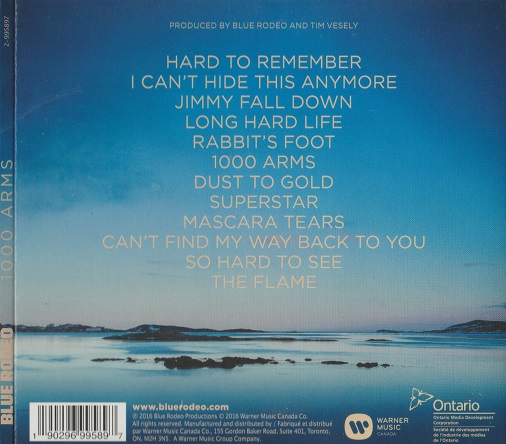
Blue Rodeo maintain their knack for incredible songs and playing on 1000 Arms. Greg Keelor conjures up the same old, not-quite-broken spirits as before. “Nothing I ever do is good for you, will I ever realize? You’re never satisfied.” Biting lyrics, chiming mandolin and perfect Cuddy/Keelor harmonies combine to make the opener “Hard to Remember” a future classic. Jim Cuddy takes the wheel next on an upbeat number called “I Can’t Hide My Feelings Anymore”. When has Jim ever hid his feelings? Not the point — another great tune.
The disc is loaded with great tunes. “Jimmy Fall Down” (vocals: Keelor) maintains the bright, upbeat direction. Things don’t slow down until track 4, “Long Hard Life”. It’s quieter but no less enjoyable. It’s only a temporary reprieve, as “Rabbit’s Foot” brings a classic guitar vibe. The title track is old style Cuddy storytelling. Greg’s penchant for slow and dramatic music is carried on by “Dust to Gold”. There is even sly humour on “Superstar”, something you don’t always get with a Blue Rodeo album. “Start a business, organics door to door, ’cause nobody buys records here anymore.”
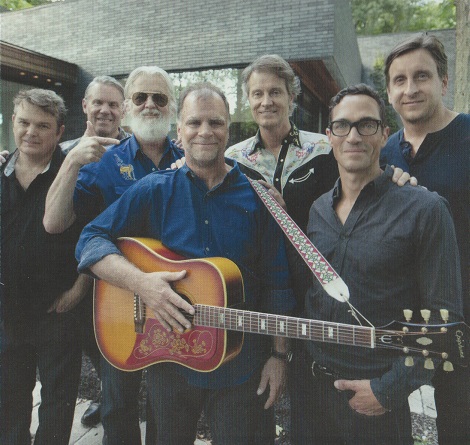
We could go on and continue to describe this batch of new tunes, but rest assured there are no duds. (Do stay tuned for a heavy exotic turn on closing track “The Flame”.) I hope that, over time, these songs become as much a part of me as the old tunes. There’s little difference in terms of quality, and the musicianship is always tops. Colin Cripps would be responsible for many of the tasteful guitar solos, but 1000 Arms is the last Blue Rodeo album to feature mandolin player (and Kitchener, Ontario resident) Bob Egan. (That’s why he’s front and center of the band photo.) Bob departed after making this one, and he went out in great style.
 STEVE VAI – Alien Love Secrets (1995 Relativity)
 It’s wall to wall shred, but if you’re looking for something even more straight-ahead, you’ll dig “Juice” which is just a classic Van Halen shuffle done a-la Steve. What about ballads? From the very beginning, Planet Steve has included ballads. “Die to Live” is a stock Vai ballad, melodic with tricky lead parts. Some of the licks remind of “Hina” from David Lee Roth’s Skyscraper. “The Boy From Seattle” would also be pegged as a ballad, but it’s definitely a bit more challenging. Then there’s the beautiful closing track “Tender Surrender”, which is blues for the intergalactic age.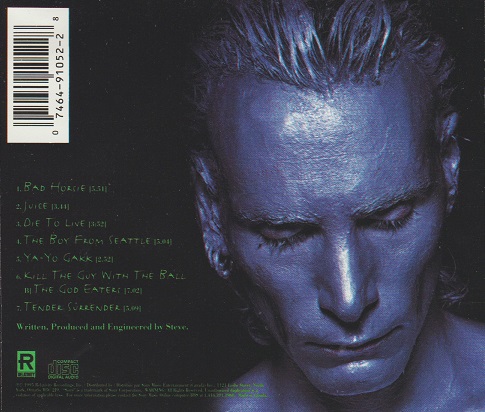


















 mikeladano.com