RE-REVIEW: KISS – Love Gun (1977)

The KISS RE-REVIEW SERIES Part 9:  

LOVE GUN DELUXE_0002kiss-logo – Love Gun (1977 Casablanca, 2014 Universal reissue)

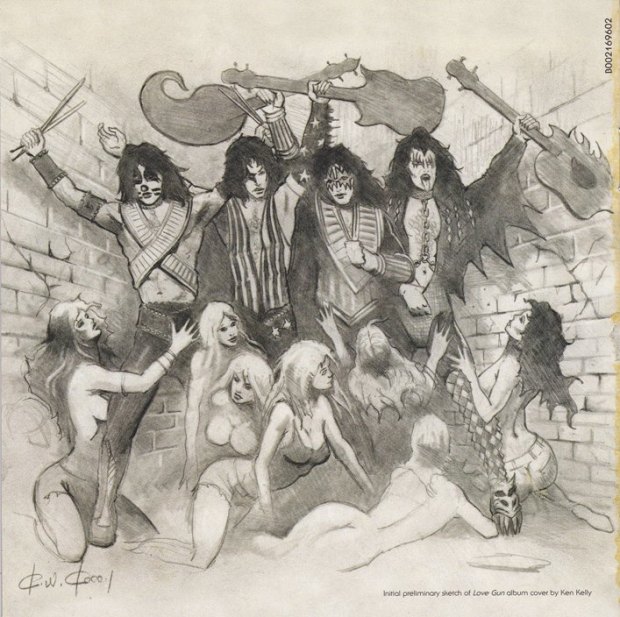
By the late 1970s, Kiss had achieved more than most bands do in an entire career.  In 1977, Marvel comics released the first ever Kiss comic.  Famously, as a publicity stunt, each Kiss member had a vial of blood drawn, and poured into the red ink.  “Printed in real KISS blood”  proclaimed the front cover.  Can you imagine such a thing in 2017?  In 1978, the toy company Mego marketed the first set of Kiss action figures.  The phenomenon of Kiss was almost eclipsing the music.  Perhaps it would have completely, if Kiss didn’t continue to release excellent albums on a biannual basis.  Their first album of 1977 was the legendary Love Gun.  Even the Ken Kelly cover art depicts Kiss as demi-gods of some kind.  Inside, the merchandising spilled over to the album.  Kiss were determined to give their fans a little extra, and so the album was packed with little cardboard “love guns” that you could assemble yourself…accompanied by a Kiss merch mail-away form.


The music brightly outshone all the flash and trimmings.  Again with Eddie Kramer in the producer’s chair, Kiss sought to make a focused heavy rock record.  Their material had rarely been stronger.  Paul Stanley was becoming handy at writing opening tracks that defined what an album was going to sound like.  “I Stole Your Love” cranked it fast with one of Paul’s most thunderous riffs.  The tribal sounding drums by Peter Criss are an apt example of what made him great at the time.  Criss was not a technical drummer, but he had the right feel and a knack for the perfect fill.  Ace Frehley soars in and dive bombs with an unforgettable lightning solo.  Gene Simmons is there in the back, adding the thump.  “I Stole Your Love” in a mere three minutes encapsulates everything about Love Gun that makes it great.

Gene Simmons’ demon character had another side; that of the “creepy old man”.  “I don’t usually say things like this to girls your age, but when I saw you coming out of school that day, that day I knew…I knew!…I’ve got to have you, I’ve got to have you!”  Probably from the perspective of a highschool senior, but still, it came from Gene’s mouth.  The less said about the words the better, for “Christine Sixteen” is one of Gene’s most perfect musical moments.  Eddie Kramer provides the piano for a vintage rock and roll sound.  A Kiss classic it is, and Peter once again has the perfect fills for the song.


Moving on to “Got Love For Sale”, the lecherous Simmons now “has love, will travel”.  Uptempo sleeze is perfect for Kiss’ friendly demon, but Frehley is the real star here.  Speaking of whom, the Space Ace finally worked up the courage to sing his first lead vocal on his trademark Kiss song “Shock Me”.  On the prior tour, Ace nearly electrocuted himself on stage when he touched a railing that wasn’t grounded properly.  “Shock Me” is a humorous reference to this.  Any Frehley track has a unique flavour.  He attacks his Gibson and assembles chords and riffs in a style all his own.  “Shock Me” showed he could sing too, finally adding a fourth voice to a Kiss album.  For the first time, Love Gun has all four Kiss members singing lead.  The first side was bookended by another Paul Stanley track, the killer “Tomorrow and Tonight”.  Piano and Motown-style female backing vocals give the track a classic feel, and Paul once again came up with a sweet candy-coated chorus.  Echoing a previous hit, Paul sings “We can rock all day, we can roll all night.”

The most well known track from Love Gun is the title track itself.  It has been in the set regularly since 1977 and is generally considered one of Paul Stanley’s best songs (if not his very best).  All the ingredients click perfectly.  “Love Gun” kills and cannot be improved upon.  Even if, when you think about it, “Love Gun” is a metaphor for “penis”, and the lyrics amount to singing, “You pull the trigger of my…penis, penis, penis”.  Substitute “penis” every time Paul sings “Love Gun” and see.  Paul Stanley is an absolute genius, because he has gotten stadiums full of thousands of people to sing an ode to his cock, and that’s cool.


“See Ronnie? His dick is the gun!”

Peter Criss only had one track on Love Gun, a Stan Penridge co-write called “Hooligan”.  It was good enough to get some live performances, though it and Gene’s “Almost Human” occupy the lower rungs of the Love Gun album.  The best thing about both “Hooligan” and “Almost Human” is that both perfectly fit the personas that sing them.  Peter has always emphasized his tough street upbringing, but as the lovable cat character, and that’s “Hooligan”.  “Almost Human” is 100% the sex-crazed demon, almost a theme song.  The bass thumps, but there is some interesting percussion stuff happening too.  Simmons continues looking for love in “Plaster Caster”, his encounter with the legendary Cynthia Plaster Caster.   One can assume that Gene Simmons’ wang is among those on her display.  “A token of my love for her collection.”  “Plaster Caster” rocks hard (pun intended) and has balls (also intended).

Love Gun surprisingly closes on a Phil Spector classic, “And Then She Kissed Me” (gender reversed) by the Crystals.  Paul Stanley helms it, a romantic number perfect for Kiss content at weddings.  The Kiss-ified version is almost comically guitar heavy, but Kiss have managed a number of unusual covers over the years.  Adapting it to their sound, Paul owns “And Then She Kissed Me”, especially when topped by an awesome and appropriate solo.

The Love Gun tour that followed this album is one of Kiss’ most legendary: the dual staircases, levitating cat drums,  and of course the big Kiss logo in behind.  Kiss were huge.  A gallup poll put Kiss as the most popular band in America, over Zeppelin, Aerosmith and the Stones.  When bank accounts inflate, so do egos.  With success comes cost.  Though the Love Gun period is all but universally lauded, it was also the last unified album before some members became liabilities.

Today’s rating:

5/5 stars

See Ronnie?  His dick is the gun!


Uncle Meat’s rating:

3.5/5 steaks 

Meat’s slice:  This was Peter Criss’ last album with Kiss for a long time.  Love Gun is a hit and miss record in Meat’s opinion.  Or maybe better put…hit and somewhat miss.  I think there are simply too many forgettable songs on this album.    “Then She Kissed Me”, “Hooligan”, “Got Love For Sale”, “Tomorrow and Tonight” and “Almost Human” are all average at best.  That’s half the album right there.  There are also standout songs. Obviously the title track is a Rock and Roll classic now, the album’s opener “I Stole Your Love” is a hot tamale, and I have always loved the catchy “Christine Sixteen”, especially that chorus.

However, Love Gun is a very significant Kiss album simply because of one song.  I don’t know a Kiss fan that doesn’t love “Shock Me”.  The debut of Ace Frehley as a “singer-songwriter” so to speak, made many wish he would have sung a few more before things all fell apart.  Some of the songs coming up in the next few albums, including his solo album, are some of Kiss’ best material in my opinion. 

Maybe they just ran out of ideas.  Should have been half an album of Ace songs instead.

Favorite Tracks:  “Shock Me”, “Love Gun”,  “I Stole Your Love”, “Christine Sixteen”

Forgettable Tracks:  Look above


To be continued…

Original mikeladano.com review:  2012/07/011
Deluxe Edition review:  2014/11/09

RE-REVIEW: KISS – Rock and Roll Over (1976)

The KISS RE-REVIEW SERIES Part 8:  

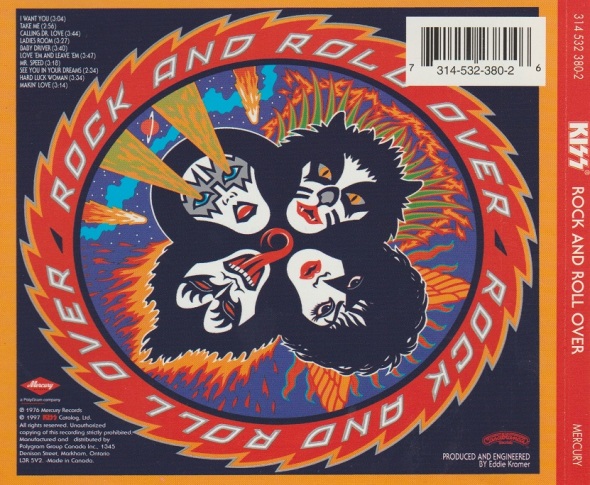
scan_20170302kiss-logo Rock and Roll Over (1976 Casablanca, 1997 Mercury remastered edition)

Kiss were at a crossroads.  What to do next?  Destroyer, produced by maestro Bob Ezrin, introduced a new Kiss to the world:  glossy, indulgent, polished and augmented with plenty of highbrow non-rock instruments.  Would they explore that road and see where it lead?  If they had, an entire alternate KISStory would exist today.  Instead they chose to get back to basics.

Producer Eddie Kramer, who made Kiss Alive! so unforgettably thunderous, was called up again.  Kramer and Kiss departed for the Star Theater in Nanuet, New York to record.  The idea this time, as opposed to Destroyer, was to go for a live Kiss sound, but on a studio album.  The theater setting was intended to help capture that.  Peter Criss’ drums were recorded in a bathroom for the perfect ambience.  Rock and Roll Over followed Destroyer by a mere seven months, maintaining Kiss’ record of two albums per year.  As promised, it was a return to the core Kiss sound:  loud guitars and hard rock.  They had learned a trick or two from the Destroyer experience.  Rock and Roll Over was tighter and sharper than the first three Kiss albums.

The acoustic intro to Paul’s “I Want You” lulls you into a false sense of calm.  Then it completely explodes with one of Paul’s most passionate tunes.  In three minutes, Kiss laid waste once again.  A second Paul scorcher, “Take Me” was written with Kiss road manager and coach Sean Delaney.  The words are simple and c-c-c-catchy: “Go baby, you make me feel ah, ah, ah, ah yeah!  Oh, baby, you make me feel ah, ah, ah, ah yeah!”  Elsewhere, Paul asks “Put your hand in my pocket, grab on to my rocket,” just so there is no confusion.

Gene Simmons’ “Calling Dr. Love” (based off a demo called “Bad Bad Lovin”) was a single and a perennial concert classic.  You either like Gene or you don’t.  “Calling Dr. Love” won’t change any minds, but it will satisfy those who can’t enough of the sex-crazed demon.  It does boast a fiery Ace Frehley guitar solo, one of his most memorable.  Gene’s second track “Ladies Room” is just rock and roll, a lesser-known Kiss classic, but catchy as sin.  The LP’s first side was closed with a Peter Criss song, co-written with his Chelsea bandmate Stan Penridge.  “Baby Driver” is not listed among Kiss’ best tracks, but there isn’t much wrong with it.  It’s basic, it slams, and Peter screams his throat out.  Not a standout but worth a spin or two.

Gene’s “Love ‘Em and Leave ‘Em” is the lovely kind of sentiment that many Kiss songs were built on.  This ode to groupies and hotel sex was not the first and not the last, but it had a memorable bop and catchy chorus.  “Mr. Speed” (Stanley/Delaney) is a standout with the kind of rock and roll guitar riff that Paul specializes in.  This killer track could and perhaps should have been a timeless concert classic, probably ahead of other tracks.  (It was also used on the soundtrack to Keanu Reeves’ 1994 action movie Speed.)  Simmons’ “See You In Your Dreams” was less timeless and memorable, so later on Gene took a shot at re-recording it.  The Rock and Roll Over version makes for the kind of song that is good for filling the spaces between better songs.

Speaking of better songs, Paul’s “Hard Luck Woman” is undeniably one of his best.  The lush acoustic six and twelve string guitars ring pure and clean.  Paul wanted to give the song to Rod Stewart to sing, as it has a light “Maggie May” aura.  Wiser minds prevailed and the song was kept for Kiss, and given to Peter Criss to sing as a followup to “Beth”.  Peter of course nailed it and “Hard Luck Woman” reigns as one of the best tracks Peter was given to sing, if not the best.  It might not have been as big as “Beth” but that means little; it is the far superior song.

Closing the record, Paul Stanley’s “Makin’ Love” ends Rock and Roll Over on the same kind of fast and furious riffing that it began with.  “I Want You” and “Makin’ Love” are bookends, starting and finishing Rock and Roll Over with hard guitars and good times.  Sean Delaney co-wrote “Makin’ Love” and his contributions to KISStory have too often been swept under the carpet.  Delaney had three co-writes on Rock and Roll Over.  Peter Criss had one, and Ace Frehley didn’t have any at all.

Rock and Roll Over gave Kiss another platinum album to hang on the wall.  Their success, and their sound, had solidified.  There was nowhere to go but up.

Today’s rating:  4.5/5 stars


Uncle Meat’s rating:  5/5 steaks 

Meat’s slice:   This time let’s start with the negative, as small and nitpicky as that is in the case of this album.  I’m not a big fan of “See You in Your Dreams”.  Not awful, but just kinda bland in comparison to the rest.  “Baby Driver” could also be lumped in with that for the same reason. 

The other thing I could say about this album is that since Kiss were the “Kings of the Night Time World” at this point, this is where the lyrics started to get their most misogynistic or what have you.  Songs like “Ladies Room” and “Love ‘Em and Leave ‘Em” are tunes I really like, however I can see that these were the gateway drug to some of the ridiculous lyrics in Kiss songs in the 80s and 90s. 

I love everything else about this album.  Rock and Roll Over was my favorite Kiss studio album as a kid, and it’s just a shade under Dressed to Kill now on my Kiss albums list. This seems to make sense now, since both albums were created in similar fashion:  Kiss under the gun and needing to write and record an album fast.   Good Rock and Roll instincts there.

My favorite ever Kiss ballad is on this record too.  “Hard Luck Woman” is an extremely catchy song, and could be my favorite song on the album.  I recall that somewhere around 2002, I was very drunk in a bar and ended up singing “Hard Luck Woman” on karaoke, and probably had not heard the song in many many years.  I sang the first 2/3rds, however well a pissed me could muster.  The end of the song surprised me and I had no idea what to sing and left in the middle of the track.  Not long after a girl came up to me and said, “I have never heard anybody sing that Garth Brooks song on karaoke before”.  She seemed so taken aback at my insistence that “Hard Luck Woman” was a Kiss song.  Maybe it was because I started freaking out on this poor girl.  “Hard Luck Woman” indeed.


Reproduction of the karaoke performance

Favorite Tracks: “Hard Luck Woman”, “I Want You”, “Makin Love”, “Calling Dr. Love”, “Mr. Speed”

Forgettabe Tracks:  I’m done nitpicking on this one.


To be continued…

scan_20170302-4

Original mikeladano.com review:  2012/07/09



REVIEW: Dust – Hard Attack / Dust (1972/1971)

The KISS RE-REVIEW SERIES Supplemental:  Kerner and Wise.

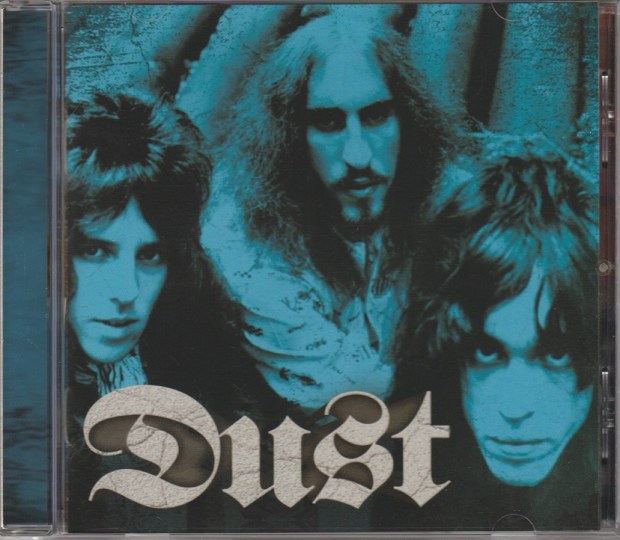
DUST – Hard Attack (1972) / Dust (1971) (2013 Sony Legacy)

fans know the names of Richie Wise and Kenny Kerner.  This production team laid down the first two Kiss records, and although their production was not the best, they were the first.  But where did they come from?  A little trio called Dust.  Wise was the singer and guitar player.  Kerner was the manager, co-producer and co-writer.  They released two records as Dust, also featuring legendary Derringer bassist Kenny Aaronson and drummer Mark Bell.  These two albums, Hard Attack and Dust, were remastered and compiled as one CD by Sony in 2013 (presented in reverse order).

The cool thing is the Dust albums actually sound better than the Kiss albums.

Dust were a hard rockin’ band, distinguished by having loads of slide and pedal steel guitars (handled by Aaronson).  Dust were travelling the same roads as other bands such as Aerosmith, Cream, Free or Zeppelin, but with less of an identity.  The songs were good.  “Stone Woman” is slippery slick blues rock, while “Goin’ Easy” is a laid back southern acoustic blues.  And they could get heavy.  “Love Me Hard” is the kind of proto-metal that Budgie, Sabbath and Purple were doing on the other side of the Atlantic.

3.5/5 stars

This was a 200 word review in the tradition of the #200wordchallenge.


Gallery: “Holy sh*t, jackpot” #3: C-3P0 Gold Arm edition

Action figures are like CDs. You can go and buy the “standard edition” at Walmart, or what have you. But if you want all the extra goodies, sometimes you have to hunt a little more and buy a few extra versions.

Toys such as my beloved Star Wars Black Series 6″ series have plenty of exclusives, some that I have and some that I want. The most elusive are the San Diego Comic-Con toys. Some exclusives: Jabba the Hut came with a cardboard throne and accessories. Their Boba Fett came with Han Solo in carbonite. But they are mucho pricey. Elsewhere down the money scale are toys that are exclusive to certain stores and online outlets.

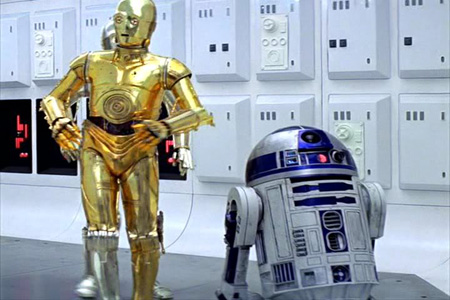
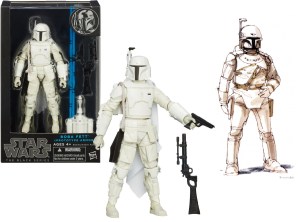
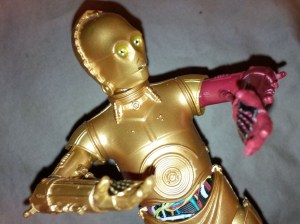
Walgreens is a store that doesn’t exist in Canada and often gets exclusive Star Wars figures. Their most well known is the “prototype” all-white Boba Fett based on an original 1978 Ralph McQuarrie concept sketch. Their current Star Wars treasure is a C-3P0 variation with two gold arms and one silver leg.

The “standard” version of Threepio has the red arm seen in The Force Awakens. This “Resistance Base” Threepio is the common one. Since C-3P0 doesn’t come with any accessories (not even a restraining bolt or com-link), fans hoped he would come with alternate limbs, so you could recreate his look in Episode IV. Hasbro had a different plan. Instead they made the different limbed robots exclusives to Walgreens. I have been looking for one.  (There is also a version with a darker red arm, but it doesn’t look as good as these.)

Our neighbors went to Toronto Comic-Con yesterday and found the Walgreens silver leg Threepio for me. It was only $40 — a lot cheaper than ordering one online. Thanks guys!!

#553: Jesus’ Lyric

GETTING MORE TALE #553: Jesus’ Lyric

Many record store employees drink.  Record store people are just people, and some people drink.  And some drink, a lot. I was never much of a drinker, not until I moved in with T-Rev in ’98. Then I caught up pretty quickly (Captain Morgan’s and Coke, not beer), but I still couldn’t compete with those guys. (In fact, I still remember when I went out for my 30th birthday. I was accused by the Operations Manager/Bully of “faking” that I was drunk. I’m a light weight, and she was just a meany.)

Like me, some of the younger folks, they just couldn’t pace themselves.  The difference is they’d be drinking while having to open the store the following morning.  A lot of them would be out partying, and then we’d get the inevitable phone call the next morning. “I’m sick. Can you cover for me today?” It happened more than once, not naming names.

One guy, who helped me set up the first store that I managed, came into work hungover so many damn times. The first time, I had to send him home. He was absolutely useless. He was actually trying to work with his head down touching the counter. He was slowing me down, so I sent him home and somebody else came in.

The same guy came in hungover one Saturday morning, later on, after we opened. He had his head down on the counter when a customer approached him. He raised his head.

jasons-lyric“Uhh, excuse me. Do you have the soundtrack to Jason’s Lyric?”

The hungover employee stumbled over to the computer.

“It’s a movie soundtrack,” clarified the customer, seeing Mr. Hangover was struggling.

“No. We don’t have it.”

The customer asked him to check to see if one of our other stores had it, so he picked up the phone.  The customer went back to browsing while Mr. Hangover was making the call.   We only had three stores at the time.   One of them had Jason’s Lyric used on CD!

Mr. Hangover then walked out onto the floor to tell the customer about the CD. Only problem:  he didn’t remember who asked.   Or the exact name of the CD he asked for.  So Mr. Hangover approached somebody who looked right.

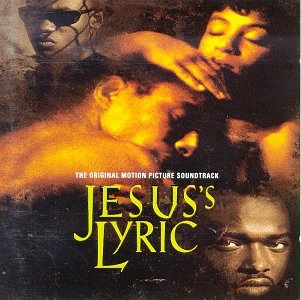
Walking up to the unsuspecting stranger he said, “Hey man. They got your Jesus’ Lyric over there.”

“What?”

“They got your Jesus’ Lyric soundtrack CD at the other store that you asked for.”

Overhearing this, the correct customer identified himself, and things got sorted.  No big surprise ending here:  Mr. Hangover was let go soon after!

RE-REVIEW: KISS – Destroyer (1976)

The KISS RE-REVIEW SERIES Part 7:  

scan_20170301kiss-logoDestroyer (1976 Casablanca, 1997 Mercury remastered edition)

Kiss had “made it”.  Alive! put them where they wanted to be:  on the charts and headlining concert stages coast to coast.  The financial pressure was off and they didn’t have to simply crank out new albums to keep the band afloat.  They could now take their time and make something that was more thought out; a statement.

The first issue to deal with was Kiss’ past sonic inadequacy in the studio.  Prior albums produced by Kenny Kerner & Richie Wise, and Neil Bogart did not capture the full-on Kiss thunder.  They failed to shred the speakers.  They needed somebody “big time”, to give them the punch they desperately needed.  That somebody was Canadian producer extraordinaire Bob Ezrin.  Ezrin had been an instrumental guiding force for Alice Cooper.  Now it was Kiss’ turn to receive the platinum Ezrin magic touch.

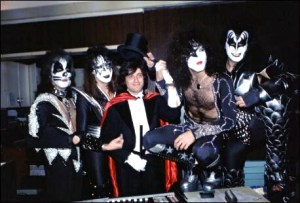
Ezrin agreed to work with Kiss, reportedly influenced by a neighbor kid who liked to discuss music.  “The kids from school love Kiss,” the boy told Ezrin.  “The problem is, their records sound so shitty.  But the band is so good we buy the records anyway.”  Working with Kiss wasn’t much different from working with Cooper.  These were not schooled musicians.  Ezrin had to take them to boot camp.  Keeping the drums in time was a challenge.  Peter Criss had difficulty maintaining a steady tempo, so Ezrin would beat a briefcase to keep him in time.  He wore a conductor’s coat and tails, and pushed the rest of the band like a drill sergeant.  Even the mighty demon Gene Simmons was chastised, for finishing a take before the producer instructed him to stop.  And when Ace Frehley didn’t show up because he had a card game?  Shenanigans were not tolerated.  When Ace wasn’t available when he should have been, Ezrin’s buddy Dick Wagner (Alice Cooper) was there.  For the first time, a Kiss member was replaced on album by an outside uncredited musician.

kiss-and-ezrin-in-tails

One innovative technique that Ezrin brought in to thicken up Kiss’ sound was using a grand piano to back up the big guitars.  The end result doesn’t sound like piano and guitars, but one solid wall of rock, like Phil Spector channelled through Bob Ezrin.  Where Kiss used to rely on rag-tag recordings they now had a big glossy sound to play with.  Ezrin was also fond of sound effects and orchestration, and he brought both to Kiss.

The opening track “Detroit Rock City” was a slam-dunk intro to the new Kiss sound.  After an extended start with the sound of a fan driving to a Kiss concert, the band thundered into focus.  That trademark riff chainsaws through, before Paul Stanley’s powerful pipes take command.  What a song.  The new Kiss had arrived, shiny and sleek, souped up and fueled, as if they were a brand new band.

detroit_rock_city“Detroit” faded out into “King of the Night Time World”, an outside song brought in for completion by Ezrin and Paul Stanley.  They turned it into something that worked for a Kiss album, albeit very different from their past.  As for Paul, he contributed a fast hard rocker called “God of Thunder”.  Though reports sometime differ in the details, ultimately the song fit Gene Simmons’ demon persona better and the song was given to him to sing.  It was slowed to a monster plod, and a few lines were changed to suit.  (“Make love ’til we bleed” was changed to “Hear my words and take heed”.)  And those little demonic voices?  Bob Ezrin’s kids, playing with walkie-talkies.

“Great Expectations” (based on Beethoven) has to be the most bizarre song on the album and one of the weirdest that Kiss have attempted.  A lush ballad with strings and choirs and Gene Simmons in crooner mode, it is definitely different.  Even one of the rockers, “Flaming Youth” written by Frehley/Stanley/Simmons/Ezrin, is different for Kiss.  It’s a rock song…with calliope.  (Picture circus music.)  Gene’s “Sweet Pain” had female backing vocals like an old Motown single.  These are all interesting experiments, but none of those three songs have become live concert classics.

Bob Ezrin tricked the band into writing “Shout it Out Loud”.  He realized they needed one more song, so he told the band that they had lost the masters to “Great Expectations” and needed a replacement.  Gene and Paul hurriedly wrote “Shout it Out Loud” with the producer and had another instant classic.  Like “Rock and Roll all Nite” before it, “Shout” was an anthemic rallying cry that a concert audience could get behind.

The album closer was a track called “Do You Love Me”, another tune brought in by outsiders (Kim Fowley) to be finished by Kiss.  Though on the surface “Do You Love Me” is a bit repetitive and dull, it was later covered by Nirvana.  There must be something to it that struck a chord.

There was still one more song on the album, a throwaway.  It was used as a B-side to “Detroit Rock City”, as the band didn’t have much faith in it.  Peter Criss had brought forward a love song called “Beck”, named for a girl named Becky, written by Stan Penridge for their old band Chelsea.  The song needed work, including a new title.  Ezrin revamped it completely, and the result was one of Kiss’ all time biggest hits:  “Beth”.  Tender and accessible, the only Kiss member on “Beth” was Peter Criss himself.  Dick Wagner played acoustic and Bob Ezrin played piano.  The orchestra finished it off.  Eventually, radio stations started flipping the “Detroit” single and playing “Beth”.  This led to Casablanca reissuing “Beth” as a single A-side, Kiss’ highest charting ever.


With the help of “Beth”, Destroyer maintained Kiss’ stardom and opened up the doors for any future musical experiments they could fathom.  Its cover showed Kiss in an apocalyptic landscape, in full super hero mode for the first time.  Artist Ken Kelly created something that helped define Kiss as larger than life…and larger than life they did become.

That wasn’t the end of the story for Destroyer.  For years it became the benchmark that Kiss albums were measured against.  In 2012, Bob Ezrin revisited the backing tapes and produced an alternate mix called Destroyer: Resurrected.  This featured some previously unheard music such as an alternate Ace Frehley guitar solo for “Sweet Pain” (Dick Wagner played the original solo).

Destroyer is far from the definitive Kiss album.  In fact, it is more like a one-off, an experiment that was never fully revisited.  Some of its songs are less than classic.  Others are so classic that you can’t imagine the world without them.  The bottom line for Kiss was that Destroyer propelled them further towards their goal of becoming the hottest band in the world.

Today’s rating:

3.5/5 stars


Uncle Meat’s rating:

4/5 steaks 

Meat’s Slice:  The general consensus of casual Kiss fans is that this is their greatest studio album.  Let’s examine this.  I’ll start with the iconic.

“SHOUT  IT OUT LOUD” – On May 22, 1976, this song went number one in Canada, the band’s first ever number one song.  40 years later and “Shout it Out Loud” might be the Kiss song with the longest shelf life.  One of two perfect “live concert” songs on Destroyer.  The other?

“DETROIT ROCK CITY” –  Thin Lizzy-esque two-guitar rock fest.   Sitting on the same shelf as “Shout it Out Loud”.  Iconic indeed.   Unperishable.   Even has a movie named after it. I have never seen  it.   Maybe it’s finally time to do so.

“BETH” – If any other member sang “Beth” it wouldn’t have been the same song, or had the same success.  Peter Criss has a special rasp in his voice that can both rock and schmaltz it up.  Like Rod Stewart, or that goof that sings for Slaughter.   I personally wish “Beth” would “fly to the angels” up in the sky, but this song did do one good thing for me.  My grandmother refused to get me anything Kiss related until I pointed out to her that “Beth”, on the radio in the car at the time, was actually Kiss.  So thanks for that at least.

“DO YOU LOVE ME” –  Perhaps this song is more iconic in my own mind specifically, since it is in my Top Five Kiss songs.  Classic Paul Stanley stuff here.

“GOD OF THUNDER” – Unique in every way for the time.  A lot of Ezrin tricks in this track including backwards drumming.  I still have not heard the great cover of this song I always thought I would from some Metal band.  There’s still time….

No wonder the casual Kiss fan believes this is the best of all of the Kiss studio albums.  It is a great collection of songs that are still loved today.  But everything else on Destroyer not listed above is average at best,  or much worse than that.  Maybe it’s because Kiss was too busy getting music lessons from Bob Ezrin while in the studio.  Maybe it’s simply that Kiss was tired of being looked at as a “joke” and wanted to get more serious, hence getting some more respect from the mainstream press.  Now again, this is my opinion and I’m sure that some might vehemently disagree with me about some of the deeper Destroyer tracks.  The best of which I think is “Flaming Youth”.   “King of the Night Time World” is pretty good, but borrowed from another song.  “Great Expectations” is blah stuff except for the melody stolen from Beethoven.  “Sweet Pain” sucks.  And “Rock and Roll Party” is just unnecessary filler, very much like “Inside”, the ending track on 5150.  Might as well take the needle off the record as soon as the song starts and put on something else immediately.

Let’s use this analogy

A couple raises 10 children.   Three of their children become world leaders.  Two others become successful doctors.  But half of their kids are in jail, some for unspeakable crimes against humanity.  Can you call them the best family overall because half of them are special?   Destroyer is definitely not the greatest Kiss album. 

Agreed?  Discuss….


To be continued…

Original mikeladano.com review:  2012/07/06

#552: Alive!

GETTING MORE TALE #552: Alive!

In the spring of 1996, we opened up the big store that I managed. It was our biggest store to date. There were a lot of good times at that location, and hundreds of incredible musical finds. Around the same time, I began replacing my cassette collection with CDs in earnest. Cassettes don’t have the longevity or the sound quality of a CD. Most of my tapes were starting to sound awful, especially the ones purchased from Columbia House, who manufactured their own at a lesser cost.

Upgrading my Kiss cassette collection to CD was an early priority. Some of the first Kiss tapes I bought, like Asylum, had degraded so much they were unlistenable. The early (Canadian) CD releases had issues too; they were not perfect. Both Hotter Than Hell and Alive II (disc one) had severe problems with digital noise in specific spots. On Alive II it was “Love Gun” that was the issue. There was a terrible scratchy sound encoded onto the CD.

The differences between my boss and myself were obvious the day that Kiss Alive! came in stock, used.  It came in one of those old “fat” CD cases.  It was the first chance I had to buy the first Alive! at an affordable used price, in such great condition. The boss and I had very different personalities, almost opposites. I was a music obsessive who collected things and wanted to know all the obscure facts. He liked music but just wanted to sell CDs. I grabbed that copy of Alive! and handed it to the boss to ring in with my staff discount.


He sighed and gave me a look. “Don’t you already have this?”

He sounded like my dad. When I’d come home, he’d say, “More Kiss? Don’t you already have Kiss?” My boss had a lot in common with my dad.

I had the tape, but the cassette had the songs in a different order.  This was a fairly common practice.  Song order would be swapped around on cassettes, to keep sides one and two about equal in length. That reduces the amount of actual tape used to manufacture it, and therefore cuts costs. It would be cool to have a CD copy of Alive! to listen to the songs in the original order.

“I have it on cassette and LP,” I explained.  “I listen to the tape, but this CD is different.  The songs are in a different order,” I finished.

He looked at me again and responded in a mocking tone, “Hey Mike, look at my shoes. The left one is different from the right one. Do you want to buy it?”

“No because I don’t collect shoes,” I answered. “I collect Kiss.”

He shrugged with frustration. I really think he was more just pissed off that I had taken some good stock for myself.

Oh well.

Staff taking “good stock” was an ongoing issue, but because getting stock at a discount was one of the established perks of working at a used CD store, there wasn’t much that could be done. I’ll give him credit; the boss considered the staff discount to be part and parcel of the job for all of us.  He eventually put a limit on how much we could buy at a time. Meanwhile, my dad would look at my collection and say “sell, sell, sell!”

He ended up getting that copy of Kiss Alive! back, when I upgraded to the 1997 remastered edition. And then he ended up getting that 1997 remastered edition back when I upgraded to the Kiss Alive! 1975-2000 box set.

He might not have understood my wants and desires as a collector, and he may have complained about me taking all the good stock, but he ended up making money when I sold back my equally good stock. No harm, no foul. Hopefully, I have bought Kiss Alive! for the final time.

RE-REVIEW: KISS – Alive! (1975)

The KISS RE-REVIEW SERIES Part 6:  

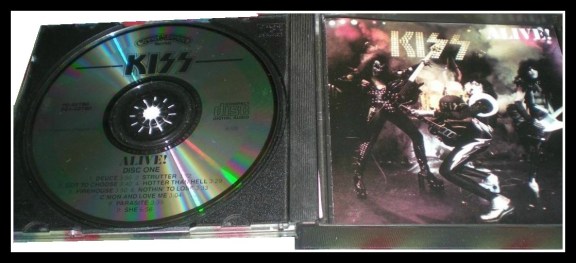
img_20170228_171256kiss-logoAlive! (1975 Casablanca, 2006 remastered edition from Alive! 1975-2000)

Music fans consider it one of the greatest live albums of all time.  Its name is spoken in the same breath as Frampton Comes Alive, Cheap Trick At Budokan, and Deep Purple Made in Japan.  It spawned thousands of young new guitar players (particularly of the grunge era), eager to emulate the six string heroism of Ace Frehley.  There is really only one miniscule issue:  Kiss Alive! is not really live.

Oh sure, Kiss and producer Eddie Kramer did record live shows.  When they listened back to the tapes, there were no performances that satisfied them.  Kiss were too rambunctious live.  They were busy jumping around, entertaining the crowd, not paying attention to each and every note.  For the live album, they weren’t looking for perfection, just performances without glaring mistakes or noise.  They realized they didn’t capture that with the shows they recorded.   So they did what most bands do:  went back into the studio and try to fix it.  Lead singer and guitarist Paul Stanley explained it in his book: “Yes, we enhanced it – not to hide anything, not to fool anyone.  But who wanted to hear a mistake repeated endlessly? Who wanted to hear an out-of-tune guitar? For what? Authenticity?”

Authenticity is an important part of great rock music, but not the only important part.  If you can’t tell the difference, then does it matter?  Fans listened to Kiss Alive! for decades, blindly enjoying every detail, from Ace Frehley’s extended “Rock and Roll all Nite” guitar solo, to Paul Stanley’s unforgettable stage raps.  Few suspected anything was out of the ordinary, unless they heard original bootleg recordings of the same Kiss gigs.  Eddie Kramer and the band re-recorded approximately 70% of the album.  The only thing they didn’t have to touch were Peter Criss’ drums, which were already pretty solid.  Bass, vocals, and even lead guitar was touched up and fixed, all but seamlessly.

img_20170228_171207

The reason Kiss Alive! was and is considered great is that you can’t tell the difference.  Unlike a double live Poison album (or even Kiss Alive II), you cannot hear obvious fixes and overdubs.  Kiss Alive! might not be authentic, but certainly sounds it.

With 16 scorching tracks all sourced from the first three Kiss albums, Alive! is all killer and no filler.  Even the typical “slow” moments, such as a long Paul Stanley rap backed by a Peter Criss drum solo (“100,000 Years”) is an unforgettable highlight.  Importantly, the new live version of “Rock and Roll all Nite” became the definitive one.  Today, it’s not the studio original version that still gets ready airplay.  It’s the Kiss Alive! version.  Many of these tracks usurp the originals as the superior versions:  “Firehouse”, “Cold Gin”, “Watchin’ You”, “Nothin’ to Lose”, and just about everything from Hotter Than Hell.  For the first time, all the warmth and energy are captured on Kiss vinyl.  If any of their studio material sounded sleepy, then this was a shot of caffeine.  Any sonic issues with the first Kiss studio albums are quickly forgotten by these volcanic recordings, finally capturing Kiss’ full power…in a roundabout way.

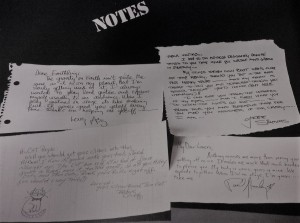
Kiss Alive! saved the band, and saved their record label Casablanca records.  Casablanca were on the verge of bankruptcy, and manager Bill Aucoin had to put the band on the road using his American Express card for currency.  Alive! put everybody back in the black.  It also put Kiss on the map as a rock and roll band to be reckoned with.  The two LP set was decked out with a gatefold sleeve, photos, a booklet, and even written notes from the band members.  For the first time, it felt like Kiss had released an album that lived up not only to their show, but their larger than life image.

Whether you decide to pick up Kiss Alive! on CD or LP, you will be in for a “rock and roll party” as per Paul Stanley.  Our recommended edition:  The four disc 2006 box set Alive! 1975-2000.  The set contains four volumes of Kiss Alive, deliciously remastered, with each album fit onto a single CD without losing any songs.  Fire away.

Today’s rating:

5/5 stars


Uncle Meat’s rating:

4.5/5 steaks 

Meat’s slice:   I would approximate that it was probably somewhere around 1978 when I first heard this record at a friend’s place.  I sat there and stared at the inner booklet and the album artwork, and I just wanted to be there.  I actually did get there many years later, but since I was like nine years old at this time and had not seen any sort of concert, it was all I knew of what a rock show was.  The picture on the back of the album taken at Detroit’s Cobo Hall is an unforgettable one, and makes you almost feel like you are there.  You get the scope of what it’s like to be on the floor for an arena show.  Tracks like “She”, “100,000 Years” and “Cold Gin” shine on this record specifically because of the banter of Paul Stanley.  I think it’s what truly makes the album special.  It wouldn’t surprise me to hear that Bruce Dickinson may have learned a thing or two from the Starchild on how to connect with an audience.  Alive! is the most important album of Kiss’ career, and is especially significant for those who were lucky to be a Kiss fan at a young age, while their unstoppable takeover of the Earth was building and building.

Following the release of Kiss Alive! in September of 1975, the second half of the 70s became known as the “Live Album Era” of Rock and Roll. Not only were a lot of bands doing it, but they were having massive successes with them (At BudokanFrampton Comes Alive...Unleashed in the EastIf You Want Blood etc).  This pioneering album was able to make the listener feel like they were actually at a rock concert, better than almost any live record has since.  Kiss Alive! was truly the birth of what is now known as The Kiss Army.

However with all this good comes some bad.  It was revealed years ago what everyone had already suspected: Most of the record is overdubbed and even most of the crowd noise is dubbed in.  For this reason and this reason alone I didn’t give this album 5 steaks.  But I refuse to go lower than 4 ½ .

Favorite Tracks:   All of it.

Forgettable Tracks:  None


To be continued…

Original mikeladano.com review:  2012/07/03