#533: Spirituality as a Heavy Metal Fan

STOPARRETThe below is a personal non-preachy discussion on living life as a Christian heavy metal fan.  I’m not interested in changing anyone’s personal convictions, just telling a story.  If this bothers you, press “back” now.


papa

GETTING MORE TALE #533: Spirituality as a Heavy Metal Fan

Any fan of heavy metal music who is also a believer in the Lord above has had to come to grips with this apparently hypocrisy.  How can one follow the word of God and yet listen to Ghost?

Believe In One God Do We,
Satan Almighty,
The Uncreator Of Heaven And Evil,
And The Unvisable And The Visable,
And In His Son,
Begotten Of Father,
By Whom All Things Shall Be Unmade,
Who For Man And His Damnation,
Incarnated,
Rise Up From Hell,
From Sitteth On The Left Hand Of His Father,
From Thense He Shall Come To Judge,
Out Of One Substance,
With Satan,
Whose Kingdom Shall Haveth No End.

I wrestled with this contradiction very early in life. As a young Catholic-raised kid discovering rock music, I wanted to make up my own mind. One of my earliest sources of music via the magic of Sunday afternoon taping sessions was my next door neighbor George.  In addition to the Kiss discography, George had most of the Maiden, Priest and Ozzy catalogue either on LP or cassette.  George wasn’t particularly religious, but one afternoon he did tell me, “I won’t listen to anything Satanic.”  I took that to mean that Maiden, Priest and Ozzy lyrics checked out A-OK.

Many people of faith have found that their religious convictions shake and waver over the years.  That period for me began in the 1990s, although I never considered myself an agnostic or an atheist.  I was in the early years of my University career; that period when you think you know it all.  I remember some fierce discussions around the dinner table with me loudly proclaiming that I was the only sitting authority on whatever subject had come up.  My parents remember them too, as the naive younger me spouted off about whatever I read on an overhead projector.  Meanwhile, I was frustrated that they didn’t seem to be giving my lecture serious enough consideration.  Some dinners ended up with me storming up to my room in anger with my food unfinished.

One of my earliest courses in University was my first year introduction to Anthropology.  The prof, whose name long escapes me now, was an animated character.  His long hair was always tied up in a ponytail on the back of his head.  He wore suits and ties to class, which most profs did not.  Many (especially in the psych department) preferred socks and sandals.  He told anecdotes and moved around a lot.  He always kept one hand on the podium.  The class noticed his storytelling sessions always proceeded with one hand firmly anchored, keeping him in a tight orbit at the front of the classroom.  He was a fantastic teacher and I briefly considered a career in Anthropology before I realized it involved a great deal of travel and going out of doors.

He was most certainly an atheist, which is unsurprising considering that the first semester of the class was about primate evolution.  He was fascinating, and though I never doubted the science of genetics and natural selection, he certainly proved to me that the simple 7-days 7-nights story of the Bible did not happen as simply as it was written.  That could only be allegory for a sequence of events that humanity did not have words for or basic knowledge of at the time.  Knowledge is cumulative.  We know now that we can follow the development of life through fossils, getting older and older as we dig deeper.  Things line up, make sense.  He explained to us why the concept of a “missing link” is a logical fallacy.

None of this bothered me.  Even though I wouldn’t consider myself a spiritual person at that age, I just assumed any God who is truly all knowing and all powerful could easily create the universe as it was, with the laws of nature, physics and all the matter inside it, via the Big Bang.  It would still turn out exactly as He envisioned it to, because that’s the definition of an all powerful God.  There didn’t seem to be any contradiction to me.  I tried to argue this as part of an intro Philosophy course paper that I wrote the same year.  I attempted to go to the quantum scale to explain things and blew it fabulously.  That paper was a C-, if I recall correctly.  The T.A. that marked it suggested that the quantum section should have been axed completely.  (He was absolutely right!)

At the same time, I was very deeply invested in a love of heavy music, having collected at least 400 tapes at that stage.  Stryper aside, none of them were Christian rock.  There were plenty of masters of the dark arts, however:  Alice Cooper, the Ozzman, the Sabs, Priest, Maiden and the lot.  As least, that’s the way many religious folks seemed to think it was over the years.  I couldn’t hear any Satanism in their lyrics.  Look at the words to Sabbath’s “After Forever”:

I think it was true it was people like you that crucified Christ,
I think it is sad the opinion you had was the only one voiced,
Will you be so sure when your day is near, say you don’t believe?
You had the chance but you turned it down, now you can’t retrieve.

Perhaps you’ll think before you say that God is dead and gone,
Open your eyes, just realize that He’s the one,
The only one who can save you now from all this sin and hate,
Or will you still jeer at all you hear? Yes! I think it’s too late.

Because the song also has a line that goes “Would you like to see the Pope on the end of a rope – do you think he’s a fool?,” some folks are likely to get their panties in a bunch. Context in any art form is important, often true with lyrics.  It’s hard to imagine Ozzy sitting there seriously worshipping Satan when he’d rather be drinking, don’t you think?

At the same time, I was collecting the albums of Savatage, and their lyrics sometimes had a clearly Christian bent.  Their Streets album features a character called “D.T. Jesus” and a full-on Holy character redemption.  This didn’t bother me either.  It stirred warm memories of Bible stories that I learned in school.  Most importantly at that time, I was learning that music lyrics are not always meant to be taken at face value.  Take Poison for example.  You might think that the “Unskinny Bop” might be an exercise regime.  They cleverly disguised their true intention with made-up words.  Ozzy isn’t singing about his belief in the undead in “Bark at the Moon”.  Maybe he’s inspired by some movie he saw as a kid.  Does it really even matter?  It’s just a song.  It’s just entertainment.

OZZYThere is one instance when paying attention to the words does really matter, such as when a vulnerable youth might think “Flying High Again” sounds really fun and cool because Ozzy said so.  But that is where the parents must step up.  It’s not Ozzy’s responsibility, nor the state’s, to monitor what your kids are doing.  Pay attention to what they are listening to and make sure you give them the straight talk on any issues that concern you.  That’s what my parents did (unbeknownst to me).  My mom read over the lyrics when I wasn’t home.  She never had made any musical demands of her son other than “turn it down” when it was too loud.

I felt a stronger return to my faith around the time I met my wife.  Our connection seemed beyond just two random people falling for each other.  It seemed like two puzzle pieces coming together.  Like I’d finally found the one who understands and puts up with my bizarre self, and vice versa.  It’s not about thinking “I was made for loving you, and you were made me loving me,” so much as feeling it.  One thing I learned from Philosophy class is that faith is not something you can prove or disprove.  The definition of an omniscient and omnipotent God means He or She could create the universe we live in without leaving any trace of His/Her existence, nor any purpose we can comprehend.  Maybe we’re all just chess pieces on a big chess board.  You don’t know and you can never prove it one way or another, because how do you know your “proof” isn’t just another move in the chess game?

Faith means you believe something or not.  I think science is pretty bang-on with how it describes how the universe behaves, and will continue to modify and reshape its theories based on what comes flying out of the next particle accelerators.  It’s an exciting time to be following science, as we unlock some of the most elusive particles predicted by theory.  At the same time, events in my life (far more than just meeting my wife) have made my heart lean further in the direction of faith than disbelief.  I think whoever it is that created the universe did so with the laws of nature that we study today.  I think that science is peering into the mind of God, as Einstein suggested.  I came to these conclusions on my own; only later did I realize many got there before me.

As for lyrics about Satan even though I’m on the other guy’s side?  I think it’s all about being a good person in the time you’re given on this Earth.  I don’t care what you call it; that doesn’t mean we can’t be friends.  As long as you try to go about your life without being an asshole, sure we can be friends.  For example I’d be foolish to exclude you from friendship just because we don’t share the same opinions on (delicious) olives.  I’d be equally foolish to exclude you just because you have different ideas about how we all got here.  I think, if anything, we’re all here to help each other.  We should do that anyway, even if it’s just holding a door open for your neighbor.  There are some things that some Christians consider hellfire-worthy sins that I could care less about.  It was always important for me to find a balance between my spiritual beliefs and what I know to be right or wrong.  I’ve encountered a few Christians who say that homosexuality in a sin.  A really bad one, too.  I don’t want anything to do with that statement.  I know in my mind and my heart that it doesn’t matter what gender you’re attracted to.  What matters is using your time on this Earth to be the best person you can be.

I like Ghost; I don’t have to sing along to their music if I’m not feeling the words.  That’s free will, and I don’t think I’ll go to hell for exercising it, even though some folks have warned me that’s where I’m headed.  I hope that when it comes to the important choices in life, I’ve made more of the good kind than bad.  At the end of it all, that seems to be more important.

Reverend X.  Much different than Catholic school.  Is that a phone book?

REVIEW: W.A.S.P. – First Blood…Last Cuts (1993)

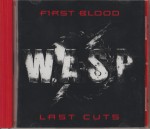
scan_20161125W.A.S.P. – First Blood…Last Cuts (1993 Capitol)

When grunge took over the airwaves in 1991-1992, a lot of older guard bands found themselves without a record contract.  W.A.S.P.’s 1992 concept album The Crimson Idol failed to generate enough interest for Capitol Records to continue investing in the band.  A greatest hits contractual obligation album was a typical move for bands in this situation, and that is how First Blood…Last Cuts came to be.  With that in mind, the 16 track album is great bang for the buck.  Rarities and new songs add value, and the photo-loaded booklet is tons of fun.

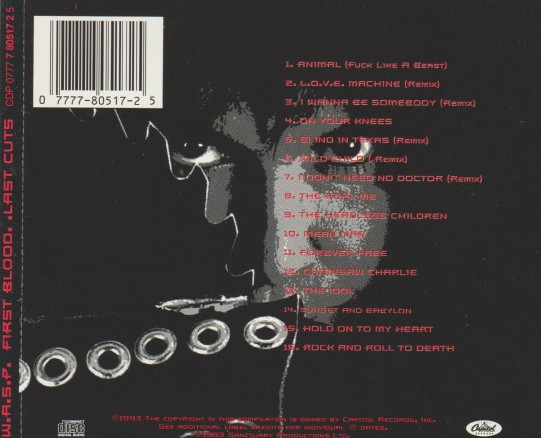
A rarity right off the bat, “Animal” was a non-album single and W.A.S.P.’s first.  It’s better known as “Fuck Like a Beast”, and that might explain why it wasn’t on the W.A.S.P. album.  A good but not exceptional track, it does boast a nice metal chug, but it’s otherwise just there for shock value.  It is primitive metal akin to the first LP, with Blackie in full screech.  You either like W.A.S.P. or you don’t.

“L.O.V.E. Machine” from the first LP is remixed with the first verse re-recorded, for some reason.  Presumably Blackie must have been dissatisfied with the original.  There are several remixes on this CD, including singles “I Wanna Be Somebody”, “I Don’t Need No Doctor” (a metalized Ray Charles cover via Humble Pie), “Blind In Texas” and “Wild Child”.  The remixes generally have a sharper drum sound, particular the tracks originally from the muddy first album.  The remixing leads to an uneven listen.  Rather than sounding fresh, the remixes feel off-kilter and slightly unfamiliar, especially when butted up against non-remixed tracks.  The muddy “On Your Knees” follows the remixed “I Wanna Be Somebody”.  The transition between the two songs, both originally from the same album, could be better.

Thankfully the strong songs outnumber the middling by a hefty margin.  “Headless Children” and “The Real Me” (a Who cover from Quadrophenia) remain two highlights of the W.A.S.P. canon.  The chugging heavy epic “Chainsaw Charlie” has never been topped by Blackie.

The final incentives are the two new songs, although one (“Rock and Roll to Death”) was recycled on 1995’s Still Not Black Enough.  “Sunset and Babylon” is special as it features Lita Ford on guest lead guitar.  The nimble-fingered Ford adds some character to the tune, a pretty standard rock n’ roller from Blackie and cohorts.

At 75 minutes, First Blood…Last Cuts is a long running album providing great value.   Perhaps it runs a song or two too long, but nit picking aside it is a solidly hot listen through.  The drunken cowboy blasts of “Blind in Texas” are as fondly remembered as the gentle strumming on ballads like “Hold On to My Heart”.  Indeed, as the album runs on to its second half, ballads begin to outshine the rockers.  “Forever Free” remains one of W.A.S.P.’s brightest stars, as likeable as it was in 1989.  “The Idol” is a darkly beautiful ballad demonstrating that Blackie Lawless is indeed deeper than just his assless chaps.  Although the album dialogue should have been chopped for this greatest hits CD, it just breaks up the flow.

Most people do not need all the W.A.S.P. albums.  In fact, scientific studies have shown that one or two W.A.S.P.’s is all the average homo sapiens will ever need.  First Blood…Last Cuts would be solidly recommended CD for your first or only W.A.S.P. purchase.

4/5 stars

scan_20161125-2

Part 150: Smells Like Presents [Reblog]

It’s the most wonderful time of the year…

I thought it would be fun going forward to re-post old chapters of Record Store Tales that you may have missed. Enjoy this Christmas-themed re-post!

RECORD STORE TALES Part 150:  Smells Like Presents

Our original computerized inventory system forced us to manually type in every album title ourselves.  Out of sheer boredom, often we’d shake it up a bit.  For example, just for laughs, we’d often input Alanis Morissette’s album Jagged Little Pill in the system as Jagged Little Pillow.  Or whatever.

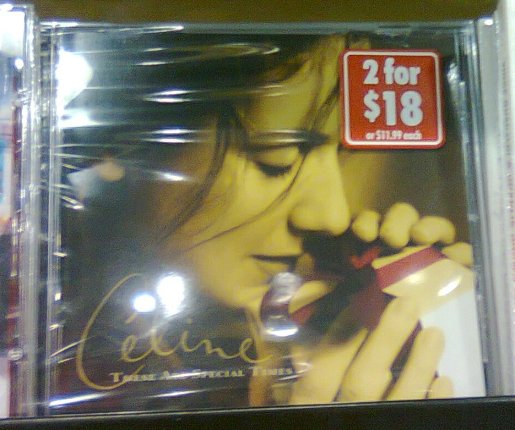
When we saw this Celine Dion Christmas album come in, somebody came up with a clever custom title for our system.  Remember that Marilyn Manson album, Smells Like Children?  Take a look at the Celine Dion album cover.  You’ll understand why we used to call this one Smells Like Presents!

Photo0942

R.I.P. Sunrise Records, Fairview mall

REVIEW: Al Atkins – Victim of Changes (1998)

scan_20161117AL ATKINS – Victim of Changes (1998 Pulse)

Al Atkins was the original lead singer in Judas Priest, before “Bob” Halford was invited to join. You’ll find a number of Atkins credits on the first two Priest albums, even though he was out of the band by that time. In fact, Atkins formed a band called Judas Priest in 1969. The band were named by bassist Bruno Stapenhill. They split in 1970, and Atkins went looking for a new band. He found them in Ken “KK” Downing and Ian “Skull” Hill, who were looking for a singer. With Atkins and drummer John Ellis, they eventually settled on the name Judas Priest, same as Atkins’ prior band. And yes, that means that Ian Hill is actually the only remaining original member of Judas Priest.

Atkins wrote and co-wrote much of Priest’s earliest material. Before he left, he wrote a song called “Whiskey Woman”. Rob Halford used that song and merged it with one of his called “Red Light Lady”. The result was “Victim of Changes”, the first and perhaps greatest of Judas Priest’s epics. Two other songs he wrote in Priest were “Mind Conception” and “Holy is the Man” which were demoed but never released.

Atkins worked a 9-5 job after Priest, but got back into music again in short order. His fourth solo album, Victim of Changes, was essentially a tribute to his Judas Priest years. It is a collection of new recordings of (mostly) a lot of numbers that Priest played live during the Atkins era.  As a gimmick, he had Priest’s drummer from the 1980s, Dave Holland, on this album.

Atkins and Halford couldn’t sound less alike.  Rob is known for his high-pitched operatics.  Atkins has a gutsier, grittier sound, somewhat like a Paul Di’anno meeting Blaze Bayley.  There is no question that Rob is the right singer for Judas Priest, so it is really only a matter of curiosity to hear these tunes with Atkins singing.  The tunes are at least good.

The unreleased “Mind Conception” commences the disc, re-recorded and very modern sounding especially in the guitars.  It is difficult to know exactly what the original “Mind Conception” sounded like, but it’s very safe to say it would not have sounded like this.  In the liner notes, Atkins states the original demos were recorded stoned and with a sore throat.  “Holy is the Man” has a slower groove to it, and would work very nicely as a modern Priest track.  As the only representation of these unreleased tracks available, die-hard Priest collectors will want to hear them.  Another track of interest is the cover of Quatermass’ “Black Sheep of the Family” which Priest played live at their earliest gigs (along with Hendrix’s “Spanish Castle Magic”).  Rainbow’s recording is still the one to beat.

scan_20161117-2

The familiar Priest tracks are actually anything but.  They are probably arranged more like the way Priest used to play them in the early days.  “Never Satisfied” is extended with a tough bluesy acoustic intro.  The heavy parts have a Zeppelin-y beat, due to Holland’s straightforward style.  Same with “Winter”.  Then there is “Caviar and Meths” which is a whopping 7:12 long.  According to Atkins, this song was their big finale live, but never recorded in full in the studio.  This version is the full-length arrangement that they used to close with live.  And it’s brilliant.  Finally there is “Victim of Changes” itself, and Atkins has some help from a backup singer for the high parts that Rob does.

There are a couple tracks that could be considered filler, since they have nothing to do with Judas Priest.  These are the instrumentals “The Melt Down” and “Metanoia”, written by guitarist Paul May.  They are excellent tracks, however, and should not be ignored.  (“Metanoia” serves as a postscript to “Winter” on the CD.) They are European sounding heavy metal tracks, loaded with guitar drama and ferocity.

Check out Victim of Changes for a glance at what Priest might have sounded like with Al Atkins singing lead.  One can hope for those unreleased demos to surface, but one can also wish for the moon.

3/5 stars

#532: If You Have Ghosts…

GETTING MORE TALE #532: If You Have Ghosts…

Many rock stars claim to have seen ghosts, or had supernatural experiences.  Geezer Butler from Black Sabbath and Mick Mars from Motley Crue are notable examples.  A black shape that Butler saw scared him “shitless”.  Ke$ha even claims she has had sex with a ghost, though that seems a little outlandish.  Robby Krieger and Ray Manzarek of the Doors think they may have been contacted by the spirit of Jim Morrison.  Sting thinks there is one in his house.  Ace Frehley claims a ghost threw a book at him, though substance abuse may have been a factor.

Tales of spirits and hauntings go back thousands of years.  As old as civilization itself are tales of the supernatural.  Yet over all this time, nobody has ever captured any tangible evidence that would satisfy science that ghosts exist.  This certainly does not mean ghosts do not exist.  Absence of evidence is not evidence of absence.  We are still learning much about the universe.  Skeptics have good reasons to be skeptical, while others have decided to go ghost hunting for themselves.  Ritchie Blackmore was well known for performing seances in his Deep Purple days and over the decades.  He stated that he has contacted many spirits, and “ghosts are very real, but not in the physical sense.”

blackmore seance

Artist’s probably very accurate impression of an actual Blackmore seance

The only experience that I simply cannot explain I have had happened when I was in grade 9 or 10.  I was sleeping, it was the middle of the night.  I was awaken by a shocked feeling that someone has just hit me hard in the face with an object like a pillow.  Like if you wanted to prank your brother or sister awake and smacked them in the face with a pillow as hard you can in the middle of the night.  I woke up with a start and there was nobody in the room, nor any object that would have hit me in the face.  My pillow was under my head the whole time.  Was it a ghost?  All I know is that I can’t explain it.

This reminds me of an experience Mick Mars wrote of in Motley Crue’s The Dirt.  Something (a ghost or an alien) seemed to shake his bed regularly.  He could physically feel it, just like I could feel the pillow smacking me in the face.

One night 10 years ago, I have the opportunity to try a little ghost hunting myself.  I wrote an email about it to a friend, so here are the fresh details from that night:


12-09-07_1628

We were in Mississauga at a party.  These two guys lived in the house and somehow the conversation got to weird stuff they’d seen.  Including:
 
  • A man standing at the top of the staircase, looking down into the basement.
  • A child wandering around the house.
  • A pale woman at the front door.
 
All these figures were solid, not transparent, seen by more than one person, and more than once.
 
They also:
Heard yelling, the sounds of people falling down stairs, and someone banging on the dryer in the basement even when the house was otherwise empty.
 
And they saw:
  • Coins on the floor where there were none before.
  • The dryer was known to move a few feet even when unplugged, blocking a doorway in the basement.
 So we turned off all the lights and went down to the basement to shoot some video on my cameraphone.  We shot ten minutes of video.  In the first minute, Alex dropped the camera because he was startled by seeing a face in front of him.  The face was not on camera but we ran our asses off out of there.  In the last minute, upon replay, we got a very strange light on camera.  I can’t explain it as the room was pitch, pitch dark.  Yet you can see a tiny pinpoint of light on camera, bright and distinct.  And that creeped me the fuck out!
 
I still have it on video and can’t explain it.
 

I can explain it now.  I reviewed that video many times.  It was disappointing to reason out that there was still one obvious light source in that pitch black room.  The screen of the camera phone itself had a slightly blue colour.  Same colour as that pinpoint of light.  It was just the reflection of the screen on the glass window of the dryer.  A mundane but simple explanation.  I’m sure most are.
 
*All due respect and inspirational credit to 1537 for regularly using Lego in his artwork.  I am but a mere ghost of your talent, sir.


REVIEW: Ted Nugent – Double Live Gonzo! (1978)

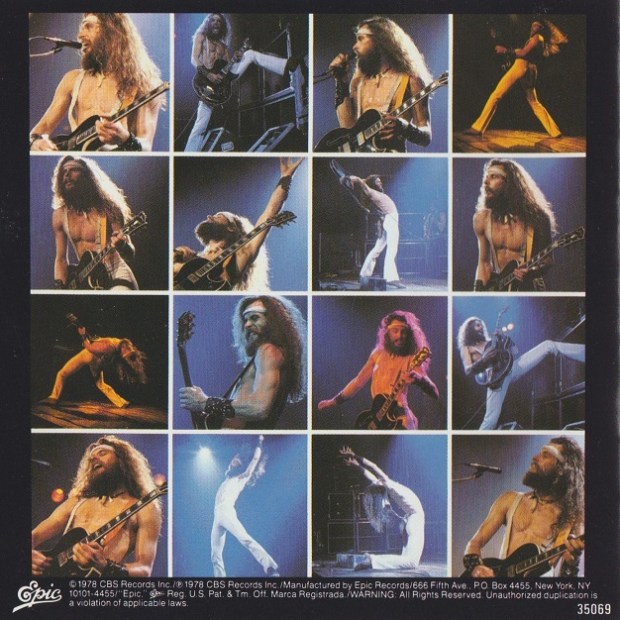
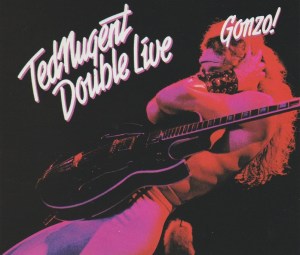
scan_20161129-2TED NUGENT – Double Live Gonzo! (1978 CBS)

Ted Nugent has expressed his displeasure with Double Live Gonzo! I wish I still had the 1990 magazine interview where he trashed the record, because I have to strongly disagree. To these ears, Double Live Gonzo! is another one of those incredible 1970s cornerstone live albums that every self respecting rocker should listen to at least once. It’s the album that spawned the name “Nashville Pussy”, and houses the definitive live take of “Great White Buffalo”.

Double Live Gonzo! was recorded at multiple shows. The shout-outs to Nashville and San Antonio (“suck my bone-i-o!”) make that obvious, but it’s not a detriment to the LP. With Derek St. Holmes on guitar and vocals, Ted and the gang bring the rock and roll noise to the best party in town. All you have to do is hit play and hold on tight.  It’s an intimidating track list at first: three songs run over 10 minutes, with the majority over 5:00. There is Terrible Ted on the front cover, covering his ears as if in pain from the powerful feedback contained inside.

Ted’s hits are present (“Catch Scratch Fever”, “Stranglehold”, “Yank Me Crank Me”) but are overshadowed by more epic rock orgasms. “Great White Buffalo” and its incredibly dexterous riff is the main attraction.  Though this song was originally recorded by Nugent’s Amboy Dukes, the live version is the most important.  Love Ted or hate him, no serious rockers should have to live without “Great White Buffalo” in their collections.   It’s all about that riff, which is hard to duplicate but impossible to forget.

The Indian and the buffalo,
They existed hand in hand,
The Indian needed food,
He needed skins for a roof,
But he only took what they needed, baby,
Millions of buffalo were the proof.

But then came the white man,
With his thick and empty head,
He couldn’t see past the billfold,
He wanted all the buffalo dead,
Everything was so sad.

The Amboy Dukes’ “Hibernation” grandstands with some equally impressive musical chops (as do all the songs).  Almost as good as “Hibernation” itself is its live intro.  Ted introduces his guitar to the crowd:  “This guitar right here is guaranteed to blow the balls off a charging rhino at sixty paces,” he claims.  “You see this guitar definitely refuses to play sweet shit, you know, it just refuses.”  However “Hibernation” is pretty sweet, as far as rock n’ roll goes.

If you are looking for some “Wang Dang Sweet Poontang”, then Terrible Ted has your prescription:  it’s “Just What the Doctor Ordered”.  The Nuge has done a few live albums over the years, but none as beloved as Double Live Gonzo!  For its minor faults (it could sound beefier with less crowd noise), Double Live Gonzo! serves the needs of the masses looking for some full bluntal Nugentity. His gut-busting guitar playing can’t be touched and with Derek St. Holmes in the house, you also don’t have to listen to Ted singing lead on every track.

Double Live Gonzo! isn’t just for guitar players, but guitarists will absolutely dig Ted’s incredible licks and control of feedback. Few guitarists can command the instrument like Ted does. Players will find much to examine, while the average listener can just look forward to a double serving of 1970s live rock. No lyrical messages, just brutal sonic massages.

4.5/5 stars

scan_20161129-3

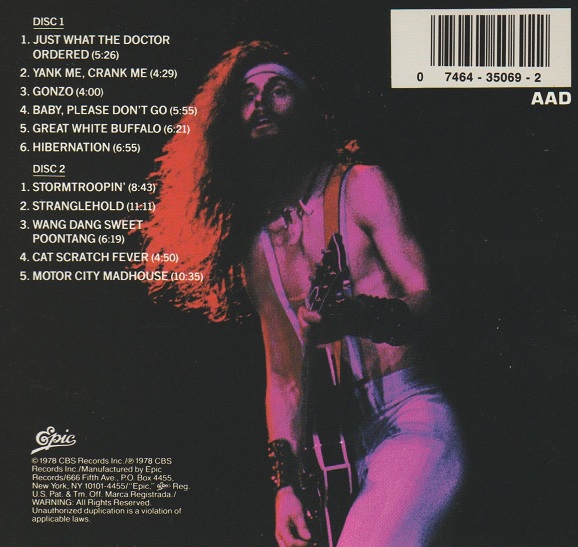
The back cover has a mis-print.  “Hibernation” is 16:55 long, not 6:55.

#531: The More Things Change…

GETTING MORE TALE #531: The More Things Change…

The first record store I worked in no longer exists.  It closed (moved actually) in 1996, but even the physical location it was in has gone.  It was tucked away in a mall, but that unit was torn up and enlarged and made into a discount store.

That entire mall has changed completely in the last 20 years.  I spent a lot of years in that mall as a kid, teen and young adult.  Before the record store opened in ’91, I would mostly shop at the Zellers store.  Zellers wasn’t bad.  They carried 7″ singles, and that is the very store about which Record Store Tales Part 4:  A Word About B-Sides was written.  The fact that they even had singles made my early music collection much more interesting.  Once I even spied a very rare Def Leppard promotional cassette called Soundtrack to the Video Historia.  It was exactly that — a cassette version of all the songs on Leppard’s Historia home video.  I assumed it would have the rare video mix of “Pour Some Sugar On Me”, and I wanted it.  But they wouldn’t sell it to me, even though it appeared in their flyer that week.  Whoops.

During my highschool years, the mall even had an A&A Records & Tapes.  A&A closed up shop nationwide in 1990-91 (much sooner in our mall).  Now Zellers is gone too (turned into a Walmart) and the grocery store Zehrs has grown supersized.  My first ever job was at the Zehrs store.  Now I can’t find my way around it; it’s too huge.  Trying to find a box of crackers takes me 15 minutes.  I have so much history with that mall.  My dad worked there before I did.  Amazingly, the bank at which he used to work is still open, though completely changed and enlarged.  His old office is now just part of the general reception area.  The old vault, which my dad used to let me into when we visited, is also long gone.

When we were really young, my mom, sister and I went to visit my dad at the bank regularly.  We liked playing with the calculator and his phone.  My sister enjoyed sitting in his big chair.  Within reach of her tiny hands was the silent alarm, hidden under his desk.  She found it, and decided to try it out and see what it did.  Nothing!  Nothing at all.  We left and headed home, while my dad continued work.  A few minutes after we departed, in rolled a squad of cops responding to the silent alarm!  My dad had no idea, but he figured it out in short order.

Needless to say, I grew up with that mall as a second home.  When I was in grade school, it was basically right next door.  I knew every inch of it, at least the way it used to be.  The Baskin Robbins – long gone.  Little Short Stop where I bought all my comics, candy and Star Wars cards — gone.  The sole restaurant — gone.  Black’s Photography – gone.  Radio Shack – also gone.  Entire wings of the mall don’t exist anymore, swallowed up by other stores.  Nothing decent moved in to replace them.  Walmart took over the skeleton of Zellers and the grocery store expanded.  Everything else was taken up by crap discount stores of questionable value.  Nobody shops there anymore.  The mall is dead.  It used to be infested with mall rats.  Now you couldn’t find a teenager within 100 meters of that place.

The second record store I worked in was also in Kitchener, but not in a mall.  It was in a strip plaza.  That strip plaza has also completely changed over the last 20 years.  When we first moved in there, they had a coffee shop and a bank.  The coffee shop was gone within the first year and the bank a few years later.  There were two gigantic gift and craft shops – both gone.  There was a dollar store where we could pop in and buy a bag of chips – gone.  “Cheese chips” was our thing at that location.  It was a new flavour to us, cheddar cheese.  We bought a lot of cheese chips from that store.

That plaza doesn’t even look the same anymore.  Today, most of the stores have been bulldozed, including my old record store.  However they moved down a little ways; not too far for the customers.  These stores were torn down to make way for a new grocery store.  Quite a shock, to see my old store reduced to rubble.  There was nothing but concrete shambles where I spent every weekday for many years not so long ago!  A strange sight to behold.  So much happened on that little patch of rubble!  Half of Record Store Tales came from that destruction zone.

I think it would be fascinating to take a look at these places in another 20 years.  Will they even exist?  Will anyone care?  Or am I just another old fogie reminiscing about the “good old days”?  You only live once and I’m very happy to have lived where I have.

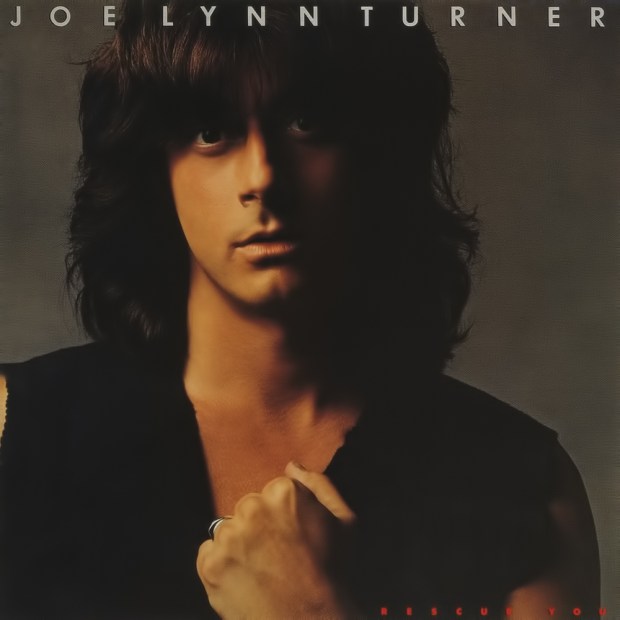
REVIEW: Joe Lynn Turner – Rescue You (1985)

jlt-ryJOE LYNN TURNER – Rescue You (1985 Elektra)

Post-Rainbow, Joe Lynn Turner embarked upon a solo career.  With the last Rainbow drummer Chuck Burgi on hand, Joe debuted his solo self with Rescue You in 1985 on Elektra.  Roy Thomas Baker, best known for his work with Queen, worked on the production.  All songs were written by Joe and guitarist Alan Greenwood.  The direction was heavy on keyboards, and sampled drum sounds.  The only thing in common with Rainbow is the voice.

That voice cannot be mistaken.  Nobody can sing soul-driven broken hearted AOR rock like Joe Lynn Turner.  Opening track “Losing You” fits this description like a glove.  The samples and keyboards are occasionally distracting, but the melodies are strong.  Joe has always been a fine writer.  Perhaps Journey should have knocked on Joe’s door for some help when they were struggling to come up with Raised On Radio.  The second song, “Young Hearts” is pure pop rock like Steve Perry did on Street Talk in 1984.

“Endlessly” was the single/video, a keyboard rock ballad, and a decent one at that, but it is overwhelmed by the title track. “Rescue You” is once again very keyboard heavy, but rocks better than anything else on the album. It has a European flavour, sounding a bit like some of the material Glenn Hughes was doing in the 1980s. Back to the Americas, “Feel the Fire” is a bit limp, but sounds like something that could have been played on radio.

The LP continued on side two with “Get Tough” which isn’t that at all. The toughest thing about it is Burgi’s excellent drumming at the start. The bassline sounds like “Livin’ on a Prayer” but before that song was ever conceived. One gets the feeling that many of these songs could have been hits if only recorded by someone more famous. “Eyes of Love” is a decent moody mid-tempo song, and Joe sounds awesome on it. “On the Run” is a bit more upbeat, boasting a strong chorus that’s as good as anything on Slippery When Wet.  Moving into Purple territory, “Soul Searcher” could have fit in well on their Slaves and Masters LP.  One almost aches to hear what Blackmore and Lord would have added to it.  Going into the closer, “The Race is On” really has the life sucked from it with the keys and samples.  You can distinctly hear a heavy blazing rocker desperately trying to get out.  The recorded song sounds half-arsed, with those unnecessary keys taking up valuable sonic ground.

Not a bad solo debut from Joe, but certainly inferior to the Rainbow that came before and the Purple that came after.

3/5 stars

scan_20161104

Songs written by Greenwood/Turner except noted

“Losing You” – 4:25
“Young Hearts” – 3:52
“Prelude” (Newman, Turner) – 0:56
“Endlessly” – 3:40
“Rescue You” – 4:31
“Feel the Fire” – 3:28

“Get Tough” (Delia, Turner) – 4:33
“Eyes of Love” (Turner) – 3:49
“On the Run” – 3:53
“Soul Searcher” (Greenwood, Newman, Turner) – 4:08
“The Race Is On” – 3:23

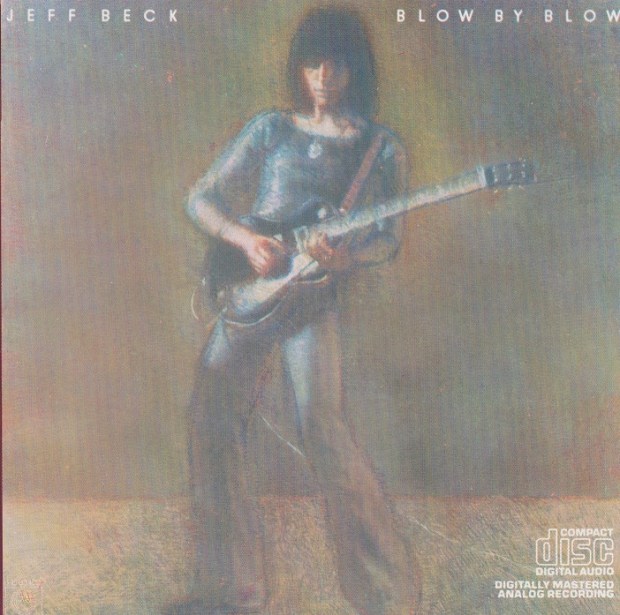
REVIEW: Jeff Beck – Blow By Blow (1975)

Purchased at BMV in Toronto, $4.99

scan_20161111-2JEFF BECK – Blow By Blow (1975 Sony)

Jeff Beck’s first solo album, Blow By Blow, was co-produced by George Martin.  The talents of both need no elaboration.  A guitar god and “the” producer’s producer were bound to make something special together.  With an ace quartet (Max Middleton on keyboards, Phil Chen on bass and drummer Richard Bailey), there were no weak links.

Blow By Blow spans many musical genres, all augmented with Jeff’s sharp and slippery fingerwork.  Funk, jazz, blues, Carribean and progressive rock all collide in the grooves.  The songs are instrumental hybrids of styles, but Jeff keeps it consistent.  His guitar speaks.  There really isn’t a better way to describe what he does with tone, technique and technology.  There is even an uncredited Stevie Wonder cameo on “Thelonius”.  If you can’t get enough funky clavinet, you’ll love Blow By Blow.

This albums is tops in almost every conceivable measure.  The drum rhythms and bass grooves are hard hitting and relentless.  Musicianship like this is rare and valuable.  Without Jeff Beck there could be no Steve Vai — this, I firmly believe.

Play Blow By Blow, and then play it again.  Thanks to George Martin’s fine musical sensibilities, it reveals new nuances each time.  A complete triumph.

5/5 stars

scan_20161111-3

This has been a 200 word review in the tradition of the #200wordchallenge.

REVIEW: The Sword – Age of Winters (2006)

Purchased at BMV in Toronto 2016 for $6.99.

scan_20161126THE SWORD – Age of Winters (2006 Kemado Records)

The scene:  Earth, post-Rapture.  A seedy bar somewhere in America, haunted by the few remaining survivors.  In walks a cloaked figure, here to recruit the only man who can help him defeat the Antichrist:  former CIA agent Stan Smith.  On the jukebox in the futuristic post-apocalyptic watering hole:  “Barael’s Blade” by The Sword.  (American Dad season 5 episode 9 – “Rapture’s Delight”)

Sounds bizarre, right?  Seth MacFarlane’s American Dad has always used modern rock music in interesting ways, and this wasn’t the only use of music by The Sword on that show.  “Iron Swan” appeared in an episode called “Minstrel Krampus” (also featuring soul crooner Charles Bradley).  Interestingly, not only are both these appearances in rather twisted Christmas episodes, but both songs were drawn from The Sword’s debut long-player, Age of Winters.

The doomy riffs of opening track “Celestial Crown” immediately recall early Black Sabbath circa 1970-72, but drawn out, slowed down, grinding heavy like a glacier carving its path through a mountain.  J.D. Cronise’s howling vocals break the ice on “Barael’s Blade”, but the assault continues right on to “Freya”.  This track, the ogre stomping “Freya”, wields multiple guitar riffs as heavy as the thunder of an avalanche.  The Norse goddess of fertility is also the goddess of war and death.  “Freya” brings the sonic conflict to your speakers.

When the “Winter’s Wolves” arrive, your senses are already overloaded by the riff-heavy metal.  “Wolves” centers on a heavy drum section, like Bill Ward on ephedrine.  Almost as if part of the same song, “The Horned Goddess” reverberates like a coda to “Winter’s Wolves”, different yet solidly in the same icy field.  “The Horned Goddess” soon transforms into a stampede of mammoths making their last stand.  Hypnotizing lead vocals welcome you into this hazy landscape of sound.

Acoustic instrumentation brings “Iron Swan” a different aura, like the Beatles via The Sword.  Then it immediately launches in a thrash metal “War Pigs”, as if all the speedy chops the band had in storage were being used up right now at this very moment.  Epic only touches on what “Iron Swan” is, as there is so much riffery that it becomes overwhelming.  Scientific studies* have shown that the human memory can only retain so many riffs at one time, and so “Iron Swan” becomes like a wave of them hitting your senses one after the other.

Painting of an Aurochs from Wikipedia

Painting of an Aurochs (Wikipedia)

The Aurochs, a part of European megafauna until their extinction in the early 1600s, were the direct ancestor of the modern domestic bovine whose products millions of people consume every day.  It is the Aurochs you see in cave paintings today.  The Sword have given us a seven-minute-plus “Lament for the Aurochs”, and we do not forget the impact that mankind has had on the ancient land we inhabit.  Although back-breeding has produced Auroch-like “Heck cattle”, we shall never feel the ground shake with a herd of Aurochs again.

“And none may see again the shimmering of Avalon,
Or know the fates of all the races man has cursed,
Long gone are the ages of the alchemists,
Now there are none who know the secrets of the earth.

“Lament the passing of the Aurochs,
And the slaying of the ancient wyrm,
Would you dare meet the gaze of the basilisk,
Or face the flames as the phoenix burns?”

The Aurochs give way to an epic instrumental “March of the Lor”, another exercise in maximizing potential riffage.  When “Ebethron” arrives to end the album with a hammering blow, it is a mercy killing.  Age of Winters is almost non-stop, all-in, nothing but riffs and pounding through its entire length.  That in mind, it only takes a short while to recover, and hit play one more time….

I look forward to exploring more of The Sword’s discography.

4.5/5 stars

Look for a review of album #2, Gods of the Earth, soon.

*Not really.