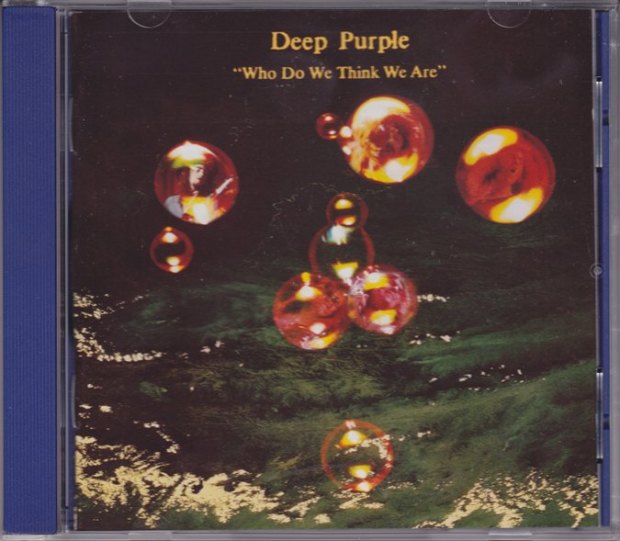


DEEP PURPLE – Who Do We Think We Are (1973, 2000 EMI)
Five solid years of work had taken their toll on Deep Purple. Relations between the band members (particularly Gillan and Blackmore) were frayed, especially since all the touring behind Machine Head and Made in Japan. There was all sorts of bad blood, including management disputes and illness (hepatitis for Ian Gillan).
The band settled in Rome with the Rolling (truck) Stones mobile studio, but found that the vehicle could not enter the premises, as the stone arch in the drive was not tall enough for the truck! Several weeks of work in Rome resulted in only one usable track, “Woman From Tokyo” which was released as a single. [See below for a cool 1998 CD reissue of “Woman From Tokyo” (2:56 edit)/”Super Trouper”!] Another song, the excellent “Painted Horse”, was rejected because Blackmore didn’t like it. It wasn’t even released as a B-side.


A few months later the band re-convened in Frankfurt Germany to finish the new record. Perhaps due to sheer fatigue, they settled into a simpler, bluesy sound without the experimentation that marked albums like In Rock and Fireball. The only really progressive moment on the album was a breakneck synthesizer solo on “Rat Bat Blue”.
The resultant album, Who Do We Think We Are, is generally considered the weakest of the original MkII studio quadrilogy. That still makes it better than many bands’ best albums. That aside, it is obvious by listening to it that Deep Purple were not putting as much in, and getting less out.
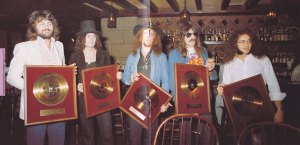
“Woman From Tokyo” is still a great Deep Purple track, very similar to the direction of Machine Head: straightforward, and slamming. It has a mellow, dreamy bridge before it assails you once more with its inimitable guitar riff.
It’s too bad that a song like “Mary Long” hasn’t been a perennial concert favourite. This scathing attack on two British social campaigners teases the prudish! “When did you lose your virginity, Mary Long? When will you lose your stupidity, Mary Long?” Glover’s bass groove carries the song, a real driving tune. Absolutely monstrous in the car.
“Super Trouper”, less than three minutes long, feels incomplete. It feels like it needed a chorus, although it is still heavy and a Purple sledge. Closing Side One, “Smooth Dancer” is Ian Gillan’s underhanded attack upon Richie Blackmore. Black suede was his favourite clothing:
Black suede, don’t mean you’re good for me
Black suede, just brings your mystery
I want to be inside of you
But you’re black and I don’t know what to do
You’re a smooth dancer
But it’s alright, ‘cos I’m a freelancer
And you can never break me though you try
To make me think you’re magical
Even though Ian’s not fond of Richie at this point, it’s important to hear the line “I want to be inside of you, but you’re black and I don’t know what to do.” Ian would have loved to be able to connect with Richie, but was simply unable to get inside the man in black. Glover too has stated that Ian was frustrated by his inability to connect personally with Richie.
 “Rat Bat Blue” (named for Ian Paice’s drum pattern that is the foundation of the song) is a great unsung classic. Funky and hard-hitting, “Rat Bat Blue” could have been a classic had it been released by a band that still wanted to be a band. “Rat Bat Blue” is my favourite on the album! (Note: the first time I bought the original CD at my own store, I ran into a manufacturing flaw – a moment of silence near the end where Ian sings, “Aaaaalright.” The CD with the defect just has “Aaaaaa” and then a second of silence! My boss would not let me exchange it.)
The final two songs (on a seven song record!) are both a bit slow. “Place in Line” has some swinging jamming blues to it, and “Our Lady” has gospel flavors and an incredible organ solo. Neither would be remembered as Deep Purple classics, although “Our Lady” is very special. Notice there’s no guitar solo, either. Jon does all the serious work.
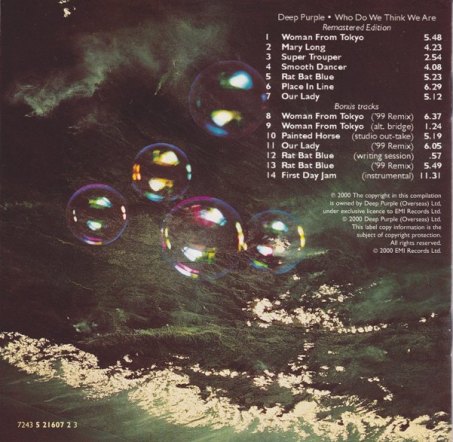
The remastered edition has some cool bonus tracks. There are several 1999 remixes, with Roger Glover assisting at the mixing console. Like prior Deep Purple remixes, you can hear additional guitar and other bits that weren’t there before. They are great companion pieces to the album tracks, particularly the smouldering “Rat Bat Blue”. There are also two snippets from the writing sessions: an unheard bridge from “Woman From Tokyo” and a bit of a deleted intro from “Rat Bat Blue”. An eleven-minute instrumental “first day jam” is interesting because it has no guitar. Roger Glover was late to the session, so that’s Blackmore on bass!
Finally, the rare outtake “Painted Horse” is restored to CD. You could get it previously on the posthumous Power House compilation CD, but once placed on the album, it’s clearly one of the best tunes. Why it was disliked is beyond me. Maybe it’s Ian’s falsetto vocal or harmonica. I think they just serve to make the song more unique. This remastered version sounds loads fuller than the one of Power House. I also love Ian’s lyrics. “Why did the carpenter die?”
For the geeks, I’m sure you will enjoy the fully loaded CD booklet, with another essay by Glover, remembering times good and bad.
I like Who Do We Think We Are enough for a solid rating, but I’m not sure it that accurately reflects how Deep Purple fans at large felt about it. If Machine Head, Fireball and In Rock are all 5/5 stars, then Who Do We Think We Are can be justified at:
4/5 stars


 THE GLORIOUS SONS – The Union (2014 Canada Factor)





 GEORGE LYNCH – Sacred Groove (1993 Elektra)






 mikeladano.com