KMA REVIEW: Kathryn Ladano – Open

This review is a re-press from keepsmealive; please drop by their site too! 

Kathryn Ladano – Open

Kathryn Ladano - Open. Now available.

www.kathrynladano.com

Miles Davis was once quoted as saying “…I’ll just walk into the ocean and die, if I lose my tone.” All musicians, whether they admit it so freely or not, are seeking that elusive tone that defines them. Granted, Kathryn Ladano has a slight advantage in that the bass clarinet has not been an instrument of choice for most musicians. But therein, also, lies the challenge, and she handily tames the beast. Her tone is clearly the product of long practice, natural creativity and, most importantly, soul.

Part soundtrack to, perhaps, a playfully dystopian horror film, part sound/texture experiment, but all done with intention and purpose, Open reveals mastery behind apparently random strings of notes. For those conditioned by mainstream jazz and pop to expect chordal resolutions, most tracks on this record will not satisfy. And fair enough. From the outset it’s musically made clear that Open is not here to hold your hand. But play it through, especially on quality headphones, until your understanding of the pieces (if you’ll pardon the play on the title) opens. Once it does, there are treasures around every corner, in the low growls, the trills and flutters, the engaging uncertainty of what might happen next.

Scattered throughout, other instruments including xylophone, guitar, piano and a double bass, competently attempt to add to the melee. But it’s Ladano’s clarinet that soars. We’re tugged to and fro at varying paces and volumes, always with the understanding that what you find here, through your willing investment of time and thought, is your own discovery. Real jolts come as well, as after the first five truly hypnotic improvisation tracks comes the startling drum crash intro of Art Show (Improvisation), probably the most mainstream jazz-like song of the tracks here. Later, there’s the wonderful silliness of Evil Kirk, complete with spoken word quotations of Star Trek’s Captain Kirk (provided with obvious glee by Ladano’s brother, Mike).

Open will surely not be for everyone, but for those willing to strap in and hold on, it will reveal itself to be the conceptually strong, musically thoughtful record that it is.

Part 98: Five Fun Facts


RECORD STORE TALES PART 98:  Five Fun Facts

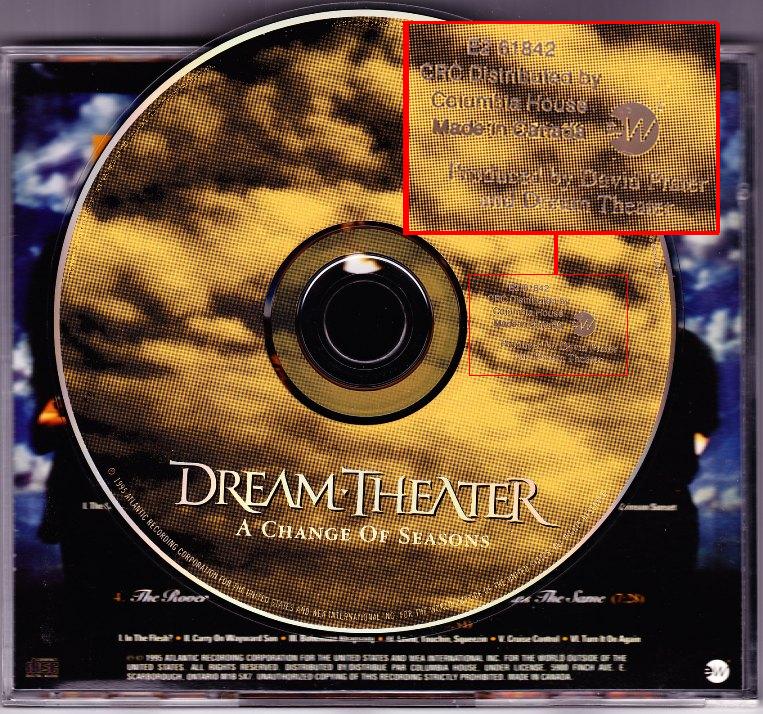
1. Columbia House used to manufacture their own CDs.  That’s how they gave away 12 for free.  They’d purchase rights to the master tapes, and manufacture their own discs.  Collectors avoid these, considering them to be of lesser quality and value.  At the store, we used to offer a buck less if your CD was from Columbia House.  Some stores didn’t even buy CDs from Columbia House!

2. Places like Best Buy and Future Shop used to sell new releases at a loss, making it tough for us to compete.  A new release might have cost the store $11.90 to get in.  We’d mark it up marginally, barely even covering the shipping and handling cost for the box of discs to be sent to us.  Best Buy and Future Shop would sell them at $9.99 for a day, or even a week, making a loss but creating customer traffic.  And presumeably those customers would buy something else, too.  In the old days, we’d sometimes go to Best Buy and Future Shop to buy copies for our own stock!

3. People used to stick a weighted ring to the top of their CDs to “balance” them.  I can find no further information out about this, but I clearly remember old CDs made in the 1980’s being modified this way.  Customers modified them on their own, with a kit.  A burgundy plastic ring, maybe 1 or 2 mm thick, would be stuck to the outer edge of a CD.  A customer once told me he applied this ring itself to “balance the CD and make it play better”.  I saw these modified CDs fairly frequently, usually with jazz and classical customers so this must have been somewhat commonplace for a time.

4. CDs play from the inside out, not outside in like a record.  This always surprised people.  If you had scratches on the outer edges of your CD, you might be OK.  If you look carefully at the shiny rainbow rings on your disc, you can actually make out how much of the disc is playing surface.

5. Products advertized to “fix” your CD will not.  But they can clean it, and maybe that is all that is wrong.  Most scratches won’t effect the play of your disc.  Your laser can read through a lot of stuff.  One thing it can’t read through is a dried bead of Coca-Cola, so make sure your skipping disc has been cleaned before you give up on it.  But don’t waste your money on a “repair” kit, which will do more harm than good.

Don’t be fooled!

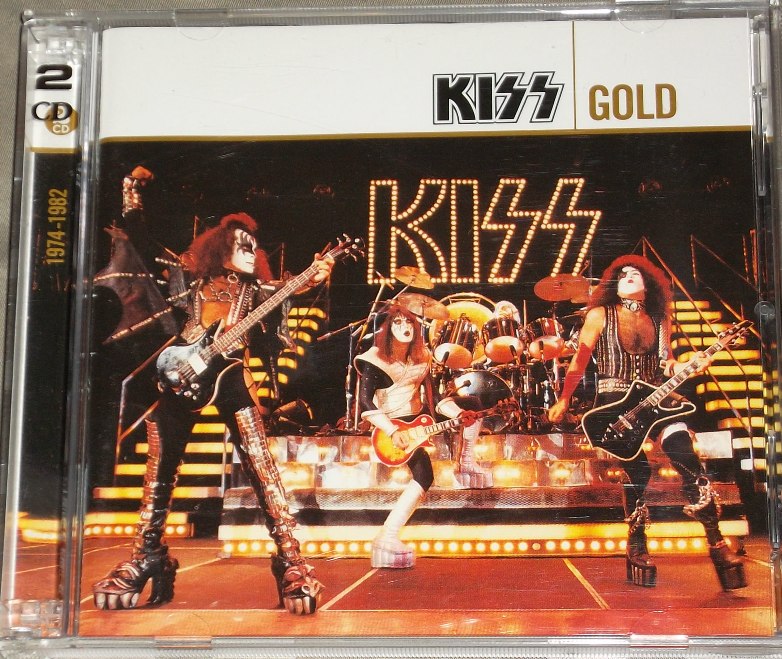
REVIEW: KISS – Gold (2005)

Part 43 of my series of Kiss reviews, leading up to the release of Monster!   Chronologically, this album was released in between 20th Century Masters Vol. 2, and Vol. 3, in 2005.

KISS – Gold (2005, Universal)

At this point, you can’t blame Gene anymore.   Kiss’ old record label was free to issue whatever compilations they wanted, and they did.  Of these compilations, none contained previously unreleased material.  So, these are aimed strictly at the newbies, and the collectors.  And the collectors loathe shelling out for this kind of thing.

There is some light shining through the clouds.

First off, unlike every hits album released before it, this one actually has liner notes! Not bad liner notes either! Some common errors have been corrected in them (for example, Anton Fig is listed on drums for the “disco” albums). Not all the errors have been corrected, unfortunately, and I believe all lineup information has been taken directly from the liner notes of Kiss’ The Box Set.

Second, the track listing really is superb, even if offering few surprises. The ground covered is the “makeup years” 1974-1982…yet for unknown reasons the entire (excellent) Creatures Of The Night album is absent. Instead Universal ends this compilation with two tracks from the import only Killers, a pleasant if baffling inclusion. The liner notes end here as well, glossing over the entire last two decades of the band.

Lastly, there are a total of 40 tracks on two CDs, a very generous slice of rock n’ roll indeed. This allowed Universal to include no less than five tracks from the first album! Five tracks are included from Destroyer, four from Alive!, and each solo record is given one track as well! Even the box set didn’t have anything from Gene’s solo record (although it included an unreleased demo). The disco albums are given a total of four tracks combined, and Music From The Elder is not ignored either.

I suppose in this day and age, a band of Kiss’ age does need a number of hits albums. You need a good, full-length single disc for the people who want that (The Very Best Of). You need a double-disc version for the people who want a little more (Gold). And now in this era, you also need a budget-priced 10 or 12 track hits compilation like 20th Century Masters.   When you think about it, it all makes sense.

While I think Universal really should have put something on here for the diehards who already have all this material several times over, one version of this album comes with a DVD of Kiss Exposed.  I guess that’s cool if you don’t have it already.  It’s an odd pick, since Exposed mostly focuses on the music after the makeup came off, none of which are relevant to Gold.

For newbies: 4/5 stars.  It’s good value for a good selection of arguably the best years.  But be aware there are plenty more hits that you’re missing.

For fans:  2/5 stars.   Good compilation of material, that Universal are hoping to get you to buy again for the umpteenth time.

Full tracklist can be seen in the gallery below.

INTERVIEW: Kathryn Ladano part 2

Kathryn Ladano, known to Dave FM listeners as the sister of LeBrain (from Stump LeBrain Week), chimed in yesterday with some insightful words about music in general.  If you’re a fan of improvised music, you may have heard Kathryn jammin’ on the bass clarinet on two continents!

We sat down and asked her 10 questions about music. Check out the final five below.

kathrynladano.com

6. What do you think about the state of popular music today?  Is the quality declining or improving over the last 20 years?

I think much popular music today is crap, and by popular music, I mean the stuff we’re hearing on the radio today. There are plenty of really great bands and artists out there, but we’re just not hearing them because they’re rarely played on commercial radio. I think it’s safe to say that the quality of popular music over the last 20 years has really declined. I think there was a time when certain artists were more concerned with evolving their sound and exploring new territory, and today it seems to be predominantly about just creating commercial hits. I think a lot of bands are also guilty of milking their success by trying to keep replicating the same album over and over without putting much care into diversifying or experimenting. However, that being said, i’m not sure we can place all the blame on commercial artists. Record companies obviously want to make money, and i’m sure a lot of artists are discouraged from trying anything different. Ultimately though, how many bands today have a series of albums in which you can hear a very clear, deliberate change and evolution in sound and style? Not very many, and definitely not Nickelback!

7. What do you think the role of computers should be in music today?  Some people feel they rob the music of a live feel, due to the ease of making corrections and adding tracks.

I actually think computers can play a very interesting role in music today. There are some interesting programs out there such as Max/MSP which allow a performer to combine their acoustic sound with the electronic and be able to manipulate it on the spot. I think this can create a lot of interesting sonic possibilities and can really enhance a performance. I’ve played around a little with electroacoustic composition, such as my piece “Open Strain”, and I think for me, the joining of live, acoustic sound, and processed, or pre-recorded electronic sounds is what I enjoy the most, both as a performer and as a listener. That being said, I have been to concerts in which all you’re watching is someone sitting at a laptop, and visually, it’s just not very interesting. When I go to a live performance, I want to see the artists displaying some kind of expression, and sitting at a laptop just doesn’t do it for me.

8. What popular bands today are carrying the flag for intregrity in music?

Radiohead is for sure doing this. Their sound has evolved so much from their first album to their last, and you can tell that they are actively exploring new territory and are not simply concerned with producing commercial hits. I think it’s great that they have maintained such an impressive level of success and popularity too – obviously there is still a large market out there for more progressive music that perhaps record companies are neglecting to acknowledge. People will always disagree about what you should be more concerned about – creating music for yourself, or creating music for the public. For me personally, I think I create for myself first, and the bands I admire the most are the ones that appear to also take that approach.


9. Is it possible to make a living simply out of creating music anymore?  Or has that day come and gone?  How does one do this as a viable living?

It is, but it certainly isn’t easy. Times have definitely changed though and artists are relying more and more on social media to promote themselves. You don’t need a record label anymore to release a CD, and many artists are doing their own recordings and promotion. There are a lot of great sites out now too that help promote independent artists such as reverbnation and soundcloud which allow artists to build their fan bases gradually without big money behind them. Also, I know of several artists who are funding their albums with fan donations. I think the big problem though is time. It takes time to promote yourself and tour, and get your name out there – and it’s difficult to have both an income and the necessary time to work on your craft. People do it though. Ultimately if you’re determined enough and are willing to make the necessary sacrifices, I think it can be done.
10:  Some bands like Radiohead have taken the unusual step of giving away albums (In Rainbows) for free digitally.  What do you think this does to the value of music?  And do you prefer have an album digitally or physically?

I think Radiohead wanted to try something different in response to the changing music industry. When that album was released, I went out and purchased a physical copy without a second thought. I personally still much prefer to have a physical album in my hands. I continue to go out and buy them and build my collection. Yes, I use itunes and own digital music, but the vast majority of my digital music collection is duplicated in physical form. I have very conflicting ideas about all of it. On the one hand, I think Radiohead offered their album for free as a way of countering piracy and trying to control the value of their music. But on the other hand, it takes so much time, energy, money, and resources to create one track which is only valued at 99 cents on itunes. As a buyer, i’m happy to pay that small amount to get a song that I want, but as an artist, I only receive 75 cents or less when someone buys one of my tracks. It’s worth it if people buy your tracks constantly, but in my genre, that just isn’t reality. I make more selling copies of physical CDs, but that isn’t what most people want anymore. *

REVIEW: Stryper – Murder By Pride (2009)

Sunday. Time for some Stryper!

STRYPER – Murder By Pride (2009, Big 3 Records)

I was a Stryper fan back in the 80’s, but I was never overwhelmed by the band.  I respected what they were saying, and I never felt like they were “in it for the money”, like some of the other kids at school.   I just didn’t think their 80’s albums were that amazing, hanging on to a sort of Dokken-level of quality as far as I was concerned.  A few good hits, a few good album tracks, but nothing blowing me away like a Van Halen album does.

Since their reunion, though, holy smokes! (Pardon the pun!)  They’ve been awesome, and putting out quality albums.  They have improved with age.  They are better musicians, better singers, better writers, and don’t have hair 12″ tall anymore.  Michael Sweet certainly proved himself on tour with the “other band” he was singing and playing with, Boston!

Murder By Pride is really the first reunion era Stryper that was designed to appeal to the old fans.  While I loved the previous album, Reborn, I fully acknowledge that it’s not an immediate thriller.  Its post-grunge sounds threw a lot of people for a loop, although it contained some great tunes such as “Passion”.  Murder By Pride was the answer to the fans who asked for more melody, more harmony vocals, twin solos and riffs.  That is largerly what they got.  There’s even the odd scream!

Murder By Pride is their best studio album.   It’s got everything — great hard rock songs, great piano ballads, great performances and crisp production that brings out the toughness of the guitars and drums.  The drums (by guest Kenny Aranoff) are absolutely flawless.  If you didn’t know better you’d swear it was Robert Sweet, as he nails that Stryper sound.  I don’t know why Robert didn’t play on the album, as he plays on their current album, the also-smoking The Covering.

If the idea of Christian lyrics throw you for a loop, I won’t lie to you, they haven’t backed down over the years.   If anything they’ve gotten more bold.  (The Covering contained a song just called “God”!)

Key tracks:  Some of the heavy rockers like “Eclipse of the Son”, and “The Plan”.  The Boston cover “Peace of Mind” featuring Tom Scholz on guitar.   The acoustic ballad power “I Believe”.  The stunning title track, with a classic Stryper riff that must be second-cousins with “Free”. If you’re not knocked out by this song, you’re not a Stryper fan!

Great album.  Welcome back Stryper — may you continue to stick to your guns, deliver your message, and rock hard!

4/5 stars

REVIEW: KISS – Kiss Symphony: Alive IV (2003)

Part 42 of my series of Kiss reviews, leading up to the release of Monster

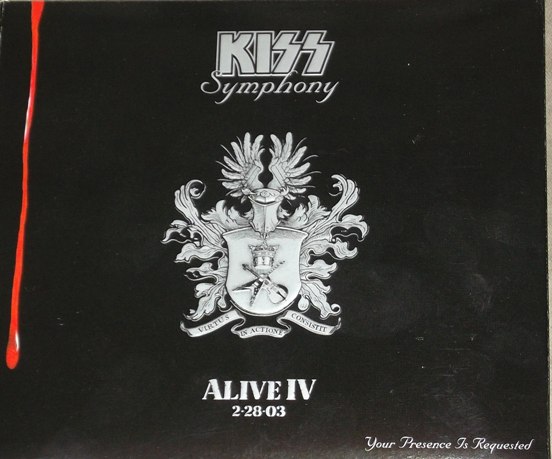
KISS – Kiss Symphony: Alive IV (2-disc edition, 2003)

When Kiss announced their “farewell tour”, Ace Frehley assumed when they said “farewell”, they meant it.  He didn’t want to continue and so Tommy Thayer was drafted in.   Thayer came to to the attention of Kiss fans while in his band Black N’ Blue, which Gene produced.  He wrote songs for Hot In The Shade, and every studio album since then.  He even ghosted on Psycho Circus, and played Ace in a Kiss tribute band.  If ever there was a guy destined to replace somebody in a band, it was Tommy Thayer.

Kiss Alive IV: Kiss Symphony is a fantastic album, and is certainly better than Alive IV – The Millenium Concert. Say what?  There’s another Alive IV?

Ya’see, back in 2001, Alive IV was announced and then cancelled. I even had a pre-order for it back then, and its picture is included in the Kiss box set as “forthcoming” in the discography section.  It was shelved, and my pre-order cancelled.   But, it was eventually released as the Millenium Concert in the Alive Box.

This is better. Way way better.

Some will accuse Kiss of copying Metallica with the whole symphony thing. Well, then Metallica copied Deep Purple. Even Red Rider, whom have a Kiss connection, did their own concert album with orchestra in the 80’s (The Symphony Sessions). This is nothing new. Nothing in rock is new anymore.

Tommy Thayer performs admirably and very Ace-like, in his place. Peter Criss is here, keeping time remarkably well with an orchestra behind him. I don’t know if he played to a click track or just to conductor David Campbell. I am sure this was a challenge to him and kudos to him for doing so well.

(Incidentally, Peter Criss had briefly left the band prior to Ace, and was replaced by Eric Singer during this time.  This Simmons/Stanley/Frehley/Singer lineup was never captured on album unfortunately.)

Kiss split the show into three sections: Full-on live 4-piece Kiss, then a section of slow songs with a small string section, and then the full-blown Kiss symphony with orchestra. Great move there, it really builds, and it allows for more variety of songs on the album.

Highlights for me included “Sure Know Something”, which might be better than the original version. “Forever” and “Shandi” sound good. but I maintain that Eric Carr is the only drummer who can play “Forever” properly. It’s also great to hear “Detroit Rock City” go straight into “King Of The Night Time World” again, and everything on the symphony disc kicks butt. Biggest surprise was “Great Expectations” — had it ever been played live before?

Note note:
There is a single “highlights” disc available. It is, unfortunately, the source of some frustration for me. Read on.

You see, Kiss did an amazing Ramones cover of “Do You Believe In Rock And Roll Radio?”  The lineup was a rare three-piece:  Paul Stanley, Gene Simmons, Eric Singer.  This song was included on the Ramones’ tribute album, We’re A Happy Family. It has some killer sax, and is among the best cover versions Kiss have ever done.

When the single disc “highlights” version of Alive IV came out, they stuck “Rock And Roll Radio” on it as a bonus track.  So, this version of the album is the only Kiss album where the song is to be found.  I wish it was on the double too.

5/5 stars…with the caveat that “Do You Believe In Rock And Roll Radio?” should have been on here, and I’m mad it’s not.

INTERVIEW: Kathryn Ladano part 1

Kathryn Ladano is a name you might not have heard before, unless you caught Stump LeBrain Week on Dave FM, or you’re a fan of free improvisation.  She’s the sister of LeBrain, is a world-class bass clarinest player, but originally came from a rock background.  We sat down and asked her 10 questions about music.  Check out the first five below.

kathrynladano.com

1. What were your earliest musical influences?  I know you listened to a lot of John Williams, pop music, and hair metal like Bon Jovi.  How do you go from that to a 10 minute improvisation on bass clarinet?

My earliest musical influences really don’t have a lot of impact on me today in terms of my professional career.  I mean, I was into the 80’s hair bands and pop music for the most part growing up. However, it’s true that movie music really spoke to me and I was intrigued by the connection between music and visual images.  This is true of 80’s music videos too actually, and I would often (and still do) picture images in my mind when I hear a song.  For movie music, I was fascinated by the fact that a certain musical treatment could greatly enhance the emotional impact of a movie scene.  I didn’t really understand why, but the idea of it really made an impression on me. As a teenager, I realized that it was the “weirder” soundtracks in particular that affected me the most. For example, the opening music of Planet of the Apes did such a great job of making you feel like you were on another planet, and it’s still one of my favourite examples of movie music. However, I think the soundtrack that affected me the most and opened my ears the most was 2001: A Space Odyssey. In particular, the compositions by György Ligeti  — Atmospheres, Lux Aeterna, Requiem, etc… I think that early exposure to highly dissonant music and seeing how brilliantly it could enhance a scene in film really opened my eyes and my ears to the experimental, and Ligeti is still one of my favourite composers today.

2. As a listener, what type of LeBrain reader would be likely to appreciate your music?  Is there a track on [your album] Open that is more accessible than others?

That’s a difficult question to answer. If I speak very generally, I would say probably readers that enjoy progressive rock and more avant-garde music would enjoy the album. I tried to throw in everything I could because I wasn’t sure when i’d have a chance to make another one, so the album features a fairly wide variety of sounds and styles. The most accessible tracks are “Something I Can’t Know” (a jazzy sounding trio for bass clarinet, piano, and drums), and “Art Show” (a more upbeat sounding trio for bass clarinet, guitar, and drums). However, the track that has gotten the most airplay is “Further Reflection” (a duo for bass clarinet and percussion that features a very atmospheric opening and minimalistic ending).

 
3. What do you think about “jam bands” such as the Grateful Dead or Deep Purple who often would go up on stage and improvise for 20 minutes with no script?

I think the concept is fantastic! Essentially, this is what we do as free improvisors. You pretty much throw musical genre out the window and just focus on sound, using your ears as your guide. I also really admire bands that can come up with a meaningful and interesting improvised piece that lasts as long as 20 minutes as it can be very difficult to do. When there is no script and no plan, the form and the personality of the piece can be difficult to find, and the more players you have, the more directions there are to take the music. Granted, bands like this don’t always succeed at creating a successful 20 minute improvisation, and it can be a lot for an audience to absorb, but the basic idea of making it up on the spot and just using your ears and your instinct to guide you is something I would welcome more of in popular music. 

 
4:  Bands that do 20 minute jams were extremely popular in the late 60’s and early 70’s, but today they are not mainstream anymore.  Why do you think that is? 

It seemed that there was a lot of musical experimentation and exploration happening in the 60’s and 70’s and for some reason, much of that stopped in the 80’s. I think audiences changed and they wanted different things in their music. Today, I really wonder how audiences would respond if more artists started incorporating long jams and improvisations into their music. It seems that it’s not something that people want anymore, and it’s too bad.  Popular music has changed and I think audiences no longer expect the unexpected – most people just want to hear their standard three chord songs – unfortunately that seems to be all the modern ear is capable of absorbing. Music and popular culture moves in waves though, so I’m hopeful that at some point more experimental live performances will come into fashion again.

5. What should the role of visuals be in live music?

I am personally very intrigued by this concept and that of interdisciplinary art in general (mixing more than one art form together). I think visuals can greatly enhance music as I said before regarding film music, and it’s an area that I have been exploring a lot lately. For example, last year I directed Wilfrid Laurier University’s Improvisation Concerts Ensemble in a performance of a live, improvised soundtrack to the classic silent film Nosferatu. The ensemble created musical pieces within the context of the film that was unlike anything they had done before without visual imagery. I think adding visuals opens doors to new ideas and greater creativity and allows a musician to react and respond to something other than just what they’re hearing.

Part 97: New Release Tuesdays


In the early days, Tuesdays were one of the busiest days of the week.  That was the day that new releases came out.  We’d also re-stock all our other stuff that day too.  Canpar would show up with several boxes which you would crack open to gander at the goodies inside.  It was also cool to see the new releases for the first time.  Checking out the album covers, the song titles, stocking them, seeing how they’d sell.  Any time there was a new release that I was personally into, it was twice as fun.

I still remember on my very first Tuesday, April Wine’s latest album Frigate came out.  I remember thinking, “April Wine?  Do people still buy new April Wine albums?”  (They didn’t.)

In the days before computers you’d have to make an inventory tag for each new release.  That was your trigger to re-order the title.  You’d put the tag on one copy of the CD.  If that copy of the CD was bought, you’d take the tag off, and put it on another.  When there were none left, you’d file that tag.  (We always filed by record company – there were more record companies back then, many have merged.)  Then come order day (Mondays) you’d go through the tags and re-order things that were sold out.

I remember when Kiss’ MTV Unplugged came out in March 1996.  Trevor was working the day shift, me the night.

“I left the Kiss Unplugged for you to make the tag.”

Maybe only a record store guy would get it, but that was cool of him.  That inventory tag would be in the store forever.  Little things like that meant something to us.

I remember when Radiohead put out The Bends.  We ordered three copies, and sold out immediately!  Imagine that today — ordering three copies!  But back then, as far as we were concerned, they were a band with one novelty hit.

The worst new release Tuesdays were the ones where we didn’t get something important.  Maybe the distributors stiffed us on an in-demand title.  Maybe we just missed some new hip-hop artist that we’d never heard of.  It would happen all the time.

I would always try to get in rock titles that I knew we could sell.  Rock wasn’t huge in the mid-90’s, but I did carry the flag.  I made sure we ordered 5 copies of Queensryche’s Hear In The Now Frontier album in 1997, which we sold out.  Then I ordered three more, which I also sold.  In fact, I sold out of that faster than I sold out of Notorious B.I.G.’s posthumous second album (which was twice the price, however).  I also carried Bruce Dickinson’s Accident of Birth.  I sold out of that one.  Even though the numbers were insignificant as far as our store sales went, I felt good that we were at least bearing the flag for rock during the 90’s.  Believe it or not, in 1997, we didn’t even carry the new Judas Priest.  That’s how bad it was for metal at the time.  I ordered one copy for myself, and just one copy.

New release Tuesdays were a long day – you had to rearrange the charts to accomodate for the new releases, and sometimes in the old days when we had more new releases, you wouldn’t even finish stocking until the next day.  Sometimes your fingers were sore from applying peel-and-stick security tags.  The excitement of new release Tuesdays, and the surprises in store, meant it was always a shift to look forward to.

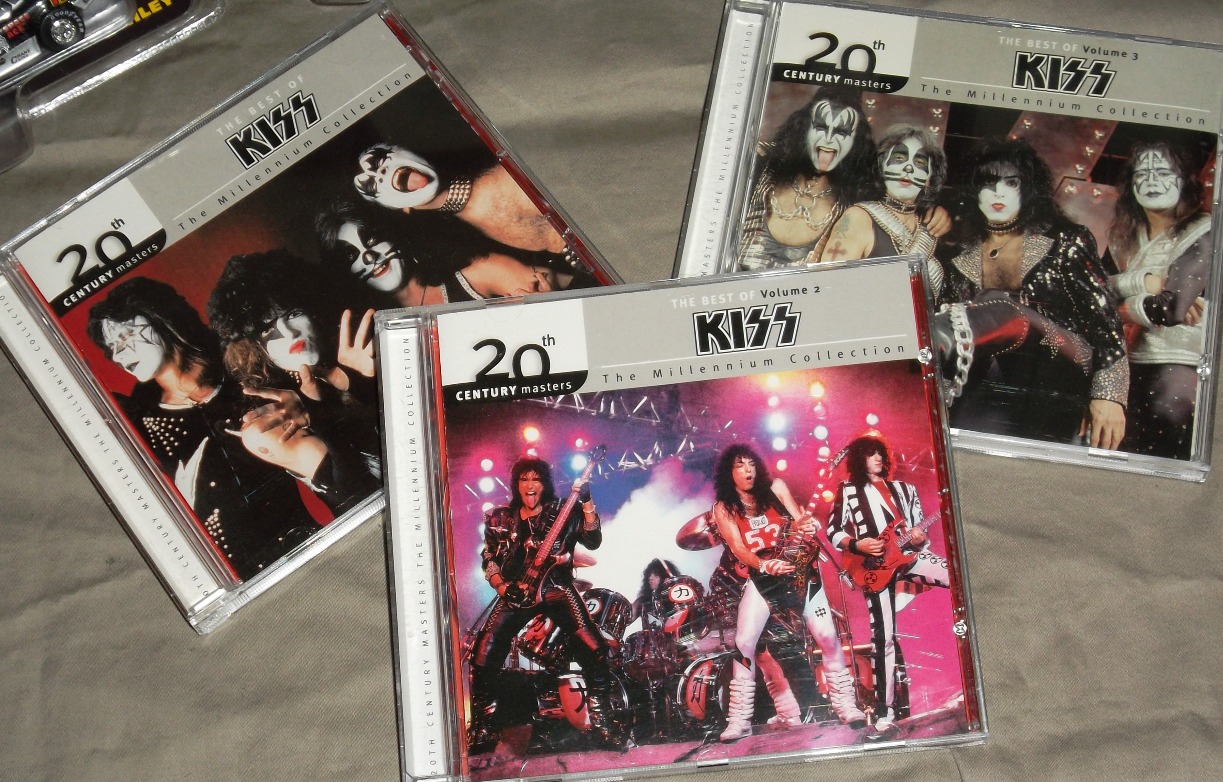
REVIEW: KISS – 20th Century Masters – The Millennium Collection: The Best of Kiss Vol. 1, 2 and 3

Part 41 of my series of Kiss reviews, leading up to the release of Monster!   We’re deep into the second compilation years of Kiss.  This time I’m doing three at once!

KISS – 20th Century Masters – The Millennium Collection: The Best of Kiss Vol. 1, 2 and 3 (2003, 2004, 2006)

This series is one I find quite enjoyable (The Millenium Collection in general, which spanned many artists). For a budget price you get 10 to 12 hits in a brief running time. Perfect for people who aren’t fans but want some hits.  If you know where to go you can get these for around $5.  Imagine that — three discs of awesome Kiss for $15.  Not a bad value.

Let’s start with Volume 1, shall we?

I am a fan. I don’t play this series often, but I do enjoy it. The problem here is, of course, you can’t sum up the early years of Kiss in 12 songs. Here’s the album breakdown:

  • 2 songs from Kiss
  • 1 song from Hotter Than Hell
  • 1 song from Dressed To Kill
  • 1 song from Alive!
  • 2 songs from Destroyer
  • 2 songs from Rock And Roll Over
  • 2 songs from Love Gun
  • 1 song from Dynasty

Considering what this album is, the only thing I don’t like is the inclusion of “I Was Made For Loving You”. I would have put on something like “Shout It Out Loud”. Dynasty doesn’t really fit in with the other albums included here, but it came out in 1979 and therefore couldn’t go on Volume II (the 80’s).

1. Strutter
2. Deuce
3. Hotter Than Hell
4. C’mon And Love Me
5. Rock And Roll All Nite
6. Detroit Rock City
7. Beth
8. Hard Luck Woman
9. Calling Dr. Love
10. Love Gun
11. Christeen Sixteen
12. I Was Made For Lovin’ You

Volume 2 continues the concept.  It contains tunes from the following records:

  • 2 songs from Creatures Of The Night
  • 2 songs from Lick It Up
  • 2 songs from Animalize
  • 2 songs from Asylum
  • 2 songs from Crazy Nights
  • 2 songs from Hot In The Shade

Although between Volume I and Volume II, a couple albums slip through the cracks (Unmasked, The Elder, Killers) this CD is a pretty good summary of key singles from 1982-1989. Only a few singles are missing (“Who Wants To Be Lonely”, “Turn On The Night”, “Let’s Put The X In Sex”, “(You Make Me) Rock Hard”, “Rise To It”). I don’t think I would have subsituted any of those, for any of these:

1. Creatures Of The Night
2. I Love It Loud
3. Lick It Up
4. All Hell’s Breakin’ Loose
5. Heaven’s On Fire
6. Thrills In The Night
7. Tears Are Falling
8. Uh! All Night
9. Crazy Crazy Nights
10. Reason To Live
11. Hide Your Heart
12. Forever

Volume 3 is the shakiest of the three.  It leans a bit too much on live versions of popular hits for my tastes.  I would have preferred more studio songs, but KISS didn’t release that many studio albums in the 90’s so there’s not much you can really change. Here’s the album breakdown.

  • 2 songs from Revenge
  • 1 song from Alive III
  • 3 songs from Carnival Of Souls: The Final Sessions
  • 2 songs from MTV Unplugged
  • 3 songs from Psycho-Circus
  • 1 song from the Detroit Rock City soundtrack

I think 3 is too many Carnival Of Souls songs on a hits CD aimed at the casual fan, and I think “Nothing Can Keep Me From You” is a terrible song with no redeeming value.  Sorry Paul.  In reality, it should almost be considered a Paul solo track:  No other members of Kiss played on or were anywhere near that song.  It’s also never been performed live by the band.

This disc is notable for being an easy, cheap place to get two rare tracks.  “Nothing Can Keep Me From You” is one, and the unplugged version of “Got To Choose” is another.

1. God Gave Rock & Roll To You II
2. Unholy
3. Domino
4. Hate
5. Childhood’s End
6. I Will Be There
7. Coming Home (Unplugged)
8. Got To Choose (Unplugged)
9. Psycho Circus
10. Into The Void
11. I Pledge Allegiance to the State of Rock & Roll
12. Nothing Can Keep Me From You

For the whole set:

3/5 stars

BEST OF INNER

REVIEW: Jethro Tull’s Ian Anderson – TAAB2 Thick As A Brick 2

Jethro Tull’s IAN ANDERSON – TAAB2 Thick As A Brick 2 (EMI 2012)

Holy crap!  This is a great album!  I have no hesitation in ranking this among my favourite Jethro Tull albums.  And yes, I consider this a Jethro Tull album.  All that is missing is Martin Barre.  The story goes that Martin does not enjoy the studio process, and the album is billed as “Jethro Tull’s Ian Anderson”.  Something like that Black Sabbath featuring Tony Iommi disc.  Or, Blackie Lawless & W.A.S.P.  David Coverdale & Whitesnake.  The list goes on!

This is what I would consider quintessential Tull:  Lots of fluttery flute, nice acoustic moments, and very traditional sounding bits. All this with stunning electic riffs, and complexity of arrangement like a roller coaster.  And my God, what an album!  I have confidence in saying that Thick As A Brick 2 is a fine sequel.  Not The Empire Strikes Back, nor The Wrath of Khan…it’s more Aliens.  Catch my drift?  Don’t expect the same thing.  What you loved about the original might be here in different form.  This is a sleeker Brick, 40 years older, dealing with the modern age and the passage of time.

The concept is this:  Where would Gerald Bostock from Brick 1 be, 40 years after that newspaper?  Ian Anderson images five”might-have-beens”.  Perhaps Gerald would become a big money banker.  Or an opposite of that; homeless.  What forks might Gerald take in the road?  And where do they end?  This story inspired Anderson to write some excellent music.  And yes, the album is divided into songs.

There are numerous musical themes that recur, tying the album together.  There are also musical clues from Tull albums past.  The biggest hook on the album is the main riff in “Banker Bets, Banker Wins”, a stunning triumph.  “Swing It Far” is like harder Tull, and it’s splendid.  There are numerous excellent flute, organ, guitar, and piano solos, but also plenty of hooks and catchy riffs.  Just listen to “Old School Song” as an example.

Ian has assembled an excellent band:  David Goodier is the current bassist in Jethro Tull.  Also from Tull is keyboardist John O’Hara.  On guitars is the very talented Florian Opahle.  On drums is Scott Hammond, who has filled in with Jethro Tull.  You can see why it is easy to consider this a Tull album.

Of all the new albums released so far in 2012, Thick As A Brick 2 is one that I have played most frequently, it has simply captured me.  In spite of this, I still have not even watched the included DVD!  A 5.1 mix of this great album is included, as well as making-ofs and interviews.  I’ll have to get around to watching this (when the wife isn’t watching her damned sports).

5/5stars