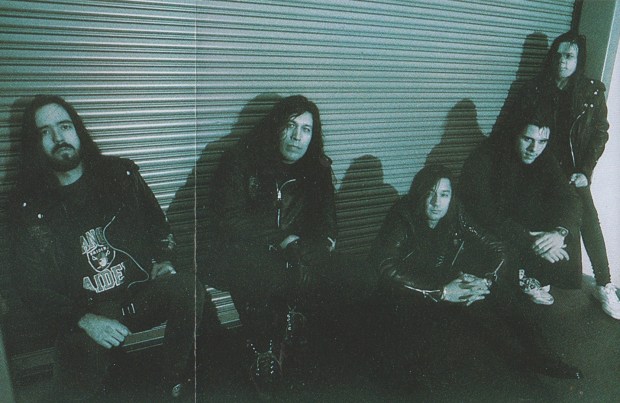
Alex Skolnick

Top Ten SAVATAGE Tracks Ranked – A Collaboration with the 80sMetalMan

SAVATAGE!  This Florida metal band reigned from 1979 to 2002, and is now back ready to unleash a new album called Curtain Call!  They never received the recognition they deserved over the course of 12 mostly excellent albums.  Let’s fix that here and now!

This list is part of a collaborative effort with 80sMetalMan!  You can check his list here.


10. “Handful of Rain” from Handful of Rain (1994)

We begin our story with tragedy, but also triumph.  Lead guitarist Criss Oliva was killed by a drunk driver, almost ending the band permanently, and shattering the soul of his brother Jon.  Jon Oliva was not even a member of the band anymore, having abdicated the mountain king throne to new singer Zack Stevens a year prior.  Undaunted, Oliva wrote and recorded almost all the instruments on the next Savatage album Handful of Rain.  Even though bassist Johnny Lee Middleton and drummer Steve “Doc” Wacholz are pictured inside, they did not play.  Jon did.  Joining him on lead guitar was former Testament master-shredder Alex Skolnick.  An immensely powerful team up.  They produced a somber album, but not without power and thrills.  The title track, available as a 5:25 extended edition or the standard 5:02 version, boasts acoustic verses and a powerful chorus that will stay with you for days.


9. “Morphine Child” from Poets and Madmen (2001)

The final Savatage epic from the final Savatage album.  Jon Oliva was back on lead vocals.  Zack Stevens departed to form his own band, Circle II Circle.  This song utilizes a powerful, relentless riff and a host of backing singers taking care of a complicated vocal counterpoint.  Different lyrics and melodies all overlap to form a cohesive and weighty segment of an already powerful song.  With piano and guitars intertwined with equal emphasis, Savatage may have taken their new operatic metal style to its peak here.  Though a comeback is planned, the band has remaining largely inactive ever since.  Regardless, at least they finished their first life in style, and with masterful progressive metal music.


8. “Warriors” from Power of the Night (1985)

Though this song commences with a corny keyboard bit and a ballady melody, it is far from that!  The battle grunts of the “warriors” soon join in with a sharp metal riff.  An alloy of iron and titanium, “Warriors” boasts a relentless chorus.  The verses are fun too.  “Armed to attack!  The soldiers react!”  Not poetry, but it matters not when Oliva screams.  This is simply heavy metal, down to the basics, and executed with youth and naivete.  The thing is:  it’s really good and catchy!


7. “Sirens” from Sirens (1983)

A shorty, at under four minutes.  The tempered steel of Criss Oliva’s riff is the main hook.  Much would improve later on, such as Jon’s lyrics and the band’s writing skills, but they had everything they needed from the get-go.  There’s a slower breakdown in the middle that only serves to re-ignite the powerful riff later on.  Oliva’s shrieking was already in place, fully formed and under his complete control.  Because the song is so short, you just have to go back and play it one more time.


6. “Strange Wings” from Hall of the Mountain King (1987)

Producer/manager Paul O’Neill was working with a little band called Badlands in 1989, featuring former Black Sabbath singer Ray Gillen on lead vocals.  He made a hell of an impression before Badlands as a backing vocalist on “Strange Wings” by Savatage!  This song, which boasts a powerfully simple riff, contains one of Savatage’s mightiest choruses!  A melancholy metal song with oodles of power, “Strange Wings” is one of Savatage’s top deep cuts.  There are many to choose from, but Ray’s singing on this one sets it apart.  His voice, mixed with Jon Oliva’s, offers a rare metal duet of stainless steel.


5. “Hall of the Mountain King” from Hall of the Mountain King (1987)

A classic Criss Oliva riff, backed by the haunting screams of brother Jon!  This song introduced Savatage to the metal masses.  Few songs can top the power of its mighty riff, or the unholy notes that Oliva hits on the chorus.  Not overly complex, but neither is it simple.  After Criss’ solo, Jon simply lets loose with the howls of a banshee gone mad!  Many would rank this song much higher than #5.   Perhaps the Metal Man is one.  It is extremely difficult, since Savatage have so many songs of different flavours.  Of their era of pure metal majesty, this song is tops.


4. “The Wake of Magellan” from The Wake of Magellan (1999)

Savatage have utilized counterpoint vocals numerous times on their albums from Handful of Rain to Poets and Madmen.  It is arguable that “The Wake of Magellan” is their most effective use of the technique.  Multiple vocal parts and lyrics overlap over each other, with uncountable Zacks singing complementary parts over each other.  Fortunately, the melodies are strong enough to stand out in the storm!  While the band and orchestra cooks behind, Zack Stevens sings all the parts, overdubbed for simultaneous power.  The first layer:  “Don’t see the storms are forming, don’t see or heed the warning, don’t hear the sound of tyrants, surrounded by the silence.”  Then a second Zack joins, singing the same.  A third Zack emerges overtop, singing the extremely fast and challenging lines:  “Columbus and Magellan and De Gama sailed upon the ocean in a world of ignorance with thoughts so primitive.  That men were killed with no more will than that they simply had the notion, but in this world of heartless men this thing they never did.”  Imagine singing that live, which the band had to do, at machine gun speed!  Another Zack doubles those lines.  Then a fifth Zack joins:  “Don’t hear it, don’t hear it…”  Then another Zack:  “Got to keep it underground, pretend you never heard a sound.”  More Zacks join with the lines “If they find it, kill it, blind it,” and “Lord tell me what is to be,” until all the voices coalesce together in the line “They whisper, and I…”  Has there ever been a more epic song in any genre?


3. “Edge of Thorns” from Edge of Thorns (1993)

New singer.  New lease on life.  Zack Stevens was sometimes compared to Geoff Tate when he first debuted in 1993 on Edge of Thorns.  The first single from the first album of a new era, combining the metal of Savatage’s early years and the piano epics of the previous two records.  The brilliant title track from Stevens’ debut still raises goosebumps on the arms.  An apex of this style of metal, “Edge of Thorns” has no dull surfaces.  Every edge cuts deep, the scarlet blood stains lingering in your heart forever.  “I have seen you on the edge of dawn, felt you here before you were born.  Balance your dreams upon the edge of thorns…but I don’t think about you anymore.”  Yet he clearly does.  This theme recurs through the album on songs like “Conversation Piece”.  Another genius Criss Oliva guitar solo is the cherry on top.  Few bands can meld their different styles from separate eras together like Savatage did on “Edge of Thorns”.  A masterpiece of a song.


2. “Gutter Ballet” from Gutter Ballet (1989)

I’ll never forget hearing that opening piano figure.  Loosely, Jon Oliva plays:  “ding, ding, ding…”  Then as he plays the notes become stronger and the tempo more steady.  Suddenly the band crashes forth and “Gutter Ballet” careens through your stereo, into your soul.  Savatage had never incorporated piano like this before, and by breaking new ground they broke down walls.  No longer were they a simple heavy metal band.  The doors to a whole new world of concept and drama had opened.  Welcome to the Gutter Ballet.  This track combines an epic piano melody with incendiary guitar riffs, an orchestra, and street-smart Oliva/O’Neill lyrics about the nasty gutters of New York City.  “Balanced on their knives, little parts of lives, such a strange reality.  Kill the unicorn, just to have its horn, soon he’s just a fantasy…”  And the Criss Oliva guitar solo!  A composition unto itself, backed by strings.  Power, emotion, skill and fire combined together into one incredible song.  An epic song that few bands could top.  Few…except Savatage.


1. “Believe” from Streets: A Rock Opera (1991)

Within the context of the Streets story, the main character D.T. Jesus witnesses a luminous spirit emerge from a dying homeless man, that he follows up several flights of stairs to a roof of a building.  D.T. opens his heart, and hears the voice of God.  “Believe” is the perfect ending to an epic emotional journey.  With all the power that Savatage can muster — overblown, dramatic, and pompous — “Believe” ends the rock opera (and this list) properly.  Interestingly, it retains an epic section that was lifted directly from “When the Crowds are Gone”, as the two albums share a genesis.  So epic is this segment, that Savatage had to re-use it.  Then later, on the Savatage album Handful of Rain, part of it was re-used again, along with other parts of “Believe”.  “Believe” ends this album on the bright up-note that you want a story to end with, your soul awash with light and musically uplifted.  “I’ll be right there, I’ll never leave, and all I ask is believe”

REVIEW: Testament – The Ritual (1992)

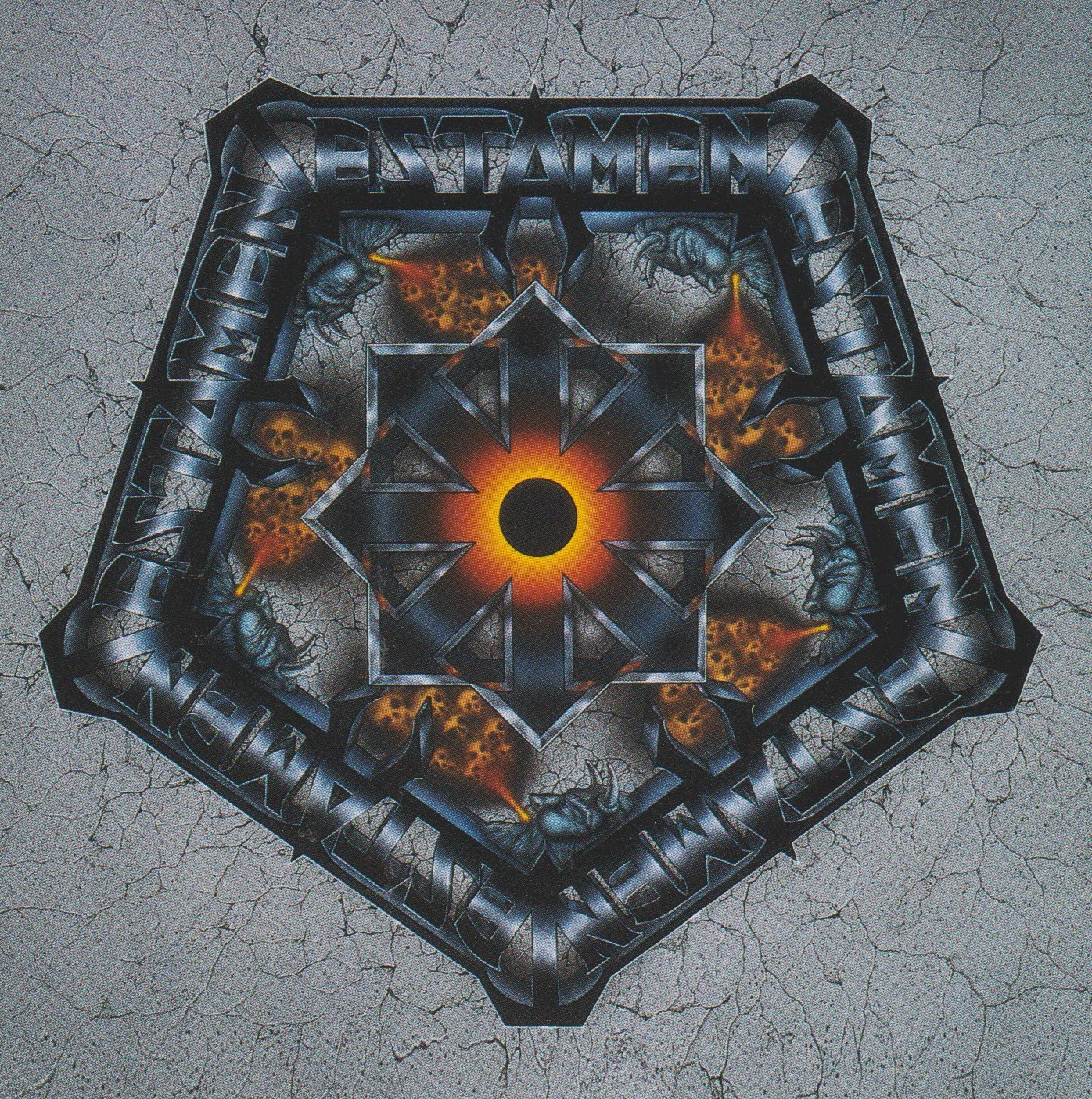
TESTAMENT – The Ritual (1992 Atlantic)

This may have been the first thrash metal album I ever bought.  I was late to the mosh pit, but I think I chose a good first thrash.  Lead video “Electric Crown” was in rotation on the Power 30, and I loved the speed combined with melody and a virtuoso guitarist.  To me, “Electric Crown” blew away any of the Metallica singles I’d heard so far.  It was way superior to the overly simplistic “Enter Sandman”.

One of the coolest sounds I ever heard came from Alex Skolnick’s guitar. In that melodic, four-note descending lick, the fourth note…just shakes. I sat there in my bedroom with my guitar, trying to make the same sound, failing every time. Skolnick was increasingly interested in jazz, and you can hear that in some of the soloing and tubey tone.

The Ritual is the most commercial Testament album.  That made it an easy gateway to thrash.  Did they sell out?  By all accounts, The Ritual is the album on which Alex Skolnick stepped up in terms on contributions.  As a schooled musician he wanted to try some different things, and indeed he left the band shortly after to grow as a player.  This isn’t a sellout, but it’s the album on which the guy who was trained by Joe Satriani had a lot more influence.  (After he left, the band went hard back to the extremes of thrash with Low and Demonic.)

Not a sellout, then.  But there are definite parallels to the contemporary Metallica album.  The slower metal chug of “So Many Lies” is this album’s “Sad But True”.  The Ritual also has a modern, crisp production (by Tony Platt) though not as fully stuffed as Metallica.

Immediately after “So Many Lies”, drummer Louie Clemente goes into a gallop on “Let Go Of My World”, an angry testament to independence.  See what I did there?  The longest song on the album is the title track, an anti-drug anthem that rocks it slow and forboding.  “Kill yourself, killing time.”  Vocalist Chuck Billy has a mighty set of lungs, the kind that make you listen up.  These lungs are put to great effect on “Deadline”, the mid-tempo banger that finishes side one.  There’s something just slightly different about the beat and there’s nothing equivalent on the Metallica album.  “Deadline” is arresting, kickin’ and menacing all at once.

“As the Seasons Grey” continues the blistering metal, not as fast as yesteryear but more measured.  Dig that false ending.  “Agony” and “The Sermon” offer some variety, but Testament are best when served fast.  Right?  Right?  No – check out the ballad “Return to Serenity”!  Testament were of course no strangers to ballads.  “The Ballad” and “The Legacy” worked out well for them previously, but “Return to Serenity” blows them away.  Alex Skolnick’s clever, echoey guitar hook is spellbinding.  This incredible ballad really should have been a hit.  That’s why they included it again on 1993’s Return to the Apocalyptic City EP.  It should be as well known as hit ballads by another big name thrash band.  The Ritual closes on a stampeding “Troubled Dreams”, an album highlight and as persistent as the wandering nomad in the lyrics.

There are more important Testament albums than The Ritual, such as their landmark Practice What You Preach.  It still remains a high water mark in the catalogue.

4.5/5 stars

REVIEW: Savatage – Edge of Thorns (1993)

By special request of reader Wardy, it’s Epic Review Time!

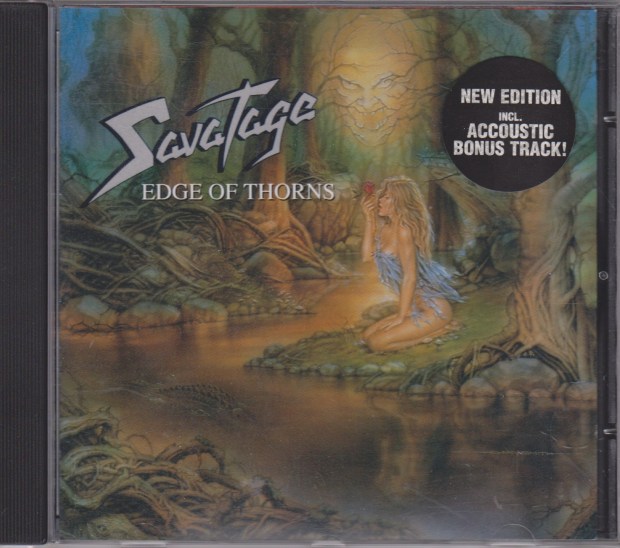
SAVATAGE – Edge of Thorns (1993 Edel & 2002 Steamhammer)

Sava-fans were shaken.  Even though 1991’s Streets: A Rock Opera was a complete artistic triumph, singer and co-founder Jon Oliva quit the band.  Side projects and home life had become priorities.  He would not, however, ever truly leave Savatage.  Even though he was no longer the singer, Jon Oliva co-wrote every track with his brother Criss and producer Paul O’Neill.  He even personally selected his replacement, Zachary Stevens, and tutored and coached the new young singer.   He also continued to play all the piano parts in the studio, although this time he would not tour.  It was certainly an unusual situation, but also an ideal one.   Fans knew that Jon was not really gone, and they easily embraced Stevens as the new frontman.  Oliva had stated that Savatage needed a voice like Zak’s in order to continue.  He knew his own voice was not commercial enough to get on the radio.  With Stevens they had a shot.

The press glowed with reviews, praising the new direction of the band.  They had successfully combined the later piano-tinged Savatage that wrote complex operatic songs and ballads, with the earlier riff-driven metallic Savatage.  Stevens was praised for his voice, and comparisons to Geoff Tate, James LaBrie and Ray Alder were tossed around.  I found a copy of Edge of Thorns in Michigan, and it was with great anticipation that I ripped the shrink wrap off the cassette and placed it in my Walkman.

Anyone who has heard the now-classic title track “Edge of Thorns” can’t forget the haunting piano that descends at the beginning of the album.  At this early stage, Stevens was very much singing like a progressive rock singer, and throwing in screams at key moments.  His range and power here are impressive, and very different from the Mountain King’s style.  “Edge of Thorns” was a great choice for an opening track and new singer.  Not only is it one of the most immediate songs that Oliva/Oliva/O’Neill had yet composed, but it also combines both sides of the band.  The soft piano intro reflects Streets, but then it kicks into overdrive with a riff, heavy bass and dramatic guitar solos. It possesses the pure rock drama of “Gutter Ballet”. It is the whole package.

I have always been drawn to the words.

I have seen you on the edge of dawn,
Felt you here before you were born,
Balanced your dreams upon the Edge of Thorns,
…but I don’t think about you anymore.

I don’t think about you…anymore,
Anymore…

But clearly, he does, and intensely so.

“He Carves His Stone” begins as if a ballad, but the patented snake-y Criss Oliva guitar riff drags us back to the metallic origins of the band.  The combination of riff and chorus are a winning one.  More intense is the borderline thrash metal of “Lights Out”, a smoking track that shows what Zak Stevens can do with the rougher side of his voice.  Hang on tight and shout along to the chorus, because this one is a ride.

Back to the dark, dramatic side that Savatage do so well, it’s “Skraggy’s Tomb”, a brilliant song bursting with ominous heaviness.   Just let it assault your skull, don’t fight it.  Fear not — “Labyrinths” is a quiet piano piece, with Jon accompanied by Chris on guitar.  This cascades in traditional Sava-fashion into a fully-blown dramatic intro similar to “Gutter Ballet”.  It is a suitable and essential part of the song it is attached to, “Follow Me”, the side one epic.

His whole life was written,
Written there inside,
The new weekly Bible,
His modern TV Guide,
Every night he stares back at the screen.

There is no way to sum up the pure excellence, drama, and chills that “Follow Me” delivers. Zak’s vocals make it accessible enough, the power is undeniable. “Follow Me” is among the greatest songs of the Zak Stevens era. A quiet piano piece appropriately titled “Exit Music”* works as an outro. Together with intro and outro, “Follow Me” is almost 10 minutes of pure Savatage adrenaline, with a Criss Oliva solo that still gives me chills.

The second side opens exotically with “Degrees of Sanity”, and Savatage fans know that sanity of one of Jon Oliva’s favourite lyrical subjects!  Criss’ guitar parts are lyrical and enticing.  Slowly it chugs, building and building.  With Criss firmly at the helm, the ship steers through craggy riff after craggy riff until it gives way to the next song, also clearly dealing with sanity:  “Conversation Piece”.  The subject person of the song thought he had been doing better, lately.  “I haven’t thought about you for a while,” he claims.  But even so, he has not let it all go yet.  “I keep your picture hidden a file, of favourite one-act plays.  Like pieces of myself, cut off in desperation, as offerings to thee.  I’ll leave them on the shelf, they’re good for conversation over a cup of tea.”  The melodramatic lyrics of Savatage have always appealed to me (I don’t know what that says about me).  Thanks to Stevens’ impassioned delivery, you can feel every word, while Criss Olivia chugs behind.  Remind me not to visit for tea!

Scan_20150816 (6)

Delicate is “All That I Bleed”, a pretty piano ballad with a rocking conclusion.  Demonstrating the versatility of his voice, Stevens sings smooth and light, until the end.  Perhaps it is all coincidence, but the songs do seem connected.  Both “All That I Bleed” and “Conversation Piece” deal with a letter and difficult emotions.  I like to think of the two songs as alternate endings to the same story — one in which the person does not send the letter (“Conversation Piece”) and one where he does (“All That I Bleed”).    Regardless, “All That I Bleed” has everything you would want in a ballad.  Had in come out in 1989 it would have stormed the charts and MTV would have played it non-stop.  1993 was a very different year from 1989, but Savatage had never expressed any interest whatsoever in musical trends (the mis-step that was Fight for the Rock notwithstanding).

“Damien” appears next, a choppy heavy rock tune with bouncy piano doubling the guitar riff.  Following this fine song is the even finer “Miles Away”, a melodic heavy rocker that is easy to like.  It has a brightness to it, and Steve “Doc” Wacholz kicks the drums right in the ass.  Unexpectedly the album closed with a quiet acoustic song, “Sleep”.  It feels like a sunrise after the stormy night, and perhaps that’s the intention.

There are plenty of bonus tracks on different editions of Edge of Thorns.  I can only review the bonus tracks I have, which are:

  1. “Shotgun Innocence”, originally a Japanese bonus track.  This is a glossy hard rock song with an emphasis on melody.  Though certainly heavy enough, its direct rock vibe doesn’t fit the mood of Edge of Thorns, which I’m sure is why it was saved for a bonus track.  Good song though, and it certainly shows off the pipes of young Mr. Stevens.
  2. “Forever After”, the second Japanese bonus track.  Probably the weakest song of the batch.  It sounds a bit like an unfinished Ozzy outtake, circa the Jake E. Lee period.
  3. “Conversation Piece (Live in rehearsal 9/24/1994)” is recorded really poorly, but the sweat and rawness are captured.  Since it is live in rehearsal, and it is known that Doc Wacholz did not tour, I assume this is with Jeff Plate on drums.  That would also have to be Alex Skolnick from Testament on guitar.  This track is on the 2002 Steamhammer/SPV remastered edition.
  4. “Believe (Acoustic)” is part of a series of acoustic versions Savatage did for another batch of reissues.  This is Zak Stevens’ version of the closing ballad from Streets, but with acoustic guitar instead of piano.  It is a fascinating alternative version, but the original always kills me.  This is on a German printing on Edel records.

As fate would have it, this would be the final time Jon and Criss would make music together.  On October 17, 1993 Criss was killed by a drunk driver with seven prior DUI’s.  Rather than let this crush him, Jon survived by pouring himself into music.  Savatage would not die, even if with half its heart ripped out.  Edge of Thorns remains Criss Oliva’s capstone, and a bright apex it is.

5/5 stars

*The really interesting thing about “Exit Music” is that it is entirely piano.  Therefore no “official” members of Savatage appeared on it!

REVIEW: Testament – Signs of Chaos: The Best of Testament (1997)


TESTAMENT – Signs of Chaos: The Best of Testament (1997 Mayhem)

I bought this in the winter of 1997.  I hadn’t listened to Testament in a few years.  I’d bought The Ritual album in 1992, but they kind of lost me post-Skolnick, when they went hell-bent for death metal.  Therefore the idea of a good, remastered single disc compilation album covering the entire career was appealing to me.  All the key tracks that I wanted were here, including two incredible B-sides!

Shortly after The Ritual came out, singer Chuck Billy denounced it as too soft, too commercial, and not the direction he and Eric Peterson wanted to take the band in the future.  Regardless of this, the single “Electric Crown” was chosen to kick off Signs of Chaos (including the brief instrumental intro, “Signs of Chaos”.  I’ve always felt it was superior to a couple of its chief rival songs at the time:  “Enter Sandman” and “Symphony of Destruction”.  You be the judge.  I think I have a strong case.

As I delved into the disc I found that I was very hit-and-miss with Testament’s earlier material.  For example “The New Order”, the title track from their 1988 album.  I find it thin production-wise, and melodically a bit awkward.  It’s hard-hitting and thrashy as fuck, but strangely enough I prefer the earlier track “Alone in the Dark” from 1987’s The Legacy.  Not only does it boast a stomping riff, but also a chorus that sticks to the head.

“Dog Faced Gods” introduced me to the Testament world of blast-beats and death metal growls.  This was from the first post-Skolnick album, Low.  Now Peterson and Billy had the chance to indulge their heaviest urges, and they did a fantastic job.  Featuring the stellar drum talents of John Tempesta (currently in The Cult), this is Testament brought to a whole new level.  While death metal growls are not normally my bag, Billy sings in a “normal” voice during the cool chorus.  As for the rest of the song, it is a precise complex of drum fills, lightning-fast guitar licks, time changes and riffs.

If you thought “Dog Faced Gods” was heavy, then “Demonic Refusal” might very well blow you out of your seat.  The followup album to Low was called Demonic and it took things further out to the boundaries.  Gene Hoglan on drums this time, “Demonic Refusal” is even more evil and scary.  It still boasts a head-crushing riff and has a strangely catchy quality to the vocal.  Chuck Billy convinced me on these songs that he is a diverse, talented thrash metal singer among the best in the genre.

“The Ballad” from the landmark 1989 album Practice What You Preach was about as close as Testament got to a hit single.  The timing was right, seeing as Metallica had success with “One” the year before.  Even though it is clearly a ballad (albeit a heavy one), the song has balls and metal fans had no problem embracing it.  To me it seems to be based on a prototype of some of Iron Maiden’s softer material.  The album Souls of Black, which followed Practice, was considered little more than a rushed carbon copy followup.  That may be the case, but either way the song “Souls of Black” is still as catchy as ever.  Skolnick’s fluttery licks are a highlight, as is Chuck Billy’s groovy lead vocal.

I find it funny that “Trial By Fire” is listed as a CD-only bonus track.  I guess this album must have been released on cassette too in 1997.  “Trial By Fire” isn’t one of the best songs in my books, but it does contain more outstanding Skolnick guitar shreddery.  A brief word about Alex Skolnick for those who don’t know:  He was one of Joe Satriani’s students, and he’s also well known for playing jazz fusion on the side.  In fact he left Testament initially to enable him to explore that kind of style.  His tone is really warm, and you can feel the vacuum tubes humming in a vintage amp when he plays.

Another uber-heavy song, “Low” from the album of the same name, is just as good and memorable as “Dog Faced Gods”.  The Low album featured one of the most respected guitarists in the death metal genre, James Murphy (Death).  Murphy’s chops helped bring Testament closer to that line between thrash and death, while maintaining the virtuosity that the band had with Alex Skolnick.

“Practice What You Preach” and “Over the Wall” provide a double-punch of early Testament heavy metal.  To me, “Over the Wall” is not an outstanding song.  It’s good for a head-bang and has a killer solo, but it’s not particularly special.  “Practice What You Preach” on the other hand nails it.  Testament were crossing groove and thrash metal together successfully, before Metallica painted it Black.  “Practice” remains one of their highest achievements from the early years.

I mentioned earlier that Souls of Black was considered by many to be little more than a second generation copy of Practice.  This extended to putting out another ballad.  “The Legacy” was one of their earlier compositions, polished up for Souls of Black.  While it’s the lesser known song, I think I prefer it to “The Ballad”.  The production seems a little more full, although the two songs are very similar.  As far as ballads go, I don’t think either song holds a candle to the next track.  “Return to Serenity” from The Ritual is a beautiful song, with gorgeous guitar tones.  It’s a less dark than the other two songs, and lyrically discussing those special places that you may have had as a child, and returning to serenity.  I would put “Return to Serenity” up against virtually any similar Metallica song, and I believe it would blow them away.  While both bands have a lead guitar player that was taught by Joe Satriani, I believe Alex Skolnick to be on a completely different level from other guitar players in this genre.

“Perilous Nation” is a plenty-good thrash party, but again this is listed as a CD only bonus track.  I just find that amusing on an album released in 1997.  The CD ends with two smoking covers:  “The Sails of Charon” (Scorpions) and “Draw the Line” (Aerosmith)!  We all know Testament are huge Aerosmith fans, since they covered “Nobody’s Fault” earlier.  Both are absolutely incredible covers and alone worth the price of the CD.  “Draw the Line”, already a manic-fast song, is give a dose of Liquid Schwartz in the ol’ engine.  I defy you to refrain from banging your head.  What an awesome song to end the CD on, and this review on!

5/5 stars