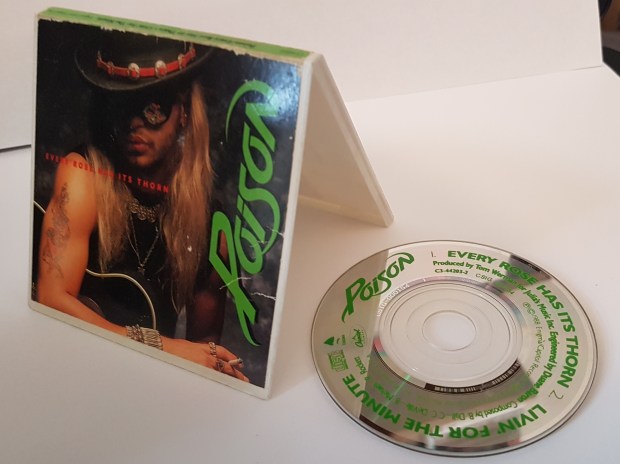
POISON – “Every Rose Has Its Thorn” (1988 Capitol 3″ CD single)
This is a beautiful item that I’m happy to have in my collection. 3″ CD singles were uncommon, but you’ve probably seen one before. What is less common is the clamshell 3″ case that this Poison single came in. A lot of 3″ singles came in regular 5″ cases, or a cardboard sleeve. Clamshells are rare. This one, called a “Gem Pak” (patent pending) was specifically made to house a “CD3”, another outdated term. It’s made of white plastic and the artwork is in the form of a sticker which covers the front, back and spine of the case. The Gem Pak’s flaw (patent pending!) is that it does not hold the disc in securely. It wants to pop out. Take care when handling one of these that the disc doesn’t fall out when you open it.
I’m a defender of “Every Rose Has Its Thorn”. I loved it as a kid. I remember some people saying it might be “too country”, which is wasn’t. It’s just an acoustic ballad but a well written one and deserving of its success, if not its notoriety. It tended to spawn a generation of soundalikes, a fuzzy swarm of late 80s acousti-balladry that ultimately only served to take bands like Poison down, while ushering in the grunge era. “Every Rose” broke down walls for Poison, but the backlash was inevitable. When Bill & Ted quoted it to get into heaven in 1991, it was already all over. I can hear all that history when I listen to this single. It’s an excellent song, and even C.C.’s solo, as inarticulate as it is, still fits like an electrically heated glove.
The B-side “Livin’ for the Minute” shows off the heavier side of Poison. Fans might forget that Poison liked to really spit one out every now and then. C.C.’s solo is bonkers on this one, but perfectly suited to the frantic tune. Bret really cuts loose too. Poison actually have some pretty cool B-sides.
These tracks are both available on the remastered Open Up and Say…Ahh!! CD, but you gotta snap this one up if you find it in the wild.
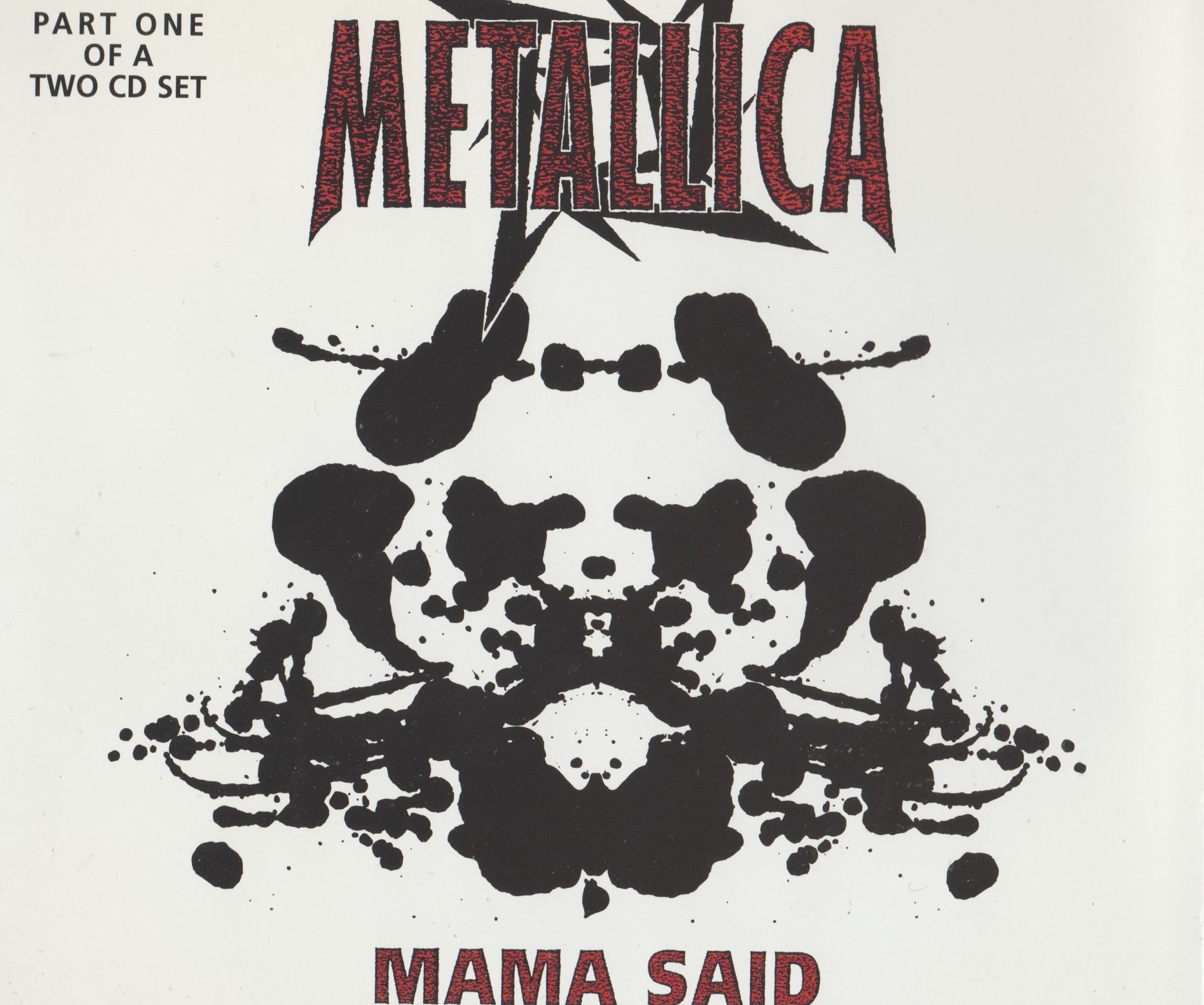
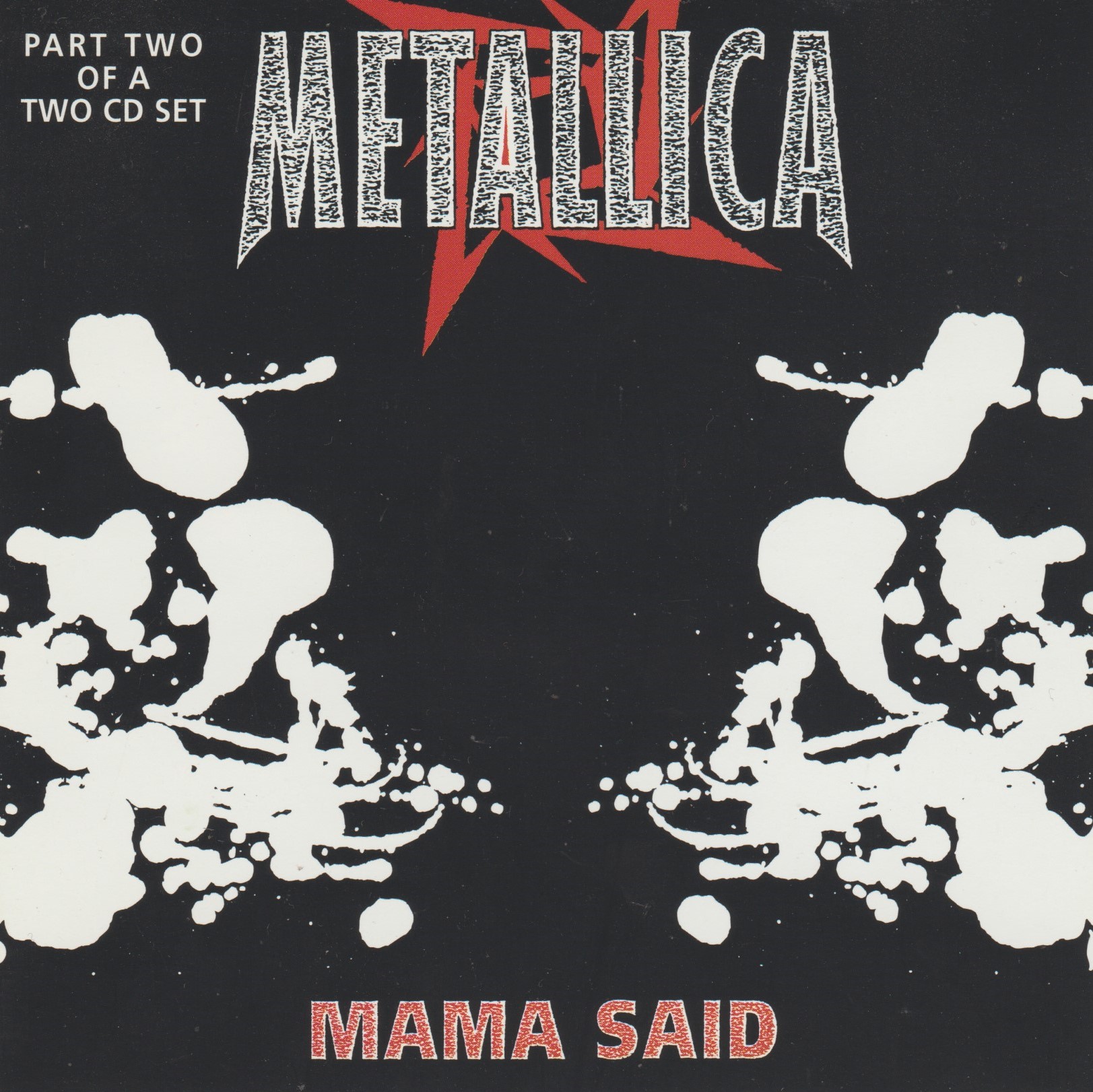
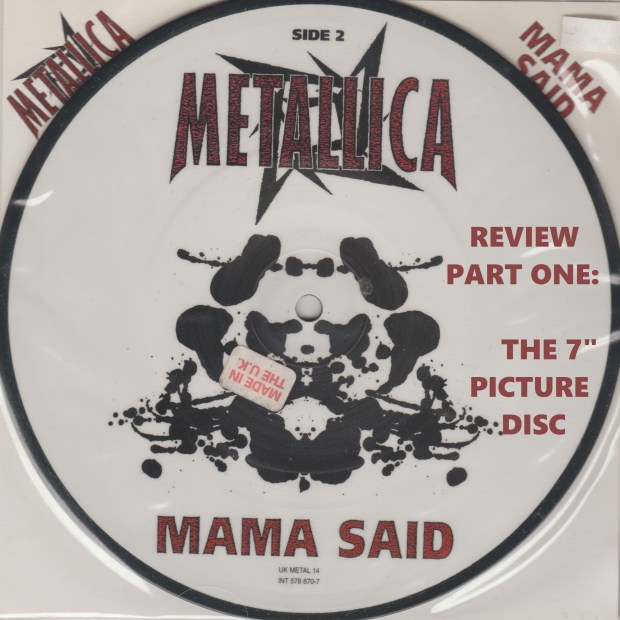
METALLICA – “Mama Said” (1996 Vertigo CD singles parts one and two)
In order to get all the songs, you had to buy three separate singles. You needed the 7″ vinyl (reviewed yesterday) and two CD singles. The total payoff was seven B-sides: five live, one demo, one single edit. The 7″ picture disc included “Ain’t My Bitch” live from Irvine Meadows in ’96, and the rest are on the two CDs each sold separately.
The first single ignites the live feast with “King Nothing”, which finds Metallica in an informal mood before kicking into the track. Though “King Nothing” was eventually released on its own as the fourth single from Load, it was never really one of the best songs from that album. It slams heavy enough and would have been fun to mosh to. They go old school on “Whiplash” which has that energy you want out of live Metallica. The old fans boo the new fans, but everybody gets what they want. Lars is sloppy as fuck; what do you expect? When Metallica play stuff like “Whiplash” live it’s not about precision, it’s about energy and this version delivers.
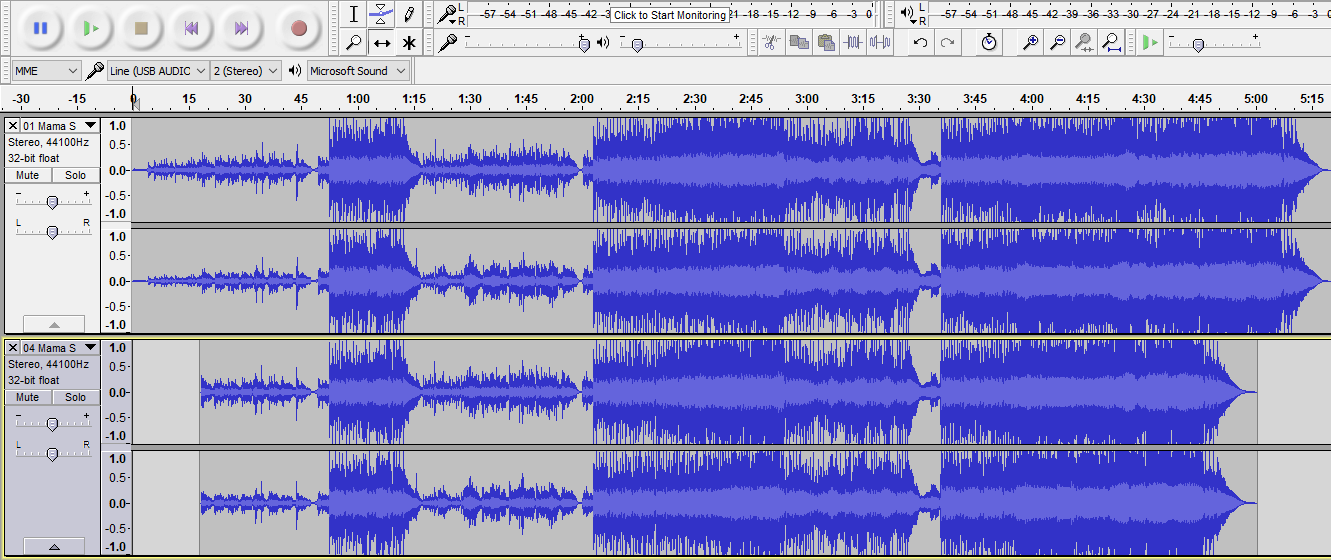
The first CD ends with just a single edit of “Mama Said”, a good ballad with a country twang that some fans might have found unpalatable. It’s shorter by 40 seconds, starting immediately with James’ lead vocal. 15 seconds chopped at the start and 20 more at the end. Do Metallica fans need single edits? No; Metallica was always resistant to compromises like that. Paul DeCarli was given the job of the edit, presumably being told to get it safely under five minutes for radio.
“Mama Said” album version (top) and single edit (bottom) waveforms
The second CD in the set wastes no time going for the throat. It’s “So What”, the infamously vulgar Anti-Nowhere League cover that was a B-side for Metallica once upon a time before. It was so notorious that it became a live favourite unto itself, often turning up in the encores. That’s followed by “Creeping Death”, an epic way to cap off the live tracks. That mountainously heavy rock just never lets up until it gives way to another massive one.
The last and most interesting track among the B-sides is the original “Mama Said” demo recorded solely by James and Lars in Ulrich’s basement. Electric guitar at first instead of acoustic, but beautiful. The purity of this version, unadorned as it may be, is the reason to seek it out. The twangy guitar part is in place, as are the lyrics (not always the case with James’ songs). Metallica could easily release an album of their demo versions, but they haven’t so you gotta get the singles.
I can admit that my first Metallica album was Load. I concede that they were more Rocktallica than Metallica on that album, but the fact of the matter is that for the genre, Rocktallica was good! A lot of hard rock and heavy metal albums in the mid-90s were not good. Metallica introduced themselves to me with an album that was what I wanted, when I wanted it. “Mama Said” was the third single from Load, a an acoustic ballad, and with an exclusive live B-side on the vinyl that wasn’t on the CD singles (to be reviewed next).
The 7″ single contains the album version, not the shorter single edit. James Hetfield wasn’t afraid of getting personal in his lyrics anymore, and “Mama Said” is about his late mother. It’s audible that he is getting something deeply important off his chest. The music is notable for its distinct country twang. Trash Metallica all you like, but this sounds great. The thing about Metallica is that they usually (not always) do whatever it is they set out to do, and do it well.
That said, a 7″ picture disc is not the best way to hear Metallica play an acoustic ballad. It can’t deliver the clarity and dynamics that a CD can. The B-side, “Ain’t My Bitch” recorded live in California on August 4 1996, is a louder song and can get away with the format a little better.
James gets the crowd to shout “We don’t give a shit!” a couple times before they break into the song. “Ain’t My Bitch” remains a fun little blast precisely about not giving a shit. “Outta my way, outta my day!” It might not be “Creeping Death” you can’t deny it’s fun to just bang along. “Mama Said” might have been James dealing with deep shit, but “Ain’t My Bitch” says “just forget it and let go”. Kirk Hammett’s solo on this one is mega fun, and it’s always a bonus to get Jason’s Newsted’s backing growls. An underappreciated ex-Metallica member.
Including the tracks released over the two additional CD singles, “Ain’t My Bitch” is the seventh of seven total B-sides to “Mama Said”. All the live ones are from the same show in Irvine Meadows. If you gotta get ’em all, then “Mama Said” you need this picture single too! Shame about the audio quality.
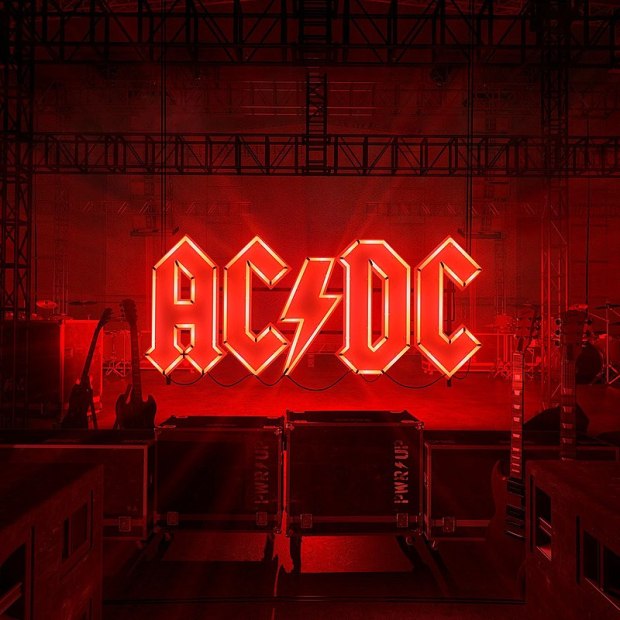
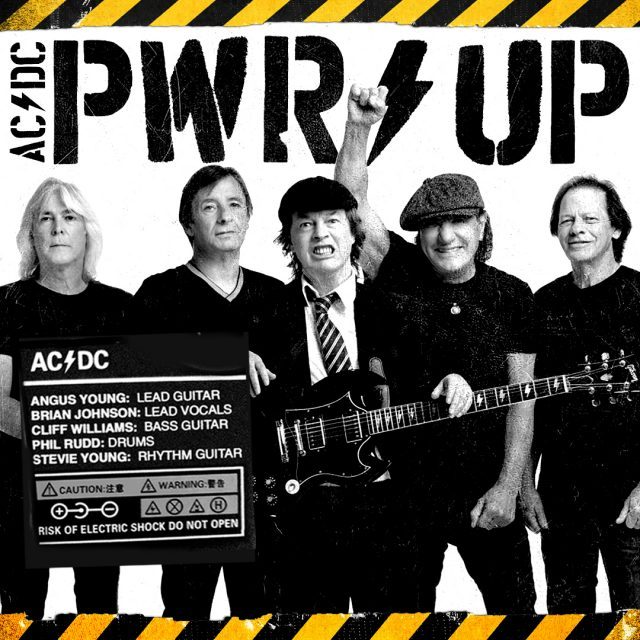
Be honest with me. Until recently, did you really expect a new AC/DC album in 2020? The notoriously private band were spotted at a studio in Vancouver a while ago, but aside from that it’s been total radio silence.
Until now. Power Up!
Brian “Beano” Johnson found himself the recipient of brand new, high-tech in-ear monitors enabling him to sing live once again. Phil Rudd put his past behind him. This was enough to get Cliff Williams back on board. Angus Young had been sorting through dozens of riffs written by Malcolm. With nephew Stevie Young still in the fold to play those riffs, AC/DC were a band once more.
2020’s Power Up (or PWRϟUP) will be the first AC/DC album since the death of both George and Malcolm Young.
“Shot in the Dark” is the first single, available now on iTunes when you pre-order the album. “Shot in the dark, beats a walk in the park.” I highly doubt that it was a walk in the park, but the thing about AC/DC is that they make everything better. (This week’s episode of the LeBrain Train was supposed to be about AC/DC bringing us exactly what we needed in 2020. It has obviously been postponed so we can talk about Eddie Van Halen instead.) If Black Sabbath’s “Rock and Roll Doctor” was a real person, there is little question that they would have prescribed us some AC/DC in 2020. We needed this. Like an Aspirin when your head is achin’, we needed a “Shot” of AC/DC. Something bright and shiny to look forward to.
What AC/DC do, only they can do right. There’s nothing even remotely unique about “Shot in the Dark”. It’s AC/DC. It is what it is and does what it does, and it’s pretty simple. All you need is a beat, a catchy guitar lick, and a belting singer. “Shot in the Dark” has all that. The things that do jump out this time are Angus’ solo — slidey goodness — and the sheer joie de vivre of it all. Brian is sounding great. Some have noted that AC/DC sounds more like the genuine article when Phil Rudd is on drums. His thrift and pocket groove are peanut butter and jelly.
Rating a new AC/DC song is kind of pointless. They always come out with something good, albeit familiar, for a first single. 1990’s “Thunderstruck” was an exception. It’s been this way since 1995’s “Hard As a Rock”. AC/DC drop a new single, and it’s always the same. Good and familiar. Same thing here. Ratings are meaningless so we’ll call it a perfect score just because we should all be happy as fuck that AC/DC are back.
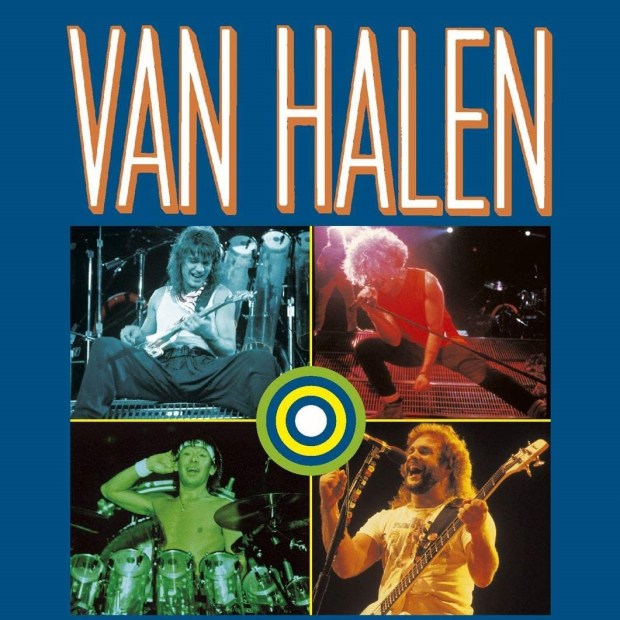
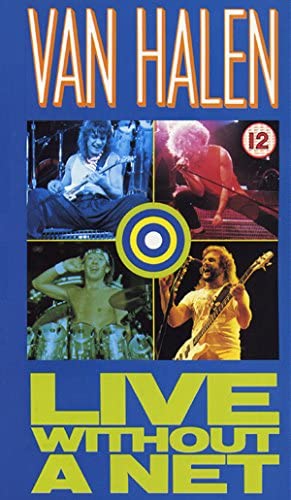
VAN HALEN – Live Without a Net (1987 Warner Reprise VHS/DVD)
I set the VCR to record. MuchMusic were showing the full concert: Van Halen, Live Without a Net! Though they beeped the naughty words, I had to make sure I didn’t miss this special. I’d never heard Van Halen doing Roth tunes with Hagar before! Folks, there was a lot of beeping.
Live Without a Net is undoubtedly goofy, and that is part of its charm. It’s kind of annoying every time Sammy proclaims that they are in “New Halen” instead of New Haven, but I guess he had to. I still don’t understand why Sammy painted that lady’s shoes red. The fact that a roadie had red spray paint on standby was kind of cool though. The band were obviously wasted, but put on a completely epic show nonetheless. It was light on the Roth stuff that Sammy didn’t want to do, like “Jump”, but they also played virtually all of their new album 5150.
The new stuff was heavier on keyboards and for many of the songs, Eddie was playing the keys while Sammy actually played the solos. Unusual for this band; absolutely. Sammy’s solo in “Love Walks In” ain’t half bad. While I enjoyed this change of pace, Bob Schipper did not. “A guy like Eddie Van Halen shouldn’t be stuck on keyboards,” he said. I’ll be honest here. I prefer Eddie playing keyboards live, even if it means Sammy’s on lead guitar.
The friendship between Sammy and Eddie here is obvious. The chemistry is clear. The tension that used to fuel Van Halen is gone here, and in it’s place is simple male comradery. It’s audible in the music, and Eddie can’t stop grinning…except when he’s busy dragging on that cigarette!
With the new tunes dominating the set, there were only two Roth-era numbers. “Panama” was the only big Roth hit, with “Ain’t Talkin’ ‘Bout Love” representing the first LP. Balancing the Roth songs are two Hagar solo tunes, “There’s Only One Way to Rock” and “I Can’t Drive 55”. These are great and you won’t find too many live versions that are better. There were also the usual guitar, drum and bass solos, but Michael Anthony’s is mostly tuneless. A Zeppelin cover, “Rock and Roll”, closes the set.
As kids, Bob and I didn’t care about the Zeppelin song. What we watched the video for was Eddie himself. When it was time for his solo, we studied it. There was no way we could have understood what he was doing on a musical level, but we watched his actual technique. We wondered if he ever burned his hand on that cigarette dangling from the headstock. Eddie’s solo was like opening a science textbook for the first time. Except this was a textbook that looked and sounded absolutely badass!
This always should have been a live album. Edited, of course. You don’t need the shoe painting episode to fully enjoy Van Halen Live Without a Net.*
4/5 stars
* The painting of the shoes happened during “Best of Both Worlds” and was edited out when released as a single B-side.
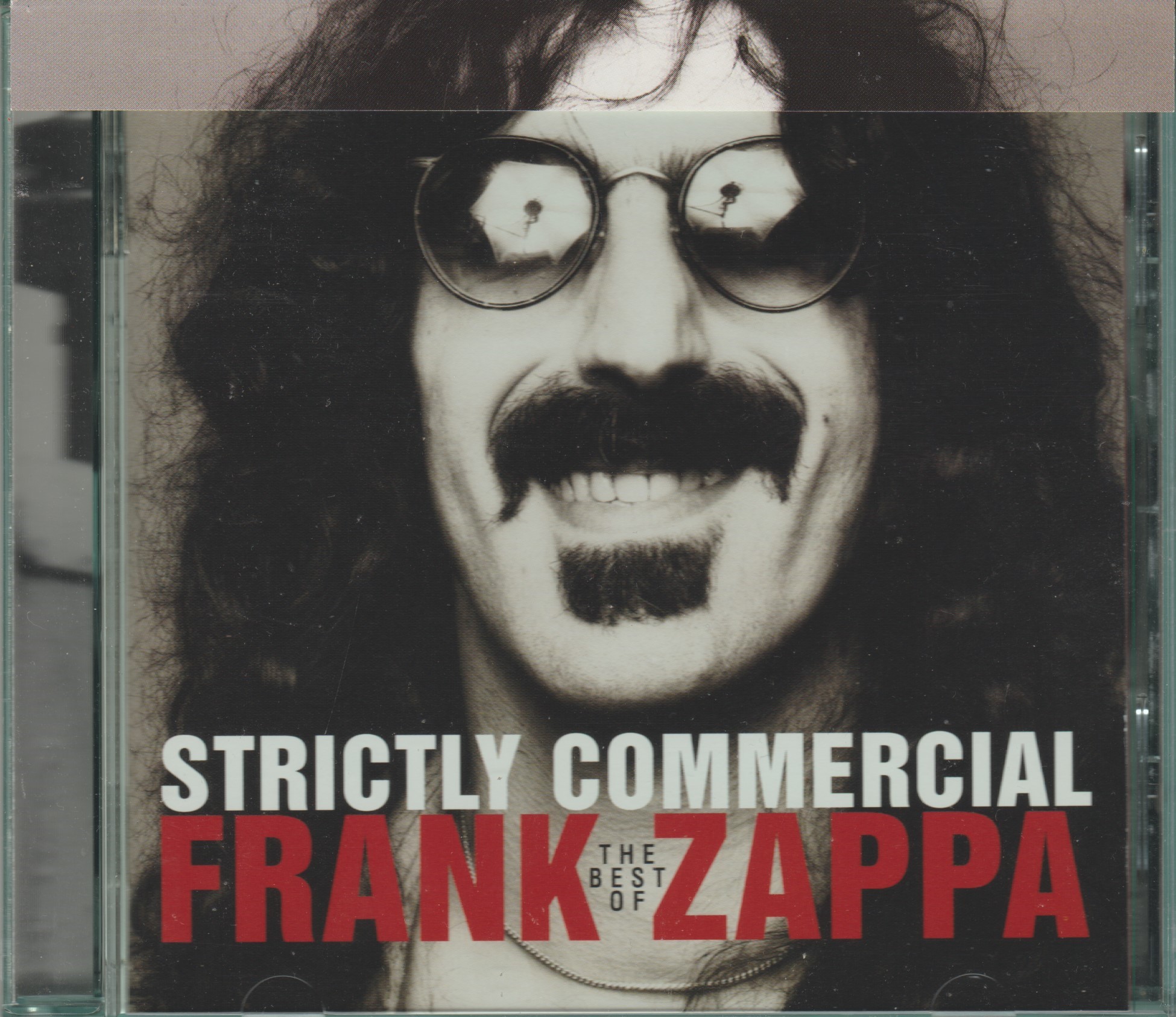
FRANK ZAPPA – Strictly Commercial: The Best Of Frank Zappa(1995 Rykodisc)
There are many versions of Strictly Commercial available in different territories, but the North American Rykodisc edition is familiar to most. The beauty of Strictly Commercial is that it can appeal to anybody. For those who are not ready to stomach a full Zappa album proper, Strictly Commercial compresses some of his most appetising music into a tight 77 minute listening experience.
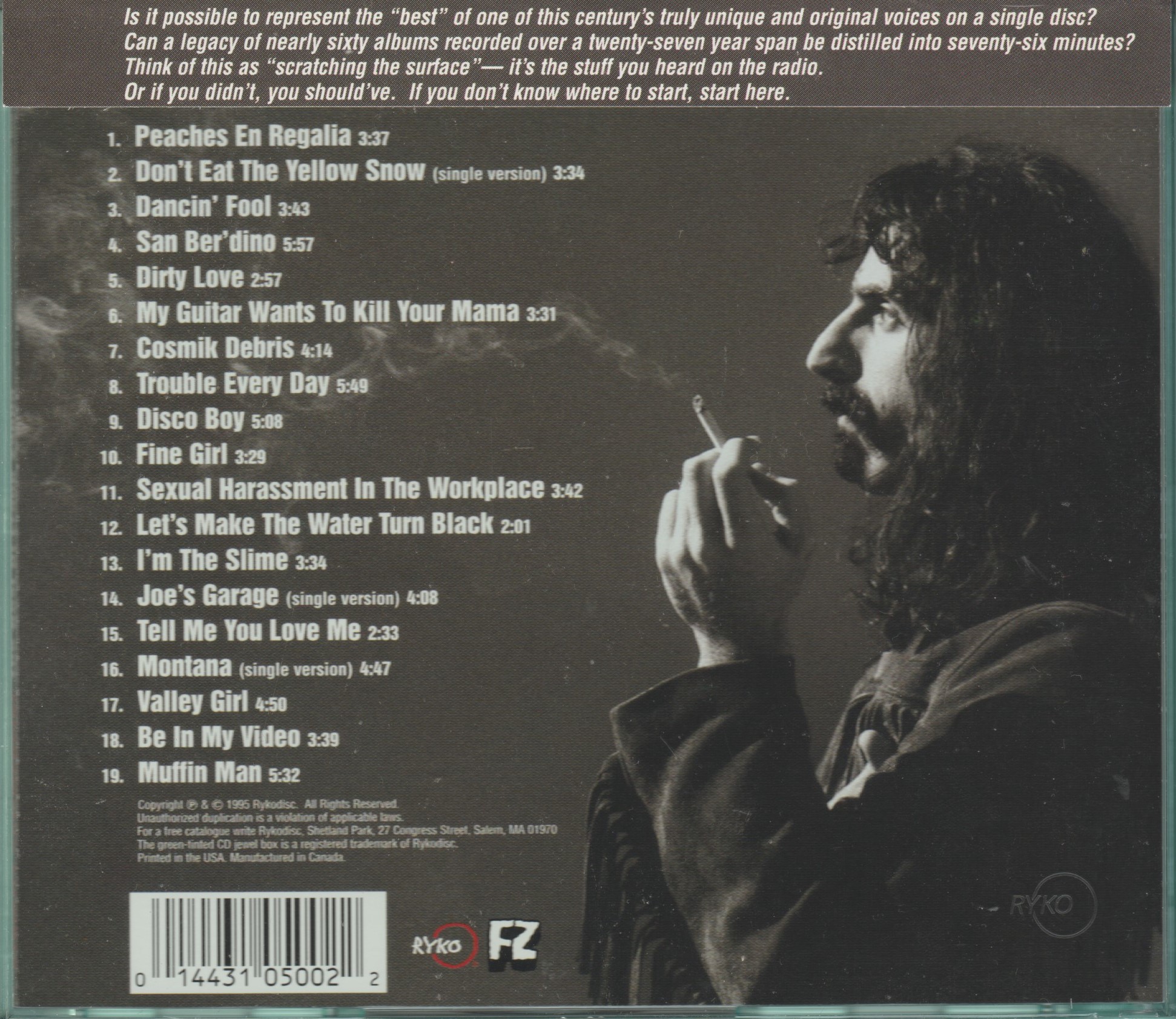
With a flourish, “Peaches En Regalia” opens the disc as it did 1969’s Hot Rats. “Peaches” is one of Frank’s most accessible compositions, with clear melodic themes. This instrumental courts jazz rock fusion while projecting images like a cue from a movie soundtrack. The horn section is both goofy and dignified at once, and the percussion is out of this world.
Great googly moogly! Speaking of goofy, it’s “Don’t Eat the Yellow Snow” (a single edit) which never fails to put a smile on the face. The twisted storytelling is as clever as it is ridiculous. Jabs of brilliant lead guitar act like aural illustrations. Brilliant guitar on this one, as is the single-ending xylophone solo. Into “Dancin’ Fool”, Zappa then lampoons a guy who can’t help but hit the disco even though he stinks at dancing. Social suicide indeed! Classic, memorable Zappa with a beat you can dance to. “San Ber’dino” is more rock than blues but certainly has ingredients from both. This is an easy entry point.
All the songs flow into the next, and “Dirty Love” has a slow rock groove and a blasting wah-wah solo. This is a suitable lead-in to “My Guitar Wants to Kill Your Mama”, one of Frank’s catchiest numbers. A classic rock composition, it must be pointed out how perfect Jimmy Carl Black’s beats are. They are hooks unto themselves.
“Cosmik Debris” has more blazing guitar, and a healthy dose of scepticism for the mystical. “So, take your meditations and your preparations, and ram it up your snout,” sings Frank with a sly smile. Then back to 1966 and Frank’s debut album Freak Out! with “Trouble Every Day”, the socially conscious track that is still relevant today. With a beat-blues bent, Frank croons “Hey you know something people? I’m not black but there’s a whole lotsa times I wish I could say I’m not white.” Frank Zappa — triggering people since 1966!
Disco people fall victim to the Zappa wit once again with “Disco Boy”. “Leave his hair alone, but you can kiss his comb.” It certainly recalls scenes from Saturday Night Fever. “Fine Girl” is about a girl who isn’t so fine, but it has irresistible elements of soul mixed in with a little bit of everything. Then the purely instrumental “Sexual Harassment in the Workplace” lets us just enjoy Frank soloing for three and a half minutes. Here he becomes the expert bluesman, with adventurous twists and turns that only a Zappa could muster.
“Let’s Make the Water Turn Black” is essentially comic opera, a silly number with munchkin voices that never fails to raise a smile. It’s over quickly enough so we can get back to more electric guitar nirvana. “I’m the Slime” is funky horn-laden fun.
If Zappa’s music has been too performance oriented for your tastes with not enough hooks per minute, then “Joe’s Garage” will do the trick for you. As one of Frank’s most immediate songs, it draws from 1950s doo-wop. A track that fits in any music collection. It gets heavy on “Tell Me You Love Me”, perhaps the closest song Frank has to metal. So of course that had to be followed by the story of a dental floss tycoon with “Montana” (single version). Brilliant xylophone is only overshadowed by Zappa himself.
Spoken word tracks can have a limited lifespan to the listener, and for many people that’s “Valley Girl”. Moon Unit Zappa’s performance as the titular character is brilliant but quickly worn thin. It could probably stand to lose its last minute or so. Focus on the playing (especially that wicked bass by Scott Thunes). Doo-wop returns on the lovable “Be In My Video”; sax solos galore!
Finally, Frank answers that age-old question: cupcakes, or muffins? Certainly one of Frank’s most charming songs, “Muffin Man” ends the disc. Yes, there is a clear preference and plenty of wicked guitar playing too. Captain Beefheart on “vocals and soprano sax and madness”! Goodnight Austin Texas, wherever you are!
Strictly Commercial might not be the album that convinces you of Frank Zappa’s mastery of guitar, or of composition. But it is carefully designed to lure you in and whet the appetite for more. From here you can explore many more of Frank’s in-depth albums, or just enjoy this brilliant run through his most fun and easily enjoyed.
GETTING MORE TALE #862: Strictly Commercial & Adventures in OCD
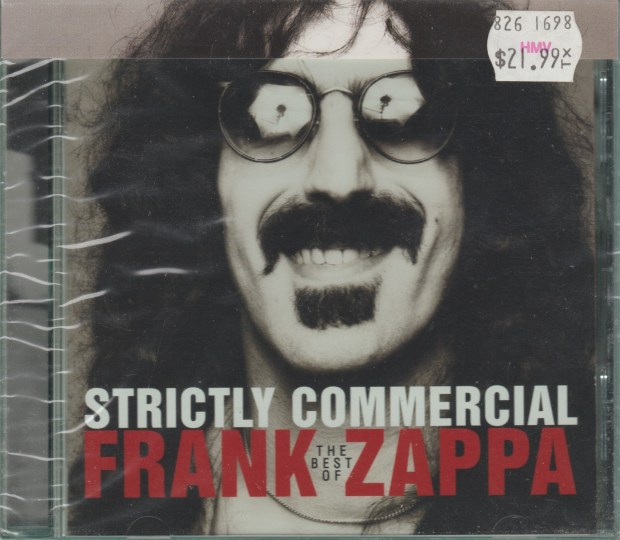
When I was working at the Record Store, I was even pickier about the condition of my CDs than I am today. Everything had to be pristine, including the case. No scratches on the disc, and few to none on the jewel box. I’d wanted some Frank Zappa for a while, but was never satisfied with the condition of those unique light green Rykodisc cases. As trade-ins, they were always scratched, cracked or completely broken. You never saw the obi strip on the top intact in a used copy. Tired of waiting for one that met my exacting standards, I decided to buy it new.
It was fall in the late 90s, and I had the house to myself that weekend. Everybody else was at the cottage. This was during a time when I’d rather be home than at the lake. I preferred to stay in town, hang out with T-Rev, hit the malls, watch some movies and listen to some music. Not just new music, but new bands for my collection. Along with Frank, I decided that I needed to add Journey to my collection that weekend. It was going to be a great couple days off.
I’d already heard plenty of Zappa in-store and from buddy Tom up in Waterloo. He was getting into Läther, a recent Zappa triple CD set designed to replicate a four record box set that Zappa originally envisioned back in 1977 but was forced to release scattershot instead. Specifically I remember Tom hyping over “The Adventures of Greggery Peccary”, a 21 minute track about a pig. I absolutely needed an artist like Frank Zappa in my collection if that’s the kind of thing he was about. How could the girls resist me if I put a song like that on the stereo?
I knew HMV at Fairview mall would have Strictly Commercial: The Best of Frank Zappa in stock. They always did. T-Rev didn’t understand why I had to do this. “I have a copy here right now,” he told me on the phone. “There’s nothing wrong with it. It plays fine, it’s in great shape.”
“But it doesn’t have the green case or that little obi strip that goes on top,” I countered.
“I guarantee that you cannot listen to a green case,” said T-Rev simply. He was right.
But I was determined; there was nothing he could do to talk me out of the much more expensive new copy. So that day I plunked down my $21.99 plus tax and bought my first Zappa. With green case, unscuffed, and obi strip intact.
Trevor was right that I couldn’t listen to that green Ryko case, but there was also a certain satisfaction in seeing such a pristine one in my collection. I made sure to protect it by carefully cutting the cellophane in such a way that I could slide the case in and out. Although the cellophane has ripped a little in the two decades plus since then, it still protects the pristine green Ryko case beneath.
Although I do have a couple more green Rykodisc cases in my Zappa collection today, Strictly Commercial (review tomorrow) is the only one I insisted on buying new. Having one was enough. I was content to have less-than-perfect Zappas for Hot Rats and Ship Arriving Too Late To Save A Drowning Witch. You have to be practical about such things after all!
As you’re aware, I’ve been doing a lot of introspection lately. I hope you don’t mind. A lot of my reflection has been to my distant past. As I look back, I am reminded how music was always there in my life. One of my first truly beloved records was the original soundtrack to The Empire Strikes Back. The bombast, drama and power of those pieces really appealed to me. It’s safe to say that I discovered music through Star Wars and John Williams. Until they came along, music was just something that was around me. It wasn’t inside me until Star Wars.
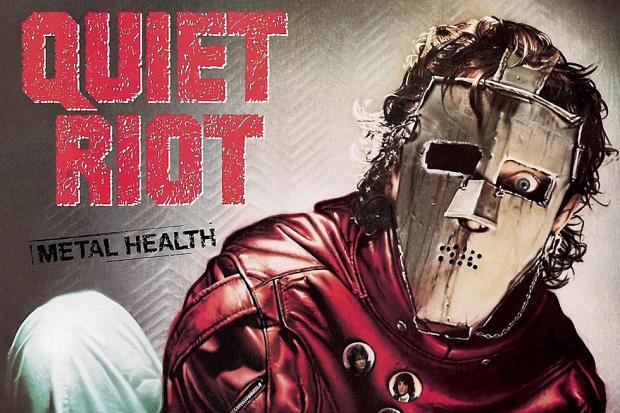
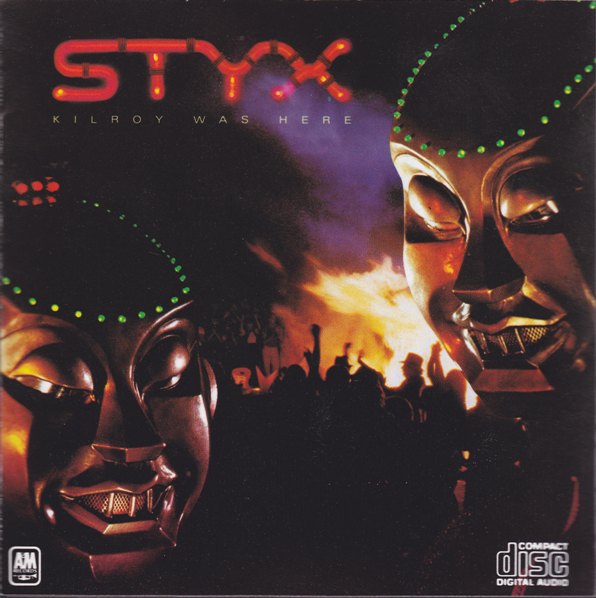
They stopped making Star Wars movies (or did they…?) in 1983, coincidentally the same year that Quiet Riot released Metal Health, and Styx came out with “Mr. Roboto”. I simply jumped from one train to the other! They were both going in the same direction so it wasn’t much of a leap. Rock music was very much about bombast, drama and power. And it stuck with me, bonded at a molecular level.
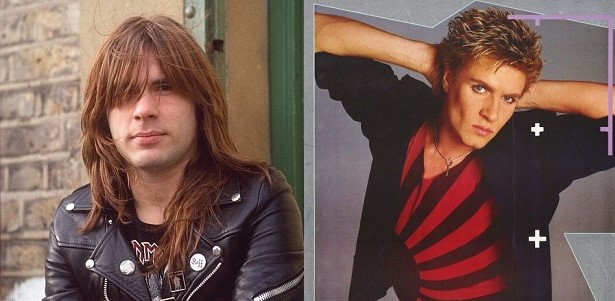
But why metal? There were other trains I could have boarded. At school, every other kid was into Duran Duran. I couldn’t have given a crap about Duran Duran, even if they were in a James Bond movie! So why metal?
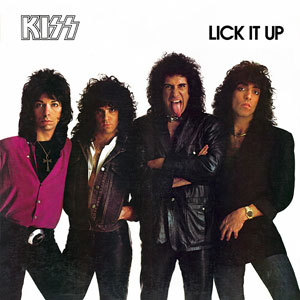
The first factor to examine would be peer groups. Essentially, I had two: the school kids and the neighbourhood kids. The school kids were, frankly, assholes. But none of them lived in my neighbourhood. It was like growing up in two separate worlds. My classmates weren’t near me and I was fine with that. Every time I came home, it was like I had entered a safe zone. The older kids in my neighbourhood were legends. Bob Schipper, Rob Szabo, and George Balasz. They were the ones I looked up to and they were all rocking the metal. Szabo’s favourite bands? Motley Crue and Stryper. Balasz liked Kiss. Schipper was into Iron Maiden.
We would gather on front stoops with boomboxes powered by D-cell batteries. Van Halen cassettes would be passed around like a joint. I heard Maiden Japan by Iron Maiden on my front patio for the first time because George brought it over. The guys were eager to educate me. Quiet Riot, Helix, Judas Priest, W.A.S.P., Black Sabbath were names I was trying to memorize. I had a few things mixed up though. I thought the song “Sister Christian” by was Motorhead, because when they sing “Motorin’!” I heard “Motorhead”. So sure.
On the other hand, the peer group at school was mostly what we called “wavers”. They liked Mr. Mister and Michael Jackson and whatever else, I simply wanted nothing to do with it. At an instinctive level, I think these people repulsed me. I had witnessed and been victim to their cruelty. I wanted nothing to do with their music or their sports and I think that was largely unconscious. I would have loved if they liked me instead of mocking me; it would have made life easier. Obviously I had given up trying. So why not? Heavy metal music was like Musica proibita in Catholic school. There were a few headbangers — I didn’t like them either — but just a few. Those guys thought it was hilarious that I was still into Quiet Riot in 1985 when they had moved onto Van Halen. They would challenge me to “name three songs by Helix” to see if they could trip me up. That was the difference between the rock guys at school, and my friends at home. The guys at home would have just taught me what songs were by Helix.
Fucking school assholes.
An other notable factor on the road to heavy metal that has to be mentioned is the one nobody wants to talk about: puberty! But it is true that the bands I was discovering were (mostly) masculine manly men, and soon I would be wanting to attract a mate like they taught us in sex ed class. To exude masculinity, I chose metal. I am certain that was a conscious decision. Despite the long hair, the guy in Iron Maiden was clearly a tougher dude than the guy in Duran Duran. If there was going to be a fistfight, I wanted to be on the Maiden guy’s side. Easy choice. It seemed that simple in grade seven.
Of course, heavy metal music had the opposite effect in trying to attract girls. It absolutely repelled them, every single one of them. The fact that I just went double-down on the metal showed that my love for the music was genuine. Girls didn’t like metal, but I did, and I was already too committed to discovering all the bands I could. I was living in the rabbit hole.
A gleaming, riveted stainless steel rabbit hole. With a million watt stereo system.
Parental approval? Not really. Though they liked Bob Schipper, they didn’t know what to make of this metal music. They tolerated it, and never gave me a hard time about any of the bands I liked. They probably would have preferred Springsteen like the family across the street listened to. But hey, they bought me the tapes I wanted for Christmas, and they let me tape the videos on TV, so a big applause to my parents. I think my dad was worried that I was becoming such an introvert. I remember him telling me “Garnet Lasby doesn’t sit in his room listening to tapes all day.”
When he said that, all I could hear in my head were the Kiss lyrics, “Get me out of this rock and roll hell, take me far away.” I was so confused. I loved listening to music in my room. The only thing better was listening to music with my friends. Was it bad? I really thought about it, but obviously decided to follow my heart.
One more factor in my journey to metal that is easily overlooked but must be accounted for: the fact that rock and roll is one big soap opera with enough drama, violence and musical brilliance to fill an entire Star Wars trilogy. As my friends taught me the songs, they also introduced me to the stories. “This is Randy Rhoads. He was the greatest until he died in a plane crash.” And Kiss? Woah nelly, there was every kind of story within Kisstory! How many guitar players? And crazy costumes and characters to go with the story? Buying a Kiss album was never just “buying a Kiss album”. It was always buying a issue of a comic book. What would Kiss sound like this time? What seedy subjects would they be wrestling with on a lyrical level? What would the cover look like and what colour would the logo be?
It seems obvious now, but the only way for me to go was metal. In every single alternate universe, I am a metal fan.
Music allowed me to rewrite my persona a bit. I hoped that, instead of that nerdy kid with the Star Wars fetish, I would be remembered as the nerdy kid that was really into music. (Music that is still popular today, incidentally.) Why metal? Because it really only could have been metal.
JUDAS PRIEST – Screaming For Vengeance (Originally 1982, 2012 Sony 30th Anniversary Edition)
While people recognize British Steel as a platinum Judas Priest landmark, it was Screaming For Vengeance that went double platinum. It introduced Priest to the MTV generation and opened them up to bigger American audiences. But before we get to Screaming For Vengeance itself, a cornerstone Judas Priest album in anyone’s books, the “Special 30th Anniversary Edition” must first be addressed. The extra content is a full concert DVD, and four bonus audio live tracks from the same DVD.
To have Priest live at the US Festival is a wish fulfilled for many. The daylight show with full classic costumes (Rob decked in silver) is a nostalgia blowout. The band look lethal although drummer Dave Holland appears overwhelmed by the demanding tunes. The setlist isn’t half bad, with “Green Manalishi”, “Diamonds and Rust”, and “Victim of Changes” being highlights and filling the need for old classics. The bulk of the set is made up of more recent material from the three 1980s Priest albums thus far. Tempos are fast, cowbells are in the air, and Rob is at his confident shrieking best. The audio is great and the video is well reproduced. Owning this edition of Screaming really is a must since it’s the only official release of this show on DVD.
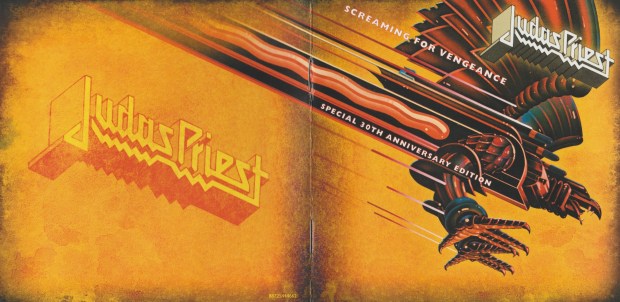
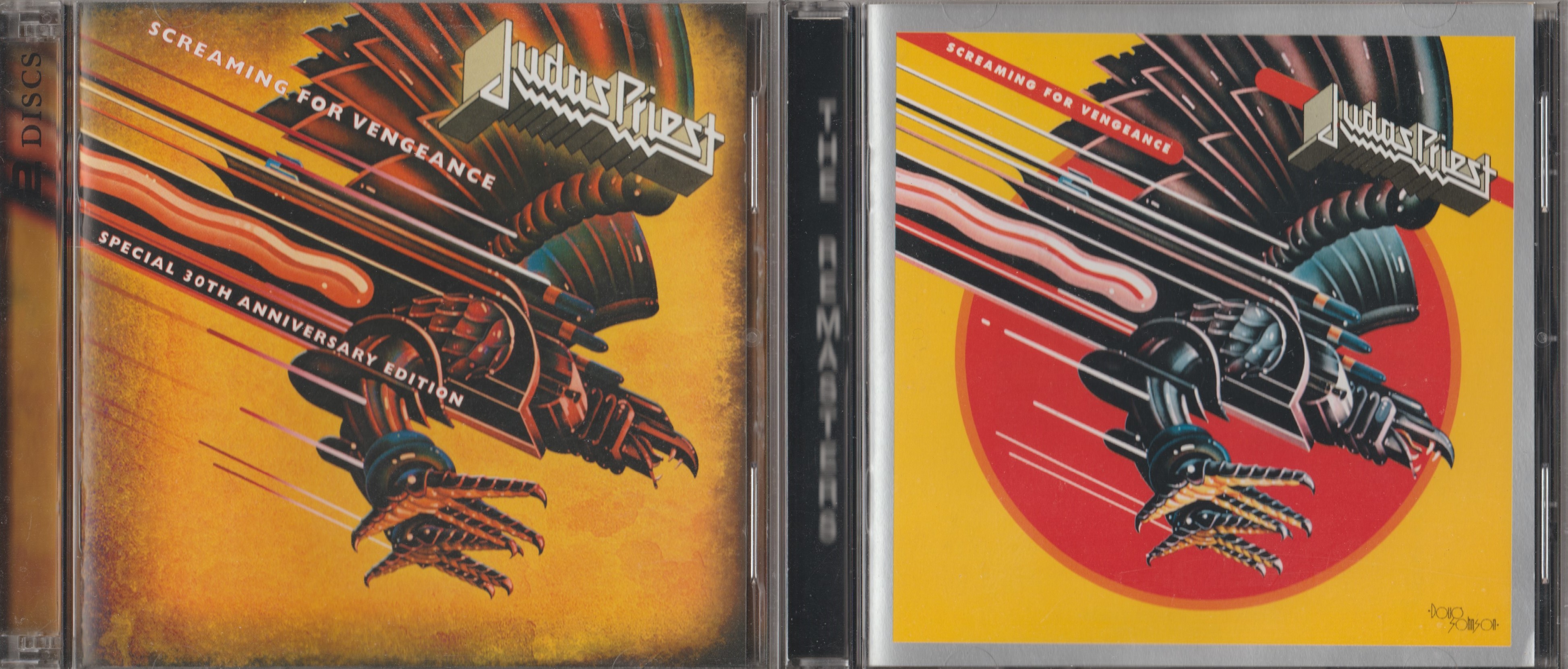
The re-imagined cover art is nice, fitting in with other Priest deluxe reissues (see images at bottom). In an unfortunate oversight, the clean and sharp original artwork is included nowhere inside this set. They did include the two bonus tracks from the previous remastered CD release, which we’ll get to after we discuss the album in full.
Screaming For Vengeance was a sudden change of style for the Priest, after two rather soundalike albums. Similarly the next album Defenders of the Faith would be cast from the same mold as Screaming. All these albums were produced by Tom Allom. Tempos were turned up, guitars sharpened, and as per the title, Rob Halford screamed. A lot. The refined 80s Priest was evident on the opening duo “The Hellion/Electric Eye”. The guitars are sleeker, the vocals processed and robotic. The riffs are just as sharp. Priest were going for the throat. This opening one-two punch was more punishing than any music I ever heard at that time. Though you could not claim it’s heavier than a Priest oldie like “Saints In Hell”, the production is louder and more in your face than ever before.
Drummer Dave Holland sprays a bloodbath of bashes at the start of “Riding on the Wind”, Priest speeding on the highway once again. With Rob in high register, this catchy tune is perfect for keeping the wind in your face. The first respite in terms of tempo is “Bloodstone”, though its glorious riffs need no accelerant. Halford’s scatting at the end is classic and a rare reappearance of his old sassy self from Hell Bent for Leather.
“(Take These) Chains” is one of the most immediately accessible tracks, a mid-tempo delight as Priest do so well. They end the side with a slow metal grind called “Pain and Pleasure”, drums soaked in echo. Rob alludes to an interest in BDSM again, but with music this heavy most people just headbanged and ignored. (In another sad oversight, the lyrics are not contained within this edition, but were reproduced on the previous CD remaster.) Don’t assume that because it’s a slow one it’s weak. “Pain and Pleasure” is a resounding an d memorable side-ender.
The second side opens with the sudden shock blitzkrieg of the title track. Speed metal turned up to 11, “Screaming For Vengeance” is over the top and almost self-parody. It’s one of Priest’s most overdriven blasts of might, but it also verges on mindlessness if not for a spirited solo section in the middle. But then in another jarring shift, the sleek mid-tempo groove of “You’ve Got Another Thing Comin'” rears its familiar head. When I was a kid, there was no question this was Priest’s “big hit”. It was the song everyone knew, and the music video was on constant rotation. Classic clip. The man pursuing Priest is meant to represent the tax man. When Rob essentially yells at him “no tax man, you will not take my money,” his head blows up. They used a little too much TNT on the mannequin, and so the tax man’s pants fell down in an added humiliation. Such is the power of heavy metal, folks. Got tax problems? Rock and roll right in that tax man’s face. Eventually his head will blow up. If you’re lucky the pants might also fall. This is what Priest have given the world!
“Another Thing Comin'” is a brilliant song. Radio super-saturation cannot dull its simply-constructed hooks. Its placement (second song, side two) is odd but that didn’t stop it to #4 on the US Billboard rock chart, nor did it impede the album rising to #17 on the Billboard 200.
The album begins drawing to a close, with an echoey tremolo effect on “Fever”, one of the album’s best cuts. Then the echo ends, and a clean guitar accompanies a plaintive Rob. Mid-tempo, powerfully built and loaded with hooks, “Fever” is a late-album winner. Then, three quarters in, Halford turns on the high voice and the song transforms into something else equally cool. Finally the echo-guitar returns to help bring the song to its dramatic end.
“Devil’s Child” is the last hurrah, a fun and heavy indictment of an ex-lover who’s “so damn wicked” and “smashed and grabbed all I had”. The album ends as suddenly as it begins; jarring transitions being a sonic theme on Screaming For Vengeance.
Tom Allom’s production is often maligned as inferior to the more raw and loose sounds of Priest on their 70s albums, and there’s certainly an argument to be made there. Screaming For Vengeance is not a warm album. It is cold, sharp and steely. It has a precise, digital undertone. But it’s also heavy, considerably more so than Point of Entry which preceded it. The cover art indicated that we were entering a new phase for Judas Priest; a simpler streamlined 80s phase but still deadly enough for the old fans.
The live bonus tracks included on the CD were not chosen willy-nilly. Instead of including the best hits from the US Festival DVD, they use tracks from a different show in San Antonio, and all from Screaming For Vengeance: “Electric Eye”, “Riding On the Wind”, “You’ve Got Another Thing Comin'” and “Screaming” itself. Watch out for the squealing feedback! Finally the original bonus tracks from the 2001 CD are edition are tacked on so you don’t have to own two copies. These include a raspy, smoking “Devil’s Child” live from another concert, and a demo from the 1985-86 Twin Turbos sessions called “Prisoner of Your Eyes”. I hate when Priest use bonus tracks from the wrong era, but the Screaming For Vengeance reissues are the only place you can get this song. In a stylistic shift, this slick ballad sounds more like “A Touch of Evil” from Painkiller, but far tamer. (The guitar solos were overdubbed and tracks finished in 2001.)
Good special edition, but not great. As these things go I’m sure we can expect a better 40 anniversary edition. It won’t be long now.
The Infinite Live Recordings, Vol 2. (3 x 10″ EPs)
DVD – Live at Hellfest, Roger Glover and Bob Ezrin in Conversation
Whoosh!
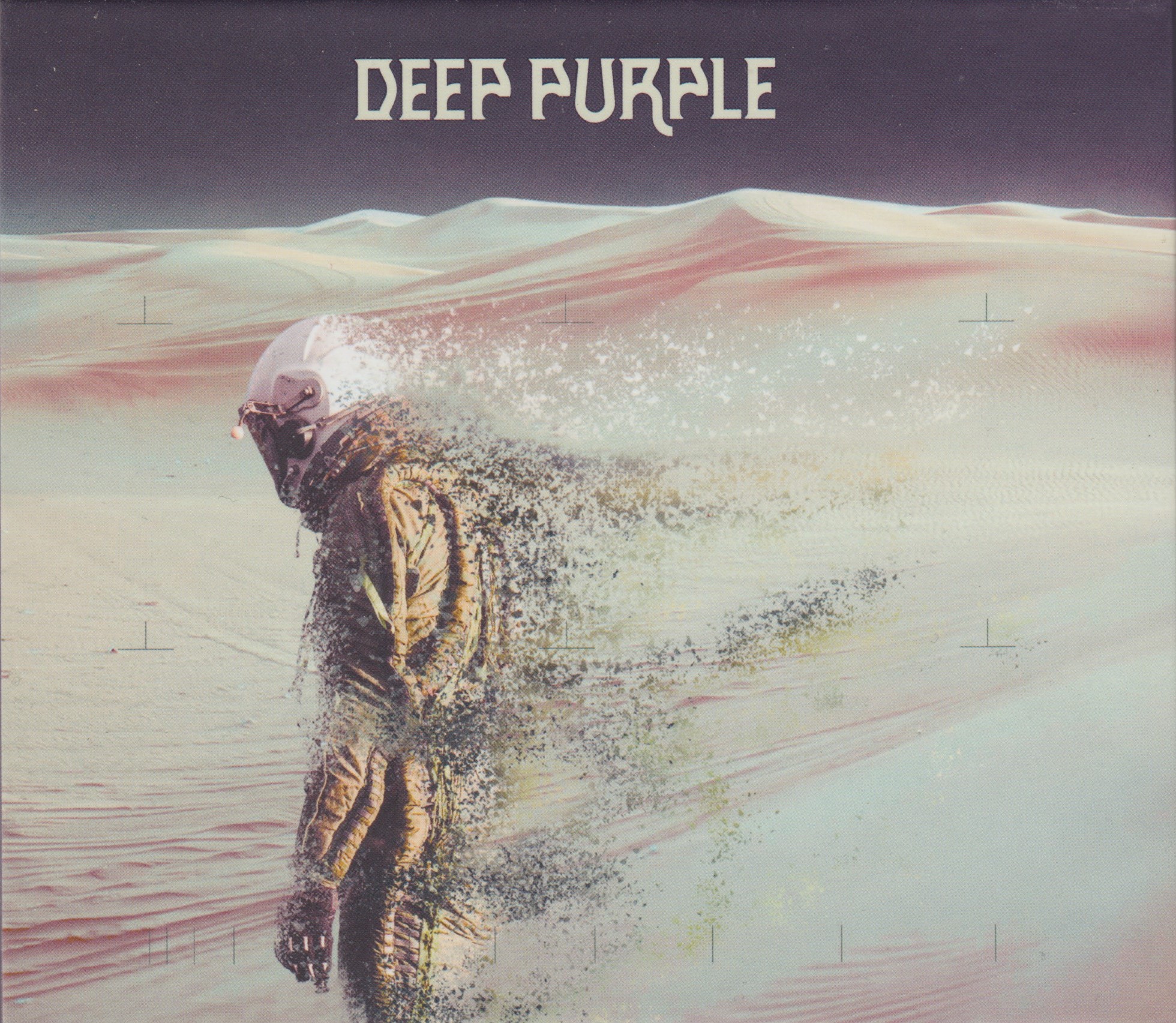
Every Deep Purple album seems like the final album. Maybe this one is; maybe it isn’t. It feels like the band treat every album as seriously as if it was their last. The cover art and music of Whoosh! takes us back to 1968 and Shades of Deep Purple. The logo is similar, and there is a new version of the 52 year old first Deep Purple song ever, “And The Address”.
Opening with the lead single “Throw My Bones“, the album sets a mid-tempo pace from the start. This is a lush, catchy groove with hints of classical and funk. It began life during the Infinite sessions but was not finished until Whoosh! Purple pick it up a bit on “Drop the Weapon”, a non-preachy appeal for cooler heads to prevail. It has a similar vibe to the 1988 album Accidentally On Purpose by Ian Gillan and Roger Glover. The immediate riffs and hooky vocals are bound to make this a favourite.
“We’re All the Same in the Dark” has a cool groove and a jaw dropping funky Morse solo. Purple haven’t sounded this funky since Glenn Hughes was in the band. Airey and Glover give it some heaviness. “Nothing At All” sounds like a Morse composition, but his intricate classical-inspired interplay with Airey is sheer delight. This could be the best track on Whoosh!, and contender for one of the best songs of the entire Morse era. A massive chorus could help this one cross over on radio. Though it’s a far different song, “Nothing at All” has elements that recall “Never A Word” from Bananas. A regal-sounding crowning achievement.
“No Need to Shout” opens with the growl of a Hammond. “Just a bunch a crap, you’re talkin’ out your hat!” sings Ian on a song featuring rare female backing vocals. This is one of a few new Deep Purple songs that display a pissed-off attitude. “I got your message loud and clear, the meaningless ringing in my ear.” Add in a couple naughty words and you can tell Ian isn’t having any of it. Cooler though is “Step By Step”, a very different kind of song with perhaps some lineage with “Vincent Price” from Now What?! The haunting, ghostly quality of “Step By Step” sets it aside with a cascade of keyboard accents.
Purple start to boogie on “What the What” (a friendlier way of saying “What the Fuck”). While Don’s hammering the keys, Steve stabs out with some tasty guitar twang. If any song recalls “old” Deep Purple, it’s “What the What”, which could have been on 1973’s Who Do We Think We Are! But that album completely lacks the joie de vivre of “What the What”. Then Purple get heavy on “The Long Way Round” which just drives. The keyboard solo is out of left field but is a spacey masterwork to itself. There’s even a sly Black Sabbath callback — “I promised myself I would not get Trashed again.” Then the song dissolves into a beautiful, quiet stream of notes. This serves as a great lead-in to “Power of the Moon”, an excellent track previously heard on the “Throw My Bones” single. It stalks prey in the cover of night.
Another heavy growl unexpectedly opens “Remission Possible”, an absolutely smokeshow of fretwork. It’s a brief instrumental interlude just before the excellent “Man Alive”. This track, enhanced by orchestra, sounds absolutely massive. It has serious heft, but it’s not weighed down. Ian is writing about some heavy themes and it will take deeper analysis of the album as a whole to decipher them all. Roger Glover was very happy with Ian’s writing on the album, which takes a more contemplative tone without going heavy-handed.
The final side of vinyl begins with another instrumental, the aforementioned “And the Address” from Shades Of. Deep Purple have occasionally re-recorded old material with new lineups, such as “Hush ’88” and “Bludsucker”. This cut of “And the Address” has more momentum. The only guy present who played on the original is Ian Paice, but Don Airey is a dead ringer for Jon Lord. “And the Address” is one of the most enjoyable songs on Whoosh!, probably surpassing the original recording.
There’s still one track to go: the “bonus track” called “Dancing In My Sleep”. Safe to say it’s called a “bonus track” because it’s the most different of all the songs. It’s an Airey conception based on a cool little techno beat. Though it’s certainly not dance music, it does have one foot in that world and it’s a sheer delight to hear Purple stretch out into new territory 52 years into their game.
A seriously fine album this late in the career. An album so fresh that it is hard to rate so soon. But clearly a high point, with a band still exploring new ideas completely unafraid of what people might say. In fact, a band who still has something to say. Something worth listening to.
4.25/5 stars
But that’s not all of course. Go big or go home. Check out the rest of the box set’s contents in detail below.
The Infinite Live Recordings, Vol. 2
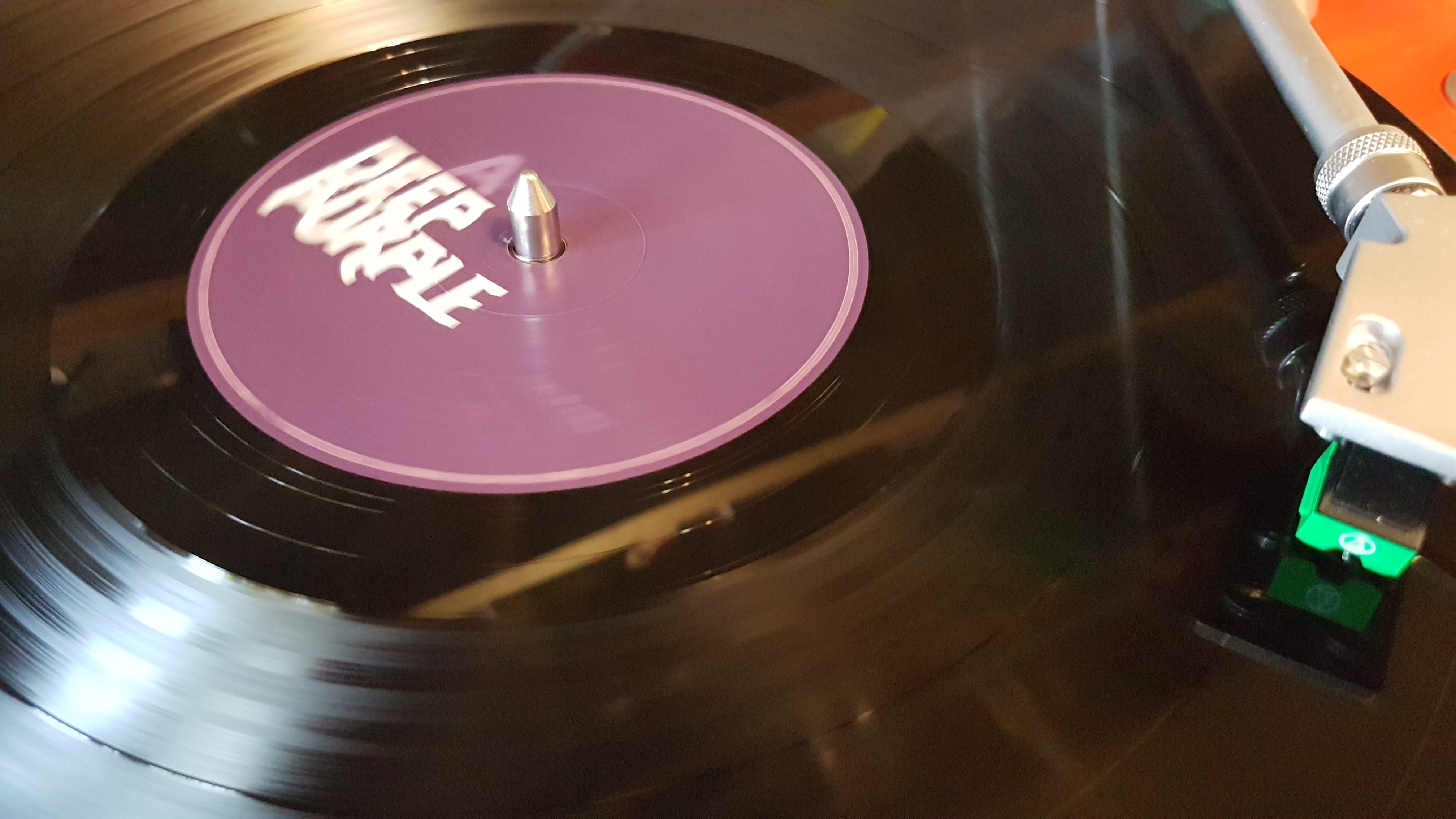
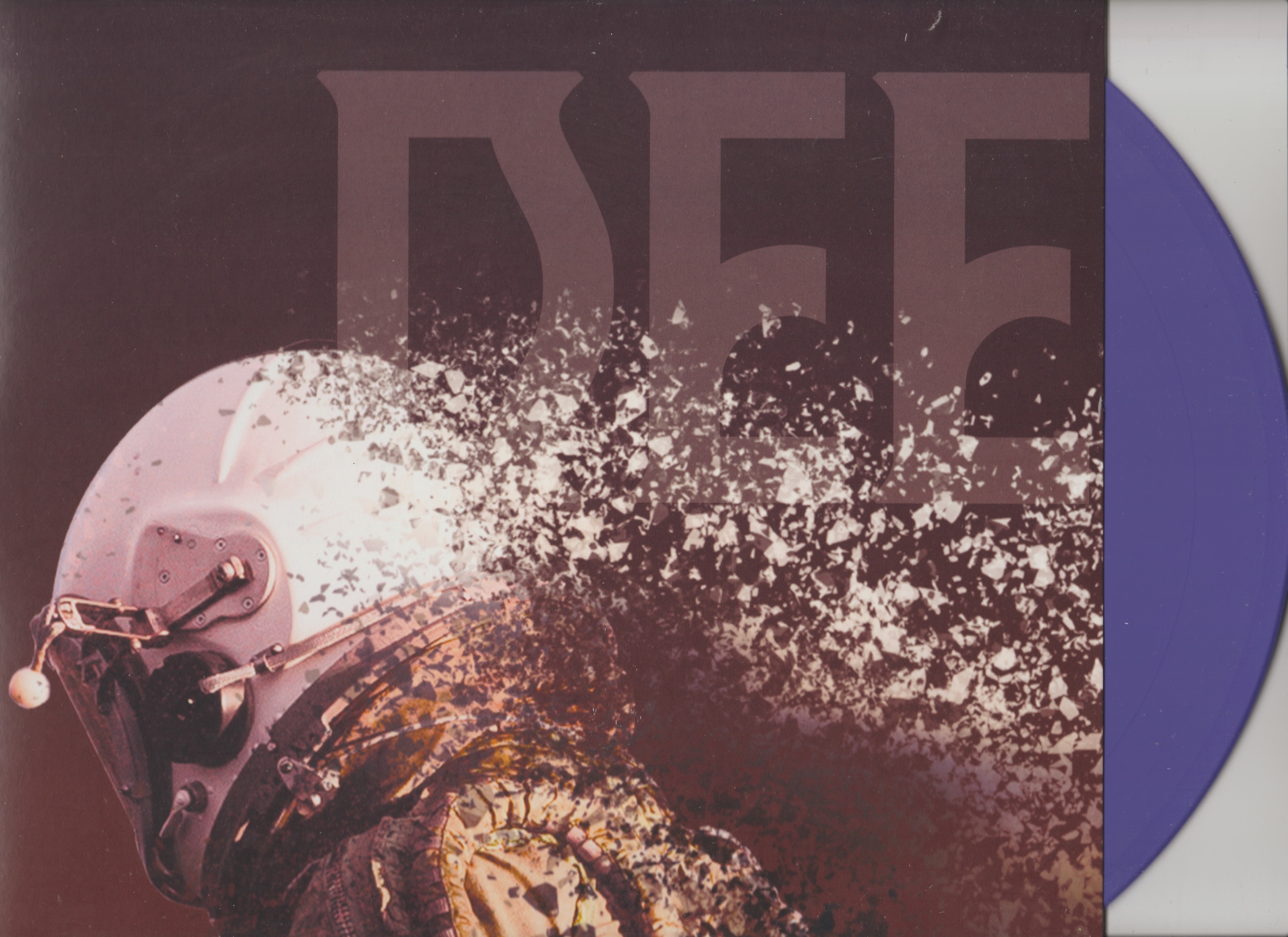
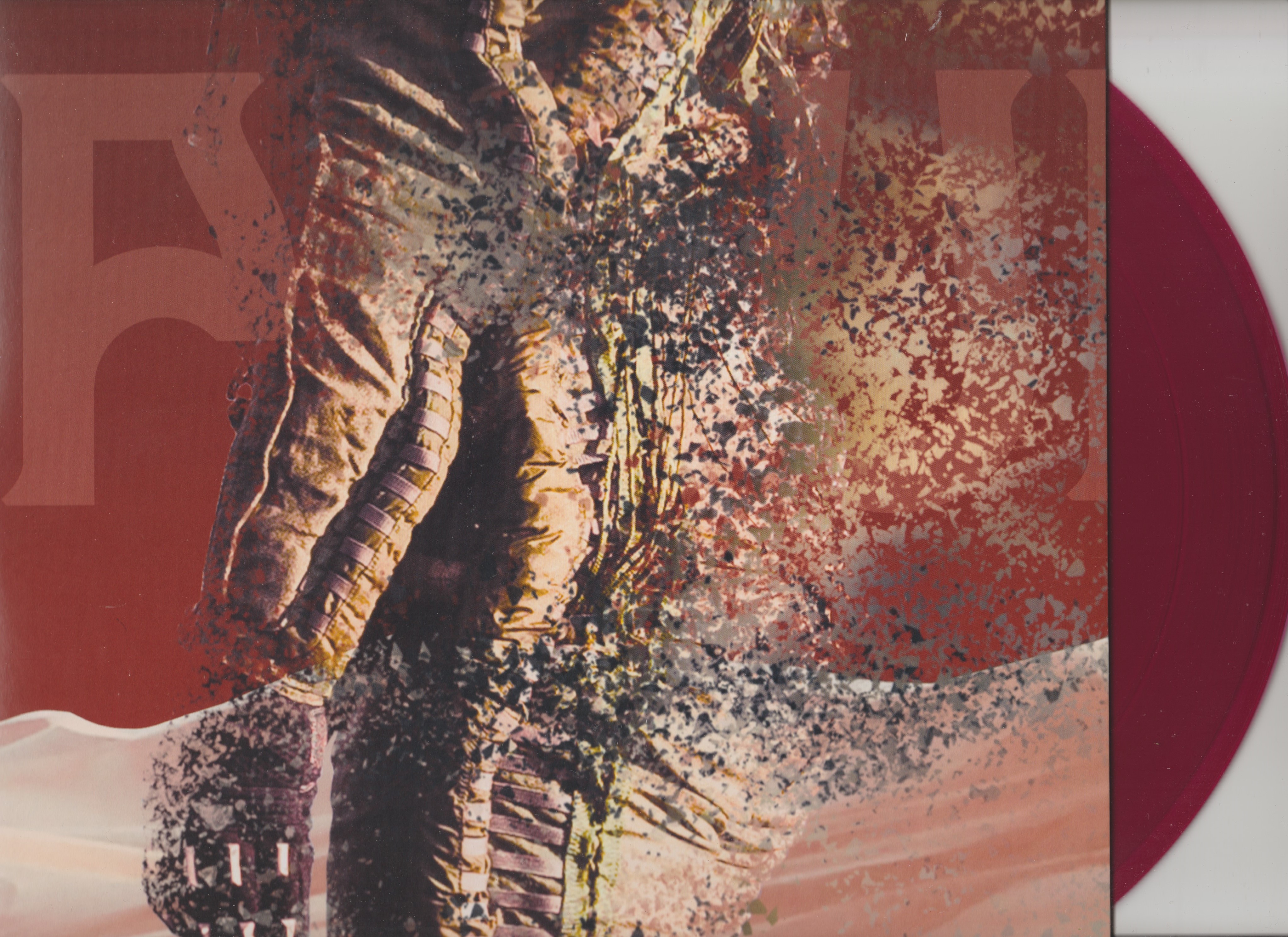
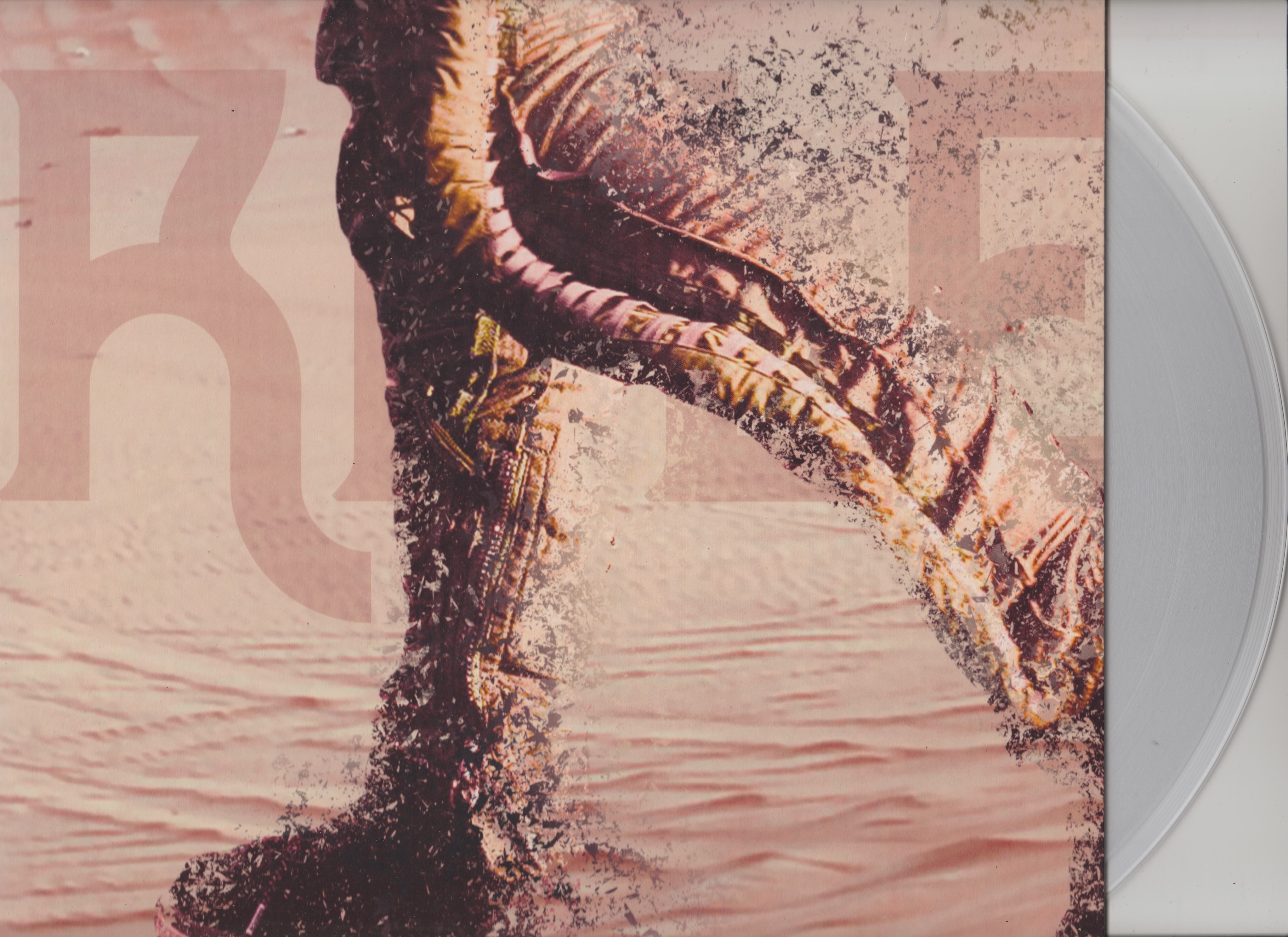
The previously released Infinite Live Recordings, Vol. 1 came out in 2017. The concept behind the series is simple: pure live releases with no overdubs. Vol. 2 comes from a show in 2017 on the Infinite Tour in Rio. It is the big bonus in this box set, and present on a set of three beautiful 10″ coloured records. 72 minutes of live Purple — essentially, a double live album.
The opening thunder of “Highway Star” is robust on purple 10″ vinyl. How these guys can still blast through it full speed is unknown, but they do it. Mr. Gillan still gives it his all, which is not the same in 2017 dollars as it was in 1970 dollars, but still more than the average mortal his age. Mr. Morse and Mr. Airey give each version of “Highway Star” a different feel, while Mr. Paice in the back is the only original member left from the 1968 lineage. Sticking to Machine Head, Purple seamlessly go into “Pictures of Home”. The old familiar groove of Mr. Glover is comforting warmth from the emptiness, eagles and snow. Morse’s solo is a composition to itself, and then Airey gets to put his spin on Jon Lord’s classic organ solo. Then it’s an unfortunate side flip as the band goes back to In Rock with “Bloodsucker”. Gillian is more a verbal timekeeper than the screamer he once was, but the track is otherwise flawless and heavier than lead. A more mainstream hit, “Strange Kind of Woman” flows from that, and relaxes the groove a bit. Don Airey gets his first of two solos (this one organ) as the last track on this disc.
The action continues on transparent burgundy vinyl, and “Lazy”. Morse’s signature string bending is the star of this show. There are a couple different twists in this fresh version including a nifty Gillan harmonica solo. Then it’s the only new song of the set, “Birds of Prey” from Infinite. It’s weighty and worthy of its place. Steve Morse is the Captain on this flight. Gillan ends the track on a joke and then, after a side flip, introduces Don Airey’s keyboard solo including Ozzy Osbourne’s “Mr. Crowley”. This diverse and fun solo goes into “Perfect Stranger” (no “s”?) which has steadfastly remained in the setlist ever since its 1984 conception. Gillan is shaky but the Purple is solid.
The final vinyl, clear 10″ power, commences with “Space Truckin'” signalling the beginning of the end. “Smoke on the Water” is the penultimate moment, slow and groovy after all this blazing rock. Ian Paice has a couple nice moments on this one and Steve Morse’s stuttery solo is completely compelling. One more side flip, and Purple end the set with their first hit “Hush” and the “Peter Gunn” theme. Glover goes funky on this one with a bassline a little like “Another One Bites the Dust” in parts.
An entertaining and good live album, but one you won’t play often simply because Deep Purple have 846 live albums (exaggeration).
There is still more live material from the same tour in DVD form included in this box set.
Live at Hellfest
Next we have a double feature DVD: A live show from Hellfest in 2017, and an interview session with Roger Glover and Bob Ezrin. The Hellfest show has a much longer runtime with more new material. They open the show with “Time For Bedlam” from Infinite. Ian doesn’t even attempt to sing it in tune, but we’ll always cut the guy some slack for still getting up there and givin’ ‘er. The track has a “Pictures From Home” vibe, and the band look cool playing midday in shades. Into “Fireball”, Ian Paice leads the charge as if it was 1971. Don Airey has an Ozzy bobblehead on his keyboard! Then it’s “Bloodsucker”, powered by Paicey. “Strange Kind of Woman” is a nice melodic respite after a pair of piledrivers like that. Ian ends this one with a bizarre freeform spoken word beat poetry bit, but with Morse shredding next to him.
The Jon Lord tribute from Now What?!, “Uncommon Man”, is heartfelt, and a solid track from their current era. It sounds massive. As good in quality is “The Surprising” from Infinite, something of an epic, and performed with full gusto. Intricate symbol work by Paice.
After a brief pause, it’s on to Don Airey and “Lazy”. A high speed workout like that merits something slower to follow, so it’s “Birds of Prey” from Infinite, a steady groove with dynamics. Steve Morse’s solo takes center stage and it’s a melter. “Hell To Pay” picks up the pace. Not Purple’s most remarkable single, nor the best version, but nice to have in live form. Airey’s jammy keyboard solo on this track is stellar, just as the sun starts going down. Then he gets his own full-blown solo, with the Ozzy bobblehead there next to him during “Mr. Crowley”. Roger Glover just watches from the side as Don goes to town through familiar melodies and themes. The crowd eats it up smiling.
Don takes it into “Perfect Strangers” without missing a beat, and soon the rest of the band joins him. This version has some stellar Morse guitar trickery. The set is almost finished, with only “Space Truckin'”, “Smoke on the Water”, “Hush” and “Black Night” left to satisfy cravings for the classics. Even at the end Paicey still brings that thunder. “Hush” has the “Peter Gunn” theme attached, and “Black Night” brings the show to a massive finish.
It’s absolutely delightful watching Ian Paice play the drums, as he mouths along to every beat as if playing beatbox along to himself. It’s fantastic and an expression of pure joy.
It’s not over yet. The DVD has even more content.
Roger Glover and Bob Ezrin in Conversation
The DVD also includes the conversation with Roger Glover and Whoosh! producer Bob Ezrin. This is another full 70 minutes of content. Ezrin was involved with Purple from the jamming stage in Nashville and speaks in terms of “we”. One of the biggest takeaways from this interview is a piece of wisdom from the late Jon Lord as told by Roger Glover. Lord didn’t want to do more than two takes of a solo. More than that, and he starting thinking too much.
The pair discuss the lyrics, the songs, the title (nicked from Faulty Towers), the playing, and more. It’s lovely watching the pair just enjoy Steve Morse’s harmonics. “Like capturing lightning,” says Roger. Watching this portion of the DVD will enhance your enjoyment of the album. It’s fun knowing what parts of the songs turned on the musicians and producer. “Stretch out,” advised Bob. And so Purple interpreted that as stretching it out every way. “I wanna put the Deep back in Purple,” said Bob. The boys also praise Ian Gillan’s focus, from eating right to meditating. They even go back in time and talk about Glover’s joining of Deep Purple in 1969.
Ezrin particularly loved seeing magic unfold live before his eyes and ears, captured on tape. He is obviously a fan of Deep Purple as musicians and as people. Whether you can get into Ezrin-era Purple or not, there is real chemistry between band and producer.
You’ll probably only watch this conversation once, but you’ll be glad you did that at least. There is so much knowledge and history to absorb here that all fans are advised to give the whole thing a spin.
Summing up
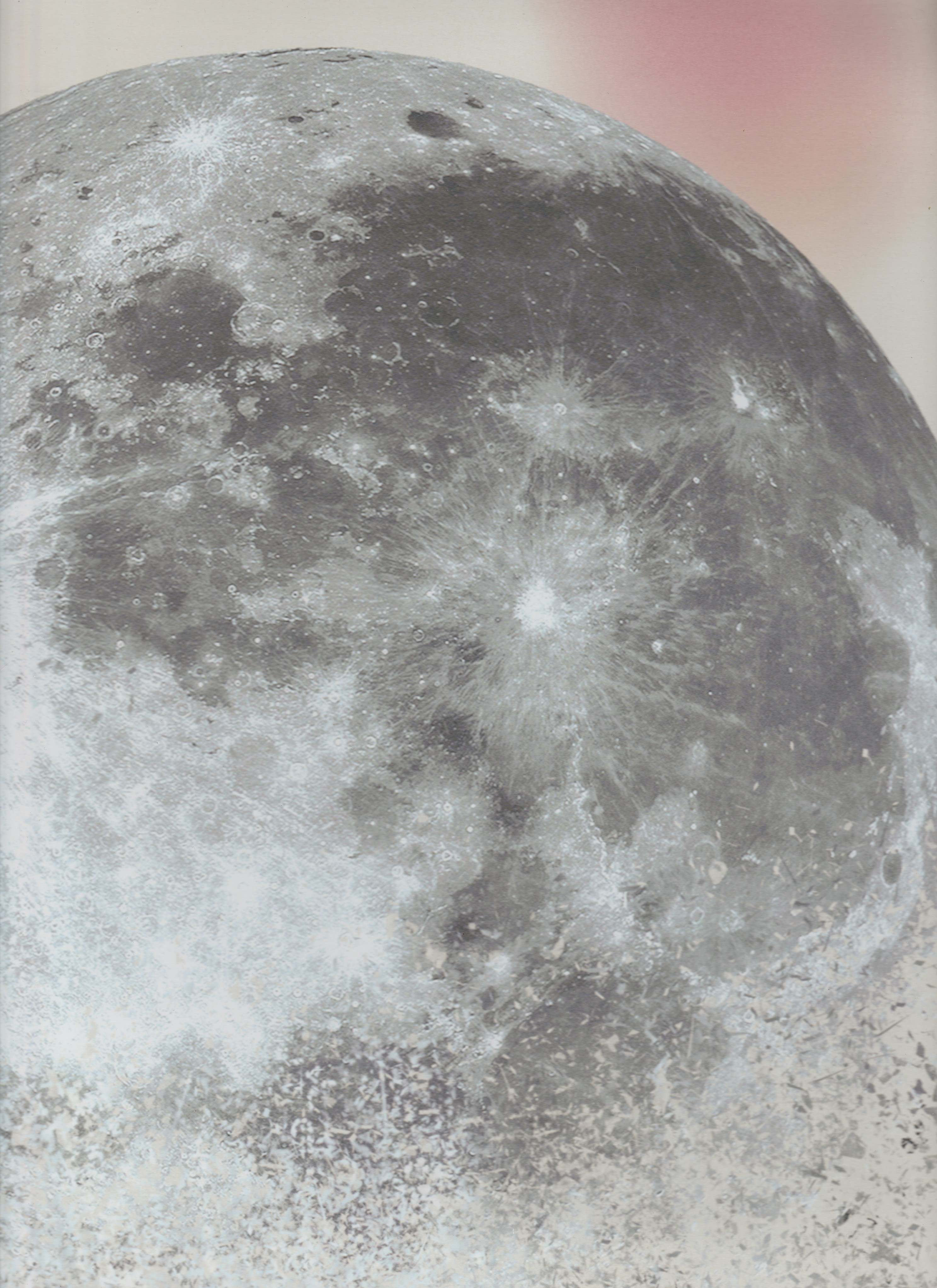
The box set itself comes with a cool black T-shirt with the “strolling dissolving astronaut” graphic. This is the second album in a row with simple excellent art design for Deep Purple. The astronaut recalls the music video for “Knocking At Your Back Door” from 1984. He appears in numerous places in this set in different forms. There are three art prints (two 12×12 and one 12×6), and of course all this music! The vinyl copy of Whoosh! comes in a gatefold sleeve with credits and photos. It sounds phenomenal with plenty of bottom end. For lyrics, you’ll have to dig into the included CD copy.
Of course, if you don’t need all the extra live stuff and added goodies, you could just buy Whoosh! on CD, vinyl or download. It’s frequently said that the benchmark for Purple is Purpendicular. “Best album since Purpendicular,” fans often enthuse. Whoosh! could be the best album of the Ezrin era, and is a contender for best of the Steve Morse epoch. A serious fan will want the whole box with the three live 10″ discs. They are beautiful to look at and sound good on the turntable. Though the set is expensive, this is the kind of thing I’m willing to pay for.
 POISON – “Every Rose Has Its Thorn” (1988 Capitol 3″ CD single)






















 mikeladano.com