“Knowledge of non-knowledge is power. “ – Dean Murdoch
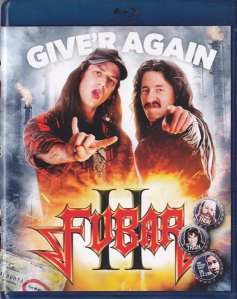
FUBAR II (2010 Alliance, directed by Michael Dowse)
Most sequels aren’t worth owning. Fubar II is. Plus, it comes with a bonus disc: Fubar, the original complete film. This was a total surprise to me. I had no idea it was going to be in there. I’m a little bummed that I bought the original film on blu shortly before this. I gifted it to my buddy Cliff at work who also adores the exploits of Terry and Deaner.
Synopsis: 5 years after surgery, Deaner is celebrating these years of good health. Even though an eviction is looming, he and Terry have no real worries. During a drunken house-trashing party, Tron tells them they have jobs waiting in Fort McMurray. Terry and Dean pack up their meager belongings and head to work in the oilsands.
As with the first Fubar, tragedy must eventually strike. Terry and Dean come to blows over a girl, Trish, who Terry has moved in with. Dean gets some bad news, and Terry gets even more unexpected news from Trish. For a while, Fubar II becomes much darker than the first film.
Unbelievably, a stroke of scripting genius turns Dean’s tragedy into triumph. This ending was as satisfactory as it gets. I ended Fubar II with a huge smile on my face. This sequel does something very unusual: it is funnier than the original, it has more emotion than the original, yet it doesn’t copy it. I have to say this is one of the best sequels I’ve seen.
The footage of the oilsands is really cool. It looks like a cross between Vegas and the Mustafar system – a whole other planet. One thing about this movie, you can tell it had a budget this time, compared to the original. There are some really nice looking shots, and the movie itself looks great. The graininess has been replaced by slick production. The documentary style has been mostly dropped in favour of more traditional storytelling, although a few interview segments are scattered within.
For music geeks, Justin Hawkins of The Darkness has a vocal cameo near the end. You’ll know it when you hear it! The movie also features excellent tunage by Ronnie James Dio & Black Sabbath, The Gun, and Dean’s own classic “Whale Hunter”.
I mentioned the bonus disc with the entire original film, bonus features intact. Other special bonuses in this set include a ton of deleted scenes. While some were overly long and you can seen why they were edited or pared down, others add to the story and comedy. There were several regarding Dean’s illness that might have worked well in the movie. One, “Mixing Meats,” was a shorty that just had me howling. Also, like the original film, this one comes with a commentary from Michael Dowse and others. Better though will be the in-character commentary by Terry and Dean. This was a real treat on the original film, and I’m sure this one will be too. I’ll have to check that out on next viewing.
RECORD STORE TALES Part 190: The Early Bird Drops the Discs
I hated the mornings. What I really hated were people banging on the door to get in before we opened. I don’t know why it bugged me so much. I guess I was just peeved that somebody wanted to cut into my last few moments of unpaid time.
I rarely let people in early. Usually I would go about my business, sometimes I’d let them know I’d be open in 10 minutes, or whatever. My journal records one instance when a fellow didn’t check to see if we were open yet.
Date: 2004/05/19
This one dude was outside the store at 15 minutes before open, trying to get in. The door was locked and when he tried to open it, his bag of CDs fell down to the ground and smashed. He was cursing up a storm out there!
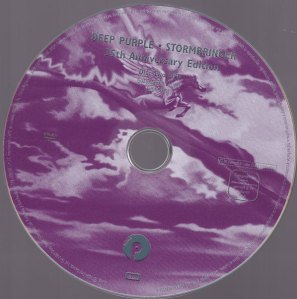
DEEP PURPLE – Stormbringer (35th Anniversary Edition, 2009 EMI, originally 1974)
Stormbringer, now available in the gloriously remastered series of Deep Purple special editions, is one of my favourite Purple platters. Now augmented with bonus material, it has finally been given the treatment it deserved. It’s certainly not everybody’s cup of tea, but Stormbringer has earned some begrudging fans over the years. I for one find it a more enjoyable listen cover to cover than 1974’s Burn.
A lot of fans did not like the funkier, softer direction of the band. You can understand this, of course. A fan who loved In Rock, one of the heaviest records of any decade, could easily be turned off by the radio-ready soul funk of “Hold On”. Blackmore himself decried the funky direction of the band.
Here’s the good news: Whatever Deep Purple set their minds to, they could do. And they could do it well.
Blackmore may not have liked the album, and he did take a step back in the mix, (you can barely hear any guitar on “Hold On”). He could stilll adapt to and play any style. His playing here, while sparse, is sublime. Ian Paice takes to the funky rhythms very comfortably, laying down some excellent grooves. Jon Lord steps up to the forefront, supplying some excellent, funky keys.
There are a few songs that harken back to the past: “Stormbringer”, the title track, sounds as solid as any epic the band had ever composed. It could have been on Burn as easily as this record. In fact, it stands out as being out of place: As the opening track, fans must have been shocked and surprised when the rest of the album was so different.
Another song that has shades of older Purple is “The Gypsy”. It’s a slow mournful piece, perhaps akin to “Mistreated” from the previous album. The lyrics are uncharacteristically bleak.
One track showed an interesting glimpse of the future. “Soldier Of Fortune” is an acoustic track which forshadowed much of the music Blackmore would do with Rainbow, and even now with Blackmore’s Night. David Coverdale has performed it live with Whitesnake. I think it’s one of Richie Blackmore’s finest compositions.
Of the other tunes, “Love Don’t Mean A Thing” is one of the funkiest, and one of the most entertaining. It’s just fun to listen to. David and Glenn co-sing this one. Ritchie’s solo is very understated, but appropriate. Glenn takes his first solo lead vocal with Deep Purple on “Holy Man”, a soulful ballad. “You Can’t Do It Right” features probably the funkiest guitar work of Blackmore’s career. It’s fascinating to listen to, and the band really cooks on this one. It’s one of the most extreme experiments of this funky Purple period.
As with all the Purple reissues, this has been lovingly remastered. Finally you can discard your original CD, mastered for digital ages ago, but never really letting the subtleties of the music shine. Stormbringer, of all the Deep Purple albums, perhaps has more subtleties to hear due to the quieter nature of the music.
Bonus material? Oh yeah, there’s bonus material, in this case four remixes by Glenn Hughes. These remixes don’t replace the original songs, but they do act as a companion piece of sorts. Fresh light is shed on alternate takes incorporated into the mixes, and “Love Don’t Mean A Thing” is extended by over half a minute. “High Ball Shooter” is presented in an early instrumental form as well.
As an added bonus, a second disc has been included. The second disc, exclusive to this edition, is a DVD containing the original 1975 quadrophonic mix of Stormbringer! Nice. Apparently, this disc is to be a limited edition so get yours while you can. I liked quite a bit, myself. As with many quad mixes from the 70’s, the songs often bear noticeable differences from the originals. Quad was a gimmicky fad, by today’s standards, but listening to it with the benefit of hindsight is quite enjoyable.
Lastly, I must acknowledge the great liner notes. The most entertaining story included is in regards to “Love Don’t Mean A Thing.” While in Chicago, Ritchie ran across a street busker, who was snapping his fingers singing a song about money. Blackmore invited him onto Purple’s plane, collected Coverdale and Hughes, and jammed for 20 minutes with this guy who taught them the song and the lyrics. The band finished the song that became “Love Don’t Mean A Thing”, credited to the entire quintet, because nobody ever bothered to get the busker’s name.
Pick up Stormbringer in this 25th Anniversary Edition, and finally you can feel comfortable discarding your original.
There was a group of kids on the street (Bob, myself, Rob Szabo, and Peter Coulliard) that were competing for a cassette copy of Kiss Alive II. There was only one copy that we knew of in town on cassette. Guys like Bob and Szabo would know that — they were older, had nice bikes, and probably had been checking all over town. The only copy we knew of was at a store called Hi-Way Market.
Other kids on the street such as George and Todd had the album on vinyl, but Bob and myself didn’t really have any decent equipment for playing records at the time. Cassette was portable, it was our primary medium in 1985. In 1985, you didn’t listen to “albums”, you listened to “tapes”. The cassette copy at Hi-Way Market was priced at $12.99. This was more expensive than most, because it was considered a “double album” even though it was still just one tape.
None of us had $12.99 plus tax right then, but Hi-Way Market had this tape we all wanted. Hi-Way Market was a great store. It had old creeky wooden floors. Downstairs were groceries and clothing. Upstairs, the greatest toy store in town. Every Christmas they did a giant Space Lego display. It was incredible. But off to the side of this store, up a narrow staircase, was a little record store. I bought my first Iron Maiden (Live After Death, on vinyl) there. (I think the deciding factor in buying the vinyl of that album was the massive booklet, a rarity in those days.)
Since none of us had the money, Peter Coulliard hid the copy of Alive II behind something else in the store. Something where no Kiss fan would ever look for it. Probably behind Duran Duran or Michael Jackson. This enabled Peter to have the edge when he finally did gather the necessary funds, thus edging Bob, Szabo and I out in the battle for Alive II.
1999:
These two kids kept coming into the store that were fascinated by my copy of Kiss’ Carnival of Souls. These were young kids…well, about the same age as Bob, Peter and I were back when we pulled this stuff. They did not have the $10.99 ($12.64 with tax) to purchase Carnival of Souls. We didn’t have the only copy they could find, but we did have the cheapest one. The mall stores were asking at least $20 for new copies.
So these kids came in day after day, week after week, moving Carnival of Souls. They continually got more creative with their hiding places. My job was to make sure the shelves were also straight and orderly, and when you’d find Kiss under Anne Murray, you’d put it back. When bosses found Kiss under Anne Murray they’d give you crap. So, much as I sympathized with the kids’ musical choice, they were grinding my gears as manager.
Finally I got fed up. I sent the CD to Trevor’s store with an explanation of why he had to keep it and sell it there. Then the two kids came in again.
“Hey, umm, do you have Kiss Carnival of Souls?” asked the first one.
“Nope, sold it yesterday,” I lied.
“Awwww…” said the second kid.
It had happened. I had become “the man”! I had lost sight of my old self. Didn’t I pull that “hide the album” stunt myself? In fact, didn’t I do it with GI Joe figures at Hi-Way Market? I did!
OZZY OZBOURNE – iTunes Festival 2010 (iTunes exclusive EP)
Jesus Murphy! How much live product does Ozzy need? Remember back in the 80’s when he used to moan and moan about record companies who wanted to release live stuff with his hits and Sabbath tunes? Well, for a guy who complained about it, he sure didn’t break the cycle.
This is Ozzy’s third live EP (after Live E.P. and Just Say Ozzy). For those keeping score, Ozzy also has four full length or double live albums, a live bonus disc to the Diary of a Madman album, and several live bonus tracks. But who’s keeping track? I guess it’s kind of cool that this EP was released three days after it was recorded on July 3, 2010…if you were there…or even knew it was happening…I guess.
Anyway this live EP was cool at least because it was the first live product available with Ozzy’s new guitar wizard Gus G. The band was rounded out by Blasko (bass), Tommy Clufetos (drums) and Adam Wakeman (keys). Hmm, didn’t two of those guys also play on the last Black Sabbath tour?
It’s entertaining enough, but any Ozzy live product in the last 20 years has felt like “just another live album” to me. Even with the new lineup on this one, I can’t feel too excited. At least I got one song that I didn’t have any live versions of: the new “Let Me Hear You Scream”. Oh, wait, hold on — another live version was on the Scream tour edition that was released a few months later! Jesus! This iTunes version sound like it has loads of taped backing vocals. Too bad.
“Mr. Crowley” is next, a fine version, nothing wrong with it, after all these years nothing can compete with the version on Randy Rhoads Tribute. Gus G plays the solo pretty much perfectly, but something’s missing. Maybe it’s that the song is tuned down for Ozzy’s voice. Ozzy reminds us that he wants to see “some fuckin’ hands”. Another Blizzard of Ozz track follows, “I Don’t Know”. Gus G gets to do some more original shredding here, as he puts his own spin on an Ozzy classic. This guy will be a guitarist to watch, as he grows.
“Suicide Solution” is the third of three tracks from Blizzard. I think it’s a shame that Ozzy keeps playing the oldies while leaving more recent songs behind him. On this EP, only “Let Me Hear You Scream” is newer than 1991. I for one would probably poop if I got to hear something like “Perry Mason” or “Trap Door”. At least Gus G breaks the world landspeed record with his solo.
One song I never liked, ever, is “I Don’t Want to Change the World” from No More Tears. This is the fifth version I own now. It’s just…I dunno…I hate the chorus. It’s too pop for Ozzy. It’s like Bon Ozzy, or something. Ozz Jovi.
My favourite track is last: “War Pigs”. Even though “War Pigs” is on pretty much every Ozzy live album ever made, this version is one of the most fun! I just love when Ozzy tells the audience this:
“Clap your fuckin’ hands, come on you fuckin’ assholes!”
That is just hilarious! I always laugh. When I put this song on mix discs, I always label it “War Pigs (‘You fuckin’ assholes’ version)”.
OZZY OZBOURNE – “How?” (2010 iTunes single)
The last thing I want to talk about is Ozzy’s studio version of John Lennon’s “How?”. This is also an iTunes exclusive, released in October 2010, shortly after the EP. It was released on what would have been Lennon’s 70th birthday, with the proceeds going to Amnesty International.
Causes and good intentions aside, I think this version is just as crappy as anything on Ozzy’s dreadful Under Cover CD. This is just…dull, boring, and not good. I don’t know who played on it or produced it because there are no credits. (Physical product! This is why I care!)
BON JOVI – “Because We Can” (2013 Island Records Japanese single)
There was a time I used to look forward to new releases by Bon Jovi. It’s been a long time since I felt that way. I thought the band bounced back (pun intended) with 2002’s Bounce, then they lost me immediately again with This Left Feels Right. I don’t like to give up on bands that I used to feel strongly about, so I decided to check out Bon Jovi’s newest single, “Because We Can”.
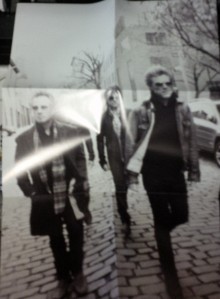
I chose the Japanese single as it had one more track than the European. I had not even heard the song yet. It is written by Jon, Richie and songsmith Billy Falcon, produced by Jon and John Shanks. (In other words, more of the same…) The single came with a small 6-panel fold out poster and lyric booklet in English and Japanese.
The light glare completely erased Dave Bryan from this photo!
Like many fans who have been hanging on long past Bon Jovi’s best before date, I found the song disappointing. Rather than growing, it sounds like Bon Jovi are returning to the mainstream modern pop sounds of Have A Nice Day or even Lost Highway. Bon Jovi’s never been the hardest rocking band, but they have written some great passionate rock songs in the past. “Because We Can”, by title alone, should be in your face and proud of it. Instead, it’s another faceless Pop Jovi song. I’m going to write my own Pop Jovi song called “Who Says We Ain’t Strangers Tonight Because We Got It Goin’ On”.
I hate the chorus, it would be embarrassing to be caught singing this one. There are some nice guitar licks flitting here and there, almost Brian May-like in sound, but barely audible. Everything is buried under a thick blanket of backing vocals, plastic drums and electronic sounds. You can barely make out Richie’s voice, and what passes for a guitar solo is really just a layered guitar melody. At least the Japanese single comes with an instrumental version, which will allow you to hear Richie’s simple and sparing guitar.
The third and final track is a 7 minute live version of “Keep the Faith”, from 2010 in New Jersey. Even this is slightly more laid back than the original 1992 version. But at least it shows that Bon Jovi can write and play challenging material while keeping it accessible. From the manic drum patterns to Richie’s smokin’ solo, this live version is everything that “Because We Can” should be. Richie really shines on this track; I hope he comes back. Bon Jovi without Richie ain’t Bon Jovi.
Based on this single, I won’t be buying the new album What About Now unless I find it cheap.
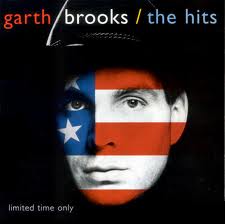
In 1994, Garth Brooks issued his 10 million copy selling compilation album, The Hits. On the front cover was an interesting notation: “limited time only”.
Now, I’ve bought discs that were limited edition before and were numbered to prove it. For example I recently picked up #5945 of the “Credo” single by Fish. Even so…that’s a lot of copies out there for a single by Fish. How many copies of a Fish single would be made anyway? And aren’t all singles limited edition? After all, they aren’t going to make more once they’ve run their course, no matter who the artist is. Onto the next thing.
And then of course you have some seriously limited edition items, like that recent Thin Lizzy Live at the BBC box set! I’m not sure how many copies were made, but everybody’s sold out, and now you have to buy it from people asking way too much. Over $250 USD on Amazon right now. Forget it! That is limited edition.
When Garth plastered “limited time only” all over The Hits, it quickly became a joke. We ordered 50 copies of them, and sold most during the first week. We ordered another 50 copies, as Christmas was coming soon. Those sold. We ordered 20 more after Christmas had passed, and continued to order them every week into the new year whenever we sold out. Some limited edition!
10,000,000 people bought it, and I’m sure 99.9% would have bought it without that “limited time” tag. With great pomp and circumstance, Garth then had the master tapes destroyed.
The master tapes to a freakin’ greatest hits album! Who cares?
It was really hard to take the phrase “limited edition” seriously after that. The next release that came out that truly was a limited edition was the Smashing Pumpkins box set The Aeroplane Flies High, but even that enjoyed a second run when the first printing sold out.
So: the lesson here folks is, when it says limited edition, be skeptical! Very few things are, and the ones that really are limited aren’t always advertized as such. Record labels want to make money, right?
Unfortunately, Garth didn’t put this one on his box set!
Mick Fleetwood and Dweezil Zappa appear in this cheesey 80’s classic!
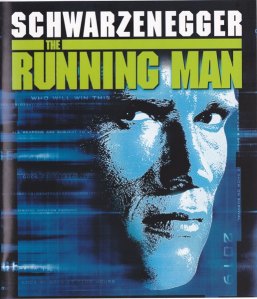
THE RUNNING MAN (1987, starring Arnold Schwarzenegger, directed by Paul Michael Glaser)
It’s hard to believe that, as goofy as The Running Man is, it came so close to predicting what aspects of our society would be like in the future. We still have a few years before we hit 2019, perhaps we are right on track for our 2019 to match this version!
The Running Man is loosely (and I mean, very very very loosely) based on the novella by Richard Bachman, otherwise known to his “dear readers” as Stephing King. Where the King book involved a desperate man who needs money to buy medicine, and a game where he can travel anywhere in the world, the movie scales things back. Ah-nold, at his one-liner best, is Ben Richards, a former pilot who disobeyed orders and refused to fire on an unarmed mob. He is imprisoned but escapes, and is now about to appear on “The Running Man”, a 24 hour a day, 7 day a week television show (hmmm, Big Brother?) and fight for his life. The prize is a full pardon for your crimes, a loss means death.
This story was recently ripped off in a lil’ smash hit movie called The Hunger Games. Perhaps you’ve seen it, or a 13 year old girl wearing a Peeta shirt?
Society is now a police state (hmmm?) and the people are distracted by endless game shows on television (hmmm?). News is heavily censored and “edited for television” (hmmm?). Ben Richards’ crime of disobeying orders has been spun by the networks — they show a fake video of him firing on the unarmed crowd, earning himself the nickname “The Butcher of Bakersfield”. Now he will have the chance to win his freedom on The Running Man, but the odds are well stacked against him. By his side, also fighting for their lives, are two captured freedom fighters. These guys are hoping to use their capture to find the source of network transmissions. Then they could jam it, and broadcast the truth of what the world has become….
The Running Man is not a great film. It’s an 80’s Arnold film. If you’ve seen one, you know what you’re getting. Lots of action. Arnold must battle “Stalkers” on The Running Man. Much like the gladiators on American Gladiators, these stalkers will do everything they can to stop Arnold from winning. They include:
* Sub-Zero, as played by Professor Toru Tanaka (weapons include hockey stick blade and exploding pucks)
* Fireball, played by Jim Brown (flamethrower, jet pack)
* the opera-loving Dynamo (who has a punk-rock-looking suit that can fire electricity; sings)
* Buzzsaw (so named for his use of chainsaw and motorcycle)
* the retired Captain Freedom (Arnold’s friend Jesse Ventura)
The show is run by Damien Killian (subtle!), played by former Family Feud host Richard Dawson. Nobody could have played this role better than Dawson. While playing a game show host was not a stretch for him, Dawson was absolutely flawless in the role. Other famous names include Yaphet Kotto (Alien) as another Running Man contestant, Mick Fleetwood as former-musician-turned-freedom-fighter named Mic (I like to think Mick is just playing the future version of himself) and a very young Dweezil Zappa.
The blu-ray disc has enough bonus features to keep you going after the film has ended, including audio commentaries and featurettes. The audio is really nice, mastered in sweet, sweet 7.1 surround. When Arnold is in that little pod heading down to The Running Man’s play area, the sound was awesome. If you have 7.1 at home you need to check this out. I really enjoyed the sound.
If you like other cheesey Arnold Schwarzenegger movies such as Total Recall or Commando, add The Running Man to your collection. If you like movies with a stirring plot and dramatic acting, avoid at all costs. Regardless of your feelings on this film, do try to read the book. I have always felt that a remake of this film, following King’s book, is well overdue.
One day in the early 2000’s, I was at work, and had this album playing. This guy was in the store, that actually worked at the HMV. As soon as “Truth?” came on, he approached me.
“I can’t believe you’re playing this album. This is great. I don’t know anybody else who really knows this album at all.”
That’s the way Slang went for Def Leppard. It came out to disappointment from the types who want to hear the same album over and over again. (They were obliged on Euphoria). I really dug Slang, then and now. If anything, today I think it might be a tad ballad-heavy. I still love it, and I am excited that Def Leppard plan on releasing a deluxe edition with bonus tracks soon. In the meantime, I have my original limited edition 2 CD set that came with a bonus disc called Acoustic in Singapore.
“Truth?” is a thunderous opener, laden with modern sounding samples and rhythms. Even better is the hypnotic “Turn to Dust”. Although it moves slow, it has loads of exotic atmosphere and instrumentation. Neither of these songs sound like old Def Leppard. There are major changes, including acoustic drums, darker tones and a noticeable lack of shout-along gang vocals.
It’s still the same spirit though. There’s an obsessive attention to detail, layers of backing vocals, and tasty choruses. It’s just 1996’s version of those things. Listen to the title track, “Slang”, for example. It doesn’t sound like anything Leppard have done before, but you can see it as “Sugar” a decade later if you like.
“All I Want Is Everything” is another personal favourite, a great ballad but again unlike what Def Leppard has done before. It has a certain power to it, without being loud and obnoxious. It has a plaintive quality and a fantastic chorus.
Next is “Work It Out” , a contribution from “new kid” Vivian Campbell. It is absolutely loaded with cool guitar squeeks and squonks, no wankery, but a new kind of guitar heroism. These little adornments are there in the mix waiting to be discovered, under suitably thick drones of rhythm guitars. I love this song, which really proved to me that Leppard had successfully adapted their sound to the mid-90’s. A shame it didn’t sell.
Phil’s “Breathe A Sigh” is one that threw a lot of people for a loop. Either Spin or Rolling Stone (I forget which) compared it to TLC. Indeed, loops make up a large part of the percussion parts, and the band seem to be trying R&B on for size. What keeps it Def Leppard are the layers of droney guitars in the back of the mix, and the immaculate vocal choirs.
Interestingly, Slang was stacked with four singles in a row, “Breathe A Sigh” being the final single. This does not mean the album is out of ammunition. “Deliver Me” brings back the heavy. Leppard In Chains? Def Temple Pilots? Not one of the best songs, “Deliver Me” at least balances some of the softer material. Better is “Gift of Flesh”, a driving riff rocker with some slammin’ drums from Rick Allen. Phil wrote this one. I bet it would have been smokin’ live if they ever played it.
This fades directly into a lush but quiet ballad called “Blood Runs Cold”. I could imagine some old-timey fans running away in fear that their nuts would shrivel, at the sound of this one. I love this song, but I’m not sure it needed to be followed by yet another ballad, “Where Does Love Go When It Dies”. Although not a single, “Where Does Love Go When It Dies” was recently dusted off by the band as part of their recent acoustic medley. It is more upbeat than the previous song, and has a folky campfire quality. It also gives the album a sense of flow: an upturn before the dramatic closer.
“Pearl of Euphoria” is that dramatic closer, which returns the listener to the dark, powerful tones that we began with. Leppard don’t often reflect a strong Led Zeppelin influence, but you can definitely hear some “Kashmir” here. Not only is Rick Allen laying down a Bonham-esque groove, but some of the guitar bits flying in and out of the speakers remind me of the sound collage section in “Whole Lotta Love”. It’s a great closing song.
The Acoustic in Singapore disc was a limited edition run, but since the album didn’t sell well you can find them quite easily. This six song disc was recorded in late ’95. Both discs were co-produced by Pete Woodroffe. Some songs work really well acoustically. “Armageddon It” works surprisingly well, a fresh summery version. Some were acoustic originally, like “Two Steps Behind”. It’s cool to have but certainly not essential to your enjoyment of Slang.
Growing up in the 1980’s, Quiet Riot was the first “metal” band I liked. Back then, we were aware that Quiet Riot had two albums prior to Metal Health. These albums seemed unobtainable forever at best, mythical at worst! The first two, Quiet Riot and Quiet Riot II, were released in Japan only. Later on, I did manage to get both albums, so I have a unique perspective on this CD: The Randy RhoadsYears, by Quiet Riot.
See, here’s a nutshell version of the story: QR lead howler and co-founder Kevin DuBrow had wanted to re-release the Randy material for years. Randy himself was never happy with those albums, nor his guitar sound on those albums. In light of this, the late guitarist’s mother Delores was very guarded of Randy’s legacy. She knew that Randy felt the albums consisted of sub-par songs with horrible production. DuBrow eventually won her blessing to re-release some of the old Quiet Riot material, but on one condition only: Get the quality of the songs up to snuff so it doesn’t tarnish Randy’s legacy.
So that’s what he did, using all the means available, and the result is a highly modified collection of Quiet Riot songs with Randy Rhoads.
I can tell people out there who haven’t heard the first two albums that they do sound awful. That’s not a myth. Randy’s guitar is but a shadow of what it would become, and the songs are mostly pretty bad, especially on the first album. The second is much better (particularly in the songwriting category) but it is still hampered by poor production. So what could DuBrow do to get permission to do a re-release?
He started by picking out six of the better songs from the first two records: “Mama’s Little Angels”, “It’s Not So Funny”, and “Look in Any Window” from Quiet Riot, and “Trouble”, “Killer Girls”, and “Afterglow (Of Your Love)” from Quiet Riot II. All of these songs were heavily remixed, with completely re-recorded vocals, from scratch. DuBrow felt, probably correctly, that his original singing voice on those albums was too “boy-ish”.
DuBrow re-sampled all the drums, and re-recorded all of Randy’s guitar tracks through a Marshall stack. Randy had confided with Kevin that he was happiest with the way his guitar sounded live with Ozzy, so Kevin recorded the original, sterile guitar tracks through Carlos Cavazo’s amps. They used the Randy Rhoads Tribute CD as a guide.
On one guitar solo, Kevin knew that Randy wished he had used a wah-wah, but couldn’t afford the pedal at the time. Kevin played the wah-wah pedal himself, using Randy’s guitar tracks, a unique form of collaboration between two friends.
With the Small Faces cover, “Afterglow”, Kevin came up with a cool idea. “Unplugged” albums were on trend, so Kevin stripped all the drums and electric instruments off the track, leaving just Randy’s bare acoustic guitar. It is like stripping a layer of paint off old beautiful old wood: the bare guitar track reveals previously unheard warmth. Kevin re-sang the vocal, kept the electric guitar solo intact, and used a triangle sample to cover up places where the original drums had leaked into Randy’s mike. This painstaking work created from the ground up an incredible alternate version that Randy would hopefully have been very proud of.
None of these people are Frankie Banali.
One of Quiet Riot II‘s best songs is “Trouble”. Kevin felt that it plodded too much, so he slightly sped it up which also raised its pitch. He then re-sang it, and the result is a much better song. Suddenly “Trouble” is a rich sounding hit-worthy rock track.
“Killer Girls” had some minor tampering, a blast of guitar where previously there was nothing. It is “Last Call For Rock ‘n’ Roll” that is most changed. Previously titled “Mama’s Little Angels” on Quiet Riot, Kevin re-wrote what he thought was a juvenile lyric. (It was about trashing the house playing a game of “indoor baseball”.) Bobby Rondinelli, who was working with Kevin on a Quiet Riot album called Terrified at the time, helped him re-write the tune. Unfortunately, regardless of all this work, the song is still just a stock sounding track, nothing special, aside from Randy’s always classy if underplayed guitar work.
The rest of the album consists of unreleased songs. One of the most exciting is a live take of “Laughing Gas” which Quiet Riot never cut in the studio. It comprised an evolving, extended Randy Rhoads guitar solo. Within it, you can hear the kernels of ideas that later became Ozzy Osbourne classics such as “Dee” and “Crazy Train”. Even this “live” track is tampered with: Kevin re-recorded his lead vocals (even the “Ladies and gentlemen, Mr. Randy Rhoads!” part) and actually spliced two different guitar solos together into one. You can hear the splice point between the two quite clearly. Of course this makes the solo no less jaw-dropping.
“Picking Up the Pieces” and “Breaking Up is a Heartbreak” are two of a kind. Kevin says these come from their “pop” period after the second album, just before Randy was off to work with Ozzy. They were getting more desperate for hits, and wrote these two melodic, radio-ready tunes. Both are excellent. Much like “Trouble”, these two songs are world-class. Kevin re-recorded the vocals and so on just as he did with the other tracks. At this time, bassist Kelly Garni had left the band and Randy played bass himself.
Lastly, “Force of Habit” is the only bare, untampered song. In the liner notes, Kevin says they lost the original master tapes, so he was unable to remix or re-record any of it. I think it’s an excellent heavy song on its own. In fact, Ozzy Osbourne must have thought so as well, since parts of this song later became “Suicide Solution”!
This work, and “Laughing Gas” in particular were enough to convince the Rhoads family to go forward with this album. If Kevin hadn’t done this, undoubtedly we would never have seen this release. On the other hand, this isn’t the way Randy recorded it, and Randy obviously had no input to how the tracks were mixed. This has polarized fans, some of whom thought Kevin was the great Satan, others just enjoying the album for what it is.
I enjoy the album for what it is. I like it a lot, actually. I do have misgivings about the tampering, but since I own the first two albums, that feeling has subsided. I can back up the claims that the first two albums are pretty poor.
Kevin had planned on a second volume, including such treasures as Quiet Riot’s metallic cover of “The Mighty Quinn”. He had also mentioned a home video, including the extended “Laughing Gas” guitar solo. Sadly DuBrow, will never get to complete these Rhoads reissues.