geezer butler

REVIEW: Black Sabbath – Live at Last (1980)

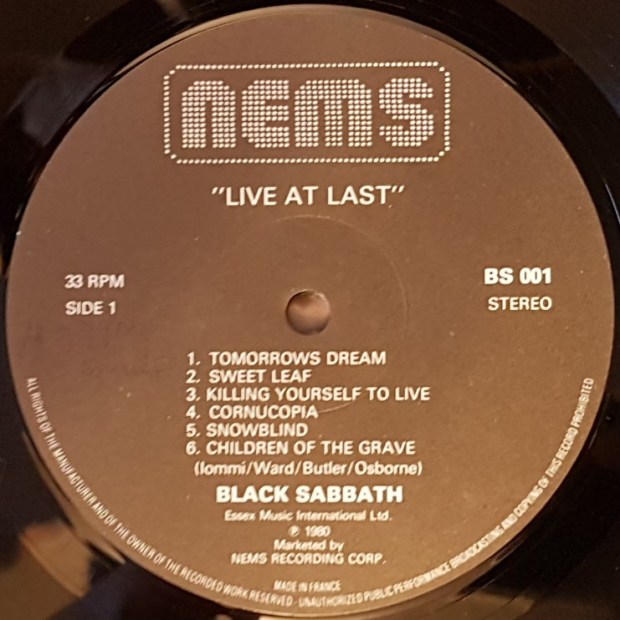
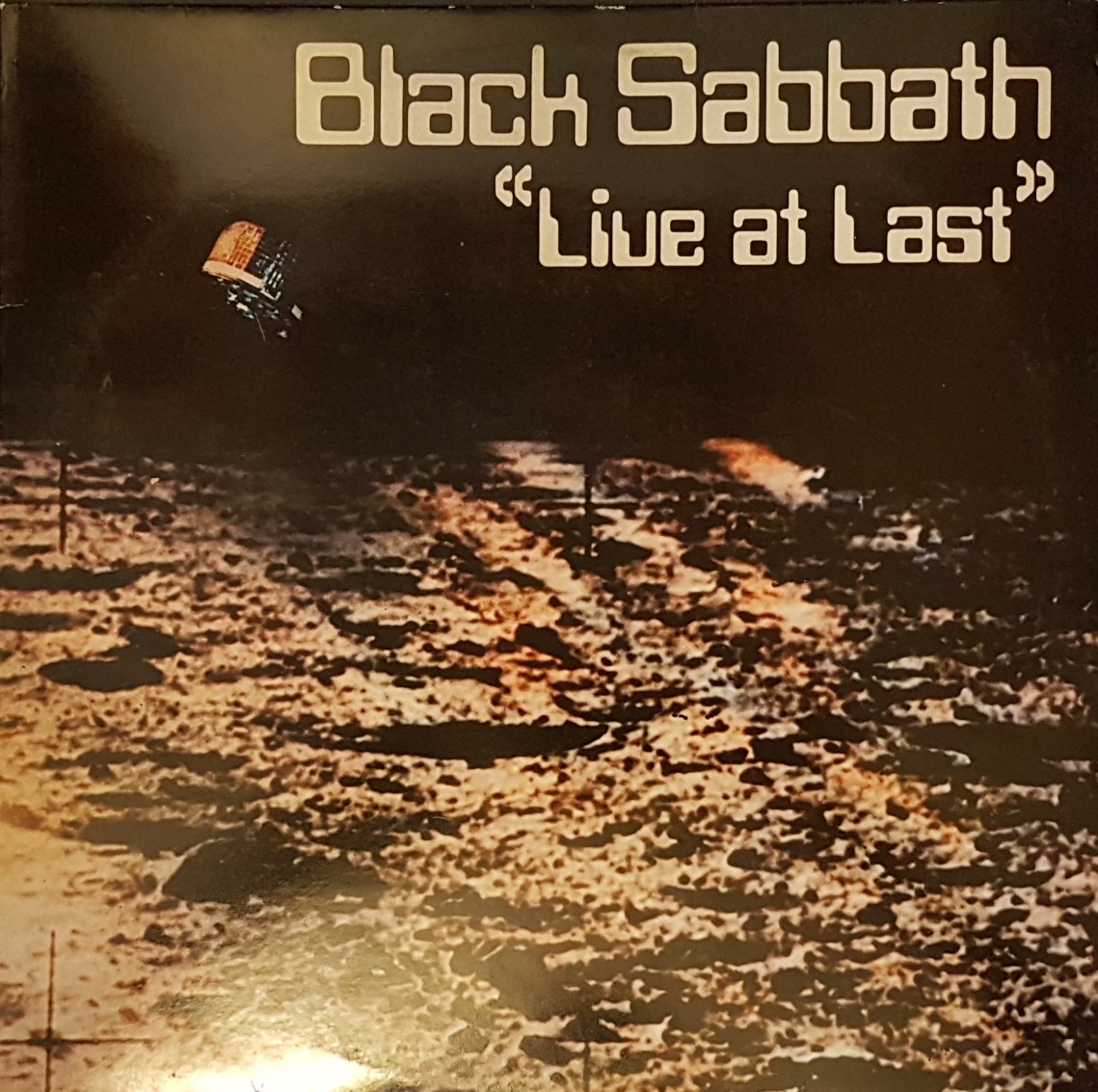
BLACK SABBATH – Live at Last (1980 NEMS)

Although the Black Sabbath discography is not that complicated, we still struggle to know exactly how to file Live at Last.  Recorded in 1973 (Vol. 4 tour), it was shelved because the band were not happy with it.  Much later on (1980) it was released officially but without the band’s consent or knowledge.  They have shunned it, while Live at Last has enjoyed a number of re-releases and remasters.  For maximum fun, why not track down an old vinyl pressing with the singer’s name spelled as Ossie Osbourne?  (The vinyl pressing is also one way to get a completely unedited version; most CD releases lack at least the band intro.)

Live at Last was, for many many years, the only live Black Sabbath album with Ozzy.  Live Evil, released in 1982, had then-current frontman Ronnie James Dio.  Although considered a sub-par album, you didn’t have much choice back then.  Excessive Tony Iommi guitar feedback may be one reason the band weren’t happy with it.

Starting with new single “Tomorrow’s Dream”, Sabbath sound coked to the brim.  Iommi’s guitar pukes sonic sludge, Bill Ward floating behind, and Geezer playing bass melodies from another world.  “Sweet Leaf” continues the trip; Ozzy howling “I love you!” while the stoned band pummels through.  Original Sabbath has a looseness that no other lineup possessed.  It’s just something special that happens with those four guys, and Bill Ward had the swing to it all.

Brand new tune “Killing Yourself to Live” hadn’t been released yet, but it’s pretty intact in live form.  “Get high!” screams Oz.  The challenging song demonstrates Sabbath’s ability to meld multiple memorable guitar riffs together into a single whole.  “Killing Yourself to Live” has at least three distinct riff sections, each cooler than the last.  Unfortunately the recording doesn’t allow us to really hear how the audience responded to the new material.

“Cornucopia” alone could be responsible for birthing half of grunge rock.  The young band’s energy is remarkable.  “Snowblind” is a blast, with Ozzy shouting “CO-CAINE!” rather than whispering slyly. Closing side one, we come to “Embryo/Children of the Grave” and its unforgettable chug riff that launched many a metal band.  You can hear the crowd clapping madly at Ozzy’s command to “Embryo”, before the riff cascades down like the Biblical flood.  Bill Ward paces it faster than the album version by several notches.  “War Pigs” also swings, a little faster than album, but with an unusually jazzy touch.

For some serious swing, check out the 20 minute “Wicked World” medley.  Ward jazzes it up like nobody’s business, when he’s not crushing the heavy parts.  Tony Iommi has a varied guitar solo section, becoming “Into the Void”, then a blues jam and the old standard “Sometimes I’m Happy”.  That turns into “Supernaut” and a drum solo, before reverting right back into “Wicked World” for the finale!  This insane extended track is the one to buy the album for.

After asking the audience several times “What do you wanna hear?”, Ozzy closes with “Paranoid”.  Once again it’s quite fast with Bill ahead of the beat.  Osbourne tells the crowd that they’re beautiful and of course “we love you all!”  and that’s that — a one hour live album on a single LP, all done.  No “Black Sabbath”, no “Fairies Wear Boots” or “Iron Man”, but plenty of the blackest Sabbaths.

Recommended CD edition:  Black Sabbath’s 2002 Past Lives set, which includes a slightly edited version of Live at Last plus a whole CD more of unreleased live stuff.  It even has a sticker on the front that says “Live at Last…deluxe edition”!  Full review of that CD tomorrow.

3.5/5 stars

REVIEW: Make A Difference Foundation – Stairway to Heaven/Highway to Hell (1989)

Make A Difference Foundation – Stairway to Heaven/Highway to Hell (1989 Polygram)

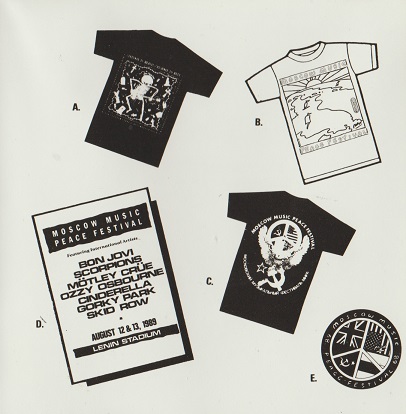
In 1989, I proudly sported my Moscow Music Peace Festival T-shirt in the highschool halls.  It was cool to see the rock bands on the forefront of heavy metal bringing music to the Soviet Union.  Scorpions, Bon Jovi, Motley Crue, Cinderella, Ozzy Osbourne and Skid Row joined Russian metal band Gorky Park in the name of peace and being drug free.

Drug free?  Ozzy?  It’s true that this was a little strange, but Motley were at least clean for the first time in their lives.  The Scorpions had played behind the Iron Curtain before, and Sabbath were huge in Russia.  Meanwhile Bon Jovi were one of the few bands to legally release an album in the USSR, and in return they brought Gorky Park to the US.  I was lucky enough to have a girlfriend who recorded the televised part of the concert off MTV and sent me a copy.  It was a pretty mindblowing video.  Those Russians were going absolutely nuts, seeing their idols on stage.

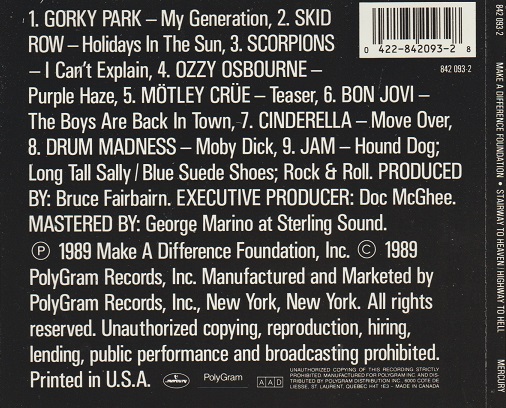
Later on, the bands each contributed a song to a compilation album called Stairway to Heaven/Highway to Hell, each covering an artist who had been touched by substance abuse.  The CD was produced by the biggest name at the time, Bruce Fairbairn himself.  The proceeds went to an anti-drug charity, for all the good “just saying no” does.  The album itself was a pretty great compilation of mostly exclusive music.  Though almost all of it is now available elsewhere, that wasn’t the case in 1989, making this a tempting buy.

Gorky Park, the up and comers, started off with “My Generation”.  Some find it too putrid to stomach.  It’s virtually an original song with only the lyrics recognizable.  The riffs and melodies seem otherwise new.  So give Gorky Park some credit for at least not attempting a carbon copy, but then you gotta take off some points for turning “My Generation” into a Bon Motley song.  Unfortunately for Gorky Park, their momentum halted when singer Nikolai Noskov quit in 1990.

Skid Row surprised the hell out of everyone with the Pistols’ “Holidays in the Sun”.  It was the first indication that Skid Row had punk roots.  “Holidays” was very much a look ahead to where they would go on Slave to the Grind.  They were on the punk bandwagon a full two years before Motley decided to cover the Sex Pistols.  It’s always strange to hear flashy metal guitar solos on a Pistols song, but it’s sheer joy to hear Sebastian spitting and screaming up a storm.

Scorpions had a new compilation out called Best of Rockers ‘n’ Ballads.  Another Who song, “I Can’t Explain” was taken from it to be used on this CD.  It is by far the better of the Who covers, as Scorpions really made it their own.  Next, Ozzy’s track is quite interesting.  It’s the only studio recording of the lineup including Zakk Wylde, Randy Castillo, and Geezer Butler.  Geezer quit the band shortly after, and this incredible lineup never recorded anything else.  I consider it the strongest band that Ozzy had after Randy Rhoads.  The quartet did a live sounding cover of “Purple Haze”, unfortunately not the greatest version.  It is at least a showcase for Zakk Wylde to go nuts on the wah-wah pedal.

I will argue that the best track on this album came from the band that was riding a brand new high:  Motley Crue.  Clean and mean, they were incredibly strong in 1989.  They the balls to choose an obscure Tommy Bolin (Deep Purple) solo tune:  “Teaser”.  Motley put on that Dr. Feelgood groove, and Mick Mars laid waste to the land with his slidey guitar goodness.  It’s no surprise that “Teaser” has reappeared on Motley compilations several times since.  It has balls as big as a bus!

Another strong contender is Bon Jovi’s take on Thin Lizzy.  “The Boys are Back in Town” fits seamlessly with that small town New Jersey vibe that Bon Jovi used to have.  Lynott must have had some influence on a young Jon Bon, because all his old tunes are about the boys – back in town!  Dino’s bar and grill could be in Sayreville NJ.  Of course, Bon Jovi are a competent enough band to be able to cover Thin Lizzy and do it well.

Another surprise:  Cinderella doing Janis Joplin.  Singer Tom Keifer suited Joplin, though you don’t immediately associate the two!  “Move Over” takes advantage of that Keifer shriek that isn’t too far removed from Janis.  From there on though, it’s filler.  Jason Bonham, Tico Torres and Mickey Curry do a pretty boring “Moby Dick”.  It’s funny how John Bonham sounds bigger on the original, than three drummers on this remake.  Then it’s a bunch of live jams from the Moscow concert:  “Hound Dog”, “Long Tall Sally”, “Blue Suede Shoes” and “Rock and Roll” (Bonham on drums again for the latter).  Vince Neil is hopelessly out-screamed by Sebastian Bach on the Zep tune.  All the singers participated, but Sebastian Bach and Tom Keifer blew ’em all away.

This disc has been out of print a while, but isn’t too hard to find.  80s rockers need to have it for its historical value.

3/5 stars

REVIEW: Ozzy Osbourne – Live & Loud (1993 grille cover)

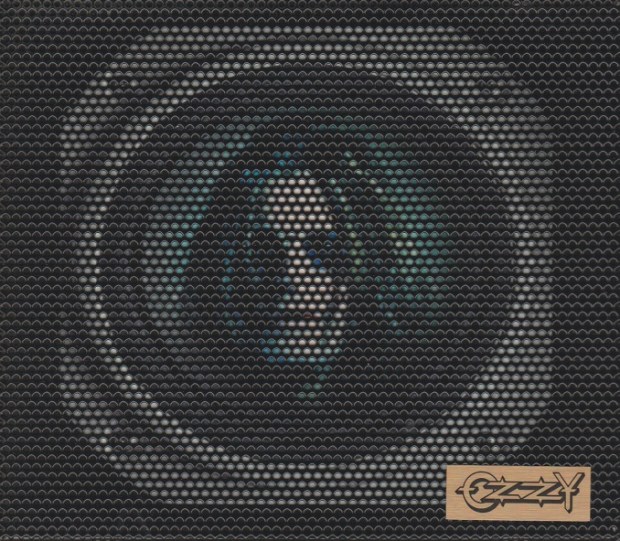
OZZY OSBOURNE – Live & Loud (limited edition 1993 Epic speaker grille edition)

Ozzy Osbourne has done lots and lots of tours since his “No More Tours Tour”.  It seemed special at the time, because we thought Live & Loud was going to be the last live album.   It was not.   What was supposed to be a definitive and indispensable capstone is just another live album, only really notable for its packaging.

Let’s start there.  If you buy this album, don’t buy the remastered edition in the jewel case.  This album didn’t need remastering a couple years later.  Why would it?  Instead search for the original digipack with the metal speaker grille cover.  Finding one in good shape can be a challenge.  Unfortunately, the metal grille is not removable although the VHS release did have a removable grille.  The release also came with two Ozzy “temporary tattoos” on little 2″ x 2″ sheets of paper.  These are the first things to get lost and you might want to consider that you’ll never find them.

Live & Loud scores an A+ for packaging, but gets mediocre grades for the music.  This is patched together from a variety of recordings, and it sounds like a lot of fixing was done after the fact.  It’s bogged down with over-long guitar and drum solos (Zakk Wylde and Randy Castillo) and too much talking.  There is only so much that one needs to be told to “go fucking crazy”.  Ozzy proclaims that he loves us so often that it loses all meaning.  He’s more of a cheerleader than a singer at times, constantly badgering the crowd to get “louder”!  There is also an annoyingly long intro that means nothing without the visual accompaniment that’s supposed to go with it.  I will admit that my buddy Peter and I were amused when Ozzy said “Let me see your fucking cigarette lighters” during “Mr. Crowley”.

On the plus side, this particular lineup of Ozzy’s band was one of his strongest.  Zakk and Randy were joined by bassist Mike Inez who was invited to join Alice in Chains in 1993.  Another plus is the presence of Black Sabbath.  The second to last song is “Black Sabbath”, performed by the original Black Sabbath, at the final show on the tour.  Fans will recall that Sabbath were touring their incredible Dehumanizer album, which frankly blows away Ozzy’s No More Tears.   When Sabbath (then including Tony Iommi, Geezer Butler, Vinny Appice and Ronnie James Dio) were asked to open for Ozzy at his final two concerts, Dio bailed.  He was replaced for those shows by a little known metal singer named Rob Halford.  At the last of the two shows, the original Black Sabbath featuring Ozzy Osbourne, Tony Iommi, Geezer Butler and Bill Ward reunited to play a three song set.  It was their first time together since Live Aid in 1985.

Unfortunately, a couple tracks aside, Live & Loud is flat and uninspired.  “Black Sabbath” isn’t brilliant but at least it’s historic.  All the important songs are there, with maybe a few too many from No More Tears.  There is one surprise in “Changes”, the old Sabbath classic.  This is performed by Zakk on piano and Ozzy.  It’s brilliant and was used as the single.  “Mr. Crowley”, “Shot in the Dark” and “Desire” are pretty good, but drummer Randy Castillo was killing it.  He was the perfect drummer for that band.  Rest in peace Randy.

Live & Loud is for the serious fan only, who will really want to get the grille cover.  Live & Loud is not consistent enough for the average listener and gets bogged down in spots making it a very long run.

2/5 stars


REVIEW: Ozzy Osbourne – Ozzmosis (1995, remastered)

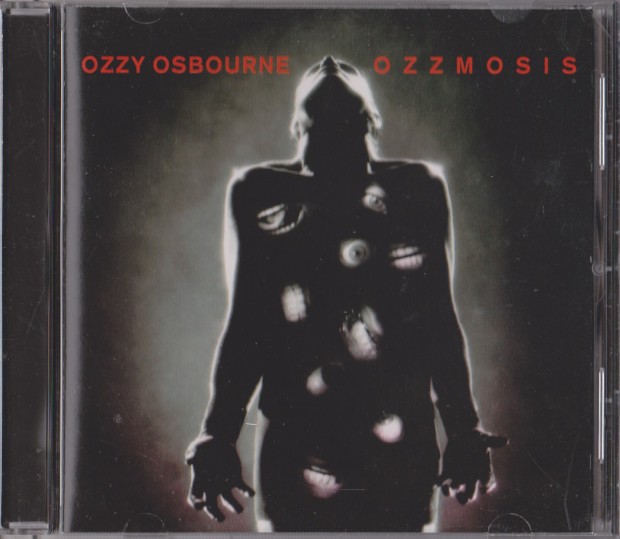
Scan_20160727OZZY OSBOURNE – Ozzmosis (1995, 2002 Sony remaster)

It is fair to say that Ozzy’s solo recording career post-No More Tears is not considered as classic as the music from before. Admittedly it was a confusing time. Ozzy finished his “No More Tours” tour while all the talk was about a Sabbath reunion that never happened. Retirement wasn’t in the cards, so Ozzy re-teamed with a few former members of his band: Zakk Wylde on guitar, and Geezer Butler on bass. Joining the band behind the drums was a pre-Journey Deen Castronovo. Ozzy sat down to write with a number of talents including Steve Vai, and eventually produced the “post retirement” album Ozzmosis.

Ozzmosis was considered by some fans to be inferior to No More Tears, although song for song, No More Tears isn’t as great as people seem to remember it.  Ozzmosis has a heavier, more bass-centric sound and certainly boasts at least four Ozzy classics in its grooves.  Osbourne has gone on record as preferring the demo versions of some songs better than the album tracks, but Ozzmosis boasts a hell of a heavy sound.

Ozzy was also struggling with his public image.  He didn’t want to be seen at the bat-biting madman anymore.  I suppose that’s why we see songs like “Perry Mason” on Ozzmosis.  Not a bad track, it was chosen as lead single.  But the subject matter?  Not sure why, but:

“Who can we get on this case?
We need Perry Mason,
Someone to put you in place,
Calling Perry Mason.”

Certainly a far cry lyrically from “Bark at the Moon”, but musically it’s still Ozzy prowling in the shadows, warning you of the dangers.  It’s delightful to hear Geezer’s trademark slinky bass all over it.  (I have often said that Ozzy’s best solo band, post-Randy, had Geezer and Zakk.)  Ozzy was sufering from some vocal issues at the time, but “Perry Mason” isn’t one of the songs you can tell this from.  Only Ozzy Osbourne & Co. could make a song about Perry Mason this cool.

“Perry Mason” would be one of the four album classics.  Also up there is “I Just Want You”, which he wrote with Canadian songsmith Jim Vallance.  Ozzy was rightfully proud of this heavy ballad.  Rick Wakeman provided keys, classy and absolutely perfect.  At times he’s playing synth parts that sound like mellotron, at others like a big fat Hammond organ (bigger than Orlando Bloom’s wang).  At all times, it is awesome.  Zakk Wylde plays an effects-laden solo that sounds underwater, but in a good way.  It’s haunting and not robbed of its power.  He utilises this “watery” sound on a number of tracks on Ozzmosis.

Standing with these songs is “See You on the Other Side”, another fab ballad from the dark side.  Ozzy’s preferred demo version (with sax solo) can be found on his Prince of Darkness box set.  There’s nothing wrong with this version though, haunting as it is.   It was written by Ozzy, Zakk, and Lemmy Kilmister, who helped Ozzy out with the words.

The fourth and final classic is the album closer, “Old L.A. Tonight”.  As one of Ozzy’s piano ballads, it has been largely forgotten over the years.  The piano and Zakk’s very emotive playing only amplify what Ozzy’s singing.  Zakk’s solo is one of his finest.  Why some things become hits and not others, I don’t always understand.  “Old L.A. Tonight” is superior in almost every way to a track like “Mama I’m Coming Home”, or “So Tired”.   This is one of the tracks that does reveal cracks in the Ozzman’s voice, as he reaches for very high notes and quavers.  I can’t hit the notes he’s hitting, though.

You’ll notice that of the four album classics, three are ballads, and that’s a problem.  Yes, even as far back as “Changes” or “Planet Caravan”, Ozzy has been a master of the art of the heavy ballad.  His core audience tends to buy albums for his heavy metal songs, and the heavy material on Ozzmosis is lacking.  Few of those songs really congeal into something solidly memorable.  The album sounds heavy on effects, and while that strategy worked on the four classics, it tends to choke and strangle the other songs, inhibiting Ozzy’s voice with a nasal muffler.  It’s surprising how much time he spends singing higher than what sounds comfortable, and that too is a weakness.

Sony tacked on two bonus tracks for this 2002 reissue — a rip off, and I’ll explain why.  The album includes two B-sides:  “The Whole World’s Falling Down” and “Aimee”.  (That makes two songs about Ozzy’s kids on this CD, including “My Little Man” about Jack.)   There were however four B-sides released for this album, and two are not included for no good reason.  Missing are “Living With the Enemy” and “Voodoo Dancer”, but fear not.  None of Ozzy’s B-sides this time out were really keepers.  “Aimee” isn’t bad, but Ozzy has done much better stuff for his B-sides in the past.  Songs like “You Said It All”, “Don’t Blame Me”, and “Liar”.

Zakk Wylde didn’t do the tour for this album, even though he co-wrote and played on it.  Zakk seemed to be trying to establish himself separate from Ozzy at the time, and so Ozzy toured with Joe Holmes who had finished up a stint with David Lee Roth.  (Though Ozzy stuck with Holmes for five years, I never thought he sounded right playing the Ozzy or Sabbath material.)  After a brief leg, Ozzy fired Deen Castronovo and re-hired his previous drummer Randy Castillo.  Ozzy made a backhanded statement about Castronovo being a talented session drummer, and that’s what he should continue to do.  Ouch.

It’s a mixed bag, but when you hit a gem in the grooves of Ozzmosis, it is worth the price of purchase. Shame about the stinky cover art.

3.25/5 stars

REVIEW: Black Sabbath – The End (2016)

NEW RELEASE

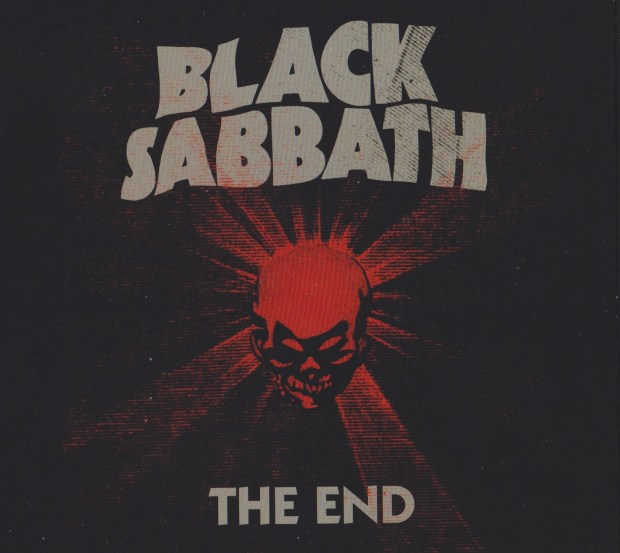
Scan_20160330BLACK SABBATH – The End (2016 BS Productions)

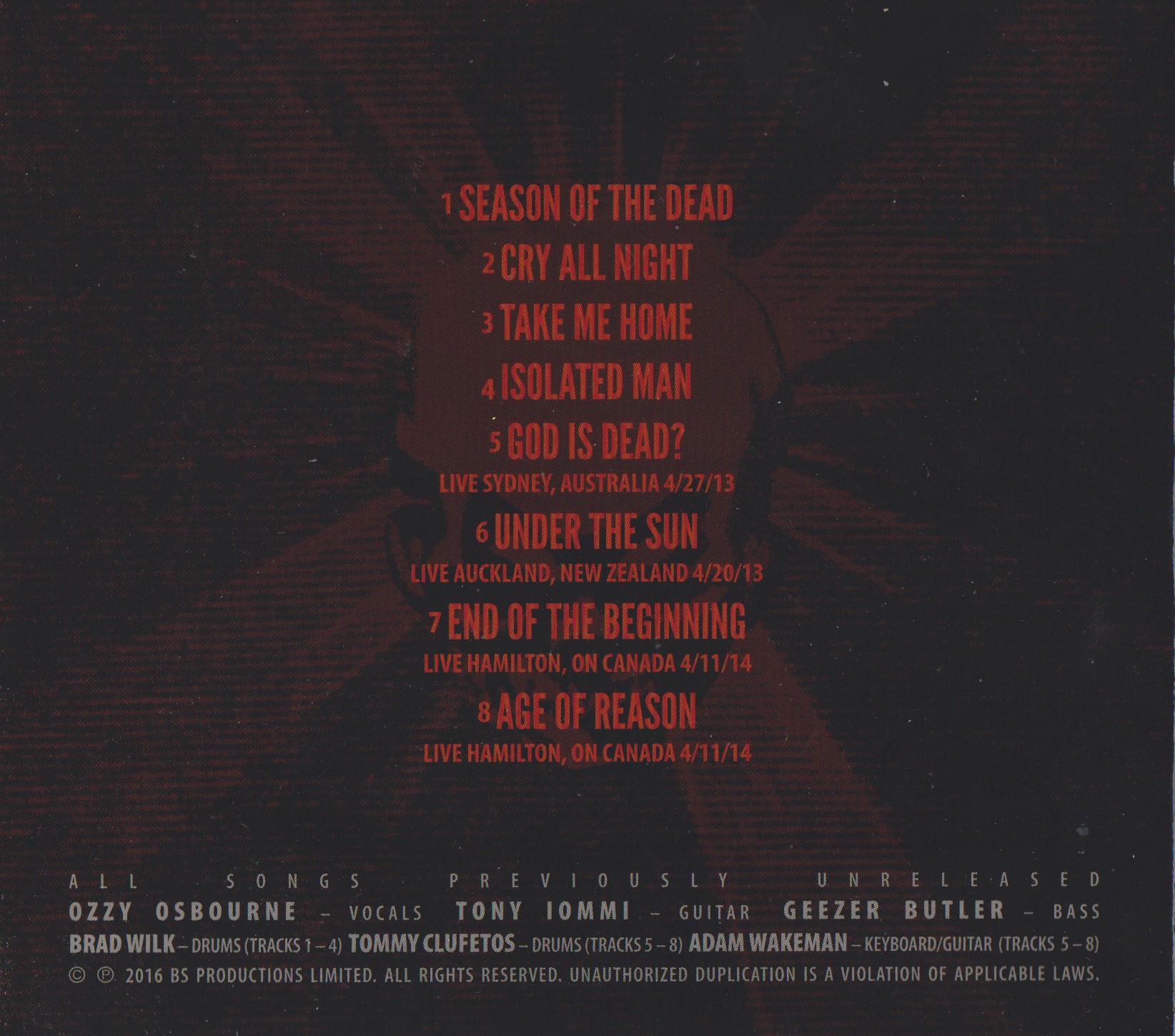
As a Black Sabbath fan since I was old enough to be a Black Sabbath fan, I have amassed a huge collection of official and unofficial Sabbath recordings.  With the exception of one Japanese bonus track (“What’s the Use” from Cross Purposes), I can happily say I have everything the band has ever officially put their name on.  The End has proven to be one of their most difficult albums to acquire, because Sabbath insisted on selling it at their concerts exclusively.  (At least until the inevitable reissue with bonus tracks.)  With only one CD, eight songs, and no booklet, it’s hard to justify a $30 selling price.  Additionally, many concerts were sold out of the CD, because of people buying multiple copies for re-sale.  The proof is on eBay and Discogs.

Thankfully, a fine gentleman known to his friends as James went to see Black Sabbath on a whim on their Calgary date.  He exited the arena with three copies of The End, but none were for re-sale: One for him, one for our buddy Aaron, and one for me!

Ever since the release of the terrific album 13, the band teased that they had plenty of extra material to perhaps do another LP.  It turns out, they had recorded at least 16 songs that we know of for 13.  There were eight songs on the album proper, and an additional four on various special editions.  The End contains four more from the sessions!  Four songs isn’t enough for a whole new album, so for added value, rare live songs are included.  None of these have ever been on a live Sabbath album before.

Sounding something like an outtake from the not-Sabbath album The Devil You Know, “Season of the Dead” has the slow crawl that has become a Sabbath trademark.  A chugging, biting riff and a slightly psychedelic melody are the pillars, but like Sabbath of old, it twists and turns into different parts.  “Season of the Dead” is a grower, but it certainly does sound like Black Sabbath and nobody but.  Doom, gloom and slinky bass.  “Cry All Night” starts as a slow Sabbath crawl but then immediately transforms into a mid-tempo stomp.  These Iommi riffs are by no means leftovers.  Can you imagine what he still has in the vault?  (Note:  Tony Iommi really does have a vault where he keeps all his riff tapes.)

Studio drummer Brad Wilk really stands out on “Take Me Home”, as a precise and hard-hitting player.  The monolithic riff he compliments is simple but effective.  Meanwhile, parts of Ozzy’s vocal melody are reminiscent of his song “Fire in the Sky” from 1988’s No Rest for the Wicked.  Tony’s Spanish guitar solo is a delicate icing on a very heavy cake.  The final studio track is “Isolated Man”, a different and interesting experiment.  At its core it is still a heavy-riffed Black Sabbath refrain, but Ozzy’s vocals are purposely mixed back and heavily layered for effect.  The result is something very much like the oddball shit that they used to do in the 70’s.

Each one of these “new” songs is going to take time to fully absorb.  They are not immediate, but neither was all of 13.  Even without Bill Ward, they managed to rebuild the sound they had 40 years ago, and that’s just grand.  13 easily could have been a full double album, consistent and heavier than fuck, had all 16 songs been included.  It also would have been an overly long ride of doom!

The live stuff is well recorded.  Ozzy doesn’t sound too lively on “God Is Dead?”, but that tends to happen when you read the words off a teleprompter.  He was in good voice that night in Sydney, maybe even great!  It’s great to have “God Is Dead?” in live form, but it only really cooks from time to time.  Oldie “Under the Sun” (from Vol. 4) has long been one of my favourite Iommi riffs.  It’s great to finally have this in live form; it’s just too bad it lacks the swing of Bill Ward.  That is not a swipe at Tommy Clufetos, a great drummer who has done very well under difficult circumstances.  Of the many drummers that Sabbath have employed over the years in the absence of Ward, Tommy has been one of the best fits for an “original” sounding Black Sabbath.

Jetting off to Hamilton Ontario Canada, “End of the Beginning” serves as a main course of doomy metal.  The crowd is clearly into it, as Ozzy gets them riled up.  This track works better live than “God Is Dead?”, being much more peppy and headbang-worthy.  Here is my only beef:  I noticed during one of Tony’s solos that there was rhythm guitar.  Looking at the back cover, keyboardist Adam Wakeman is also credited with additional guitar.  Black Sabbath has always been a single-guitar band, and I definitely noticed this unfamiliar sound.  I’m not sure how I feel about that.  Sure, it sounds more like the album, but it sounds less like the live Black Sabbath that I loved.

Of course Ozzy has to remind the audience that he loves them all!  “God bless you all, thank you!” he says, showing gratitude for a #1 album in Canada.  “Age of Reason” sounds like a crusher live, and certainly epic enough to act as a closing track on the final Black Sabbath album.  Even if it wasn’t epic, it was a new Black Sabbath song recorded for posterity and now in the collection forever.  That’s enough for this guy.

I am not sure how a $30 price tag is justified, but I have paid more for less.  The score for this review is completely independent of the price.  You’ll have to judge for yourself how much you’re willing to pay.  $30 is high for four new songs and four live songs.  Be that as it may, eBay prices are stupid.  My advice:  Grab it for $40 or less, or sit tight and wait and see if it’s ever reissued.  Final Black Sabbath album?  Perhaps, but expect plenty of Sabbath material to buy in the future.  Up next: deluxe editions of Headless Cross and Tyr!

4/5 stars

Scan_20160330 (2)


DVD REVIEW: Black Sabbath – Never Say Die (live 1978)


BLACK SABBATH – Never Say Die (Live in 1978, 2003 Sanctuary DVD)

Recorded in 1978 at the Hammersmith, the DVD Never Say Die was recorded for TV, and not badly either.  The video part, anyway!  Great live angles and decent editing lead to a very watchable concert, albeit chopped down for length.  The audio leaves something to be desired.

The muffled riff of “Symptom of the Universe” commences the set, Iommi sounding as if powered through a crappy battery powered transistor amp, such is the horrible sound captured.  A blazed Ozzy growls through it, and Bearded Bill is in the back wearing braids and looking like a complete dirt bag.  As for Geezer?  He’s mixed too low to have any significant impact.  Tony Iommi stands guard at center stage, while Ozzy claps along next to him.

The close-up shots are nice and vivid, Ozzy waving the peace sign during the start of “War Pigs”.  He then commands the crowd to put their hands together, and they soon oblige singing along with him.  There is something about a live version of this song with the full original lineup including Bill Ward.  Bill was always a jazzy drummer, and that’s the vibe he loaned Black Sabbath.  It’s especially necessary on tracks like “War Pigs” which require a certain swing on the traps.  With Bill here still in vintage mode, the song has all the right heft and movement.

It’s hard to tell that this was a group of guys who couldn’t bear each other anymore.  While they mostly keep to themselves on the large stage (as they always have), Ozzy acts as Tony’s cheering section during the guitar solos, and you can even see a hint of a smile in Tony’s eyes.  Then Ozzy claps and screeches his way through the monolithic “Snow Blind”.

IMG_20160123_163908

The only track from the new album, Never Say Die, is the title track.  Its upbeat attitude and fast tempo allude to where Ozzy was going to go as a solo artist.  For Sabbath, it’s one of their most unappreciated tracks.  This live version is pretty sloppy but very rock and roll (including an old-tymey rock and roll riff that wasn’t in the original).  Then, Ozzy introduces the all-time classic, “Black Sabbath”, with an interesting statement.  “Thanks for the last 10 years, and we hope we’re around for another 10 years, and another 10 years.”  It’s interesting because at this point, Ozzy had already left the band once, been replaced by Dave Walker (Savoy Brown) for one TV performance (“Junior’s Eyes”), and then returned to the band to do the Never Say Die album, refusing to sing anything they wrote for Walker.  Not exactly the kind of environment to encourage longevity!  Of course the amazing thing is that three of these guys are still together, winding up the band that they formed.

It’s worth noting that nobody can (or will) capture the vibe of “Black Sabbath” like the original four.

Detouring to Technical Ecstasy, Sabbath pour into the underrated prowl, “Dirty Women”.  After this, uncredited, is a brief Bill Ward drum solo.  That melds into “Rock and Roll Doctor”, another obscurity.  Ward’s cowbell and Tony’s rock and roll riff give it a retro vibe.  Bill plays it busy compared to the album version; that’s fine by me.  Tony takes a guitar solo before the scary oldie-goldie, “Electric Funeral”.   Always a treat to hear this rarely played Paranoid classic, but unfortunately this one is noticeably edited down.

Closing out the disc, “Children of the Grave” is an obvious highlight.  Once again there is no drummer on Earth who can play it properly, except for Bill Ward.   Some come close, but none capture the reckless engine that drives it.  For the encore, Ozzy asks the audience “What do you wanna hear?” to which they are supposed to respond “Paranoid!”  I don’t know if they do; the audio here is really not good.  They trot out “Paranoid”, the flaw of which is that it always sounds by rote.  Ozzy couldn’t sound less interested in singing it again for the millionth time.

You have to consider the sound quality on a DVD like this and if you’re the kind of person who will care or even be able to tell the difference.  I don’t care.  This is a great though imperfect glimpse at a rare period in Black Sabbath’s history.  A short while later Ozzy would be solo, and Sabbath would go to Heaven and Hell with Ronnie James Dio.

3.5/5 stars


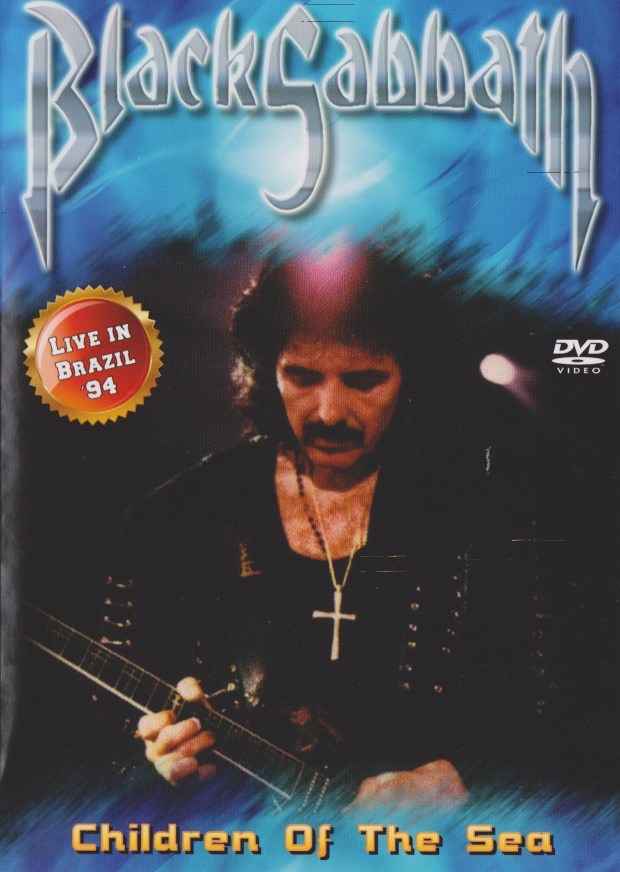
DVD REVIEW: Black Sabbath – Children of the Sea – Live in Brazil ’94

Scan_20150927BLACK SABBATH – Children of the Sea – Live in Brazil ’94 (Disc Media)

The Cross Purposes tour was not a happy time in Black Sabbath.  Geezer Butler had felt that this band (featuring himself, Tony Iommi, Tony Martin, and new drummer Bobby Rondinelli) should have had a new name and not been billed as Black Sabbath.  Rondinelli left mid-tour, so Tony and Geezer called up the original Sabbath skinsman Bill Ward.  With this historic lineup, 3/4 of the original band were intact (the same ratio as today’s Sabbath).  They went to South America to play five shows.  Then Butler quit after a furious standoff with Iommi.

This broadcast footage is all that remains of this very short-lived lineup of Black Sabbath.

The set opens with “Time Machine”, a Dio-era song that neither Tony Martin nor Bill Ward originally appeared on.  The sound is pretty horrendous, coming in slightly better than bootleg quality.  The crowd noise is too high, and the backing keyboards of Geoff Nicholls actually drown out the lead guitar.  Nicholls’ backing vocals are also more audible than they should be.  As a frontman, Martin does his best, which involves spreading his arms wide and shaking his hair.  A long haired Ward has a completely different rhythm on this track than Vinnie Appice gave it.  Another Dio number is next, “Children of the Sea”.  Ward at least played on this Heaven and Hell classic.  Haters would be critical of Martin’s version of Dio songs, but Dio quit. Ozzy wasn’t ready to come back.  Iommi carried on, and that’s how it went down.  Martin had to sing the old songs to the best of his talents and he helped keep the ship afloat during these difficult years.  Having Bill Ward on this track lends it a required authenticity.

There are certain songs that Sabbath has never dropped from the set, that are very difficult for most singers to perform.  “Black Sabbath” is top of the list.  Ozzy’s possessed original can never be duplicated or imitated.  A big part of that, however, is that Bill Ward’s primitive drum fills were such a big part of it, and Bill’s back on this one.  With 3/4 of the original Sabbath there, this version actually works out.  It’s one of the most true to the original of the versions released by any post-Ozzy lineup of Black Sabbath…except it is edited!  It halts abruptly at the half-way point, to awkwardly go into “War Pigs”.  This concert was clearly cut down to fit into a one hour (with commercials) time slot.  Why half of “Black Sabbath” was sacrificed instead of something else, I don’t know.  Shoddy.  At least “War Pigs” is intact, with Bill (shirtless now) providing the loose backbone it always had on album.  It acquires a jazzy feel during the slow outro.

Iommi gets a guitar solo (could have edited this out instead of “Black Sabbath”, but what do I know?) which has shades of “Too Late” from Dehumanizer.  Then it’s “Paranoid”, with Bill behind the beat as it should be.  Martin bites into every word, doing a fantastic job of it.  I have several live versions of Martin doing “Paranoid”, but this one is the best and most true.

When it’s time for “Headless Cross”, the rhythm section are not the ones who recorded it (Lawrence Cottle on bass and Cozy Powell on drums).  It’s weird to think of Bill Ward playing drum parts that Cozy Powell wrote.  Geezer sounds more at home, and is able too bring his trademark slink to the bass.  Offstage, Geoff Nicholls quite obviously provides the high notes in the chorus that Tony Martin can no longer hit, whether by voice or sample I do not know.  There’s another awkward edit into “Iron Man”, a song most singers except Ozzy struggle with.  This could have been excised.  We finally blast into “Sabbath Bloody Sabbath”: better, even though nobody can hit the unholy notes that Ozzy did on the studio version.

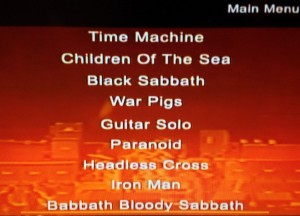
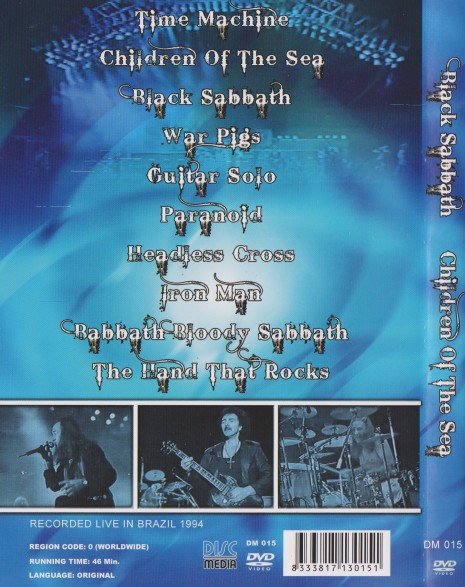
That’s the last track..  The back cover claims that “The Hand that Rocks the Cradle” is next, but there is no such track.  Bastards!  To compound the error, they got the song title wrong by just having “The Hand that Rocks”.  Not that this is the only mistake on the track list.   “Babbath Bloody Sabbath” is pretty funny, especially since this title carried over to the song menu on the DVD!

SABBATH COTS

Wardrobe wise, I like Geezer’s sweater with the crosses on it; that’s nice.  Tony Martin has a cool, steel plated leather jacket, which looks as if raided from Rob Halford’s closet.  Iommi sports silver cross center-chest, while Bill Ward is right out of 1975 with the long hair and track pants.

There are issues with the audio sync on this DVD, probably originating from the broadcast but carried over even though it would be easily fixed.  Sloppy release.  I’m sure that this is ripped from a VHS recording of the broadcast, due to the obvious spots where commercial breaks are edited out.

Maybe the original uncut tapes are out there somewhere. If so, somebody should release them.  This concert could have been a great little DVD release, but the various audio and editing flaws make it a difficult viewing.

2/5 stars

Scan_20150927 (2)

REVIEW: Ozzy Osbourne – Just Say Ozzy (1990 EP)

OZZY OSBOURNE – Just Say Ozzy (1990 Epic EP)

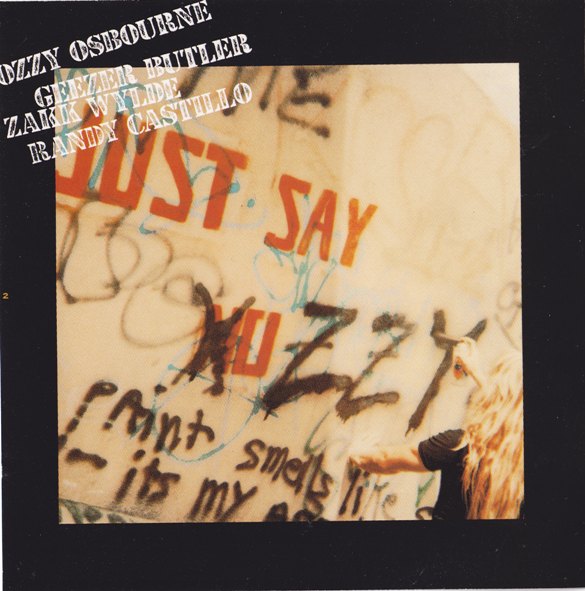
Nobody was shocked when Ozzy Osbourne, the man who said he hated live albums, put out his fourth (!) solo live release in 1990. (His other three live releases were the Mr. Crowley EP, Speak of the Devil, and Randy Rhoads Tribute. This does not include the Ultimate Live Ozzy EP which was…not live.) The liner note by Ozzy attempts to justify its release. “Firstly, ‘Shot in the Dark’,” begins Ozzy. “I am happier with this version than the original.” (Oooh, sick burn on Jake.) Ozzy continues, “Secondly, the Sabbath songs – To have recorded them one last time with Geezer Butler, Zakk and Randy says it all for me. It’s a chapter of my musical career I can now close.”

What the fuck did that mean?

Was Ozzy going to stop playing Sabbath songs?  Did anyone actually believe that?  The bitter liner notes accompany a front cover emblazoned with all four band members’ names, in the same sized font as Ozzy’s.  And on the front cover is not Ozzy Osbourne, but guitarist Zakk Wylde! (Albeit from behind so you can’t see his face, and he’s just in one corner of the cover.)  It all seems to deliver a message of “I am focused on the present, not my past.”  This quartet was fully expected to record the next Ozzy studio album together, athough ultimately that did not happen.  Geezer left in 1991 for a reunited Dio-era Black Sabbath.  So much for not looking back!

JUST SAY OZZY_0005

Just Say Ozzy functioned as a stopgap.  Ozzy would take his time with the next LP (which at that time was tentatively titled No Dogs Allowed, then Don’t Blame Me), but No Rest for the Wicked was already two years past.  They had to release something, so here it is.  One careful listen will reveal a lot of studio trickery was employed afterwards. Indeed, if one focuses on the crowd noise you can hear edits everywhere. Billboard magazine revealed that the music for this album was re-recorded in the studio with audience noise overdubbed.
Having said that, if this kind of trickery doesn’t bother you (and if you own Kiss Alive! or Frampton Comes Alive then it shouldn’t too much) then this is a great EP. Just Say Ozzy‘s meager six songs feature the only recordings of the brief Osbourne/Wylde/Butler/Castillo lineup. I was always a fan of those particular guys and there’s something to be said when you have two original Black Sabbath members in the band, while Black Sabbath only had one.
Since this EP was from the No Rest tour, three of its heaviest songs were showcased: the single “Miracle Man”, “Tattooed Dancer”, and “Bloodbath in Paradise”. No ballads.  These three songs are nice to have, but are not even close to competing with the better known hits.

From The Ultimate Sin comes “Shot In The Dark”…yes, Ozzy’s so-called “preferred version”.  And it is indeed very good.  Zakk Wylde was a talented kid even then, and I love the youthful “go for it” attitude in his playing. “Shot in the Dark” features an extended solo that established Zakk’s place with his axe predecessors.  Then, a deuce of Sabbath: a smokin’ “Sweet Leaf” and probably the best live version of “War Pigs” that I have ever heard.

Yeah, that’s what I said.

This Zakk-infused version of “War Pigs” is, in this humble writer’s opinion, the best live version ever released. Zakk’s guitar digs deep into the strings with those nice wide vibratos. It’s just monstrous, plus with Geez on bass, it has that slink it needs.  Randy Castillo (RIP) was certainly no slouch, and his relentless fills here are solidly entertaining.

3/5 stars.  Shame about that crappy cover art though.

Tracklist:

  1. “Miracle Man”
  2. “Bloodbath in Paradise”
  3. “Shot in the Dark”
  4. “Tattooed Dancer”
  5. “Sweet Leaf”
  6. “War Pigs”

REVIEW: Black Sabbath – Live Evil (remastered 2 CD version)

NOTE:  This is basically a review of the Deluxe edition of Live Evil.  I own The Rules of Hell (2008) box set of Dio-era Sabbath, so I did not need to buy the later Deluxe of Live Evil.  The 2 CD edition inside The Rules of Hell is sonically the same.

BLACK SABBATH – Live Evil (1982 Warner, 2008 Rhino)

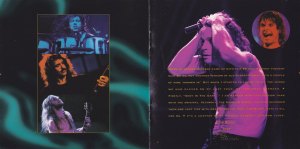
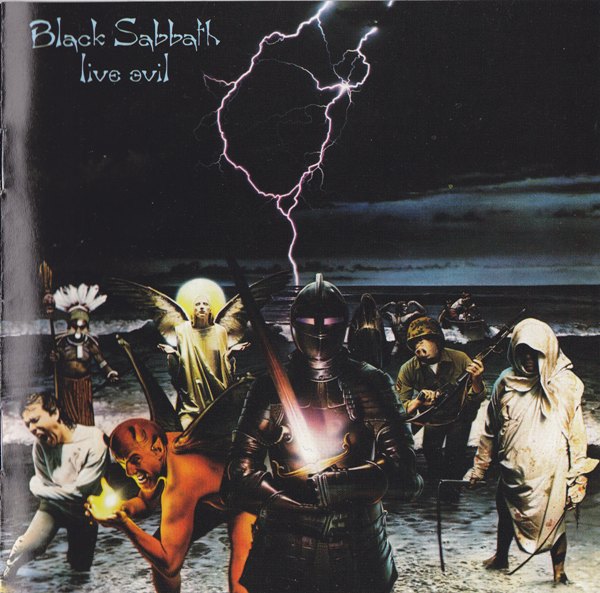
Live Evil: Not only a palindrome, but also the last gasp of the Dio/Appice/Iommi/Butler lineup of Black Sabbath.  Hard to believe that their first “official” live release was with Ronnie James Dio at the mic and not Ozzy Osbourne! This infamous live album was the last thing Sabbath did before Dio left (the first time) and it’s actually a lot better than people generally give it credit for.

Some folks may not enjoy that live, there’s only one guitar.  When Iommi takes a guitar solo, the gap is filled by bassist Geezer Butler and keyboardist Geoff Nicholls.  The audible keyboards in the middle of a heavy metal song like “Neon Nights” do take a little getting used to, admittedly.  In the end though, it’s part of the scenery.  Black Sabbath didn’t do much with live keyboards in the original Ozzy era, but they were a part of every Sabbath lineup since.  There was also apparently a lot of behind the scenes bitching about instrument levels and whatnot that supposedly lead to the disintegration of the band.  This remastered edition of the CD leaves me with few qualms about the sound.

LIVE EVIL_0004

Back in the 80’s and 90’s, you used to see a lot of fan rivalry.  “Dio sucks!” or “Dio rules!”  Today we all have the perspective to know that you can have both Ozzy and Dio, like having your cake and eating it too.  Well, until Dio’s heartbreaking 2010 death, that is.  It is true most singers that Sabbath have had couldn’t do the Ozzy material convincingly. Ozzy sounded genuinely disturbed and terrified on “Black Sabbath”. (“What is this that stands before me? Figure in black which points at me. Turn round quick and start to run. Find out I’m the chosen one…oh no, please God help me!”) Dio camps it up quite a bit, which is not my personal preference. The same goes for “War Pigs”.  I also find that Vinny Appice just can’t cop the vibe that Bill Ward got on the drums. Ward played it very subtle, almost tribal, and Vinny plays it straight ahead. But I’ve yet to hear any lineup that can do that song as well as the original album version, including the reunited (1997-2012) Sabbath with Ozzy and Bill.  (Appice also gets a drum solo on “War Pigs”; thunderous but not necessary.)

The set list for this album was pretty cool, including Mob Rules favourites “Voodoo” and an absolutely killer “Sign of the Southern Cross”. This version, melded with a long extended “Heaven and Hell”, is among the very best moments in Dio’s career. Basically, all the Dio-era material here is excellent, while the Ozzy-era stuff leaves you feeling just a little bit underwhelmed. Not to say they’re bad, they’re just…different.  Two completely different singers with their own personalities.  The fact is that Dio made it work live as best he could, and that’s commendable.

MVP:  The super slinky Geezer Butler.  The remastered edition allows us to hear with real clarity every massive note, and his bass is like a jolt of caffeine to the brain!

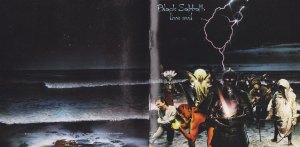
Since this is a 2CD set, all the between-song banter that was deleted on single disc versions has been restored. That’s important. Dio talks a lot between songs and that’s part of the album. Otherwise there is no bonus material. There are ample and interesting liner notes, and the front cover looks absolutely stunning. This is one of Sabbath’s all-time best covers (perhaps second only to their first album) and it definitely shines in this edition. (But don’t let that stop you from tracking down a vinyl copy so you can see it in its 12×12 glory!)

LIVE EVIL_0001

Shame that this was the last album of the original Dio era, but of course Dio and the band felt there needed to be additional chapters later on. And so there were. Live Evil remained a controversial album for a decade after its releasing, dividing fan and band opinions.  I asked two of my esteemed Sausagefest rock scholar friends for their opinion on it, to make sure we’ve covered all the bases. This is why they had to add:

Uncle Meat:  “As good as Dio was as a singer, I never really liked some of his takes on Ozzy Sabbath songs. He kinda over-sings them. It’s like he is bored with them and he appeases the singer in himself. Also the mix is pretty horrible as well. The truth is, the only great Sabbath live album isnt even a Sabbath album. Ozzy’s Speak of the Devil still sounds great today.”

Dr. Dave:  “I don’t love or hate it. I like it. The most interesting thing for me, besides Dio, is the Vinny Appice take on the whole thing. More of a groove, less of a swing than Bill Ward. Not saying better, just neatly different.”

Final note: The liner notes correct Dio’s name to Ronnie James Dio.  The original LP and CD had his name printed as simply “Ronnie Dio”, as a bit of a “fuck you” to the singer.  They do not, however, reinstate Vinny Appice as an “official” member, having his name under “special thanks”!

3.5/5 stars. The most historic of the Sabbath live albums.

REVIEW: Black Sabbath – The Dio Years (2007)

BLACK SABBATH – The Dio Years (2007 Rhino)

Compilations are always fun to quibble about. Fans like to complain about which songs are missing, and which songs they’d replace. I won’t spend too much time talking about that. Most reviewers have already pointed out that “Sign Of The Southern Cross” and “Time Machine” are missing from the 2007 Dio-era Black Sabbath compilation, The Dio Years.

It’s very important to remember two things. One, this album contained the first new Black Sabbath music released in nine years. Nine years! This is a band that used to release an album every year, up until the point that Ozzy Osbourne rejoined the band. Since then (and before the new album 13), the band released exactly two new songs (both with the Ozzman singing) and started to stagnate. Since The Dio Years represented the first new Sabbath material in almost a decade, it bears a listen.

The second point of note: this set was originally supposed to be a 2-CD boxed set. As such I’m sure a lot of songs were dropped along the way, Yes, “Southern Cross” is missing. However, this reviewer’s only real quibble is “Southern Cross”. I mean, hey — “Lonely is the Word” is on here!  I would have replaced “Lady Evil” with “Southern Cross” myself (I never liked “Lady Evil” much), but perhaps the fine folks at Rhino felt that one 7+ minute epic was enough for a single disc. I can understand that logic. Besides, I, like every Sabbath fan worth his or her own salt, already own Mob Rules.

SABBATH DIO YEARS_0006

This disc was freshly remastered. I should point out that this remastering session was not the same one that produced the series of Sabbath Castle remasters in the late 90’s, but one that occurred in 2006/7. As such the sound is even heavier (louder). I found that I had to roll down the bass a bit, as my normal settings made the bass just too heavy. This was also the first time that the material from Dehumanizer (15 years young!) had been remastered.  The running order is a little weird, though.  “Heaven and Hell” as the third song on an album?  A live “Children of the Sea” following “I”?  The flow is lacking in cohesion.

The liner notes are excellent, very detailed, with lots of facts that casual Sabbath fans didn’t know (like the fact that Craig Gruber from Rainbow, and Sabbath keyboard man Geoff Nicholls were brought in to play some bass when Geezer briefly left the band in 1980). There are a bunch of cool pictures and artwork as well, which fit in nicely with the Sabbath vibe.

Every Dio-era album get a look-in, even the controversial Live Evil via a great version of “Children Of The Sea”, almost as memorable as its studio counterpart. No rarities. What you get instead are the aforementioned three new songs. That’s one more than Ozzy gave you on the Sabbath Reunion CD, by the way!

When Dio was with Sabbath he tended to talk about his songs in terms of tempo. As such, you get one “fast one” (“Ear In The Wall”), one “slow one” (“Shadow Of The Wind”) and one mid-tempo song (the single “The Devil Cried”). I almost always prefer the fast Sabbath stuff, so obviously “Ear In The Wall” is my favourite. Sound-wise, these three new songs pick up where Dehumanizer left off, and foreshadow The Devil You Know.

Geezer, unfortunately, was not involved in the writing.  Iommi and Dio also did the production themselves. This might have something to do with the fact that I can’t hear nearly enough of Geezer’s trademark slinky bass lines–something I identify with the Sabbath sound more than any singer they’ve ever had. Iommi’s playing some good riffs and some scorching solos here, although I have found his guitar tone over the last decade to be too modern and distorted. I much prefer it when he gets a nice amp-driven sound rather than something so processed. However, bottom line is, these three new songs are good, albeit not essential, parts of the Sabbath catalogue.

Thankfully these three new songs were not the last gasp of Black Sabbath. Before his untimely death, Ronnie James Dio recorded The Devil You Know, under the name Heaven & Hell. And of course after that, the original Black Sabbath finally delivered the unforgettable 13.

As for The Dio Years?

4/5 stars