instrumental music

REVIEW: George Lynch – Sacred Groove (1993)

It’s a shame I lost my original 1993 review of this album.
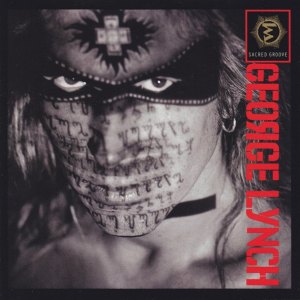
LYNCH_0001GEORGE LYNCH – Sacred Groove (1993 Elektra)

If you like Dokken but never followed George onto the Lynch Mob, then this album is for you.

George Lynch is a very talented shredder, capable of playing a wide variety of styles.  Sometimes he hits, sometimes he misses, but on Sacred Groove he makes the mark every time.  Sacred Groove was designed as a solo project shortly after the second Lynch Mob album.  The idea was to work and write with different singers and musicians, and George loaded up on some great singers.  Glenn Hughes, anyone?

John Cuniberti, who co-helmed many Joe Satriani albums, produced this opus and lent it some serious sonic excellence.  The opener “Memory Jack” is a collaboration between producer and guitarist, but this is little more than a sound collage to kick off a killer instrumental called “Love Power From the Mama Head”.  This isn’t to say that “Memory Jack” does not contain some shredding licks, because it does…but they are not the focus.  The sound collage itself is the focus.  Into “Love Power”, George lays down some serious riffy rhythm guitars.  This is topped with a very Satriani-esque guitar melody.  “Love Power” is constructed very much like a Satch rock instrumental track, with memorable guitar melodies and song structures.

There is a very cool moment in the guitar solo in “Love Power From the Mama Head”, at exactly 4:47.  While George was essentially assaulting his guitar with the whammy bar, he accidentally dropped the instrument on the studio floor.  “Shit!” said George, while producer Cuniberti ran over and stopped George from picking it up.  The producer then kicked the guitar for added effect!  Cuniberti assured George it would sound cool, and it kind of does!  The guitar just stops on this weird chord-like sound, before they punch out of that and into more shredding.  It’s different and spontaneous and I love shit like that.

“Flesh and Blood”, contender for best track on the album, is the first vocal, featuring Badlands’ Ray Gillen (R.I.P.).  It’s a Dokken stomper for sure, but with Ray Gillen’s bluesy Coverdale-isms all over it.  Killer.  The lyrics were co-written by George’s ex-Dokken bandmate Jeff Pilson, who also co-wrote and plays bass on the next track, “We Don’t Own This World”.

Now here’s the interesting thing about “We Don’t Own This World”.  Lyrics by: Don Dokken?  The fuck?

George, Don and Jeff had planned to reunite on this one song, that Don supplied the lyrics for.  Don however cancelled or chickened out (either/or) and didn’t make it to the session.  It just so happened that the Nelson twins, Matthew and Gunnar, were in town and eagerly sang on the track in Don’s absence.  With their harmonies, “We Don’t Own This World” sounds nothing like Dokken, except in basic ways.  It’s the most commercial track on the album; a pop rocker.  The vocals soar over one killer melody, and the solo is one of George’s best.  If this song had come out only two years sooner, it would have been a hit single.  The Nelsons have done some cool music over the years, and not gotten a lot of credit for it, so this song is pure delight.

I still think of CDs as “albums” with distinct sides, and on the cassette version “I Will Remember” closed Side One.  This instrumental ballad has a vaguely dark tropical feel, although it is an electric guitar song.  George’s solos are sublime and I love his unexpected timing on certain notes.  He has flawless chops mixed with feel…a rare combination.

LYNCH_0002

Side Two’s opener is an epic in two parts, but it’s as close to a skip as this album gets.  The problem is vocalist Mandy Lion, of WWIII.  You either like his glass-garling-elfin-metal voice or you do not.  I do not.  However, “The Beast” Parts I and II are such a slamming groove that I tend to block out the words and the voice singing them.  This is another track where the original vocalist slated could not do it.  Udo Dirkschneider wanted too much money and Rob Halford was too busy, but Mandy Lion would do it.  He showed up at the studio in the heat of summer wearing head to toe black leather.

“The Beast” could be a dirty sex anthem, I guess, but it’s far too heavy for the 50 Shades crowd.  I dig when halfway through, George breaks out his newly-bought sitar.  (I remember seeing pictures of George in Metal Edge magazine buying it!)  If only Mandy would have chosen to shut up at this moment.  Bassist Chris Solberg comes in and grooves through to a false ending, and then it’s “Part II (Addiction to the Friction)” — a 10 minute track in total.  Thankfully a huge chunk of it is instrumental.

The regal Glenn Hughes raises the bar any time he opens his mouth.  His two songs were the first new Hughes singing I had heard since Black Sabbath.  I detect some fragility in his voice here.  I think this may be from a period where Glenn was recovering from addictions.  Regardless, he sounds a lot better today, whatever the reasons are.  That’s not to say he’s bad here, because he’s still the best singer on the album.  You just feel he’s not giving it everything like he does today.

“Not Necessary Evil” is Glenn’s first song, a Dokken groove with Hughes’ soulful signature style.  This one too had hit single potential, but only in an alternate timeline in which Rock never fell to the Grunge Hordes in 1991.  “Cry of the Brave” is his second track, a slower and more soulful rock track.  This is a song about injustice to the American Indian (reading the lyrics, I’m assuming specifically Leonard Peltier), and it’s worth noting that Glenn wrote the lyrics by himself.

The album closes with a final instrumental called “Tierra Del Fuego”, and if you couldn’t guess, that means George breaks out the flamenco guitar.  There’s also a guest electric guitar soloist named Daryl Gable.  If I remember the story correctly, Daryl Gable was a lucky fan who was selected to have a guest shot on the album.  How cool is that?  And he’s pretty good, too!  I have to admit I like these dusky tropical flamenco things, so I consider “Tierra Del Fuego” to be a very successful album closer.  But fear not, there’s plenty of electric guitar too!

Sacred Groove is pretty damn near flawless.  If only they could have got Udo instead of Mandy, eh?

4.5/5 stars

REVIEW: Derek Kortepeter – Stochastic (2014)

stochasticDEREK KORTEPETER – Stochastic (2014)

A short while ago, I reviewed the debut EP Compilation Vol. 1 by UCLA musician Derek Kortepeter. Since then Derek has put the finishing touches on his first full-length album Stochastic, an even more experimental collection.

Music like this is difficult for me to review as it’s pretty far out from the mainstream. Take the opening track, “Veritas”. The first 45 seconds are the sounds of guitar scrapes and echos, before the grand chords commence. As an opening track, this is both a welcome and a warning: It says, “If you find me intriguing, dive in! But if this is not much more than noise to you, farewell!” Not everybody is going to get music like this.

“Veritas” flows seamlessly into “Burning Embers” which uses backwards guitar as a melodic hook. Heavy, noisy guitars and drums soon flood the speakers. It’s difficult to grasp at the rhythm, but Derek does not make music that does not challenge him. Just listen. Allow the music to seep in, and you will begin to pick up on the melodies and rhythms within. It’s there in the contrasting guitars and keys. At this point I’ll mention that Derek plays all the instruments on Stochastic himself.

“Illusions” plays with odd drum rhythms and mixes guitars with synths into an atmospheric whole. I couldn’t tell you what effects he’s using on his guitar but it sounds cool to me. There’s lots of echo and bluesy playing on “Solitary”. I find that there is plenty to love here, you just have to really listen and let it happen. In particular, even though this isn’t a “guitar album”, I was drawn to that instrument.

“Fusion” is a favourite track of mine. This is a jazzy, upbeat mellow tune with a tropical feel. The piano is a key instrument here, while Derek noodles cool jazzy licks on his six string. Elsewhere (like on “Glitch”), I hear elements of Steve Vai’s fearlessness and playfulness. Steve Vai once said, “Sorry folks, I can’t help myself,” in regards to his experimentation. I think Derek can probably relate.

Another moment I really enjoyed is a multitracked cacophony of guitar and drums in “Solar Wind”. But it’s not just noise. It’s easy to see how somebody could hear it as noise, but there’s a lot going on here. (I can’t tell you exactly what is going on, but trust me, it’s happening.  It’s very dense.) Then it goes sparse, with only one guitar, which throws you a bit (in a good way).

Finally I’ll quote Derek from his own website, because I think what he says hits the nail on the head:

“Many records, when they find their groove, bring the listener to a certain element of familiarity. This LP is quite the opposite of that. I want you to react, to think, to be moved, to be jarred, to be confused, and ultimately form an opinion on what it is that you are hearing. Whatever the “Stochastic” system determines for your mind, I can promise that it will be a unique result. This result will not be repeated in the consciousness of another human being listening to the same songs.”

Stochastic by Derek Kortepeter is available at CD Baby, iTunes, and beyond.

4/5 stars

derekkortepeter

REVIEW: Derek Kortepeter – Compilation Vol. 1 (2014)

DEREKK

DEREK KORTEPETER – Compilation Vol. 1 (2014 independent)

According to his WordPress page, Derek Kortepeter is a composer, multi-instrumentalist, and alumnus of the School of Ethnomusicology at UCLA. Already, I’n in way over my head. I already find it hard to talk about instrumental music, but I am not a composer, nor a multi-instrumentalist, and definitely not an alumnus of the School of Ethnomusic-anything.  So as a knuckledragger off the street who really only has laymen’s terms at his disposal, here are my thoughts on Derek’s Compilation Vol. 1 EP.

So here we go!  “Light Within” is the first song, a track written entirely by Derek featuring a whole lot of unfamiliar instruments.  (oud, Chinese gongs, Tibetan bells, Tibetan singing bowls, kora, Andean panpipes, oh my!) Derek plays chunky guitar chords over this, which lends it a vibe similar to the guitar instrumentalists that I like.  A Vai-ish guitar melody meanders through.  There’s a lot going on here, particularly in terms of unexpected notes.  Before the 2 minute mark there’s a blast of shredding, and you know that I do like shredding.  There’s plenty of that on this track.  So far so good.

“It Begins” consists of some traditional rock instrumentation: guitars, bass, drums, organ.  There’s a slow groove, and some really nice bluesy guitars.  But the guitars dart in and out of different styles, maintaining the feel.  This is a 7 minute long bomber, but it maintains its appeal due to the always-interesting guitar.  The third track is called “Omega” is an ambient guitar piece, backed with string-like keyboards.  I’m immediately reminded of things like Joe Satriani’s first self-titled EP in terms of sound.  Although this track is primarily atmosphere I like it a lot.

The final song is a “bonus track” called “Waves”, also an ambient piece.  This one has a little bit more in terms of instrumentation, but the focus is still mainly on the spare guitar chords.  About halfway through, there are a series of gongs and cymbals, before the echoey guitar is left alone.

So, in summation: I like this EP.  Is it something I fully understand?  Probably not.  Is it catchy and memorable?  Memorable yes, catchy no — you have to listen.  Sometimes the guitar melody feels at odds with the backing music.  Will I play it in the car?  No, it’s not that kind of music for me.  But I will play it this fall while going for those morning walks when things are quiet.  That’s what this music feels like to me.

3.5/5 stars

Buy it:  Amazon!

REVIEW: Mark St. John – Magic Bullet Theory (2003)

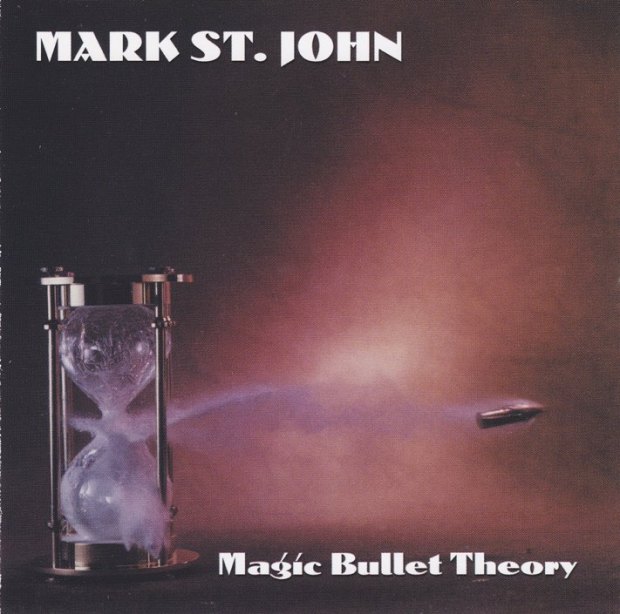
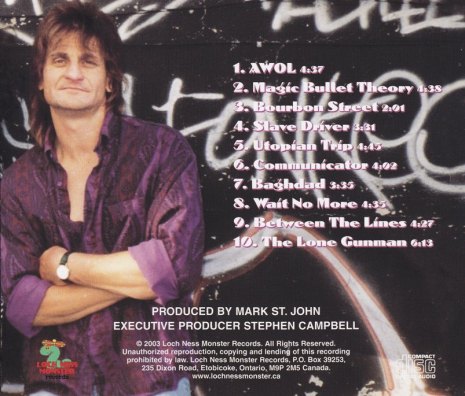
MARK ST. JOHN – Magic Bullet Theory (2003 Loch Ness Monster Records)

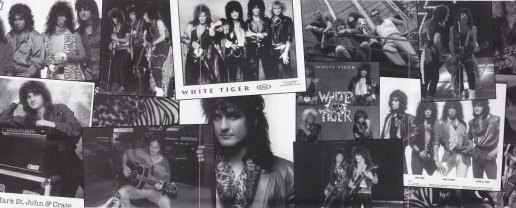
Mark St. John (1956-2007) is best remembered as the lead guitarist on Kiss’ 1984 Animalize album.  He was however much more than just a Kiss guitarist.  His exotic shredding was the basis of an instrumental solo album, Magic Bullet Theory.  Thanks Lemon Kurri for hooking me up with this CD.

“AWOL” blasts the doors open wide: high-octane tempo, high-speed shred, high-tech tricks.  There are Yngwie-like moments, Van Halen harmonics but also enough melody and song structure to keep it interesting.  Mark’s solos feature a number of different sounds and styles.  Intricate flamenco and electric guitars open the title track “Magic Bullet Theory”.  Then it turns into a melodic instrumental with lead guitar center stage.  Next, out of left-field comes the jazz workout of “Bourbon Street”.  This delicate number features non-stop jazz guitar shredding, full speed ahead, which some will find to be just too much to absorb.  “Too many notes,” some might say.  I am not one who would say that.

MARK ST JOHN_0006

It’s back to instrumental heavy metal with “Slave Driver”, which reminds me of Yngwie’s “Leviathan”.  “Utopian Trip” is more laid back, and I can hear mandolin on this one.  Mark lays a blistering lead guitar line over the largely acoustic track.  “Communicator” offers plenty more shred, perhaps resembling the high pitched screech of some 60’s sci-fi communication device.  “Baghdad” has guitars that sound like air raid sirens, certainly appropriate given the title. But the song itself is Arabic is style, with a lot of very complicated acoustic guitars.

“Wait No More” is more melodic instrumental hard rock, but with complex rhythms and tricks aplenty.  “Between the Lines” is ballad-like, with layers of shimmering guitars,until the song gives way to a nice rock riff.   This is of course accentuated by plenty of lead and melody guitars.  Finally “The Lone Gunman” closes the album on a heavy note.  (Notice how this title ties in with “Magic Bullet Theory”.)  The is a riffy track, which frankly the album could have used more of.  It’s also the longest song on the album, and probably the most epic emotionally.

MARK ST JOHN_0004

Although Magic Bullet Theory is not as song-oriented as I prefer instrumental albums to be, it has plenty of memorable moments and tracks.  It certainly shows off the talent that Mark had, that the world doesn’t know enough about.  Magic Bullet Theory comes recommended to all dyed-in-the-wool Kiss fans, and those who enjoy intelligent shreddery.

3/5 stars

…But wait, it’s not over!  After a five minute silence is an unlisted classical guitar rough recording, melodically lovely and astonishingly fast!  A nice coda.

MARK ST JOHN_0005

REVIEW: Ace Frehley – “Cherokee Boogie” (1996)

A little bonus review, part 5.5 in my series of Ace Frehley reviews!  Just a single track today.  Missed the last installment?  Click here!

ACE FREHLEY – – “Cherokee Boogie” (1996 Attic)

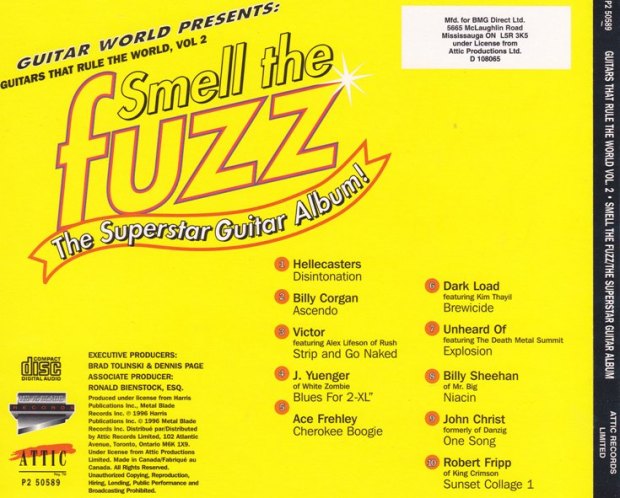
From Guitars That Rule the World, Vol 2: Smell the Fuzz – The Superstar Guitar Album!

I was a big fan of the first installment of the Guitars That Rule the World.  It had a really eclectic and diverse list of guitarists, including Zakk Wylde (doing chicken-pickin’ for the first time on record), Albert Collins, Richie Sambora, Yngwie Malmsteen, Paul Gilbert, and many others.  This volume (with a stupid cumbersome title) is geared more towards alternative artists such as Billy Corgan, J. Yuenger, and Kim Thayil.  There’s also John Christ of Danzig, Alex Lifeson, and Robert Fripp.  Hell even Billy Sheehan has a track, and he’s a bassist!  (But, you can already get the Lifeson and Sheehan tracks on albums by their side projects Victor and Niacin.)

CHEROKEE BOOGIE_0002To me this album is only worth buying for the brand new Ace Frehley track.  It’s an instrumental called “Cherokee Boogie”, and while it doesn’t boast too many particularly strong catchy melodies it is still the Ace.  Ace’s soloing is (as always) note perfect for the song.  The riff is quintessential Ace, thick and chunky, albeit not one of his best.  It’s still nice to hear his distinct Les Paul squeal on a new track.  I especially love when the song gets fast and thrashy just past the halfway mark.  At this point Ace is burning rubber, and it’s a real rush.

I’m not familiar with the backing musicians on this recording.  They are Saul Zonana (bass) and Phil Richford (drums).  They get the job done without getting in Ace’s way.

I would say that “Cherokee Boogie” would have made a strong instrumental interlude on any of Ace’s post-Kiss solo albums.  It’s 4:00 of solid rock guitar.

3.5/5 stars

Very poor audio on this

CHEROKEE BOOGIE_0004

REVIEW: Electric Joy by Richie Kotzen (1991)

Classic Kotzen! For a look at the new album by his new supergroup The Winery Dogs, check out Jon Wilmenius’ excellent review.

RICHIE KOTZEN – Electric Joy by Richie Kotzen (1991 Shrapnel)

Albums by Richie Kotzen were impossible to find in Canada.  My only exposure to his music was “Dream of a New Day”, from his second album Fever Dream.  Fever Dream was his first vocal album, but Kotzen returned to instrumentals on his third, Electric Joy.  I’d seen his picture in dozens of guitar magazines, but hadn’t heard his tunes until “Dream of a New Day” was included on the Bill & Ted’s Bogus Journey soundtrack.

His debut album was a hit with the shredders, but three albums in, Kotzen had already delivered three completely different pieces of work.  Electric Joy has some of the playfulness of the debut, but is mostly a jaw-dropping collection of intricately composed pieces that skirt multiple genres including funk, country, bluegrass, jazz, fusion, and blues.  If I had to pick out an influence, I would say that Electric Joy sounds like Richie had been listening to a lot of the “two Steves”:  Vai and Morse.  His technique is top-notch.

I first got this on a trip to Frankenmuth, Michigan.  My parents made a point of going there every spring and I started tagging along, and then later on my friend Peter joined us as well.  We’d stay at the Bavarian Inn and on the way back to Ontario, we’d stop at the stores in Port Huron, where I found this as well as old rare Savatage cassettes.

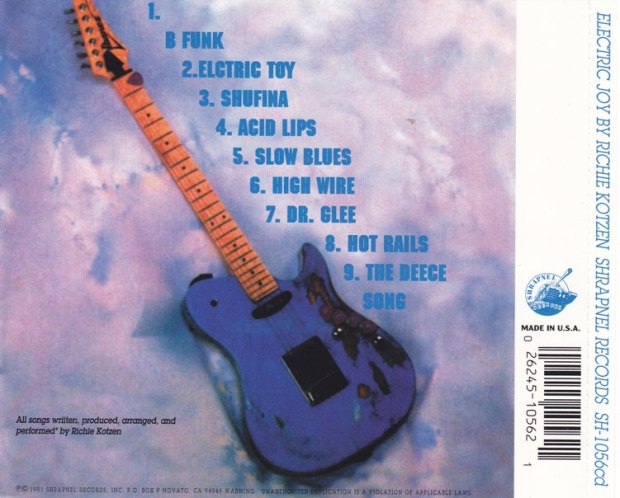
“B Funk” opens the album with some light-speed bluegrass-y licks, but it keeps changing, from a funked up rocker with shredding, to a melodic “chorus” section.  Then it’s back to the bluegrass from space.

At this point I’ll point out that Kotzen plays all the instruments except drums, himself.  That’s Richie’s standby Atma Anur on drums.  What this means is, that incredibly dexterous bassline you’re hearing on “B Funk” is also performed by Kotzen!  And it’s almost every bit as stunning as the guitar!

“Electric Toy” begins ballady, with some lyrical Vai-like moments.  Of course, Kotzen can’t help but do what he does, so there are different sections, some at lickity-split tempos.  This is followed by “Shufina”, which is essentially a blues jam.  Kotzen’s deep bends are appropriate, but before too long he’s harmonizing with himself on some unconventional melodies.

A smoking hot riff ignites “Acid Lips”, little lightning licks flicker in and out, but this one has a solid groove.  (It can’t be easy grooving with yourself on bass.)  “Slow Blues” contains some of Richie’s most lyrical lead work.  If you can imagine the lead guitar taking on the role of a singer, then “Slow Blues” is probably the most accessible song on the album.

The next song “High Wire” is uncatagorizable, suffice to say that like all of Electric Joy it combines quirky notes with shreddery, funk and groove.  My favourite song is “Dr. Glee”.  It sounds like it seems it should – gleeful.  I find this pleasant melody to be very summery.  Kotzen guitar has so many different sounds and shades, even just within this one song.

“Hot Rails” is another one that sounds like advertized…a train racing down the track.  Kotzen’s slide work is anything but simple.  This one’s so fast it’s hard to keep track of all the cool different guitar parts.  It almost sounds like Kotzen wrote a blues shuffle, and then decided to hit fast forward on his tape deck and learn it at that speed!

Electric Joy closes with “The Deece Song”, which thankfully is mid-tempo allowing us to catch our collective breath.  It’s another great performance, similar in style to “Dr. Glee”.  It has its sweeping Satriani moments as well.

The production on the album is very dry, which is different from what a lot of the other instrumentalists were doing at the time.  While this means it might take some more time to penetrate an album that is loaded to the brim with dense ideas already, it is a worthwhile endevour.

In a bizarre turn of events, Kotzen briefly put his solo career on hold.  He received a phone call from Bret Michaels.  The Poison frontman was looking for a replacement for the departed CC Deville.  The fact that Kotzen was from Pennsylvania, not already in a band, and wrote and sang original material caught Michaels’ eye in a magazine article.  Having a shredder, but one with some feel too, might garner Poison some respect in the tough 1990’s.

Kotzen did succeed in co-writing (and in some cases, writing entire songs himself) their most accomplished album, Native Tongue.  Of course, it did not sell.  The Poison relationship imploded because of another relationship: the one that Kotzen was secretly having with drummer Rikki Rockett’s fiance!  Kotzen eventually married her, and he was replaced in Poison by another shredder, Blues Saraceno (who was in the running with Kotzen in the first place).

As for Electric Joy?

4/5 stars

ELECTRIC JOY