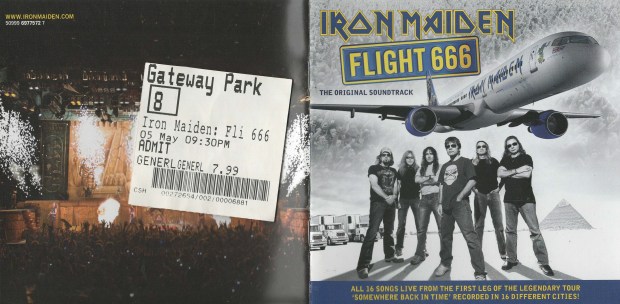
“Since their debut in 1980, Iron Maiden have become one of the biggest bands in the world. With little support from radio or mainstream media, they have sold over 70 million records and played some of the most legendary concerts in rock history – including Britain’s Donington Festival, Rock In Rio, and Poland during the height of communism. In 2008, they embarked on the most challenging and adventurous tour of their career…” – Sam Dunn
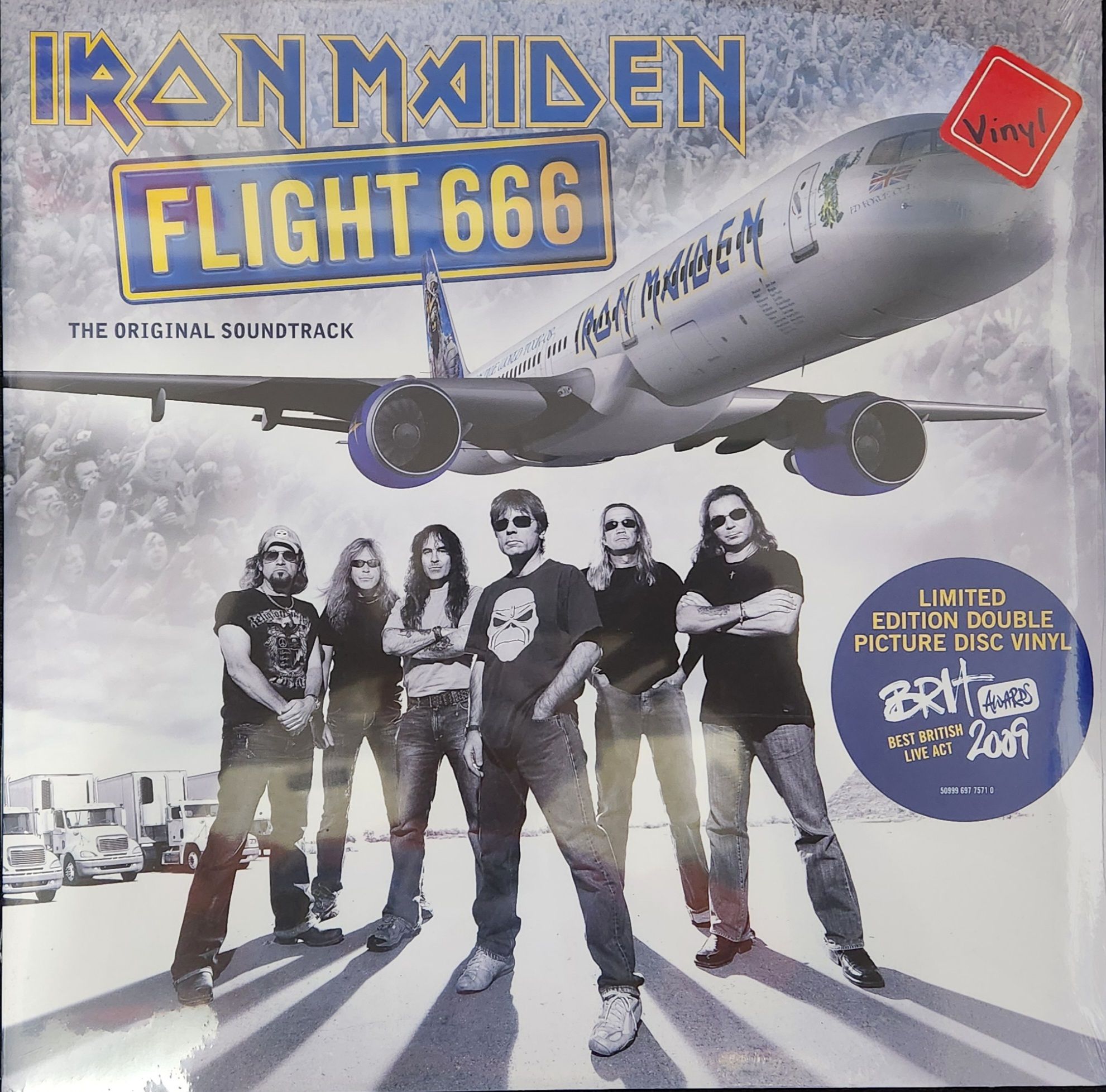 IRON MAIDEN:
Flight 666 – The Film (2009 UM DVD)
Flight 666 – The Original Soundtrack (2009 EMI CD)
Supporting their newest compilation album, Somewhere Back In Time (released May 11 or 12 2008), Iron Maiden embarked upon a new kind of tour. Lead singer and licensed pilot Bruce Dickinson wondered if there was a way for the band to buy a plane, modify it to carry all their gear and still have room for the road crew, and fly it from gig to gig. As an added twist, Bruce often flew the plane himself. The tour had to be captured on a documentary, so Sam Dunn and Scot McFadyen of Banger films took the job.
Since Somewhere Back In Time focused on the Dickinson albums from Number of the Beast to Seventh Son of a Seventh Son, Iron Maiden chose a setlist that (mostly) reflected this, with one notable exception. The interesting thing about this setlist is, because there is only one song played from the Janick Gers era of Iron Maiden (which we’ll get to), he gets more solos on older songs than usual. The final film was released theatrically, and later on DVD with a CD soundtrack. The film featured 16 songs, each taped in a different city all over the world, from India to Japan to Brazil. The concert footage was edited seamlessly into the documentary, but the DVD offers a second disc with the complete songs, unedited. If you just want the audio experience, the 2 CD soundtrack has you covered. Since the film had the songs in a certain order to suit the timeline of the tour, we will (mostly) follow the film song order for this review. The CD features fade-outs between songs, since we all know they are from different shows. This is the first and only Iron Maiden live album to date, to fade out from song to song.
Flight 666 was recorded over six weeks, from February 1 to March 16, 2008. The film was released on April 21, 2009 with the soundtrack following on May 11, and the DVD on June 9. With a running time of 113 minutes, the film made $233,193 at the box office.
1. “ACES HIGH” (Mumbai)
Cut to the airport, and Sam Dunn is boarding the plane Ed Force One. Bruce is in his pilot’s uniform, and he explains how he came up with this idea to fly themselves on their own plane. The plane had to be specially modified to carry the gear. Guitarist Adrian Smith was skeptical. Special authorization was needed and only came last minute. Then, a wheel had to be replaced. The road crew loved the luxury of it, and Dickie Bells gives the slovenly ex-colonial Canadians hell for standing there with their hands in their pockets. First stop: India. The band is completely mobbed by a crowd that has been waiting since 6 am. “Wrathchild” can be heard at soundcheck. The stage is just made of wood!
You can see a glimpse of the backstage prep before the band hits the stage. Nicko walks to the stage in flip flops. The show begins with “Churchill’s Speech”. The “Aces High” song intro is the studio recording, before breaking into noticeably thicker live version (because of the three guitars). Bruce in a toque, jumping and leaping everywhere! He also enjoys playing a gong! Davey and Adrian’s solo are both magnificent. First song of the set, and Janick is already dancing! Bruce’s voice is rougher and lower than Live After Death after 23 years past, and less melodic, but this is still a rather strong version of “Aces High”.
Bruce isn’t flying the plane in the next flight after the show; he is a passenger. He is only allowed so many hours of work time if he is to fly the plane. The band talk about manager Rod Smallwood, and they all do their Rod impressions. Off to Malaysia and Perth Australia, before hitting Melbourne.
The song “Moonchild” is heard but not seen at this point in the film. On the second DVD, it appears later, so we’ll pick it up then.
2. “2 MINUTES TO MIDNIGHT” (Melbourne)
“SCREAM FOR ME MELBOURNE!” The crowd handles most of the chorus! The Australians are absolutely nuts. Bruce is in great voice. Janick, dancing once again, twirling his guitar around his body, irritating some and delighting others. Adrian’s solo is more effects-laden than the album, but still the same notes. Bruce and Steve run all over the stage, from left to right. Top version of “Midnight ” – the best since Live After Death, in fact.
After the show, Adrian seems unhappy about the sound that night, but stresses that you have to push through for the crowd. Bruce and Nicko praises Adrian’s ability to find all the right notes.
The band enjoys a day off, Adrian plays tennis with Wimbleton champ Pat Cash. Nicko and Davey go golfing. Steve brings his kids and enjoys family time.
3. “REVELATIONS” (Sydney)
Bruce comments that it took them a while to get to Sydney. “WAKIE WAKIE!” His vocals are powerful – no issue with the demanding song. On this track, the triple guitar harmonies are…revelatory! Bruce’s vocal is as passionate as it gets. This is a top version of “Revelations”, second only to Live After Death. Davey’s solo is like butter, and then Janick’s is sharp like a blade. Nicko’s powerful right foot does what some drummers do with two bass pedals. Bruce disappears backstage during the solos to re-hydrate.
4. “THE TROOPER” (Japan)
Bruce talks about his family heritage with the RAF. On flying: “You can never be the master of it. It is a very humbling experience.” There is an Eddie on the dashboard as they fly to Japan. It is a place that Nicko has always wanted to visit. The fans are polite and give gifts. Backstage, Adrian plays some bluesy jams revealing his talent. Dick Bell is constantly teased about retirement, and if this will be his last tour. He is stern and hilarious.
For “The Trooper”, Bruce changes into the red coat waving the Union Jack! The song is a tad faster but Bruce keeps up, and puts in an impressive powerhouse performance. We’ve had a lot of live versions of “The Trooper” on their many live albums and singles, but this is a good one. It’s cool when Bruce says “Hey Tokyo…” The three guitars are blended really well here. It is a pleasure to watch Davey bend his strings – wide, accurate and with great “guitar mouth” too.
Maiden fly to Anchorage Alaska, and then south to Los Angeles. The palm trees are a stark contrast to the February snow! Steve goes to the studio with Kevin Shirley. and works. You can hear them listening to “The Longest Day” from A Matter of Life and Death.
5. “THE NUMBER OF THE BEAST” (Los Angeles)
Kerry King, Lars Ulrich, Scott Ian, Vinnie Appice, Tom Morello and Chad Kroeger are all at the star-studded gig.
Bruce is now down to a T-shirt. His voice is pushed to the limits here, but he still manages a pretty great opening scream. The pyro begins, and Bruce is once again leaping, and Janick is kicking up a storm. Davey’s solo is wonderful when he extends that one note that he is prone to doing. He really lets it ring.
Back on the plane, Bruce is flying once again and marvels at the change of seasons as they travel, as the jetlag sets in. Off to Mexico! Bruce senses there is always a sense of something exploding in Latin America when they arrive. OLE OLE OLE OLE OLE! MAIDEN MAIDEN!
6. “WASTED YEARS” (Monterey, Mexico)
A potential highlight of the film and sound track is “Wasted Yeats” from Somewhere In Time. “It’s great to be in Mexico!” exclaims Bruce, as he playfully sits as the crowd cheers “ole ole ole ole ole”. It’s cool to watch how Adrian plays the main guitar hook – a lot of open strings. His solo has slightly evolved but it is now even better! More energy, more shred! It is skin-tingling when Bruce shouts out “ADRIAN!” and then Smith sings the next line: “So, understand…” Later, he contributes vocals to the chorus: “Don’t waste your time always searching for those Wasted Years…” He did write the song, after all.
Off to Mexico City. Nicko describes Janick as a “lone soldier”, usually looking for an Irish bar. Janick is also the jester, says Nicko. Apparently has a degree in sociology. He’s a free spirit and plays guitar as a free spirit, says Rod. In Mexico, he explores a pyramid with Nicko.
7. “CAN I PLAY WITH MADNESS” (Mexico City)
Bruce’s voice is a bit rougher, but his huge sombrero is hilarious! It’s so out of place! This is a solid version of the song which is always challenging vocally. Adrian’s presence on backing vocals improves the song over versions without him, such as Donington and A Real Live One.
Off to San Jose, Costa Rica. Maiden are playing a 27,000 seat football stadium. Fans line the streets! The fans are a whole level above the rest! They cannot imagine that Iron Maiden has come to Costa Rica , a once in a lifetime experience for them. These people are truly starved of metal concerts like Maiden, and they are not shy about showing it. Nicko goes golfing, but gets hit by a golf ball in the wrist. Fortunately, a minor injury. Nicko is the social side of Maiden, says Rod.
8. “POWERSLAVE” (San Jose, Costa Rica)
Bruce is wearing the full bird mask! In full voice too! SCREAM FOR ME COSTA RICA! This version of the song thumps harder during the riff. You can also hear keyboards providing backing melody. Bruce riles up the crowd with a “HEY HEY HEY HEY!”, and this could be the second best version of “Powerslave” ever, after Live After Death. Adrian’s solo is actually a very different version, a variation perhaps, of the album solo. Still great, just new.
Iron Maiden now head Columbia, where soldiers are everywhere. Bruce is very apprehensive, in case something goes wrong outside. People camped out for days, sleeping under tarps waiting for Iron Maiden. Security confiscates all food and all cameras. There is a lot of tension in the air.
9. “RUN TO THE HILLS” (Bogota, Columbia)
Now Bruce is wearing a vest. The crowd is mixed very loud in the chorus. Davey’s wah-wah laden solo is cool, but otherwise this is just another version of “Run to the Hills”. The crowd is what makes this version different as they are absolutely nuts. One fan who caught Nicko’s drum stick is crying with emotion at the end of the show (during “Always Look on the Bright Side of Life”). He thanks God, as other fans nearby weep in joy.
Nicko eats a pizza – says he likes the “sweaty feet” kind of cheese. Off to Sao Paulo, Brazil next. Bruce talks about their 1985 visit to Rock In Rio, and old video footage is shown from the televised event (which is also “Run to the Hills”). Fascinatingly, there is a Priest who has a ministry in Brazil with 162 Iron Maiden tattoos. He includes their lyrics in his sermons. He named his son Steve Harris. Incredible.
10. “HEAVEN CAN WAIT” (Sao Paulo, Brazil)
The band is seen playing football, and then we cut to the stage. The football players have joined for the “Woah oh oh!” singing on “Heaven Can Wait”. It’s pandemonium on stage, with dozens of people jumping up and down. Janick takes the first guitar solo while Bruce hides behind a sarcophagus. Bruce kicks the gong this time! The triple guitars don’t seem to blend so well on the harmony solo, but Bruce is killing it on the vocals (aside from only singing “Heaven can…” most of the time.) Janick’s solos are great here, defying those who call him second rate. Again, Nicko’s right foot is doing the work of two feet.
The band continues to travel through South America for several more gigs, into Buenos Ares, Argentina. They are greeted by fans at the airport once again. Fans following them around 24 hours a day and it gets to be a bit much for Adrian. He wants peace and quiet when he’s at the hotel, but fans are a mob at the front door.
11. “FEAR OF THE DARK” (Buenos Ares, Argentina)
This is the one and only song that does not fit into the Somewhere Back In Time era. Why was it included? It probably serves a dual purpose: to give Janick a song from his era on this tour, and because it has become a concert staple. The Argentinians don’t seem to mind. The crowd are almost louder than the band. Though we have many versions of “Fear of the Dark”, this one is solid. Janick’s single harmonic note is always a favourite part. The way the crowd blends with Bruce on the chorus is powerful. Dickinson is in great voice, and you can hear every delicious pick scrape on the guitars. This is a solid go-to version.
Off to Chile, and once again the fans are over-the-top crazy to see the band, mobbing them at the airport and making the national news. At one point, Iron Maiden were banned in Chile for “Satanic” lyrics, so this is a big deal for the fans.
12. “IRON MAIDEN” (Santiago, Chile)
Bruce creates a neat muffled voice effect by singing “SCREAM FOR ME SANTIAGO!” into a paper drinking cup.
Out comes the Somewhere In Time Eddie! You can see the guy controlling him too, with a massive remote. Nicko is particularly pounding on this version of “Iron Maiden”. Janick throws guitar in the air, and twirls it around, which the South Americans don’t seem to be complaining about.
13. “MOONCHILD” (San Juan, Puerto Rico) Full song on CD and DVD disc two
Contrary to other live versions, the acoustic intro is live this time, not pre-recorded. The usual synth part is re-created on guitar with an echo effect, by Adrian. A unique version unlike the prior ones, and Steve is killing it on the bass, too. Thge bass is very prominent in the mix. This is a great version of “Moonchild” and a delight to fans of Seventh Son era Maiden.
14. “THE CLAIRVOYANT” (Curitiba, Brazil) Not in film at all – only on CD and DVD disc two
A fan makes it on stage and is promptly escorted off, you can see Bruce mouth “Who’s he?” to the audience. The opening guitar harmonies are rich with the three guitars, and Bruce is in strong voice, bellowing the verses.
15. “RIME OF THE ANCIENT MARINER” (New Jersey)
Back to North America. This the other show highlight. “Rime” has a heavier riff with the three guitars.
Bruce is now dressed in a black cloak, spending a lot of time on the ramp over the drum kit. This is the song he was most excited to revisit. It really is a dramatic scene, and the fans are clearly psyched to hear this song again. Keyboard accents (in spots) are added to provide a melodic backing. There are loads of explosions and after the middle section is finished. Quite a spectacle! Adrian throws in a brand new tapping section into the guitar solo. The triple harmony part at the end of the solos is thick, fresh and exciting. Never before have we had this with three guitars. A landmark version of the song.
Bruce is interviewed by Eddie Trunk. He explains that they are doing this setlist for new, young fans who never got to hear these songs before. Bruce notes that their audience keeps getting younger. He doesn’t mention backlash to the Matter of Life and Death tour, which featured the new album played live in its entirety, but that probably also impacted their seasons to “play classics” this time.
Finally, onto Toronto Canada! The CN tower can be clearly seen as they land in snowy Toronto. Last show. They did it. It’s a successful tour.
16. “HALLOWED BE THY NAME” (Toronto)
SCREAM FOR ME TORONTO! The atmosphere is electric as the fans clap along, and sing the opening section. The beautiful harmonics on the guitar by Janick add texture. Once the song picks up, everyone is leaping in the air. Bruce is in great voice here, hitting the higher notes, and clearly putting 100% into his performance. One of the heaviest versions of “Hallowed” available. A good go-to live version of the song.
That’s the album, and that’s the film. We go out to the end credits music: Monty Python’s “Always Look On The Bright Side of Life”.
Taken as an album, this is a top three Iron Maiden live album. Taken as a film, it is for fans only. Unlike other metal documentaries, there is not much in terms of narrative or drama. Nicko being hit by a golf ball, and Adrian complaining about mobs is as dramatic as it gets. Who cares? It’s Iron Maiden. It’s a fascinating trip around the world in under two hours. To be able to be a fly on the plane bulkhead wall with Iron Maiden is the whole point.
5/5 stars














 mikeladano.com