kk downing

REVIEW: Judas Priest – Screaming For Vengeance (30th Anniversary Edition)

JUDAS PRIEST – Screaming For Vengeance (Originally 1982, 2012 Sony 30th Anniversary Edition)

While people recognize British Steel as a platinum Judas Priest landmark, it was Screaming For Vengeance that went double platinum.  It introduced Priest to the MTV generation and opened them up to bigger American audiences.  But before we get to Screaming For Vengeance itself, a cornerstone Judas Priest album in anyone’s books, the “Special 30th Anniversary Edition” must first be addressed.  The extra content is a full concert DVD, and four bonus audio live tracks from the same DVD.

To have Priest live at the US Festival is a wish fulfilled for many.  The daylight show with full classic costumes (Rob decked in silver) is a nostalgia blowout.  The band look lethal although drummer Dave Holland appears overwhelmed by the demanding tunes.  The setlist isn’t half bad, with “Green Manalishi”, “Diamonds and Rust”, and “Victim of Changes” being highlights and filling the need for old classics.  The bulk of the set is made up of more recent material from the three 1980s Priest albums thus far.  Tempos are fast, cowbells are in the air, and Rob is at his confident shrieking best.  The audio is great and the video is well reproduced.  Owning this edition of Screaming really is a must since it’s the only official release of this show on DVD.

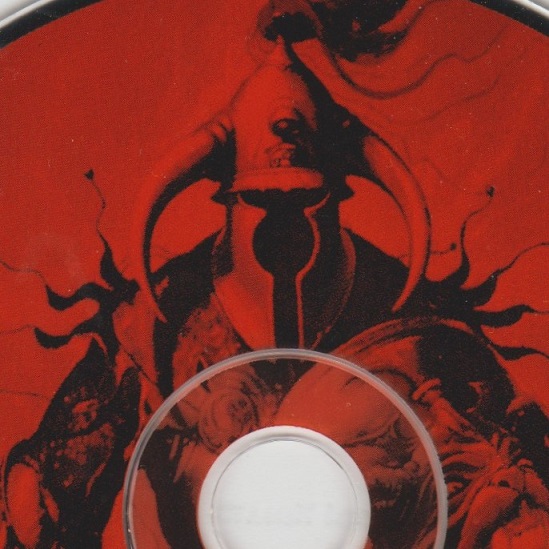
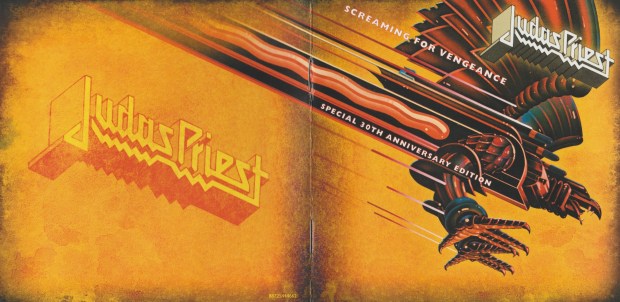
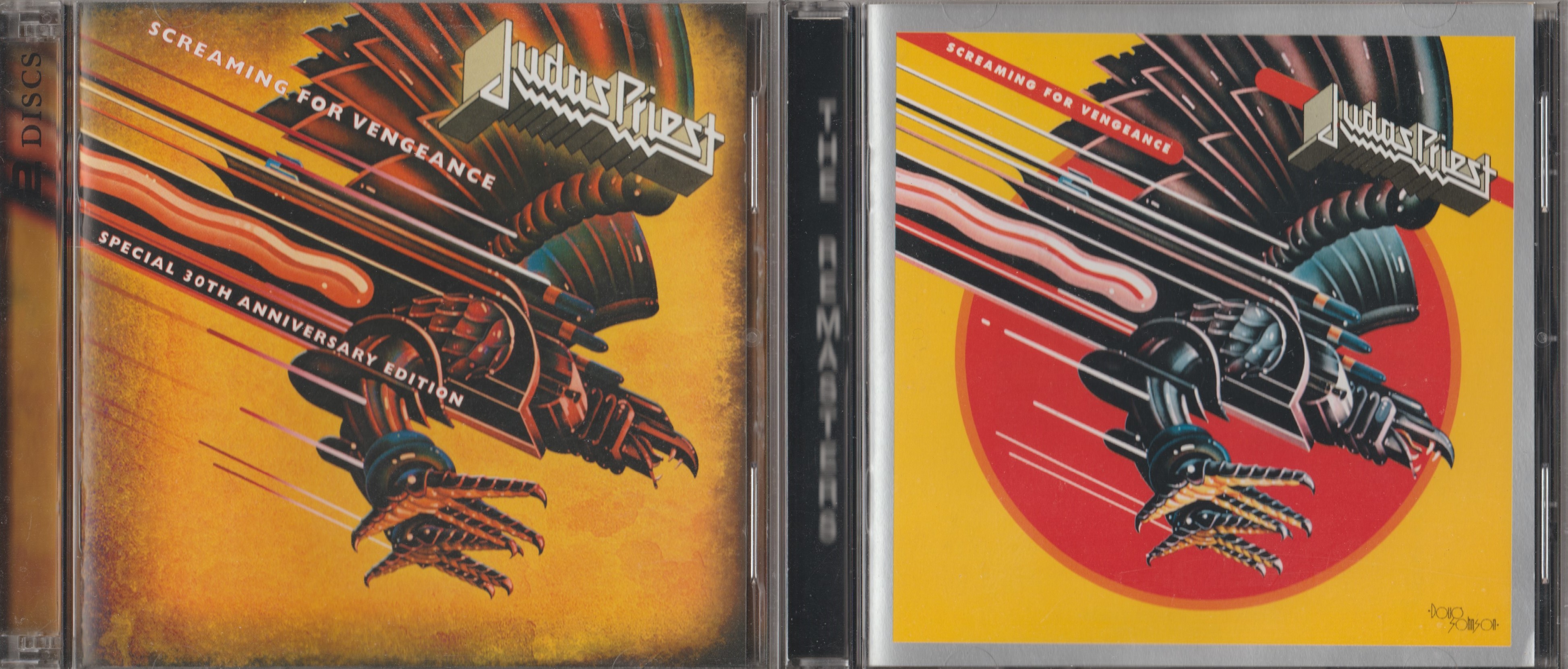
The re-imagined cover art is nice, fitting in with other Priest deluxe reissues (see images at bottom).  In an unfortunate oversight, the clean and sharp original artwork is included nowhere inside this set.  They did include the two bonus tracks from the previous remastered CD release, which we’ll get to after we discuss the album in full.
Screaming For Vengeance was a sudden change of style for the Priest, after two rather soundalike albums.  Similarly the next album Defenders of the Faith would be cast from the same mold as Screaming.  All these albums were produced by Tom Allom.  Tempos were turned up, guitars sharpened, and as per the title, Rob Halford screamed.  A lot.  The refined 80s Priest was evident on the opening duo “The Hellion/Electric Eye”.  The guitars are sleeker, the vocals processed and robotic.  The riffs are just as sharp.  Priest were going for the throat.  This opening one-two punch was more punishing than any music I ever heard at that time.  Though you could not claim it’s heavier than a Priest oldie like “Saints In Hell”, the production is louder and more in your face than ever before.

Drummer Dave Holland sprays a bloodbath of bashes at the start of “Riding on the Wind”, Priest speeding on the highway once again.  With Rob in high register, this catchy tune is perfect for keeping the wind in your face.  The first respite in terms of tempo is “Bloodstone”, though its glorious riffs need no accelerant.  Halford’s scatting at the end is classic and a rare reappearance of his old sassy self from Hell Bent for Leather.

“(Take These) Chains” is one of the most immediately accessible tracks, a mid-tempo delight as Priest do so well.  They end the side with a slow metal grind called “Pain and Pleasure”, drums soaked in echo.  Rob alludes to an interest in BDSM again, but with music this heavy most people just headbanged and ignored.  (In another sad oversight, the lyrics are not contained within this edition, but were reproduced on the previous CD remaster.)  Don’t assume that because it’s a slow one it’s weak.  “Pain and Pleasure” is a resounding an d memorable side-ender.

The second side opens with the sudden shock blitzkrieg of the title track.  Speed metal turned up to 11, “Screaming For Vengeance” is over the top and almost self-parody.  It’s one of Priest’s most overdriven blasts of might, but it also verges on mindlessness if not for a spirited solo section in the middle.  But then in another jarring shift, the sleek mid-tempo groove of “You’ve Got Another Thing Comin'” rears its familiar head.  When I was a kid, there was no question this was Priest’s “big hit”.  It was the song everyone knew, and the music video was on constant rotation.  Classic clip.  The man pursuing Priest is meant to represent the tax man.  When Rob essentially yells at him “no tax man, you will not take my money,” his head blows up.  They used a little too much TNT on the mannequin, and so the tax man’s pants fell down in an added humiliation.  Such is the power of heavy metal, folks.  Got tax problems?  Rock and roll right in that tax man’s face.  Eventually his head will blow up.  If you’re lucky the pants might also fall.  This is what Priest have given the world!

“Another Thing Comin'” is a brilliant song.  Radio super-saturation cannot dull its simply-constructed hooks.  Its placement (second song, side two) is odd but that didn’t stop it to #4 on the US Billboard rock chart, nor did it impede the album rising to #17 on the Billboard 200.

The album begins drawing to a close, with an echoey tremolo effect on “Fever”, one of the album’s best cuts.  Then the echo ends, and a clean guitar accompanies a plaintive Rob.  Mid-tempo, powerfully built and loaded with hooks, “Fever” is a late-album winner.  Then, three quarters in, Halford turns on the high voice and the song transforms into something else equally cool.  Finally the echo-guitar returns to help bring the song to its dramatic end.

“Devil’s Child” is the last hurrah, a fun and heavy indictment of an ex-lover who’s “so damn wicked” and “smashed and grabbed all I had”.  The album ends as suddenly as it begins; jarring transitions being a sonic theme on Screaming For Vengeance.

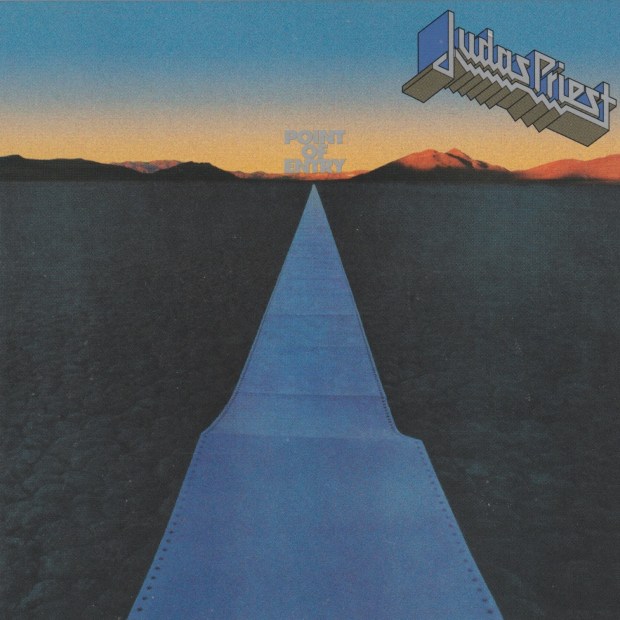
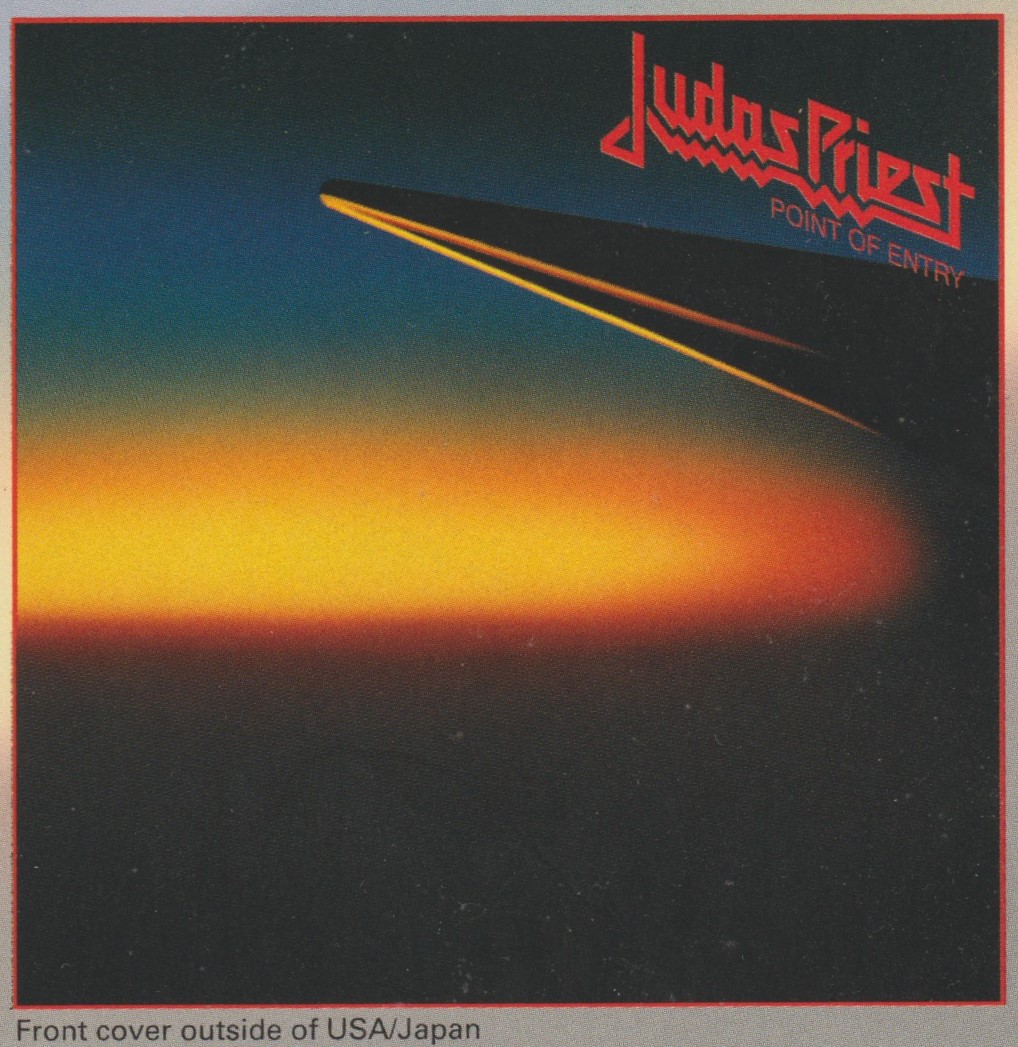
Tom Allom’s production is often maligned as inferior to the more raw and loose sounds of Priest on their 70s albums, and there’s certainly an argument to be made there.  Screaming For Vengeance is not a warm album.  It is cold, sharp and steely.  It has a precise, digital undertone.  But it’s also heavy, considerably more so than Point of Entry which preceded it.  The cover art indicated that we were entering a new phase for Judas Priest; a simpler streamlined 80s phase but still deadly enough for the old fans.

The live bonus tracks included on the CD were not chosen willy-nilly.  Instead of including the best hits from the US Festival DVD, they use tracks from a different show in San Antonio, and all from Screaming For Vengeance:  “Electric Eye”, “Riding On the Wind”, “You’ve Got Another Thing Comin'” and “Screaming” itself.  Watch out for the squealing feedback!  Finally the original bonus tracks from the 2001 CD are edition are tacked on so you don’t have to own two copies.  These include a raspy, smoking “Devil’s Child” live from another concert, and a demo from the 1985-86 Twin Turbos sessions called “Prisoner of Your Eyes”.  I hate when Priest use bonus tracks from the wrong era, but the Screaming For Vengeance reissues are the only place you can get this song.  In a stylistic shift, this slick ballad sounds more like “A Touch of Evil” from Painkiller, but far tamer.  (The guitar solos were overdubbed and tracks finished in 2001.)

Good special edition, but not great.  As these things go I’m sure we can expect a better 40 anniversary edition.  It won’t be long now.

5/5 stars for the album

3.5/5 stars for the 30th Anniversary edition

REVIEW: Judas Priest – Point of Entry (1981, Remastered)

JUDAS PRIEST – Point of Entry (1981, 2001 Sony remaster)

Point of Entry will always be one of those “other” Judas Priest albums. It wasn’t a ground breaker and wasn’t a massive seller. It will always just be “the album that came after British Steel” or “the one that came before Screaming for Vengeance“.  It did fine (500,000 US sales) and spawned a killer single called “Heading Out to the Highway”, but it didn’t make history like the other two records.

Coming after British Steel, Priest continued with producer Tom Allom and drummer Dave Holland, and it doesn’t sound like they were overly interested in taking chances.  Sonically Point of Entry is a carbon copy, though with less impactful songs.  In 2001, it was issued remastered by Sony with two bonus tracks.

For me, Point of Entry occupies an interesting space.  Listening to it on a recent road trip took me back to 1987 or 88, when I was in the midst of seriously trying to collect “all the Priest”.  From the perspective of a kid in 1988, Point of Entry was what I thought 1981 must have sounded like, though it wasn’t that long before.  So Point of Entry takes me back not to the early 80s, but the late 80s.  And in the late 80s, it sounded good.

Sure, I was aware that it sounded a lot like British Steel before, but without the massive landmark tracks like “Metal Gods”.  But what about “Desert Plains”?  Why wasn’t it as important as “Metal Gods”?

To this day, I don’t know.

Point of Entry does boast a few songs that could go toe-to-toe with any on British Steel.  Certainly “Desert Plains” and “Heading Out to the Highway” can stand up to the prior album.  “Highway” has one of those riffs so classic that I sometimes find myself humming it in a grocery line wondering what song was in my head.  As a mid-tempo road song, it does the job.  One could argue it’s just a sequel to “Living After Midnight”, but you just try and resist this one.

“Heading Out to the Highway” was made into an unintentionally funny video, mixing on-set with on-location footage in an obvious way.  Worse though were the two videos that followed:  “Don’t Go” and “Hot Rockin'”.  “Don’t Go” features the band playing trapped inside a small room, with a door that leads various impossible locations including outer space.  Fortunately the song is better:  slow and plaintive, yet with that solid rocking beat and a killer guitar solo.  “Hot Rockin'” is high-speed but tends to be forgotten because Priest have better material at this tempo.  The video is situated in a sauna, and then a concert stage where Rob’s flaming feet light fire to his microphone, and the microphone to a couple guitars.  Funny to look at, but I think it’s one of those cases where we’re laughing at the band, not with them.
“Turning Circles”, and a lot of the rest of the album, fall into various categories.  This one fits alongside “Don’t Go” as a slow but hard track.  “We’ve all got somethin’ wrong to say,” sings Rob in this song that seems to be about ending a relationship.  The “ah ha, ah ha” break in the middle is an album highlight, and to me it sounds exactly like my bedroom in 1987.

It’s “Desert Plains” that really brings it home.  There is a pulse to this song, created by Dave Holland and Ian Hill.  You don’t associate those two guys with awesome rock beats often, but here it is.  “Desert Plains” is an instant classic, and it’s alive with movement.  From the verses, to the choruses, to Holland’s drum “sound effects” (like “wild mountain thunder”), this is a Priest classic and shall forever remain so.  This side one closer should have been a video way before “Hot Rockin'”.

The second side opens with “Solar Angels”, another track with an interesting rhythm (slow drums, fast guitar chug).  The song feels like it could use some more substance, but it’s still enjoyable albeit in a “Metal Gods” knock-off kind of way.  Though heaviness is always celebrated, who doesn’t enjoy when Rob Halford gets sassy?  That’s “You Say Yes”, an outstanding shoulda-been hit.  The verses verge on punk rock as Rob spits out the words as only he can.  Then the airy “what I do, what I do, what I do” middle section goes right to heaven — or my room in ’87, I’m not sure which.
Point of Entry ends on three decent but unremarkable mid-tempo tracks, which perhaps always served to weaken the album’s impressions.  “All the Way” might be an attempt to rewrite “Living After Midnight”, and although it’s a cool track we all know Priest have better stuff in this vein.  “Troubleshooter” might even be more of a rewrite, with that opening drum beat sounding a little familiar.  But Rob’s vocals kill it.  Finally “On the Run” is a screamy album closer where Rob is once again the star.

As with previous CDs in this Priest remasters series, there are two bonus tracks, one of which has nothing to do with Point of Entry.  “Thunder Road” sounds a lot like Ram It Down era Priest, so you can safely assume it’s from those sessions in the late 80s.  Clearly outtake quality, almost like a prototype for “Johnny B Goode”.  Then there is a live version of “Desert Plains” from what sounds like the 1987 tour judging by the big echoey drums and Rob’s added screams.  It’s much faster than the album cut, all but destroying the pulse of the original.  Yet the song still kills!  Somehow it didn’t make it onto the Priest…Live! album, which was already stuffed full.

In the late 90s, a guy sold a used copy of this on CD to me, but he left something inside.  Something I wish I’d kept because it was so bizarre and funny.  The back cover features five white boxes in the desert.  The guy left a little white piece of note paper inside, explaining what he thought the back cover was about.   “Maybe they are graves,” said part of it.  I wish I could remember the rest.  (I always thought the five boxes represented the five band members, with the large one in the back being Dave Holland and the drum kit.)  And speaking of the cover, this album does look better on vinyl.  I have vinyl for almost all the Priest up to Ram It Down, and they all look better on vinyl.

Although Point of Entry will always live in the shadows of the towering albums that came before and after, it still leaves a glow behind.

3.75/5 stars

REVIEW: Judas Priest – Sin After Sin (1977)

JUDAS PRIEST – Sin After Sin (Originally 1977, 2001 Sony reissue)

“SIN AFTER SIN, I have endured, but the wounds I bear are the wounds of love.”

This lyric from “Genocide” on 1976’s Sad Wings of Destiny would have been little more than a throwaway, if Priest didn’t recycle the words “sin after sin” for their next album title.  Though the song may have appeared to be the same, much had actually changed.  For the first time, they had a producer that understood that kind of aggressive rock that the young band were trying to create:  Roger Glover, ex-Deep Purple, who had already recorded several albums for Elf, Ian Gillan and Nazareth.  Perhaps even more significantly, for the first time they had a serious drummer creating the beats:  the not-yet-legendary Simon Phillips, who had still already played on a Jack Bruce album.  This was just a session for Phillips, but it enabled Priest to break the shackles of rhythm and really start exploring.

Opener “Sinner” might have been the same kind of tempos that Priest were working with before, but there is a new slickness to the drums; an effortless drive with increasingly interesting accents.  With a solid backing, Priest sound more vicious.  “Demonic vultures stalking, drawn by the smell of war and pain.”  The apocalypse has never sounded cooler.  As Phillips drops sonic bombs left and right, KK Downing goes to town on what would become his live showcase solo.  His growls and trills sound like a beast inflicting wounds on a struggling combatant.  At almost seven minutes, “Sinner” is the album epic, and it’s the opening track!

Priest previously recorded a cover of Joan Baez’ “Diamonds and Rust” for Gull records; that early version can be acquired on The Best of Judas Priest or Hero, Hero.  The Glover-produced track is the more famous and better of the two.  Radio play for “Diamonds and Rust” helped push the album to eventually sell 500,000 copies.  Rob Halford’s high pitched harmonies gleam like polished silver.

Ironic observation:  I hope by now we all know a light year is a measurement of distance, not time.  It is the amount of distance that light can travel in one year (9.46 trillion kilometres).  So, really really far.  Joan Baez playfully used it as a melodramatic measure of time in “Diamonds and Rust”.  (“A couple of light years ago”.)  On the next track “Starbreaker”, Halford refers to “light year miles away”, a crudely worded hyperbole for distance.  So with Sin After Sin, you get it both ways.  Regardless of scientific accuracy (or not) “Starbreaker” is a good track with a slightly flat riff.  Though Phillips is brilliant, it could just use a little more pep.

Like with Sad Wings of Destiny, you gotta have a ballad in there somewhere, and on side one that’s “Last Rose of Summer”.  This softie isn’t bad, though Priest have done and will do better.  Using a ballad to close a side isn’t always wise either, but on CD nobody really notices except us nerds.

“Let Us Prey/Call For the Priest” is a pretty epic side two opener, with harmony guitars playing an opening instrumental anthem.  Then a choir of Halfords joins in, and the band break in to what could be their fastest song yet.  From the wickedly fast dual guitar solos to the powerful rhythm, this song is a blitzkrieg of metal trademarks.  It’s relentless and all over the board, something that 80s Priest rarely was.

Side two keeps getting better with the groove of “Raw Deal”, which was Rob’s real “coming out” to fans in the know.  Today he calls it a “heavy metal gay rights song”.  It’s actually one of Halford’s best lyrics.  Instead of mashing together science fiction words and singing about battlefields, this time Halford paints a hazy picture of what is probably a gay club in Fire Island, New York.  It’s vivid but vague:  “The mirror on the wall was collecting and reflecting, all the heavy bodies ducking, stealing eager for some action.”  It’s also backed by some seriously cool Priest music, almost funky but always heavy.  “The true free expression I demand is human rights – right?”  It was all there in the lyrics all along.

A second ballad, the dirge “Here Comes the Tears” brings a cloudier mood.  An ode to loneliness, “Here Comes the Tears” is the one to play when you just can’t take it anymore.  When Halford starts givin’ ‘er at the end with the wildest screams in history, it sounds like an exorcism.  The guitars howl, a hint of piano can be heard, and there is an underlying choir of Robs singing sadly in unison.  Finally “Dissident Aggressor”, famously covered by Slayer, concludes the album on a violently fast note.  “Stab!  Fall!  Punch!  Crawl!”  This song is not for amateurs and might be the heaviest thing Priest have ever done.  There are plenty of contenders, but “Dissident Aggressor” must be in the Top Five Heaviest Priest Songs Ever.  But that being said, they still have the balls to end the song with another multi-layered harmony of Halfords.

The 2001 Sony remastered CD has two bonus tracks, and the first is the best in the entire series:  “Race With the Devil”, a cover of a track by The Gun.  This version, recorded for the next album Stained Class (Les Binks on drums) could easily have been a B-side all this time.  Why it went unreleased until 2001 is unknown.  Perhaps it was lost, but now that it has gotten a proper mastering job it is available on CD.  This is un-retouched, which cannot be said for other unreleased tracks in the Priest Remasters series.  “Run With the Devil” is raw, riffy, fast, and wicked.  All it really needed to make it album quality is a better guitar solo.  The second bonus track is a live “Jawbreaker” (Dave Holland on drums) from the Defenders of the Faith tour.  Out of place, but an excellent song regardless.

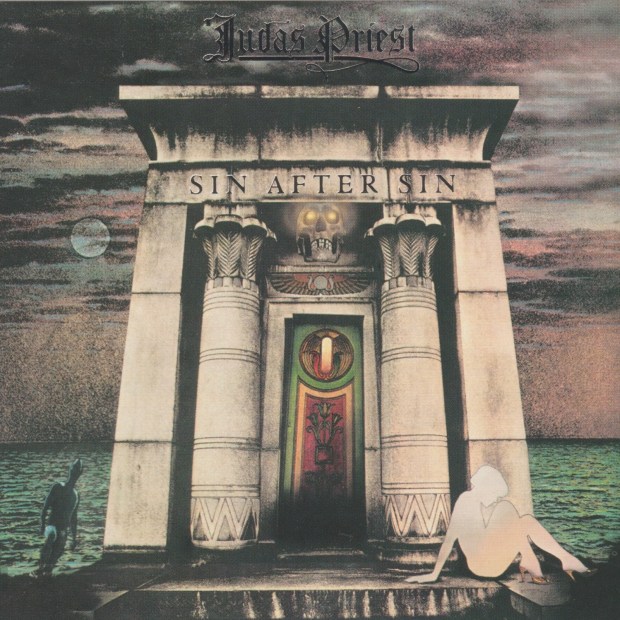
Incidentally, Sin After Sin is the last album before Priest adopted the first version of their current logo design.

4/5 stars

RE-REVIEW: Judas Priest – Sad Wings of Destiny (1976)

I was listening to Sad Wings of Destiny recently and wrote up a brand new review before realizing I already reviewed it.  Fortunately, I had lots more to say.  For my original 2015 review, click here.

JUDAS PRIEST – Sad Wings of Destiny (1976 Gull, 1998 Snapper Music)

1974’s Rocka Rolla didn’t set the world on fire, so back to the drawing board for album #2.  Having rid themselves of most of their early bluesy material, Judas Priest went heavier, and more diverse simultaneously.  The resulting album, 1976’s Sad Wings of Destiny, is considered an early classic by the band.  Some feel they rarely reached these heights again as they took their metal more mainstream in the 80s.

“Victim of Changes”, which opens the album, introduced the world to the high notes that Rob Halford was able to hit.  “Whiskey woman don’t you know that you are driving me insaaaaaaaaaaaaaane!”  Yet that note is nothing compared with Rob’s final shrieks.  This track combines an earlier unreleased Priest song titled “Whiskey Woman” written by original singer Al Atkins with a track called “Red Light Lady” brought in by Halford from his old band Hiroshima.  You can hear the moment the two songs are welded together at around the 4:45 mark.  Together at almost eight minutes they form a complex, classic Priest track that represents a high water mark.  Twisting from a metal groove into ballady territor-y and back again, this is drama the way Priest do it.  And they never do it better.

“The Ripper” boasts similar high notes but it’s almost a parody.  This riff-based shorty (2:51) is from the perspective of Jack the Ripper (or if you like, Jack the Knife).  With a galloping beat from new drummer Alan Moore (who was eventually replaced by the far superior Les Binks), “The Ripper” is as metal as things got in 1976.  Its placement as second track is perfect because the next two, “Dreamer Deceiver” and “Deceiver” form a single 8:34 epic.  “Dreamer Deceiver”, which forms the majority of the song, is an epic ballad about a supernatural being who tempts those below.

“Saw a figure floating, ‘neath the willow trees.
Asked us if we were happy, we said we didn’t know.
Took us by the hand and up we go.”

They follow the dreamer through the purple hazy clouds into the cosmos.  The intricate acoustic guitars let Rob Halford dominate with his story.  Though the track is haunting, it seems the people in the song find “complete contentment” and live without worries.  But as the song builds, adding piano, Rob’s vocals become more urgent (and high).  Though it seems like a heavenly paradise, the second part “Deceiver” changes the mood considerably.

“Solar winds are blowing, neutron star controlling.
All is lost, doomed and tossed, at what cost forever?”

There is always a price when temptations seem too good to be true.  This song brings another heavy gallop, the kind which Iron Maiden would later perfect.  Solos blast, as Halford warns us all of the “Deceiver”!  This is the kind of metal that people associate with Judas Priest, though its’ far more impressive if you consider it part of a larger composition.

Side one can be viewed as just three songs:  two epics and a hard rocker.  Side two has more to offer, though it opens in epic enough quality.  Glenn Tipton’s piano piece “Prelude” is foreboding.  As a Sabbath-like instrumental, it serves to set the scene for “Tyrant” (though “Tyrant” is always performed live without “Prelude”).  Overdubbed vocals make for a cool chorus, but this one is just a molten metal burner.  It wastes no time in laying waste, with guitar solos galore, in both single and dual formations.

“Genocide” is a slower, cooler groove that doesn’t seem to match its violent title.  But this is from the perspective of a survivor.  “Save me, my people have died, total genocide.”  This is the song that gave us the next album title, Sin After Sin:  “Sin after sin, I have endured, but the wounds I bear are the wounds of love.”  Cool track and a necessary one to give the album balance.  Songs of this tempo and style would make up the bulk for Priest albums in the future, yet it’s not simple or blockheaded like some 80s Priest tended to be.  It retains some complexity and traverses multiple musical landscapes through its length.

Next:  a complete left turn.  “Epitaph” (written by Tipton) is a piano-based funeral dirge that sounds a heck of a lot like Queen.  It’s beautiful though.  With Halford’s vocals layered as a choir, it’s a daring change of pace even though Queen were pretty much the biggest band in the world in 1976.

“Epitaph” fades directly into the final track “Island of Domination”, another metal chug but with an apocalyptic bent.  Rob’s lyrics are unusually styled with archaic sounding lines like “‘Twas as if all hell had broke loose on this night.”  This could be Rob’s first BDSM-themed song with lines like “Lashings of strappings with beatings competing to win.”  If not, then it’s just a brutal battle set to the tune of speedy Priest metal.

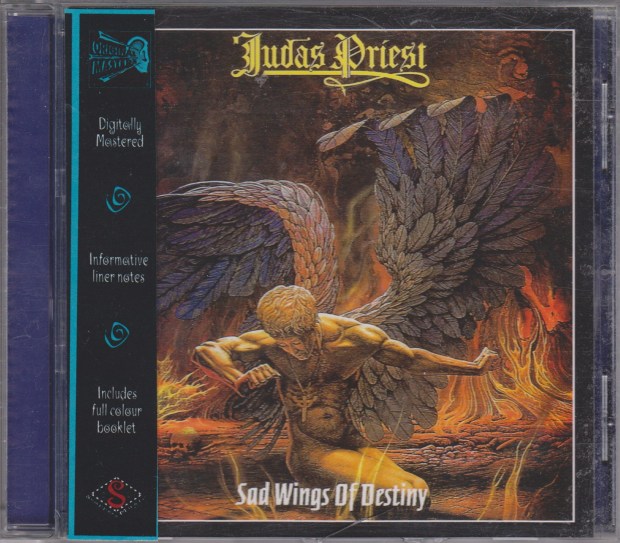
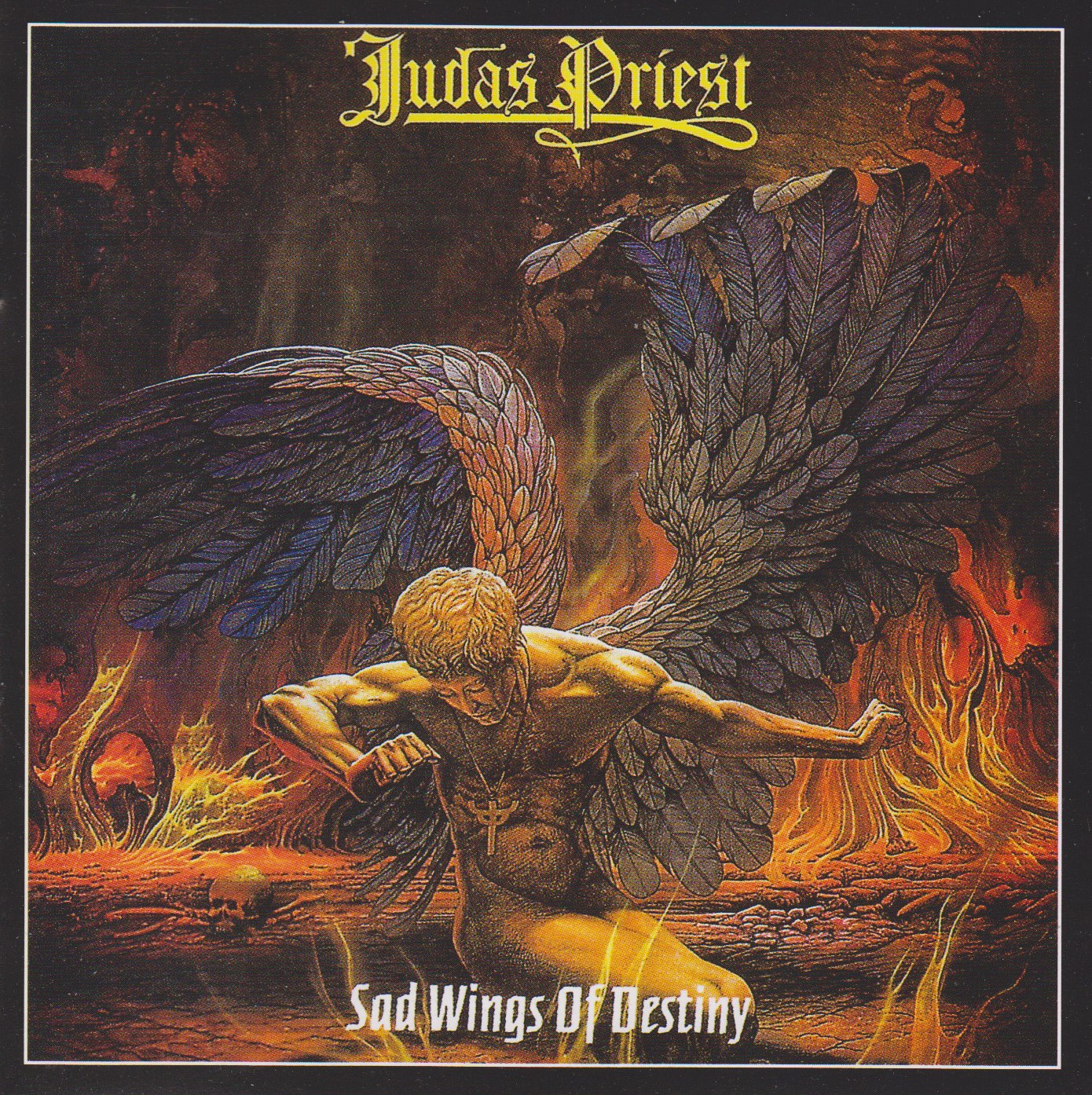
It must be said that Sad Wings has a striking album cover, with the angel depicted burning in hell.  School teachers worldwide would have loved this cover back in 1976.  The angel character would return 14 years later as the Painkilller.  The “devil’s tuning fork” necklace that the angel is wearing would become Priest’s symbol on later albums as well.

Though Sad Wings is an essential album for a serious metal collection, and stuffed full with riff after riff of majesty, it is frustrating hard to find good versions on CD.  Priest’s albums on Gull records have never been officially reissued by the band.  The 1998 CD release by Snapper music is usually rated fairly well.  If you’re unsure then get an original Gull vinyl copy.  But do get Sad Wings of Destiny and prepare to hear a young, vital and daring Judas Priest just beginning to learn what they can do.

5/5 stars

REVIEW: Judas Priest – Angel of Retribution (2004 CD/DVD)

“Sabbath are heavy, but Priest are metal.” – K.K. Downing

JUDAS PRIEST – Angel of Retribution (2004  Sony CD/DVD deluxe set)

Like Iron Maiden before them, Judas Priest pulled off a successful reunion tour before venturing into the studio to record a new album.  When the new music finally came, a deluxe package was made available featuring live videos from the reunion tour.  In this deluxe-sized review, we’ll take a close look at both the CD and DVD content.


The CD

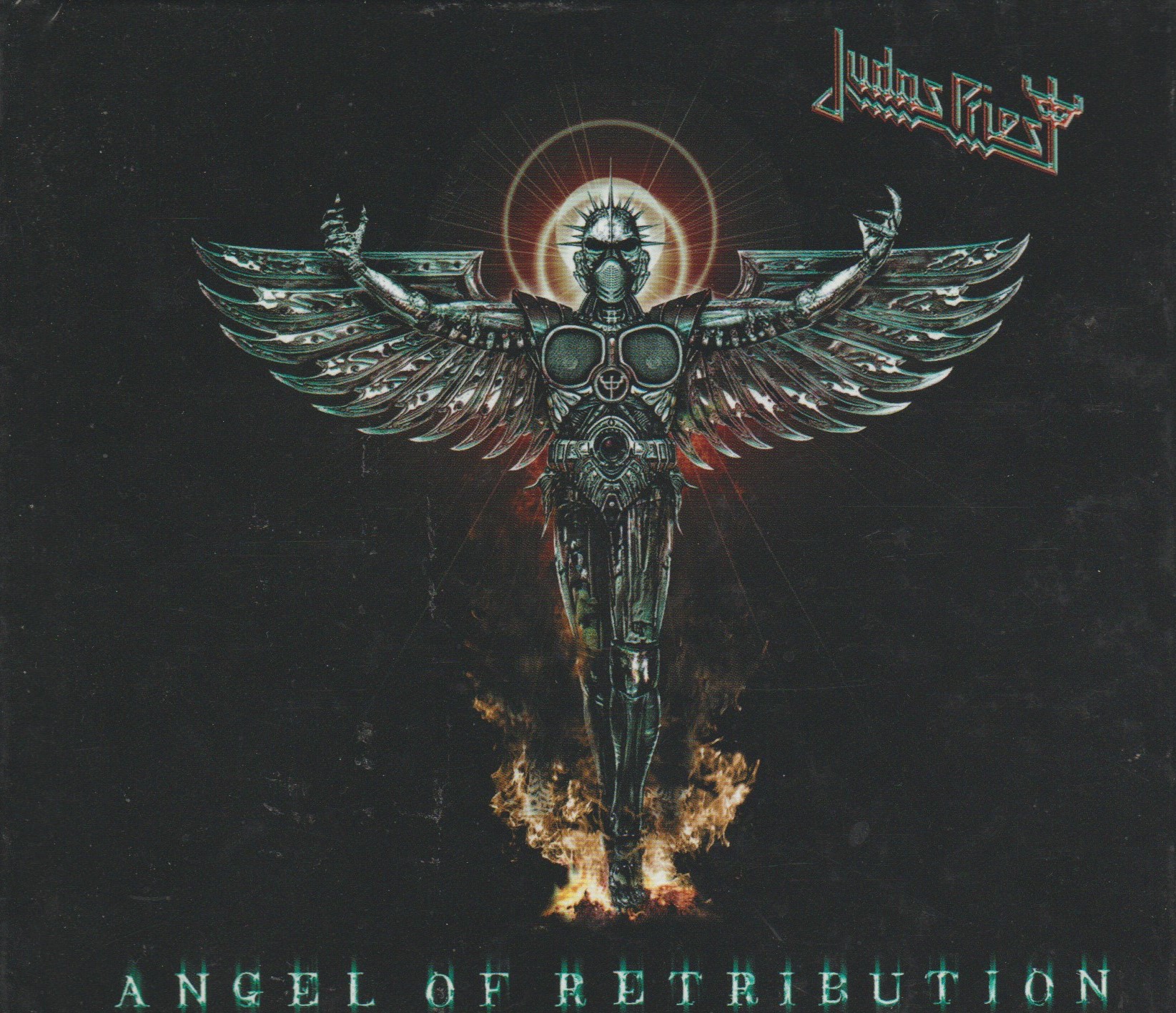
Pure anticipation preceded the arrival of the Angel of Retribution.  Two underwhelming albums with Tim “Ripper” Owens on lead vocals caused Judas Priest’s star to diminish in the 90s and 2000s.  The return of the Metal God, Rob Halford, meant a reunion of the successful 1990-1991 Painkiller lineup.  The new album cover even featured the return of the Painkiller character, now the Angel of Retribution.  But a long time had passed.  Could Priest hope to live up to the hype, and their legacy?

The answer is mixed.  While Angel of Retribution contains enough classic Judas Priest metal to consider it a success, it also has some truly legendary filler, of sub-Ram It Down quality.  Instead of running through the album track by track, let’s break it down in terms of song integrity.

Priest wrote a natural sounding album, with elements from virtually all eras of Priest past.  They say it came about organically, and it does sound that way.  Some of the best material are the songs that sound like variations of classic Priest.

The opening song “Judas Rising” brings it back to 1976’s Sad Wings of Destiny with that fade-in opener inspired by “Victim of Changes”.  Then it transforms right into the Painkiller era, with something that sounds like a far more intense “Hell Patrol”.  Solid 5/5.

The slightly psychedelic first single “Revolution” ranks among the better songs, although perhaps it’s actually most similar to “Little Crazy” by Rob Halford’s Fight.  It has flavours of Rocka Rolla and Killing Machine, and is far from what anyone expected Priest to put out for a first single.  Dig that slide guitar bit in the solo!  Solid 5/5.

Worth Fighting For” isn’t a ballad; it’s a little harder edged than that.  It’s the one song that is unique in the Priest catalogue, and remarkably strong.  The riff has a nice chug to it, while Rob ably carries the melody to a higher place.  A special song, and a 5/5.

Demonizer” is Jugulator meets Painkiller, faster than a hellriding devil dog (whatever that is), but “the Painkiller rises again!”   So testifies Halford.  It’s so ridiculously over the top that it can only be worth a solid 5/5.  Likewise the similar “Hellrider” on side two.  Both feature double bass so fast that it’s almost a parody of itself, but both rock so hard you’ll break your neck keeping up.  “Hellrider” is also notable as the song where Rob Halford inexplicably name drops “Megatron”.  Similar songs, both solid 5/5’s.

The ballad “Angel” is a little soft, unexpectedly so on an album with so much heavy metal.  Yet, Priest can do anything.  The acoustic “Angel” could be the quietest ballad since the early days.  “Put sad wings around me now,” sings Rob to the angel, an appropriate callback.  As his voice aged it acquired more depth.  That helps make “Angel” a respectable 4/5.

Deal With the Devil” and “Wheels of Fire” fall in a netherworld of pedestrian Priest.  These both feel like filler from Point of Entry or Ram it Down.  Less explosive, less memorable.  The autobiographical “Deal With the Devil” is amusing for its many lyrical callbacks: “Under blood red skies”, “Took on all the world”, references to razor blades.  Likewise the short one, “Eulogy“, which is really an intro for another song that we’ll get to.  “They remain still as stained class”, “Guarded by the Sentinel”, and so on.  3/5 each.

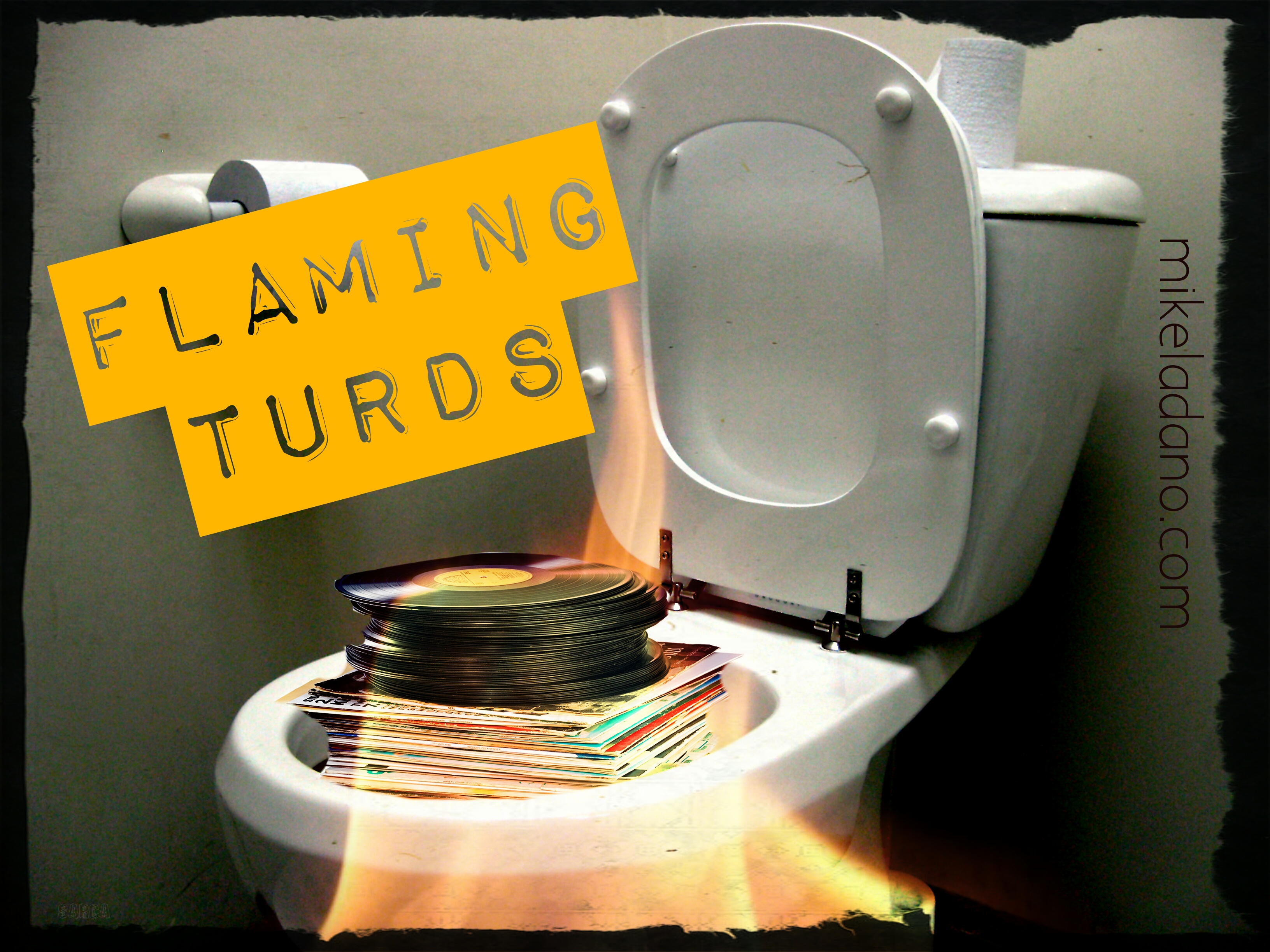
The worst of all songs is “Loch Ness“, a mess so atrocious that we had to devote an entire entry just to that one song.  Combined with its intro “Eulogy”, it’s over 15 minutes of mire that has no reason to exist.  Many people simply stop the album after “Hellrider” and leave this foul turd to rot unheard.  “Loch Ness” could very well be the worst Judas Priest song of all time.  A flaming turd to extinguish all flaming turds.  The worst of all putrid, rancid filler songs ever foisted upon the faithful.  0/5.


“Reunited” DVD

It’s worth getting a copy of this album with the bonus DVD.  For one, there’s a documentary from the Priest Reunited tour.  Secondly, there are seven uncut live songs here for you to enjoy, and it’s the only official video release from the Reunited tour.  The live footage is something to see, especially if you own the robotic Rising in the East DVD.  In that concert, Rob Halford was a stiff mannequin instead of a frontman.  Here, he comfortably in charge and engaged.  The entire lineup is energized.  “Breaking the Law” sees them powered up and working hard.

But how did the seemingly unlikely reunion begin?  According to the documentary, the band and Halford met to discuss the forthcoming Metalogy box set.  Glenn Tipton states that they decided to reunite later the same day.  It was like they’d never been apart.  Terribly British, says Rob.  “Have a cup of tea, see you later.”  Rob does express regret for his actions (reportedly he gave Judas Priest his notice in 1992 by fax), but it seems all was forgiven over time.

Beware which version you buy.  This CD/DVD combo set contains the documentary plus the full live songs:  “Breaking the Law”, “Metal Gods”, “A Touch of Evil”, “Hell Bent for Leather”, “Eletric Eye:”, “Diamonds & Rust”, and “Living After Midnight”.  The DualDisc version does not; it only includes edited fragments of those tracks.  Which is a shame, because the band sounded fantastic and Rob was in full-lunged form.  This is probably the best live version of “A Touch of Evil” available, for example.  Not everyone likes the acoustic version of “Diamonds & Rust”, but it’s certainly different. The only bonus to DualDisc is that you also get the album in “enhanced stereo”.  Avoid that; get this.


Although Angel of Retribution is overall a very strong Judas Priest album, “Loch Ness” is impossible to ignore.  It does serious damage to an album that was otherwise an impressive listen.  In the included DVD, K.K. Downing says they had to pick and choose from an overabundance of songs.  Can you imagine how bad the leftovers are if “Loch Ness” made the album?

3.5/5 stars

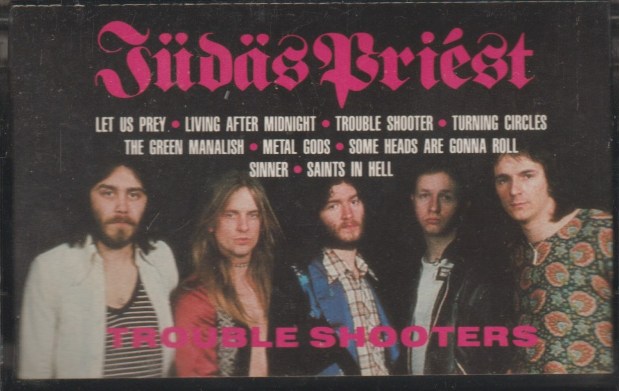
REVIEW: Judas Priest – Trouble Shooters (1989 CBS cassette)

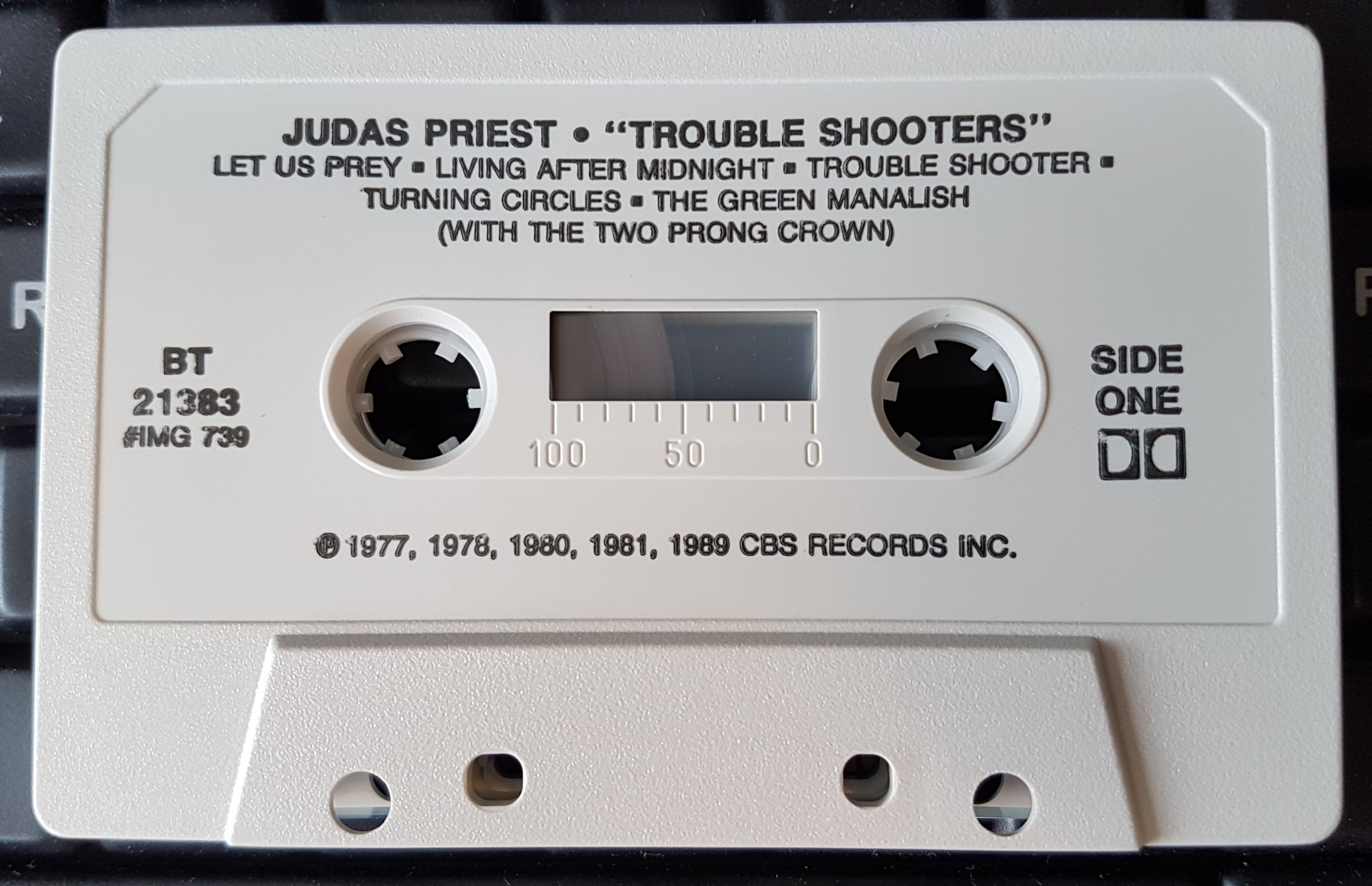
JUDAS PRIEST – Trouble Shooters (1989 CBS cassette)

Readers understand that I’m pretty anti-cassette.  For most of my life, I had shitty equipment and shitty tapes so my memories of fiddling with tapes are not happy ones.  You do tend to find oddities on cassette that don’t exist on any other media, which is one reason I’ll always need a tape deck.

Here’s one from my personal collection that I bought in early 1990.

Bob Schipper knew my favourite band in 1989/1990 was the mighty Priest.  He told me of a cassette I didn’t have called Trouble Shooters.  The one detail I can’t recall is what store he saw it in, but I gave him some money and he got me the tape.

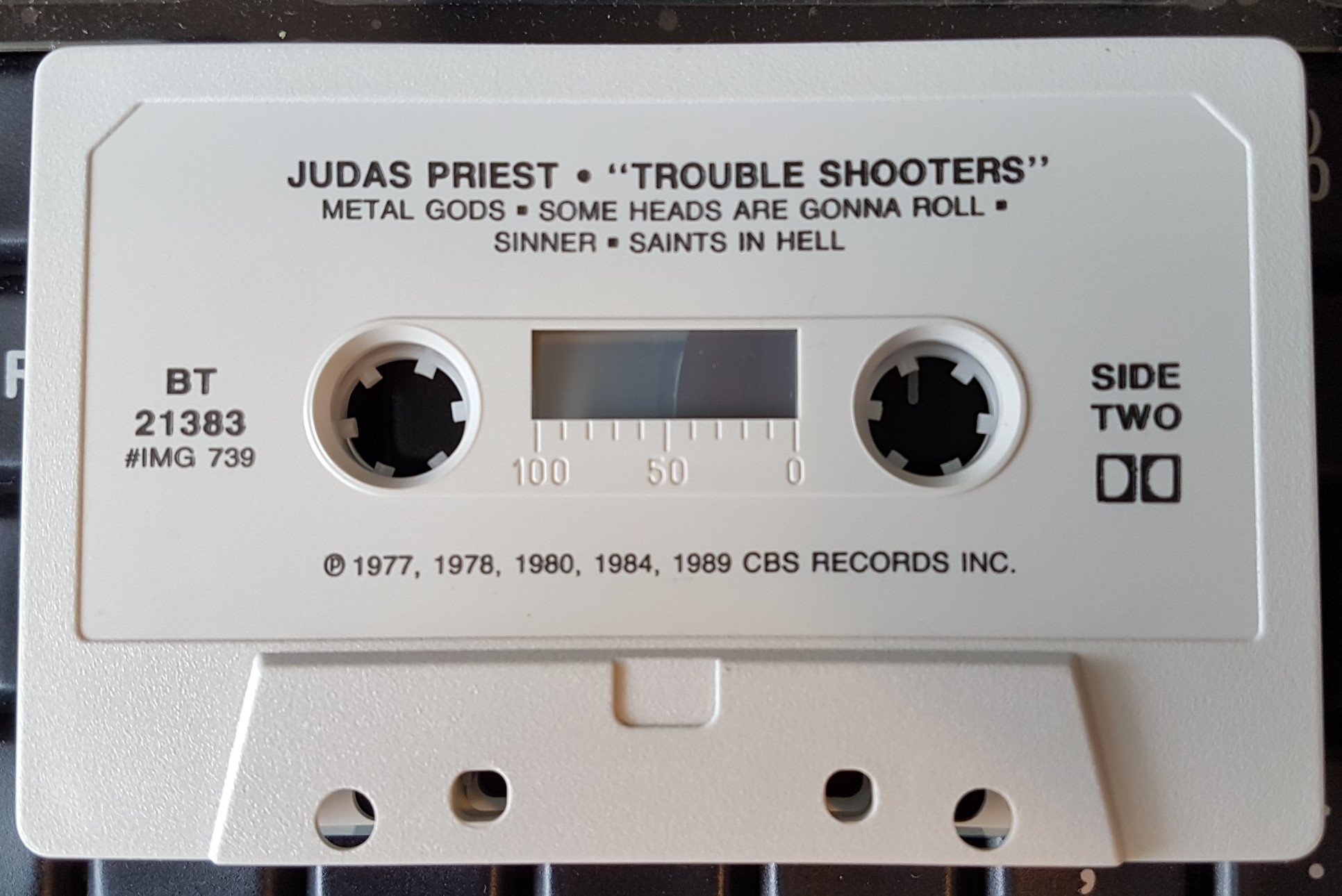
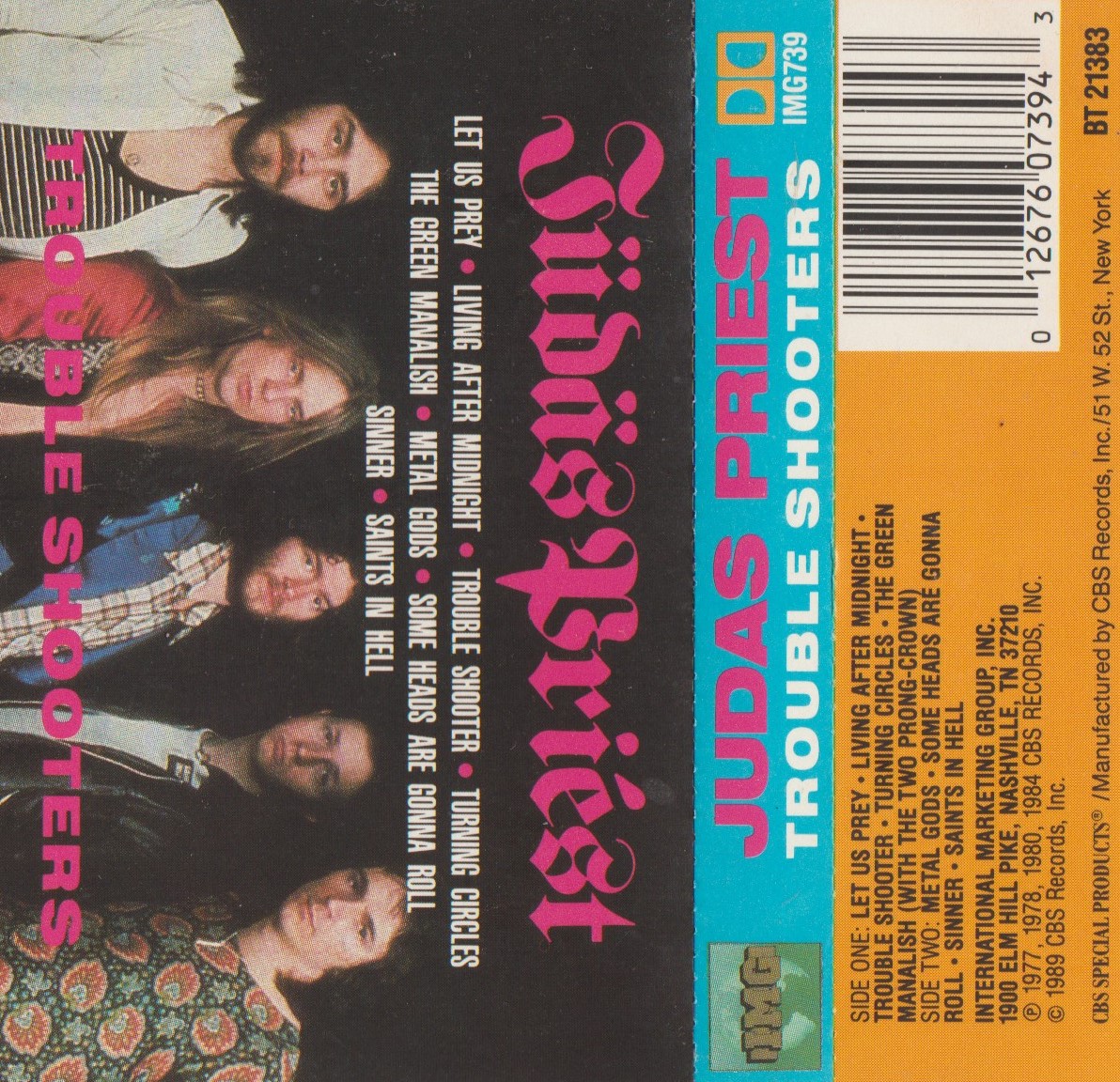
I was disappointed that it was a cheap tape with nothing on the inlay, but I now had a Priest tape I didn’t own before.  I spied the release date:  1989.  It looked odd sitting in my tape cases filed as the “newest” Judas Priest release, with Les Binks on the front cover.  Trouble Shooters was in fact a bargain bin compilation made up of songs from Sin After Sin, Stained Class, Hell Bent for Leather, Point of Entry, British Steel, and Defenders of the Faith.  Another thing that looked strange:  the uber-metal Priest logo on the front.  Turning it up to 11, it’s rendered as the insane-o looking Jüdäs Priést.

The running order on these tapes is usually pretty random, but side one of Trouble Shooters goes down really well.  “Let Us Prey/Call For the Priest” is a pretty cool way to open a tape, with that low hum of instruments before the regal guitarmonies enter.  (Note that the second part of the title isn’t printed anywhere.)  “Let Us Prey” is suited to commence a Priest tape that is heavier than the average.  Its proto-thrash pacing represents Judas Priest at an early peak.  Then, sensibly, Trouble Shooters gets the “hit single” out of the way early, in this case “Living After Midnight”.  Casual music buyers picked up these tapes in discount bins, so you have to put on the hit early; the second slot working best.

I appreciated that they included two songs from Point of Entry as that has always been a personal favourite.  The title track is parsed wrong as “Trouble Shooters” when it should be all one word.  Still a good song, with Priest taking a simple sassy 4/4 time stance.  “Turning Circles” from the same album is lesser known but possesses a slower groove that works just as well as the fast ones.  The secret seems to be Rob Halford, who twists and turns every word for maximum expression.

Side One is granted an epic quality thanks to “The Green Manalishi”, my favourite Priest song of all time and certainly a crowd pleaser too.  (Yeah, yeah, I know it’s a Fleetwood Mac cover.)  You just can’t find a better closer for a Side One anywhere else in the Priest canon.

Continuing the excellent sequencing is a song heralding the arrivals of “Metal Gods” on Side Two.  Then “Some Heads Are Gonna Roll”, the most recent song from 1984’s Defenders of the Faith.  Nothing from Turbo or Ram It Down.  I wonder if there were rules about what could and couldn’t go on these budget compilations.  Maybe they were limited to music five years old or more.  Back to the tape, “Some Heads” follows a similar sonic mood as “Metal Gods”, though the production is less sleek and more muddled.  It’s still apocalyptic metal for breakfast.

Finally it’s back to the start with a couple epics from the early days.  For me, I think I would have ended the tape on “Sinner”, but it comes before “Saints In Hell” here.  Much like “Let Us Prey” on Side One, these songs show off the early savage side of Judas Priest, ripping meat from the bone raw and ugly.  It’s barbaric metal with sharply precise moves.

I don’t know why I hung on to this tape when so many of them ended up in a Thunder Bay landfill.  I’m glad I did:  this was a fun cassette to review.

3.5/5 stars


REVIEW: Judas Priest – Firepower (2018)

JUDAS PRIEST – Firepower (2018 Sony)

It’s 2018 and the Priest is back.  The excitement for the mighty metal band’s return has been restrained by the knowledge that Glenn Tipton is too ill to tour.  Parkinson’s disease — what a bastard that is.  Co-producer Andy Sneap has stepped up to take over Glenn’s guitar parts on tour.

Meanwhile on album, Glenn’s contributions to Firepower can be heard.  Sneap and classic Priest producer Tom Allom recorded one of the most biting Priest albums to date.  More impressive than the sound they captured are the performances.  Rob Halford in particular is more expressive than he has been in years.

At 14 tracks and almost an hour, Firepower suffers only from too many tracks.  There are a couple that clearly could have been cut and left for B-sides or bonus tracks.  “Flame Thrower” (similar to “Hot For Love” from Turbo), though a cool title, would have been great on a B-side.  On album, I’d rather race ahead to some of the more exciting tracks.

Firepower throws it back to sounds of the past.  Sometimes it’s Painkiller, and sometimes Angel of Retribution.  Rock writer Heavy Metal Overload noticed sonic similarities to Halford’s Resurrection CD.   At other times it’s brand new, because guitarist Richie Faulkner brings new things to the table, such as slide.

There are many highlights among the 14 tracks.  “Evil Never Dies” and “Never the Heroes” both immediately jump out for their melodic mastery.  Rob is sounding better than he has on the last couple, with a few tasty screams to enjoy.  As time goes on, new favourites will replace old.  Perhaps it’ll be “Spectre”, “No Surrender”,  “Children of the Sun”, “Rising From the Ruins” or even “Flame Thrower”!  Another highlight:  mellow album closer “Sea of Red” which bears lyrical similarities to “Blood Red Skies” from 1988’s Ram It Down.  In general, Firepower is about fighting back.

The cover art by Claudio Bergamin is Priest’s new mascot, “Titanicus”.  Silly name aside, this one Priest’s best album cover in decades.  (Mark Wilkinson continues to contribute to the packaging art as well.)  Notice how Bergamin’s lines match up with the style of past Priest albums like Screaming for Vengeance.

It’s hard to imagine a better album this late in their career.  Priest have done it again.  Firepower lives up to its name.

4.5/5 stars


JUDAS PRIEST REVIEWS


REVIEW: Judas Priest – ’98 Live Meltdown (1998)

JUDAS PRIEST – ’98 Live Meltdown (1998 BMG)

First in a long line of non-essential Priest live albums, here’s ’98 Live Meltdown.  Why did bands at certain points feel the need to add the year to the title?  Warrant – ’96 Belly to Belly – Volume One.  Kind of silly, right?  For fans who know their metal history, 1998 falls in Judas Priest’s Ripper Owens years.  Priest had just released their first album without Rob Halford, Jugulator.  Live Meltdown (let’s leave out that ’98 part for simplicity’s sake) captures the tour that followed, from various uncredited dates.

Fortunately the album is better than its title and awful cover art.  (Shame on you Mark Wilkinson!)  Ripper Owens provided fresh young lungs and with him at the mic, Priest were uber-powerful live.  All the new tunes from Jugulator were better in the live setting too.  “Blood Stained” is devastatingly powerful, and an enthusiastic crowd eats it up.  There are a few extraneous Jugulator tunes.  The world could have lived without “Death Row” and “Abductors”, and maybe the title track could have been thrown in instead.  Fortunately the track list is an otherwise excellent mix of new tracks and old cuts.

Priest deserve points for re-imaging their Joan Baez cover “Diamonds and Rust”.  The acoustic version was completely new for Judas Priest and Ripper could easily handle the heavy and the light.  Even though it’s acoustic, “Diamonds and Rust” represents Sin After Sin on a CD that gives face time to nearly every Priest album.   Rocka Rolla and Ram It Down are shunned as usual, but otherwise the only albums without tracks on this are Turbo and Point of Entry.  There is an emphasis on the classic material from the 70s, solid songs from the early 80s, and four tracks from Painkiller.  It’s a well-rounded album, and by the next live release (2003’s Live in London) they changed it up and added “Turbo” and “Heading Out to the Highway”.

Ripper was a great lead singer for this band during Rob’s absence.  He took one of the hardest jobs in rock and roll and did it with class.  Ripper had the goods.  He could scream the notes.  He added his own slant with guttural growls.  He struggled with “Painkiller” proving he’s a mere mortal but still he got the job done.

Live Meltdown was self-produced by Priest and Sean Lynch, but the guitars are too low in the mix.  The emphasis is on Ripper, but it seems to come at the expense of the volume of the rhythm guitars.  And the packaging is atrocious.  While it is true that most metal bands like Priest found themselves on smaller record labels, this is worse than a 90s indy band.  Fortunately the music and performance justify its existence.

Curious fans are advised to pick up Live Meltdown for the best representation of the Ripper Owens years.  It’s better than Jugulator and Live in London.  Fans are unanimously happy that Rob Halford is back in Judas Priest today, but that shouldn’t be taken as a slight against Ripper.

3.5/5 stars

REVIEW: Judas Priest – Hero, Hero (1981)

JUDAS PRIEST – Hero, Hero (1981 Gull)

It’s true:  By all measurements, Hero, Hero is an exploitive compilation of Judas Priest material.  Their first record label, Gull, was prone to do this.  However this is no typical “hits” set; this one is of interest to collectors and die hard fans.

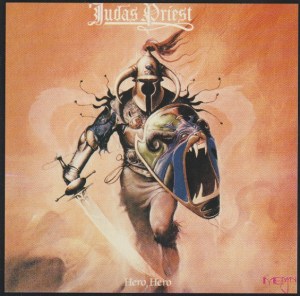
Hero, Hero (named for a lyric from the song “Dying to Meet You”) was originally released in 1981 to take advantage of Priest’s rising star. The original two releases on Gull records, Rocka Rolla and Sad Wings Of Destiny, had been exploited previously in a compilation called The Best Of Judas Priest, which was a single record. Hero, Hero was a double record which included all of Rocka Rolla and most of Sad Wings, as well as the crucial Joan Baez cover, “Diamonds and Rust”, in an alternate take (previously heard on Best Of).

So, if you have all that material already, why is this album required at all?  Cover art aside, of course.  That cover (a pre-existing painting) is brilliant.  There is also a Kiss bootleg called Barbarize with the same cover.

The reason is revealed in the liner notes. All of Rocka Rolla had been remixed for this release. Why is unknown, as that record sounded just fine for what it is. The remixes are, in general, not even all that different. The major changes are made during “Cheater”, the “Winter” suite, and “Rocka Rolla” itself, during which major portions of the songs are noticeably shifted around. “Rocka Rolla” has its verses rearranged, and there’s a burst of harmonica in “Cheater” where there never was before.

The remix done to Rocka Rolla doesn’t really add or subtract anything from the album, which makes it that much harder to understand why it was done.  Why Gull records spent the money to remix these tracks is unknown, and the names of the engineers involved are a mystery.  But there it is:  Rocka Rolla remixed in its entirety but not in order, here on the Hero, Hero album.  Because they’re less familiar to the ear, they sound fresh, but in many cases you’d struggle to point out differences.  A little reverb here, a little echo there.

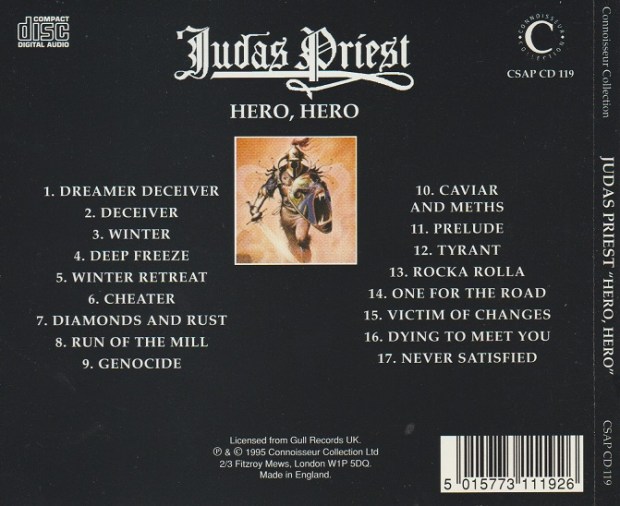
Highlights including a bluesy “Cheater” and the flanged chug of “Diamonds and Rust”.  The six tracks from Sad Wings of Destiny are brilliant.  “Dreamer Deceiver” and “Deceiver” are used to open this CD, but that is not the original running order.  Normally the album begins with “Prelude” and “Tyrant”, also from Sad Wings.  The original Canadian cassette version on Attic maintained the original running order with “Prelude” at the start.  Essentially, the Connoisseur Collection CD has side one and side two flipped.

Fair warning to CD buyers:  There are some shoddy reissues of this album that don’t have the remixed tracks.  Transluxe is one such version.  To make your life easier you might just want to look for an original 1981 LP.  The pictured CD from Connoisseur Collection (1995) does have the remixes, so you’re good to go if you spot one.

3/5 stars


REVIEW: Judas Priest – Ram It Down (Remastered)

JUDAS PRIEST – Ram It Down (Originally 1988, 2001 Sony remaster)

Judas Priest seemed pretty lost in the late 80s.  They were bigger than ever, but they lost focus of their musical direction.  Producer Tom Allom had cursed them with a robotic plod, far removed from the lively firepower of yesteryear.  When they released Turbo in 1986, they had gone as far down those roads as possible.  It was am ambitious departure, but 100% a product of the 1980s.

For Turbo, Priest had written enough songs for a double album.  Twin Turbos, as it was to be called, was supposed to reflect all facets of metal, but the record comany got cold feet and a single disc was issued.  It contained the most techno-commercial tracks, while Priest held onto the rest for another day.  That day came in 1988 when Priest (again with producer Tom Allom) released Ram It Down, largely made up of Turbo outtakes.  The album was hyped as a return to the heavy Priest of yore, and this was at least partly true, but fans were unconvinced by it.  In comparison with Turbo, yes, Ram It Down was heavier.  But Priest had gone as far as they could with Allom.  Ram It Down was too sterile and bogged down with filler.

Certainly the title track opens Ram It Down on a thrash-like note.  As if to silence to critics, it was a proud metal statement with an opening Rob Halford scream that curdles the brain.  The weakness is drummer Dave Holland on his final Priest outing.  Only when Scott Travis joined Priest in 1990 did they acquire a drummer who could play the kind of beats at the speed they needed.  On Ram It Down, Priest were held back by the drummer and clunky production, two mistakes they fixed on 1990’s Painkiller.  The lyrics also seem dumbed-down for the 80s.  “Thousands of cars, and a million guitars, screaming with power in the air,” is cool but cliche.

“Heavy Metal” is more of the same lyrically, an ode to the power and glory of power chords.  Rob Halford’s performance is fantastic, and the man has rarely sounded as fantastic as he does on Ram It Down.  You can’t say the same for the words, the highschool equivalent of poetry.  On the music front, Priest were now following rather than leading.  They were on the same clunky metal trip as bands such as Scorpions at the same time.  There audible Kiss and Whitesnake influences on the album, with Rob sometimes sounding like he was trying to write a Gene Simmons tune.  “Love You to Death” on side two sounds right out of the Demon’s closet.  The embarrassingly terrible  “Love Zone” and “Come and Get It” both sound as if Coverdale co-wrote them on the sly.  Whether Priest were consciously copying other bands or just lost, who knows.  (“Love Zone” is one of the few songs that Halford almost seemed to write gender specific.  “With your razor nails and painted smile” are not specifically referring to a female, but certainly that was the general assumption.)

There are definitely a few cool tracks that deserve mention.  The first is “Hard as Iron” which had to be one of the fastest Priest songs to date.  It’s still held back by the production, but has some serious energy to it.  Like metal espresso injected right into the brain!  The other standout is “Blood Red Skies”, a forgotten highlight of this album and indeed of the Priest catalog in general.  (I actually used “Blood Red Skies” in a poetry project for school.  A girl liked it so much she asked for a copy of the lyrics.)  Using the synth effectively, “Blood Red Skies” paints a Terminator-like future with humans hunted by beings with “pneumatic fingers”, “laser eyes” and “computer sights”.  Halford  pours power and anguish into it, as a human freedom fighter.  “As I die, a legend will be born!”  Cheesey?  Absolutely.  Priest perfection?  Yes indeed!

There are also two mis-steps on Ram It Down that must be addressed.  The first and most obvious is “Johnny B. Goode”, from the 1988 movie Johnny Be Good starring Anthony Michael Hall and some guy named Robert Downey Something.  This track should have been kept off the album.  As a novelty single, sure, you can dig it.  It’s a stereotypical cliche-ridden metal cover, and that’s fun for a goof.  As a Priest album track, it only serves to completely destroy any momentum that Ram It Down managed to build.  Then there is “Monsters of Rock”.  This awful excuse for a song is only 5:31 long, but seems twice that.  It is the prototype for the even more awful “Loch Ness” from Angel of Retribution.  Most buyers probably didn’t finish listening to the album because of this bloated and aimless track.

The Priest Re-masters collection had two bonus tracks per studio album.  Ram It Down provides two completely unrelated but great tracks:  live versions of “Bloodstone” and “Night Comes Down”.  The liner notes don’t state when they were recorded, but live versions of either are always welcome in any Priest collection.  It’s interesting that bonus tracks from these actual sessions, such as “Red, White and Blue”, were used on other CDs but not Ram It Down.

Priest may have known Ram It Down wasn’t the metal album they hoped to make.  They cleared house afterwards.  Dave Holland and Tom Allom were done, and there is no question that Painkiller was superior to Ram It Down because of that.

2/5 stars