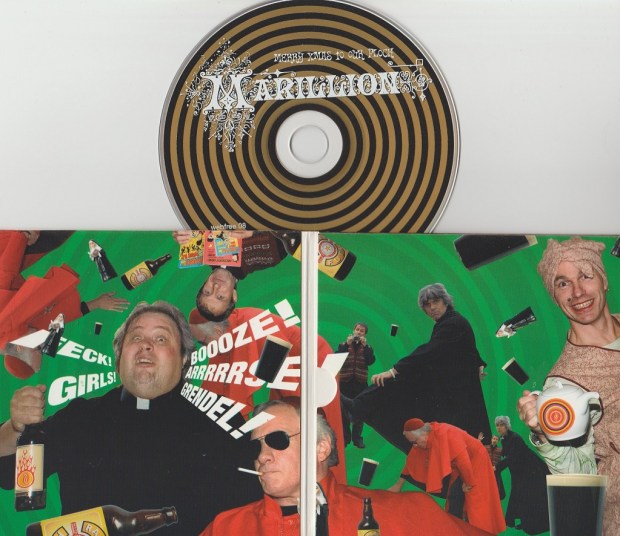
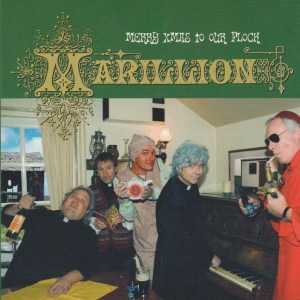
Every year, like the most reliable loyalty program in the world, Marillion reward their fanclub members with a special Christmas release. Each one has exclusive music on it, some more Christmas-y than others. The main exclusive on the 2005 Christmas release is a live set by “Los Trios Marillos”: a stripped down trio version of the band. Los Trios does acoustic versions, usually for radio sessions, and consists of singer Steve Hogarth, guitarist Steve Rothery, and bassist Pete Trewavas. These 13 tracks were recorded in Washington DC for XM radio, featuring a wonderful cross-section of Hogarth-era favourites.
That’s not all, of course! Marillion deliver their traditional Christmas message at the start of the CD, campy and tipsy. Bonus points if you’re from North America but can still translate everything the band says. It takes them a few takes to finally get it to their, err, satisfaction. “We hope you have a really good Christmas, don’t get too drunk, and we’ll see you next year.” Then, “That’s not written down at all!” Usually these albums include a brand new studio Christmas track too, and this time it’s the celtic “Erin Marbles”. It’s a hyperactive Irish jig with mandolin, tin whistle, squeezebox, fiddles and bodhran. Calling this a Christmas track is a bit of a stretch, as it is basically the song “Marbles” from the same-titled album done up for fun, mixed with a medley of Christmas tunes. There is no question it’s fun for the fans, but nobody except fans will “get it”, so it’s not really useful for mom’s Christmas mix CD this year.
The Los Trios set commences with the downer “Hollow Man” which is an abrupt change of moods. The was recorded live with an audience, but they are so quiet during “Hollow Man” you could hear a pin drop, which makes the song that much more haunting. It is performed solo by Hogarth only accompanied by piano. “It’s a little early in the morning to be singing,” says Steve. Fortunately things become upbeat if only for a little while on “Cover My Eyes”, a song that is brilliant acoustically. If you have heard Marillion’s piano treatment of this single, then you will recognize this arrangement. It might have been too early to sing that morning, but Steve manages just fine, including the high “pain and heaven” section that challenges every mere mortal. Rothers and Pete join Hogarth at this point for the B-side “The Bell in the Sea”, which Steve mis-introduces having lost his place in the set list! It’s live radio, folks. This is the jazzy bass-oriented acoustic version that the band had been performing since at least 1998, very different from the nautical epic original. They then return to the song that H was beginning to introduce, “Runaway” from Brave. It was the song that kickstarted the whole concept of the album. It is a dark and emotional band and fan favourite, but stripped down to a trio format, it is even more delicate.
The first of four songs from the most-recent Marbles is the dancey hit “You’re Gone”. Acoustically it is a different animal, but just as beautiful. The focus isn’t on the beats but on the melody. Another song that is completely altered is “Dry Land” from Holidays in Eden. It is slowed down with a gentle electronic pulse as it rolls softly. “Fantastic Place” from Marbles flows naturally from there, and Rothery’s solo is absolutely supernatural. The set really moves at this point, with minimal talking. “This is the 21st Century” from Anoraknophobia burns quietly but strongly. On album it percolates with unusual electronic effects, but live it simmers with the hot tone of Steve’s guitar.
“Easter” is a bright light in the set. This version starts very quiet, slow and understated. It’s an inventive take, and it slowly builds to the resemble the original, though it ends early. “Marbles 1” and “Don’t Hurt Yourself” are the last of the new songs presented, and the audience get right into it. “Don’t Hurt Yourself” has to be one of the best songs Marillion has ever written, and the clapping crowd energizes it. “Don’t Hurt Yourself” was one of many highlights on Marbles, but here it is head and shoulders the winning track. A wonderful performance of an exceptional track.
Old favourites end the radio session: “Answering Machine” (from Radiat10n) and “Man of a Thousand Faces” (from This Strange Engine). “Answering Machine” should be very familiar, as this acoustic mandolin and guitar arrangement has been recorded many times before. The handclapping crowd returns to finish “Man of a Thousand Faces” with class. This song has always been acoustic, so this does not tread far from its roots, though it is shortened for the trio format.
You can’t buy this CD anymore and the chances of stumbling upon one in the shops are nil, however you can still download it by joining the official Marillion webUK fan club. It is well worth it. You get three thick, glossy full colour magazines, this year’s Christmas CD, and access to download all the old ones and much more. Worth thinking about, or adding to this year’s Christmas list.
Dedicated to my dear friend Uncle Meat. This CD was purchased off Joe “Big Nose” at the Waterloo branch of the Record Store at which I used to work.
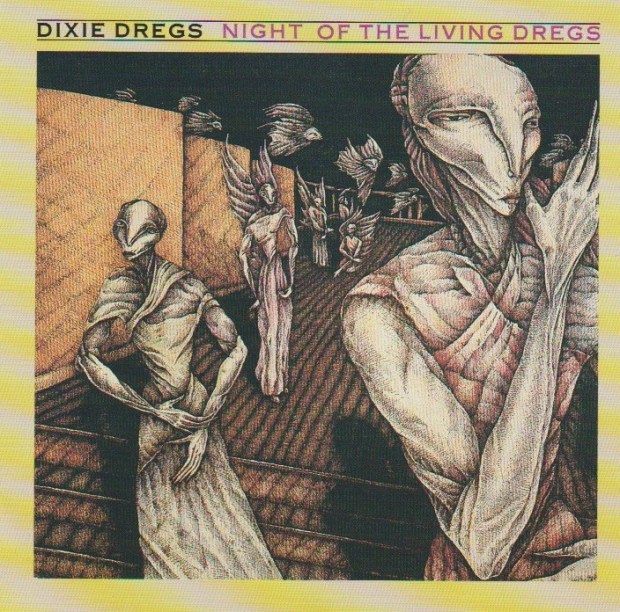
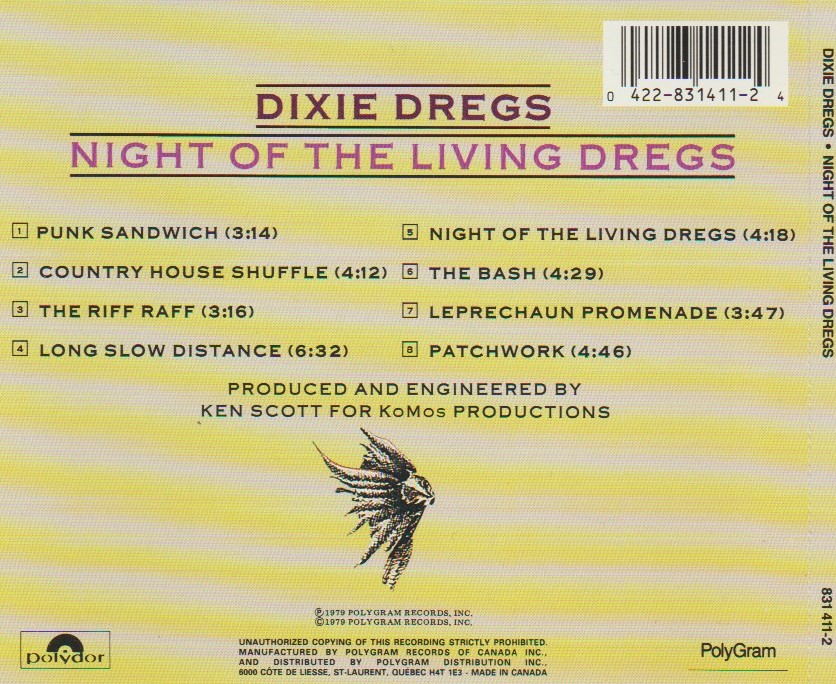
DIXIE DREGS – Night of the Living Dregs (1979 Polydor)
If they could bottle genius, distill it down to its essence, sell it and serve it at a party…then the Dixie Dregs are the music that should be played at that party.
The Dregs are undefinable. Just when you think you have them nailed down to a progressive jazz-rock hybrid, they go classical on you, or full-bluegrass mode. Their instrumental chops are incomparable, while still managing to deliver such basic song pleasures such as “melody”, “hooks” and “grooves”. These melodies are usually delivered at the hands of Steve Morse (guitar) or Allen Sloan (violin). Listeners familiar with with the guitar stylings of Morse will have an idea of the kind of songs and arrangements he writes: challenging, but rewarding.
Night of the Living Dregs is half studio, half live. The first side, from the cleverly-titled “Punk Sandwich” to the ballad “Long Slow Distance” are carefully crafted studio recordings, each different from the last. While each track is unique and showcases different sides of the band, it is “Long Slow Distance” that really shines. This soft work captures so much of what Morse does well. There are jazzy licks embedded within melodies, and so many different textures of guitar.
The live side is recorded nice and clean without a lot of crowd noise. “Night of the Living Dregs” is an upbeat little number, featuring some absolutely jaw-dropping melodic bass playing from Andy West. This is also where drummer extraordinaire Rod Morgenstein comes up to the plate. His playing is so multifaceted and you can hear it on this track. The most fun can be found on “The Bash”, a full-on bluegrass ho-down, chicken-pickin’ full steam ahead. Any jaws left on the floor are hopefully picked up so they don’t miss “Leprechaun Promenade”. There are celtic flavours thanks to the violin, and the song is comparable to Jethro Tull. Then suddenly it turns into Frankenstein’s monster with some eerie keyboards (Mark Parrish). This is complex stuff, not for the timid!
The whole experience ends on “Patchwork”, which works as a description of the album at large. It is a patchwork of style and feels, which create the whole. The Dixie Dregs are a challenging listen, but ultimately rewarding. There is plenty of joy in the grooves. The band does not play anything simple or easy. Everything is a little bit of smarty-pants music, but for the listening, this is a delight.
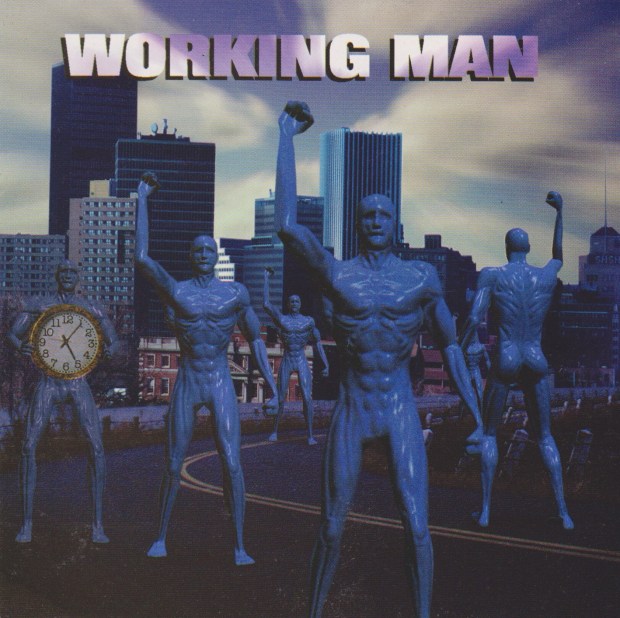
This CD was released in 1996, and almost immediately the music press started reporting that Rush were trying to have it taken off the shelves. One of our former owners at the Record Store, the infamous Tom, said: “I can see why they were trying to do that. Because it’s too fucking good.”
It actually is. There are few tribute albums worth listening to all the way through. How many can you name: Encomium, the Zeppelin tribute? The Sabbath tributes Nativity in Black? Do you listen to those front to back? That’s the best and only way to enjoy Working Man. So numerous are the progressive rock and hard rock names here that we may have trouble keeping track of them all.
Sebastian Bach hails from the Great White North, so it is only appropriate for him to open this CD with the title track. He also passionately stuns on “Jacob’s Ladder” a bit later on, utilising the power and range he is known for. What names on these songs! Mike Portnoy and Billy Sheehan play drums and bass respectively; two guys often cited as the best in the world on their instruments! If that wasn’t enough, ex-Ozzy guitarist Jake E. Lee shreds the hell out of “Working Man” while John Petrucci from Dream Theater goes for the throat on “Jacob’s”. Take a minute to absorb all that.
Seamlessly, “Working Man” develops into “By-Tor and the Snow Dog” with James LaBrie of Dream Theater in peak voice. Sheehan and Portnoy handle the rhythm for most of the album, so you can be assured that the chops of Mr. Lee and Mr. Peart are served well here by the next generation of players. Dream Theater fans will lose their shit completely. But there is so much more here than just progressive rockers letting it fly. A youthful and impressive Jack Russell from Great White takes on the galloping “Analog Kid” from Signals and wins. Have no fear or doubts: this may seem strange, but Russell’s version of “Analog Kid” may well be one of the best Rush covers you’ll ever hear. (Especially when Billy Sheehan and guitarist Michael Romeo do a synched-up dual bass/guitar solo!)
Other highlights:
The late Mike Baker of Shadow Gallery has no problems with “The Trees”, an excellent version.
Steve Morse (Deep Purple, Dixie Dregs, Flying Colors) takes the main guitar part for “La Villa Strangiato”, causing spontaneous head explosions.
Blue-eyed soul singer Eric Martin (Mr. Big) does a fine job of the light “Mission”, though it sounds very different from the shred-rock elsewhere.
A bang-on “Closer to the Heart” performed by Fates Warning is a must-have for fans.
James LaBrie and his old bandmate in Winter Rose, Rich Chycki, reunite on the classic “Red Barchetta”. A little added Can-Con for rock fans.
And best of all, Devin Townsend screaming his balls off, all over “Natural Science”. Without a doubt, Townsend has the most unorthodox interpretation, but it’s Devin Townsend, so you must expect the unexpected. This guy is an underrated national treasure, and along with James Murphy (Death, Testament) on guitar, Stu Hamm on bass, and Deen Castronovo on drums, all walls are shattered. “Natural Science” is undoubtedly the most different track here, and consequently it’s the most exciting.
The only mis-fire:
“Anthem”, with Mark Slaughter and George Lynch. Slaughter’s voice is too shrill. (I cannot handle when he shrieks “Come on! Yeah!” at the start.) George’s Eastern-flavoured shredding is also overdone and misplaced.
That means out of 13 tracks, 12 of them are keepers.
For an added layer of authenticity, the CD was mixed by Terry Brown himself, in Toronto. Prices fluctuate wildly, but fans of Rush, Dream Theater, Sebastian Bach or Devin Townsend would be wise to pick this up if found in their travels.
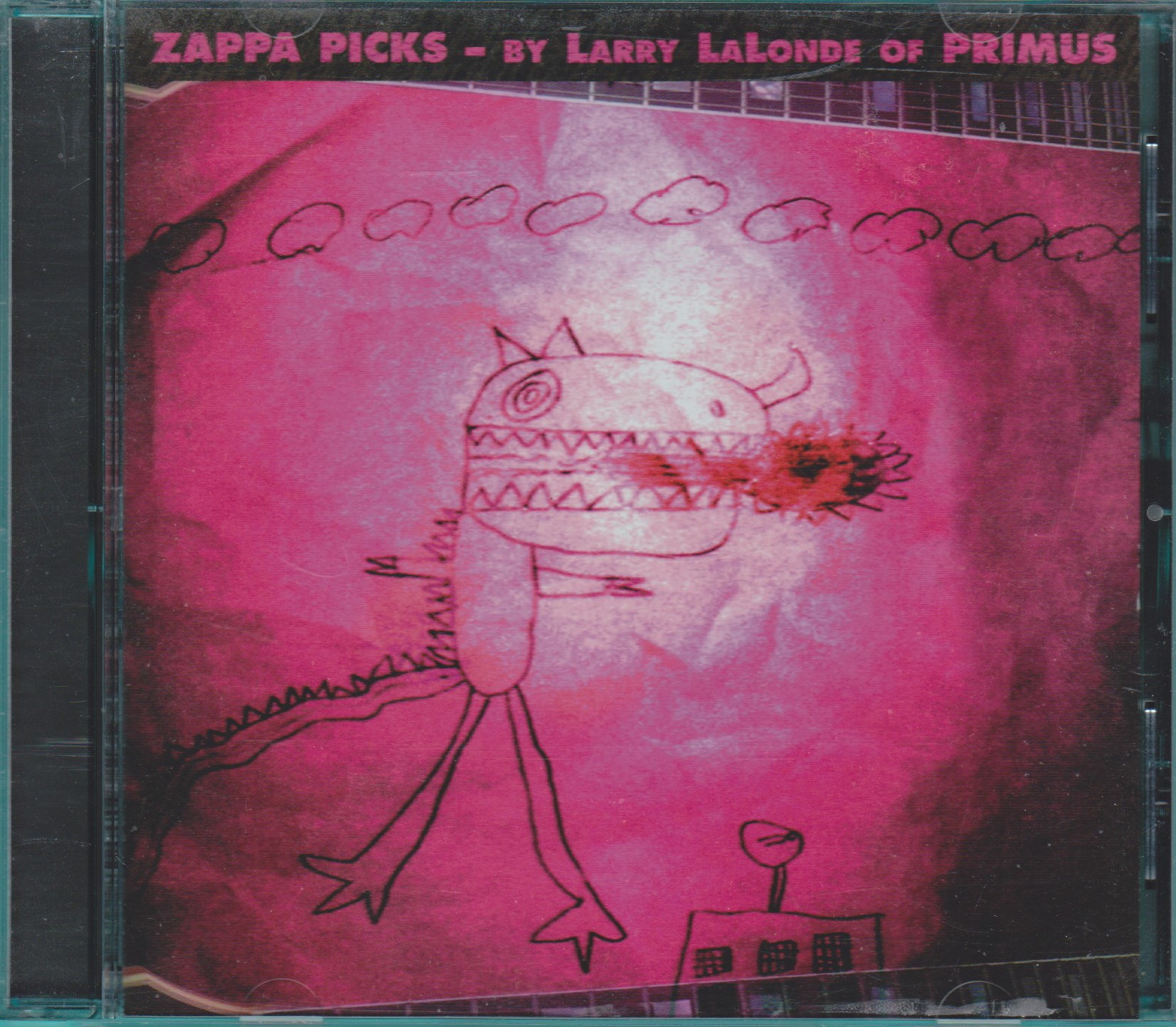
FRANK ZAPPA – Zappa Picks – by Larry LaLonde of Primus (2002 Rykodisc)
This was a cool idea for a series. I love the concept. Big name fans of Zappa compiling their own Zappa disc. I only know of one other disc — a Zappa Picks by Jon Fishman of Phish. I prefer Primus to Phish, so getting Larry LaLonde’s instalment of Zappa Picks seemed like a good idea. LaLonde assembled an eminently listenable, endlessly entertaining and humorous Zappa album. And of course the playing is still stunning, because it’s Zappa.
What I like about this album is that you get a lot of great and challenging tunes that aren’t on the Simply Commercial hits album. In fact I think there’s only one song that appears on both! The CD is sequenced in such a way that it sounds like an actual album in terms of flow. Songs merge into each other seamlessly and the pacing is perfect. I’m discovering a lot of music I missed, because I simply don’t have all the Zappa albums. Who does?
This is spacey fun. It’s guitar nirvana. It’s percussive. There is a wealth of material both instrumental and vocal. It’s weird all the way to the edges of comprehension. It stretches every genre you can think of. It’s anything but boring.
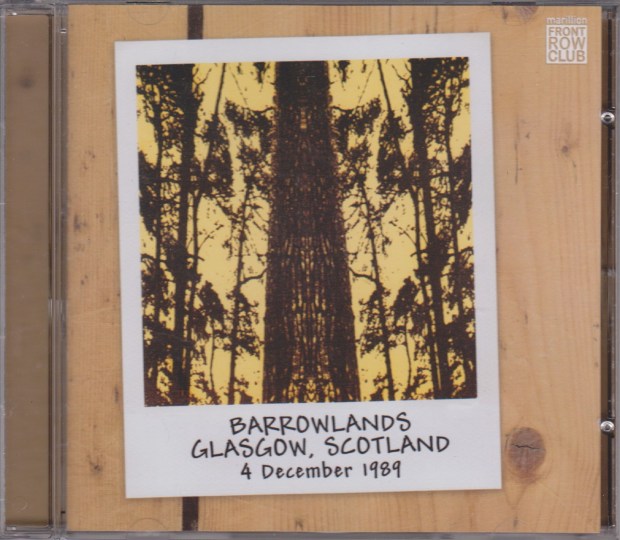
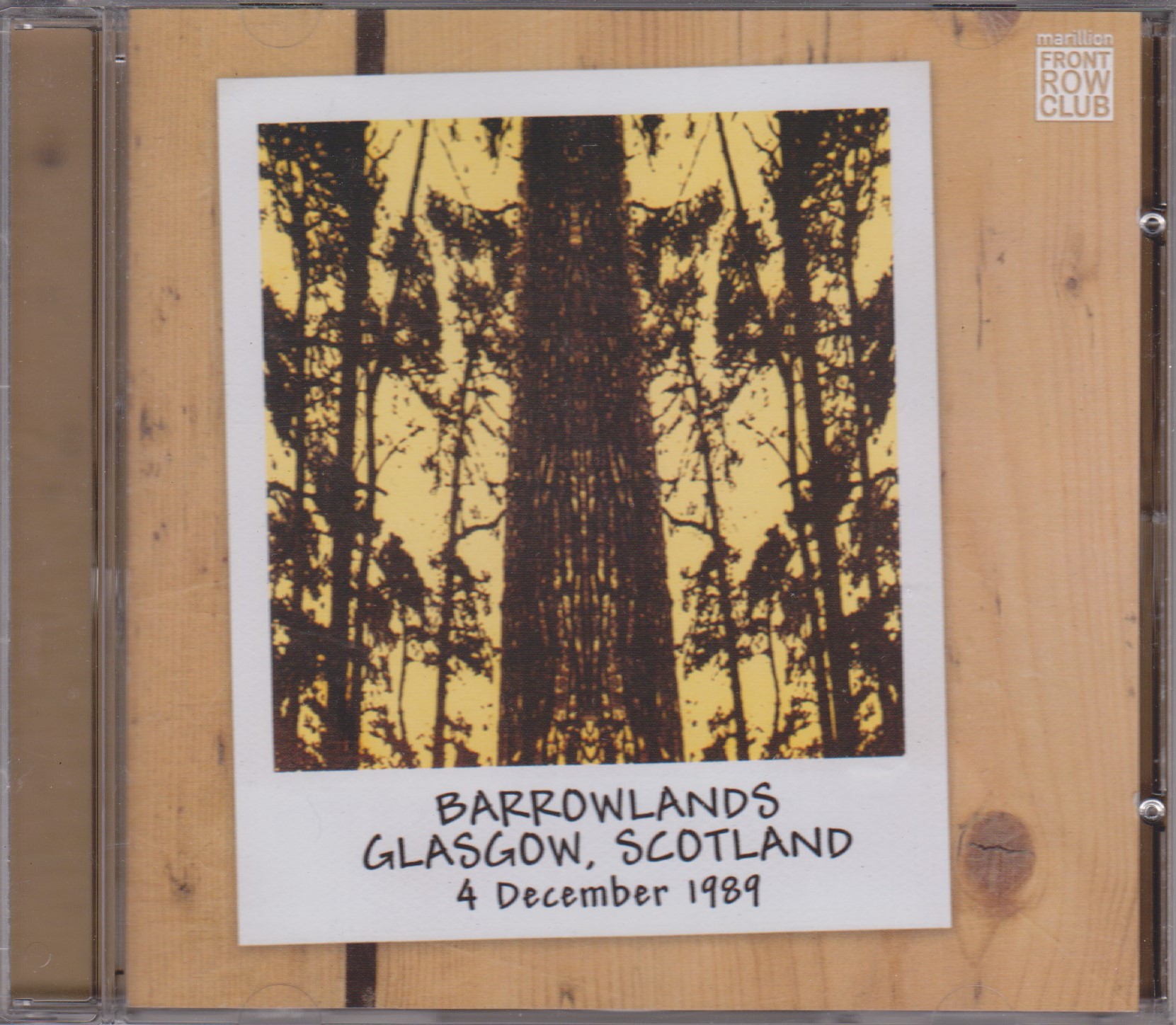
Marillion have always been an innovative band, not just musically, but also the ways they interact with their fans. In 1992, they started offering mail-order exclusive live albums to the diehards. The first one, Live in at the Borderline sold out quickly. Live in Caracas took a few years to sell out; I have an original copy of that one. The third, Live in Glasgow, also sold out quickly. Today I own a remastered and reissued version, Barrowlands, Glasgow, Scotland, released in 2002 as part of Marillion’s Front Row Club.
The Front Row Club was a subscription service. Sign up for a year, and Marillion would mail you a live album every two months. Some were single discs, like Barrowlands, and some were doubles. They were sourced from all parts of Marillion’s history. Subscribers could choose to opt out of releases they didn’t want, for example I didn’t need a second copy of Caracas. There were 43 Front Row Club releases in total, and I have them all (excepting the optional Caracas). (For a review of FRC-006: River, click here.)
In 1989, Marillion were showing off the new guy, Steve “H” Hogarth on vocals, guitars and keyboards. If they were to get a cold reception, Scotland would have been the place. After all, former singer Fish was a proud Scot, and replacing a singer is always dicey. Fortunately for Marillion, fans embraced Steve H very much, and the Barrowlands show is evidence of that.
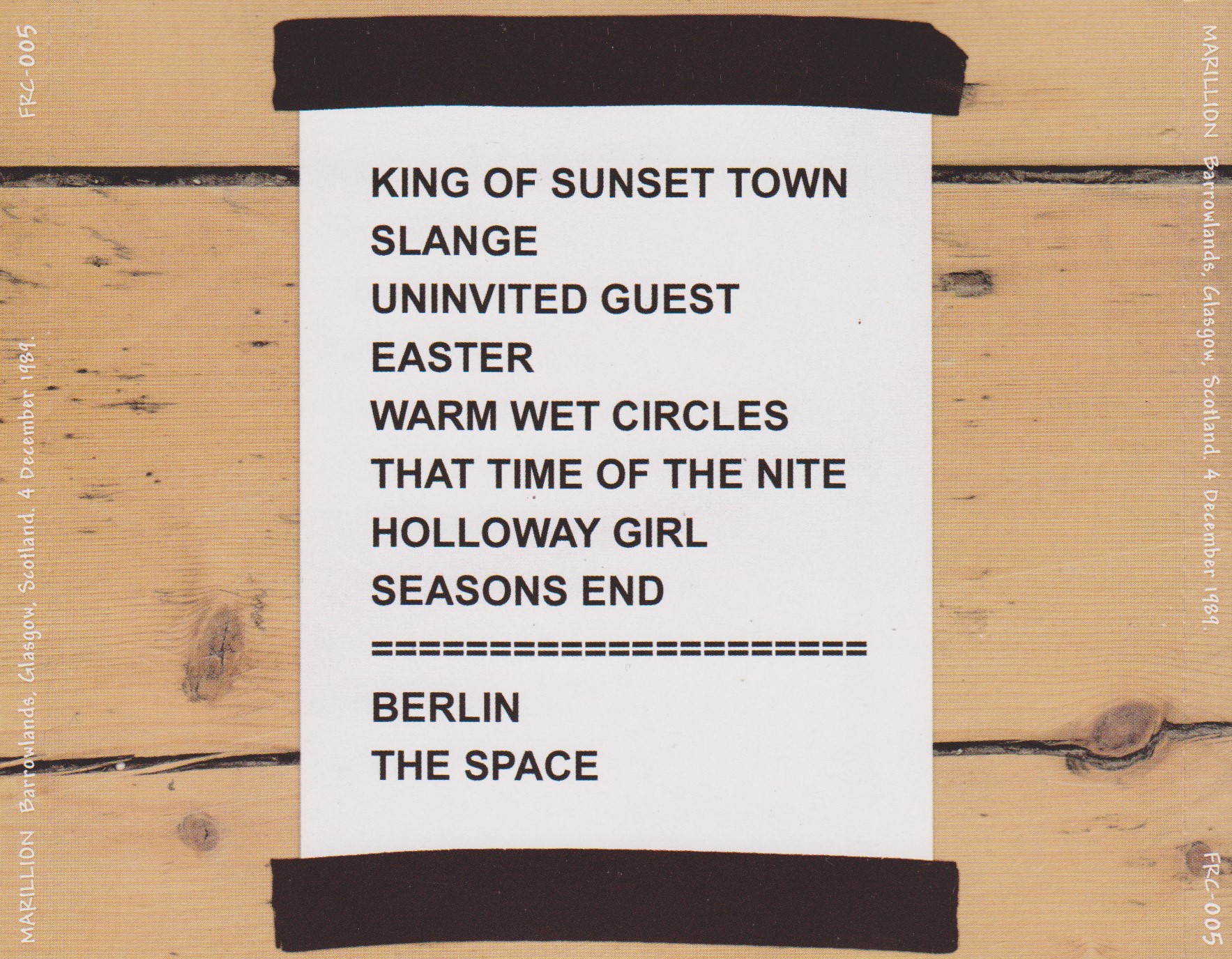
Opening with the brand new classic, “King of Sunset Town”, it sounds like Marillion had them in the palms of their hands from the first notes. This releases was recorded from the desk onto cassette tape, and it sounds remarkably good considering! “Sunset Town” has the instrumental adventures that fans expect, but with a passionate vocal very unlike Fish. Singing along, the fans were already familiar with the new material. The drums sound amazing in the Barrowlands, and Steve Rothery’s solo had the fans screaming.
There are only eight tracks from Barrowlands — apparently, somebody forgot to flip the tape as the band played. Instead, two songs from a show in Bradford were added to the end.
“Slàinte Mhath” (or “Slange” as it is spelled phonetically on the back cover) is a beloved fan favourite. It was one of the songs that H felt more comfortable singing. The crowd grew quiet. This was an important song to get right. No worries there. “And you listen, with a tear in your eye, to their hopes and betrayals, and your only reply is slàinte mhath.” (Cheers, good health.) The line is greeted with a few excited screams. While he was nothing like Fish, H managed to raise the hair on my arms.
“Good evening Glasgow! It’s very nice to meet you. We waited a long time for this!” It must have been a tremendous relief for H to be accepted in Glasgow. Two new singles follow “Slàinte”: “Uninvited Guest” and the ballad “Easter”. These are songs that remained in the setlist for tour after tour, and they do not vary much from other live takes. It is interesting to listen to these fresh versions, new to the band as they were to the crowd. “Easter” is youthful and beautiful.
Hogarth seemed drawn towards the Clutching at Straws material. “Warm Wet Circles”/”That Time of the Night” were performed for a few tours after, and Steve did them very well. It’s a 10 minute slab of progressive rock with labyrinthine lyrics as only Fish could write. Hogarth nailed it.
“On promenades where drunks propose to lonely arcade mannequins, Where ceremonies pause at the jeweller’s shop display, Feigning casual silence in strained romantic interludes, ‘Til they commit themselves to the muted journey home.”
I mean come ON!
And that’s it for old songs. More were played that night, but the tape didn’t get them. Too bad, because they included “Market Square Heroes”, “Incommunicado”, “Kayleigh” and lots more. Barrowlands goes on with “Holloway Girl”, which boils with a dark intensity. Marillion and Mark Kelly are very good at using keyboards for texture, and this is a good example. Also dark and powerful is “Seasons End”, introduced by the Christmas carol “Oh Come Emmanuel”. This early warning about global warming is a reminder that this is not some new theory. We’ve known about global warming for decades. Marillion turned that into a pretty epic quality track.
That’s it for the Barrowlands tracks. “Berlin” and “The Space” are added to make it an even 10. There’s a shift in sound quality as it gets a little clearer, but it’s not obtrusive. “The Space” is a very apt way to end a CD.
Rating something like this…it’s almost “What’s the point?” There are 43 of these bloody Front Row Club albums. You can’t get them anymore. You have to look at this as a good but incomplete set of some of the earliest live Marillion with Hogarth. When we’re talking about a band with probably 100 live albums or more, it all becomes a little hard to see the forest for the trees!
I haven’t reviewed much of my Savatage collection, and the reason for this is actually their fault. There are so many different versions with different bonus tracks that I cannot keep any of it straight. I have no idea what I have or what I’m missing at this point concerning bonus tracks. I like to be thorough when reviewing an album, providing some commentary on all the different tracks available. In Savatage’s case, I give up. I can’t keep up with the bonus tracks, but I’m going to review the albums anyway. Streets: A Rock Opera is the Savatage album closest to my metal heart. And that means it’s Epic Review Time!
SAVATAGE – Streets: A Rock Opera (1991, 2002 Steamhammer remaster)
The origins of Savatage did little to hint at what they could become. Little more than a thrash band with remarkable riffs and throat, Savatage truly began to grow when they hooked up with producer/co-writer Paul O’Neill. He had already been working on an idea for a musical called Gutter Ballet. Savatage liked his ideas; singer Jon Olivia used the title for his song “Gutter Ballet” (unrelated), after being inspired by Phantom of the Opera. Their next project was determined to be the O’Neill musical, which now needed a new title: Streets (with Ghost in the Ruins being O’Neill’s preferred, un-used title). One song was already used: “When the Crowds are Gone” was recorded by Savatage for their 1989 LP. Other songs would also have to be trimmed, such as “Desirée”, and “This is Where We Should Be” which later emerged as bonus tracks elsewhere.
A children’s choir opens the title track “Streets”, before the tinkling of creepy piano. “Streets” acts as introduction to the story, setting the scene with Jon Olivia as your narrator. The song turns very metal to let us know this story is going to be a heavy one. “These streets never sleep, still they never wake,” goes the ominous tune. Jon’s brother, guitarist Criss Oliva, rips up and down the neck for a solo section that evokes hope instead of fear. I feel chills on my arms.
Streets contains very little dialogue. A man begging for a quarter introduces himself. “I ain’t no bum or nothin’. I used to live uptown once before too you know.” He lights up a cigarette. Lots of characters down here. But there was one character who made it out of here: D.T. Jesus. He was a drug dealer, “Downtown Jesus”, or “Detox” to his friends. Streets is his story, and this is the intro to “Jesus Saves”.
“Jesus Saves”…
The interesting thing about “Jesus Saves” is that there is an alternate version out there that wasn’t used, called “DT Jesus”. Lyrically it’s identical, but musically it’s gospel rock. Don’t ask me to choose a favourite; I can’t. The gospel version has an incredible power that the album version, “Jesus Saves”, does not. However Savatage are a metal band, and even if this is a rock opera, “Jesus Saves” works better for a metal album. It’s exactly what is needed for the start of this album: a short, hard shot right in the face, guitars exotically dancing and Jon Oliva shrieking the best he can. D.T. Jesus may have been a low-life, but that wasn’t his future. “Bought himself a cheap guitar, started playing bars, kids came in their cars.”
…and “DT Jesus”. Which do you prefer?
Fame comes. T-shirts, radio interviews, headline concerts. It was not to last for D.T. Jesus. “He started missing shows, the band came down to blows, but Jesus just didn’t care.” Even when he quits the band, his fame won’t disappear. The story of the musician who could not kick his demons resonated with Jon Oliva who went through his fair share of powders and pills before Streets. There are probably several kernals of truth within his vocals and that is one thing that makes Streets so unforgettable.
“Tonight He Grins Again” refers to the monkey on his back: addiction. “Still he is my only friend, and tonight he grins again.” The power in this piano/metal hybrid is undeniable. During the quiet passages, Oliva’s voice quavers; then he shouts hauntingly on the choruses. Mid-tempo guitars kick in for “Strange Reality”, and the story begans to turn. Jesus sees a filthy man on the streets. “That could be me,” he begins to think to himself. Is it a sign or a warning? D.T. comes to this realization and then begins a confessional on “A Little Too Far”. A pretty piano ballad like “A Little Too Far” may seem out of place, but it is only the first of several. “A Little Too Far” is very special, raw and penetrating. Towards the end it lightens up, and this is my favourite verse on the whole album:
“And who’s to say what it’s about, When John Wayne caught the last train out? And Spock and Kirk have had enough, And no-one’s left to beam me up?…”
Drummer Steve “Doc” Wacholz used to play with a United Federation of Planets banner on his bass drum.
The mood lightened, D.T. Jesus goes for a comeback. “You’re Alive” is the most “pop-metal” of all the songs, like Sava-Journey, indicating this is it: this is D.T.’s moment. “The crowd they came in just to see a man back from the dead.” Triumphant hard rock it is, victorious and fist-pounding. But it’s too soon for a happy ending. “You’re Alive” ends abruptly. Enter: Sammy.
“Sammy and Tex” is old-school Motor-metal. The heavy chug interrupts the celebration. Oliva screams rapid-fire from the left speaker, as the character of Sammy, an old acquaintance from the drug days. He’s come looking for an old drug debt: $30,000, plus interest: “Now I would have said duck it, but with the money by the bucket, I hear you’re raking in…” A struggle ensues, but D.T.’s manager Tex hears the commotion and enters the room. Sammy pulls a knife, and Tex is dead.
Musically, “Sammy and Tex” is the most hard core Savatage metal on the album. Shreddery and riffs collide with the kind of speed metal tempos that they mastered on their earliest albums. Relentless and without pause, “Sammy and Tex” perfectly accompanies the words. The struggle is over in a blur. Sammy makes a run for it leaving D.T. with Tex’s dead body.
The first side of the album closes with the sorrowful “St. Patrick’s”. Not knowing where to turn, D.T. enters St. Patrick’s church, begging for answers. The statues and paintings provide no answers. “Surely, you must care, or are you only air?” asks D.T. in frustration. The music turns dramatic, and then explodes as D.T. breaks down. He then apologizes for his outburst: “Didn’t mean to doubt what it’s all about, seems I forgot my place. But if you find the time, please change the storyline.”
Side two opens in a different mood, a dreamy landscape of echoey drum bursts and light guitars. “Can You Hear Me Now” drops a heavy Criss Oliva riff at the halfway mark and then it starts to rip. D.T. Jesus seems haunted by people from his past as he tries to fall asleep. Hitting the streets again, “New York City Don’t Mean Nothing” begins as an out-of-place acoustic song. Here we meet some other unsavoury street characters, as the song begins to accelerate. First a fast bass beat, then chunky electric guitars join in and the song blasts off. All sorts of advice is offered to our lead character, but none is really useful.
It sounds like Savatage ripped off the opening guitars from Def Leppard’s “Die Hard the Hunter” on the next track, “Ghost in the Ruins”. I all but expect Joe Elliot’s voice next. It goes heavy instead, painting a picture of the bad side of town at night. D.T. then begins to question what the world would be like if he didn’t exist anymore. Would anybody care? “If I Go Away” goes full-on power ballad mode. It is one of the most powerful songs on the album, anthemic and beautiful, but sad. It has become a bit of a classic to Savatage fans today, often considered among their best ballads.
D.T.’s demons will not die, and the urge to go back to the drugs once again speaks on “Agony and Ecstasy”, the last of the heavy tracks on the album. With a chugging Criss riff, this one blasts like a train fueled by Van Halen (not Van Hagar) albums! “Just remember, if you ever need me…I’m here,” ends the song. Then the story gets a little fuzzy, but thankfully the band included a narrative that helps explain events. The album closes with a trio of piano ballads, each building upon the other to a satisfying climax.
Fair warning here: Much of Savatage’s conceptual music has Christian overtones, but none more obvious than on these three tracks. According to the story, D.T. finds a homeless man in the streets who is dying. D.T. feeds him and clothes him. This would be during the ballad, “Heal My Soul”, the first of the ballad trio. It is based on a Welch lullaby called “Suo Gân”. With just piano and the voice of Oliva, you can imagine D.T. singing this to comfort the man as he passes away. The children’s choir then returns, adding a pretty but haunting quality.
“Believe”
According to the story, D.T. witnesses a luminous spirit emerge from the homeless man, who he follows up several flights of stairs to a roof of a building. On “Somewhere In Time”, D.T. seems to have come to a spiritual realization and confesses all his regrets and mistakes. “I’ve been grasping at rainbows, holding on to the end, but the rain is so real lord, and the rainbows pretend.” The music goes upbeat with a hard rocking middle section, guitars squealing as if possessed by St. Halen himself. Then, finally D.T. opens his heart and gets his answers: “Believe” is the perfect ending to an epic emotional journey. With all the power that Savatage can muster, overblown, dramatic, and pompous, “Believe” ends a rock opera properly. Interestingly, it retains a simply epic section that was lifted directly from “When the Crowds are Gone”, excised from the story when it was used on the Gullet Ballet album. So epic is this segment, that Savatage had to re-use it. Then later, on another Savatage album later in 1994 called Handful of Rain, part of it was re-used again, along with other parts of “Believe”. Its positioning on that album was the same: it was part of the closing track. Only on Handful of Rain, it was on a song called “Alone You Breathe” that was a tribute to Criss Oliva, who was killed by a drunk driver.
“Believe” ends the album on the bright up-note that you want a story to end with, your soul awash with light and musically uplifted. Reading the story and words, it’s really hard to avoid the obvious message. Listening to the music purely as an album, you can probably live life completely ignorant of the story. But as soon as they put A Rock Opera in the title, that makes the listener try to follow along. I think it’s pretty obvious, in the final song “Believe”: “I am the way, I am the light, I am the dark inside the night…” Paul O’Neill, who wrote the musical on which this album was based, is openly Catholic, and there’s nothing wrong with that. There’s nothing wrong with writing what you know and what interests you and what makes you feel something. But some…probably a minority of listeners…just flat out won’t like it. They will consider the call of “I’ll be right there, I’ll never leave, and all I ask is believe,” to be heavy-handed preaching, and fair enough. That’s why I’m putting it out there — for readers to make up their own minds.
A later, Zak Stevens-sung version of “Believe” done acoustically.
So, on to this lovely Steamhammer remaster…with “bonus tracks”.
Two bonus tracks are listed: “Jesus Saves” and “Ghost in the Ruins” live. One issue: There are no bonus tracks on this CD. None. Nada.
There is a recent release with narration between all the songs, and a previously unreleased track called “Larry Elbows”. That’s probably a good one to have. There is a 2011 remaster with unreleased acoustic songs. There was a 1997 release with a Zak Stevens-sung version of the outtake “Desirée”. Or you could go with the original 1991 release if you’re so inclined, because there are more flaws with this Steamhammer package.
One is that all the artwork is blurry in comparison to an original release. The other is that the narrative story isn’t included in the booklet. It was in the original, along with the lyrics. Steamhammer only brought over the lyrics. In compensation, they do include an 11 page (very small print) segment detailing every aspect of the making of this album and the tour that followed. In the end, Jon Oliva resigned from the band, citing exhaustion. His replacement was the young and able Zak Stevens for 1993’s followup Edge of Thorns.
Savatage’s Streets: A Rock Opera was their first full-length concept album, the first of many: Dead Winter Dead, The Wake of Magellan, and Poets and Madman all followed after a brief period of non-conceptual work. That’s some heavy competition, but Streets remains their most passionate.
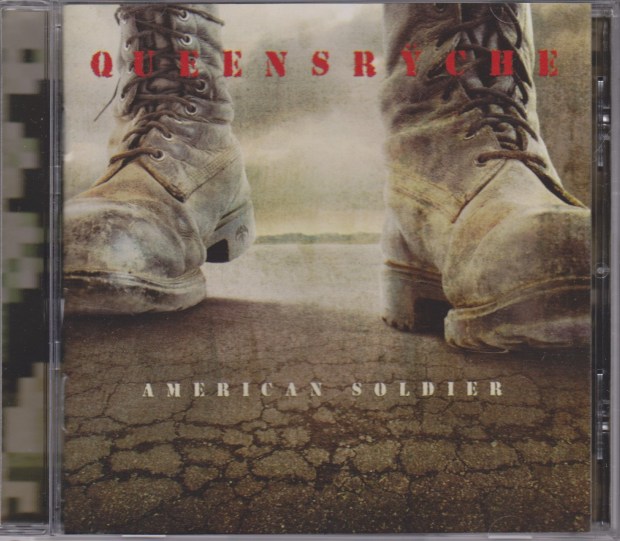
There is no doubt that a decade and a half of war has dramatically changed the United States. In 2009, Queensryche decided to deal with their feelings by writing a concept album on the subject. It’s something that they do very well, and American Soldier, the finished product, was another ambitious piece of work. Although the album was mostly written by Geoff Tate and his friends Jason Slater and Kelly Gray, in reality it’s the last good album the band made with Tate.
The band interviewed soldiers for this album, and their words are a huge part of the record. The track “Unafraid” opens like this, creating a hauntingly serious atmosphere. At times, the music is toned down, allowing the dialogue to speak. It’s an interesting effect and certainly it works in creating the mood that the band were going for. I think it is also a token of appreciation to the soldiers who defended the country. They had a chance to speak their minds, and be immortalized in music. That’s pretty cool.
The end result is a good album that is not necessarily easy to listen to. There is no “fun” in this music, it is dead serious the whole way through. The intensity burns and you can hear that Tate was focused like a laser on this project. The songs are fine; not Mindcrime quality but I don’t think that anthemic progressive rock would have fit American Soldier. The single misstep is the vocal by Tate’s daughter Emily on “Home Again”. What was meant to be a dramatic, emotional focal point is instead distracting.
Among the best tracks are “Sliver”, a cool opener featuring an actual soldier (A.J. Fratto, a 14 year vet) barking orders with the music. Fratto ended up touring with the band in support of this album. Well done, sir! “Hundred Mile Stare” is slow and intense. The hundred mile stare in the song is a variation of the thousand yard stare — a distant look in the eyes a soldier gets after they’ve been in the field too long. “A Dead Man’s Words” is another complex highlight, middle-eastern in style and clearly about conflict in that region. This one is perhaps the most “Queensryche” of the songs, in the sense that you can hear their classic sound at play. This includes a Tate sax solo, something I wished he did more of with the band. Then, for choruses, I have to go with “The Killer”. For sheer intensity, it’s the soldier’s story on “If I Were King”. If you want heavy ‘Ryche, then “Man Down!” is the track for you.
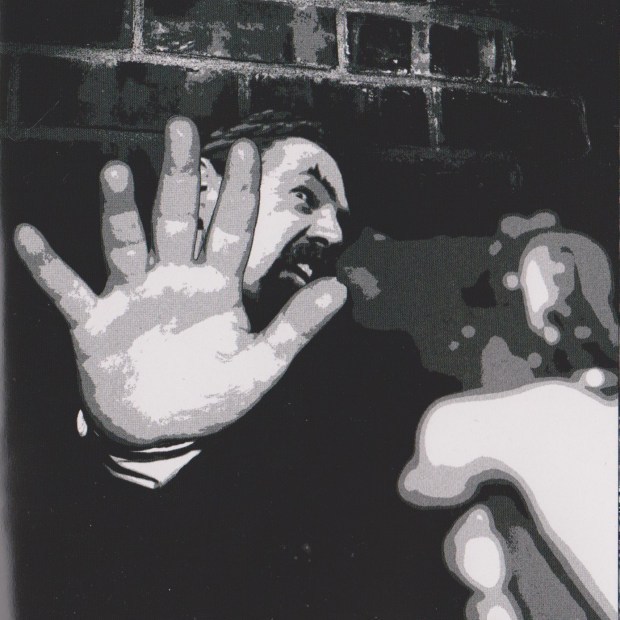
One disappointing factor in American Soldier only hits you when you open the booklet. Great artwork aside, it’s really too bad that Tate relied so heavily on his buddies to make this album rather than his band. Drummer Scott Rockenfield has two co-writes, and that’s it. Damon Johnson from Brother Cane has just as many co-writes. The rest of the credits are variations of Tate, and producers Jason Slater and Kelly Gray. Queensryche were down to four members at this point, so Johnson and Gray subbed on guitars.
Although Promised Land was probably the most deeply personal Queensryche album, American Soldier is likely the runner up. At least for Tate and his collaborators, there is obviously a lot of their hearts and souls invested in this. Unsurprisingly, it is not an immediate album. It requires time, but it also requires space between listens. There’s no glory here, just stark reality, so take your time.
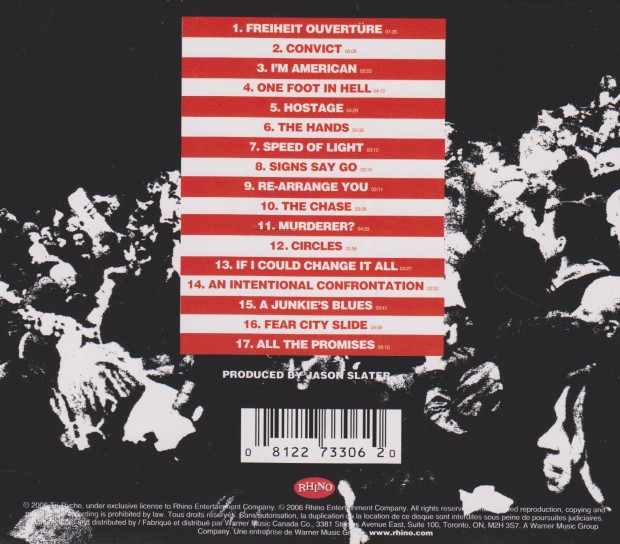
QUEENSRYCHE – Operation: Mindcrime II (2006 Rhino)
10 years ago, when this project finally saw the light of day, a lot of fans were expecting it to be 1988 all over again. However, there were many reasons why they shouldn’t have.
1. Longtime guitarist/songwriter Chris DeGarmo, such an integral part of the original Mindcrime, had been out of the band for quite some time. 2. Geoff Tate’s voice didn’t have that high-note power it once had. 3. The band never intended to pretend it was still 1988. This album is a continuation, 18 years later, and as such the music has changed somewhat as well. The albums are meant to complement each other, not duplicate each other.
The story picks up with Nikki, the anti-hero from the original Mindcrime, finally being released from prison, 18 years after the events of the first album. He begins to piece together his memories of what happened. He decides to pay Dr. X a visit (“X marks the spot”, goes the lyric), who is deliciously played by the late Ronnie James Dio. For die-hard Dio followers, this was a real treat. Dio sings as if in a stage production, which I’ve never heard him do before. Pamela Moore reprises her role of Sister Mary, playing a larger role and appearing on more songs. She’s a great complement to Geoff Tate, who clearly revels in the chance to do something dramatic like this.
New second guitar player Mike Stone (ex-Criss) gels very nicely with Michael Wilton, playing dual guitar leads that Queensryche of old would have been proud of. At the same time, modern technology has creeped into the production in the form of sequencers and samples, to remind us that this was 2006. Still, Eddie Jackson’s bass had never been recorded this well before; he should be very proud of his rumble. Scott Rockenfield’s back to playing some serious metallic drumming as well, leaving behind some of his tribal influences for the moment.
So, the actual sound of Mindcrime II is amazing. The songs however are not up to the very high standards that Mindcrime I set. There is no “I Don’t Believe In Love” or “Eyes Of A Stranger”, although some songs like “The Hands” come pretty close, with an amazing metallic riff and great chorus. (Did anyone else notice a few bars of music from “I Don’t Believe In Love” within “The Hands”? Listen again.) “I’m American” is lyrically fantastic, and angrier than anything Queensryche has done since Q2K. “Chase” is the one featuring Dio, and the one I keep coming back to.
The thing about Queensryche albums is, they do tend to get better with time. Maybe they were always slightly ahead of the curve, or more likely they just take a few listens to absorb. It’s been a decade now, and few of the Mindcrime II songs remain lodged in the my brain. Meanwhile, I could hum any song from the first one. In particular, the second side of Mindcrime II really takes a drop. Tracks like “Fear City Slide” do not have the impact of “I Don’t Believe in Love”, and the closer “All the Promises” fails to deliver. It’s a concept album after all, and the last song is like the last scene in a movie. It should be memorable.
Will Mindcrime II ever become classic like the original? Doubtful. As soon as you name something with a “II” behind it, you’re painting yourself into a corner, but Queensryche have done about as good a job as the fans could have expected. It seems many fans have warmed up to it over the years, though it certainly cannot be considered equal with the original.
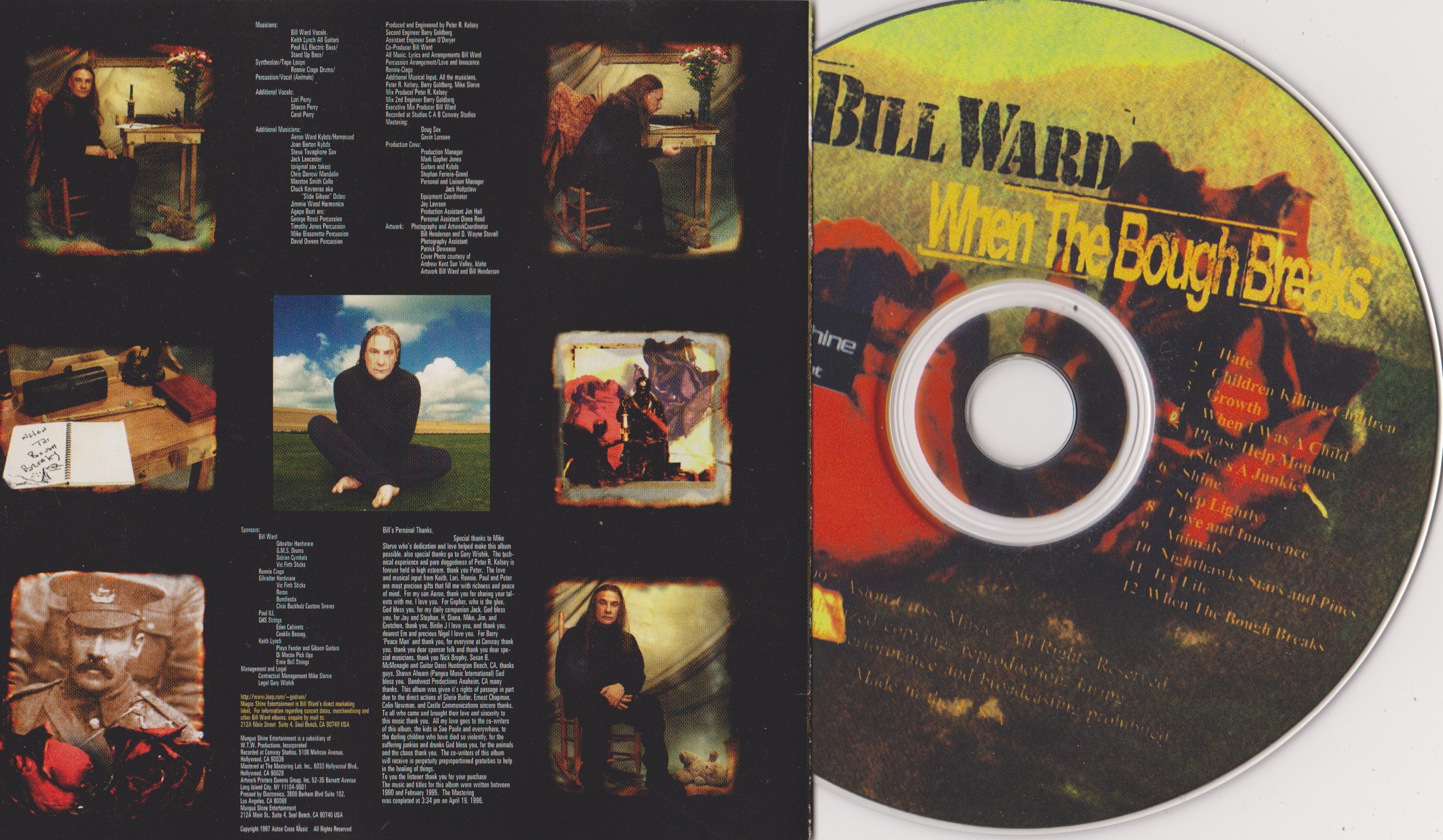
BILL WARD – When the Bough Breaks (1997 Purple Pyramid)
If anybody in Black Sabbath is an under-sung genius, it must be poor Bill Ward, the drummer on the outs with the legendary band. Not only did he release the cult classic Ward One: Along the Way, but also its lesser known followup When the Bough Breaks. Much more than just a drummer, Ward writes music and lyrics. He also sings lead on every song, unlike its guest-laden predecessor. What he didn’t do on When the Bough Breaks was plays drums — at all. Maybe there is something to this talk from Ozzy about Bill not being able to hack it?
Folks who know little about Bill or Sabbath usually assume it’s all doom and gloom. Track 1’s song title is “Hate”, but fear not, Bill has not changed his tune. Hate is the easy way, not the right way, is the message. Meanwhile there’s a cool sax lick and chunky guitar, and I swear that Bill must have arranged the drum parts because even though it’s not him, it sounds like him. Ronnie Ciago does a fine job on the skins, all over the album. Then, “Children Killing Children” is clumsy lyrically, but backed by lovely music and a heartfelt vocal performance. A pretty ballad with mandolin, dobro, cello and violins is not what many would expect, but When the Bought Breaks is a mellow listen as a whole, and it can’t be pigeon-holed.
“Growth” maintains the soft trend, but it also cascades into massive waves. Bill sings with a high, whispery quavering voice. It lends itself best to quiet drama, interspersed with maniacally heavy rock. That’s what “Growth” is, with a progressive bent and female backing singers. It seems to form part of a suite, “When I Was a Child” emerging directly from it. Though the title misleads, this is actually one of the heaviest tracks — a sludgy heavy metal blues born from the steel mills of Birmingham. The childhood theme is continued with “Please Help Mommy (She’s a Junkie)”. It also continues the blues with swampy dobro…before it transforms in a space age gospel-soul-metal slam dance. It has a hell of a lot more life and rock and roll than anything Ozzy’s produced since then. The sludge remains on “Shine” which I like to think of as ending a side. Oddball Bill rock is the best way to describe it.
“Step Lightly” has a soft touch to it but the heavy guitars leave no doubt. A potent mixture of influences and genres, “Step Lightly” defies categorization except to say it’s rock, but it’s a lot of things. “Love and Innocence” is a strange name to a brief percussion instrumental, and it’s an intro to the song “Animals”. A drummer’s wet dream, “Animals” is a heavy percussion blast with less emphasis on guitar. A fine song, “Animals” is only hampered by a weird tribal-y front section. “Nighthawks Stars and Bars” commences as we wind down. This beautiful song feels like dusk, serenaded by saxophone. Bill wrote a lovely soul ballad here, and the ladies singing on it are incredible. “Try Life” is Floyd meets Lennon with a teeny tiny sprinkle of Sabbath, creating a light concoction of classy progressive rock balladry.
One last epic, the slow building title track (almost 10 minutes) leaves no doubt in mind that Bill Ward is a unique talent. Of all the Sabbath solo records, Bill’s have been the most ambitious. They’ve also been the fewest. Bill’s long awaited Beyond Aston has no release date, but another solo album called Accountable Beasts was finally released in 2015. Meanwhile, of Beyond Aston, Bill says it’s his best since Master of Reality in 1971!
Of When the Bough Breaks, I can only close with this. It takes time. It takes a lot of listening time invested, to pay back its full dividends. When it does, you’ll be glad you bought it. Of note however, there are multiple pressings and the one I have has liner notes and lyrics so tiny, that I fear I might irreparably damage my own eyes if I try to read them.
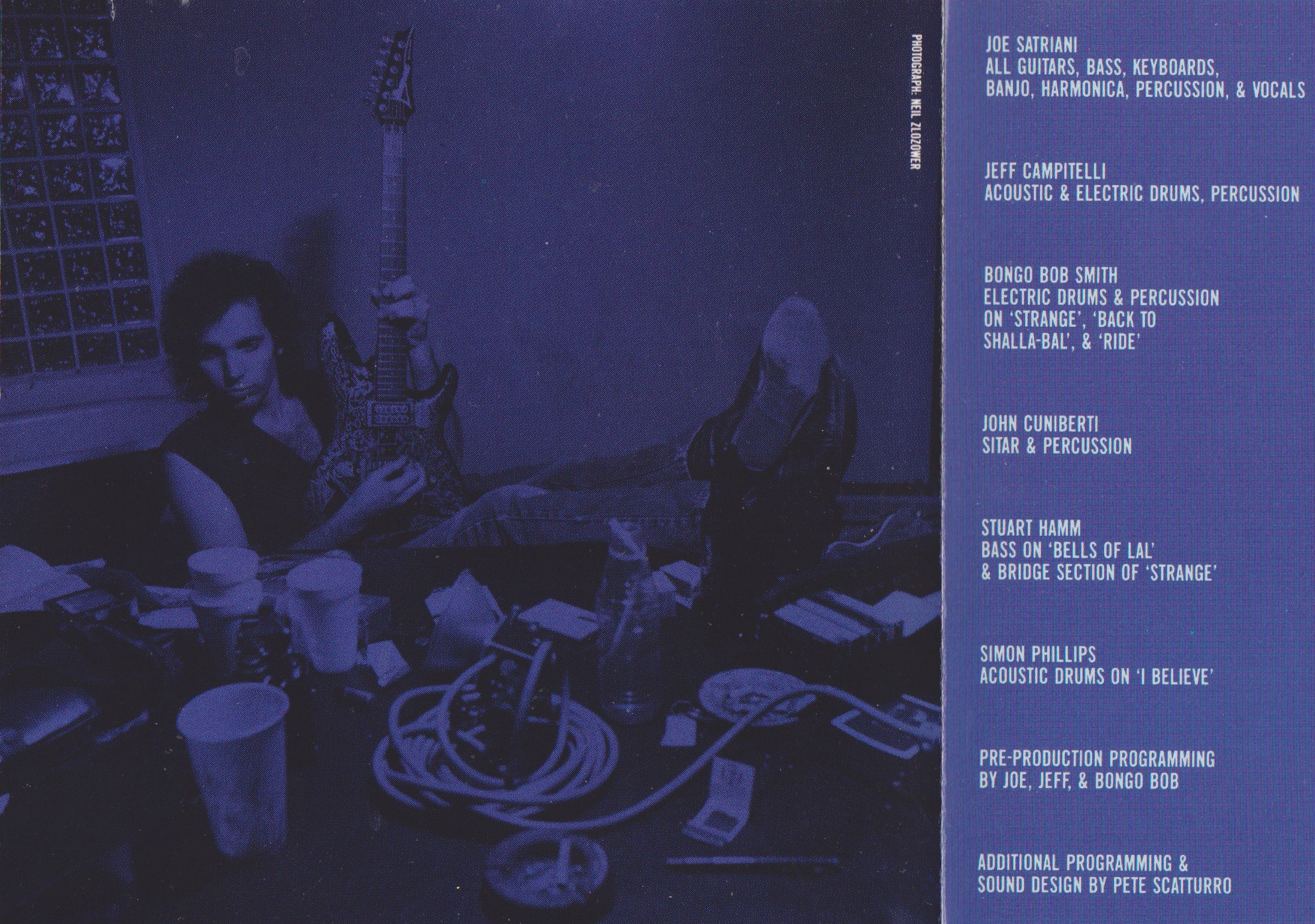
JOE SATRIANI – Flying in a Blue Dream (1989 Relativity)
I used to read all the rock magazines and charts as a kid, and I was surprised when Joe Satriani’s latest album cracked the top 30 in Canada. “Isn’t he an instrumental guitar guy? Do enough people buy that stuff for it to chart?” Apparently they did, and even if instrumentals aren’t your thing, you have to love Joe’s big vocal single debut, “Big Bad Moon”.
Joe nailed a cool, creative music video with lots of shreddery, which immediately caught my eye. Joe looked like Razor Ramon before there was such a character, but cool as ice in that suit. Meanwhile, another Joe in a leather jacket shreds the fuck out of a beautiful silvery Ibanez. Putting on a gritty, Waits-ish voice, Joe slammed out a blues rocker like no blues I’d ever heard before. I had to get this!
Flying in a Blue Dream contains only six vocal songs, but it didn’t need any more than that to become a hit. The instrumentals are all killer (as Joe’s usually are). For an album that is well over an hour, it is rare to find one so full of killer, with zero filler! The best way to think about Satriani songs is that they are not really instrumentals, just good songs where the lead vocal melody is performed by a guitar. Most of the songs on Flying share this quality. The title track is one such song, where the musical backbone is a good song on its own, but the lead guitar front and center is where the lead singer would normally be delivering the hooks. Instead, Joe delivers all the hooks with his guitar alone, and does so ably. This is no easy accomplishment. Lots of songs are in the five minute range, but don’t drag or bore.
Variety is another key quality to this album. “Flying” isn’t a ballad, but falls somewhere in between. “Can’t Slow Down” on the other hand will rip your head clean off. For a real ballad, check out the beautiful “I Believe”, still a favourite of mine today. While the diversity of the album is one of its strengths, another is the production, particularly on the guitars. Melty, etherial and slippery as greased mercury, Joe’s tone defies imitation. He gets crunchy on the rhythms though, and it’s a really sweet crunch — like a Skor bar.
When instrumentalists like Joe added vocals to their arsenals, jaded music snobs would often accuse the artist of “selling out” or “going soft”. Nothing could be further from the truth. Boom, right there on track #2 (“The Mystical Potato Head Groove Thing”) is bright instrumental showcasing virtually every trick in the Book of Satch! Harmonics out the wazoo, sounds I can’t describe or articulate, but all done with an eye to the melody and groove of the song. That’s how to do it, folks. You want groove? Check out “Can’t Slow Down”, one of the blazing vocal tracks, or the headlong “One Big Rush” and “Back to Shalla-Bal”. You want bizarre and experimental? Then “Headless” and “Strange” appropriately fit the bill. You want mystical, exotic and avante garde…but with funk bass? Parts I and II of “The Bells of Lal” should do you.
Adding vocals was the coup de grâce. Those songs really elevate Flying in a Blue Dream to a timeless level. Of them, “I Believe” is particularly special. It is quiet and spare, in contrast to some of the heavier moments on the album. Tasteful and reserved guitar melodies set the tone, and Joe sings softly of making a better tomorrow. His singing is remarkable actually, because though Joe is not known for his voice, he sings with the correct passion and feeling. In short, it all works as a package. Remember, it is usually Joe’s guitar that delivers the the hooks.
Flying in a Blue Dream always seems to live in the looming shadow of its predecessor, the million selling Surfing With the Alien. If I had to pick a favourite, it would be Flying in a Blue Dream, every time.
 MARILLION – Merry Xmas to Our Flock – Christmas 2005 (2005 Racket Records WebUK membership CD)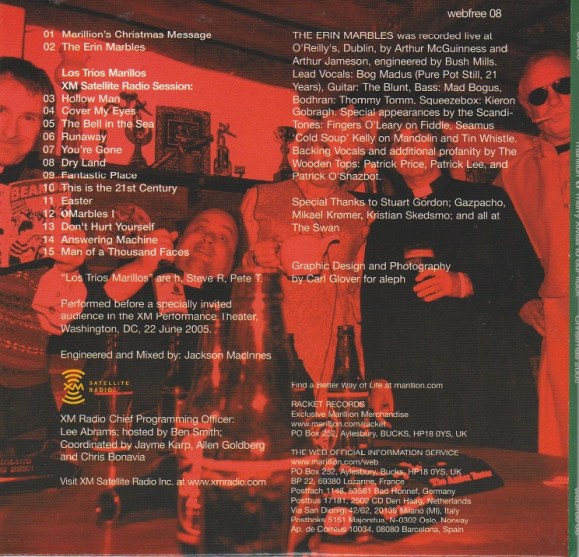





















 mikeladano.com