Part three in a series on singles from Def Leppard’s Adrenalize, including hard to find B-sides!
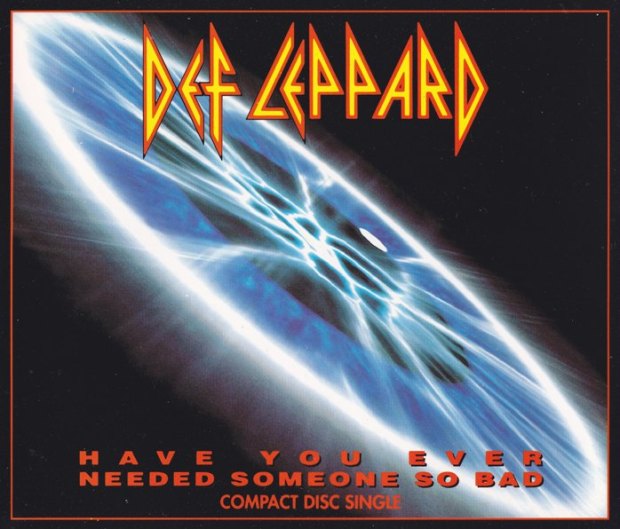
DEF LEPPARD – “Have You Ever Needed Someone So Bad” (1992 Phonogram CD single)
On their last single, “Make Love Like a Man”, Def Leppard released their first acoustic recording in a song called “Two Steps Behind”. This time, they went all-in. Not content with a couple acoustic guitars, Joe called up some friends from Hothouse Flowers (Fiachna Ó Braonáin, Liam Ó Maonlaí, and Peter O’Toole) and formed an octet* called the Acoustic Hippies from Hell! As the Acoustic Hippies, they did three songs: an unreleased Joe original called “From the Inside” and two covers. The Flowers brought tin whistle, piano and mandolin to the table.
“From the Inside” is a haunting number, with Joe singing about addiction from the perspective of the drug. “I’ll shoot through your veins, I’ll drive you insane.” Joe first played it for a television program called Friday at the Dome. Liam Ó Maonlaí and he played it together as an experiment in artists from two different fields colliding. Joe liked the song enough to record it here with the Acoustic Hippies. This song was re-released in 1993 on Retro-Active, but added the original count-in from the session. It’s certainly a good song but not easy for some Leppard fans to appreciate.
The guys then jam on 7 1/2 minutes of “You Can’t Always Get What You Want”. This is a highlight of the single, a fantastic version that deserves more attention. You might be surprised just how good this is. It sounds 100% live, with people calling out cues and hoots and hollers. Almost as good is Hendrix’s “Little Wing”. Softer and less rambunctious, it is haunting more like “From the Inside”. Thankfully these two tracks were later reissued on the Adrenalize deluxe edition.
These three B-sides completely outshine the A-side, the putrid “Have You Ever Needed Someone So Bad” from Adrenalize. This annoying title is only slightly worse than the song itself, one of the most by-the-numbers ballads that Def Leppard have foisted upon the fans. Of course it became a top 10 charting single in the US.
3.5/5 stars
* There are no drums but Rick Allen is credited for “acoustic inspiration”.
Part two in a series on singles from Def Leppard’s Adrenalize, including hard to find B-sides!
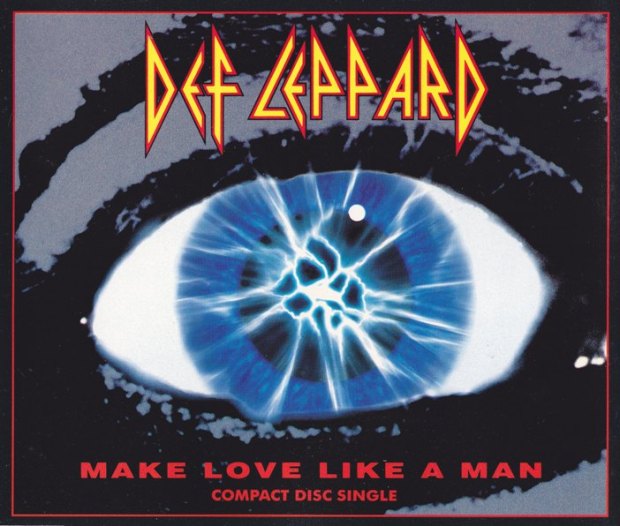
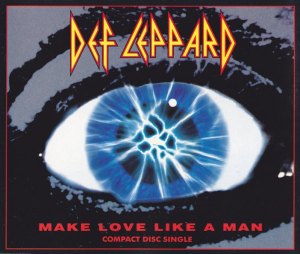
DEF LEPPARD – “Make Love Like a Man” (1992 Phonogram CD single)
For the life of me, I couldn’t understand why this song from Adrenalize was ever chosen as a single, let alone the second one. As stated in my album review, it “sounds like a hard rock version of a Shania Twain hit”. No thank you.
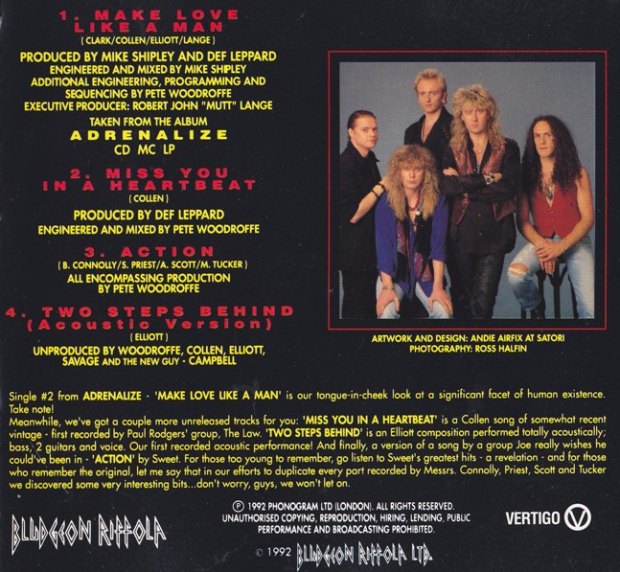
Def Leppard singles are always exciting for collecting B-sides, but “Make Love Like A Man” was the first one to include three brand new songs. Each one was completely different from the other, while remaining of very high quality.
First up is a not-cover of “Miss You In A Heartbeat”, originally recorded by Paul Rodgers’ band The Law. Phil Collen wrote it, but The Law was first to release it in 1991. Atmospheric, moody, but bright, it was a worthy successor to the lofty heights of Hysteria. It’s superior to some of the songs that made it to Adrenalize, and it’s certainly better than its own A-side. In fact, a bare piano version was later as released as a single in its own right, supporting Retro-Active in 1993.
Next is cover of The Sweet’s “Action”. This is the original mix. The one on Retro-Active has re-recorded snare drums and possibly additional backing vocals. Leppard have played this one live, steadily for years. It fills the niche of a solid rocker with a solid riff needed on this otherwise fairly mellow single. Like “Miss You In A Heartbeat”, it too was released as a single in 1994, but with the re-recorded drums.
“Two Steps Behind” was the band’s first ever acoustic recording, a trend picking up at the time. It was a bit of a throw-away at the time, with a sparse unadorned arrangement and a pleasant but ordinary melody. However, it too was released a single as well! It was chosen for Arnold Schwarzenegger’s Last Action Hero soundtrack, and had strings added courtesy of Michael Kamen. Once again this is the original version and the first to feature “new guy” Vivian Campbell!
In the context of 1992, this was a pretty special single. Viv’s first Leppard recording, Lep’s first acoustic foray, and some quality tunes ensured solid play time that summer. A-side aside, this was Leppard’s most satisfying single for the dollar yet.
Do you wanna get rocked? Time for a new series! When we looked at the deluxe edition ofDef Leppard’s Adrenalize, it was noted that many B-sides from that era were missing. Songs such as “Only After Dark”, “Miss You In A Heartbeat”, “Action”, “From The Inside” and “She’s Too Tough” were not included on that disappointing deluxe. Fortunately, LeBrain HQ has a stack of Def Leppard CD singles right here, to help inform readers where you can get the original versions of these tracks. Let’s get rocked!
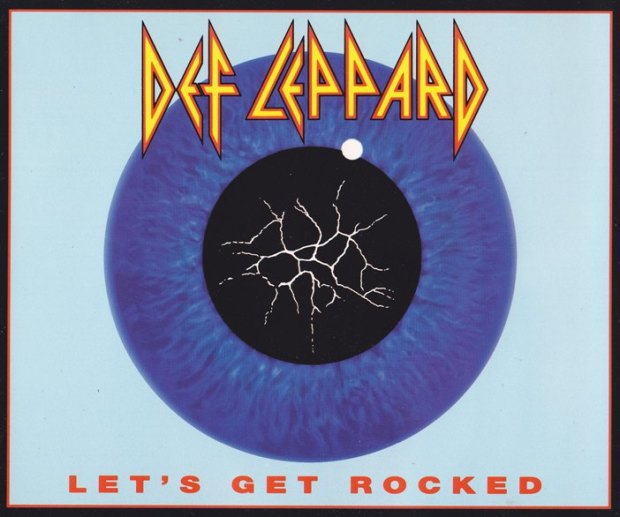
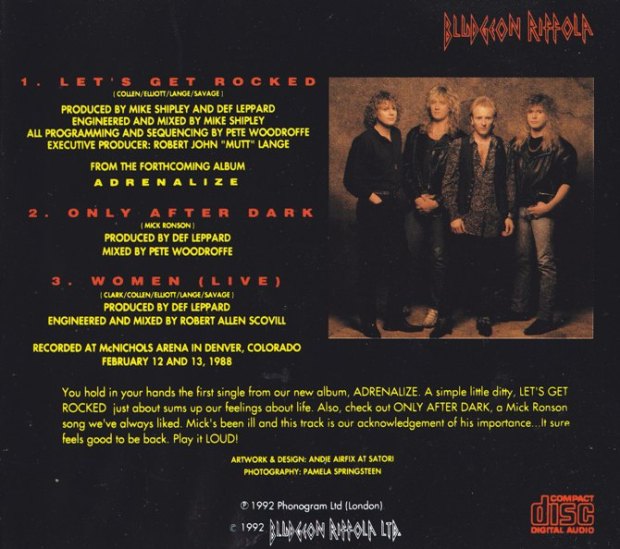
DEF LEPPARD – “Let’s Get Rocked” (1992 Phonogram CD single)
Hell and back — those words are as good as any to describe Def Leppard. This, the first Def Leppard single in what seemed like ages, was also their first single without “Steamin'” Steve Clark. That left a monster riff-sized gap in Leppard’s arsenal. Rather than seek out a replacement immediately, Phil Collen stepped up to the plate and recorded all the guitars on Adrenalize himself (with a little acoustic help from Rick Savage).
“Let’s Get Rocked” hit the airwaves in early 1992, and immediately shot up the charts, such was the value of Def Leppard. Even though the band maintained their disciplined studio techniques, layering guitar shimmer and vocals galore, “Let’s Get Rocked” sounds sparse compared to the Mutt Langue produced Hysteria. Though Collen did his best in difficult circumstances, Steve Clarke is missed, as are his riffs. “Let’s Get Rocked” was one of a few songs on Adrenalize without his name in the writing credits.
Def Leppard have a knack of picking interesting but obscure covers, which is one reason collecting their singles is so much fun. The Mick Ronson (R.I.P.) solo song “Only After Dark” has that glammy vibe that Leppard love so much. The liner notes state that “Mick’s been ill, and this track is out acknowledgement of his importance.” Indeed, Mick passed away at the terribly young age of 46, from cancer. This is a fun little cover, more lively than many of the album tracks. It certainly sounds like the band were having fun doing it.
This version of “Only After Dark” is the original studio version. The version released on the Retro-Active album features newly overdubbed guitars by Phil Collen and new guy Vivian Campbell, added in 1993. You can also hear additional vocals on that mix. Therefore the original B-side version is still exclusive to the single.
Unfortunately, “Let’s Get Rocked” only has two B-sides, one being “Only After Dark” and the second being a live take of “Women”, this one lifted from their live home video, Live – In The Round In Your Face (Denver 1988) Strangely though, this track was previously released as a B-side on the previous Def Leppard single, 1989’s “Rocket”. It’s also on the Hysteria deluxe…and the Adrenalize deluxe! Talk about oversaturation.
“Let’s Get Rocked” was an acceptable first single. The track itself was good enough, though it certainly broke no new ground at all musically. “Only After Dark” was different than typical Def Leppard and another welcome B-side to the collection. “Women” was just another re-release. It could have been better.
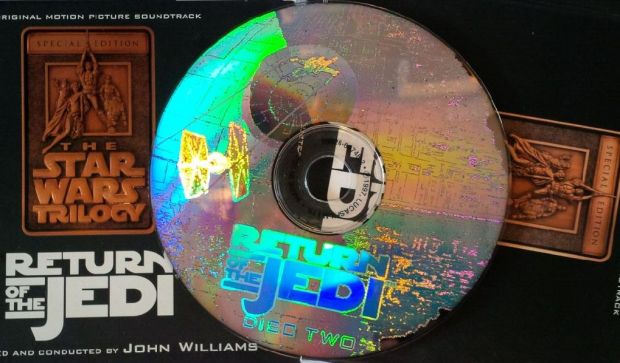
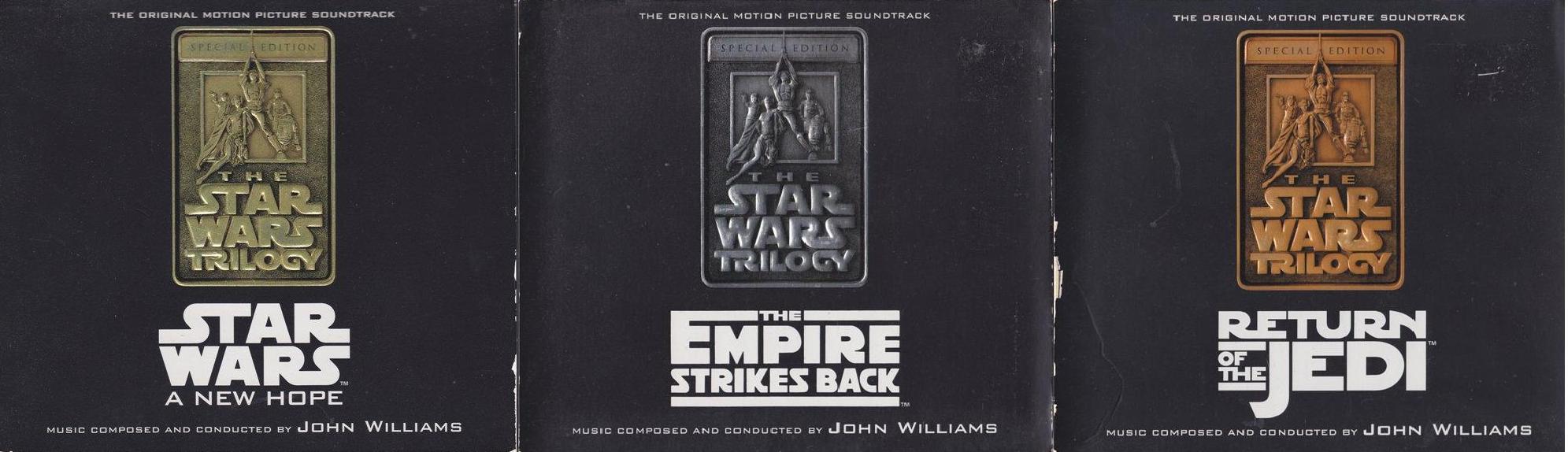
STAR WARS: Return of the Jedi – Special Edition original motion picture soundtrack (1997 RCA limited edition with holographic discs, original soundtrack released 1983)
The final soundtrack of the original trilogy received the most disappointing Special Edition soundtrack. The reissues for A New Hope and The Empire Strikes Back essentially offered complete collections of all the music from those two films. The soundtrack for Return of the Jedi suffers the most from the Special Edition changes. New music replaces old well-loved tunes, which is rarely a good idea.
Instead of the classic music of “Lapti Nek” (Jabba’s palace scene) we now get “Jedi Rocks”. I need not tell you how unwelcome that song was, replacing “Lapti Nek”. All because Lucas didn’t like that the singing alien puppet’s lips didn’t move enough, so he decided to “fix” that by putting in a much more elaborate musical number to go with the new CG lips. Thanks, George. Thankfully “Lapti Nek” was included on the 4 CD Star Wars Anthology box set.
The other missing music is “Ewok Celebration”, which fans worldwide know as “Yub Nub”. This Ewok song was one of those miserable little teddy bears’ few redeeming qualities. “Ewok Celebration” is replaced by the bland new “Victory Celebration” which ends the film. Thankfully the original music is also on the Anthology box set. (I would like to get that.)
Yub Nub!
Return of the Jedi gets off to a slower start than the other soundtracks. Instead of a battle or vicious Wampa attack, Jedi opened with a couple droids wandering through the desert before finding gainful employment with Jabba the Hutt. I know, right? How could that not make for exciting music? It’s not until Luke Skywalker confronts Jabba (track 6) that things start to move. Until then, the music remains largely atmospheric and creepy. There are a few unforgettable musical cues, such as that which accompanies Han Solo’s thawing.
Because Jedi was the third movie in a trilogy, it revisits a lot of familiar themes. The music for “The Imperial March” is heard several times for example (such as within “The Emperor Arrives”), but there isn’t much in terms of new memorable themes. I suppose that is to be expected. The nature of the film, including the deaths of beloved characters and other upsetting revelations, lent themselves to a darker soundtrack. A lot of atmospheric pieces helped underscore the mood of these scenes. This is offset by child-like Ewok segments of brightness.
A nice touch is the inclusion of alternate versions. The exciting “Sail Barge Assault” is included in an alternate take. There is also a sweeping concert suite of “The Forest Battle” on disc two. “Lapti Nek” and “Yub Nub” would have been nice, but in 1997 George was really trying to bury the original versions of the films forever. I’ll just have to find an old record, or that Anthology box.
The original music, excised for the Special Edition, is what this CD misses most.
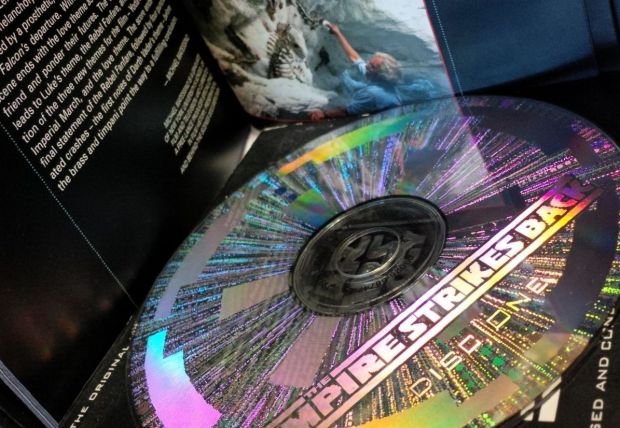
STAR WARS: The Empire Strikes Back – Special Edition original motion picture soundtrack (1997 RCA limited edition with holographic discs, original soundtrack released 1980)
Composed and conducted by John Williams
When I was 8 years old, this was my favourite album. It was my favourite album for a long time. I didn’t have a lot of albums when I was young, but The Empire Strikes Back was a clear favourite. It was only usurped by Styx’s Kilroy Was Here several years later.
Even when I was a child I had a sense that this one was something special. The Empire Strikes Back contains one of the best known Star Wars anthems ever: “The Imperial March”. Hard to imagine today, but that piece of music did not exist when the original Star Wars came out in 1977. The character of Darth Vader grew tremendously in the second film, and I think “The Imperial March” helped drive it home.
As far as I’m concerned, composer John Williams is a rock star. He makes instrumental concept albums. That is exactly the way that my rocker ears hear this music. I cannot express how true to me that is. For me, this album (in its original double LP format) was like The Wall, Tommy, or Quadrophenia. It has always been a rollicking journey to listen to, preferably loud. It has swells and drops, peaks and valleys. It has memorable “songs” that you can go back to over and over and over again.
The original soundtrack from 1980 was a massive two record set, but it was still only long enough to contain 75 minutes of the film’s music. This double CD has a whopping 124 minutes — the complete score. Even all these years later, revisiting the soundtrack, I can immediately tell when a piece of music wasn’t on the original record. “Ice Planet Hoth” was the first such moment. Other pieces such as “The Magic Tree” are very familiar because I played those records so many times! As a kid, I don’t think I even realized that the LPs didn’t have all the music.
Having the whole soundtrack, in order, on CD, is a real treat. It makes me want to take a dig through my parents’ basement and dig up my old Kenner Millenium Falcon. Or even better, get the bigger, badder, awesomer new one. That thing looks incredible…but I digress. My point is, it reignites that feeling I had as a kid. I’d hear this music, and go grab my Falcon toy, and “fly” it around. That feeling hasn’t gone away. In fact, with this baby remastered the way it is, I’d say that feeling is stronger than ever.
Other honorable mentions: “The Battle of Hoth”, “The Asteroid Field”, “Mynock Cave”, and “Yoda’s Theme”. All these are almost as memorable as “The Imperial March”.
Since I’m not musically schooled in any way, I wanted to talk to someone who is. I spoke to world-renowned bass clarinetist Kathryn Ladano about the music:
This album is one of my favourite soundtracks, and I still listen to it often. In fact, when I got my new turntable for Christmas, the original LP soundtrack for Empire was the very first album I played on it. In terms of Star Wars soundtracks, I think this is the best one. I am certainly more critical of John Williams’ soundtracks in general now than I was as a kid because I now know that much of his material was “borrowed” from other composers, but despite that knowledge, this album still has a lot of iconic and evocative themes. My favourite is probably “The Asteroid Field”, but obviously “The Imperial March” is pretty amazing too.
If I had to pinpoint a favourite moment in this soundtrack, it actually appears during the track “Carbon Freeze/Darth Vader’s Trap/Departure of Boba Fett”. From about 5:10 to 5:20 is a series of dissonant chords that I have always loved the sound of (especially the one at 5:17 – 5:18!). Long before I studied music or played an instrument, those dissonant chords resonated with me and I still love hearing them.
I now know what album I’m going to listen to today.
I’m fortunate to have the limited edition CD wallet version of this soundtrack. As with A New Hope, the discs are hologram etched. This time, instead of the striking image of the Death Star, it’s just a fairly flat Imperial logo. Not quite as awesome.
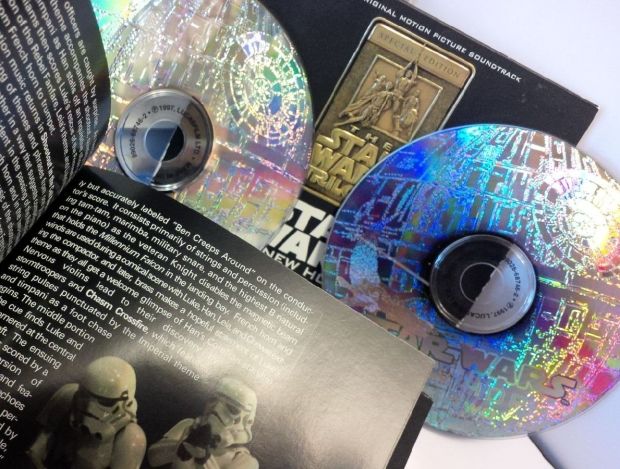
STAR WARS: A New Hope – Special Edition original motion picture soundtrack (1997 RCA limited edition with holographic discs, original soundtrack released 1977)
Composed and conducted by John Williams
Everyone over a certain age remembers the feeling of seeing Star Wars for the first time. Star Wars — not “A New Hope“, a subtitle used starting with the 1981 theatrical re-release. It was hard not to be blown away by it. Star Wars was groundbreaking in many ways, but let’s not forget about the music! Before Star Wars, space movies didn’t have much in the way of original soundtracks. The best space movie of all time, 2001: A Space Odyssey, used entirely pre-existing music by composers as diverse as Strauss and Ligeti. Lucas himself wanted to do the same thing. He had selected pieces such as The Planets by Holst, before having a change of heart. [Thanks to Rob Daniels from the Visions in Sound show for this info.]
Movie veteran John Williams came recommended by Steven Speilberg, who struck gold with the composer on Jaws. Incredibly, Williams turned in a score for Star Wars even more memorable than that of Jaws. Utilizing the London Symphony, a soundtrack of incredible emotional depth and themes was forged.
This 1997 issue of the soundtrack was released to coincide with the Special Editions, but don’t let that frighten you away. When the original was released on vinyl, the complete score could not fit onto two LPs. The special editions enabled the engineers to go back and do new digital transfers from the original master tapes. A full chronological soundtrack was then assembled including previously unreleased music, as well as bonus alternate takes.
The discs are housed in a nice CD wallet that is prone to scratching the discs if you are not careful. The discs themselves are etched with a hologram of the dreaded Death Star. The other two soundtracks in this series of reissues had their own holograms, but only for the initial run of discs. When they sold out, they were replaced by un-etched discs in simple jewel cases. The first run are collectibles, at least when the CD wallet is in good shape and still has the embossed outer cardboard shell. Unfortunately over my years at the Record Store, I saw many of these in absolutely mangled condition.
The wonderful thing about listening to a soundtrack like this, in order, is enjoying the images that come with it. You could be cleaning the house or working on your taxes, but subliminally, your mind is re-playing the scene when Obi-Wan gives Luke his father’s lightsaber. You know the score by heart: when old Ben says, “A young Jedi named Darth Vader, who was a pubil of mine before he turned to evil, you hear that mournful theme swoon. When we were kids my sister and I used to play Star Wars to the music of The Empire Strikes Back soundtrack, and it made the scene we re-created with our Kenner toys that much more awesome.
Put on the track “The Battle of Yavin” and try not making laser blast sounds, and a big ol’ explosion when the Death Star blows up. It’s more fun just to go ahead and make the sounds anyway.
Disc one contains the bonus track, an alternate take “Binary Sunset”. You know the scene, when Luke is looking longingly as the twin suns set. Hidden within the track, but unlisted, are alternate takes of the opening scene music, complete with voice cues.
I’m a firm believer that the Star Wars soundtracks are basically the heavy metal of the classical world. Listen to those trumpets and horns blasting those battle themes. Put that on an Iron Maiden album played by the duo of Smith and Murray, and you have primo heavy metal. That’s one reason why I recommend John Williams and the Star Wars soundtracks to fans of heavy metal who want to expand their horizons.
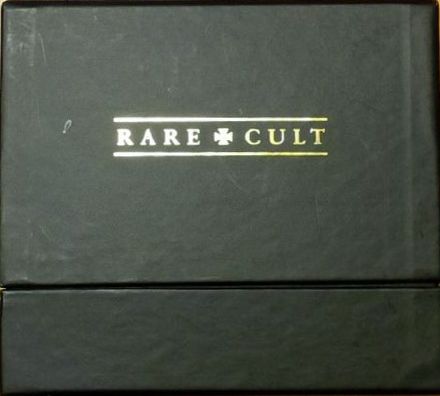
THE CULT – Rare Cult(2000 Beggars Banquet box set with limited 7th remix CD)
Rare Cult is a feast of rare and unreleased Cult music, for the Cult connosoir only. If you’ve been a Cult fan for a while but have struggled to find those early singles, then this is your dream box set, my friend. They have a lot of singles and assorted rarities, and acquiring a complete set of them all takes money. Rare Cult secures a huge chunk of that music in one package.
I’m not going to bother cataloging all the different tunes and where they came from. They’re too numerous but I will say the following:
1. This set has an enormous number of unreleased demos and otherwise finished songs that nobody had heard before — not previously released on B-sides. The songs range from the Dreamtime era (1984) with some cool, unheard BBC performances. Over six discs, it spans over a decade to 1995 when the band broke up (for the first time). All tracks are of very good sound quality.
2. There is a humongous (80 page) booklet inside, with complete credits and details for every single song contained within. Billy Duffy and Ian Astbury provide commentary, and there are lots of photos too.
3. There are a lot of remixes here, as per normal for a band from this era. In fact there is an entire seventh limited edition bonus disc dedicated single remixes, called Rare Cult Mixes. I don’t know how many copies were released with the bonus disc, but be sure of what you buy before you buy it! Personally I don’t see the point of buying this set without the seventh disc. For example, the “Fire Woman” single had two excellent remixes: The “LA mix”, and the “NYC mix”. The NYC mix is included on the Disc 5 of this box set, but to get the LA mix, if you don’t have the “Fire Woman” single, can only be had on the limited edition seventh Rare Cult disc. If you’re a collector (which I think you are, because if you’re not you probably stopped reading this already) then there’s no reason to buy the version without the bonus CD. Wait it out and get the full package.
4.Peace. While astute fans had probably collected most of these tracks already, this box set contains the first ever official release of the Peace album, in sequence on disc 3. The Cult were working on Peace after the Love album, and even finished it, but scrapped the recordings for being too Love-like. They hooked up with Rick Rubin to revamp, re-write, and re-record the album, released as Electric. Many of the Peace songs surfaced as B-sides over the years, on singles and EPs such as The Manor Sessions. While Rare Cult was the first release of the full Peace album, it has since been reissued as part of the Electric Peace two disc set.
5.Warning! There’s more. If you really, really, really want it all, you have to shell out for the single CD Best Of Rare Cult which had five exclusive songs not included here. Oh, marketing. The five exclusives on Best of Rare Cult are: “She Sells Sanctuary (long version)”, “Spanish Gold”, “The River”, “Lay Down Your Gun (version two)”, and “Go West (Crazy Spinning Circles) (original mix)”. Some of these songs, such as “The River”, are B-sides, while some are unreleased.
6. There’s even more! Yes, there are demos here, but that’s not all of them. The masterminds behind this set cleverly left off enough demos to create a whole other box set. You’ll want to pony up for Rare Cult: The Demo Sessions (an even more limited edition 5 CD set of its own) which is interesting in its own right. Look at Rare Cult as scratching the surface.
7. Even with all this stuff available out there, The Cult liked to include live songs on their singles. None are present here. Be forewarned, you may still want to get those original singles anyway, if you care enough! Maybe they should do a box set called Rare Live Cult. (Are you listening Ian?)
As a listening experience, Rare Cult is long but rewarding. One thing about The Cult, they were a diverse band, and this set is very diverse. For example you’ll go from a very dancy 80’s remix of “Sanctuary” straight into “No. 13” which is more punk influenced. Regardless of what it is, or what it isn’t, I think this set is worth listening to. Even their demos are better than most bands’ album tracks. Like many bands who released numerous single B-sides, The Cult put effort into all their songs. Check out “Sea and Sky”, “Bleeding Heart Graffiti” and “Bone Bag” as ample proof.
The packaging is quite nice. It comes in a sturdy black box. The aforementioned booklet allows you to read through the whole history of the band up to 1995. The first six discs are housed in three double digipacks, while the seventh disc sits in its own sleeve tucked into the box.
You might not very often have the luxury of 8-9 hours to listen to the Cult, but if you’re a fan, think hard and consider your buying options.
RECORD STORE TALES MkII: Getting More Tale Report: Aux 33 Tours in Montréal
My sister, bass clarinetist Kathryn Ladano, just completed the east coast leg of her Canadian tour last month. This was followed by a western leg, but while returning home from the east there was a stop in Montréal. Kathryn is a collector too, though not to the extent that I am. She doesn’t need the physical musical media in her daily life like I do. She still collects some of her favourite bands, and has recently started buying vinyl. While in Montréal, she visited a record store called Aux 33 Tours, located at 1373 Mont-Royal Est. According to their website, it is the largest record store in the city. She emailed me the following day, May 27, raving about the store. I’ll let her take it from here! Enjoy the pictures.
I found the most amazing record store in Montréal yesterday! I found almost all The Spoons’ albums on LP, including ones that aren’t available on CD. I also found a promo live album by them that didn’t have a proper cover because it wasn’t supposed to be sold. They were all dirt cheap – like $2 – $7. One of them was autographed and personalized “To Martin”! [Fortuitously, her husband is also named Martin!] I also got Kid A on record. Kid A and Sgt. Peppers are reissues with heavy packaging. They had an original Sgt Peppers, but the reissue was cheaper, so I got that.
I spent about $140. Which I think is good for that many albums! Note: the Simon and Garfunkel and Gord Downie ones are Martin’s.
I’d also like to point out how rare that Bryan Adams single is. He really tried to bury that song! Watch the video, you’ll hear why. (They sped up his voice which gives him a Chipmunks sound.)
And finally, gratuitous photos of Schnauzers and Starfleet collars:
AEROSMITH – Box of Fire Bonus Disc (1994 Sony, only included in the Box of Fire)
Sony did a sonic makeover to the Aerosmith catalogue in ’93, using their new Super Bit Mapping technique. Each CD received a well due remastering job, and improved packaging, as you have seen here throughout this series. In 1994 these albums were released again inside the near-definitive Columbia box set, Box of Fire. Back when I was working in the Record Store, we stocked this one for over $200 brand new. I remember looking at that sealed box longingly, wishing I could peer inside.
The bonus CD included in Box of Fire was an added little reward for those fans who waited to shell out for the full box, rather than buy the CDs individually. In defense of Sony for the double-dip, I distinctly remember them announcing in advance the the future box set would include all the albums and additional goodies. Because of that, I did indeed wait to shell out for Box of Fire. I bought it used, at the store that Joe Big Nose manages today. It was in good shape. I just needed to replace a few broken CD trays, and the outer plastic sleeve was also missing (not a huge deal). I later found that plastic sleeve at another one of our outlets, and the owner “Billy Bob” gave it to me himself! (Thanks man, you have no idea how much that makes an OCD collector like me happy.)
The Bonus Disc has five tracks.
1. “Sweet Emotion” (1991 remix by David Thoener). Remember the music video they released in late 1991 to promote the Pandora’s Box set? That video featured a remix of “Sweet Emotion”, and it was released as a limited as a limited CD single. It’s a little longer and has a few things mixed louder.
2. “Rocking Pneumonia and the Boogie Woogie Flu”. A later track (1987) from the Less Than Zero soundtrack. I’m always in favour of getting one of Aerosmith’s numerous soundtrack contributions on an Aerosmith disc. I hate buying a soundtrack for one or two songs. Wanna know what Aerosmith sound like produced by Rick Rubin? This old rock n’ roll cover indicates, it’s kinda dry.
3. “Subway”. A cool instrumental jam from the Draw the Line sessions, but originally released on the 1991 “Sweet Emotion” CD single.
4. “Circle Jerk”. Another instrumental from the same period. Most fans who collect Aerosmith already had this one. It was the unlisted “hidden” bonus track at the end of Pandora’s Box. These two jams are simple and unadorned. They were unreleased for a reason, although they both could have evolved into cool heavy rock songs.
5. “Dream On” (MTV Anniversary). This live version from 1991, complete with orchestra, was from an MTV thing later released on a CD of its own. I’d rather have the song on this. It’s a brilliant version, best appreciated by the Aerosmith connoisseur.
The Bonus Disc is housed in a simple cardboard CD sleeve. This slips into a gap inside the Box of Fire, easy to miss and sometimes missing! If you’re buying a Box of Fire, make sure it’s intact.
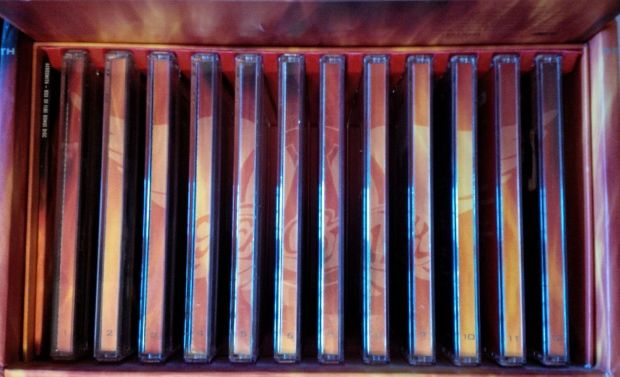
Wrapping up this exhaustive look at the Box of Fire and all the albums inside, there is very little left to add. The packaging is cool; a sturdy box with orange flame emblazoned all over. The front door opens “garage style”, with a little plastic “match” as a handle, painted to look as if burned. Each CD, housed in its own jewel case, slides easily in and out. It’s a simply lovely way to display your Aerosmith collection, open or closed — when lined up, the CD spines form an Aerosmith logo! Each disc is numbered 1-12 (except the Bonus Disc), and can be differentiated from the regular retail versions by the numbered spines. If you bought these albums separately, they do not have the numbers or the coordinated spines that form the Aerosmith logo. That’s how you can tell the difference!
I’m glad to have taken the time to listen to the entire Box of Fire, in sequence, from start to finish. That’s something I haven’t done since I first bought it.
4/5 stars (for Bonus Disc and Box of Fire overall)
We temporarily interrupt the Aerosmith series in order to bring you this…
NEW RELEASE
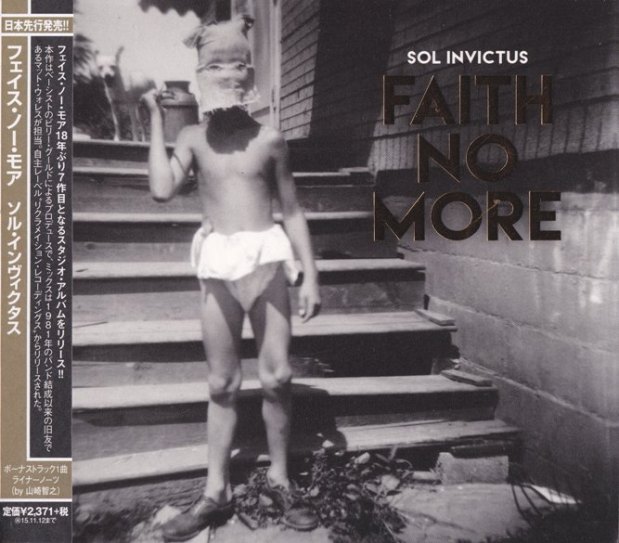
FAITH NO MORE – Sol Invictus (2015 Reclamation, Japanese import)
When I worked at the Record Store, I used to tell the younger folks, “If you like bands such as Korn, System of a Down, or Incubus, then you need to check out Faith No More. They were doing what those bands did way back in the early 90’s.” I still maintain that to be true. Faith No More have been there, done that, and moved onto Sol Invictus, their first studio album in 18 years.
Every Faith No More album requires multiple listens to “get”, usually somewhere between three and a dozen listens. There is no shortcut to this. The only way to appreciate Faith No More is to give each record the time and focus that it deserves. Faith No More is not background music nor have they ever been. Scott from Heavy Metal Overload said in his Sol Invictus review, “…On initial spins it seemed like Faith No More were playing it too safe. The material and delivery seemed lazy and half-baked.” I had the same impression. The songs seemed too laid-back and passive at first. Then the album began to sink in, as I absorbed its shadowy intensity.
As a fan since 1990, I tried to keep my expectations reasonable in 2015. In my heart, I knew that if Faith No More were to live up to their past, the new album must meet the following criteria at minimum:
1. The album had to continue to straddle many genres of music, as they always have — preferably within the same song. They have done this again, blending exotic moods and textures together into a contiguous whole. Diversity is not an issue.
2. I needed Mike Patton to blow me away with his singing again. I know his voice has changed (as voices do!) but he is such a unique, innovative vocalist that I couldn’t settle for anything less than manic intense awesomeness. Once again, Patton has risen to the occasion. Utilizing gutteral grunts, Tom Waits’ low grumbles, and sandpaper screams, he uses his voice as an instrument. Just listen to that “Go! Go! Go! Go!” hook in “Superhero”. There is no better way to describe it than vocals as a bizarre instrument.
3. A Faith No More album must be bracing, even if the songs are slower and quieter. I found 1997’s Album of the Year (the last album, and the only other one with guitarist Jon Hudson) to be tame by comparison to their prior work. Not Sol Invictus. Even on slower, more melodic tracks like the excellent “Sunny Side Up”, they bristle with tension. There’s an emotional intensity to every track.
4. Faith No More have to sound like they mean it — and they do. I hate when a band reunites, but do not add anything to their legacy when they do it. Sol Invictus has a purpose; you can hear the blood sweat and tears in the songs.
5. This one was a given. The musicianship had to be top notch. No worries there. In addition I feel like I’m “getting to know” guitarist Jon Hudson for the first time, due to his diverse work here. Heavy Metal Overload also laid kudos at the feet of keyboardist Roddy Bottum, and he does deserve credit for creating the textures and atmosphere.
I have to admit I was worried about this album. I didn’t care for the first two singles, “Superhero” and “Motherfucker”. Because of this, I purposely did not play them again, until the album came out. I know that Faith No More are not the kind of band you can always appreciate from a single. I was concerned that the first two singles didn’t leave an impression, but I knew that the context of a full album would do them good, and I was right.
My favourite track of the album cuts is “Rise of the Fall”. This singular song combines elements from all eras of Faith No More into one. At times it sounds like a Mosely-era track from Introduce Yourself. At others, one of the more humid and tropical moments on King For A Day. Then a track like “Matador” reminds me of how “Zombie Eaters” from The Real Thing builds, and builds, and builds. It stands out to me for those reasons, but it is impossible for me to ignore any of these songs. Each one has a personality of its own, and there are none I haven’t grown to like. I look forward to listening to Sol Invictus this summer, and allowing the songs to unfold on their own, and reveal their colours.
The Japanese version of this CD has a fantastic bonus track — a remix called “Superhero Battaglia”. Because I normally dislike remixes, you can trust me when I say this is a good’un. The song is intensified and made more exotic. I like it better than the original. “Superhero Battaglia” was originally the B-side to “Superhero”, logically enough. This leaves one B-side, a J.G. Thirwell remix of “Motherfucker”, still on my “want” list. (It was the B-side to the Record Store Day single for “Motherfucker”.)
Sol Invictus is the first contender for album of the year. (Pun intended.)
 DEF LEPPARD – “Have You Ever Needed Someone So Bad” (1992 Phonogram CD single)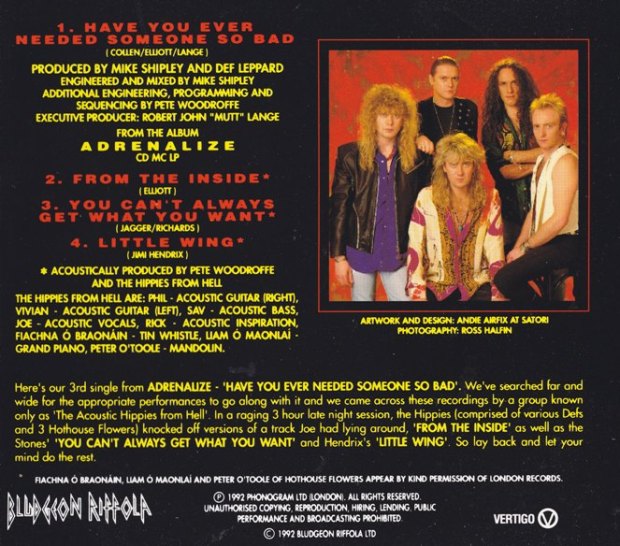

















 mikeladano.com