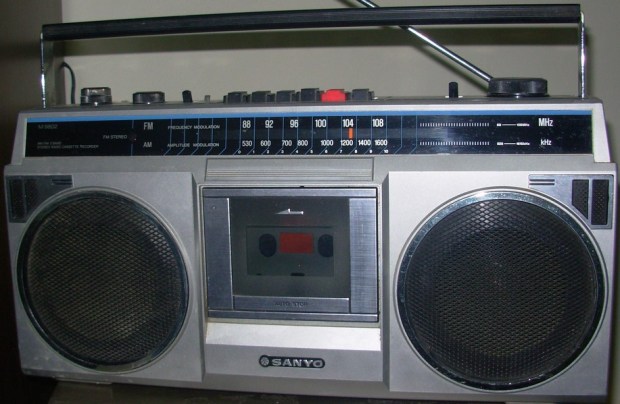
Sanyo

#1117: I Admit It: I Miss My Cassettes

RECORD STORE TALES #1117: I Admit It: I Miss My Cassettes

Hey, it’s me, the guy who has talked about how much he hates cassettes, again and again ad nauseum.  I don’t know why, but I’m feeling a lot of nostalgia for tapes these days.  While CD remains my go-to format, with vinyl in second, I am now on the lookout for old 80s metal cassettes that still play well.  What the hell happened to me?

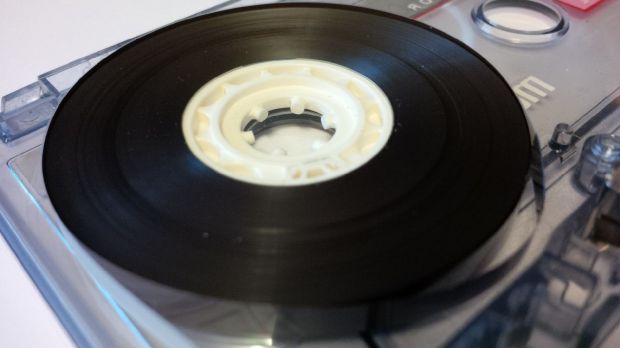
It’s true that I have a lot of bad memories about cassettes, to go with the good.  I have my own system and language when it comes to my collection, but I abandoned cassette back in 1995 because the sound quality wasn’t there and got noticeably worse the more you played the tape.  I considered cassette to be a “soft copy”, with the longer-lasting CD and vinyl being “hard copies”.  You simply have more control in keeping those two formats in good shape.  Cassettes are another story.  It’s just magnetic particles stuck to a ribbon, and every time you play it, those particles wear off bit by bit.  In effect, you wreck your favourite tapes fastest because you simply love listening to them!  There were other complications.  Different decks played at different speeds, with my “ghetto blaster” playing the slowest and most warbly.  I had two Sanyos and then a Sony, and the Sanyos were by far the worst.  Only my Sony Walkman was able to play almost every tape in my collection at something close to the right speed.  Once I learned to drive, I found that the car deck could play pretty much anything, but it did eat a few tapes too.  It was like every time you wanted to listen to music, you had to pick the right equipment and cross your fingers.  I remember wrecking a copy of Black Sabbath Tyr by accidentally pushing two buttons at once on my Sanyo.  This created a loud squeal right during the start of “Anno Mundi” that was impossible to ignore.  Playing tapes was like walking a minefield sometimes!  I always prayed that nothing would go wrong.

CD solved most of the problems I had with cassettes.  Heck, even the artwork was back to being a square!  Cassette cover art was either cropped or “pan-and-scanned” (to coin a phrase) to make a square fit into a rectangle.  Everything about CD was better.  Bonus tracks, better sound, longer life, larger (and square!) artwork…even the ability to skip through songs in an instant.  What wasn’t there to prefer?  And why the hell do I miss cassettes right now?

It’s all nostalgia.  There was something about buying a new album on cassette, and being basically forced to listen to the whole thing.  There was a certain appreciation for the album, with an actual side break, that connected us to the vinyl age in a way that CD did not.  Or, maybe it was just the glory time of our youths that made it feel that way.  The act of closing the door, pressing “play” on a new tape, and laying on your bed to listen with intent.  How often is music just background noise in our modern lives now?  How frequently do we sit and spend time just listening to the music while staring at the packaging today?  Are we listening, or are we multitasking?  I’m multitasking right now, listening to Trilogy by Yngwie J. Malmsteen on my speakers.

I picked that recording for a reason.  I got on cassette from my grandma in 1987.  It was on Capitol Records and it played for shit out of the box.  Many Capitol tapes did around 1986-87.  my W.A.S.P. and Iron Maiden all had similar problems, which them priorities to upgrade on CD when the time came.  I know not everybody likes Yngwie.  Some find him grating.  He does take some adjustment, but imagine listening to your first Yngwie on a slow, warbly cassette.

I do miss some things though.

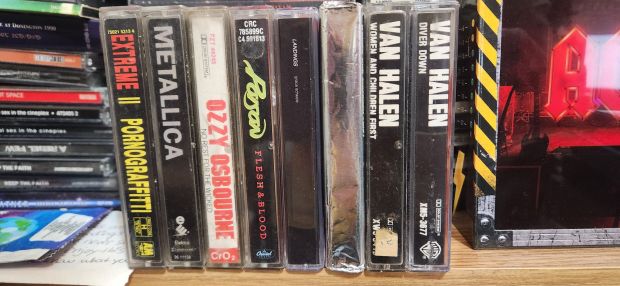
I miss opening up a new tape and seeing what colour or design the shell was.  Usually they were black, but as the 90s progressed they were frequently clear.  Some were white, and my Helix was glow-in-the dark!  With CD there was the occasional thrill when we got a picture disc, but soon that became the standard.  The clunky cassette, with its little wheels and windows, was physically just cooler than a CD and you didn’t have to be as careful.

The lyric sheets were easier to read.  All you had to do was unfold the J-card and lay it out.  CDs often had pages stapled into a little booklet that you had to hold open.  Cassettes may have had smaller print, but the paradox was that the format made it physically easier to read!

Cassettes were perfect for the pocket.  You could easily slide a couple (maybe even three) into a jacket pocket.  CDs never fit right and if you got one in your pocket, it was a tight fit.  And jewel cases were easy to crack and break.

That’s another thing!  Cassette cases had their weaknesses too.  They could crack like a CD case, and the little arms could snap off.  However this is far more common on the CD case, which also have those annoyingly fragile teeth that hold the disc in place.  Cassette cases were just slightly more sturdy than their CD counterparts.

Finally, cassette spines were wider and easier to read.  Period!

I do miss cassettes.  I have better equipment today, and though not an audiophile setup, I get by.  There are some releases I’d like to have on cassette again, or for the first time.  I guess I’m a changed man.  I’m not the format snob I used to be.  However, if they start jacking up the prices of cassettes the way vinyl is today, we’ll have to talk again.
 

#643: Boom Boxes and Walkmen

GETTING MORE TALE #643: Boom Boxes and Walkmen

In the 80s, you had to have a Boom Box.  Or a Ghetto Blaster.  Or whatever you wanted to call a portable tape deck/radio.  Everybody had one, because they were awesome.

In order to make your Boom Box truly portable, you needed batteries.  There was often a place on the back where you could wrap up and store the power cable.  Then you’d load up the deck with batteries.  My first Sanyo stereo deck took about eight D-cells.  They’d last less than one afternoon of rock and roll.  When the tape started to slow down, you knew your batteries were dying.

Next door neighbor George liked to prop his Boom Box up on his shoulder as he walked, like the kid in the video for “The Right to Rock” by Keel.  It seemed cool at the time.

My second Sanyo was a dual tape deck with detachable speakers.  To make it portable, you just secured the speakers to the sides and plugged in those batteries.  This one took even more batteries than my first one.  In addition to the D-cells to power the music, it also required two AA batteries for the clock!  The truth is, a Boom Box was such a pain in the butt to make portable, that we tended to avoid it.  Sure, we could take it to the park and assault the tennis court with Black Sabbath, but it was just better to keep it at home.  A Ghetto Blaster, plugged into an extension cord in the garage, could still keep us entertained outdoors.  Parents would yell to “turn it down!”, so we would…for a little while before turning up again.

A Walkman was easier on batteries than a Boom Box.  The only problem with a Walkman?  Nobody else could listen in.  So that made it a little awkward and a lot funny when George would walk down the street with his Walkman.

George worked an early shift at Long John Silver’s, which was walking distance.  In the morning he could be seen strolling off to work, earphones on his head.  My sister and I would watch from the window.  As he walked forcefully down the street, suddenly he burst into song.  A lot of the time, you couldn’t tell what he was singing.  Most memorably though, he serenaded the neighborhood with “Love Gun”.

We watched him walk when he suddenly yelled, “ALRIGHT! LOVE GUN!” just as Paul Stanley did on Alive II.  And then George ripped into the chorus:  “Love Gun, Looo-ooo-ove Gun…”

It was hard not to laugh.  George singing in the mornings was a daily event, rest his soul.  We teased George a bit but he was a good person.  He was certainly unique and a non-conformist.

My parents bought me a neat little speaker set to go with my Walkman.  When fully packed up, it looked like a cylinder with the speakers on each end.  When you opened it, you could remove the speakers and set them up on your desk or shelf.  Just plug in a Walkman and you were good to go.  If you wanted to go portable, there was room inside the set for both speakers and your Walkman.  It too was heavy on battery use, but it was a very cool little set.  I brought it to school when I needed musical accompaniment to any of my OAC-level presentations.

Who misses stocking up on AA and D-cell batteries?  And don’t forget extras for when your Walkman slows down. You don’t want to be stuck without batteries! Isn’t it so much easier to just charge some USB speakers and plug them into your phone?  Sure is!


#423: The Tyranny of Cassette in the ’80s

RECORD STORE TALES MkII: Getting More Tale
#423: The Tyranny of Cassette in the ’80s

Anyone who grew up in the mid to late 1980s probably enjoyed their music on the most popular format at the time:  cassette.  Vinyl LPs were still around, and still popular, but not nearly as much as cassettes.  CDs were new and only a few of us had CD players yet.  Cassette tapes had the portability factor going for them.  Everybody had a Walkman, and those who didn’t probably had one on their Christmas list in 1985.

Vinyl was a dying breed in our highschool halls.  There were still some older kids who boasted of the superior sound quality, but none of my friends had equipment good enough to enjoy that sound quality.  I certainly didn’t.  All I had was a turntable hooked directly into a Sanyo cassette deck for amplification.  The sound was harsh and tinny.  The scratches inherent with the format were also more distracting than the tape hiss of cassette.

So, it was all about cassette!  Buy ‘em, trade ‘em, swap ‘em and re-record over them when you decide you don’t like the music anymore.  I have a cassette copy of Michael Jackson’s Thriller that had long ago been erased and taped over with other stuff.  When you couldn’t find a fresh blank tape to record on, you could just erase something else.  Everybody did it.  My friend Bob had a cassette of In Through the Out Door that he recorded over with us talking and goofing around!

For teenage highschool kids, cassettes were enough for our musical fixes.  A decent quality name brand tape could hold up to 110 minutes without stretching.   We used them to tape anything and everything.  (I have a tape with the sound of a friend’s dad taking a massive shit — no, I did not record it, they did!)  Since cassettes were re-recordable, that meant that every kid could even record their own music and become a rock star in his or her own basement.  You couldn’t do that with your fancy schmancy LPs, we all thought!  Don’t like your song?  Just rewind and record it again!  Those who didn’t play music could have their own fun, DJ’ing and and writing skits.  And let’s not forget about taping your friends’ albums.  Recording tape to tape would always result in excessive tape hiss, but kids didn’t seem to mind in the 1980’s.  We ignored the hiss.  It was something we considered part of the music, because we really never heard any music without hiss!

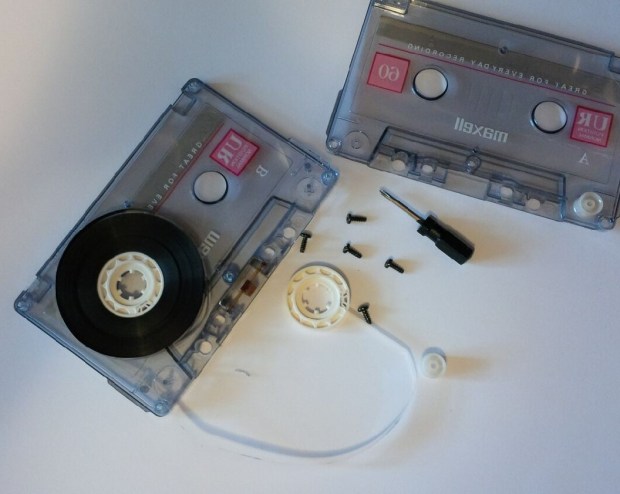
Although the flaws of cassettes are patently obvious today, in the 80’s we were just discovering these troubling issues for ourselves.  We overlooked the tape hiss, but it was harder to ignore speed issues.  The biggest problem that I had with cassettes was inconsistent speed.  Some tapes, especially those made by Polygram and EMI in Canada, seemed to have a lot of internal friction.   Grab a small screwdriver and open up an old cassette tape some time.  Inside you will find rollers, spindles, and bits and pieces all designed for the cassette tape to roll smoothly.  Whether they worked right always seemed to be a matter of random luck.  When friction inside caused the tape to run slow, it was immediately obvious.  The pitch would be noticeably lower, and often the tape would warble as your player tried to play it at normal speed, but fought against the friction.

On the other hand, sometimes the problems came down to your player.  Your tape deck had even more spindles and doo-dads to turn that tape around and around.  Those got dirty and worn out, too.  Sure, you could buy tape head cleaners and demagnetizers, but did they ever really have a noticeable effect on your listening experience?  Probably not.  I used to diligently clean the insides of my tape decks with lint-free cloths and isopropyl alcohol.  Although I could see black filth coming off the rollers when I cleaned them, the sound and speed never really improved.  It was always very frustrating when a tape would play fine on a friend’s deck, but went slow as molasses on your own.  My Sanyo went in for service and professional cleaning more than once, but that didn’t help either.

Although cassettes sounded like shit, and only got worse the longer you kept them, they did have a big advantage over CD for me, and that was portability.  I preferred cassettes in the car, up until fairly recently.  The reason for this was, working in the used CD store, I saw so many CDs that were just utterly destroyed by car CD players.  You don’t get that problem so much anymore, but in the 90’s and 2000’s, there were a lot of discs just annihilated by a lot of car decks. It didn’t seem to matter if the car player was a high-end stereo or a piece of crap.  People would bring their used CDs in to me, and ask me how they looked.  I’d usually ask, “Did you play this in a car deck?”  I could always tell.  Customers would ask me, “How did you know?”  Because the CD would be completely scratched, but always in perfect circles.  Some dirt clearly got into the car deck, and scratched up the discs as they were spinning.  Or, the disc was just scraping up against the internal workings of the car player as it spun.  Either way, the result was usually a CD that looks like a kid’s Spirograph drawing.

At least when playing a cassette in the car, those things could take a beating.  I only ever had one or two that were “eaten” by the player.  Compare that to the thousands of CDs that I saw destroyed by car decks over the years.

If life is a musical journey, then cassettes were my travelling companions for over a decade.  We had a necessary parting of ways, and now I am happy to stick to CD and flash drives when on the road!