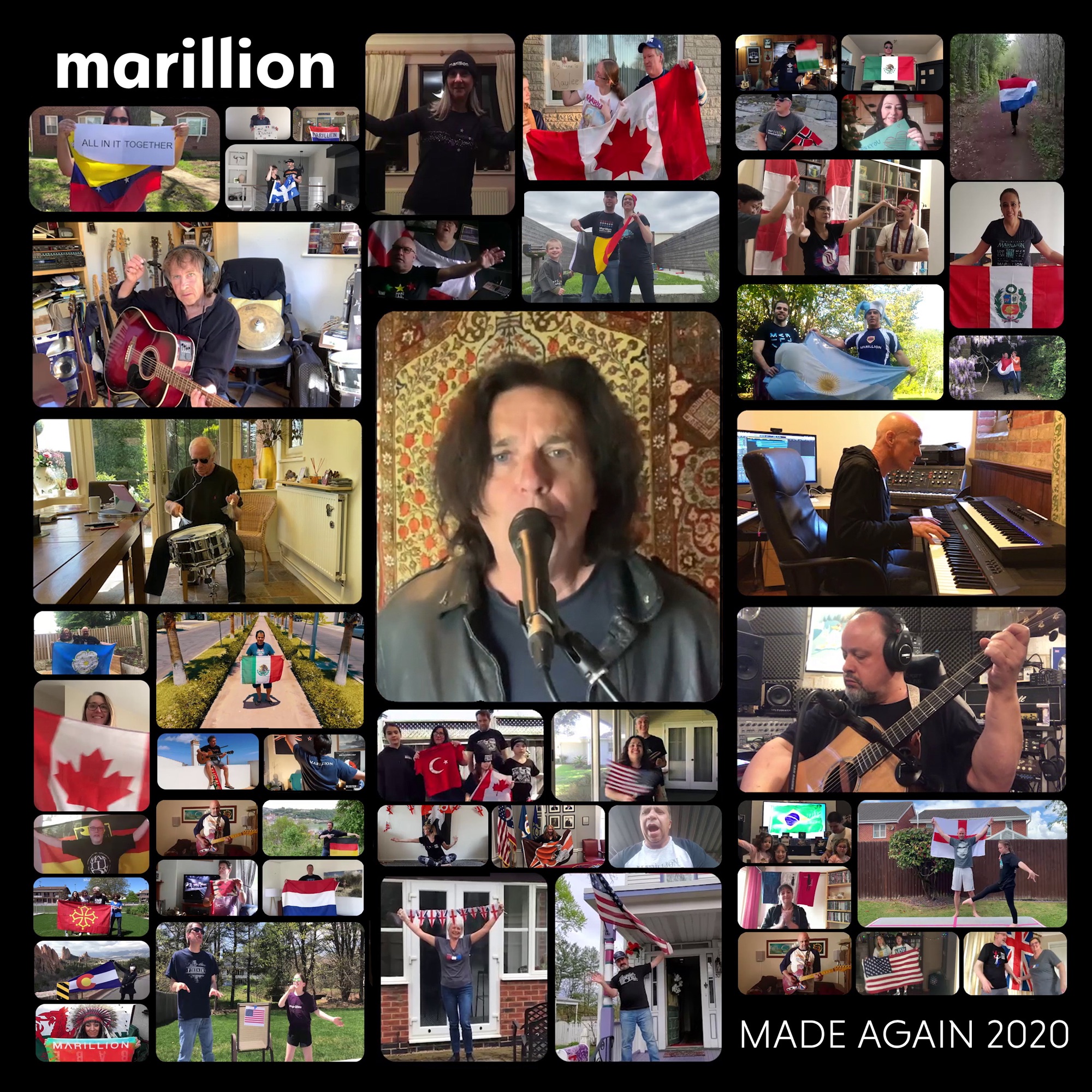
It wasn’t that long ago, in this sad year, that Marillion gifted us a new version of “Easter” from their lockdown spaces. Now, from the landmark Brave album, they’ve re-recorded the hopeful “Made Again”.
“I have been here many times before, in the life I used to live…”
Poignant. We’re all grieving for the lives we used to live, some more than others. I’m tiring very quickly of virus-themed songs, like that damn “I know there’ll be better days” ad I keep hearing on the TV. It’s having the opposite effect on me and making me very bitter.
Since “Made Again” was written in 1994, it doesn’t have the stench of 2020 all over it. We know the lyrics are being repurposed but it’s not so bad knowing their old origins.
“Like I woke up from a bad dream, to a brand new world.”
Unlike “Easter” this is a bit more of a complete arrangement, not abbreviated and without shortcuts. You can buy the track for 99 cents on iTunes or watch the video on YouTube. The video was painstakingly assembled from the at-home performance videos and fan footage sent in from all over the world.
We all need some optimism.
“I woke up from a deep sleep, I woke up from a bad dream, To a brand new morning, To a brand new day, Like the whole world has been made again.”
AMERICAN DAD – “Brave N00b World” (Episode 4, season 17)
Chinese ice cream can save the world. That’s the message of this episode of American Dad.
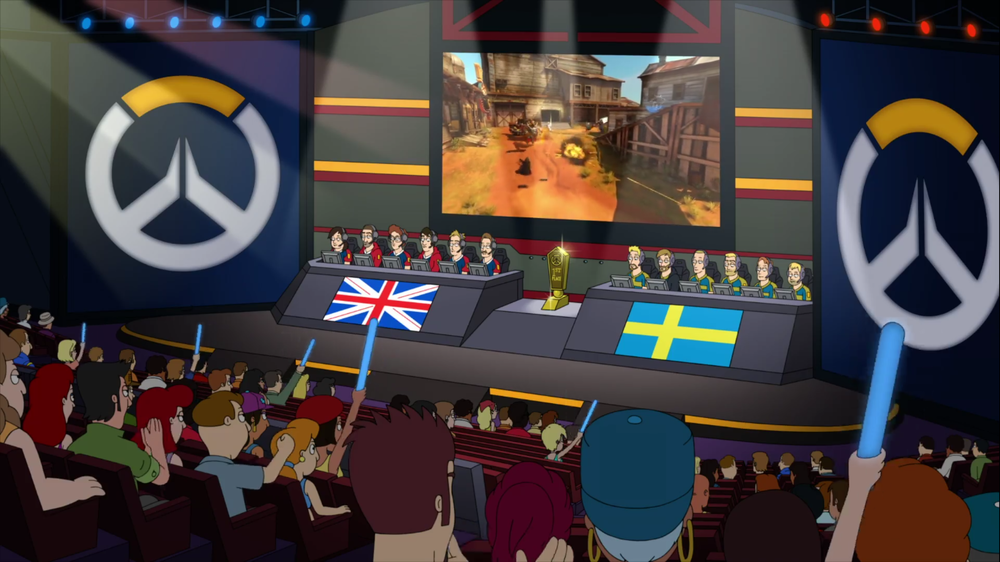
CIA agent Stan Smith has a new assignment. A North Korean general is expected to be in China for an Overwatch video game competition. Stan and his team must enter the contest and progress through the rounds to assassinate the general, but first he will need his son Steve’s help playing the game and looking like a millennial. Jackson better learn to vape if he wants to fool anyone into thinking he’s young and into Overwatch! If the team can get some Chinese ice cream while there, so much the better.
Unfortunately for Stan and his team (and the world), his attention is split between his son and his assignment. He wasn’t totally honest with Steve, who thinks this is more a father-son trip than a kill-a-North-Korean-general trip. As Stan is learning, focus is key. So how can he split his focus between assignment and son?
Since it’s Stan Smith we’re talking about, you can safely assume he screws it up and the mission goes wrong as usual. But this time, he didn’t just screw it up Stan style. He didn’t even stop at full Sledge Hammer. This time, Stan goes all the to way maximum Rick and Morty, and destroys the entire world.
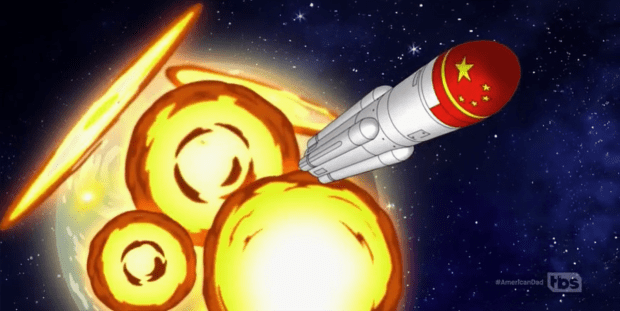
Smith misses his shot, botching the assassination. China launches their nukes. America retaliates. Mutually assured destruction.
Fortunately, China saved mementos of their heritage in a culture pod, including a cone of delicious Chinese ice cream. So America launches an eagle-headed missile adorned with truck-nuts and blaring “Kickstart My Heart”, and the culture pod is destroyed. Before you can say “Kee-stah-ma-hah”, there is nothing left of the Earth. Nothing but rubble, dust, and ash…and a single scoop of Chinese ice cream, floating in space, past Mars, past the asteroid belt, and into the void.
For one million years, the ice cream floats through the cosmos undisturbed until finally an alien ship happens upon it. What an incredible taste! They must have more. Scans show that Earth suffered an “extinction event”. The only way to get more ice cream is to re-create the Earth and let time do the rest.
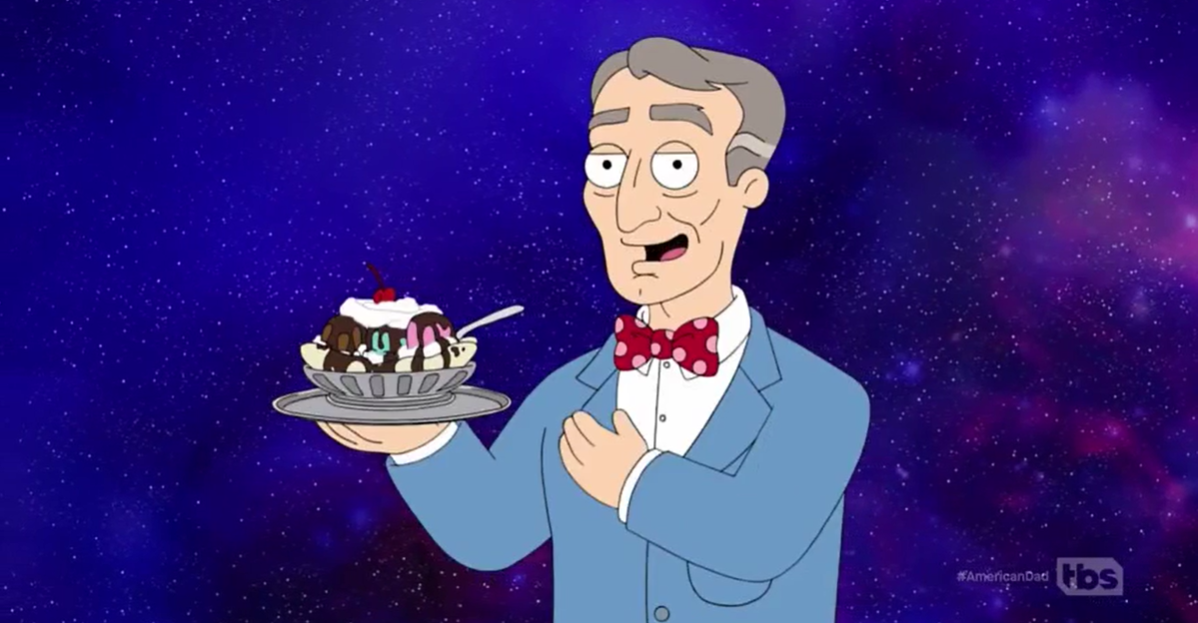
The world has a second chance. Will Stan do it differently this time? Will anyone discover the truth of this new reconstructed existence? Will Bill Nye show up at the end to throw cold water all over “Ice Cream-ulation Theory”? You’ll have to watch to find out.
In the B-story, the entire rest of the family gets their heads stuck in the banister, which basically puts Roger, Francine, Hayley and Jeff out of action. The best instalments are usually Roger-centric, but not this time. Perhaps American Dad needed to catch up with Rick and Morty, or perhaps it should try harder to live up to the promise of old episodes like “Lost in Space” or the saga of the Golden Turd. At first it appeared this episode was going to a gamer-based comedy. Then it evolved into something more existential. It can be stated firmly that “Brave N00b World” returns the show to a high point like the good old Mike Barker days.
Since I already had the 1986 Saga scheduled all week, I didn’t want to schedule a formal live stream for this weekend like I usually do. Instead I decided to just wing it and go live whenever I felt like it. Streaming periodically through the day like this, we had almost 3 hours of jibber jabber!
This week’s major feature: The “Nigel Tufnel Top Ten” KISS albums list! Special guest star: Uncle Meat.
Len Labelle also sent a list, but I forgot to write it down so we will do his next week!
If you just want to see the KISS lists, you can skip ahead to 2:06:30 of the stream.
If you want to hear me rip an epic fart point blank into the microphone in stereo, skip ahead to 1:52:30 of the stream.
If you’d like to hear my mom’s reaction to Uncle Meat’s attraction to my sister, skip to 0:57:10 of the stream.
If you want to see Deke move and speak in real life, skip to 2:46:15 of the stream. This is his very first appearance, ANYWHERE – you’re welcome for the start and the boost. Hope it is appreciated.
If you’re just interested in the Star Wars action figures, you’ll want to watch from 0:12:45 of the stream.
“If you’re going to keep sitting next to me, never sing again,” said Steve Vanderveen. It was the first day of grade 9, the first day of highschool, the first day of my new life. And I fucked it up! In Catholic school, we had to sing “O Canada” and we had to sing it like we meant it. Little did I know, in public school, they didn’t sing. They just stood at attention. But on that first day of school, it was me and only me singing, without even realizing it.
What a winner.
I managed to recover from this embarrassment, and make a go of highschool. Without all the loser baggage I carried from the grade school days, it was a fresh start. The bullies were gone. I was making new friends! There was Rob Daniels and his buddy “Gumby”, there was Danesh and Anand, and I had never seen such diversity in a classroom before. As strange is this sounds, in all the years from kindergarten up, I never had a black kid in my class before. And now here was Carlton, a popular kid who loved to talk about how beautiful Jamaica was. I don’t think I knew anyone who’d even been to Jamaica before. I wanted to be his friend! And of course there was Peter Cavan, who absolutely was not my friend in grade 9! I ratted him out for eating liquorice in Geography class, so you can understand why it took him a few years to warm up to me. By the end of highschool, we were best friends.
And the girls? I had never seen so many in one place before. I developed many secret crushes. They never knew, because I never quite figured out how to talk to them! But they were there, lots of them, and I thought maybe I’d have a shot.
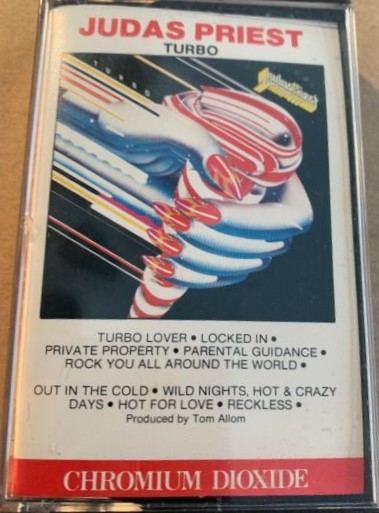
The first week of school, I bought some new music: Turbo, by Judas Priest. I did my homework on the back porch, with that cassette on the boom box. I only had three Priest albums: Screaming, Defenders, and Turbo. Turbo was easily my favourite. While not as heavy as the other two (and let’s face it, Screaming for Vengeance can rip heads clean off), Turbo was more the kind of music that I was into. It was melodic, with hook after hook, and possibly even female appeal.
But soon after, something monumental happened. Monolithic. Youth-defining.
Iron Maiden came out with a new video.
“So, understand!” sang Bruce Dickinson in what was, quite honestly, the best video we’d ever seen. “Don’t waste your time always searching for those wasted years!” A bit of a word salad. If a certain president said something like this today, we’d consider it another sign of his declining mental faculties. But even to us as kids, it was obviously a road song. A song about the loneliness of touring. Many of the new Maiden songs were darker and introspective. This was not lost on us. Nor was the lack of Dickinson writing credits on Somewhere In Time. It was clear to us that some of the rumours were true, and Maiden were starting to burn out a bit. That they put out an album as awesome as Somewhere In Time is remarkable, but I recall an air of disappointment in the press. Certainly, after the triumvirate of Beast, Piece of Mind, and Powerslave, it had a lot to follow.
My best friend Bob and I sat in the basement, watching my recording of “Wasted Years” over and over again, pausing to catch every single Eddie painting. The video was a combination of black & white performance, with still photos and album artwork edited in quick flashes. The kind of thing two kids should be obsessively pausing and analysing! Eventually we both got the album and naturally gravitated to the same songs. I used the lyrics for “Alexander the Great” as a calligraphy project in art class.
My friendship with Bob was the cornerstone of my youth, and as much as I looked up to and emulated him, there were times he did me no good whatsover.
One night we were throwing a ball around the park, and one of us (probably me) threw it over someone’s hedge. Steve Pushcar’s hedge, as it turned out. Bob jumped the fence to retrieve it, and got yelled at by Steve’s mom. Bob said he was only getting his ball back, but this quickly degenerated into an argument. Bob always was a bit cocky. Whatever he said that night, Steve Pushcar went at me for the next two months.
Me? Why me? I was just the sidekick! I just stood there? I didn’t say one word! Why me? Because Pushcar couldn’t get at Bob, and he’d have been flattened if he tried.
Pushcar was in my art class. First he stole my pencil case and returned it to me completely empty. Then he stole my art. He was a fucking asshole. The shitty thing was, he did all this anonymously. I didn’t even know he had a grudge against me. Not until a mutual friend told me. That’s the kind of coward he was. But his campaign only lasted a couple months, and highschool was actually pretty uneventful after that.
As the year went on, I discovered two “new” bands: Bon Jovi, and Europe. Neither were really new; they were both on their third albums. But the teen magazines pitted them as rivals: heartthrob vs heartthrob, Jon vs. Joey. Who would win? (Jon.) Really, all they had in common musically was the use of a full time keyboardist.
Partway through the year, who should show up but Steve Hartman, my old nemesis from Catholic school. He had transferred from wherever the hell he was. But he couldn’t get to me. I was in the “advanced” program and he was in the “general” level. We had no classes together, and I think he only lasted half a year. I do remember him showing up in our gym class, wearing his shirt over his face so the teacher wouldn’t realize he had an extra student. We were doing ball hockey, and the teacher Mr. Paull was too spun to figure it out. I had a malingering wrist injury that I really milked so I could stay on the benches. As if Mr. Paull would even notice.
At the end of the year, it was obvious where my talents did not lie. My two worst classes were French, and typing, 66% in each. Typing? I know, right? I type all day. It’s all I do. And I still fucking suck at it. I was never good at proper form, and today type using only four fingers. Funny thing. The French and typing teachers were married. Monsieur and Madame Euler. They were fantastic teachers, just because I was a disappointment doesn’t reflect on them. It reflects on me absolutely sucking at languages other than English, and my lack of physical coordination. I mean, the following year I tried to play guitar. The same problem followed me from keyboard to strings: I can’t make my extremities go exactly where I want them to. I’m sloppy and clumsy and have no timing. Madame Euler wasn’t going to be able to fix that in a grade 9 typing class.
I didn’t get any girls to talk to me, but I had a good year. For what might have been the first time, I really had a good year. They’d only get better. I was heading into a summer full of great music. Stuff like Priest Live, Frehley’s Comet, and Love Is For Suckers. Even then, I could not believe how much my life had changed for the better. I succeeded — I escaped.
The future was bright. Bob and I went on to have many adventures and a few “Crazy, Crazy Nights”. But that’s another story.
GETTING MORE TALE #833: Postcards From the Solo Summer of ’86
(Part Four of the 1986 Saga)
While we definitely had our fun in the summer of 1986, there was one person missing from all of it: Bob Schipper. I really missed my best friend. Bob was spending the summer in Calgary, Alberta with his older brother Martin. I was so used to doing…well…everything with Bob! It was really quiet around the neighbourhood without him. I had to come up with my own games and schemes without my partner in crime.
I spent a lot of afternoons watching TV in the basement, recording music videos and watching WWF wrestling. I wanted to update my buddy on all the latest songs I’ve been hearing, and the newest wrestling plots and turns. I was bored! But one day, I received a postcard from him. The first contact in weeks! I was so excited to hear from my friend again. Even in this brief postcard, he talked about music. We were both so into rock bands, it was already dominating our interests.
“Hey Mike, it’s me Bob, writing a post card to you to tell you that I’m still living. I hope everything is okay over there, because it’s great here. I got this awesome poster of Gene Simmons you’ve got to see. Well, see you soon.”
My mom got his address in Calgary from his mother, and I wrote him back a letter. I had to update him on all the gossip and goings-on in the world.
A short while later I got a letter back and jumped in glee. I read it twice through. One of the biggest pieces of news that I had to update him on, was that my parents had finally agreed to get a dog. “Boy, Katy finally got what she wanted,” Bob said. It was definitely my sister that wanted the dog most. I was not sure how I felt about it yet. Big changes, big adjustments!
Bob had news of his own. I had heard he was going to be seeing a concert, but didn’t know who.
“You know what, the concert I was going to see, well it was cancelled. The group I was going to see was OZZY OSBOURNE, and I was looking so forward to it, but now he’s coming back in October instead.” That would obviously not do, since Bob would be coming back home in August. The opening act was a group neither of us knew: Metallica.
“P.S. – Have you seen the commercial for Friday the 13th Part 6? I’m going to see it.” Bob loved his horror movies a lot more than I did.
The next letter from him arrived a couple weeks later.
“I can hardly wait to show you the two albums I bought. They’s both rare KISS albums! The first one I bought is a mint condition Killers album with the new KIZZ logo.” This is the very copy of Killers that I own today, acquired from Bob all those years ago. No longer mint condition, far from it in fact. I remember doing things like playing it backwards, and tracing the West German logo with the backwards Z’s. You can see the indentation from my pen. A shame, really.
“If you think that’s great,” he continued, “wait till you see my other one! It’s a picture-disc album, with a Kiss interview on it! On one side it has a picture of the unmasked Kiss, and the other side Gene with his axe guitar! The amazing thing was it was only twenty dollars! Also, I got two cassette tapes, Alive II and Love Gun. I also might be getting Dressed to Kill.” I recall the Kiss interview disc was from the Lick It Up era because they were talking about Vinnie Vincent and taking off the makeup. In fact I still have this interview on a cassette, because I taped everything from Bob.
We were getting closer to getting our new dog in August. Bob remarked, “I can hardly wait to see Katy’s new dog.” Funny how we always referred to it as her new dog. That does bring back memories though, of the way things seemed before we knew what it was like to actually have a family dog. It really did seem to me like it was Kathryn’s dog. And she is definitely the dog person of the family today. She always has multiple pets in the house.
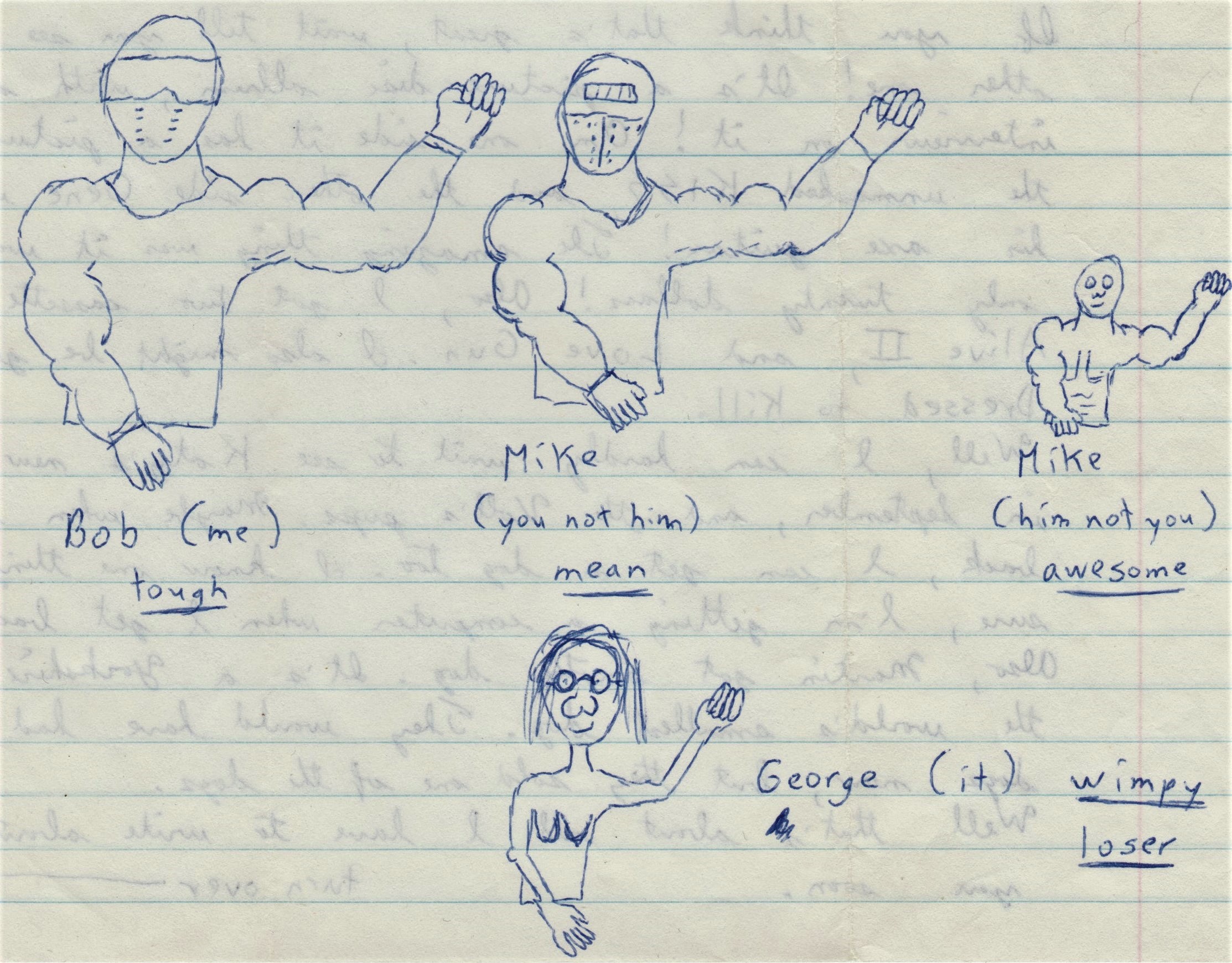
In our letters back and forth, we took shots at the neighbour George, who was a bit of a punching bag for us. It was well deserved though, George earned every bit mockery we poured into our letters. He crossed the line when he tried to steal Bob’s brother’s bike. He stole Lego from us. He was, honestly kind of a dick back then. So Bob ended his letters with some drawings of himself, me, his new nephew Mike, and George.
Reading these letters today, it’s clear how important our friendship was to both of us back then. For me personally, I looked up to him and needed him by my side as I embarked onto my next journey: highschool! It was too bad that I didn’t have my best friend around for that last summer before highschool, but at least I still have the letters.
Potentially triggering material ahead. The following is a work of fiction — or not.
Just A Boy
I stepped into the titanium chamber, glowing lightly purple from the inside. A bare metal seat was firmly bolted to the floor with two control panels, one on either arm. The seat was its only occupant. The walls glowed faintly as the mercury pumps worked their strange magic. I sat. The door closed automatically, latched shut and hissed with the sound of a vacuum seal made perfect.
On the right control panel, I entered a date. February 18, 1986. On the left, my hand flew as I swiped a series of commands. In my excitement, I forgot to fasten my seatbelt. With that now tight across my chest, I pulled the red lever on the far left. My vision blurred.
G-forces assaulted my body but I had no difficulty in breathing. I saw stars, the kind like when you fall and hit your head. I heard voices but they were melded together and the words indistinguishable. White noise but identifiably human. Then I heard music. A guitar strummed. A triangle tinkled.
I was close.
The taste of hot chocolate, but overly sweet and unappealing.
Very close.
The sensation of cold and damp. Feels like February. I must be there.
Music again.
For I am just a boy, Too young to be sailing. I am just a boy, And my future is unveiling, And I’m so frightened of failing.
My eyes opened — I didn’t realize they had been closed. The chamber door was open ahead of me and I could see white snow, and dark green trees. I heard the sound of children. But I could not be seen. I could not be heard. In fact I was not really there at all. A part of me was, but not physically. I could see, hear, smell and feel my surroundings but not affect them. The process of travelling back through time had a strange effect on the senses. To a limited degree, I could also feel what my younger self was experiencing. The cold, wet feet. The taste of that awful hot chocolate. I was in the right place.
This was Mount Mary 1986.
Every year, the Catholic school sent its graduating grade to a week long retreat at Mount Mary. A few students declined to attend, but only over the loud objections of the Grade 8 teacher.
“Any student I had that didn’t go to Mount Mary either died or went on the drugs!”
For an entire week, I was stuck with those awful kids and the oblivious teachers. It was a lonely time. That’s why I had to come back here.
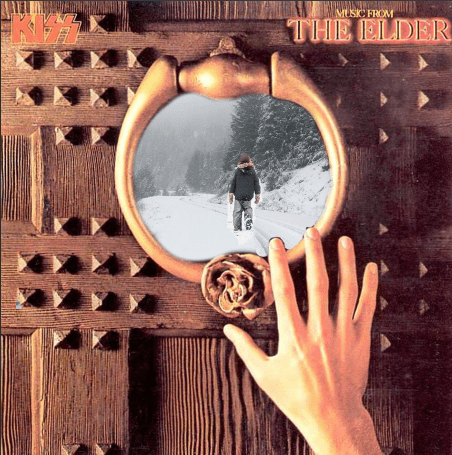
We weren’t allowed to bring anything with us to Mount Mary except our clothes. No Walkmans, no music. The night before we left, I absorbed as much Kiss as I could. Times like this called for my favourite band, and only my favourite band. I memorised Double Platinum and The Elder the best I could.
That music that I was hearing when I arrived back here? The songs in my younger self’s head.
I surveyed the landscape. It felt like I was floating. I could see my legs, and they hovered inches above the fresh dusting of pure white. I could move in any direction at any speed I liked. I just had to think it. I couldn’t be seen or detected in any way. Nothing more than a ghost in their world. A world that disappeared, and transformed over the decades into the one we live in today.
I followed the sound of the children. Their footsteps were deep in the snow. The larger prints were from the teachers. The adults who enabled the bullying. The people who allowed this trauma to happen under their watch.
“Here we are! Agony Hill!” said one of the supervisors. I remember this hike. The teachers hyped up the forest to us beforehand. “You’ve never seen trees so dense in your life!” they boasted. It wasn’t true. It was the same as the cottage. Agony Hill was a steep incline that we had to traverse. This time, I flew.
There! Just below. I saw him. Me. In the blue coat, blue mittens, and blue jeans. Why did I always wear blue?
A couple larger kids pushed. I felt the shove in my back. I felt the surge of anger and the welling of tears. I remembered.
I stopped. I had no idea that time travel would be this intense. I wasn’t prepared. The wounds are fresh. Other memories are flooding back. An assault of snowballs was still to come, followed by the laughter.
It was time to do this.
I willed my presence ahead and caught up to my younger self. My face was red. I was burying as much of it as I could into my coat. I could see the glistening in my own eyes. I was utterly alone. I had a few friends but they were walking in groups with other kids that didn’t like me. But I wasn’t really alone this time.
It felt weird talking to myself. I put the strangeness aside and spoke.
“Kid,” I started and stumbled.
“I know you can’t hear me. I can’t hear me. This is weird. Let me start over. Kid, I know what you are going through now feels like an unending series of hellish bad dreams. I know it because I lived it. I survived it. Those kids that have power over you today — power over your fear — won’t be around forever. You only have to hold out a little longer. Just a few more months. And there are good things to look forward to in those months too. It’s not all doom and gloom.”
“Trust me on this. You are just at the horizon of experiences that will change your life. When that happens these kids will be in the past, forever. They will have no power over you anymore. They will have no more influence on your life than a bent and creased photograph. I didn’t realize it before, but seeing you now, you are already on your way.”
“You climbed Agony Hill. You were breathless by the time you were over the top but you made it. And guess what? Your legs and lungs will be stronger tomorrow because of it.”
“This whole time, with all these kids, you’ve been preparing yourself for the better years. And you are going to cherish and savour every last moment of them. You are going to use all of this, the good and the bad, to light a fire. Everything about this time and this place is going to drive you to be an individual. And that individual is the guy next to you right now.”
I paused my monologue and observed something peculiar. I saw something flicker on my younger self’s face. It was like he could hear me. He shouldn’t be able to. It turns out, nature is always two steps of humanity. There is no such thing as a time travel paradox. Nature wouldn’t allow it. All I could do was see and feel the past, but I couldn’t interact with it. The laws of reality are quite firm on this matter. Yet I could swear I saw my past self react to my own words. Impossible.
Yet the younger me appeared more relaxed in posture. I wouldn’t go so far as to use the word “confident”, but there was a visible shift in that direction.
Impossible! Carry on.
I continued. “Stay you. You are going discover some amazing new music, meet people that inspire you to create, and these…” I trailed off. No need to encourage my younger self to swear more. “These little jerks are going to be nothing more than ghosts in your past real soon. But what they have done by mocking you and belittling your individuality is that they have made you more determined. Instead of trying to be more like them, you are going to keep pushing to be more like you.”
I had to pause again. After all, I don’t want to lie to myself.
“It’s not all a bed of roses. I don’t want to mislead you. What these kids did to you is going to last and it’s going to take work and time to process it. Sometimes memories will sneak up on you. But I’m OK. I can honestly say that I am OK. Being an individual makes me happy. It means people really like me, for being me, not for someone I’m pretending to be. And guess what? Tables always turn. One day, the things you have always loved your whole life are going to be considered cool. And you are going to be the expert.”
Suddenly my younger self smiled. I could not believe it. Coincidence? I immediately felt the need to cut my visit shorter than I planned. What if the science had an unseen loophole? Science always has a way of surprising us. I didn’t want to change the past, or even take the risk. Let the theorists argue about it. I had to go.
“See you round, kid.” I gently kissed myself on the forehead. It didn’t seem a weird thing to do. But I had to go now or I’d never leave.
In a blink I was back in my chair. I felt the warmth of my tears on my cheeks. I had to wipe my eyes to set the date back to the present. Seatbelt on, I pulled the lever. I saw the stars, and again I heard the music. Drums now, stuttering through time.
I was so frightened, I almost ran away. I didn’t know that I could do, Anything I needed to.
They said I didn’t stand a chance, I wouldn’t win no way. But I’ve got news for you, There’s nothing I can’t do.
I believe in me.
They say that time travel can be a bit unnerving. That’s why most people don’t do it. They try it once, and most folks leave it at that. Me, I need to recover after this trip. Home again, my tired eyes closed as I drifted off into a dreamless sleep.
CODA
February 18, 1986. Mount Mary, Ontario Canada.
I can’t sleep. All I can think about it is that voice I heard today on Agony Hill. This place is weird. The shadows on the walls are strange and creepy and these beds feel like army beds. But what’s keeping me up is that voice. I’ve never heard a voice like that before. Was it a ghost? Is this place haunted?
I’m drifting off, but I hear music: the music in my head that I memorized before they bussed us off to this awful place. The beat is still fresh in my head and the words echo into my sleep. I feel OK. I feel like I’m going to be OK.
I believe in me. I believe in rock and roll. Yes I believe in me.
One of the many recurring themes here has been the awful experiences of being a metalhead in Catholic school. A story that has somehow escaped being told until now is the one where those bastard kids gave me the name “Fag Boy” for a whole school year.
Grade 8, the 1985-86 year, had to be the worst. It was kicked off by a huge fight with the school bully Steve Hartman, a total piece of shit, but at least I won. Not that it helped. I was teased relentlessly all year for my love of Kiss and Judas Priest. Then I had mono. Incidentally, Catholic school bullies are the worst and the teachers didn’t give a fuck. When one kid, Ian Johnson, got into a fight with another bully, the teachers made them walk around the schoolyard together hand in hand. What was that supposed to do?
The only thing that made life easier that year was beating Hartman in September of ’85. That kept him off my back for the school year, although there were other bullies waiting in the wings. Jeff Brooks, who stuffed snow down my jacket every Thursday after shop class. Kevin Kirby, who copied my homework. Towards the end even Hartman was campaigning for a “rematch”.
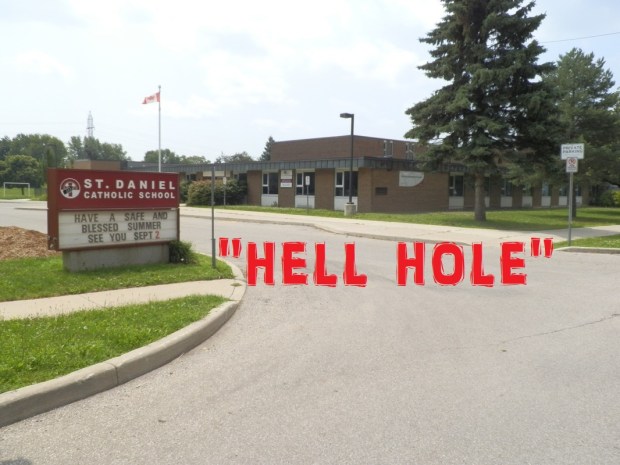
My sister used to call that school the “Hell Hole”. She would sing Spinal Tap’s “Hell Hole” when we drove by. This is a little kid in grade 4 calling her school that name.
At the start of the eighth grade, to learn social responsibility, we all had to volunteer for something. There were a limited selection of slots for each role we were offered. I cannot remember all of the duties that were set out on our menu of options. Volunteering at the church was definitely among them, but I volunteered for the one I thought would be the most interesting: security! On a regular basis, we were to walk around the school when it was closed to make sure all was well. Keep an eye out for anything wrong, like vandalism. It was perfect because I was always biking around that direction anyway. It was really the most appealing of all the options to me.
I’m sure you have already guessed they didn’t give me the security assignment. No, I was given something that was supposed to be better, but was actually far worse. It was such a dubious honour. I was Flag Boy.
I wasn’t athletic, I was a skinny kid who openly listened to Judas Priest. No way were they putting me on security. They gave the two open positions to a couple of the athletic kids. I don’t think either of them did any security that year.
As Flag Boy, I was responsible for putting out and bringing in the Maple Leaf at the start and end of every day for the year. It was worst at the start of the day. When announcements were about to commence, I had to get out of my seat and leave the class, which always seemed to amuse them. Then I had to walk down the hallway past the other grade 8 classroom, who always mocked and laughed and pointed at me as I went. They called me “Fag Boy” from day one. What made it even worse were my boots. My dad gave them to me. I thought they were so cool. They didn’t have laces, they had dual zippers. The boots only made me more a “Fag Boy”.
When the first pair of boots wore out, my dad gave me his second identical backup pair. Ironically those boots would be considered so retro and stylish today.
The abuse that year was pretty bad and I faked sick a lot. I faked sick mostly on Thursdays, which was shop class. They bussed us to another school, St. Joseph, which had a woodworking shop. The supervision was minimal and the bus rides were all but intolerable. At one point or another I just decided I couldn’t take it anymore and faked sick as many Thursdays as I could. By the time I got sick with mono for real, I had several incomplete projects in woodworking. I was home for the rest of the term, and I never had to worry about those Thursday bus trips again.
Having mono sucked a lot, but Thursdays on the bus were far worse. I considered it more than a fair trade.
While sick at home for real, I absorbed as many Pepsi Power Hours as I could. I heard Hear N’ Aid for the first time. I became addicted to “Rough Boy” by ZZ Top because of that damn music video. (I guess I learned from an early age that I’m really a leg man.) My heavy metal credentials grew by leaps and bounds and I listened to more and more songs: “Metal on Metal”, “Never Surrender”, “Turbo Lover”, “Rock and Roll Children”. To this day, I associate those songs with my sick time in 1986. Especially Dio’s “Rock and Roll Children”. The surreal music video suited the way I felt physically. It didn’t look like the real world and I didn’t feel like myself.
My association of heavy metal music with relief from the outside world was cemented that year. I had always come home to the comfort of a few Kiss tapes. In 1986, sick with mono, I was safe from the school and surrounded not by bullies but by Ronnie James Dio, Ozzy Osbourne, Rob Halford, and Bruce Dickinson. They didn’t call me “Fag Boy”, in fact their lyrics encouraged me to dig for strength. Recovering from my illness, I had built this wall of metal around me. It would be my armour for life.
I don’t know if those kids remember calling me “Fag Boy”, or if they would admit it. I know I wouldn’t recognize Hartman if I saw him today. They used to talk about forgiveness a lot in Catholic school. You can forgive, but you never forget.
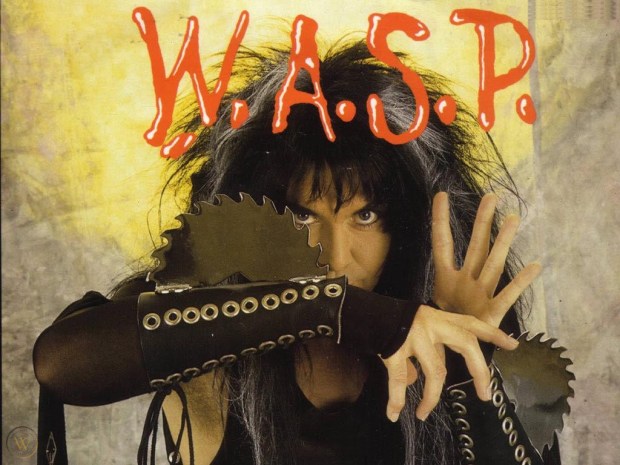
It was Bob Schipper that discovered if you cut out the top of a juice tin, and then continue to cut teeth into it, you could make yourself a replica saw blade wrist band like the ones wielded by Blackie Lawless of W.A.S.P. Bob was always the one inventing things. He was the most creative of us. He was usually the instigator.
We had to improvise with our rock n’ roll accessories. Neither of us had the resources or the parental approval to make or wear leather studded wristbands. You could buy studs at the local mall rock shop (there were rock shops opening up everywhere) but instead of trying to do that, we made our own out of the same juice tins. Before too long we had studded wristbands made of black electrical tape backed by cardboard and tin.
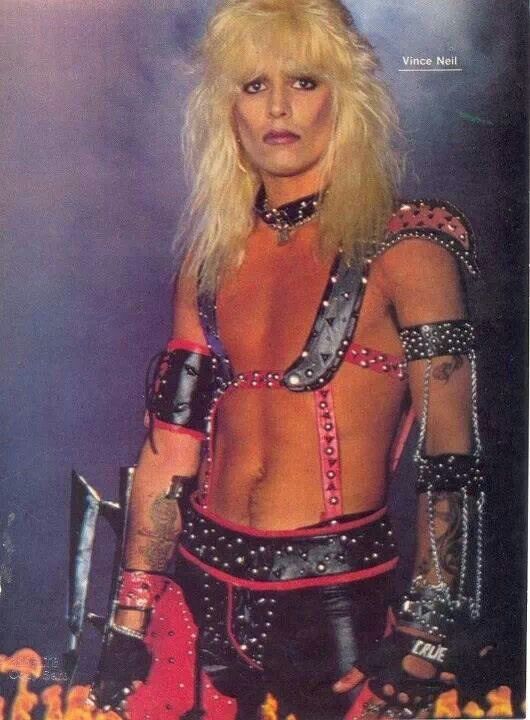
What I really wanted to do, but failed to achieve in a realistic looking way, was to make Vince Neil’s arm gauntlet. He had this wrist piece that appeared to have a crossbow bolt launcher on it. It looked lethal! Though I tried, I couldn’t make anything that looked quite like it.
Bob was also working on a jean jacket project, with buttons and a huge back patch of Iron Maiden’s Powerslave. Buying a back patch was an important component of the jacket. He had to pick a cool image that meant a lot to him, because it would be his identity, at least from behind! The only thing people would know about him from behind was that he liked whatever band his back patch was. The Powerslave choice was perfect. When Bob eventually outgrew the jacket, he took the back patch off and sewed it to the front of his guitar amp. That he blunted the sound of the amp wasn’t the issue — looking cool was the point. At least he got a lot of mileage out of that patch.
Meanwhile we’d drink as much apple juice as we could, to gather more raw materials for our precious projects. A soup tin, for example, could be carved into the shape of a ninja star. Scouring our recycling bins for more, we would create our little weapons and throw them at trees, trying to get them to stick. In the summer of 1985 we had an entire arsenal made of tin. Each throwing star was only good for one or two throws before they were blunted and deformed. Bob got the idea to buy throwing knives instead…improvised throwing knives.
We went to the Zellers store, bought a set of the cheapest possible kitchen paring knives, took them home and threw them at trees. A paring knife would last longer than a soup tin throwing star, but not by much.
Hey, give us some credit! We didn’t steal mom’s knives and wreck them. We bought our own!
It was an innocent time, but we’d heard that the cops would give you a warning if you were downtown wearing spikes. Not studs, but spikes — the pointy kind. So we kept to our neighbourhood with the juice tin sawblades and throwing stars. I can remember one Sunday, riding my bike solo with my juice tin sawblades on. I ran into a kid I knew who had a good laugh at me. I never wore them again. They were pretty haggard.
You can imagine how silly we looked, riding around on our BMX bikes with studded wrist bands that smelled like soup. Short-haired boys with just a tiny fringe of growth at the back. “Leave the back long,” we’d tell the barbers though they never did. “I have to cut off the dead ends,” they’d respond. And you’d come out of the salon with short hair again.
You know, mom and dad used to give me a hard time about the way I looked, but thinking back they probably had good reason!
GETTING MORE TALE #833: Introduction to the 1986 Saga
Upon reflection, I don’t think any year was more pivotal in my life, personally and musically, than 1986. When I finally posted the “lost chapter” about 1986 a couple years ago (over 5000 words!), I thought I had said everything I had to say about that year. I was wrong.
A few weeks ago I started writing more chapters from that period, reliving the music, sometimes trauma. There was a lot still to unpack. The Catholic school years were not pleasant. After writing a particularly raw chapter (to be called “Flag Boy”), I received some really good advice. “Have you ever tried writing a letter to your younger self?”
The idea is to show kindness to your inner child. While I was familiar with the concept, doing it myself had never occurred me to. That’s not the kind of writing that I do. But what if I could frame it in such a way so that it is the kind of writing that I do?
In a caffeine-fuelled two-hour spurt I wrote a story, including the letter, which flowed out of me like a stream. I played the very same albums while writing that I played back then. Emotions were happening so I had to stop a couple times. By the end of it I was completely spent. It was not only a therapeutic experience, but I also pushed my abilities past their normal boundaries. The end result is a story I am so proud of that I’ve chosen to publish it, even though that wasn’t the original intent. I chose “me, 1986” as the younger self to write to and so it only makes sense to include this work as part of the series.
The 1986 Saga currently stands at five chapters, with the letter as the centerpiece. Music exists as an important component to every part of this journey. Rock music. Hard rock music.
I hope it’s not too much of a downer. Some chapters are funny, and I made sure the Saga has an upbeat and optimistic ending. And so it should. I’m still breathing, right? I’m still rocking and rolling, keeping on keeping on, and doing my part to spread the rock to every corner of the globe.
Including the previously published lost chapter “1986”, this series will make it a total over 11,000 words on the subject. If this were a proper book like an autobiography I would have weaved them together into a single chapter, but the nature of online publishing means you get the instant gratification of posting piece by piece any time you want. The end result feels more like a “work in progress”, but I get to put everything out now and feel that satisfaction from it.
Because everything has to connect back to music, we’ll be revisiting early love of W.A.S.P., Iron Maiden, Judas Priest, Spinal Tap, and of course, Kiss. Music helped me survive that year, and hopefully by the end of the 1986 Saga you will understand how.

 MARILLION – “Made Again (2020)” (2020 iTunes)












You must be logged in to post a comment.