Reviews

REVIEW: Sword – Live Hammersmith (2016)

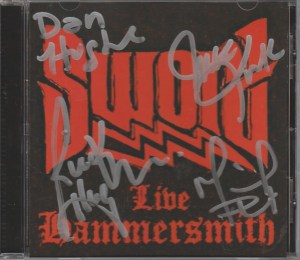
scan_20170103SWORD – Live Hammersmith (2016)

30 years ago, there was a heavy metal band from Quebec named Sword.  They only released two albums (Metalized and the more ambitious Sweet Dreams) before disbanding at the end of the 1980s.  Lead singer Rick Hughes is one talented guy though, and he gave it another shot with a hard rock band called Saints & Sinners in 1992, who were produced by Aldo Nova.

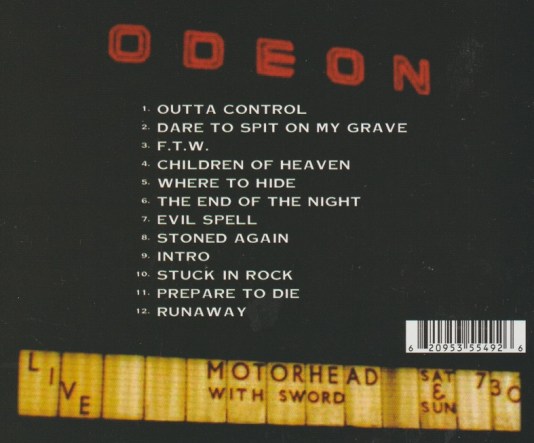
Hughes has remained active in Canada, though Sword are now long gone.  Fortunately the internet has given old metal bands like Sword a way to get back in touch with their fans.  Thanks to the web, you can now buy a live CD recorded in 1987 on Sword’s opening tour with Motorhead.  Lemmy took the band under his wing early on and fortunately this live tape survived.  They played two nights at Hammersmith Odeon and recorded them to 4-track tape.  The liner notes do not state which gig the CD is from, or if it is a mixture of both.  Considering the age of the tapes, Sword’s Live Hammersmith CD stands up remarkably well.  There is a real sense of “being there” at Hammersmith, in spite of (or because of) the sonics.

Ripping through all 10 tracks from their debut album, Sword made the most of their opening slot.  Even so, they still had time for a brand new song too, “Prepare to Die” (later released on Sweet Dreams).  With 11 songs and only 36 minutes, Sword’s already thrashy material seemed faster live.  Sword’s songs had the goods, too.  These blazing aggressive tunes weren’t simple or easy.  Most importantly, Rick Hughes’ incredible metal shrieks were 100% intact in the live setting.  Hughes’ voice was critical to the Sword sound, being their most unique characteristic.  It is always disappointing when you hear a band live, and the singer can’t scream like the album.  Not a problem with Sword.

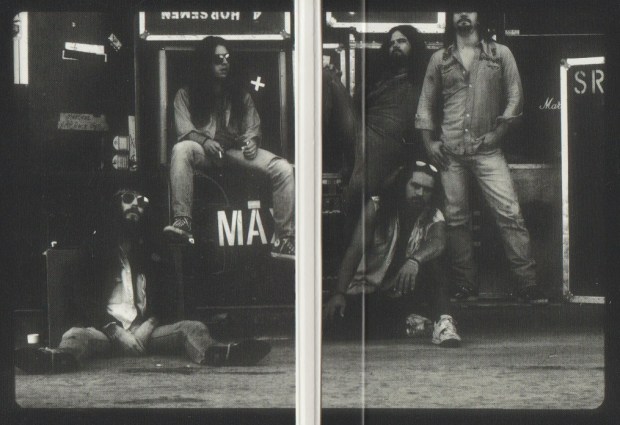
The singles “F.T.W.” (“Follow the Wheels”) and “Stoned Again” are the immediate highlights.  The gallop of “F.T.W.” sounds like a heavier Iron Maiden, while “Stoned Again” goes for the groove.  If anything, the songs have more impact in the live CD setting.  It is quite possible that Sword were one of those bands who were better live than on album.  They were, at the very least, flawless live.  Rick Hughes didn’t miss a note, word or scream.  Dan Hughes (drums) was also bang-on.  You can’t get a live album like this without the rhythm section doing it right.  Dan Hughes and bassist Mike Larock were right there, locked in, and driving the machine forward.  Larock had the groove, and also a knack for throwing in catchy bass runs.  As for the lead work, Sword were a one-guitar band, so Mike Plant had to switch from rhythm to lead seamlessly, and he made it all sound easy.

Inhabiting the fine line between metal and straight-up thrash, perhaps Sword were not unique out there in the 80s trying to make it.  This CD proves that they did have the talent.  As Henry Rollins says, live is “the only way to know for sure”.  A soundboard recording like this is as close as you will get.

As an added bonus (always appreciated in these frugal days), the Sword CD is signed by all four members and comes in a jewel case.  A very nice reward for the devoted fan.  You can buy Live Hammersmith from the Sword Facebook page.

4/5 stars

scan_20170103-3


REVIEW: The Four Horsemen – Death Before Suckass (2012)

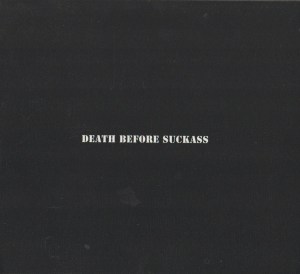
scan_20161216THE FOUR HORSEMEN – Death Before Suckass – Live at Saratoga Winners (2012)

“No edits.  No overdubs.  No bullshit.”  No kidding!  There also also no frills, just seven songs and 30 minutes of rock and roll.

Death Before Suckass, recorded fall 1991, sounds like a crowd recording.  You can tell by the douchebag talking before the Horsemen’s set.  “You should see our drum kit!  It fuckin’ blows that one away!  $5000 Yamaha…”  Whoop-de-do, fucko.  Because no matter how much your kit costs, I doubt you could hammer on it as hard as Ken “Dimwit” Montgomery did on his.

Dimwit swiftly kicks things into motion, with “75 Again”, a screamy rocker that is about 9 out of 10 on the AC/DC scale of kickass.  Lead singer Frankie Starr’s voice was primed for screaming, and could do it better than most.  Without even a pause, “Hothead” follows up.  In a groove now, lead guitarist Dave Lizmi greases up his Gibson and lays down some beautifully fluid solo work.  In the realm of heavy bluesy rock and roll, few can touch Dave Lizmi.  Then rhythm guitarist Haggis takes out his slide for the single “Tired Wings”, soaking it in whiskey stained blues.  Frankie’s charismatic singing shares the spotlight with the biting licks.

frank-c-star-biting-licks

A non-album Savoy Brown that used to get some live play was “Can’t Get Next to You”, an AC/DC blues a-la “The Jack”.  There is a sloppy edit into “Wanted Man” but as Haggis says in the liner notes, there is nothing perfect about this CD.  “Wanted Man” comes close, with Lizmi again doing some really impressive playing on the six string.  The most familiar songs are the singles “Nobody Said it Was Easy” and “Rockin’ is Ma Business”.  The beat is a little faster, a little more intense for the stage.  The only tragedy is the fidelity of this CD does not capture the thunder.  You can hear it on the stage, but you cannot feel it shake the floor.  Too bad, because you can be assured it all but certainly did shake the floor.

And this leads to a quandry.  This album is packaged intentionally minimalist.  It suits the recording inside.  But it has hard to ignore that what is recorded inside is only 30 minutes, and costs $18 US plus shipping.  Yes, it definitely costs The Four Horsemen a lot to press up these independent discs, and they surely don’t make a lot of money on them.  Still, it is hard for the cash-strapped fan to justify that kind of money, unless you are a superfan.  And unfortunately, it is likely that only superfans will be able to appreciate Death Before Suckass as the valuable noisy treasure that it is.

3.5/5 stars

scan_20161216-2

COMPLETE FOUR HORSEMEN REVIEW SERIES:

1. NOBODY SAID IT WAS EASY (21ST ANNIVERSARY EDITION)
2. GETTIN’ PRETTY GOOD…AT BARELY GETTIN’ BY (1996)
3. WELFARE BOOGIE (21ST ANNIVERSARY EDITION)
4. DAYLIGHT AGAIN (21ST ANNIVERSARY EDITION)
5. LEFT FOR DEAD (1988-1992) (CD/DVD SET)

REVIEW: Rik Emmett & RESolution9 – RES 9 (2016)

Had I got it in time, this album could have made the Top Five of 2016 list.

scan_20161231RIK EMMETT & RESolution9 – RES 9 (2016 Mascot Music)

Rik Emmett had a long productive career as 1/3rd of Triumph, but he has rarely looked back.   Post-Triumph he has released a steady stream of jazz, rock, blues and acoustic music, sometimes revisiting Triumph songs in re-arranged form.  Finally the ice thawed and Triumph successfully conquered Sweden Rock.  In 2016 Rik released RES 9, a new rock album with his new band RESolution 9.

RES 9 is in fact a time machine.  Dial up track 1.  You will be transported back to 1990 with the rock boogie of “Stand Still”.  This is a spiritual sequel to “Drive Time” from Rik’s first solo album Absolutely.  Then punch track 2.  “Human Race” (not a Red Rider cover) could have been a single from 1986’s The Sport of Kings.  With Alex Lifeson guesting on guitar, Rik and the band tapped into the hookiness of 80’s Triumph, but with a modern integrity.  When you hit up track 3, you will find yourself in the future.  Accompanied by fellow Canadian James LaBrie (Dream Theater), Rik turns in a modern rock anthem with “I Sing”.  Big and uplifting choruses preceded by mellow verses are built for radio.  LaBrie’s vocals are the perfect compliment.  Without a shred of hyperbole, “I Sing” is absolutely one of the best songs Rik’s ever recorded.

The bluesy soul ballad “My Cathedral” gives Rik a chance to show off his impeccable chops.  His tone — unbelievable!  Moving on to “The Ghost of Shadow Town” effectively dials up 1976 in the time machine, with a dark heavy Zepp-ish blues.  “When You Were My Baby” continues down smoove blues street, throwing in some jazz licks.  “Sweet Tooth” is turn down a brightly lit side avenue, a sweet treat indeed.

A hard Triumph-like vibe permeates “Heads Up”, another fine hard rocker for the radio.  “Rest of My Life” adds the jangle of acoustic guitars to the rock and roll mixture, creating another fine concoction just begging to be a hit.  Things toughen up with the pure rock power of “End of the Line”, featuring the returns of LaBrie and Lifeson.  The sheer star power of all these Canucks in one studio must have driven the temperatures well below freezing.  Still the track smokes, and if you’ve ever wanted to hear Emmett and Lifeson go head to head, then wish no more.

But it is not the end of the line.  Back to the future, we have a bonafide Triumph reunion featuring the full trio of Emmett, Gil Moore and Mike Levine.  This long awaited reunion happens on the bonus track “Grand Parade”.  The genuine surprise here is that it’s not a hard old time hard rocker, but a thoughtful and musically deep blues ballad.  It strikes me as appropriate that this much anticipated track sounds nothing like old Triumph.  That was, after all, a long time ago.

With RES 9, Rik has re-established his rock credentials.  Whether he does another album like this is beside the point.  RES 9 is the point; a damn fine album indeed.

4.5/5 stars


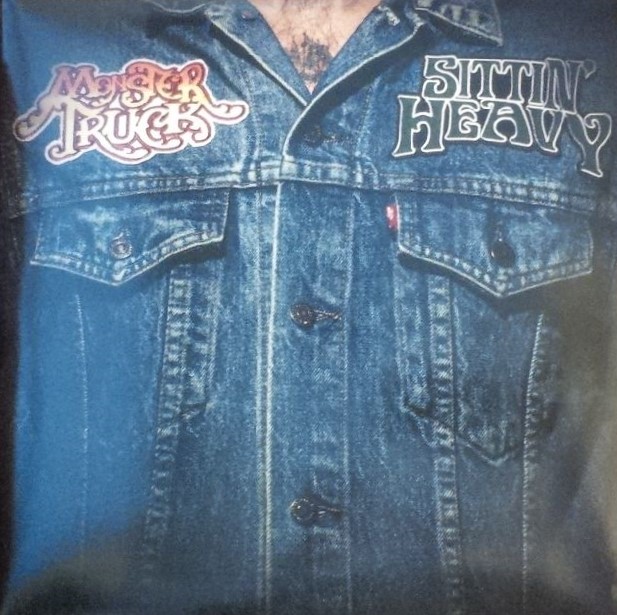
REVIEW: Monster Truck – Sittin’ Heavy (2016 double vinyl)

“I don’t care ’bout the weather, the band’s here to play.” – Jon Harvey

img_20161113_081455 MONSTER TRUCK – Sittin’ Heavy (2016 Dine Alone 2 LP edition)

Why are you not rocking?  This is the question that Monster Truck ask to open their 2016 release Sittin’ Heavy, easily the best record the quartet have released to date.  “Rock and roll might save your life, it might save your life tonight.”  Perhaps this is the Truck’s modus operandi, because judging by Sittin’ Heavy they are interested in delivering the rock and doing it right.

From the short blitz of an opener, Truck go right into the first single “Don’t Tell Me How to Live”.  The track has been a radio staple in Canada for most of 2016, and it’s easy to see why.  The slow riffy groove is easily digestible by rock fans craving that sound, backed by a searing chorus about eagles and lions.  Some have compared this band to another Nickelback, but on Sittin’ Heavy they have moved far beyond those measures.  Nickelback has never delivered anything this classic sounding.  Track three, “She’s a Witch” has a modern swampy vibe that Chad Kroeger couldn’t hope to taint.  Three songs in, Monster Truck delivered three completely different tunes, though all with the rock solid Truck groove.  One ingredient that separates the Truck from the crowd is the soulful organ provided by keyboardist Brandon Bliss.  “She’s a Witch” is one track with a bizarrely heavy soul-metal vibe.  That vibe culminates with “For the People”, an uplifting track that closes side one of the vinyl.  The soul-rock vibe is obvious and augmented by Ian Thornley of Big Wreck who lays down some of his trademark wicked slide guitar.  The Wreck-ifying of the track unites the two bands in a cool, celebratory way.

Flip the vinyl, and take a moment.  “Black Forest” is a organ based track, slow and mournful, and very different from any of the four on side one.  When a band like Monster Truck turn down the volume, they risk revealing that there is little substance beneath the howling distortion.  This is certainly not the case here.  “Black Forest” has a more subtle touch, and the band allow it to breath.  As a result it’s one of the most stand-out tracks.

“Another Man’s Shoes” walks us back into familiar territory.   The Truck don’t make things complicated, and guitarist Jeremy Widerman’s Frehley-like solos are just what the doctor ordered for these musical bruisings.  They take a left turn down Abbey Road next by adding some Beatles-like piano vibes to “Things Get Better”, an outstanding track.  “I got a feelin’ thing’ll get worse before they get better,” sings Jon Harvey but he couldn’t be more wrong.  Sittin’ Heavy keeps getting better the more you play it, and “Things Get Better” is a high water mark.  Side two blasts its way to a finish on “The Enforcer”, which races home with plenty of the Truck’s trademark “woah-woah-woah” gang vocals.

The third and final side (we’ll talk about that shortly) begins darkly with a Sabbath-like “To the Flame”.  Widerman and Harvey seemed to study at the feet of Iommi and Osbourne when composing this menacing crawl.  “Midnight” takes the tempo back up to cruising speed.  Going in at low altitude, the Truck bomb your senses with a vinyl-only bonus track.  Considering the price you pay for a record vs. a CD, it is nice to get something like a bonus track for your dollars.  In the 80s, it was common to put a bonus track on the CD, since it was the most expensive format at that time.  Now the situation is reversed.

A choppy riff introduces “New Soul”, a purely enjoyable return to the church of soul-rock.  It’s a head-bangin’ good time.  Clap your hands for a good time (unless you’re listening to this while driving, in which case, keep ’em steady on the wheel).  Then the final track is appropriately the ballad “Enjoy the Time” which sounds like a natural way to end a soulful rock album like Sittin’ Heavy.  Its Supertramp-like keyboard tones lend it a unique sound over the rest of the album.  It also sums up the vibe of the whole album:  “Enjoy the time we have, before they’re gone away.”

But what about the fourth side?  What’s on that?  Check out the etched vinyl, baby!

img_20161113_080846

If you are looking for a new rock album that sounds classic, then you have found one.  Those who like a rock record to be a journey of highs and lows and with a satisfying conclusion, then Sittin’ Heavy is the one.  With little doubt, this one is going to be on a few best of 2016 lists at the end of the year.

5/5 stars


MOVIE REVIEW: Star Wars – Rogue One [spoiler-free]

“It is a period of civil war. Rebel spaceships, striking from a hidden base, have won their first victory against the evil Galactic Empire.

During the battle, Rebel spies managed to steal secret plans to the Empire’s ultimate weapon, the DEATH STAR, an armored space station with enough power to destroy an entire planet.

Pursued by the Empire’s sinister agents, Princess Leia races home aboard her starship, custodian of the stolen plans that can save her people and restore freedom to the galaxy….”

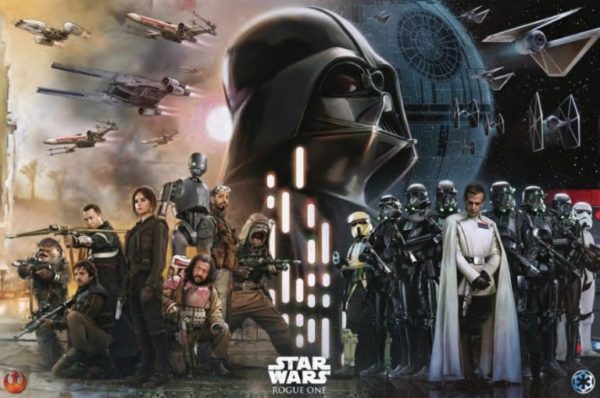
jyn-erso-rogue-one-posterSTAR WARS:  ROGUE ONE (2016)

Directed by Gareth Edwards

If you are familiar with the opening crawl from Star Wars: A New Hope (1977), then you are already familiar with the last third of Star Wars: Rogue One.  With Disney now in control, we will see Star Wars movies to fill every nook and cranny in the mythos.  Rogue One is just the beginning, and it’s a logical place to start.  A New Hope began mid-action.  Princess Leia is under attack and captured by Darth Vader, but R2D2 and C3P0 have escaped his clutches with the plans to the Death Star.  Did we need an entire movie to see how they got there?

Of course we didn’t.  That’s why George settled for an opening crawl.  The story of how the Death Star plans got into Leia’s hands has gone through many iterations over the years.  The original Star Wars radio drama was one variation.  In another, the video game Dark Forces, you steal the plans yourself as a character named Kyle Katarn.  Now we have the official story featuring a new band of rebels:  Jyn Erso (Felicity Jones), Cassian Andor (Diego Luna), K2S0 (Alan Tudyk), Bodhi Rook (Riz Ahmed) and the charismatic pair of Chirrut ÃŽmwe (Donnie Yen) and Baze Malbus (Jiang Wen).  They are assisted by the forces of Saw Gerrera (Forest Whitaker), an extremist character originally from the Clone Wars television series.  Together they must get those Death Star schematics into the hands of the Rebel Alliance.

If only it didn’t take so long to do it.

Rogue One is a long running movie, with a final battle that is stunning eye candy but too slow.  As X-Wings, Tie Fighters, Y-Wings and new ships such as Tie Strikers and U-Wings do battle over the planet Scarif where the Death Star plans are stored, you get to watch…someone trying to flip a master control switch.  Someone describing the location of the switch.  Someone trying to locate a file in an archive.   Someone trying to align an antenna and send a file.  Almost sounds like another day at the office, and it takes forever to get from A to B.

Fortunately, Rogue One delivers in other respects.  Planets new and old (you’re gonna shit your pants when you see which old) are to be seen.  One strength of the original trilogy was the variety of planets.  We visited five different worlds:  desert, ice, cloud, swamp and forest.  The prequel movies brought fire and water planets.  Rogue One debuts the exotic Jedha, a spiritual home of the Jedi religion and a source of the Kyber crystals that power their lightsabers.  There is also a tropical paradise planet, torn up and exploited by the evil Empire.
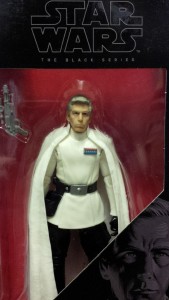
img_20161223_212600There are also cool new ships and stormtroopers to feast your eyes on.  The coolest of these are the black Death Troopers, the personal force of Director Krennic (Ben Mendelsohn).  Krennic is the prime villain of the film, an ambitious yet bumbling higher-up in the Empire who finds himself on the wrong side of Governor Tarkin (a CG Peter Cushing) and Lord Darth Vader himself.  And as you shall see in the climax of the film, being on the wrong side of Darth Vader is not a place you want to find yourself.  Mendelsohn shines in the role, especially in any scene in which he is paired with Mads Mikkelsen who portrays Jyn’s father Galen Erso.  The character of Galen Erso is revealed to have made a major covert move in the war, that changes A New Hope in one significant way.

In trying to please Star Wars fans who weren’t into The Force Awakens or the prequel trilogy, perhaps Rogue One went too far.   A film with Tarkin as a major villain is a Star Wars fan’s dream, but CG isn’t at the stage yet where he looks perfect.  The uncanny valley strikes again, and somewhere between your eyes and brain, you can tell something is “off” about the character.  The same can be said about another surprise cameo from the past.  Other characters seem shoehorned into the film without a good reason.  (Was there any logical reason to see Pignose and his friend, Scott?)  On the other hand, there is some very clever use of original, unused footage from 1977 to bring other characters back who absolutely should be there.  You’ll know the shots when you see them.  Best, and most significant of the nods to the past are appearances by Bail Organa (Jimmy Smits) and Mon Mothma (Genevieve O’Reilly), two senior leaders of the Rebel Alliance.

Felicity Jones and Diego Luna are as fantastic as Mendelsohn is.  Jones can do more acting with her face than most can do with 10 lines of dialogue, but her character isn’t fleshed out.  We know a little bit about who she is, but not about what makes her tick and what she feels.  Luna’s Cassian Andor seems to have more depth.  He seems to have some more skin the game.  Jyn Erso is just along for the ride until she changes her mind mid-way and does a complete 180.  Too many times, characters don’t take actions that are consistent or logical.

The biggest flaw with Rogue One is you already know how it ends.  And if you don’t, you will be able to predict death scenes well in advance, so obviously are they telegraphed.

What makes Rogue One special despite its flaws are the ways it brings childhood dreams to the big screen.  For decades, kids have been flying their X-wings through the back yard, strafing their stormtroopers on invented planets.  Others lucky enough to have an AT-AT in their collection enjoyed target practice with a group of Rebel soldiers.  Younger fans brought up on Star Wars video games will enjoy settings and action right out of the Jedi Knight series.  Rogue One also lifts the veil on the Empire a little bit, an organization we actually see little of in the original trilogy.  Think about it.  Most of the time, you were following around Luke and his friends, on the run from the Empire and doing their own thing.  You didn’t see much of what life under the Empire is like.  Now you do.  Mass electronic surveillance, police state tactics, punishment and coverups are the order of the day.

img_20161223_212639

The last issue to discuss is the score by Michael Giacchino, which is intentionally different from a John Williams soundtrack. It is different and good, but lacks the standout themes that the saga films are known for.  That was the right direction to take, as Rogue One should and does feel like a different kind of Star Wars movie.  It should not be confused with the concurrent saga films, which follow the story of the Skywalker family.

It’s not Giacchino’s fault that Rogue One doesn’t deliver the same kind of awe-inspiring story of the other films.  While it does venture into the mythos of the Force via the blind guardian Chirrut ÃŽmwe, it is not intended to unveil the same kind of chilling revelations.  There is no “I am your father” moment.  There is no self-discovery of inner power as we saw in the past with Anakin, Luke and Rey.  Instead Rogue One travels the road of the soldiers, the grunts on the ground fighting the Empire both openly and secretly.  There are no Jedi to save them, no chosen ones.  Only luck, if you believe in that sort of thing.

The most encouraging thing about Rogue One is how “right” it was done.  Its heart is in the right place at all times.  When the prequels came out to fill in the blanks, they left us more puzzled than anything.  Wait…Darth Vader built C3P0?  Obi-Wan was actually trained by Liam Neeson?  Princess Leia’s mother died in childbirth even though Leia remembered her as being “beautiful, but sad?”  Rogue One doesn’t trample on the continuity at all, it only enhances it.  And that’s all we really needed.

3.5/5 stars
REVIEW: Warrant – Cherry Pie (1990, remastered)
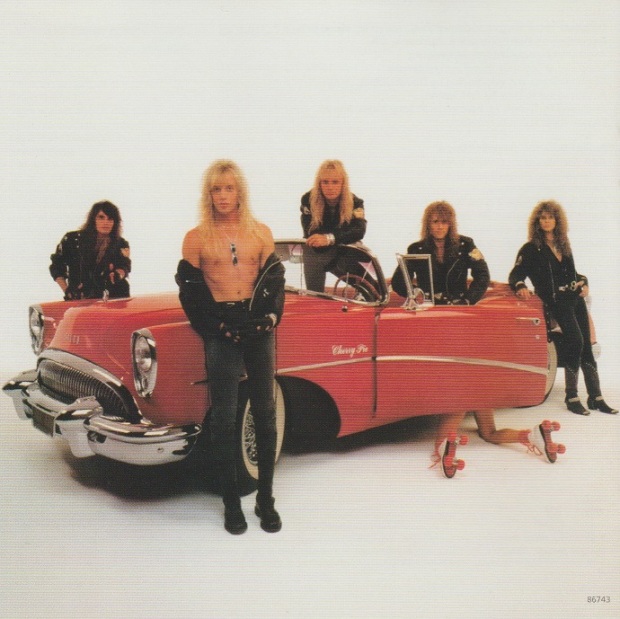
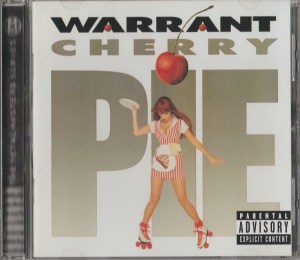
scan_20161207WARRANT – Cherry Pie (1990, 2004 Sony remaster)

It was bands like Warrant, and albums like Cherry Pie, that made the 1991 grunge onslaught inevitable.

If Motley Crue were the poor man’s Kiss, and Poison were the poorer man’s Motley Crue, then Warrant are the pauper’s Poison.  Heck, Poison’s C.C. Deville even shows up on guest lead guitar on Cherry Pie‘s title track.  Think about that a moment.  How bad do a band have to be to warrant (no pun intended) a C.C. Deville guest guitar solo?  Guitarists Joey Allen and Erik Turner even confessed to having guitar tutors in the studio helping them come up with their own lead work.

Cherry Pie was an improvement in some regards over the prior album Dirty Rotten Filthy Stinking Rich.  The second single, “Uncle Tom’s Cabin”, remains a high point for this band.  Swampy bluesy guitars and a kick ass melody?  Who cares if that’s not Warrant playing on the acoustic intro (it’s singer Jani Lane’s brother Eric Oswald), and so what if that’s not Warrant on the banjo (that’s producer Beau Hill)?  “Uncle Tom’s Cabin” is one of those rare Warrant songs that you just have to get.  Instead of singing about girls, Jani chose to write a story about a murder and a coverup.  It’s far more entertaining than “She’s my cherry pie, put a smile on your face ten miles wide.”

Speaking of “Cherry Pie”, as embarrassing as it is, did you notice that’s not Jani Lane on the opening scream?  It’s an uncredited Dee Snider, sampled from Twisted Sister’s song “I Want This Night (To Last Forever)”.  Guess who produced both albums?  Beau Hill.   Rather, he overproduced the hell out of both albums. Rather misleading.

Warrant’s biggest hit was a ballad, and so Cherry Pie has more.  “I Saw Red” was glossy and enhanced with piano, but the acoustic version that was later released as a B-side was better.  The second ballad, “Blind Faith” had more heft, though it is little more than a rewrite of “Heaven”.  Another acoustic track called “Thin Disguise” was even better than either of these songs, but was relegated to a B-side.  Too bad.  This album could have used it.

Warrant are better when just rocking out.  There are a couple indispensable Warrant rockers on Cherry Pie.  “Mr. Rainmaker” is remarkably powerful with dark clouds.  It’s in the same mold as “Uncle Tom’s Cabin”, with a chorus that is still memorable today.  “Bed of Roses” and “Song and Dance Man” are strong also-rans.  There are other notable songs (“Sure Feels Good to Me” set speed records for this band) but on the whole they are a harsh blend of sound-alikes.

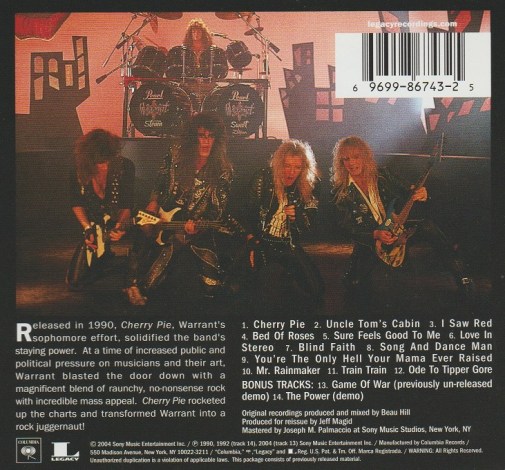
Buyers should be aware there are two versions out there of Cherry Pie, “clean” and “dirty”.  The “clean” version is missing the track “Ode to Tipper Gore”, and has a naughty word beeped at the start of the Blackfoot cover “Train Train” (1979).  How unexpected it was to hear that beep, and how ripped off did we feel since it was not advertised as a censored version?  A beep in a rock song is a rare thing indeed.  If you get the uncensored version, you’ll hear the “All a-fuckin’ board!” intro correctly, which is important since “Train Train” absolutely smokes.  “All a-BEEPin’ board!” just didn’t cut it.  Covering “Train Train” was one of the best decisions Warrant made on this album.  Warrant transforms it from a hard southern rocker to a plain old hard rocker, but the transformation works and the groove is the only solid one on Cherry Pie.

As for “Ode to Tipper Gore”, it is just a joke track made up of naughty outtakes from Warrant concerts spliced together into one stream of “fuck”.  (Tipper Gore was behind the PMRC, the scourge of 1980s censorship.)  It is included on the 2004 Sony remastered edition, along with two bonus tracks.  Strangely enough the two bonus tracks have nothing to do with this album.  “Game of War” is the long-sought 1988 demo that garnered Warrant attention at the labels.  It’s unpolished but you can hear how an A&R person looking for the next Poison would have signed this band.  Finally there is a track called “The Power” from a 1992 Cuba Gooding Jr. movie called “Gladiator”.  It is the only song on the CD not produced by Beau Hill.  Erwin Musper gave the band a less cluttered sound, and the song has a corny stadium-ready stomp like “Rock and Roll, Part 2”.

Although you don’t need the remastered version if you just want to check out Cherry Pie, you do need to at least seek out the uncensored version with “Ode to Tipper Gore”.  That way you won’t have to listen to the beep in “Train Train”, which is a song worth having.

2.5/5 stars

scan_20161207-3

REVIEW: The Black Crowes – iTunes Originals (2008)

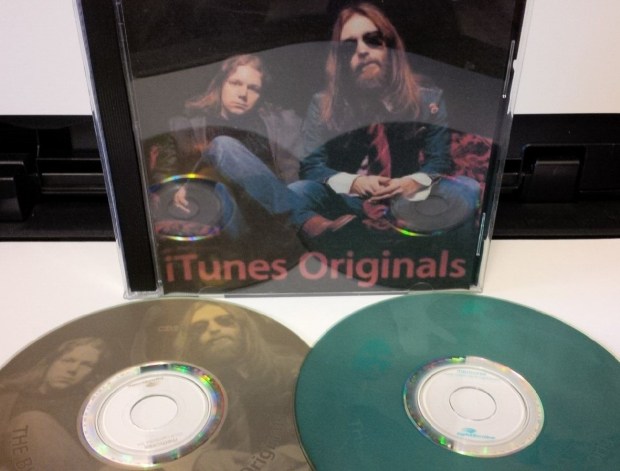
crowes-itunes-originalsTHE BLACK CROWES – iTunes Originals (2008)

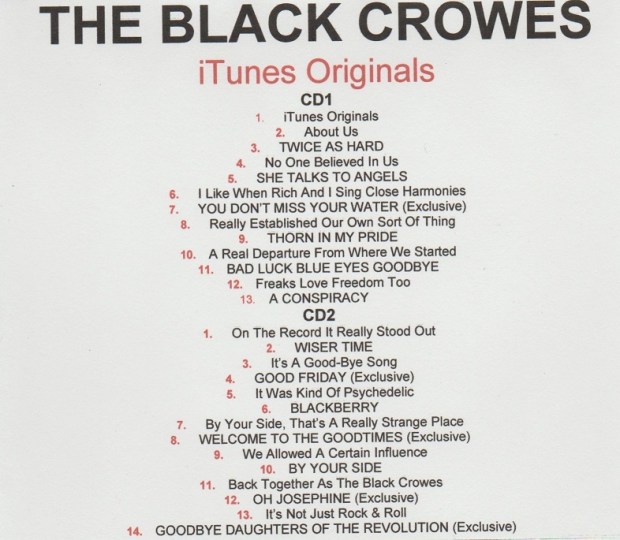
If you ever spy these iTunes Originals sets from bands you like, then have a gander at the track list.  The Black Crowes’ edition contains original hits, but also has unreleased exclusive versions.  There is also a long interview session (spread through the set) with Chris and Rich Robinson, a good and revealing chat.  In total the set runs over an hour and a half.  Chris and Rich are vivid storytellers and the interviews are good enough to want to listen to more than once.  They surprisingly reveal that punk was a strong early influence.  Rich recalls seeing Corrosion of Conformity which opened up a new world for the brothers Robinson.  The punk shows gave the band a “try anything” attitude in concert, including playing brand new songs that they didn’t have words for yet.  But their influences also stretched deep into indi rock, folk, jazz and beyond.

“Twice As Hard” from the debut album is the first hit song presented, and damn if it isn’t still as fine as the day it dropped in 1990.  That simple classic British blues rock sound gave the Crowes the springboard they needed to drive them on to greater achievements.  It was different for the time.  Yet the ballad “She Talks to Angels” was really special and that’s here too.  With the interviews in between explaining the journey, iTunes Originals plays like an audio documentary.  The story and the music get more interesting as you go.  Each album brings something new to the table.  By Your Side was a “strange place”, says Chris, but its title track still rouses the senses.

It’s a light sprinkling of hits and album cuts moving forward through the discography of the Crowes. The main thing for long time fans is the exclusive material, all acoustic versions recorded by Rich and Chris. The Otis Redding cover “You Don’t Miss Your Water” is a song they’ve been singing together for years, but never recorded until now. What a lovely song, and what harmonies.  From Three Snakes and One Charm, “Good Friday” is rendered slower and sadder.  The stripped down approach of these acoustic recordings lends “Welcome to the Good Times” from By Your Side a new appeal.

The Crowes split up for a bit in the early 2000s, but you can’t keep the Robinson brothers apart for too long.  War Paint (2008) was their reunion as the Crowes.  With new and returning members, the band felt revitalized.  “Oh Josephine”, another acoustic exclusive, is as pretty as “She Talks to Angels” 18 years earlier.  The last of the exclusives is “Goodbye Daughters of the Revolution” which also closes the set.  Upbeat gospel rock and roll works as well electric as it does acoustic.  “Goodbye Daughters of the Revolution” was one of the finer moments on War Paint and it’s perfect for ending this iTunes Originals.

4/5 stars

scan_20161203

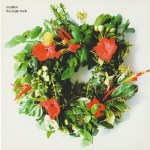
REVIEW: Marillion – The Jingle Book – Christmas 2006

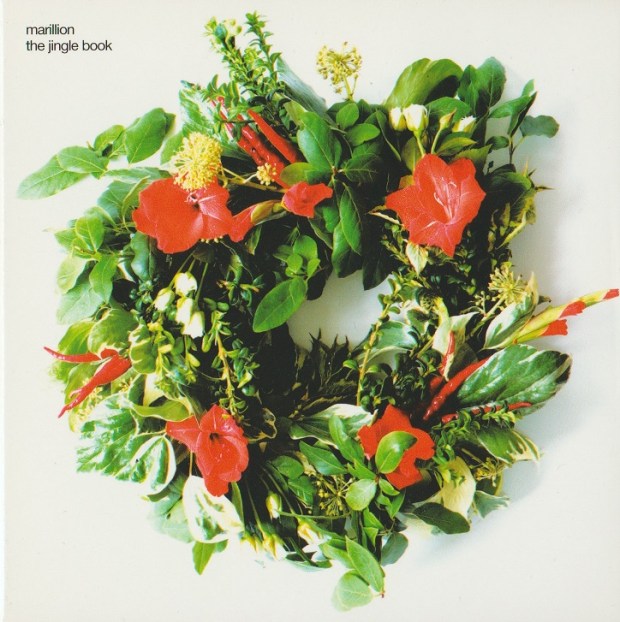
scan_20161213MARILLIONThe Jingle BookChristmas 2006  (2006 Racket Records WebUK membership CD)

Gather ’round the glow of your computers children, and get your hot chocolate in hand, for it is time for a look at another Marillion Christmas CD.  The Jingle Book is a doubly clever title, for Marillion’s Christmas song for 2006 was a cover of “That’s What Friends Are For” from The Jungle Book. A surprising choice, it is rather movie accurate and partly acapella.  There is also the traditional and always silly Christmas greeting from the band.  In what may also be a Marillion tradition, this short message requires multiple takes!

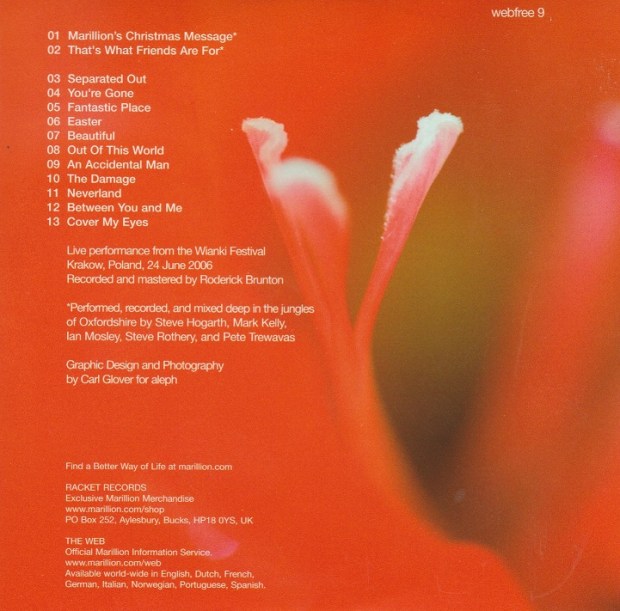
The bulk of the CD is a live set from Poland in 2006.  The festival setting lends this CD a different atmosphere than other live Marillion discs.  From the sonics to the feel, The Jingle Book doesn’t work like typical Marillion sets.   There are only a few long bombers, lots of singles, and no tracks earlier than Seasons End.  Decent quality audio will satisfy all but the pickiest of fans; remember this amounts to an official bootleg.

An ass-kicking “Separated Out” was chosen for opening position.  This song, among Marillion’s most energetic, would have got the crowd’s attention.  Drummer Ian Mosely is a monster on “Separated Out”, which is immediately followed by the band’s hit single “You’re Gone”.  The mosh pit vibe gives way to ethereal dance.  Floating like smoke in the air, “Fantastic Place” and “Easter” are rolled out in powerful performances.  Talking is minimal though Steve “h” does attempt some Polish.

Afraid of Sunlight is given a nod with the ballad “Beautiful”, and progressive epic “Out of this World”.  “Beautiful” is as lovely as its name, and has the feeling of celebration.  The mood darkens immediately on “Out of this World”, as there are very few positive songs about nautical disasters.  Steve Rothery’s immaculate guitar tone sings its own song, sad but hopeful.

The beat picks up with the electrifying “Accidental Man” from This Strange Engine.  As a highlight from that often overlooked album, “An Accidental Man” does not get showcased often, and this organ-heavy take is satisfying.  Boppy Beatles-y single “The Damage” (from Marbles) is sheer delight.  With genie now out of the box, “Neverland” begins a long slow climax.  As one of the most dramatic of all Marillion epics, “Neverland” haunts the air like burning incense.  Then like a halogen light, Rothery brightens it up with his un-immitatible string magic.  Consider the heart that “h” puts into his singing here, combined with Rothers’ liquid guitars, and this could be the best ever live version of “Neverland”.

scan_20161213-2

Rolling into the encores, “Between You and Me” and “Cover My Eyes” exude glee and positive vibes.  There is much common ground between the two albums those songs are taken from (Holidays in Eden and Anoraknophobia) so it is unsurprising that they work together so well in the encore position.  A brilliant pairing, crisp and refreshing like Sauvignon Blanc with a healthy avocado salad.

As with any past Marillion Christmas CD, you can’t buy this anymore and the chances of stumbling upon one in the shops are nil, even with the help of all of Santa’s elves.  However you can still download it and the others by joining the official Marillion webUK fan club.  Members receive three thick, glossy full colour magazines, the Christmas CD, and other downloadable content.  Worth thinking about, or adding to your Christmas list.

4/5 stars

scan_20161213-3

REVIEW: Talas – If We Only Knew Then What We Know Now… (1998)

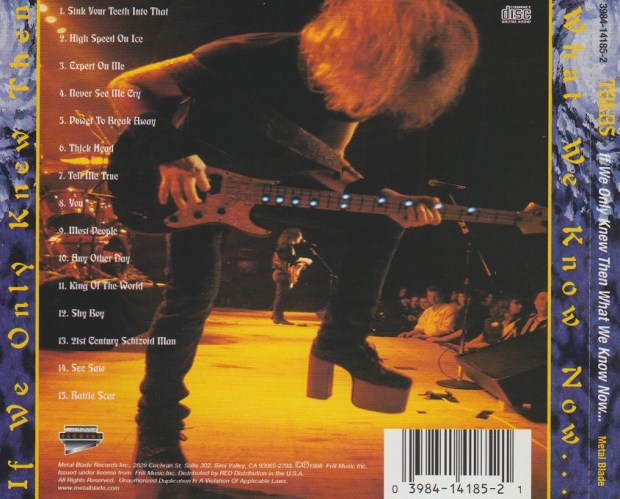
scan_20161211TALAS – If We Only Knew Then What We Know Now… (1998 Metal Blade)

The Talas story did not end with the breakup of the band.  Of course not; bands both famous and obscure like to reunite for nostalgia shows.  Talas did that in 1997 with the original power trio lineup:  Billy Sheehan on bass, Paul Varga on drums, and Dave Constantino on electric guitar.  With classic material (from the first two Talas albums) and a few unreleased songs, they memorialized their reunion with a brand new live CD.  Billy even pulled his old platform boots out of the closet for this one.

As usual the set opens with “Sink Your Teeth Into That” and an enthusiastic home town crowd.  Talas only sounded better with age.  The original voices are there and just as strong as they were in 1982.  It actually sounds like everyone has improved over the years.  A speedy “High Speed on Ice” is in the second spot ensuring no loss of momentum.  Material from the first self-titled Talas album is included too (unlike the last live album Live Speed on Ice).  “Expert on Me” is very pop in construction, but clearly not as great as the songs from album #2, Sink Your Teeth Into That.  Speaking of which, the slow rumbler “Never See Me Cry” is brilliantly adapted to the stage.

“Power to Break Away” is one of the previously unrecorded songs, and it kicks it just as hot as anything from Sink Your Teeth Into That.  It’s taut with hooks and the prerequisite bass workouts.  “Tell Me True” is the second unreleased song, a slow non-descript dirge ballad that takes a while to get going.

Imagine Billy Sheehan plowing his bass right through a funky Led Zeppelin riff.  That’s “Thick Head”, an awesome track from Talas (1979).  “You” has a cool vibe, almost like an unheard Aerosmith demo from the Done With Mirrors era.  A few other tunes from the first Talas (“Most People”, “Any Other Day” and “See Saw”) are adequately entertaining.  Back to Sink Your Teeth Into That, “King of the World” is still one of the best Talas tunes, overshadowed by only a few like “Shy Boy”.  Here, “Shy Boy” is preceded by a Paul Varga drum solo.  The sheer velocity of “Shy Boy” itself makes me wonder how Varga did it.  It’s just pedal to the metal, blurring the lines and smoking the minds.

Nothing like a good cover to help draw a live album to a close.  Talas did two:  “21st Century Schizoid Man” and “Battle Scar”.  The King Crimson cover is a daring one to attempt.  They somehow manage to strip it down and pull it off with integrity.  As for “Battle Scar”?  Total surprise there!  Max Webster were just across the border from Buffalo, and Billy Sheehan nearly joined Max at one point late in their career.  Introduced by a Billy Sheehan bass solo, this Max/Rush cover is the set closer.  As a final addition, “Battle Scar” surely makes this one hell of an album for the history books.  (The Japanese version has a bonus track called “Doin’ It Right” — this shall be reviewed at a later date.  Our copy is on order but will not arrive for several weeks.)

Since this is a more recent release on a well known label (Metal Blade), it turns out that If We Knew Then What We Know Now is an easy CD to find in the shops.  Fortunately this is a good first Talas album to add to any collection.

4/5 stars

scan_20161211-2

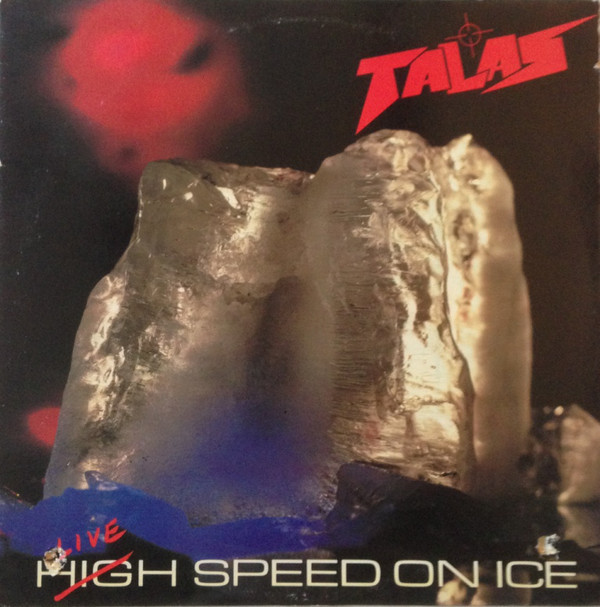
REVIEW: Talas – Live Speed on Ice (1983)

Second in a two-part review of the 1989 compilation CD, Billy Sheehan – The Talas Years.  Part one is here:  Sink Your Teeth Into That.  More Talas tomorrow!

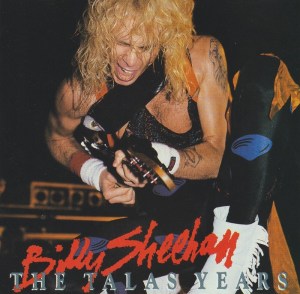
scan_20161210BILLY SHEEHAN – The Talas Years (Part Two of Two)  (1989 Relativity)
TALAS – Live Speed on Ice (1983 Relativity)

When we last met Talas, they were a power trio.  On their 1984 live album, they were a quartet.  Billy Sheehan was the only remaining member of the original lineup, with some hot talent behind him:  Mark Miller on drums, Mitch Perry (MSG) on guitar, and the hugely talented Phil Naro singing.  Naro has been around, including a stint with Peter Criss.  (You can hear a number of his performances on Mitch Lafon’s Kiss tribute CD A World With Heroes.)

There is little question that Naro’s voice brings the songs to another level.  “Sink Your Teeth Into That” benefits from his young rasp.  Mitch Perry throws in a more articulated guitar solo for an extended section leaving Billy to hold down the riff.  Second in line is a new song, “Crystal Clear” which has a biting Police guitar riff.  The busy bass holds down the melodic center as Naro soars on top.  Live Speed on Ice has great value, since much of its material was actually brand new and never released on anything else.  “The Farandole” is another new one, an instrumental of jaw-dropping ability.  Dueling bass and guitars dance and parry while the drums hit the heavy blows.

scan_20161210-2

More new tunes:  “Do You Feel Any Better”, “Lone Rock”, and “Inner Mounting Flame” continue the ass-kicking streak.  Each has their own groove, but “Inner Mounting Flame” truly is live speed on ice.  A few older tracks from the album are solid winners:  “King of the World”, “High Speed on Ice” and of course “Shy Boy”, the one Talas song that people know today thanks to David Lee Roth.  Billy’s signature bass solo is also performed live (and extended), but cleverly retitled.  While “NVH 3345” meant “SHEEHAN” upside down, “7718 (3A17)” means “BILL (LIVE)”.  With the freedom of the live setting, Bill took his time to showcase some unheard of chops and effects.

Any album that has Billy Sheehan on bass is bound to include a thousand notes of pure thrills, and any record with Phil Naro is going to sound awesome vocally.  Therefore, Live Speed on Ice should be a welcome addition to the discerning rock fan’s personal library.  The easiest way to get it is on CD combined with Sink Your Teeth Into That as the 1989 compilation Billy Sheehan – The Talas Years.  Either way, you win.

4/5 stars

scan_20161210-5