THE SEX PISTOLS – Filthy Lucre Live (1996 Virgin Japanese import)
Late to the punk rock scene in ’96, I threw Filthy Lucre Live on the speakers in-store. Impressed by their canon of catchy, simple guitar rock, I decided I was a fan and bought a double disc version of Never Mind the Bollocks. I still think the reunited 1996 band were valid and put out a worthwhile document of that tour. I was fortunate to finally stumble upon the Japanese version with additional B-side bonus tracks, from the concurrent “Pretty Vacant” live single. It was brand new and cost only $20 at the 2013 Toronto Musical Collectibles Record & CD Sale.
Recorded on 23 June, the album was released only a month later. Even though a big money reunion tour isn’t very punk rock, a one month turnaround isn’t bad! The backing vocals however sound so clean that I wonder if some very un-punk overdubs happened in that time. I don’t know. I do know that the vocals of Steve Jones, Glen Matlock and Paul Cook deliver the hooks required while Johnny Rotten rants with full-on vibrato. Either way it sounds brilliant.
Scorching through “Bodies”, the Pistols in ’96 kicked many competitors in the ass. “Seventeen”, with its classic chorus* of “I’m a lazy sod!” lacks some of the edge it used to have in the 70’s, but I don’t think the thousands of people singing along minded too much.
“New York” rocks sloppily, and Johnny Rotten delivers his voice with that vibrato…almost distracting, almost unnerving, but strangely catchy. His vocals have become more exaggerated and dramatic over the years and I like these renditions of the songs. Steve Jones’ sloppy guitar riffs are mixed too low, or perhaps mixed that way to hide a multitude of feedbacky sins? Who cares. “No Feelings” slams just as hard either way.
“Don’t be naughty…I’ve done you no wrong,” Johnny scolds the crowd before diving into “Did You No Wrong”. One song is much the same as another, but that hasn’t stopped AC/DC either. “We’re not that fucking bad after all, are we?” sneers Johnny. Do I detect some pride? “God Save the Queen” is early in the set, but as venomous as ever.
Through “Liar”, “Satellite”, and the cover of “(I’m Not Your) Stepping Stone” the set drags a bit. “Holidays in the Sun” brings back that excitement and reckless abandon. “Submission” is next, another riffs as simple and memorable as “Holidays”, and do I detect a touch of “Where Have All the Good Times Gone” by the Kinks there at the end?
“Pretty Vacant”, “EMI”, “Anarchy” and “Problems” close the set for a memorable end. Even though I don’t think they ever really gave two shits about the music, there was a lot of good music. John Lydon is a parody of himself, and he knows it and embraces it. He’s become a grumpy, angry elder statesmen of punk and Filthy Lucre Live is representative of that version of him. Either way, it’s an enjoyable departure from the same old versions.
The Japanese CD comes with some B-side bonus tracks. “Buddies” is what sounds like an audience recording of “Bodies”. I guess for that raw punk authenticity? “No Fun” is also present, a Stooges cover to add to the count of classic punk rock.
4/5 stars
*I’m aware that Johnny Rotten would likely kick me in the ass for calling his music “classic”. He’d probably also disagree with many more of my words, but I love that crazy guy.
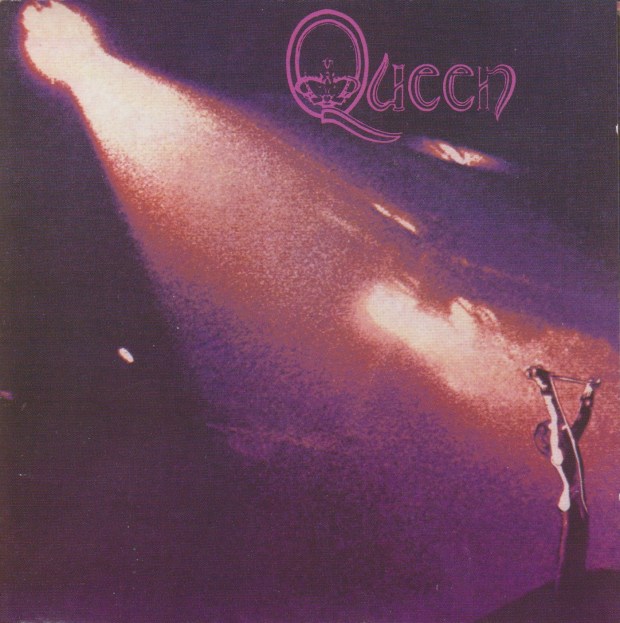
I’m in a unique position for someone who was a newborn when this album came out. By happenstance, this was my first Queen album. My mom bought it for me. She bought it at the store that I would one day spend over a decade working myself. This just happened to be the one she picked.
A few weeks prior, I had been immersed in the latest issue of one of the big guitar magazines. Queen were out there doing press for Innuendo, and this magazine did a run down with Brian May of the entire Queen discography. I read it over and over again. I knew the pop hits, but what of these other songs they were talking about? “Stone Cold Crazy” had to be awesome for Metallica to cover it. And this tune “Bohemian Something”…by the description alone I needed to hear it.
And then, only a month or two later, I was hanging out with my friend Andy watching music videos in the basement. My mom came downstairs. She had been up watching the news.
“Hey guys, sorry to interrupt,” she said, “But Queen just made an announcement. Freddie Mercury has AIDS.”
“Oh no,” Andy and I said almost simultaneously. The rumours were that he was very, very sick. Although Brian May denied it only months before, fans feared for the worst. Freddie hadn’t toured since 1986. He looked gaunt, frail, in the most recent photos. We were both saddened to know the rumours were true. The very next day, Freddie Mercury died.
That’s my story where it comes to the first Queen album. It is an intensely personal love for me.
I was surprised how raw it sounds. Yet although the guitars are rough by comparison to later Queen, the layering of vocals and instruments has already begun on “Keep Yourself Alive”. It is one of the most brilliant Queen rockers of all time. When I first heard this song, I recognized some gallop that was later ripped off by Iron Maiden. Roger Taylor (credited as Roger Meddows-Taylor) even gets a drum solo! First single, first song — drum solo. Why not? Brian’s layered guitar solos point the way to where he would go with the instrument. It’s worth noting that Queen get a co-production credit. I’m sure they had a lot to do with the way they wanted to hear the instruments and vocals.
“Doing All Right” begins as a tender piano ballad, but it soon goes into an acoustic section, before finally going fully electric and amplified. The voices of Freddie, Brian and Roger have a distinct sound that is Queen. Roger’s voice in particular gives it an edge. All “Doing All Right” lacks is the intense focus that Queen would later acquire.
Queen’s first serious epic was “Great King Rat”. Freddie wrote the song himself, and a complex number it is. Vocally, melodically, and lyrically, it is a killer. Brian’s wah-wah solo in the left speaker is an eargasm, but it’s fascinating to hear him playing against himself in the right speaker. There’s a flamenco inspired part that hints towards a similar section on “Innuendo” many years later. This song is dazzling in its resplendent luminosity. Another Freddie song, “My Fairy King” follows, and shows of his operatic side. Fingers dancing on the piano keys, Freddie leads the way through various tempos and textures. There is nothing simple about it. And so closed the first side of the first Queen albums.
Another Freddie epic opens the second side, which is “Liar”. I always assumed “Liar” had to be a Brian song because of the heavy guitar riff, but it is a sole Mercury credit. Roger’s drum work is stunning, but it’s Queen — everybody’s stunning. Since we haven’t mentioned him yet, It should be noted that John Deacon (credited as Deacon John) is Queen’s secret weapon on the bass. Not only is he always dead on, but he composes catchy bass lines that are subliminally absorbed into your cranium. You’re not always aware of Deacon when you’re listening, but when you focus on the bass, you realize he’s always very melodic. That’s probably important when Brian is laying down such heavy chords!
The acoustic guitar comes out again for “The Night Comes Down”. It’s a pleasant ballad, nothing outstanding, somewhat lacking in focus in favour of atmospherics. But is it possible that Queen invented punk rock with “Modern Times Rock ‘N’ Roll”? Unlikely. Still, there isn’t a better word to describe it. It’s less than 2 minutes, direct, heavy and blazingly fast. Taylor wrote it and sang it with his sandpaper raspy voice. The only think un-punk about it is Brian May’s very rock ‘n’ roll guitar solo. In no way is this a Queen classic, but I think it’s pretty fascinating.
Queen got some heavy groove going on with “Son & Daughter”. “The world expects a man to buckle down and to shovel shit”, wrote Brian in the lyrics that Freddie sings. Uncharacteristically Queen! It’s heavy, short and to the point with great hooks. Then comes “Jesus”, the story of Christ’s birth and performing of miracles. Certainly this is unusual subject matter for a rock band like Queen. Although it begins dramatic and hymn-like, it has a very heavy middle section with blazing May guitars; too many to count! To me, this song proves that God loves rock and roll.
Queen closes with a preview for the next album, an interesting twist that you don’t see often. “Seven Seas of Rhye…” is a short instrumental previewing the main piano hook. Of course, “Seven Season of Rhye” as a full song on Queen II became a classic. On Queen I it’s a curious but good closer.
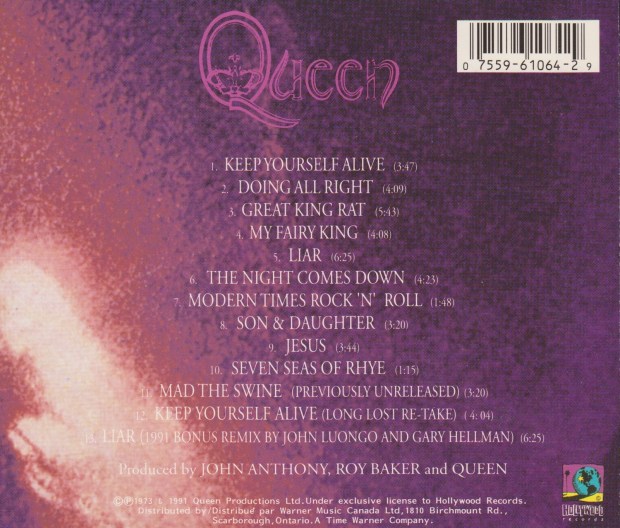
Every good CD reissue should have bonus tracks. The 1991 Hollywood CD issue of Queen has three, while the cassette only had one, which was “Mad the Swine”. This is an odd little song, an acoustic hippie track that you can sing along to but probably don’t want to. “Corny” is an appropriate word. Better is a remake “Keep Yourself Alive”. The band tried out different instrumental bits on this version, especially noticeable in Roger’s busier drum part. The vocals are also glossier and better defined. The tapes were lost and then re-surfaced in time for the 1991 reissue. I think it’s likely a track like this would have eventually been released as a B-side, had the tapes not been lost for so long. It’s a great and very interesting version that can co-exist along with the original.
The unfortunate thing about the 1991 reissues were the inclusion of useless remixes. If it were a vintage remix from an earlier period that’s one thing. But these are 1991 remixes, done for the express purpose of creating bonus material for reissues. The artistic value in them is questionable. That said, “Liar” is pretty faithful to the original, but with mixing board tricks to draw attention to different parts. There are some unheard guitar parts as well, which are fascinating. Of the 1991 remixes, this is one of the better ones. (Don’t even get me started on Rick Rubin’s remix of “We Will Rock You” with Chad Smith on drums and Flea on bass. That atrocity was even released as a Queen single. But I digress.)
That’s the last track on the CD. I know what you’re thinking now. “But LeBrain,” you are saying to yourself, “Isn’t there a more recent reissue with more bonus tracks? Aren’t you going to tell us about those, too?” Yes, there is a more recent version (2001, on Universal) with more bonus tracks (six total). No, I’m not going to talk about that today. Reason being, I don’t have it yet. But Christmas is coming.
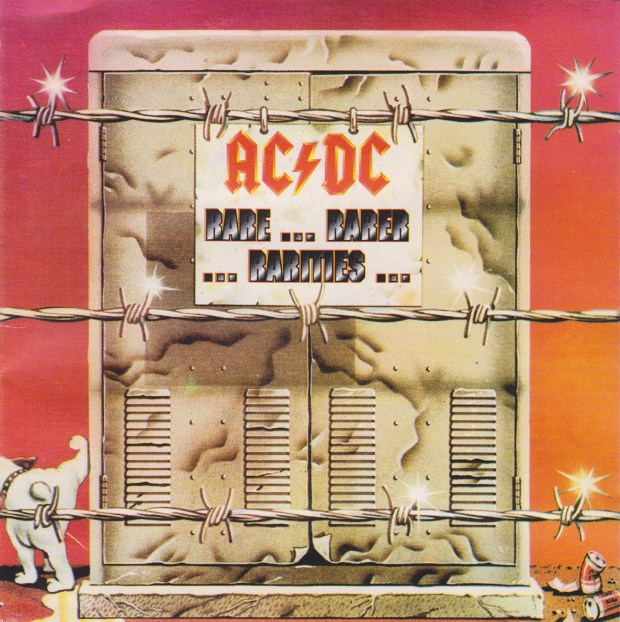
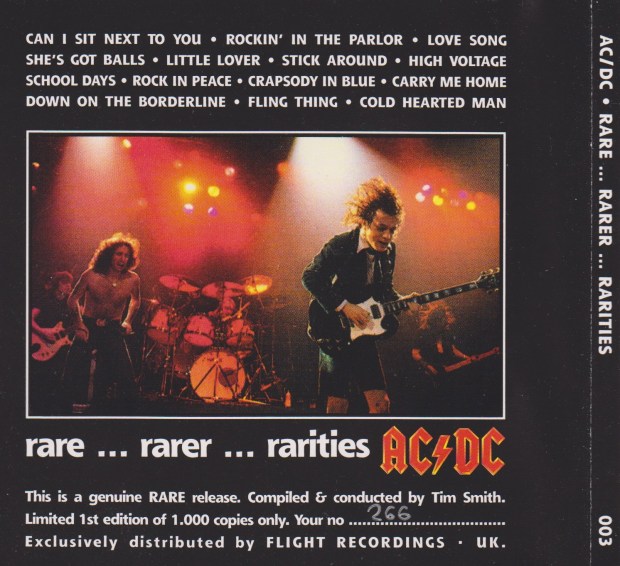
AC/DC – Rare…Rarer…Rarities(Flight records bootleg CD, year unknown)
Rare…Rarer…Rarities, huh? Indeed, this is a bootleg CD that includes rarities that most fans don’t have on an official release. The pretty comprehensive Backtracks box set, which came out later, covers most of these songs…but not all.
Most of these tracks are either single B-sides or songs that were exclusively released on the Australian versions of albums. Until Backtracks came out, those songs were very hard to find in North America. The only one I had was “Rock in Peace”, from Dirty Deeds Done Dirt Cheap. I couldn’t believe my luck in scoring the Australian CD of that album.
There are, however, two songs that none of us are likely to ever own an original physical copy of. These two tracks alone make the bootleg CD purchase worth considering, since they are AC/DC’s first single from 1974, featuring original singer Dave Evans. Most fans have never heard anything with Dave Evans singing. These are ripped from an original 7″ single.
“Can I Sit Next to You Girl” is a song every AC/DC fan knows, because this golden oldie was re-recorded on T.N.T. (1975). Bon Scott’s cheeky delivery made all the difference in the world. Dave Evans is just some guy, asking to sit next to you. Bon was Bon fucking Scott asking to sit next to you…who do you think gets the girl? This early single was issued in the summer of ’74, and it has a completely different, much more laid back intro. It’s not nearly as heavy as it would later become. Evans does have a fine vibrato, I must say!
Every single has a B-side, and “Rockin’ in the Parlour” was AC/DC’s first. It’s much more “rock and roll” than you expect from AC/DC, but it’s catchy and melodic. Angus and Malcolm have yet to fully develop their styles, but you can certainly tell its them. You can hear for yourself, that Dave Evans was not the lyricist that Bon Scott was. “She said, ‘I got some booze, around at my place, so come along and have some fun!'” Sorry Dave, but that just won’t cut it when the band is AC fucking DC.
The rest of these songs are all in print today, so they can be acquired on official AC/DC releases. “Love Song” (High Voltage) shocked me on the first number of listens. Is this AC/DC’s one and only ballad? I guess so! “Oh Jean, Oh Jean!” sings Bon, seemingly heart broken. Once you get used to it, and accept the fact that there are no other AC/DC songs that sound anything like it, you might enjoy it. I know that I do, from time to time.
I’m not sure what makes “She’s Got Balls” and “Little Lover” qualify as rarities. As far as I can tell these are the album versions. Next! “Stick Around” (High Voltage) is a cool tune, a laid-back AC/DC rocker with lots of space between the instruments. You can hear the air sizzle! The riff is about as simple as it gets: two chords. But they are the right chords! “High Voltage” is slightly longer than the album version, and this is also on Backtracks.
“School Days” is a Chuck Berry cover, one of very few covers AC/DC recorded. Chuck Berry is the prototype of AC/DC anyway, so this version fits like a glove. Hail hail rock and roll, indeed! This was originally on T.N.T., but you can get it on the Bonfire box set too. The aforementioned “Rock in Peace” is a shorty, heavy with that AC/DC stomp and the same damn riff they’ve been playing for 40 years.
AC/DC have always had tongue firmly in cheek, but “Crabsody in Blue” is probably the jokiest song they ever recorded. A slow blues similar to “Ride On” deserves to have some down-and-out lyrics. Bon takes that to a descriptive extreme!
“Oh, and when they start to bite, Then it’s time you saw the light, For an appointment. Before you start to scream, That’s when you apply the cream, Blues ointment.”
Only Bon Scott can really write a lyric about venereal disease. Nobody else seems quite as qualified.
“Carry Me Home” was the heavy and instantly likeable B-side to “Dog Eat Dog” (1977). Using his speaking voice to full effect, Bon proves to me why he is one of rock’s all time greatest frontman. His animated vocal performance here is something that very few singers can pull off. (Ian Gillan is one such singer — think “No Laughing in Heaven”.) Then, “Down on the Borderline” is Brian Johnson’s only showing on this CD. This was the B-side from “Moneytalks” (The Razors Edge), but it sounds little like that album. Sonically and vocally, it resembles Blow Up Your Video, right down to the muddy finish. I have no doubt it was recorded for that album.
“Fling Thing” is AC/DC’s take on “The Bonnie Banks o’ Loch Lomond”, which they cheekily credited to Young/Young! It sounds like quite a party was going on during the recording, which falls apart after a mere two minutes! This was originally the B-side to “Jailbreak”. The final song is “Cold Hearted Man”, which was recently dusted off for the Iron Man 2 soundtrack album. It was on Powerage (1978) first, and a dark prowler it is.
A lot of people like to joke that all of AC/DC’s songs sound the exactly the same. This CD of also-ran’s has proven otherwise, and “Cold Hearted Man” is a perfect closer for a solid collection of rock.
By special request of reader Wardy, it’s Epic Review Time!
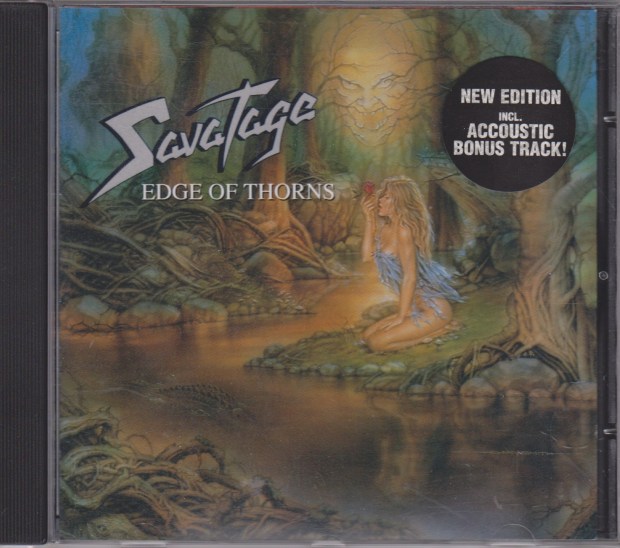
SAVATAGE – Edge of Thorns(1993 Edel & 2002 Steamhammer)
Sava-fans were shaken. Even though 1991’s Streets: A Rock Opera was a complete artistic triumph, singer and co-founder Jon Oliva quit the band. Side projects and home life had become priorities. He would not, however, ever truly leave Savatage. Even though he was no longer the singer, Jon Oliva co-wrote every track with his brother Criss and producer Paul O’Neill. He even personally selected his replacement, Zachary Stevens, and tutored and coached the new young singer. He also continued to play all the piano parts in the studio, although this time he would not tour. It was certainly an unusual situation, but also an ideal one. Fans knew that Jon was not really gone, and they easily embraced Stevens as the new frontman. Oliva had stated that Savatage needed a voice like Zak’s in order to continue. He knew his own voice was not commercial enough to get on the radio. With Stevens they had a shot.
The press glowed with reviews, praising the new direction of the band. They had successfully combined the later piano-tinged Savatage that wrote complex operatic songs and ballads, with the earlier riff-driven metallic Savatage. Stevens was praised for his voice, and comparisons to Geoff Tate, James LaBrie and Ray Alder were tossed around. I found a copy of Edge of Thorns in Michigan, and it was with great anticipation that I ripped the shrink wrap off the cassette and placed it in my Walkman.
Anyone who has heard the now-classic title track “Edge of Thorns” can’t forget the haunting piano that descends at the beginning of the album. At this early stage, Stevens was very much singing like a progressive rock singer, and throwing in screams at key moments. His range and power here are impressive, and very different from the Mountain King’s style. “Edge of Thorns” was a great choice for an opening track and new singer. Not only is it one of the most immediate songs that Oliva/Oliva/O’Neill had yet composed, but it also combines both sides of the band. The soft piano intro reflects Streets, but then it kicks into overdrive with a riff, heavy bass and dramatic guitar solos. It possesses the pure rock drama of “Gutter Ballet”. It is the whole package.
I have always been drawn to the words.
I have seen you on the edge of dawn, Felt you here before you were born, Balanced your dreams upon the Edge of Thorns, …but I don’t think about you anymore.
I don’t think about you…anymore, Anymore…
But clearly, he does, and intensely so.
“He Carves His Stone” begins as if a ballad, but the patented snake-y Criss Oliva guitar riff drags us back to the metallic origins of the band. The combination of riff and chorus are a winning one. More intense is the borderline thrash metal of “Lights Out”, a smoking track that shows what Zak Stevens can do with the rougher side of his voice. Hang on tight and shout along to the chorus, because this one is a ride.
Back to the dark, dramatic side that Savatage do so well, it’s “Skraggy’s Tomb”, a brilliant song bursting with ominous heaviness. Just let it assault your skull, don’t fight it. Fear not — “Labyrinths” is a quiet piano piece, with Jon accompanied by Chris on guitar. This cascades in traditional Sava-fashion into a fully-blown dramatic intro similar to “Gutter Ballet”. It is a suitable and essential part of the song it is attached to, “Follow Me”, the side one epic.
His whole life was written, Written there inside, The new weekly Bible, His modern TV Guide, Every night he stares back at the screen.
There is no way to sum up the pure excellence, drama, and chills that “Follow Me” delivers. Zak’s vocals make it accessible enough, the power is undeniable. “Follow Me” is among the greatest songs of the Zak Stevens era. A quiet piano piece appropriately titled “Exit Music”* works as an outro. Together with intro and outro, “Follow Me” is almost 10 minutes of pure Savatage adrenaline, with a Criss Oliva solo that still gives me chills.
The second side opens exotically with “Degrees of Sanity”, and Savatage fans know that sanity of one of Jon Oliva’s favourite lyrical subjects! Criss’ guitar parts are lyrical and enticing. Slowly it chugs, building and building. With Criss firmly at the helm, the ship steers through craggy riff after craggy riff until it gives way to the next song, also clearly dealing with sanity: “Conversation Piece”. The subject person of the song thought he had been doing better, lately. “I haven’t thought about you for a while,” he claims. But even so, he has not let it all go yet. “I keep your picture hidden a file, of favourite one-act plays. Like pieces of myself, cut off in desperation, as offerings to thee. I’ll leave them on the shelf, they’re good for conversation over a cup of tea.” The melodramatic lyrics of Savatage have always appealed to me (I don’t know what that says about me). Thanks to Stevens’ impassioned delivery, you can feel every word, while Criss Olivia chugs behind. Remind me not to visit for tea!
Delicate is “All That I Bleed”, a pretty piano ballad with a rocking conclusion. Demonstrating the versatility of his voice, Stevens sings smooth and light, until the end. Perhaps it is all coincidence, but the songs do seem connected. Both “All That I Bleed” and “Conversation Piece” deal with a letter and difficult emotions. I like to think of the two songs as alternate endings to the same story — one in which the person does not send the letter (“Conversation Piece”) and one where he does (“All That I Bleed”). Regardless, “All That I Bleed” has everything you would want in a ballad. Had in come out in 1989 it would have stormed the charts and MTV would have played it non-stop. 1993 was a very different year from 1989, but Savatage had never expressed any interest whatsoever in musical trends (the mis-step that was Fight for the Rock notwithstanding).
“Damien” appears next, a choppy heavy rock tune with bouncy piano doubling the guitar riff. Following this fine song is the even finer “Miles Away”, a melodic heavy rocker that is easy to like. It has a brightness to it, and Steve “Doc” Wacholz kicks the drums right in the ass. Unexpectedly the album closed with a quiet acoustic song, “Sleep”. It feels like a sunrise after the stormy night, and perhaps that’s the intention.
There are plenty of bonus tracks on different editions of Edge of Thorns. I can only review the bonus tracks I have, which are:
“Shotgun Innocence”, originally a Japanese bonus track. This is a glossy hard rock song with an emphasis on melody. Though certainly heavy enough, its direct rock vibe doesn’t fit the mood of Edge of Thorns, which I’m sure is why it was saved for a bonus track. Good song though, and it certainly shows off the pipes of young Mr. Stevens.
“Forever After”, the second Japanese bonus track. Probably the weakest song of the batch. It sounds a bit like an unfinished Ozzy outtake, circa the Jake E. Lee period.
“Conversation Piece (Live in rehearsal 9/24/1994)” is recorded really poorly, but the sweat and rawness are captured. Since it is live in rehearsal, and it is known that Doc Wacholz did not tour, I assume this is with Jeff Plate on drums. That would also have to be Alex Skolnick from Testament on guitar. This track is on the 2002 Steamhammer/SPV remastered edition.
“Believe (Acoustic)” is part of a series of acoustic versions Savatage did for another batch of reissues. This is Zak Stevens’ version of the closing ballad from Streets, but with acoustic guitar instead of piano. It is a fascinating alternative version, but the original always kills me. This is on a German printing on Edel records.
As fate would have it, this would be the final time Jon and Criss would make music together. On October 17, 1993 Criss was killed by a drunk driver with seven prior DUI’s. Rather than let this crush him, Jon survived by pouring himself into music. Savatage would not die, even if with half its heart ripped out. Edge of Thorns remains Criss Oliva’s capstone, and a bright apex it is.
5/5 stars
*The really interesting thing about “Exit Music” is that it is entirely piano. Therefore no “official” members of Savatage appeared on it!
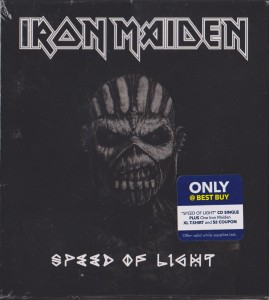
IRON MAIDEN – “Speed of Light” (2015 BMG single/T-shirt bundle – Best Buy exclusive)
“Only at Best Buy“ — the words chill me to the bones.
I don’t know what the deal is with Best Buy exclusives in Canada. When Tenacious D’s movie Pick of Destiny came out, I found the Best Buy edition no problem, just up the street. Bonus disc and all, easy peasy. Didn’t even know such a thing existed until I found it at Best Buy.
Only a few years later, it became impossible to find Best Buy exclusives at Best Buy. Using Tenacious D as the example again, the Best Buy edition of Rize of the Fenix has two bonus tracks. I had to buy it on eBay, so you know it was an inflated price. Same thing with the last Black Sabbath album. Best Buy had a bonus track called “Naïveté in Black” which happened to be one of the best songs. Had to buy it on eBay. Paid too much.
A few weeks ago, Best Buy announced they were getting an exclusive on the new Iron Maiden single “Speed of Light” from the forthcoming double album The Book of Souls. It came with a T-shirt. But I wanted the single just as much. That’s where Stone from Metal Odyssey came in!
First of all, I’m gonna tell you to follow Stone in some way, shape, or form. (WordPress/Twitter) He read my plight regarding Best Buy items here and took pity. I called my closest Best Buy — all CDs have been removed from their inventory. So Stone bought two copies and sent me one, asking nothing in return. (I will return the favour — just name it man!) To say I appreciate this gesture is am understatement, which is why I’m being more long winded than usual for a one track CD single!
“Speed of Light”, written by the duo of Dickinson/Smith, is true to Iron Maiden, and it sounds fucking brilliant. We know all about the new double album, with plenty of long bombers. “Speed of Light” is just a hair over five minutes, a very concise song for any Maiden album. When Adrian and Bruce write together, you can count on a catchy riff and hooks. “Speed of Light” delivers, and Bruce’s singing is just as powerful as ever, cancer be damned. His voice is virtually unchanged since Brave New World, 15 years ago. The air raid siren is intact. And this album will be the fifth with this Maiden lineup, the longest lived in its history. Impressive.
Most impressive.
A highlight of “Speed of Light” has to be Adrian’s solo. The three Maiden guitarists (Janick Gers and Dave Murray being the other two) all have their own distinct styles, which is a major boon to a band like Maiden. Adrian is the one who thoughtfully composes his solos, and then lets them rip. This one is brief but has his stamp all over it.
Sometimes Maiden take on a 70’s vibe. “The Angel and the Gambler” is one such moment, but I think “Speed of Light” also has one foot in the 70’s. Just a hint, an insinuation, at the beginning. Otherwise, “Speed of Light” is purely a modern Maiden metal moment. It would have fit comfortably on The Final Frontier, although I would caution against inferring the sound of the new album from just one single. It is probably one of the more straightforward moments on The Books of Souls, but we’ll find out for sure on September 4.
One last comment: fuck you, cancer! You just got beat by Bruce Dickinson!
DIO – Holy Diver (2012 Universal deluxe edition, originally 1983)
Ronnie James Dio often said that the best Dio album was the first. Fans will always have their own favourites, but there is no denying that Ronnie was right about Holy Diver being a special album. Dio had always had a knack for rallying talented people around him. Just look at that lineup: Ronnie and Vinny Appice had recently fled Black Sabbath. Jimmy Bain had worked with Dio in Blackmore’s Rainbow, an integral part of that band’s lineup in the Rainbow Rising period. On guitar – Vivian Campbell, from little known New Wave of British Heavy Metal band Sweet Savage. A shredder he was, able to compete with the hot flashy players of the 80’s.
Very few people do speedy metal songs better than Ronnie James Dio. “Stand Up and Shout” is the prototype of such Dio songs. Youthful and rebellious, “Stand Up and Shout” was exactly what fans in 1983 were craving. The band got to show off their chops a bit, with Vinny Appice leading the way via a hell of a drum performance. Then it’s Vivian’s turn to shine on one of the speediest solos laid to tape. “You are the strongest chain and not just some reflection,” sings Ronnie, inspiring the masses with his positive message of self-belief.
For the first four albums, Dio always put the title track second. If this holds some special meaning, I do not know. “Holy Diver”, with its ominous opening, still remains upon the lofty peak of the best songs Ronnie has ever written. The riff, written solely by Ronnie, is iconic. Perhaps it is not recognized on the level of immortal riffs such as “Whole Lotta Love”, but among metal fans, it is held in high regard. “Holy Diver” is the shiniest jewel in the crown, a massive track that just has everything. Bain and Appice formed a tight rhythm section with the exact right amount of heft. The song is flawless…shiny diamonds indeed.
Like the eyes of a cat in the black and blue, something is coming for you.
“Gypsy” is a knockout. Ronnie belting in full voice with a solid mid-tempo song behind him is always a pleasure. This is Vivian’s first writing credit on a Dio album. The guitar solo could use some focus, but I think the directive here was “just shred”. One of Dio’s most pop moments (in terms of melody only) is “Caught in the Middle”, one of his catchiest, most concise and direct songs. Even Vivian sticks to point on the solo. But “Caught in the Middle” is soon eclipsed by an even more exciting song: “Don’t Talk to Strangers”. The acoustic fake-out intro is a trick Dio pulled again later on “The Last in Line”, but when the song really starts, it’s friggin’ frantic. It’s like the wind. These guys had so much energy, it is remarkable. “Straight Through the Heart” has balls to it, it’s a groovy tune. I loved Halestorm’s cover of it immensely. I think they really caught and emphasized what is great about the song. Lzzy Hale is one of very few people who can do Dio justice vocally.
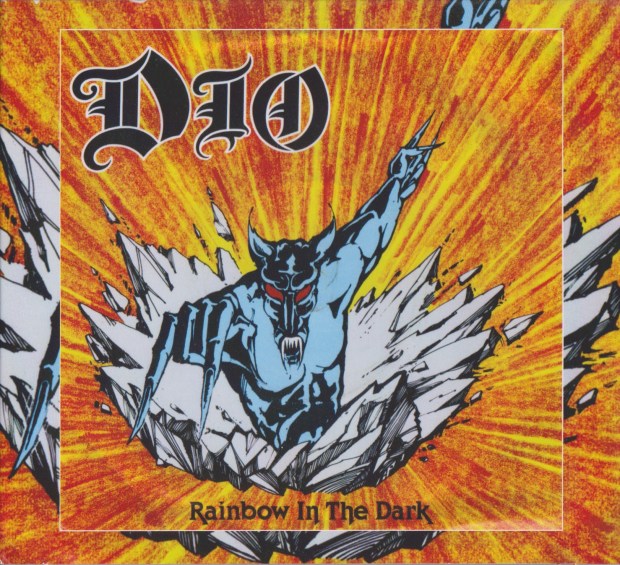
The slow intro to “Invisible” reminds me of a 1987-era Whitesnake ballad. This is another trick! It stops and abruptly turns into another Dio stomper of high quality. There is very little letup on this Dio album. The momentum is maintained by the stunning single “Rainbow in the Dark”. That’s Ronnie on keyboards, by the way. I have a story about this song.
Our local rock station, 107.5 Dave Rocks, has a 3:00 contest called the Tedious Tiresome Trivia in the Tri-Cities, or the TTT in the TC. What makes it so tedious and tiresome are the callers. Craig seems to attract the…how should I say this? The most “interesting” callers. The most notorious of these is “Bore-linda” who has a legion of haters who can’t stand her perky tone. (She’s actually a very nice lady in real life.) Craig Fee would receive emails from annoyed listeners saying, “Hang up on Bore-linda! Play some Dio!” So that’s exactly what Craig did, and he chose “Rainbow in the Dark” as the song. And Bore-linda calls in a lot. And Craig hangs up a lot. For a while, “Rainbow in the Dark” was played almost daily between 3 and 4 o’clock. And you know what? It never got tiring. Every single time it came on was a fist-pumper.
Holy Diver deserves a dramatic ending, and that would be “Shame on the Night”. Copying the template of a song like Sabbath’s “Lonely is the Word”, it occupies the same kind of slow-paced dark metal space. Vivian’s guitar intro is very cool, but the song just pounds.
The bonus CD is chock full of Dio goodness. Deluxe editions should always present a complete set of B-sides. This has the three from this era, including the studio cut “Evil Eyes”. This excellent, cruisin’ tune was re-recorded for The Last in Line, and the B-side version has remained obscure until now. Vivian has a lot of different solos on this version, and they are all cool. Then, essential cuts “Stand Up and Shout” and “Straight Through the Heart” are both live B-sides, every bit as electrifying as the originals. They are simply more raw, probably a little faster, and there is nothing more powerful than Ronnie James Dio’s voice live in the raw.
The balance of the disc is fleshed out by six live songs recorded for radio by the King Biscuit Flower Hour. They sound excellent, thanks to King Biscuit. You get “Stand Up and Shout” a second time, but the rest of the live songs are not repeats. In the mix are some Sabbath (“Children of the Sea”) and some Rainbow (“Man on the Silver Mountain/Starstruck”). Of the two, “Children of the Sea” fares better from the Dio band’s interpretation. To be fair, I think Tony Iommi and Ritchie Blackmore both have so much personality, that it is daunting to cover them no matter who you are. I think Vivian’s style works less well on the Rainbow song than it does with Sabbath’s material. The rest of the songs (“Holy Diver”, “Rainbow in the Dark”, “Shame on the Night”) are all quality Dio tracks. Although the market is now inundated with live Dio packages, it is still a delight to have these early recordings on CD.
I needn’t divulge that this deluxe edition is loaded with cool liner notes and pictures. You have come to expect that from a good deluxe edition. And Holy Diver is quite good indeed.
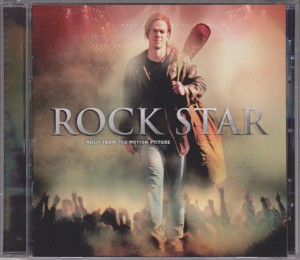
ROCK STAR – Music from the Motion Picture (2001 Warner)
I remember dragging my long-suffering girlfriend at the time out to see this movie. She had every right to complain. The movie was a stinker, absolutely. Not to mention, it had no idea when it is taking place. Vaguely, the 80’s, but then after this guy (Marky Mark) leaves the band (Steel Dragon), he goes and becomes the founder of grunge? The movie sucked! It was very, very loosely inspired by the story of Ripper Owens being discovered by Judas Priest, by being in a Judas Priest cover band. In the movie, Marky Mark becomes the singer of Steel Dragon after their original singer (who also happens to be gay, hmmm?) quits. It was supposed to be a really inspiring story of the everyman with talent who succeeded, but it ended up being just a normal everyday turd.
But listen, we’re not talking about the movie. We’re looking strictly at the soundtrack CD. I ask you one simple question: If you were to pick one band to write and play the title anthem for a movie about a heavy metal band in the 80’s, who would it be? Obviously the answer is Everclear. (I say “obviously”, because a whole bunch of suits who get paid a whole lot more than I do picked it, so they must be right.) Actually, their tune “Rock Star” isn’t bad. It sounds a bit like an old Canadian rock band called Deadline, actually.
It’s astounding, but Zakk shaved his beard to get that 80’s look back!
The main attraction of the CD is actually the original tunage by the fictional band Steel Dragon. On record, the lineup was:
Zakk Wylde – lead guitar
Jason Bonham – drums
Jeff Pilson – bass
Nick Cantonese – guitar
Mike Matijevic – lead vocals
Jeff Scott Soto – lead vocals
See why I dragged that poor girlfriend out to see this movie? Zakk, Jason and Jeff were in even the movie, as the band Steel Dragon.
They had two lead singers, while Marky Mark mimed. Jeff Scott Soto sings the raspy, mid-rangey stuff such as “Livin’ the Life”. This isn’t a bad rock tune, but it’s Zakk’s guitar that makes it perk up a bit. Mike Matijevic (Steelheart) sings the smooth and screamy stuff, with his impeccable range. “We All Die Young” is a bonafide great songs. Matijevic’s stunning vocals meeting Zakk Wylde’s leads is probably a wet dream for some folks! The only problem with it is that it doesn’t sound accurate to the period. The movie is supposed to take place in the early 80’s (I think) but “We All Die Young” sounds early 90’s. But wait…we’re supposed to be talking about the CD, not the movie. Fuck the movie!
“Blood Pollution” (written by Twiggy Ramirez, interestingly) has Matijevic singing, but as with “Livin’ the Life” the song isn’t that special. It sounds like Motley Crue, except with Zakk Wylde on guitar and a better Vince Neil. Jeff Scott Soto helms “Stand Up”, which is way heavier than you’d expect considering Sammy Hagar wrote it! This version actually came out before Sammy’s, on 2002’s Not 4 Sale and has different lyrics. “Stand Up” kicks ass, and along with “We All Die Young” is one of the soundtrack highlights. Just listen to Zakk killing it in that fast part! It’s also one of the few tunes with that patented, genetic Bonham Stomp.
Another track right up Motley Crue’s alley is “Wasted Generation”, and with its Desmond Child co-write it’s a lot heavier than expected. Jeff Scott kicks ass on the anthemic punchy chorus, and Zakk’s shredding is tasty. The final Steel Dragon tune on the disc is a Rainbow cover — “Long Live Rock and Roll” with Matijevic singing. I never understood why the band Steel Dragon would be playing a Rainbow cover, since it is implied that Steel Dragon were active in the 70’s too, contemporaries with Rainbow. But we’re here to talk about the CD, not that piece of shit movie. “Long Live Rock and Roll” with Zakk Wylde on guitar…it’s not what you’d hope it would be. Bonham’s awesome though, and remarkably Ian Paice-like.
The rest of the disc contains various hits from various bands from various years. The Verve Pipe – “Colorful” (2001), check! INXS – “The Devil Inside” (1987), check! Why? Who the fuck knows. I like some INXS, it’s completely out of place. I suppose that a soundtrack for you. More suiting to the tone of the CD are Kiss’ “Lick It Up” (1983), Bon Jovi’s “Livin’ On A Prayer” (1986), Ted Nugent’s “Stranglehold” (1975), and Motley Crue’s “Wild Side” (1987). I do wonder why “Stranglehold” seems to be the only Nugent that ever shows up on movie soundtracks. At least Marky Mark doesn’t have any songs.
The final song, Trevor Rabin’s “Gotta Have It” sounds like end credits music, but I’m not going to watch that crummy movie to find out. Rabin’s track is excellent, as should be expected. It sounds like Rabin, which is all I can really say to describe it!
So: Rock Star, a shit movie, gave us a pretty OK soundtrack. Considering I (and probably you) already had the Nugent, Kiss, Bon Jovi and Motley Crue songs, I salvaged seven tracks from the album as keepers: the six Steel Dragon tunes, and Trevor Rabin. There are 14 songs, so this time the math is easy.
It’s the final instalment of GREATEST HITS WEEK! All week we were examining some pretty cool greatest hits albums. I saved the best for last — one of the very greatest, Greatest Hits albums ever. Once again, thanks to Aaron over at the KMA for the idea (which I stole). For his original Greatest Hits Week, click here!
Yeah, oh yeah! Ooh, said I, I’m comin’ out to get you Ooh, sit down, I’m comin’ out to find you Ooh, yeah Ooh yeah Findin’ my way!
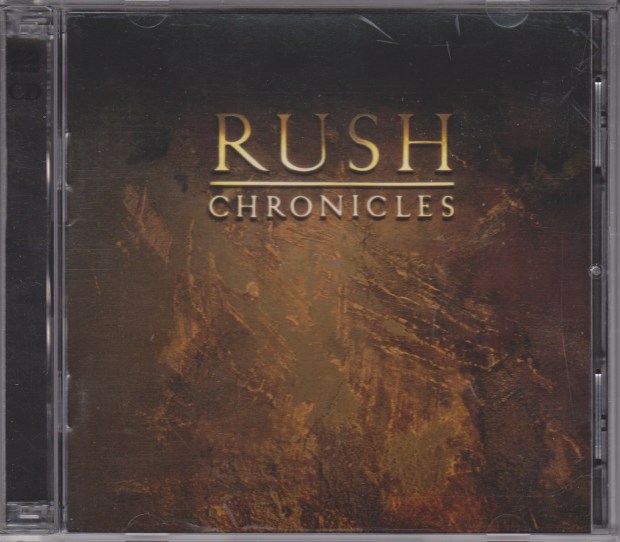
I just can’t stress how important this album is to me. I had always followed Rush, and been interested in what they were up to. I had never taken the plunge and bought any albums. I wouldn’t have had a clue where to begin anyway. In July 1994, I was hired at the Record Store thus kicking off the exponential growth of my music collection (and tastes). With birthday money, I finally acquired my first Rush: Chronicles, the massive 2 CD set that was released for Christmas of 1990.
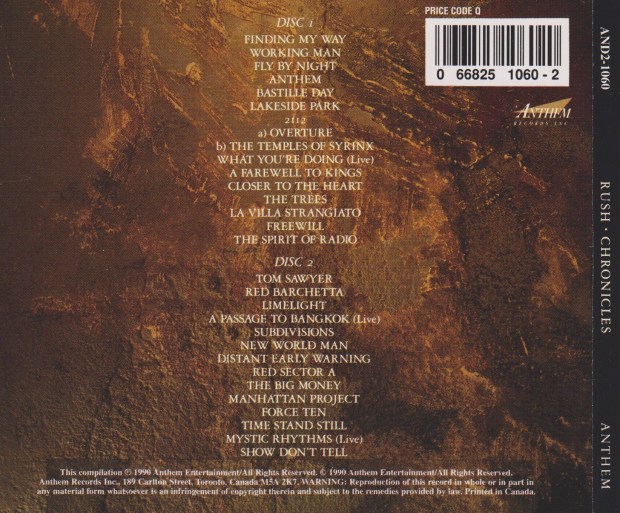
For my first listen, I didn’t play the whole thing from front to back. I picked out the songs I liked best, and programmed the CD player. I revisited favourites like “Tom Sawyer” and especially “Subdivisions”, and then the next day, listened to the whole thing. One song jumped out at me immediately: “Red Sector A”. Holy shitballs! “The Temples of Syrinx” was the next one that grabbed me on second listen, along with “Freewill”, “Limelight”, “The Trees” and “What You’re Doing”. I had feared Rush would be a bit over my head if consumed in this quantity, but it turned up to be just my poison.
Even though Chronicles is the first Rush “greatest hits” compilation, and has arguably been replaced by the three volumes of Rush Retrospective, I still think that it is a perfect entry point. I think back to my early experience of trying to figure out where to start with this band. They seemed to have a lot of different sounds over the years. I know today that anybody looking to buy their first Rush album can comfortably start with Moving Pictures. But what about those who want a little bit more music than that, in the form of a detailed sampling? Then Chronicles is the one.
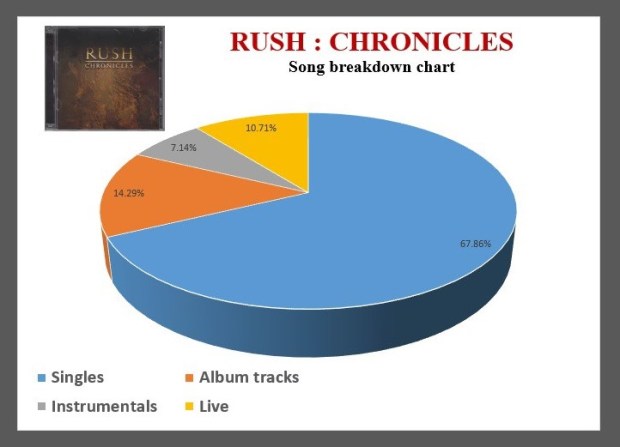
Appropriately, Chronicles goes chronologically which works for a band like Rush. Their evolution over the years has been very natural and organic, not at all jumpy. That makes for a smooth listen. Each studio album gets two tracks, with a few exceptions: Moving Pictures is represented by three, while the most recent Presto has one. Additionally, 2112 has one track, albeit actually the first two parts of “2112” itself. The neat thing, though, is that for its time Chronicles actually had three rare live tracks too. Back in the early days of CD, they couldn’t get as much music onto the disc as they can today. “What You’re Doing”, “A Passage to Bankok”, and “Mystic Rhythms” were all cut from their respective CD releases for time reasons. They were released on Chronicles, on CD, for the first time ever. All three are brilliant versions, especially the electrifying “What You’re Doing” from All the World’s a Stage.
I was hooked. Using the tracks and liner notes from Chronicles as a guide, I began adding more Rush to my collection: 2112, Signals, Moving Pictures, A Show of Hands, plus the more recent Counterparts and Roll the Bones too. I see no reason that new fans today can’t use the album as a gateway the same way I did. It’s still in print, even though the more recent Rush compilations are readily available.
There are minimal exclusions missing from Chronicles. Some notable songs are absent, such as later singles “Superconductor” and “The Pass” from Presto. This isn’t hard to understand. Rush wouldn’t have wanted to compete with the current studio album they were still promoting! The price is the only issue. Even after all these years, Chronicles is still found for over $20, unless you go for a used one, much like I did!
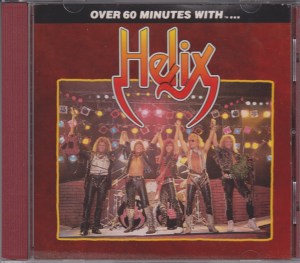
It’s always risky buying a compilation album from a label “series”. Yesterday, we looked at a Judas Priest compilation from Sony’s Steel Book Series. Over 60 Minutes With… was a CD-only (no tapes, no records) series by Capital/EMI in the late 80’s and early 90’s. I remember seeing it over Christmas break in ’89, and trying to decide whether to buy it, or Ace Frehley’s Trouble Walkin’. (I went with the Ace, and saved the Helix for a month or two later.) I was confused: Here was a brand new Helix CD, with Brent “The Doctor” Doerner right there on the front cover. But hadn’t he left the band? He had, but that was how I could tell this was a semi-official release, driven by the label.
The difference between Over 60 Minutes With…Helix and all the other label compilations is that this one is really, really good. In fact to this day, it is still the one of the best Helix compilations assembled (and it was the first!). Here are some reasons:
1. Rare tracks! Three of them in fact. You get demos for “Give It To You” (a new song re-recorded for the Back For Another Taste CD), “Jaws Of The Tiger” (re-recorded for B-Sides) and “Everybody Pays The Price” (later to be the B-side to “The Storm”).
2. Lots of hits. 21 tracks are contained within, and a good solid six of them were hit singles.
Those two points are enough reason to buy this CD (especially the first). Let’s keep listening.
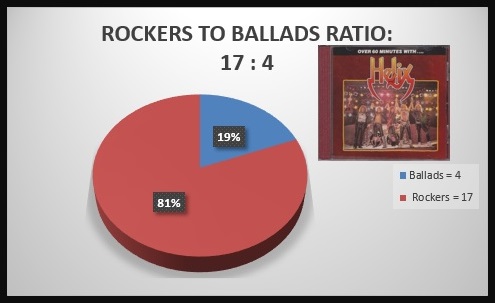
3. Rocker-to-ballad ratio is a generous 17 : 4. Keep me mind, Helix ballads tend to rock anyway. “Never Wanna Lose You” gets pretty heavy come chorus time!
4.Loads of tunes from No Rest for the Wicked. When this CD came out in ’89, that album was unavailable on CD and scarce on cassette. This CD has seven songs from No Rest! That album, loaded with rockers heavy and melodic, is still one of their very best today. Even though there were only three unreleased songs on Over 60 Minutes With…, there were tons that were brand new to me.
That considered, Over 60 Minutes With… has one serious flaw. The record company only included songs from the first three Capitol Helix albums. Obviously nothing from the independent albums Breaking Loose or White Lace & Black Leather were up for grabs. Strangely though, 1987’s Capitol Wild In The Streets CD is strangely missed. The inclusion of one or two tracks from that album would have been appreciated.
Flaw aside, the liner notes are informative and the track listing is still generous. You certainly don’t want to miss album tracks such as the awesome “You Keep Me Rocking”, the raunchy “Dirty Dog” or the slinky “Check Out The Love”. They are here along with many others. Pick this up, enjoy it, and then explore some of Helix’s proper albums, such as No Rest for the Wicked. This is great, but it’s only the beginning! Gimme an R indeed.
Welcome back to GREATEST HITS WEEK! This week we are looking at different, interesting hits albums from various bands. Today we re- visit the Mighty Priest, for the second of a Priest double-shot!
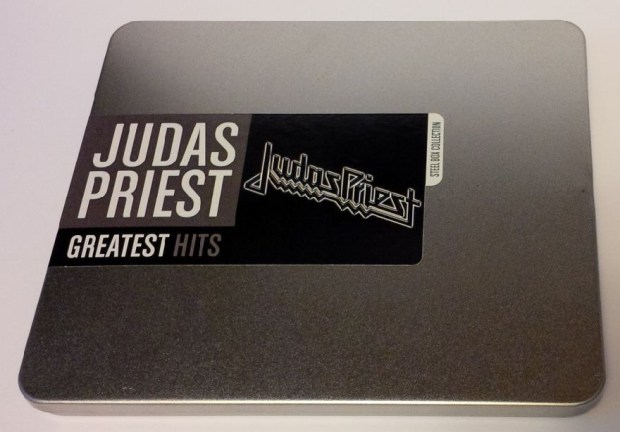
Ever buy a CD for no real good reason? I have all these songs, because I already own every song Priest has ever released. I saw this Judas Priest compilation, from the “Sony Steel Box” collection, at my local Best Buy for a few measly dollars. There are a few artists who have hits albums in this collection, such as Aerosmith. I just wanted one of the steel boxes, so I chose Priest. I chose Priest because of the brief, but interesting track listing. There are some odd choices for a greatest hits disc: “Rock Hard Ride Free”, and “Rock You All Around the World”, for example, instead of “Heading Out to the Highway”, “A Touch of Evil”, “Painkiller”, or other better know singles. Hell, where’s “You’ve Got Another Thing Comin'” or any song from Screaming? You do get two “new” songs from Angel of Retribution. Needless to say, for a 10-track hits CD, it was an interesting selection of songs, so I chose this one. I have only played it once, so it’s time to revisit and assign a rating.
This is where we run into the flaw with these Sony steel boxes — the front cover and back cover art is just a sticker, that wraps around the case. When you open the case, it damages the sticker where it covers the hinge, digging huge creases all over the spine. I’ve opened my copy a couple of times and see what it looks like already? That’s me being careful.
“Breaking the Law” has always worked well in the opening position. Off with a bang (literally; the first sound is a snare drum), we are now off to the races. This Greatest Hits concentrates almost entirely on material from British Steel and after, collecting a lot of Priest music from their simple, straightforward metal period of the 1980’s. There is nothing wrong with that of course, but it lacks the balance that earlier more complex tracks like “Victim of Changes” would have brought to the table. “Breaking the Law” and “Living After Midnight”, both classics culled from British Steel, get the job done on a hit laden note. The sound is fine, as it appears these were lifted from the Priest remasters.
I’m not sure the logic in choosing “Out of the Cold”, a synth-laden slow crawler from Turbo. There is nothing wrong with it of course, it was and remains a stormy fan classic. That’s just it though, it’s a fan classic, not a well known hit that the band play in concert. On a 10 song CD, it seems an odd choice, but it leads well into the dark “Love Bites”. I went through a period of about three days in grade 8 of being completely obsessed with this song. The things I liked about it, such as the choppy rhythms and hypnotic vocals, are still striking today. It also flows perfectly into “Rock You All Around the World”, which unfortunately is pretty much just filler that should have been donated to the Scorpions.
I still think it terms of albums having “sides”, and I wonder if whoever sequenced this CD had the same thought? “Rock You All Around the World” is a great side closer, as it filled that slot on Turbo. Then the next track is the very different “Diamonds and Rust” (live version from Unleashed in the East). It’s as if you have started a new side. Another track from Defenders of the Faith (“Rock Hard Ride Free”) brings the listener back to the 80’s. Although it was not a single, it was good enough to be one. Back to the Turbo album for the third time, “Turbo Lover” is a song that still gets occasional radio airplay. It’s funny how this robotic and very dated song is still loved today. I wouldn’t have predicted that.
“Turbo Lover” is the last of the golden oldies, since the last two tracks are off Angel of Retribution, Priest’s glorious reunion album with Rob Halford after a long solo career. Strange though that the single “Revolution” is not one of these tracks. “Deal With the Devil” was an OK tune, a good heavy album tune that was of the same quality as similar songs from Painkiller. “Worth Fighting For” was excellent – a midtempo quiet rocker that almost borders on ballad territory. This song was a triumph, a really excellent song worth of the Priest canon. Unfortunately in this case, a quiet midtempo near-ballad does not work to close a Priest compilation. It works as a song to build into another song, but here it just leaves you hanging. Sloppy sequencing.
Rating the steel book CD is not a reflection on the songs or the band, just the CD itself. There are too many serious omissions (“Metal Gods:, “Freewheel Burning”, hello!) for it to rate highly. The flawed packaging design is the final nail in the steel box.

 THE SEX PISTOLS – Filthy Lucre Live (1996 Virgin Japanese import)


 QUEEN – Queen (1973, 1991 Hollywood reissue)



















You must be logged in to post a comment.