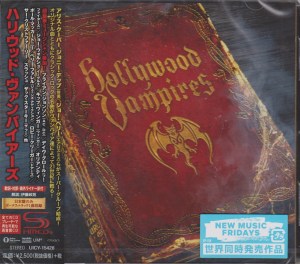
ALICE COOPER / HOLLYWOOD VAMPIRES – Hollywood Vampires(2015 Universal Japan)
Ignore the hype. The press has been going ga-ga over this new supergroup featuring movie star Johnny Depp (rhythm guitar), Joe Perry (lead guitar), and Alice Cooper (lead vocals). Just ignore the hype completely. Cooper fans know what this is. This is the covers album that Alice has been talking about doing ever since Welcome 2 My Nightmare in 2011. Alice has even been playing a number of these tunes, in these arrangements, live. Check out his Raise the Dead double live album/video for a few.
According to an interview with Ultimate Classic Rock earlier this year, “I can’t tell you who’s on what right now, ’cause it’s not gonna be released yet, but it’s the ‘who’s who’ of everything. It was one of those things where, at one point, I’m looking around in the studio and I’m going, ‘Holy crap! Look who’s in the studio.” Bob Ezrin, Alice’s long-time producer and musical collaborator came up with the concept. Alice continues: “Bob came up with the idea, ‘Let’s concentrate it on all the guys that you drank with in L.A., the Hollywood Vampires, the ones that are all dead.’ I like the title All My Dead Drunk Friends. It’s just offensive enough to work, but all those guys would have totally got it. They had the same sense of humor. If you told them you were going to do an album after they were gone called All My Dead Drunk Friends, they would have died laughing.” Ultimately the album was simply called Hollywood Vampires. That’s also the name of this “supergroup” which is essentially just Alice with Depp and guests.
I have this album filed in my Alice Cooper section, and that’s how I’m treating this review.
Hollywood Vampires consists of 14 tracks, except in Japan who have 15. Two of these are brand-new songs, and one is an intro called “The Last Vampire”. Fittingly, this features the narration of Sir Christopher Lee, who passed away earlier this year. Lee’s old friend from the Hammer horror days, Vincent Price, appeared on Cooper’s original Welcome to my Nightmare in 1975. Today, Alice Cooper truly is the last vampire left from those old days. Lee’s rich voice is backed by spooky keys and theremin by Ezrin, Depp and engineer Justin Cortelyou. “Listen to them, children of the night…what music they make.”
Alice then kicks it with “Raise the Dead”. Depp appears on every track, and Alice’s drummer Glen Sobol plays on this one and several others. It’s an upbeat stomper of a track, and a perfect introduction to this covers album that is also a concept album. The first of Alice’s dead drunk friends to be covered is Keith Moon on “My Generation”, an authentic and pounding version. Alice Cooper is one of the few that does justice to it. Bassist Bruce Witkin perfectly tackles John Entwistle’s signature bass solo. One thing that is immediately obvious is how massive this album sounds. Ezrin wrought a monster-sounding disc, so full and heavy, but textured when required.
John Bonham is up next. “Whole Lotta Love” was handled in a completely different way than you’d expect. Starting as a low, prowling Cooper blues it soon blasts into gear. Alice isn’t known for hitting those high Plant notes, so who joins him? None other than Brian Johnson of AC/DC, who kicks my ass completely. Joe Walsh and Cooper’s former lead guitarist Orianthi play some jaw droppingly greasy guitars, but Alice’s harmonica work is also worthy of praise! Even though very few can cover Led Zeppelin, “Whole Lotta Love” turned out to be my favourite track. It’s also the heaviest sounding, like a skid of concrete blocks assaulting your face! That’s Zak Starkey (son of Ringo) on drums.
Cooper has covered “I Got a Line on You” (Spirit) before, on the soundtrack to Iron Eagle 3, of all things. That 1988 take is my preferred version, but Alice remade it on Hollywood Vampires. Abe Laboriel Jr., Joe Walsh, and Alice’s old bassist Kip Winger join as guests. Perry Farrell of Jane’s Addiction helps Alice out on the lead vocals, but his part isn’t prominent. Then it’s time for the Doors, and a medley of “Five to One” and “Break on Through”. Alice had been playing “Break on Through” live, but this version has Robby Krieger! Alice heavies both of them up, but he is also one of the few singers who can do Morrison.
Farrell and Krieger return for a Harry Nilsson medley, joined by David E. Grohl on drums. “One” is rendered as a haunting, creepy piece as if Alice himself wrote it. This merges into “Jump Into the Fire”, a strangely upbeat companion which rocks in a vintage 70’s fashion. It’s like guitar nirvana. There’s also a cute outro of “Coconut”, also by Nilsson.
Sir Paul himself, rock royalty if there ever was one, shows up for Badfinger’s “Come and Get It”, which Paul wrote. Joe Perry has spoken about how incredible it was when McCartney showed up in the studio with his Hofner bass, and actually allowed them to hold it! “Come and Get It” is simple rock/pop, not the kind of timeless thing that happened when Paul wrote with John, but certainly a notch above what mere mortals can write. I love hearing Paul’s “screaming” voice, and I’m sure everybody in the studio had a great time. Sure sounds that way.
Marc Bolan’s “Jeepster” is one I could pass on. Alice makes it sound like an original from 1972’s School’s Out, but if you’re only going to skip one song, it’s probably going to be “Jeepster”. Lennon’s “Cold Turkey” featuring Joe Perry has more kick and grind to it, and it’s always a pleasure to hear Joe Perry do some Aero-jammin’ on lead guitar. (I think it would have been amazing to get McCartney to play bass on this Lennon classic — shame nobody thought of it. That could have been history made.)
The Japanese bonus track is “I’m A Boy”, the second Who cover. Once again, Alice nails it. This is such a difficult song to attempt. Alice makes it work, and if anybody can do it, it’s Alice. “My name is Alice I’m a head-case…” Just that one change makes the song work. “I’m a boy, I’m a boy, but my mom won’t admit it…I’m a boy, but if I say I am, I get it.” And he’s got the girl’s name. It’s perfect! This bonus track is worth tracking down if you’re a Cooper fan. You’ll definitely need it in your collection.
Jimi Hendrix was a Hollywood Vampire, and “Manic Depression” is the song Alice chose to cover. (He’d already done “Fire” back in the Hey Stoopid days.) Like “Jeepster”, this is one that could be skipped. Joe Walsh fans will enjoy his lead guitar work, but otherwise, it’s a stock cover. Way, way better is “Itchycoo Park”. Alice’s treatment of the Small Faces is far more entertaining, and its melodic base continue to deliver the hooks.
Brian Johnson returns to belt it out on the “School’s Out”/”Another Brick in the Wall Part 2” medley. This arrangement is similar to the way Alice did it live, and it’s cool how the two songs work together perfectly. It’s a genius mashup. Guests include Slash, and original Cooper band members Dennis Dunaway and Neal Smith. “School’s Out”, of course, is here for Glen Buxton, of the original Alice Cooper band. Buxton had suffered the consequences of alcohol abuse, and dropped out of music completely when the original band split in ’74. Buxton died in 1997.
The final song is an original, “My Dead Drunk Friends,” the song that Alice wanted to use as a title track. If you don’t mind some black comedy, you will love this tribute to all the lost Hollywood Vampires. It’s irresistible, and also sounds vintage Alice. So chants the crowd: “We drink and we fight and we fight and we puke and we puke and we fight and we drink!” Doesn’t sound particularly glamorous, but Alice isn’t about to have a mournful wake. Alice is about entertainment, and even though a brilliant artist who drinks themselves to death is sad, Alice has thrown a party for them instead. “My Dead Drunk Friends” ends the party on a darkly celebrating note, as only he can. Job well done.
Hollywood Vampires is pleasantly surprising. 9/10 covers albums are not worth the money you paid for them. Alice’s is. They call it a supergroup for marketing purposes but it only takes one listen to know what this is. This is a project that Alice, Bob Ezrin and friends have been passionate about for years, and has finally been finished. It is an apt follow-up to Welcome 2 My Nightmare, and another killer concept album from the kings of concept albums.
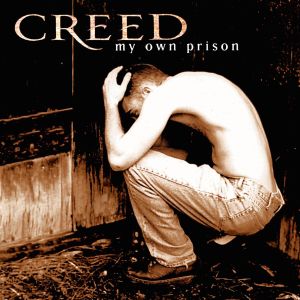
CREED – My Own Prison (1997 Wind-Up, originally Blue Collar)
Have you ever gotten flak for an artist or genre of music that you enjoy? Not a whole lot of fun, is it? Try to imagine that negative opinion not just as common, but as something resembling the general consensus. One that not only discounts anyone that disagrees, but actively mocks and ridicules them. Ask anyone you meet on the street: who are the “worst” musical artists of all time? Chances are, one particular scapegoat of late-90s’ rock will come up… To say that Creed is a controversial band is putting it lightly. Perhaps no group in the history of rock and roll has been a casualty of its own fame quite the same way the band composed of vocalist Scott Stapp, guitarist Mark Tremonti, drummer Scott Phillips and bassist Brian Marshall have. While the amount of fans often rivalled the number of critics in their heyday, as of 2015 the predominant word is negative. Whether it be from fans moving on or the band’s hiatus keeping them from speaking up for themselves, anything positive is rare. Case in point: Scott Stapp’s recent mental breakdown in December featured the most press coverage the frontman has had to endure since the turn of the millennium. EVERYBODY had something to say about it, oftentimes hateful. What of him now? He’s pulled himself back together and aside from his own personal PR, only one or two websites actually reported the news. I’m sure more than a few readers of this review will think he’s still whacked out on drugs, despite spending the last five months at home with his family.
Unfortunately, Creed’s status as something of a pariah maintains that I can’t just hop into the music and give you my personal take. If I were to do so, I’d likely have more than a few commenters simply reiterating age-old hate for the band or questioning the validity of my perspective because I’m not slinging feces. So let’s get to it: perhaps the most common strike against Creed is the idea that they’re heavily derivative of Pearl Jam. Um… have you ever listened to either of these bands? Generally speaking, Pearl Jam is angry garage rock with guitars that bite but don’t shred, and songs that are intended to coast primarily on the emotion conveyed in Eddie Vedder’s vocals and lyrics. Creed is arena rock with soaring pop hooks and beefy guitar riffs. Forgive me if I don’t find those two approaches to be all that similar. Not to mention the fact that Creed rarely ever treads the political ground that Pearl Jam does, and that the perspective of Pearl Jam’s material is often outward, with the Creed being much more introspective. To put it simply, Pearl Jam’s songs are often “you, you, you” while Creed’s are “me, me, me.” If you consider such a point-of-view as pretentious I understand, but I’d rather have someone pointing a finger at themselves than me or a hypothetical “them.”
Of course, this comparison between the bands primarily stemmed from the similarities in Vedder and Stapp’s vocal styles, specifically their employment of what’s known as “yarling” (which involves putting an ‘R’ sound behind enunciations). I’m not going to try and convince anyone that the two frontmen don’t sound similar, but there are important differences that even a cursory listen will highlight: Vedder has more range and is much more likely to yelp, with his voice cracking as he gets higher and more intense. Stapp has a richer timbre but over-pronounces his words in a somewhat silly manner that has become common fodder for haters that fancy themselves comedians. I understand the comparison, but postulating that Stapp “copied” Vedder isn’t wholly substantiated. Claiming that he sounds exactly like Vedder and applying that comparison to the whole band is outright lunacy. This didn’t make any sense to me when I only knew either band from their radio hits; having actually dug into each band’s body of work in subsequent years, it now strikes me as pure propaganda. The fact that the Pearl Jam comparison is blanketed over pretty much EVERY band of the so-called “post-grunge” era just confirms that suspicion.
The next common (and even more ridiculous) complaint is that Creed is somehow Christian rock. Come again? Creed isn’t Christian rock anymore than AC/DC is Satanist metal. Talking about God in a song does not make it religious in and of itself; Christian music involves God as the subject nine times out of ten, with some sort of message of hope through Him conveyed therein. With Creed, God is only ever mentioned as being there; Stapp’s lyrics allude to the Divine in the same way a person might speak of gravity. He’s not trying to convert or otherwise convince anyone of his religious convictions, he’s simply stating them as one might a fact of life. If you dislike this quality that’s fine but it doesn’t make Creed Christian music, even if some of the members are open about their religious convictions.
Even then, to properly interpret these allusions, one must also have some understanding of Stapp’s upbringing. He, like many youngsters, was born into a religious home. He had little interaction with his real father, and his mother remarried when he was still a kid. His stepfather Steven Stapp (from whom Scott took his last name) was a dentist by trade, but a zealot in practice. He made Scott study the Bible for several hours each day and conclude his time by writing essays about what he learned from the passages he perused (Scott later came to find that Steven was using his essays for Sunday school lessons). Think that’s bad? It’s not even the worst of it: whenever Scott messed up, he was physically beaten by Steven. As in abused. Steven also set a specific time each week that Scott was to be thrashed for sins that his stepfather “knew he committed but didn’t see.” Scott was also punished whenever Steven caught him listening to rock and roll, because it’s “the devil’s music.” To top it off, the doctrine advocated was of an unforgiving God that would damn a soul to Hell for the slightest trespass, lest they live a perfect life.
So why am I telling you all of this? Because personal experience naturally informs art, and if you were brought up in a household like this, chances are you’d address those feelings through song as well. It’s all in HOW one addresses these topics that informs the atmosphere. Scott didn’t write lyrics that concerned themselves with theology because he wanted listeners to believe it, he wrote them because HE didn’t know what to believe about the God he had shoved down his throat by his stepfather. It’s a fair assessment to assume that his childhood had a massive effect on his personality, not to mention the disparate reactions to the Creed’s music. It’s a wonder Stapp didn’t have a meltdown before 2014. Of the common complaints about this band, I consider the Pearl Jam point open for debate. Do the bands sound alike? To a degree; both play dour hard rock. There’s only so much variation one can attain within that template, after all. The Christian rock charge, however, is simply untrue. Overall, as far as I’m concerned, both of these sleights were coined not because of their accuracy, but moreso to knock the band off of their perch when they got huge. With the passing of time, these legends have become fact, and the legend is being printed. (As a final point, it behooves me to point out that the band was originally to be called Naked Toddler until Brian Marshall suggested the name be changed to Creed).
Finally, you have the general complaint of the era to contend with: Creed is most often resigned to the “post-grunge” monicker. I don’t care who you are or what you think about grunge, designating a bunch of later artists with a “post-” label when they make pretty much the exact same type of music as their forbears is ridiculous. Does that make Poison and Guns N’ Roses “post-hair metal” since they appeared relatively late in that particular cycle? I get that the so-called post-grunge bands are considered much less authentic than their precedents, but the problem with that line of thinking is that grunge didn’t really invent anything, nor were they all that “original.” Sure, grunge killed hair metal, but there’s a distinct difference between killing and conceiving. The faces of the sub-genre, Nirvana and Pearl Jam, are watered down punk with a hard rock flair. Think AC/DC is simplistic? Nirvana rocks three chord riffs like there’s no tomorrow. That “yarl” that is so often attributed to Eddie Vedder? He wasn’t even the first from the scene to use it, much less music at large. Layne Staley of Alice In Chains holds that dubious distinction for the grunge crowd. As far as the style’s far-reaching beginnings, Ray Charles, George Jones and Jim Morrison of the Doors all sung with such an affectation before Eddie Vedder was ever a glint in his father’s eye. Nevermind the fact that Stapp often cites Morrison as perhaps his most formative influence, along with Def Leppard and U2 (or that Scott honed his singing skills in black churches, whose members would frequently goad him to use “soul” as he sung (read: yarling)).
There are a variety of other diatribes against Creed, such as the band taking itself too seriously (didn’t Nirvana, Led Zeppelin and Black Sabbath, among others?), that Scott Stapp was an arrogant ass (John Lennon, Kurt Cobain, Axl Rose?) and that the band was too commercialized…sigh. This accusation has to be the MOST fragile of the stones thrown at these guys. Just because a song or album is mainstream does not in and of itself guarantee any sort of quality, good or bad. Anyone that attempts to postulate otherwise is too far up their own ass to give any other line of thought consideration. Sure, rock and roll has always had rebellion in its blood, so I can understand that the idea of a rock band NOT pushing such an image as odd. But let’s not forget that the most respected band of all time, the Beatles, was also the most commercial.
There’s also the charge that the band simply blended in with most of the other like-minded superstars of the time, with LeBrain’s popular line being to colloquially refer to them all as Theory of a NickelCreed. Maybe so, but if the band was so “generic” why are they singled out as one of the “worst of all time”? Just because they got big? And the only way to fight it was to backpedal 110% the other way? Politics, politics, politics… and that’s not even the worst of it. By far the most immature response to this band over the years has not been so much in terms of their output, but the fact that a disturbing amount of haters act like no one else has a damned right to enjoy this band. As if Creed deserves to be burned at the stake and obliterated from the public record along with anyone that admits to being a fan. If hold anything but contempt for them you’ve obviously been living under a rock and haven’t experienced the “good stuff” yet. Are you kidding me? Yeah, and Creed fans are the stupid ones.
Preamble over. Can we move on to the actual music now? That’s what we’re here to discuss, but my pen is pre-ordained to at least address these concerns beforehand, lest I be case out of the “elite” musical regime (which will probably happen anyway since, you know, my argument about Creed consists of more than the age old operandi “they suck because they suck.” Even now I feel readers skipping past my prose to the comments section to light their torches and take my ass to task for my “transgressions”).
Released in 1997 and selling over six million copies in the United States alone by 2002, My Own Prison heralded the arrival of Creed. According to a decent amount of the more casual fans and even some critics, this is their best album, and one after which many jumped ship in indignation. Why? Because of the first three records from the band, this one is decidedly the least commercial. The songs mostly just crunch and end, leaving the listener to sort out the details. Few are trying to be populist anthems. It’s not my favorite Creed album, but I can see why it’s a popular choice. The album weaves through mostly introspective stories of faith and loss, with slight forays into light political fair on “In America.” Overall, this is a moodier and less bombastic affair than the band’s subsequent albums.
Tremonti’s lead guitar ordains the album opener “Torn” with melancholy, and Stapp’s vocals maintain the atmosphere. “Peace is what they tell me/love, am I unholy?/Lies are what they tell me/Despise you that control me” he sings. The guitars crash in in full force on the word lies, underscoring the inherent evil of the practice. “The peace is dead in my soul/I have blamed the reason for/My intentions poor” goes the chorus. I love the atmosphere and passive, rather than assertive, anger conveyed with the lyrics and instrumental. Say what you will about this band but they know how to start an album (perhaps not coincidentally, “Torn” along with followup album Human Clay’s opening track “Are You Ready?” are my two favorite songs from this band).
Next comes “Ode”, a quintessential tune about being mistreated by others. Scott hints at his past here: “One step on your own/And you walk all over me/One head in the clouds/You won’t let go you’re too proud.” This track is a weaker standout, but still pretty good. The title track follows at number three. Perhaps I’m biased, but I consider the song “My Own Prison” to be a classic of ‘90s rock. The one feat Creed is rarely credited for is their knack for catchy and memorable hooks. There’s a reason they were so popular, and forgive me if I don’t think they’ve sold 40 million albums just because the general populace has “terrible taste.” Stapp is often cited for being too earnest with his lyrics and lacking subtlety; well, as far as I’m concerned life isn’t subtle, and he captures that aspect well. I consider the lyrics of “My Own Prison” to be pure poetry: “So I held my head up high/Hiding hate that burns inside/Which only fuels their selfish pride/We’re all held captive/Out from the sun/A sun that shines on only some/We the meek are all in one.” I’d be entertained just reading this stuff; can’t really say the same for “Lithium” or “Even Flow.” As a song, Tremonti and Marshall’s haunting guitar work and Phillips’ dejected drumming elevate the experience to another level.
The album hits something of a snag with the next few tracks in that none of them really stand out from one another (hey, I can make the case that this band is highly underrated but I never implied they were perfect; no artist is). “Pity for a Dime” is your typical “no one cares about me” song that never really distinguishes itself. The atmosphere of the album bolsters this track along with the other weak links, but otherwise it’s one that you skip when going for the meat. The melody is decent, but the point of the lyrics is quickly lost in their redundancy. Even then, the guitar work starting at 3:50 is a real treat and a standout of Tremonti’s contributions.
“In America” is caught in the same net as “Pity for a Dime”, essentially reprising the same theme. However, the twist is that Stapp is noting other opinions rather than his own. I’ve often felt the perspective that Stapp’s lyrics convey to be a hint of subtle genius; he’s merely playing the part of observer, not necessarily “judge” of the politics he addresses. While I think he’s overlooked as a lyricist, Stapp makes a crucial mistake in his treatment of the central conceit: the hook plays as “ONLY in America.” Even as someone that actively avoids politics and the news, I know that very few (if any) of the social issues brought up in this song occur solely in Uncle Sam’s domain. Even if the premise is flawed, the theme of being torn between two extremes is powerful. That military-esque drum beat at the beginning is a nice touch as well.
Two of the more intense tracks from My Own Prison are “Illusion” and “Unforgiven.” The former’s dissident fascination with the nature of life is engrossing. While I wouldn’t call it a standout, it’s also hard to dismiss. If anything, the song helps maintain the atmosphere and momentum, even if you probably won’t catch yourself reaching for this album solely to hear it. However, if you’re just letting the album play it certainly adds to the experience. As for “Unforgiven”, remember Scott’s stepfather and his violently fundamentalist ideas about God? Well, the title should speak for itself. Stapp bluntly speaks of his childhood and feelings about that time in his life. The music is appropriately menacing on this track and it’s a popular live song for the band despite not being released as a single. Tremonti’s guitar solo is especially striking, no doubt a major part of the song’s popularity.
“Sister” is next, perhaps my least favorite track from Creed’s debut. Interestingly, it maintains the theme of “Unforgiven”, with the focus shifted onto a sibling of Scott’s that endured similar treatment as he did. It’s still perhaps the weakest track, but I like the continuity and pondering of the idea of his younger sisters having not one role model as he did, but two (counting Scott himself). Who says Creed have no artistic merit? The instrumental and overall atmosphere of the song are much lighter than previous tracks, perhaps underscoring the love one feels for their immediate family.
The ninth slot is filled by a song called “What’s This Life For,” one of the four monster singles from this album. This is another favorite of fans, myself included. I appreciate the passion in this track and the yearning for answers. Call me a sap, but haven’t we all wondered this exact thing at SOME point in our lives? Sure, it’s not exactly profound nor does the song really offer anything resembling a solution, but I like it. Shoot me. (Side note: some assessments of the song I’ve read cite the “don’t have to settle no Goddamn score” part as eliciting giggles. Am I alone in wondering just what might be funny about that part? Just because Scott says “Goddamn”? Note that this word is omitted from the single version; it was 1997 after all).
I like to think the entire album is summed up with the final track “One.” Stapp reprises that poetic quality from before: “Society blinded by color/why hold down one to raise another” he sings. Relevant in 2015, don’t you think? “One, oh one/the only way is one” he imparts on the chorus, backed up by another bright riff from Tremonti. The song goes on to note the aforementioned prison the narrator finds himself in, as well as the desire to escape and the likelihood of it happening. To be honest, songs like this remind me much more of U2 than Pearl Jam, with that “save the world” vibe coming in full force. As such, the song falls prey to some of the same problems that ilk does by sweeping the more intricate complications of these social issues under the rug, but it’s hard not to appreciate the intent behind the song. I especially like the “flying” effect at 3:16, where the sound circles between speakers, as if to “unite” them once the song kicks back in, just as the band wishes for the world to be united.
Well, if you’ve read this far, I trust that I have your full attention and that you’ve been at least slightly entertained by my ramblings. A little known fact about this album is that two different versions exist. Recorded for a meager $6,000, My Own Prison was originally published through Blue Collar Records, a label founded by Creed to get their music out. The band received some airplay with this version in their native Florida before attracting the attention of major labels. An exact figure of their pre-fame sales is hard to find, but My Own Prison is quoted as shifting several thousand units before it was bought and reissued by Wind-Up records. Creed were then called back in to re-record parts of the album, while the rest was remixed to make for a more polished listening experience. I picked up one of the original copies on eBay a few years ago for about $50. Back in the day, these things were known to go for a few hundred. So how do the tracks compare?
Well, the first thing you notice is the lack of dynamic range. Sure, Creed’s albums have always been among the numerous victims of the loudness wars, in that they’re mixed to blow your head off with sheer noise. However, believe it or not, the dynamics seem more stylized on the Wind-Up version when compared to the original. The opening seconds are a perfect example of this: whereas the first strains of “Torn” are a bit quieter before the song crescendos in the re-release, the original is pretty much the same volume throughout. This goes for all of the tracks to some degree, with certain parts louder and softer given the version. On a related note, the bass is non-existent on the original version, similar to how it was missing from Metallica’s …And Justice For All. The remix brings it out a bit more, though ultimately the lead guitar and vocals mostly overpower the other parts.
The re-recorded material mostly amounts to some vocals. On certain song choruses of the “official” version, Stapp and Tremonti can frequently be heard singing in multiple keys at the same time. Here, it’s mostly just one at a time. It sounds to me like an additional acoustic part was added to “In America” as well. Reverb was also applied to the remix, which I feel adds to the overall atmosphere of the recordings. Some songs also start at different points, with the odd note or two being cut off, as with “My Own Prison.” The biggest and most noticeable change is the omission of the original intro to “What’s This Life For”, a quiet little melody that appears nowhere else in the song. Tremonti is known to play it at concerts when performing, but it’s completely missing from the Wind-Up version.
Overall, if you resent the commercial tendencies of Creed, you might do well to seek out the original mix of this album. This is the band at their rawest. However, I wouldn’t recommend a purchase unless you’re actually a fan as prices are frequently steep and the remix isn’t THAT different when all is said and done. I have one because I’m a collector and completist, as well as a curious listener. I also have an inkling that as this album nears its 20th anniversary, we might see something of a special edition that features both mixes on separate discs (the perfect gimmick). Not that I urge you to wait for a hypothetical re-release, but it’s a thought. Wind-Up released a vinyl compilation celebrating the label’s 15th anniversary in 2013, with the original version of “What’s This Life For” featured. They obviously have access to the masters and might put it to use at some point. All in all, the rawer mixes can readily be found on YouTube if you are so inclined to seek them out but don’t want to pay collector prices for an original copy.
For those interested, there’s also a bonus track version of the Wind-Up issue featuring an 11th song by the name of “Bound & Tied.” The bonus track version was available in Central America and Europe, though it might be a little harder to find these days. For U.S. listeners, the song was made available via the soundtrack to the 1998 film Dead Man on Campus. If you can get your hands on the bonus track version of My Own Prison for a reasonable price, I’d say go for it. “Bound & Tied” is a forgotten gem from Creed, with an intriguing into in which each instrument comes in at a different point, gradually intensifying the sound. I especially like the vocal effects, as well as the menacing guitar riff from Tremonti. The lyrics are also much more ominous than most Creed songs: “Tongue-tied, restless and wanting/Looks like you might bite, you might bite/Breathin’ in, breathin’ out, you’re weakened/The poisons hit your mind, your mind/Time’s ticking and it’s got you thinking/You’re happy with your life.” The band seems to be commenting on the double-edged sword that is fame; you seek it, yet can’t escape it once it’s attained.
In conclusion, if you actually made it this far (scanning or skipping doesn’t count!), my final verdict is that this album is solid. Classic? Perhaps at times, but it’s not anything resembling horrible, either. If your standards are so lofty that a slightly generic album of solid hard rock is your idea of “horrible” music, I envy your musical taste. Here’s hoping that My Own Prison and Creed as a whole are subject to a re-evaluation of sorts at some point in the future. If you can listen past your gut reaction to the name and pay attention to the music, you’ll probably find something to like.
Rating: 3.5/5
Thanks for reading, guys! Thank you, Mike, for the opportunity to do this! LeBrain has given me the option to review Creed’s discography, so if you want more let us know in the comments! (P.S. I take no responsibility for the band’s music videos. They’re atrociously dated and corny, at least for the next two albums, and if your only exposure to Creed is of the visual kind I don’t blame you for thinking they’re garbage.)
No sir, thank you Mr. Acca Dacca for a very thought-provoking review! I really appreciate the time and effort he put into this monster of a review. I have definitely opened my ears to this band. – LeBrain
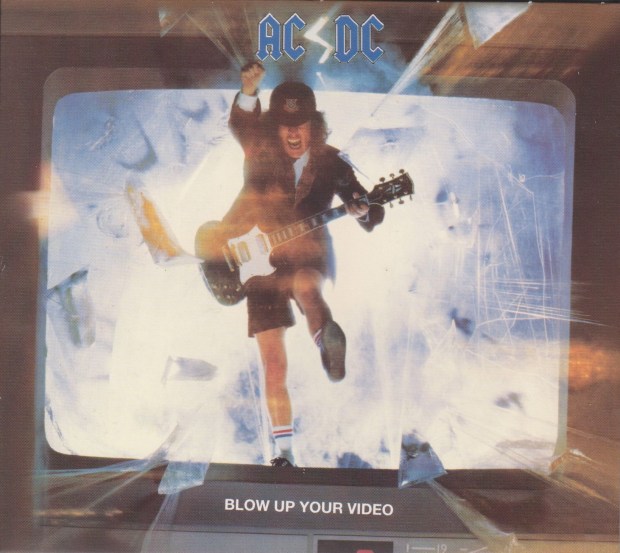
AC/DC – Blow Up Your Video(1988, 2003 Epic remaster)
By 1988, AC/DC had abandoned the bare-bones live-style music videos they had been doing for the last few years, and went into full-on productions. That became AC/DC’s trademark style from that point forward: the band playing in front of an eager crowd, and crazy stuff going on around them. Explosions, lights, wrecking balls or what have you — this all became part of the AC/DC music video experience, with Angus stomping around front and center. “Who Made Who” was really the first of the big AC/DC videos of this style. “Heatseeker” continued the tradition, with Angus popping out of a missile!
“Heatseeker” was an explosive first single, but unexpectedly, it was not really representative of Blow Up Your Video as an album. The highschool halls were filled with mutterings that the new AC/DC was “not as good” as past AC/DC, and that was troubling. Blow Up Your Video proved to be a transitional album, as many changes were afoot for AC/DC.
Malcolm Young had hit rock bottom, in the depths of a drinking problem that was starting to take its toll on the band on the concert stage. He was unable to tour. Angus and Malcolm’s nephew Stevie Young stepped up, and helped the boys out on tour. (Nobody would ever imagine that Stevie would have to do it permanently in 2014 when Malcolm withdrew from the band due to dementia.) Drummer Simon Wright wouldn’t last either. After the tour, he left to join Dio. It was also the last album to which Brian Johnson wrote any lyrics.
On the other hand, the chemistry with producers Harry Vanda and George Young (an older brother) had never been better. They helmed the classic AC/DC albums with Bon Scott, as well as three more recent songs on 1986’s Who Made Who. It was thought that they would bring that old time rock and roll slant back to AC/DC, so they were retained for Blow Up Your Video.
“Heatseeker”, being so upbeat and catchy with just a hint of a jangle in the guitars, was certainly promising. Like a one-two punch, the second single “That’s the Way I Wanna Rock N Roll” is next. The production holds it back, lacking punch (especially on the drums), but it’s a killer AC/DC good time rock and roller. Weak sonics aside, few AC/DC albums begin with two big winners like this right from the get-go.
Things get funky from there. “Meanstreak” does have a bit of funk to it, but suffers again from a muddy sound and too much echo on the vocals and drums. The further one delves into Blow Up Your Video, it seems like the songs aren’t so bad, just the sound. Same with “Go Zone”. There’s nothing wrong with the tune, but it seems to drag and fumble in a muddy puddle with the tires spinning. The side one closer “Kissin’ Dynamite” has a smoky prowling guitar and so sounds more at home. At least the side is salvaged by this last tune.
Since AC/DC offloaded their two singles right off the bat on side one, the second side is a much more turgid affair. “Nick of Time” has a blasts of guitars exactly where you want them, but lacks hooks. “Some Sin For Nuthin'” is better, because it’s back to that menacing dusky prowl that AC/DC do so well. Finally, AC/DC hit all the buttons with “Ruff Stuff”, a mid-tempo rocker with an actual chorus and verses that you can remember! “Two’s Up” is of similar quality, another decent album rocker good enough for rock and roll.
Finally, “This Means War” ends the album on a frantic, unfocused note. It has the energy and fire lacking on earlier songs, but has nothing else. Simon Wright is perfectly behind the beat, and Angus’ fingers sure are flying…but is that enough? For AC/DC, it is not.
The album sold a measly million copies in the US and failed to crack the top ten. Needing to do better, Bruce Fairbairn was called upon when needed for The Razors Edge. Since then, Blow Up Your Video has remained under its large, looming shadow, and for good reason.
Part two of a Bon Jovi two parter! For the last instalment, 1984’s Bon Jovi, click here.
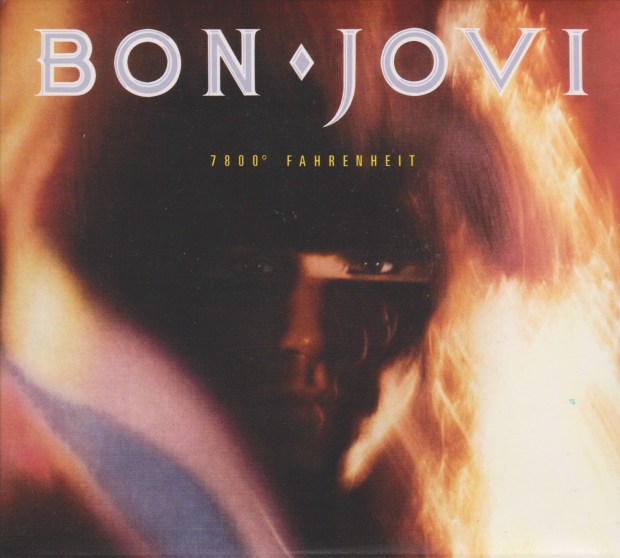
BON JOVI – 7800° Fahrenheit (1985 Polygram, 2012 special edition)
Sophomore slump? Bon Jovi’s first record didn’t set the world alight, but their second, 7800° Fahrenheit sounded like they’d run out of material. It had a darker overall vibe, but managed to go gold in the US. To this day, 7800° Fahrenheit remains an inconsistent listen with a few great songs and a number of pure filler.
Although I was backtracking through their catalogue after Slippery When Wet, I was decidedly disappointed with 7800° Fahrenheit. Based on the excellently fun single and video “In and Out of Love”, it wasn’t unreasonable to expect more. That song was a blast, quality-wise sounding like a Slippery also-ran. It’s the only tune that periodically shows up on Bon Jovi hits albums. This remastered edition also has a smoking live version of the tune (from Tokyo), featuring an extended jam and guitar solo by Richie Sambora, before Tico Torres gets the spotlight for a drum solo! It’s a 12 minute track total, not the kind of thing you expect in a bonus track.
“Tokyo Road”, another hard rocker, is also worthy of praise. Japan was about the only place Bon Jovi were big. I could do without the boring “Sakura” intro though. Wow, does that thing get old fast. Otherwise, “Tokyo Road” is superfine. Jon seems to find these songs embarrassing today. They were certainly not very sophisticated lyrically, but neither is “When you breathe, I wanna be the air for you.”
Also on the better side are “The Price of Love” and “The Hardest Part is the Night”. Every good Bon Jovi has to contain a few heartbroken rockers. These two do the job while retaining an edge of toughness. Having Richie Sambora unfettered on axe sure does help. I’ll also admit a fondness for the single/video “Only Lonely”. Bon Jovi captured that tone of desperation. This rock ballad also appears as a live bonus track, much tougher and stronger than the studio version. It sounds like possibly a rehearsal tape.
“Only Lonely” had a pretty high budget music video for a band of Bon Jovi’s stature. It’s cheesy as hell and absolutely hilarious to watch today. So serious! It almost appears like a trailer in some kind of Bon Jovi movie. I guess Jon was interested in acting even back then.
7800° Fahrenheit was also plagued with its fair share of filler, leading to believe that Bon Jovi really only had half the material needed for a good second album. Among the filler: “Silent Night”, one of the sappiest of the sappy ballads from early Bon Jovi. It does work in clinical studies* as a sleep aid, if you need that sort of thing.
The last three albums tracks in a row were all pretty dozy and unremarkable, rendering the second side a limp finish. “Always Run to You”, “To the Fire”, and “Secret Dreams” as as forgettable as they are substandard. This second side has always made 7800° Fahrenheit a hard album to want to finish listening to in its entirety. The only interesting bit of trivia about these songs is that drummer Tico Torres only had one co-writing credit in Bon Jovi history, and it’s on “Secret Dreams”.
I don’t need to tell you that whatever slump Bon Jovi were in, they certainly overcame it by the next album. With a little help of course: names such as Desmond Child, Bruce Fairbairn, and Bob Rock. 7800° Fahrenheit is a forgettable blip in their trajectory.
BON JOVI – Bon Jovi(1984 Polygram, 2012 special edition)
With Bon Jovi sucking quite a lot of ass lately, there has never been a better time to go back and check out some old Bon Jovi. Join us in taking a look at the band’s very first LP, Bon Jovi from 1984. It didn’t do much in terms of sales. The music videos are kind of funny to look at today. But there is an honesty and innocence to early Bon Jovi, that is completely gone from the band now. Then, they were five hungry guys trying to make it together. Today they’re three guys — one boss and two employees. Today we will look at the 2012 reissue, with four live bonus tracks. This is notable since Bon Jovi rarely if ever played these songs after they hit it big.
Jon Bongiovi had been working at Power Station recording studios, having got a job there thanks to his cousin Tony Bongiovi. Several demos from that era have been released on compilations such as Jon Bon Jovi – The Power Station Years. The studio time evolved into a band with a record deal. They soon set down to record nine songs for their debut album to be called Tough Talk, however the label convinced them a self titled debut was the way to go.
The first track and single was actually an older song: “Runaway”. JBJ had a local hit with it, which he recorded with the “All Star Review”, five local studio guys. Among them was bassist Huey McDonald, who later went on to play bass with Bon Jovi themselves. It’s an instantly catchy rock song leaning heavily on keyboards. Even from this early track you can tell that young Jon Bon Jovi had a hell of a talent for writing catchy hooks. The immaculate backing vocals are obviously not those of Richie Sambora. Just wait until Jon goes for the high notes at the end though!
It was 1984, the peak of the “post-apocalyptic wasteland” setting for music videos.
Moving on to “Roulette”, we now get a song that is a little harder-edged. Richie has a chunky guitar riff that gives the song some weight. Jon pours it all on, and it’s clear even on this first album that Sambora was a serious talent. His style has evolved considerably over the years, but at this stage he was already capable of writing great songs with memorable guitar solos.
“She Don’t Know Me” was also a single, but this one has not aged so well. Sounding like a New Jersey version of the lighter side of Journey, “She Don’t Know Me” is a lil’ too sappy for most adults. It’s not terrible but “She Don’t Know Me” is just too heavy on the syrup. It is at least upbeat, with a Sambora solo right out of the Neal Schon book of tricks!
“Shot Through the Heart” is a forgotten song, since its title was used as in the chorus of “You Give Love a Bad Name”. This is a hard rock heartbreak, the kind of thing Jon does so well. The balance comes from Sambora. Without him, there’s no edge. He brings a very special guitar quality to the table, not to mention songwriting.
The first Bon Jovi album’s biggest weakness is an over-reliance on sad sounding love songs. “Love Lies” is another one, a dusky piano based ballad. David Bryan (known here as David Rashbaum) co-wrote it with Jon, and like all the other tunes it does have quality to it. It’s just too much heartbreak for one side of vinyl.
“Breakout”, also written by Rashbaum, is a hard enough rocker to open side two. Jon has found some backbone, telling his ex that he’s “better off on my own”. That’s better, Jon! Let’s stay strong buddy, and crank out a rocker. “Burning for Love” continues the hot streak. Now we’re cooking with gas. Richie really nails it on the axe. Then is a song called “Come Back”. You might expect by the title that Jon has lost his balls again. Thankfully, his pal Richie is there to keep him standing. “Come Back” is a bit of a broken-hearted rocker, but Sambora’s pick scrapes keep it rock and roll.
One last rocker was all you needed to call it an album back then. Of all the songs on Bon Jovi, “Get Ready” sounds the most like what Bon Jovi would become famous for: good time rock music! Guitar, piano, bass and drums: that’s all you need for a rock and roll party. This really sounds like Bon Jovi.
That’s a pretty solid debut album right there, for a band in Bon Jovi’s league. I have no idea why they (he) won’t play so many of these songs anymore. They’re better than most of the stuff he’s been putting out lately. And we still have the four bonus tracks to discuss.
The four live songs come from various shows, 1984-1988. Each is heavier than its studio counterpart. “Runaway” benefits from the full band treatment, as opposed to the studio cats. Having Richie there singing it with Jon makes all the difference. (This is not the same version as the B-side from “Lay Your Hands On Me”.) “Roulette” is a solid inclusion. “Breakout” keeps it rolling, but you gotta love that “Get Ready” was also included, ending the album as it always has.
3.5/5 stars
2010 Special Edition bonus tracks
1. “Runaway (Live Le Zenith, November 20, 1988)”
2. “Roulette (Live BBC Friday Rock Show)”
3. “Breakout (Live Super Rock ’84)”
4. “Get Ready (Live Japan Tour 1985)”
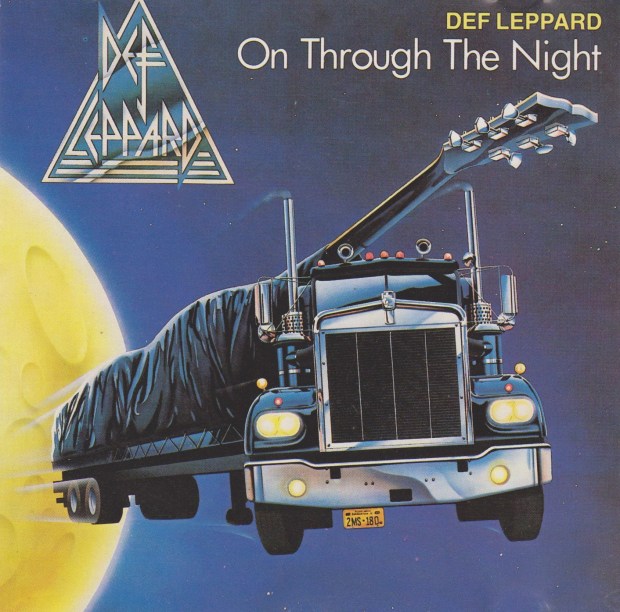
DEF LEPPARD – On Through the Night(1980 Phonogram)
A bright young Mike in grade 11,
During the glorious 80’s,
Needed new music to feel like heaven,
To woo some lovely young ladies.
In 1980 Def Leppard came out,
With the LP On Through the Night,
It is heavy with screams and plenty shouts,
It makes me feel alright alright alright.
“Hello America”! It’s the “Rock Brigade”!
I played these singles on my ghetto blaster,
Unpolished – but the tunes made the grade,
Heavy ones like “Answer to the Master”.
Producer was Tom Allom of Judas Priest fame,
A heavy raw album he did record,
Leppard had not yet joined the hit game,
No big tricks on the electronic soundboard.
“It Could Be You” rocking out to this one,
Reckless abandon with axes ablaze,
“Wasted” blasts you like a shotgun,
Nothing left to see but a smokey haze.
Sophistication will not be found anywhere,
Maybe a little on the closer “Overture”,
Loud guitars drums blasting and long hair,
For your metal sickness this is the cure.
On Through the Night straight into battle,
Leppard hit the launching pad hard,
With the New Wave of British Heavy Metal,
The Lep became leaders of the new guard.
The story continues today as Leppard survive,
Still prowling the concert stage all over the world,
Fans clamour to hear these old song lives,
And so on Viva Hysteria, “Wasted” was unfurled.
This is but the seed that would grow into a beast,
The mere beginning of something great,
Pick up this record at the very least,
You will find it is very difficult to hate.
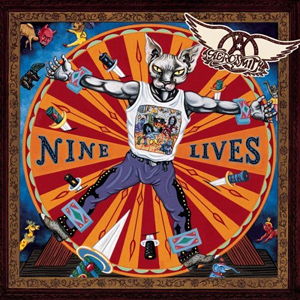
AEROSMITH – Nine Lives (1997 Columbia, European version)
By popular demand, here is a look at Aerosmith’s Nine Lives, an often overlooked and sometimes forgotten record overshadowed by bigger hits.
Aerosmith were in trouble. In 1995, after completing a massive amount of work to support Get a Grip and Big Ones, drummer Joey Kramer suffered a nervous breakdown. It was a traumatic experience for the musician, who had conquered his drug demons long ago and thought he was otherwise healthy. Aerosmith went ahead with new producer Kevin Shirley, replacing longtime collaborator Bruce Fairbairn who was busy with Van Halen, The Cranberries, and INXS. A session drummer (Steve Ferrone) filled in, with the intention that when Joey returned, they could finish the album with him. Kramer did return, perhaps stronger than ever, and re-recorded all of Ferrone’s drums himself. According to Joey, it made all the difference to him, to make the album sound like Aerosmith.
Although the first single, “Falling in Love (Is Hard on the Knees)” was pretty blasé, the album itself is very strong. I liked it all but immediately, bought it, and then bought it again when I found the European version with the bonus track “Falling Off”. The domestic version was “enhanced” for PC use, with some kind of game where you could play along to Aerosmith songs. I never even tried that, and I ditched the original when I found the European version. I found it in Calgary, Alberta, of all places.
A raucous opening is what you need to set the scene, and “Nine Lives” fits the bill. That’s Joey on drums alright, as he has this steady, heavy beat that is quintessentially Joey Kramer. There’s Tyler, vintage sassy and welcoming you to the party. Over on guitar, Brad Whitford and Joe Perry are sounding brilliant thanks to some crunchy, crisp production from Kevin Shirley. As always Tom Hamilton on the bass isn’t afraid to play all over the neck without getting in the way. In other words, for all appearances, Aerosmith were as strong as ever.
Listening to the dreadfully titled “Falling in Love (Is Hard on the Knees)” again reminds me that I never disliked the song. It was only the title (and the video directed by Michael Bay) I found silly. Otherwise it’s a fine example of horn-enhanced mid-tempo 90’s Aero-rock. It has a sleezy grind to it, but it’s not particularly distinguishable from any similar songs on past Aerosmith records. It’s what they do, and although there are plenty better tunes, I suppose there is an Aero-niche that needs to be filled and here it is. Another thing they had to do was the sappy ballad with strings and so here is “Hole in My Soul”, another single. I think track 3 is a little early for ballad.
I remember walking into a record store with T-Rev one afternoon (I think Sunrise) and they were playing an early pre-release promo of “Taste of India”. I intensely dug the heavy groove, and the exotic spices thrown in. “Holy shit,” I said to Trevor, “this is really good.” He wasn’t as enthusiastic, but I think the groove here is impossible to resist. For latter-day Aerosmith, “Taste of India” represents one of those peaks, kind of like tunes such as “Kings and Queens” were for the early years. It’s adventurous and I’m a sucker for those guitars that sound like sitars. There is also sārangī on this track, performed by Ramesh Mishra who was a student of Ravi Shankar. I will return back to my original point though — the heavy groove here is the key. It’s all about that unstoppable steamroller of a rhythm. You don’t hear Aerosmith groove this heavy very often anymore. Back when I was at the Record Store, I did a brief paragraph review of this record for our store newsletter. I praised the song then too, and my enthusiasm has not diminished in the slightest.
“Full Circle” is an interesting track, a ballad that sounds a bit like something you’d sing in a big group on New Year’s Eve. “Time, don’t let it slip away, raise your drinking glass, here’s to yesterday.” It sounds a bit like an old Beatles ballad, interpreted by Aerosmith. It’s just a stunning little track, different from a lot of the Aero-noise that filled later albums. But “Something’s Gotta Give”, and we need an adrenaline-filled Aero-ass-kicker next. “Something’s gotta give! Does the noise in my head bother you?” Tyler’s harmonica solo is scorching hot, I’m sure his lips were burning. Then it’s a smokey, jazzy (with muted trumpet) intro to “Ain’t That a Bitch”. I don’t think I’d wanna call this a ballad, but maybe a slow Aero-burner? Using the word “ballad” sells the song short because it has more to it than that, even though there’s those strings again! Then the horns return for the “The Farm”, an inessential but dramatic song. This is about where the break between side 1 and side 2 would come, so I consider this song to be an apt side closer.
Aerosmith kick it into gear and “Crash” for a breakneck blaze of a song. Perry’s solo is incandescent. Kramer’s there in the back, locked into Tom Hamilton driving this big beast called Aerosmith forward as fast as it will go. Tyler’s screaming “I’m losing my mind, losing my mind, losing my mind!” while the boys in the back are jamming hard. The second half of this song is truly as good and wreckless as Aerosmith can get. Just top drawer rawk n’ roll.
So of course they bring you down from that “Crash” with a ballad, called “Kiss Your Past Goodbye”. This is by the books, and strictly just an off-the-shelf stock Aero-ballad. There is a lull in the album right about here, as it stalls towards the end. Another single, the pretty dreadful “Pink”, takes up a solid 4 minutes of your listening time. I had a customer at the Record Store, the “Barefoot DJ”, a really annoying fucker who was persistently looking for this damned song. But he refused to pay $11.99 for the Aerosmith album it was on, so he didn’t get it. Sucked to be him, I guess.
Joe Perry redeems the album (on the European version only) with his song “Falling Off”, for which he handles lead vocals. It’s nothing special, but it has an old-style rock integrity to it that centers us back to where we should be with this album. Fortunately it’s followed by another strong song, “Attitude Adjustment” which has a hint of a twang to it. It’s still nice an’ heavy, which you will have noticed by now is a continuing theme on this album. Sure there are lots of ballads, but also lots of kinds of heavy. “Attitude Adjustment” is rhythmically hard-edged, and Joe Perry’s slide guitar always hits you square right in the guts.
“Fallen Angels” brings the ballad count to four. However, this ballad has integrity. It is a long ballad, adorned with strings and all the fixings, but it also has the feeling and drama that preceding ballads lacked. The exotic sounds of India return to close the song and the album, going “Full Circle” as Aerosmith said earlier.
Lastly, I think Nine Lives has some of the best album artwork of any Aerosmith album in the CD age. I know that the original cover art with the snakes and the dancing cat was offensive to some of the Hindu faith. They then issued an alternative, revised version for retailers who wanted it, and it was just as cool anyway. Each page of the booklet features artwork that “pulls back” further giving you a wider perspective of the actual scene. This culminates with a zombie Aerosmith on the last page. The best thing about the revised cover art is that it adds one more picture to this sequence of “pulling back”. Now you can see the zombie Aerosmith are just a picture on a T-shirt on the same cat, who is strapped to a circus knife throwing wheel! I wouldn’t mind getting that version of the CD (cheap) just to have the final picture in the sequence.
This version of Nine Lives has 14 songs. If you think of an album in old-school terms, you realize that’s about four or five songs more than you used to get on a record. If you trimmed a few of these songs off, as if you were releasing a vinyl album in the 1970’s, imagine how tight it could have been. With the ballady filler, I’d give it:
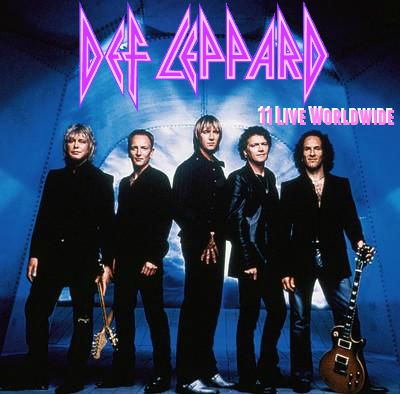
DEF LEPPARD – Official 11 track live mp3 collection, download only (2000-2001)
We at LeBrain HQ have always loved being able to shed some light on music that is so rare, that you just can’t find out much of anything about online anymore. It seems one of most obscure categories of rare music are official downloads from long ago that were never physically released, and long since taken down. 15 years isn’t a long time ago, but did you know that in 2000-2001, Def Leppard gradually put up 11 live tracks to download from their official site? This was long before they had any sort of live album out whatsoever.
These official live recordings were selected by the band, and were released over a period of several months. They were not available for long. They were taken down by the time Leppard changed their site over to promote the X album in 2002. Taken together, I assembled them in order of release into a a full length live album by Def Leppard — unofficial, yet official just the same!
The first song released was the old acoustic standby “Two Steps Behind” (San Antonio, Texas, 2000). Joe begins by announcing that they were recording the show, and that this particular night was also the “official opening evening, at it were, of our brand new website, www dot defleppard dot com. And that’s the reason we’re recording it, because we’re gonna put it on the web. Worldwide, you guys are going worldwide!” That certainly explains things! The recording itself is quite excellent, rich and clear. You also know there are no overdubs, because chords are missed and the songs goes on. To me this is the ideal form of live recordings: official, but with a loose “who cares” attitude in regards to fixing mistakes later on.
An older classic, “Women” (Salem, Oregon, 2000) has similar sonic qualities. It’s also quite bass heavy which is a nice change of pace for this band. There had already been a B-side live version of “Women” out there for a while, recorded in 1987 for the video In the Round – In Your Face. This version however has the currently lineup with Vivian Campbell, and a Joe Elliot who hits all the screams at the end. This would have to be my go-to live version when I want to hear one.
The first then-new Def Leppard song to get the live release treatment was “Demolition Man” from Euphoria. This one, from Denver, Colorado in 1999, sounds faster than the album version. On an album of mostly so-so songs, “Demolition Man” at least had some velocity to it, unremarkable as it is. It’s over and out quickly enough.
“When Love & Hate Collide” (Tokyo, 1999) is the second ballad released in the collection. Although you could get an acoustic version on the bonus disc (Acoustic in Singapore) to Slang in 1996, this was the first full-on electric live release. This version has some heft to it, and once again I would say this is the go-to version to listen to.
Def Leppard have been playing The Sweet’s “Action” for so long now, that you may as well consider it a built-in part of their set. This was the first live version made available (London, 1999). Like “Demolition Man”, it seems faster and much heavier live. Joe’s voice is sounding pretty ragged at the end — as it should be after a performance like that!
The hit song “Animal” from Hysteria was not readily available in live form, at least on an audio format. They did it unplugged for Acoustic in Singapore, and there were a couple VHS videos out there too, but nothing on vinyl or CD. This more recent version (Nashville, Tennessee, 2000) is as reliable as any other. It’s clear that even though the Euphoria album was shaky, the tour behind it was anything but.
Def Leppard started putting the instrumental scorcher “Switch 625” live again on the Slang tour. It was welded onto “Bringin’ On the Heartbreak” for a High ‘N’ Dry medley, just like it was on album. This Montreal recording from 1996 is incredible. Even the ballad has some serious crunch and scream to it. Would you like some feedback? Here you go, turn it way up. Campbell nails the solos on “Heartbreak”, but it is “Switch 625” that is the pièce de résistance. Just listen to Rick Allen, but don’t leave your jaw on the floor! At the end, Joe says “Ladies and gentlemen, the best drummer in the world, Mr. Rick Allen!” Then, a moment later you can hear Joe say, “He is,” to affirm the man’s awesomeness. These two were released as one solid 8 minute 12 second track. Then, from the same 1996 show in Montreal is another special track. Is it “Knockin’ on Heaven’s Door”?
“Mama take this gin from me, I can’t drink it anymore, Where’s the sink, I gotta pee, Looks like I’m checking into Betty Ford…”
In another moment of “I’m really glad they didn’t cut that,” Joe needed to fill a minute while Phil Collen went to pee! They left it in. Joe then turns the microphone over to Phillipe for his song “Miss You in a Heartbeat”, performed acoustically. Phil does the lead vocal and also the acoustic guitar solo, while it is quite possible that Joe himself went to pee.
“Rock! Rock! Till You Drop” is the only song fromPyromania to be released as part of this series. By the opening tapes, it sounds like it was the first song of the set in Cardiff, Wales in 1999. As such, Joe’s got a lot of screaming to do, but he does a good job. What an opener that must have been! You have to give these five guys credit for putting a lot of energy into their live performances. There is a lot of singing, soloing, and riffing to do, and they don’t make it easy for themselves!
The final two songs of the set were recent Euphoria songs, from the Tokyo show in 1999 once again. The ballad “Goodbye” is just boring as hell. You gotta get out there and promote the new album and single, but this was never a good album or single. It was a weak attempt to write another “Have You Ever Needed Someone So Bad”. Thankfully they saved the best Euphoria song for last, which was “Paper Sun”. I like when Def Leppard get into that “Gods of War” / “White Lightning” space, and that is what they did with “Paper Sun”. (It also has shades of “Women”.) Unfortunately these last two recordings, being new songs and all, feel a little more stiff. The band weren’t as familiar with them obviously, but I think you can hear it. Still, what are the chances of Leppard ever playing “Paper Sun” live again? Slim to none, I’d say. So who’s complaining? Not this guy.
Since this time, Leppard have put out plenty of official live product. There’s the excellent double live Viva! Hysteria, with loads of rarities. There’s Mirrorball, a double album representing a standard modern Def Leppard concert set. There was even a bonus live disc added to the deluxe version of Pyromania. None of those releases have “Demolition Man”, “Goodbye”, “Paper Sun”, “Miss You in a Heartbeat”, or “When Love & Hate Collide”. That makes this collection pretty special, to this day.
4.5/5 stars
We at LeBrain HQ want to hear from you if you know any more about these tracks. Any information gleaned such as actual recording or release dates will be happily added to this review. (Comments regarding trades will be deleted.)
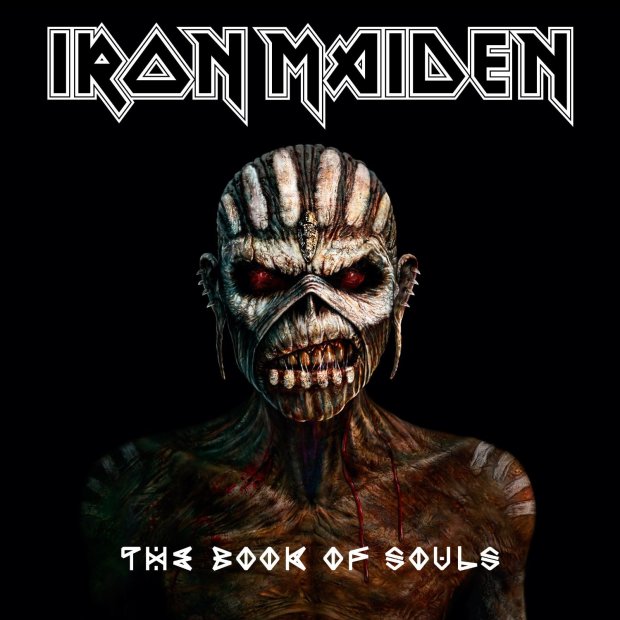
IRON MAIDEN – The Book of Souls(2015 Parlophone, collector’s book edition)
I have a new hero. His name is Bruce Dickinson.
Bruce has not only beaten cancer back to that dark hole from which it came, but he takes command on Iron Maiden’s new opus The Book of Souls.
Even though he only has writing credits on four of the 11 tracks here, his impact is massive. With lungs of iron, Bruce propels everything. For the first time (possibly) ever, I feel that the most important band member is not leader Steve Harris, but the singer himself.
Right from the opener “If Eternity Should Fail”, Bruce is center stage. He wrote this complex number himself. It boasts one of Maiden’s most memorable choruses yet, and musical twists and turns that return us to Powerslave. Meanwhile, there is a hook that reminds me of Bruce’s solo song “The Ghost of Cain”, from Accident of Birth.
We took a good look at the lead single, “Speed of Light” a couple weeks back. Maiden often write a fast, heavy blazer to go with a new album, and that’s “Speed of Light”. Even though it is the single, it is far from the strongest song. Written by Bruce and Adrian Smith, it is certainly a good Iron Maiden track, but in comparison to the monuments of metal that surround it, “Speed of Light” feels like a brief diversion from the epic metal moments at hand. Adrian’s solo, however, is delicious.
“The Great Unknown” (Smith/Harris) opens softly, but even so there is a menacing tone to Bruce’s voice and the underlying instruments. With a slow, thrusting riff, “The Great Unknown” soon lurches forth, a killer metal march for the ages. Bruce pushes his voice to the very limits, giving it all and then some. As with many of the songs on The Books of Souls, I hear hints and echoes of past Maiden epics. This is not a lack of originality, more like a signature — familiar but always different. “The Great Unknown” ends on the soft note with which it began.
What is an Iron Maiden album without a Steve Harris bass intro? He and producer Kevin Shirley captured a wonderful bass sound on this album. “The Red and the Black”, another epic, is the only Harris solo writing credit. It has a riff that takes me all the way back to Killers, but then it is gone, and it’s onto another riff…and another…and another. At 13 minutes in length, this is one of those trademark Harris songs. Time changes galore, loaded with hooks. You can draw parallels to many epics from the past, but to do so takes away from this one. “The Red and the Black” is a proud achievement, a passionate metal song as only Iron Maiden can really do. Adrian Smith handles one of the guitar solos with a huge splash of wah-wah, and that is simply a thing of beauty. In sum, if you took a little bit of everything that makes Iron Maiden great and unique, then all those ingredients are in “The Red and the Black”. Bass outro, and that’s that.
A semi-shorty (5:52) is in the next slot, a fast riffer called “When the River Runs Deep” written by Steve and Adrian. This one is hard to compare to any past Maiden tracks, as it occupies a space all its own. Adrian Smith sometimes brings in riffs that sound like something other than Iron Maiden, and I think that’s “When the River Runs Deep”. Adrian takes another wah-wah solo, but not to be outdone is Janick Gers who throws down an edgy solo of his own. As far as Iron Maiden goes, this song is guitar solo nirvana.
A 10 minute epic always makes a good closer when you’re Iron Maiden, so the title track “The Book of Souls” (Gers/Harris) is last for disc one. Gentle acoustic guitars and keyboards emulating pipes tell us that this is previously uncharted territory. Then “The Book of Souls” trudges forth, with a beat not unlike “Mother Russia” from No Prayer for the Dying. There’s far more to the song than that, however. Soaring lead vocals (Bruce only seems stronger!) just ice the cake. All three Maiden guitarists shine on this, but Janick and Adrian have some solos that just play off each other so well. You want those trademark Maiden guitar melodies? How about galloping riffs? Nicko McBrain killing it on the drums? Maiden deliver, in top notch style, everything and then some more.
Bruce and Adrian co-wrote “Death or Glory”, opening side two with frenetic drums and riffing. Going for the throat, The Book of Souls has more fast riffs per minute than any Maiden album in decades. In five brief minutes, you are blasted against the wall, bounced off the floor, and nailed to the ceiling. Don’t hurt your neck from all the headbanging. This time, the guitar spotlight is on Dave Murray for an intense, dramatic solo.
“Shadows of the Valley” (Gers/Harris) sounds a lot like “Wasted Years” at first, but only briefly. If anything, “Shadows of the Valley” recalls Dance of Death-era Iron Maiden. Although this song is not as powerful or memorable as others on the album, it does contain some seriously incredible instrumental moments.
One of the most heartfelt and powerful songs on the album is the shortest. “Tears of a Clown” is a thoughtful moment about Robin Williams. The poignant lyrics are to the point:
All alone in a crowded room, He tries to force a smile, The smile it beamed or so it seemed, But never reached the eyes, disguise, Masquerading as the funny man do they despise.
I found this to be one of the compelling songs. Of all the bands to commemorate Robin Williams, I did not expect it to be Iron Maiden. But they did it in such a way that it completely fits.
Dave Murray and Steve Harris might not have known that Bruce already has a solo song called “Man of Sorrows”, but it doesn’t matter much since Maiden’s song is called “The Man of Sorrows”. Musically this sounds much like X Factor-era Maiden. Bruce takes it to a higher level than that. Dave himself has a nice slow bluesy solo at the end that is just pure gravy.
The biggest surprise, the biggest song, and the biggest challenge has to be “Empire of the Clouds”. Written solely by Bruce and coming in at almost 20 minutes, it is unprecedented in the Maiden canon. Never before have the credits “Bruce Dickinson – vocals, piano” been written inside one of their albums. For the first time ever, the piano is a part of Iron Maiden’s makeup. Maiden have used orchestras before, and the strings return as well. “Empire of the Clouds” is a peak accomplishment, something that they (and Bruce) can proudly proclaim, “we did that”. The piano is a natural fit, in the way it is used to make an epic song even more dramatic. Aviation has been one of Bruce’s favourite lyrical subjects for a long time, but “Empire of the Clouds” might be his first song about airships. You can trust him to instill it with all the drama and heaviness that you expect from Iron Maiden.
Even though 92 minutes have elapsed, The Book of Souls does not particularly feel longer than A Matter of Life and Death or The Final Frontier. Like those two previous records, The Book of Souls is going to have to be digested long-term, returned to again and again to fully absorb and appreciate. This is an album in the true sense: best appreciated in sequence, as a single work. There’s an intermission in the middle for you to change CDs and take a break, but I recommend diving right back in once again.
With Bruce’s very serious health scare, and the increasing age of the band, there is always the chance that this could be the last Iron Maiden album. Of course, some said that about The Final Frontier as well. It seems that ever since Brave New World in 2000, Iron Maiden have set to top the previous album each time. The cumulative effect of that is that they had a hell of a lot to live up to on The Book of Souls.
Mission accomplished.
5/5 stars
Disc 1
1. If Eternity Should Fail (Dickinson) 8:28
2. Speed Of Light (Smith/ Dickinson) 5:01
3. The Great Unknown (Smith/ Harris) 6:37
4. The Red And The Black (Harris) 13:33
5. When The River Runs Deep (Smith/ Harris) 5:52
6. The Book Of Souls (Gers/ Harris) 10:27
Disc 2
7. Death Or Glory (Smith/ Dickinson) 5:13
8. Shadows Of The Valley (Gers/ Harris) 7:32
9. Tears Of A Clown (Smith/ Harris) 4:59
10. The Man Of Sorrows (Murray/ Harris) 6:28
11. Empire Of The Clouds (Dickinson) 18:01
For the official KeepsMeAlive review by Aaron,click here!
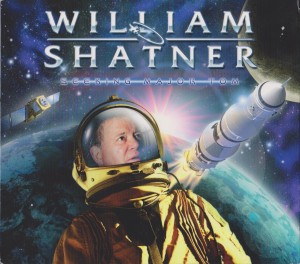
WILLIAM SHATNER – Seeking Major Tom(2011 Cleopatra)
Why? Why do I keep doing this to myself? I spend hard-earned money on something I knew would be shit. I knew it! Didn’t I?
The hype was palpable in the air. Two of my favourite worlds collided — heavy metal and Star Trek. Captain James T. fucking Kirk, doing sci-fi rock classics, with luminaries of the art such as Ritchie fucking Blackmore, Zakk fucking Wylde, Dave fucking Davies and many, many more. It’s almost as if it was a compulsory purchase.
I…wished I had…resisted. (notice the Shatner-like pauses?)
You know how many times I have listened to Seeking Major Tom? Once.
Let’s go in for round two. Let’s see what happens.
Did I mention this is a double album? This is a double album. The original versions of a lot of these songs are deeply ingrained in our hearts and memories. “Bohemian Rhapsody”, “Learning to Fly”, “Iron Man”. I have a lot of feelings invested into these songs, and deep respect for every musician playing on the album. There is even a mini Ozzy Osbourne band reunion on Iron Man, as Zakk Wylde and Mike Inez reteam once again.
Shatner first teams up with Nick Lalensi of the Strokes for “Major Tom (Coming Home)”, and musically it’s perfect, and very Strokes-like…Bill’s vocals take some getting used to. Not bad though! He’s not attempting to sing, it’s a spoken word performance. It’s performing the lyrics as if it was poetry. For “Major Tom”, it actually works kinda brilliantly. The original “Space Oddity” is next, and this one features one Ritchie Blackmore and his lovely wife, Candice Night. Candice adds melody enough with her backing vocals, and Bill makes his style work on the song. Blackmore is the real star here, and it is too bad his electric guitar is low in the mix. He takes a solo where there would normally be saxophone.
I’m actually surprised by how listenable this is! Bill manages to evoke emotion with his monotone, which is remarkable to me.
I’m not familiar with the U2 song “In a Little While” at all. The space connection here is that astronaut Frank De Winne once read the lyrics live from the International Space Station, beaming his vocals to a U2 concert, recorded for the DVD U2360° at the Rose Bowl. Bill is joined by an unlikely guest, Lyle Lovett, but once again I am surprised by how well this works. Lyle’s still got it, I’ll tell you that much! This segues into a reprise of “Space Oddity”, and then the Steve Miller favourite “Space Cowboy”. Brad Paisley and Steve Miller himself (he still plays brilliantly) join Bill on this one, which…well, it crashes and burns in the atmosphere. Bill takes on the persona of a drunken cowboy (?) and it’s just a bit too weird.
“Space Oddity” returns once again, but this time, we’re going “Space Trucking” with Ian Paice and Johnny Winter…acoustically. “Come on! Come on, let’s go Space Truckin’!” invites Bill, coming across more as a creepy old guy than the kind of person who drives a space truck you’d feel comfortable jumping into. Just wait until he screams, “Yeah, yeah yeah yeah!” No, no, no, no. “Rocket Man” (Elton John), featuring progressive rock veteran Steve Hillage, works much better. Hillage creates sounds similar to the “space whale” call from Star Trek IV: The Voyage Home. Bill’s interpretations of old classics work better when he’s not hamming it up. Much like his acting. And ham it up is exactly (predictably) what he did with “She Blinded Me With Science”, featuring Bootsy Collins. Since the original is so goofy, this works plenty well. Reggae veteran Toots Hibbert lends some credibility to the Police classic, “Walking on the Moon”. This is pretty good too! The ever-excellent Peter Frampton drops by for “Spirit in the Sky”, a song I usually find irresistible due to the vocal melody. Unfortunately that melody has been gutted, and without it, there’s not much left in terms of a song.
The first (and last) time I listened to this album, I remember being repulsed by “Bohemian Rhapsody”. You can picture it, can’t you? It’s terrible. “I’m just a poor boy,” whimpers Bill, and it’s awful. “Mama,” he cries, and I’m crying too.
Thankfully, Hawkwind’s “Silver Machine” (with Wayne Kramer and Carmine Appice) is a lot better than that. It actually rocks pretty heavy, and Bill finds the right tone for his vocals, no problem. This is noisy goodness and quite possibly the best track on the disc. A segue back into “Major Tom (Coming Home)” leads into a Sheryl Crow original called “Mrs. Major Tom”. This is a very nice piano based ballad, showcasing Sheryl’s powerful pipes. It’s a sequel of sorts to “Coming Home”, about what happens if he doesn’t come home. Bill doesn’t even appear on this one, strangely enough! It closes the first disc on a somber but very classy note.
I don’t know where Bill heard The Tea Party, but that’s who he’s covering on “Empty Glass”, featuring Michael Schenker. This track was from The Tea Party’s final album before breakup, Seven Circles, which I own but can’t remember at all. I should revisit it soon, because “Empty Glass” (which references Major Tom, a Starman, ground control, and Diamond Dogs) is damn good and heavy. “Lost in the Stars” is from the 1949 musical of the same time. The dusky, sparse piano accompanies Bill’s deep speaking voice perfectly. Still mellow but in tune with the Pink Floyd original is “Learning to Fly”. The only thing wrong with this version is that there is nobody who sounds like David Gilmour, and his guitar hook is such an important part of the original classic. Bill sounds perfectly at home, and the musical background is sturdy enough.
The Kinks’ Dave Davies helps Shatner out on guitar, for the Byrds’ “Mr. Spaceman”. It has that campy feel that doesn’t particularly work well. It’s amusing, but a novelty. “Twilight Zone” by Golden Earring (known for that chorus of “When the bullet hits the bone), rocks. Warren Haynes from the Allman’s kicks every ass in the room on his extended guitar solo. There is then a Shatner original called “Struggle”, written with his producer Adam Hamilton (ex L.A. Guns). This soft dramatic piece seems vaguely familiar, like a U2 outtake, and is very good in fact.
Winding things down, Sabbath’s “Iron Man” featuring Ozzy’s old band members Zakk Wylde and Mike Inez is an easy one to screw up, and Shatner does so gloriously. He sounds appropriately Dalek-like on the opening line, “I am Iron Man!” but he attempts to sing the song. I repeat: he attempts to sing the song “Iron Man” by Black Sabbath. This goes about as well as you would expect. Zakk backing him on lead vocals only creates an irritating cacophony. The album ends on a very different note: “Planet Earth” by Duran Duran. Not having any particular attachment to the original, I quite liked this one. Hamilton plays some killer disco bass on it. It sounds like “I Was Made For Lovin’ You”.
Going into this for the second time, I fully expected the album to suck again. The truth is, it doesn’t. It sure didn’t click with me the first time, but it is truly not a bad album. Metallica made a double album with vocals like this once; I think it was called Lulu. From this two disc set, you could extract one good solid CD of enjoyable William Shatner interpretations. So, given that:

 ALICE COOPER / HOLLYWOOD VAMPIRES – Hollywood Vampires (2015 Universal Japan)
 The Japanese bonus track is “I’m A Boy”, the second Who cover. Once again, Alice nails it. This is such a difficult song to attempt. Alice makes it work, and if anybody can do it, it’s Alice. “My name is Alice I’m a head-case…” Just that one change makes the song work. “I’m a boy, I’m a boy, but my mom won’t admit it…I’m a boy, but if I say I am, I get it.” And he’s got the girl’s name. It’s perfect! This bonus track is worth tracking down if you’re a Cooper fan. You’ll definitely need it in your collection.





















You must be logged in to post a comment.