Part four in a series on singles from Def Leppard’s Adrenalize, including hard to find B-sides!
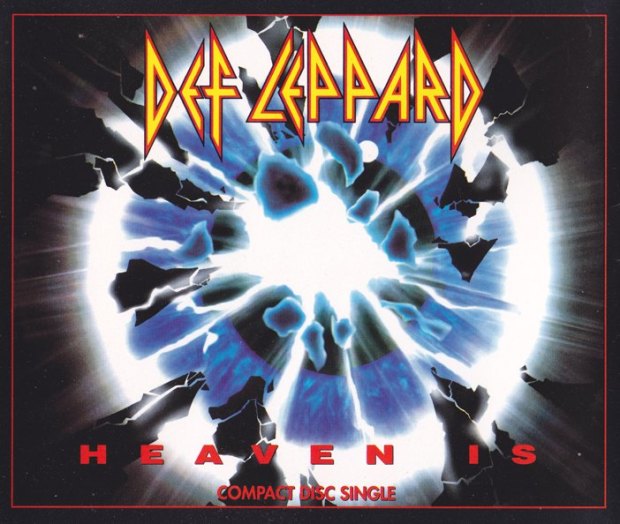
DEF LEPPARD – “Heaven Is” (1993 Phonogram CD single)
“Heaven Is” and “Stand Up (Kick Love Into Motion)” were released as singles at roughly the same time (different territories and whatnot), but I don’t have a copy of “Stand Up”. It doesn’t matter though, since both singles shared the exact same B-sides. These are an interesting mix of new and old.
The Canadian rock band Helix released “She’s Too Tough” on 1987’s Wild in the Streets album. While their version is faster and louder, the Leppard version sounds way better. Helix had production issues on their album, while Leppard recorded theirs with trusted engineer Pete Woodroffe as a quartet during the Adrenalize sessions. The single contains the original version of the track. Rick Allen re-recorded the drums in June 1993, and that version was released on the Retro-Active album. No matter which version you have, it’s an absolute pleasure to hear Leppard with Joe screaming like he used to.
“Elected” is indeed a live cover of the Alice Cooper classic. This one dates back to 1987 and features the late Steve Clark on guitar! A young, energized Leppard have no problem filling this with all the electricity needed. One must assume the old tapes were not the best, since the credits claim the track was “salvaged” by engineer Pete Woodroffe! Following this is a new live recording, of “Let’s Get Rocked” in 1992, from Bonn, Germany. Naturally that means this features the new boy Vivian Campbell on rhythm guitar. This version, from the 1992 club tour, is available on the deluxe Adrenalize.
As for the A-side itself, “Heaven Is” works as a pleasant enough pop rock song. Fans were tiring of that schtick, but “Heaven Is” is fine for a second-tier Def Leppard hit. When Steve Clark died I don’t think the band felt it was the time to stretch out and find new musical avenues. Writing safe rock was the easiest and probably only real course of action.
Part three in a series on singles from Def Leppard’s Adrenalize, including hard to find B-sides!
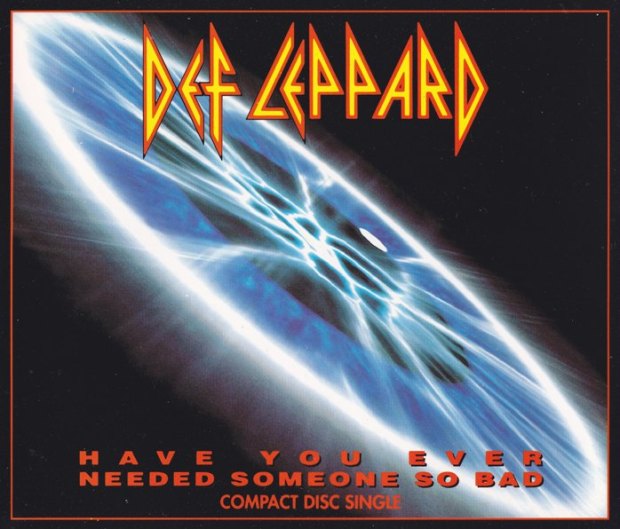
DEF LEPPARD – “Have You Ever Needed Someone So Bad” (1992 Phonogram CD single)
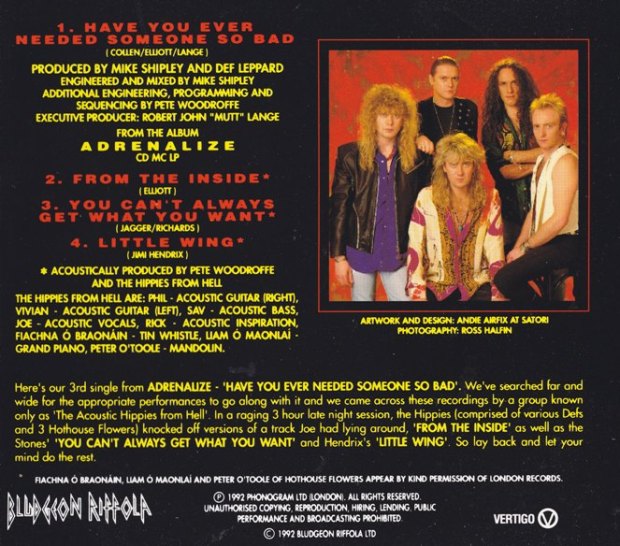
On their last single, “Make Love Like a Man”, Def Leppard released their first acoustic recording in a song called “Two Steps Behind”. This time, they went all-in. Not content with a couple acoustic guitars, Joe called up some friends from Hothouse Flowers (Fiachna Ó Braonáin, Liam Ó Maonlaí, and Peter O’Toole) and formed an octet* called the Acoustic Hippies from Hell! As the Acoustic Hippies, they did three songs: an unreleased Joe original called “From the Inside” and two covers. The Flowers brought tin whistle, piano and mandolin to the table.
“From the Inside” is a haunting number, with Joe singing about addiction from the perspective of the drug. “I’ll shoot through your veins, I’ll drive you insane.” Joe first played it for a television program called Friday at the Dome. Liam Ó Maonlaí and he played it together as an experiment in artists from two different fields colliding. Joe liked the song enough to record it here with the Acoustic Hippies. This song was re-released in 1993 on Retro-Active, but added the original count-in from the session. It’s certainly a good song but not easy for some Leppard fans to appreciate.
The guys then jam on 7 1/2 minutes of “You Can’t Always Get What You Want”. This is a highlight of the single, a fantastic version that deserves more attention. You might be surprised just how good this is. It sounds 100% live, with people calling out cues and hoots and hollers. Almost as good is Hendrix’s “Little Wing”. Softer and less rambunctious, it is haunting more like “From the Inside”. Thankfully these two tracks were later reissued on the Adrenalize deluxe edition.
These three B-sides completely outshine the A-side, the putrid “Have You Ever Needed Someone So Bad” from Adrenalize. This annoying title is only slightly worse than the song itself, one of the most by-the-numbers ballads that Def Leppard have foisted upon the fans. Of course it became a top 10 charting single in the US.
3.5/5 stars
* There are no drums but Rick Allen is credited for “acoustic inspiration”.
Part two in a series on singles from Def Leppard’s Adrenalize, including hard to find B-sides!
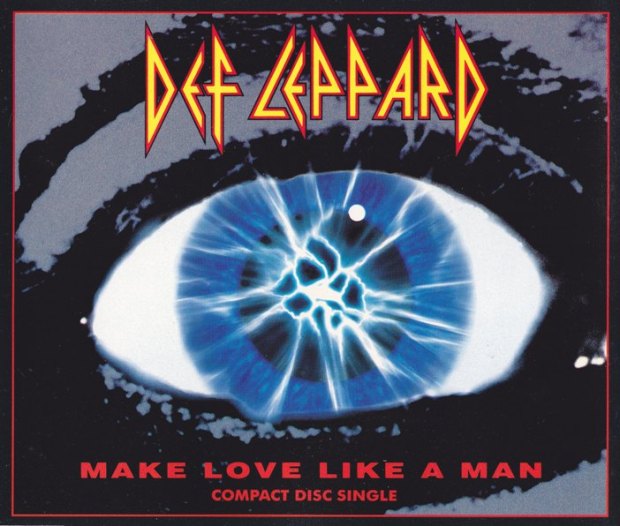
DEF LEPPARD – “Make Love Like a Man” (1992 Phonogram CD single)
For the life of me, I couldn’t understand why this song from Adrenalize was ever chosen as a single, let alone the second one. As stated in my album review, it “sounds like a hard rock version of a Shania Twain hit”. No thank you.
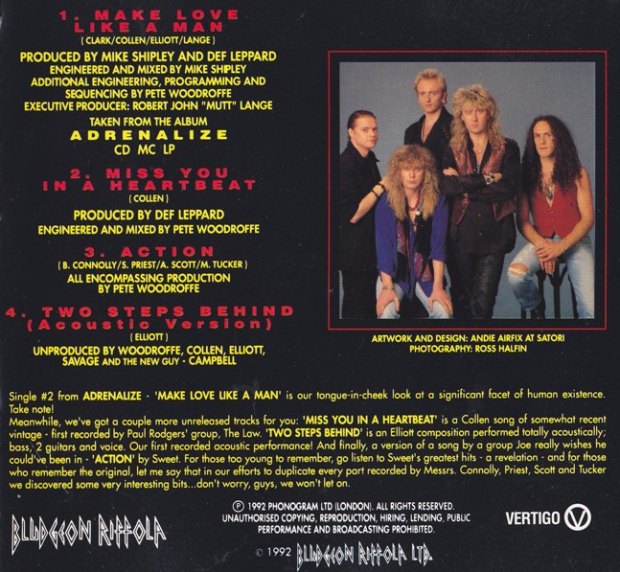
Def Leppard singles are always exciting for collecting B-sides, but “Make Love Like A Man” was the first one to include three brand new songs. Each one was completely different from the other, while remaining of very high quality.
First up is a not-cover of “Miss You In A Heartbeat”, originally recorded by Paul Rodgers’ band The Law. Phil Collen wrote it, but The Law was first to release it in 1991. Atmospheric, moody, but bright, it was a worthy successor to the lofty heights of Hysteria. It’s superior to some of the songs that made it to Adrenalize, and it’s certainly better than its own A-side. In fact, a bare piano version was later as released as a single in its own right, supporting Retro-Active in 1993.
Next is cover of The Sweet’s “Action”. This is the original mix. The one on Retro-Active has re-recorded snare drums and possibly additional backing vocals. Leppard have played this one live, steadily for years. It fills the niche of a solid rocker with a solid riff needed on this otherwise fairly mellow single. Like “Miss You In A Heartbeat”, it too was released as a single in 1994, but with the re-recorded drums.
“Two Steps Behind” was the band’s first ever acoustic recording, a trend picking up at the time. It was a bit of a throw-away at the time, with a sparse unadorned arrangement and a pleasant but ordinary melody. However, it too was released a single as well! It was chosen for Arnold Schwarzenegger’s Last Action Hero soundtrack, and had strings added courtesy of Michael Kamen. Once again this is the original version and the first to feature “new guy” Vivian Campbell!
In the context of 1992, this was a pretty special single. Viv’s first Leppard recording, Lep’s first acoustic foray, and some quality tunes ensured solid play time that summer. A-side aside, this was Leppard’s most satisfying single for the dollar yet.
Do you wanna get rocked? Time for a new series! When we looked at the deluxe edition ofDef Leppard’s Adrenalize, it was noted that many B-sides from that era were missing. Songs such as “Only After Dark”, “Miss You In A Heartbeat”, “Action”, “From The Inside” and “She’s Too Tough” were not included on that disappointing deluxe. Fortunately, LeBrain HQ has a stack of Def Leppard CD singles right here, to help inform readers where you can get the original versions of these tracks. Let’s get rocked!
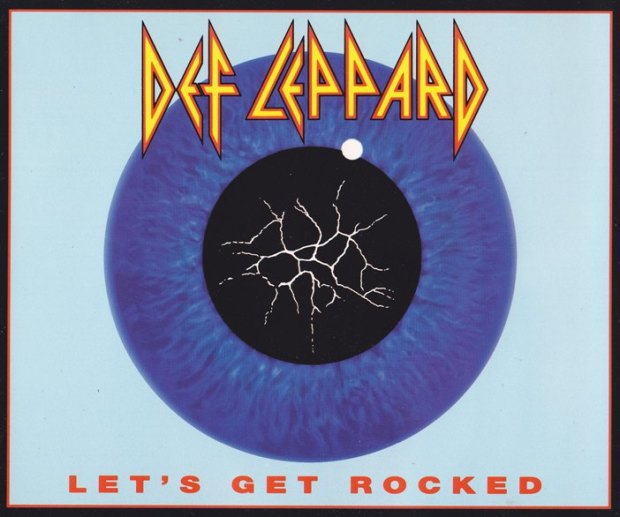
DEF LEPPARD – “Let’s Get Rocked” (1992 Phonogram CD single)
Hell and back — those words are as good as any to describe Def Leppard. This, the first Def Leppard single in what seemed like ages, was also their first single without “Steamin'” Steve Clark. That left a monster riff-sized gap in Leppard’s arsenal. Rather than seek out a replacement immediately, Phil Collen stepped up to the plate and recorded all the guitars on Adrenalize himself (with a little acoustic help from Rick Savage).
“Let’s Get Rocked” hit the airwaves in early 1992, and immediately shot up the charts, such was the value of Def Leppard. Even though the band maintained their disciplined studio techniques, layering guitar shimmer and vocals galore, “Let’s Get Rocked” sounds sparse compared to the Mutt Langue produced Hysteria. Though Collen did his best in difficult circumstances, Steve Clarke is missed, as are his riffs. “Let’s Get Rocked” was one of a few songs on Adrenalize without his name in the writing credits.
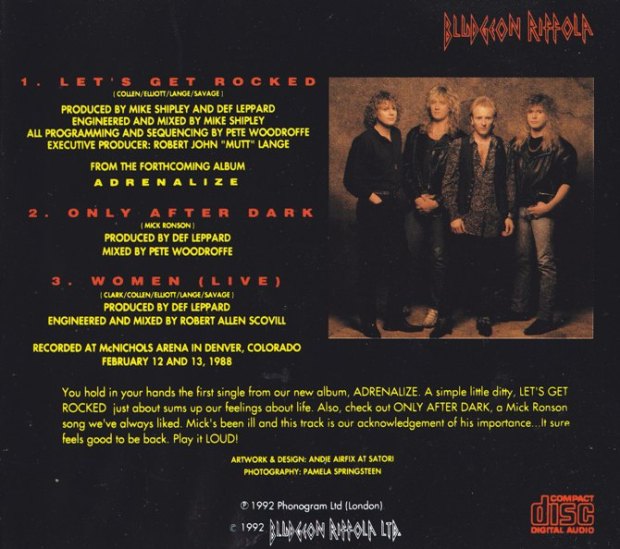
Def Leppard have a knack of picking interesting but obscure covers, which is one reason collecting their singles is so much fun. The Mick Ronson (R.I.P.) solo song “Only After Dark” has that glammy vibe that Leppard love so much. The liner notes state that “Mick’s been ill, and this track is out acknowledgement of his importance.” Indeed, Mick passed away at the terribly young age of 46, from cancer. This is a fun little cover, more lively than many of the album tracks. It certainly sounds like the band were having fun doing it.
This version of “Only After Dark” is the original studio version. The version released on the Retro-Active album features newly overdubbed guitars by Phil Collen and new guy Vivian Campbell, added in 1993. You can also hear additional vocals on that mix. Therefore the original B-side version is still exclusive to the single.
Unfortunately, “Let’s Get Rocked” only has two B-sides, one being “Only After Dark” and the second being a live take of “Women”, this one lifted from their live home video, Live – In The Round In Your Face (Denver 1988) Strangely though, this track was previously released as a B-side on the previous Def Leppard single, 1989’s “Rocket”. It’s also on the Hysteria deluxe…and the Adrenalize deluxe! Talk about oversaturation.
“Let’s Get Rocked” was an acceptable first single. The track itself was good enough, though it certainly broke no new ground at all musically. “Only After Dark” was different than typical Def Leppard and another welcome B-side to the collection. “Women” was just another re-release. It could have been better.
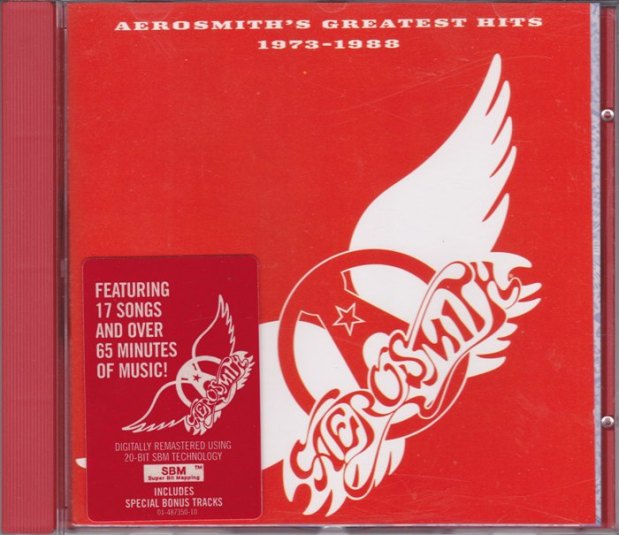
Back in May/June, we took a detailed look at the entire Aerosmith Box of Fire set (1994), including the original Aerosmith’s Greatest Hits(1980). What we didn’t inspect was the expanded 1997 reissue of Greatest Hits, now dubbed Greatest Hits 1973-1988, including an unreleased track.
Since this CD is based on the original Aerosmith’s Greatest Hits, it contains all the original songs. Because of the greatly expanded tracklist (from 10 to now 17 tracks), it is the preferred listening experience. The title is misleading: If it truly was the greatest hits from ’73 – ’88, wouldn’t “Angel” be included? “Dude”? “Rag Doll”? Yes, but this is the Columbia Records music, not the Geffen stuff. Casual fans don’t know that. Casual fans might see the title and say, “Oh cool…this will have some of the 80’s music on there.” No, it doesn’t.
“Chip Away The Stone” was released on CD for the first time on 1988’s Gems album, and there are a lot of fans out there who would name this as a favourite. Putting it on the expanded Greatest Hits is what we in the reviewing world might call a “no-brainer”. It elevates the album to a whole new level.
“Seasons of Wither” is a beautiful one from the early days, an acoustic number just a little different than your typical “ballad”. Fantastic song. “Big Ten-Inch Record” is loaded with horns and soul and sounds like classic Aerosmith. Be glad these tunes were added, among others. They’re all still great today, and not overplayed on radio or in concert. Of course you still get the songs you know, such as “Dream On”, “Same Old Song and Dance”, “Sweet Emotion”, and all that good stuff.
One unreleased song is present: A live version of “One Way Street”. This is actually a more recent recording from 1994 (so what’s this 1973-1988 nonsense?), and was also on a Walmart exclusive EP called Made in America in 1997. “One Way Street” is a debut album classic, and oh so very welcome here. It was recorded for radio broadcast, and the setting sounds intimate. Steve’s harmonica work is the high point of this great little-known song.
I used to advise fans to pick this up instead of the old, cheaper Greatest Hits. Today you can find it for under $5 if you know where to look. The price has dropped considerably since I paid almost $28 for it on US import!
I’m taking today off from blogging. It’s my birthday! So I’ll be opening stuff like this, while you are hopefully enjoying a nice day off, too.
I deserve a day off! I’ve been posting here almost daily for three and a half years! I’ve accumulated almost 1600 posts in that time, so I’m sure you won’t hold it against me.
In the meantime, you can check out the past birthday related posts. I’ll be back tomorrow with more rock!
Record Store Tales Part 78: Meat on LeBrain (An overly kind birthday post from my friend Uncle Meat to me.)
Record Store Tales Part 306: Happy Birthday to Me – (Memories of being hired at the Record Store 20 years prior.)
Blu-ray review: 2001: A Space Odyssey – (My favourite movie, a post I did on my birthday 2013)
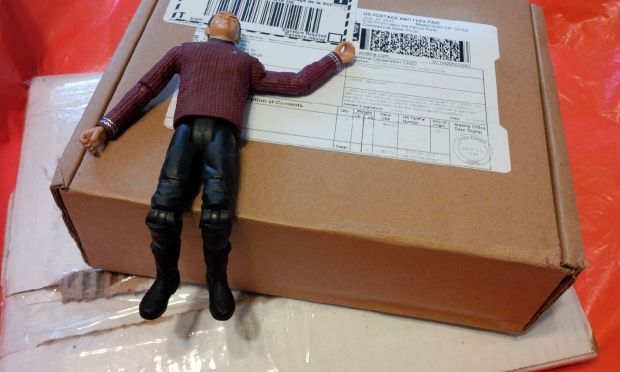
Thank you Aaron for the gift…whatever it may be…well, it could be a bomb but it’s not ticking! I will be sure to update you all with photos of whatever musical treasures await me today.
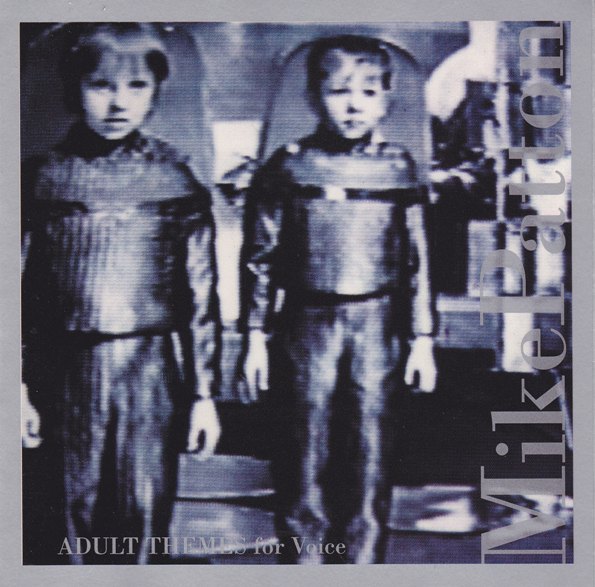
MIKE PATTON – Adult Themes For Voice (1996 Tzadik)
I’m a huge Faith No More fan; I think they’re easily one of the most brilliant bands of any genre to grace the stage. I collect their stuff, and occasionally Mike Patton’s solo projects as well. Numerous as they are, I tend to pick and choose today. Back in 1996, that wasn’t the case.
One night, out with T-Rev record shopping, we visited Encore Records in downtown Kitchener. On their shelves, for $24.99, was a Mike Patton solo album called Adult Themes for Voice. I asked the lady at the counter, “Is this any good?” She responded cryptically, “Well, nobody’s ever returned one.”
I did buy it, not only because I’m a completist, but because the text on the obi strip made it sound so fucking cool:
The debut solo album from a performer/composer who has worked with Mr. Bungle, Kronos Quartet, Faith No More, Bob Ostertag and many others. Experimental sounds never imagined from just a voice and microphone. An absolute classic.
Shit, how could I possibly say no after reading that? I’d have to be a dick not to buy the CD.
Then, we went to go visit Tom at his store, and he put the disc on. In-store.
First came the wide open eyes, then the chuckles, then the “I can’t believe you spent $25 on this”.
Sorry folks, it’s just not for me. I know there are people out there who can appreciate this. I’m not one of them. It’s true that Mike Patton can do just about anything with his voice, and here he does just about anything with his voice, except singing. Different screams and guttural sounds are spliced together into brief compositions. Tape editing is just as important as the vocals, in terms of the final compositions. At times his voice is percussive, at other times whimpering. At all times, assaulting the ear. It rarely sounds human at all. It’s interesting, with the recent release of the new Faith No More album Sol Invictus, how Mike Patton has integrated some of these techniques with their sound.
Being a collector, and being a long-time Faith No More fan, I did keep this album in my library. I found a good use for it: the shorter tracks make for awesome transitions on mix CDs!
1/5
But 5/5 stars if you can listen to something like this regularly; there’s no denying the creativity involved!
C.C. DeVille was let go from Poison after an embarrassing performance on the 1991 MTV awards. Who can forget the pink-haired C.C.? Drugs and alcohol had taken their toll on the guitar player. There were musical differences as well. Bret Michaels liked the bluesier direction Poison were going on; C.C. preferred basic sloppy rock. A parting of ways was all but inevitable.
Poison were lucky enough to convince guitar prodigy Richie Kotzen to join the band. Kotzen was from Pennsylvania, like Poison, and had released three critically acclaimed solo albums. Richie Kotzen and Electric Joy were hard-to-penetrate instrumental albums, while Fever Dream introduced Richie’s soulful singing voice. He had also contributed the bluesy rock of “Dream of a New Day” to the Bill & Ted’s Bogus Journey soundtrack album.
Like many fans, I waited and wondered what the new Poison would sound like. Kotzen claims that many of the songs were completely written, lyrics and all, before he joined Poison. Regardless each song received a four-way songwriting split among the band members. Fans in the know could tell right away that Kotzen’s impact on the songs was much greater than the other members.
Native Tongue was not as immediate as any prior Poison album, but what it lacked in instant hooks it made up for in musicianship and integrity. Native Tongue was also a long album, at almost an hour not including B-sides such as “Whip Comes Down”. It was a lot to absorb, and due to the changing winds of rock, not too many fans were willing to spend time with and get to know Native Tongue.
You couldn’t have asked for a better start to the album that the duo of “Native Tongue”/”The Scream”. Tribal drums by Rikki Rockett and Sheila E. set the scene for one of Poison’s heaviest songs ever. “The Scream” is killer: a relentless driving rock song with aggressive playing and lyrics. Bret Michaels merged this with his Poison singing style, creating a successful hybrid. “The Scream” is one of Poison’s finest achievements, and a hell of a way to kick off the new album with the new guitarist.
“Stand” was the soulful, gospel-like lead single. It didn’t do anything for me, but you have to give Poison credit for going all-in. With choirs and Kotzen’s soulful guitar playing, it’s still an outstanding Poison song. “Stay Alive” was another good tune, this time about bassist Bobby Dall’s struggles with substances. That led into the ballad “Until You Suffer Some (Fire and Ice)”, one of the band’s best such songs. The only weakness here is a grouping of slow songs on side one. “Body Talk” and “Bring It Home” make up for that. “Bring It Home” in particular had that heavy groove that you needed to have in the 1990s, as well as strong backing vocals from Kotzen. “Bring It Home” ended the first side with the heaviest song since “The Scream”.
The one thing that I found difficult about Native Tongue was the aforementioned lack of immediacy. Thankfully, side two had a few songs that maintained that old-tyme Poison singalong chorus. They were “Seven Days Over You” (a horn-inflected goodie), the anthemic “Blind Faith” and, “Ride Child Ride”. These tunes weren’t too much of a departure from earlier Poison of Flesh & Blood. Perhaps if they had been released as singles, there would have been more chart action. “Strike Up the Band” is similar, capturing the high octane rock that Poison were good at doing live.
This slideshow requires JavaScript.
“Richie’s Acoustic Thang” and “Ain’t That the Truth” are swampy bluesy goodness, crossing Poison and Kotzen perfectly. Where Poison failed to do decent blues before, they finally managed to get it done with Richie. Likewise, “Theatre of the Soul” is a soulful ballad that acts as another album highlight.
The final song was “Bastard Son of a Thousand Blues”, and it is really the only stinker, despite Kotzen having plenty of vocal time. It reminds me of “Poor Boy Blues” from the prior album, and unfortunately ends the album on a mediocre note, guitar pyrotechnics notwithstanding.
Kotzen didn’t last long with Poison. After a controversial departure, he was replaced by Blues Saraceno, another highly rated shredder. The ironic thing was that Blues Saraceno was in the running for the guitar slot in the first place, but the band chose Kotzen. Saraceno recorded the strong Crack A Smile CD, an intentional return to good-time Poison rock, but were dropped by the record label before a release. That’s a whole other story, with six years of delays and bootlegs before the album was out, eventually leading to a reunion with C.C. DeVille.
Fortunately, Native Tongue remains a reminder of a brief period in Poison where they were momentarily among the best acts in hard rock. No shit.
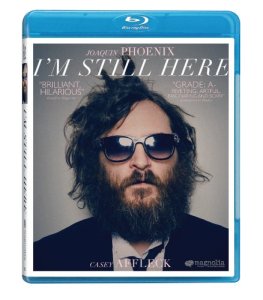
By special request of J. atResurrection Songs! This is an old review that I wrote when the Blu-ray of I’m Still Here was released. I have since sold the movie and have no good way of re-watching in order to ensure I still feel the same way about it. Hence, this review was written in 2010 and may or may not reflect my opinions if I saw the movie again….
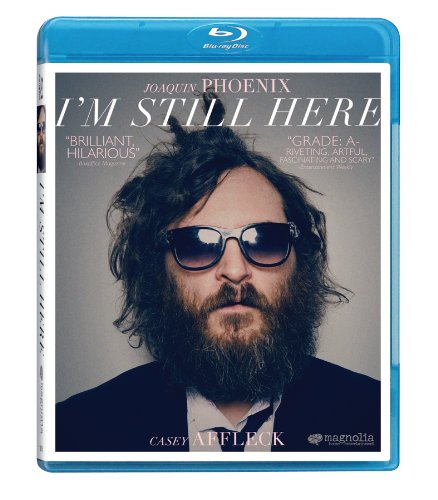
I’M STILL HERE (2010 Magnolia)
Directed by Casey Affleck
I can’t stand today’s media as much as the next guy, so when Casey Affleck and Joaquin Phoenix revealed that they just “punk’d” the media in a big way, I was curious about the results. Joaquin faked a major meltdown in front of the world, pretending that he was retiring from acting to become a rapper. His rapper persona, “JP”, grew out a long straggly beard and hair to feign mental illness.
The movie never addresses the issue of “fake/real”. As far as the film is concerned, Affleck doesn’t let on. It was only after the fact that they both let the cat out of the bag.
Things start out innocently enough. “JP” reveals that he’s become interested in music and wants to concentrate on that. As the beard expands, so does the odd behaviour. Weird, disjointed and off-rhythm raps, dirty clothes, and the beard continue to grow. The infamous Letterman appearance follows and this is when most people heard of Phoenix’s breakdown. The media reports, which immediately follow his public television “meltdown”, are covered as well.
JP gets frustrated trying to find a producer, finally getting some interest from P. Diddy. Trying to hook up with Diddy is damn near impossible, but when he does, Diddy is interested. One song, “Compli-fuckin-cated”, could have been a novelty hit for real. When it comes time for concerts, the stage gigs don’t go well, as JP is heckled by the crowd. Can JP redeem his rap career and finally begin to express himself in a meaningful way? If the drugs don’t get to him first, maybe.
I’m Still Here wasn’t a bad film. It was definitely a unique film; I’m just not sure how much entertainment value it had. Pranks tend to go best when they are short and sweet,and to the point. When they last a year and become a full length movie, the lines between prank and reality are blurred (which I’m sure was part of the point). I admit that Phoenix did outdo himself, creating this character based on himself, and living with it for this time, never breaking character in public. The problem is, while technically it is a great achievement, as a character JP isn’t all that interesting. As a breakdown, we’ve seen far more interesting real ones in recent years. Hard to top Britney shaving her head, you know?
Spacehog fans will enjoy Antony Langdon’s appearance as a personal assistant to JP. Royston Langdon contributed to songwriting.
The Blu-ray bonuses are generous, with all sorts of featurettes and deleted scenes with commentary. Perhaps they will shed some light on the process. The movie hasn’t clicked with me, but I’ll give it another shot. It is a strange animal after all.
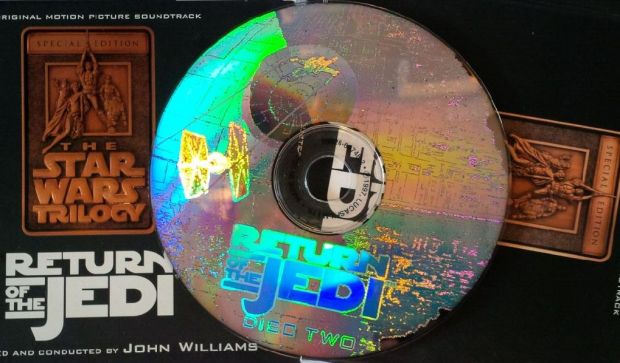
STAR WARS: Return of the Jedi – Special Edition original motion picture soundtrack (1997 RCA limited edition with holographic discs, original soundtrack released 1983)
The final soundtrack of the original trilogy received the most disappointing Special Edition soundtrack. The reissues for A New Hope and The Empire Strikes Back essentially offered complete collections of all the music from those two films. The soundtrack for Return of the Jedi suffers the most from the Special Edition changes. New music replaces old well-loved tunes, which is rarely a good idea.
Instead of the classic music of “Lapti Nek” (Jabba’s palace scene) we now get “Jedi Rocks”. I need not tell you how unwelcome that song was, replacing “Lapti Nek”. All because Lucas didn’t like that the singing alien puppet’s lips didn’t move enough, so he decided to “fix” that by putting in a much more elaborate musical number to go with the new CG lips. Thanks, George. Thankfully “Lapti Nek” was included on the 4 CD Star Wars Anthology box set.
The other missing music is “Ewok Celebration”, which fans worldwide know as “Yub Nub”. This Ewok song was one of those miserable little teddy bears’ few redeeming qualities. “Ewok Celebration” is replaced by the bland new “Victory Celebration” which ends the film. Thankfully the original music is also on the Anthology box set. (I would like to get that.)
Yub Nub!
Return of the Jedi gets off to a slower start than the other soundtracks. Instead of a battle or vicious Wampa attack, Jedi opened with a couple droids wandering through the desert before finding gainful employment with Jabba the Hutt. I know, right? How could that not make for exciting music? It’s not until Luke Skywalker confronts Jabba (track 6) that things start to move. Until then, the music remains largely atmospheric and creepy. There are a few unforgettable musical cues, such as that which accompanies Han Solo’s thawing.
Because Jedi was the third movie in a trilogy, it revisits a lot of familiar themes. The music for “The Imperial March” is heard several times for example (such as within “The Emperor Arrives”), but there isn’t much in terms of new memorable themes. I suppose that is to be expected. The nature of the film, including the deaths of beloved characters and other upsetting revelations, lent themselves to a darker soundtrack. A lot of atmospheric pieces helped underscore the mood of these scenes. This is offset by child-like Ewok segments of brightness.
A nice touch is the inclusion of alternate versions. The exciting “Sail Barge Assault” is included in an alternate take. There is also a sweeping concert suite of “The Forest Battle” on disc two. “Lapti Nek” and “Yub Nub” would have been nice, but in 1997 George was really trying to bury the original versions of the films forever. I’ll just have to find an old record, or that Anthology box.
The original music, excised for the Special Edition, is what this CD misses most.
 DEF LEPPARD – “Heaven Is” (1993 Phonogram CD single)










 POISON – Native Tongue (1993 Capitol)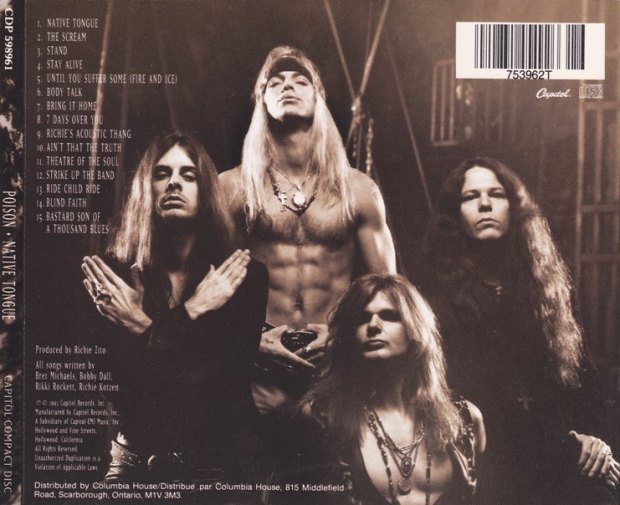




 mikeladano.com