Reviews

REVIEW: Gene Simmons – The Vault – Disk 2 (2018)

Previous Reading: 

Record Store Tales #600:  The Vault
Disk 1 Review


Another disc, another 15 songs!


GENE SIMMONS – The Vault – Disk 2 (2018 Rhino)

One of the fastest and heaviest songs from Gene’s solo album Asshole was “Weapons of Mass Destruction”.  It was originally written for Psycho-Circus, but deemed insufficient.  The demo version just called “Weapons” features Gene calling out what instruments go where, and a much rougher recording.  The final album version was not a remarkable song and neither is this demo.  The song was pretty much in place at this stage.  2.5/5

“Weapons (Power to Raise the Dead)” is another demo version, this one with Ace Frehley on lead vocals.  Gene hoped for him to sing it on the Kiss album, and let Ace write new lyrics.  It also features Bruce Kulick and Eric Singer.  It sounds like Gene wrote the entire song around a bass lick.  This is why it’s better than Gene’s original idea:  Ace’s presence also brings much needed variety to this box set after 16 songs with Gene singing lead.  Ace was in good voice back then, and it would have been awesome to hear a final version.  Psycho-Circus could have and should have been a longer album to accommodate more band contributions.  3.5/5

“Hate” made it onto Carnival of Souls.  Gene openly admits he was inspired by Seattle and that angry style of music.  Written with Bruce Kulick and Scott Van Zen, “Hate” would be improved upon immensely when it was recorded for good.  What’s missing is Bruce’s wah-wah drenched lead guitar acrobatics and drones that normally run through the track.  Otherwise, this is the same arrangement, complete with lyrics and only minor differences.  There’s a neat tape edit trick at the end; see if you can spot it.  4/5

“Hate” goes immediately without break into “Carnival of Souls #2”.  This a four-track demo of the same song included on disc one.  This is performed with Scott Van Zen, and the lyrics are not fully written yet.  As stated earlier, this was never one of Gene’s better songs.  It does feature some cool guitar stuff in the middle breakdown, but otherwise this is a forgettable demo of a song that was never really up to snuff.  2/5

“Master of Flesh” is an interesting song because it’s a cover of a New York band called Street Punk.  Gene bought the publishing rights for cash from writer Jon Montgomery.  Regardless of the name “Street Punk”, that’s not what this is.  An acoustic ballad with spoken word verses, Gene compares it to David Bowie and Lou Reed.  There’s also a bit of John Lennon in the falsetto of the chorus.  Gene recorded the undated demo on a Tascam and plays the lead guitar solo himself.  Really not bad and had potential.  It wasn’t where Kiss was headed over their next few albums, but could have perhaps fit in somewhere.  3.5/5

“Heavy Rain” is a demo with Bruce Kulick of a recurring song called “Rain Keeps Fallin'”, previously released on a Gene Simmons Family Jewels Season One bonus CD.  This heavy-as-hell riff really pops.  Very much akin to Carnival of Souls kind of heavy, with rolling bass, this is the kind of material that is worth coming back to.  There’s some tape dropout issues but that is not unexpected on a collection of demos, often originally recorded on cassettes.  Eric Singer can easily be identified on drums by style and sound.  3.5/5

“Within” from Psycho-Circus was one of Gene’s more ambitious stompers.  Featuring backwards guitars and Lennon-inspired lyrics, there was some psychedelia involved.  Taking that further, the overall song was inspired by Doctor Strange from Marvel comics.  Gene envisioned Strange facing off against a character like Nightmare, and somehow, that led to “Within” featuring Bruce and Eric once again.  The backwards guitar on this demo was used in the final album version later on.  This lengthy demo is far more dramatic and heavy, and really allows certain riffs and bass parts to come out more.  If only the lyrics were complete!  If this were properly recorded, it could surpass the overproduced album version.  4/5

The first version of “In Your Face” included on this box set is a Gene demo before bringing it into Kiss for Ace Frehley to sing.  You may recall this track was a B-side or bonus track for Psycho-Circus, with Frehley singing.  The early version is a bit different with a lot of different lyrics.  It sort of hangs together but is a fairly loose idea that sounds thrown against the wall.  2.5/5

“In Your Face with Ace” is much closer to album version, partly re-written by Ace and much better recorded.  It’s barely different from the final version, except the lead guitar may sound more naturally Ace.  Another Frehley vocal is also very welcome.  This is a fantastic demo that again shows that Psycho-Circus could have rocked a lot more like Kiss.  The producer may have been an issue.  5/5

“Rain #2” is the second (but not last) version of “Rain Keeps Fallin'” that we will hear on this disc.  This version features Simmons proteges Silent Rage on instruments, with a drum machine.  It’s a bit different from the first version we heard called “Heavy Rain” and doesn’t seem to punch as hard.  Only now do a realize there is a line about “keep sippin’ my Diet Coke.”  Why not?  Dare I say why not?  3/5

It’s almost a cheat to call “Carnival Intro” a full track among the 15 here.  This 32 second track is the intro that was later used on Psycho-Circus, though it was originally intended for “Carnival of Souls”.  A cool little intro, but more like a bonus.  Historically valuable for the eventual use by Kiss.  2/5 

It was only a matter of time before Vinnie Vincent (née Cusano) appeared in this set.  Kiss began writing with the future Ankh Warrior in 1982 for what became Creatures of the Night.   Gene says “I Wanna Live” is among the songs they wrote, and has never been recorded or heard before.  It has a cool synth part that goes through the song and sounds like an idea with potential.  This demo sounds pretty decent and the chorus is good enough for rock and roll.  Catchy hard rock with a tough vibe.  4/5

“If It’s Too Hot, You’re Too Cold” later became “Hot and Cold” on Sonic Boom.  This demo with Silent Rage is based on an old song called “Rotten to the Core” from 1977.  Gene says it’s also related to “Eat Your Heart Out”, but the liner notes are a little confused here.  Either way, this is pretty good stuff and does have a 70s Kiss vibe, which is why it worked swimmingly on the Sonic Boom album.  4/5

Finally, “Rain Keeps Fallin'” appears in its third version!  This is still not the same one as the Family Jewels set, which is 3:53 in length.  This version sounds the most 80s, of the songs, circa Crazy Nights if Gene’s smooth vocal delivery is to go by.  It is very hard rock, with focus on the chorus.  You can really hear the evolution of a song by listening to this disc.  An interesting trip.  4/5

“Bells of Freedom” closes this disc, with a Who-inspired song.  Tommy Thayer is on guitar, but from a time before he was in Kiss.  You can hear the Pete Townsend influence in those big chords.  It’s a pretty good song idea and and it sounds like it could really have become something.  There is a great solo included.  It is hard to judge demos like this because often the concept is to get the idea down quickly.  We’ll err on the high side, because there are some serious possibilities with these hooks!  This could have been an 80s rock anthem!  4/5

Averaging out the score for the 15 songs, disc two rates:  3.16/5 stars


Disk 2 Track length and songwriters (from Wikipedia)

1. Weapons (4:16) Simmons
2. Weapons (Power to Raise the Dead) (4:13) Simmons / Frehley
3. Hate (Demo) (4:02) Simmons / Van Zen / Kulick
4. Carnival of Souls #2 (Demo) (3:15) Simmons / Van Zen
5. Master Of Flash (Street Punk) [1980?] (3:38) Montgomery
6. Heavy Rain (3:22) Simmons / Kulick
7. Within (Demo) (5:58) Simmons
8. In Your Face (Gene Demo) (1:51) Simmons
9. In Your Face (Ace Re-write Demo) (3:20) Simmons / Frehley
10. Rain #2 (3:35) Simmons
11. Carnival Intro (0:32) Simmons
12. I Wanna Live (Demo) (4:33) Simmons / Cusano
13. If It’s Too Hot, You’re Too Cold (3:42) Simmons
14. Rain Keeps Fallin’ (3:22) Simmons
15. Bells of Freedom (4:37) Simmons

REVIEW: Gene Simmons – The Vault – Disk 1 (2018)

Previous Reading:  Record Store Tales #600:  The Vault


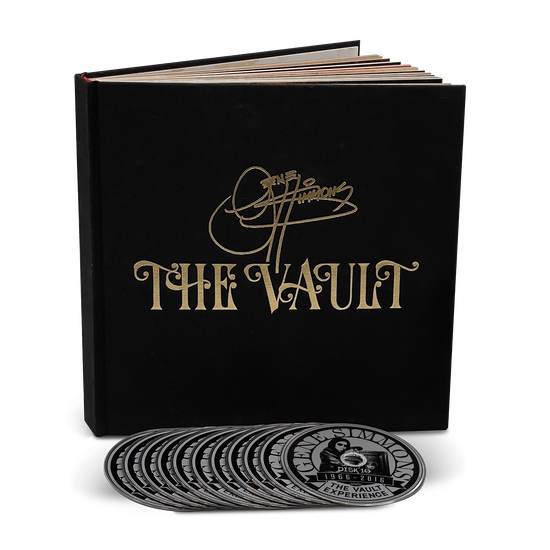
I knew — I knew!! — that if I held out long enough, there was a chance this could happen.  When a bare-bones versions of the Gene Simmons Vault finally went on sale for a reasonable price, I had to have it.  All 11 CDs, plus the coin and the statue, for $100 was too great a deal to pass up.  All you don’t get is the actual vault and gift from Gene.  In this 12 part series, we will take a good look at my new Vault.

This box set was first announced about two decades ago, originally titled Gene Simmons 100.  Then it was going to be called Monster, though that title was re-used on something else instead (Gene blames Paul for “borrowing” that name).  As implied from 100 title, it was supposed to be a set of 100 unreleased songs from Gene vaults.  Kiss demos, solo demos, pre-Kiss music, everything.  Obviously things grew and grew, and so did the price tag!  In the end, there were 165 songs and a much more reasonable valuation.  This will only become more collectible.

In the liner notes, Gene says he tried to split up the songs by “mood”.  Please enjoy this series as we go through each and every song, disc by disc, in this massive collection.


GENE SIMMONS – The Vault – Disk 1 (2018 Rhino)

Rather than start with his earliest material, Simmons chose to sequence this box set starting with a 2011 recording called “Are You Ready”.  It is, for all intents and purposes, a Kiss song without Paul Stanley.  It features Tommy Thayer and Eric Singer on guitar and drums (and backing vocals).  This song was written after Kiss had essentially given up on recording albums, though one lyric was used previously on Monster:  “Give me [a] kiss,  bite your lips”.  This is a Kiss rocker, pure and simple, and had they ever recorded it, it could have been one of their best latter day songs.  The chorus is right out of 1977, and the boys do a great job on it for a demo.  A simple riff, and a fist-pumping beat, and you’re hooked.  Great song.  5/5

“I Turn To Stone” is a hotel demo by Gene and Tommy Thayer.  The title was inspired by the Biblical “pillar of salt” story, but there’s nothing holy about these lyrics.  It’s all about Gene’s inability to resist the fairer sex.  It’s a pretty good song that sounds very early 80s, somewhere around the Killers-Creatures era.  Gene talk-sings some of the lyrics but the song is otherwise pretty melodic.  There are some of “ah-ah-ah” bits in the outro that sound very Hot In the Shade.  Pretty cool, and doubtless would have been polished up for an album.  Great potential.  3.5/5

“Juliet” starts immediately with a riff like “Custard Pie”.  Co-written by Ken Tamplin for the Revenge album, it did not make the cut.  It’s a little herky-jerky sounding, and the clunky primitive drum machine used doesn’t translate it well.  Again, there’s a lyric here that was used later on “Russian Roulette” from Sonic Boom.  This song was probably rejected for being too close to Led Zeppelin.  2.5/5 

“Hey You” is the second Tamplin co-write.  It has a really cool dark vibe, but doesn’t hold together as a song.  It’s more just some components stuck together that don’t necessarily fit.  One guitar bit sounds like it made it onto Revenge in another song.  It’s upbeat, and sounds like something that was hoped to would be a fist pumper in concert.  Close but no cigar.  2/5 

The Carnival of Souls album contained a lot of stuff that was written for Revenge“I Confess” is one such song.  It’s one of Gene’s more serious lyrics, regarding religion and hypocrisy.  If you confess to the priest, who does the priest confess to?  This demo is not very different from the final version; just as dark and with the same vocal delivery.  The main differences are in the guitar parts, which Bruce Kulick later put his own stamp on.  4/5

Continuing on with things that ended up on Carnival, “Legends Never Die” was inspired by events that also inspired “Childhood’s End” later on.  Co-written by Micki Free and Adam Mitchell in 1982, this power ballad could have been on an album had Paul Stanley not been the ballad guy in Kiss.  When Gene went on to produce Wendy O. Williams, she recorded this song almost identically to the demo.  Her vocals are more extreme, going from soft to growl, but a Kiss version sung by Gene certainly would have been interesting.  This is as close as we get.  Gene considers it a very personal song.  4/5 

“Something Wicked This Way Comes” is a familiar song title that we have heard about for years.  Gene says he recorded several versions including some with Bruce Kulick on guitar.  It sounds very much like Carnival of Souls material, but not up to standards.  The outro guitar stuff is great.  There is potential to some of the individual parts, but as a whole there’s not much of a song here.   The title was inspired by Ray Bradbury, but is otherwise unrelated.  1/5

“Hand of Fate” with Tommy Thayer and Eric Singer was considered for Sonic Boom.  It’s a song Gene likes, and is a prime example of the “monster plod” groove that he is known for.  There are some nice layers of backing vocals on the bridge (all overdubbed by Gene), but the song would have been one of the weakest on Sonic Boom.  We already have a lot of Gene songs with this kind of groove and theme.  Next!  2/5

“Hunger” is a sex song, written in the late 80s and recorded on New Year’s Eve with Bruce Kulick and Eric Carr.  It’s nice to hear Carr; he has such an identifiable song.  This is an unremarkable song.  It’s a simple riff without a lot of melody to back it.  It sounds like a Whitesnake outtake more than Kiss, but Gene wasn’t beyond being “inspired” by other bands who were having hits.  2/5  

Gene prefers this demo of “In My Head” from Carnival of Souls.  His idea was to do “Beatles-y” things like recording backwards cymbals, but layering them over a heavy thumping groove.  The song idea is inspired by people to hear voices in their heads, and the result is a very chilling song and lyric.  It’s angry, heavy and slightly psychedelic.  The main differences are that Bruce hadn’t added all his layers of genius to the guitars yet.  4/5

Speaking of Carnival, one of the songs that didn’t make that album was “Carnival of Souls”.  It later came out on Gene solo album called (ahem) Asshole.  It was never a good enough song.  Demo #1 is pretty intact.  The issue is mostly the chorus, which just isn’t very good, nor fitting for the fast, almost thrashy verses.  Written with Scott Van Zen, Gene says he was going to a psychedelic vibe similar to the band Love.  A miss.  2/5

“Are You A Boy, or Are You A Girl” is a phrase Gene heard a lot growing up in New York, growing his hair long.  People would stop him on the street and ask that question.  “Are you a long haired creature from another world?”  This song has Eric Carr and Tommy Thayer, which would date it back to the Hot in the Shade era.  There are some musical ideas that later turned up in a Kiss song called “Hot and Cold”.  What is most interesting about this song is that Gene takes a brief bass solo at 1:25 into the song.  Gene’s an underrated bass player; just listen to those walking basslines on the first three albums.  Too bad Kiss never did anything like that on an album.  3/5

“Say You Don’t Want It” dates back to 1979, with a problematic song Gene had called “Mongoloid Man”.  This a is a re-write from 2001 with Tommy Thayer and without the troublesome lyrics.  Some of these words would resurface on “Spit” from the Revenge album.  “Spit” is a far better song.  Just not good enough, and monotonous to boot.  2/5

If that wasn’t enough, the original version of “Mongoloid Man” with Joe Perry on guitar follows.  Musically, this demo actually sounds better.  It has a cool vintage vibe not unlike Gene’s first solo album (which Joe also played on).   It was never going to be an amazing song, but this vintage version is definitely marginally better, despite the lyrics.  Perry smokes!  2.5/5 

Written by Darren Leader of Steel Panther with Gene, “I Wait” ends this disc on a powerful note.  You could call it a ballad, in sort of a late 90s altera-rock way.  It’s actually a great song and though not suitable for Kiss, would have made an excellent solo track.  It definitely sounds a lot more like a 90s alternative band than a classic rock band, but a good song is a good song.  “I Wait” is a good song with potential to be great.  Re-record this one, Gene, and release it as a single.  4/5

When we tally up the 15 individual song scores, this is how Disk 1 averages out:  2.63/5 stars.

We’ll be keeping track of these scores so we can get an accurate average for the box set.  This score is not surprising.  Gene is known for a quantity-over-quality style of creation.  At least his batting average here is over 50 (barely).


Disk 1 track length and songwriters (from Wikipedia)

1. Are You Ready [2011] (3:13) Simmons
2. I Turn to Stone (3:58) Simmons
3. Juliet (2:52) Simmons / Tamplin
4. Hey You (3:44) Simmons / Tamplin

5. I Confess (3:40) Simmons / Tamplin
6. Legends Never Die [1982] (4:24) Simmons / Mitchell / Free
7. Something Wicked This Way Comes [1988] (3:44) Simmons
8. Hand of Fate (3:15) Simmons
9. Hunger (4:14) Simmons
10. In My Head [1994] (3:30) Simmons / Van Zen / St. James
11. Carnival of Souls #1 [1994] (3:44) Simmons / Van Zen
12. Are You a Boy, or Are You a Girl (2:49) Simmons
13. Say You Don’t Want It (3:29) Simmons
14. Mongoloid Man [1976] (4:06) Simmons (with Joe Perry of Aerosmith)
15. I Wait (4:04) Leader / Simmons)

First Lunchwalk of the Year! Aching Joints, Happy Head

The clouds have parted, the sun has returned…and so have I, to my old lunchwalk route!

I have two routes.  The shorter one is about 25 minutes.  The longer one is about twice that.  Against my better judgement, I chose the long route.  No pain no gain?  I was definitely in pain!  My right leg specifically.  My knee and hip were groaning towards the end.  I pushed through, increasing my speed as much as I could handle, in order to get back and drink something cold and fizzy.

I decided to go the opposite direction as I usually went last year.  If you recall, I was getting really tired of the same route last year.  As usual, I took pictures.  I really like the one bag of dog poo that someone tried to throw over the fence into the work yard, but got tangled in a tree.

Maybe tomorrow I’ll do the short route!

REVIEW: Glass Tiger – Diamond Sun (1988)

GLASS TIGER – Diamond Sun (1988 Capitol Records)

Produced by mainstay Jim Vallance and recorded at Le Studio with Paul Northfield, Glass Tiger’s Diamond Sun is generally considered the best of their studio albums. What you may not know is that the Canadian pop band’s second album also really rocks.  Diamond Sun was their last album featuring the co-writing skills of drummer Michael Hanson, and his absence would be felt in the future.  For 1988, Glass Tiger were running on a high, and hit after hit.

The band had the courage to open the album with a soft one, the title track.  This was the second of five singles, and a powerful ballad it is.  The keyboard chimes work in tandem with drums, samples and singer Alan Frew’s impassioned vocals.  The lyrics circle around the still-topical subject of colonialism.  “When they came to this land, we gave our friendship, gave them our hands.”  The music has the appropriate feel, but listen carefully and enjoy the lyrical bass work of Wayne Parker, who has often gone unnoticed in this band.  Check that false ending!

“Far Away From Here”, the second song, is single worthy in itself but remains a nice deeper cut.  This time the guitar work of Al Connelly rises at the start, setting up an awesome mid-tempo rocker.  The chorus is among one of Glass Tiger’s best, accented by catchy acoustic guitar bits hanging lower in the mix.  Connelly’s riff is very much akin to 80s Rush, but encased within a simpler, more direct kind of song.  Alan Frew’s voice has a smooth, deep kind of power.

Personal favourite “I’m Still Searching” is a fast electro-acoustic rocker.  This song lit our VCR on fire back in 1988 when it was released as the first single/video.  Nobody expected such an upbeat rocker from the Newmarket quintet!  It’s an immediate singalong with a campfire quality, despite the electric shimmer of guitar, and organ by Sam Reid.  Once again Al Connelly has come up with some cool, catchy guitar parts.

“A Lifetime of Moments” is a lesser known ballad, well-rounded with keyboards and guitars as the main features.  The lyrics are about a lost love and rebounding, and Frew sells it.  This song is unique because of the sax solo, something simply not utilised enough in ballads or rockers!

The best of the deep cuts is the awesome side one closer, “It’s Love U Feel”, which is right out of the 80s Rush playbook.  From the echoing guitar jingle to the bouncing basswork, this song easily could have been a hit for Rush on Power Windows.  A duet with Lisa Dalbello on the chorus, this song kicks hard.  How this isn’t one of the Tiger’s biggest hits is unknown.  Perhaps it was just too advanced for an 80s pop video audience.  This sounds more like the kind of thing that would have been big on rock radio.  It is one of Glass Tiger’s greatest songs, featuring some stinging, smoking guitar work.  It could be Keith Scott from Bryan Adams’ band, as he is credited with additional guitar on the album, along with Michael Hanson.

Side two opens with two more singles.  “My Song” was a big hit with a Celtic feel, performed with the legendary Chieftains themselves.  They were recorded separately in Ireland, with Sam Neil producing their session.  Tin whistle dominates, with bodhrán, fiddles and other instruments lower in the mix.  For anyone with a taste for Celtic pop rock (think Marillion “80 Days”), this will hit the spot.  A huge hit in Canada because of its unforgettable, timeless chorus.  They tried to repeat this trick with Rod Stewart on the next album, with less success.

The most powerful song on the album is, paradoxically, the softest.  The piano ballad “(Watching) Worlds Crumble” absolutely explodes on the chorus, while the verses feature Alan Frew singing in a soft falsetto.  The music video, recorded live on stage, was the first not to feature Michael Hanson.  He left the band mid-tour to be replaced by Randall Coryell from Tom Cochrane’s band.  It was one of those sad instances of the new guy never becoming “official”.  Glass Tiger remained, on paper at least, a four-piece after the departure of Hanson.  “(Watching) Worlds Crumble” is one of the few without his writing.  It was written by Frew, Reid and Vallance, and features another really nicely written Connelly guitar solo.  The drums are absolutely epic too.

Back to a rocker, “Send Your Love” has an upbeat stuttery guitar part and a slamming chorus.  Another winning deep cut.  The warm ballad “Suffer in Silence” and another sax solo take us out to the closer, “This Island Earth”.   Diamond Sun ends in epic fashion, with this slow burning number and a social message.  Again, Rush comes to mind, with a slight progressive sound and keyboards.  In the end it’s Alan Frew who sells it.

Diamond Sun sold 200,000 copies in Canada, an astronomical amount for this country.  It is an album with broad appeal, spanning a variety of styles but all somehow sounding like Glass Tiger.  It’s a cohesive album with no weak tracks, and only highlights to be found.

5/5 stars

REVIEW: Tonic – Head On Straight (2002)

Though they had Bob Rock in the producer’s seat, Tonic really stopped rocking on their third album.

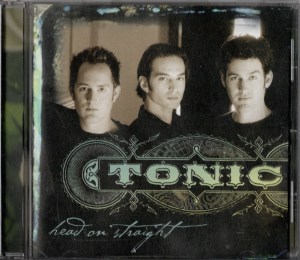
TONIC – Head On Straight (2002 Universal)

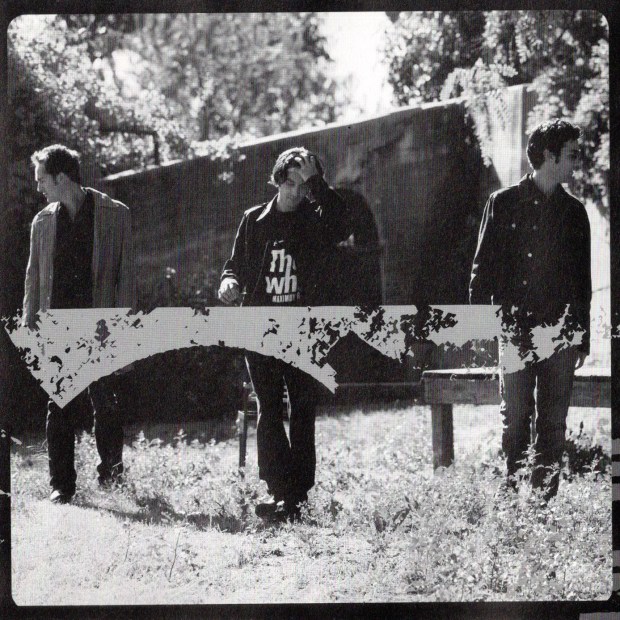
This album really should have been their best to date, with talent like Bob Rock at the console.  Instead, it sounds as if Rock was bored or distracted, and there was nobody in quality control for songwriting.  The band sound desperate, chasing hits, and not doing what they used to – rock in their own style with twang and stomp.  The bland cover art belies the faceless music within.

The misleading opener “Roses” is a typical de-tuned early 2000s rock song.  The riff and chorus fail to lift off.  It slams hard, but there’s nothing at all to hook you in.  It’s as if the band have forgotten how to write songs.  You can hear that Jeff Russo is doing some cool stuff on guitar, but you can’t actually hear it!  It’s buried under the uninteresting riff.  It’s like they forgot all that southern charm that made their debut and follow-up both attention-getters.

Second track “Take Me As I Am” is the first ballad, and it’s fine, if a bit cookie-cutter.  It has hooks.  Three more ballads follow, and none are as memorable as anything on the first two albums.  Even the title track, “Head On Straight”, is a ballad.  I was expecting a rocker.  These ballads just don’t have the weight or impact of past albums.  They’re well produced and hefty enough, but they lack that je ne sais quoi they used to have.

“Liar” is the first rocker in a dog’s age, and it’s crap.  Low on melody and high on cliche, it ain’t good.  Then, more ballads!  Songs like “On Your Feet Again” might work a lot better if there were only two.  As it is, the brain just can’t differentiate from song to song.

Fortunately, “Come Rest Your Head” isn’t a ballad, but it also doesn’t really rock.  It has one riff that rocks, but it meanders into the murky swamp of “meh”.  Bet you’ll never guess that “Ring Around Her Finger” is a ballad though, and it’s the sappiest yet.  Singer Emerson Hart affects an annoying falsetto.  This song just stinks.   It’s followed by “Believe Me”, which I guess for lack of better words, we will also call a ballad.  It’s not a rocker, so what is it?  Mid-tempo schlock with xylophone, on an album that needed adrenaline in any form.  It’s atrocious, is what it is.

“Irish” is also embarrassing.  Would you call this a sea shanty?  A rock sea shanty?  I have no friggin’ idea.  Normally I like this kind of thing – rock music with a celtic bent – but maybe I’m just sick of this album and feeling salty.

The album ends on…a ballad.  “Let Me Go”.  It’s so cliche, it could have been music from a Family Guy montage.  Fortunately the song picks up at the end, but until that point, it is the most cliche song on the entire album.  “Let me change my direction, I won’t take their rejection!”  But Emerson…you did change your direction.  You use to have some serious emotion; now you’re punching a clock.  It’s no wonder this was Tonic’s last album before a break up.

The shame of it is, I like these guys.  I adore the first two albums, and I followed Jeff Russo through to his career in TV soundtracks.  The last minute guitar burning on “Let Me Go” is far too little, too late to save this album.

2/5 stars


#1119: The Olde Toys R Us Store Sure Has Changed…

RECORD STORE TALES #1119: The Olde Toys R Us Store Sure Has Changed…

Where Toys R Us stands today in Kitchener Ontario, there once was a drive-in movie theater.  That was torn down in the early 1980s, and the mighty Toys R Us was raised.  There it has loomed heavy over Fairview Mall across the street, for four decades, beckoning children with aisles and aisles of Star Wars toys, then replaced by GI Joe figures and Transformers.  It was impossible to enter Toys R Us without finding something you wanted.  It has ebbed and waned since then, now stuffed with unwanted and overpriced 6″ figures and Super 7 cards.

“At least we still have a Toys R Us,” we say.  “Mastermind Toys is closing, and Walmart sucks.  Now let’s go check out the vinyl at the Toys R Us store.”

Full stop.  What?  Vinyl at Toys R Us?

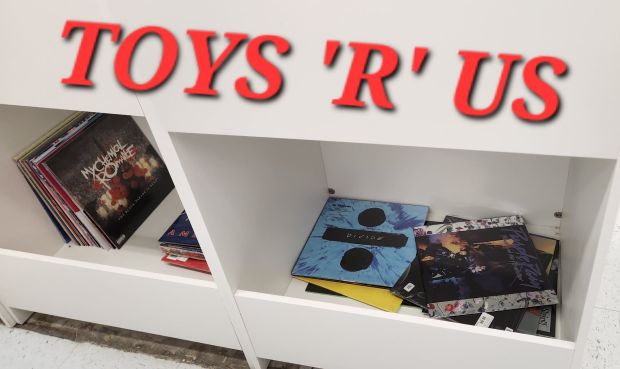
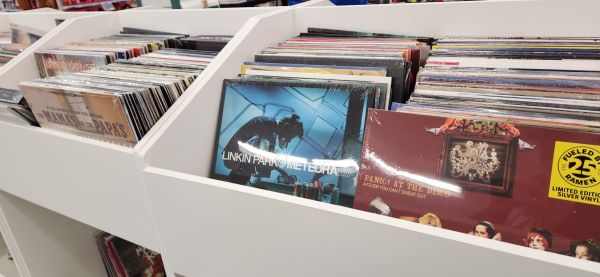
In another attempt to stay relevant as Hasbro drives their prices up and quality down, creating shelfwarming superheroes and Sith lords, Toys R Us is now stocking vinyl at their Kitchener location.

Last time I visited there, about a month ago, they were in the process of re-organizing.  Where the Lego and Hasbro products were, was becoming a book section.  Interesting!  Book stores haven’t done well in the area, with the short-lived Booksmarts closing a decade ago, across Wilson Ave from TRU.  Still, we must applaud any attempts to get kids reading books.  I didn’t have a look at the book section myself; nothing caught my eye.  What did catch my view was the familiar shape of white bins containing shrink-wrapped packages, 12″ by 12″.  Each one was different, boasting vibrant artwork.

They were not calendars.  They were records.  Vinyl had come to Toys R Us.

The first one I noticed was Prequelle by Ghost.  $25.  Not bad.  I picked it up in my eager hands.

I considered buying Ghost on vinyl at that price.  Oh, sure, I already own a CD copy with a lenticular cover and bonus tracks, but…vinyl, right?

I put it back.  Ghost are more of a car band for me.  I wouldn’t play the vinyl more than twice.  Decent price though.

Thinking of the bands aching to be collected on vinyl back at home, I looked for Kiss and Iron Maiden.  No Kiss; lots of The Killers though.  The albums were loosely organized.  Toys R Us doesn’t have a dedicated person for this section to keep things organized, and…ouch!!  What’s that?  A record was clumsily wedged between two rows, pulling the cover in two directions and creating an ugly crease.  I put the records back in rows, but this is why you need a dedicated person when you put a record store inside a toy store.

There were some interesting finds there.  Purple Rain on vinyl would be cool to have.  I chuckled when I saw a Linkin Park Meteora 2.0 box set.  Jen used to love Linkin Park.  I bought her the Linkin Park/Jay-Z album for Christmas when we were dating.

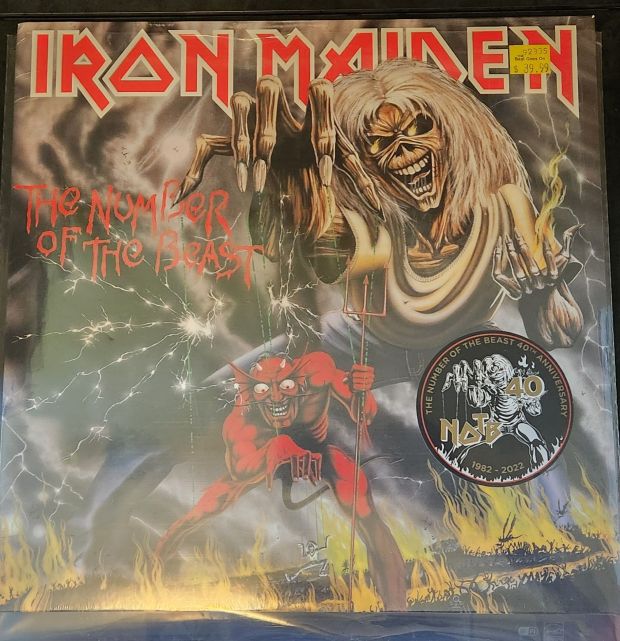
Over to Iron Maiden.  They had a decent selection – better than a lot of the local chain stores.  Several albums I needed on vinyl, and even the three-LP En Vivo set.  A-ha!  Number of the Beast.  I just got ripped off at The Beat Goes On with an overpriced copy a few weeks prior.  How does Toys R Us pricing compare?

Cheaper!  Four bucks cheaper!  Toys R Us had The Number of the Beast four bucks cheaper than the $40 copy I bought at The Beat Goes On across the street.  How can Toys R Us be beating The Beat Goes On, a dedicated music store, in prices?  According to friend Kevin, the record sections are actually little HMVs.  They also have one in St. Catharines.

“They really need to work on their merchandising,” said Chris Preston, who had copious notes on how to improve this situation.  “No genres whatsoever,” he added.  Chris also felt it was a big miss to not sell turntables or accessories with the records.

There was no signage, and the records were as much in order as you’d find at the local mall stores.  There were no letter groups – A, B, C, etc.  Many additional records were not displayed at all, and just shoved into a lower shelf.  That’s where I found Purple Rain.  They did have coloured vinyl and limited editions.  It wasn’t a bad little corporate record section, if it was properly cared for.

I questioned the wisdom of placing a record section in a store primarily occupied by running and screaming pairs of hands, right around record shelf height.  I dealt with this at a CD store, remember.  I think they’re gambling on the nerd factor.  Those people who are coming in for the newest Lego releases or collectible figures.  They’re hoping those people will also stop and buy a record.

“Nerds like records too now, right?”  You can imagine an executive asking that question in a boardroom, somewhere in a downtown metropolis where decisions such as these are made.

Considering three, briefly, I ended up not buying any.  I considered but dismissed Prequelle, and also Somewhere In Time and Powerslave by Iron Maiden.  The prices were a little high for Maiden albums that I remember being stocked at $10 or less at the downtown Sam the Record Man in 1989.  Incidentally, Toys R Us had Powerslave cheaper than Amazon at the exact same time, also by about four bucks.

What does it mean when Toys R Us stores are stocking vinyl in a makeshift music section, but no other formats like CD or cassette?

I think this means we have hit peak vinyl.  HMV is dumping their stock in these micro-locations, because they have too much.  I’ve seen it before.  We did similar things when we had too many CDs in our warehouse.  The Boss Man tried moving them in bulk to a micro-location.  That was one of many schemes that I remember.

I do look forward to buying at least one record at Toys R Us in the future.  I’ll keep the price tag on forever, just to prove it happened.

My overpriced Beast vinyl from The Beat Goes On.  I wonder how the old Boss Man feels about another chain inching in on his territory, with cheaper prices?

#1118: I Wonder…

RECORD STORE TALES #1118: I Wonder…

I recently enjoyed a trip to Burlington Ontario, a place I have not been since the early 2000s working at the Record Store.

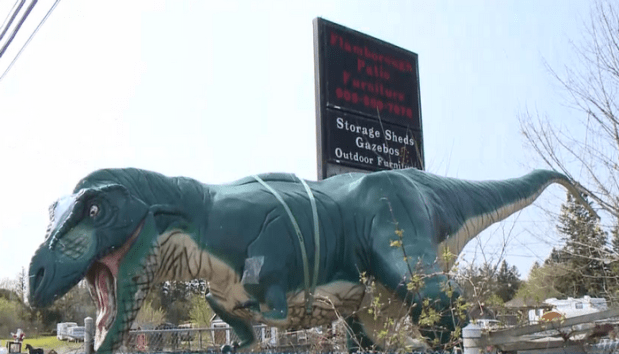
Driving down Highway 6, I wondered, is that place with the funky dinosaurs on the front lawn still in business?  I remember they had a T-Rex with a missing head.  And yes!  That business, Flamborough Patio Furniture, is still there and still has the T-Rex.  They even fixed the decapitation damage.  I was impressed.

A lot of other businesses didn’t make it.  There was Grasshopper Imports, a weed accessory shop with a tie-dye pattern on its walls.  It almost survived the last 20 years, but is now closed and for sale.

I wonder what else changed since my last trip to Burlington, in the world of the Record Store?

Do they still force their employees to drive down Highway 6 to manage two stores in the winter time, with cars that are barely snow-worthy, like they did to me?  I remember asking them, “When you do plan on hiring a full time manager for that store?  I’m concerned about the drive in the winter.”  Without sympathy, I was told “other people have to do that drive too.”  Yeah, maybe, but I had my own store to manage in Kitchener.  Driving to Oakville every day at Christmas time wasn’t what I was hired to do.

Do they pay mileage, or make employees wait months, like I did?

Do people still come in daily with hundreds of CDs to sell?  Or has vinyl taken over once again?

Do they still have a TV in that Burlington store to show movies?  Does that guy who was roommates with Scott Anderson from Finger 11 still work there?  I’m guessing no, to both.

I’m just glad the dinosaurs still live.  It’s comforting to know that T-Rex has his head back.


REVIEW: Joe Satriani – Surfing With the Alien (1987, 1999 remaster, 2017 RSD 2 LP reissue)

JOE SATRIANI  – Surfing With the Alien (1987, 1999 Sony remaster, 2017 RSD Epic 2 LP reissue)

On October 15 1987, the face of rock music was  shaken when a little instrumental album called Surfing With the Alien started making waves.  The record eventually went platinum, and its songs found itself used on radio and TV for decades to come.  Why?  Possibly because of Joe’s impeccable attention to songwriting.  Though his guitar playing put him on the map, it was his knack for writing catchy rock songs that made this album so special.  Satriani’s songs are written as if the lead guitar is the lead singer.  There are verses and choruses, and attention to structure and melody.  That must be why Surfing With the Alien was nominated for two Grammys in 1988.

Opening with the title track, a striking little chugging riff starts the show.  But then Joe’s melodic lead guitar kicks in, and you realize it’s exactly like if a singer was leading the show!  You can literally sing along to Joe’s guitar and a little wah-wah effect doesn’t hurt.  And then the shred begins, and you feel like, “OK, I get it now.  This guy is an actual genius.”

Yet it’s all accessible.  He may throw in licks as fast as greased lightning, but you can still follow.  Your brain still picks out notes and melodies that satisfy those musical needs.

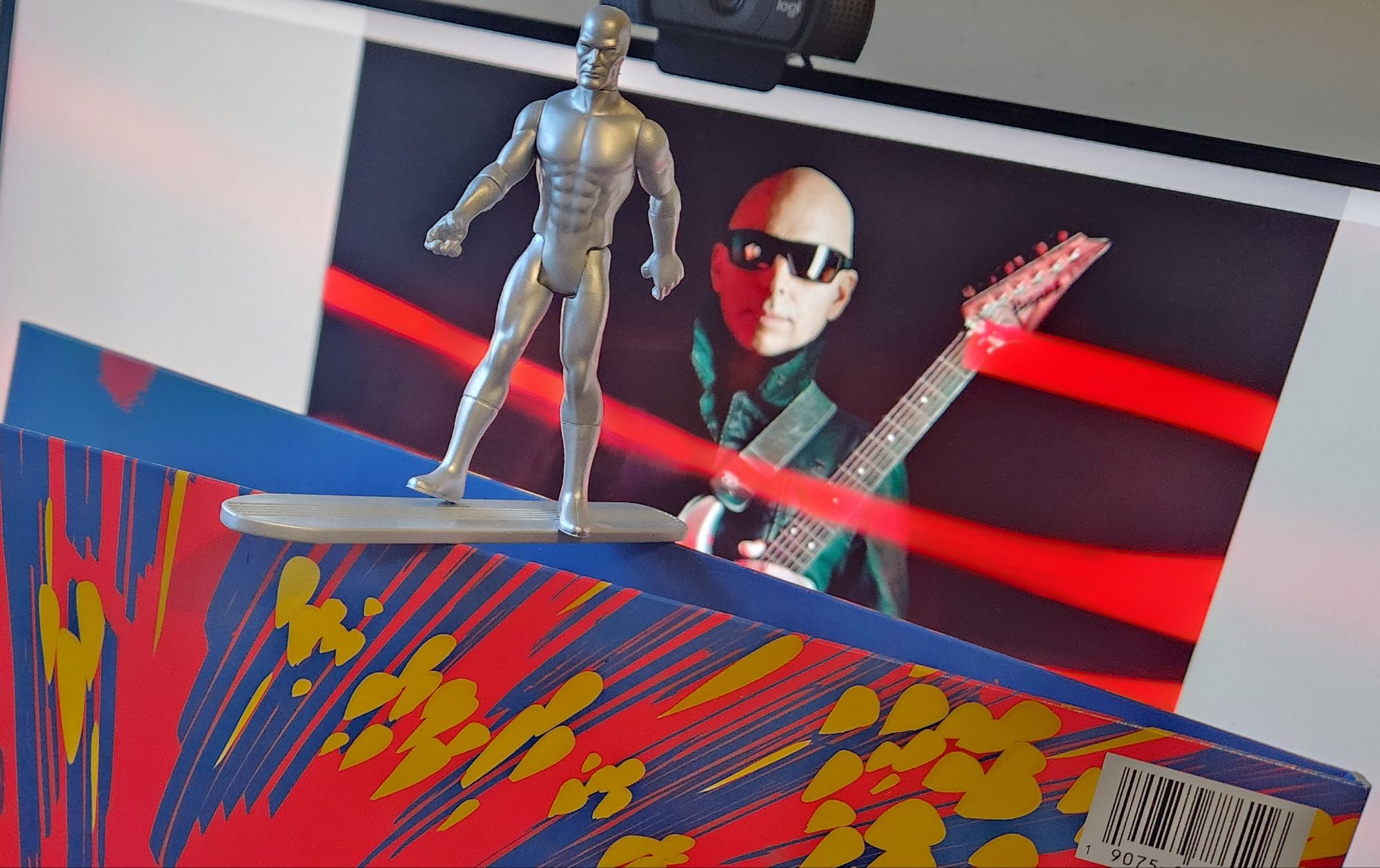
The cool “Ice 9” is a funky groove (Joe on bass) with a slick melody on top.  Joe can work with mid-tempo grooves just as well as high-speed blazes.  Solos with different sounds and guitar tones add diversity.  A fun tune, but the third song “Crushing Day” has more tension and urgency as the tempo is turned up once again.  The variety of solos, melodies and riffs in one short song is quite remarkable.  Joe’s guitar tone is bright and shimmery, like the Silver Surfer himself.

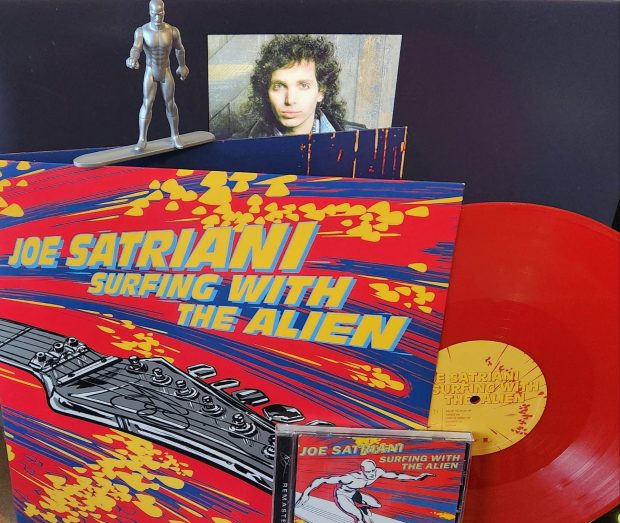
Incidentally, regarding the striking album cover featuring the titular Marvel character from Silver Surfer #1 (1982), Joe lost the licensing for him at some point in the 2000’s.  This is why the 2017 RSD reissue has different artwork, without him.  (Look carefully at the new art, and you will see that they replaced the yellow streaks with yellow guitar picks!)  Hopefully Joe doesn’t feel too badly about losing the Surfer art.  Marvel comics repaid him for the popularisation of the character outside the comic world by naming a planet after him.

The beautiful ballad “Always With Me, Always With You” might be considered the most famous song.  It received three Grammy nominations in three separate years (live versions, you see) and was prominently featured in an American Dad episode.  It is hard to describe exactly what makes it so special, without you listening for yourself.  The guitar is lyrical and memorable, and it worked so much better than it would have with a lead vocal.  This is an instrumental ballad, made magical.

“Satch Boogie” is arguably just as popular.  Deep Purple played it during the brief period when Joe Satriani was in the band post-Blackmore and pre-Morse.  It has been used on TV, radio and video games.  It is indeed a boogie!  It taps into the Van Halen vibe a-la “Hot For Teacher”, but burns straight through without stopping to talk.  Mid-song, there’s a jaw-dropping solo that is pure tapping nirvana.

An ominous and brief interlude (“Hill of the Skull”) paints an apocalyptic picture.  The programmed drums don’t detract, as it is all about the tale that the guitar is telling, with layered wails.  This serves to set up “Circles”, one of the most interesting tracks.  Echo is employed to great effect on this mellow but dark ballad.  Without pause, the striking chimes of “Lords of Karma” enter the picture, a pounding guitar rocker with drums by Jeff Campitelli.  (Drums on this album are a mix of live and programmed.)  Much like “Crushing Day”, “Lords of Karma” is a bit faster and more intense.

A lovely classical sounding interlude called “Midnight” sets up the final track.  “Midnight” features techniques that an expert will have to identify, except to say it sounds remarkable and innovative.  The spotlight is never really on Joe’s fingers though – just on the notes and sounds he magically produces with them (and an array of effects).  Then the thud of bass opens “Echo”, the last song on this important album.  It’s unlike the previous ones, with the bass so prominent.  The song sounds as if it’s always just bubbling under.  Perhaps it would come as a surprise that the final song on this album of guitar showcases is so much about feel and restraint.

That’s one thing about Surfing that does make it special.  Like any good album, it is sequenced as a full listen, not as a collection of shreds.  Even without the shreds, it’s still not bad.

That’s what the 2017 Record Store Day deluxe vinyl edition is all about.  A bonus LP is included, with all the lead guitar stripped off.  This allows you, the ambitious home player, to try to solo over the bed tracks.  For the rest of us, it just allows us to listen a little bit differently to an album that is very familiar.

The drums seem more prominent on the title track, allowing us to better hear Jeff Campitelli’s fills.  Mostly though, you can still bang your head, and maybe sing along to an imaginary vocal melody.  “Ice 9” is particularly fun in this guise, sounding a bit like an “80s dance remix” even though it’s not.  “Always With Me, Always With You” is still delicate and beautiful.  You get the picture.  These tracks, though needing the lead guitar to be whole, are perfectly listenable without.  Only “Circles” and “Midnight” seem completely barren.  You don’t have to be a guitar player to enjoy this bonus record.  You just have to be interested in music, and how it is constructed in the mix.  You can hear melodies and accents, even on “Always With Me”, that you might have missed on the album version all these years!

There are many ways to acquire copies of this impactful album, that opened the charts to Steve Vai and others a few years later.  There is a 1999 Sony remaster with liner notes and nice packaging.  There is a deluxe edition with a live DVD from the 1988 Montreux Jazz Festival.  The version with the most actual audio tracks, however, is the limited 2017 Record Store Day reissue.  You don’t get the lovely Silver Surfer artwork, but you do get the bonus record of stripped tracks, and red & yellow coloured vinyl.

No matter what choice you make, Surfing With the Alien in any form is an essential addition to a serious rock fan’s collection.  Some may argue it’s the best rock instrumental guitar album ever made.

5/5 stars


What’s Good? With D’Arcy Briggs – Music, Unboxing and More

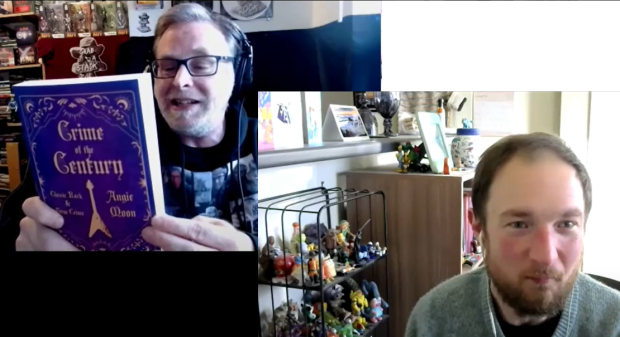
I was so pleased to be able to collaborate with YouTuber D’Arcy Briggs. He has a great channel all about physical media and music, and my favourite new feature of his is called “What’s Good”.  It’s just him and a guest literally talking about whatever’s fresh and good that they want to share.  This is only the second episode of “What’s Good”, following the debut with Jex Russell!

For me, I had three unboxings and a Gene Simmons set to show.  The unboxings are brand new and exclusive to this show!   This is the first reveal of these treasures to come into my collection.

D’Arcy had some cool stuff included new music by Jack Antonoff, jazz rock fusion, the complete English Beat, some vinyl, and a parcel from Ontario!  We took four turns each but you’ll have to watch the show to see what we brought.

One of the items I was proud to show was my autographed copy of Angie Moon’s first book, Crime of the Century.  You can find out more and buy your copy by clicking this link. crazyonclassicrock.com/buy-crime-of-the-century

Crime of the Century is an original book idea about the connections between classic rock and roll and true crimes!  Some are less known than others.  The Band and Jack Ruby?  The Kink and John Wayne Gacy?  DEVO and John Hinkley Jr.?  I didn’t know any of this before.  I can’t wait to dig in and talk to Angie on Grab A Stack of Rock.  She came from right here in the WordPress community and it’s awesome to see her out with her first book!

Check out the episode below, and subscribe to D’Arcy’s channel if you already haven’t!


REVIEW: Tony MacAlpine – Edge of Insanity (1985 Shrapnel)

TONY MacALPINE – Edge of Insanity (1985 Shrapel)

Tony MacAlpine seemed to be in every guitar magazine when I was a kid, but I never got to hear his music. He looked cool, and he was highly praised as a shredder, but his music (on Shrapnel records) was impossible to find unless you ordered it from a specialty shop.  Like most of Shrapnel’s output, it was produced by Mike Varney.

His 1985 solo album Edge of Insanity features an impressive band:  Journey’s Steve Smith on drums, and of course it’s common knowledge that Billy Sheehan played bass.  The album is instrumental.

Opener “Wheel of Fortune” has a neoclassical vibe, with the rapid fire bassline enabling MacAlpine to focus on the melody rather than shred his way throughout.  There is certainly a commonality in terms of musical direction with Yngwie, but Tony’s approach is more easily digested.  Tony’s music has an actual bottom end thanks to Billy, and of course Steve Smith’s technique speaks for itself.  He’s more than capable of heavy metal hammering as he does on “Wheel”, but listen carefully and you will hear his signature cymbal work, so unique to me.

“The Stranger” discards some of the neoclassical robes, and rocks a more straight-ahead blitz.  Tony has a wicked keyboard solo mid-song, showing the breadth of his abilities.  The pulse of the song is all Sheehan, and Smith’s fills sound a lot like a certain band that started with a “J”.

A live solo called “Quarter to Midnight” is unaccompanied.  It reminds me of a Randy Rhoads solo.  There’s some nice whammy work near the end, which was so popular in the era.

A ballady song called “Angrionia” (mis-printed on the back cover, but correctly in the booklet) follows; quite a nice little tune with the occasional bursts of neoclassical guitar speed.  Billy has a couple nice rips as well.  MacAlpine multitracks his guitars for effect.

“Empire in the Sky” has a very cool keyboard intro, that leads into a gallopy metal number.  This has a mid-tempo vibe like Maiden circa Seventh Son when keyboards were happening.  You could imagine this coming from that era, though of course Tony was three years ahead.  His doubletracked leads set it apart from that, and there are some chunky riff chords happening beneath, though this is not a riff album.  There’s also some outro guitar twangin’ that is absolutely freakin’ rib-shattering.

An Yngwie vibe pervades “The Witch and the Priest”.  You hate to make comparisons, and it seems lazy, but when you hear a vibe there might be something to it.  Of course, Billy Sheehan and Steve Smith help make it sound less Yngwie.  Tony’s tone is warmer than the Swedish shredder’s as well.

“The Taker” is the only song with Tony playing bass and it’s less prominent for that reason.  This tune is a full-speed blaze, with Tony deftly weaving melody through all his playing, and then suddenly taking a left turn with harpsichord-like keys and then some organ for good measure!  “The Taker” keeps you on your toes.

Tony treats us to actual classical music next:  his spin on Chopin.  “Prelude 16, Opus 28” is performed on piano, and you’d never guess it wasn’t from a professional classical pianist.  This prelude leads into Tony’s “Edge of Insanity”, a deep cut title track and one that allows the chug-chug-chug of the metal to come through.  There’s still a soaring melody and flying bassline to absorb.  Smith’s drum parts are smashing – literally.  A great tune and a little easier to digest than the speedier stuff.

“The Raven” has classical keys opening a speedy metal rollercoaster ride.  Once again, Smith is classing up the place several notches with his signature fills.  Tony rarely lets up, constantly treating the listener to impressive shred.  He switches tones (and probably guitars) at some points, giving the lead work different voices.

The closing track, “No Place in Time” has some slinky Billy bass, and really allows him to have some of the spotlight.  His playing here is all about the groove he’s laying down, and how he complements Tony’s lead.  MacAlpine uses doubletracked guitars and plays a slow melody.  It’s not the most memorable track, and not the most effective closer.

Edge of Insanity is more accessible than a lot of instrumental guitar albums of the era.  If some of those other artists seem daunting but you’d still like a taste of neoclassic rock, then go for some Tony MacAlpine.

3.5/5 stars