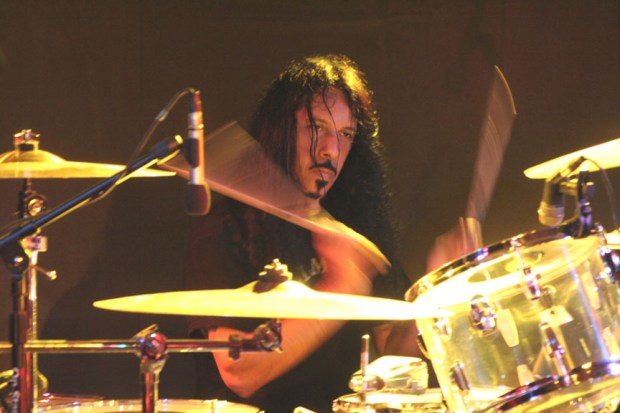
After a 16 month battle with pancreatic cancer, Frankie Banali has passed away.
His best album, W.A.S.P.’s The Headless Children, will always be a cornerstone of this collection. Metal Health was the first hard rock album I ever acquired and it changed my life for good. To say Frankie was dedicated would be an understatement. His dedication led to a rejuvenated Quiet Riot and some excellent albums with James Durbin on vocals. Against the odds, Banali silenced the critics, myself included.
One of the hardest hitters in rock, Banali has an extensive resume including Hughes/Thrall, Heavy Bones and Faster Pussycat. He was one of those drummers you could identify just by his snare sound. A true original.
Now Frankie rides the wind, forever free. Rest in peace.
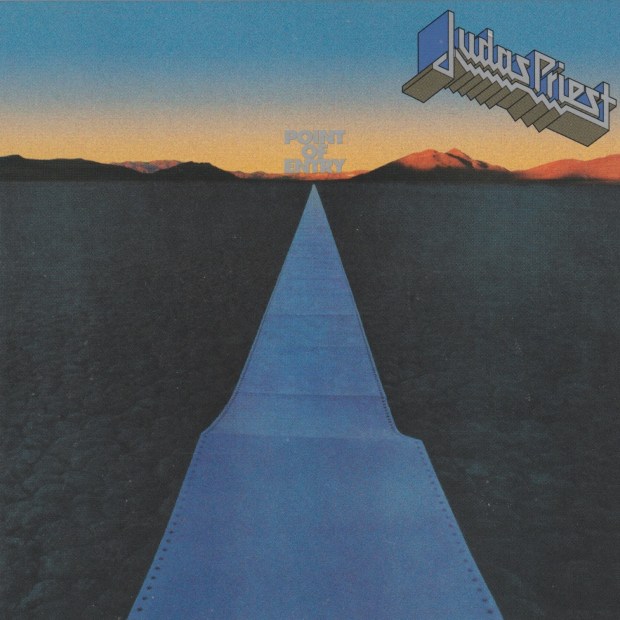
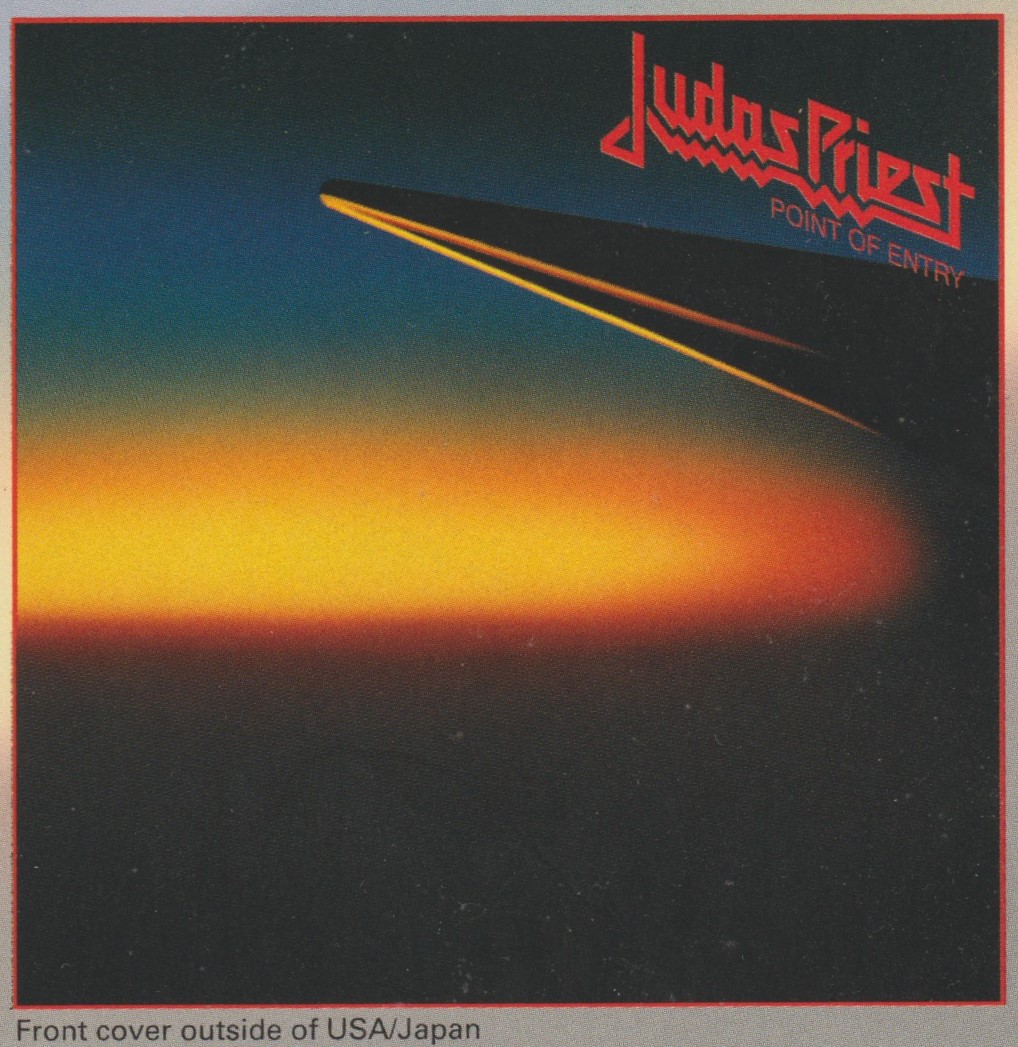
JUDAS PRIEST – Point of Entry (1981, 2001 Sony remaster)
Point of Entry will always be one of those “other” Judas Priest albums. It wasn’t a ground breaker and wasn’t a massive seller. It will always just be “the album that came after British Steel” or “the one that came before Screaming for Vengeance“. It did fine (500,000 US sales) and spawned a killer single called “Heading Out to the Highway”, but it didn’t make history like the other two records.
Coming after British Steel, Priest continued with producer Tom Allom and drummer Dave Holland, and it doesn’t sound like they were overly interested in taking chances. Sonically Point of Entry is a carbon copy, though with less impactful songs. In 2001, it was issued remastered by Sony with two bonus tracks.
For me, Point of Entry occupies an interesting space. Listening to it on a recent road trip took me back to 1987 or 88, when I was in the midst of seriously trying to collect “all the Priest”. From the perspective of a kid in 1988, Point of Entry was what I thought 1981 must have sounded like, though it wasn’t that long before. So Point of Entry takes me back not to the early 80s, but the late 80s. And in the late 80s, it sounded good.
Sure, I was aware that it sounded a lot like British Steel before, but without the massive landmark tracks like “Metal Gods”. But what about “Desert Plains”? Why wasn’t it as important as “Metal Gods”?
To this day, I don’t know.
Point of Entry does boast a few songs that could go toe-to-toe with any on British Steel. Certainly “Desert Plains” and “Heading Out to the Highway” can stand up to the prior album. “Highway” has one of those riffs so classic that I sometimes find myself humming it in a grocery line wondering what song was in my head. As a mid-tempo road song, it does the job. One could argue it’s just a sequel to “Living After Midnight”, but you just try and resist this one.
“Heading Out to the Highway” was made into an unintentionally funny video, mixing on-set with on-location footage in an obvious way. Worse though were the two videos that followed: “Don’t Go” and “Hot Rockin'”. “Don’t Go” features the band playing trapped inside a small room, with a door that leads various impossible locations including outer space. Fortunately the song is better: slow and plaintive, yet with that solid rocking beat and a killer guitar solo. “Hot Rockin'” is high-speed but tends to be forgotten because Priest have better material at this tempo. The video is situated in a sauna, and then a concert stage where Rob’s flaming feet light fire to his microphone, and the microphone to a couple guitars. Funny to look at, but I think it’s one of those cases where we’re laughing at the band, not with them.
“Turning Circles”, and a lot of the rest of the album, fall into various categories. This one fits alongside “Don’t Go” as a slow but hard track. “We’ve all got somethin’ wrong to say,” sings Rob in this song that seems to be about ending a relationship. The “ah ha, ah ha” break in the middle is an album highlight, and to me it sounds exactly like my bedroom in 1987.
It’s “Desert Plains” that really brings it home. There is a pulse to this song, created by Dave Holland and Ian Hill. You don’t associate those two guys with awesome rock beats often, but here it is. “Desert Plains” is an instant classic, and it’s alive with movement. From the verses, to the choruses, to Holland’s drum “sound effects” (like “wild mountain thunder”), this is a Priest classic and shall forever remain so. This side one closer should have been a video way before “Hot Rockin'”.
The second side opens with “Solar Angels”, another track with an interesting rhythm (slow drums, fast guitar chug). The song feels like it could use some more substance, but it’s still enjoyable albeit in a “Metal Gods” knock-off kind of way. Though heaviness is always celebrated, who doesn’t enjoy when Rob Halford gets sassy? That’s “You Say Yes”, an outstanding shoulda-been hit. The verses verge on punk rock as Rob spits out the words as only he can. Then the airy “what I do, what I do, what I do” middle section goes right to heaven — or my room in ’87, I’m not sure which.
Point of Entry ends on three decent but unremarkable mid-tempo tracks, which perhaps always served to weaken the album’s impressions. “All the Way” might be an attempt to rewrite “Living After Midnight”, and although it’s a cool track we all know Priest have better stuff in this vein. “Troubleshooter” might even be more of a rewrite, with that opening drum beat sounding a little familiar. But Rob’s vocals kill it. Finally “On the Run” is a screamy album closer where Rob is once again the star.
As with previous CDs in this Priest remasters series, there are two bonus tracks, one of which has nothing to do with Point of Entry. “Thunder Road” sounds a lot like Ram It Down era Priest, so you can safely assume it’s from those sessions in the late 80s. Clearly outtake quality, almost like a prototype for “Johnny B Goode”. Then there is a live version of “Desert Plains” from what sounds like the 1987 tour judging by the big echoey drums and Rob’s added screams. It’s much faster than the album cut, all but destroying the pulse of the original. Yet the song still kills! Somehow it didn’t make it onto the Priest…Live! album, which was already stuffed full.
In the late 90s, a guy sold a used copy of this on CD to me, but he left something inside. Something I wish I’d kept because it was so bizarre and funny. The back cover features five white boxes in the desert. The guy left a little white piece of note paper inside, explaining what he thought the back cover was about. “Maybe they are graves,” said part of it. I wish I could remember the rest. (I always thought the five boxes represented the five band members, with the large one in the back being Dave Holland and the drum kit.) And speaking of the cover, this album does look better on vinyl. I have vinyl for almost all the Priest up to Ram It Down, and they all look better on vinyl.
Although Point of Entry will always live in the shadows of the towering albums that came before and after, it still leaves a glow behind.
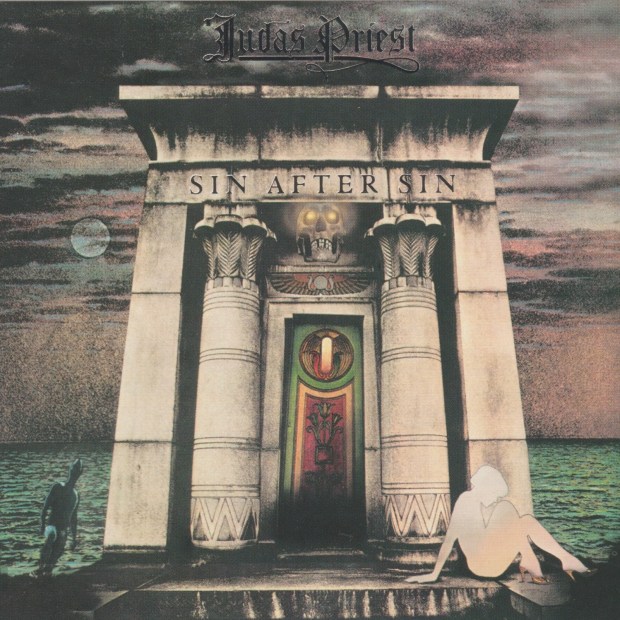
JUDAS PRIEST – Sin After Sin (Originally 1977, 2001 Sony reissue)
“SIN AFTER SIN, I have endured, but the wounds I bear are the wounds of love.”
This lyric from “Genocide” on 1976’s Sad Wings of Destiny would have been little more than a throwaway, if Priest didn’t recycle the words “sin after sin” for their next album title. Though the song may have appeared to be the same, much had actually changed. For the first time, they had a producer that understood that kind of aggressive rock that the young band were trying to create: Roger Glover, ex-Deep Purple, who had already recorded several albums for Elf, Ian Gillan and Nazareth. Perhaps even more significantly, for the first time they had a serious drummer creating the beats: the not-yet-legendary Simon Phillips, who had still already played on a Jack Bruce album. This was just a session for Phillips, but it enabled Priest to break the shackles of rhythm and really start exploring.
Opener “Sinner” might have been the same kind of tempos that Priest were working with before, but there is a new slickness to the drums; an effortless drive with increasingly interesting accents. With a solid backing, Priest sound more vicious. “Demonic vultures stalking, drawn by the smell of war and pain.” The apocalypse has never sounded cooler. As Phillips drops sonic bombs left and right, KK Downing goes to town on what would become his live showcase solo. His growls and trills sound like a beast inflicting wounds on a struggling combatant. At almost seven minutes, “Sinner” is the album epic, and it’s the opening track!
Priest previously recorded a cover of Joan Baez’ “Diamonds and Rust” for Gull records; that early version can be acquired on The Best of Judas Priest or Hero, Hero. The Glover-produced track is the more famous and better of the two. Radio play for “Diamonds and Rust” helped push the album to eventually sell 500,000 copies. Rob Halford’s high pitched harmonies gleam like polished silver.
Ironic observation: I hope by now we all know a light year is a measurement of distance, not time. It is the amount of distance that light can travel in one year (9.46 trillion kilometres). So, really really far. Joan Baez playfully used it as a melodramatic measure of time in “Diamonds and Rust”. (“A couple of light years ago”.) On the next track “Starbreaker”, Halford refers to “light year miles away”, a crudely worded hyperbole for distance. So with Sin After Sin, you get it both ways. Regardless of scientific accuracy (or not) “Starbreaker” is a good track with a slightly flat riff. Though Phillips is brilliant, it could just use a little more pep.
Like with Sad Wings of Destiny, you gotta have a ballad in there somewhere, and on side one that’s “Last Rose of Summer”. This softie isn’t bad, though Priest have done and will do better. Using a ballad to close a side isn’t always wise either, but on CD nobody really notices except us nerds.
“Let Us Prey/Call For the Priest” is a pretty epic side two opener, with harmony guitars playing an opening instrumental anthem. Then a choir of Halfords joins in, and the band break in to what could be their fastest song yet. From the wickedly fast dual guitar solos to the powerful rhythm, this song is a blitzkrieg of metal trademarks. It’s relentless and all over the board, something that 80s Priest rarely was.
Side two keeps getting better with the groove of “Raw Deal”, which was Rob’s real “coming out” to fans in the know. Today he calls it a “heavy metal gay rights song”. It’s actually one of Halford’s best lyrics. Instead of mashing together science fiction words and singing about battlefields, this time Halford paints a hazy picture of what is probably a gay club in Fire Island, New York. It’s vivid but vague: “The mirror on the wall was collecting and reflecting, all the heavy bodies ducking, stealing eager for some action.” It’s also backed by some seriously cool Priest music, almost funky but always heavy. “The true free expression I demand is human rights – right?” It was all there in the lyrics all along.
A second ballad, the dirge “Here Comes the Tears” brings a cloudier mood. An ode to loneliness, “Here Comes the Tears” is the one to play when you just can’t take it anymore. When Halford starts givin’ ‘er at the end with the wildest screams in history, it sounds like an exorcism. The guitars howl, a hint of piano can be heard, and there is an underlying choir of Robs singing sadly in unison. Finally “Dissident Aggressor”, famously covered by Slayer, concludes the album on a violently fast note. “Stab! Fall! Punch! Crawl!” This song is not for amateurs and might be the heaviest thing Priest have ever done. There are plenty of contenders, but “Dissident Aggressor” must be in the Top Five Heaviest Priest Songs Ever. But that being said, they still have the balls to end the song with another multi-layered harmony of Halfords.
The 2001 Sony remastered CD has two bonus tracks, and the first is the best in the entire series: “Race With the Devil”, a cover of a track by The Gun. This version, recorded for the next album Stained Class (Les Binks on drums) could easily have been a B-side all this time. Why it went unreleased until 2001 is unknown. Perhaps it was lost, but now that it has gotten a proper mastering job it is available on CD. This is un-retouched, which cannot be said for other unreleased tracks in the Priest Remasters series. “Run With the Devil” is raw, riffy, fast, and wicked. All it really needed to make it album quality is a better guitar solo. The second bonus track is a live “Jawbreaker” (Dave Holland on drums) from the Defenders of the Faith tour. Out of place, but an excellent song regardless.
Incidentally, Sin After Sin is the last album before Priest adopted the first version of their current logo design.
I was listening to Sad Wings of Destiny recently and wrote up a brand new review before realizing I already reviewed it. Fortunately, I had lots more to say. For my original 2015 review,click here.
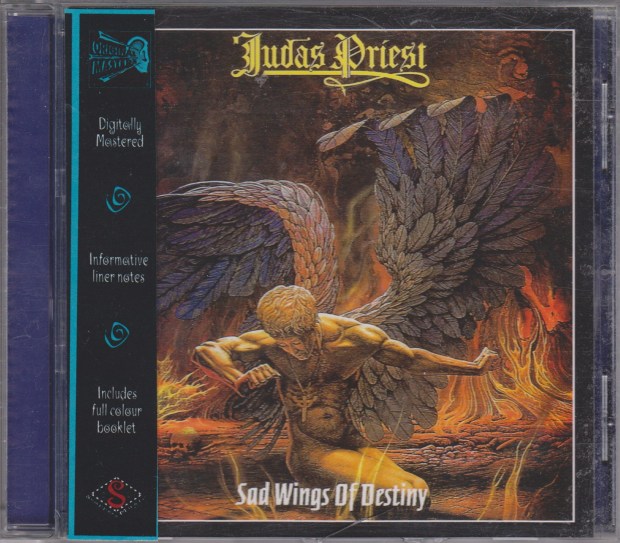
JUDAS PRIEST – Sad Wings of Destiny (1976 Gull, 1998 Snapper Music)
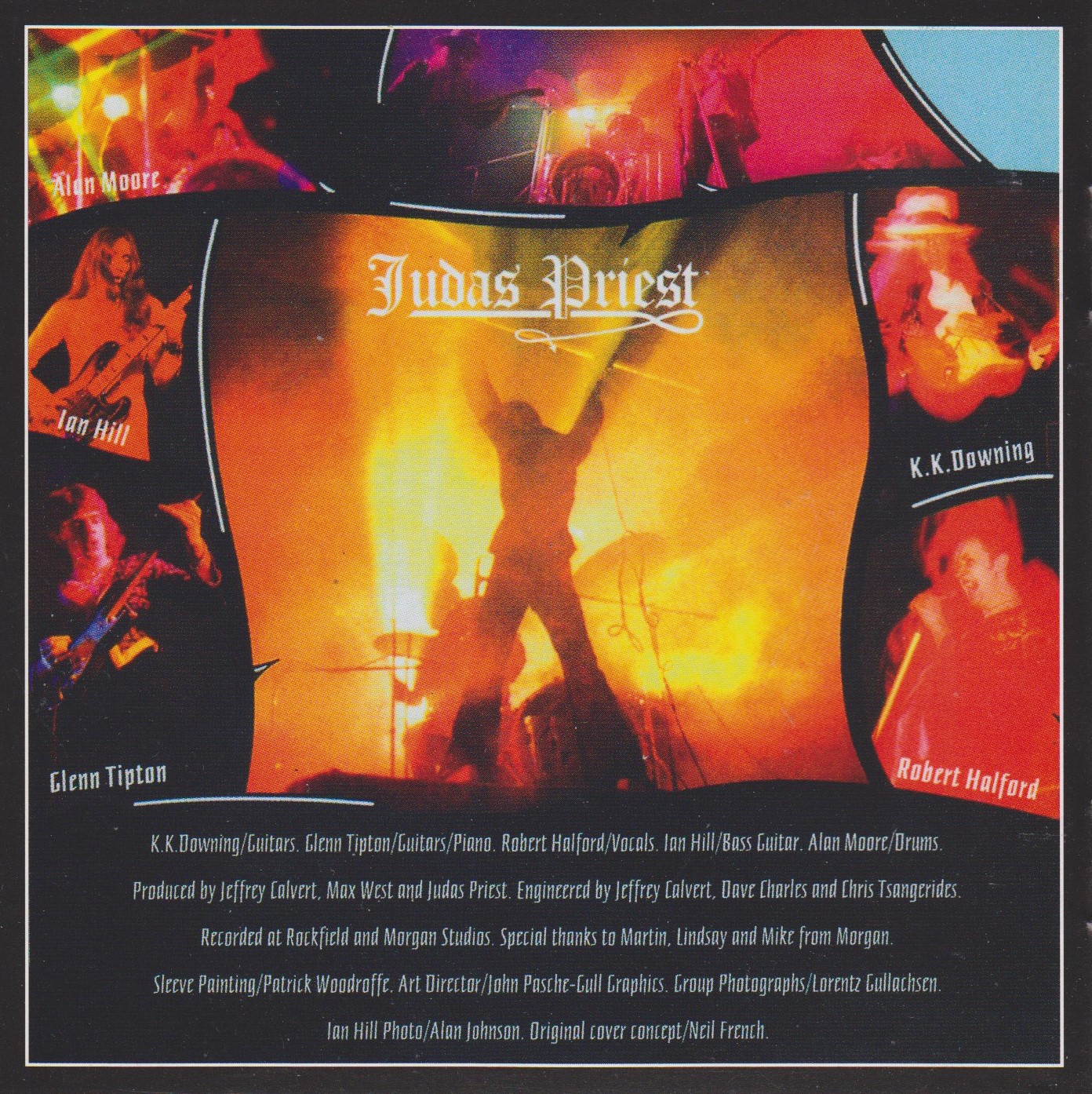
1974’s Rocka Rolla didn’t set the world on fire, so back to the drawing board for album #2. Having rid themselves of most of their early bluesy material, Judas Priest went heavier, and more diverse simultaneously. The resulting album, 1976’s Sad Wings of Destiny, is considered an early classic by the band. Some feel they rarely reached these heights again as they took their metal more mainstream in the 80s.
“Victim of Changes”, which opens the album, introduced the world to the high notes that Rob Halford was able to hit. “Whiskey woman don’t you know that you are driving me insaaaaaaaaaaaaaane!” Yet that note is nothing compared with Rob’s final shrieks. This track combines an earlier unreleased Priest song titled “Whiskey Woman” written by original singer Al Atkins with a track called “Red Light Lady” brought in by Halford from his old band Hiroshima. You can hear the moment the two songs are welded together at around the 4:45 mark. Together at almost eight minutes they form a complex, classic Priest track that represents a high water mark. Twisting from a metal groove into ballady territor-y and back again, this is drama the way Priest do it. And they never do it better.
“The Ripper” boasts similar high notes but it’s almost a parody. This riff-based shorty (2:51) is from the perspective of Jack the Ripper (or if you like, Jack the Knife). With a galloping beat from new drummer Alan Moore (who was eventually replaced by the far superior Les Binks), “The Ripper” is as metal as things got in 1976. Its placement as second track is perfect because the next two, “Dreamer Deceiver” and “Deceiver” form a single 8:34 epic. “Dreamer Deceiver”, which forms the majority of the song, is an epic ballad about a supernatural being who tempts those below.
“Saw a figure floating, ‘neath the willow trees. Asked us if we were happy, we said we didn’t know. Took us by the hand and up we go.”
They follow the dreamer through the purple hazy clouds into the cosmos. The intricate acoustic guitars let Rob Halford dominate with his story. Though the track is haunting, it seems the people in the song find “complete contentment” and live without worries. But as the song builds, adding piano, Rob’s vocals become more urgent (and high). Though it seems like a heavenly paradise, the second part “Deceiver” changes the mood considerably.
“Solar winds are blowing, neutron star controlling. All is lost, doomed and tossed, at what cost forever?”
There is always a price when temptations seem too good to be true. This song brings another heavy gallop, the kind which Iron Maiden would later perfect. Solos blast, as Halford warns us all of the “Deceiver”! This is the kind of metal that people associate with Judas Priest, though its’ far more impressive if you consider it part of a larger composition.
Side one can be viewed as just three songs: two epics and a hard rocker. Side two has more to offer, though it opens in epic enough quality. Glenn Tipton’s piano piece “Prelude” is foreboding. As a Sabbath-like instrumental, it serves to set the scene for “Tyrant” (though “Tyrant” is always performed live without “Prelude”). Overdubbed vocals make for a cool chorus, but this one is just a molten metal burner. It wastes no time in laying waste, with guitar solos galore, in both single and dual formations.
“Genocide” is a slower, cooler groove that doesn’t seem to match its violent title. But this is from the perspective of a survivor. “Save me, my people have died, total genocide.” This is the song that gave us the next album title, Sin After Sin: “Sin after sin, I have endured, but the wounds I bear are the wounds of love.” Cool track and a necessary one to give the album balance. Songs of this tempo and style would make up the bulk for Priest albums in the future, yet it’s not simple or blockheaded like some 80s Priest tended to be. It retains some complexity and traverses multiple musical landscapes through its length.
Next: a complete left turn. “Epitaph” (written by Tipton) is a piano-based funeral dirge that sounds a heck of a lot like Queen. It’s beautiful though. With Halford’s vocals layered as a choir, it’s a daring change of pace even though Queen were pretty much the biggest band in the world in 1976.
“Epitaph” fades directly into the final track “Island of Domination”, another metal chug but with an apocalyptic bent. Rob’s lyrics are unusually styled with archaic sounding lines like “‘Twas as if all hell had broke loose on this night.” This could be Rob’s first BDSM-themed song with lines like “Lashings of strappings with beatings competing to win.” If not, then it’s just a brutal battle set to the tune of speedy Priest metal.
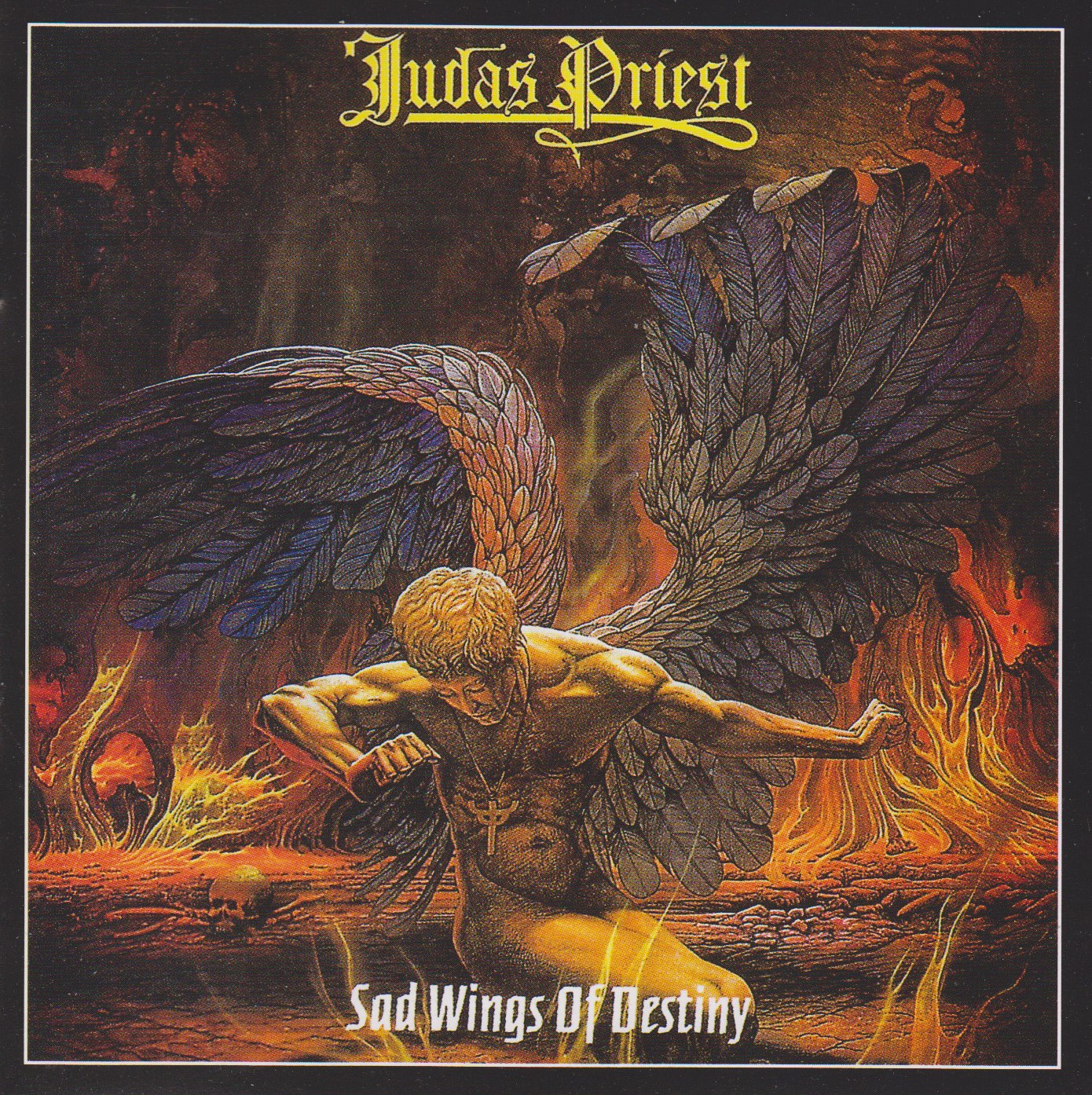
It must be said that Sad Wings has a striking album cover, with the angel depicted burning in hell. School teachers worldwide would have loved this cover back in 1976. The angel character would return 14 years later as the Painkilller. The “devil’s tuning fork” necklace that the angel is wearing would become Priest’s symbol on later albums as well.
Though Sad Wings is an essential album for a serious metal collection, and stuffed full with riff after riff of majesty, it is frustrating hard to find good versions on CD. Priest’s albums on Gull records have never been officially reissued by the band. The 1998 CD release by Snapper music is usually rated fairly well. If you’re unsure then get an original Gull vinyl copy. But do get Sad Wings of Destiny and prepare to hear a young, vital and daring Judas Priest just beginning to learn what they can do.
Strange Animal was only Lawrence Gowan’s second solo album, and one of his best sellers. It’s also one of his most dated sounding, with programming and production honed in on the 1980s. Regardless, you can’t knock the musicians: Tony Levin (bass/Chapman Stick), Jerry Marotta (drums), and Chris Jarrett & David Rhodes (guitars). Gowan basically lifted his studio band from Peter Gabriel.
Opener “Cosmetics” was a single, though just shy of cracking the Top 40. It’s terribly dated sounding, with that wretched brittle synthetic sound that even Queen resorted to at one point. So you might love it! The piano is delectable and Gowan is as smooth as pie. “Desperate” is darker, but I sure do hate synth hand-claps! Fortunately this is a great song, akin to 80s Phil Collins. Another really smooth one is “City of the Angels”, like a waltz at midnight. Progressive rock invades “Walking on Air”, which lightly tip-toes from gentle rock to more aggressive guitars.
A delicate but powerful “Burning Torches of Hope” sits right at the middle of the album, and it is so very 80s. Levin makes some animalist noise on “Keep the Tension On”, which sounds much like its title. Taut, powerful, and even heavy in a certain way. It’s melds right into a march on “Guerilla Soldier”, a killer song with terrific verse hooks. Massive song! It feels like this album builds to a close. Especially when you consider the last two songs.
Finally, at the end of the album comes the familiar hits. First: a huge Chapman Stick groove, on the poppy upbeat title track. “Strange Animal” is an awesome song: strictly fun, and incredibly so! The melody stays in your head for days, and you’re hooked. Ominous spiritus, ahh! And then it’s his most famous song, “A Criminal Mind”, otherwise known as “the one that Styx play live”. Solo, in the studio, “A Criminal Mind” is just as haunting, just as powerful, and just as unforgettable. It also had one of the most disturbing music videos we had seen as young kids, and our reaction was revulsion. On album, it is a capstone of a pretty terrific record. It really feels like it should have opened.
Though ultimately it is up to the listener, unless you grew up with Strange Animal in the Walkman nestled in your back pocket, the programming and 80s-isms are a bit distracting. It’s also strange how Gowan left all the big firepower stacked at the end of the album. In the CD age, it just makes the whole thing more rewarding at the end!
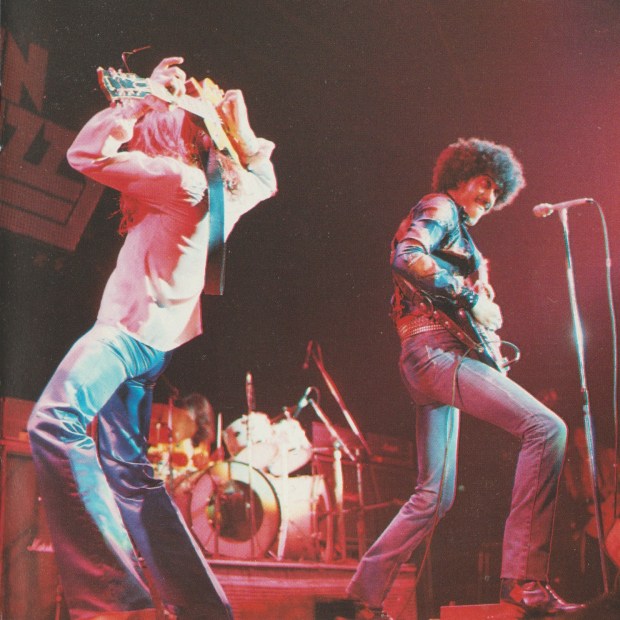
REVIEW: Thin Lizzy – Dedication – The Very Best of Thin Lizzy (1991 Polygram North American version)
It might not be the best introduction to the most underrated classic rock band of all time, but it was my introduction. Dedication was a 1991 Thin Lizzy compilation that was buoyed by the unreleased song “Dedication” which was released as the radio single. There’s nothing wrong with the “new” track, except it wasn’t supposed to be a Thin Lizzy song. Phil Lynott recorded the song in 1985 for his new band Grand Slam. Scott Gorham and Brian Downey replaced the original instrumentation leaving Phil intact. And that’s fine. “Dedication” sounds slightly unfinished but it also sounds like what Thin Lizzy might have been doing had they carried on.
These kind of extra songs usually get spotlighted at the front of the album, or left at the end to whet the appetite. On Dedication, it goes last, leaving the compilation to ascend in chronological order. Is that the best way to approach listening to Thin Lizzy? While many sets go that route, it leads to a very uneven playing experience. Early Thin Lizzy was much more folksy, and dare I say it, just not as good. It certainly had some excellent tunes, and some of the better ones are showcased here. “Whiskey in the Jar” is an actual folk traditional, rocked up and made unforgettable by that Eric Bell guitar hook. That’s followed by the firecracker “The Rocker”, just shy of three minutes but every one of them shockingly great.
Original guitarist Eric Bell left the band after three albums due to exhaustion, and the band was beefed up to a four-piece with Brian Robertson and Scott Gorham taking his place. It took a while for the albums to really catch up with the talent. On CD it’s a lot of slow material before we get to the more rocking stylings of the Thin Lizzy that you know and love. From 1974’s Nightlife we have “She Knows”, “Still in Love With You”, and “Showdown”. A lot of ballads and blues and not a lot of fire. The guitar work is sparkling but the songs are not yet as astounding as they would yet become. Another ballad, “Wild One” from Fighting (1975) is one of the best of the batch. It is bookended by two rockers, “Fighting My Way Back” and the Bob Seger cover of “Rosalie”. Both are tracks you don’t want to live without.
Part of (but only part of) Phil Lynott’s genius was bringing Gorham and Robbo (and later others) together as a unified guitarmony duo. The next batch of classics really hammer this home. “Jailbreak”, “The Boys are Back in Town”, “Cowboy Song” and “Don’t Believe a Word” are the embodiment of what people think of when they picture Thin Lizzy. The driving beats, the hooks, the dual solos, the poetic lyrics — it’s all there in what might be considered Lizzy’s peak era.
Brian Robertson left the band shortly after, and doesn’t appear on “Bad Reputation” or “Dancing in the Moonlight”, but Gorham picked up the slack in the studio and rendered these as two more stone-cold classics. “Bad Reputation” covers the driving side of the band while “Dancing in the Moonlight” is funky, light romantic storytelling. Truly excellent songs even without Robbo.
The Gary Moore era follows with “Do Anything You Want To” and “Waiting For An Alibi”, two more excellent Lizzy classics from the underappreciated album Black Rose. Moore lasted only for one album, and his successor Snowy White for two more. Snowy is only heard on one track here (“Chinatown”) and the man that replaced him (John Sykes) is heard on none! So another failing of the Dedication album is a sudden drop-off at the end, leaving out important songs. “Chinatown” is excellent at least, but so is “Hollywood” and “Renegade”, yet they are not here.
Yes, too many songs were left off Dedication because you couldn’t get ’em all on a single CD. Johnny The Fox (possibly their best record) is an album that isn’t given enough time here, along with Black Rose. And to have no Sykes? Unjustifiable.
Fortunately the last song “Dedication” is better than expected, sounding like Thin Lizzy 1991, beefy and tough. It doesn’t sound like Lizzy ’75 or Lizzy ’83. But it does sound like Lizzy because Phil Lynott’s voice tends to do that. Scott Gorham does a decent job of replicating all the guitar excitement himself (he’s had to do it before). The track, written by Lynott and Grand Slam guitarist Laurence Archer, had one of those guitar hooks well suited to the Lizzy canon. Gorham and Downey did it justice enough.
Dedication is not enough Thin Lizzy but it’s enough to get your feet wet. Although it’s a slow starter it will eventually get you interested enough to try more. It worked for me and it’ll work for you.
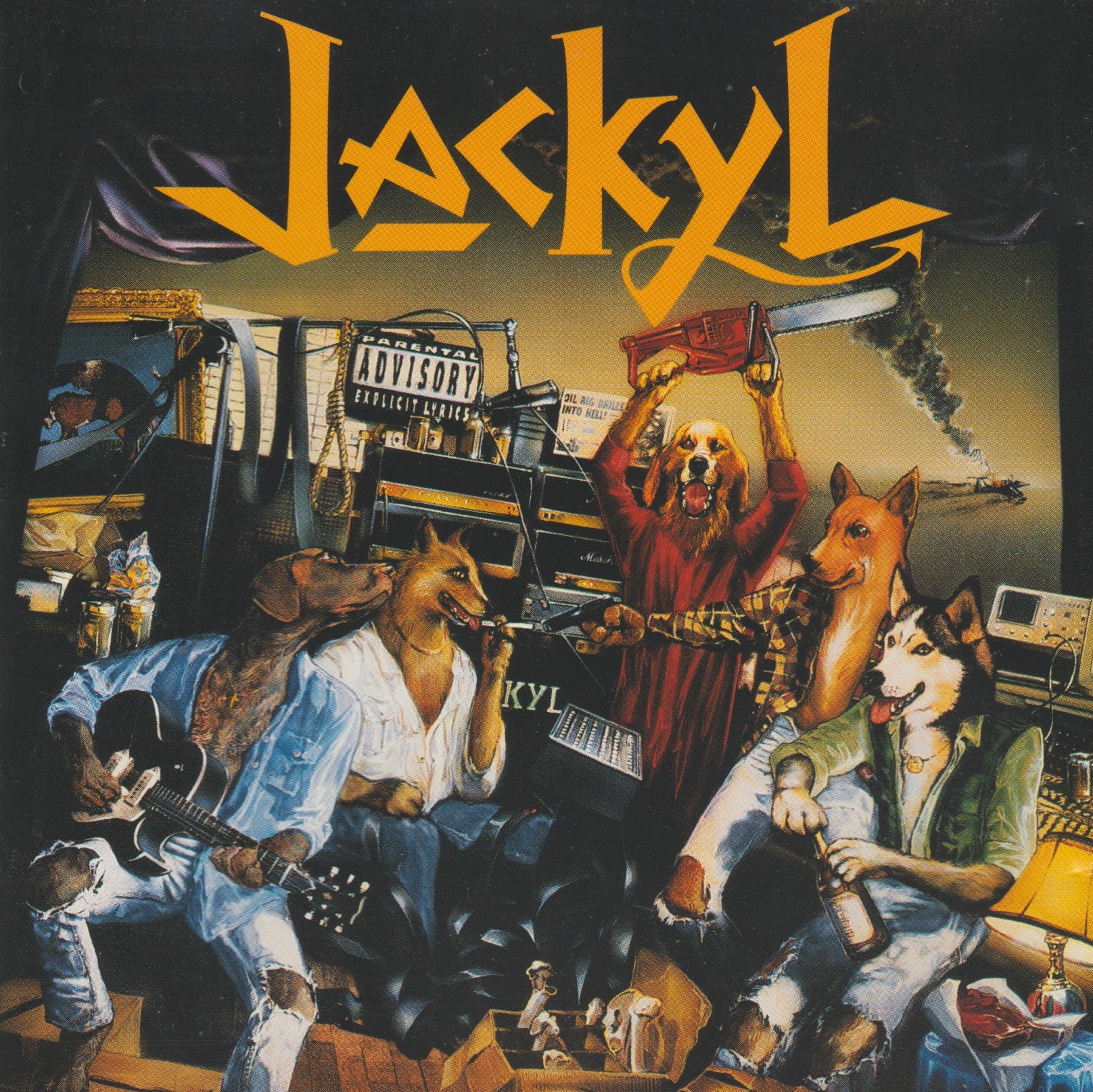
This is one of the CDs I inherited from my late Uncle Don Don. I always wanted the first Jackyl for two songs: “She Loves My Cock” and of course “The Lumberjack”. Now that I finally have it, I thought it would be fun to review it “live” on first listen. The first thing to notice is that all of the songs are under five minutes.
Jackyl, starring Jesse James Dupree on lead vocals and chainsaw, signed to Geffen at the tail end of the hard rock era in 1991. It wasn’t too late though as Jackyl scored a platinum with their 1992 self titled debut. Even though they never reached those heights again, Jackyl have continued on to the present day with relatively few lineup changes.
With a song called “She Loves My Cock”, you can probably understand why why K-Mart refused to stock this album. In protest, Jackyl filmed their video for opener “I Stand Alone” in a K-Mart parking lot. An AC/DC vibe is imminent, but Americanized with shout-along chorus. Dupree certainly has the Brian Johnson pitch and grit, as well as certain vocal inflections. Good track, solid groove, great catchy solos. The shouted bits are dated, but the song is otherwise pretty slick.
Then Jesse James starts squealing about a “Dirty Little Mind”, a sleazy rocker with more of the shouting, and then it gets really dirty. Not a classic in any universe, but it sounds like it would be fun singing along in a bar. A stuttery riff, like those popularized in the late 80s and early 90s, starts off “Down On Me”, catchy midtempo heaven with a soulful southern slant. Apparently “Down On Me” was their biggest charting hit, even surpassing “The Lumberjack” and “When Will It Rain”. I remember “When Will It Rain” from the music video, a darker and stormier concoction. It seems an unlikely single, but thus far it’s the most serious track. Certainly more serious than “Redneck Punk” which sounds like its name. Sped-up punk beats infused with a Dixieland vibes. And then as if to make the “redneck” point even further, it’s “The Lumberjack”. I love found objects in music as a general concept, and it’s awesome to hear a sleazy rock band like Jackyl executing such highbrow concepts, going as far as to play an actual chainsaw solo and still keeping it musical. The contrast of the highbrow with the brutally juvenile lyrics strides that ever-so-fine line between clever and stupid.
It sounds as if this would be a natural place for a side break, as “Reach For Me” has a completely different vibe. A choppy riff and dynamic verses really set up a cool song. Without missing a beat we’re on to “Back Off Brother”, a tough little number with a minimalist riff. “Brain Drain” has a slightly funky feel emphasized by the cowbell. Not an album highlight, but a strange cross between AC/DC and Def Leppard. Dupree expresses a clear preference for alcohol. “It’s not the ‘caine, not the Mary Jane, but the golden grain.” It’s good to know what you like. A slick one called “Just Like the Devil” starts to wind things up with a tough riff and speedy beat.
Finally and wisely the album ends on “She Loves My Cock”, the track that got them banned from K-Mart. There are clean versions of this CD available without the song, but what’s the point? This album without that song like like a sentence without the exclamation mark! The lyrics are not repeatable here but you can use your imagination. Fortunately there is a solid foundation to this heavy track to support the ridiculous words.
And that’s the album, thoroughly enjoyable with minimal filler. I could probably live without “Brain Drain” and “Dirty Little Mind”, but stuff like “Reach For Me” and “Down On Me” are like newly discovered treasure. A good album that stretches out just enough, but never exceeds its ambitions. Jackyl wants to be a party album with humour and balls, so that’s what it is. It couldn’t exist without AC/DC or gasoline-powered wood-cutting implements, and there are few albums you can say that about.
Cross Purposes catches a lot of crap from fans, and maybe it is the softest Sabbath, but it ain’t bad. The Tony Martin era was unfairly derided when he was the singer in Black Sabbath. “Only Ozzy or Ronnie — no Tony!” complained some fans. Well, we had Ronnie for Dehumanizer and that didn’t last. Tony Martin was probably always the backup plan in case things went south with Dio. It is said that Tony Martin recorded his own set of vocals for the Dehumanizer album in case Dio left abruptly. It wasn’t a surprise to anyone that Tony Iommi called up Martin when Dio did inevitably walk.
Ronnie brought drummer Vinny Appice with him, which meant Sabbath were replacing two members. In a genius move, Iommi snapped up ex-Rainbow heavy-hitter Bobby Rondinelli. Bassist Geezer Butler stayed put, but not without regrets. He would later say that he thought they were recording an album for a new band, but that Iommi decided to use the name Black Sabbath. This seems hard to believe given that Iommi always returned to the Sabbath name in the past.
Tony Martin & Bobby Rondinelli
Whatever the case may be, Cross Purposes was met with mixed reactions when it was released in 1994. While some welcomed the return of a classic sounding band, others called them irrelevant in the face of grunge. Indeed, Sabbath were accused of copying the style of Alice in Chains on “Virtual Death”, featuring a double tracked vocal similar to the Seattle band’s trademark sound.
True as that may be, there is no question that opener “I Witness” sounds like no band other than Black Sabbath. From Iommi’s squealing guitar shrieks to Geezer’s slinky bass, only one band sounds like this. Yes, on the surface Tony Martin sounds like Dio, but that sells him short. Dio has more grit, while Martin takes it smooth. “I Witness” is one of those blazingly fast Sabbath openers, and Rondinelli’s massive snare sound just kills it. I’ve always enjoyed how Black Sabbath worked their name into certain lyrics, like “Sabbath Bloody Sabbath”. Here, Tony Martin (an underrated lyricist) refers to the “pilgrims of Sabbocracy”, a word that doesn’t seem to exist outside the Black Sabbath pantheon.
Perhaps one of the biggest reasons this album was poorly received is that two of its best songs are ballads. People forget that Sabbath have many classic ballads — “Solitude”, “Changes” and “Born Again” come to mind. “Cross of Thorns” is a vocal workout for Martin that darkens the sky and shakes the seas. An acoustic riff begins the journey, but it transforms into something bigger and more dramatic. It also includes one of Iommi’s most memorable guitar solos from his entire career. Special mention goes to late keyboardist Geoff Nicholls who provides much atmosphere for this dark burner.
“Psychophobia” is an interesting song; not the most memorable but with a tricky riff that’ll get the heads banging. The middle section exactly halfway into the song is outstanding. It’s also a gas to hear Martin singing “It’s time to kiss the rainbow goodbye”. A sly jab at Dio? Fans will probably always see it that way. But then comes “Virtual Death”. Its possible grunge inspirations stick out like the sorest of thumbs on side one. This slow song drags too long. The whole “virtual reality” trend was well worn out by 1994, so that did not help matters much. Fortunately the first side redeems itself with a resounding closer called “Immaculate Deception”. The beguilement here is that the song seems like trudge at first, until Rondinelli puts it in turbo on the choruses.
Side two opens with the second ballad (more of a blues really) called “Dying For Love”. This is reminiscent of “Feels Good to Me” from the Tyr album. Interestingly, Geezer’s bassline sounds like the one Bob Daisley played on “The Shining” in 1987. (Geezer was around when “The Shining” was written, possibly under the name “No Way Out”.) It must be said that, as great as Tony Martin is on this song, it would have sounded out of this world had Dio sung it.
“Back to Eden” is a skipper. Nothing particular wrong with it, just not as good as other tracks. We resume on the single, “The Hand that Rocks the Cradle”. A keyboard opening gives way to a killer Iommi riff, one that sticks in your brain for days. Top it off with an excellent chorus and this track is a winner. Shame it never had a chance as a single. “Cardinal Sin”, like “Back to Eden”, isn’t much to talk about, though it does have a cool keyboard line.
The standard album ends on “Evil Eye”, a song that incredibly came about through an unlikely 1993 jam with Eddie Van Halen. Van Halen laid down a solo, but the band weren’t recording properly. According to Tony Martin, the Van Halen recording is simply too poor in quality to release. I don’t think fans would mind, but that is wishful thinking considering they couldn’t even give Eddie a writing credit due to contractual wranglings. This song just grinds, like a mountain over the aeons. Tony Martin wails on the chorus, and Tony Iommi lays down several minutes of guitar licks that may or not have been inspired by Van Halen’s original solos.
A big thanks must go out to Harrison the Mad Metal Man for locating this Japanese printing of Cross Purposes that you are looking at. A Sabbath collection that began in earnest back in 1992 was finally completed in 2020. The bonus track here is “What’s the Use”, a song that doesn’t quite sound like the rest of the album. The short choppy Iommi riff sounds more like Judas Priest than Sabbath, but it’s a welcome addition because it’s unlike the usual.
Had Cross Purposes come out under a different band name (something anonymously 90’s…like, I dunno, Carpet or something) with “Virtual Death” as the single, who knows what might have happened? Probably nothing, because just as there were too many glam rock acts in the late 80s, the 90s were choked to the gills with alterna-bands. A Japanese copy is expensive to come by, so don’t hesitate too much if you find a gently used domestic CD in the wild. The album is, of course, out of print.
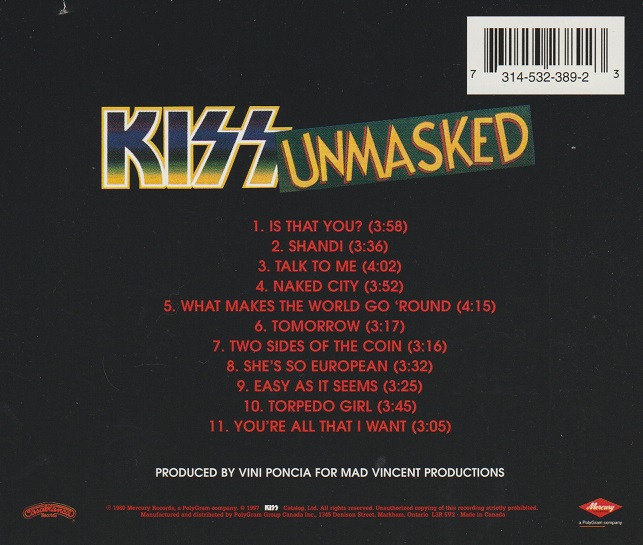
This has been a weird year. Comforting, nostalgic sounds in the age of Covid have dominated at LeBrain HQ. There are two Kiss albums that have been absolute joys this summer for blowing the blues away. They have been Dressed to Kill, and Unmasked. Originally rated 2.5/5 stars, I was definitely wrong on Unmasked. The band may have disowned it, and it might not be hard rock, but reviewing it is not as “Easy As It Seems”. This album definitely has “Two Side of the Coin”. It might not be “What Makes the World Go ‘Round” but this summer, I just want to say one thing to Kiss Unmasked: “You’re All That I Want”.
One reason I may have judged Unmasked harshly before is that first impressions are strongest. In a case of Classical Conditioning, my first impression was not good. In fact, for the first two years of hearing Unmasked, my copy was all but unlistenable. In the beginning, I taped my first Kiss albums from next door neighbour George. He fancied himself a bass player. While he was recording Unmasked for me, I sat in his bedroom while he played bass along to it. Every song. Unbeknownst to him, his bass bled onto my tape. Every time I played the album, it was like a remix with George overdubbed on bass, and I had the only copy. Sometimes he continued playing well after the fade, other times he came in prematurely. Either way, my first two formative years with this album were awful. Even after buying a proper copy on cassette, I couldn’t hear the album without the auditory illusion of George’s bass ringing in my skull. Though not the only factor, that had to be one of several reasons for my dislike of the album. A dislike which in no longer: in 2020, it’s love. Just a fun anecdote to colour in some history, nothing more.
“Is That You?” asks Paul Stanley on the opener, a Gerard McMahon song that boasts grinding verses and a killer chorus. Piano tinkles quietly in the background, but the guitars are nice and rich, especially Paul’s solo. His lead vocals absolutely rip, while a sultry Gene sings the backgrounds.
A second Paul vocal follows, and it’s the big hit “Shandi”. Listening with 20/20 hindsight in the year 2020, it’s amusing to ponder how anybody thought this was Peter Criss on drums. It was a secret that Anton Fig played on Unmasked and Dynasty, but it’s really obviously not Peter Criss. That disco groove is too impeccably perfect to be the Catman. Paul is, in fact, the only Kiss member to play on “Shandi”. And while this song is a softie, it ain’t a baddie. It’s clear that Kiss were not the rag-tag rock and roll beast they once were. They had evolved. Temporarily, at least.
If the first two tracks were light on Ace Frehley, that’s not indicative of the album. Three lead vocals for the Spaceman this time, including the single “Talk To Me”. Shiny and chromed-up, Frehley’s songs are among the best on Unmasked and “Talk To Me” could be the top track.
I always had problems with “Naked City”, but part of that might be that I can still hear George come in early on the bass. Gene Simmons makes his album vocal debut here, and while the chorus and riff are still not top-notch, the verses are excellent. Songs like this also demonstrate that Gene is an underrated singer. He’s more versatile than people realize.
Paul strikes a cool riff on “What Makes the World Go ‘Round”. He often talks about how the album had good songs, but they should have sounded different. This one sounds like it could have turned out more like the first three albums. You can imagine how the riff would have been more prominent. As it is though, it’s one of the most unabashedly catchy songs Paul’s ever written, and his guitar solo is simply delicious. You can slag Paul for doing something so pop, but can you slag him for doing it so well?
Side B’s opener is “Tomorrow”, with Paul’s vocals cleanly produced as per the pop trends of the day, with slapback delay and airy EQ. But like “What Makes the World Go ‘Round”, this is pop rock done really well. The keyboards are too prominent, but at least Ace gets a tasty solo here. As Kiss songs got catchier, so did the Spaceman’s solos. Frehley’s next lead vocal follows on “Two Sides of the Coin”, the song title which inspired a podcast (“Three Sides of the Coin“). Y’see, Ace just can’t pick a girl! But he has to. “Two sides of the coin to choose from, I’m getting weary. Which one should I choose? I need time.” He insists that the girls don’t mind, but I question that assertion. But he has to pick a mate because he’s “tired of all those dates”! Silly words aside, Ace has knocked out two top-notch songs on Unmasked so far.
Gene’s back on “She’s So European”, a song about a girl with a French accent who drinks pink champagne. I’ve softed my stance on this one too. You can certainly hear the rock n’ roll riffiness that it could have been. That’s been replaced by keyboards and slick beats, and it’s fine. “Easy As It Seems”, a Paul song, really sneaks up on you. It disappears into the fabric of the album until one day you just can’t get it out of your heard. Paul lays down another fine solo, and weaves a plaintive tapestry with his incredible voice. What range he had.
An album highlight is the third and final Frehley concoction — a weird little number called “Torpedo Girl”. Surf rock meets the Space Ace. The guitar lick is a tricky little off-beat riff, but with Anton Fig behind on drums, Kiss could do complex stuff like this. Especially since that’s Ace playing the bouncy bass part too. It’s also one of Frehley’s most entertaining lyrics. A submarine with a pretty girl on the bridge has surfaced in the bay! Better go check it out.
The final track, “You’re All That I Want” is a Gene number. Like “Easy As It Seems”, one day it just catches you. Especially Paul’s “answer” vocals in the outro. One thing (among many) that made Kiss truly special is the multiple lead singers. And unless you’re a Catman diehard, you don’t really miss Peter in that mix. Frehley more than made up for the lack of Criss. While four singers is better than three, remember that Kiss only had three lead singers for their first five studio albums.
I don’t want to have to three-view the entire Kiss catalogue but it is amazing how Unmasked just opened up to me this summer. I’m enjoying more than ever, with that nostalgic glow for days gone by. The “good old days” were not always good, but at least the music was.
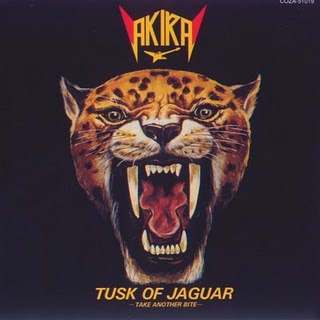
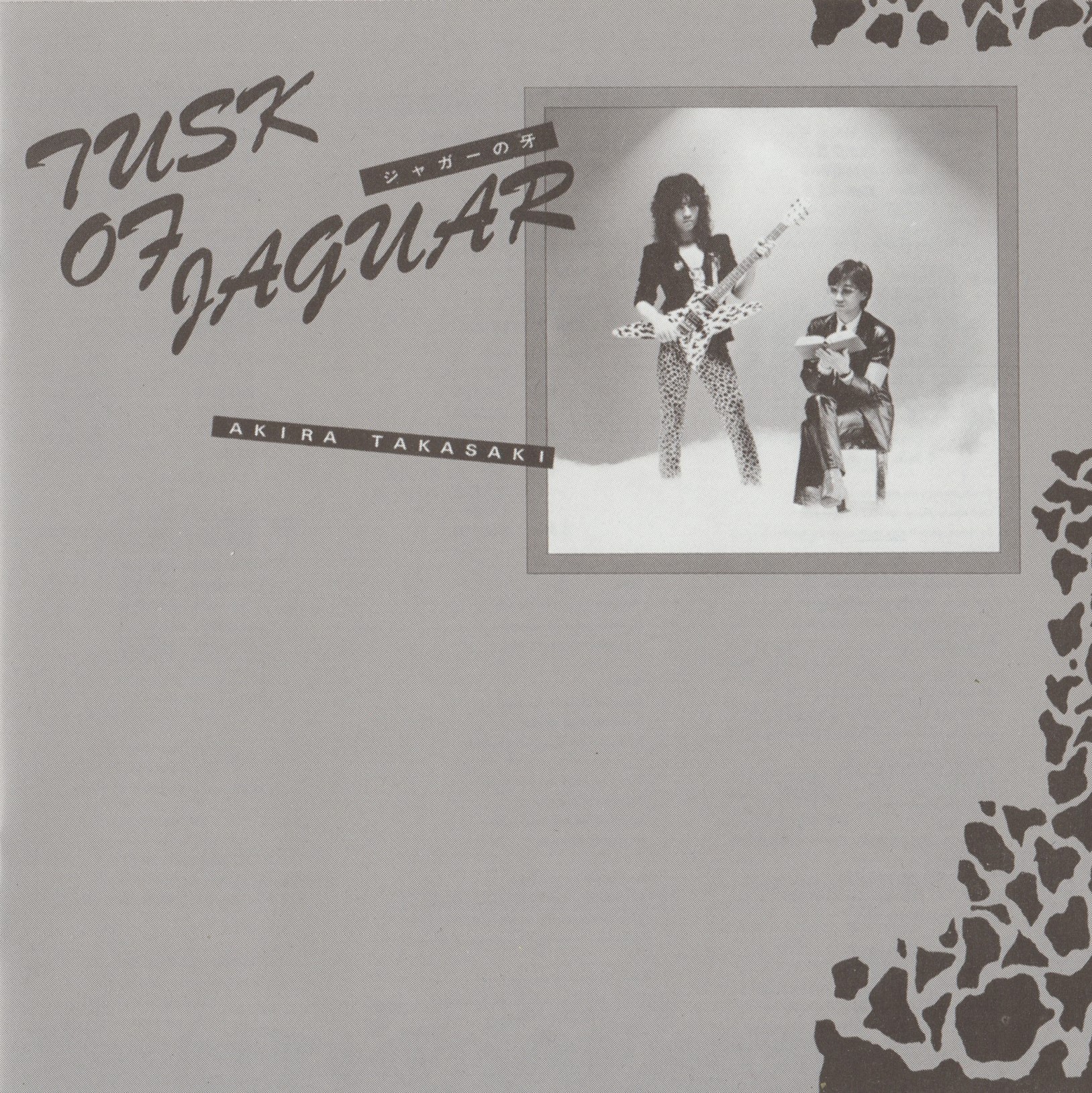
AKIRA TAKASAKI – Tusk of Jaguar (Take Another Bite) (1982, 2009 Columbia CD reissue)
In 1982, Loudness guitarist Akira Takasaki and a Japanese keyboardist named Masanori Sasaji teamed up to record an album of music that was different from the usual Loudness rock. Though the cover art and title Tusk of Jaguar screams “pure metal”, this is actually a combination of rock, pop and jazz fusion among other influences. The cool thing about the album is that Loudness play on almost all of it, including singer Minoru Niihara on a couple of vocal tracks. Some songs are all but considered part of the Loudness discography.
Certainly the opening title track sounds like Loudness. That speed metal pace can only have been set by Munetaka Higuchi on drums and Masayoshi Yamashita on bass. “Tusk of Jaguar” is a strange amalgam of shredding metal and jazz-rock interludes. It sounds a bit like the Ian Gillan Band but with Eddie Van Malmsteen on lead guitar instead of Berne Torme. Tremendously enjoyable, but way over the heads of most of the masses.
Minoru makes his first appearance on “Steal Away”, a song difficult to describe. It’s Styx-like and has a big organ sounds like Dennis DeYoung. Cinematic, progressive pop dance rock? Then it goes pure Burn-era Deep Purple! I don’t know what it is, and even with Minoru it sounds little like Loudness. It’s also one of only a few songs without Higuchi and Yamashita.
“Macula (Far from Mother Land)” is based on synthesizer until it transforms into a more traditional guitar instrumental, with clear Brian May influences. The way Akira Takasaki stacks his guitar harmonies can only be described as Queen-like. For that reason, this song is the most accessible to rock fanatics, who will eat up every note that Akira celeverly lays down. For those curious to know more about the critically acclaimed guitarist, check out “Ebony Eyes”, a serious hard rocker on which he takes lead vocals himself! His voice is higher in timbre than Minoru’s, and while he is not an amazing vocalist, he does have some pretty incredible guitar solos on this track.
“Wild Boogie Run” is an interesting tune, sounding almost exactly like Dixie Dregs. The violins, the acoustic & electric guitars, and slight western leanings make this a track that will make your friends wonder what Dregs album it was from. This could be the track worth buying the album for. Rock returns on “Gunshots” but even when Akira is just riffing, the rhythms beneath are complex and jazzy. Hard to describe, but heavy! A jazzy funk opens “Mid-Day Hunter”. Takasaki is nothing if not diverse on Tusk of Jaguar, but even if the rhythms throw you for a loop, you can surely dig into his always memorable lead work. In their early pre-Steve Perry days, Journey wrote songs like this.
Minoru Niihara returns on a song that is basically a Loudness track: “Show Me Something Good”. Though it also has Masanori Sasaji on keyboards, it is the entire Loudness lineup otherwise. A pop rock track like this could have sat on an album like Lightning Strikes if it was produced with heavier intent. The album closer is called “Say What?” which you might in fact be saying by the end of it. Blazing tempos and synth solos adorn a track that is beyond the comprehension of mere mortals.
This is a challenging album, no word of a lie. It’s certainly not immediate, and though parts of it sound familiar, it takes a bit of listening to really start to penetrate. Loudness fans, and anybody into challenging progressive rock should give it a go.



















 mikeladano.com