GETTING MORE TALE #610: 25 Years Ago – Digital Compact Cassettes
Every once in a while, you stumble upon some old obsolete media format that you never knew existed in the first place. 25 years ago, the Digital Compact Cassette was announced by Philips and Matsushita. Philips and Sony launched the CD together, but this time Philips sought a new partner for its Digital Compact Cassettes. It was designed to replace the standard audio cassette in a way that CD hadn’t yet: it was recordable. It was a direct rival to the Minidisc and DAT tape, neither of which caught traction.
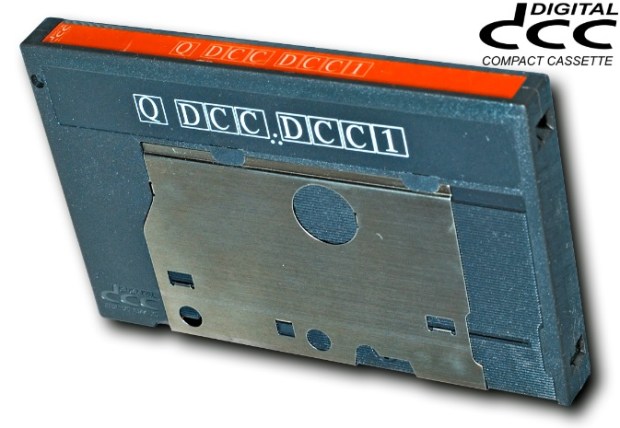
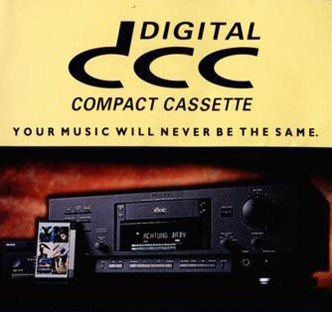
The 1992 Digital Compact Cassette player had one benefit that the other formats lacked. Players were backwards compatible. You could play all your old tapes on them as well as the new DCC tapes. The tapes themselves looked much like cassettes but with spool holes on one side only. An added feature was a sliding metal guard, similar to those on floppy discs, to protect the tape inside. Different players were marketed, including components for your home system, portable Walkman-like devices, and car tape decks. Signalling the shape of things to come, there was even one player that could connect to a desktop PC.
Another benefit to the new format was that players used fixed magneto-resistive heads, which didn’t require any demagnetizing. They were more resistant to wear and tear. Cleaning was something you still needed to do with these players, and more frequently. Unfortunately for DCC, there was already a lot of competition on the market, and the Sony Minidisc appeared to be winning.
The new Digital Compact Cassettes were not a huge technological step ahead. The cassettes ran at the exact same speed as a standard audio tape, and were the same width. The tape used was the same grade as VHS tapes. They could hold a maximum of 120 minutes, about the same as the max for an audio cassette tape, though no 120 minute DCC tapes were ever made. By comparison, a DAT tape could hold three hours, and a Minidisc 80 minutes (same as an audio CD).
Each DCC tape had 18 tracks, or nine per side. The main eight tracks held the audio information, while the ninth could be encoded with the metadata: track names, numbers, lengths and so on. This allowed the player to be able to find any spot on the tape that you wish. There was even copy protection available. If a tape was encoded as a “protected original”, in theory you couldn’t make a copy.
Ultimately, the desire for a digital but recordable audio format was fulfilled by CD itself. A DCC player could range from $600 to $1700, and with so many people still buying CD players, that wasn’t a viable price. Recordable CDs fit the bill, once they came down in price in the late 1990s (formerly about $200 per single CD-R). The cassette format died its well-deserved death. Digital Compact Cassettes are barely a footnote, but the magneto-resistive heads have since become a crucial component of PC hard disc drives. Even rejected tech can often lead to another.
There’s one final footnote to the story of the Digital Compact Cassette. The film covering of those new innovative tape heads found usage in an unlikely place: brewery filters. The microscopic holes in the material turned out to be perfect for nice clean and clear beer. And you have old obsolete cassette tech to thank!
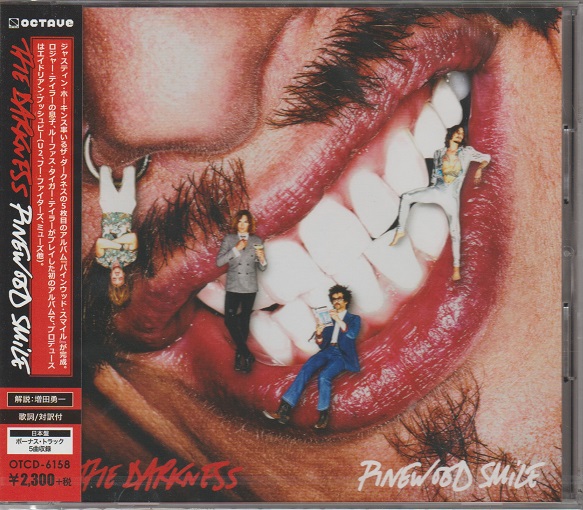
THE DARKNESS – Pinewood Smile (2017 Canary Dwarf Japanese printing)
Please welcome Rufus Tiger Taylor to the drum kit! Son of Roger Taylor (the guy from The Darkness’ biggest influence, Queen), I think we can assume this kid knows his way around a drum set. It’s the third drummer in three albums for The Darkness. Original member Eddie Graham was on board for Hot Cakes (2013), but he was replaced by Emily Dolan Davies for Last of Our Kind (2015).
The Darkness are The Darkness are The Darkness — don’t expect them to ditch the operatic vocals or bombastic arrangements. Pinewood Smile is more of what fans love, perhaps turned up just a little bit louder than before. Indeed, the second track “Buccaneers of Hispaniola” sounds like The Darkness have been listening to a lot of Queen II on maximum volume. “Japanese Prisoner of Love” has similar epic Queen inspirations, but melded to a momentous thrash metal riff.
Their penchant for humour remains unabated. “And we’re never gonna stop shitting out solid gold!” sings Justin Hawkins on one radio-ready rock tune. “Southern Trains” features the truism “There are fucking assholes everywhere.” We must assume the trains in the south of England are shite: “Fuck you, southern trains, we’re not getting anywhere!”
Of course, what would a Darkness album be without a few ballads? It can’t be all heaviness and gloom. “Why Don’t the Beautiful Cry?” is a quite lovely acoustic Darkness ballad. Bright and sunny “Happiness” is the gleeful mood of early Darkness returned. There are a number of exceptional diverse tracks as well, that defy categorisation. “I Wish I Was in Heaven” and “Lay Down With Me Barbara” stretch out, incorporating different elements both hard and soft, but always catchy as the plague. The standard album closer “Stampede of Love” is a folksy “Blackbird”-ish duet with Justin and Dan Hawkins…but stay tuned for a manic unlisted coda!
On to the bonus tracks — four on the deluxe edition, five on the Japanese. These are a little stranger than the standard album tracks. What is a “Uniball”? Ummm…it’s when you have to have one testicle surgically removed. Yes, The Darkness wrote a heavy metal song about it. B-side worthy “Rack of Glam” is a decent pun with a punchy chorus. “Seagulls” is quite exceptional, highlighted by mandolins and a slight celtic flavour. Maybe the subtitle “Losing My Virginity” is why it ended up as a bonus track. Also brilliant is “Rock in Space”, the most pompous and bombastic track of the group.
The Japanese exclusive track is a demo of “Why Don’t the Beautiful Cry?”, which is a real treat. Stripped back to just the basic acoustic arrangement, you can really just listen to Justin and Dan harmonising. No drums, no bass. Even though it’s just a demo, you can choose which version of “Why Don’t the Beautiful Cry?” is your favourite, because both have merits.
What Pinewood Smile lacks, compared to previous Darkness albums, is an immediately loveable pop rock standout track. Something like “She Just a Girl, Eddie” or “Last of Our Kind”. Pinewood Smile doesn’t have those kinds of songs, but hopefully this means we’ll still be listening to it a year or two later.
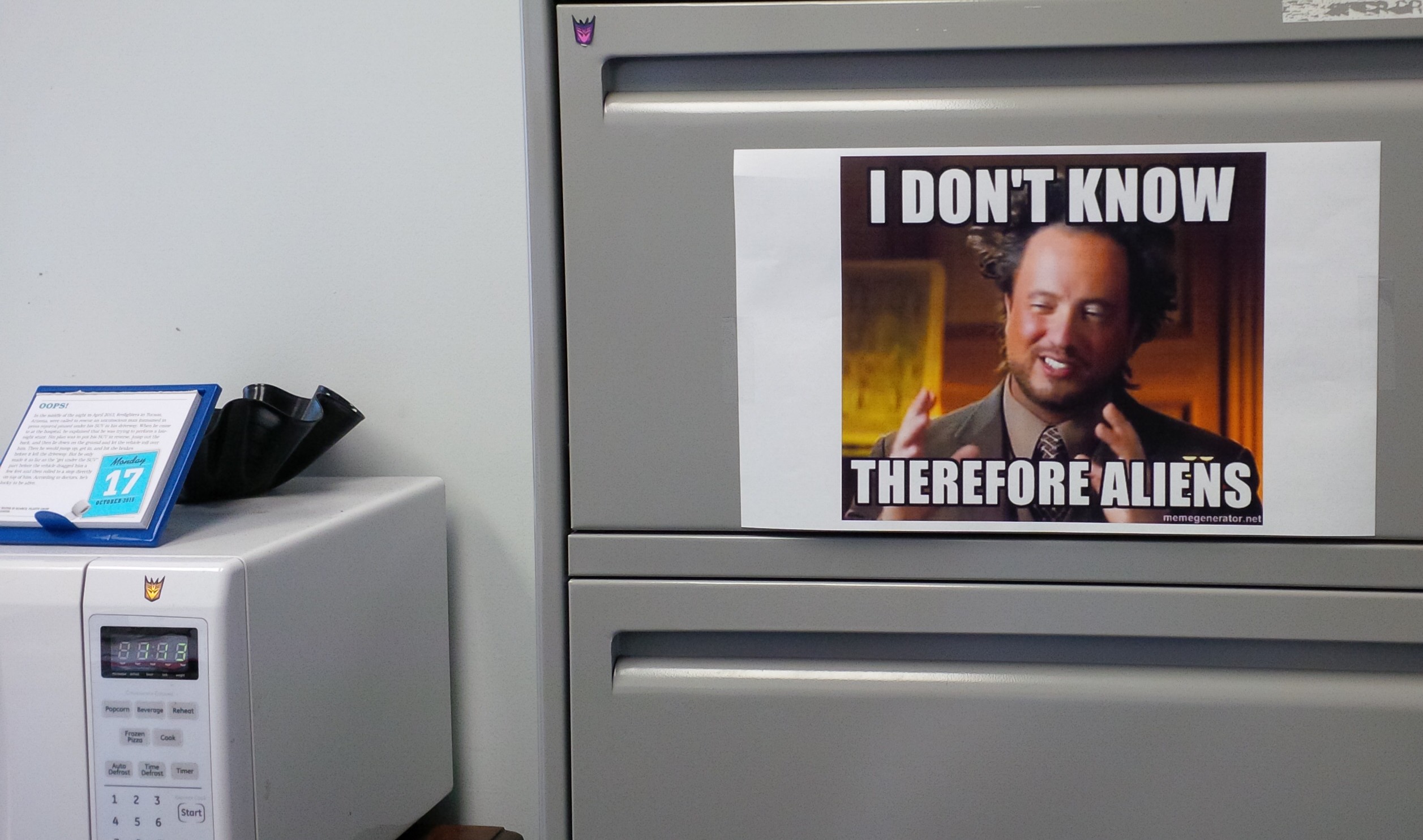
Buddy Chris and I had a running joke about UFO “expert” Giorgio Tsoukalos. Everything seemed to explained by…aliens! Could it be…aliens? I came into work one day to find this taped to my file cabinet. I love it!
My first real job at age 17 was packing groceries. I worked at Zehrs, the big grocery store in town. It was hard work, but a good job to have. They paid well and you could make a career there if you wanted to. Several people had been there 10 years or more, had security, and were making decent money. The neat thing for me was the Zehrs store was in the same mall that I later worked in at the first Record Store! My dad worked there at the bank. Best friend Bob worked in the Zehrs bakery. The mall was like a second home.
The grocery store had a dress code. No running shoes, just plain black shoes. No jeans, just brown pants and white shirts. A brown clip-on tie and apron with box cutter in the pocket was issued to us upon hiring.
Facial hair grooming was strict. I was there when one guy showed up looking unsatisfactory, was written up and sent home to shave. No stubble allowed. No beards, no sideburns.
The only facial hair we were allowed to have was…
A moustache.
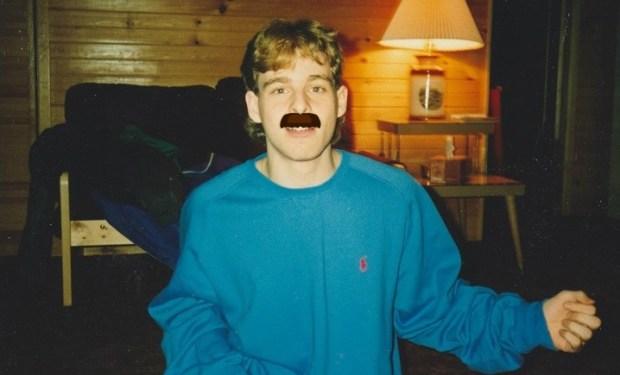
So many guys there had moustaches. The guy who trained me had one. One of the managers, and even a few of the guys my age had moustaches. I am not a fan of moustaches, but given the lack of options, one day I showed up with a stupid little blonde growth on my upper lip.
“Is that…are you…growing a moustache?” asked the girl I liked. Her name was Kathleen. Kathleen Fitzpatrick. She was really nice, but every guy there liked her. Guys with higher seniority would work on her lane, kicking me off. They’d stick me with one of the older ladies. Everybody preferred to pack for Kathleen and I was low man on the totem pole.
I wore that moustache once. One day. Truth be told, I never felt comfortable in a moustache, but imagine this scenario: what would have happened if Kathleen liked my moustache? How history could have turned out differently. I could have been a moustache guy all this time! I’d probably drive a Camero and listen to a lot of April Wine.
I’m glad it didn’t go that way. Wherever you are Kathleen, I think I owe you a debt of gratitude. Maybe.
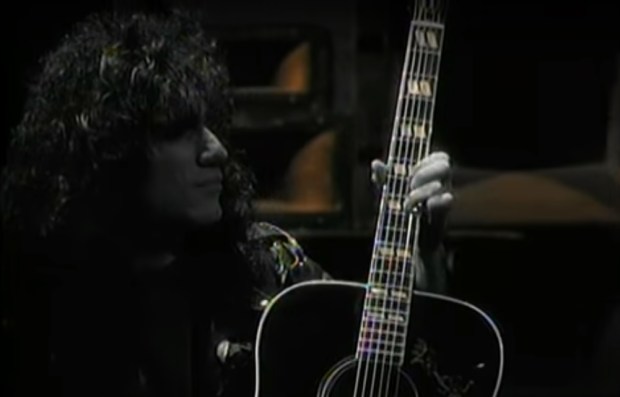
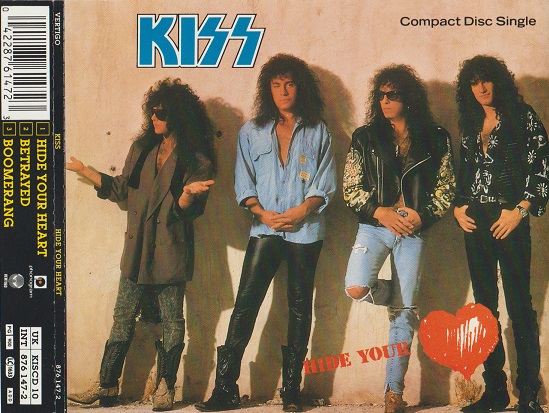
Kiss took the unusual step of waiting six months before going out on tour to support Hot in the Shade. Bands were having trouble selling out arenas. In the meantime they released singles and videos. “Hide Your Heart” came first in October of 1989. It did alright; for fans the best part of “Hide Your Heart” was seeing Paul Stanley playing guitar again in the music video. The CD single was nothing special; just the Paul Stanley A-side, backed by two Gene Simmons B-sides, as had become the norm. “Betrayed” and “Boomerang” were among the better Simmons tracks to chose from Hot in the Shade.
In January of the new year, they dropped what they hoped to be the big single, “Forever”. The excellent music video was an MTV hit, going to #1, while the single went to #8 on the U.S. Billboard Hot 100. One reason the video was so well received is that it was a rare back-to-basics look at the band. It was just four guys playing together in a room. No girls, no gimmicks, no dancing. Featuring exceptional performances by Eric Carr and Bruce Kulick, “Forever” was one of those rare ballads with integrity. Having Bruce’s old Blackjack buddy, Michael Bolton, in the writing credits didn’t hurt.
Ace Frehley wasn’t impressed though. In the July 1990 issue of Guitar for the Practising Musician, he dismissed it as pop. He wasn’t wrong, but that doesn’t make “Forever” bad.
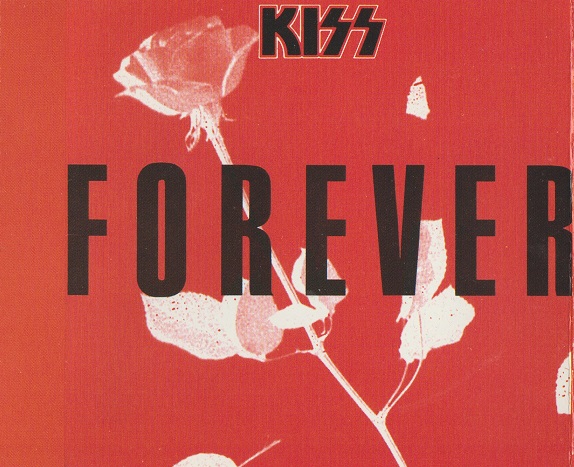
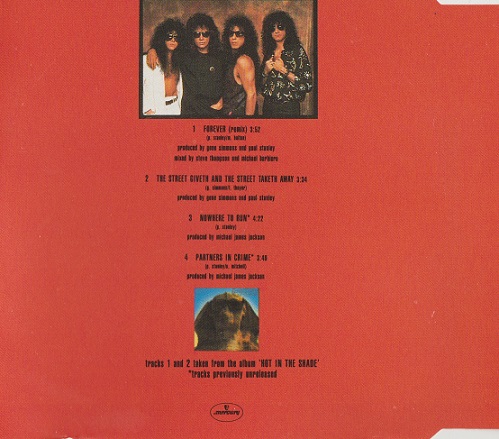
The single for “Forever” received a wider release on all three major formats (CD, vinyl and tape), and was expanded to EP length with four tracks. It also received something very rare for Kiss: a single exclusive remix, by Steve Thompson and Michael Barbiero. It has some difference in levels and echo. However, every CD copy of this single has a flaw, a skip at 1:40 that shouldn’t be there. It’s not even a damaged CD; if you look at the track times, the single version is encoded few seconds shorter. In other words a faulty master was used on every CD single. You won’t find one without the skip. Vinyl and cassette don’t have the flaw.
Fortunately this oversight was fixed when Kiss released their box set a decade later. The correct remixed single version without flaw was remastered and included in the set.
The included B-sides are an interesting mix. From the Hot in the Shade album, there’s the Gene Simmons throwaway “The Street Giveth and the Street Taketh Away”. The other two are, strangely, two of Paul’s “new” tracks from Kiss Killers. The logic here was the Kiss Killers was (and still is) unreleased in North America. At least this gave us an easy way to get the amazing “Nowhere to Run” on CD.
Too bad about that flaw on the CD version. Otherwise this isn’t a bad little single.
Step one: Get Gene Simmons’ demon head back into the game.
Step two: Record a rock album, not a Bon-keyboard-Jovi-Kiss hybrid.
Throw in the kitchen sink while you’re at it. It’s Kiss, so what’s wrong with excess? Why not a new album with 15 tracks? Why not work with Vini Poncia, Desmond Child, Holly Knight, and Michael Bolotin Bolton? How about bringing in Tommy Thayer from Black ‘n Blue to co-write some tunes?
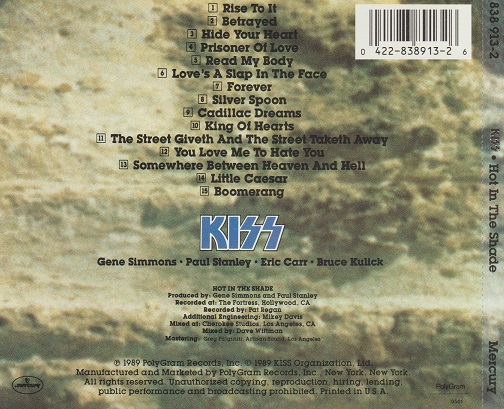
Why not indeed. The results yielded were interesting to say the least, and certainly more rock and roll than anything else Kiss did in the 1980s. It is also overall one of the hardest Kiss albums to listen to front to back. A for effort, D for songs. Its bloated and unfinished track list seemed like Kiss was trying really hard on one end, but gave up on the other.
Paul Stanley and Gene Simmons self-produced Hot in the Shade, after the negative experience with outsider Ron Nevison. This meant that there was no-one to push them to do better, as Bob Ezrin and Eddie Kramer would. No-one to say “no” to using demo tapes on the finished albums. No-one to say “no” to 15 tracks, to drum machines, and to sub-par songs.
Issues aside, Hot in the Shade is not all bad. At least you can say that Kiss went for it.
Opener “Rise to It” begins with something new: acoustic slide guitar (from Paul Stanley)! In a time when rock bands were re-discovering the blues, this old-timey touch was a welcome sound. The slide gives way to one of Paul’s most incendiary tracks of the decade. Written with expert songsmith Bob Halligan Jr., “Rise to It” hits all the right spots.
“Rise to It” was eventually chosen as a third single to promote Kiss’ upcoming 1990 tour. The music video opened a door that fans refused to allow them to close: Kiss in makeup again. Instead of the slide guitar intro, the video takes us to a theoretical 1975. Gene and Paul sit in the dressing room, applying their legendary whitepaint. The conversation was one that Gene and Paul may have had many times in the old days: musing on a life without makeup.
“I saw that review today. Some of those people don’t think this is gonna last. They think it’s a joke,” says Paul. Gene reassures them that it doesn’t matter as long as they believe in themselves.
“I bet you we could take the makeup off and it wouldn’t make any difference,” Paul retorts. Gene calls him nuts.
“Gene, there’s nothing we can’t do.”
“Still say you’re nuts.”
At the end of the video, there they were: Paul and Gene, Starchild and Demon, in makeup for the first time in seven years. What did it mean? Was it just hype? Of course it was. It would be seven more years before they’d do a tour in makeup again.
But it was cool, and it made many fans smile ear to ear.
Like all the previous Kiss albums from the non-makeup era, all three single/videos were Paul songs. Though “Rise to It” is the most noteworthy video, “Hide Your Heart” was first. This Stanley/Child/Knight outtake from Crazy Nights was actually first recorded by Bonnie Tyler in 1988. At the same time that Kiss were recording it for Hot in the Shade, Ace Frehley also did his own version for 1989’s Trouble Walkin’. Confusing? Kiss were the only band to have a semi-hit with it (#22 US).
As a nice change of pace from putting X’s in sex, the lyrics were a story about star-crossed lovers in gangland. “Tito looked for Johnny with a vengeance and a gun, Johnny better run better run,” sings Paul. In fact, “Hide Your Heart” does not get enough credit in fan circles for being lyrically different. At least it is recognised as a great tune from a poor album.
Kiss weren’t worried about competition from Ace and did indeed record the best version of “Hide Your Heart”.
The most notable single was the ballad “Forever” (and we will take a closer look at the CD single in the next instalment of this series). Michael Bolton was an old bandmate of Bruce Kulick’s from the Blackjack days. Before he was a superstar crooner, he was a rocker. Together he and Paul wrote “Forever”, which became the big hit (#8 Billboard hot 100).
As an acoustic ballad, “Forever” is far more palatable than the keyboardy “Reason to Live” from ’87. What gives it balls are the two unsung Kiss members: Kulick and Eric Carr. Eric’s heavy drumming on “Forever” really kicks it up a notch. Listen to that hammering 1-2-3-4 bit at the 1:05 mark. “When you’re strong you can stand on your own…” ONE TWO THREE FOUR on the snares. Heavy as fuck on a ballad! Then there’s Bruce’s acoustic solo, another first for Kiss. The temptation would be to record a ripping electric solo like everyone else. Bruce wrote and recorded a hook-laden acoustic solo that is as much a part of the song as the chorus.
Those are your three standouts from Hot in the Shade, leaving 12 more that don’t hit the same bar.
Of the remaining 12 tracks, Eric Carr’s lead vocal “Little Caesar” is significant. Making him sing “Beth” on Smashes, Thrashes & Hits was unfair and a cheat. “Little Caesar” is his “real” lead vocal debut. Originally written as “Ain’t That Peculiar” (later released on a Kiss box set), the words changed to reflect one of Eric’s nicknames. He was, after all, a little Italian guy! The funky “Little Ceasar” was performed entirely by Eric and Bruce Kulick.
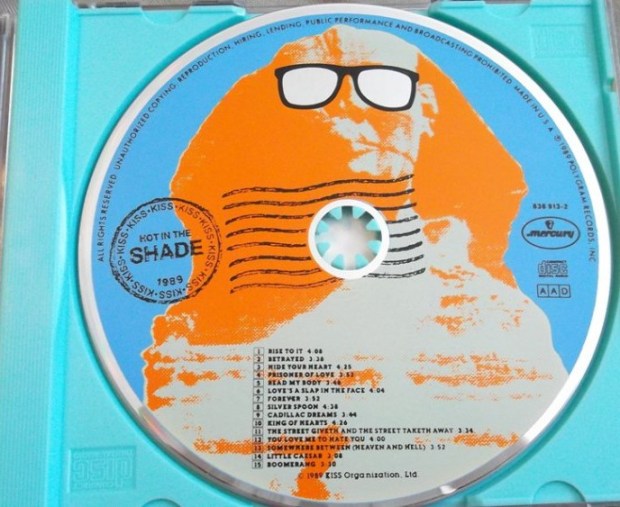
US picture CD
Gene’s “Boomerang” (written for Crazy Nights with Bruce) may be noteworthy as the closest Kiss have ever gotten to thrash metal. Another Gene tune, “Cadillac Dreams” has a horn section and electric slide guitars. Paul’s “Silver Spoon” is augmented by soulful female backing vocals. You have to give them credit for stretching out and trying new things, but keeping it rock and roll.
Then there is a slew of filler, stuff that would never be played live nor remembered fondly. Gene has a number of generic sounding songs, heavy but uninteresting: “Betrayed”, “Prisoner of Love”, “Love’s a Slap in the Face”, “The Street Giveth and the Street Taketh Away”, and “Somewhere Between Heaven and Hell”. Paul is also guilty of providing filler material. “Read My Body” isn’t bad, but sounds like his attempt to re-write “Pour Some Sugar On Me”. “King of Hearts” and “You Love Me to Hate You” both have good parts here and there, but not quite enough.
As unfocused as Hot in the Shade is, at least it was a step. Sure, adding horns and slides smacked of Aerosmith. Going almost-thrash was following, not leading. Musically, Kiss have never been leaders, but what they do is create their own confections from the ingredients of their best influences. Hot in the Shade represented a better mixture of ingredients, just without the discipline to mould them into 10 (just 10, not 15!) good songs.
Today’s rating:
1.5/5 stars
The story of the next three years in Kiss will be explored in a series of reviews on CD singles, live bootlegs, and solo releases. Don’t miss them!
November of 1989 was an historic moment in time. Three events collided in one day that I distinctly remember unusually well. Based on historical records, I almost can nail down the exact time I first heard Kiss’ then-new Hot in the Shade album that year. I can remember being on a bus for a school trip, sitting next to a German kid, as the news of the Berlin Wall coming down became the top story of the day. It was probably the 10th of November, a Friday.
It was huge news. I grew up in the tail end of the Cold War, and hope was finally on the horizon. I can remember in 1983, kids in the school yard talking about the Korean passenger liner that the Soviets shot down. “There’s gonna be a war,” one kid said, and it sure did seem like it. Every other year, it seemed like it. November of 1989 was a different kind of time, when fears suddenly melted away albeit briefly. Sitting next to that German kid on the bus, Mark, was the best place for me to absorb the greater meaning of it.
What were we doing sitting on that bus? We were on the way to Pickering, to visit the nuclear plant. Our names had to be submitted weeks in advance to get the clearances, but we were inside an operational nuclear facility! It wasn’t even my first tour of a nuclear plant, though it was the first time being inside one. When I was a youngster, the family took a tour of Bruce Nuclear’s grounds and visitor center on summer vacation one year. I remember being really small, and asked to try and lift some depleted rods of uranium. I couldn’t; it was far too heavy! This demonstration indicated the density of the nuclear fuel. “Did you have your Wheaties today?” asked the tour guide to the chuckles of the group. But in Pickering, we got to look right inside.
The Pickering plant was impressive. We had helmets on to go with our visitor badges. There were checkpoints everywhere, where you had to put your hands and feet in a scanner to make sure you didn’t pick up any radioactive dust. Once you were cleared, you could go into the next area. We saw the big rooms where the spent fuel is kept. Not surprisingly, everything was immaculately clean. Every surface gleamed, and all the equipment appeared new and in top condition. We were told that amount of radiation we were exposed to was about the same as an X-ray at the dentist. The trip was optional, and at least one kid opted out because he didn’t want to get zapped.
There was a more intensive scan at the end of the trip before we were allowed to leave. You had to pass a full body scan; if not they had to confiscate your clothes and send you home in paper hospital gowns. I had a brief moment of terror when my scanner refused to give me the green light. “Come closer” the damn machine kept saying to me. “I’m as close as I can get!” I retorted to the infernal contraption. A guide helped me get standing correctly and thankfully I passed the scan! No hospital gowns for me, which is especially good because the next stop on the trip was Pickering Town Center for lunch.
I ate a sandwich for lunch that my mom packed for me. She always made sure I had a lunch every day! We had time to kill at the mall so Mark and I hit up a record store. It was probably A&A Records and Tapes, though it certainly could have been an HMV. Either way, they had two new releases that I had my eyeballs on: Trouble Walkin’ by Ace Frehley, and Hot in the Shade by Kiss. I only had enough money for one, and Kiss had to take priority of solo Ace. I remember having a conversation with the guy at the counter about how Anton Fig was back playing drums for Ace. (And that right there is a lesson about customer service. That guy made an impression on me that lasted 28 years, just by mentioning Anton Fig on the off chance that I’d know who he was.)
So I walked out of there with Hot in the Shade in my Walkman, and I had a chance to hear the new Kiss album for the first time. I always enjoyed a first listen. I’d look at the song titles and try to guess which were Paul’s and which were Gene’s. I really liked the acoustic slide guitar that opened “Rise to It”. Bruce Kulick was proving his awesomeness, though I didn’t enjoy his tone on Hot in the Shade. It was only later that I learned Hot in the Shade was essentially a set of demos that were polished and finished for album release. That might explain why I felt the tone was so…flat.
Mark also encouraged me to listen to one of his tapes, a group called Trooper. “I bet you haven’t heard of Trooper,” he said, and I hadn’t, which was odd because they were Canadian. Trooper didn’t make any lasting impressions other than remembering that Mark was rabid for them. One thing I remember about Mark: he hated long songs. He liked songs in the three to four minute range, and that’s pretty much all of Trooper’s hits.
Our final stop was Lakeview Station, a huge and now defunct coal fire plant in Mississauga. “Don’t touch anything,” the teacher warned us before going in. “This place is covered in black coal dust. If you touch any, you’re going to get it all over the next thing you touch which will probably be your clothes.” And he was right. Every surface had coal dust on it. The tour was noisier and far grimier than the nuclear tour. This was intended to make an unsubtle point about the differences between the two.
We were all glad to get out of Lakeview and back on the highway home. I flipped sides on my Kiss tape and tried to get into the album. I was struggling with it. Some songs were really good, like the ballad “Forever” which was immediately discernible from the pack. Others made it seem like putting out an album with 15 new songs might have been a better idea on paper.
I listened to the album on my boombox when I got back home. I listened intently and tried to figure out what sounded “off”, and the only thing I could figure was the guitarist. “I don’t think Bruce Kulick’s tone is right,” I said with a twinge in my gut. Of this, I’m glad he proved me wrong by the next album Revenge.
What a memorable day that was. I’m just glad I didn’t come home radioactive and hot in the shade!
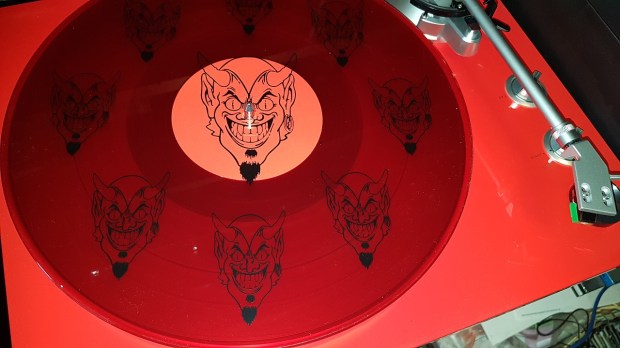
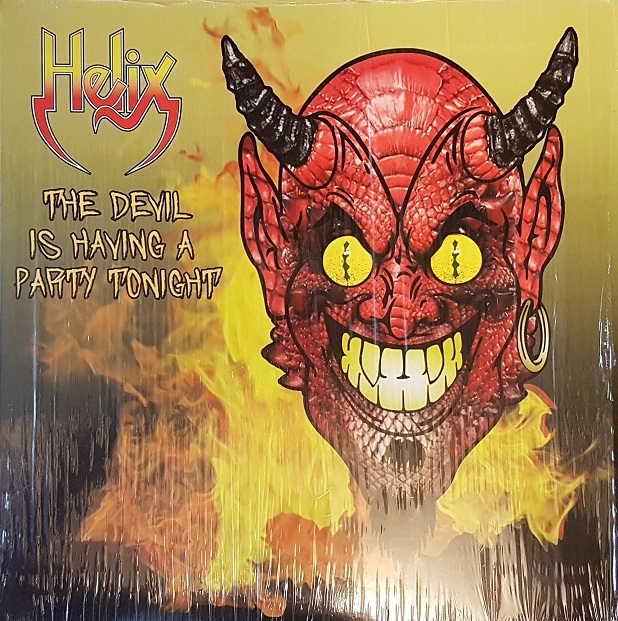
HELIX – “The Devil is Having a Party Tonight” / “The Tequila Song” (2017 clear red picture single)
It’s been love for Helix and I since…many years! Since Record Store Tales Part 2: Gimme An R, at least. As such, I may be a little biased when it comes to this band. Maybe. I truly believe their music deserves much more attention from the rock community, particularly the recent albums which are always excellent. Helix mainman Brian Vollmer maintains a reputation as the hardest working man in Canadian heavy rock. 2017 sees the release of not just a new Helix single (and a lavish one at that), but also his second solo album Get Yer Hands Dirty.
Helix today is Vollmer on vox, Daryl Gray on bass, Fritz Hinz kickin’ the drums, and newer members Kaleb “Duckman” Duck and Chris Julke. The inner sleeve is signed by all five members, which is just the kind of cool personal touch Helix are known for. Also noteworthy, all but Hinz wrote the single A-side “The Devil is Having a Party Tonight”. That makes it the first Helix song in years written solely by band members. “The Tequila Song” on the B-side is composed by mainstay collaborators Gord Pryor, Steve Georgakopoulos and Vollmer.
Great tunes, these are, both party songs. Each is a little heavier than you might usually expect from the Helix band. “Devil” is possessed by a heavy-as-a-tombstone riff, and some exotic guitar noodlings that recall the good stuff from the metallic 80s.
I think “The Tequila Song” is even better. I was known to drink tequila from time to time in my younger days, but I gotta say that Helix have written a better song about tequila than Sammy Hagar ever has. Stomp to that riff as you “lick it, bang it, suck it, tequila!” Even if you’re the designated driver, you’ll find the chorus infectious and party-ready.
This Sunday Chuckle is, in part, a followup to the story of my wife’s battle with epilepsy. She now has a prescription for “Oil of the Green Ganja”, for seizure control. So far, it seems to have reduced their number and severity, but it’s a learning process. She also wanted to try the dried product to see if it would help. She got some “government green” and just needed a vaperator. We checked out a local shop called Crazy Bill’s.
I suppose you’d call Crazy Bill’s a “head shop” but we looked at it as a place for medical supplies. They have excellent service. We’re very grateful to the woman who helped us out. She recommended a particular “vape” for starting out, so that’s what we got, and so far so good with that.
Crazy Bill’s has an insane amount of candy and junk food at the checkout counter. Cool stuff, too. I couldn’t leave without getting some hard to find Nerds, a white chocolate Reese’s Cup, and…
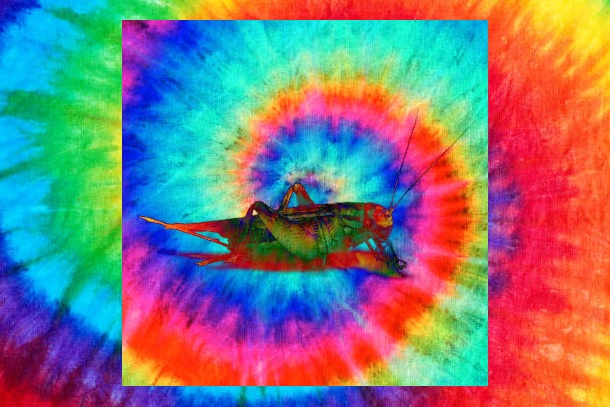
Deep fried crickets (or “Crick-ettes”). Had to get some. Would you try these?
Old review from the archives (revised). This book has long been ejected from the collection.
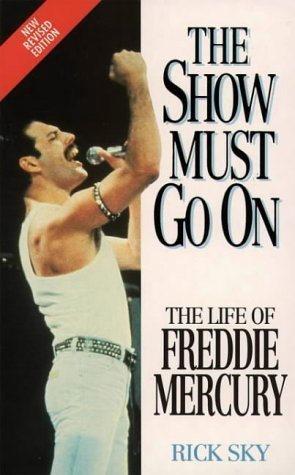
RICK SKY – The Show Must Go On – The Life of Freddie Mercury (1992 Fontana)
This book is shallow to the extreme. If you ever wanted to know how much money Freddie Mercury spent on lavish parties, then this is for you. If you want to learn anything at all about Queen and their music, you will have to look elsewhere.
While the book dwells far too long on Freddie’s fabulous friends and fantastic parties, I did find the closing chapters regarding his death very sad and heartfelt. It puts you in the moment. There were also some interesting bits about his childhood and youth. Not enough to redeem this book, which just isn’t up to snuff for any fan, serious or casual.
 Another benefit to the new format was that players used fixed magneto-resistive heads, which didn’t require any demagnetizing. They were more resistant to wear and tear. Cleaning was something you still needed to do with these players, and more frequently. Unfortunately for DCC, there was already a lot of competition on the market, and the Sony Minidisc appeared to be winning.
















 mikeladano.com