REVIEW: Joe Satriani – Surfing With the Alien (1987, 1999 remaster, 2017 RSD 2 LP reissue)

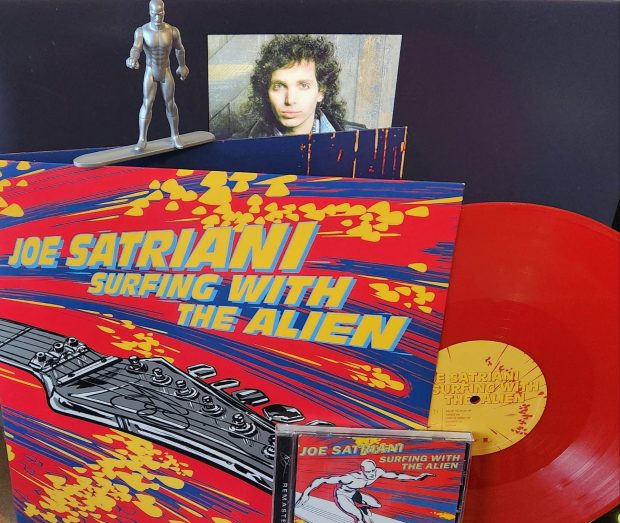
JOE SATRIANI  – Surfing With the Alien (1987, 1999 Sony remaster, 2017 RSD Epic 2 LP reissue)

On October 15 1987, the face of rock music was  shaken when a little instrumental album called Surfing With the Alien started making waves.  The record eventually went platinum, and its songs found itself used on radio and TV for decades to come.  Why?  Possibly because of Joe’s impeccable attention to songwriting.  Though his guitar playing put him on the map, it was his knack for writing catchy rock songs that made this album so special.  Satriani’s songs are written as if the lead guitar is the lead singer.  There are verses and choruses, and attention to structure and melody.  That must be why Surfing With the Alien was nominated for two Grammys in 1988.

Opening with the title track, a striking little chugging riff starts the show.  But then Joe’s melodic lead guitar kicks in, and you realize it’s exactly like if a singer was leading the show!  You can literally sing along to Joe’s guitar and a little wah-wah effect doesn’t hurt.  And then the shred begins, and you feel like, “OK, I get it now.  This guy is an actual genius.”

Yet it’s all accessible.  He may throw in licks as fast as greased lightning, but you can still follow.  Your brain still picks out notes and melodies that satisfy those musical needs.

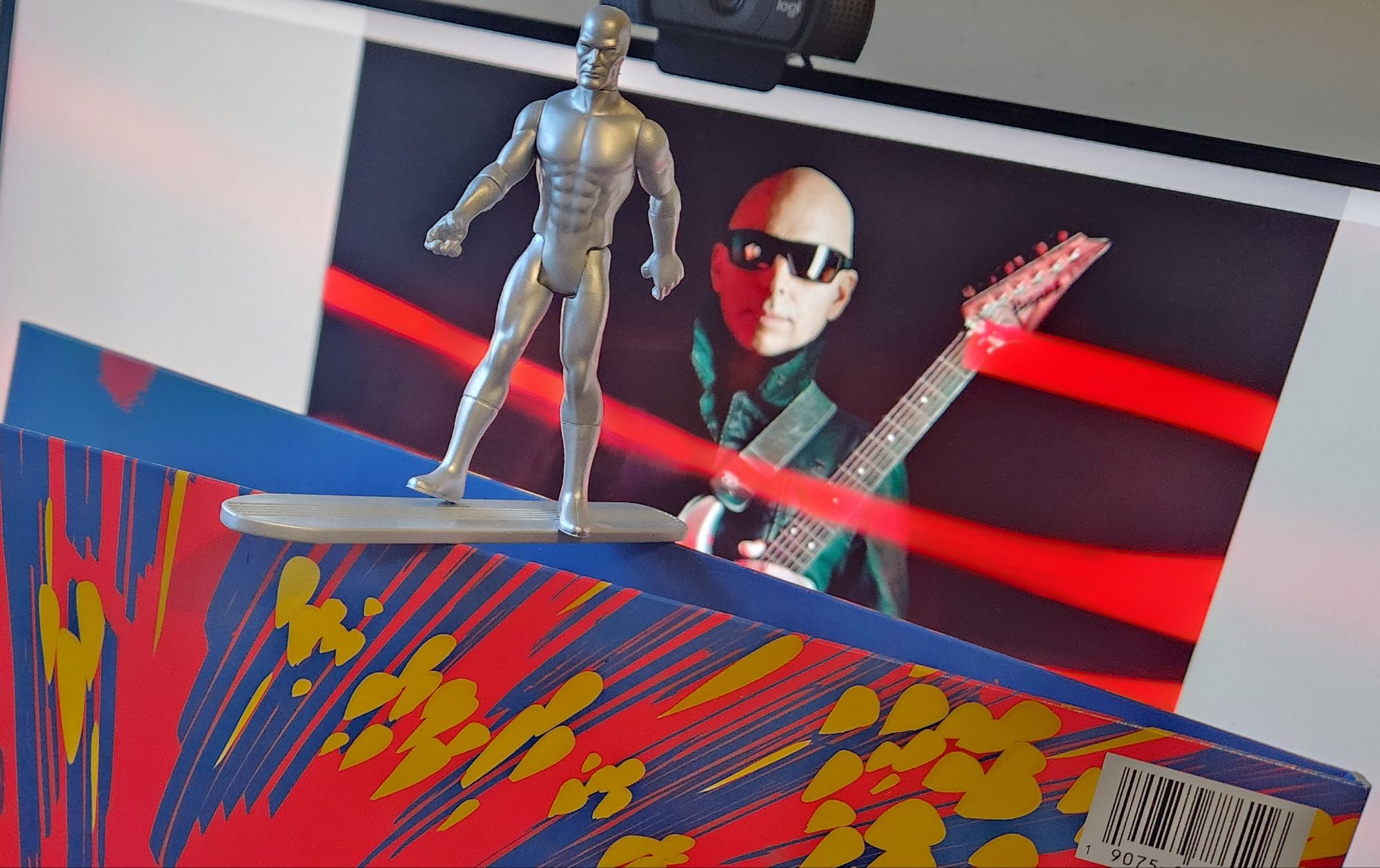
The cool “Ice 9” is a funky groove (Joe on bass) with a slick melody on top.  Joe can work with mid-tempo grooves just as well as high-speed blazes.  Solos with different sounds and guitar tones add diversity.  A fun tune, but the third song “Crushing Day” has more tension and urgency as the tempo is turned up once again.  The variety of solos, melodies and riffs in one short song is quite remarkable.  Joe’s guitar tone is bright and shimmery, like the Silver Surfer himself.

Incidentally, regarding the striking album cover featuring the titular Marvel character from Silver Surfer #1 (1982), Joe lost the licensing for him at some point in the 2000’s.  This is why the 2017 RSD reissue has different artwork, without him.  (Look carefully at the new art, and you will see that they replaced the yellow streaks with yellow guitar picks!)  Hopefully Joe doesn’t feel too badly about losing the Surfer art.  Marvel comics repaid him for the popularisation of the character outside the comic world by naming a planet after him.
The beautiful ballad “Always With Me, Always With You” might be considered the most famous song.  It received three Grammy nominations in three separate years (live versions, you see) and was prominently featured in an American Dad episode.  It is hard to describe exactly what makes it so special, without you listening for yourself.  The guitar is lyrical and memorable, and it worked so much better than it would have with a lead vocal.  This is an instrumental ballad, made magical.

“Satch Boogie” is arguably just as popular.  Deep Purple played it during the brief period when Joe Satriani was in the band post-Blackmore and pre-Morse.  It has been used on TV, radio and video games.  It is indeed a boogie!  It taps into the Van Halen vibe a-la “Hot For Teacher”, but burns straight through without stopping to talk.  Mid-song, there’s a jaw-dropping solo that is pure tapping nirvana.

An ominous and brief interlude (“Hill of the Skull”) paints an apocalyptic picture.  The programmed drums don’t detract, as it is all about the tale that the guitar is telling, with layered wails.  This serves to set up “Circles”, one of the most interesting tracks.  Echo is employed to great effect on this mellow but dark ballad.  Without pause, the striking chimes of “Lords of Karma” enter the picture, a pounding guitar rocker with drums by Jeff Campitelli.  (Drums on this album are a mix of live and programmed.)  Much like “Crushing Day”, “Lords of Karma” is a bit faster and more intense.

A lovely classical sounding interlude called “Midnight” sets up the final track.  “Midnight” features techniques that an expert will have to identify, except to say it sounds remarkable and innovative.  The spotlight is never really on Joe’s fingers though – just on the notes and sounds he magically produces with them (and an array of effects).  Then the thud of bass opens “Echo”, the last song on this important album.  It’s unlike the previous ones, with the bass so prominent.  The song sounds as if it’s always just bubbling under.  Perhaps it would come as a surprise that the final song on this album of guitar showcases is so much about feel and restraint.

That’s one thing about Surfing that does make it special.  Like any good album, it is sequenced as a full listen, not as a collection of shreds.  Even without the shreds, it’s still not bad.

That’s what the 2017 Record Store Day deluxe vinyl edition is all about.  A bonus LP is included, with all the lead guitar stripped off.  This allows you, the ambitious home player, to try to solo over the bed tracks.  For the rest of us, it just allows us to listen a little bit differently to an album that is very familiar.

The drums seem more prominent on the title track, allowing us to better hear Jeff Campitelli’s fills.  Mostly though, you can still bang your head, and maybe sing along to an imaginary vocal melody.  “Ice 9” is particularly fun in this guise, sounding a bit like an “80s dance remix” even though it’s not.  “Always With Me, Always With You” is still delicate and beautiful.  You get the picture.  These tracks, though needing the lead guitar to be whole, are perfectly listenable without.  Only “Circles” and “Midnight” seem completely barren.  You don’t have to be a guitar player to enjoy this bonus record.  You just have to be interested in music, and how it is constructed in the mix.  You can hear melodies and accents, even on “Always With Me”, that you might have missed on the album version all these years!

There are many ways to acquire copies of this impactful album, that opened the charts to Steve Vai and others a few years later.  There is a 1999 Sony remaster with liner notes and nice packaging.  There is a deluxe edition with a live DVD from the 1988 Montreux Jazz Festival.  The version with the most actual audio tracks, however, is the limited 2017 Record Store Day reissue.  You don’t get the lovely Silver Surfer artwork, but you do get the bonus record of stripped tracks, and red & yellow coloured vinyl.

No matter what choice you make, Surfing With the Alien in any form is an essential addition to a serious rock fan’s collection.  Some may argue it’s the best rock instrumental guitar album ever made.

5/5 stars


What’s Good? With D’Arcy Briggs – Music, Unboxing and More

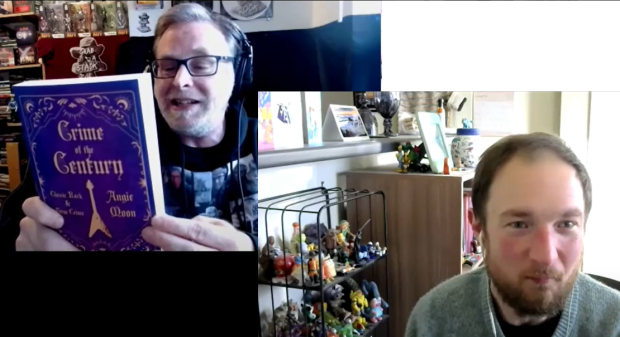
I was so pleased to be able to collaborate with YouTuber D’Arcy Briggs. He has a great channel all about physical media and music, and my favourite new feature of his is called “What’s Good”.  It’s just him and a guest literally talking about whatever’s fresh and good that they want to share.  This is only the second episode of “What’s Good”, following the debut with Jex Russell!

For me, I had three unboxings and a Gene Simmons set to show.  The unboxings are brand new and exclusive to this show!   This is the first reveal of these treasures to come into my collection.

D’Arcy had some cool stuff included new music by Jack Antonoff, jazz rock fusion, the complete English Beat, some vinyl, and a parcel from Ontario!  We took four turns each but you’ll have to watch the show to see what we brought.

One of the items I was proud to show was my autographed copy of Angie Moon’s first book, Crime of the Century.  You can find out more and buy your copy by clicking this link. crazyonclassicrock.com/buy-crime-of-the-century

Crime of the Century is an original book idea about the connections between classic rock and roll and true crimes!  Some are less known than others.  The Band and Jack Ruby?  The Kink and John Wayne Gacy?  DEVO and John Hinkley Jr.?  I didn’t know any of this before.  I can’t wait to dig in and talk to Angie on Grab A Stack of Rock.  She came from right here in the WordPress community and it’s awesome to see her out with her first book!

Check out the episode below, and subscribe to D’Arcy’s channel if you already haven’t!


#1116: Oh, the Boss is Coming!

RECORD STORE TALES #1116: Oh, the Boss is Coming!

Oh, the boss is coming!You better look busy,They’re not paying you for nothing!

— ARKELLS

If there’s time to lean,
There’s time to clean.

— THE BOSS AT THE RECORD STORE “The Beat Goes On”

They used to call it “fucking the dog”.  I don’t know what vernacular the youth of today use, but that’s what we used to call slacking off on the job:  dog fucking.

I have known some expert dog fuckers in my day.  I know one guy who had taken it to a fine art.  I won’t tell you any details about this fine young man, except to say he was a maestro of dog fucking.   He was the Bach, the Beethoven, of slacking off on the job.  Let’s call him Smart Guy.  He truly was a smart guy, which is one reason he was able to get so much paid free time at work.  He was no dummy.  But man, he had a system!

Smart Guy had a different boss from me.  Everyone liked him.  He was pretty grounded for a guy who was destined for big things.  He worked in a small room, with a friend of mine.  Because of this, I heard things and that’s why I can tell this story.

I learned from Smart Guy that Honda Civics were very popular with his age group because they were easy to customize.  I had no interest in this, but I took interest for the sake of conversation.  I’d stroll into their room, and Smart Guy would be on eBay looking for Civic parts.  Maybe a fender, maybe hubcabs, maybe a spoiler, I don’t know.  He was always shopping for car parts.

He was also very tech-savvy.  For example he figured out how to send coded messages to my printer, in an effort to freak me out.  He was also very playful.  He printed out numerous pictures of clowns and hid them all over his room.  Sort of a calling card for after he left.  I had to find all those clowns when he eventually did move on to bigger things!

So how did he get away with it?  By being a fast, efficient worker, and always having one project complete at all times — just not handed in.

So, if his boss walked in and he was fucking the dog, he’d just hand him a completed piece of work.  “I’m all done this project, here you go!”

“Oh, thanks Smart Guy!  Great.  OK, I’ll leave you to your work.”

That was it.  Pretty smart guy, eh?

#1115: The Winds of Change

RECORD STORE TALES #1115: The Winds of Change

My time in music retail was relatively long, considering how taxing on the soul it can be buying used music from the public on the wrong side of town.  I started in July of 1994, in a small store in a small mall in Kitchener, Ontario, called The Beat Goes On.  We sold some used, some new.  In 1996, I began managing a new store that was a slightly different format:  95% used, with a small Top 40 chart of new CDs.  I stayed there until early 2006.  12 years total, with 10 in management.  Over those 12 years, I witnessed so many changes to the way we did business.  Join me for a journey through time.

Ah, 1994.  I had just start dating a new girlfriend.  Motley Crue had come out with their John Corabi album, which was easily my favourite disc of the year.  I wore cowboy boots to my job interview with the boss man at the Record Store.  I was hired and nervously stepped behind the counter and did my first transactions.

We had a huge cash register, and still took cheques.  Credit cards were processed with one of those imprint machines that made the satisfying CHK-CHK sound when you imprinted the card.  Then began a long process of writing in dollar amounts and getting a signature.  Today, one tap and you’re done!  When we got a debit machine, it used the same phone line as the actual store phone.  When someone called the store, it would interrupt your debit transaction if you had one going.  You usually ended up with two impatient customers that way:  one on the phone and one in front of you!

Our stock was part CD and part cassette, but tapes were on their way out and we only bought and sold used CDs.  The reasoning was it was easier to check a CD for quality visually, looking for scratches.  We carried only those two formats, until one day in November 1994.  Pearl Jam came out with Vitalogy in 1994 on vinyl, two weeks before its cassette and CD releases.  The first vinyl I ever sold.  We only stocked five copies because nobody was buying vinyl back then.  We probably should have stocked 15 or 20, because we were surprised with demand.  People who didn’t even own a turntable wanted it for its collector’s value and larger artwork.

Boyz II Men were big.  TLC were bigger.  Soundgarden and Nirvana were dominating the rock charts.  My kind of music wasn’t popular and wasn’t encouraged to be played  in store.

Tastes changed rather quickly for some of these bands.  Boyz II Men made their way into the bargain.  Thence came Puff Daddy, Mase, and of course the posthumous albums by 2pac Shakur and the Notorious B.I.G.  On the rock side, upstarts like Korn, Limp Bizkit, Creed and eventually Nickleback replaced Nirvana, Soundgarden and Alice in Chains on our charts.  And then came Crazy Town, and by then, it felt like there was no coming back.  Rock was a cartoon.  A “fuck”-laden filthy cartoon.

The job behind the counter became easier.  By 1996, our inventory was computerized.  Cassettes were gone; it was 100% CD.  You could look everything up with a simple search.  Before, I had to physically search the shelves to see if we had inventory.  Of course, we soon learned that just because something pops up on the computer as in-stock, that actually means nothing.  Human error was a huge problem and I was as guilty as everyone else, if not more so!  Putting the wrong disc in a CD case upon sale was so easy to do.  Not every customer realized they bought something with the wrong CD inside, and we didn’t always get them returned.  We ended up with many missing or mis-matched CDs, and also missing cases due to mis-filing or theft.

Soon customers wanted to look things up on computer terminals by themselves.  They also wanted to see what our other stores had in stock, as the we franchised out and grew.  These complicated problems were eventually solved with a little thing called the World Wide Web.

Having internet access at the store in the year 1999 was unimaginable to me of 1994, who had never even been on the internet yet.

Of course, the advent of the internet brought with it an unforeseen danger.  Soon our very existence would be threatened.  No, I’m not talking about computer viruses or Y2k.  Those had little impact at all.  Something else did:  Napster.

Napster changed everything.  Soon we were carrying so much more than just music, to make up for the decline in sales.  Bobble heads, action figures, books, video games, headphones, and so so so so many CD wallets.  Sometimes the toys and action figures wouldn’t have anything to do with music, like the Muppets or the Simpsons.  (Those were carried because a certain regional manager personally liked those shows.)  Osbournes merch was popular.  Kiss had many different toy options available.  Metallica had a cool stage playset.  Macfarlane figures either sold out, or sat around forever.  We stopped carrying blank tapes, but had a variety of CD-Rs available instead.

I recall the boss resisted carrying CD-Rs for a while, because he thought it was counterproductive to our business of selling music on CD.  However eventually it became a case of a dam giving way to a flood.  It was “if you can’t beat ’em, join ’em” and blank CDs were now being sold by brick or spindle.  Remember bricks and spindles full of blank CDs?

We also sold CD cleaning kits and tended to stay away from snake-oil CD fixing “solutions”.   Instead, we had a couple of guys who fixed CDs with a grinder and wax in their garage.  Eventually we began fixing the discs ourselves using the same method, but actually improving upon the solution by using soap instead of wax.  I’m not sure how the original guys took that, but I’m pretty sure it wasn’t pretty at all.

Competition was always fierce.  We had an HMV store at the mall across the street from the store I managed.  We had a Cash Converters pawn shop buying and selling CDs and video games in the same plaza as us.  A few years later, a Best Buy opened next door, and their prices were often lower.  DVDs began to take up a huge share of our sales, and we now had to make room.  Additional shelving was installed.  Then we ran out of space again.  New formats like SACD and DVD-A started to infiltrate our inventory.  Things became really, really complicated compared to the store I managed in 1996.

There are a million stories.  I remember one guy buying an SACD, and coming back wanting to know why the “Super Audio” light wasn’t lighting up on his player.  How the fuck should I know?  I’d never even seen an SACD player at that point.  The guy actually wanted me to write a letter to Sony and ask them on his behalf.  Yeah, I’ll get right on that sir, after I serve you some fresh Grey Poupon on a charcuterie board.

Technology, transactions and inventory may have changed shape, but one thing never did:  the customers.

When we first opened, we had a single disc CD player and tape deck to play music in store.  There was a TV for MuchMusic, but it was usually on silent while we played CDs in store.  If a customer wanted to hear a CD, we had to open it for them and play it on the store speakers.  They’d signal me when to change tracks.  In 1996, we have six five-disc changers, each with a dedicated set of headphones, for customers to list.  We had another five-disc changer for store play, and eventually one for an outdoor speaker we had.  The six customer listening stations took a dedicated person to serve on weekends.  We had to retrieve the CDs from behind the counters and load them into the players.  We often had to assist the customer in the operation of the machines.  And they broke down, frequently.  Some days towards the end we only had two working stations at a time.

Our first store was in a mall with a licensed restaurant.  We had a few drunks.  The other stores I worked at were in strip plazas.  We had a few stoners, potheads, crackheads and gang-bangers.

Ahh, the good old days when it was just drunks!

One thing we never delved into in my time was selling CD players.  We didn’t want to dip our toes into that kind of thing.  Today, they sell turntables at my old store.  We also, strangely, never sold batteries which people frequently asked for.  I guess margins were so low it wasn’t worth it.  I never lasted long enough to see the vinyl revival happen.  We only sold a few things on vinyl in time.  The aforementioned Pearl Jam was one.  Soundgarden (Down on the Upside) was another.

The change that impacted me most had nothing to do with formats, or technology.  It didn’t matter that I now had two shelves full of Sega and Nintendo games.  The biggest change was in heirarchy behind the scenes.  I started as a part timer with one boss.  I was promoted to manager, with one boss, and several peers at other stores.  Then, suddenly, I had two bosses.  Then there were three, and the worst thing about the third is that we were all told “they’re not your boss, they’re here to help.”  That was false.  Three bosses, and there was now an in-house accountant and other periphery people that seemed to get yelled at less than I did.  I’m sure it’s clear from this story that the winds of change did not bring me happiness.  Instead they chipped away at the job I started with, and diluted the “music store” I managed into a music/movie/game/knick-knack store.  I was attending manager meetings in big hotel board rooms.  There were marketing people and franchisees, and nobody ever seemed truly happy on the inside.  110% was demanded of us, but we had no reason to be invested in what boiled down to a bad retail job that caused a lot of stress.

Nothing lasts forever but the certainty of change, and there was one change I was happy to witness:  In the late 90s, Black Sabbath reunited.  It was a happy return, though they had their trailer hitched to a nu-metal Ozzfest which wasn’t my cup of tea.  Music began to shift until one day in 1999, something truly remarkable happened.  We didn’t know how long it would last, or what the new music would sound like, but Iron Maiden reunited with Bruce Dickinson and Adrian Smith.  Judas Priest were a few years behind them, getting Rob Halford back in the band.  Suddenly, classic metal was back in a big way.  Bigger than ever.  It was not waned since.  I was happy that I got to see this process begin at the end of my days at the Store.

My boss used to say that I resisted change.  I don’t agree.  No sir.  I embraced the good stuff.  The computers, the internet, the website, fixing CDs, the abandonment of certain formats (cassettes and VHS) when they were fading away.  The things I struggled with included the diluting of the store with all these other products like video games.  I started there because I loved music.  Fortunately I also loved movies, so when DVDs began to take over a large section of the store, I was cool with that too.  When Grand Theft Auto was upon us, I had no passion.  Then came the addition of more upper management, and increased demands on our personal time and investment in the Record Store life.  Monthly manager meetings dragged on for hours.  We’d leave scratching our heads why this wasn’t just covered in emails.  We had zero autonomy and little say in what we did.  I remembered a time when I loved my job.  There was no love there anymore.

The happy ending is this.  When I quit that job, I rediscovered my passion for music.  Music was fun for me again, not just something playing in the background as I worked.

Music is joy once more.


My Music Corner: Year of the Priest – Turbo (1986 – Judas Priest series)

Johnny Metal and John the Music Nut over at My Music Corner have been relentlessly going through the Judas Priest catalogue, from Rocka Rolla to Invincible Shield.  This week they tackle the 11th Priest album Turbo.  A very divisive album:  Priest go synth!  Yet also a crucial album as it garnered them some newer, younger fans.  Where do we fall on this album?  We go through the album track by track, before the Music Nut dives deep into the Fuel For Life tour.  We talk background and fallout.

Thank you to John and Johnny for having me on.  This was a blast to record.  Good memories, good music, and good guys.

On this episode of The Year of the Priest, we look at 1986’s Turbo. This was a bit of a divisive album for Priest fans! How do we look at it?

REVIEW: Tony MacAlpine – Edge of Insanity (1985 Shrapnel)

TONY MacALPINE – Edge of Insanity (1985 Shrapel)

Tony MacAlpine seemed to be in every guitar magazine when I was a kid, but I never got to hear his music. He looked cool, and he was highly praised as a shredder, but his music (on Shrapnel records) was impossible to find unless you ordered it from a specialty shop.  Like most of Shrapnel’s output, it was produced by Mike Varney.

His 1985 solo album Edge of Insanity features an impressive band:  Journey’s Steve Smith on drums, and of course it’s common knowledge that Billy Sheehan played bass.  The album is instrumental.

Opener “Wheel of Fortune” has a neoclassical vibe, with the rapid fire bassline enabling MacAlpine to focus on the melody rather than shred his way throughout.  There is certainly a commonality in terms of musical direction with Yngwie, but Tony’s approach is more easily digested.  Tony’s music has an actual bottom end thanks to Billy, and of course Steve Smith’s technique speaks for itself.  He’s more than capable of heavy metal hammering as he does on “Wheel”, but listen carefully and you will hear his signature cymbal work, so unique to me.

“The Stranger” discards some of the neoclassical robes, and rocks a more straight-ahead blitz.  Tony has a wicked keyboard solo mid-song, showing the breadth of his abilities.  The pulse of the song is all Sheehan, and Smith’s fills sound a lot like a certain band that started with a “J”.

A live solo called “Quarter to Midnight” is unaccompanied.  It reminds me of a Randy Rhoads solo.  There’s some nice whammy work near the end, which was so popular in the era.

A ballady song called “Angrionia” (mis-printed on the back cover, but correctly in the booklet) follows; quite a nice little tune with the occasional bursts of neoclassical guitar speed.  Billy has a couple nice rips as well.  MacAlpine multitracks his guitars for effect.

“Empire in the Sky” has a very cool keyboard intro, that leads into a gallopy metal number.  This has a mid-tempo vibe like Maiden circa Seventh Son when keyboards were happening.  You could imagine this coming from that era, though of course Tony was three years ahead.  His doubletracked leads set it apart from that, and there are some chunky riff chords happening beneath, though this is not a riff album.  There’s also some outro guitar twangin’ that is absolutely freakin’ rib-shattering.

An Yngwie vibe pervades “The Witch and the Priest”.  You hate to make comparisons, and it seems lazy, but when you hear a vibe there might be something to it.  Of course, Billy Sheehan and Steve Smith help make it sound less Yngwie.  Tony’s tone is warmer than the Swedish shredder’s as well.

“The Taker” is the only song with Tony playing bass and it’s less prominent for that reason.  This tune is a full-speed blaze, with Tony deftly weaving melody through all his playing, and then suddenly taking a left turn with harpsichord-like keys and then some organ for good measure!  “The Taker” keeps you on your toes.

Tony treats us to actual classical music next:  his spin on Chopin.  “Prelude 16, Opus 28” is performed on piano, and you’d never guess it wasn’t from a professional classical pianist.  This prelude leads into Tony’s “Edge of Insanity”, a deep cut title track and one that allows the chug-chug-chug of the metal to come through.  There’s still a soaring melody and flying bassline to absorb.  Smith’s drum parts are smashing – literally.  A great tune and a little easier to digest than the speedier stuff.

“The Raven” has classical keys opening a speedy metal rollercoaster ride.  Once again, Smith is classing up the place several notches with his signature fills.  Tony rarely lets up, constantly treating the listener to impressive shred.  He switches tones (and probably guitars) at some points, giving the lead work different voices.

The closing track, “No Place in Time” has some slinky Billy bass, and really allows him to have some of the spotlight.  His playing here is all about the groove he’s laying down, and how he complements Tony’s lead.  MacAlpine uses doubletracked guitars and plays a slow melody.  It’s not the most memorable track, and not the most effective closer.

Edge of Insanity is more accessible than a lot of instrumental guitar albums of the era.  If some of those other artists seem daunting but you’d still like a taste of neoclassic rock, then go for some Tony MacAlpine.

3.5/5 stars


#1114: Music Groups / Party Poopers

RECORD STORE TALES #1114: Music Groups / Party Poopers

They say it’s not about size, but I do have a pretty big music collection.  I guesstimate at around 6000 CDs at present.  Because my goal in collecting music is to acquire physical copies of “all the official tracks” by the bands I like, I do have a lot of rare discs in my collection.  Primarily, Japanese imports with bonus tracks.  I don’t go out of my way to buy multiple copies on multiple formats (though I still do) and I don’t shell out big bucks for anything if I already have all the tunes.  I don’t buy cassette reissues, I don’t worry about vinyl variants.  I just want a physical copy of “all the official tracks”, be they remixes, live, or whatever.

Because I have so many rare CDs, twice in 2022, Tim Durling asked me to guest on his show Tim’s Vinyl Confessions.  We did two episodes on rare CDs (#351 and #390).  I showed off a number of my imports, but because my music is so scattered around the house (a whole other story), I missed a few.  Some I didn’t even think of.  I mean, I could have grabbed every Japanese import in my house, but instead I grabbed a few dozen of the closest ones with obi strip intact.  They just look cooler that way.

Fast forward a year to summer of 2023.  While relaxing one Saturday afternoon at the cottage, I was ambushed by Tim and John the Music Nut, as they tried to coerce me into buying some Y&T CDs.  Their methods worked, and I ordered Black Tiger, UnEarthed Vol. 1, and the DVD On With the Show.  However, Tim was flabbergasted when the subject of “Go For the Throat” came up.  “You need the 2006 reissue of In Rock We Trust,” cautioned Tim, “because, aside from the Hear N’ Aid CD, it’s the only place you can get that track on CD.”

“I have Hear N’ Aid on CD,” I responded.

“WHAT?”  Tim was absolutely floored, flabbergasted, and perhaps a little betrayed that I had never brought this fact up before.

Hear N’ Aid, of course, was a project produced by Ronnie James Dio in 1986 to raise funds for famine relief in Africa.  It was released on cassette and LP, with a 7″ and 12″ single too.  There was a documentary on VHS, and sources report there was even a very rare CD single in Japan (found on a Japanese music auction site).  In 1986, there was no compact disc release.

This changed in 1994 when a limited Japanese CD was released overseas. It was deleted again shortly after.

“Mike…that has to be one of the rarest CDs you own!  Why didn’t you show it off on my show when we did rare CDs?”

The Music Nut concurred that it was very hard to find on CD.  It didn’t occur to me.  I acquired it for about $15 many years before, from “Gum Chewin’ Conrad”, a customer of mine at the Record Store who always sold Japanese imports (no obi, unfortunately).  I also had a cassette (in a Thunder Bay landfill now) and vinyl, but the CD was the only thing they cared about.  A few days later I posted about it on Facebook, and Reed Little from the Contrarians immediately jumped into the comments, remarking on my rare treasure.

There must be some issue with record labels and estates, considering the artists involved.  The Hendrix estate is already a tangled affair, and there was a Jimi song on the album (“Can You See Me”).  The album also contains rare live Kiss, Scorpions, Accept, Dio, Rush and Motorhead.  The song “Stars” recorded by the supergroup Hear N’ Aid, had members of Motley Crue, Dokken, Journey, Dio, Iron Maiden, Judas Priest, Quiet Riot, Twisted Sister, Blue Oyster Cult, Queensryche, Night Ranger, W.A.S.P., Y&T, and solo artists such as Ted Nugent and Yngwie J. Malmsteen.  Even Spinal Tap were involved.  You can imagine, this must be why Wendy Dio has struggled so long trying to reissue the album.

In recent months, I began dipping my toes into the murky world of Facebook discussion groups.  The best, by far, is Jamie Laszlo’s Let’s Get Physical.  I enjoy the Rock Candy Magazine group.  I also joined a couple Facebook CD collector groups.  The experience was, to say the least, mixed.

I discovered one property that I will declare as an axiom:  there is always a party pooper in any Facebook music discussion group.

Disclaimer:  When I collect, I don’t care so much about value.  I care how much I spend for music I want, but not resale value.  I am also not an audiophile and tend not to get along well with diehard audiophiles.

I decided to post my Hear N’ Aid CD in the Rock Candy music group and see what the reaction was.  My caption was “Some folks say this is the rarest CD that I own,” which is 100% true.  Folks do say that.

There were over 500 reactions, and only two negative comments.  Negative comments, sadly, are as constant as the north star.

“It’s not that rare,” said the first Negative Nancy.  “There are copies on Discogs right now for as low as $50, and there are 17 copies available.”

Thanks.  Go buy one, then.

The other Negative Nancy wasn’t happy with the sound quality on the CD.  He complained there’s a low hum throughout the disc.  He showed me some kind of graph.  I told him I was very happy with my disc, and I enjoyed listening to the music and never noticed a hum.  He told me I never really listened.

I get it, everybody wants to say their two cents.  Most people were very cool and posted pictures from their own collections.  From about 500 reactions, there were about 10 to 15 people who owned the album on CD.  Most had vinyl, cassette, the single, or a VHS tape.

I left one CD collector group immediately, when all the comments were either focused on value or sound quality.  I stayed in another group, despite two weird comments.

“Crappy pic…more disc, less face next time,” said one guy who couldn’t read the title and never heard of the zoom feature.

“This CD is mastered from the LP,” said another guy who had no evidence for his claim.  “Wendy Dio doesn’t own the masters and the reissue will also be taken from vinyl,” he insisted.

Weird folks in some of those music groups, I’ll tell you.  The audiophiles reminded me of dealing with those types in my Record Store days.  Guys who could hear things I never could, and get angry because I couldn’t.  Music collectors are by and large an amicable group of nerds, but there’s always one or two ready to rain on your parade.


RE-REVIEW: Europe – The Final Countdown (1986, 2019 Rock Candy remaster)

EUROPE – The Final Countdown (1986, 2019 Rock Candy remaster)

When Europe set in to do The Final Countdown, some changes were necessary.  The drum seat went from Tony Reno to Ian Haughland, a guy that Joey Tempest liked partially because his drum kit looked like Alex Van Halen’s.  Some new songs, such as “Carrie” and “Ninja” had already been road-tested on the Wings of Tomorrow tour.   The record label was gunning hard and hooked them up with Journey producer Kevin Elson for the third album.  What Elson brought to the music was not drastic change, but the essentially improvements that made the record what it is today.

Record?  In this case, CD.  In 2019, Rock Candy reissued The Final Countdown with six bonus tracks:  the same three live ones from the 2001 Epic remaster edition, plus three extra.  For that reason, let’s take a second deep dive:  It has been over 10 years since we last reviewed it.

With the ominous boom of synth, the anthemic title track opens The Final Countdown with regal, grand intentions.  The track was cut down from seven minutes to just five, and for that reason it was able to become the hit it was.  Today you hear it on TV commercials and shows such as Arrested Development (in hilarious fashion).   Back then, it was pushing the envelope about how much keyboard was acceptable in hard rock or heavy metal.  Europe really started as a metal band on their first album.   Yet here we are, with those big gongs of synth provided by new member Mic Michaeli.  When the trumpet-like main keyboard melody enters the fray, it’s all but over.  Your mind is now hooked!  The wicked John Norum guitar solo remains one of his catchiest and most memorable, with plenty of fret-burning action.  The lyrics tell the story of abandoning the Earth for Venus due to catastrophe.  Corny, but pretty unusual for its time.  “The Final Countdown” remains one of those career-defining songs that live forever.

“Will things ever be the same again?” begs Joey Tempest, before the chorus.  For the band, no.  Superstardom hit soon thanks to this unforgettable anthem.  Though their fortunes would fade and they would never hit these heights again, they wrote themselves into rock history with one song.

Straight-ahead party rocker “Rock the Night” was the infamous video that featured Joey Tempest using a ketchup bottle as a makeshift microphone.  Great song though, with that kind of shout-along chorus that Bon Jovi were also becoming experts in.  But listen to Ian Haughlaand’s drums!  Absolutely pounding.  All the elements come together in perfect balance here, with the keyboards taking a back seat to John Norum, who continues to burn on the solo.  His tone on this album was unique and very tasty.

“Carrie” was born on tour as a simpler arrangement with just Joey and Mic on stage.  When recorded for the album, it was a full band arrangement.  A little heavy handed, a little over-dramatic perhaps.  It too was a huge hit.  It still sounds good today, largely thanks to Joey’s impassioned vocal performance.  The man was at the peak of his powers, and it shows here.  Very few singers can do what Joey does on “Carrie”.

The rock returns on “Danger on the Track”, a tale of Joey fleeing from the strangers on his back.  And he was so right, apparently, but we won’t get into that!  This is clearly an album track, not up to the standards of the previous three singles, but still good enough for rock and roll.  It’s “Ninja” that surpasses the singles, with a ripping tale of the era of the ninja.  It has the rhythmic chug that the other songs don’t, and plenty of John Norum’s addictive, dramatic runs.

The final song written for The Final Countdown was one of its best:  the side two opener “Cherokee”.  It seems odd for a band from Sweden to sing about a dark period in American history, but the lyrics aren’t too far off the mark.  They were based on a book Joey saw while working in America.  This is probably the second most anthemic song on the album behind “The Final Countdown”.  It has a big keyboard hook too, and a chorus that sticks for days.

“Time Has Come” is only the second ballad, but it has some heavy guitars to keep it from going too soft.  Once again, Norum’s solo is a highlight, being a key part of the song’s melodicism.  Moving on to “Heart of Stone”, a memorable mid-tempo track, John Norum continues to shine.  This cool song boasts a killer chorus to boot.  There are cool stabs of organ a-la Deep Purple ’84.  You wouldn’t call it a heavy song, but “On the Loose” sure is.  This scorcher is among Europe’s best blasts.  It’s just a simple song about teenage frustration and energy.  This might have been the song that made me a John Norum fanboy in the first place.

Album closer “Love Chaser” is a melancholy mid-tempo romp.  It has a bouncy beat and keyboard hooks, and it ends the album just perfectly.  It even has a keyboard melody at the start that recalls “The Final Countdown” a bit, providing the album with a nice set of bookends.  Sadly this would be John Norum’s last appearance with Europe until a 1999 reunion.  He was replaced by Kee Marcello, who appears in all the music videos aside from “The Final Countdown” itself.

The first set of bonus tracks are the three live songs that appeared on the 2001 Epic remaster.  These are taken from the Final Countdown World Tour VHS from the Hammersmith Odeon in 1987, and feature Marcello on guitar, though this information is not included in the otherwise excellent booklet.  It is audibly him.   “The Final Countdown”, “Danger on the Track” and “Carrie” are the three tracks included, though there is a clear opportunity here to do a 40th anniversary edition with the entire show on disc 2.  These are solid live versions, and it does sound pretty live especially in the lead vocals.  Joey Tempest is one of the most impressive singers in hard rock, and though the press was trying to build a rivalry with Bon Jovi in 1986-87, Joey was clearly the superior singer.

The first of the new bonus tracks is a rare 1986 re-recording of “Seven Doors Hotel” from their debut.  There are now drapes of synths over the piano opening, but the song still scorches hot as ever.  John’s guitar is doubled effectively for a more Lizzy-like approach.  It was clearly too heavy for The Final Countdown album but it could have been an excellent B-side.

Speaking of B-sides, a special B-side remix of “Rock the Night” is another rarity brought back to light.  This version could have been better than the original, but falls short of the mark.  It does not actually sound like a remix at all, but a completely different recording, at least vocally.  If you wanted to hear this song a little heavier, then this version might do it for you, except for the annoying looping of hooks.  “Rock now, rock now, rock now, rock the night!”  “What do you want?  What do you want?”  Stop looping the hooks, please!  It sounds so artificial.  This version is a minute and a half longer than the original.  It’s a slog, but it didn’t have to be.

Finally, the excellent B-side “On Broken Wings”, previously available on compilations, has been restored to the album as it always should have been.  It’s a hard rocker, a driving song, and could have fit very well on side two.  It would have been one of the faster songs, yet with another memorable Europe chorus.

This new Rock Candy remaster sounds sharp and vibrant.  An excellent remastering of a stone cold classic.  The booklet includes an interview with Joey Tempest on the making of the album.  Until they issue an expanded edition for the 40th anniversary (let’s hope), then this is the version to buy, hands down.

5/5 stars


#1113: Running Up That Hill

RECORD STORE TALES #1113: Running Up That Hill

By and large, 1998 was a pretty good year for me.  There was a lot going on musically with new albums by Iron Maiden and Van Halen (long awaited) coming out.  In January I moved in with T-Rev, into this little basement apartment.  It was a cool hang.  We both managed record stores, and the apartment was right near mine.   T-Rev had this “comfy couch” that was like kryptonite.  You couldn’t help but surrender to the comfy couch.  There were Christmas lights up all year round, and beaded entranceways.  Movie posters adorned virtually every wall.  He sought to make a place where gals and guys alike would want to come over and hang out.  We were both single.

I had my fully loaded Nintendo 64 and a handful of great games like Goldeneye and Top Gear Rally.  Our place was the place to be on a Friday night.  It was frustrating when T-Rev’s skills exceeded mine in both games, but that’s how it went down!  He was really, really good.  He was working at finishing both games, I was lucky to have made it as far as I did.  Friends of all kinds liked Nintendo 64 night on the comfy couch.  Trevor usually had beer and a bag of chips.

Some time in May that year was a typical gathering at the T-Rev residence.  The place was packed with people he worked with at the Waterloo Inn, including the woman that he would one day marry and is still his wife today!  There was a girl that I was interested in but didn’t return the sentiment, and another girl who had a thing for me but was unreciprocated.  I think the movie they chose to watch that night was Kama Sutra.  I wasn’t into it, and on that night I felt like a third wheel (or ninth wheel perhaps).

I was never very good at talking to girls and today I wonder if I have some kind of actual mental malfunction.  T-Rev would try to help me.  “Don’t quote movies man,” he advised me.  “Nobody gets it when you quote movies.”  I guess my hope was that one day, somebody would get it, and I’d meet a new soul mate.  However I tried to stick to Trevor’s advice and not quote Pulp Fiction lines at girls, hoping they too were fans of Samuel L. Jackson.

I seem to remember hurting my neck while washing my hair in the shower before the party, which was a common weakness of mine.  The girl that was interested in me gave me a neck rub, but it didn’t feel good at all.  I wasn’t able to relax.  I may have two separate parties mixed up here – Kama Sutra and hurting my neck might not have been the same night – but these are the memories coming back about that basement apartment.  One way or the other, at some time in the evening on May, I was feeling disconnected from everyone else.  It was one of those times where I felt alone in a crowded room.  I was lonely sitting there in that apartment with my thoughts, apart from the conversations surrounding me.  I wanted some fresh air, and maybe also some company.

“Anyone wanna go for a walk?  Anyone?  No?”

Everyone was content to stay in.  I put on my shoes and stepped out into the darkness of early evening.

We lived very close to Stanley Park Mall, which in turn is close to my old stomping grounds at St. Daniel School.  In the winter time, the large hill behind the school was popular for tobogganing.  In spring, I thought it might be a good place to catch a good view at the stars and surrounding city.  And so, I crossed River Road, and wandered through the mall parking lot.  Though it is all built over now, once upon a time just an empty field separated the mall parking lot and the hill.

The hill!  That green, steep hill!  Looking at it today, it seems so small but back then it seemed a mountain!  Perhaps the pitter-patter of children has been flattening it over the decades, but then it seemed as tall as the sky.  Located in Midland Park behind the school, it was home to so many childhood adventures.  Technically it was not on school property and sometimes the teachers would get fed up with the kids, and ban the hill from recess activities.  But what fun we had when it was allowed!  Running up that hill, running down, imagining if we caught enough air we could take off and fly!

What would I find on that hill on this night in 1998?  The view would be good at least, I was certain.  There it was in front of me, and so I took off running up just as I did as a little kid!  I may have been alone, but I smiled in glee as I flashed back to the golden carefree years.

Whew…running uphill wasn’t as easy at age 25 as it was at age 10!  But up I went, and upon reaching the summit in that pitch black, I leapt upwards and landed on the bald, grass-free patch at the very top.

“HEY!  WHAT THE FUCK ARE YOU DOING?” came a startled voice from the darkness.

Apparently, I had interrupted a couple in the middle of coitus! Let’s just say they must have been having a bangin’ good time.

What could I do?  Without a word I just kept running down the opposite side!  As if to say “I meant to do that,” Pee-Wee Herman style, I just kept running.

I eventually made my way around the block, and back to the basement apartment.  That was enough walking for one night.  When I returned and told my story, everyone laughed and the general consensus was that I should have expected it!  I suppose they were right; that spot did have a reputation for make-out central for the teenagers in the early 80s.

That’s what I found when I went running up that hill.  The lesson learned:  never run uphill at night!


Our Heavy Metal Origins with John Clauser, Reed Little, Roger and Jex Russell!

A longer episode, but worth it:   A treasure trove of memories unfurled on Friday night.  How did we discover heavy metal music?  What did we listen to before that?  What were our earliest metal records?  Johnny Metal (My Music Corner on YouTube)  came prepared with stacks upon stacks of rock (and Johnny Mathis).  Metal Roger brought a younger perspective, highlighted by Elvis Presley and Slipknot.  Reed Little left us spellbound by the stories he weaved of his Heavy Metal Origins!  Growing up watching MTV and MuchMusic, together we reminisced about Kiss videos, getting music from friends, finding our musical identities and generally rocking out to heavy music.  Family man Jex Russell joined in shortly after, with stories mix CDs, buying a turntable in 2004 (way before it became trendy again) and hearing the Heavy Metal soundtrack.

Several artists came up repeatedly.  W.A.S.P., Dio, Kiss, Iron Maiden, Judas Priest, Black Sabbath, Accept.  Regardless of some of the age differences here, certain albums were common to our stories.  Reed and I share a background involving a love of science fiction and discovering Kiss at an early age.   We also shared an aversion to rock music that was from a prior generation, for “old people” such as…Deep Purple!  Obviously we all grew in the years since, but when we first discovered metal, all of us went head first, all-in.
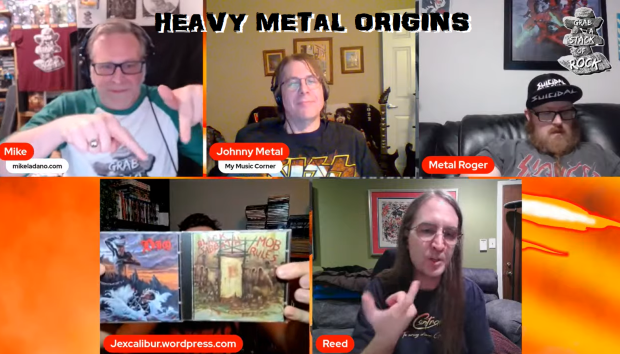
I hope you enjoy this show and this exceptional panel.  See you in two weeks with Jex Russell on Good Friday at a special afternoon time!