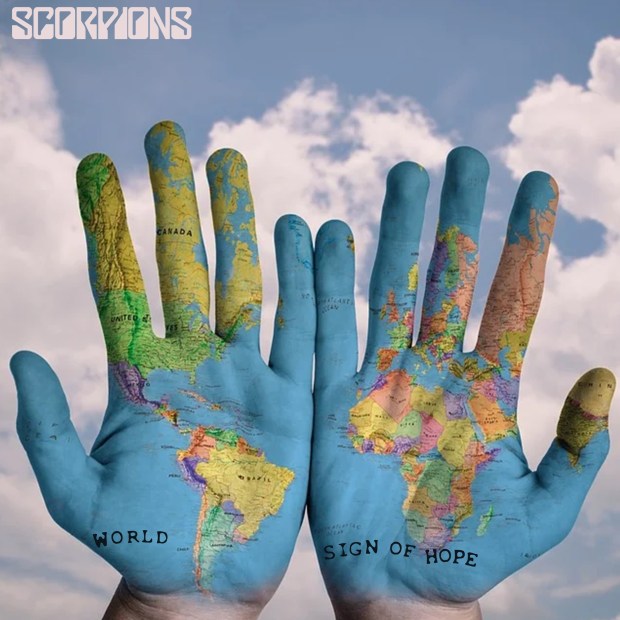
The Scorpions, in the midst of writing their next album, are the latest band to release a lockdown single in 2020. It will come as no surprise that it’s a ballad. “Sign of Hope” is a reassuring song from the guys who know how to write ballads (and reaaaally know how to paaartaaaaaaay!). Of course a ballad is appropriate for these sombre times. “Sign of Hope” sounds like Scorpions circa 1996, the Pure Instinct album. It’s gentle and peaceful. For accompaniment, it’s primarily acoustic guitars, with slight electric guitar accents that pop in and out. It’s actually quite a good ballad, short and to the point. The sparse arrangement really lets us hear the nuances of guitar, and Klaus Meine’s voice. It’s well written and memorable enough.
One could ask, “Why do we need another Scorpions ballad?” Perhaps the simplest answer is because the Scorpions are still around making music. So why not? Will they ever top “Still Loving You” or “In Trance”? It doesn’t matter, because they are in their 55th year and are still creating.
“I see empty places, empty roads,” sings Klaus, and though the streets are fuller now it’s hard to forget the sight of a deserted world. It also strangely seems like such a long time ago that this all began. But the Scorpions reassure us that “it’s gonna be alright,” and eventually it will be. We are getting there. We are indeed seeing signs of hope, but everybody needs to treat themselves well. So treat yourself to some music and grab the new Scorpions on iTunes.
3/5 stars
I also really like the single artwork, I think it’s striking and has several layers of meaning. It’s also nice to see the word CANADA so prominently!
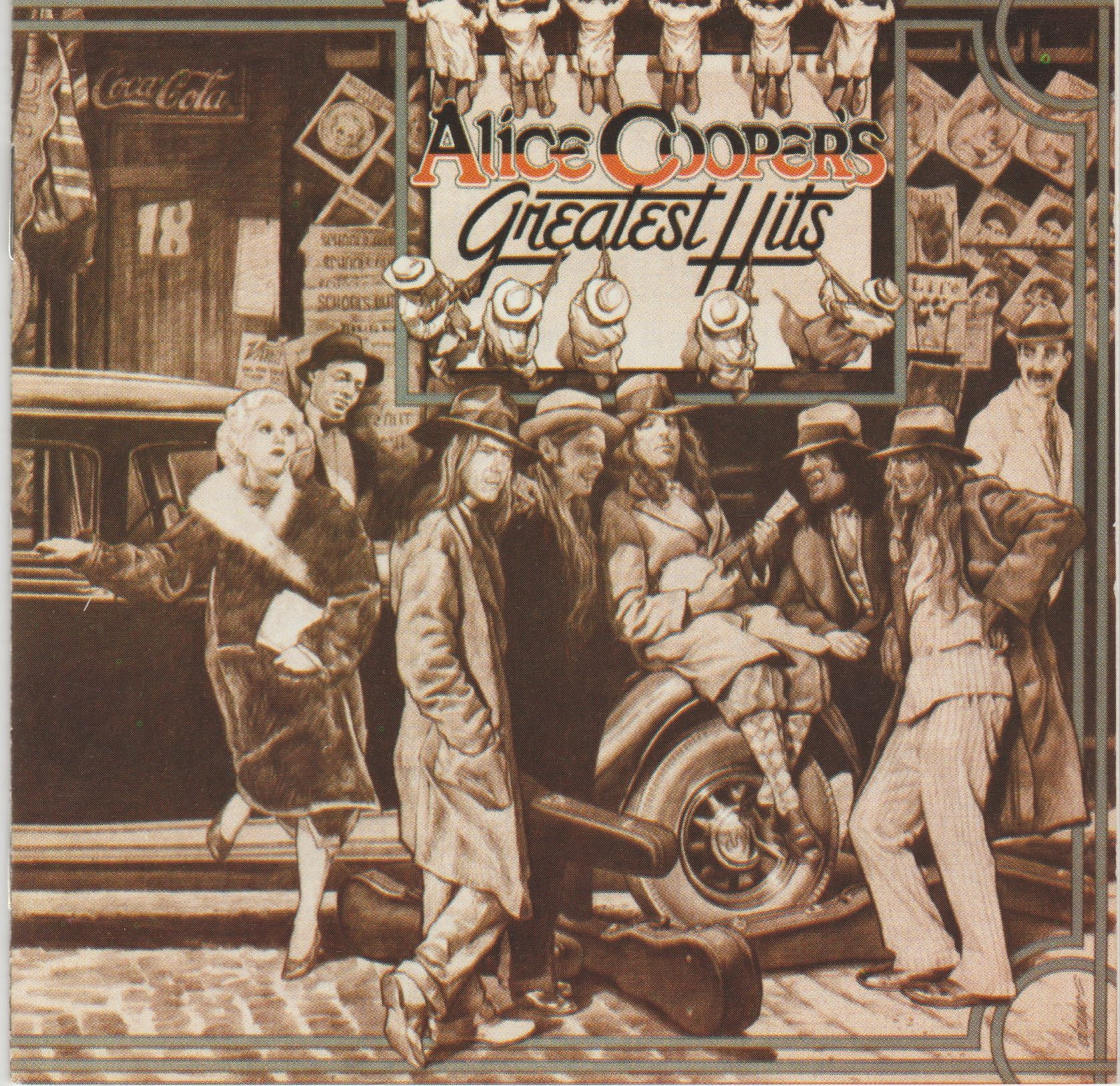
ALICE COOPER – Alice Cooper’s Greatest Hits(1974 Warner)
Picture this: a kid, just turned 17. An older uncle named Don Don. Recording tapes off each other in the summertime. I didn’t know much of Alice Cooper. “Teenage Frankenstein”, “The Man Behind the Mask”, and “I Got A Line On You” were the songs I knew best. I heard a bit of a live version of “I’m Eighteen”, and a Krokus cover of “School’s Out”. That’s all I knew. But my uncle had Alice Cooper’s Greatest Hits in his tape collection, and I had a blank tape.
I recorded Greatest Hits on one side of a 90 minute cassette. (Eventually I taped Trash on the other side.) My impressions at that young age were mixed. The music sounded old fashioned. Not at all like his 80s stuff. While some songs (“Desperado”) flat out lost me, after a couple listens, other tunes started to jump out.
Some of the elements that appealed to me were the lyrics. “She asked me why the singer’s name was Alice, I said ‘listen baby, you really wouldn’t understand.'” (“Be My Lover”.) “The Reverend Smith he recognized me and punched me in the nose.” (“No More Mr. Nice Guy”.) Of course, “Elected” too — that goes without saying. Simple, comedic and effective lyrics.
The huge orchestration behind “Hello Hooray” hit me where it counts too. I grew up on soundtracks and orchestras, so anytime a band used a big bombastic arrangement like that in rock song, it immediately appealed to me. Even then I was aware of Bob Ezrin from his work with Kiss.
My favourite song on the whole thing was “Teenage Lament ’74”. What is it about that song? The old-fashioned jangly rock and roll? The unforgettable “What are you gonna do?” chorus? Although it’s fallen by the wayside since, “Teenage Lament” is still an Alice Cooper triumph of triumphs. On the cassette version, it had a place of honour — second song, side one, right after “I’m Eighteen”. I couldn’t figure out all the words but I got the jist. I still love what I perceive to be its old-fashioned sound. Alice Cooper didn’t need to be heavy to be awesome. I was learning this. None of Alice Cooper’s Greatest Hits would be considered “heavy” by the standards of the time when I first heard it (1989).
“Is It My Body”, “Under My Wheels”, and “Billion Dollar Babies” were the next songs to slowly reveal themselves to me. “Muscle of Love” and “Desperado” were the last ones to enter into this new Alice love affair. Before long, they were all memorized. Then it was time to start collecting the albums! Billion Dollar Babies seemed like a wise choice, since I liked so many of its songs on Greatest Hits. And that’s how a greatest hits album is supposed to work. It is meant to whet the appetite and make you want more.
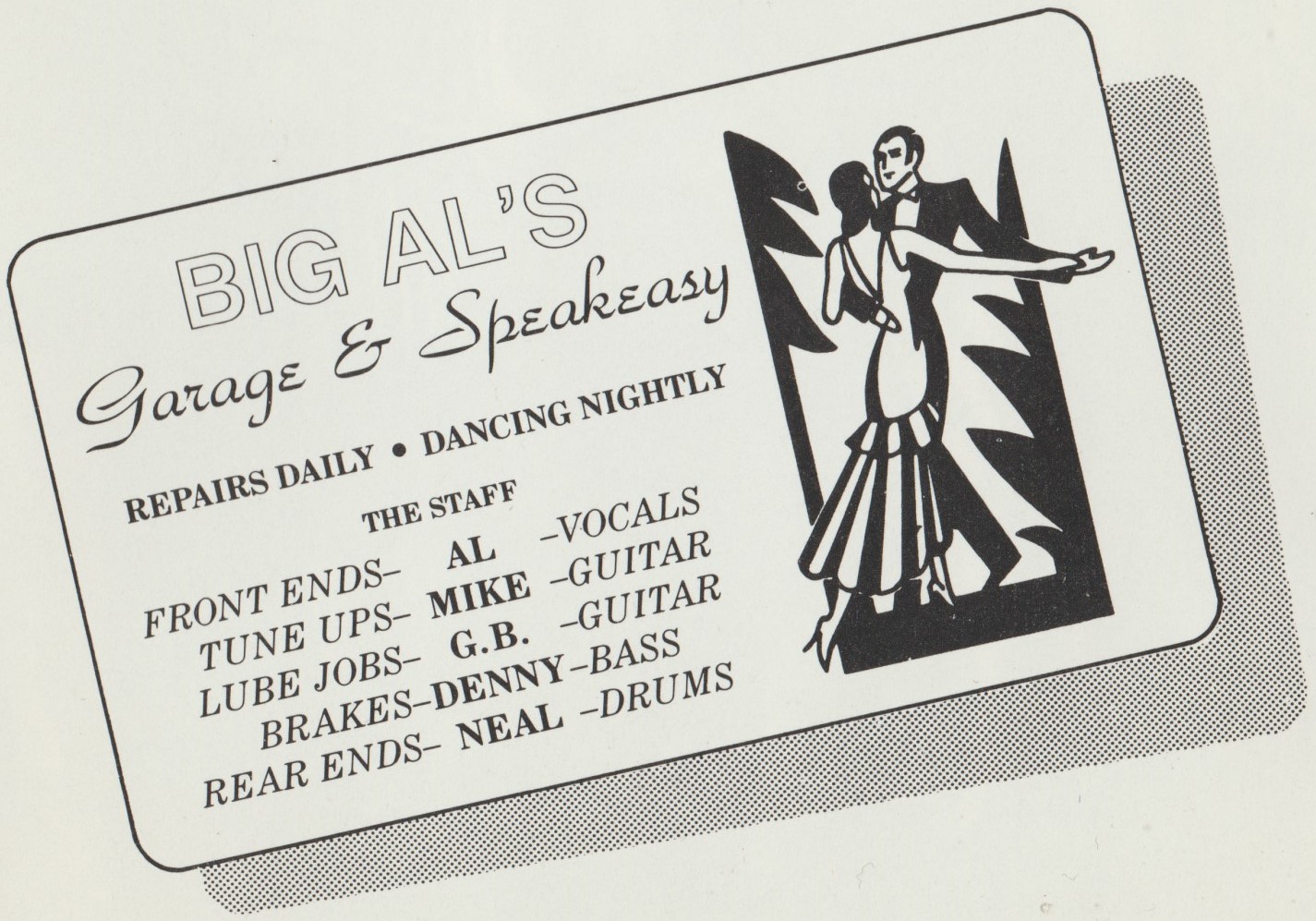
Today Alice Cooper’s Greatest Hits has been supplanted by more recent, more complete greatest hits discs, remastered for the modern age. That’s fine and well, but Greatest Hits works better as a first Alice. The track order, the more concise running time (41 minutes), and of course the classic cover art made this something special. It’s historic as it was the very last product released by the original Alice Cooper group before Vincent Furnier went solo. Also worth noting: all tracks were remixed by Jack Richardson, but you probably won’t even notice. Completionists, pay attention.
Want an awesome first experience with Alice Cooper? Follow my lead and check out Greatest Hits.
QUEEN + ADAM LAMBERT – “You Are the Champions” (2020 iTunes)
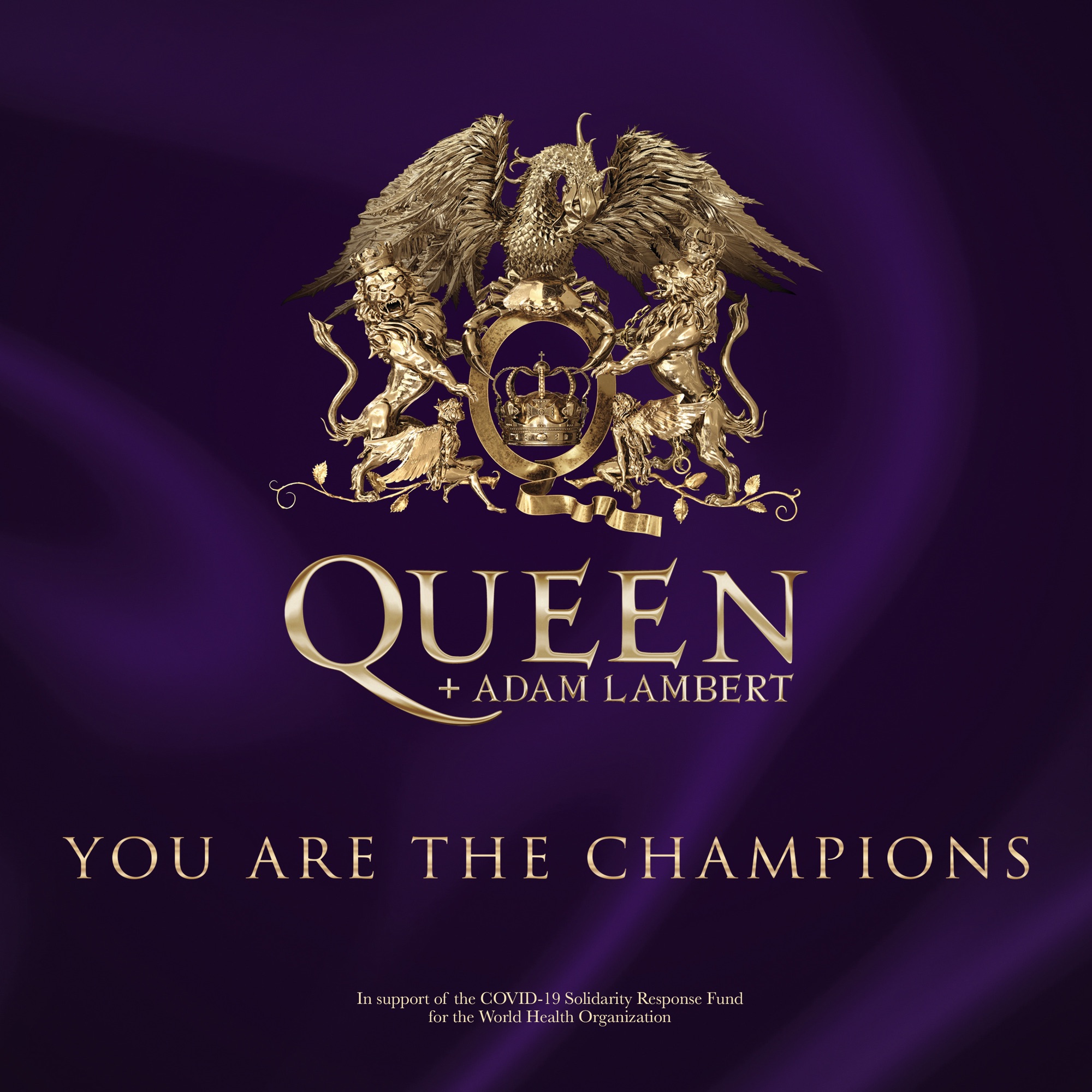
Queen were one of the earlier groups out of the gate with new “lockdown” recordings. From their homes they re-recorded “We Are the Champions”, dedicated to frontline workers, with Adam Lambert to raise money for the World Health Organisation’s “Solidarity Response Fund”. Whatever the cause may be, we are here to review the music.
The idea here is that Queen are not the champions this time — we are! Together we have locked down and sacrificed, and we are doing it for each other. The lyrics don’t really fit but we know what Queen meant. Lambert doesn’t actually change the words to “You are the champions” until the halfway point.
This track is the familiar Queen arrangement, though shortened by a verse. Adam Lambert is a fine singer, as he proves in the outro. Queen didn’t go with the big layered vocals here; perhaps you need a recording studio to do that. Instead Lambert’s voice takes the spotlight by itself. Even the instrumentation is sparse — no solos, and only a couple Brian May guitar noodles to savour.
There’s a striking music video with stark footage of empty streets. I like that Lambert did his hair and makeup to the nines while the other two look casual. Let’s join Queen and Adam in thanking our frontline healthcare workers — and thank you Queen for recording again. How about a new album next time?
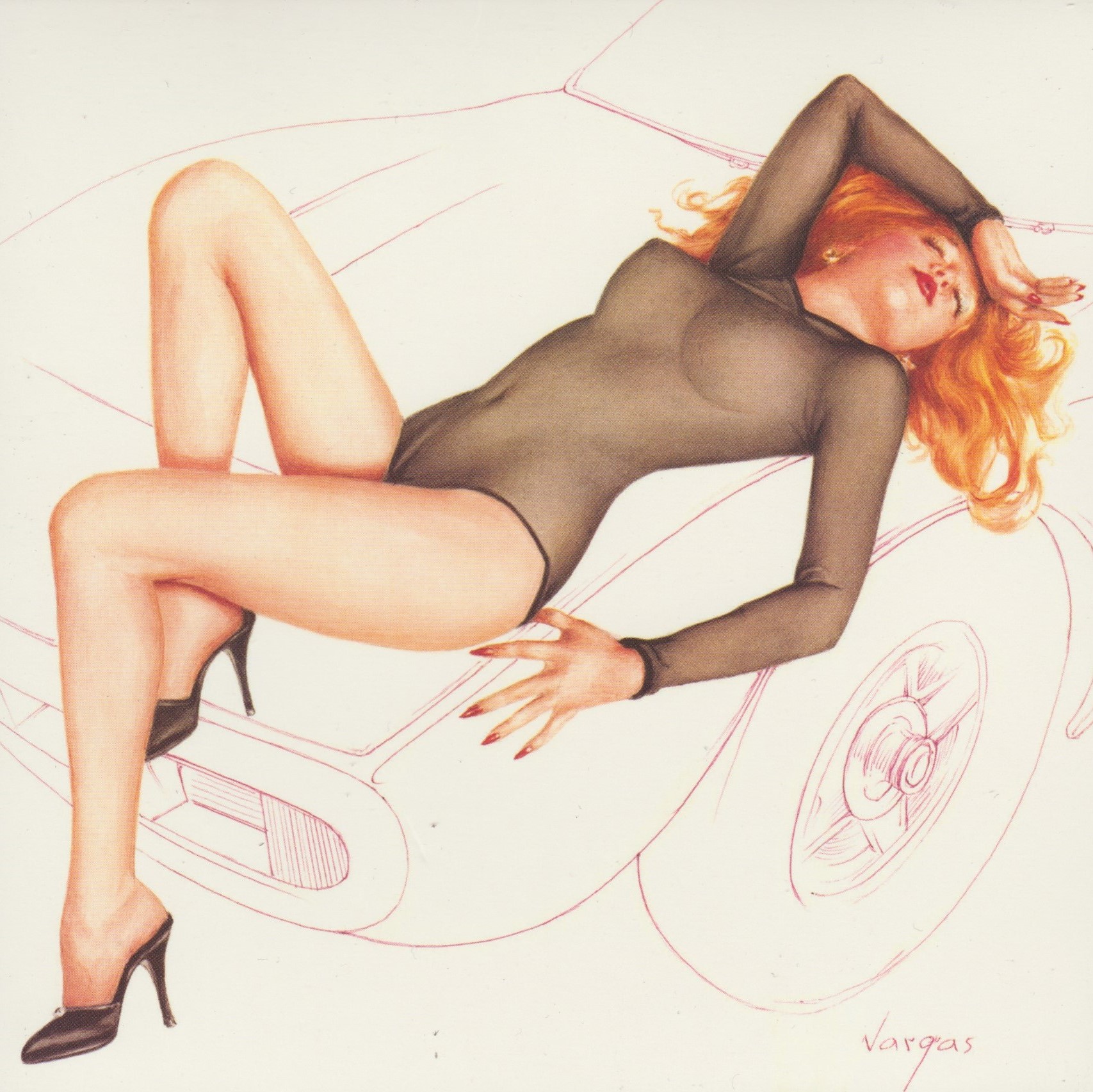
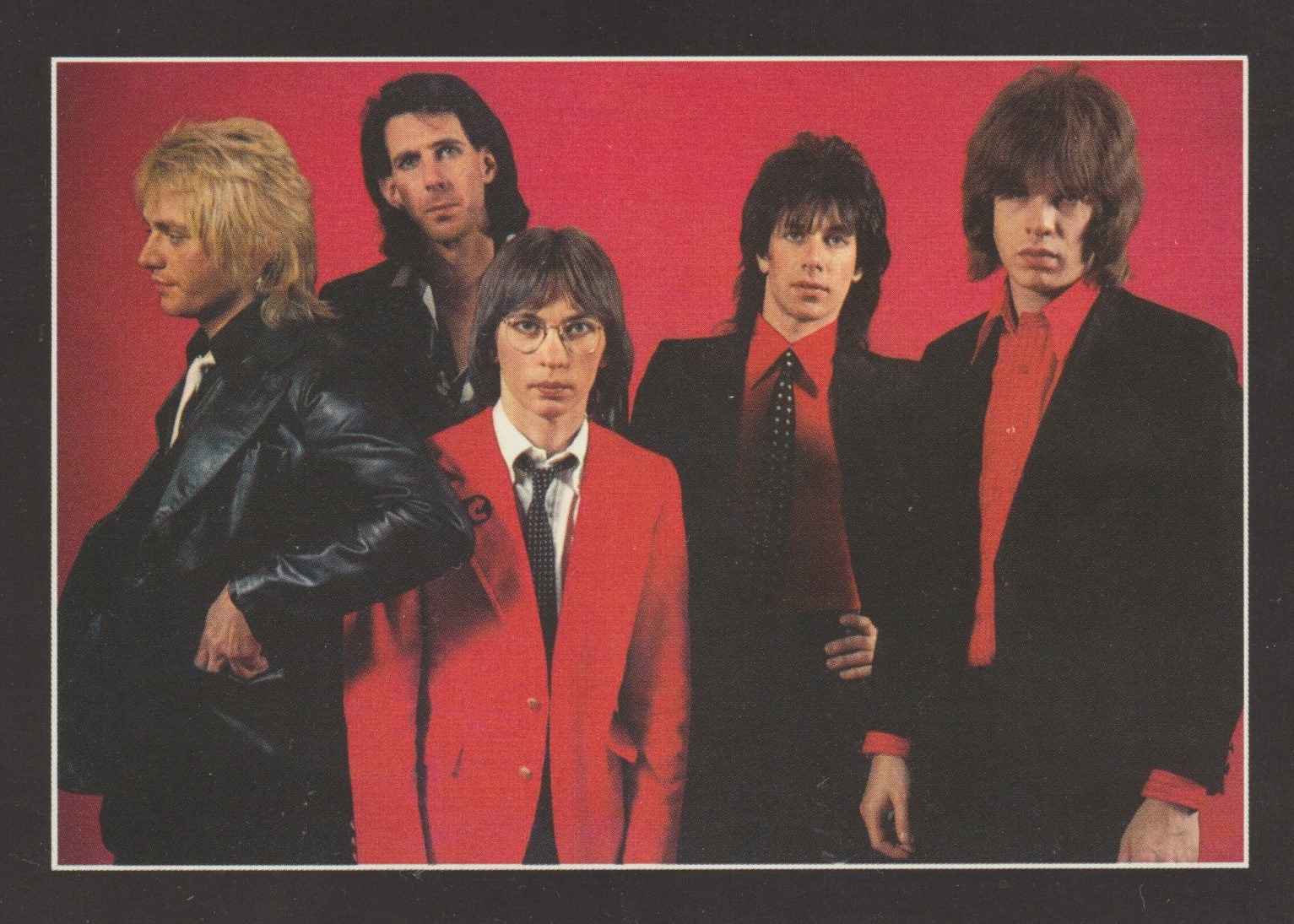
THE CARS – Candy-O(1979 Elektra, 2017 expanded edition)
How many perfect albums are there in the world? Albums with no filler, only songs vital to the whole and valuable to the listening experience? Hopefully you have included The Cars’ Candy-O in your count. The often “difficult” second album was apparently no problem for The Cars. Ric Ocasek came in with a huge batch of new minimalist songs, plus a couple outtakes.
“I like the night life, baby!” Ben Orr takes the first lead vocal on “Let’s Go”, the Max Webster-like lead single. Already off to a great start, this tight little number is subtle and loaded to the gills with hooks.
“Somethin’ in the night just don’t sit right.” Ric Ocasek enters the fray with a quirky “Since I Held You”. The Cars’ unique way with a melody is apparent on this track, one of those deeper cuts you don’t want to miss. David Robinson’s drums — loud and effective at punctuation. Give credit to producer Roy Thomas Baker for wringing every last hook out of these songs.
“And once in a night, I dreamed you were there.” A restrained ballad, it unleashes the melodic power of the Cars at the chorus, given a bump by Greg Hawkes’ mini moog. One of their more accomplished compositions, every part serving its purpose.
“It takes a fast car, lady, to lead a double life.” The possible centrepiece of the album, Ocasek’s “Double Life” smoulders and builds into a dark masterpiece. At one point this track was to be dropped from the album; let’s be glad the Cars came to their sense. Though the song is built on a punchy, sharp beat, Elliot Easton’s guitar melody floats detached above.
“You ride around in your cadium car, keep wishin’ upon a star.” A robotic pulse and frantic vocal make up “Shoo Be Doo”, a transitional piece that serves to bridge the two songs it falls between. Candy-O is beginning to sound like a concept album to the ears.
“Edge of night, distract yourself.” The fierce title track “Candy-O”, fronted by Ben Orr, is another possible centerpoint of the album. The song is layered thick with Elliot Easton’s guitar hooks and Greg Hawkes’ keyboard blips. Though not a single, “Candy-O” has become a favourite and a great example of the Cars’ musical abilities as players.
“Ooh, how you shake me up and down, when we hit the night spots on the town.” Jittery and caffeinated, the noturnal “Night Spots” again verges on Max Webster territory. Ocasek stutters his way through the lyrics while the hyper band get bouncing in behind. It feels like you’ve been staying awake for three days and three nights with nothing but coffee in your blood.
“I can’t put out your fire, I know it’s too late.” The album then takes a sudden left turn back to smoother ground, playing looser on the ballad “You Can’t Hold On Too Long”. The lyrics take a darker turn, with the shadow of addictions.
“He’s got his plastic sneakers, she’s got her Robuck purse.” Ocasek sings an anthem to the mismatched on “Lust for Kicks”, another punchy Cars song though with a laid back tempo. Hawkes’ simple keyboard hook is the main structure, with Easton providing guitar noise far in the background. Ocasek’s expressive vocal is the focus.
“Send me a letter on a midnight scroll.” There’s a frantic energy to “Got a Lot on My Head”, a sense of panic and urgency. This time it’s the guitar in front and some of the Cars proto-punk roots break through. A lot is packed into a short song.
“Can I bring you out in the light? My curiosity’s got me tonight.” A third contender for centerpiece of the album is the closer “Dangerous Type”, and its closing position might be its only disqualifier. Though it has a “Bang-a-Gong” knockoff riff for the verses, the chorus dips into much darker territory. Then another Max Webster moment creeps in when Hawkes adds his moog. This brilliant track is an apt closer for such a quirky yet dark album.
Indeed, Candy-O seems semi-obsessed with the night, with shadows, and with secrets. So it’s quite unexpected how uplifted you feel after listening to it — lighter and brighter. As if the shadows have been exorcised, at least for a little while.
Candy-O itself is only 36 minutes, so if you need a deeper immersion, the expanded edition is perfect. It contains seven bonus tracks: five alternate versions, one B-side and one unreleased song. (There is an additional piece of rare music available separately, a very different early version of “Night Spots” on Just What I Needed: The Cars Anthology). Remarkably, though rougher, most of these are probably good enough for an album already. If you already love Candy-O, you will dig the slightly different and more raw versions offered as bonus tracks. “Dangerous Type” is far less dark, and “Let’s Go” is busier.
“They Won’t See You”, like early 80s Alice Cooper, has a dark campy quality but also a biting guitar hook. It’s actually better than a lot of Cooper from that period, even though it was never released. Apparently it was a popular Cars encore. Finally (and appropriately) its “That’s It”, ending the CD at an hour in length (easy enough to digest in a single sitting). If not for the technical limits of vinyl at the time, it might have made an excellent coda for the original album. It’s a song about endings, so it works naturally at the end of this edition.
Candy-O, with or without the extras, is a perfectly brilliant listen and an album that deserves a place of honour in a collection. But why get 36 minutes when you can have an hour, plus an expanded booklet with lyrics, photos and Easton essay? “Let’s Go”!
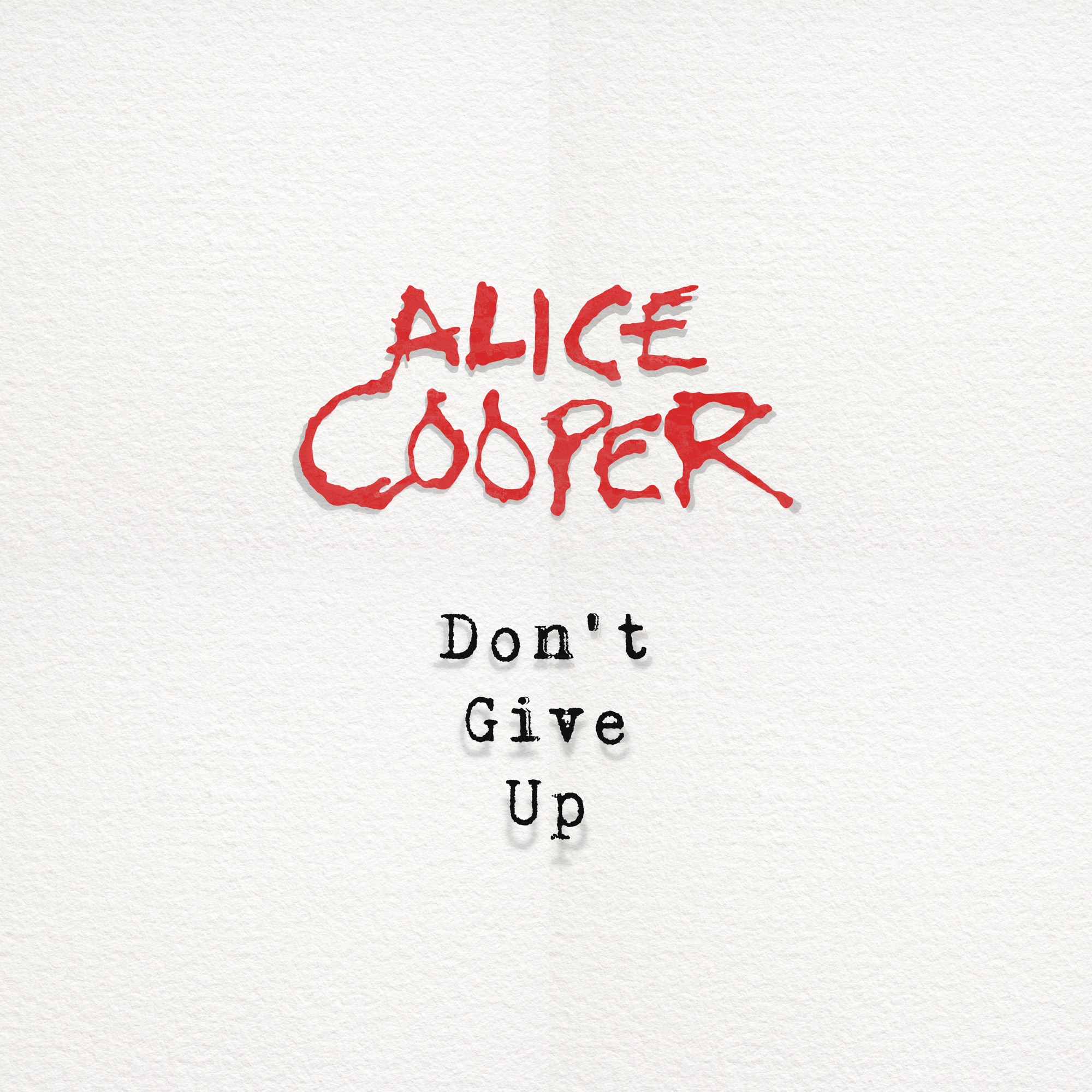
Thank God for Alice Cooper! 50 years ago, he was considered by the mainstream to be nothing more than an untalented shock rocker. In 2020, he is inspiring people to keep on keepin’ on. He’s got a powerful message for anyone who needs to hear it.
“Don’t Give Up” is the most direct, the most topical and the least “Alice” song that the Coop has ever done. Why the “least” Alice? Because this time he is not playing a character. He’s not telling some horrifying bedtime story. Or is he? “Don’t Give Up” is about Coronavirus and blatantly so.
“Yeah, I know you’re struggling right now. We all are, in different ways. It’s like a new world that we don’t even know. It’s hard to sleep, even harder to dream. But look, you got seven billion brothers and sisters all in the same boat! So don’t panic. Life has a way of surviving and going on and on. We’re not fragile and we sure don’t break easy.”
This single was recorded in home studios. It’s accompanied by a cool video expertly produced by Canuck Frank Gryner, using footage sent in by fans. It is so rare for Alice to really make a statement that pertains to current events. And it is a very specific song; there are no underlying stories or metaphors to untangle. But when you think about Coop, it’s not really surprising that he came out of the gates so fast with a song like this. Alice Cooper is a human being that cares about other human beings. The message is simple: keep fighting and don’t give up. Sometimes people need to actually hear the words.
Musically you could call “Don’t Give Up” a power ballad. It has a very 80’s guitar figure, with Alice speaking his message over it. The chorus is more modern, with Alice singing as plaintively as he can. “Don’t Give Up” is unremarkable as a rock ballad, but as a lyrical accomplishment, Alice has forged new ground 50 years on. He has written some remarkably powerful words.
“Our enemy is a cold, indiscriminate monster. It doesn’t care if you’re old or a newborn. It exists to kill. You and I are nothing to it. It has no heart or soul or conscience. Do we fear it? Yeah! Do we cower before it? Hell no! We’re the blood-n-guts human race. And we win.”
The important thing that Alice says here is that it is alright to be afraid. Look, Alice has fought demons, and if this scares him then there is no shame in feeling fear. People are being labelled as cowards for wearing a mask in public. Alice is right — we will win, and we will do whatever it takes to win. If you’re scared right now, you tell ’em that Alice Cooper said that’s OK.
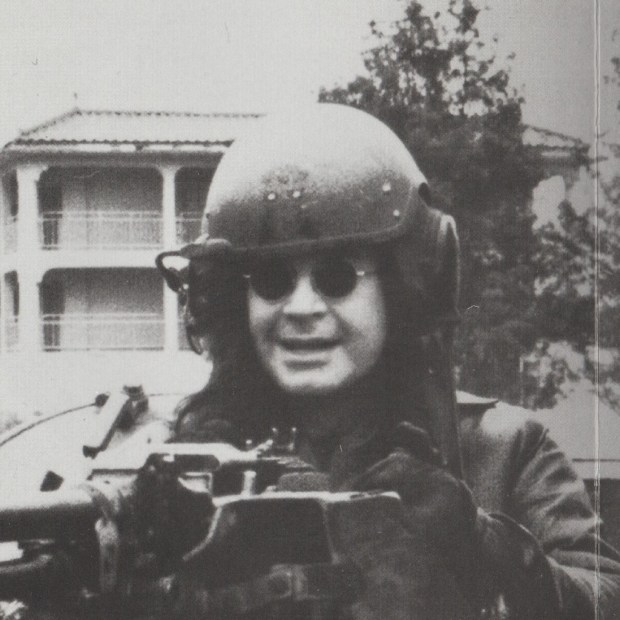
Ozzy’s last paint-by-numbers live album was almost two decades ago. In actuality, you really only need a live one with Randy Rhoads and you’re golden. But if you’re in the mood for downtuned Ozzy songs, Live at Budokan might be the way to go.
While the new rhythm section of Mike Bordin (Faith No More) and Rob Trujillo (Metallica) do have a positive impact on the sound, Zakk Wylde is tiring. His constant divebombing all over Randy’s composition “I Don’t Know” just rubs the wrong way. Then it’s an unremarkable song called “That I Never Had” from Down to Earth. The most enjoyable thing about it is actually Zakk’s backing vocal.
Ozzy spaces out old songs with new ones so sleep doesn’t take you too soon. “Believer” is a nice inclusion, since we’ve never had a version of it with Zakk on guitar. There’s a novelty to it for that reason, so it’s notable. A crap new song called “Junkie” acts as filler before “Mr. Crowley”. They used to have an acronym in Star Trek that they would paint on pipes and conduits on the Enterprise: “GNDN”. Goes nowhere, does nothing. That’s “Junkie”. And “Crowley” just drags.
The last of the new songs here is “Gets Me Through”; the single, you know the one. The one with the hilariously unimaginative lyric “I’m not the kind of person you think I am, I’m not the Antichrist or the Iron Man”. We sure do miss Bob Daisley’s lyrical touch. “Gets Me Through” might be the most paint-by-numbers of any Ozzy track since Zakk joined the band.
Get ready for a whole shit-ton of No More Tears stuff, as Ozzy rolls out four of ’em. The title track is still great and doesn’t strain Ozzy as much as the earlier songs. “Mama I’m Coming Home”, well sure, it has its fans. “I Don’t Want to Change the World” is still a yawn and “Road to Nowhere” fares well. The crowd sure loves ’em, those familiar hits. They go nuts for “Crazy Train” which just doesn’t sound right tuned down like this. Same with “Bark at the Moon”. Ozzy closes with the only Sabbath track on the disc, “Paranoid”. The double tracked vocals are obvious and annoyingly artificial sounding. It’s cool hearing the Faith No More style of drumming all over it though. Mike Bordin is a tremendous talent but was he the right guy for Ozzy Osbourne?
As the most unessential of all Ozzy releases, Live at Budokan should really be the last one to add to your collection. If you care, it was available with two covers: red printing, and black printing. For extra pain, you could also go for DVD. Best track: “Believer”.
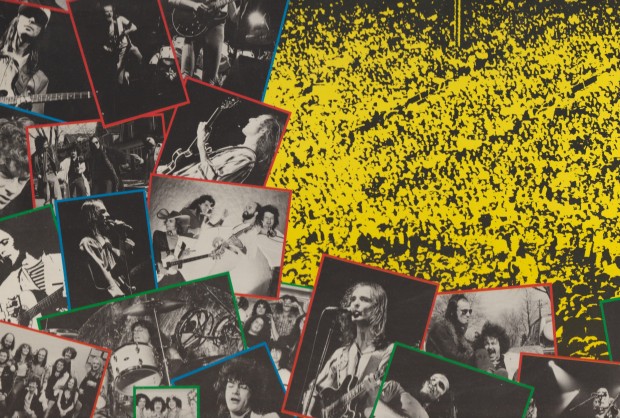
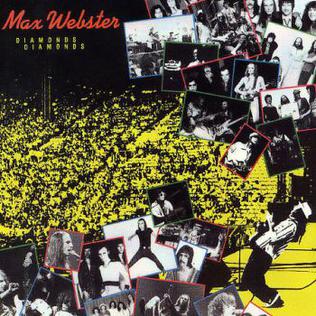
What a title for your first “greatest hits” compilation, eh? Diamonds Diamonds emerged the year after Max Webster broke up, with no songs from the final album Universal Juveniles, the only one without Terry Watkinson. Even though these kinds of posthumous records are usually not very good, Diamonds Diamonds is an exception. It’s also one of the hardest Max Webster albums to find on CD, but a generous slice of vinyl at 13 tracks and 47 minutes.
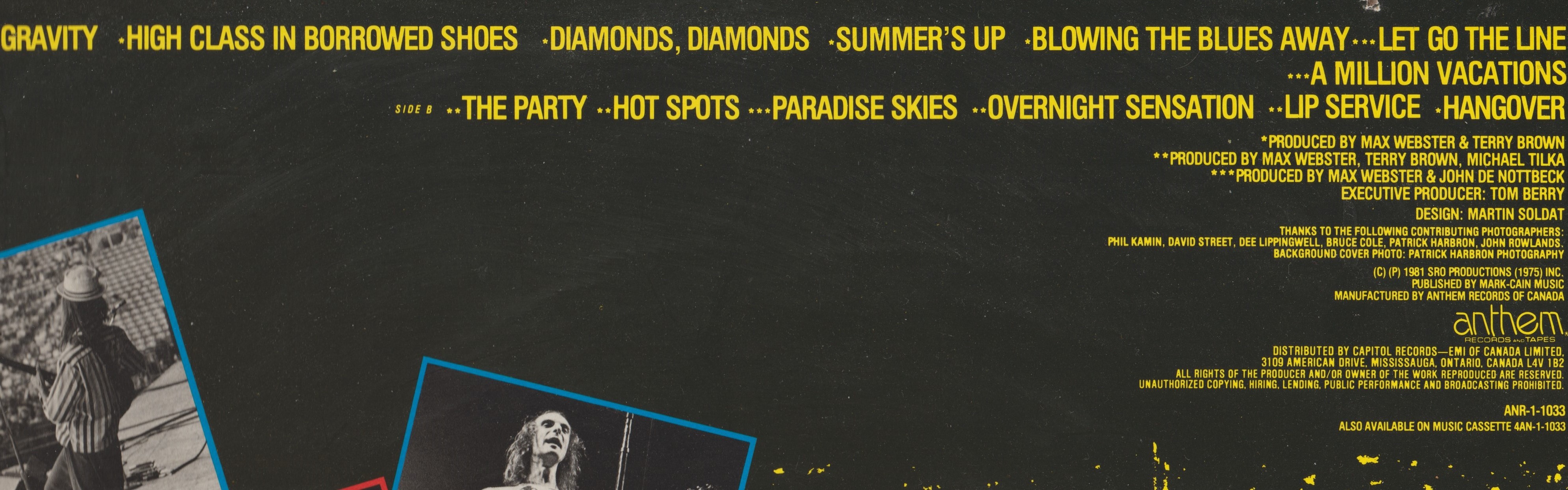
“What do I know?” asks Kim Mitchell in the opening line of “Gravity”, the debut number. Kim knew quite a bit actually, including how to write catchy music without it being overtly commercial. He knew how to challenge listeners while delivering the hooks they craved. “Gravity” is one such slice of brilliance. It’s complex pop.
“High Class in Borrowed Shoes” is a classic rocker from their second album in ’77. As much as it kicks, the lyrics and keyboard arrangement are not typical. The title track “Diamonds Diamonds” followed “High Class” on the original album and it does again here. Like a lullaby, “Diamonds Diamonds” floats on the wings of the backing vocal arrangement. Next is “Summer’s Up” from the incredible debut Max platter. Jangling guitars and dreamy keyboards make for a summer scene by the pool side, with drinks. “Blowing the Blues Away” has a more traditional feel, country and blues and pop rolled into one, with a side order of quirky tones. But it’ll make you feel good. Continuing the feel-good celebration, it’s “A Million Vacations”, one of the greatest Canadian party songs of all time. Kim Mitchell’s guitar work is sublime and baffling at once.
Side A ends with one of Max Webster’s most significant songs, “Let Go the Line” with lead vocals by Terry Watkinson who wrote the song, music and lyrics. In Max Webster, lyrics were usually handled by the poet Pye Dubois. In fact he wrote all but two of the lyrics on Diamonds Diamonds. The two he didn’t (“Blowing the Blues Away” being the other) were written by Watkinson. “Let Go the Line” could not be improved upon if you tried. Kim’s regal guitar line, Dave Myles bass pulse, and the thrift of Gary McCracken’s drums are all flawlessly and perfectly fit to Terry’s ballad. If Max Webster only had one “perfect” song, it’s “Let Go the Line”.
Fearlessly opening side two with furvor, it’s “The Party”! It’s the off-kilter musicianship on tracks like this that had fans often comparing Max Webster to Frank Zappa. Frank liked to have fun, too. Well Max really liked to have fun! “We’re all here for a celebration, the madcap scene and the Max Machine!” That says it all.
Every decent “greatest hits” album needs unreleased songs. Diamonds Diamonds has two decent ones, good songs that might be a bit too mainstream for a Max studio album. “Hot Spots” is the first, a rip-roaring boogie of a good time. By comparison, Kim could have recorded it on one of his early solo albums if Max didn’t release it on this. It is chased by the outstanding “Paradise Skies”, another summery Max hit that keeps Canadian radio stations in business. Melody and musicianship — that should be Max’s calling card. The second of the new unreleased tunes is “Overnight Sensation”, the most ordinary (or forgettable) of the tracks. The bassline really hops, and there’s even some cowbell, but the song isn’t comparable to something like “The Party” or “High Class”.
Although it’s better as an album opener, “Lip Service” (from Mutiny Up My Sleeve) is a bouncer. “Socialutions, written down in our teens. I mailed them to Kennedy, I typed them for Tito.” Brilliance in a pen by Pye Dubois, barely contained by the bopping bass and upbeat keys. Then before it’s all over it goes into a brief jazzy jam! Finally it’s “Hangover”, also traditionally an opening song. It’s the hardest rocker of the bunch, quirky as all hell and actually a good closer too!
Diamonds Diamonds still an important record today because “Overnight Sensation” and the outstanding “Hot Spots” haven’t been reissued on anything else. You can’t say that about any of the songs on The Best of Max Webster (1989). This is the one to get. If you find one on CD, you’ve got yourself a good one.
ZZ TOP – Chrome, Smoke & BBQ (2003 Warner limited edition BBQ shack version)
Though it seems an outlandish thought today, there was once a time when if you desired to hear original ZZ Top music, you couldn’t do that on CD. You had to purchase original ZZ Top LPs. In 1987, most of the original ZZ Top albums were issued on CD as part of the ZZ Top Six Pack, which featured remixed percussion to make them sound more like Eliminator and Afterburner. Needless to say this was a very unpopular idea, though it didn’t stop the Six Pack from selling. The original ZZ Top albums were finally given a CD reissue in 2013. Until then, your best bet on compact disc was to buy the 4 CD Chrome, Smoke & BBQ anthology.
Because Chrome, Smoke & BBQ features original mixes and a helping of rarities, it still makes for an enjoyable listen and valuable collectible today. The limited edition version came housed in a box like a little BBQ shack, but both have the same four discs of bluesy, greasy ZZ rock. A well-assembled anthology can make for a great listen even well after its expiry date, and this is one such set.
Disc 1 of Chrome, Smoke & BBQ features three tracks from Billy Gibbons’ first band the Moving Sidewalks. The guitar work is brilliant even in Billy’s youth. These tracks are notably more psychedelic than ZZ Top. The year was 1969, the same year as the first ZZ Top single “Miller’s Farm” / “Salt Lick”. This early version of ZZ Top (credited as “embryonic ZZ Top”) was a transition from Moving Sidewalks and didn’t feature Frank Beard nor Dusty Hill. Organ on a ZZ Top song is an unusual sound, and it’s quite prominent on “Miller’s Farm”. It’s a pretty standard blues with the emphasis on the keys and with one foot solidly in 60s rock. “Salt Lick” has a bit more of the mid-tempo ZZ groove, but the with the organ still part of the whole. Chrome, Smoke & BBQ remains the easiest way to obtain this rare single.
ZZ Top’s First Album takes the spotlight next with three tracks including “Brown Sugar”, the first “real” ZZ Top track. An impactful one it is, and so obviously ZZ Top. It seems by the time the right three guys got together, the ZZ Top sound was born. “Brown Sugar” is so essential to the ZZ Top sound that maybe the box set should have opened with it, chronology be damned! Dusty’s pulse on bass is already present, and Frank’s sheer style adds some much needed character. Then “Just Got Back From Baby’s” has the spare nocturnal blues that is a ZZ signature.
The next three ZZ Top albums – Rio Grande Mud, Tres Hombres and Fandango! are featured much more prominently with seven tracks apiece. This part of the set is deep with essential music. “Francene”, obviously “Francene”, the catchiest song during this part of history, is present and accounted for. (Even in Spanish!) For relentless groove, ZZ Top never nailed one as hard as “Just Got Paid”, slide guitar right in the pocket. “Chevrolet” showed how they could just lay back. For shuffles, “Bar-B-Q” got the spice you need. “Sure Got Cold After the Rain” covers the sad, spare blues that Billy’s guitar can evoke. The music goes on, and on: “La Grange”, “Beer Drinkers & Hell Raisers”, “Heard It on the X”, “Blue Jean Blues”, “Tush”. Though the songs in between are all excellent as well, it’s hard to ignore the hit power of these tracks.
Six tracks from Tejas feature on this set, still more than half the album. The ZZ Top direction was gradually making tentative steps towards modernizing. “It’s Only Love”, a bluesy country pop, sounds like something new. They hadn’t left anything behind though, as told by the menacing “Arrested for Driving While Blind”. It’s a cleaner, more studio-driven sound, as heard on “El Diablo” with its subtle overdubs and dynamics. “Enjoy and Get it On” is a nice sentiment, with the slide all greased up and ready to go. Two of the most interesting of the Tejas tracks are the quiet instrumental “Asleep in the Desert” and the twangy “She’s a Heartbreaker”.
At this point ZZ Top took a break to decompress after years of consecutive touring and recording. The Best of ZZ Top came out during this break, but what was going on behind the scenes was to be far more important down the road. ZZ Top’s image began its final evolution when Gibbons and Hill returned from vacation with matching full length beards. Their next album Degüello allowed the music to evolve as well. Six songs from Degüello represent this period, along with a rare radio spot advertising the album.
ZZ Top’s cover of Sam & Dave’s “I Thank You” is iconic enough that many people probably assume it’s an original. What was original was “Cheap Sunglasses”, a staggering hangover of a track — the new ZZ Top. Same with “Maniac Mechanic”, a track so bizarre that you could mistake it for Zappa. Meanwhile “I’m Bad, I’m Nationwide” has the laid back, cruisin’ ZZ Top vibe that fans always loved. “A Fool For Your Stockings” showed that Gibbons could still play the blues, too.
Another six tracks from El Loco account for the last hits before the MTV generation took hold. “Leila”, a 50s inspired ballad is clearly an experiment albeit a successful one. As is the surf rocker “Tube Snake Boogie”, a track unlike any ZZ Top ever attempted before. Another ballad, “It’s So Hard” is not out of place, with its roots in soul music. “Pearl Necklace” has surf vibes but is most memorable for its dirty double entendre. “Heaven, Hell or Houston” is even weirder than “Maniac Mechanic”. It’s quite clear that ZZ Top were stretching out, while still maintaining a foot in their bluesy, rock and roll roots.
And then came MTV, the music videos, the car, and the girls. The music was laden with sequencers and electronic percussion, but this unlikely combination is the one that really struck oil. Black gold, Texas tea, and platinum records. Eight tracks from Eliminator are included here, almost the whole album minus three. Only “Thug”, “I Need You Tonight” and “Bad Girl” are left behind. So you get all the hits, and then some. “I Got the Six” had to be on here, a dirty but slick little favourite from the day. “Dirty Dog” is a fun also-ran too, but didn’t need to be on a box set.
When ZZ Top found their successful formula, they really ran with it, right into the next album Afterburner. As we know a sequel rarely tops an original, but the album still features eight songs, and this is where Chrome, Smoke & BBQ begins to stumble. By featuring so many songs from this period, the box set is really unfairly weighted. Surely another few tracks could have been included from ZZ Top’s First Album instead of so many from Afterburner and Recycler. “Can’t Stop Rockin'” and “Woke Up With Wood” could have been dropped, but let’s keep “Sleeping Bag”, “Stages”, “Rough Boy”, Delirious, “Velcro Fly”, and “Planet of Women”. Around Afterburner, ZZ Top had taken their music to its most commercial extreme. They decided to reduce, though not remove, technology on the third album of the MTV trilogy Recycler. Notable from this period: “Concrete and Steel”, “My Head’s In Mississippi”, “Give It Up”, “2000 Blues” and “Doubleback”.
ZZ Top switched from Warner to RCA for their next studio album 1994’s Antenna, and nothing from that era onwards is included. There is still some more music on this box set to enjoy. In 1990, ZZ Top recorded a cover of “Reverberation (Doubt)” by Roky Erickson for the tribute album Where the Pyramid Meets the Eye. Gratefully, this ZZ Top rarity is included here. You can note the Recycler-era sequencers, but they compliment the psychedelic track nicely. This is followed by the two “new” songs that ZZ Top recorded for 1992’s Greatest Hits. “The corniest Elvis song ever” is “Viva Las Vegas”, sung by Dusty Hill, and overproduced to the gills. Huge hit of course. “Gun Love” is also included.
Disc 4 ends with six “medium rare” tracks. Some are actually super rare. These include a spanish version of “Francene” with Dusty Hill singing. It sounds like thie audio could be taken from an actual vinyl single. A live version of “Cheap Sunglasses” comes from a 1980 promo-only single, and it smokes. Then there are some dance mixes from 12″ singles, easily the most skippable part of this box set. None of these will be played regularly by you, the listener. Especially not “Viva Las Vegas”.
The booklet included with Chrome, Smoke & BBQ is impressive on its own. It’s packed with music and text, including a track by track commentary by the band. “Seems like all our songs are about dicks and pussies,” says Frank Beard.
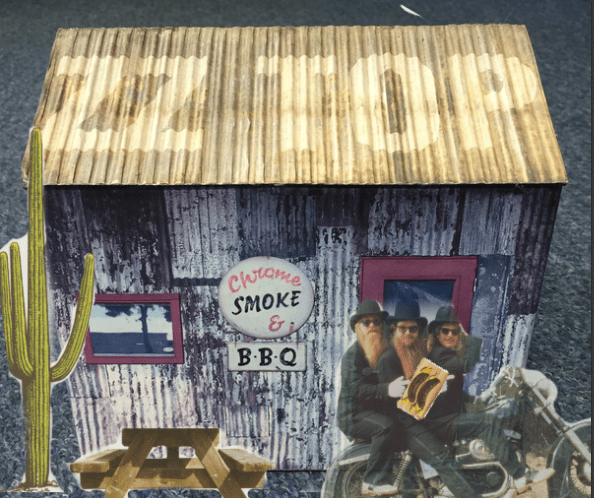
Limited edition box sets are fun to get while they last. Chrome, Smoke & BBQ boasts its box shaped like a steel shack, including corrugated roof. (It’s actually great because it doesn’t collect dust!) Include the box, all four CDs are safely housed in individual jewel cases. If you dig inside a little more you’ll find cut-out characters to add to your BBQ shack display. You could scan and print these cut-outs yourself. Enjoy a picnic table, ribs, sausages, cacti, and of course the guys from ZZ Top themselves (on a bike, or disembarked). Also hidden in the box is an animated flip-book. See the video below for a quick demonstration.
As with many box sets, tracklists could use a little tweaking and everybody will have their own ideas for how to fix that. Perhaps instead of dumping all those remixes at the end, they could have been included chronologically so the set doesn’t end on such a…tepid concept as the extended dance remix. The set could certainly use some balancing away from Afterburner and Recycler with more focus on the earlier stuff. The exclusive rarities are adequate and appropriate for a set of this stature. Not too few, not too many. The ZZ Top completist will want this set for them and will still enjoy giving it a complete spin from time to time.
The regular edition will do nicely, but if you can find a complete limited version for a good price, don’t hesitate to snag it.
Think of this as a companion piece to Live and Dangerous. Four tracks were previously released on that landmark live album. Still Dangerous has a bunch more, purportedly recorded in October 1977 in Philly. 10 tracks; 12 if you got it on vinyl with bonus 7″, on iTunes, or in Japan.
Like Live and Dangerous, what you get is live Lizzy at their peak, well recorded, and charismatic as ever. It’s interesting that they opened with “Soldier of Fortune” since it’s a slower number, though no less powerful than any others. It merges into “Jailbreak”, leaving the audience no chance to breathe…only to be rocked. Impressive guitar and drums on this one.
“Cowboy Song” and “Boys are Back in Town” are the same as Live and Dangerous; legendary! Basically one long ongoing song. Phil introduces their then-new single “Dancing in the Moonlight” as a song with some sax and sex. Yet it has a youthful exuberance. “Now we go steady to the pictures, I always get chocolate stains on my pants.” You can picture that long, hot summer night. The next track, the blistering metal of “Massacre” is from Live and Dangerous. Just listen to Brian Downey on the drums, a prototypical metal machine. Without “Massacre” there could be no Iron Maiden.
“Opium Trail” doesn’t let up the aural assault. Brian Downey impresses once again with his creative fills and patterns. Lizzy moves on to “Don’t Believe a Word”, an older classic but just slightly sluggish. There are more energized versions out there. “Baby Drives Me Crazy” is also a bit dull, with one of those long audience singalong sessions. The standard CD closes with “Me and the Boys”, furiously fast and fun! It’s a long jammer, but its caffeinated pace really keeps things moving.
The two iTunes bonus tracks (mastered annoyingly louder) are “Bad Reputation” and “Emerald”. Only Emerald was previously available on Live and Dangerous. “Bad Reputation” is pure smoke.
Since this album was mixed by Glyn Johns and Live and Dangerous was not, one must assume even the tracks from that album are presented differently here. If you already know that album front to back, then enjoy the fresh sounds of Still Dangerous instead.
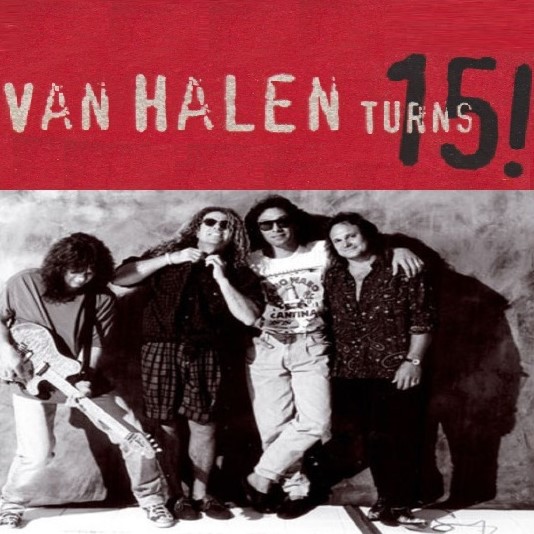
VAN HALEN – Selections from LIVE: Right here, right now.(1993 Warner promo EP) “Van Halen turns 15!”
Stuff like this is in my collection not because it’s valuable to me, but because at one point in time I got it for free. We ran across promos like these all the time, and couldn’t sell them, so they were free to take. Because it was Van Halen, I hung onto it even though all five tracks are taken from the live album Right here, right now. It disappears in your CD collection due to the jewel case without a back cover or spine. For the sake of simplicity (and a shorter title), we’ll just refer to this EP as “Van Halen turns 15”.
It actually plays really well. Without any filler or solos, it’s a tight CD packed with some of the best songs. “Dreams” serves as a connection to the earlier pop rock sounds of 5150. Live, it rocks with higher octane than the studio version. “Judgement Day” was one of the better representations of the then-new For Unlawful Carnal Knowledge material. Its modern groove was predictive of the kind of music people would want to hear in the 90s: heavier with more edge. “Ain’t Talkin’ ‘Bout Love” is the one token DLR track, and then seemingly to balance things out, it’s Sammy’s “One Way to Rock”. Whatever — the listening experience is perfect.
Because “Right Now” was the biggest thing since Crystal Pepsi, it’s inevitable that the live version was included on this CD. If you find “Right Now” to be vomit-inducing, you can just hit stop.
Since this is a promo and should only be sought as a freebie, appointing it a score out of 5 stars is meaningless. Radio stations are always ditching boxes of old CDs so it’s bound to turn up somewhere.


















You must be logged in to post a comment.