Van Halen had some of the best videos of the 80s, bar none. After David Lee Roth, the visionary behind the videos, left the band, they refused to film any new clips for their first six singles with Sammy Hagar! They didn’t want the comparisons. Instead they released live versions of singles as videos. They finally filmed an actual studio video for the ballad “When It’s Love” in late 1988.
It seems Van Halen still can’t reconcile all the different singers from the past. That is obvious by the omissions from this disc. Go ahead and list the missing videos:
The excellently corny “Oh Pretty Woman”. “You Really Got Me”, the timeless Kinks cover. The live videos for “Unchained” and “So This Is Love”. All the live video clips are missing, even Sammy’s debut in “Why Can’t This Be Love”. As is Gary Cherone’s “Fire In The Hole”. “Feels So Good”, “Top of the World”, “Amsterdam”…all missing.
At least they included one Cherone video (“Without You”), but then again, he was the band’s current singer when this was released in 1998. It would have been weird if he wasn’t on it. He hasn’t made an appearance or even been mentioned on any Van Halen releases since.
For Van Halen to refuse to release those videos on DVD just indicates they’re scared of their own shadows. You can’t bury your past, you may as well celebrate it.
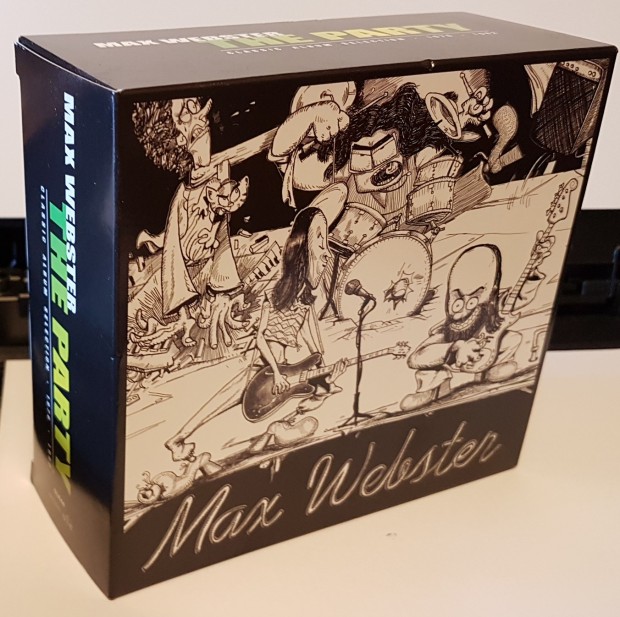
MAX WEBSTER – The Party (2017 Anthem 8 CD box set)
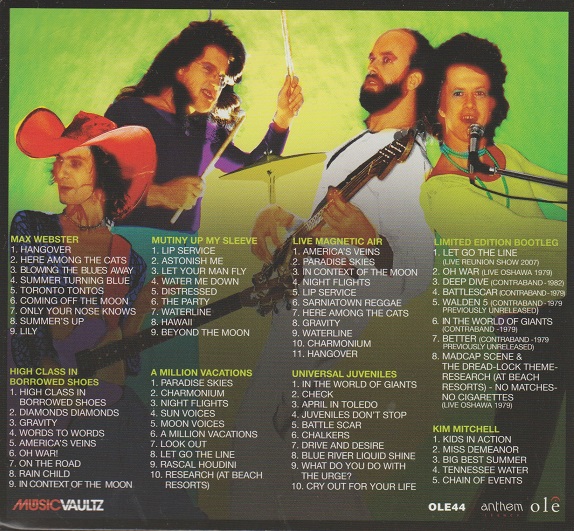
Normally when we review box sets like this, we prefer to review each album individually. Three of the eight discs have already been covered here: Max Webster (their debut), High Class in Borrowed Shoes, and Universal Juveniles (their final album). The rest of the Max Webster albums will be reviewed in due time, so for now we will take a general look at their brand new CD box set, The Party.
The Max Webster catalogue (and to a lesser extent, the solo Kim Mitchell discography) has been well overdue for a remastering. The original Anthem CDs are thin and tinny. Rock Candy did a fantastic remaster of the first three albums with better sound and a generous booklet, but what about the rest? I first heard about this project via Uncle Meat this past summer at Sausagefest. It was one of those “know a guy who knows a guy” stories, but the bottom line was, Max Webster’s catalogue was being remastered. And now we have The Party in hand as proof!
The contents include all five original Max studio albums, their concert opus Live Magnetic Air, Kim Mitchell’s very rare solo EP, and a bonus disc of rarities called The Bootleg. Those who buy the forthcoming vinyl version will also receive a booklet with rare photos and other goodies. The CD version has no booklet, but it does have nice gatefold packaging for each album. It’s affordably priced, so we forgive the lack of a booklet on the CD edition. Vinyl owners can look at it as a bonus for buying vinyl.
If improved audio is what you are longing for, then you should be very satisfied with The Party. It’s not overdriven, but it sounds fuller and deep. They didn’t go for loudness. This is all very good. You can safely ditch your old CD versions, rendered obsolete by this box.
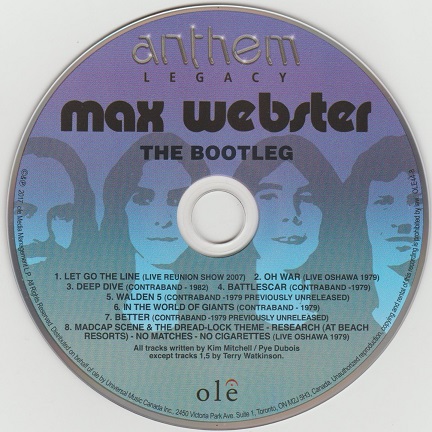
The Bootleg will be the main draw for many. It does not disappoint. In fact, it intrigues, because it teases that there is more. Unreleased demos are listed as “Contraband” — reports suggest this refers to a collection of unreleased material still in the vault.
Max Webster apparently recorded their 2007 reunion show, or at least “Let Go the Line”. It sounds brilliant and makes you pray for a live album of the show. Terry Watkinson’s classic ballad sounds a little older, a little wiser, but just as brilliant as ever. Other live stuff from 1979 was recorded in Oshawa. “Oh War” simply smokes, and was not included on Live Magnetic Air. Then there’s the crazy jam centred on “Research (At Beach Resorts)”. These insane live sessions really show why Max Webster is held in such high esteem, almost like a second coming of Frank Zappa himself.
The unreleased demos include some songs that didn’t make Max’s albums. Fans know “Deep Dive” from Kim Mitchell’s solo live album, I Am A Wild Party. Max’s original 1982 demo is completely different. Same melody, same words, but a vastly different arrangement. It’s like rock and roll bluegrass, fast as possible, and insanely good. It was likely deemed too different to be on the Universal Juveniles LP, but there’s no doubt it’s awesome and the highlight of this box set.
Another standouts from the batch of demos is a version of “Battle Scar” without Rush; just Max! It’s a revelation; an interesting work in progress. There are also two songs you’ve never heard before, “Walden 5” and “Better”, both from 1979. Let’s just say that the quality of these unreleased Max songs is album level. “Walden 5” just needed some editing. A demo version of “In the World of Giants” from 1979 has way more guitar soloing. Kim fans will love it! Oh — and stay tuned for a surprise unlisted bonus track.
The box itself is just a cardboard sleeve, but at least an attractively packaged one. Yes, a booklet would have been appreciated. In lieu of that, we recommend Martin Popoff’s brilliantly detailed book Live Magnetic Air: The Unlikely Saga of the Superlative Max Webster to accompany this otherwise perfect set.
Oh, one last thing: The two “new” songs that were included on the hits compilation Diamonds Diamonds are not in this box set. So, to be a completist, you’d still need to track that one down. Vinyl is recommended; and then you’d own “Hot Spots” and “Overnight Sensation” to complete the picture. Just a word to the wise.
GRETA VAN FLEET – Black Smoke Rising(2017 Republic records EP)
Sometimes a tune just comes outta nowhere and takes over. Greta Van Fleet’s very Zeppelin-like “Highway Tune” is one such song. Who are Greta Van Fleet? Three young brothers and a buddy from Frankenmuth, Michigan of all places! (These guys weren’t even born yet when I was last in Frankenmuth singing Zeppelin karaoke, so I cannot claim to have influenced them at all.) They describe themselves as “a blues influenced rock n roll band picking up where classic rock left off”. Black Smoke Rising is their second EP, after the very rare Greta Van Fleet: Live in Detroit (2014).
They call themselves “blues influenced”, but the truth of the matter is that they sound like the second coming of Led Zeppelin. That’s not a terrible thing, and given their ages, certainly forgivable. They have a whole career ahead of them in which to grow. The good news is that regardless of the various shades of Zep, all four tracks are excellent.
Singer Joshua Michael Kiszka is a born star. At times he’s a dead ringer for young Robert Plant. At others he’s more like Andrew Stockdale. He also shows his own character and lung power. The point is, this guy is special. Not that anyone in the band is a slouch, but there is one obvious immediate standout.
It’s easy to compare these tracks to earlier ones. “Highway Tune” is a bit of an amped-up “The Rover”. Zep bleeds into “Safari Song”. You can hear “Down By the Seaside” and “Your Time Is Gonna Come” at the tail end of “Flower Power”. Their most unique song is closer “Black Smoke Rising”. If anything it sounds more like “Fight the Good Fight” by Triumph than anything like Zeppelin, but it’s more than that. It sounds like a hint of what this band can progress into.
Keep an eye on Greta Van Fleet and by all means, get this EP.
Still On Fire – Dave Thomas & Anders Holm (1988 Melody Line)
In the 1980s, there were generally no Kiss books on the market. If you found one, you bought it. The only widely known Kiss book back then was 1978’s paperback Kiss by Robert Duncan. I was lucky to find Kiss Still On Fire in Stratford Ontario on December 27, 1990 in a great little store called The Book Vault. Still On Fire is very very unofficial, but it was unequalled in its time: 130 magazine sized pages, mostly in full colour, loaded with pictures, facts and a few errors.
Peppered with old interviews and article snippets, Still On Fire takes a balanced look at the band and isn’t afraid to get critical when it’s warranted. It also attempts to take a crack at who played what on some of those tracks where it wasn’t quite clear. For example, Ace Frehley is pictured on the front cover of Killers, but didn’t play on any of the new songs. Still On Fire quotes a Paul Stanley interview. Was it Bob Kulick playing lead on these tracks? “Bob did come out, yes, but he didn’t play. When I couldn’t handle things — and I don’t consider myself the ultimate lead player — another friend of ours came in and gave us a little help.” The book states this friend was Robbin Crosby of Ratt, a claim that is not backed up in other sources. Did Crosby play on Killers? Who knows, but according to this book, he did. Other books such as Julian Gill’s Kiss Album Focus claim Bob Kulick did play some on Killers. In other words, if you read something interesting in this book that contradicts what you’ve read elsewhere, take it with a grain of salt.
There’s a bit of content here about what Gene was doing in the 1980s outside of Kiss: producing bands such as Black & Blue and EZO. Gene was responsible for EZO’s fantastic single “Flashback Heart Attack”, co-written by James Christian of Simmons Record act House of Lords. Gene was also working on movies but was having trouble finding the time. Apparently Sergio Leone really wanted Gene Simmons for Once Upon a Time in America in the role of Max, ultimately played by James Woods. Can you imagine?
Besides the ample photos, the most impressive feature of Still On Fire is the discography. Though incomplete, Still On Fire attempts to document myriad Kiss bootleg recordings, including cover art. There are also interesting promo and foreign releases, such as the Special Kiss Tour Album and Kiss – The Singles. Side projects and solo albums are included, from major (Frehley’s Comet) to obscure (Bruce Kulick’s band The Good Rats). A variety of singles, picture discs and videos are on display, fully illustrated. All of this was completely new to me then. Not to mention the titles of unreleased songs! What the heck were “Don’t Run” and “The Unknown Force”? (The Elder demos.) This is also where you’ll find the most typos and spelling errors. (I really want to hear this song called “Pick It Up”.)
Still On Fire isn’t definitive nor is it definitely 100% accurate, but it should still prove to be a valuable resource for your Kiss library.
Though hard to believe, in 1988 Kiss needed the money. According to CK Lendt in his book KISS and Sell, they were in trouble financially. Some bad investments and too many expenses, plus the underperformance of Crazy Nights, had the band in a bind. The traditional easy solution is to throw together a “greatest hits” set.
Gene announced this album to Canadian audiences on a trip to the Great White North promoting his record label, Simmons Records. House of Lords were the band he primed to be big, and their debut album is held in high esteem by rock connoisseurs worldwide. It seemed to fans that Simmons was transitioning from Hollywood to businessman. Surely, it was hard to believe him when he claimed Kiss was still his priority.
Greatest hits albums need something new to sell them. This was left to Paul Stanley, who produced two new songs co-written with Desmond Child (and Diane Warren on one). It seems unlikely that Gene cared much at this point. In the music video for one of the new songs, “(You Make Me) Rock Hard”, he can be clearly seen miming the wrong words.
Speaking of music videos, “Let’s Put the X in Sex” was something new for the band (and it wasn’t the lawsuit from the people who owned the building in the video). Suddenly, Kiss were a three-piece backing band with a guitar-less frontman. At least in the videos for Crazy Nights, Paul Stanley wore and danced with a guitar. In “Let’s Put the X in Sex”, he is front and center, without instrument: the frontman. Gene’s just the bass player in these videos, looking completely lost. Paul was doing all the work behind the scenes, therefore he was going to take the spotlight. And why not?
Getting two new Kiss songs on a greatest hits was good in theory. Even back then, we sensed they were more the “Paul Stanley Project” than Kiss. For Kiss, they are too light and glossy. “Let’s Put the X in Sex” has horns (or is it synth?) making it sound vaguely like an Aerosmith outtake from Permanent Vacation. At least Steven Tyler injects a little cleverness into his innuendo. Both Bruce Kulick and Eric Carr rise to the occasion with worthy work, but the tune is a dud.
Likewise with “(You Make Me) Rock Hard”, which passed for a rocker at the time. Neither of the new tracks are as good as the four on Kiss Killers. Paul must have just been out of gas. He states these songs were the best he could do at the time without his partner in crime. “Rock Hard” is just Kiss by numbers.
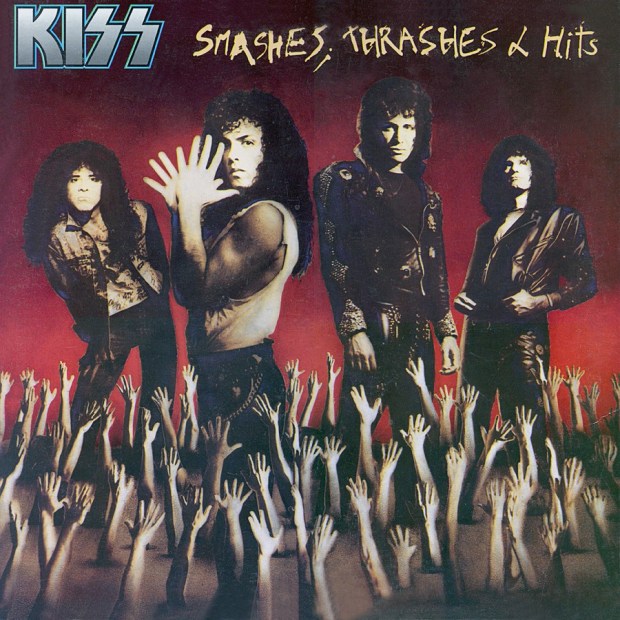
First two tracks aside, Smashes, Thrashes & Hits contains 13 of the greatest. Most are remixed (ill-advisedly) to bring all the tracks to a standard sonic backdrop. The remixes are from a variety of names in a number of studios: Dave Wittman, David Thoener, Jay Messina for example. Some played it a little more loose with the tracks, others didn’t meddle much. “Love Gun” is an example of a remix that changes things up, but still works. Ace’s solo is given more emphasis by mixing out the vocals. It’s a cool alternate arrangement. Excess echo is added on the drums…you can’t win ’em all. Many of the remixes suffer from drum related issues.
Smashes, Thrashes & Hits takes a scattershot approach to running order. It’s very telling that no tracks from Crazy Nights were included, except in the UK where “Crazy Crazy Nights” and “Reason to Live” were hits. No tracks with an Ace Frehley writing credit were included, and only one from Peter Criss. That’s another gripe that fans have with this album.
“Beth” is included, a throwback to one of Kiss’ biggest hits, which they tended to shun since Peter’s 1980 departure from Kiss. It’s considered a slap in the face to Peter that Eric Carr was called in to re-record the lead vocal. The backing track is identical. Carr never felt comfortable in this role, but had never been featured on an album lead vocal before. It was a hell of a dilemma for the drummer. He’d been in the band for six years and six albums, and never got a lead vocal. He did the best he could. The re-recorded “Beth” didn’t replace the original, and it remains an oddity in the Kiss canon.
One afternoon in the summer of 1990, Bob and I were hanging out with these two girls at his trailer that we were going out with. We were listening to songs, but Bob and I didn’t seem to get much say in what songs. One of the girls said, “I have some Kiss!” and put on Beth. As soon as she did, I had a feeling it wouldn’t be the original. Simultaneously, Bob and I both said, “Oh no, it’s Eric!” The girls had no idea what we were talking about or why it was a big deal.
Smashes, Thrashes & Hits was the first compilation to reconcile the makeup and non-makeup eras of Kiss. The majority are from the makeup years, as it should be, with only three from non-makeup albums. You could argue for this song and that song, but the running order is jarring. “Heaven’s On Fire” into “Dr. Love” is not even as bizarre as “Beth” into “Tears are Falling”. The less familiar remixes don’t help the situation. Incidentally, the only songs untouched by remixers’ hands are “Lick It Up”, “Heaven’s On Fire”, “Tears are Falling” and “I Was Made For Lovin’ You”.
There was no tour for Smashes, Thrashes and Hits. Gene had his label stuff, including a new Canadian band called Gypsy Rose to think about. (Remember “Poisoned By Love” on Simmons Records?) Paul Stanley didn’t want to sit idle, and so did a 1989 solo tour. Kiss family member Bob Kulick returned to his side on guitar. Kiss keyboardist Gary Corbett was there with bassist Dennis St. James and ex-Black Sabbath drummer Eric Singer. The setlist featured a number of old Kiss classics that hadn’t been played live in 10 years, such as “I Want You”. Eric Carr was unhappy about the solo tour, worrying about what it meant. Like most Kiss fans, he wondered if it was the beginning of the end. He also worried that Paul didn’t ask him to be his solo drummer. Paul said it was because two Kiss members wouldn’t be right for a solo tour. Ominously, Eric Carr said about Singer: “That’s the guy who’s going to replace me.”
Fans were confused and some were unhappy. Like they had once before, Kiss were drifting further and further into pop music. This time, it was without Ace Frehley to keep them anchored. Paul Stanley now seemed to be a Bon Jovi-like dancing frontman. These new songs were not easy to stomach, and the Eric Carr vocal felt all wrong. Had Kiss lost all credibility? Smashes, Thrashes and Hits wasn’t winning any back.
A question I often get is “Have you heard ‘x‘ by ‘band y’?” I’m always eager to offer up opinions, but like any other music collector, there are albums I simply have not heard yet. Friends and fellow writers continually offer fantastic suggestions, but time and money are always limited. I like to listen to my old music too, and not just stuff that is new to me all the time. Getting caught up on bands I may have missed is a time consuming process.
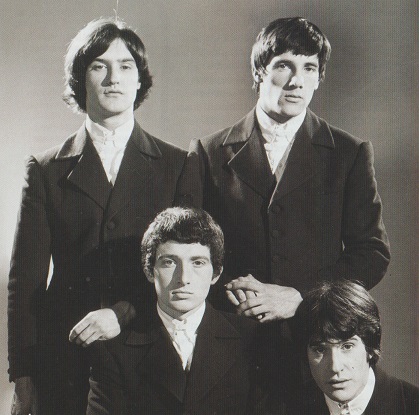
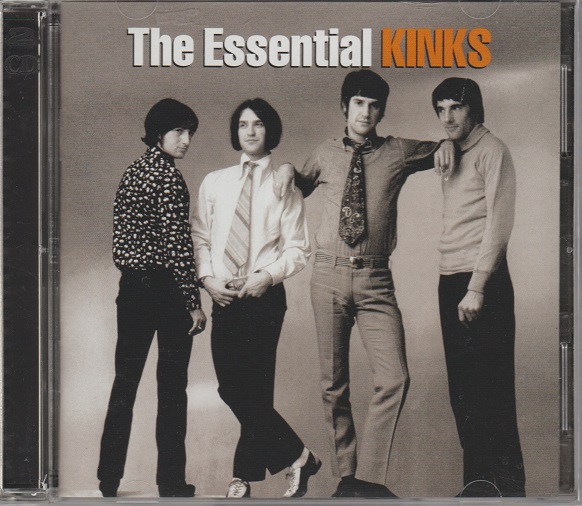
The Kinks are one such band. Growing up as a rocker, I was aware of their hits and the overall narrative of their career. As an adult, I wanted to start with a compilation. When you have a band with a career as long and varied as The Kinks, I very much enjoy getting a snapshot of the whole thing rather than pick off albums one by one. Sony’s double disc Essential Kinks is 48 tracks of rock from 1964 to 1993. It’s a rather monolithic slab, but it does tell a story.
The beginning is hard and ragged British invasion rock and roll, and the road is windy. Whether you know these tunes from movie soundtracks (“Nothin’ in This World Can Stop Me Worryin’ ‘Bout That Girl”) or Van Halen riffs (several), many songs are familiar. Early on, their pop and rock stylings could be compared with equal respect to that of those Beatles. The songs are just as unique, memorable and British. The charismatic vocals of Ray Davies immediately capture the imagination. His knack for melody is uncanny. As time goes on, their music becomes more unique and conceptual, but no less captivating. It is here that I discovered my favourite Kinks song, “Apeman”.
Perhaps I shouldn’t be too surprised that I already knew many of these songs as covers. Queens of the Stone Age did “Who’ll Be the Next in Line”. Def Leppard did “Waterloo Sunset”. The Jam tackled “David Watts”, and made a hit out of him again. I can also hear a lot of Dave Davies’ guitar in the rock bands that followed. There is no denying the influence of the Kinks.
The only imperfection with this compilation is that live tracks are substituted for studio ones on “Lola”, “Till the End of the Day” and “Where Have All the Good Times Gone”. You’ll tell me “just buy the albums, then” and to that I respond, “OK”. (“Lola” live is a single B-side.)
I’ll be lazing on a “Sunny Afternoon” with the Kinks.
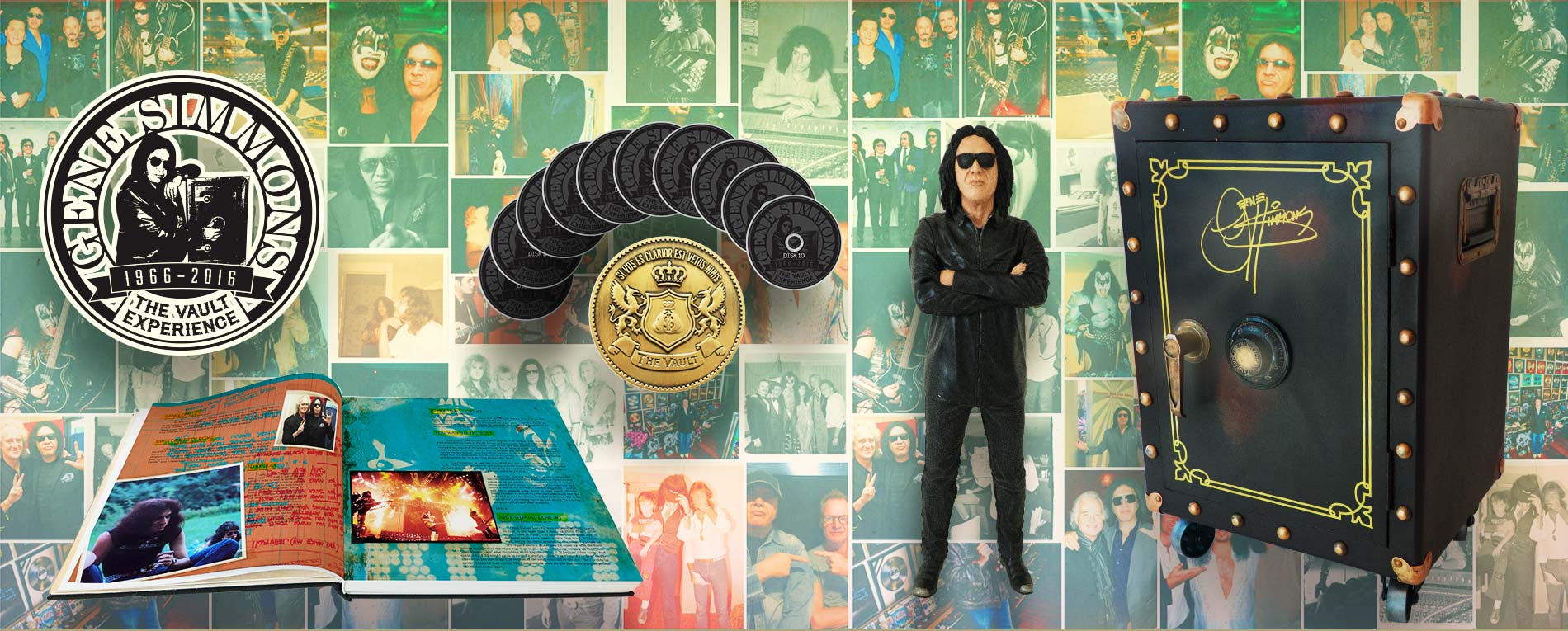
By now, surely you have heard that Gene Simmons is finally releasing his massive 150 song boxed set, The Vault (1966-2016). Gene has been talking about this box for over a decade, under the previous working title Monster. Entirely unreleased, these songs are a treasure trove of things that fans have wanted for years. Gene’s Love Gun-era Van Halen demos? Supposedly here. Along with “Feels Like Heaven” and dozens of tracks we’ve wanted in official quality. In other words, The Vault box set is as much a must-have as the original Kiss Box Set itself. A full track list has yet to be released, but we can be assured that there will be music that we have long sought on Vault.
Gene likes to promote his big ticket items in terms of what they weigh, as if that’s a reflection of value. Vault comes in a safe that weighs 38 pounds. The box also includes:
10 CDs, 150 unreleased songs
In Gene We Trust “gold” coin
The very first Gene Simmons figurine without makeup (also without any articulation)
Deluxe book containing over 50,000 words and 160 pages of unseen photos from Gene’s personal collection
A “hand selected personal gift” (no exchanges)
All this for only $2000 USD.
“But Gene,” you might be thinking to yourself, “that’s not enough. I want more!”
If you want more, you better be prepared to pay for it.
For $50,000, Gene will deliver your copy of Vault right to your home. It’s called the “Vault Home Experience”, but only available in the United States:
You plus 25 friends get Gene in your own home for two hours
Pictures/videos/autographs
Intimate “Songs & Stories” session and Q&A
Signed “golden ticket”, exclusive T-shirt, USB stick (with song “Are You Ready”), and laminate pass
Each guest gets a laminate and T-shirt
Numbered The Vault (first 300 sold)
What’s that “Songs & Stories” session? This is really “stories about songs”. Gene won’t be singing live. The FAQ states that “if you have an acoustic guitar around, Gene may strum a few tunes for you and your guests.” “If” and “may”.
Don’t have $50,000? That’s OK. For just half ($25,000) you can get “The Producer’s Experience” in one of select US cities.
Buyer and one guest spend one hour in a recording studio with Gene
Buyer’s name appears as an “Executive Producer” on The Vault
Buyer & Gene listen to tracks and discuss The Vault
Photos/autographs (up to four items)
Guaranteed low numbered The Vault (first 500 sold)
Skype call from Gene
Think about it. You and a friend just need to raise $12,500 each!
Finally there is the basic $2000 “Vault Experience”. These are all over the world, including two in Toronto (May 2018).
Gene hand delivers The Vault
Buyer and a guest meet Gene
Photos/autographs (up to two items – more “if he has time”)
Gene performs an intimate “Songs & Stories” session and Q&A
Signed “golden ticket”, exclusive T-shirt, USB stick (with “Are You Ready”), and laminate pass
It pays to read the language of this. Gene’s “hand delivery” of the box set is really just you going to pick it up from him in one of a few select cities. I picture it like Santa Claus at the mall. Stand in line, get your few minutes with the old guy, a picture and your present (Vault). The only true “hand delivery” is available for $50,000. It’s also important to think about all the different activities squeezed in to a short period of time for you and all the other buyers. Each buyer is only allotted five minutes with Gene.
If you and 24 (American) friends pitched in $2000 each, you could in theory throw a two hour home party starring Gene Simmons. That could make for a pretty cool bachelor blowout. You’d still have to figure out who gets The Vault box set when you’re all done. Maybe you could share it, with everybody getting it two weeks a year! It’s your money, it’s entirely up to you.
Is it worth it? I am sure these experiences will be sold out. What if you can’t make it out to one of the Vault Experience locations? In lieu of meeting Gene, you can have it shipped normally.
$2000 is a lot of money to most of us. We music collectors are not loyal to just one band. Gene may have released his box set, but other bands are also vying for our dollars. This Christmas, Max Webster, Bruce Dickinson, the Sex Pistols, Whitesnake and more will have new box sets to sell. Are we to budget all our money to just Gene this year?
I cannot. I love Kiss, but not just Kiss. No other artist I’ve ever loved has asked this much money for unreleased demos. Yes, let’s put this into perspective. It’s not the Wu-Tang Clan selling a new million dollar album to some pharma-jackass. These are unreleased demos — stuff that either was never intended for release, or weren’t good enough for albums. Incredibly desirable to collectors, but artificially inflating the price to $2000 not only puts them out of reach, but exaggerates what you’ll be getting inside. To fans and collectors, it might be worth the money. Play the songs for your buddies and they might wonder why the hell they were worth $2000.
At the end of the day, I just want the music. An official, physical copy of the music. At $13.33 per song, Gene is asking way too much for unreleased demos and a bunch of knick-knacks I wouldn’t buy otherwise. I can’t pay that much, even for unreleased Kiss.
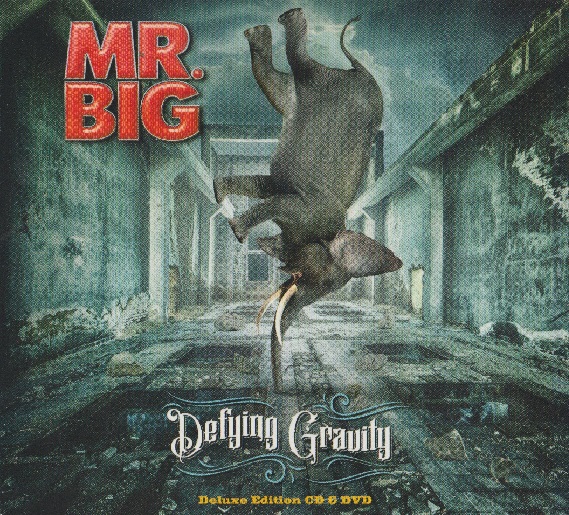
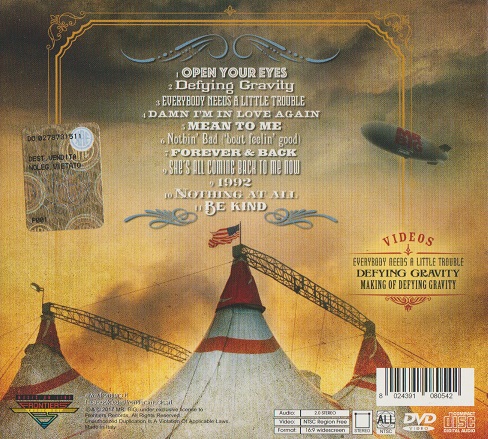
MR. BIG – Defying Gravity (2017 Frontiers CD/DVD edition)
I can still remember, very clearly, my thoughts about “To Be With You” when it finally became a hit in 1992.
“It’s a deserved hit,” I thought, “But that’s the end of Mr. Big having any chance of being seen as a serious band by the general public.”
Serious indeed. Eric Martin had a previous career as a blue-eyed soul singer. Paul Gilbert was in shred band Racer X with future Judas Priest drummer Scott Travis. Pat Torpey was a well-known drummer for appearing on several shred rock albums, like Impelliteri. And Billy Sheehan, of course, is generally listed as one of the top bassists of all time, with a period at the end. These guys were not slouches. But they did form a commercial rock band, and suffered the consequences that most commercial rock bands did in the 1990s. They faded to obscurity. Everywhere but Japan, where they continued to thrive as rock heroes.
It’s gratifying that 25 years later in 2017, Mr. Big have an album out that’s as good as any of their first four. They even reunited with their original producer Kevin Elson. But it’s all not peaches and cream. Pat Torpey suffered a setback in 2014 when he was diagnosed with Parkinson’s disease.
Undaunted, Torpey still worked with his loyal bandmates on Defying Gravity. Just as before, he participated in shaping the songs, even though he was unable to play on them. Ace Frehley’s drummer Matt Starr* has taken over live and recording duties, while Torpey wrote and produced the drum parts. In the accompanying DVD, it’s very gratifying to see the band adapt seamlessly to this new reality. They even have fun with it in the music videos, as Starr and Torpey play together and switch instruments. Check out the lead single and title track for a great example of making it work.
Speaking of the lead single/video…holy shit, what a hook! Gilbert’s tricky and exotic timing and note choices are somehow bent and twisted into a pop song! It’s that schooled approach that makes certain Mr. Big songs completely unlike whatever is on the radio, but just as catchy.
All the songs have spark, and the solo work is untouchable. Bluesy and funky hard rock is the basis of “Open Your Eyes”. The second single (“Everybody Needs a Little Trouble”) stomps out a heavy blues rock beat. On to “Damn I’m In Love Again”, Mr. Big take a drive into the country. “Nothing Bad ‘Bout Feelin’ Good” is a hybrid, using the acoustics in a heavier way. There are plenty more hit-quality highlights: “Forever & Back”, and “She’s All Coming Back to Me Now”. For the fans: “Nothing At All”, the heavy rockin’ “1992” (a brilliant look back at the glory days), and “Be Kind” which is just a jaw dropping example of what these guys can do with just their voices, instruments and a song!
For a deeper understanding of this album, check out the deluxe edition with bonus DVD.** Not only will you get all the music videos, but also behind the scenes segments on set, and the EPK (“electronic press kit”). Finally there is a track by track analysis of every song featuring each member, and more behind the scenes footage. This is where you’ll find the most insight. Influences abound from the expected to the unexpected. From doo-wop to Christina Aguilera? Why not. The one with the beat cribbed from Aguilera is actually one of the heaviest and solo-dense tracks (“Mean to Me”).
Defying Gravity isn’t really a surprise, because Mr. Big have put out plenty of good albums over the recent years. Perhaps it’s a bit more inspired. It certainly has potential to be on a few “top ten of 2017” lists this year.
4/5 stars
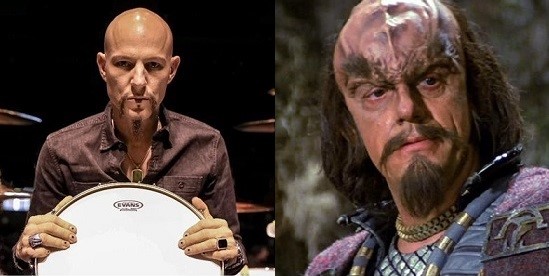
* Matt Starr may in fact be a Klingon. In the Original Series, Klingons looked much like humans, without their trademark head ridges. What gives away Starr’s possible Klingon status is his dead ringer of a Klingon moustache and beard.
Matt Starr is the one with the drum head.
** I know what you’re thinkin’. “LeBrain, why didn’t you buy the Japanese edition with a bonus track?” This time out the only bonus track is a radio edit of “Defying Gravity” which, cost considered, I can live without.
– The Ritz, NYC, 12th August 1988(from 4 CD set Radio Waves 1974-1988) (2015 American Icons broadcast release)
At last, we are at the end of the Crazy Nights era. Radio broadcasts are the next best thing to a bootleg. Actually, strike that. Radio broadcast CDs are often better than bootlegs. The audio is usually decent because it’s a professionally recorded broadcast. They are almost always cheaper than an equivalent bootleg CD too. Broadcast discs are easily found on various Amazon sites and all over Ebay. Thanks to their abundance, sometimes you can even choose from multiple releases of the same concerts.
One such show is Kiss’ 1988 performance at the Ritz in New York in 1988. It’s a tight, hot Crazy Nights recording, but there are pros and cons to the different releases. There was a 2013 Gold Fish release of the Ritz concert, called The Ritz on Fire, reviewed here. Fans immediately noted that “Reason to Live” was missing, although others had “Reason to Live” on different releases. In fact The Ritz on Fire is missing two songs: “Bang Bang You” is the other.
To get all the songs, one recommended version is the 4 CD set The Very Best of Kiss – Radio Waves 1974-1988. Inside you will get:
Disc 1: Agora Ballroom, Cleveland, April 1 1974. We reviewed a better version of this show with bonus tracks from ABC In Concert and the Mike Douglas Show.
Discs 2 & 3: Animalize Live Uncensored 1985. Missing some of the stage raps, but including all the songs from the original VHS release.
Disc 4: The Ritz NYC 1988. All the songs, but missing some of the stage raps.
Nothing’s perfect. These broadcasts are quirky that way. You can buy Radio Waves 1974-1988 to get all the songs from the Ritz show, but not all of Paul’s stage raps. You could, of course, compile the best of the two versions together into one custom complete concert. The sound quality is virtually the same. What about an official release? The only Kiss-produced media of this concert is a rare 11 song bonus DVD that came with Kissology Vol. 2, but only at US Best Buy.
Regardless of which version you buy, this concert has a good reputation with fans and it is easy to hear why. Eric Carr and Bruce Kulick rose to the challenge and gave a Kiss a hard, professional sheen. Meanwhile, behind the curtain stood Gary Corbett, thickening up the sound with additional keyboards and backing vocals. Paul Stanley was in his prime, hitting notes only dogs could hear. Meanwhile Gene Simmons was present in body if not spirit. Notably, “Shout it Out Loud” was performed at the Ritz, making it a rare 80s appearance of that song. “Dr. Love” was also something of a rarity at the time.
Choose according to your own preferences, but don’t be afraid to pick up some version of Kiss at the Ritz.
– In the Land of the Rising Sun (Big Boy Records bootleg from 1988 tour)
If you are in the mood for some live Kiss from the late 80s, then your journey might just come to an end here: Kiss at the Budokan, Tokyo Japan, April 22 1988. It’s not the last live Kiss from 1988 that we’ll examine, but it’s decent. This 2 CD set boasts a more extensive track selection than Monsters of Rock, recorded in Germany in August. It’s an audience recording, but above average quality. It sounds like it is sourced from a previous vinyl generation.
In Germany, Kiss opened with “Deuce”, but in Japan, they didn’t even play it. Instead they opened with “Love Gun”, chased immediately with some “Cold Gin”. Therefore, it’s cool to have a couple bootlegs from this tour, to get a broader range of songs. Japan also heard “Bang Bang You” from Crazy Nights. Not a highlight to be sure, but a rarity that Kiss fans will want in their bootleg collection. In a strange twist, “Fits Like a Glove” is split into two tracks, just like it was on the Germany CD, made by a completely different company.
Bruce Kulick’s solo before “No No No” is much longer, leading us to think that the solo on the Germany CD was edited for length. This is the one to check out, to hear what kind of solo Bruce was playing in 1988. Kulick is continuously impressive. He always does justice to the original Ace Frehley (or Vinnie Vincent) ideas, but by playing his own solos with the right feel. His technique is all but flawless. This disc also has the Eric Carr drum solo and Gene’s bass solo intro to “I Love it Loud”.
There are plenty of tunes here that either weren’t played in Germany or just weren’t on that CD: “Bang Bang You” (see above), “Calling Dr. Love”, “Reason to Live”, “War Machine”, “Lick It Up”, “I Was Made For Lovin’ You”, “Shout it Out Loud”, and “Strutter”. “I Was Made For Lovin’ You” hadn’t been played live since 1980.
Almost every bootleg CD I own has some amusing mistake or quirk that I enjoy picking out. This has a couple. The label can’t decide if it’s named “Big Boy” (inner sleeve) or “Big Apple” (disc itself). There are three “producers” and two “engineers” credited, for a bootleg CD. I guess Eddie Kramer wasn’t available. Kiss is credited on the disc as — not Kiss! — as the “Metal Boys of New York”! Finally, in order to appear that nobody was making money off Kiss’ back, it is claimed on the CD that this “promotional copy” is “not for sale”.