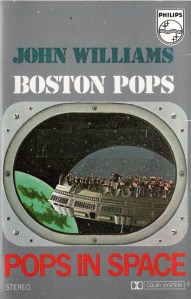
 JOHN WILLIAMS – BOSTON POPS ORCHESTRA – Pops In Space (1980 Phillips)
January, 1980. John Williams succeeds Arthur Fiedler as the conductor of the Boston Pops Orchestra. Fiedler passed in July of 1979. Williams had received 14 Academy Awards nominations, 8 Grammies, and had conducted over 50 movie scores. Later that year, Phillips released Williams’ first recording with the Pops: a selection of his science fiction “greatest hits” so to speak. The audible differences between these and the original cinematic recordings are minor, but there for the diehard fan to enjoy. If not, the casual fan will be able to hear some of the best bits from Williams’ beloved scores to date. The Empire Strikes Back was a new release, and three cuts were recorded for this release.
1978’s Superman: The Movie truly made us believe that a man could fly, kids and adults alike. The Superman main theme is one of Williams’ greatest refrains in his long storied career. Triumphant, strong, and bright, it glows with the power of our yellow sun. You can envision Christopher Reeve (the greatest Superman) smiling and waving as he casually swooped across the silver screen. Williams’ music embodied Superman, and the optimistic spirit that the film represented. It bears similarities to other familiar themes, such as Indiana Jones, which was in production. It is a Williams “trademark” theme if you will; instantly identifiable and unmistakable. It has highs, lows and an incredible outro. This is followed by Lois Lane’s love theme, which we liked even as impatient kids who hated romance in our superhero movies. Some of Superman’s theme has a soft reprise here, but the piece is its own.
The brand new Empire Strikes Back is represented by three classic pieces: the action packed “Asteroid Field”, Yoda’s jaunty theme, and of course, “The Imperial March”, already on its way to becoming a thumbprint anthem for scum and villainy. There is not much to add here, because words are not sufficient to describe the sheer momentum of “The Asteroid Field”! Or the joyful playfulness of “Yoda’s Theme”. Or the symphonic metal majesty of “The Imperial March”, as we watch those monolithic, grey Star Destroyers cruising menacingly through space.


More Star Wars on side two, with the film Star Wars (not yet known as A New Hope – that happened in April 1981). The two themes included are the main title theme, and Leia’s theme. I noticed the most difference on the main title – the third note of the opening “bah bah bah…” part is held just a little longer. As for Leia’s theme, it is softer of course, but the violin strain is so memorable. So plaintive, yet beautiful. It grows in power towards the lush end, which is magnificent. Perfect for our princess in distress, though her reputation for kicking butt was starting to form!
The final piece included is a “Close Encounters of the Third Kind” suite, including the extended ending, added to the special edition. This 10 minute suite is a rollercoaster, as we recall scenes of awe and wonder. A bit of “When You Wish Upon A Star” plays, some piano tinkles, and we are swept away with Roy Neary on that starship, whether we wanted to see the inside or not.
As a “greatest hits” of Williams early science fiction music, Pops In Space is a treat to play. A concise treat, representing a small slice of Williams’ work, yet that little slice has some of his most indelible music.
If anything, fans of physical media need to get this album on any format, just for the cool cover art. The orchestra can be seen playing on a floating platform…in the vacuum of space! Far out.
5/5 stars









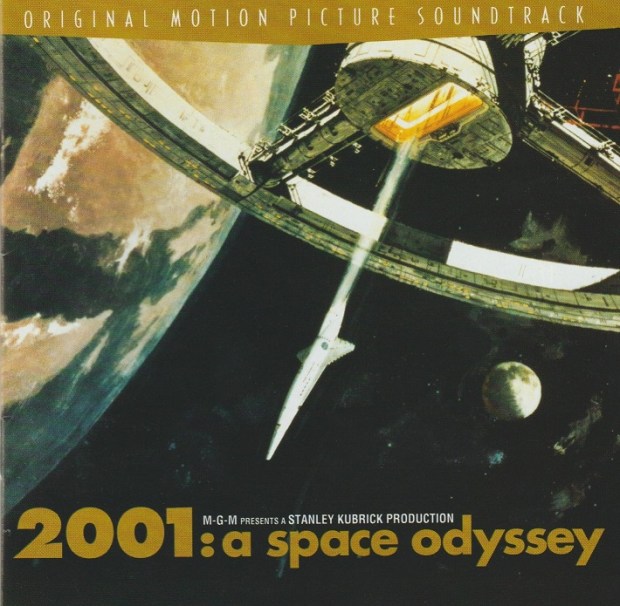

 2001: A Space Odyssey – Original motion picture soundtrack (originally 1968, 1996 Rhino remaster)
 After the chaos of “Requiem” and “Atmospheres”, Strauss’ “Blue Danube” offers a warm respite. The brilliance of the “Blue Danube” in the film is how Kubrick managed to capture the dance-like coordinated movements of objects in space. A shuttle docks with a spinning space station; spinning of course to create artificial gravity that humans need to survive long-term in space. This complex docking maneuver requires no dialogue, just Strauss. But space is a cold deadly place, hostile to almost all known life. Ligeti returns, as he must, with “Lux Aeterna”. This music was used to back Dr. Floyd’s trip across the lunar surface to meet the Monolith. It is mildly disconcerting, as is what Floyd’s team finds.











 mikeladano.com