glenn hughes

REVIEW: George Lynch – Sacred Groove (1993)

It’s a shame I lost my original 1993 review of this album.
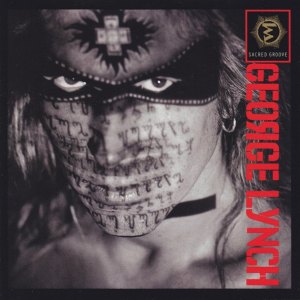
LYNCH_0001GEORGE LYNCH – Sacred Groove (1993 Elektra)

If you like Dokken but never followed George onto the Lynch Mob, then this album is for you.

George Lynch is a very talented shredder, capable of playing a wide variety of styles.  Sometimes he hits, sometimes he misses, but on Sacred Groove he makes the mark every time.  Sacred Groove was designed as a solo project shortly after the second Lynch Mob album.  The idea was to work and write with different singers and musicians, and George loaded up on some great singers.  Glenn Hughes, anyone?

John Cuniberti, who co-helmed many Joe Satriani albums, produced this opus and lent it some serious sonic excellence.  The opener “Memory Jack” is a collaboration between producer and guitarist, but this is little more than a sound collage to kick off a killer instrumental called “Love Power From the Mama Head”.  This isn’t to say that “Memory Jack” does not contain some shredding licks, because it does…but they are not the focus.  The sound collage itself is the focus.  Into “Love Power”, George lays down some serious riffy rhythm guitars.  This is topped with a very Satriani-esque guitar melody.  “Love Power” is constructed very much like a Satch rock instrumental track, with memorable guitar melodies and song structures.

There is a very cool moment in the guitar solo in “Love Power From the Mama Head”, at exactly 4:47.  While George was essentially assaulting his guitar with the whammy bar, he accidentally dropped the instrument on the studio floor.  “Shit!” said George, while producer Cuniberti ran over and stopped George from picking it up.  The producer then kicked the guitar for added effect!  Cuniberti assured George it would sound cool, and it kind of does!  The guitar just stops on this weird chord-like sound, before they punch out of that and into more shredding.  It’s different and spontaneous and I love shit like that.

“Flesh and Blood”, contender for best track on the album, is the first vocal, featuring Badlands’ Ray Gillen (R.I.P.).  It’s a Dokken stomper for sure, but with Ray Gillen’s bluesy Coverdale-isms all over it.  Killer.  The lyrics were co-written by George’s ex-Dokken bandmate Jeff Pilson, who also co-wrote and plays bass on the next track, “We Don’t Own This World”.

Now here’s the interesting thing about “We Don’t Own This World”.  Lyrics by: Don Dokken?  The fuck?

George, Don and Jeff had planned to reunite on this one song, that Don supplied the lyrics for.  Don however cancelled or chickened out (either/or) and didn’t make it to the session.  It just so happened that the Nelson twins, Matthew and Gunnar, were in town and eagerly sang on the track in Don’s absence.  With their harmonies, “We Don’t Own This World” sounds nothing like Dokken, except in basic ways.  It’s the most commercial track on the album; a pop rocker.  The vocals soar over one killer melody, and the solo is one of George’s best.  If this song had come out only two years sooner, it would have been a hit single.  The Nelsons have done some cool music over the years, and not gotten a lot of credit for it, so this song is pure delight.

I still think of CDs as “albums” with distinct sides, and on the cassette version “I Will Remember” closed Side One.  This instrumental ballad has a vaguely dark tropical feel, although it is an electric guitar song.  George’s solos are sublime and I love his unexpected timing on certain notes.  He has flawless chops mixed with feel…a rare combination.

LYNCH_0002

Side Two’s opener is an epic in two parts, but it’s as close to a skip as this album gets.  The problem is vocalist Mandy Lion, of WWIII.  You either like his glass-garling-elfin-metal voice or you do not.  I do not.  However, “The Beast” Parts I and II are such a slamming groove that I tend to block out the words and the voice singing them.  This is another track where the original vocalist slated could not do it.  Udo Dirkschneider wanted too much money and Rob Halford was too busy, but Mandy Lion would do it.  He showed up at the studio in the heat of summer wearing head to toe black leather.

“The Beast” could be a dirty sex anthem, I guess, but it’s far too heavy for the 50 Shades crowd.  I dig when halfway through, George breaks out his newly-bought sitar.  (I remember seeing pictures of George in Metal Edge magazine buying it!)  If only Mandy would have chosen to shut up at this moment.  Bassist Chris Solberg comes in and grooves through to a false ending, and then it’s “Part II (Addiction to the Friction)” — a 10 minute track in total.  Thankfully a huge chunk of it is instrumental.

The regal Glenn Hughes raises the bar any time he opens his mouth.  His two songs were the first new Hughes singing I had heard since Black Sabbath.  I detect some fragility in his voice here.  I think this may be from a period where Glenn was recovering from addictions.  Regardless, he sounds a lot better today, whatever the reasons are.  That’s not to say he’s bad here, because he’s still the best singer on the album.  You just feel he’s not giving it everything like he does today.

“Not Necessary Evil” is Glenn’s first song, a Dokken groove with Hughes’ soulful signature style.  This one too had hit single potential, but only in an alternate timeline in which Rock never fell to the Grunge Hordes in 1991.  “Cry of the Brave” is his second track, a slower and more soulful rock track.  This is a song about injustice to the American Indian (reading the lyrics, I’m assuming specifically Leonard Peltier), and it’s worth noting that Glenn wrote the lyrics by himself.

The album closes with a final instrumental called “Tierra Del Fuego”, and if you couldn’t guess, that means George breaks out the flamenco guitar.  There’s also a guest electric guitar soloist named Daryl Gable.  If I remember the story correctly, Daryl Gable was a lucky fan who was selected to have a guest shot on the album.  How cool is that?  And he’s pretty good, too!  I have to admit I like these dusky tropical flamenco things, so I consider “Tierra Del Fuego” to be a very successful album closer.  But fear not, there’s plenty of electric guitar too!

Sacred Groove is pretty damn near flawless.  If only they could have got Udo instead of Mandy, eh?

4.5/5 stars

REVIEW: Deep Purple – Live in Graz 1975 (2014)

NEW-ish RELEASE

DEEP PURPLE – Live in Graz 1975 (2014 Edel)

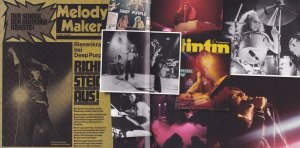
Any time there is an official Deep Purple archival release coming out, diehards have to pay attention.  The current library of vintage live CDs is the Official Deep Purple (Overseas) Live Series.  A mouthful.  Live in Paris was the first in the series, followed by Copenhagen 1972 (which I missed but have to catch up on).  Graz 1975 is the third, and it has a long history of incomplete releases going all the way back to 1976!  Some songs were used on the single LP Made in Europe in that year.   In 1996, five songs were remixed and included on Mk III: The Final Concerts.  Now the entire April 3 show in Graz, Austria has been remixed again and released in its completion.

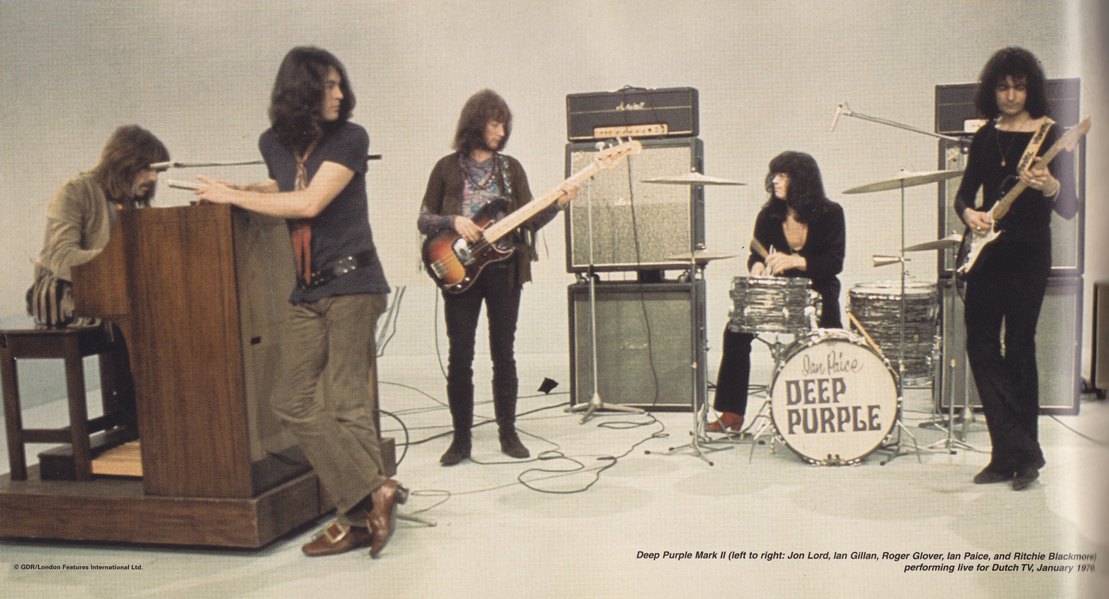
As a guy who owns virtually every single official Deep Purple release and catching up on the rest, I’m amazed at how crisp and fucking essential this new mix of “Burn” is.  The liner notes call it “surely the best version of this song, ever.” Paice and Blackmore both play with an excitement and energy that is even above their standards.  Lord too, but my God are Ian and Ritchie fueled up, laying down fill after fill that were of that moment.  Ritchie was on the verge of leaving — he was gone after only two more shows.  Even if you’ve heard this exact same recording of “Burn” from Mk III: The Final Concerts before, you haven’t heard it like this.  This new mix kills the prior ones, rendering them almost obsolete.  Ditto with “Stormbringer”, which captures all the energy that that was missing from Made in Europe.

I’m always pleased to hear “The Gypsy” from Stormbringer, an underrated track from an underrated album.  Glenn Hughes’ young pipes are achingly powerful, drowning out David Coverdale.  An unreleased “Lady Double Dealer” is the last short song before the show progresses on to long 10 minute or more jams.  Ritchie’s manic pick scrapes are deliciously perfect.  This usually isn’t one of my go-to Deep Purple songs, but this absolutely smokes any version I’ve heard before.

LIVE IN GRAZ 1975_0005

The first long bomber is Ritchie’s blues centerpiece, “Mistreated”.  I confess I usually snooze through this one.  This version will be familiar as one of the “bonus tracks” on Mk III: The Final Concerts.  Ritchie is the main focus of “Mistreated”, and he stretches out far and wide, using bits from “Lazy”, “Sail Away” and classical melodies.  Coverdale is much stronger vocally than he tends to be on this song.  A ramshackle “Smoke on the Water” is also dull by comparison with the first part of the set.  Its highlight is a long, building and breaking Jon Lord organ solo, which leads into “With a Little Help from my Friends”.  “You Fool No One” is over 10 minutes, and it gives Ian Paice a chance to strut his stuff.  Paice is one of those drummers that it pays off to focus on and really listen to, because he is always doing something interesting.  All of this is outshined by a 20 minute “Space Truckin'”. Richard Strauss’ “Thus Spake Zarathustra” is a suitably bombastic segue, for a band of Deep Purple’s stature.  They also detour into “Child in Time”.  If you’re not wiped out by now, you will be by the end.

Gotta say that those responsible do a great job with these Deep Purple products. Absolutely no qualms about this release at all.  Not essential to anyone but fans of Deep Purple Mk III.

3.5/5 stars

REVIEW: Ronnie James Dio – This Is Your Life (Tribute)

NEW RELEASE

“I’m letting them pick what songs they wanna do in the way they wanna do it.” Wendy Dio

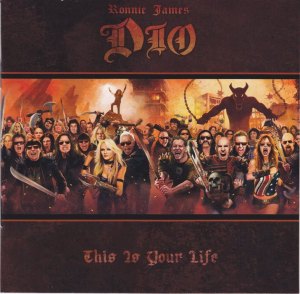
THIS IS YOUR LIFE_0001VARIOUS ARTISTS:  Ronnie James Dio – THIS IS YOUR LIFE (2014 tribute CD)

No preable from me: we all know how great Dio was.  Let’s get to the tracks.

Anthrax kick off the festivities with a slamming “Neon Nights”.  The storming opener couldn’t have been in a better slot.  Not only is Charlie Benate heavy as shit, but the guitar solos are mental.  Joe Belladonna handles the powerful vocal ably.  Rob Caggiano is still in the lineup indicating this isn’t brand new.  I suspect it was recorded at the same time as last year’s Anthems EP.

The guys that never get respect, Tenacious D, tackle the difficult second slot.  No worries there; they chose “The Last In Line” which Jack Black sings with no difficulty.  Uncle Meat has said it before:  Jack Black is one of the best singers he’s seen live.  “The Last In Line” proves his pipes, although some may not like his exaggerated, humorous vocal enunciation.  Kyle Gass plays a cute recorder solo in lieu of guitar, but there’s not enough K.G. on this track.  Brooks Wackerman kicks the drums in the ass.

And speaking of drums, Mike Portnoy is next with Adrenaline  Mob.  They demolish “Mob Rules”, although singer Russell Allen is certainly no Dio.  He is completely overshadowed by Portnoy and the shredding of Mike Orlando.

Corey Taylor, Satchel (Russ Parish) and friends  chose “Rainbow In the Dark” as their tribute to Ronnie.  This has always been such a fan favourite, and a personal one as well.  It is difficult to imagine anyone but Ronnie singing it.  While Corey Taylor is not at all like Ronnie James Dio, you can tell he loves this song.  It bleeds out of his performance.  He does it in his own rasp, and it works.

The incredible Lzzy Hale and Halestorm are up next with another Dio classic, “Straight Through the Heart”.  There is no denying the talents of Lzzy Hale, but her powerful pipes are almost too much.  Perhaps she overpowers the song, rather than simply fueling it.  Halestorm fans will love it, but I think Lzzy maybe should have reeled it in a bit.  Or, maybe I just need to get used to it.  “Straight From the Heart” does sound better after a few listens.

Biff Byford (Saxon) joins Motorhead on lead vocals for Rainbow’s “Starstruck”.  There’s a bit of that Motor-slam in it, but if I didn’t know who it was, I never would have guessed Motorhead.  You can hear Lemmy on backing vocals, but weirdly, he’s not credited on bass.  Nobody is, but you can hear the bass clearly and it sounds like Lem.

THIS IS YOUR LIFE_0004

I’m a little sick of the Scorpions doing ballads, but I admit that “Temple of the King” (another Rainbow classic) is stunningly good.  One might almost mistake it for a Scorpions original.  It has that regal Scorpions bombast to is, but Matthias Jabs’ lead work is just sublime.  He’s an underrated player, absolutely.  You can tell he’s a Blackmore fan.

An oldie from 1999, Doro’s cover of “Egypt (The Chains are On)” is excellent.  It’s cool to hear female singers like Doro and Lzzy Hale sing Dio.  Doro’s impressive pipes have always been astounding.  Her version of “Egypt” is a little over the top compared to Dio’s, but that’s cool by me.

Killswitch Engage…hmm.  “Holy Diver” starts great, super heavy, with some perfectly acceptable, melodic vocals.  Then it all goes down the toilet at the bridge.  That’s when it turns into hardcore shouting and blast beats…sorry, not on this song, thanks.  I can listen to that stuff in moderation, but don’t sully “Holy Diver” with it.  Fortunately the guitar solos are great, sounding like an Iron Maiden outtake from Powerslave.  Shame about the growling and shouting.  Skip.

“Catch the Rainbow” is a great song, and Craig Goldy plays guitar on this cover.  He’s ex-Dio himself, and he’s backed by his former Dio-mates Rudy Sarzo, Scott Warren and Simon Wright.  (Hey, that’s also 1/3 of Tateryche!)  Glenn Hughes sings, but this song sounds out of his scope.  His bluesy slant doesn’t work for me.  Sorry Glenn, you’re still awesome!

I find it strange that two more ex-Dio members (Jimmy Bain and Rowan Robertson) chose to cover Black Sabbath.  But who cares!  They covered “I”, perhaps the greatest song from Dehumanizer (1992)!  On drums is Brian Tichy, with Oni Logan (Lynch Mob, Dio Disciples) singing.  It’s a perfectly authentic version and I love it.  It’s absolutely thunderous, and I love Jimmy Bain’s bass sound.  Always have.  Of all the vocalists on This Is Your Life, it is Oni Logan that comes closest to nailing Dio’s vibe.  Considering he’s in Dio Diciples, I shouldn’t have been surprised.  I didn’t expect it though, based on what I knew of Logan from Lynch Mob.  He fits “I” like a glove!

I was disappointed in Rob Halford’s version of “Man On the Silver Mountain”.  It’s true that Halford did replace Dio in Black Sabbath for two shows in 1992.  However, having owned a bootleg video of that show since that time, I knew that Halford’s and Dio’s styles didn’t really mesh.  This is no different; I don’t think his voice works with the song and it unfortunately shows off the places where Rob’s voice has weakened.  What is cool though is that the band (all ex-Dio:  Doug Aldrich, Vinnie Appice, Jeff Pilson and Scott Warren) take it to a swampy bluesy Whitesnake-y place for the intro.  You can definitely hear Pilson covering the high notes in the chorus.

Finally we arrive at the mighty Metallica.  Snicker if you like.  If Metallica do one thing really well, it’s covers.  If they do two right, it’s covers and medleys.  The “Ronnie Rising Medley” is entirely made up of parts of Rainbow songs.  “A Light In the Black” bleeds into “Tarot Woman,” where the vocals begin.  It’s safe to say if you don’t like Metallica, you won’t like this.  If the opposite is true, I think you’re in for a treat.  Metallica do these classics in their own style, just as they have in the past when covering Maiden, or Mercyful Fate, or Thin Lizzy.  Simply add Lars’ thuds, James’ growl, and some standard Metalli-licks, and you’ve got a medley that is enjoyable through its near-10 minute run time.  Having said that, the weak point is definitely “Stargazer”, which is gutted of all its majesty.  They do much better with “Kill the King” which is fucking perfect.  They include the entire song in their medley!

Fittingly, the album ends on a ballad:  Dio’s own somber “This Is Your Life”, performed by the man himself in 1996.  I did not like the Angry Machines album, but if there was one song I would have picked as a highlight it would be “This Is Your Life”.  Performed only by Dio and Scott Warren on piano, it is unlike anything else in Dio’s canon.  The lyrics speak of mortality:

This is your life
This is your time
What if the flame
Won’t last forever?

This is your here
This is your now
Let it be magical

What a way to end a great album.  As much as you can “miss” a person you have never met, I do miss Ronnie James Dio.  In many ways he’s been my friend for 30 years.

4.5/5 stars

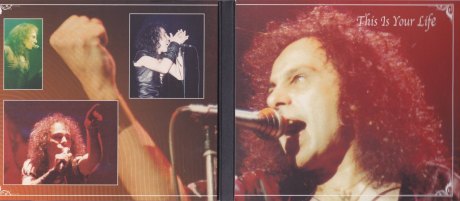
As a nice added touch, the liner notes include photos of just about every performer on this CD with Ronnie!

Of  note:  the Japanese edition has a bonus track by Dio Diciples:  “Stand Up and Shout.”  It also has Stryper’s version of “Heaven and Hell” from their 2011 album The Covering, which I reviewed here.

REVIEW: Whitesnake – Slip of the Tongue (Deluxe edition)

WHITESNAKE – Slip of the Tongue (1989, deluxe edition)

Normally I go crazy for these deluxe editions. Many are great!  The Whitesnake deluxe editions have not been great.  This is the third and last one in my Whitesnake deluxe edition series of reviews.

Once again, instead of two CDs, you get an expanded CD and a brief DVD. The lack of decent bonus material really frustrates me because there is more in the vaults. You know there has to be more in the vaults. In fact in the liner notes, David tells us that there is more.  He name-drops several unfinished songs that didn’t make the cut, but fans would kill to hear.

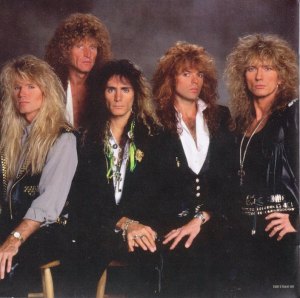
SLIP OF THE TONGUE_0008Slip Of The Tongue was not the best Whitesnake album (not by a long stretch), but with 20/20 hindsight and the presence of Steve Vai, it’s fun to listen to. Yes, it’s too glossy, and yes, Vai was not the right guy to be in Whitesnake, but the result is one of those strange one-off’s like Black Sabbath’s Born Again, or Motorhead’s Another Perfect Day. It’s an album that doesn’t quite fit with the back catalogue, but has become a cult favourite.  I have long been a fan of it, simply because Steve Vai is jaw-dropping even when playing pedestrian hard rock.

SLIP OF THE TONGUE_0007For Vai fans, he plays it pretty straight here, not a lot of craziness.  There’s a broken string on one song, and some cool solos, but nothing bizarre like you’ll find on a Vai solo album.   If  you want to hear him just do some serious hard rock and balladeering without the crazy stuff, this is the CD for you. Within the scope of Whitesnake, Vai sets the album on fire; throwing in notes where you didn’t know they could fit, making sounds you didn’t know a guitar could make, and overdubbing a mountain of fills. Just check out opening track “Slip Of The Tongue” for some serious burning, via a 7-string Ibanez guitar through an Eventide harmonizer.

Song-wise, this is mostly hard rock and very little blues. The slick remake of “Fool For Your Loving” (originally from Ready An’ Willing), which Coverdale’s liner notes reveal he didn’t want to do, is inferior to the bluesier, groovier original. “The Deeper The Love”, purportedly a soul song, is actually just a great hard rock ballad with some wonderful Vai licks. The best songs are the epic Zeppelin-esque “Judgement Day”, the aggresive “Wings Of The Storm”, the hit rocker “Now You’re Gone” and the signature Coverdale album closer “Sailing Ships” which has become one of his philosophical classics.

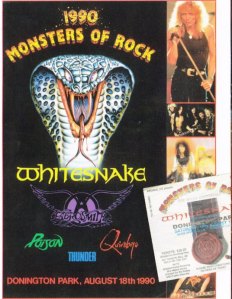
SLIP OF THE TONGUE_0006Among the sparse bonus tracks: the B-side “Sweet Lady Luck”, which is available many times elsewhere now, on both Whitesnake and Steve Vai compilations.  Also, the US single mix (by Chris Lord-Alge) of “Now You’re Gone” is included but many fans would be hard pressed to tell the difference. The promo-only “Vai Voltage Mix” of “Fool For Your Loving” predictably throws in a lot more guitar. (I already had this on a promo single that I acquired for $2, but this is good for fans to have.)  There are two tracks from the 1990 Donington Festival, which would have been a real treat, because these songs (unlike the other bonus tracks) had never been released before. This was the first ever official release of Whitesnake live stuff with Vai. But it was also just a sneak preview of an actual 2 CD/1 DVD release of the full Donington show.  Double dipping sucks!

Then, just like on previous deluxe editions…another live track by a more current edition of Whitesnake! Honestly, this ticks me off for two reasons. One, you can get the new live Whitesnake albums with no difficulty and two, it’s from 15 years later and has nothing to do with Slip Of The Tongue. Yet these new live versions pop up on all these Whitesnake reissues. Why?

The DVD is brief and hardly as satisfying as another CD would be. You get the three original music videos, the two Donington live songs, and then another bunch of unrelated live stuff. Two live tunes from 1997’s Starkers In Tokyo acoustic show, and yet another live track from a more recent Whitesnake live DVD, which is available on its own. Again, I feel this is a bit of a ripoff. It’s nice to have these Starkers tunes on a DVD, but why not release an entire separate DVD of that show? It has nothing to do with Slip Of The Tongue, except that Coverdale played a couple of these songs live.

SLIP OF THE TONGUE_0004The booklet by Coverdale is a real treat, revealing much previously unknown tidbits to tease your friends with. I had no idea that Adrian Vandenberg for example managed to play a little bit of backing guitar on the album. Previous issues of the CD stated that Vai handled all guitar duties, but that has turned out to be false. Also, Coverdale talks a bit about Glenn Hughes, and why you can barely hear him sing on this CD, even though he’s credited on backing vocals.

Frustratingly though, Coverdale also mentioned all those unfinished and unreleased songs from these sessions: “Kill For The Cut”, “Burning Heart”, “Parking Ticket”, and so on. These were all titles that I read about 25 years ago in Hit Parader magazine, and wondered why they didn’t show up on album B-sides. The booklet reveals that they were never finished, but that is no excuse — they should have been presented here as bonus tracks instead of this unrelated live stuff. The Sabbath deluxe editions have tons of unfinished songs on them. So do some of the reissues of the early Whitesnake albums, such as Come An’ Get It.  This CD should have been the same.  Unless David is hanging onto these songs for some kind of anthology box set in the future, I can’t figure out how they arrived at the selections for this reissue CD!  It’s maddening.  Do it right, or not at all.

Decent album, great liner notes, top notch and generous packaging, and great remastering job. Crap bonus material.

3/5 stars

More WHITESNAKE at mikeladano.com:

WHITESNAKE – 1987 (Deluxe edition)
WHITESNAKE – Come An’ Get It (EMI 1981, 2007 remastered)
WHITESNAKE – Forevermore (2011 deluxe edition, Frontiers)
WHITESNAKE – Good to Be Bad (2008 Warner/SPV)
WHITESNAKE – Live At Donnington 1990 (2CD/1DVD) (2011)
WHITESNAKE – Snakebite (1978)
WHITESNAKE – Slide It In (EMI, UK, US mixes, 25th Anniversary Edition)

More VAI too:

VAI – Sex & Religion (1993 Relativity)
ALCATRAZZ – Disturbing the Peace (1985 EMI, 2001 Light Without Heat)
DAVID LEE ROTH – Skyscraper (1988 Warner Bros.)
DAVID LEE ROTH – Sonrisa Salvaje (“Wild Smile”, 1986 Spanish recording, remastered 2007 – Warner)

REVIEW: Black Sabbath – The Sabbath Stones (1996)

Bought at HMV, Stone Road Mall, Guelph ON, on import for $29.99 in 1996.

BLACK SABBATH – The Sabbath Stones (1996 IRS)

The Sabbath Stones, a record-company cash-grab, is a greatest hits compilation of Sabbath’s Tony Martin years (mostly) plus a smattering of bonus tracks. While it is not perfect, and so many great songs were omitted, it is still a really great listen from start to finish. Tony Martin is probably the most derided of all Sabbath vocalists. Having seen Sabbath live on their final tour with Martin (also including Cozy Powell and Neil Murray) I can say that I quite enjoyed that incarnation of Sabbath. Also, in 1996 when this was released, albums such as Headless Cross and The Eternal Idol were very hard to find on CD.  With that in mind, read my track-by-track breakdown.

1. “Headless Cross” — This compilation is the IRS years (that’s the record label, not the government agency) and thus starts with their first IRS album, Headless Cross. The title track is one of those underground classics. The groove here is monstrous (thanks, Cozy)  and the notes Martin hits in the chorus are superhuman. This track, back in 1989, was Sabbath getting back to a truly heavy evil sound. Shame that the keyboards (on all tracks by Geoff Nicholls) are mixed so high!

2. “When Death Calls” — One of my favourites from Headless. Beginning with fretless bass (by temp bassist Lawrence Cottle) and haunting vocals, you’d almost think this was a ballad. By the end, it’s breakneck, with Tony Martin singing these evil lyrics about how “your tongue will blister” when Satan says you’re to die! The guest guitar solo by Brian May will sear your soul.

3. “Devil and Daughter” — A third great track from Headless, an album loaded with great tracks. This is an uptempo one all the way through!

4. “The Sabbath Stones” — From 1990’s underrated Tyr album. I quite liked Tyr. “The Sabbath Stones” is a fast one, wicked, but muddy in sound as was all of Tyr. Once again, Martin hits inhuman high notes by the end.

5-7. “The Battle Of Tyr/Odin’s Court/Valhalla” — These three tracks are actually all bits of one long piece, on Viking mythology. Sabbath at the time were trying to get away from the “Satanic thing”, and Vikings were still evil enough to sing about. Some fans didn’t like that turn of events but I think Sabbath were well ahead of their time. “The Battle Of Tyr” is a keyboard-y bit, just an intro to get you in the mood. “Odin’s Court” is acoustic, with Iommi picking a simple melody while Martin sings about “leading us on, to the land of eternity, riding the cold cold winds of Valhalla”. That takes us into the main meat of the trilogy, the “Valhalla” portion. One of the most powerful of all Martin-era tracks, with great keyboard accents and a memorable Iommi riff, this was my favourite track off Tyr.  (It’s either this one, or “Jerusalem”.)

8. “TV Crimes” — A brief departure from the Tony Martin years. In 1992, he was out and Ronnie James Dio, Geezer Butler, and Vinny Appice were back in. The album was called Dehumanizer and even though it did not sell well, a hardcore following now consider it among the very best Sabbath albums of all time, and possibly one of the best things Dio’s ever done. Why it was underrepresented here with just one song is beyond me. There should have been at least three Dehumanizer tracks on this CD (I would have nixed “Devil and Daughter” and “The Sabbath Stones” in favour of two more with Dio singing.) Anyway, “TV Crimes” (the single) is here, and while not one of the best songs from Dehumanizer, it and “Time Machine” were the two most well-known.

9. “Virtual Death” — Tony Martin is back, with Rainbow’s Bobby Rondinelli and Geezer Butler too!  That would not last long, as Geezer soon fled back to Ozzy’s solo band to record the Ozzmosis CD. “Virtual Death” is hardly one of the better songs from the Cross Purposes album, a decent record if a bit soft. Having said that, the soft tracks were really quite good and “Virtual Death” was just a grunge song.  Black Sabbath influenced that whole scene, but they ended up copying Alice In Chains’ trademark vocal style on “Virtual Death”.  That double tracked vocal melody could have come right off Dirt.

10. “Evil Eye” — Another puzzling Cross Purposes selection.  I can’t think of a reason to include it.  There was once a legend that “Evil Eye” was co-written by Eddie Van Halen, who went uncredited.  The same rumour suggested that Van Halen either performed the guitar solo or wrote the solo for Iommi to play.  Joe Seigler of black-sabbth.com has busted this rumour as false.   My two tracks from this album would have been “I Witness” (fast one) and “Cross Of Thorns” (slow one).

11. “Kiss Of Death” — Finally we arrive at the end of the Martin years with the dreadful Forbidden album. It’s sad because it wasn’t the end that Tony Martin deserved. The album just got out of hand and next thing you know, Ozzy was back. This track was at least one of the strongest ones. A killer, slow closer with some unbelievable Cozy Powell drum fills, if it had been recorded right it would have just slammed you in the face.

12. “Guilty As Hell” — Another Forbidden track, and one of the weakest. “Can’t Get Close Enough” should have been subbed in. Just filler.

13. “Loser Gets It All”TREASURE!  The Japanese Forbidden bonus track, finally available domestically! (Please note, the Cross Purposes Japanese bonus track “What’s The Use” is still unreleased outside Japan, dangit.) This song, a shorty just over 2 minutes, is actually stronger than all the other Forbidden stuff. Good riff, good keyboards, not bad sounding. Shame it was buried on a Japanese release.  Why?  Who knows.  Maybe Tony Martin does.  Tony, drop me a line.  I’d love to talk.

And that finishes the final IRS album, and the final one for Martin. He’d been replaced once before by Dio, and now finally by the once and future Ozzy, and it’s all over for him.  Since then he’s taken a back seat to his more famous predecessors, although he released the strongly reviewed (by me) Scream solo album in 2005.  He also did a number of albums with guitarist Dario Mollo, two of which I own but have to revisit.

There are three “bonus tracks”, songs that were included under license, from the period before the IRS years.  The inclusion of these songs really make the album a fun listen.

14. “Disturbing The Priest” — My favourite incarnation of Sabbath was 1983’s Gillan/Iommi/Butler/Ward and this is my favourite song from Born Again. It’s so evil you’ll feel like you need to confess your sins after listening! I have no idea how Gillan managed such demonic screams. Brilliant selection!

>

15. “Heart Like A Wheel” — I’m actually quite fond of the Glenn Hughes fronted album, Seventh Star, but this song has no place on this album. Granted Sabbath played it live on the ’86 tour with Ray Gillen subbing in for Hughes, but it’s too slow and bluesy. The title track or “In For The Kill” should have been subbed in.

16. “The Shining” — Tony Martin triumphantly ends the album with his first single with Black Sabbath.  “The Shining” has a vintage Iommi riff, and more ungodly high notes. There are early demos of this song from before Tony joined the band, with other singers, as Iommi had this riff a long time before.  A 1984 demo entitled “No Way Out” was recorded with Ian Gillan’s short-lived replacement singer, David “Donut” Donato.  Then it was re-written and re-sung by Ray Gilllen, and this version was recently released on the Eternal Idol deluxe edition. Tony Martin’s version then is the third incarnation of the song that I have, and it’s a triumphant one.  I love the way this album was bookended with Tony Martin songs.

That’s the CD: 80 MINUTES LONG! You just can’t argue with cramming that much music onto one disc. And yes, you can get 80 minutes onto a CD, and this album is the proof.

While I have argued against the inclusion of some songs, by and large this is a well-made compilation, for a record company cash-grab. Considering the Martin years have been buried, I think it is well worth owning. I listened to it all the time.

4/5 stars

REVIEW: Deep Purple – Perks and Tit (Live in San Diego 1974)

DEEP PURPLE:  Perks and Tit  (2003 Purple Records/Sonic Zoom)
Re-released in 2007 as Live in San Diego 1974  

Lineup:  Deep Purple Mk III – Ritchie Blackmore – David Coverdale – Glenn Hughes – Jon Lord – Ian Paice

I love bootlegs.  If you don’t, you won’t like Perks and Tit.  Recorded in San Diego, April 9, 1974, Deep Purple are loose.  Ritchie Blackmore’s guitar is imperfectly awesome.  I love every moan and squeal he wrings from that neck.  And only on a bootleg will you hear Glenn Hughes say something like, “This one’s not being taped, so we can say and do what we wanna do!”

The bootleggers were taping that night, preserving this remarkable night of Deep Purple prowess.  A record was released in 1975, and over the years took on different forms and configurations.  Sonic Zoom then released a definitive version of the show on CD, with hard to find onstage banter.

The great news is that Sonic Zoom were able to trump previous CD bootlegs, sourced from vinyl, and go straight to a soundboard master tape.  Apparently Glenn was wrong!  The sound is loud but only occasionally fuzzy.  The vocals are clear, as is Blackmore’s guitar.  You can make out Glenn’s bass a little bit, but on the whole this is a very listenable and enjoyable CD release.

Highlights for me included the rarely played “Lay Down, Stay Down”.  I don’t know what Ritchie did to his guitar there in the solo section, but he went from volcanic eruption noises to velvety smooth picking in like 10 seconds.  The man is unreal!  He and the whole band groove the shit out of “Might Just Take Your Life”, too.  Not to mention his brilliant solo intro to the extended blues, “Mistreated”.  Burn was a brand new album, as Glenn keeps reminding the crowd, and the first four songs are all from Burn!  But when they get to “Smoke”, Ritchie plays with the riff in unfamiliar but really catchy and appropriate ways.

The six-track collection is unfortunately only the first half the night’s set.  The second half, if it was ever recorded at all, could not be found.  So the CD ends on an odd note, a Jon Lord organ solo.  On the other hand, with Jon now gone forever, it’s kind of apropos, no?

4/5 stars

REVIEW: Deep Purple – Come Taste the Band (35th Anniversary edition)

DEEP PURPLE – Come Taste the Band (35th Anniversary edition, 2010 originally 1975, EMI)

For those keeping score, now every single album from the original run of Deep Purple 1968-1976 has been remastered with some sort of deluxe edition. Come Taste The Band is the final album of this series. Deep Purple imploded shortly after and the band was no more until Perfect Strangers in 1983.

Personally I have always liked Come Taste The Band right from first listen. However, I never heard the album until 1996 so the idea of a great Purple album without Richie Blackmore was not foreign to me. With open ears you can really appreciate what Deep Purple were up to on this powerfully rocking album. It has a solid groove, a much harder sound than Stormbringer and some greasy unconventional guitar playing from Tommy Bolin. Everybody is playing amazingly, even the coked-out Glenn Hughes who just rips it to shreds on “Gettin’ Tighter”, my favourite track. Paicey is awesome on said breakneck track.

Really though there are no losers on Come Taste The Band. Every song is incredible right from the opener of the ferocious “Comin’ Home” to the philosophical “You Keep On Movin'”. Another personal favourite is the sliding groover “Dealer”, a tale of warning from David Coverdale to Glenn Hughes about his habit. Bolin takes his first and only studio Deep Purple lead vocal on the bridge.

IMG_00000713As with all previous special editions, the liner notes are excellent, revealing, and loaded with pictures. One fact I didn’t know: The band were going to kick out Hughes if he didn’t kick the coke.

Bonus material is present. The single edit of “You Keep On Movin'” is tacked on to the end of disc one, but this is previously available on such albums as Singles A’s and B’s. The second disc contains the entire album remixed by Kevin Shirley. Shirley is truly a great mixer. It’s hard to discern what he did differently here, except the songs are a bit more punchy. Some now continue on past their original fade points, revealing never before heard playing from the band, right to the end of the song. This was done on previous remasters such as Machine Head and I like this touch a lot.

Two previously unreleased tracks are included. These tracks will be worth the price of purchase alone to Purple collectors. “Same In L.A.” is a nearly complete song with lead vocals and lyrics. If it had been included on the original album, it would easily have been the most pop, it sounds more suited to Stormbringer material. “Bolin Paice Jam” is also unreleased — not even heard before on Days May Come and Days May Go or the limited edition 1420 Beachwood Drive albums. This is a massive, fiery jam capturing the best of both players. Difficult to understand why this was not included on the aforementioned two compilations, but it’s just awesome and I’m glad it’s out.

Once again, Simon Robinson has outdone himself with the final Deep Purple remaster of this series. These albums, while expensive and difficult to obtain (mine took almost two months to ship) are well worth it to the faithful.

5/5 stars

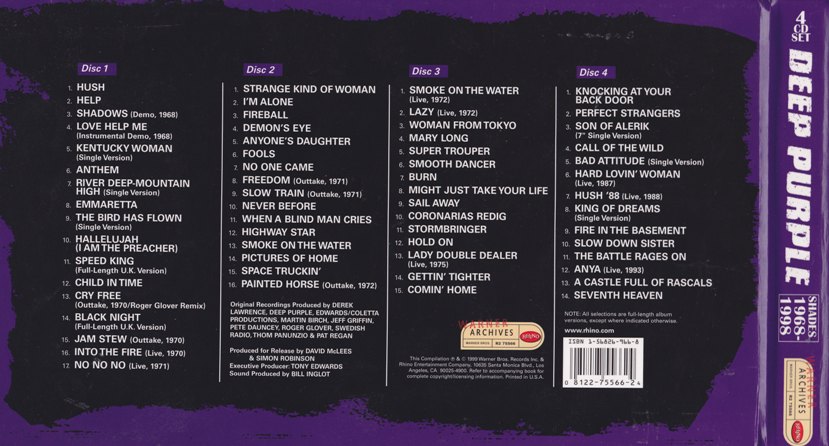
REVIEW: Deep Purple – Shades 1968-1998 (box set)

DEEP PURPLE – Shades 1968-1998 (Rhino 1999 box set)

I was really excited about this 1999 box set when it came out, but what it came down to was this: I paid “x” amount of dollars for just two songs that I didn’t have on other recent Deep Purple CDs. One song, “Slow Down Sister”  by Deep Purple Mk 5 was only available here. It’s since been reissued on the Slaves and Masters deluxe edition.  The other is a very rare and very great 1971 live version of “No No No” from a compilation called Ritchie Blackmore/Rock Profile Vol. 1. So there’s your bait.

Unfortunately, the booklet and discography is loaded with errors. This was disappointing. The packaging is nice, with that sheet metal looking embossed cover. It opens kind of awkwardly though, making it hard to handle. And man, there are so many Deep Purple box sets out there now! I have Listen, Learn, Read On which is six CDs dedicated entirely to just 1968-1976. Obviously you can’t squeeze Deep Purple’s career onto just four discs. This set covers 1968-1998, which is a huge chunk.  It’s almost the entire Jon Lord tenure.  It skimps in some places and confounds me in others. Usually, Rhino do such a great job, but I felt this one didn’t live up to their other products.

SHADES_0003Disc one covers 1968 to 1971 (Shades Of to Fireball). The tracks listed here as demos or rarities are from the Deep Purple remastered CDs, all except for the aforementioned “No No No” which really is awesome. If you have the great Singles A’s & B’s and the Deep Purple remasters, you have all this stuff. Except maybe the edit version of “”River Deep, Mountain High”, I’m not certain about that one. You get a good smattering of favourites on here, like “Kentucky Woman”, “Speed King”, “Child In Time” and so on, but it’s not really sequenced all that well. The slow-ish Deep Purple Mk I material fits awkwardly with the Mk II.  Other songs of note include non-album singles and B-sides such as “Hallelujah” (first recording with Ian Gillan) and “The Bird Has Flown”.  The version of “Speed King” included is the full UK cut, with the crazy noise intro.

Disc two is 1971 to 1972: more Fireball, and Machine Head. All these tracks can be found on Deep Purple remasters. There  are some excellent tracks here, such as the rare “Painted Horse” and “Freedom”. “Painted Horse”, a personal favourite, has been available for decades on an album called Power House. I guess Blackmore didn’t like them at the time, so they languished until the band broke up before the record label released them. “I’m Alone” was rare for a long time, and “Slow Train” was completely undiscovered until the Fireball remaster. I like that “Anyone’s Daughter” is on here, a very underrated song.  Of course you will hear all the big hits on this disc: The studio versions of “Smoke on the Water”, “Fireball”, Highway Star” and “Space Truckin'”. This will be many people’s favourite disc.

The third CD continues with Mk II.  It starts off with the Made In Japan live version of “Smoke” which is fine, but now you’ve heard it twice.  Soon, it’s  “Woman From To-kay-yo”, “Mary Long”, and the scathing “Smooth Dancer”.  Then Gillan and Glover are out, and in comes Coverdale and Hughes  One rarity on this disc is the instrumental “Coronarias Redig”, which dates from the Burn period. It also includes some of Mk III’s most impressive work, including two of the best tunes from Come Taste The Band. Conspicuous by their absence is the epic “You Keep On Moving”, and Blackmore-era fave “Gypsy”. You will, however get “Burn”, and “Stormbringer” from Stormbringer itself.

SHADES_0005The fourth CD is the one that ticks me off the most. This covers the reunion era, from 1984 to the then-most recent album Abandon in 1998. The hits are here, “Perfect Strangers” and “Knocking’ On Your Back Door”, as well as some singles from the Joe Lynn Turner era. What ticks me off here is the song selection. “Fire In The Basement”? What? That song kind of sucks, why not “The Cut Runs Deep”? Only one song from The Battle Rages On is included, only one from the excellent Purpendicular, and only one from the recent Abandon? And not even the best songs? That makes no sense.

To short-change the later era of Deep Purple only serves to short-change the listener.  The band were revitalized and rejuventated by Steve Morse, and made some really good, well received music. I saw them live with Morse in 1996.

From The House of Blue Light era, a single edit of “Bad Attitude” is included, which is probably rare.  What you won’t get is the full, 10 minute + version of the instrumental “Son Of Aleric”. This is one of the best lesser known tunes from the reunion era. Instead, you get the truncated 7″ single version. That makes the 10 minute version frustratingly hard to get. It was originally released on a 12″ single, which you may be able to find. You might have better luck finding it on the European version of Knocking at Your Back Door: The Best of Deep Purple in the 80’s. It was included there, replacing “Child In Time” from the US version. I managed to get it thanks to my mom & dad who bought it for me at an HMV store in Edinburgh (along with Restless Heart by Whitesnake).

SHADES_0004Mick Wall’s liner notes offer the Morse years a mere mention, and end on a nostalgia note of “bring back Blackmore.”  Come on. Let’s focus on the present of a band that shows no signs of slowing down, shall we? But this box set short changes the present, and by picking it up you won’t hear such awesome later songs as “Sometimes I Feel Like Screaming” or “Fingers to the Bone”.

I know many reviews of this set are glowing, and each reviewer has their own reasons for doing so. I can’t. This band is too important, too vital, and dammit, still alive! This box set simply doesn’t do them justice. I was ticked off when I bought it and realized I owned almost all the “rare and unreleased” material. Collectors won’t find much here worth the coin spent, and rock fans who just want a great box set of Deep Purple won’t get to hear enough Morse.

Somebody dropped the ball on this one! 2/5 stars.

SHADES_0002

REVIEW: Quiet Riot – Rehab (2006)

Part 2 of my 2-part review of the Quiet Riot Twin Pack set.  Twin Pack bundled the band’s final two releases:  a retro live album, and the final studio album, Rehab.

QUIET RIOT – Rehab (2006 Demolition)

I love Quiet Riot, even more than I have reason to. Metal Health was the first “metal” album I ever bought, on cassette, and I’ve re-bought it three more times since. I just love that album, and I admit it’s probably 60% music and 40% nostalgia. Since it came out, I’ve managed to collect a lot of Quiet Riot.  Prize possessions are my CD copies of Quiet Riot I and II.  This Twin Pack set was important to me because the version of Rehab contained herein has the European bonus track, “Wired To the Moon”.

It turns out, however, that Rehab kinda sucks. It has its supporters who enjoyed the heavier, bluesier sound.  Rehab unfortunately repeats the problem that Quiet Riot have had for many years:  they don’t write very many good songs!  Kevin DuBrow and Frankie Banali were reduced to a duo after the departures of Rudy Sarzo (who went on to Dio and is now in Tateryche) and Carlos Cavazo (now in Ratt).  Rehab had the right ingredients in place, with the awesome Tony Franklin on bass and Glenn Hughes providing backup vocals, but it was not to be. I give them an A for effort, as I am usually in favour of heavying up the sound and adding blues elements.  They get a D for execution.

The concept was to leave behind the glam rock, but the songwriting is so underpar.  Choruses and verses don’t mesh, melodies don’t stick in the head, and riffs don’t hit you where it hurts. The best song, “South of Heaven”, is a really good Zep-ish tune though.  “Strange Ways” features an incredible solo by Neil Citron, like a cross between jazz fusion and Eddie Van Halen.  Jazz Halen?  On the other hand, “Old Habits Die Hard” is one of the more colossal failures.  Aping Joe Cocker’s “With A Little Help From My Friends”, DuBrow sinks this one all by himself with his overwrought lead vocal.

There are some good moments.  Pretty much all the guitar solos and instrumental sections are incredible.  The drums are good.  A song called “Beggars and Thieves” is one of the better songs, because it is anthemic and memorable like old Quiet Riot.  Unfortunately, that cannot be said of most of this material.  Glenn Hughes classes up the place by several notches when he shows up at the end, but this also highlights Kevin DuBrow’s limitations.

I dislike the cover art and packaging.  DuBrow’s wig, oh my God.  Seriously? The old Quiet Riot logo is also gone, and the masked mascot dude is barely visible.  The album was self-produced by Kevin and Frankie, but they really should have spent some money on a producer with a decent set of ears.  These songs would not have passed muster with any serious producer.  The title of Quiet Riot’s final album is now a sad irony, considering DuBrow’s overdose at age 52.

2.5/5 stars

And sadly, almost unbelievably, the band’s legacy has been tarnished even further with Banali’s hack version of the band currently touring without any original members.  And Kevin rolls in his grave.

REVIEW: Deep Purple – Stormbringer (35th Anniversary Edition)

STORMBRINGER OUTER FRONT

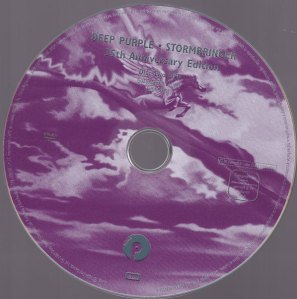
DEEP PURPLE – Stormbringer (35th Anniversary Edition, 2009 EMI, originally 1974)

Stormbringer, now available in the gloriously remastered series of Deep Purple special editions, is one of my favourite Purple platters. Now augmented with bonus material, it has finally been given the treatment it deserved. It’s certainly not everybody’s cup of tea, but Stormbringer has earned some begrudging fans over the years.  I for one find it a more enjoyable listen cover to cover than 1974’s Burn.

A lot of fans did not like the funkier, softer direction of the band. You can understand this, of course. A fan who loved In Rock, one of the heaviest records of any decade, could easily be turned off by the radio-ready soul funk of “Hold On”.  Blackmore himself decried the funky direction of the band.

Here’s the good news: Whatever Deep Purple set their minds to, they could do. And they could do it well.

STORMBRINGER CDBlackmore may not have liked the album, and he did take a step back in the mix, (you can barely hear any guitar on “Hold On”).  He could stilll adapt to and play any style. His playing here, while sparse, is sublime. Ian Paice takes to the funky rhythms very comfortably, laying down some excellent grooves. Jon Lord steps up to the forefront, supplying some excellent, funky keys.

There are a few songs that harken back to the past: “Stormbringer”, the title track, sounds as solid as any epic the band had ever composed. It could have been on Burn as easily as this record. In fact, it stands out as being out of place: As the opening track, fans must have been shocked and surprised when the rest of the album was so different.

Another song that has shades of older Purple is “The Gypsy”.   It’s a slow mournful piece, perhaps akin to “Mistreated” from the previous album.  The lyrics are uncharacteristically bleak.

One track showed an interesting glimpse of the future. “Soldier Of Fortune” is an acoustic track which forshadowed much of the music Blackmore would do with Rainbow, and even now with Blackmore’s Night. David Coverdale has performed it live with Whitesnake.  I think it’s one of Richie Blackmore’s finest compositions.

Of the other tunes, “Love Don’t Mean A Thing” is one of the funkiest, and one of the most entertaining.  It’s just fun to listen to.  David and Glenn co-sing this one.  Ritchie’s solo is very understated, but appropriate.  Glenn takes his first solo lead vocal with Deep Purple on “Holy Man”, a soulful ballad.  “You Can’t Do It Right” features probably the funkiest guitar work of Blackmore’s career.  It’s fascinating to listen to, and the band really cooks on this one.  It’s one of the most extreme experiments of this funky Purple period.

As with all the Purple reissues, this has been lovingly remastered. Finally you can discard your original CD, mastered for digital ages ago, but never really letting the subtleties of the music shine. Stormbringer, of all the Deep Purple albums, perhaps has more subtleties to hear due to the quieter nature of the music.

STORMBRINGER DVDBonus material?  Oh yeah, there’s bonus material, in this case four remixes by Glenn Hughes. These remixes don’t replace the original songs, but they do act as a companion piece of sorts. Fresh light is shed on alternate takes incorporated into the mixes, and “Love Don’t Mean A Thing” is extended by over half a minute. “High Ball Shooter” is presented in an early instrumental form as well.

As an added bonus, a second disc has been included. The second disc, exclusive to this edition, is a DVD containing the original 1975 quadrophonic mix of Stormbringer! Nice. Apparently, this disc is to be a limited edition so get yours while you can. I liked quite a bit, myself. As with many quad mixes from the 70’s, the songs often bear noticeable differences from the originals.  Quad was a gimmicky fad, by today’s standards, but listening to it with the benefit of hindsight is quite enjoyable.

Lastly, I must acknowledge the great liner notes. The most entertaining story included is in regards to “Love Don’t Mean A Thing.”  While in Chicago, Ritchie ran across a street busker, who was snapping his fingers singing a song about money.  Blackmore invited him onto Purple’s plane, collected Coverdale and Hughes, and jammed for 20 minutes with this guy who taught them the song and the lyrics.  The band finished the song that became “Love Don’t Mean A Thing”, credited to the entire quintet, because nobody ever bothered to get the busker’s name.

Pick up Stormbringer in this 25th Anniversary Edition, and finally you can feel comfortable discarding your original.

5/5 stars for both the music, and the reissue!