hard rock

REVIEW: Bonham – Mad Hatter (1992 Japanese import)

BONHAM – Mad Hatter (1992 Sony Japan)

The first Bonham album in 1989 was a critic’s darling.  Produced by Bob Ezrin, it sold well enough and made plenty of year-end lists.  For the year 1989, it was a breath of fresh air compared to the Motley Crue, Bon Jovi and Def Leppard tracks dominating the airwaves.  Those who thirsted for the rarified air of Led Zeppelin got some of that with Jason on drums and the incredible Canadian Daniel MacMaster on lead vocals.  It was easy to imagine that “Wait For You” was a new Zeppelin single built for that year.  But every band has to grow, and where would Bonham take it?  Further down the Zeppelin road, or try and find their own identity?

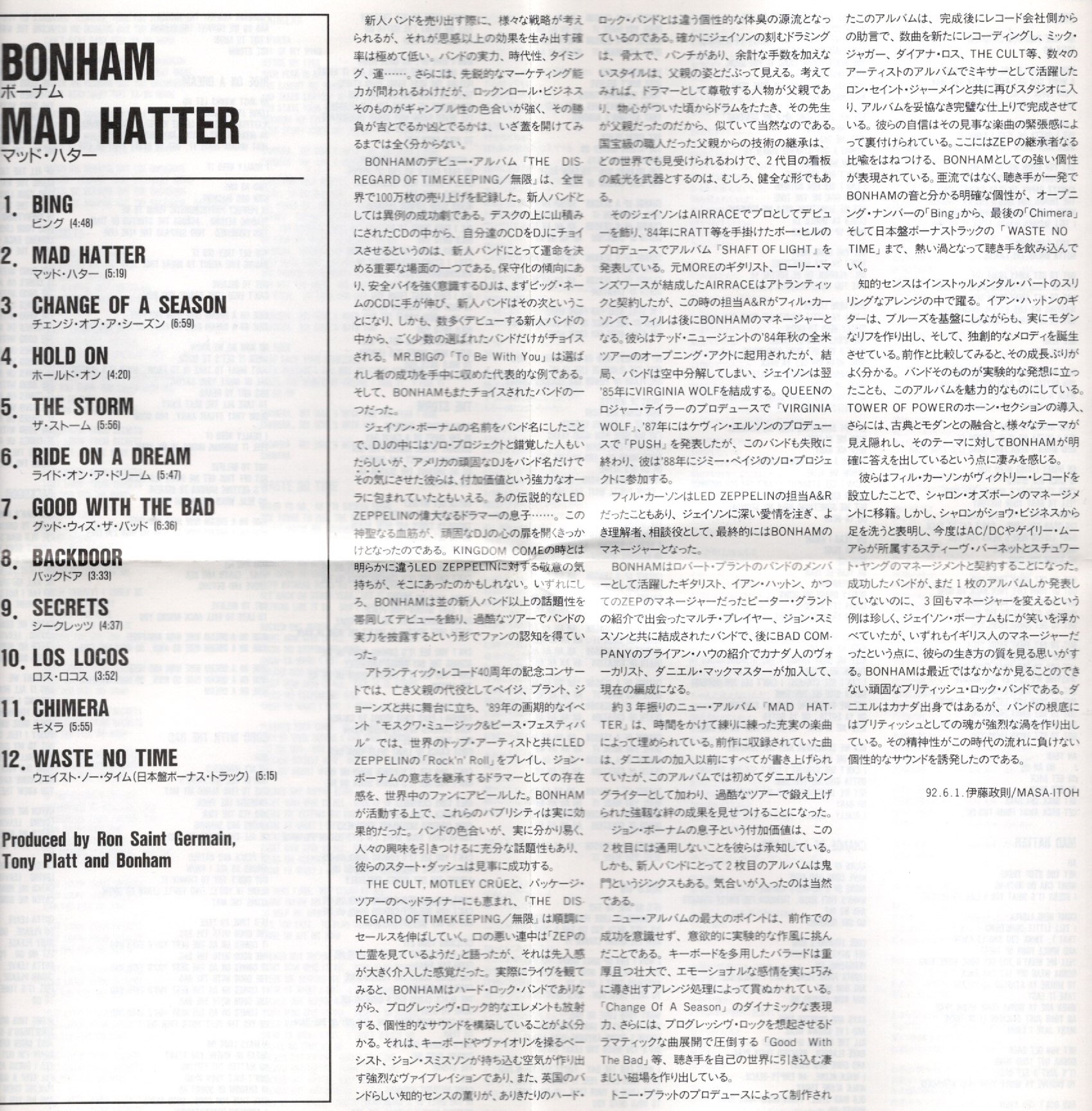
Bob Ezrin did not return, and most of the followup album Mad Hatter was produced by Tony Platt, with the rest produced by Ron Saint Germain.  The band grew from the debut, establishing more of their own groove.  It was a more diverse and challenging platter.  Unfortunately, the album arrived in 1992, amidst the Pearl Jams, Soundgardens, Nirvanas and the rising tide of grunge.  Despite the strong single “Change of a Season”, the album tanked.

What an opener “Bing” is, a word that doesn’t seem to be in any of the lyrics.  At first, it has a very old school Zeppelin groove, akin to “Candy Store Rock” meets “Black Dog”.  But then it goes to a completely different place on the chorus.  The sonics are clearer and sharper than the debut.  Jason’s drums are huge as the should be.

Yet it’s the title track that really shocks the system.  Opening with a blast of horns, “Mad Hatter” goes one of the few places Zeppelin never went:  full-on funk with horns.  This would be the Tower of Power horn section.  It would be lazy to compare “Mad Hatter” to “Get the Funk Out” from a couple years past, as it has its own vibe.  Ian Hatton on guitar proves himself to be diverse talent with licks-o-plenty.

Another direction is explored on “Change of a Season”, the shoulda-woulda-coulda single that would have been huge a year or two prior.  The melancholy ballad was simply the wrong temperature for 1992. The gothic tone of the video was cool, but the video got zip for airplay.  It’s the backing strings (synth) and epic chorus that make this song.  It sounds less like Zeppelin and perhaps more like something from David Coverdale’s Reptile Emporium.

Another cool direction is explored on “Hold On”, a unique song with elements from multiple genres.  Funk, soul, progressive, blues, and even bluegrass.  This is followed by another song with epic overtones, “The Storm”, a six minute track that takes the Zeppelin influences to the craggy progressive peaks of another land.

Although there’s no side break on a CD, there are a natural place for it as you can pause for a breath before plunging into “Ride on a Dream”.  A breaknace pace and metallic riff make it unlike anything else on the album.  Perhaps a band like the Scorpions could do “Ride on a Dream”, but even Klaus would be challenged by the outstanding MacMaster lead vocal.  This plutonium-fuelled track would give anyone a run for their money.

But after all that drama, you need something a little more laid back.  That would be “Good With the Bad”, a jazzy piano ballad and the longest song on the album.   It doesn’t remain in ballad territory forever, going to the swamps of Florida where Savatage reside halfway through.  The comparisons are easy to hear.  Next, we go to a bluesy, funky blast of Zeppelin-flavoured ale on “Backdoor”.  Another cool tune with a different vibe from the others.  Things drag a bit on “Secrets”, which tries to marry the funky side with a “Kashmir”-scale chorus but doesn’t really follow through.

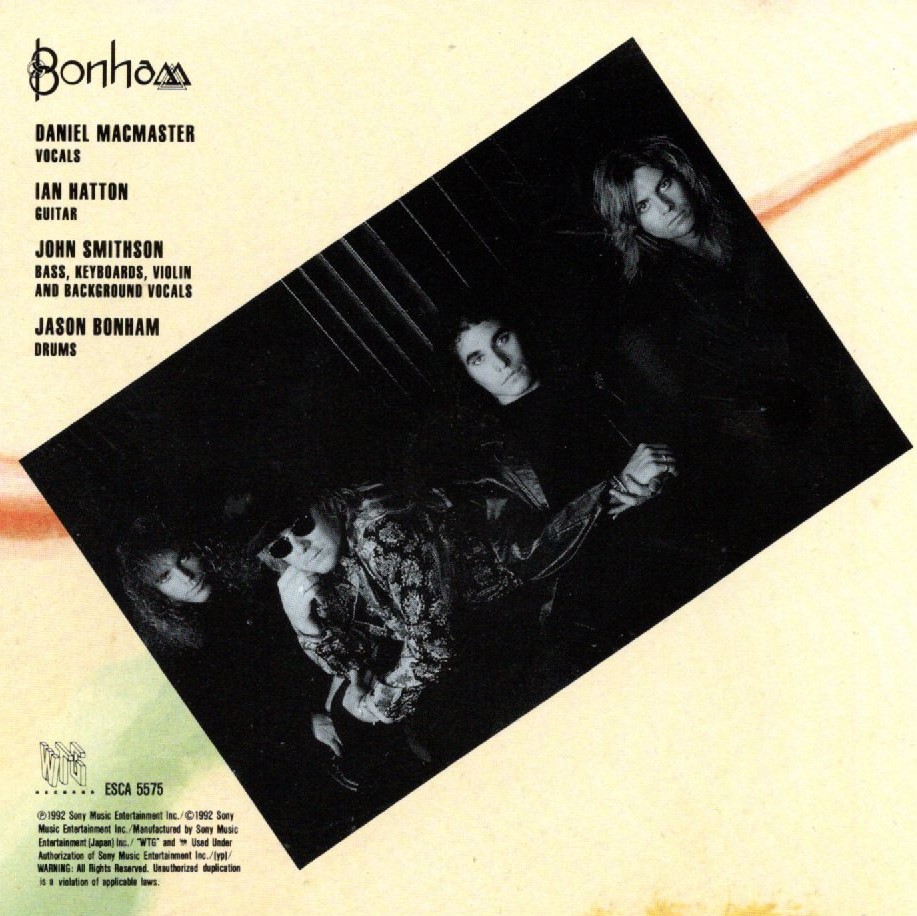
Moving on to the end, it’s “Los Locos” in second to last position.  This is a tender blues guitar/violin instrumental with dark piano accents.  That would be bassist John Smithson handling those wicked violin licks and a lot of the keyboards.  Perfect track for this spot, setting up for the closer.  It’s up to “Chimera” to take you out, and it does with a shiny upbeat vibe.  Although it’s probably sheer coincidence, it sounds a bit like Marillion circa the same period.

Lo and behold, that is not all!  The Japanese fans got a little bonus on their CDs called “Waste No Time”.  It’s definitely not an also-ran.  It has a heavy bass groove that isn’t like the other tracks on the album.  MacMaster really lets it blast on the chorus too.  Definitely Zeppelin vibes come solo time.

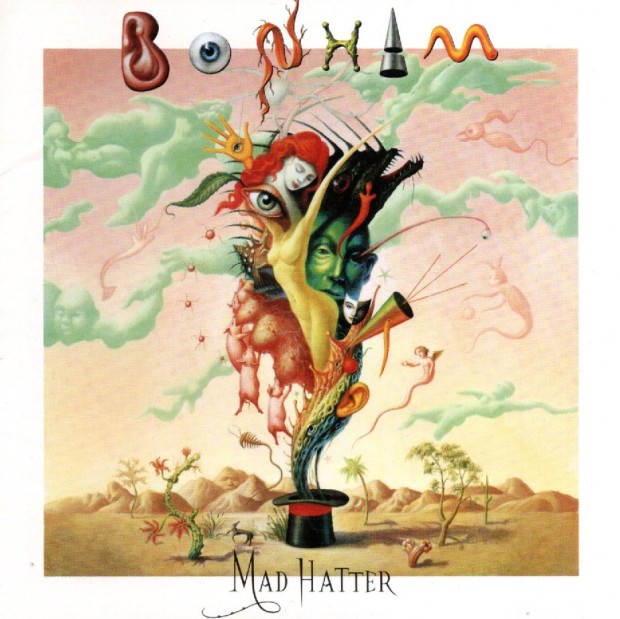
This album was available with two covers.  The majority of copies have the surreal Dali-esque landscape that you see here.  The alternate cover was plain white with just the new Bonham logo.  Which looks rather silly without the proper cover art for context.  That’s the cover that retailers such as Columbia House sold in the 1990s.

In 1994, Jason Bonham reconvened with Ian Hatton and John Smithson, but not Daniel MacMaster.  The new singer was Marti Frederiksen — yes, that Marti Frederiksen, the one that writes massive hits for everyone today.  The band took on a new modern grunge sound, and renamed themselves Motherland.  ☮︎ For Me was the pretentious name of that album.  As a sad final coda, Daniel MacMaster died too young at age 39 from a strep infection that he thought was a cold.

At least we can say that Bonham with MacMaster really did outgrow the Zeppelin tag by the second album.  Still a part of the DNA, but expressing itself more rarely.  It’s a shame about the timing of the album, because had it sold like the first one did, maybe we wouldn’t have had the Motherland debocle.  Mad Hatter is a pretty fine second album that does all the things that second albums should do.  Shame it was the last.

3.75/5 stars

REVIEW: ZZ Top – The ZZ Top Six Pack (1987)

ZZ Top – The ZZ Top Six Pack (1987 Warner)

What a strange time the dawn of the compact disc was.  Even at the end of the 1980s, vast catalogues of music had yet to be released on CD.  It was a hit and miss affair, with some early discs sounding wonderful and others sounding like a thin, tinny facsimile of the original vinyl.  The longer running time of CD was a bonus that many bands took advantage of, while other heritage groups were considering the ways they could re-release their music on this new format.

Before Jimmy Page took his first crack at remastering the Led Zeppelin catalogue for CD, ZZ Top took a different route.

Now, granted, ZZ Top’s music spans a longer time period than that of many of their rivals.  They’re also notable for starting the 1970s as a dirty raw blues and ending the 80s as clean space-age rock.  While this took them from one success to an even more massive one, it unfortunately meant that the ZZ Top camp felt it necessary to “update” their music for the CD age.  Make the catalogue sound more on an even keel with Eliminator and Afterburner.

And so the six ZZ Top albums that were so-far unreleased on CD were remixed:  First Album, Rio Grande Mud, Tres Hombres, Fandango!, Tejas, and El Loco.  Only Degüello was spared, having been released on CD earlier.

Apparently, updating the ZZ Top catalogue for CD was of “overriding concern” for all parties involved.  ZZ Top were aware that there were complaints about early CD transfers for classic albums.  The goal was “return to the original analog tapes and consider what steps were needed to render the music appropriate to  contemporary digital playback equipment without compromising integrity.”

The answer was none.  No steps were necessary.  The remixes were not what the old fans wanted to hear on their brand new CD players.  Rhythm tracks were updated with sequencers, drums treated digitally, and the whole thing came out sterile and flat.  Adding echo didn’t add depth.  Doing an A/B test with a remix vs. an original track makes you wonder why you even own the ZZ Top Six Pack.*  It just…doesn’t sound right.  Like a disorienting time displacement.

As of 2013, you can get all the original ZZ Top albums on remastered CD as they should have always sounded.

While it is nice to have six ZZ Top albums on just three CDs, and there is no denying the booklet is hot, you do not need the ZZ Top Six Pack anymore.  The charm of the originals is that they are a document of those hot Memphis studios where ZZ Top laid down the original tracks fast and dirty.  The remixes sound like a digital mixing board trying to tame a wild animal.  Wrong, and unnecessary.  “Francine” is actually awful.

The booklet is truly valuable (nonsense justifying the remix aside) and worth a point on its own.  The ZZ Top songs in and of themselves are always incredible, so they too are worth a point.

2/5 stars

* It was a gift from Kevin.  He also rates it 2/5 stars.  I asked him for a quote for this review.  All he had to say about the ZZ Top Six Pack was:  “I’m glad Mike took this crap off my hands.”  

REVIEW: Brant Bjork – Jalamanta (Remixed and Remastered 2019)

BRANT BJORK – Jalamanta (Originally 1999, Remixed and Remastered 2019 Heavy Psych Sounds)

When the needle hits wax it won’t be long,
You got your radio tuned but it won’t play this song.

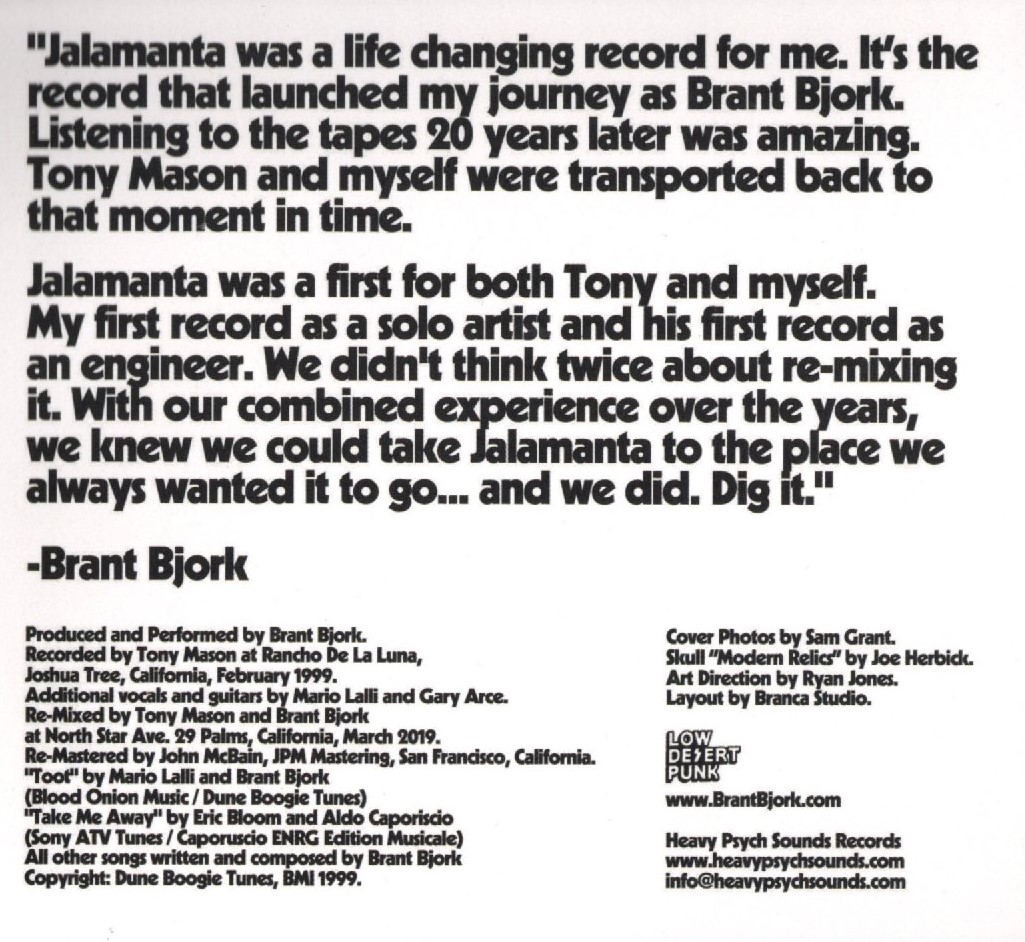
20 years ago, Jalamanta was one of my favourite albums in the world.  This is my third copy.  Partly instrumental, partly vocal, but 100% Brant Bjork.  It was his first solo album, and he played virtually everything himself.  The laid-back desert vibes are perfect for a summer evening chill-out.  Humid, sparse, exotic, varied compositions take you across a hazy landscape.

In 2019, Brant and engineer Tony Mason remixed Jalamanta, to take it the place they “always wanted it to go”.  The remixes are largely subtle, just making the album sound bigger in your ears.  The vocals might be a little less buried.  It’s still raw, and sparse, and all the things you always liked about Jalamanta.  Some songs have more noticeable differences.  More guitar on “Toot”.  Tracks tend to run longer than their previous fade-outs.  But there are things I enjoyed about the original that aren’t here.  The echoey lead vocal on “Toot” — “Cat scan, cat scan…”  That echo is gone, maybe so the sonic field wouldn’t be too crowded with that louder backing guitar?

This remix will never replace an original, especially when it was one of my favourites 20 years ago.  What is “Jalamanta” made of that makes it so tasty?  Only the most basic of ingredients.  Rolling bass and drums, simple unaffected guitar parts, and Brant’s laid back singing style.

Yeah, the man shakes me down and that’s why I’m broke.
The rich man’s got all the green but it ain’t the kind you smoke.
So we turn up the rock, and we roll it slow.
We’re always flying high, and the ride is always low.

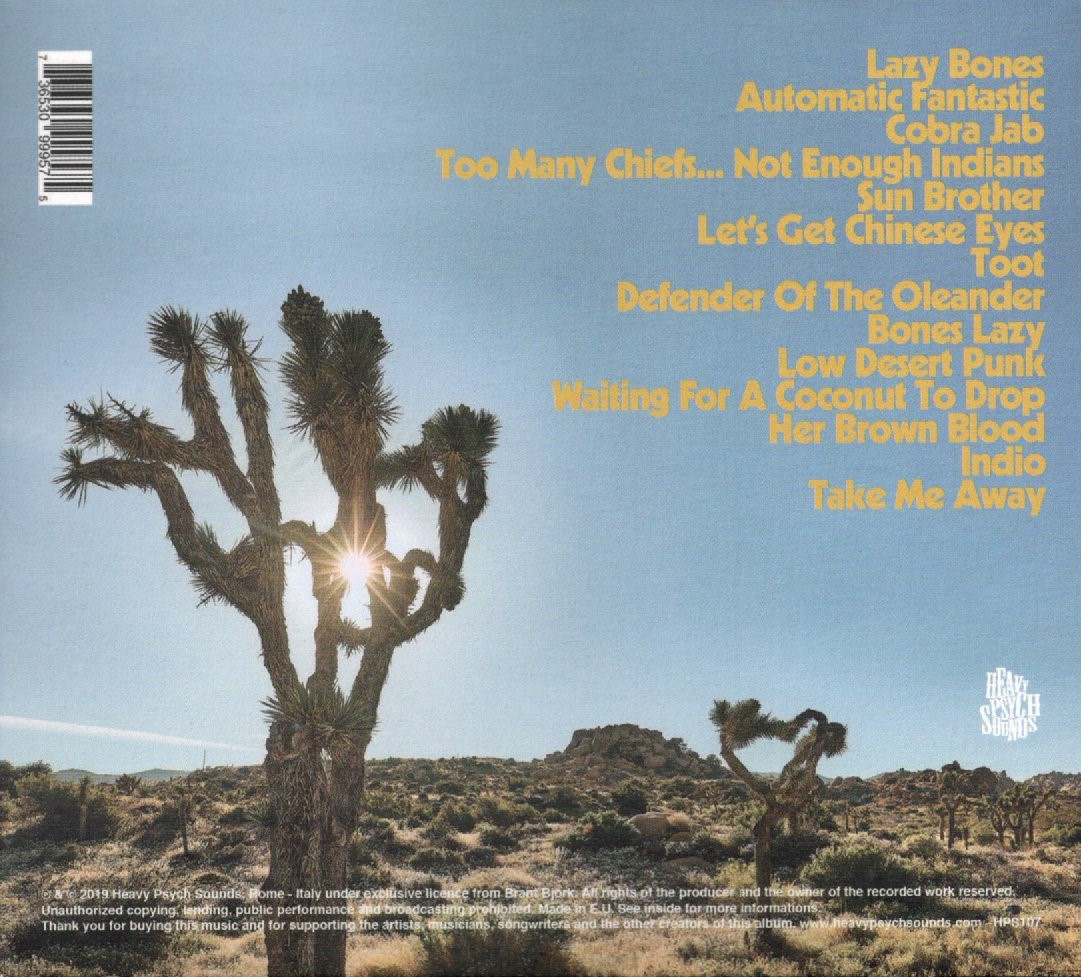
Snakey guitars jab in and out of the speakers — one song is even called “Cobra Jab”.   Other tunes are more aggressive.  “Too Many Chiefs… Not Enough Indians” has a relentless and simple riff, with the snakey guitars carrying the melody over it like a wave.  Brant’s quiet vocal is hypnotic.  By contrast, “Defender of the Oleander” has a barely-there main riff while the snakey licks do all the brilliant melodic work.  Brant goes for hypnotic again on “Her Brown Blood”, a speedy run through the desert, with a cool monotone vocal right in the middle of your head.

Whichever version of Jalamanta you happen upon, you are guaranteed an incredible listening experience.  The new remix is certainly more three-dimensional, and will sound better on your big system.  But you will lose some of the charm of the original.  The 2009 vinyl used to be the way to go, with a beautiful full-colour booklet and Blue Oyster Cult cover “Take Me Away”.  But now you can get “Take Me Away” here on CD, albeit remixed.  Another bonus is exclusive to this CD — “Bones Lazy”, which segues out of “Defender of the Oleander” into the brilliant rocker “Low Desert Punk”.  And with the title “Bones Lazy”, you won’t be surprised that it is “Lazy Bones” backwards!  Like you’re watching Tenet.  Cool though.  Even though I knew what was likely coming, I felt like it fit right in.

Get a load of this, man.

Well I’m gettin’ up when the sun goes down,
And I shine ’em up and I hit the town.
Well I trim it clean and I roll it up,
And then I take it nice and slow…so what the fuck, man.

Jalamanta makes me feel that California sun way more than any Desert Sessions CD ever has.  You can taste it.  Let it sink into your lazy bones.   And as great as this new CD is sonically, it also makes me want to hear the original.  Nothing can truly upgrade a 20 years love affair with Jalamanta.  As a complimentary piece, I don’t regret owning or listening to it at all.  Hearing guitar parts that used to be beyond the fade is the kind of bait that we nerds line up for.  The 2009 vinyl, with the gorgeous embossed cover and all that delicious photography inside, will remain my preferred way to experience Jalamanta.  The 2019 remix will be the one to play when you want to examine it in more thorough detail.

(still) 5/5 stars


Original CD and vinyl releases seen below.

#884: The Long Walk Home

RECORD STORE TALES #884: The Long Walk Home

In theory, it should have taken 15 minutes for us to walk home from school.

Cross the busy Ottawa Street with the crossing guard.  Down Ottawa, left on Crosby and then right on Secord.  All the way down Secord to Hickson, Inlet and home.  Sometimes if my dad was driving home from work at the same time, he’d see us walking and pick us up.

The reality was, we usually took a lot longer.  My dad used to say that we “dawdled home”.  Most of the time, we trudged it on foot.  We began at the start in clumps of kids, who would peel off singly or in pairs for their own homes as we walked the route.

The other day I was driving that way, and decided to take a spin down Secord and the old route.  The roads were slushy and the snowbanks were high, and suddenly I had a flashback.  Why does it seem like we were always walking home in the middle of winter?  Those are the most powerful memories.  Dodging snowballs thrown by other kids, trudging through deep snow trying to make a “short cut”.  Coming home soaked and cold.  Eating some Scotch broth for lunch and then back to school for the afternoon.  I’ve driven that way lots of times, but only this one time — in the winter, with snowbanks at kid-level — did I have a flashback.

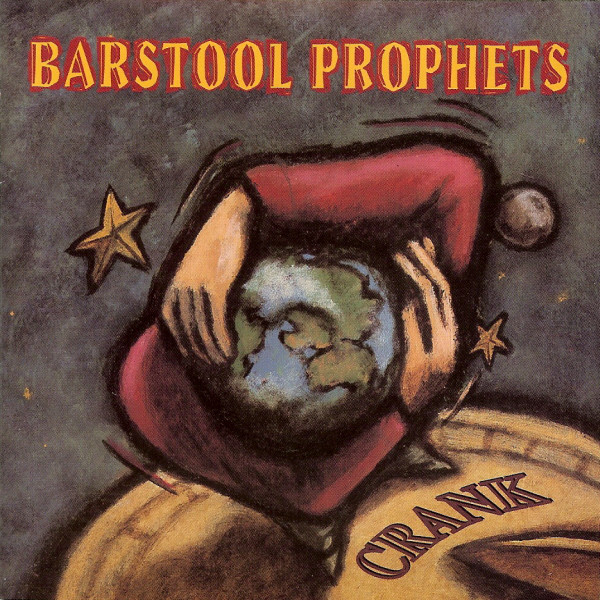
One of the only shields from the cruel outside world that I had as a kid was music.  At the moment I was driving, suddenly the power chords in “Little Death (Mary Mary)” by the Barstool Prophets hit the speakers.  “I would have loved this song as a kid,” I said aloud.

I never knew who my friends were back in those days.  A kid who claimed to be my friend one week would be a bully the next week.  There were one or two kids I knew I could trust, like Allan Runstedtler.  He was too nice and smart a kid to get caught up in that stuff, but he walked home from school in the opposite direction.  There was nobody else I could count on to stick up for me.  KK was just as likely to be throwing the snowballs at me.  Ian Johnson used to get under my skin.  “Name five songs by Iron Maiden,” he would say, instead of just teaching me about Iron Maiden like my real friends did.  But my real friends, from my neighbourhood, didn’t go to that shitty Catholic school.

The thing that I was discovering was that music like Iron Maiden made me feel good.  It made me feel temporarily bulletproof.  Something about those proud, defiant power chords.  I felt more capable of projecting pride and defiance if I had Iron Maiden behind me.  Helix, Kiss, Judas Priest — these were the bands that kept me trudging through the snow while being pelted from behind.

The Barstool Prophets song had the same effect.  As the flashbacks hit me, the guitar riff of “Little Death” pushed back against them.  Yes, I would have loved the song as a kid, had time travel existed back then.  Still working on my flux capacitor, but I’m getting there.  It’s strange, but sometimes I sit there and imagine if I had been able to allow my past self to hear certain songs.  I imagine my younger self’s reaction.  It makes me emotional.  That’s the only kind of time travel I’m able to do.  I didn’t have a bad childhood by any means, but man those bullies did a number on me.  I made it well into my 30s before being able to assess the damage that followed me right into adulthood.  I think the hardest part was not knowing who I could trust.  As it turns out, almost nobody.  By the end of the eighth grade, only Allan hadn’t picked on me.  And then I was rid of them forever as I changed school systems.

I would try to memorize songs as best as I could so I could keep them in my head while I was at school.  The teachers were part of the problem and the defiant nature of heavy metal music was, shall we say, not appreciated by Mrs. Powers.  I don’t think she commended its aesthetics, nor song titles like “Hotter Than Hell“.  She wasn’t one of my supporters as the grade school days drew to a close.  Nor was Ian Johnson, Kenny Lawrence, Kevin Kirby or any of my supposed “friends” in class.  My only friends in that cold depressing classroom were the songs by Helix and Kiss in my head.  I drew guitars in art class.

There’s a flashback for you.  Ian Johnson may have mockingly quizzed me on how many Iron Maiden songs I could name, but he vastly underestimated just what that music meant to me.  A year later he cut his hair short and was into something else.  My love affair with music never ended and only grew with me through time.  The Barstool Prophets have just shared a serious emotional moment with me, which allows them automatic entry into my soul’s Rock and Roll Hall of Fame.  It’s a pretty serious honour.  Please takes your seats with the other immortals enshrined within.  Graham Greer, Glenn Forrester, Al Morier, and Bobby Tamas — otherwise known as the Barstool Prophets — welcome to the hallowed Hall of Fame!


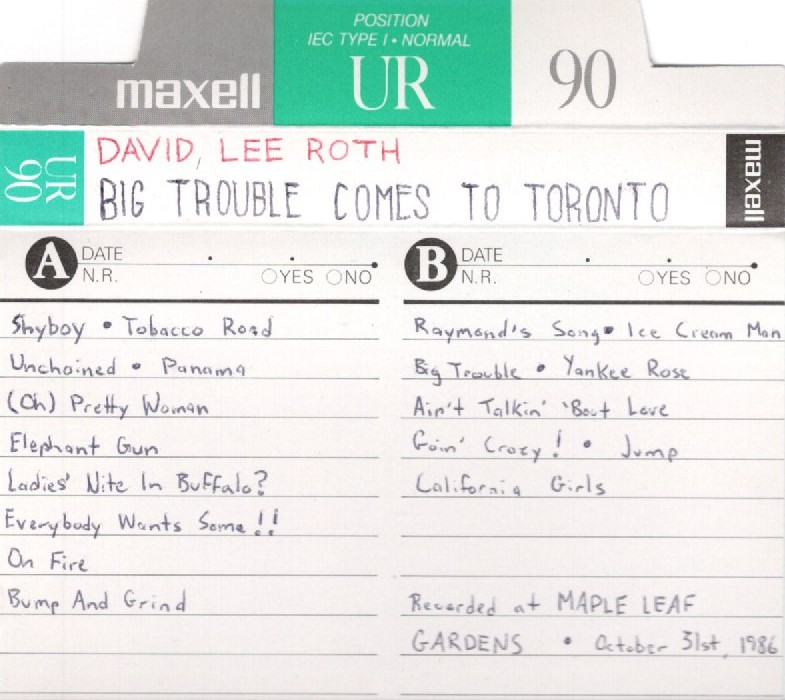
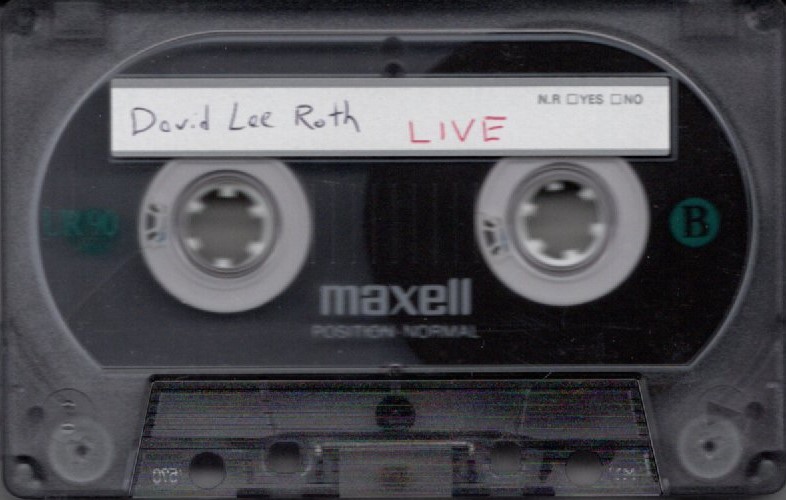
REVIEW: David Lee Roth – Big Trouble Comes to Toronto – Maple Leaf Gardens 10/31/86 (bootleg cassette)

DAVID LEE ROTH – Big Trouble Comes to Toronto – Maple Leaf Gardens 10/31/86 (bootleg cassette)

This cassette is a second generation, recorded from a buddy (with good equipment at least) in 1992.  My first bootleg.  It opens with a Van Halen-era interview with David Lee Roth about “precision rock”.  The crackle of original vinyl is audible.

A nice fade-in brings Steve Vai’s guitar to the fore, and then it’s wide open into “Shyboy”.  High octane, even though it’s just an audience recorded cassette with not enough volume on the guitar.  Without pause they rock into “Tobacco Road”. Gregg Bissonette’s toms a-thunderin’.  Vai certainly needs no help in hitting all the guitar hooks that he baked into the vinyl, just with more flair and energy.

Dave has never shied away from Van Halen hits or deep cuts.  “Unchained”, “Panama” and “Pretty Woman” are the first three.  The bass rumblings are unlike anything Michael Anthony played on the original.  The backing vocals are far more elaborate.  Like in Van Halen, “Unchained” is interrupted part way, but this time it’s so Dave can ask what you think of his new band!  Pretty hot.  After “Unchained” he stops to talk to a “pretty Canadian girl”.  “Panama” sounds a little odd with Brett Tuggle’s keyboards so prominent in the mix.  And it’s also way way way too long, with Dave trying to figure out who is reaching down between whose legs, but that’s Dave.  You don’t go to the show just to hear the music.  You go to see the whole schtick.  You put in the quarter, you gotta let the jukebox play the whole thing out.

“Pretty Woman” is zipped through fairly quickly (with one audience participation stop), going into Dave’s rabid “Elephant Gun” and the slick “Ladies’ Night in Buffalo?”  “Elephant Gun” features solos galore that would have been pretty awesome to see up close.  It sounds like there’s a vinyl side break before heading into “Buffalo”.  Vai’s guitar is the star here, in an extended solo backed only by Tuggle.  This turns into a dual bass/guitar call-and-answer.

When Bissonette starts on those tribal beats, you know it’s Van Halen’s “Everybody Wants Some!!”  This great version includes a drum solo.  Next it’s “On Fire” from the Van Halen debut.  Dave asks for the guitars to be turned up – we agree.  “On Fire” with keyboards and Vai noodling is a different animal.  After Dave’s original “Bump and Grind”, it’s time to flip the tape.

Side two opens with some of Dave’s acoustic strummin’, and a story called “Raymond’s Song”.  It’s just an excuse for him to say “Toronto” a whole lotsa times before introducing “Ice Cream Man”.  Which completely smokes.  Vai puts his own space-age spin on it, and Tuggle adds boogie piano, but this is one wicked version!

Dave’s solo track “Big Trouble” has plenty of atmosphere and fireworks for the Toronto crowd, but “Yankee Rose” is just nuts.  Nothing but the hits from here on in:  “Ain’t Talkin’ ‘Bout Love”, “Goin’ Crazy!”, “Jump” and “California Girls”.  The heavy riff of “Ain’t Talkin’ ‘Bout Love” sounds great in Steve’s hands, who doesn’t go too crazy with it.  Of course there has to be another long break in the middle (too many breaks at this point now).  This time it’s so Dave can get Stevie to make his guitar say “Toronto kicks ass, because the chicks are so fine”.  The rest of the songs are somewhat fluffy, the pop stuff, and rendered a little sweet with the added shimmer of Brett Tuggle.  “Jump” misses the deeper tone of Eddie’s Oberheim OBXA.

It’s worth noting that Roth closes with “California Girls”, not “Jump”.  His solo career is the point, not Van Halen, he seems to be saying.  This is the cherry on top.  Roth hands it to his new band several times in the show — he knew they had to deliver, and they did.  And he wants people to know that he has a band that can compete with his old group.

The show is complete,  and apparently Dave didn’t play “Just a Gigolo” on this tour.  The opening act in Toronto was Cinderella, supporting Night Songs.

Sometimes you wish Dave would get on with it and play the next song, but that’s only because this is a cassette bootleg being played on a Technics RS-TR272.  If you were there in Toronto on the Eat ‘Em and Smile tour, you’d be eating up every word Dave laid down.  He is the master of the stage.  Sure, it doesn’t always translate to tape but that’s the nature of Dave’s live show, isn’t it?  It’s precision rock — visually and audibly combined.

4.5/5 stars (for what the show must have been in person)


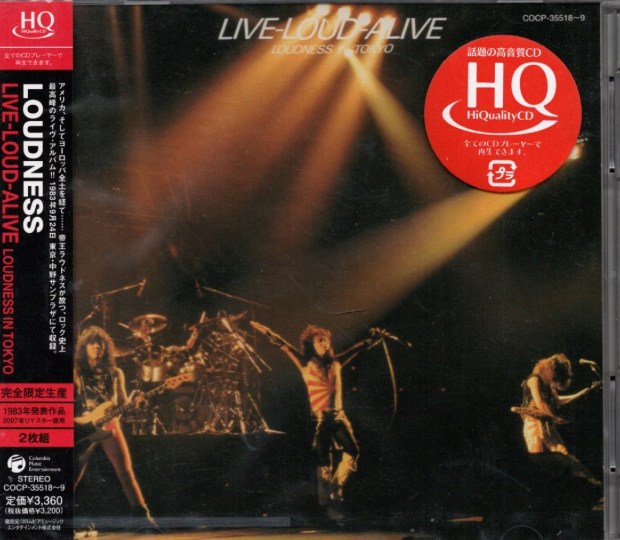
REVIEW: Loudness – Live-Loud-Alive – Loudness in Tokyo (1983)

LOUDNESS – Live-Loud-Alive – Loudess in Tokyo (1983 Columbia)

Like many classic rock bands, Loudness waited three studio albums before going double live.  The Birthday EveDevil Soldier and The Law of Devil’s Land were ripe and ready for live album immortality.  English is minimal, but you don’t need a Japanese dictionary to enjoy the metal within Live-Loud-Alive.  It is the most galvanized of the metal; Loudness’ integrity uncompromised, with Akira Takasaki in lead shred mode.

With a double length album so early in Loudness’ career, they played plenty of non-album material to fill it.  And it’s good!

Opening with a recording of Holst’s “Mars, the Bringer of War” the band rip right into the riff for “In the Mirror”.  That guitar sounds so classic, you’ll be questioning which Scorpions or Metallica album it’s from.  A heavy chug named “Road Racer” (originally a non-album Loudness single) is paired with one of Minoru Niihara’s most melodic lead vocals.  Only the thick and shimmery (probably embellished) chorus is in English.   On guitar, Akira Takasaki’s solo sounds like he is re-entering the atmosphere after an alien/robot conference in space.  “I Was the Sun” has a slower beat, pounding sheet metal into lethal form, with an elementary riff.  Ordinary as the riff may be, it isn’t the highlight this time.  The chorus takes center stage.  The first side of the original vinyl ended on “Fly Away”, a mammoth of a song mixing the delicate and the heavy.

“Black Wall” opens on what sounds like bass synth, but Akira soon takes command with a melancholy and precise guitar pattern.  Then, like any good Sabbath song, he breaks into a completely different lick, just as catchy.  An instrumental track from Akira’s solo album follows, including a wicked drum solo by Munetaka Higuchi.  This side of the record blows out with “Mr. Yesman”, a complex track like “2112” crossed with “Children of the Damned”.

On side three, a new song is previewed:  “Exploder”, a Van Halen-like guitar instrumental destined for album #4.  This transitions into another instrumental called “Heavenward”, similar to Akira’s solo work.  It’s all just good music that flows track intro track.  Guitar shrieks tell us that “Loudness” is next, a brilliant mid-tempo rocker of radio-ready nature.  It sounds like vintage, early 80s Scorpions.  Another killer riff in “Sleepless Night” brings the side to a solid close.

“Speed” does what it says.  That’s no surprise.  What may be surprising is the quality of the non-album B-side “Shinkiro”.  This cool track has some great melodic twists and an absolutely brilliant and varied Akira solo.  One of his best!  From volume-knob twists to full-on speed, it’s brilliant.  The only way to end it is by going back to the beginning, and “Burning Love”, the first non-album single by the band.  It’s a blistering way to go out.

Though not singing primarily in English yet, their musical influences were clearly the same ones from North America and Europe that we know and love too.  While you may not recognize the songs, many will sound familiar because they draw from the same pool.  It’s the best of early Loudness, void of commercial ambition.  While you do lose the ability to sing along, you can at least slam to the riffs.  One can hear why this album is held in such high esteem by the faithful.  It sounds like an experience.

4/5 stars

REVIEW: Loudness – World Tour 2018 – Rise to Glory – Live in Tokyo (2019)

LOUDNESS – World Tour 2018 – Rise to Glory – Live in Tokyo (2019 Ear Music)

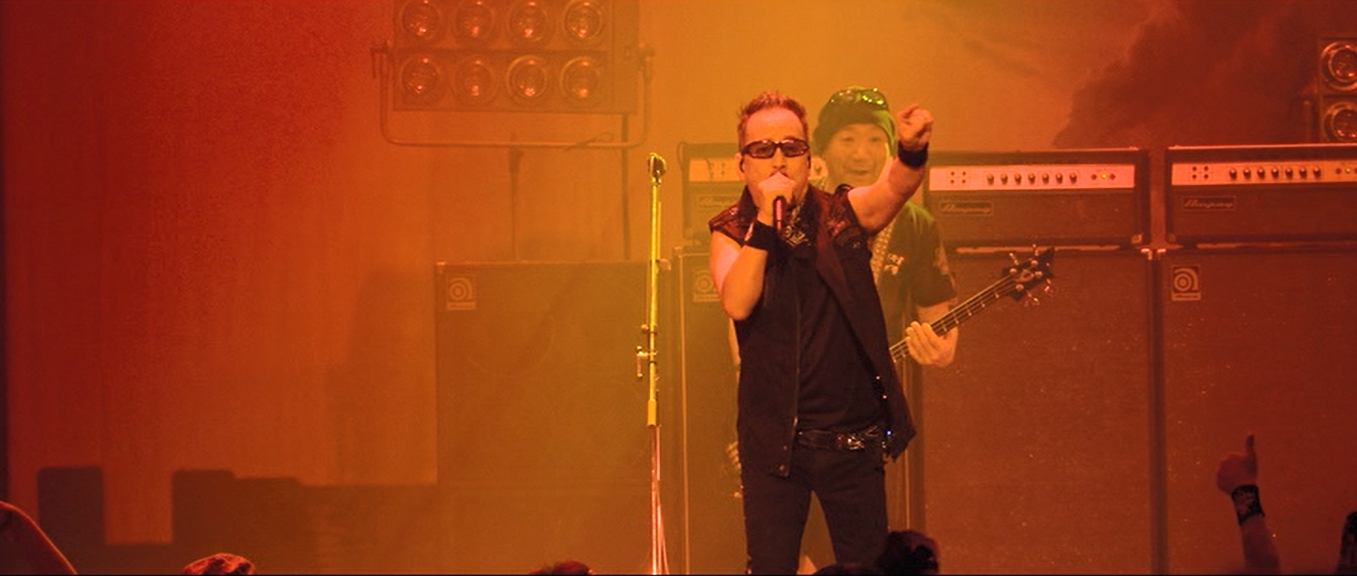
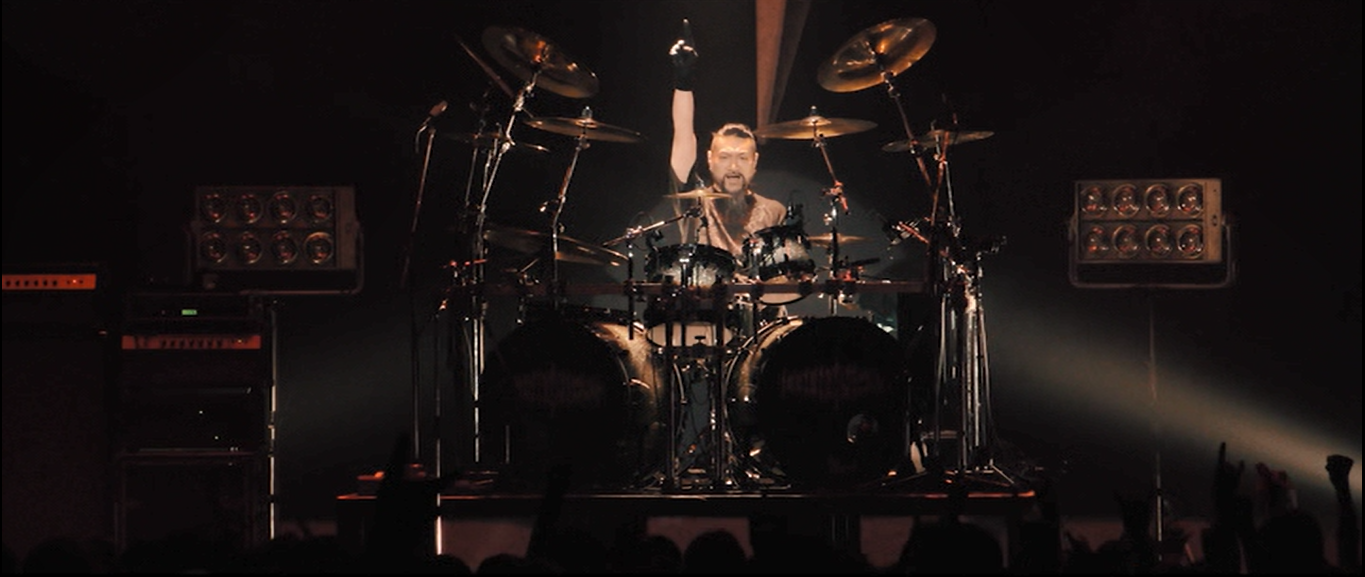
In an unfortunate twist of events, Loudness drummer Masayuki Suzuki was sidelined by stroke and could not perform on the Rise to Glory tour.  Ryuichi “Dragon” Nishida filled in beat-for-beat and appears on the live album World Tour 2018 – Rise to Glory – Live in Tokyo.  This 2 CD/1 DVD combo set is compiled from three days in Tokyo, with a bonus:  the DVD features one track with Masayuki Suzuki from the fourth day.  His performance on “Loudness” is as if there was nothing wrong with him, and he appears delighted to be playing live again.

Live in Tokyo is an energized performance, focusing almost entirely on early Loudness.  This being a hometown crowd, many of the songs are performed with their original Japanese lyrics.  1985’s Thunder in the East takes the early focus on disc one with the first six tracks all being sourced from the “big” album.  These tracks are intense, with solos by Akira Takasaki that melt the face.  Classic Loudness with jagged riffs and still-powerful vocals from Minoru Niihara.

Oldies abound.  Disc 1 also includes “Loudness” (the version with Ryuichi Nishida on drums) from the 1981 debut The Birthday Eve.  A slick, well-received version.  There’s also a punishing “In the Mirror” from third LP The Law of Devil’s Land, and the memorable “Crazy Doctor” from 1984’s Disillusion.

The second disc spotlights two lesser-known albums.  First is The Law of Devil’s Land from 1983.  The first five heavy numbers (including a second version of “In the Mirror”) all come from that platter.  This is the heavy proto-thrash that Loudness were peddling at the start of the 80s, and vicious stuff it is.  But not without hooks!  The last five originated on Disillusion, regarded by some aficionados as Loudness’ best.  From “Crazy Doctor” through the ballad “Ares’ Lament” and the finisher “Esper”, these are some great metal songs.


Impressively, the third disc (the DVD) highlights another batch of songs missed on the first two discs:  newer material.  “Soul on Fire”, “Go For Broke”, “Until I See the Light”, “I’m Still Alive” and a pair of instrumentals from the new Rise to Glory (2018) stand up to the earlier material.  The awesome “The Sun Will Rise Again” from the 2014 album of the same name rounds out the freshest material.  The new tunes are still heavy, riffy and melodic, but with a very slight modern edge.  “I’m Still Alive” goes thrash metal, but that’s part of Loudness’ origins.  Besides the return of Suzuki on drums for one song, the highlight of the DVD is a ballad.  After so many brutal songs, Minoru breaks out an acoustic guitar for an unplugged “Ares’ Lament”.  This is completely different than the version on CD 2, which was done fully electric.

Any classic band from the 80s or earlier, still trying to pull it off today, has the same question to answer:  How good is the singer?  Minoru Niihara is excellent.  As if no years have passed.  None of the material presents a challenge.

Considering the mixture of material over the three discs, Rise to Glory – Live in Tokyo would be a suitable entry point for any rock fan wanting to check out Loudness.  You’ll get the hits from Thunder in the East, ample early deep cuts, and a sampling of quality new stuff.  Value for the money and time invested.

4.5/5 stars


REVIEW: Tesla – The Great Radio Controversy (1989)

TESLA – The Great Radio Controversy (1989 Geffen)

Tesla came right out of the box with two great studio albums in a row.  Their debut Mechanical Resonance is close to perfect.  Two years later they came into their own even more with The Great Radio Controversy which saw them stretch it out further.  The dropped some of the more overt heavy metal influences that were heard on “Modern Day Cowboy” and went for the roots.  The Great Radio Controversy provided Tesla with their biggest hit, “Love Song”, the track that got me into the band for good.

1989-90 was peak power ballad time and I loved ’em as much as any lonely highschool boy wouldBob Schipper was the Tesla fan first, but once I decided to take the plunge, I went all the way and got both albums on CD instead of cassette.  Though the big hit was the ballad, The Great Radio Controversy is a tougher album overall than the debut.  Once hooked by “Love Song”, other tunes made themselves immediately prominent.  Unfortunately the ballad probably didn’t convey an accurate image of Tesla to the general public.

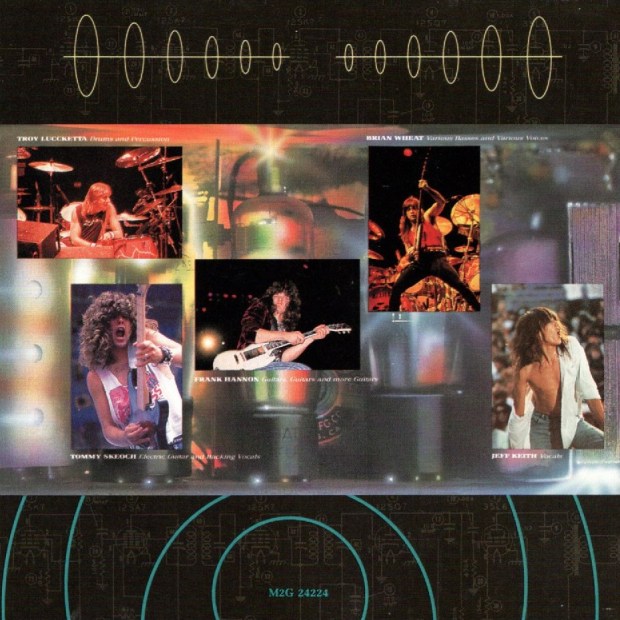
Tesla were great at writing hooks, and opener “Hang Tough” hits right away with a killer little bass intro by Brian Wheat.  This hard-hitter is a killer song with dual guitars, and Jeff Keith just givin’ ‘er at the microphone.  It’s a defiant tune with the kind of shouted chorus that a concert crowd could get behind.  Guitars galore courtesy of Mssrs. Hannon and Skeoch.  Continuing the lyrical theme of “hangin’ in there”, it’s “Lady Luck”.  The punchy chorus, “Lady Luck took a walk,” has a Def Leppard vibe circa Pyromania.  Jeff Keith’s convincing rasp is like a blunt instrument for delivering hooks.

The first track that really showed Tesla were a cut above the Hollywood trash was “Heaven’s Trail (No Way Out)”, a track ahead of its time.  With a grungy, chunky groove and acoustics layered with electrics, wah-wahs and slides, it’s Tesla doing their own thing.  It has one foot in southern rock and another in molten lead.  At this point, Frank Hannon and Tommy Skeoch were on their way to “serious guitar duo” status.

Tesla lighten up a bit on “Be a Man”, catchy and simple enough for the radio.  Nicely composed for easy consumption, complete with a considerably canorous guitar solo.  The skies grow dark again quickly on “Lazy Days, Crazy Nights” which sounds like it should be a party rocker, but is not.  “I’m doing fine right here on borrowed time,” sings Jeff on this memorable dirge.  Things get hot again on “Did it For the Money”, a slammin’ track with another riff reminiscent of a certain British band from Sheffield.  They don’t slow down on “Yesterdaze Gone”, the side closer, which is only faster and more intense.

A solid side-opening “Makin’ Magic” brings the tempo back to centre.  Chugging along with guitarmonies aloft, this is a nice rocker to reset the tone.  This leads into another single, “The Way It Is”, which is a light rocker but not quite a ballad.  Tesla’s southern side shines through.  It sounds like a celebration with a little bit of Skynyrd on the side.

I have one memory regarding “Flight to Nowhere”.  It was September of my last year of highschool, and for the yearbook, they wanted to take a big aerial photo.  I believe we stood in the football field spelling the letters “GRCI” while a plane flew overhead taking the pictures.  I remember standing near my friend Danesh, who also owned a CD of The Great Radio Controversy.  This song came to our minds as we jokingly imagined doomy scenarios of plane crashes and our imminent deaths.  “Goin’ down!  I’m on a flight to nowhere!”  Anecdote aside, this killer track is a deep cut tragically ignored over the years.  As it blasts through the skies powered by the chug of electric guitars, it only gets more intense.  My favourite line to repeat:  “Now the headlines read all across the lands, ’bout the motherfuckers gettin’ way outta hand.”  It seemed to genuinely apply to the world we lived in, as Iraq invaded Kuwait and created a powderkeg in the middle east.  More importantly it captured my youthful anger at the situation the world found itself it.  Motherfuckers.

The one weakness that The Great Radio Controversy has is its length.  We’re on track 11 and only now getting to “Love Song”.  Like “Little Suzi” on the previous LP, this one opens with a unique acoustic instrumental passage.  It is a mini composition of its own, unrelated to “Love Song” with a vaguely neoclassical vibe.   Yet it’s still a part of it, as one seems incomplete without the other.  Either way, “Love Song” is a powerhouse, a definitive power ballad, and one of the best from a period that suffered from a glut of them.  Midway it goes to a whole new level with a gut-busting Frankie Hannon lead.

Everything after this unfortunately feels like anti-climax because of the massive presence “Love Song” has on the second side.  “Paradise” is a good tune, which actually sounded better when it was redone acoustically on the next album Five Man Acoustic Jam.  The original is a tad overwrought, like heavy-handed Aerosmith.  The final song is, appropriately enough “Party’s Over”.  The riff bounces from the left speaker to the right in a cool effect, and once again I’m reminded of another five-member band from across the pond with the same management (Q-Prime).

Though song for song, The Great Radio Controversy seems the equal of Mechanical Resonance, it’s just a hint more uneven due to its longer running time.  Minor quibble.  Tesla had made two outstanding rock albums in a row by now and were still growing.   Some say The Great Radio Controversy is the best Tesla album.  I say, you be the judge.

4.25/5 stars


REVIEW: Triumph – “Spellbound” (1984 special promo 12″)

TRIUMPH – “Spellbound” (1984 MCA 12″ radio promo disc)

1984’s Thunder Seven was a big one in Canada, with “Spellbound” and “Follow Your Heart” both hitting the top 100 singles chart.  Triumph singles rarely offered up much in the way of non-album material, but the odd curiosity could be found.  This Triumph single for “Spellbound” was acquired by a friend, from Jerry’s Records in Pittsburgh back in 2013.

On the A-side, the standard 5:12 single version of “Spellbound” without edits.  You can really hear why this was a hit in 1984.  Triumph had learned to marry keyboard and guitar riffs for a bigger radio-ready sound.  With Gil Moore on lead vocals, “Spellbound” had huge chorus.  The track was also made into a cool video.

The B-side was specially designed for radio airplay.  Each track on Thunder Seven is given a brief special intro by the three band members.  You could look at this as an interview disc.  It’s nine minutes in length and not without value.  By listening we learn that “Spellbound”, for example, changed much from conception to release.  It was once titled “White Lies” before it was rewritten.  “Time Canon” was made up of 18 parts over 66 tracks.  Amazing stuff.  Their Canadian accents are adorable.

An excellent purchase for Triumph fans who have it all and need a little more.

4/5 stars

REVIEW: Jim Crean – The Book of Cryptids Volume II (2020)

JIM CREAN – The Book of Cryptids Volume II (2020 Dark Night Records)

Jim Crean, hard rock singer extraordinaire from Buffalo, New York, has issued another covers album called The Book of Cryptids Volume II.  Many will shy away at the thought of a covers album, but Crean always picks interesting covers off the beaten track.  The Book of Cryptids Volume II works because A) these are not songs you typically hear covered, and B) Jim kicks ass on them all.

It’s a varied album.  “Medusa” by Anthrax opens heavily and melodically.  You might wonder how a hard rock singer like Crean tackles Anthrax.  Without difficulty!  Jim has a bit more rasp, but where Joey Belladonna gets aggressive, Jim pays more attention to the notes.  It’s a fine trade-off.  Second in line is the seldom-covered Aerosmith classic “Kings and Queens”, which is right up Jim’s alley.  Sounds like a banjo is thrown in for texture during the verses.  For an even deeper cut, check out the flawless version of Def Leppard’s “Mirror Mirror”.  It ticks all the boxes from dual guitars to throbbing bass.  Old raspy Def Leppard is well suited to Jim, who wrenches some panache from the chorus.  An ace performance.

Gowan’s “A Criminal Mind” is definitely an unexpected cover.  The only band known for covering it is Styx — featuring Lawrence Gowan.  Jim Crean could be the only other singer to dare tackle it?  This song might be a bit of a sacred cow in some quarters, but Jim does an admirable job of it.  Not vastly different, but with its own unique vocal colours.

Keeping with a synthy 80s plot twist, “Silent Running (On Dangerous Ground)” is the old Mike + the Mechanics hit.  Cool guitar solo on this track that stays pretty true to the original.  Then “Cry For Freedom”, the White Lion slow burner from 1989, is another surprise.  Crean has covered White Lion before, but “Cry For Freedom” is a special song.  Not a ballad yet not a rocker, it leans heavily on the beat and the vocal.  Then it has a guitar burn-up near the end, and this one sounds exactly like Vito Bratta.

A keyboardy piano ballad called “Love Is” (Vanessa Williams) …well, let’s just say it takes balls of steel to put it on the same album as an Anthrax song.  Fortunately Jim makes it cool, but not as cool as the earlier “Criminal Mind”.  But then it’s a whole different ball park:  Mother Love Bone, and “Star Dog Champion”.  Again, a song that might be considered sacred in some quarters.  Jim’s voice is well suited to it, and this “Champion” is fully enjoyable.

We begin to draw to a close on the Scorpions early dark ballad, “When the Smoke is Going Down”.  It’s another song that Crean is capable of bending to his will.  Brilliant vocal on this one, especially considering that Klaus Meine has to be a top-five metal singer.  Coming down from that climax, the final denoument is surprisingly authentic to the original:  the Stones’ “Gimme Shelter”.  This is one of those mountainous peaks that only fools dare to climb.  Yet Crean’s winning streak continues unabated.  The sonics are so close to the Stones, and everything sounds completely natural.  How the hell do you replicate Charlie Watts’ drums on “Gimme Shelter”?  Dunno, but it sounds really good!

All this said, you’re still skeptical, right?  Covering “A Criminal Mind” and “Gimme Shelter”?  A healthy dose of skepticism is warranted when reading a glowing review of a covers album.  To me, covers are worth listening to when you enjoy the spin that another artist puts on the song.  In this case it’s Jim’s voice, a classic hard rock voice that I like a lot.  So I’m cool with hearing “A Criminal Mind”, because I like the way Jim sings.

Consider this.  We’re 10 months into a worldwide pandemic and gigs have dried up.  Some artists, like Jim Crean, are recording and releasing music, and we should be supporting that.  He gives you good value for the money.  This copy came signed, with a custom Jim Crean guitar pick and signed photo.  Not to mention some quality covers of great songs off the beaten track.  The Book of Cryptids Volume II comes with cool artwork of various cryptozoological specimens including a kraken, Bigfoot, some sirens and an alien.  You can buy this package direct from the artist, so you know the money goes to the right people.  Check it out — guaranteed a few of these tracks will put a smile on your face.

4/5 stars