hard rock

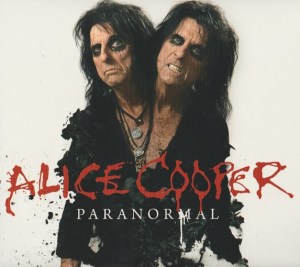
REVIEW: Alice Cooper – Paranormal (2017 2 CD edition)

ALICE COOPER – Paranormal (2017 Edel 2 CD edition)

Both Alice Cooper and Bob Ezrin had a lot to live up to with their latest collaboration Paranormal.  Excluding 2015’s covers album Hollywood Vampires, their last record together was the remarkable Welcome 2 My Nightmare in 2011.  Bob Ezrin has already produced one of the more impressive rock albums of 2017, Deep Purple’s InFinite.  Considering this recent track record, one might say we expect the goods this time too.

Paranormal is a great album, loaded with fantastic Alice Cooper material of different rock and roll styles.  It is not up to the level of brilliance of Welcome 2 My Nightmare.  That album (a concept album sequel) was dense with ideas and composition.  Paranormal is a step towards something less conceptual and more like a traditional album.  The big surprise this time out is the drummer:  U2’s Larry Mullen plays on 9 of the 10 core songs, and you’d never guess that without reading the credits.

The title track is impressive on its own.  It has a haunting guitar hook and vocal, and is built a bit like Alice’s horror material from the 80s.  That’s Ezrin’s pal, Roger Glover from Deep Purple on bass.  Back to the early 70s, get down with some hard rocking “Dead Flies”, but don’t let your guard down.  Relentlessly, “Fireball” blazes down the terrain, kicking aside everything not nailed down.  Alice doesn’t have anything that sounds like “Fireball” on any of his other albums.

The lead single “Paranoiac Personality” (a single worth tracking down for an exclusive live B-side) is similar to “Go to Hell” (from 1976’s Alice Cooper Goes to Hell).  It’s the kind of magic that happens only when Alice Cooper and Bob Ezrin work together.  Memorable Alice Cooper rock, accessible enough for radio play, but within the personality of Alice.

Moving on to sleaze rock, “Fallen in Love” is a strong entry.  If it sounds a little greasy, that’s probably because Billy Gibbons is on it.  It’s followed by a speedy trip called “Dynamite Road” with a neat spoken-word style vocal.  It suits Alice’s storytelling lyrics.  After a couple of heavy bashers, it’s good to get back to a groove on “Private Public Breakdown”.  These are some impressive songs, each different from the other but fitting the whole.

A kickin’ horn section joins Alice on “Holy Water”, a fun and unorthodox rock and roll sermon.  Then there’s a good old fashioned punk rocker called “Rats”.  It might remind you of Michael Monroe’s classic “Dead, Jail or Rock ‘N’ Roll”.  It’s the only song on disc one that Larry Mullen doesn’t play on.  “Rats” has the surviving original Alice Cooper band: Michael Bruce, Neal Smith, and Dennis Dunaway.

Going for a haunting close, there is an understated song called “The Sound of A” to end the album proper.  This truly recalls Welcome to (and 2) My Nightmare.  Original bassist Dennis Dunaway co-wrote and plays bass on the track.  Although he was not in the band during the Nightmare era, that is what immediately comes to mind.  This is the kind of song that has the potential to become an Alice classic a few years down the road.
Cooper has been generous with bonus tracks on his last few albums, and Paranormal has a fully loaded second CD.  There are two more brand new songs featuring the surviving members of the original Alice Cooper band.  Steve Hunter is also on board with some slippery slide goodness.  “Genuine American Girl” is a transgender celebration, the kind of thing that would have been cutting edge in 1972, but today is just timely.  Smith co-write this with Alice and Ezrin, and it’s a remarkably catchy little tune.  “This is no-man’s land and I live here every day” sings a gleeful Alice.  It does sound like something the original band could have played back then.  “You and All Your Friends” (Cooper/Dunaway/Ezrin) is more of an anthem.  A crowd could definitely sing along.  These two tracks serve as reminders to what great players the original band members are.  Neal Smith is absolutely a drumming maniac and Dennis Dunaway is still one of kind.

There are six more bonus tracks, all live cuts from 2016 featuring Alice’s stellar live band.  It’s good to have these, because really the only thing missing from the new songs is guitarist Nita Strauss.  She’s a monster player.  For those hoping to hear Nita on Alice’s new album, at least she’s on the bonus tracks.  The live cuts are a fairly standard selection of 70s hits (all but “Feed My Frankenstein”).  You know what you’re getting:  expertly performed Cooper classics by his gang of professional rock and roll misfits.

Paranormal is yet another late-career triumph by Alice Cooper.  It’s just a hair shy of mind blowing.

4.5/5 stars

REVIEW: Lee Aaron – Radio Hitz and More… (2012)

LEE AARON – Radio Hitz and More… (2012)

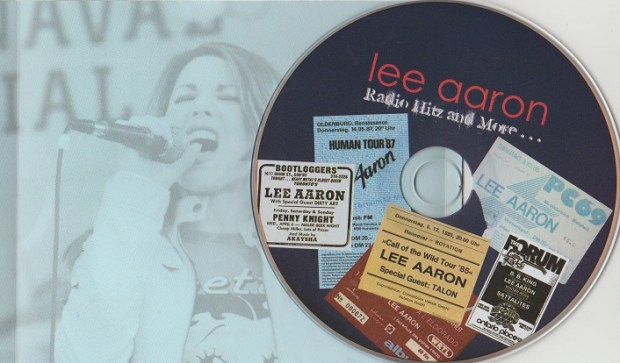
Respect to Lee Aaron!  She’s persisted through the decades with a multi-faceted career, including her early metal roots.  What she really needed was some kind of compilation CD that captured it all.  1992’s Powerline is a good compilation but some of Lee’s most interesting work came after.  Radio Hitz and More… fills in some of the blanks from the past 20 years.  You can only get it via Lee’s website as a promotional item.  I bought a T-shirt and got the CD with it, signed and personalized.*

Even if it haunted her career at times, “Metal Queen” is a damn fine song.  Period, end of sentence.  Today we can see that “Metal Queen” had it all:  killer quintessential riff, howling vocals and a searing solo.  Few metal singers could touch Lee Aaron’s ability.  While the fans knew she could do more than metal, she absolutely owned it on “Metal Queen”.  Hail to the queen.

Lee eventually shifted into a hard rock mold.  “Whatcha Do to My Body” was a big hit, and it’s next in radio edit form.  It delivered big hooks and didn’t require any song doctors.  Lee Aaron and her longtime guitarist John Albini wrote it and were rewarded with loads of MuchMusic video play.  However the two did collaborate with an outside writer on “Powerline” (1987) and that outside writer was surprisingly former Rainbow singer Joe Lynn Turner.  “Powerline” is a bit light and heavily reliant on keyboards, sounding a little like Heart.

The songs included from Lee’s “rock” period are all pretty much hits in Canada.  “Hands On” followed “Watcha Do to My Body” in regular video rotation.  “Sweet Talk” and “Sex With Love” were singles from another big Lee Aaron album, Some Girls Do (1991).  The title track “Some Girls Do” is here and very Van Halen.  Two of Lee’s most stunning ballads are included too.  “Barely Holdin’ On” could be her best song, period.  “Only Human” was from the 1987 pop rock era, but is a strong ballad regardless.  Only a few notable singles are missing.  The always likeable Disco-dis “Shake it Up” is too hard to find out there in the wild.  Another big ballad, “Peace on Earth” is missing in action.  However the space does not go to waste.

In 1996 Lee Aaron resurfaced with a new band called 2preciious.  The lineup included Lee and the three Dons from Sons of Freedom!  A strange combo to be sure, and the alternative-flavoured album they came out with didn’t make waves, though it got decent reviews.  “Mascara” is edgy acoustic rock, completely unlike Lee’s previous work.  There’s even a rare European-only track called “Concrete and Ice” which is a bass-heavy 90s groove rocker.  Great stuff; it’s unfortunate it didn’t gain traction,  because with Alanis Morissette being so big at the same time, perhaps Lee could have tagged along.

The next stage of Lee Aaron’s career was her entry into the jazz world.  2000 saw the release of her album Slick Chick, and in 2004 there was Beautiful Things.  Tracks from both are here, including the instantly likeable “I’d Love To”.  It’s a little jarring to hear “Handcuffed to a Fence in Mississippi” in the middle of a bunch of rock tracks, though.

This compilation is great for gathering together a bunch of Lee Aaron’s diverse hits, but that’s not all.  Track 18 is a little bonus for collectors.  From Sweden Rock, it’s killer track “Baby Go Round” originally from Emotional Rain.  This live version is available nowhere else, which is like catnip for collectors.

77 minutes of music, for free?  How do you spell N-O-B-R-A-I-N-E-R?

4/5 stars

*If ordering, check before assuming they still offer signed CDs.


REVIEW: Judas Priest – ’98 Live Meltdown (1998)

JUDAS PRIEST – ’98 Live Meltdown (1998 BMG)

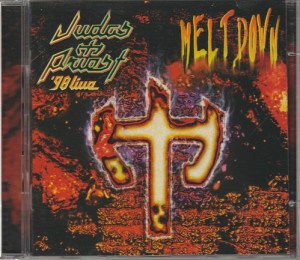
First in a long line of non-essential Priest live albums, here’s ’98 Live Meltdown.  Why did bands at certain points feel the need to add the year to the title?  Warrant – ’96 Belly to Belly – Volume One.  Kind of silly, right?  For fans who know their metal history, 1998 falls in Judas Priest’s Ripper Owens years.  Priest had just released their first album without Rob Halford, Jugulator.  Live Meltdown (let’s leave out that ’98 part for simplicity’s sake) captures the tour that followed, from various uncredited dates.

Fortunately the album is better than its title and awful cover art.  (Shame on you Mark Wilkinson!)  Ripper Owens provided fresh young lungs and with him at the mic, Priest were uber-powerful live.  All the new tunes from Jugulator were better in the live setting too.  “Blood Stained” is devastatingly powerful, and an enthusiastic crowd eats it up.  There are a few extraneous Jugulator tunes.  The world could have lived without “Death Row” and “Abductors”, and maybe the title track could have been thrown in instead.  Fortunately the track list is an otherwise excellent mix of new tracks and old cuts.

Priest deserve points for re-imaging their Joan Baez cover “Diamonds and Rust”.  The acoustic version was completely new for Judas Priest and Ripper could easily handle the heavy and the light.  Even though it’s acoustic, “Diamonds and Rust” represents Sin After Sin on a CD that gives face time to nearly every Priest album.   Rocka Rolla and Ram It Down are shunned as usual, but otherwise the only albums without tracks on this are Turbo and Point of Entry.  There is an emphasis on the classic material from the 70s, solid songs from the early 80s, and four tracks from Painkiller.  It’s a well-rounded album, and by the next live release (2003’s Live in London) they changed it up and added “Turbo” and “Heading Out to the Highway”.

Ripper was a great lead singer for this band during Rob’s absence.  He took one of the hardest jobs in rock and roll and did it with class.  Ripper had the goods.  He could scream the notes.  He added his own slant with guttural growls.  He struggled with “Painkiller” proving he’s a mere mortal but still he got the job done.

Live Meltdown was self-produced by Priest and Sean Lynch, but the guitars are too low in the mix.  The emphasis is on Ripper, but it seems to come at the expense of the volume of the rhythm guitars.  And the packaging is atrocious.  While it is true that most metal bands like Priest found themselves on smaller record labels, this is worse than a 90s indy band.  Fortunately the music and performance justify its existence.

Curious fans are advised to pick up Live Meltdown for the best representation of the Ripper Owens years.  It’s better than Jugulator and Live in London.  Fans are unanimously happy that Rob Halford is back in Judas Priest today, but that shouldn’t be taken as a slight against Ripper.

3.5/5 stars

REVIEW: The Black Crowes – The Southern Harmony and Musical Companion (remastered)


THE BLACK CROWES – The Southern Harmony and Musical Companion (originally 1992, 1998 American remaster)

On their first album, the Crowes were old time soulful rock and roll saviours.  They were a retro treat, an antidote to the Poisons and Bon Jovis and Warrants.  By their second album, the Crowes became artists.  Fraught with tension, ther brothers Robinson battled over creative direction.  Songs were recorded, re-recorded, dropped, replaced.  But it all happened very quickly.  The songs were written in a matter of weeks, and the album was recorded in a matter of days, according to Chris Robinson.

There was also a lineup change.  Guitarist Jeff Cease (who didn’t play much on the first album anyway) was out and Marc Ford from Burning Tree was in.  Perhaps most importantly, the Crowes added a full-time keyboard player.  Canadian-born Eddie Harsch (R.I.P.) fit like a glove and became a fan favourite relatively quickly.  Unusually, Harsch isn’t on the front cover though he’s on the back and inside of The Southern Harmony and Musical Companion.

Get stung!  “Sting Me” is one of the songs the brothers fought over.  One liked the fast one that opens Southern Harmony.  One preferred the original slow version that’s included as a bonus track.  The fast version won out and you will get why.  It’s hyper-fast, but with the southern flavour added in shots.  Backup singers Barbara and Joy are all over the album, including “Sting Me”, putting a soulful spin on everything.

Can I have some “Remedy”?  Track two was a #1 hit for a stunning 11 weeks.  A slick groove and funky electric piano make this one a blues rocker for the ages.  In one track, the Crowes stepped away from their previous derivative sound, and hit the warp drive.  It’s such tremendous leap in terms of growth.  Barbara and Joy have the chorus covered while Chris scats his way into the charts.

The acoustic side of the Crowes comes out on “Thorn in My Pride”, which also points the way forward to 1994’s Amorica.  Congas and organ add a slightly psychedelic slant, but the song also gives way to an electric jam.  Another single and another hit for the Black Crowes.  Going further into electric blues, “Bad Luck Blue Eyes Goodbye” is raw and exposed.  The band and producer George Drakoulias captured a warm and bare sound, and no track shows it off better.  You can hear the hum of hot amplifiers.  And those amps get cranked up on “Sometimes Salvation”.  Heavy blues, emphasis on groove.  Drummer Steve Gorman has long been this band’s secret weapon.

Side two is cranked immediately on the rock and roll “Hotel Illness”.  Guitars crash and slide, it’s a harmonica blowin’ good time.  Southern Harmony takes a few listens to fully penetrate but a track like “Hotel Illness” takes no time at all.  Then the black moon starts-a-creepin’.  There’s a dark swampy vibe to “Black Moon Creeping”, but heavy with growling guitar explorations.  “No Speak No Slave” crawls up next, bustin’ down the doors with some sweet guitar harmonies.  For songs like “No Speak No Slave”, guitar players have admired this album for a long time. Then it’s on to “My Morning Song” which returns the emphasis to some soul singin’.

An acoustic cover of Bob Marley’s “Time Will Tell” sounds like a jam, but those things are often the magical moments.  That’s what “Time Will Tell” is, a magical moment.  It’s a snapshot of a group of musicians just singing and playing with their hearts.

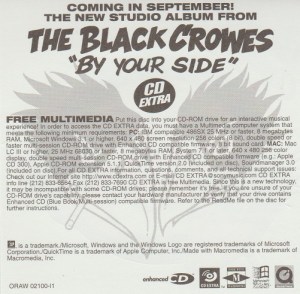
As with the other Crowes remasters from the 1998 reissues, Southern Harmony has bonus stuff.  All four have a sticker inside with an ad for the forthcoming Crowes album By Your Side on the back.  There are two music videos, a screensaver, and a “link to the Black Crowes’ website!”  More importantly there are two bonus tracks.  The aforementioned “slow” version of “Sting Me” is interesting but the fast version sets it apart but the other mid-tempo material on the album.  Another fast tune, “99 lbs” is an instantly likeable blues cover, more straightforward than the album itself.  It’s more like Shake Your Money Maker Crowes.  Great tune for a bonus track.

If you’re familiar with this album, you may agree.  If you’re not, you probably know this album for its reputation.  Southern Harmony and the Musical Companion is an essential album for any rock collector with integrity.  They don’t come more authentic or proudly individual than this.  Get some.

5/5 stars
REVIEW: Ozzy Osbourne – No More Tears (remaster)

“Politicians make decisions, they’re the ones to blame, so don’t blame me.”  — Ozzy Osbourne

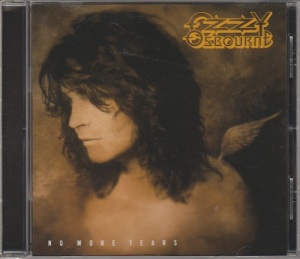
OZZY OSBOURNE – No More Tears (originally 1991, 2002 Sony remastered edition)

No More Tears was a big hit for Ozzy and is usually hailed as a “comeback” and “his best album since Randy Rhoads”. But is it?

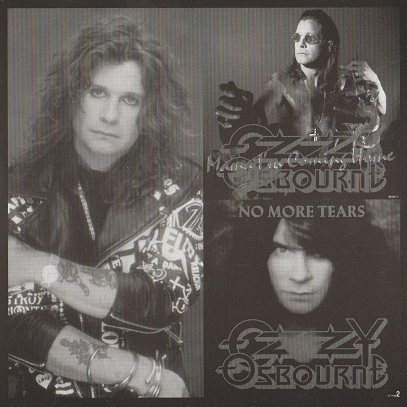
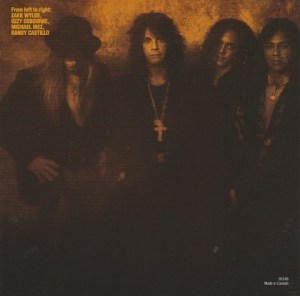
No More Tears certainly offers chills, thrills and new sounds.  Slide guitar on an Ozzy album?  Check out “Mr. Tinkertrain”.  Zakk Wylde was starting to spread out and grow, really exploring his southern roots and adapting that to heavy metal.  No More Tears might be the peak of Ozzy’s collaborations with Zakk, as they really did produce some magic here.  Some of the stuff Zakk does on “Mr. Tinkertrain” alone is career-defining.

Ozzy was also trying to escape his “satanic” image, and No More Tears was his step away from that.  It’s also a step towards the mainstream.  Second track “I Don’t Want to Change the World” is an example of Ozzy’s turn to radio-ready hard rock.  It’s a shame because after the chunky guitar assault of “Mr. Tinkertrain”, a speedy metal track like “Don’t Blame Me” would have been perfect in the second slot.  “I Don’t Want to Change the World” is unfortunately not much better than a Motley Crue filler track.  It’s repetitive and despite Zakk’s squeals and licks, fails to launch.  His solo at least scorches hot.  Then the whole thing gets stuck in the mud.  “Mama, I’m Coming Home” (lyrics co-written by Lemmy) was the hit ballad that I never liked.  “Mama” more than any of the other tracks really represented Ozzy’s desire to break free of the shackles of his own image.  There are better ballads on the album.  “Mama” is so generic it could have been recorded by literally anybody.

Moving past, the album catches a little air due to the groovy chugging riff of “Desire”.  The stock melody doesn’t do it many favours, but momentum is restored.

Ozzy did well by discovering his newest member, bass player Mike Inez who later went on to Alice in Chains.  Inez was a co-writer on the title track “No More Tears” and his bass line has become a signature hook.  “No More Tears” is one of Ozzy’s greatest achievements as a recording artist.  This is a direction he should have explored further.  Even though it’s incredibly memorable and accessible, “No More Tears” has slightly progressive and psychedelic elements mixed in.  Its groove was detuned and modern, but the samples and keys bring it levels above what most other mainstream bands were doing in 1991.  And then there’s Zakk’s slippery slide guitar expertise.  It just doesn’t get any better than “No More Tears”.  Ozzy wanted to move beyond being the clown prince of devilish metal?  Mission accomplished and then some, in a completely fearless 7:24.  Ozzy was an innovator when he was in Black Sabbath, and in 1991 he became that again on “No More Tears”.

Opening side two, “S.I.N.” is great old-school Ozzy metal.  Call it “S.I.N.” or just “Shadows in the Night”, this track has the kind of classic hooks and soaring vocals that Ozzy is so good at delivering.  Ozzy had a core writing team of Zakk and drummer Randy Castillo, who wrote this killer.  Lemmy stepped in to help out on “Hellraiser” which Motorhead recorded as well on 1992’s March ör Die.  “Hellraiser” is too middle of the road to be classic.  Even Motorhead’s version kind of sucks.

A stock ballad called “Time After Time” is a tad better than “Mama, I’m Coming Home”.  It has some pretty sweet melodies and harmonies going for it, and another brilliant Zakk solo.  “Zombie Stomp” brings back the heavy, simply by living up to its name.  You got a name like that, you better stomp, and this one stomps like all the beasts in the jungle are coming for you now.  It’s also plenty of fun.  Surely an underappreciated Ozzy career highlight.  Drummer Randy Castillo had a lot to be proud of on this one, as he took the spotlight for the two minute tribal intro.  When that’s all over, Zakk powers the groove.

More fun ensues on “A.V.H.” (no idea what that stands for).  A little bit of southern pickin’ from Zakk gives way to an adrenaline powered blast.  It’s a shorty compared to some of the more epic lengthy songs.  Finally “Road to Nowhere” ends the album with a retrospective.  “I was looking back on my life, and all the things I’ve done to me.”  It’s easily the strongest ballad on the album and one of Ozzy’s personal best.  “The wreckage of my past keeps haunting me,” wrote Ozzy in 1991, perhaps not knowing that it always will.

There is no arguing the importance of the song “Mama, I’m Coming Home” in the career of Ozzy.  It went top 30, and was huge on MTV.  Would No More Tears be a better album without it?  Should Ozzy have released it as a single or on a movie soundtrack?  Try this.  Remove “Mama” from the album, and put the B-side track “Don’t Blame Me”* in between “Mr. Tinkertrain” and “I Don’t Want to Change the World”. There is something to be said for a good B-side, and Ozzy has done a number over the years.  Yet “Don’t Blame Me” is far too good for that fate.  It combines riff with groove and hooks like nothing else on the album, and just listen to Zakk’s funky pickin’.  Fortunately it’s on the 2002 Sony remastered CD, along with a lesser B-side called “Party With the Animals”.  You might remember it from the 1992 soundtrack Buffy the Vampire Slayer.  “Animals” is definite B-side material.

Back to our original question.  Was No More Tears the “best album since Randy Rhoads”?  It’s quite good and easily his biggest since Randy Rhoads.  But it has filler, and some of that filler is downright annoying.  The remastered edition is the one to get, since you don’t want to miss out on “Don’t Blame Me”.  Bark at the Moon is likely the high water mark since the passing of Rhoads.  No More Tears is still one to own, even if you have the hits, for some killer and underrated album tracks (and one B-side).

3.5/5 stars
* Two early album titles used for this record were Don’t Blame Me and No Dogs Allowed.

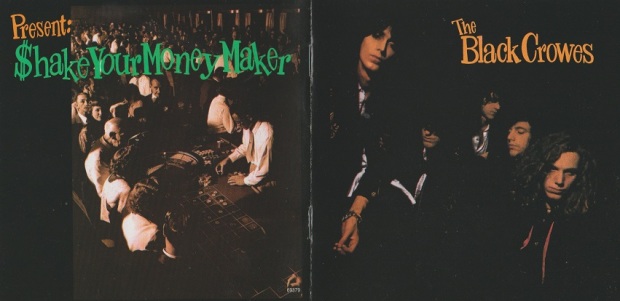
REVIEW: The Black Crowes – Shake Your Money Maker (remastered)

THE BLACK CROWES – Shake Your Money Maker (originally 1990, 1998 American remaster)

In 1990, just on the cusp of a musical revolution, a new band emerged from Georgia to challenge everything that was going on in rock and roll.  The biggest rock bands in the world had been playing around with the blues, but now there was a new band who lived and breathed it.  The Black Crowes were unlike all the other bands (except maybe the London Quireboys) and their debut album Shake Your Money Maker shook the money tree!

With George Drakoulias in the producer’s chair, the Crowes laid down one fine debut album.  They drew influence from the 70s:  Bands like the Stones and Skynyrd, as well as the old Mississippi Delta bluesmen.  The slide-drenched “Twice As Hard” certainly didn’t sound like a new band in 1990, but its honest authenticity has kept in a fan favourite for decades.  Listen to Rich Robinson’s slide and dig in.  Vocalist Chris Robinson’s bluesy drawl delivers a hell of a chorus.  “Twice As Hard” is perfect in every measure.

Rolling right into the first single “Jealous Again” the Crowes sound like the offspring of the Stones at their boogie-woogie best.  During the summer of 1990, you simply could not escape these songs.  Unlike many of their contemporaries they still stand tall.

The Stones had their “Angie”, the Crowes have their “Sister Luck”.  Shake Your Money Maker is a well rounded album with a few piano based slow tracks.  You want authenticity?  That’s Chuck Leavell on keys (he’s been playing with the Rolling Stones for decades).  Back to the rock, “Could I’ve Been So Blind” kicks it with a shot of caffeine and a great chorus.  Thing go slow again on the organ based blues “Seeing Things”.  The Crowes were just kids but it sounds like they have years and years of pain to pour into these songs.  “Seeing Things” is a tour de force!

One of the most well known singles from Shake Your Money Maker was the old Otis Redding cover “Hard to Handle”.  Bringing the boogie back, the Crowes had a huge hit with this cover.  It must be noted that there are two different versions of this track.  Radio stations were serviced with a very rare “horn mix” that brings in a brass section.  (This extremely rare promo CD is catalogue number PRO-CD-4896.)   The remix still gets occasional radio play.  Unfortunately the album only has the original mix.  (There were plenty of live and acoustic B-sides made for these singles too.)

“Thick N’ Thin” begins with a car crash, and this is one of the most energetic tracks in the Crowes catalog.  Like the Faces on adrenaline, “Thick N’ Thin” is a blast.  Fast paced rock and roll with boogie woogie piano gets the feet moving.  One of the fastest songs gives way to the slowest one.  “She Talks to Angels” is the only one that deserves the tag “ballad”.  Acoustics guitars, organ, and Chris’ plaintive voice took it to #1 on the US album rock charts.  It’s still just as stunning today.

Moving in for the close, “Struttin’ Blues” is relatively nondescript compared to some of the prior ass-kickers.  They save most kick-ass for last:  “Stare It Cold”.  It starts as a standard Stones-y rocker, but then it picks up speed right to the end, brilliantly ending the debut album on a hell of a good impression.

The 1998 remaster contains two bonus tracks and a few anachronisms:  music videos, a screen saver and “a link to the Crowes’ website!”  With the benefit of hindsight, we would have preferred more bonus tracks, but in 1998 this was cutting edge stuff.  The bonus cuts include “Don’t Wake Me”, a slide-drenched add-on.  As a song it’s not the most memorable, but that slide guitar is priceless.  The second is an “acoustic” version of “She Talks to Angels”.  The emphasis is on piano, and it sounds live in the studio.

Huge credit must go not only to the Black Crowes but also to producer Drakoulias.  His reputation speaks for itself but this album still sounds fantastic.  It does not sound like it was recorded in 1990.  The drums and all the other instruments are full and clear.  The brothers Robinson wrote all the original tunes, and as it turned out they were a classic batch.  Shake Your Money Maker is not original or innovative, but it is timeless.

4/5 stars
REVIEW: Styx – The Mission (2017)

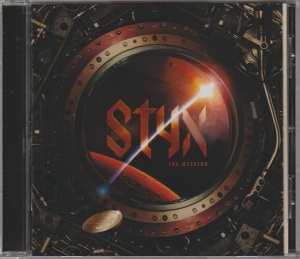
STYX – The Mission (2017 Universal)

Did anyone in 2017 expect Styx to come out with one of the best albums of the year?  Even though Styx have successfully carried on with Lawrence (But You Can Call Me Larry) Gowan on keys and vocals, nobody really predicted this!  Yet here it is:  The Mission, surely one of the best albums of the year so far,* and the best Styx in decades.

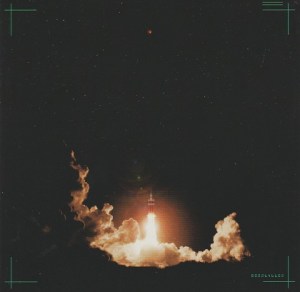
Here’s another unexpected twist:  The Mission is a concept album about colonizing Mars!  It has a coherent story and recurring hooks.  In many ways The Mission sounds like a lost album from Styx’s progressive rock heyday.  But you wouldn’t guess that if you only heard the Gowan-sung lead single “Gone Gone Gone”.  Although it’s about a rocket launch, you might not catch that on first listen.  The year is 2033.  “Light it up, let’s get this show on the road!”  This hard rocker came out of nowhere as one of the big surprises this summer.

“Hundred Million Miles From Home” (vocals by Tommy Shaw) has a funkier 70s groove.**  When the band harmonizes together, it sounds like vintage Styx.   “Hundred Million Miles” is a great song and also fairly accurate.  Mars was 100 million miles away from Earth as recently as the 2012 opposition.  Problems happen on “Trouble at the Big Show” (vocals by James “JY” Young), a slower groove with killer bluesy guitar work.  This moves into the ballad “Locomotive”, about the brave pilot of the ship Khedive.  Shaw pours passion into it, as he does the next one “Radio Silence”.  Just as interesting as the actual music is the spacey backing sounds.  It certainly adds atmosphere to an excellent vintage sounding song.  “Radio Silence” recalls some of Shaw’s 70s hits like “Boat on a River” at times.

Gowan returns to the microphone on the lovely piano ballad “The Greater Good”.  It sounds like quintessential Styx; hit quality material with soul.  Things start to get upbeat again on “Time May Bend” (another Gowan vocal).  If you’re not familiar with Lawrence Gowan, he is not a Dennis DeYoung clone, sounding closer to Steve Hogarth of Marillion.  (He even looks a little like “H”.)  Listen for a subtle musical “S.O.S.” signal in the backing track.

There are musical segues and radio voices between some tracks, but  “Red Storm” is the next full song. It’s a very progressive song with all the trimmings.  It’s based on Tommy Shaw’s excellent acoustic work, and it paints a picture.  The crew of the Khedive must brave a dust storm on the surface of Mars.  “Carry what you can, there’s no turning back, gonna make it to the mothership.”  There are avante-garde flashes of guitar noise that emulates the squeals of a radio, or perhaps metal on metal.  Then a rocking riff and solo…”Red Storm” has it all.

Gowan absolutely proves his mettle on the piano opus “Khedive”.  The blur of piano recalls classical compositions, and the guitar solo is pure Queen.  The minimal vocals continue the story:  “Onwards!  Onwards!”  Then we revisit the sounds of the 80s on “The Outpost”, the triumphant conclusion to the story.  The 80s synth and beats remind of the classic “Mr. Roboto” period of Styx, but it rocks solidly too.  Listen for a reprise of the “Overture” music from the start for the album.  Finally “Mission to Mars” is the denouement, a bright and lively end.

The Mission is brilliant for a number of reasons.  First and foremost — great songs.  You will play The Mission over and over, simply because it has great songs, as good as the days of old.  Second, although Lawrence Gowan has his stamp all over the album, it sounds like Styx and nobody else.  Having Gowan more involved is a good thing.  He has a 40 year career in Canada, and he didn’t have enough time on the Cyclorama (2003) album.  But this sounds way more like Styx than Cyclorama did.  Finally, this album is loaded with incredible playing by all the members.  This is easily the best lineup Styx have had since Kilroy Was Here (1983).***    Fans of the guitar (both electric and acoustic) will find many moments of musical ecstasy.

For Styx, this is mission accomplished!

5/5 stars

* One of the best album covers too.  Is that a port hole, or a turntable?  You decide.  

** Bassist Chuck Panozzo plays the funky bass on “Hundred Million Miles From Home”, his only appearance.  Chuck, the other original member besides JY, is only able to make sporadic appearances with Styx due to his battle with AIDS.  Ricky Phillips plays the rest of the bass parts, meaning Styx have two official bassists!

*** Lawrence Gowan (piano/vocals), Tommy Shaw (guitar/vocals), James “JY” Young (guitar/vocals), Todd Sucherman (drums), Ricky Phillips & Chuck Panozzo (bass)

REVIEW: Ritchie Blackmore’s Rainbow – Stranger In Us All (expanded edition)

RITCHIE BLACKMORE’S RAINBOW – Stranger In Us All (originally 1995, 2017 Sony expanded edition)

Blackmore said “adios” to Deep Purple for the second and final time in 1993.  He beat them to the punch with new music, in the form of a resurrected Rainbow…sort of.  As he is prone to do, Blackmore assembled an all-new Rainbow of unknowns.  The only familiar face was bassist Greg Smith who happened to be in Alice Cooper’s band when Wayne’s World was filmed.  The new singer was the smooth-voiced Scot, Mr. Doogie White.  White’s career almost broke in a completely different direction earlier, when he was one of two finalists in the running to replace Bruce Dickinson in Iron Maiden.  It went to Blaze Bayley.  Signifying new beginnings, Blackmore reverted the band’s name to Ritchie Blackmore’s Rainbow once again.

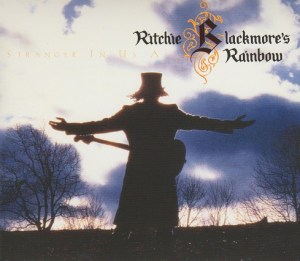
Back in 1995, my impressions of Stranger In Us All, the new album by Blackmore’s Rainbow, were significantly underwhelming.  It has taken its time, but over the years the album slowly penetrated my stubborn refusal to accept it as legitimate.  By now I think we know all Rainbow needs is the Man in Black.  And there he stands on the front cover, pilgrim-hatted again, gloriously silhouetted against a cloudy sky.

The only serious weakness in Stranger In Us All has nothing to do with the lineup.  The production (by Pat Regan and Blackmore) sounds low budget and the drums sound muddy.  Blackmore’s guitar tone is thankfully impeccable and his neo-classical leanings on the first track “Wolf to the Moon” were refreshing.  “Wolf to the Moon” is one song that has stood the test of time.  It is thoroughly still enjoyable today, and Blackmore is unleashed.  And the singer?  It is true that Doogie White stands in the shadows of some great lead vocalists.  I’ll resist ranking and comparing.  White has a very smooth voice with impressive power and range, and he doesn’t sound like any of his predecessors.  Where White really impresses is in live renditions.  He is an entertaining and amicable frontman.

Track two brings a slower grind to Rainbow, and White slinks along with him, adapting perfectly to every vibe.  Going slower still, “Hunting Humans (Insatiable)” really prowls.  It is spare, dark and sweaty.  Moving on to inspirational hard rock, Rainbow brings the harmonica-inflected “Stand and Fight”.  What is not to like?

Rainbow ended the first side in typically epic fashion.  “Ariel” was quite a track, featuring backing vocals from the lady who is now Ritchie’s wife, Mrs. Candice Night.  She co-wrote a number of the album’s tracks including “Ariel”.  This kind of thing is Ritchie’s bread and butter, he’s been writing epics like this since “Child in Time” back in 1970.  As an added bonus, the extended edition of Stranger In Us All has the single edit of “Ariel”, trimming it to a tidy format-friendly 4:00.  This is more like a re-edit, moving parts around and making it more compact.

They step on the gas again for “Too Late for Tears”.  Side two has a couple “stock” rockers — “Too Late for Tears” and “Silence”.  Good blood-pumping tracks, nothing to save for your greatest hits album, but decent enough.  “Black Masquerade” is better, as it has a dark neo-classical edge.  Thing go kind of goofy when they cover Grieg’s “Hall of the Mountain King” and add lyrics.  They also have another go at the Yardbirds’ “Still I’m Sad”, this being the second time.  The first Rainbow version was an instrumental.  This one has vocals, and it’s pretty good.  Just like with lead singers, I don’t think it’s worth comparing this version to the 1975 one.  It’s unique enough that it’s almost two different things.

Back in 2013 I found the Japanese edition of Stranger In Us All at the 2013 Toronto Musical Collectibles Record & CD Sale for $15.  Instant no-brain purchase right?  Now that this expanded edition is out, I no longer need it in my ever-expanding collection.  I am passing it on to massive Rainbow fan Brian over at Boppinsblog.  Now that CDs are worth nothing, I like to pay it forward with my retired music.  The expanded edition contains the Japanese bonus track, “Emotional Crime”.  It has a cool, “smoove” groove and a bluesy feel.  Think Purple’s 1988 remake of “Hush” in terms of vibe.  The other extra tracks are the aforementioned “Ariel” edit, and a live take of the old Rainbow classic “Temple of the King”.  This is and the “Ariel” edit are taken from the old out of print CD single.  “Temple of the King” was recorded in Stockholm October 2 1995, meaning it is not the same as the one on the double live CD Black Masquerade.  That was recorded exactly a week later in Germany.  (Thanks to Scott the Heavy Metal Overlord for pointing this out.)  It’s a brilliant arrangement giving Candice Night and Doogie White a chance to harmonize over a very quiet backdrop.  The Man in Black whips out a solo that surely must be considered one of his most passionate.

That’s how this version of Rainbow succeeds — by a putting a fresh spin on it.  You avoid trying to compare to other versions of the band and just enjoy.  Ritchie reveals in the extensive liner notes that he wanted to call the band Rainbow Moon.  And speaking of the liner notes, there are also recollections from Doogie White.  In short this expanded edition is worth every penny, even if you’ve bought it before.

3.75/5 stars

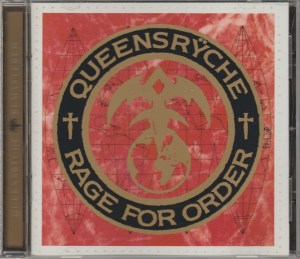
REVIEW: Queensryche – Rage For Order (remastered)

QUEENSRYCHE – Rage For Order (originally 1986, 2003 EMI remastered edition)

Every fan has their favourite Queensryche album.  Whether it be The Warning, MindcrimePromised Land or Empire, there are plenty of great albums in their back catalogue.  I used to seek the warm high of Promised Land when looking to chill with my favourite Queensryche.  Now I look for refuge in the cold, technological sheen of their 1986 album Rage For Order.

Rage For Order was a challenging album in its time and today it is still complex.  In 1986, fans questioned the gothy makeup and hair, not to mention the excessive samples and synths.  Today you can look back and almost call Rage For Order the first progressive industrial metal album.  It certainly has qualities from all three of those genres.  Geoff Tate beat Trent Reznor to the punch by years.  Rage seems to have a vague futuristic concept about a world of technology, revolution, and disconnection.

Although Rage For Order is certainly not an immediate listen, certain key tracks are commercial enough to keep you coming back.  The first is “Walk in the Shadows”, one of the few songs to be played live fairly consistently over the years.  “Walk in the Shadows” could pass as a hard rocking hit.  For the first time Queensryche really proved they were more than a simple metal band.  The slick production was completely different from their first two records, with the edge taken off the guitars and instead given to the computers and sequencers.  They give the whole album a precise, punchy tech sound that is its own form of heavy.  No wonder:  Dave “Rave” Ogilvie was an engineer.

A dense ballad called “I Dream in Infrared” has sorrow, but flowing through the veins of a computer.  Geoff Tate blows minds with his incredible voice and singing ability, layered for maximum effect.  In 1991 it was remixed acoustically for a single B-side, and that version is a bonus track on the remastered edition.  The original was perfect for what it was, but the acoustic mix is more accessible to outsiders.  It ends suddenly and the metallic guitars of “The Whisper” enter, accompanied by clock-like percussion.  Rage For Order has many songs with layered, overlapping vocals and you can hear that on the chorus.  It is a cold, sterile but powerful track.

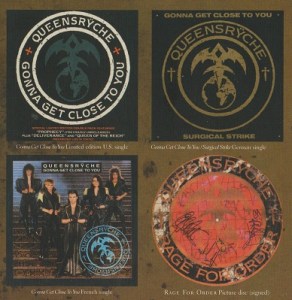
The strangest song was actually the lead single, “Gonna Get Close to You”.  It was the only cover Queensryche ever put on one of their studio albums, a track by Canadian songstress Lisa DalBello.  In the hands of Geoff Tate, it becomes a creepy song of a stalker with a strangely rousing pre-chorus.  “You think I’m a fool or maybe some kind of lunatic?  You say I’m wasting my time but I know what to do with it.  It’s as plain as black and white.  I’m gonna get close to you.”  Cree-hee-eepy!  Which is the point.  The bizarre samples and synths only deepen the macabre.  DalBello’s original is perhaps even creepier, but Tate’s pompous bravado adds its own slant.  “If you knew my infinite charm, there’d be no reason to be so alarmed…”

As an added bonus, a 12″ extended version of “Gonna Get Close to You” is included in the bonus tracks, but like most extended versions from the 1980s, it’s very choppy and awkward.

Along with the technology, there is a theme of loneliness on Rage For Order, and “Gonna Get Close to You” plays into that.  “The Killing Words” contains more heartbreak on the album’s second ballad (third if you count “Gonna Get Close to You”).  Tate’s voice is drenched in pain.  A 1994 acoustic version from the “Bridge” CD single is included as a bonus track.

“Surgical Strike” is a brilliant track, fast and heavy, and working with the technology.  The lyrics are brilliant and quite prescient.

It’s lonely in the field,
that we send our fighters to wander.
They leave with minds of steel,
It’s their training solution.
We’ve programmed the way,
It leads us to Order.
There’s no turning back.

A Surgical Strike.
We’ve taught them not to feel.
performance is their task,
A Surgical Strike,
Its time is arriving now for you.

The plan for the day,
will be swift as the lightning they harness.
The atom display,
It’s not mindless illusion,
At master control, assessment will not,
Be by humans.
There’s no turning back…

It feels like this future is not very far off.

One of the most techy tracks is “Neue Regel”.  Clockwork percussion, strangely computerized lead vocals, and intelligently used samples paint a scene of a future battlefield, complete with bomb-like drum sounds.  The multi-layered chorus is one of Queensryche’s most perfect.  Respect to Geoff Tate.  When the man was at his peak, nobody could touch him, both vocally and as a songwriter.  Of course one must also remember the other side of the equation, which was guitarist Chris DeGarmo.  He has more songwriting credits on this album than Geoff Tate, including two solo credits (“The Whisper” and “I Will Remember”).

The future continues to look cold and dark on “Chemical Youth (We Are Rebellion)”.  “Our religion is technology” is one line, and if only Tate knew how right he was!  There is a still a spark of hope and that is the young.  “Chemical Youth” is one of the heaviest tracks on the album, and sonically very interesting too.  The next ballad “London” fades in with a synthy bass line.  Loneliness returns.  “There’s some things in life I could never face.  The worst is being alone.”

The technology slant hits its peak on the brilliant “Screaming in Digital”.  Describing this song can do it no justice.  It is like listening to Queensryche within the gleaming sterile walls of the dystopian sci-fi classic THX-1138.  There is far too much going on underneath it all to absorb in just a few listens.  You will hear new sounds you never noticed before even 30 years later.  Artificial intelligence has never rocked so heavy.

I am the beat of your pulse,
The computer word made flesh,
We are one you and I,
We are versions of the same,
When you can see what I feel,
Don’t turn your back on me,
Or you might find that your dreams,
Are only program cards.

Fucking chilling!

“Screaming in Digital” must be counted on any list of Queensryche’s best music.  It is sheer genius, far beyond what their hard rock peers were peddling.  It was also years ahead of its time.  By crossing digital techniques with heavy metal in such an intelligent way, Queensryche truly were breaking new ground.

“I Will Remember” is the final song, a ballad that seems to tie it all together.  It has the feel of a lonely ballad, while lyrically tying up the technology concept.  “And we wonder how machines can steal each other’s dreams.”  Another Queensryche classic, including a genius DeGarmo acoustic guitar solo.  Shades of the future “Silent Lucidity” too (also written by DeGarmo).

There are four bonus tracks including the three discussed above.  The last one is a 1991 live version of “Walk in the Shadows”, which appears to be a mix of two different performances judging by the credits.  Whatever the case may be, it’s cool to get a live version of this incredible song as a coda to the album.

Queensryche took the conceptual approach to its logical apex next time out with Operation: Mindcrime.  They ditched the technology and went back to guitars and even added an orchestra.  For that reason, Rage For Order is very unique in the collection.  It was a sound they have never repeated.  Operation: Mindcrime had a sequel, but Rage For Order never will.

5/5 stars


#579: Entering the Asylum

GETTING MORE TALE #579: Entering the Asylum
(Supplement to the  Re-Review series)

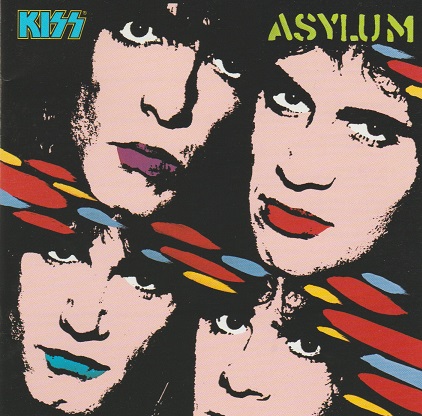
Back in Record Store Tales Part 3 (!), we took a nostalgic look at my first ever Kiss albums, that all arrived in one glorious batch.  The year was 1985, but Kiss also had a new album coming out in a matter of days.  Now that I had started on a Kiss collection, I would have to get their newest album too, called Asylum.  I didn’t even know how to pronounce “asylum” correctly, nor did I know what the word meant, but I did understand that it was their third album without makeup.

Next door neighbor George, who was my introduction to Kiss, came over one day talking about the new single “Tears Are Falling” and how much I would love it.  I didn’t have much money but by the time the snow fell, my dad bought me a copy of Asylum on cassette.  We got it at the Zellers store at Stanley Park Mall in Kitchener.

My meager Kiss collection at that point consisted of Alive!, Asylum (cassette) and a bunch of LPs I recorded off George.  I didn’t know much about the discography but George was a good teacher.  George actually named one of his first bands Asylum.  Before long I could name all the albums, in order.  I even predicted that the next single would be “Uh! All Night”.  I didn’t foresee the third single “Who Wants To Be Lonely” because Kiss hadn’t done a third single in ages!

George was only missing two Kiss albums:  The Elder, and Double Platinum.  He was dying to get both and finish the collection.  His record collection was fascinating to me and a goldmine of music to tape and explore.  The album covers, particularly for Kiss and Iron Maiden, had me hooked.

As my interest in Kiss grew, a new kid at school who I later found out was a “liar liar pants on fire” claimed he had “all” the Kiss albums at home.  His name was Joe Ciaccia (pronounced “chee-chaw”).  I asked him if that meant he had The Elder.  He said yes.  I told George I knew a kid who owned it, and he just about shit his pants.  I made arrangements with Joe to meet up at his place on the next Sunday to do a trade.  All I asked for brokering this trade was recording the album.

George was really excited.  “I don’t care what he wants for it, I’m not leaving without that record.”  I distinctly remember a small group of us trudging through the snow to meet Joe at his apartment.  Who came with us?  I can’t remember.  Joe lived on Breckenridge Drive, just down the street from Brian Vollmer of Helix.  One thing that I can remember very clearly was grabbing my Sanyo ghetto blaster loaded with D-cell batteries, my Asylum tape, and rocking while walking to Joe’s.

Listening to a cassette on a ghetto blaster powered by D-cells was a warbly experience that kids today don’t understand.  Our small group lollygagging through the slush listening to “King of the Mountain” on that old Sanyo is an image I’ll always remember.  I carried it through the wet melting snow.  Those Sanyo ghetto blasters were built like tanks!  You could drop them and they’d keep on ticking.

We arrived at Joe’s apartment and buzzed.  No answer.  Buzzed again.  No answer.  I began to realize my fears.  Joe was all talk and no Elder.  We hung out down there a while but there was no sign of Joe.  George was partly crushed and mostly pissed off.  At school, Joe gradually earned a reputation for tall tales.  His were beginning to rival the lies of Ian Johnson – they even lived on the same street.

We flipped the Asylum tape over and began the walk home.  A wasted trip, and Joe dodged me at school the next day.  George kept pestering me to arrange a second hookup with Joe, thinking he still had that copy of The Elder that he wanted so badly.  I realized Joe was full of shit and told George the sad truth.  The record was not there.  Joe was telling stories, trying to seem cool to me for having all the Kiss albums.  Then he got caught in the lie, after going so far as to arrange a trade and giving me the address.  Very un-cool.

George did get a copy of The Elder a few months later, and he still taped me a copy.  It was a strange album, after being immersed in Asylum for many months.  Then, I definitely preferred AsylumAsylum was special to me.  It was my first “new” Kiss album since getting into the band!  I had boarded the Kiss train and I wasn’t getting off!