hugh syme

REVIEW: Coverdale/Page – Coverdale/Page (1993)

COV PAGE_0001COVERDALE-PAGE:  Coverdale-Page (1993 Geffen)

Following the demise of Whitesnake and the failure of Zeppelin to mount a 1991 tour in support of their first box set, it was almost inevitable what happened next. It was something that many Zeppelin fans feared. Lead Snake David Coverdale, who was once derided as “David Coverversion” by Robert Plant, joined Plant’s erstwhile bandmate Jimmy Page in a new supergroup. Geffen’s John Kalodner (John Kalodner) helped facilitate this move which should have generated sales over 10 million units. Unfortunately another thing also happened in 1991: grunge.

The shame of it is that Coverdale-Page is a stunning rock album.   For years it haunted my bargain bins, simply because of the hard rock stigma that permeated the 1990’s.  Many fans refused to listen to it, others simply chose to mock superficial elements of it, such as Coverdale’s man-shrieks.  The fact that Page was looking and sounding great should be enough to warrant multiple listens by any serious rock fan.  He hadn’t released any new material since 1988’s Outrider.  As for Coverdale, it was a chance to get back to his bluesy rock roots, something he expressed a desire to do shortly after Whitesnake’s dissolution.

The studio band weren’t hacks either.  Ricky Phillips had played bass with Neal Schon and Jonathan Cain in Bad English, and he’s been in Styx for ages now.  Drummer Denny Carmassi was in Montrose (that’s him on the cover of the classic 1973 self-titled record) among many stellar bands, and he later did a stint in Whitesnake itself.  Coverdale and Page co-produced the album with veteran Mike Fraser.

Finally, the most important elements were also in place:  the songs.  11 songs, most in the 5-6 minute range, make up Coverdale-Page.  Those expecting or even hoping for a Zeppelin album were bound to be disappointed.  Despite the “Coverversion” nickname, Cov the Gov is his own person and persona.  Singing over Pagey’s classic Zeppish riffs does not a Zeppelin make.  Rather, Page and Coverdale comingle over their common ground, and naturally there are elements that have a Whitesnake aura.  To expect otherwise would be folly.

“Shake My Tree” was the perfect opener.  Pagey’s tricky little licks have that familiar sound, immediately.  Then the great lothario Cov the Gov starts howlin’…the stage was set within the first minute of the album.  The closest comparison I can think of would be “Slow An’ Easy” in terms of overall vibe.  Just replace Moody’ slide guitar with Jimmy’s intricate chicken pickin’.  David’s lyrics were as naughty as ever.  It must have burned Robert Plant’s ass to have to sing it when he reunited with Jimmy later on himself.  He seemed to be freestyling it quite a bit with David’s lyrics, barely sticking to the words at all!

“Waiting On You” would have been a radio-ready single.  It has that kind of smoking hard rock riff, a killer of a chorus, and great vocals.  Coverdale’s no poet, but I dig his words.  “Ever since I started drinkin’, my ship’s been slowly sinkin’, so tell me what a man’s supposed to do.”  Well, let me tell you David.  1) Drinking and boating is against the law, just like drinking and driving.  2) Put on your goddamn life vest!

I hesitate to call “Take Me A Little While” a ballad.  I mean, it is a ballad, but it’s also a pretty good bluesy workout for David.  It’s a little classier than the average “power ballad”, because hey…it’s Jimmy Page.  It doesn’t sound like other ballads by other bands, because not too many bands have Jimmy Page.  His playing and writing are unlike anyone else’s, he is one of the most recognizable musicians in rock and roll.

“Pride And Joy” was the first single, and what a single it was.  It starts off swampy and acoustic, before Jimmy’s big Les Paul announces its presence with some big chords.  Then David’s back in lothario-land, seducing “daddy’s little princess, Momma’s pride and joy.”  Despite the lyrics, the song’s still a stunner.  “Over Now” is also cool; a thinly veiled attack on Tawny Kitaen.

You told me of your innocence,
An’ I believed it all,
But your best friend is your vanity,
And the mirror on the wall.

It doesn’t get any nicer from there, but musically this is one of the most Zeppelin-ish songs.  While you can’t compare it to any specific song in the Zeppelin oeuvre, but it’s there in that slow relentless drum beat, the orchestration, and Pagey’s unorthodox guitar.

The closest thing to filler on Coverdale-Page is “Feeling Hot”.  It’s not outstanding, but it does show off the faster side of Jimmy’s playing.  It’s akin to “Wearing and Tearing” but with naughtier lyrics.  Once again it is Jimmy’s playing that I’m tuned in to.  That continues with “Easy Does It” which begins acoustically.  Like most acoustic moments on the album (and like Zeppelin), Jimmy’s guitar is recorded in layers, giving it real heft.  This all changes halfway through the song, when Jimmy’s Les Paul once again takes center stage.  Then it transforms into a bluesy prowl.

Possibly the most commercial song is “Take A Look At Yourself”.  Not a bad song, but definitely the most “pop rock”.  It’s probably closest to a Whitesnake song such as “The Deeper The Love”.  Had the year been 1990 or even 1991, “Take A Look At Yourself” would have been a top charting single everywhere.  David seems to have cheered up with new found love here.  However the heartbreak is not over.  “Don’t Leave Me This Way” is about as earnest as it gets.  At 8 minutes, it’s also the most ambitious song.  It’s the centerpiece of the album.  It sounds at once like it’s the most sincere song, showcasing some of Jimmy Page’s best post-Zeppelin guitar work.   As for David, he’s never sung better.

“Absolution Blues” begins similarly to “In The Evening”.  Fading in are layers of atmospheric guitars as only Jimmy plays them.  These give way to the fastest, heaviest song on the album.  It’s also one of my favourites.  You you can hear the elements of Jimmy and David separately, but working together.  The song goes through numerous changes before returning to that riff.  If you thought Jimmy Page had already written every great riff in Led Zeppelin, think again.  It’s “Black Dog” sped up to ludicrous speed.

Album closer “Whisper A Prayer For the Dying” is as cheerful and uplifting as the title alludes.  It’s has an epic quality and length like “Don’t Leave Me This Way”, but this time the lyrics are less personal and more topical.  David laments the innocent casualties of modern warfare, and refers to politicians as “bodyguards of lies”.  While certainly not profound, it’s refreshing to hear Coverdale change the bloody subject away from the female of the species every now and again.  Profound or not, I’m certain that it was heartfelt, and musically it kicks ass.  It’s also a perfect album closer for a dark and brooding record like this.  So there.

Hugh Syme (Rush) did the artwork.  Say what you will about the bland cover itself, but I like the way he used the “merge” sign much like the “object” was in the artwork for Presence.  And like many Zeppelin albums, there are no pictures of the artists anywhere.

The year 1993 was not a kind one to singers of Coverdale’s ilk.  Most of his competition had been replaced by Chris Cornell, Eddie Vedder, and Kurt Cobain.  One way or the other, the Coverdale-Page tour was not doing enough business and the plug was pulled.  David has since mentioned that he and Page had more songs, enough to get started on a second album.  He’s also expressed a desire to release those songs on some kind of deluxe edition reissue.  I hope that happens.  I’d buy Coverdale-Page again.  It would only be the third time.

4.5/5 stars

More COVERDALE at mikeladano.com:

Snakebite – Come An’ Get It – Slide It In – Whitesnake (1987) – Live at Donnington – Good to be Bad – Forevermore

More ZEPPELIN too:

Self-titled box setBox Set 2The Complete Studio Recordings

REVIEW: Queensryche – Hear in the Now Frontier

HITNF_0005

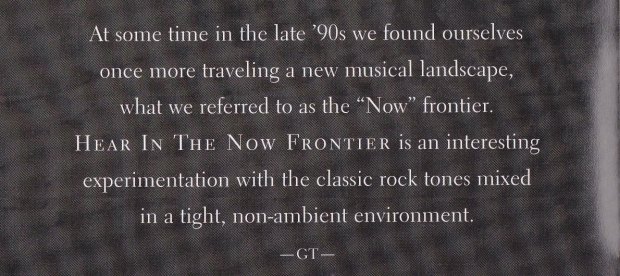
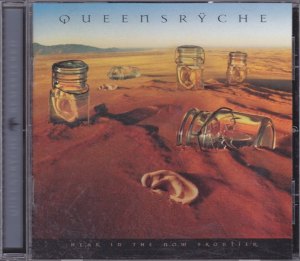
HITNF_0001QUEENSRYCHE – Hear in the Now Frontier (1997, 2003 EMI remaster)

I remember when this album came out in the spring of ’97. There was anticipation and a certain amount of fear: How could Queensryche possibly top Promised Land? The band, as always chose to do something different. In this case they dropped the production, sound effects, and themes, and created a stripped down album of individual unrelated songs. That’s the nice way of putting it. Critics of the album say “Queensryche went grunge,” or “Queensryche went alternative.”

Whatever you call it, this is not a great album. There are some truly great songs, but they are in the minority, swimming through a sea of padding. Guitarist Chris DeGarmo wrote the music for almost every song here, and about half of the lyrics. He even got his first lead vocal (“All I Want”).  Even though Hear in the Now Frontier (God I hate that title) isn’t a great album, Queensryche has missed DeGarmo’s presence.  This was his last album with the band.

As I said, there are some great songs.  They include:

  • “Get A Life” – Not very Ryche, but it’s a heavy rocker based on the riff and Geoff Tate’s shredding vocal melody.
  • “All I Want” – A piano-based ballad with a nice rhythm, very different from anything Queensryche have done before or since.
  • “Hit The Black” – Grungy, distorted lead vocals drive this heavy riff-oriented groove rocker.  I like it.
  • “Anytime/Anywhere” – Another heavy rocker that would have fit right in on the Q2k album.
  • “sp00l” – The only song that I might describe as progressive, and the one that sounds the most like Queensryche.  Powerful vocal and melody. Sonically interesting, and centered on the bass guitar much like “Della Brown” or “Promised Land”.

But that’s pretty much it for me. The other 9 tracks I would describe as dry, flat, not memorable, melodically poor and homogenous. It is clear that the vision for this record was to make something that sounded stripped down, and even with odd flourishes such as violin and piano, it’s just too boring. Even the cover art (by Hugh Syme again) stinks.

There are four bonus tracks, all of which are decent. Three songs come from the “Sign Of The Times” CD single; “Chasing Blue Skies” is a studio track, and had it been on the album, it would have been one of the best songs. Why it was left for a B-side, I don’t know. Maybe because they didn’t want another ballad on the record, which was already bogged down by slow numbers? Anyway it’s great, and sounds like something from Promised Land. Then there are three MTV Unplugged tracks, all fantastic. “Silent Lucidity” and “The Killing Words” were released as B-sides, but “I Will Remember” was completely unreleased in audio format until now. These songs are all considered rarities, as the singles have been out of print for over a decade.  They are at least worth having, even if you don’t like the album.

2/5 stars

More RYCHE:

BOOK REVIEW: Kevin J. Anderson – Clockwork Angels

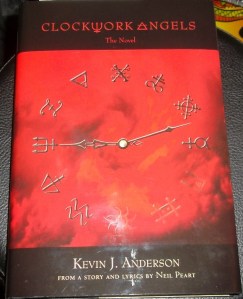
KEVIN J. ANDERSON – Clockwork Angels  (2012 ECW)

From a story and lyrics by Neil Peart

It was bound to happen eventually.  Somebody had to write a Rush concept album into book form.  I’m sure a lot of highschool kids in the 1970’s wrote their own short story versions of 2112.  Now in 2012, Kevin J. Anderson (the Dune spinoffs) has teamed up with Neil Peart to novelize Rush’s latest album, Clockwork Angels. The end result, according to Aaron, is a near total ripoff of Harlan Ellison’s Repent, Harlequin! Said The Ticktockman, but Rushified.  I’m sure both Peart and Anderson are familiar with the previous work, so their plaigarism is not forgiveable.

I found Clockwork Angels, the album, to have a sparse story that begged to be opened up in more detail.  There’s text in the CD packaging to help illustrate the story a bit more, but that only scratches the surface.  I had a hard time visualizing the world that these characters inhabited.

Like many novels of this ilk, the world of Clockwork Angels is Earth-like in some respects.  There’s a massive, unexplored eastern sea, a far away land called Atlantis, and a vast deserted land of wonders unimagined beyond that, all waiting for our hero Owen Hardy to explore.

Owen Hardy, an apple orchard manager from Barrel Arbor, Albion, is a dreamer.  (Hmmm…ever heard that setup before, in Rush songs past?)  He dreams of the faraway lands that he’s only read about in his mother’s books.  Their world is run by their loving Watchmaker, an ancient old man who has mastered the power of “coldfire” and alchemy.  Using his mastery of these arts, he has created a clockwork society:  everything has its place, and every place has its thing.  Everything runs precisely, on time, and every person fulfills his or her role in society.  It is a place where everyone is content.  Everyone but the dreamer.

One night Owen Hardy suddenly departs Barrel Arbor for the wonders of the capitol Crown City, home of the Watchmaker and his Clockwork Angels.  The Angels are glowing coldfire-powered mechanical beings that inspire awe in the citizens lucky enough to have a ticket to see them.  Owen wishes to see them for himself, but the Angels would never be enough for this young dreamer.  Along the way Hardy meets colourful characters from airship pilots to carnies to the notorious pirates, the Wreckers.

Owen gets tangled up with a character called the Anarchist.  The Anarchist lies at the opposite extreme from the Watchmaker.  Where the Watchmaker believes in rigid order to achieve happiness (called “The Stability”), the Anarchist believes that true happiness can only come with the freedom to do whatever you want and go wherever you please.  But both the Anarchist and Watchmaker have designs on young Mr. Hardy, an exceptional man because dreamers are rare.

Through it all, Hardy journeys to lands far away, glimpses parallel universes and discovered his own inner strength.  All the while, Kevin J. Anderson sprinkles his journey with Rush references.  “Tough times demand tough hearts”.  Lyrics from songs past and present find their way into the text, and unfortunately I found this touch to be distracting.  I get it – a nod and a wink to the Rush fans who will buy the novel – but as a Rush fan, these references stick out like a glowing beacon of coldfire.  (Coldfire’s another one, by the way.)  This is a minor complaint; the novel soon took on a life of its own and was impossible to put down.

One of the best features of Clockwork Angels are the glorious illustrations by Rush cover artists Hugh Syme.  From steampunk airships to the glowing Seven Cities of Gold, Syme’s art helps the reader visualize this fascinating world that Peart and Anderson have created.  Clearly, Syme was in sync with the authors when he created these paintings.

While I enjoyed Clockwork Angels thoroughly, and this enjoyment only enhanced my appreciation of the album, its template is far from original.  The archetypes are familiar, as was the plot.  Having said that, Anderson and Peart successfully conjured up a vivid landscape, interesting characters, and a rollicking good story.

3.5/5 stars

Under piercing stars
I stand watching the steam-liners roll by

REVIEW: Iron Maiden – “Virus” (1996 single) / Metal For Muthas (1979)

Part 23 of my series of Iron Maiden reviews!  Continuing where we left off with Best of the Beast, we’re also taking a glance back to the past…

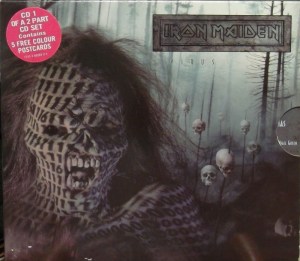
IRON MAIDEN – “Virus” (1996 two-part CD singles)

Last time, I was talking about Maiden’s first-ever greatest hits set, Best of the Beast.  But there was also the single to be had, “Virus”.

Much like other UK singles, “Virus” was released in two parts each with its own B-sides and cover art.  If you bought the first, you also got a box with 5 postcards and space to store the second disc.

The first disc contained the (unadvertized) single edit version of “Virus”.  I can happily live without the slow, boring, goes-nowhere first three minutes of that song.  At least the single edit only has the up-tempo part of the song.  I recall when the single came out, a few of us had grumbled that Maiden seemed to be losing it…

The B-sides on this first single were the previously released covers, “My Generation” and “Doctor Doctor”.  You could get these tracks on the previous single, “Lord of the Flies” from The X Factor.  Having said that, these are great versions, among the best covers Maiden have ever recorded in this writer’s opinion.  “My Generation” is of course the Who classic.  Maiden breathe their original punky sensibilities into this one, and it rocks like nothing that actually made it onto The X Factor!  “Doctor Doctor” is a beefed up version of the classic UFO song, and my preferred version.

The second disc was the really, really special one.  It had the album version of “Virus” (all bloody 6:15 of it, ugh) but it also has the ultra rare “Sanctuary” and “Wrathchild” from the 1979 compilation album, Metal For Muthas! When I had first picked up the single for “Virus”, I didn’t even know these recordings existed.  Collectors rejoice!  These tracks were previously unavailable anywhere else but Metal For Muthas, and this is the first CD release.

“Sanctuary” and “Wrathchild” both feature Paul Di’Anno on vocals, and are from the short-lived Maiden lineup of Di’Anno, Steve Harris, Dave Murray, Tony Parsons, and Doug Sampson.  This represents one of Maiden’s earliest recordings.  There are more from this lineup, but we’re not going to talk about those for a while yet…

Do I need to mention that these two tracks are just pure smoke of the early-Maiden variety?

A quick glance at Wikipedia reveals that there is a 12″ single release of “Virus” as well, this one with the two missing Soundhouse Tapes tracks that weren’t on the Best of the Beast CD.  Adding to “want” list!

I found the cover art of the “Virus” single to be a little lacklustre, particularly the one in the petri dish.  Like, really?  It didn’t scream to be made into a cool poster for my wall.  There were some cooler things on the postcards including one by Derek Riggs.

4/5 stars