Jon Oliva

REVIEW: Savatage – Edge of Thorns (1993)

By special request of reader Wardy, it’s Epic Review Time!

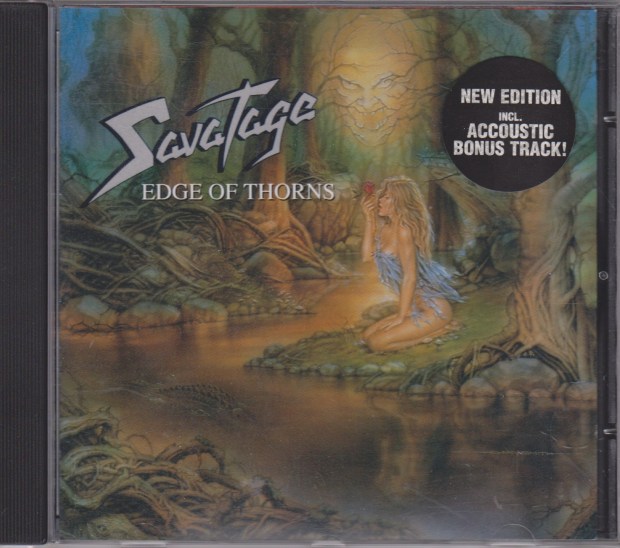
SAVATAGE – Edge of Thorns (1993 Edel & 2002 Steamhammer)

Sava-fans were shaken.  Even though 1991’s Streets: A Rock Opera was a complete artistic triumph, singer and co-founder Jon Oliva quit the band.  Side projects and home life had become priorities.  He would not, however, ever truly leave Savatage.  Even though he was no longer the singer, Jon Oliva co-wrote every track with his brother Criss and producer Paul O’Neill.  He even personally selected his replacement, Zachary Stevens, and tutored and coached the new young singer.   He also continued to play all the piano parts in the studio, although this time he would not tour.  It was certainly an unusual situation, but also an ideal one.   Fans knew that Jon was not really gone, and they easily embraced Stevens as the new frontman.  Oliva had stated that Savatage needed a voice like Zak’s in order to continue.  He knew his own voice was not commercial enough to get on the radio.  With Stevens they had a shot.

The press glowed with reviews, praising the new direction of the band.  They had successfully combined the later piano-tinged Savatage that wrote complex operatic songs and ballads, with the earlier riff-driven metallic Savatage.  Stevens was praised for his voice, and comparisons to Geoff Tate, James LaBrie and Ray Alder were tossed around.  I found a copy of Edge of Thorns in Michigan, and it was with great anticipation that I ripped the shrink wrap off the cassette and placed it in my Walkman.

Anyone who has heard the now-classic title track “Edge of Thorns” can’t forget the haunting piano that descends at the beginning of the album.  At this early stage, Stevens was very much singing like a progressive rock singer, and throwing in screams at key moments.  His range and power here are impressive, and very different from the Mountain King’s style.  “Edge of Thorns” was a great choice for an opening track and new singer.  Not only is it one of the most immediate songs that Oliva/Oliva/O’Neill had yet composed, but it also combines both sides of the band.  The soft piano intro reflects Streets, but then it kicks into overdrive with a riff, heavy bass and dramatic guitar solos. It possesses the pure rock drama of “Gutter Ballet”. It is the whole package.

I have always been drawn to the words.

I have seen you on the edge of dawn,
Felt you here before you were born,
Balanced your dreams upon the Edge of Thorns,
…but I don’t think about you anymore.

I don’t think about you…anymore,
Anymore…

But clearly, he does, and intensely so.

“He Carves His Stone” begins as if a ballad, but the patented snake-y Criss Oliva guitar riff drags us back to the metallic origins of the band.  The combination of riff and chorus are a winning one.  More intense is the borderline thrash metal of “Lights Out”, a smoking track that shows what Zak Stevens can do with the rougher side of his voice.  Hang on tight and shout along to the chorus, because this one is a ride.

Back to the dark, dramatic side that Savatage do so well, it’s “Skraggy’s Tomb”, a brilliant song bursting with ominous heaviness.   Just let it assault your skull, don’t fight it.  Fear not — “Labyrinths” is a quiet piano piece, with Jon accompanied by Chris on guitar.  This cascades in traditional Sava-fashion into a fully-blown dramatic intro similar to “Gutter Ballet”.  It is a suitable and essential part of the song it is attached to, “Follow Me”, the side one epic.

His whole life was written,
Written there inside,
The new weekly Bible,
His modern TV Guide,
Every night he stares back at the screen.

There is no way to sum up the pure excellence, drama, and chills that “Follow Me” delivers. Zak’s vocals make it accessible enough, the power is undeniable. “Follow Me” is among the greatest songs of the Zak Stevens era. A quiet piano piece appropriately titled “Exit Music”* works as an outro. Together with intro and outro, “Follow Me” is almost 10 minutes of pure Savatage adrenaline, with a Criss Oliva solo that still gives me chills.

The second side opens exotically with “Degrees of Sanity”, and Savatage fans know that sanity of one of Jon Oliva’s favourite lyrical subjects!  Criss’ guitar parts are lyrical and enticing.  Slowly it chugs, building and building.  With Criss firmly at the helm, the ship steers through craggy riff after craggy riff until it gives way to the next song, also clearly dealing with sanity:  “Conversation Piece”.  The subject person of the song thought he had been doing better, lately.  “I haven’t thought about you for a while,” he claims.  But even so, he has not let it all go yet.  “I keep your picture hidden a file, of favourite one-act plays.  Like pieces of myself, cut off in desperation, as offerings to thee.  I’ll leave them on the shelf, they’re good for conversation over a cup of tea.”  The melodramatic lyrics of Savatage have always appealed to me (I don’t know what that says about me).  Thanks to Stevens’ impassioned delivery, you can feel every word, while Criss Olivia chugs behind.  Remind me not to visit for tea!

Scan_20150816 (6)

Delicate is “All That I Bleed”, a pretty piano ballad with a rocking conclusion.  Demonstrating the versatility of his voice, Stevens sings smooth and light, until the end.  Perhaps it is all coincidence, but the songs do seem connected.  Both “All That I Bleed” and “Conversation Piece” deal with a letter and difficult emotions.  I like to think of the two songs as alternate endings to the same story — one in which the person does not send the letter (“Conversation Piece”) and one where he does (“All That I Bleed”).    Regardless, “All That I Bleed” has everything you would want in a ballad.  Had in come out in 1989 it would have stormed the charts and MTV would have played it non-stop.  1993 was a very different year from 1989, but Savatage had never expressed any interest whatsoever in musical trends (the mis-step that was Fight for the Rock notwithstanding).

“Damien” appears next, a choppy heavy rock tune with bouncy piano doubling the guitar riff.  Following this fine song is the even finer “Miles Away”, a melodic heavy rocker that is easy to like.  It has a brightness to it, and Steve “Doc” Wacholz kicks the drums right in the ass.  Unexpectedly the album closed with a quiet acoustic song, “Sleep”.  It feels like a sunrise after the stormy night, and perhaps that’s the intention.

There are plenty of bonus tracks on different editions of Edge of Thorns.  I can only review the bonus tracks I have, which are:

  1. “Shotgun Innocence”, originally a Japanese bonus track.  This is a glossy hard rock song with an emphasis on melody.  Though certainly heavy enough, its direct rock vibe doesn’t fit the mood of Edge of Thorns, which I’m sure is why it was saved for a bonus track.  Good song though, and it certainly shows off the pipes of young Mr. Stevens.
  2. “Forever After”, the second Japanese bonus track.  Probably the weakest song of the batch.  It sounds a bit like an unfinished Ozzy outtake, circa the Jake E. Lee period.
  3. “Conversation Piece (Live in rehearsal 9/24/1994)” is recorded really poorly, but the sweat and rawness are captured.  Since it is live in rehearsal, and it is known that Doc Wacholz did not tour, I assume this is with Jeff Plate on drums.  That would also have to be Alex Skolnick from Testament on guitar.  This track is on the 2002 Steamhammer/SPV remastered edition.
  4. “Believe (Acoustic)” is part of a series of acoustic versions Savatage did for another batch of reissues.  This is Zak Stevens’ version of the closing ballad from Streets, but with acoustic guitar instead of piano.  It is a fascinating alternative version, but the original always kills me.  This is on a German printing on Edel records.

As fate would have it, this would be the final time Jon and Criss would make music together.  On October 17, 1993 Criss was killed by a drunk driver with seven prior DUI’s.  Rather than let this crush him, Jon survived by pouring himself into music.  Savatage would not die, even if with half its heart ripped out.  Edge of Thorns remains Criss Oliva’s capstone, and a bright apex it is.

5/5 stars

*The really interesting thing about “Exit Music” is that it is entirely piano.  Therefore no “official” members of Savatage appeared on it!

REVIEW: Savatage – Hall of the Mountain King (1987)


HALL OF THE MOUNTAIN KING_0001SAVATAGE – Hall of the Mountain King (1987, 2002 Steamhammer remaster)

Man, I just love Hall Of The Mountain King! Who can forget that classic video…the little elf running through the mountain trying to steal the King’s gold! Any time in the past that I have thrown an “80’s metal video” party, that one was the star of the night.

Elf or no elf, the album is solid front to back.  Savatage have many different styles, from thrash to ballads to progressive metal, and have housed three different singers over the course of their long but too brief career! Hall Of The Mountain King falls into the first era with original lead howler Jon Oliva, and captures them at their most “metal”.  Which isn’t to say that other influences aren’t audible.  Progressive rock was definitely starting to creep in.  You can tell by the rendition of Grieg’s “In the Hall of the Mountain King” (here listed as “Prelude to Madness”).  When metal bands start playing classical pieces, you know that rock operas aren’t far behind (and they weren’t: four of them, to be exact).

One important factor that separates Hall from earlier and later ‘Tage albums is the riffage of Criss Oliva (RIP.) By this time, working with producer Paul O’Neill, the writing was becoming very focused and the riffs and melodies very sharp. I don’t think the riffs had ever been honed to an edge like this on Savatage albums before.  They are just crushing.  Criss of course passed away in the early 90’s, and his riffs were never to be heard again. This, in my humble metal heart, is the absolute best of Savatage’s early metallic phase.

There are no bad songs on this album, though “Prelude To Madness” runs a little long and is a tad too synth-heavy. But since it segues right into the title track, we’ll forgive Savatage.

The metal on this album begins with a groove called “24 Hours Ago”.  Jarring riffs, great bass lick and patented Oliva screams — what an opener. Just rips your head off!  “Beyond the Doors of the Dark” is where the album really begins, in my opinion. This is just an awesome, heavy rocker with a riff of carbon steel as only Savatage could forge. One of their all-time best songs.  Joining it is “Legions”, another Sava-classic.  Again, it’s dark and riffy, with great lyrics and melodies from Jon. Definitely makes my desert island.  Closing side one is a bit of a surprising song: “Strange Wings”.  This one is more hard rock, but it’s certainly great. The late Ray Gillen (ex-Black Sabbath & Badlands singer) duets here, and raises the bar up another notch. His vocal soars. Both singers kill it.  Manager Paul O’Neill, who also produced the first Badlands album, was was managing both that band and Savatage!

“Hall of the Mountain King” is the song most people know Savatage for.  Its riff will drill its way into your head, and that is a promise.  I fell hard for this band, and it all started with this one song.  You might want to skip that long intro, unless you’re dying to hear Grieg played by a metal band (and even if you do, Ritchie Blackmore’s Rainbow also covered the same Grieg piece on Strangers in Us All).

HALL OF THE MOUNTAIN KING_0004Tempo slides back a notch on “The Price You Pay”, this one’s a little more Dokken. Yet with another great Criss riff, and more great vocal melodies from Jon, it’s not filler.  “White Witch” isn’t either, but it’s the weak link.  This is thrash metal like old-school ‘Tage. Reminds me of “Skull Session” or songs of that ilk…fast Savatage with Jon screaming his face off.  Then finally “Last Dawn” is a Priest-like instrumental intro to “Devastation”. The riff to “Devastation” is awesome. Chris was at the top of his game, riff wise, in 1987.  What a way to end the record. So memorable, and classic ‘Tage.

Special shout-outs go to bassist Johnny Lee Middleton and drummer Steve “Dr. Killdrums” Wacholz for some damn fine metal performances. And, of course, producer/manager/co-writer/arranger Paul O’Neill. He changed the band forever, and Hall Of The Mountain King was just the beginning.

The 2002 Steamhammer version contains two live bonus tracks.  From Cleveland in ’87 come “Hall of the Mountain King” and “Devastation”.   While the vintage recordings aren’t as beefy as the album itself, they are a very nice add on.  “Are you metal?” asks Jon.  Yes, yes we are!

Don’t miss this classic. If you enjoyed it, pick up Power Of The Night and Sirens.

4.5/5 stars

REVIEW: Savatage – Gutter Ballet (Steamhammer remaster)

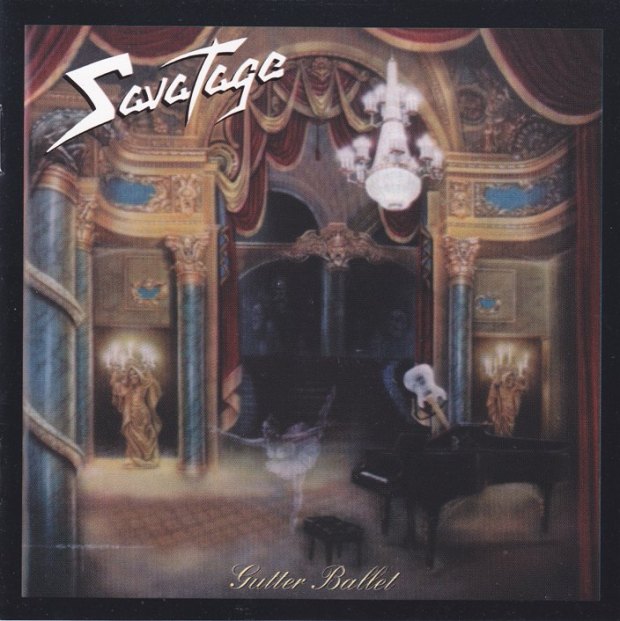
GUTTER BALLET_0001SAVATAGE – Gutter Ballet (1989, 2002 Steamhammer remaster)

Having first latched onto Savatage in ’87 with “Hall of the Mountain King”, I was primed and ready for Gutter Ballet.  What I didn’t expect was the heavy piano on the title track/first single.  But that was a pleasant surprise: I was heavily getting into piano within the context of hard rock at the time.  Savatage’s Jon Oliva has a tendency to write simple but very catchy piano parts.  “Gutter Ballet” was inside my head on first mindblowing listen.  All that was left for me to do was buy the album.

Savatage have reissued Gutter Ballet with different bonus tracks many times.  I have the 2002 Steamhammer release (the Earmusic version) which has an extensive booklet with ample liner notes.  Gutter Ballet was the post-rehab album for Jon Oliva, and this informs many of the lyrics (“Thorazine Shuffle” for example).  Upon beginning the album, Jon and his brother Criss wrote heavy guitar based metal songs which were later included as bonus tracks on various releases.   Not satisfied, producer/co-writer Paul O’Neill sent Oliva out to see Phantom of the Opera in New York.  This changed everything.  Meanwhile, the rehab stint ended up producing a three song mini-suite.  The road to 1991’s Streets: A Rock Opera was now paved.

Gutter Ballet commences with “Of Rage and War,” the bass hook of which reminds of “24 Hours Ago” from the last album.  It has one of those staggered Criss Oliva guitar riffs that I miss so much, and the unforgettable drum patterns of Steve “Doc” Wacholz.  The lyrics are not profound, but they’re catchy enough (especially when Oliva starts shrieking).  They’re also still relevant today.

You got Libya, you got the Russians
You got civilian planes crashing to the oceans
Airports full of terrorists, Nazi skins, anarchists
When are you gonna learn?

Lyrics aside, the strongest thing about “Of Rage and War” is the guitar riffing.  The six-string then takes a bit of a back seat (solo aside of course) on “Gutter Ballet” to the piano for the first time.  Oliva’s simple melody is one of the first that I learned to play on keyboard and I still have my old cassette demo somewhere!  A minute later things speed up and get dramatic.  As good as the piano part is, the guitar riff that comes in to compliment it is just as stellar.

Could “Gutter Ballet” be Savatage’s best song?  You could easily argue that, even though the band would later ramp up the drama and complexity on their albums.  I think the song is completely without flaw.  From Jon’s lyrics (inspired by a stabbing he witnessed while in New York) to the slightest piano accents, the track is perfect.  And it even manages to maintain its balls, which I’m sure helped longtime Savatage fans adapt to the new sound.

First video with Chris Caffery.

“Temptation Revelation” is a 3:07 instrumental track that really only serves to bridge “Gutter Ballet” to another piano based hit, “When the Crowds are Gone”.  The piano and guitar vibe is maintained throughout.  “When the Crowds are Gone” is a very special song, and undoubtedly you could call it a ballad.  It has heavy choruses, but the thrust of the song is based on Jon’s voice and piano.  Jon sounds tiny at first before using his full throat.  The song was first conceived by Paul O’Neill as part of  the later Streets rock opera, a project he had cooking for many years.  The song would have fallen after “A Little Too Far” on side one.  I think it’s another one of Savatage’s best-ever compositions, and Jon’s screaming at the end seems to really embody the desperation of the lead character.

I never wanted to know, never wanted to see
I wasted my time, till time wasted me
Never wanted to go, always wanted to stay
‘Cause the person I am, are the parts that I play.

So I plot and I plan, hope and I scheme
To the lure of a night, filled with unfinished dreams
I’m holding on tight, to a world gone astray
As they charge me for years I can no longer pay.

Note Doc Wacholz’s United Federation of Planets drum kit!*

Side one closed with an acoustic instrumental called “Silk and Steel” which is really a showcase for the underrated Criss Oliva.  It’s just acoustic guitars — nothing else — for four minutes.  Right on, and perfect for a side closer.

No punches are pulled whatsoever on side two.  A bruising tune called “She’s In Love” boasts a chugging riff and those speedy Dr. Killdrums snare hits.  As for Jon, he spends most of the song screaming in fury (but also in tune).  Musically, think “Loss of Control” by Van Halen, but metalized.  “Hounds” then opens with quiet picking, similar to Metallica’s “One”.  This doesn’t last, and before too long it’s a regal metallic plod with a little bit of Sabbathy organ audible in the background.  Then, “The Unholy”:  a stampede of tricky licks and screaming vocals.  There is no let up.

GUTTER BALLET_0003The aforementioned three-song mini suite is next, and it begins with “Mentally Yours”.  The character of “Timmy” is introduced, a disturbed character.  The insanity theme is immediately obvious by the piano intro where Jon sets the scene.  Think Alice Cooper’s From the Inside album.  This piano intro could even be considered a separate song, as it has nothing to do with “Mentally Yours” musically.  Intro aside, this is another heavy metal bruiser, guitars on the prowl.  It even changes to a speed metal thrasher by the end.

“Summer’s Rain” is the only thing resembling a ballad on side two.  If so, it’s a heavy ballad without piano.  It does feel spiritually connected to “When the Crowds are Gone” from side one.  Still, the best tune of this trilogy is “Thorazine Shuffle” which has an ominous opening.  Then the song really begins; a stuttering limping riff, evoking the Thorazine shuffle Oliva sings about.  Gutter Ballet ends on an appropriately heavy note.

This remastered edition has two live bonus tracks; unfortunately they are just from the album Final Bell/Ghost in the Ruins. As such I’ve chosen not to talk about them, since I’d rather just review that album later on.  So be aware, the Steamhammer remaster from 2002 doesn’t have any exclusive bonus tracks.

3.5/5 stars

* Savatage MUST be Trekkies.  The next album, Streets, featured the following lyrics:

And who’s to say what it’s all about?
When John Wayne took the last train out?
And Spock and Kirk have had enough,
And no one’s left to beam me up.

REVIEW: Savatage – Poets and Madman (Limited edition)

A Savatage reunion gig has been announced for Wacken 2015!

SAVATAGE – Poets and Madman (2001 Steamhammer limited edition)

It is hard to believe that well over a decade have gone by since this, the final Sava-disc. Whether we’ll ever see another is unlikely, but this is a heck of a great album to go out on. Since the death of Criss Oliva, Savatage had become a much more operatic beast, culminating in the formation of Trans-Siberian Orchestra. Here, there are many changes afoot. Guitarist Al Pitrelli departed for Megadeth, although some of his work is herein. Co-lead vocalist Zach Stevens is also gone, having formed the excellent Circle II Circle. This leaves The Mountain King himself, Jon Oliva, to handle all lead vocals for the first time since 1991’s Streets: A Rock Opera. (A new co-lead vocalist named Damond Jineva was hired for the tour.)

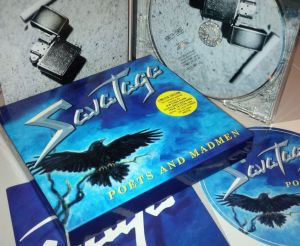
IMG_20140723_174816This is another dramatic rock opera, and as soon as the needle hits wax (or in this case, the laser hits 1’s and 0’s) you hear Oliva’s piano flourishes dominate the opening song, “Stay With Me Awhile”. Much like “Streets”, this song is simply an intro to the story which is about to unfold. This time, Oliva and producer Paul O’Neill weave a tale about an abandoned insane asylum and the ghosts within its walls. On a whole it is a much less satisfying concept than some previous Sava-operas, but it backs up the music just fine. And to be honest, that’s why we’re here — the music.

From heavy rockers like “There In The Silence” (backed by a fat synth riff) to slow dramatic ballads like “Back To A Reason”, this is a well-rounded Sava-disc. It is comparable to previous in quality and direction to rock operas such as The Wake of Magellan or Dead Winter Dead, just without Zach.

As with the aforementioned rock operas, there is always a centerpiece on the album. There had to be a counterpoint-vocal-laden masterwork to make your jaw drop in awe and hit that “reverse” button to hear it all again. This time it is a 10 minute epic called “Morphine Child”. With Zach gone, Oliva sings with multiple backing vocalists but the song is no weaker for it.  I’ll confess that even though I usually listen to albums from front to back, I usually play “Morphine Child” three times in a row.  It’s that incredible.

Other standouts include the single “Commissar” which is loaded with guitar flash, keyboards and riffage.  It also features Trans-Siberian-style backing vocals.  “I Seek Power” sounds like classic Savatage circa Gutter Ballet.  “Awaken” is another number that brings to mind that mid-period Savatage sound.  If some fans thought they had strayed way too far into rock opera, then songs like “Awaken” will appeal to their tastes.  I still like hearing Jon screaming a chorus.

I was underwhelmed a bit by the acoustic “Rumor”, but the song does take off fully electric after a few minutes.   Then there’s “Surrender” which feels like an outtake from Streets, but I didn’t find it as memorable.  So there are a couple duds, who cares?

This deluxe version comes with a sticker, a nice box, a bonus music video (1994’s “Handful of Rain” for some reason) and a bonus track (a live version of “Jesus Saves” with Zach singing…for some reason). There was also a poster, and little surprise that relates to the story that fell out of the booklet, but I won’t spoil it. Just a little extra to make the whole thing seem more real.

Poets and Madmen is an excellent album, and it fares well against the other rock operas that Savatage has done. Streets will always be the pinnacle, but Poets and Madmen can hold its own against The Wake of Magellan, and it easily out-does Dead Winter Dead.

4.5/5 stars

Also available was a CD single for “Commissar”.  The single contained two album tracks, as well as an exclusive instrumental called “Voyage”.  This acoustic piece was written and recorded by Al Pitrelli before his departure and it has not been reissued anywhere else.