progressive rock

REVIEW: Rush – 2112 (deluxe with 5.1 Blu-ray)

RUSH – 2112 (2012 Universal CD/Blu-ray 5.1 deluxe edition)

I received this deluxe CD/Blu-ray edition of Rush’s immortal 2112 for Christmas two years ago.  I meant to review it back then, but it slipped between the cracks.  Apologies.

The set includes: the entire album on Blu-ray in 5.1 surround sound, the entire album on CD, three live CD-only bonus tracks, hardcover packaging including a comic book, a new essay by David Fricke, and more.  Not to mention that the Blu-ray is a motion comic that combines the album with the included comic, seamlessly.

IMG_20141216_1454372112 was Rush’s fourth album.  It was make or break for Rush, and they went ahead and made an album with six songs, one of them being a side-long 20 minute epic!  That side would go on to be Rush’s best known epic, “2112”, which itself is subdivided into seven chapters (but not tracks).

Any truly epic album should open with an instrumental, and “Overture” is one of the best you’re likely to find north of the 49th parallel.  This regal anthem of guitars, bass and drums quickly leaps into action as an Iron Maiden gallop, long before Iron Maiden did gallop.  In this one brief intro, there are as many as four great timeless riffs.  It’s guitar riff nirvana.  All these musical themes will re-emerge later on in the “2112” story, but here they are condensed into one maelstrom of awesome.

The story is pretty simple, and is also nicely laid forth in the comic.  Our protagonist, who lives in the oppressive Solar Federation, has found an ancient guitar in a cave behind a waterfall.  He brings it to the Priests (of the Temples of Syrinx), to show them this wonderful discovery and the sounds it brings forth.  He is crushed to find that the Priests do not approve of this “music”!

Pretty highschool, right?  Maybe, but certainly no worse than what passes for Hollywood fodder today!

IMG_20141216_145411“The Temples of Syrinx” is chapter II of the story.  This is a ferocious metal assault, with Geddy in full-on scream mode, introducing the titular Priests.  They are the law, on this planet.  In my opinion, this is one of Rush’s finest musical achievements.  It’s heavy, concise and blazing fast.  In surround sound, I will admit I was expecting more.  The music fills the room in 5.1, but it’s not as enveloping as I had hoped.  It’s hard to specifically describe what’s missing.  Whatever it is, chapter III “Discovery” works better.  This takes place in the cave behind the aforementioned waterfall, and the water sounds have some depth to them.

“Presentation”, chapter IV, is when it all goes to shit for our protagonist.  It is here that he brings his newly discovered guitar to the Priests.  The motion comic makes it quite clear that the Priests do not approve!  “Yes we know, it’s nothing new.  It’s just a waste of time!”  The hero pleads with them, and tries to convince them that the world could use the music as a positive force!  But the Priest smashes the guitar on the ground and has no more to do with this nonsense.  “Another toy that helped destroy the elder race of man!” he claims of the guitar’s history.

“Oracle: the Dream” is chapter V, a mellow moment at first.  Then the character’s dream begins, and Geddy returns in full voice.  He dreams of change.  Alex’s guitars have a nice shimmer, as they fill the field directly in front and to the sides.   Waking from his dream, chapter VI is “Soliloquy”.  Like “The Dream”, guitars dominate.  Geddy’s pleading lead vocal is an album highlight, as is Lifeson’s Sabbath-y guitar solo.  It all ends in chapter VII: “Grand Finale”.  In a nice twist to the motion comic, Geddy Neil and Alex appear as characters from the invading and returned elder race of man!  The era of dominance of the Priests is over, as is side one.

“ATTENTION ALL PLANETS OF THE SOLAR FEDERATION!  WE HAVE ASSUMED CONTROL.”

The motion comic does not end here.  Each song from side two of 2112 receives its own panels, and the band appear in each one — a very cool touch that I did not expect.  “A Passage to Bangkok” was the lead track from side two.  This crushing anthem with an Oriental feel is one of Rush’s few drug songs.  In fact it’s the only one I can think of right now.  “Sweet Jamaican pipe dreams, golden Acapulco nights…”  Rush somehow had a way of making this all sound classy and cultured, and perhaps from their perspective it was.  In the comic appearance, the Professor has his nose buried in a book on a train, as he often did.  Once again I’m underwhelmed by the 5.1 mix.  I want to feel enveloped by the music, but I don’t get that as much as I’d like.  I do hear more of Geddy’s bass, and that’s never a bad thing.  I’m noticing licks I never picked up on before.

“The Twilight Zone” is a different song for Rush, as it has a slower sway to it.  Lyrically, I can identify several of the old Twilight Zone episodes that Geddy is singing about.  Can you?  I don’t think this will top anybody’s charts of Rush’s best lyrics, but it’s goofy fun and sometimes that’s enough.  A Zeppelin flavour inhabits “Lessons” which has the acoustic-electric mix that Zep mastered.  Likewise, the backing mellotron in “Tears” reminds me of John Paul Jones.  This is a mournful slow song, not at all what many people expect from Rush.

“Something for Nothing” ends the album on a solid hard rock note.  Thematically, it is full circle, as the character in this song also seeks answers in life.  Rush close the album on a furiously jamming note, ending with a song that has all the Rush trademarks rolled into one short ride.  If the last couple songs just didn’t have enough juice, then “Something for Nothing” ends it right.  Side 2 of 2112 isn’t perfect, it has its ups and downs, but this is an “up”.

The vintage live CD bonus tracks are all unreleased.  They include the first two parts of “2112”, and “A Passage to Bangkok”.  Geddy coyly says that this song “deals with foreign matter”.  I’ve no doubt!  Incidentally I’m of the belief that “Bangkok” is better live than on album. Having said that, the Exit…Stage Left version remains definitive.  Blu-ray bonus features include a goofy photo gallery of blow-dried haircuts, kimono, mustaches and concert shots.  Looking at these photos, I’m reminded that Rush were for all intents and purposes, just kids when they created 2112.  With that in mind, it’s pretty impressive.

As for this reissue, I’m not very blown away by the forgettable 5.1 mix.  Too bad.  It’s a blown opportunity.  On the other hand, I very much enjoyed the included comic.  I think it’s excellent, and geared straight to Rush fans.  So:

For the album: 4.5/5 stars
For the reissue:  3.5/5 stars
Average rating:  4/5 stars

REVIEW: Pink Floyd – The Endless River (2014 CD/Blu-ray)

NEW RELEASE

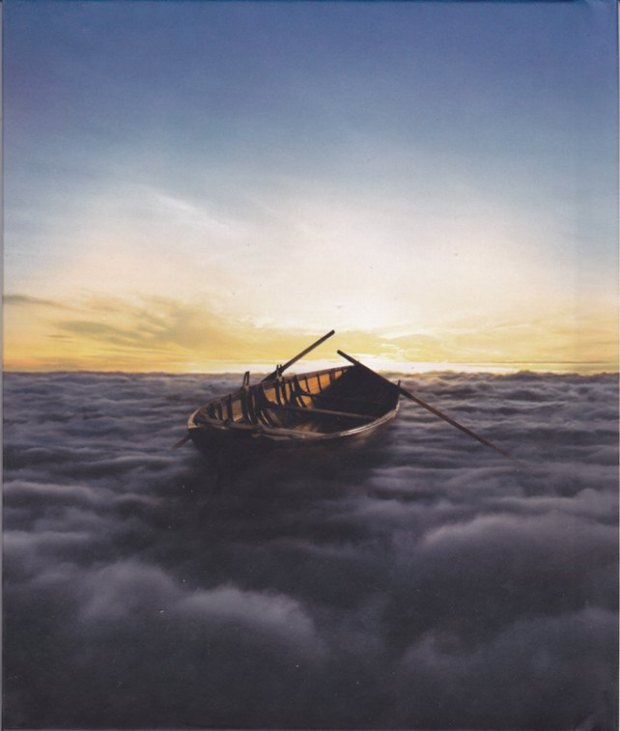
PINK FLOYD – The Endless River (2014 Columbia CD/Blu-ray deluxe edition)

Sometimes you just have to take a chance.

Perhaps that’s the theme of The Endless River, but I’ll warn you in advance that it’s the theme of this review.  Sometimes, you have to take a chance, and buy an album on pure faith.  Sometimes you want something to be good, just because you liked the idea of it.  I took a chance on it, not really expecting too much, but liking the concept enough to try.

IMG_20141123_171023The Endless River is an intriguing idea with successful execution.  Even though these recordings were made 20 years ago during The Division Bell sessions, David Gilmour gambled that there might be something worth salvaging here in memory of late keyboardist Rick Wright.  When they recorded Division Bell, they actually thought they might have two albums’ worth of material.  The second album, which they never finished, would have been more instrumental and ambient in nature.  Less song-oriented, more meandering and scenic.  Not too far off from what The Endless River is, perhaps.

Unafraid of a little work, Gilmour and Nick Mason got back together and finished what they had started with Rick.  According to David, “We listened to over 20 hours of the three of us playing together and selected the music we wanted to work on for the new album. Over the last year we’ve added new parts, re-recorded others and generally harnessed studio technology to make a 21st century Pink Floyd album. With Rick gone, and with him the chance of ever doing it again, it feels right that these revisited and reworked tracks should be made available as part of our repertoire.”

I will state for the record that there is no comparison between the CD and 5.1 surround Blu-ray listening experiences.  The Blu-ray enveloped me in electronic warmth from the start, occasionally startling me with an unexpected bit of guitar here, or sax there.  By comparison to the 3D experience of 5.1 surround sound, CD is flat and tinny.  Having said that, the CD is one of the best sounding CDs out there right now.  Sonically, this is absolutely flawless.  The keys, organ, and drums are warm and genuine, sometimes wrapped up in dreamy synth.

The Endless River is divided up into four sides, but is best experienced in one sitting.  The four sides have distinct “song” sections within them, but everything flows with a purpose.  Some of the more composed sections really stand out as potential fully-fledged songs:  The chugging “Allons-y (1) & (2)” for example, or the guitar showcase of “It’s What We Do”.   A track like “Sum” takes a while to build, but when it does, it’s into another impressive Gilmour show piece.  (Then on the same side, Nick Mason gets his own moment on the percussive “Skins”.)

Other memorable moments include “Talkin’ Hawkin'” which reprises the Stephen Hawking voice from The Division Bell‘s “Keep Talking”.  I love the haunting church organ on “Autumn ’68”.  There is also one vocal song, “Louder Than Words”, which was chosen as a single.  It’s not a particularly special Pink Floyd song; I think the instrumental pieces are far more interesting than “Louder Than Words”.

A number of bonus tracks are included on the DVD and Blu-ray deluxe editions.  These include unreleased studio jams and unfinished tracks, as well as a couple rough album tracks.  “Anisina” and “Evrika (a) & (b)” are cool, relaxed jams.  “Evrika” is similar in nature to parts that made it to the finished album.  The most interesting unreleased song is easily “Nervana”, a basic guitar riff jam that doesn’t sound anything like Pink Floyd at all.  It does sound cool though, a detour into what might have been…if only Gilmore had taken a chance.  Some of these bonus tracks are accompanied by 1994 black and white behind the scenes footage and stills.  Very cool stuff, if you’re into watching the best musicians in the world getting the job done.

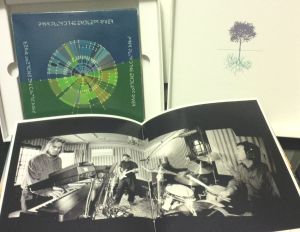
The deluxe comes in a box with some post cards (one with lenticular art), a hardcover booklet with more photos, credits and lyrics, and individual sleeves for the discs.  Nothing overly fancy, it’s the Blu-ray disc itself that is the selling feature of this set.  Some of the bonus tracks are cool and worth having, but it’s that awesome dreamlike 5.1 surround mix that is the clincher.  If you’ve ever wondered, “What’s the big fuss about surround sound anyway?” then see if you have a buddy who can demonstrate this album to you in surround, on a good system with a decent subwoofer.  Strap yourself in.

I think Rick Wright would have been very happy and proud of the finished product, all these years later.  Take a chance on The Endless River and see if you too will be swept away.

4/5 stars

REVIEW: Marillion – Less Is More (2009)

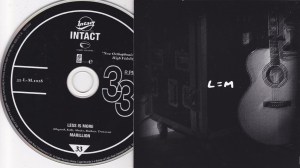
MARILLION – Less Is More (2009 Intact)

I’ll be honest here: I haven’t been into Marillion much, post-Marbles. 2004’s Marbles is my favourite H-Marillion album, and I wasn’t into the two studio followups. I found Somewhere Else to be a rushed and somewhat uninspired, and the sprawling Happiness Is The Road all but impenetrable. Therefore I’m not as familiar with Marillion’s recent more live output as I am with the pre-Marbles stuff, so that’s my problem reviewing Less Is More.  The song “Wrapped Up In Time”, I couldn’t tell you how the song goes until I hear it again.

I am, however, extremely enamored with Marillion’s previous acoustic CDs, the double Live At The Walls, and the fanclub exclusive A Piss-up In A Brewery. Marillion are a band that truly shine in an acoustic setting, but I wasn’t all that excited about another one.  How badly do we need more acoustic Marillion?  I didn’t think I needed another one, but I bought it anyway, because…the collection you know?

MARILLION LESS IS MORE_0002I was wrong. Less Is More (a studio acoustic recording instead of a live one) is just as great as Live At The Walls, with many songs given a fresh arrangement. Some, such as “The Space…”, are the same acoustic versions that the band has been playing for a long time, but others are fresh and inspired. Truly, this album sounds like a labour of love to me. The band’s lust for experimentation has come out beautifully in an acoustic setting, with a song like “Interior Lulu” actually quite a bit better than its original 1999 (marillion.com) counterpart. The songs are subtle, with slight percussion additions, but not a lot of bells & whistles. One of the best songs is the one new one, “It’s Not Your Fault”, which outshines some of the classics. I found the acoustic version of “Hard As Love” to be even more enjoyable than the original rocking version, and quite a surprise too, because I didn’t think it would lend itself well to an acoustic arrangement. Other highlights for me included “Memory Of Water” and “This Is The 21st Century”.

The two bonus tracks on this CD, “Runaway” and a cover of “Fake Plastic Trees”, have been released before on Live At The Walls. (“Fake Plastic Trees” was also a bonus track on the CD single for 1998’s “These Chains”.) I have always been fond of “Fake Plastic Trees” and I prefer Marillion’s version to Radiohead’s. (I’m not a big Thom Yorke fan, but Hogarth really sings his heart out on this one.)

This album is so good, it really revamped by interest in Marillion. I’m glad I bought it! For non-fans, this is a great accessible introduction to a band that by all rights should have been huge. The quality of their songs, as displayed on Less Is More, is simply world-class.

5/5 stars

REVIEW: Platypus – Ice Cycles (2000)

quiz

Complete studio albums (and more!), part 13


Second review from Mike and Aaron Go to Toronto…Again!  I paid $2.99 for this CD at Sonic Boom.  A steal.

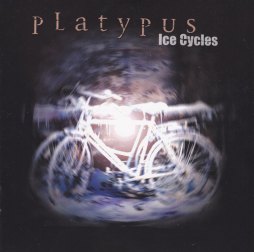
PLATYPUS_0001PLATYPUS – Ice Cycles (2000 InsideOut)

Platypus are:  Ty Tabor – Guitars & vocals (King’s X).  John Myung – Bass (Dream Theater).  Derek Sherinian – Keys (Dream Theater, Alice Cooper, Kiss).  Rod Morgenstein – Drums (Dixie Dregs, Winger).

From the information above, you already know several things: 1. Platypus is a supergroup. 2. This is going to have plenty of incendiary playing on it. 3. It’s gonna be progressive. Much like their first album (this is their second), it’s also gonna be fun!

If you’re a fan of any of these guys, you will love to hear them in this band’s context. There are plenty of King’s X-isms, but the personalities of the players have their own influences. Nobody plays drums like Rod Morgenstein, and I always enjoy the chance to hear him work.

The opening track, “Oh God” is quite heavy, with quieter keyboard moments. The track has some serious weight to it. Ty of course is a melodic singer, so that balances it. It’s just one of several standout tracks.  “Better Left Unsaid” has a pleasant aura, similar to Faith Hope Love-era King’s X, but with Sherinian’s keyboards lending a completely different sound. Myung doesn’t play bass like Dug Pinnick does, but he does create a thick sound. Morgenstein’s drums have marching band precision.

PLATYPUS_0002The heavy melody-driven “The Tower” really gets the engine running during the chorus. The verses lack a bit, but that chorus section is furious, as is the guitar solo. The piano tinkle of “Cry” has a moment that is playfully lifted from Alice Cooper’s “I Love the Dead”, but the chorus is like Alice In Chains! This is a complex track, not instantly likable. Give it some time to sink in. Morgenstein, once again, leaves jaws on the floor.

My favourite tracks are two: the brief “I Need You”, which has the lush Tabor vocals that we know and love.  This track is probably the most like King’s X, coincidentally.  Then there’s the smoking hot “25” with its Dream Theater keys and Zeppelin guitars.  There’s also a Rush riff in there somewhere.  This is one of only two instrumentals on the album, but it sure is a corker!  Just stunning.

The final track can only be called an epic.  “Partial to the Bean (A Tragic American Quintology)” is a instrumental that goes all over the board, in seven parts.  If you’ve heard instrumental epics by these players before then I’m sure you know what you’re up against.  A challenging but rewarding listen.

That can be said for the album in general.  It’s a rewarding listen that will, at times, challenge you.  I like that.

3.5/5 stars

Part 1 – Out of the Silent Planet (1988)
Part 2 – Gretchen Goes to Nebraska (1989)
Part 3 – Kings of the Absurd (split bootleg with Faith No More)
Part 4 – Faith Hope Love by King’s X (1990)
Part 5 – “Junior’s Gone Wild” (from 1991’s Bill & Ted’s Bogus Journey soundtrack)
Part 6 – King’s X (1992)
Part 7 – Dogman (1994) + bonus “Pillow” promo single review
Part 8 – Ear Candy (1996)
Part 9 – Best of King’s X (1997)
Part 10 – Tape Head (1998)
Part 11 – POUNDHOUND – Massive Grooves from the Electric Church of Psychofunkadelic Grungelism Rock Music (1998 Doug Pinnick/Jerry Gaskill)
Part 12 – Please Come Home…Mr. Bulbous (2000)

REVIEW: Rush – Red Stars of the Solar Federation (Live at Montreal Forum May ’81)

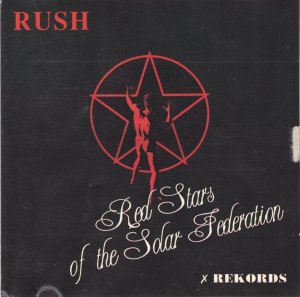
RED STARS_0001RUSH – Red Stars of the Solar Federation (X-Rekords, Live at Montreal Forum May ’81)

I found this bootleg when I was unceremoniously transferred from one location to another.  When I started at the other location, this was among the first CDs that came in that I just had to buy.  It’s a Rush bootleg from the legendary Moving Pictures tour.  In fact this CD is the audio of the Rush video Exit…Stage Left, which is a different audio from the LP.  It sounds like a vinyl rip.  Otherwise the sound quality is pretty good.  The audience is shrill and very loud.  There are also clearly speed/pitch issues with the audio.  (This could be corrected in Audacity, but I don’t think I could do it by ear.)  This CD is selling for over $70 currently on Discogs.  I paid nowhere near that.

Between the songs are interview snippets from the band, same as the video.  It features a few tracks that were not on the Exit…Stage Left album:  “By-Tor”, “In the Mood”, “In the End”, and “2112” which is unlisted.  The rest of the songs are completely different recordings, anyway.  I guess that’s why the asking price is $70.  They are no less perfect; no less electrifying.

“The Trees” and “Xanadu” take up one massive 17 minute track on the CD, and it’s a monument to perfection of performance and craft.  I can barely remember the sequence of all the different parts of Xanadu; I can’t imagine how Rush can play a set full of this stuff with precision and feel all the time!  All this while Geddy has to remember complex lyrics about searching for the lost Xanadu.

RED STARS_0002I love Peart’s slamming drums on “Red Barchetta”, a song I simply never tire of.  What is it about Rush songs?  They don’t burn out like so many other bands.  Not even “Closer to the Heart” has burned out on me yet, and it’s always a pleasure hearing a less familiar version.

On to “By-Tor”: it features a nicely noisy and meandering Alex Lifeson solo, surely a highlight of the entire performance.  This segues directly into a truncated “In the End”, also from Fly By Night.  This then is butted against “In the Mood” from the first Rush album in an awkward transition.  Geddy appears to change the lyrics from “Hey baby” to “Hey Cookie”.  Even this song is shortened, and segues into “Grande Finale” from 2112.  Alex ends it with some noise-laden blasting on his axe, almost stealing the spotlight from his two bandmates.  It’s a perfect storm of musical excellence and heavy rock.

Sonically,  Red Stars of the Solar Federation is vastly inferior to the current Exit…Stage Left DVD.  Yet I have a geeky love for an oddball CD like this.  While I can’t say it’s worth $70, I can say it’s worth:

3.5/5 stars

REVIEW: Rush – Snakes & Arrows (2007 MVI 5.1 version)

You’ve heard of Epic Meal Time?  They should call me Epic Review Time.  Here’s a couple hours of music, text and video distilled down and covered in detail.  This is a double-sized review for the price of one.  Dive in and engorge!

RUSH – Snakes & Arrows (2007 Warner Music Interactive DVD album)

Rush’s Snakes & Arrows album was considered a progression from the previous record, Vapor Trails. The pummeling of Vapor Trails has been tempered with light and shade, bringing a more balanced Rush.  It was also mixed in 5.1 for a special “Music Video Interactive” DVD by Richard Chycki and Alex Lifeson, who oversee most of Rush’s 5.1 mixes.  I haven’t listened to any version of Snakes & Arrows for many moons, so this is a review from fresh ears.

IMG_20140921_103720

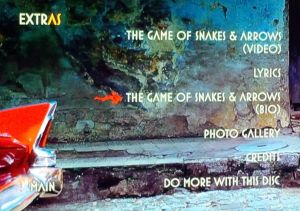
First though, there is a 40+ minute documentary video called “The Game of Snakes & Arrows” so we can learn a bit about how the album came to be.  Geddy Lee says that their priority for choosing a recording studio was that they wanted the best drum sound imaginable.  They chose an old mansion out in the Adironacks.  47 individual microphones were used to record the entire drum kit.  Neil Peart says that the isolation of the studio led to the three guys reconnecting as musicians and friends like the old days at Le Studio.   According to Alex Lifeson, the plan for writing this time was to take it easy, working on the writing part only part time.  Later on, more time was spent on just rehearsing and playing the new songs, which transformed them along them way.  The documentary contains snippets of some intricate Lifeson acoustic 12-string, in the studio, where Alex makes it look easy.

Producer Nick Raskulinecz was not a passive participant; indeed there was give and take with the band in order to make the best out of each song. It was a process that worked well according to Alex.  I enjoyed hearing Alex explain the suspended F chord in “Far Cry” — there’s a story behind it. There is some great footage of Geddy playing Mellotron on “Good News First” too.  I also love a fly on the wall scene of Geddy jamming a bass lick on his brand-new-out-of-the-box Jaco Pastorius bass.  The lick sounded good and Geddy says, “We’ll jam to it later.  We’ll get the Big Guy on drums.”  Chills up my spine.   Raskulinecz  asks, “Would it be bad if we had two instrumentals on the record?”  Geddy immediately responds, “No, it’ll be a first.”  Peart shows up and they start to jam, and when Alex arrives it only takes him a day to come up with his guitar part to the Grammy-nominated Rush bass-drum jam called “Malignant Narcissism”.  Wham, bam, thank you ma’am.  This is how the big boys play.

Although this doc is only 40 minutes in length it’s well worth having.  This is great stuff.   Neil Peart crafting drum parts in front of our very eyes is a treat that few other DVDs deliver.  Seeing Geddy applauding his bandmate shouting, “He’s killing it, woo!” is glorious.

As if all this isn’t enough, there is a many-paged (I lost count) essay by Peart called “The Game of Snakes & Arrows: Prize Every Time”.  My favourite detail is what producer Nick Raskulinecz was nicknamed:  “Boujze”, based on the sound he’d make when trying to convey to Peart a drum fill suggestion.  “Bappitty-bap-bap-booooujze!”

The DVD photo gallery is a total joke:  FIVE pictures.  At least the package comes with an expanded booklet with lots of Hugh Syme’s surreal artwork.  Since the photo gallery on the DVD was just shite photies, I’ll give you some shots from the documentary that are loads better.


So, let’s get on with the album then.  Pushing play

Delicacy and aggression describe album opener (and first single) “Far Cry”.  The acoustics of Lifeson are easily overwhelmed by the pummeling band.  “Far Cry” boasts one of those powerful 90’s-style Rush riffs that groove rather than exercise the brain.  Immediately I am overwhelmed by a dense 5.1 riff.  I do not know how many guitars I am hearing, but Alex has unique parts coming in from all sides, including an acoustic on the left that I never noticed before.  I have loved “Far Cry” since its triumphant release in 2007; it is just as powerful and engaging today.  New appreciation for Lifeson will be had on this mix.

“Armor & Sword” was a standout then and now, just as “Far Cry” before.  The song has always shimmered, but more so in 5.1.  This track has much more of Alex’s acoustic guitars, and more texture.  It has a regal 80’s Rush-like quality without the keyboards.  In fact there are no keyboards on Snakes & Arrows, only the Mellotron.  The 5.1 mix becomes a little dense at times, and the layers of guitars oppressive, but it is indeed a massive song.  Then, you can audibly hear the Mellotron on “Workin’ Them Angels”, a phrase taken from one of Peart’s books.  It is a brighter song than either of the first two, and I like the reference to the “moving picture”.  “Workin’ Them Angels” is an album highlight, particularly the mandolin near the end.

SNAKES AND ARROWS_0007Somber moods inhabit “The Larger Bowl”, with Alex’s acoustics again giving it mood and texture.  The hippy-ish chorus sounds like the 1960’s to me, and with the acoustics it paints a picture in my mind.  This is a very good song, but Alex’s well composed guitar solo is the focal point for me.  His tone is very different on the solo, very warm.  It’s an excellent song.  “Spindrift” is less overwhelming to me.  There is nothing wrong with it; it is simply less enchanting than its predecessors since they set the bar quite high.  The song was, however, performed on the Snakes & Arrows tour and kicks of CD 2 of the album Snakes & Arrows Live and there is no denying it is powerful.

“The Main Monkey Business” is the first instrumental, again featuring Geddy on Mellotron.  The main melodic element to this song feels familiar to me — it reminds me of one of Ace Frehley’s “Fractured” instrumentals in terms of melody.  In terms of playing and structure, it is nothing like Frehley.  The 5.1 mix here is nicely balanced.  I’m getting plenty of distinct acoustic parts, with Geddy and Neil front and center.  The chiming guitars behind me envelope the listener in warmth.  Then, suddenly during a solo guitar section, the mix retreats almost all way to stereo before returning again on all 5.1.  Things bounce back and forth between intensely heavy and intensely heady.  This is a masterpiece of instrumental craft.

SNAKES AND ARROWS_0005“We can only go the way the wind blows,” claims Peart on the next song.  “The Way the Wind Blows” has two distinct sections:one heavy and one with layered acoustics. I prefer the acoustic section and I’m not too much into the heavy parts which sounds a bit same-y to 90’s Rush stuff.  Then, “Hope” is a short Lifeson acoustic showcase.  This might be the point at which some Rush fans started to doze a bit.  Admittedly Snakes & Arrows is the most acoustic-based Rush album I can think of. I just don’t think that’s a bad thing.  Not when you have Alex Lifeson in your band.  “Hope” leads into “Faithless”, a strong Rush composition.  There seems to be some sort continuity of theme here, or perhaps it is all in my head?  First Neil says we can only go the way the wind blows.  Then we go from “Hope”, to a discussion of faith.  On “Faithless”, Neil says that like the willow, he will quietly resist.  Seems like a total 180 from going where the wind blows to me, and I don’t care if it’s not intentional because I think it’s cool.  On the guitar end, Alex plays a cool bluesy solo, once again classing up the song several notches.  What a player.

The song that doesn’t work for me is “Bravest Face”.  I find the verses annoying.  “Good News First” is better, returning us to the regal Rush territory I prefer.  Alex’s magnificent chords are enhanced by the Mellotron.  Weak verses are compensated for here by other elements.  It sounds like an incomplete song to me, but better than “Bravest Face”.  The aforementioned “Malignant Narcissism” is a mind-tornado as opposed to a mind-blow.  But it’s actually a distraction; you’re about to be blown away by the sheer power of closer “We Hold On”.  Rush closers usually just bowl me over, and “We Hold On” is one of those.  Fucking awesome.  This time, Alex concentrates on the electric guitar and comes up with numerous unique and enhancing licks.  This is a complete Rush triumph.  Neil is absolutely relentless.  It leaves the album on an exhausted, satisfied note.

And a good thing, too — I was starting to worry as the song quality was dipping towards the end there.  I’m happy Rush redeemed it with a stunner like “We Hold On”.

4/5 stars
REVIEW: Marillion (as “Remixomatosis”) – You’re Gone (2005 promo EP)

Welcome back to the Week of EPs! Each day this week, I’ll be checking out a variety of EP releases, both famed and obscure.

MONDAY: Aerosmith – The Other Side (1990)
TUESDAY: Wolfsbane – All Hell’s Breaking Loose Down at Little Kathy Wilson’s Place! (1990)
WEDNESDAY: AC/DC – ’74 Jailbreak (1984)

REMIXOMATOSIS – You’re Gone (Promotional 2005 Intact records)

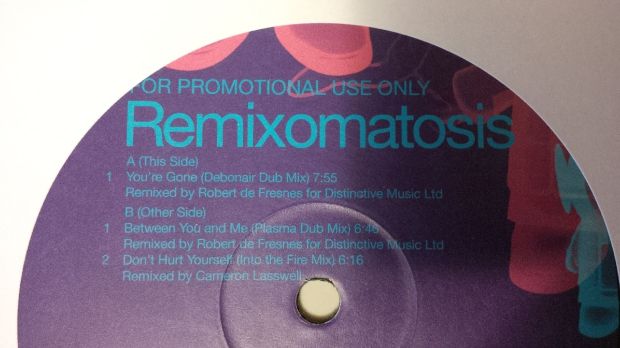
REMIXOMATOSISEager to cross over to new fans, in 2004 Marillion released an album called Remixomatosis.  It was a 2 CD set of fan remixes of tracks from 2001’s Anoraknophobia.  Hogarth-era Marillion have not been remix-shy, having done something like this on 1998’s Tales From the Engine Room EP.  Aware that chances of being played in the clubs were slim, the following year Marillion released a promo EP of three more remixes under the band name Remixomatosis.  The name Marillion appears nowhere on the sleeve.

99% of the time, I really dislike remixes, especially when songs are danced up.  I bought this for the collection, but let’s give it a spin.  “You’re Gone”, originally from Marbles, sounded very little like the “Debonair Dub Mix” on this EP.  All I can hear from the original track is Hogarth’s vocals.  Maybe some keyboards, but who knows because the dominant part of the song is an annoyingly repetitive synth & beat.  This goes on for an agonizing 7:55.  This is not a song I would listen to for enjoyment.

IMG_20140920_085903

The “Plasma Dub Mix” of “Between You and Me” is almost twice as long as the “Marillion Vs. Plasma” version on the Remixomastosis CD.  This track adds a new bass line consisting of four notes that repeat over and over and over and over and over.  Then a little bit of Hogarth’s vocal is dubbed over synthesizer lines.  There have been better remixes of this song, notably the Mark Kelly remix from the “Between You and Me” CD single.  After a couple minutes, the remixer Robert de Fresnes throws in some acoustic guitar from the original song, which really only makes me want to hear the original song.  If you like repetitive music made by computers, go for it.

The closing track is the best (and shortest) one, the “Into the Fire Mix” of the superb “Don’t Hurt Yourself” from Marbles.  As arguably the best song on Marbles, it is a difficult track to ruin.  The remixer Cameron Lasswell wisely leaves Steve Hogarth’s vocal intact.  The vocal hooks on this song have always been fetching.  They are now cloaked in spacey synths, which I prefer to dumb repetitive synths.  It sounds like a song by Lights, perhaps, or one of her soundalikes.

I can’t rate this EP very high.  This is a collectible, pure and simple.

2/5 stars
IMG_20140920_085958

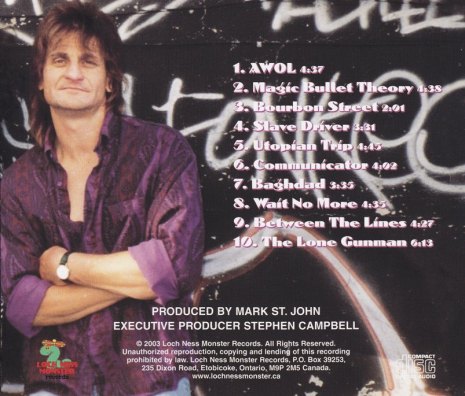
REVIEW: Mark St. John – Magic Bullet Theory (2003)

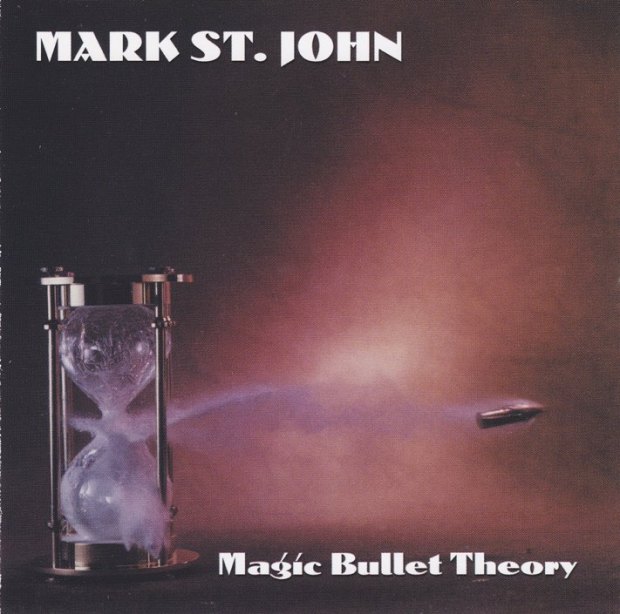
MARK ST. JOHN – Magic Bullet Theory (2003 Loch Ness Monster Records)

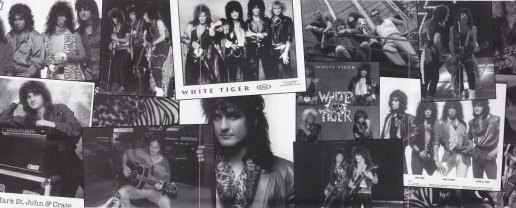
Mark St. John (1956-2007) is best remembered as the lead guitarist on Kiss’ 1984 Animalize album.  He was however much more than just a Kiss guitarist.  His exotic shredding was the basis of an instrumental solo album, Magic Bullet Theory.  Thanks Lemon Kurri for hooking me up with this CD.

“AWOL” blasts the doors open wide: high-octane tempo, high-speed shred, high-tech tricks.  There are Yngwie-like moments, Van Halen harmonics but also enough melody and song structure to keep it interesting.  Mark’s solos feature a number of different sounds and styles.  Intricate flamenco and electric guitars open the title track “Magic Bullet Theory”.  Then it turns into a melodic instrumental with lead guitar center stage.  Next, out of left-field comes the jazz workout of “Bourbon Street”.  This delicate number features non-stop jazz guitar shredding, full speed ahead, which some will find to be just too much to absorb.  “Too many notes,” some might say.  I am not one who would say that.

MARK ST JOHN_0006

It’s back to instrumental heavy metal with “Slave Driver”, which reminds me of Yngwie’s “Leviathan”.  “Utopian Trip” is more laid back, and I can hear mandolin on this one.  Mark lays a blistering lead guitar line over the largely acoustic track.  “Communicator” offers plenty more shred, perhaps resembling the high pitched screech of some 60’s sci-fi communication device.  “Baghdad” has guitars that sound like air raid sirens, certainly appropriate given the title. But the song itself is Arabic is style, with a lot of very complicated acoustic guitars.

“Wait No More” is more melodic instrumental hard rock, but with complex rhythms and tricks aplenty.  “Between the Lines” is ballad-like, with layers of shimmering guitars,until the song gives way to a nice rock riff.   This is of course accentuated by plenty of lead and melody guitars.  Finally “The Lone Gunman” closes the album on a heavy note.  (Notice how this title ties in with “Magic Bullet Theory”.)  The is a riffy track, which frankly the album could have used more of.  It’s also the longest song on the album, and probably the most epic emotionally.

MARK ST JOHN_0004

Although Magic Bullet Theory is not as song-oriented as I prefer instrumental albums to be, it has plenty of memorable moments and tracks.  It certainly shows off the talent that Mark had, that the world doesn’t know enough about.  Magic Bullet Theory comes recommended to all dyed-in-the-wool Kiss fans, and those who enjoy intelligent shreddery.

3/5 stars

…But wait, it’s not over!  After a five minute silence is an unlisted classical guitar rough recording, melodically lovely and astonishingly fast!  A nice coda.

MARK ST JOHN_0005

R.I.P. Warren Murchie

WARREN

I woke up this morning to find some sad, unexpected news: my friend, contributor and former customer Warren has passed away.  I know he had been sick in hospital in Switzerland.  I have only seen him once since he moved there many years ago, but we kept in touch.  He read my site regularly and contributed a lovely piece on the late bassist Randy Coven.

Warren loved the bass.  Actually he just loved music, period.  He was passionate about it, it was his life.  That and his wife, whom I know he loved very much.  As the tributes to Warren pour in, I find myself at a loss for words.  I know Warren loved the bass playing of Chris Squire, so the best I can think to do is post this, for my friend Warren.  I can’t believe we’ll never talk about music together again.

Rest in peace, Warren, and thank you for all you’ve done.


Part 306: Happy Birthday to Me

IMG_20140712_160505

RECORD STORE TALES Part 306: Happy Birthday to Me

Today is my birthday!

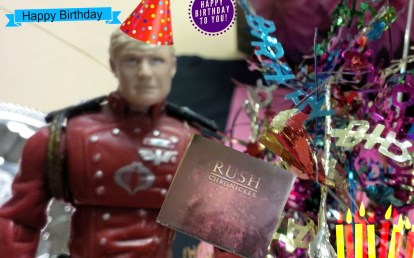
20 years ago…20 YEARS AGO!…I was hired at the old Record Store. It wasn’t 20 years ago today; I don’t remember the exact date. But it was mere days before my birthday, two weeks at best. I was given some money for my birthday, and I remember the exact CD that I bought on July 19, 1994. It was Rush. Chronicles.
So here’s a confession, something I’ve never admitted to here before. Privately yes, but not publicly. That Rush Chronicles that I bought 20 years ago today was my first Rush album. Ever.

I was pretty late to the Rush party. I didn’t really start to pay attention to them until the 1990’s. Growing up in the late 1980’s, in my age group, none of my friends liked Rush. As far as I could tell, nobody liked Rush. They simply were not in my hemispheres. I had seen their music videos on Much, but for the most part I didn’t like what I saw. A funny looking guy, keyboards, a guitar player wearing a tie…I overlooked Rush.

I did like one song. “Subdivisions”. That song was undeniably cool, with that slick synth part as the main hook. This song, I dug. Way more than “Tom Sawyer”. Way more than “Red Barchetta”. Definitely more than “Time Stand Still”, which I considered an embarrassment at the time. “Subdivisions” stuck with me, through highschool, through university. I decided I needed to get it, so I finally started exploring the Rush repertoire. And I started with Chronicles.

I would have got it sooner, but I didn’t have the money. Now I had money, a staff discount, and access to hundreds of used CDs in great condition. I had arrived in my own musical paradise!

I was soon enthralled with Chronicles.  Many songs that were new to me were quickly becoming favourites: the new-to-CD live version of “What You’re Doing”.  The silly but instantly likable “The Trees”.  Most of all though, “Red Sector A” from Grace Under Pressure.   For a brief while, this song unseated “Subdivisions” as my favourite Rush track.

On this day, I’m going to extend a hearty virtual handshake to the man who gave me a chance at that job, the owner-founder of the store. He did it just because he knew my dad, and my dad asked him to help me out. He didn’t have to, he didn’t even ask for a resume. He just asked me to come down one afternoon and talk. That one talk irreversibly changed my life, and I look at that moment as the end of one life and the beginning of another. It was one of those proverbial turning points.

Thank you.  Now, I’m off to party!

IMG_20140712_134900