rock music

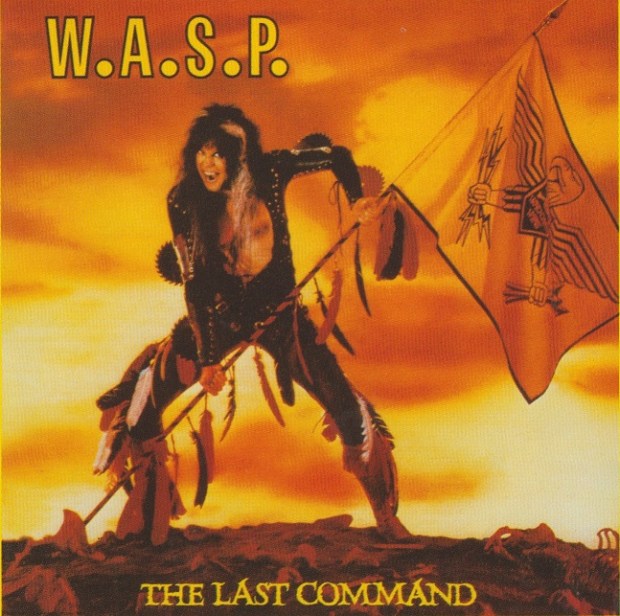
REVIEW: W.A.S.P. – The Last Command (1985, 1997 reissue)

scan_20170110W.A.S.P. – The Last Command (1985, 1997 Snapper reissue)

With W.A.S.P.’s second album The Last Command, Blackie & cohorts made a slight move closer to the mainstream.  Blackie Lawless gave the producer’s chair to Spencer Proffer who worked magic with Quiet Riot in 1983.  There was also a new drummer.  W.A.S.P. said sayonara to Tony Richards and hit Japan with new guy Steve Riley, who today is best known for L.A. Guns.  Riley’s pasty-white demeanor fit right in with W.A.S.P.’s horror rock fantasy.  This foursome (also featuring guitarists Chris Holmes and Randy Piper) became what many refer to as the “classic” lineup.

Each side of the original LP was top-loaded:  “Wild Child” led off side one while “Blind in Texas” was used to ignite side two.  This was a calculated move, as none of the rest of the songs are as memorable as the two singles.  The strategy worked as this album doubled the sales of W.A.S.P.’s first, and those two singles had a lot to do with it.  “Wild Child” in particular was proof that W.A.S.P. could write songs and not just iron riffs.  With a bright incandescence, “Wild Child” found its way onto radio.  It’s an early example of what Blackie Lawless can do when he gets everything right.

As for “Blind in Texas”?  It was always more of a novelty, a chance for the crowd to yell along with Blackie (just listen to the live B-side version on the Headless Children CD).  A cute ZZ Top cameo in the music video didn’t hurt their chances on the Power Hour, and even the staunchest critic must admit this is a blast of pure fun.

Delving into the deeper cuts, “Ballcrusher” is…a quaint love song, let’s say, with a metal chug and a cutting W.A.S.P. riff.  Throw on one of those shouty W.A.S.P. choruses and you pretty much know how “Ballcrusher” goes!  Wealth is celebrated on “Fistful of Diamonds” which is the blueprint for all the generic W.A.S.P. rockers to follow. Steve Riley made his songwriting debut on “Jack Action”, a cool but forgettable nocturnal chug. On side one, however you will discover one real diamond which is the slow and ominous “Widowmaker”. This one too is a blueprint, for classic W.A.S.P. prowls like “The Headless Children”.

Side two has its own pits and valleys. As a sequel to the first album’s ballad “Sleeping (In the Fire)”, “Cries in the Night” is less successful. However it does have a strangely futuristic Iron Maiden-circa-1992 vibe, as if Steve Harris nicked this song for some of his own on Fear of the Dark.  “The Last Command” is junk; limp and hookless.  Blackie plagiarized himself and not for the last time.  When Blackie goes “Running Wild in the Streets” it sounds as if he’s stealing from Quiet Riot.  Ask Spencer Proffer, but surely the similarity between the “all the way!” section and the “I want more!” part of “Scream and Shout” is not coincidence.  The point is moot as neither song is particularly amazing.  Closing The Last Command is “Sex Drive”, a “good enough” song but only just.

W.A.S.P. have been generous with their reissues and included virtually all their related B-sides on the CDs.  “Mississippi Queen” (Mountain) is actually a decent B-side cover.   You have to wonder if, in 1985, W.A.S.P. could have had a hit with “Mississippi Queen” just as Motley Crue did with “Smokin’ in the Boys’ Room”.  Then “Savage” is better than 90% of the actual album.  Why are songs like “Savage” left off albums?  Who makes the decision to release it as an obscure B-side?  The rest of the bonus tracks are all live B-sides, and all W.A.S.P. classics:  “Fuck Like a Beast”, “I Wanna Be Somebody”, “Sleeping (In the Fire)”, “Hellion” and “On Your Knees”.  Some suffer from excessive crowd noise, but it sounds like W.A.S.P. were formidable live.  Blackie should consider selling a live album made up of single B-sides like these, all in one place.

So good are the bonus tracks for The Last Command that they even alter its final score:

3/5 stars (original LP)

to

3.5/5 stars (CD reissue)

REVIEW: Extreme – Saudades de Rock (2008 European & Japanese editions)

scan_20170115-2EXTREME – Saudades de Rock (2008 Frontiers in Europe, Victor in Japan, with exclusive bonus tracks)

Extreme were one of those bands that always seemed to resist reuniting. Nuno didn’t seem interested, or was too busy with Perry Farrell and Rihanna. When they finally did get the band back together, they did it right with a few tours and a new album to prove they still had the goods. 2008’s Saudades de Rock (Portuguese for “Nostalgic Yearnings of Rock”) earned positive reviews from rock critics.  It did moderate sales but the important thing was that it was good.

Immediately “Star” reminds us why Extreme were special in the first place:  Those harmonies, the good time Halen-inspired riffs, the kick-ass singer and a solid beat. Gary Cherone’s voice has aged well, coming over as a cross between Sammy Hagar, Freddie Mercury and Paul Stanley (good company to be in).  This song best exemplifies the “nostalgic yearnings of rock”, as the arrangement could have come from 1990.  Extensive (jaw-dropping) solos and a big chorus immediately remind us why this band was so critically acclaimed 25 years ago.

It’s not all longing for days gone by.  “Comfortably Dumb” concentrates its focus on the groove, like a bizarre cross between Soundgarden and the Trews.  The space-age guitar work by Nuno Bettencourt separates it from anyone else.  His style has matured nicely but still makes you wonder just how the hell he does it.  His machine-gun guitar riff on “Learn to Love” does the same.  It’s not all trickery:  these are also great compositions, with challenging rock arrangements.  Time changes and flurries of notes keep it interesting.  The middle section gives all the members a little time to shine including new drummer Kevin Figueiredo.

The first knuckleball is thrown on “Take Us Alive”, a genuine electric bluegrass shuffle.  Remember Extreme always prided themselves in their diversity, modeling themselves after Queen who were unafraid to do anything.  “Take Us Alive” is a new step for Extreme who have never gone this twangy.  Unsurprisingly they mastered this direction too.  A saucy funk rocker called “Run” goes in another direction, akin to Queen’s own funky experiments, just heavier.  Like Queen, Extreme topped it with a fine melodic chorus, but stay tuned for a superb outro.

“Last Hour” is not a ballad; more of a heavy dirge.  Nuno takes a quiet solo full of volume swells before going full shred. He then rips a page from the book of his solo album with the punky “Flower Man” (I say “punky” rather than “punk” since few genuine punk songs have a blazing Nuno Bettencourt guitar solo).  “King of the Ladies” is something else entirely, featuring Nuno on lead vocals.  It’s trippy, slinky, drony, modern and sultry with smoking instrumental sections and sounds like nothing else you can think of.  Few bands can take so many directions on one album and have it sound like a cohesive whole.

scan_20170115-3

Every Extreme album has at least one ballad, and “Ghost” is a wonderful continuation of this tradition.  With the focus on the piano, it’s a reprieve in the relentless guitar assault that makes up the majority of Saudades de Rock.  You have heard this sound before on albums like Extreme III.  We then visit the Houses of the Holy with “Slide” which possesses the unmistakable Zeppelin funk.  You’ll be wondering, where’s that confounded bridge?  The riff is a wink and a nod to “Sweet Emotion” and there is definitely some of that Aero-groove mixed with the Zoso Magic.

An acoustic reprieve is offered with “Interface”, a floaty ballad that fits this leg of the running order.  It merges into the funk-Halen of “Sunrise”, a nice heavy track before “Peace (Saudades)” takes us out on a dreamy, Queen-like ballad.  Yes that’s a lot of ballads late in the game and on paper it shouldn’t work.  It does because Extreme are consummate balladeers (each one being different) and successful composers of album-length works with a start, middle and ending.  “Peace” is a triumph and uplifting finale.

There are two bonus tracks available at the end of different versions of Saudades de Rock.  Both are old demos from the vaults, ancient relics of a pre-fame Extreme.  It’s a cool idea to release old unheard songs as bonus tracks, though unorthodox.  “Mr. Bates” (1986) is exclusive to Japan only.  It’s something like seeing old baby photos, or highschool yearbook grad pictures.  You wince and think “Well, they were young.”  Even so young, Nuno obviously had more talent than the average bear.  Europe got the better song “Americocaine” (1985), which shows off that blend of Gary and Nuno’s voices that, one day, would earn them millions.  You could imagine “Americocaine” showing up at the end credits of a minor 80s action movie.

Extreme played to their strengths, didn’t try to repeat anything from the past, while giving fans exactly the kind of album they needed.  The bonus tracks don’t fit, but who says a “bonus track” has to fit?   These are bonuses in the truest sense.  Rare little treats you can’t find anywhere else.  Any fan of the 1989 debut album Extreme will love them, because that is the era they resemble.

4.5/5 stars

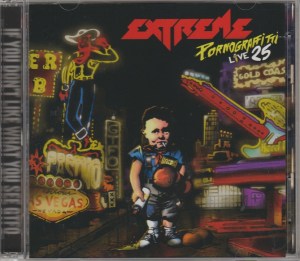
REVIEW: Extreme – Pornograffitti Live 25 (2016 Japanese 2 CD set)

scan_20170114-4EXTREME – Pornograffitti Live 25 (2016 Victor Japan 2 CD set)

When you hear that an album like Pornograffitti (which defined one of our teenage summers) turned 25 last year, don’t it make you feel old?  Maybe you haven’t played it in a while.  (If you haven’t, here is a refresher course.)  It was one of those discs that had appealing songs from start to finish, each different from the last.  All 13 songs (14 if you include the solo “Flight of the Wounded Bumblebee”) are reproduced in sequence on this new live CD release, fresh from a hot show in Vegas in 2015.  You can buy a blu-ray or DVD of the concert too, but CD collectors will want to spring for this Japanese double set.  On a second disc you get “Play With Me” (given more exposure in the movie Air Guitar Nation) and “Cupid’s Dead”, normally exclusive to the video version.  The total package is close to an hour and a half of some of Extreme’s best songs.  The Japanese printing also has its own cover art, though no other exclusives.

The familiar taped intro of rain and piano inaugurates the “funked-up fairy tail” that is Pornograffitti.  “Trying so hard to keep up with the Joneses!” begins Gary and and the Vegas crowd knows all the words.  With Nuno Bettencourt and Pat Badger helping out, the Extreme vocals are nice and thick live.  The sound is beefy goodness, wound up in electric guitar strings.  Kicking it on drums, Kevin Figueiredo keeps things pretty close to the way original drummer Paul Geary did it.  “Decadence Dance” is sincerely good nostalgia.

Following the vague storyline of the original album, “Lil’ Jack Horny” shows up amidst shimmery guitar harmonics and a funky lil’ riff.  The horn parts (tapes?) jack up the funky little guitar number, which carries over to “When I’m President”.  Nuno squeaks and squonks while Gary waxes poetic.  “So go ask Alice, ah you know what he said?  What did he say — remember, I wanna be elected?”   Maybe one day Gary, because it is indeed true:  just about anyone can be president!  Cherone promises that things’ll be different.  You can even be in his cabinet!

The funk peaks (obviously) on “Get the Funk Out” which remains as silly and fun as it was 15 years ago.  (Listen for a little bit of a lyrical modernization from Nuno!)  It’s pure live smoke only slowed down by the obligatory audience participation section.  This appropriately segues into “More Than Words”, which is slightly more than a singalong.  Stripped naked of the loud guitars, Nuno and Gary can still harmonize as clean and perfect as they always have.

scan_20170114-6

“Money” resumes the rock, as Gary bemoans the modern worship of the almighty dollar.  Nimbly killing it on both guitar and harmonies, Nuno Bettencourt is a super hero.  He does it again on “It (‘s a Monster)”, a stock album track that goes from point A to point B at top speed.  Some real gems start showing up a in steady string from there.  “Pornograffitti” possesses some serious funk metal riffage and guitar tricks, performed at an unbelievable level of rock supremacy.   Then it is time for the slow jazz lounge croon “When I First Kissed You”.  Piano flourishes and Figueiredo on brushes lend it a really pretty dusky sound.

“And now back to our regularly scheduled program!” shouts Gary as Extreme once again puts on their rock and roll shoes.  It’s time for “Suzi (Wants Her All Day What?)”, another funky rock combo.  Nuno plays some of the fastest licks ever attempted, but that is mere warm-up, for next is “Flight of the Wounded Bumblebee”, the legendary guitar instrumental that re-defined the guitar instrumental for a short while.  There is no time to recover because it’s straight into “He-Man Woman Hater”.  This Van Halen-like blast contains some of Nuno’s finest fret abuse.

Pornograffitti was also a little different, and one aspect of that is that it ended with two ballads.  Historically that has been demonstrated as a risky way to end an album, but Extreme pulled it off by using two that were different from any of the others on the CD.  “Song For Love” was a big pompous Queen-like anthem, and you can all but see the lighters and cell phones waving in the air.  “Hole Hearted” was the memorable acoustic closing number, great for campfires and rock concerts alike.  Live is just as solid as the studio original.

Onto to the Japanese bonus CD with its two bonus tracks.  “Play With Me” has always been a bit of a novelty, but notable for its sheer velocity and Mozart-a-go-go guitar dexterity.  Few players have chops like these.  “Cupid’s Dead” is a set highlight – heavy, funky and progressive at times.  Extreme III deserves as much praise as Extreme II: Pornograffitti so it is quite pleasing to have this adventurous track close.

Bravo to Extreme for making this trip back in time a real treat.

4.5/5 stars


REVIEW: Aerosmith – Just Push Play (2001 import version with bonus track)

scan_20170109AEROSMITH – Just Push Play (2001 Sony, includes bonus track “Face”)

“I don’t think we’ve made a decent album in years. Just Push Play is my least favorite.” – Joe Perry

The sad and depressing fact of the matter is, Aerosmith could have retired long before Just Push Play, and we would have lost nothing terribly valuable.  They’ve pandered for hits before, but never as blatantly contrived as Just Push Play.  It’s an embarrassing state of affairs that deserves every inch of scorn we’re about to unload upon it.

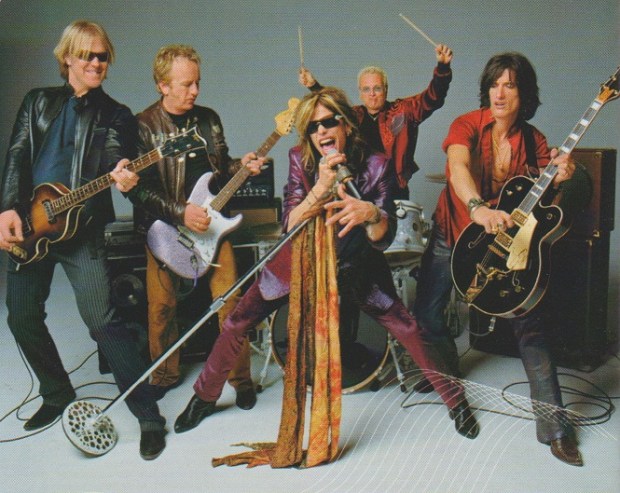
Hi-tech digital tracks written and produced with outsiders make up Just Push Play, a weak attempt to be young hip and cool when Aerosmith were anything but. Look at the sleek haircuts in the band photo. Only Joe Perry appears to know what band he’s in. The album was recorded with sterility. At no time were all five members in the studio together, according to Joe, and that’s exactly how it sounds.

If their heads weren’t in the clouds (coming off their biggest hit single ever) they might have made a rock album.  “Beyond Beautiful” is a close imitation, a robotic and stiff carbon copy.  Ballads like “Fly Away From Here” sound as if faxed in from the office.  These blatant attempts to repeat past glories are among the most offensive on Just Push Play.  It is true that one of Aerosmith’s first hits (“Dream On”) was a ballad.  That was a long time ago and a long way from being flat broke and banging out a song in the middle of the night on a piano.  These new ballads like “Luv Lies” and “Sunshine” are written specifically by hitsmiths in order to appeal to people who would not normally buy an Aerosmith CD.  The result is that they appeal to nobody.

As bland and unappealing as these forgettable ballads are, none are as offensive as the title track “Just Push Play”.  Nobody asked Aerosmith to do a rasta-hip-hop track.  The Run-DMC version of “Walk This Way” is the definitive Aero-rap, a masterpiece of serendipity and cutting edge ambition.  Aerosmith thought it was necessary to revisit that sound 15 years later, and once again the result is a blurry facsimile that pales in comparison.

“Jaded”, the first single, is a great Aero-hit, one of the few from this era of co-writers and collaborators.  Fortunately you don’t have to buy the album to get it, as there was a five track EP you could buy instead.  If you go that way, you can still enjoy a couple different versions of the charismatic single.  “Jaded” had the kind of chorus that Aerosmith used to be able to write in their sleep, but now apparently need help to do.

There were different bonus tracks for different regions.  US and Canada got nil, but Europe got “Face” while Japan received “Won’t Let You Down” and a bunch of other stuff including five live tracks from 1978 (California and Texxas Jams).  That 2 CD Japanese edition might be worth tracking down for the bonus material, but “Face” remained exclusive to Europe.  Is it worth it?  Actually…it might be.  “Face” is an acoustic track that sounds a bit like a B-side.  It’s closest to “Jaded” in sound, and sounds looser than most of the rest of the album.  It’s certainly not going to become a lost favourite, but if you find a copy at the right price, consider it.

Just Push Play deserves the dreaded Flaming Turd.

FLAMING TURDS

1/5 stars

REVIEW: Rik Emmett & RESolution9 – RES 9 (2016)

Had I got it in time, this album could have made the Top Five of 2016 list.

scan_20161231RIK EMMETT & RESolution9 – RES 9 (2016 Mascot Music)

Rik Emmett had a long productive career as 1/3rd of Triumph, but he has rarely looked back.   Post-Triumph he has released a steady stream of jazz, rock, blues and acoustic music, sometimes revisiting Triumph songs in re-arranged form.  Finally the ice thawed and Triumph successfully conquered Sweden Rock.  In 2016 Rik released RES 9, a new rock album with his new band RESolution 9.

RES 9 is in fact a time machine.  Dial up track 1.  You will be transported back to 1990 with the rock boogie of “Stand Still”.  This is a spiritual sequel to “Drive Time” from Rik’s first solo album Absolutely.  Then punch track 2.  “Human Race” (not a Red Rider cover) could have been a single from 1986’s The Sport of Kings.  With Alex Lifeson guesting on guitar, Rik and the band tapped into the hookiness of 80’s Triumph, but with a modern integrity.  When you hit up track 3, you will find yourself in the future.  Accompanied by fellow Canadian James LaBrie (Dream Theater), Rik turns in a modern rock anthem with “I Sing”.  Big and uplifting choruses preceded by mellow verses are built for radio.  LaBrie’s vocals are the perfect compliment.  Without a shred of hyperbole, “I Sing” is absolutely one of the best songs Rik’s ever recorded.

The bluesy soul ballad “My Cathedral” gives Rik a chance to show off his impeccable chops.  His tone — unbelievable!  Moving on to “The Ghost of Shadow Town” effectively dials up 1976 in the time machine, with a dark heavy Zepp-ish blues.  “When You Were My Baby” continues down smoove blues street, throwing in some jazz licks.  “Sweet Tooth” is turn down a brightly lit side avenue, a sweet treat indeed.

A hard Triumph-like vibe permeates “Heads Up”, another fine hard rocker for the radio.  “Rest of My Life” adds the jangle of acoustic guitars to the rock and roll mixture, creating another fine concoction just begging to be a hit.  Things toughen up with the pure rock power of “End of the Line”, featuring the returns of LaBrie and Lifeson.  The sheer star power of all these Canucks in one studio must have driven the temperatures well below freezing.  Still the track smokes, and if you’ve ever wanted to hear Emmett and Lifeson go head to head, then wish no more.

But it is not the end of the line.  Back to the future, we have a bonafide Triumph reunion featuring the full trio of Emmett, Gil Moore and Mike Levine.  This long awaited reunion happens on the bonus track “Grand Parade”.  The genuine surprise here is that it’s not a hard old time hard rocker, but a thoughtful and musically deep blues ballad.  It strikes me as appropriate that this much anticipated track sounds nothing like old Triumph.  That was, after all, a long time ago.

With RES 9, Rik has re-established his rock credentials.  Whether he does another album like this is beside the point.  RES 9 is the point; a damn fine album indeed.

4.5/5 stars


REVIEW: The Black Crowes – iTunes Originals (2008)

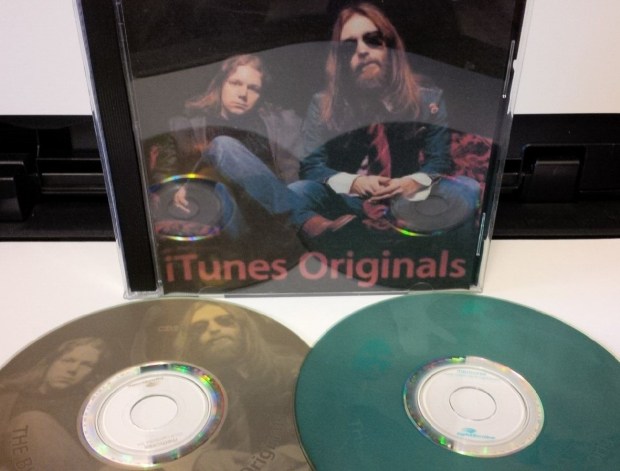
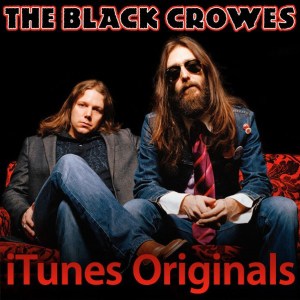
crowes-itunes-originalsTHE BLACK CROWES – iTunes Originals (2008)

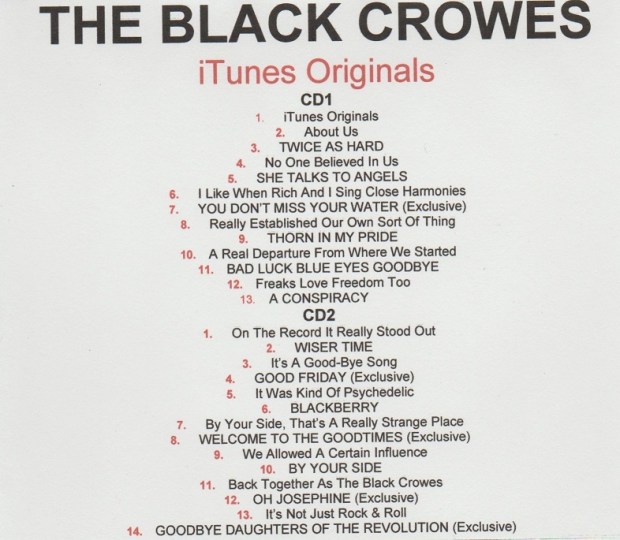
If you ever spy these iTunes Originals sets from bands you like, then have a gander at the track list.  The Black Crowes’ edition contains original hits, but also has unreleased exclusive versions.  There is also a long interview session (spread through the set) with Chris and Rich Robinson, a good and revealing chat.  In total the set runs over an hour and a half.  Chris and Rich are vivid storytellers and the interviews are good enough to want to listen to more than once.  They surprisingly reveal that punk was a strong early influence.  Rich recalls seeing Corrosion of Conformity which opened up a new world for the brothers Robinson.  The punk shows gave the band a “try anything” attitude in concert, including playing brand new songs that they didn’t have words for yet.  But their influences also stretched deep into indi rock, folk, jazz and beyond.

“Twice As Hard” from the debut album is the first hit song presented, and damn if it isn’t still as fine as the day it dropped in 1990.  That simple classic British blues rock sound gave the Crowes the springboard they needed to drive them on to greater achievements.  It was different for the time.  Yet the ballad “She Talks to Angels” was really special and that’s here too.  With the interviews in between explaining the journey, iTunes Originals plays like an audio documentary.  The story and the music get more interesting as you go.  Each album brings something new to the table.  By Your Side was a “strange place”, says Chris, but its title track still rouses the senses.

It’s a light sprinkling of hits and album cuts moving forward through the discography of the Crowes. The main thing for long time fans is the exclusive material, all acoustic versions recorded by Rich and Chris. The Otis Redding cover “You Don’t Miss Your Water” is a song they’ve been singing together for years, but never recorded until now. What a lovely song, and what harmonies.  From Three Snakes and One Charm, “Good Friday” is rendered slower and sadder.  The stripped down approach of these acoustic recordings lends “Welcome to the Good Times” from By Your Side a new appeal.

The Crowes split up for a bit in the early 2000s, but you can’t keep the Robinson brothers apart for too long.  War Paint (2008) was their reunion as the Crowes.  With new and returning members, the band felt revitalized.  “Oh Josephine”, another acoustic exclusive, is as pretty as “She Talks to Angels” 18 years earlier.  The last of the exclusives is “Goodbye Daughters of the Revolution” which also closes the set.  Upbeat gospel rock and roll works as well electric as it does acoustic.  “Goodbye Daughters of the Revolution” was one of the finer moments on War Paint and it’s perfect for ending this iTunes Originals.

4/5 stars

scan_20161203

REVIEW: The Sword – Age of Winters (2006)

Purchased at BMV in Toronto 2016 for $6.99.

scan_20161126THE SWORD – Age of Winters (2006 Kemado Records)

The scene:  Earth, post-Rapture.  A seedy bar somewhere in America, haunted by the few remaining survivors.  In walks a cloaked figure, here to recruit the only man who can help him defeat the Antichrist:  former CIA agent Stan Smith.  On the jukebox in the futuristic post-apocalyptic watering hole:  “Barael’s Blade” by The Sword.  (American Dad season 5 episode 9 – “Rapture’s Delight”)

Sounds bizarre, right?  Seth MacFarlane’s American Dad has always used modern rock music in interesting ways, and this wasn’t the only use of music by The Sword on that show.  “Iron Swan” appeared in an episode called “Minstrel Krampus” (also featuring soul crooner Charles Bradley).  Interestingly, not only are both these appearances in rather twisted Christmas episodes, but both songs were drawn from The Sword’s debut long-player, Age of Winters.

The doomy riffs of opening track “Celestial Crown” immediately recall early Black Sabbath circa 1970-72, but drawn out, slowed down, grinding heavy like a glacier carving its path through a mountain.  J.D. Cronise’s howling vocals break the ice on “Barael’s Blade”, but the assault continues right on to “Freya”.  This track, the ogre stomping “Freya”, wields multiple guitar riffs as heavy as the thunder of an avalanche.  The Norse goddess of fertility is also the goddess of war and death.  “Freya” brings the sonic conflict to your speakers.

When the “Winter’s Wolves” arrive, your senses are already overloaded by the riff-heavy metal.  “Wolves” centers on a heavy drum section, like Bill Ward on ephedrine.  Almost as if part of the same song, “The Horned Goddess” reverberates like a coda to “Winter’s Wolves”, different yet solidly in the same icy field.  “The Horned Goddess” soon transforms into a stampede of mammoths making their last stand.  Hypnotizing lead vocals welcome you into this hazy landscape of sound.

Acoustic instrumentation brings “Iron Swan” a different aura, like the Beatles via The Sword.  Then it immediately launches in a thrash metal “War Pigs”, as if all the speedy chops the band had in storage were being used up right now at this very moment.  Epic only touches on what “Iron Swan” is, as there is so much riffery that it becomes overwhelming.  Scientific studies* have shown that the human memory can only retain so many riffs at one time, and so “Iron Swan” becomes like a wave of them hitting your senses one after the other.

Painting of an Aurochs from Wikipedia

Painting of an Aurochs (Wikipedia)

The Aurochs, a part of European megafauna until their extinction in the early 1600s, were the direct ancestor of the modern domestic bovine whose products millions of people consume every day.  It is the Aurochs you see in cave paintings today.  The Sword have given us a seven-minute-plus “Lament for the Aurochs”, and we do not forget the impact that mankind has had on the ancient land we inhabit.  Although back-breeding has produced Auroch-like “Heck cattle”, we shall never feel the ground shake with a herd of Aurochs again.

“And none may see again the shimmering of Avalon,
Or know the fates of all the races man has cursed,
Long gone are the ages of the alchemists,
Now there are none who know the secrets of the earth.

“Lament the passing of the Aurochs,
And the slaying of the ancient wyrm,
Would you dare meet the gaze of the basilisk,
Or face the flames as the phoenix burns?”

The Aurochs give way to an epic instrumental “March of the Lor”, another exercise in maximizing potential riffage.  When “Ebethron” arrives to end the album with a hammering blow, it is a mercy killing.  Age of Winters is almost non-stop, all-in, nothing but riffs and pounding through its entire length.  That in mind, it only takes a short while to recover, and hit play one more time….

I look forward to exploring more of The Sword’s discography.

4.5/5 stars

Look for a review of album #2, Gods of the Earth, soon.

*Not really.


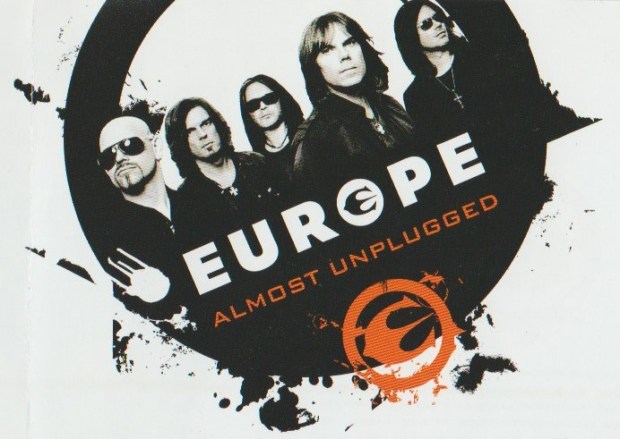
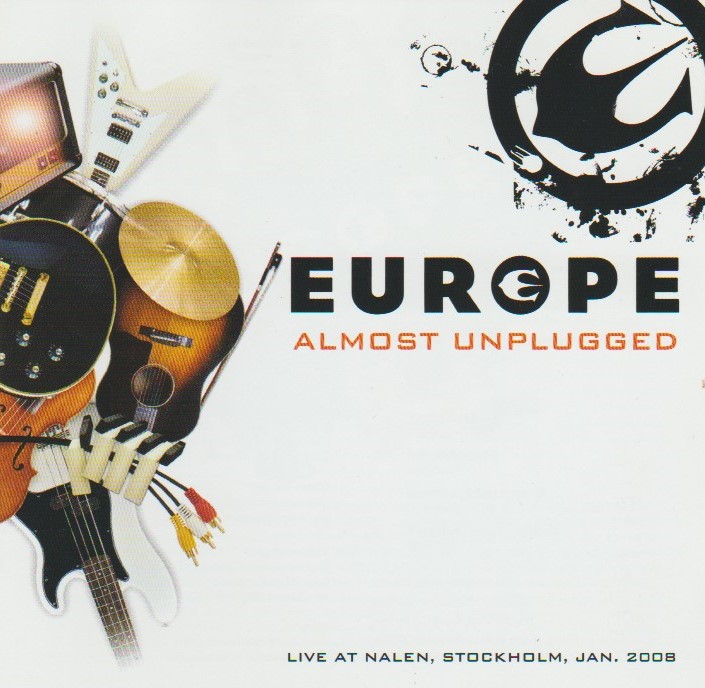
REVIEW: Europe – Almost Unplugged (2009)

scan_20161012EUROPE – Almost Unplugged (2009 MVD Audio)

Almost Unplugged“?  The devil is this?

This was a special show in Sweden, with Europe playing some of their best material (with a few covers) in a largely acoustic setting.  There are strings, but there are also keyboards and electric guitar.  The best of both worlds!

The band were riding a high wave then, which has really not dissipated since.  They had done a couple well received reunion albums (Start From the Dark and Secret Society) and were working on music that many fans consider a peak (Last Look at Eden).  Europe have long been an under appreciated band, but Almost Unplugged should win over even the staunchest critic.

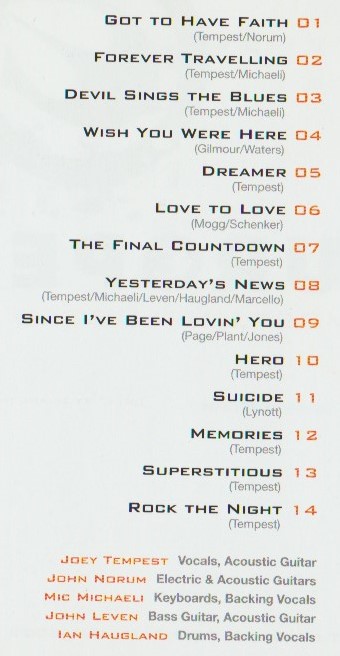
“Got to Have Faith” opened Europe’s reunion album Start From the Dark, so it works triumphantly as a concert opener.  Here, it is laid back, bluesy with slippery guitars.  “Forever Travelling” from Secret Society follows hot on its heels.  The string quartet adds drama to this song, which works naturally in the acoustic setting.  From the same album is the killer track “Devil Sings the Blues”, highlighted by some splendid John Norum electric guitar noodling.

Every time Europe does a cover, it becomes an album highlight.  The acoustic “Wish You Were Here” is beautiful and not at all overdone.  Thin Lizzy’s “Suicide” is full on electric, and pretty spot-on, especially considering that Lizzy were a two-guitar band while Europe has a guitar and a keyboard.  Covering Led Zeppelin is always risky but “Since I’ve Been Loving You” is surprisingly great.  Joey doesn’t try to copy Robert Plant, but he certainly can sing the blues just fine.  (Hey!  Maybe the devil really does sing the blues!  Oh, you devil you!)  Just as importantly, Norum plays some electrifying guitar blues over this monster of a cover.  The most brilliant cover however is a UFO song:  “Love to Love”.  More than any other, this one sounds like Europe owned it.  It’s very well suited to their dramatic rock stylings, and they absolutely kill it.  If there was one track worth buying the CD for, you just found it.

The Europe originals that make up the bulk of the album span the entire history of the band.  From the first LP is “Memories”, which in its original version was a brutally heavy stampede.  Here, it is an acoustic gallop, just as aggressive, but with subtlety.  The piano ballad “Dreamer” comes from the second album, an unsung classic that was a few years shy of fame.  The fame and fortune finally came on 1986’s The Final Countdown, and of course the title track is played.  In its acoustic version there is no synth hook; it instead played by the string quartet.  It’s trippy to hear it done like this; a little strangeness for fun.  “Superstitious” (from 1988’s Out of This World) sounds more natural in this format.  It’s also refreshing to hear Joey’s voice crack in a couple places.  That means this is really truly live.

One should always familiarize with the originals first, but even if you don’t have them, Almost Unplugged should be well enjoyed by any discerning rock fan who doesn’t mind when the acoustics come out.

4.5/5 stars

scan_20161012-2

REVIEW: Still Crazy – Soundtrack (1998)

Hosted by Vinyl Connection, it’s the inaugural…
LP stack white soundtracks – Version 2

November 1 – November 14

scan_20161024-4STILL CRAZY – Soundtrack (1998 Warner)

What a band Strange Fruit would be…if only they were real!

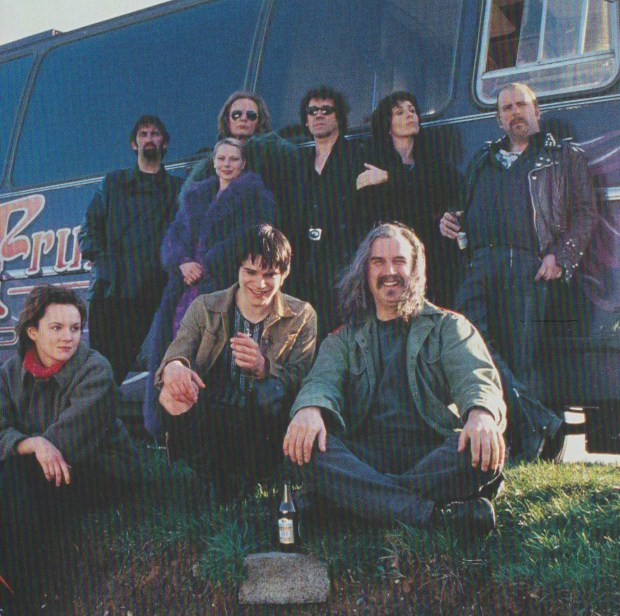
The film Still Crazy chronicled the tale of the fictional band, Strange Fruit.  The Fruit were led by brothers Brian and Keith Lovell (guitar and lead vocals respectively).  When Keith died, they carried on with new singer Ray Simms (Bill Nighy).  The inevitable internal tensions led to the band’s demise.  However in 1998 there was enough interest to get the band back together — minus Brian, who is assumed to have also died.  The surprisingly emotional film boasted fine performances from Nighy, Jimmy Nail, Billy Connolly, Timothy Spall and more.  The key however to any movie about a fictional band is to come up with a soundtrack of original material that sounds like it could be classic.  Still Crazy accomplished this.  You wish for Strange Fruit to be a real band, so good are the songs.

The ballad “The Flame Still Burns”, which in the fictional movie was written by bassist Les Wickes for the fallen Keith, is sung by Jimmy Nail in real life.  (The song was written by the team of Mick Jones, Marti Frederikson, and Chris Difford.)  This fine song is a perfect example of something that sounds like it must have charted somewhere many years ago.  In the film, this song is the cause of much tension between Les and Ray, who did not want other band members to sing lead vocals.  The beautiful thing about Still Crazy is that there is a tremendous amount of history to the band, most of which is not seen on screen, only felt through the actors portraying the memories.  Jimmy Nail sings another sorrowful ballad, “What Might Have Been”, and does a fine job of it.  It’s a lovely acoustic song with a little mandolin and another standout performance by Nail.  He gets a chance to sing an upbeat number with “Bird on a Wire” (not that “Bird on a Wire”).  This is a darn fine Wilburys-like rock tune.

To be clear, Strange Fruit are not a ballad band even though “The Flame Still Burns” is clearly that.  Strange Fruit are a rock band, and “All Over the World” is a prototypical set opener.  Bill Nighy would make a damn fine rock frontman, if he wasn’t too busy being a fine film actor.  It’s not about the notes he sings but the style in which is he sings them.  Nighy sounds like a veteran rock singer (and in the film, you believe it 100%).  The track “Dirty Town” has a nifty little riff reminiscent of “Layla”, but this track sounds more like 80’s Deep Purple, right down to a blazing guitar solo.   “Black Moon” verges on heavy metal.  If you’re wondering why it rocks so hard, it probably because of Michael Lee on drums.  It’s Purple, Sabbath and Cream all in one.  Nighy gets to be a heavy metal demigod on “Scream Freedom”, which was one of the funnier scenes in the movie.  The best Fruit tune might be “Dangerous Things” which plays in the movie like it’s one of their biggest hits.  This too has Michael Lee on drums, along with bassist Guy Pratt.  That’s some heavyweight talent, folks.

A movie with Billy Connolly in it is twice as good as a movie without (studies have shown).  A movie with Connolly singing in it is four times as good.  The traditional “Stealin'” is a fine fit for the Big Yin and his banjo.  There is even a great vintage-sounding rock track by Bernie Marsden (ex-Whitesnake) that is plenty of fun (“A Woman Like That”).   This is incidental to the main feature, which is the host of Strange Fruit tracks, but a nice inclusion.  Unfortunately the techno track “Ibiza Theme” doesn’t fit the disc at all and can be safely skipped by most listeners.
Admittedly, the Still Crazy soundtrack is more enjoyable if you have seen the film.  When I hear “Dangerous Things” I picture things that Nighy as Ray does on stage.  “The Flame Still Burns” is more powerful when you remember the friction it caused because of petty jealousies.   Regardless, these songs were all written and performed by professional musicians, and they do stand up as individual tunes.  Memorably so.

4/5 stars

scan_20161024-5

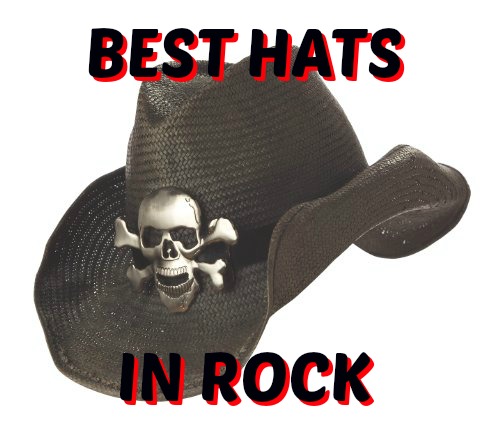
#525: Best Hats in Rock

GETTING MORE TALE #525: Best Hats in Rock

With all the head-banging going on, it’s no surprise that the majority of rockers do not wear hats on stage.  The flailing around in musical ecstasy means that hats don’t stay on top for long.  Also, with those hot stage lights beating down, nobody needs to preserve their body heat with a hat.

Yet some rockers have managed to make hats a trademark.  Let’s have a look at five of the best.*


ament

5. Jeff Ament’s whatever hat

During the Ten period, Pearl Jam bassist Jeff Ament used to sport some cool, huge hats.  We have no idea what you call these hats, but there is no denying their 90’s cool-ness.  If I had long hair again, I’d want one of these hats.

blackmore

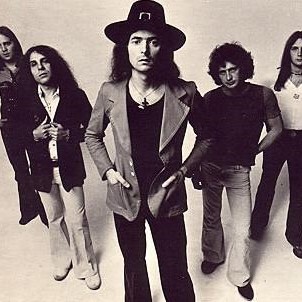
4. Ritchie Blackmore’s pilgrim hat

Blackmore is well known for his anachronistic mixture of time periods.  Playing medieval music with electric guitars?  Sure, why not.  We don’t know why Blackmore wants to look like a passenger on the Mayflower, but it does not matter.  The hat has become iconic, though not as iconic as…

lemmy

3. Lemmy Kilmister’s assortment of Motorhats

God bless Lemmy, for he had a fine collection of headgear, usually emblazoned with skulls, crossbones, and World War II symbology.  Lemmy may not have been a fashion icon, but he did own some pretty cool hats.

johnson

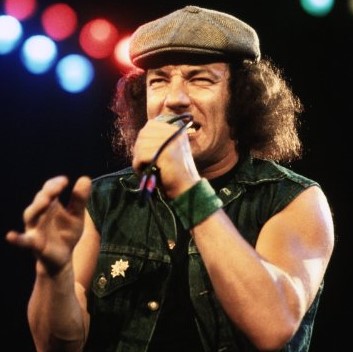
2. Brian Johnson’s newsboy hat

This one is near and dear to my heart.  Brian’s hat was to cover a receding hairline, but I had one just like it.  It was perfect for keeping a tangled mess of hair under cover.  Best of all, I could use it as a “hair mold”.  I would comb my hair in the morning, tuck it under the hat to “set” it, and an hour later it would come out looking perfect!

slash

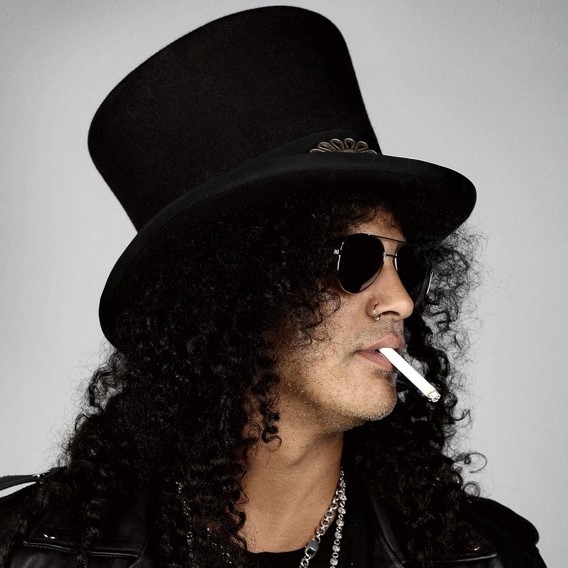
1. Slash’s top hat

At LeBrain HQ, we think Slash’s hat has become the most iconic rock and roll piece of headgear.  One look at that hat, and you automatically know who is underneath it.  The fact that Slash hid his face behind curtains of hair meant that fans had to recognize him in other ways.  That’s where the hat comes in!  Even if you wouldn’t recognize Slash’s face in a crowd, it’s a guarantee that you know his hat.


Honorable mentions:

Kim Mitchell’s OPP hat

Tom Morello’s assorted baseball hats

Mick Mars’ skull hat


What are your favourite hats in rock?


*Not including bandanas or hair pieces