I will be LIVE at 12:30 AM (ET) Saturday morning with Robert Daniels and Jason Drury on VISIONS IN SOUND. Tune in on your dial to 98.5 or internet to CKWR! You folks in the UK can tune in as you enjoy some morning java! Join Us THIS Saturday 12:30-2:30am (ET).
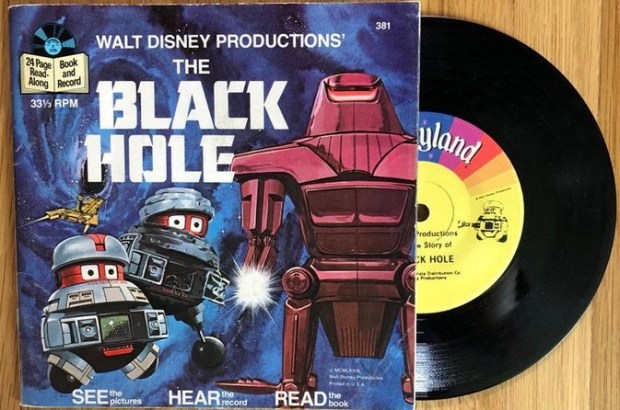
What a bizarre Disney film The Black Hole was. Marketed to kids with funny looking robots from the House of Mouse, instead of a swashbuckling adventure, kids got a strange treatise on life, death, morality, mortality, God, the soul, isolation, artificial intelligence, good, evil, heaven, hell, and eternity. It attempted to be Star Wars, 20,000 Leagues Under the Sea and 2001: A Space Odyssey.
Rob, Jason and I will be playing the soundtrack by John Barry, and dissecting this interesting and puzzling film piece by piece.
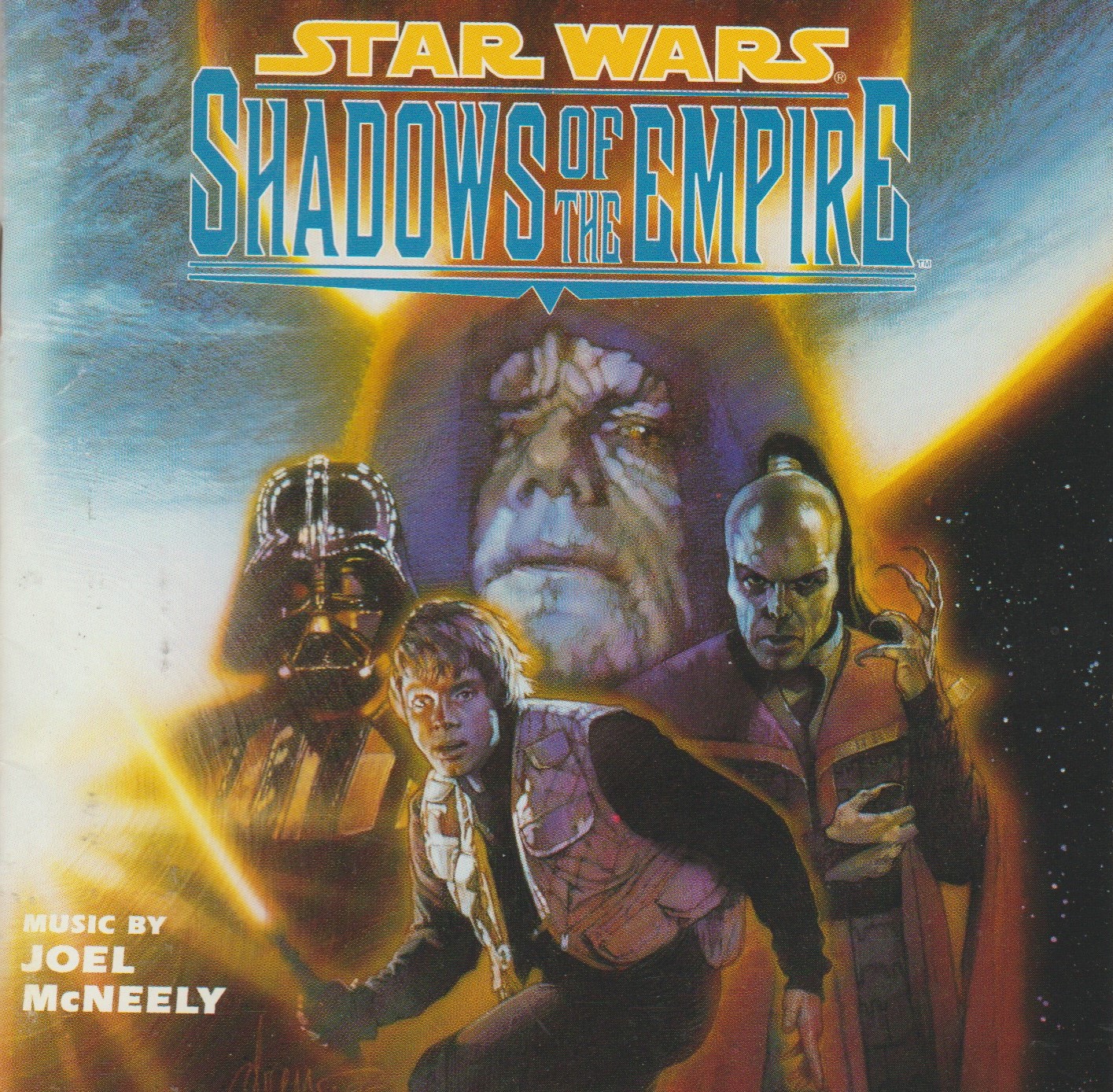
STAR WARS: Shadows of the Empire soundtrack (1996 Varese Sarabande)
by Joel McNeely
Things were starting to heat up! As Lucasfilm toiled away at the Star Wars special editions behind the scenes (and Episode I even further behind the scenes), they also launched a huge new multi-media story. It was called Shadows of the Empire, and it was meant to represent a movie between The Empire Strikes Back and Return of the Jedi. Just as Star Wars was re-entering the public consciousness again, out came this massive, sprawling thing that was meant to make you feel like you did when a new Star Wars movie was released. It included:
A comic miniseries by Dark Horse
A novel by Steve Perry (not the singer)
A new Kenner toyline
Topps trading cards
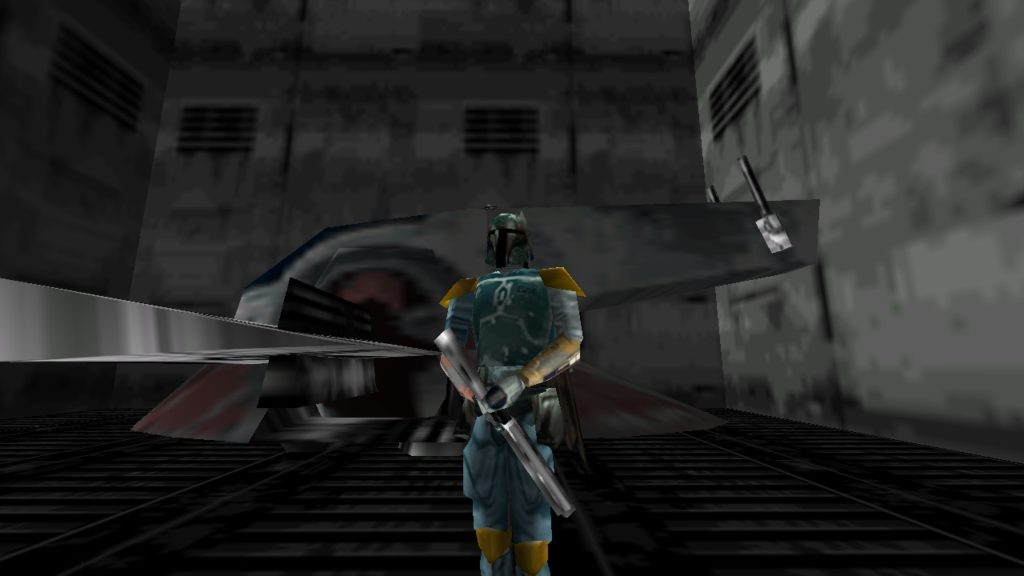
Nintendo 64 first-person shooter game
A soundtrack composed by Joel McNeely
The catch? You had to get everything in order to get the complete story of Shadows of the Empire. Scenes in the game were not in the comics or novel, scenes from the comics were not in the game, and so on.
McNeely had done a bit of soundtrack work, but had also crossed paths with Lucasfilm when he scored The Young Indiana Jones chronicles for television. He was facing a losing battle by being the first composer besides John Williams to score a Star Wars soundtrack. McNeely provides ample liner notes for each track of his score, explaining the scenes they represent from the fiction and how it translates into music. These valuable notes are a terrific example of why listening to physical product is always the best way to listen to music.
The audio journey begins with the Star Wars theme, as if it were a full-fledged film score. Differences can be heard, but not deviating far from course. “Leia’s Nightmare” begins quiet and prequel-esque, with hints of “The Imperial March” and other classic Williams themes. And even in retrospect, it is thrilling hearing them in the context of something new.
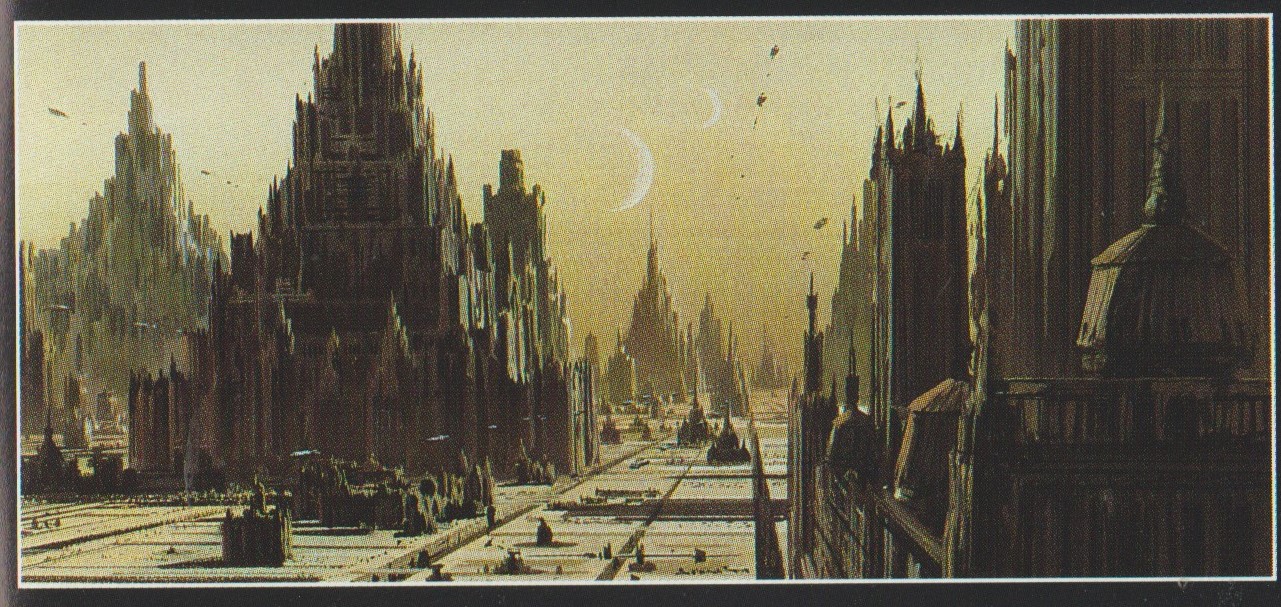
“The Battle of Gall” is an early attempt to rescue Han Solo from Boba Fett. Fett has stopped at the Imperial moon of Gall on his way to Jabba the Hutt, with Solo frozen in carbonite. Why? No reason, except to milk the Boba Fett character even further. Military drums can be heard as Luke and friends prepare their daring mission…doomed to fail, of course, since we have all seen Return of the Jedi. A bouncy new theme in this piece sounds out of character, but memorable. “Imperial City” is our first glimpse of the Galactic capitol world of Coruscant. Much like it is described in The Phantom Menace, it is a planetary city. Ideally, you’d be leafing through the Ralph MacQuarrie paintings of the planet while listening to the imposing horns and drums. A choir welcomes you to the city amidst fanfares and trumpets. None of this sounds like Star Wars, but much of it is good.
An action scene on Tattooine follows, as Luke is chased by goons on speeder bikes. He is rescued by new character Dash Rendar, a poor man’s Han Solo. Dash has his own swashbuckling theme. He was a huge part of the Shadows of the Empire campaign. His ship, the Outrider, was saucer shaped with a side cockpit like the Millenium Falcon. Lucas added it to the Star Wars special edition in ’97, making it screen canon forever.
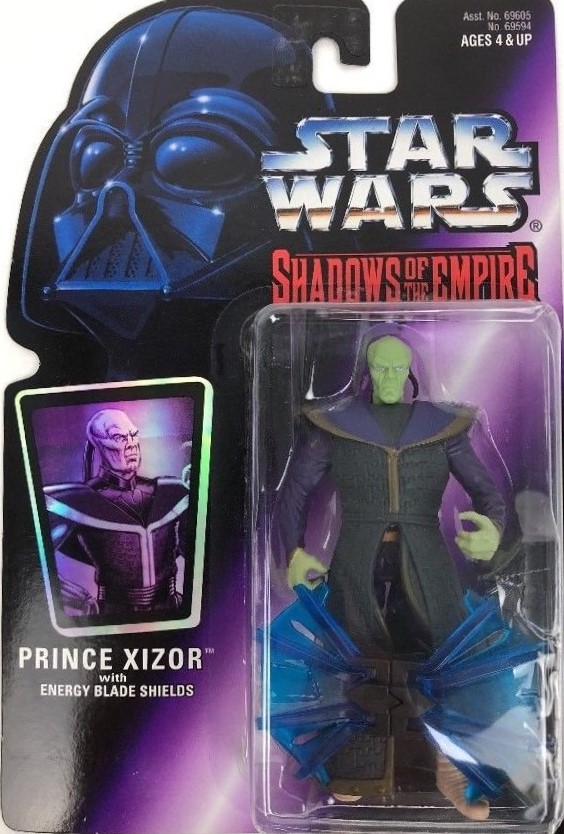
Leia’s mission follows, as she searches the lowest levels of Coruscant looking for a crime organisation known as Black Sun. She wishes to forge an alliance. Their leader, the tall green Prince Xizor (shee-zor), is the main villain of Shadows. Not nearly as terrifying as Vader or the Emperor, but he has his own scary theme. The music paints a picture of an evil entity with refined, extravagant tastes. He has one advantage over Leia when they meet: alien pheromones that make him irresistible to women. But Leia loves Han. This battle of wills is composed as a dramatic ballet called “The Seduction of Princess Leia”.
We learn Xizor failed to seduce Leia on “Night Skies”, a piece of music he shares with Darth Vader, as he attempts to contact Luke through the Force. The dark side of the Force is palpable in the air, then Vader’s theme returns. Next, Luke rescues Leia from Xizor’s palace on “Into the Sewers”, which are the only way to sneak in undetected. Xizor is defeated on “The Destruction of Xizor’s Palace”, when a massive space battle ensues. A choir heightens the tension while exciting action music animates what’s happening. Grab your action figures and play along.
The only serious flaw is that the soundtrack should really end like a Star Wars movie ends — with the credits theme music. That aside, Shadows of the Empire is an enjoyable piece of music when you want to hear something just a little different and contemplative in the galaxy far, far away.
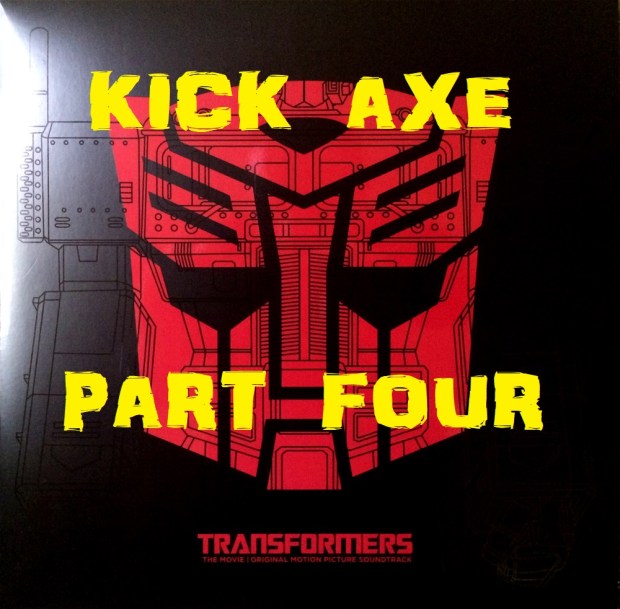
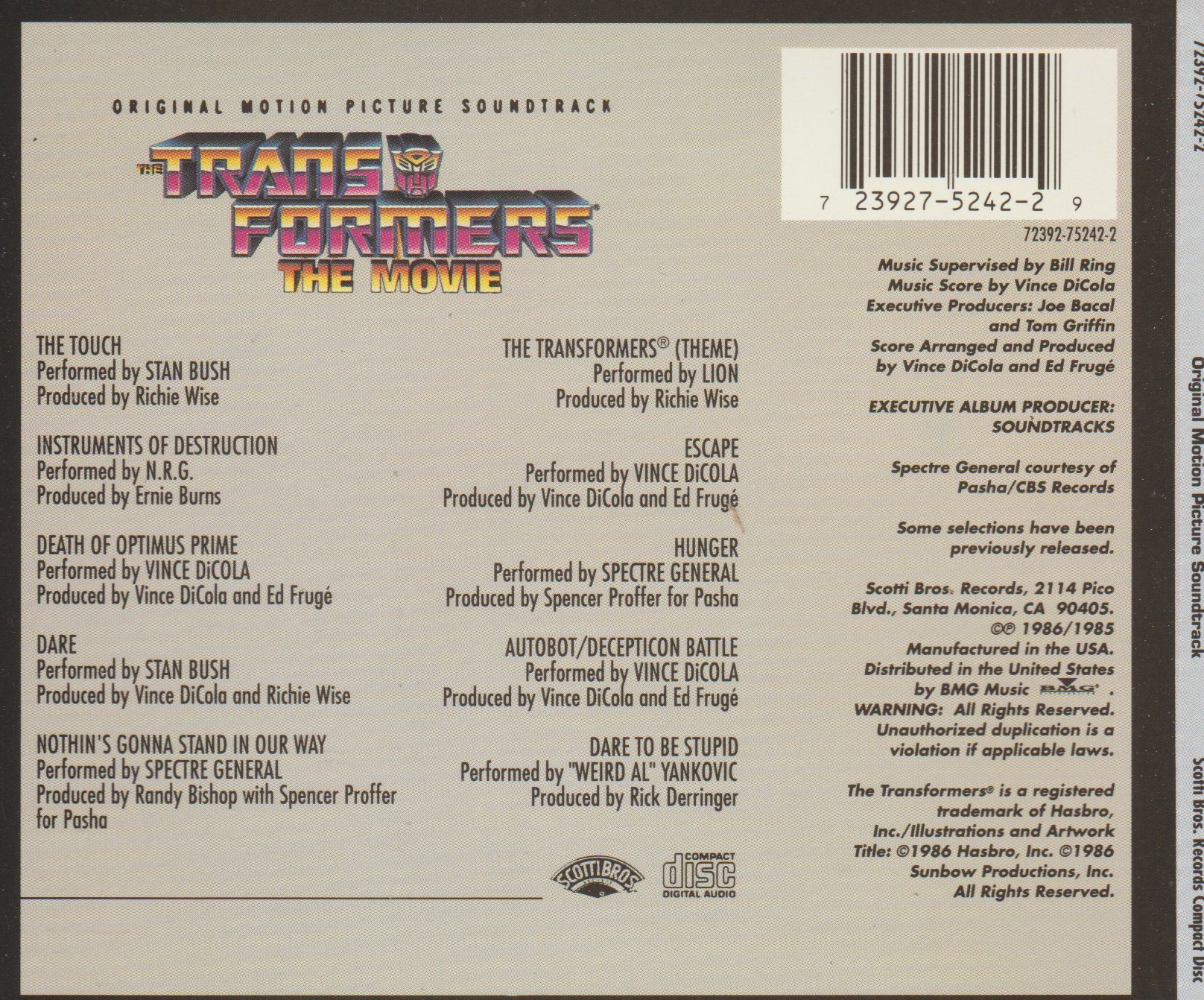
KICK AXE as SPECTRE GENERAL – “Hunger” and “Nothing’s Gonna Stand In Our Way”
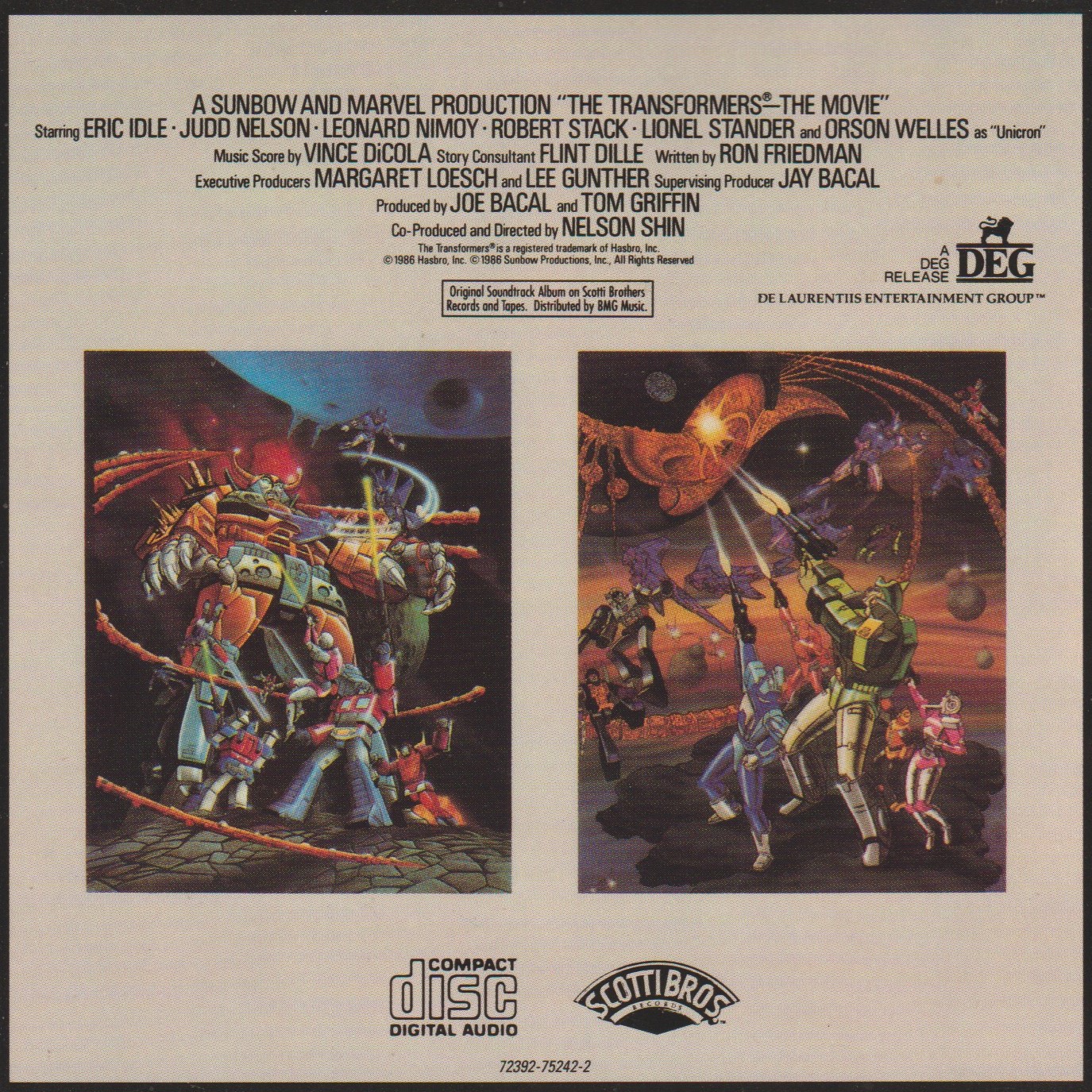
from Transformers: The Movie original motion picture soundtrack (1986 BMG)
Although the recordings were not released until 1986, it makes sense to talk about “Hunger” and “Nothing’s Gonna Stand In Our Way” now, in terms of storytelling. After the Vices album was completed in 1984, Kick Axe were tasked to contribute to another project. And it wasn’t a movie soundtrack.
Producer Spencer Proffer was scheduled to go into the studio with Black Sabbath — a Black Sabbath still fronted by Ian Gillan, though not for long. Proffer felt that Sabbath needed fresh ideas and recruited Kick Axe to write some. Though details are murky, we do know that Gillan left Black Sabbath abruptly to record Perfect Strangers with Deep Purple. Kick Axe frontman George Criston was one of the singers that Tony Iommi was interested in as his replacement. Whatever happened, no recordings of Sabbath with Criston have surfaced, but we do have the songs Kick Axe wrote for the sessions.
In a strange coincidence, they all first came out on November 9 1985, on two separate albums. W.A.S.P.’s The Last Command (produced by Proffer) featured the Quiet Riot-like “Running Wild in the Streets”, though without proper writing credit. Another album produced by Proffer was released the same day: Ready to Strike by King Kobra. “Piece of the Rock” and hit single “Hunger” were written by Kick Axe for the Sabbath project.
Ultimately, “Hunger” by Kick Axe did finally come out in the summer of 1986. Too late, perhaps, considering people assumed it was a generic cover of a King Kobra song. Especially since no one had ever heard of…Spectre General?
Who the hell is Spectre General?!
For reasons unknown but said to be contractual, Kick Axe couldn’t release their own song under their own name, so Proffer invented Spectre General, and that’s how they’re credited in Transformers: The Movie. The band didn’t even know about it. They had two songs on the original 10 track album: “Hunger”, and a new song called “Nothing’s Gonna Stand In Our Way”, a cover version (John Farnham original) intended for the next record Welcome to the Club.
Perhaps it’s the familiarity of the King Kobra recording, but this version of “Hunger” does stand in its shadow. Both Mark (Marcie) Free and George Criston are stellar vocalists, and the Free version just had more…weight. Kick Axe’s original is heavier and chunkier, so perhaps in that way it’s actually superior. “Nothing’s Gonna Stand in Our Way” is an upbeat number, hook-laden, with the trademark Kick Axe “chug” and backing vocals. It’s pretty essential to have both these tracks to augment a Kick Axe collection.
Besides not getting their real name in the album, other contributions by Weird Al Yankovic and Stan Bush were featured more prominently in the movie than the two “Spectre General” songs. The band Lion got to do the movie theme song. Those were some memorable movie moments to any kid in the theater, particularly the Stan Bush selections.
It’s pretty amazing that Kick Axe came up with “Hunger” but were never really recognized for it. It’s a great song and their original version of it is the proof. Also strong, “Nothing’s Gonna Stand in Our Way” would have made a fine addition to the next album. Clearly, the Canadian quintet had big league talent the whole time.
We didn’t have a VCR in 1980. You could rent them; this was usually reserved for special occasions. That meant, unlike today, we couldn’t just watch the latest Star Wars any time we felt like it. The best way to re-experience the movie was on your own, with action figures and soundtracks. The Empire Strikes Back was my favourite album at that time. I played certain tracks on those records so often with my kid fingers that they started to skip.
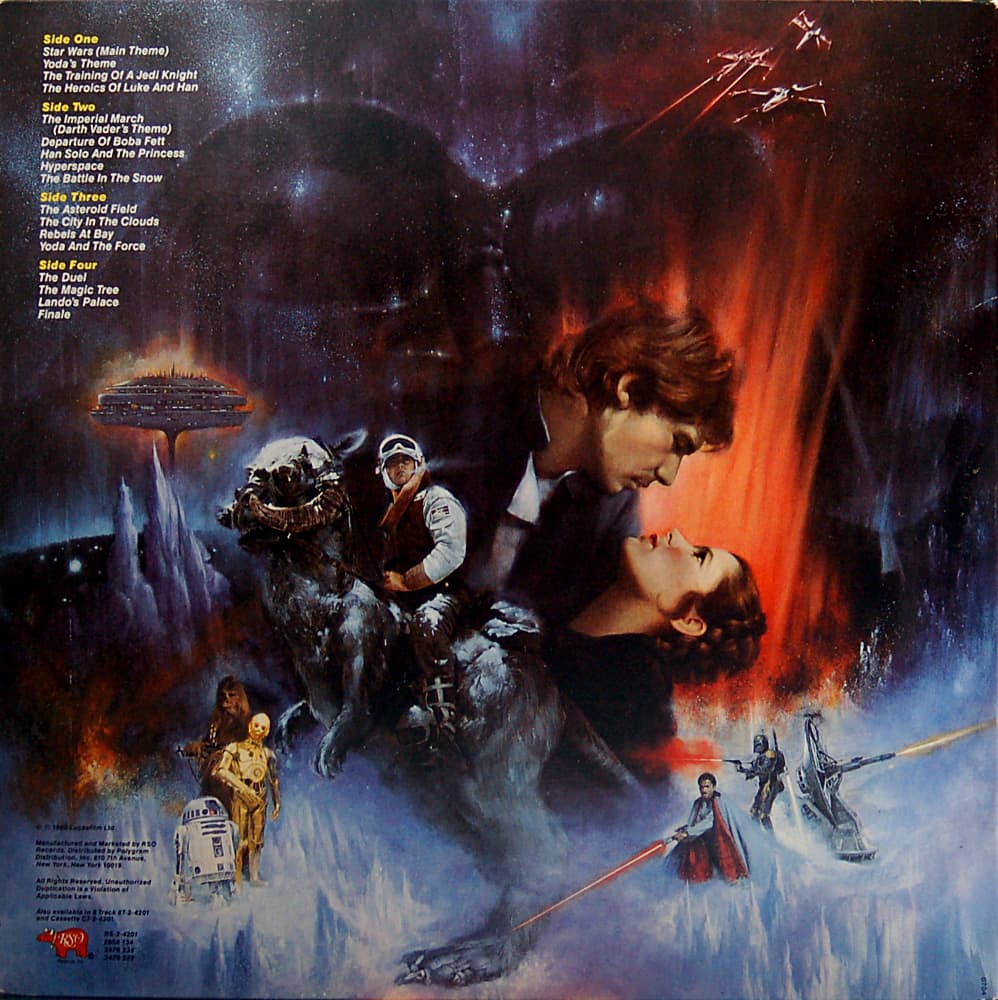
I used my parents’ big living room hi-fi. Giant wooden speakers as heavy as oak doors. A turntable, an 8-track, and a receiver. Once I discovered Star Wars, I think I used it more than they did. The Empire Strikes Back came in a luxurious gatefold, with photos from the film, liner notes, and a generous booklet. It didn’t take long for the rips and tears to set in; that record was well loved. Usually, I would plug in the set of headphones and listen quietly while turning the pages of that booklet. On weekends, my sister and I would probably set up a big battlefield and re-enact the movies, with the soundtrack playing in the background. The most frequently played tracks were “Yoda’s Theme”, “The Asteroid Field” and of course “The Imperial March”. Sometimes we would ambitiously re-enact the entire movie in sequence using the whole soundtrack.
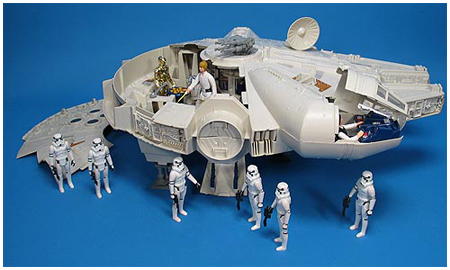
We had to improvise. There were lots of characters and vehicles we didn’t have. When the Wampa ice monster attacks Luke Skywalker and knocks him off his tawn-tawn, we had to use Chewbacca as a stand-in for the monster. Before we had a Boba Fett, we used a Micronaut with an actual missile-firing backpack. We didn’t have an AT-AT, so we used my sister’s cardboard Jawa sandcrawler. The centrepiece of our play time was usually my huge Millennium Falcon toy.
Before anyone gets too nostalgic for the good old days, I’ll remind you those Kenner toys were actually quite shit. My two biggest toys, the Falcon and the X-Wing, both broke immediately out of the box. The wings on the X-Wing never worked right and I had to wedge marker lids in the wings to keep them open. The hinge for the boarding ramp of the Falcon snapped when my dad put it together. He tried to glue it, but ultimately the door was held on by an ugly piece of masking tape. Sturdy toys they were not, and parts were always popping off. The guns refused to stay on the wings of the X-Wing. The canopy of the Falcon always popped open mid-flight. It too eventually got locked down by masking tape.
During these huge play battles, my sister and I would take over the entire living room floor. There was a coffee table that usually acted as Imperial headquarters. You could park a TIE fighter on the shelf underneath. All the while, John Williams and the London Symphony spun behind us. I’d flip sides and cue up another track, or just play “The Imperial March” again.
When we were done playing Empire, we would do our own original stories. We usually set these “pre-Empire“, since Han Solo was frozen in carbonite at the end of the movie. He was a favourite character and we had two Han Solo action figures: original Han and Hoth Han. I loved Hoth Han. Not only did he look cool but he was the only figure you could take his gun and plug into a holster on his hip. It was hard to really make good coherant “pre-Empire” stories though, because we also wanted to play with other cool figures like Lando, and Yoda. It didn’t particularly matter because we had tremendous fun without a logical story.
I’ll say it again: improvisation. We built a custom multi-level Cloud City out of cardboard boxes. It had sliding doors and sort of an elevator. We made our own figure-compatible vehicles out of Lego. Before I had a figure of Han Solo frozen in carbonite, I took my Solo and put him in a glass of water. If I put him in the freezer for a few hours, I’d have a frozen Han ready to go for the next adventure. My dad was bemused to go into the freezer and find Han Solo in there so frequently.
No matter the story or setting, the Millennium Falcon was there. You could fit several figures in it, with two in the cockpit, one in the gunner’s chair, and several tossed into the opening rear compartment. The cool thing about the gunner’s chair was that it rotated in sync with the top quad-cannons. The Falcon’s rear compartment was equipped with a space chess table (called Dejarik), a Jedi training area (you know, for that one scene), and a smuggler’s compartment with secret hatch. This made it more of a playset than a ship, but it did have several features that made it more a ship than a playset as well. Close up the rear compartment, raise the working landing gear, and you are airborne. The Falcon also had sound effects and a large battery compartment where the escape pod would have been. While playing on the living room floor, if the track “The Asteroid Field” was playing, you just had to get the Falcon ready for take off. Close the ramp, the canopy, and the rear compartment. Raise the landing gear and you were space-bound! Then I’d fly the ship around the living room in sync with the swells and crescendos of the theme. It really felt like Star Wars at that point.
In 1981, the first Indiana Jones soundtrack was released, also composed by John Williams. It was official then: Williams was my favourite. I didn’t have very many records; most of the others were “Story Of” soundtracks with full narration and dialogue. That was another way to re-live a movie in a pre-VHS household, but I kept coming back to the actual movie scores. I outgrew the “Story Of” records but not the scores. Even so, nothing topped the original two-record set of The Empire Strikes Back. When Return of the Jedi was released in ’83, it was only a single record. It didn’t have as many memorable cues. I loved and cherished it, but not as much as Empire.
Besides, in 1983 something else happened besides the end of the Star Wars trilogy. I was getting older, and there was this new song out. I heard four words — “Domo Arigato, Mr. Roboto“, and my world shifted once again! But that, friends, is another story.
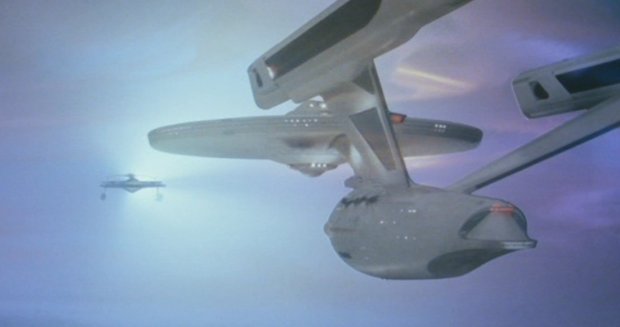
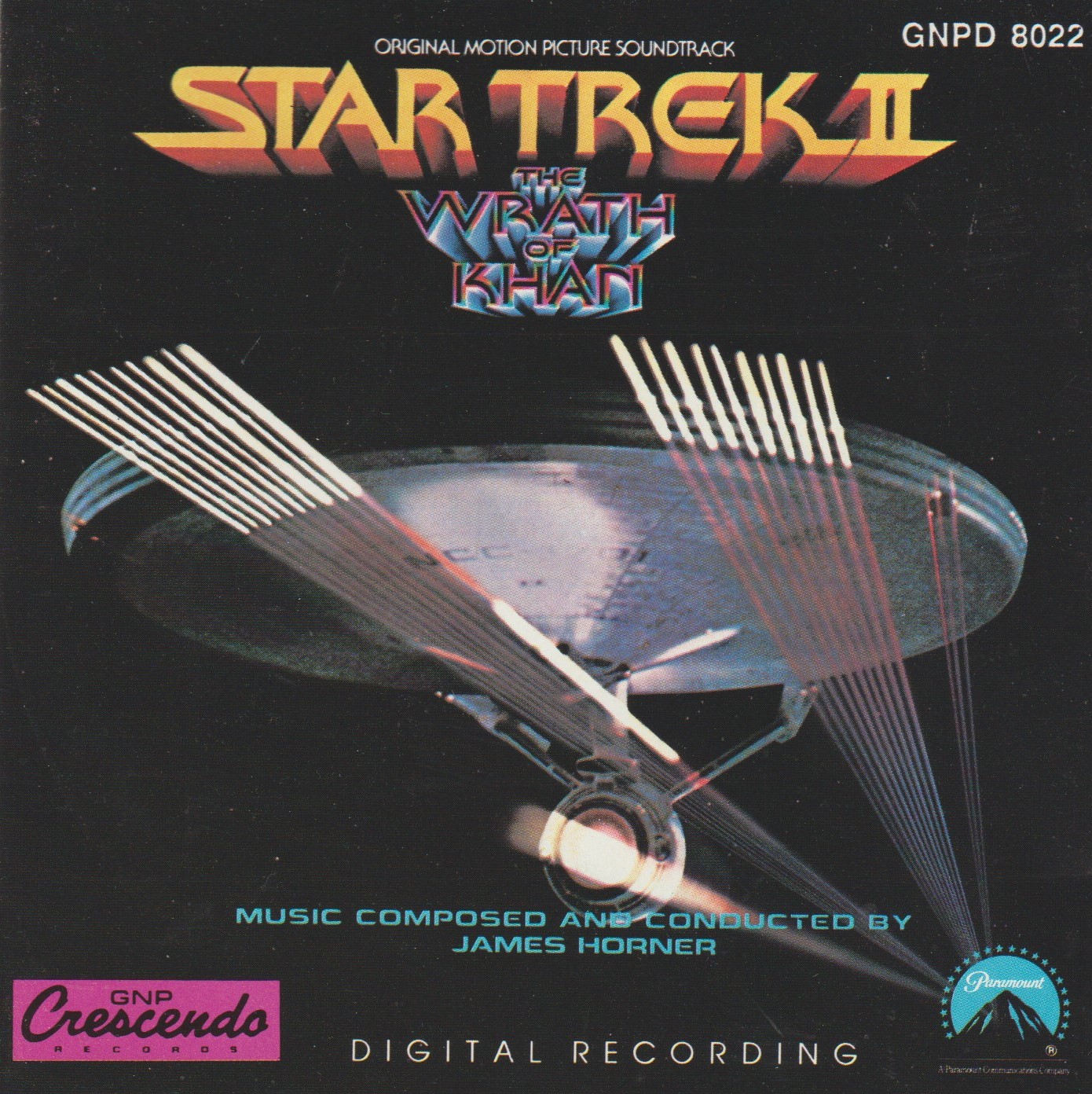
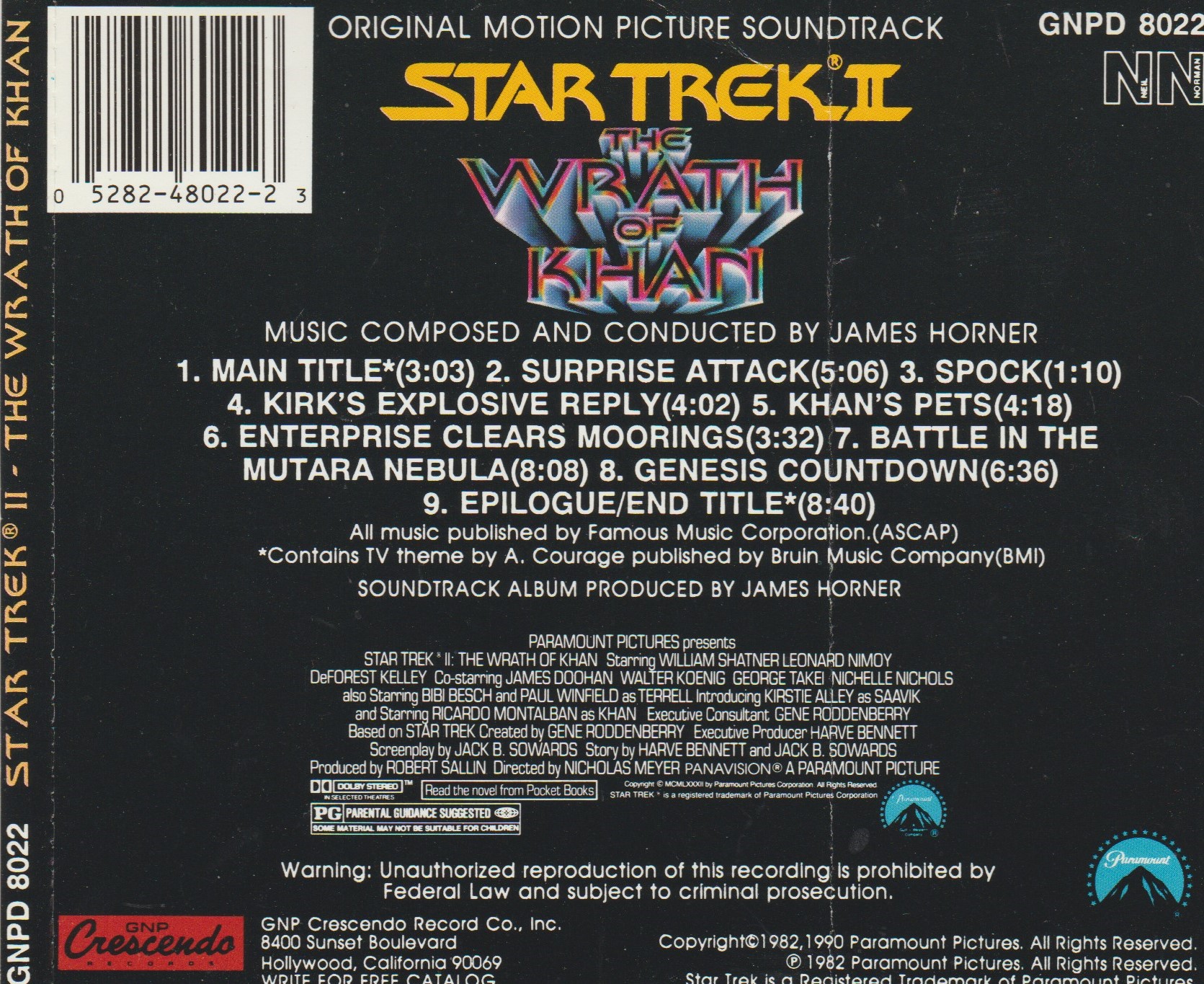
STAR TREK II: The Wrath of Khan original motion picture soundtrack (1982 GNP Crescendo) Composed and conducted by James Horner
The Wrath of Khan was James Horner’s breakthrough score. He sold a bajillion albums since, for movies you probably heard of (Titanic, Avatar, Aliens, etc. etc.). One listen is all it takes to hear why The Wrath of Khan put him on the map.
When the film came out in 1982, it felt brand new in two ways. One, it felt like Star Trek was alive again. Khan‘s tight pacing, dialogue and performances were miles ahead of the monumental bore than was Star Trek: The Motion Picture. Second, the score was top-knotch. Just as John Williams made Star Wars a brilliant audio ride, so did James Horner with Khan. Of course this isn’t to knock Jerry Goldsmith, who score The Motion Picture (and lots of other Treks too). Khan was a different kind of movie, with the kind of action and tension the first film lacked. The score followed suit.
Perhaps the most exciting cue on this soundtrack is recurring Khan theme heard in “Surprise Attack”. As stunningly good as it is, the quieter moments in the score are just as important. Though quiet, they still delivering tension when necessary. Check out “Kirk’s Explosive Reply”, from the scene in the film when Kirk is stalling for time to take down Khan’s shields. When a character stalls for time, you need to feel that tension, and it is all there in the track. “Spock” is also a lovely softer piece, from a thoughtful moment between Spock and the Captain. There is an air of ambiguous danger.
Surprise attack!
This being Star Trek, you need regal themes for those big widescreen shots of the USS Enterprise gliding past in all her glory. Check out “Enterprise Clears Moorings” for a the finest example of this. Of course, Khan was probably best loved for its battle scenes. “Battle in the Mutara Nebula” and “Genesis Countdown” combined are 16 minutes of adrenaline mixed with tense stretches of quietly humming instruments. Even when contemplative, this soundtrack is somehow so big and bold. It is an absolutely huge sounding score. Brass, military drums, strings…it is a flawless collection of music. Every bit as exciting as the film, and completely enjoyable as its own work.
People say James Horner plagiarised music from classical composers. So did John Williams, and you don’t hear fans complaining about it! The Wrath of Khan could easily one of the best soundtracks you ever buy.
THE BUDDY HOLLY STORY – Original Motion Picture Soundtrack (1978 Epic)
The Buddy Holly Story was a remarkable movie, not because it was terribly accurate (it wasn’t). Some of the best music biopics, like The Buddy Holly Story, feature the movie cast doing the singing and playing. In a rare stroke of fortune, Gary Busey was cast as the perfect Buddy Holly. He could sing enough like the rock and roll legend, and with some curly hair and glasses, Busey fit the bill.
The “Clear Lake Medley” is made up of Buddy’s greatest hits like “Peggy Sue”, “That’ll Be the Day”, “Oh Boy”, “Maybe Baby”, and “Not Fade Away”. They’re amped-up, made to sound like the live concert experience. Busey’s more manic in this setting than the old familiar studio versions.
The most interesting track, possibly, is the a-Capella “I’m Gonna Love You Too”, with just Gary Busey’s voice. You can’t fake it in that setting. The guy managed to sound enough like Buddy Holly through this whole soundtrack that you often drift away and forget that’s what it is. The suspension of disbelief is complete.
All this and you’ll get a collection of some pretty amazing songs too. You’ll know most of ’em, including “Everyday” and “Whole Lotta Shakin’ Goin’ On”. As seen in the film, “Everyday” is a slow, ballady version. That is certainly compensated for by the “Roller Rink Medley”, another adrenaline-pumped live set.
Truly a great soundtrack and a worthy addition for Buddy Holly fans.
QUEEN – Bohemian Rhapsody – The Original Soundtrack (2018 Hollywood Records)
“Best Queen greatest hits yet,” said a trusted fellow Rock Connoisseur. “Nahh”, I thought, remembering the red and blue CDs I grew old with. But his theory might just hold water. For fans new and old, listening to the Bohemian Rhapsody soundtrack from start to finish is very satisfying.
The movie’s getting torn to shreds by the critics. Don’t let that scare you away from the album. Worth the price of admission for die hard fans is the new Queen version of the “20th Century Fox Fanfare”. Who needs an orchestra when you have a Brian May? Then it’s “Somebody to Love”, which you can imagine playing over the opening credits, can’t you?
“Doing All Right…revisited” is a pre-Freddie version of the Queen song, by the pre-Freddie version of the band, called Smile. This is a first for collectors, and is hopefully a taste of more Smile music to come. Moving on chronologically, it’s the scorching classic “Keep Yourself Alive” from the legendary Live at the Rainbow ’74. Because Queen was one of the greatest live bands of all time, having live tracks mixed in with hits won’t phase the old fans. Folks out there who hate live versions (yes they exist) will whine that the originals aren’t included. That’s OK because sometimes Queen live was actually as good or better than Queen in the studio. “Keep Yourself Alive” is one such track.
One can’t fault the song selection. “Killer Queen”, “Crazy Little Thing Called Love”, “Under Pressure”, “Another One Bites the Dust” and “We Will Rock You (in a movie remix) represent the radio perennials. Other favourite Queen songs are present in a mini-set from Live Aid. It’s not the whole set, unfortunately, but a large slice: “Bohemian Rhapsody” (also present earlier on the CD in its studio version), “Radio Ga-Ga” “Hammer to Fall” and “We Are the Champions” are stellar performances from an historic concert. No one is poorer for having these.
You may question your need to own a remix of “Don’t Stop Me Now” with too much guitar, or a live “Now I’m Here” from the Night at the Odeon album. Well, you’d do it to get “Fat Bottomed Girls”, which was chopped from the Live Killers album, or “Love of My Life” from Rock In Rio in front of 500,000 people. It’s a trade-off with you as the winner.
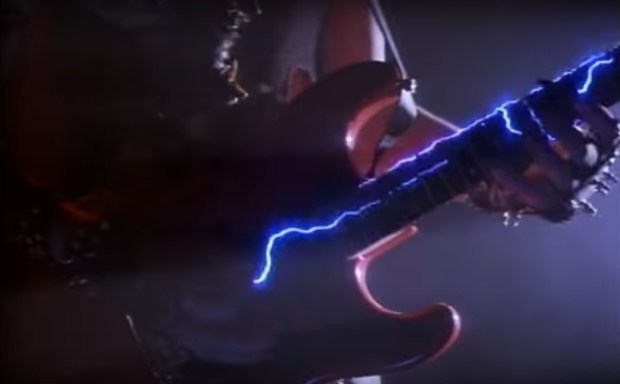
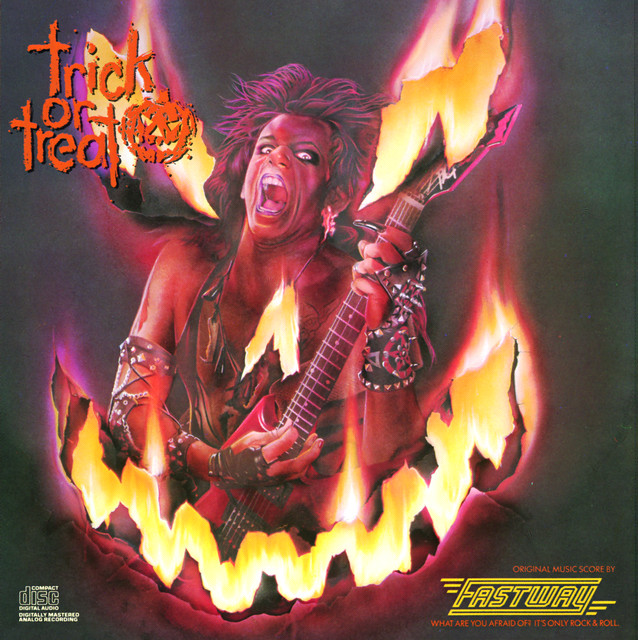
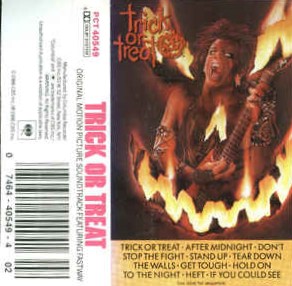
FASTWAY – Trick or Treat Original Music Score (1986 Columbia)
Some albums excel by being excellent; Trick or Treat is not one of those albums. It excels because of its banality. There’s nothing on this album that you’ve never heard before, but the band sells it with such conviction that you buy into about as much as the band itself does. This is the soundtrack to the best forgotten 1986 film starring no one worth remembering, with a couple of cameos from Gene Simmons and Ozzy Osbourne. The film was such a dud that once it was released on DVD, they changed the cover to feature the faces of Simmons and Osbourne despite the two of them being in the film for a collective total of about five minutes. The journey I went through listening to this album impacted me in such a way that I feel obligated to elaborate on it here, and that journey will essentially act as the review. I didn’t intentionally go anywhere while listening to this album; the music was such a powerful agent that it literally shattered the very fabric of space and time. The film is not as strong.
However, this review isn’t about that film. This is about the Fastway soundtrack to the film. You’d think a band taking on a film as gloriously moronic as this one would whip up some tracks that were appropriately tongue in cheek, but nope. Fastway plays it 100% straight, which actually makes it funnier than if they’d been going for laughs. The songs that follow are a complete artistic tour de force that will leave your soul shaken by the depth and insightful words of automatic poetry.
The first time I heard the opening song and title track, I pooped my pants.* The song’s unparalleled emotion and tenacity penetrated the very depths of my being, and left me quivering unequivocally with raw radiant emotion. The spiritual rebirth was enough to temporarily reset my bowels back to their earliest stages, causing a stinky disturbance. Joy mixed with sorrow as the cool tears streamed down my face like a river from the ice caves of the indigenous population of Mars. The deep prose of the chorus commanded deeper attention, as Dave King eloquently belted out the most imaginative lines in all of rock. “Rock and roll! Rockin’ on at midnight, steal your soul!” So much can be determined from the hermetic intangibility of this expertly crafted piece of macaroni and songwriting. Never before has a rock vocalist journeyed to such spiritual and internal truths. This has elevated to a level beyond art, beyond comprehension, beyond all human understanding! It has encompassed all the ostentatious pretension and grandeur of the art world, while maintaining a close link to the blue collar worker! This is a work of God!
By the time the song is over, my hands are bloody from the sheer force with which I was gripping my security blanket. My nails dug through the blanket into my fist. My material possessions (except the stereo and the blanket) had burned up in the intensity, as music so self-aware could only be absorbed by living tissue. I feel so weak that I can barely discern the ends of the blanket from my fragile body. I press pause on my CD player, and I begin to cry. After a healthy drink of water, I decide to venture on to the next potential masterpiece, and continue on with my expedition into the brilliantly alluring tapestry of the Fastway facade. The opening chords of “After Midnight” burst out of my speakers directly into my chest, and they blow me into another dimension.
I awoke in an alternate reality where candy was made of fish, and fish were made of candy in the chocolate river of wind city sticks. A man dressed like a woman and a woman dressed like a woman approached me and gifted me a dishwasher. A balding wildflower called my name and I decided to investigate his store front. He was selling music, but only two albums. Those two albums were a copy of Steve Vai’s Flex-Able, and Pearl Jam’s Vitalogy. Considering the fact that it was Fastway that knocked me into another dimension, it was weird getting this musical inception to other artists’ records. The orange label on the Vai album began to swallow me, and my spirit was floating above my unconscious body as I returned to my room, hovering over my body as Fastway played. My spirit re-entered my body as I discovered I had soiled myself again. What high art!
After a quick attire substitution, and a breeze through the mediocrity of the song “Don’t Stop the Fight”, “Stand Up” began to emanate from the speakers. The ceiling shattered as I was abducted by alien people that looked like Jon Bon Jovi and Sam Kinison fused their DNA together. They drank wine like classy sophisticates. Fastway is the only music good enough to satisfy their cultural needs, and they intended to harvest my Fastway collection, but I was able to fight them off by comparing their acting skills to Rob Lowe’s. As they nursed their bruised egos, I leapt out of the spaceship and slid down the rainbow from the clouds of snow and weather pulses.
I went on a series of comparable journeys throughout the process of listening to the album, with tribal incantations and aristocratic meat loaf simulators, but nothing could prepare me for the climatic showdown induced by the closing track masterpiece “If You Could See”. Apparently, the reason that Fastway was able to lift itself to such scholarly levels of uncompromising respectability is because the band wasn’t a band at all. Fastway was a hype mind suffering from malignant narcissism due to a computer virus uploaded into the mainframe by a ghost bearing a striking resemblance to Herbert Marcuse. The hype mind was designed to make the greatest music imaginable that would only reveal itself to the chosen one. I guess I was the chosen one. Luckily the hype mind was printing dot matrix still, and was running on a Pentium processor from the ‘90s. I was able to overload it by switching the computer date to 2000. Y2K! Escaping the area would manage to be the greatest magic trick I was able to conjure upon the underpopulated document absence of consequential thought and sound devised by the penultimate direct access line to the semi permeable ancestors of the Pagan worship center of healthcare management fiscal responsibility drones. To combat the territorial dipping sauce from the entrée dessert filibuster mustard, swans arose from the pie crust to entrench the moon beams of reflective solar glares in Jimmy Stewart fashion. And that’s how I escaped!
So in the end the album was only a half-baked set of ideas that didn’t quite measure up to the level of the first two Fastway albums, but easily left the third album in the dust. I trust you were able to ascertain that from my last paragraph, but I may as well summarize for clarity’s sake. There are enough inspired moments on this release to merit owning it as a good enough novelty Halloween disc, but if it didn’t have the gimmick of being attached the holiday there would be little reason to own this. It’s pretty generic ‘80s rock, with Dave King sounding like a hybrid between Jack Russell of Great White and Kevin DuBrow of Quiet Riot. However, sometimes generic can hit the spot if you’re not sure what specific flavor you want, and the holiday connections make it go down with a little less guilt. “Hold on to the Night” knocks off half a point for being maddeningly repetitive, but it gains that half point back for not sucking as much as the movie it’s featured in.
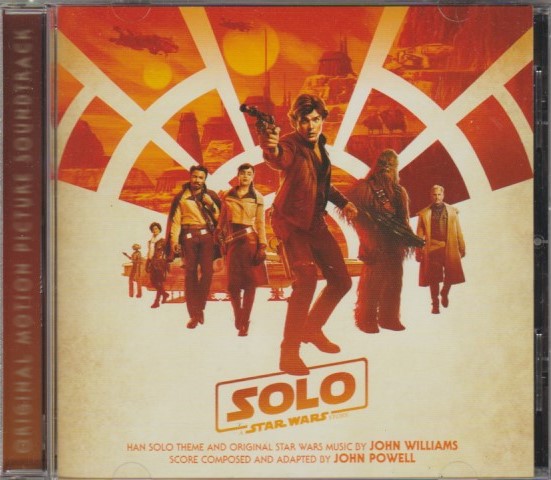
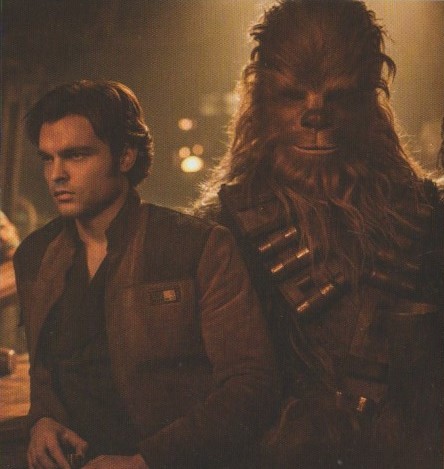
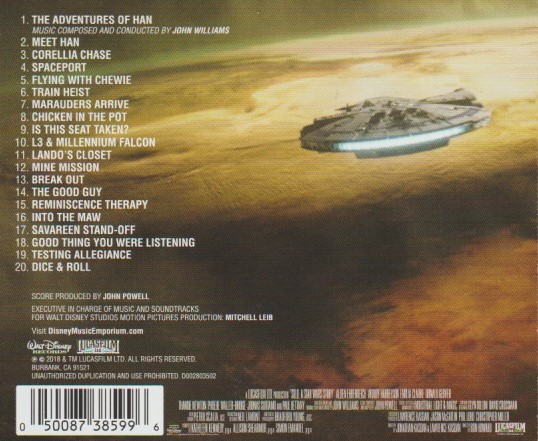
SOLO: A Star Wars Story original motion picture soundtrack (2018 Lucasfilm/Disney)
The second Star Wars spinoff movie, based on that ol’ scoundrel Han Solo, is also the second Star Wars movie with a soundtrack by someone other than John Williams. He still helms the main “Saga” films, but this time out John Powell had the difficult task of writing new Star Wars music. Powell’s career has mostly centred on kids’ movies like Antz and Shrek. He had an Oscar nomination for How to Train Your Dragon. He’s also known for action scores, like the Bourne movies and and X-Men: The Last Stand. Though Solo has plenty of action, Powell doesn’t go for tired action cliches in his score. And of course, there are plenty of callbacks and reprises of old Williams themes that you’ll never forget.
The opening cue “The Adventures of Han” begins sounding like an old film reel, before settling into something Marvel-like and heroic. This track was actually composed and conducted by Williams himself, providing the essence of a new theme for Han.
Solo is a different kind of Star Wars movie, even from Rogue One (conducted by Michael Giacchino). Likewise, its score is different too though still living in the same universe. Modern percussion and instrumentation can be found alongside the traditional. Han comes from a dark corner of the galaxy, and the score is fraught with tension over oceans of calm (“Flying with Chewbacca”). The characters of Han Solo and Lando Calrissian are loaded with panache, and so are parts of the score. Some of the best tracks are the dark “Spaceport”, which is contrasted by the rhythmic action of “Train Heist”.
“Marauders Arrive” features a children’s choir and a clue. At this point in the film, the masked pirate Enfys Nest enter the scene to pilfer the score that Solo’s crew was in the process of stealing. Later on, [SPOILER] we discover that Enfys Nest is actually a young girl. A Rebel, in fact. Some of her crew were first seen with Saw Gerrera’s rebels in Rogue One. The quite awesome sound of the children’s choir in this scene is a clue to Enfys’ true nature — a child herself. [END SPOILER]
Much of this score just sounds like a heist film. “Is This Seat Taken?” has that kind of quiet tension (with some peaks of themes in the background). It’s all very appropriate for sneaking around and trying to steal stuff like a scoundrel. There there are some more familiar sounds, like when the Falcon shows up. When it does, expect more hi-jinks, excitement and drama from this soundtrack. It rarely gets dull, but strap yourself in for “Reminiscence Therapy”. It’s a virtual greatest hits of themes, including the ones from Solo.
To be charitable, two tracks don’t work as well as others. Star Wars movies tend to have a lounge or bar scene with a band. “Chicken in the Pot” has annoyingly modern R&B beats, just not right for Star Wars, weird languages aside. “Dice & Roll” is also a bit too close to home for a galaxy far, far away.
Solo turns out to be one of the pleasant surprises of 2018. It’s a soundtrack far better than expected.
Please welcome guest writer Robert Daniels, from radio’s Visions In Sound
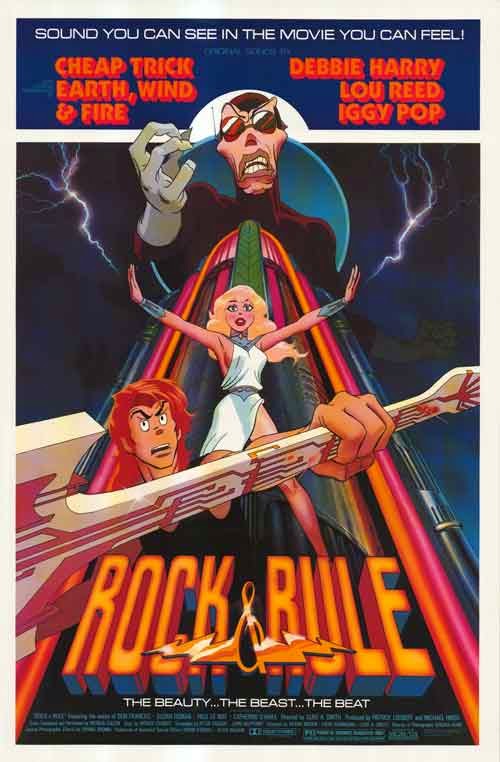
ROCK AND RULE (1983 Nelvana)
“Oh what will the signal be for your eyes to see me…”
Back in about 1984 or 85 I remember watching TV one afternoon and stumbling on an animated movie. Interested, I stopped to watch. It had weird, trippy images and some scantily clad cartoon woman singing and a strange creature growling. My 14 year old mind was intrigued and then was completely blown when one of the animated characters said “Shit!” Cartoon characters were not supposed to swear!! Clearly this was a mistake. No, it was not a mistake, it was Rock and Rule. Although at the time I didn’t know the title and didn’t see the movie on TV again for a while. Rock and Rule was set in a post apocalyptic future where the street animals evolved into a human like society. MOK is an aging rock star trying to find a specific voice in the guise of a worldwide talent search. MOK hopes to unleash a powerful demon from another dimension, his dwindling popularity driving him to destroy the world in vengeance and immortalize himself in the process. After returning to Ohmtown he finds the voice he’s looking for in Angel, a singer in a local band along with friends Omar, Dizzy and Stretch. MOK invites her to join him and when she refuses he kidnaps Angel and forces her to sing to raise the demon.
This was the era of the edgy “adult” cartoon, Heavy Metal, American Pop, Wizards, Starchaser: The Legend Of Orin and others. I do remember getting into an argument with my Mom back in 1981 about not being able to see Heavy Metal. “It’s a Cartoon…it HAS to be for kids!!!”.
It would be several years later when I was in high school that I described the ending scene to someone and they said “Oh yeah, that’s Rock and Rule…” Bingo, I had a title and looked high and low for a copy on VHS. Nothing. I was obsessed to find Rock and Rule. Of course, in the late 80s early 90s there was no internet so the only thing I could do was continue to bug the people at Steve’s TV to try and find a copy. Again, nothing. Then one day out of the blue I got a call from Steve’s. They said they found a copy and would order it for me. “Great” I said, “How much.” “$129.99”. My heart sank, that was far too expensive for my blood. So the film continued to sit in the back of my mind for years.
“My Name Is MOK, thanks a lot”
Then one day in (about) 2003, I heard of a showing at the former Hyland theatre. A local Anime expert and film buff rented the then-empty theatre to show the a cut of the film.
Also Don Francks, the voice of MOK, was going to be there. I jumped at the opportunity.
The film was nothing like I thought it was going to be. First, it was produced by Nelvana Studios that I only knew for Care Bears, Strawberry Shortcake, Droids and Ewoks, etc. All kids’ cartoons. It was also one of the first films I ever saw that listed “Songs by…” first above the main cast. This list included Cheap Trick, Debbie Harry, Lou Reed and Iggy Pop, with a special performance by Earth, Wind and Fire. After the movie there was a Q & A with Don Francks, who I later found out provided the voices for such characters as Dr. Claw from Inspector Gadget, Lackki from Captain Power and the un-credited voice of Boba Fett from the Star Wars: Holiday Special. I asked him if he based his performance of MOK on David Bowie. He said that he didn’t have any particular person in mind when he voiced MOK. I later found out that MOK’s full name was MOK SWAGGER a spin on Mick Jagger. However, the talent representation of The Rolling Stones’ lead singer objected and forced the producers to drop the character’s surname. It’s also interesting to note that David Bowie, Tim Curry, Michael Jackson, Mick Jagger and Sting were all considered for MOK but the budget of the film couldn’t afford them.
“I dunno about this, nobody seems to be buying these ‘I survived the MOK concert’ T-shirts.”
This year (2018) is the 35th anniversary of this masterpiece of Canadian animation. Rock and Rule is the first English speaking Canadian animated feature film entirely produced in Canada itself. Unfortunately the film sat in near obscurity for years after being shelved by distributor MGM and never got released in North America. The film did develop a cult following after being shown on CBC (who held the Canadian TV Rights), HBO and Showtime. Bootleg copies would show up at comic book conventions oddly enough with Ralph Bakshi being credited as director.
“She can sing, or she can scream!!!”
Much like Heavy Metal from 1981 music was a huge part of the film and also much like Heavy Metal the music got tied up in rights issues.
Back in about 2005 just before the release of the Rock and Rule DVD, I was actually in contact with someone from Nelvana Studios who told me that director Clive A. Smith, whose wife Patricia Cullen had also written the score, had the tape masters for the soundtrack in his garage and that he might be willing to let me have them for mastering. Unfortunately nothing came of this as I lost contact but it was the closest I came to producing a soundtrack release. In 2010 the film was released on Blu-ray and unfortunately has become quite expensive on the used market.
It was previously believed that no official soundtrack album had ever been issued for Rock and Rule. In fact, Deborah Harry mentions on a “Making Of…” documentary that she hopes the music gets a soundtrack release. However, as it turns out, a handful of film critics received a cassette tape featuring nine songs (“Hot Dogs and Sushi” and “Send Love Through” were omitted). All songs are extended from how they appear in the film and in familiar copies. “Born to Raise Hell,” “I’m the Man,” “Dance Dance Dance,” and “Ohm Sweet Ohm” have been officially issued on CD, along with an alternate version of “Pain and Suffering,” and “Maybe For Sure” (an alternate version of “Angel’s Song”).
Though a deliberate Google search will turn up a couple of versions of the soundtrack, this is the most common track list:
[2:46] 01. Born To Raise Hell (Cheap Trick – Album Version)
[5:14] 02 Angel’s Song (Deborah Harry)
[4:22] 03 My Name Is Mok (Lou Reed)
[2:11] 04. I’m The Man (Cheap Trick – Album Version)
[3:12] 05. Earth Wind And Fire – Dance Dance Dance
[2:49] 06. Ohm Sweet Ohm (Cheap Trick – Album Version)
[3:15] 07. Triumph (Lou Reed)
[1:28] 08. Hot Dogs & Sushi (Melleny Brown)
[3:28] 09. Invocation Song (Deborah Harry)
[3:41] 10. Pain & Suffering (Iggy Pop)
[5:56] 11. Send Love Through (Deborah Harry and Robin Zander)
[4:30] 12. Maybe For Sure (Deborah Harry)
[5:22] 13. Angel’s Song (Cassette Mix)
[3:29] 14. Invocation Song (Mono Cassette Mix)
[4:35] 15. My Name is Mok (Cassette Mix)
[3:42] 16. Pain And Suffering (Iggy Pop)
[0:52] 17. Triumph (Movie Mix)
[2:35] 18. Angel’s Song (Movie Mix)
[1:38] 19. Invocation Song (Movie Mix)
[1:49] 20. Pain & Suffering (Movie Mix)
[2:06] 21. My Name is Mok (Movie Mix)
[3:36] 22. Triumph (Mono Cassette Mix)
Rock and Rule falls into the category of “…what could have been”. Had MGM had more faith in the project and released it in North America it may have been a hit rather than the cult classic it would eventually become. If you haven’t seen it or are interested in a look at a piece of Canadian animation history check it out, you will not be disappointed.
A solid 4/5 stars. Dark, and yet at the same time fun.














 mikeladano.com