After Aldo’s career had been declared clinically dead and Aldo himself a “one hit wonder” (“Fantasy”), it took the mighty Jon Bon Jovi to resurrect him. JBJ, who co-produces and co-writes pretty much every song here, has a heavy stamp on this album. Considering that Aldo played on several Jon Bon Jovi releases, this album will appeal mostly to fans of the Well-Coifed One.
The problem with Blood On The Bricks is not lack of decent material, or lack of chops. Indeed, Aldo proves on several tracks that he is a burnin’ axeman, and he even takes a brief keyboard solo on “Bright Lights”. The problem here is that this album is choked to death in overproduction, and I have to blame JBJ for that. Every song collapses under its own weight of gang “whoa whoa” backing vocals, shrill instruments, and thudding shapeless drums with all the characteristic telltale signs of samples.
A song like “Medicine Man”, for example, is a decent if generic song on its own. However it stumbles under the weight of layers of backing vocals and overdubs. The production has spoiled this batch of pleasant if ordinary rock toons. This type of production value was way too common in 1991. Play Prisoners in Paradise by Europe, or Hey Stoopid by Alice Cooper for an idea of this sonic quality. Aldo’s album is recorded and mixed even worse than the afforementioned. And the lyrics are pretty juvenile. “His boom-box blastin’ some Metallica track”? Did Aldo really sing that?
Song highlights for me incluced the burning title track, “Bright Lights”, and nostalgic moments like “Touch Of Madness”, “Young Love” or “Medicine Man”. However aside from the guitar playing everything here is terribly generic; there’s nothing here that you haven’t heard before. For example, “Veronica’s Song” boils down to a rewrite of Bon Jovi’s “Silent Night”, and that makes me sad.
Two more Bon Jovi connections to mention: the great Kenny Aranoff, whom Jon likes to use on his solo projects such as Blaze of Glory, plays drums. Phil X is pictured in the CD booklet as he was in Aldo’s touring band, but he does not play on Blood on the Bricks. Phil X, known to his friends as Phil Xenedis, is currently on the road with Bon Jovi, filling in for Richie Sambora.
I do like the original cover, it was cool if a bit bland. This edition has an annoying “FEATURING JON BON JOVI” scrawled all over it, as large as the album title. That also makes me sad.
ALCATRAZZ – Disturbing the Peace (1985 EMI, 2001 Light Without Heat)
Released as part of Steve Vai’s The Secret Jewel Box
This is the only Alcatrazz album I own. The reason I own it is Steve Vai. I’m a Steve Vai fan before I’m a Graham Bonnet or Yngwie Malmsteen fan. Plus, this album was reissued exclusively in Steve’s stunning looking Secret Jewel Box (2001) as CD 2. The collector in me wanted that box set and I was glad Steve was so thorough as to include collaborative efforts like this one in his box set. According to Steve’s 2001 liner notes, Alcatrazz was one of his favourite band experiences and I think you can hear that.
Disturbing the Peace, Alaztrazz’s second LP, is very idea-heavy. It’s dense musically and conceptually while still being straight-ahead rock music. It’s the same trick Steve pulled on David Lee Roth’s universally acclaimed Eat ‘Em and Smile record. Vai is credited as a co-writer on every track, except the instrumental “Lighter Shade of Green” on which he has sole credit. Clearly, his input on the album is tremendous as it is literally covered with his fingerprints. His style is all but fully formed (he had already recorded and released his experimental first solo album, Flex-able). His guitar sound was certainly well on its way, and the way it shimmers with multiple layers is omnipresent on Disturbing the Peace. Hell, Vai even recycles melodies from Flex-able, which he would recycle yet again on Passion & Warfare!
(Note: I’m referring to the melody from Steve’s “Answers” from Passion and Warfare, which is also in “Wire and Wood” on Disturbing the Peace and “Little Green Men” on Flex-able. While this is strictly conjecture, I assume this melody to be among the many that Steve “heard” in his lucid dreams that inspired the Passion and Warfare album. Another such melody is “Liberty”, which was based on recollections of a lucid dream.)
There are some really great songs on Disturbing the Peace. “God Blessed Video” (which had its own great video that featured Steve extensively) is a great example of the kind of powerful, melodic hard rock Graham Bonnet can produce. It superficially resembles Rainbow’s “Death Valley Driver” (surely a coincidence) and has the same relentless drum stomp and chugging riff. This is all left in the dust by Steve who anticipates his role as the “Devil’s Guitarist” from the movie Crossroads by stewing up an unconventionally wicked guitar solo.
The more straightforward metal of “Mercy” is credited to the whole band, also including Gary Shea (bass), Jan Uvena (drums) and Jimmy Waldo (keyboards). That’s probably why it’s much more standard in construction. Bonnet’s pipes get quite a workout, and Steve’s solo is jaw dropping. The solo section here absolutely sounds like a prototype for Passion and Warfare. “Will You Be Home Tonight” is steamy, a bit more laid back and heavy with atmosphere. None of this prevents Bonnet from wailing, nor Vai for throwing down some space-age bluesy licks. This kind of thing would come in handy for Whitesnake, later on.
The aforementioned “Wire and Wood” is actually the most Rainbow-like of the songs. At times it almost sounds like a leftover from Down to Earth, but then Vai reminds us that this it was now 1985 and there’s a new kid on the block. Side one closed with “Desert Diamond”, Steve Vai on Choral sitar this time. This time I’m reminded of a similar gimmick on “My Little Man”, which Steve co-wrote for Ozzy’s Ozzmosis album.
“Stripper” is pretty far from lyrically sophisticated. While “A dark and crowded room / Warm beer that’s stale” does set the scene, it’s not really a story that needed telling, I suppose. Similarly, “Painted Lover” could not misconstrued as poetry. “She just wants that hard stash, hot from your pocket.” I’m sure, Graham.
It’s kind of weird hearing trashy lyrics like this sung over Steve’s schooled and intricate melodies and tricks. It’s like the smartest kid in class helping out a less talented classmate or something. Nothing against Graham of course, he’s had more hits than I have, so what do I know?
“Skyfire”
Steve’s “Lighter Shade of Green” solo is a brief intro to “Sons and Lovers”, one of the most accessible hard rock songs. It has a grand chorus, courtesy of Graham, the kind of thing he’s very good at. “Skyfire” (surely named after the 1985 Transformers character, right?) is a very 1980’s sounding groove. I like the fast chuggy parts, the strong melodies, and Steve’s guitar bits. I also like that I’m going to start a rumor that it’s named after the Transformers character. (It’s actually about a UFO that Graham sighted.)
The only song I kinda don’t like is the last one, “Breaking the Heart of the City”. It’s here that I feel the Vai/Bonnet experiment fails somewhat. It sounds like it wants to be dark, heavy, and ominous, but Steve is whimsical at times, space-y and too smart. Meanwhile I’m feeling that the song needs something gritty, some more chug, a little bit of grind, you know?
After revisiting Disturbing the Peace, I now feel an urge to get No Parole From Rock ‘n’ Roll and compare. Steve Vai and Yngwie Malmsteen are polar opposites stylistically and it’ll be interesting to hear Yngwie’s version of Alcatrazz.
4/5 stars
Interestingly, Disturbing the Peace was produced by Eddie Kramer!
It was with great excitement and anticipation that I hit ‘play’ on my brand new mp3 copy of “The Horn”, a new single from The Darkness. Like much of the preceding album Hot Cakes, this is a dirty little number about (surprise) sex!
I would like to take this opportunity, to mention the fact that while some of the acts that I may have described in this song appear to be degrading, they were in fact consensual. — Justin Hawkins
I won’t share the details, except to say that the words “my pale buttocks” are uttered.
Musically, “The Horn” is heavy as…well, not quite as heavy as lead. Platinum perhaps? It has a merciless guitar riff, bloodthirsty drums, and a hefty groove. Sonically speaking, “The Horn” strikes me as one of the heaviest Darkness songs. The guitars have some chunkiness to them, and the direction seems simple enough: let’s rock out! With Justin’s particular brand of lead vocal, there’s no mistaking this band for anyone else.
I would like to take this opportunity to mention that fact that Justin is still singing as great as ever. He has a knack for some utterly odd vocals, but at the same time, he makes them awesome. Acrobatic, never too serious, but always fascinating to listen to. By the end of this song, I’m picturing a coop full of chickens singing in harmony.
This bodes well for a new Darkness album. Not only are they quickly out of the gates with new material, but it’s really good material. Without a doubt, I like “The Horn” better than many of the songs on Hot Cakes. And I liked Hot Cakes a lot.
5/5 stars
There was a vinyl 7″ single, but only 500 copies. There’s also a new Darkness demo out there, a ballad called “Second Fiddle” . This song boasts multiple vocalists and an uber-catchy chorus: “We are the Hawkins Brothers / And I am Frankie Poullaine / We are the Hawkins Brothers / And this is Eddie Graham.” Solid!
DAVID LEE ROTH – Greatest Hits/The Deluxe Edition (2013 Warner CD/DVD)
Dear LeBrain readers,
I’ve been here writing reviews for the better part of 21 months now. I think we know each other well enough, you and I, that I can skip the formalities in some instances. I don’t think I need to describe in detail classic David Lee Roth recordings such as “California Girls”, “Just a Gigolo”, or “Just Like Paradise”. I’m willing to bet that with exception to the 1990’s material, most readers already know most of the songs on this album. If you happened to stumble upon later albums like A Little Ain’t Enough or Your Filthy Little Mouth, then you probably know them all.
If you’re familiar with David Lee Roth but don’t own any as of yet, then your next question is likely to be, “Is this a good place to start?” Sure, why not? Dave’s latest “hits” compilation, simply called Greatest Hits (his last one was called The Best), does the trick in most regards. It even includes Dave’s entire first solo EP Crazy From the Heat albeit not in the original running order. (1. “Easy Street” 2. “Just A Gigolo” 3. “California Girls” 4. “Coconut Groove” in case you feel like re-arranging the tracks as originally released.) “Easy Street” is an Edgar Winter Group original, and Dave has Edgar guest on his version too.
Some of the best songs are distilled from Eat ‘Em and Smile, but that’s a 5/5 star album that needs to be owned on its own regardless. From Skyscraper is “Just Like Paradise” and “Hot Dog and a Shake”, but not the single “Stand Up” interestingly enough. Present are the three singles from A Little Ain’t Enough: the bluesy “Tell the Truth,” the title track and the swanky “Sensible Shoes”. Three tracks are included from Your Filthy Little Mouth, only one of which is a head-scratcher (the reggae infused “No Big ‘Ting”) but by-and-large this an acceptable slice of Warner Brothers era David Lee Roth.
What you readers are likely to be most interested in is the bonus DVD. This “Deluxe Edition” (there’s no other edition available) includes most of Dave’s groundbreaking, genre-hopping classic music videos. The “Dave TV” segment has uncut videos for “California Girls” and “Gigolo” interspersed with Dave’s commentary. Continuing the fun are Dave’s first two “band” videos, “Yankee Rose” and “Goin’ Crazy!” along with Dave’s cast of characters. These of course includes the fabulous Picasso Brothers!
As an added bonus they also included the Spanish version of “Goin’ Crazy!” (“¡Loco Del Calor!”) which appears to be an entirely unique cut, based on the same video shoot. There are fewer costume changes and stunts, but it’s cool that Dave’s attention to detail included lip-synching an entirely separate video for another territory.
The odds and ends on this disc are pretty scarce, such as the videos for “Sensible Shoes”, “The Nightlife”, and “Tell the Truth”. None of these videos are nearly as entertaining as the colourful classics. Let’s face it, Dave’s great in front of a camera, but he’s at his best when it’s one hell of a party happening behind him.
In Canada, this is an import and I paid about $26. In the US it’s under $19 which is a much more reasonable price. For fans who don’t own anything, get this, it just makes sense to. For fans who already have all the albums, you are now forewarned that you’re buying this solely for the DVD. There’s nothing much else special in terms of packaging, although lyrics are included.
When this album came out I bought it immediately. Well, as soon as it was made available by Columbia House music club, that is. I remember that I described it to a work friend named Mark as “raw bluesy shit”, and I still stand by that three word description. With an emphasis on raw. For 1989, this kind of production was unheard of. You can hear everything on this album, you can hear Jake’s fingers talking. Very little embellishment going on here.
Badlands were almost a supergroup of sorts: Ray Gillen (ex-Black Sabbath), Jake E. Lee (ex Ozzy Osbourne), Eric Singer (also ex-Black Sabbath, now in Kiss) and Greg Chaisson (ex-nobody significant). Jake had always complained he didn’t have an outlet to play the blues in Ozzy’s band, so this is his version of the blues, and it’s hard as hell! The band also had a vision of an album with two sides: a first harder rocking side, and a second bluesier side with longer songs.
“High Wire” kicks Badlands off with Jake’s raw, stripped back guitar sound. Producer Paul O’Neill (Savatage, Trans-Siberian Orchestra) was also managing Badlands, and his production work here is completely different from the layers that he is better known for. The effects are stipped back, and Jake’s guitar is very different from The Ultimate Sin. A groovy exciting track, “High Wire” is driven by the riff and Gillen’s authoritative Coverdale-esque lead vocals.
The single “Dreams In The Dark” is next, the closest thing to a commercial song that this album gets. It has a strong chorus, instantly memorable, but you’ll be forgiven for thinking this is a Whitesnake outtake at first. A brief instrumental precedes my favourite song, “Winter’s Call”. It is as close is you’ll get to a ballad on this album, and only because its intro is slow and acoustic. However once that first riff kicks in, there’s no looking back. Eric Singer’s drum patterns are complex and hard hitting. The song itself is atmospheric and still kicks my ass all these years later. It’s infectious, like an old Zeppelin number. I hear sitar!
A pair of rockers finish side one, “Dancing On The Edge” (an accelerated raw rocker with a great chorus) and “Streets Cry Freedom” a steamy, slower tune like a classic Coverdale prowl. Both songs are standouts.
Side two starts with a serious rocker, “Hard Driver”, but from there it is on to the long, slower bluesy numbers that the band talked about. “Rumblin’ Train” is the bluesiest number, and “Devil’s Stomp” is as heavy as the title implies. “Seasons” is a slow moody one, brilliantly dramatic thanks to Gillen’s emotive vocal. The cassette/CD bonus track was called “Ball & Chain” and it finishes the album on a another hard bluesy note. (Yes, back then when they couldn’t fit all the songs on an LP, they’d still include it on the cassette version and call it a “bonus track”.)
Badlands made a couple more albums, but this one is my favourite. Martin Popoff himself rates this one a 10/10. I gotta agree with the man on this one. On a 5 scale…
Here’s a leftover fromTHE WEEK OF SINGLES!Each day from November 18-22 we looked at recent single acquisitions. This review didn’t make the series as intended, but it’s still pretty rare with cool exclusives!
TESLA – “Edison’s Medicine” (1991 Geffen CD single)
It wasn’t that long ago that we had a look at Tesla’s damn good Psychotic Supper CD. We also reviewed the CD single for “Call It What You Want” and its non-album B-sides. I recently acquired the first single from Psychotic Supper, “Edison’s Medicine”. This one has two album tracks and two non-album covers. What makes this single a little more special than “Call It What You Want” is that these two B-sides have never been re-released on anything else, to my knowledge.
The A-side itself is one of the best tunes Tesla’s recorded to date. In my own review for the album, I stated that Tesla were “taking their love of Nikola Tesla to the Nth degree…What an incredible song. I still remember seeing the music video, and being blown away by the solos. Not only are there guitar solos, but Frank Hannon torments the theremin, before he slips on a bass and plays a bass solo too!”
“Had Enough”, the other album track on this single is equally heavy to “Edison’s Medicine”. It’s not as riveting melodically, but it burns rubber pretty hot. I’m quite fond of the song myself, even though in the grand scheme of things it wouldn’t make my own Tesla road CD. It’s just bubbling under, but it does cook!
Covers are always a tricky thing. You have to pick the right song, and you have to pull it off. Tesla chose the Montrose classic “Rock the Nation”. They definitely picked an appropriate song, as it fits in with the overall Tesla sound. They did a solid, workmanlike version of “Rock the Nation”, but it lacks the piercing, instantaneous charisma of the original. The drums are a tad too thuddy for my tastes, and as good a singer as Jeff Keith is, Sammy Hagar owns this one. Still, there’s nothing really wrong with it, it’s just not as special as it could have been. It sounds like it was knocked off as a quick B-side to record, and I’m sure that was the case.
I won’t act all cool as if I knew who Jo Jo Gunne are. I have never heard of Jo Jo Gunne. Apparently they were ex-members of Spirit, which also spawned Randy California. “Run Run Run” was a hit for them in 1972. I gave the original song a listen, and I can say that Tesla’s version is pretty authentic if a little bit harder. Who doesn’t love some great “Oooh, oooh, oooh” vocals? I sure do. That, and the catchy dual guitar melody (straight out of the Lizzy cookbook) make this one a keeper.
I paid £2.00 for this on Discogs. I consider that a good buy.
NINE INCH NAILS – broken (1992 Interscope EP) / halo five
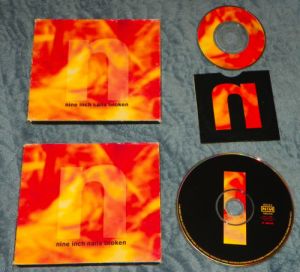
I remember seeing this in my local HMV store in 1992. I thought, “Nine Inch Nails have cool packaging,” because you didn’t see too many digipacks back then. It’s cooler than just that though, with three panels unfolding in a “T” shape each with a letter on it. “n”…”i”…”n”…
Gotta give Trent Reznor credit for packaging, he usually has very striking and original concepts for his discs. Also cool how the packaging for broken nicely complements the remix album fixed once both are bought. broken technically qualifies as an EP I guess, or a mini-album maybe, even though it is longer than most classic Van Halen albums.
There is a version of broken out there that was once considered one of the Holy Grails of Nine Inch Nails collectibles. I guess the advent of eBay made it much easier to get, because eBay has one as of this writing for $12, free shipping, VG condition. It is a 2 CD version, with the two “hidden” tracks on a separate 3″ CD enclosed within the digipack. This was supposedly discontinued because unscrupulous store owners were taking out the bonus CD and selling it separately. Or so goes the legend. I think cost would also have been a factor in discontinuing the bonus CD. On re-releases like I own, the bonus tracks are included as #98 and #99, with 91 tracks of 1 second silences preceding them.
“Pinion” serves as a brief intro to “Wish” and they are always presented together. This serves to intensify the mighty “Wish”, the heaviest song released by Nine Inch Nails up to the time. What sounds like a blowtorch punctuates a frantic drum rhythm. This progresses into a mélange of bizarre sounds, shredding guitars and a sledgehammer riff. “Last” follows, a slower more relentless riff. At times its the industrial version of “Sad But True”, but with a synthpop style chorus. Reznor maintains his angry snarl throughout, bitching about whatever he’s bitching about. “Pigs” are referenced, he sounds upset, angry, sad…aww!
“Help Me I Am In Hell” is one of the coolest tracks, a quiet two-minute guitar n’ noise respite. It sounds a lot like some of the quieter moments that would later come on The Downward Spiral (a genius album if there ever was one). Then, “Happiness in Slavery” serves as a barrage to the noggin’, Trent yelling stuff about slaves screaming in a distorted voice. There are some cool, ascending metal-y guitar licks and another synthpop chorus. If I had to guess, I’d say the lyrics are a thinly veiled discourse on getting screwed by your record label, as Trent was at the time.
The final song of this batch of tracks is “Gave Up”, another fast metallic song. It’s hard to discern the melodies from it, such is the distortion of the track. It does have a bad-ass keyboard solo though. Trent sounds like he’s singing on a broken tape deck and the guitars sound like they’re on the same cassette too. It’s my least favourite song on the EP, although I remember it had a cool “live” style music video with Marilyn Manson on guitar.
After 91 tracks of silence (a quaint-oh-so 90’s gimmick that I sidestepped by not ripping them) are the bonus cover songs. “Physical (You’re So)” is an Adam and the Ants tune, morphed into something that sounds like a cross between Nine Inch Nails and Motley Crue. This is a great track. Among the best on the album. There are jackhammer sounds, plenty of distortion and unidentifiable but cool sounds. “Suck” is a Pigface cover (from Gub) that Trent originally sang and co-wrote anyway. It has a powerful chorus and riff much like the rest of broken, but the verses (pun intended) kind of suck. That funky bassline…it’s not my thing, I guess.
One weird thing. I don’t know where it came from, but I somehow got a booklet for a Japanese version of broken. I found it inside my copy…I must have found it laying around at the store. Kinda neat to have, I can’t read a word of it, but cool. My CD appears to just be the regular single disc US release otherwise.
The month of Movember is upon us again, men allowing fur to gather on their upper lips. Some say it is to raise money for testicular cancer research. Some say it is a rite of passage. One way or another, Movember is now intertwined with rock and roll. Long gone faces such as Frank Zappa, John Bonham, and Phil Lynott are remembered fondly. The Guys want us all to remember together.
It’s not the first time. A couple years ago, The Guys brought out the excellent “Man With A Moustache”. It’s a catchy 80’s sounding synthpop-rock tune. It’s hard not to smile at its catchy chorus and wired guitars. It’s irresistible actually. Having sampled their tunage extensively on their website, I can’t say it’s indicative of their sound in general, which varies wildly all over the 1980’s. But you have to be the judge yourself of this talented creative force.
But ya know…The Guys have something new out this Movember. This kind of thing is categorized as a “parody”; I don’t consider it a parody. I consider it a tribute. I consider it a testament to Phil Lynott and moustaches everywhere from coast to coast of this glorious nation and beyond. That song is “The Stache Is Back In Town”. I hope I don’t need to explain this to you, but it’s a cover of “The Boys Are Back In Town” off Jailbreak, by Thin Lizzy.
You can hear it for yourselves, but I think The Guys did a damn fine job of this song. They even call out one of the greatest ‘staches of all television history: Thomas Magnum. That’s right. Thomas Magnus aka Magnum P.I. aka Tom Selleck! Lead vocalist Thomas Love (known to his friends as Marko Fox) explained it to me: “Grooming is essential for success…as a moustache can make anything better. It is not a coincidence that both Thomas Magnum and Jonathan Higgins both had killer staches.”
You can’t argue with that.
I hope “The Stache Is Back In Town” remains a Movember classic for years to come. While I did not participate in Movember this year, you can support the cause here: http://ca.movember.com/ Men’s health is an important issue, but Movember lets us take it a little more lightly. The Guys have the Movember spirit, and I applaud them.
6/5 stars
The Guys: THOMAS LOVE – Vocals, Drums, Percussion & Keys JOHNNY KIKX – Vocals, Guitars & Keys BARRY FUSE – Guitars, Bass, Keys & Vocals RICK DANIELS – Bass, Keys & Vocals
Guess What Just Grew Back Again A Hairy Lip That’s Made To Win Went From Being A 2 To A 10 Just Because It’s Movember
Thomas Magnum Posters On Every Girl’s Wall All You Babyfaced Boys Get Ready To Fall I Hear The Rock That Is Our Party Call So Let The Mo’ Ruckus Begin
THE STACHE IS BACK IN TOWN
Spread The Aftershave Around Turn Up That Hairy Sound
No Shaving Cream To Be Found…
You Know That Chick That Turned You Down A Lot? Every Night She Be Laughing, Blowing You Off But Now Man She Be Staring, She Be Red Hot The Hairy Lip’s Got Her Steaming
The Radio’s Playing Our Favourite Song Called “Man With A Moustache” And It Won’t Be Long Till All The Ladies Will Want Me To Take Them Home They Want To Watch Me Shave It In
I was watching the Pepsi Power Hour one afternoon in the 10th grade when they debuted the first video from Quebec metallers Sword — a song called “F.T.W.” My best friend Bob and I were both watching that day, and we got into the song big time. I was recording and we went back and played the video two or three more times. Later on, lead throat Rick Hughes was in the MuchMusic studio live, and explained that some people thought that “F.T.W.” stood for something else; the chorus of of the song goes “Follow the Wheels”. The song is about bikers, but some assumed the song “F.T.W.” stood for “Fuck the World”. I discovered this first hand when I scrawled the Sword logo on my Math notebook, along with the initials F.T.W. The kid behind me didn’t believe me when I told him I meant it as “Follow the Wheels”.
We were blown away by “F.T.W.”, a galloping metal song with gritty vocals. Bob and I agreed that Rick Hughes had the power and grit of a guy like Dee Snider, but the music was borderline thrash metal. A couple years later, when I signed up for Columbia House music club, I ordered the album Metalized on cassette. It was every bit as heavy as “F.T.W.” and then some. It seemed to lie somewhere between W.A.S.P. or Anvil and Megadeth. It was on the heavier side of music that appealed to me but I gave the album a shot. (That is, until the cassette got eaten. Capitol Records were issuing some of the worst quality cassette tapes in Canada in the 1980’s and Metalized was one more victim.)
The second single was a track called “Stoned Again”. Hughes clarified on Much that the lyrics are not meant to promote drug use, which I was relieved to learn. Either way it takes the tempo back from breakneck for a bit, instead throwing in a heavy groove. “Stoned Again” was every bit as great as “F.T.W.,” and perhaps a bit forward thinking. A few years later, Pantera would be eating up and chewing out songs like “Stoned Again” at a furious pace.
The rest of the album stands up. It’s a bit singular in direction, the songs suffering from a certain sameness. The production is echo-y and typical of many albums of this period. The rest of the music is virtually all up-tempo, with vicious vocals and biting riffs. Each song is executed expertly, the guys were not slouches on their instruments, and Hughes could let loose some chandelier-shattering screams. On “Outta Control” he’s Ian Gillan during the Sabbath phase! Another highlight is “Runaway” which features a cool Maiden-esque intro riff and a decent chorus.
“Pee away, buddy!” – Dave Mustaine
Metalized is an enjoyable but non-essential romp through the tundra of heavy Canadian metal. Our winters may be cold but this Sword was clearly forged in fire.
TESTAMENT – Signs of Chaos: The Best of Testament (1997 Mayhem)
I bought this in the winter of 1997. I hadn’t listened to Testament in a few years. I’d bought The Ritual album in 1992, but they kind of lost me post-Skolnick, when they went hell-bent for death metal. Therefore the idea of a good, remastered single disc compilation album covering the entire career was appealing to me. All the key tracks that I wanted were here, including two incredible B-sides!
Shortly after The Ritual came out, singer Chuck Billy denounced it as too soft, too commercial, and not the direction he and Eric Peterson wanted to take the band in the future. Regardless of this, the single “Electric Crown” was chosen to kick off Signs of Chaos (including the brief instrumental intro, “Signs of Chaos”. I’ve always felt it was superior to a couple of its chief rival songs at the time: “Enter Sandman” and “Symphony of Destruction”. You be the judge. I think I have a strong case.
As I delved into the disc I found that I was very hit-and-miss with Testament’s earlier material. For example “The New Order”, the title track from their 1988 album. I find it thin production-wise, and melodically a bit awkward. It’s hard-hitting and thrashy as fuck, but strangely enough I prefer the earlier track “Alone in the Dark” from 1987’s The Legacy. Not only does it boast a stomping riff, but also a chorus that sticks to the head.
“Dog Faced Gods” introduced me to the Testament world of blast-beats and death metal growls. This was from the first post-Skolnick album, Low. Now Peterson and Billy had the chance to indulge their heaviest urges, and they did a fantastic job. Featuring the stellar drum talents of John Tempesta (currently in The Cult), this is Testament brought to a whole new level. While death metal growls are not normally my bag, Billy sings in a “normal” voice during the cool chorus. As for the rest of the song, it is a precise complex of drum fills, lightning-fast guitar licks, time changes and riffs.
If you thought “Dog Faced Gods” was heavy, then “Demonic Refusal” might very well blow you out of your seat. The followup album to Low was called Demonic and it took things further out to the boundaries. Gene Hoglan on drums this time, “Demonic Refusal” is even more evil and scary. It still boasts a head-crushing riff and has a strangely catchy quality to the vocal. Chuck Billy convinced me on these songs that he is a diverse, talented thrash metal singer among the best in the genre.
“The Ballad” from the landmark 1989 album Practice What You Preach was about as close as Testament got to a hit single. The timing was right, seeing as Metallica had success with “One” the year before. Even though it is clearly a ballad (albeit a heavy one), the song has balls and metal fans had no problem embracing it. To me it seems to be based on a prototype of some of Iron Maiden’s softer material. The album Souls of Black, which followed Practice, was considered little more than a rushed carbon copy followup. That may be the case, but either way the song “Souls of Black” is still as catchy as ever. Skolnick’s fluttery licks are a highlight, as is Chuck Billy’s groovy lead vocal.
I find it funny that “Trial By Fire” is listed as a CD-only bonus track. I guess this album must have been released on cassette too in 1997. “Trial By Fire” isn’t one of the best songs in my books, but it does contain more outstanding Skolnick guitar shreddery. A brief word about Alex Skolnick for those who don’t know: He was one of Joe Satriani’s students, and he’s also well known for playing jazz fusion on the side. In fact he left Testament initially to enable him to explore that kind of style. His tone is really warm, and you can feel the vacuum tubes humming in a vintage amp when he plays.
Another uber-heavy song, “Low” from the album of the same name, is just as good and memorable as “Dog Faced Gods”. The Low album featured one of the most respected guitarists in the death metal genre, James Murphy (Death). Murphy’s chops helped bring Testament closer to that line between thrash and death, while maintaining the virtuosity that the band had with Alex Skolnick.
“Practice What You Preach” and “Over the Wall” provide a double-punch of early Testament heavy metal. To me, “Over the Wall” is not an outstanding song. It’s good for a head-bang and has a killer solo, but it’s not particularly special. “Practice What You Preach” on the other hand nails it. Testament were crossing groove and thrash metal together successfully, before Metallica painted it Black. “Practice” remains one of their highest achievements from the early years.
I mentioned earlier that Souls of Black was considered by many to be little more than a second generation copy of Practice. This extended to putting out another ballad. “The Legacy” was one of their earlier compositions, polished up for Souls of Black. While it’s the lesser known song, I think I prefer it to “The Ballad”. The production seems a little more full, although the two songs are very similar. As far as ballads go, I don’t think either song holds a candle to the next track. “Return to Serenity” from The Ritual is a beautiful song, with gorgeous guitar tones. It’s a less dark than the other two songs, and lyrically discussing those special places that you may have had as a child, and returning to serenity. I would put “Return to Serenity” up against virtually any similar Metallica song, and I believe it would blow them away. While both bands have a lead guitar player that was taught by Joe Satriani, I believe Alex Skolnick to be on a completely different level from other guitar players in this genre.
“Perilous Nation” is a plenty-good thrash party, but again this is listed as a CD only bonus track. I just find that amusing on an album released in 1997. The CD ends with two smoking covers: “The Sails of Charon” (Scorpions) and “Draw the Line” (Aerosmith)! We all know Testament are huge Aerosmith fans, since they covered “Nobody’s Fault” earlier. Both are absolutely incredible covers and alone worth the price of the CD. “Draw the Line”, already a manic-fast song, is give a dose of Liquid Schwartz in the ol’ engine. I defy you to refrain from banging your head. What an awesome song to end the CD on, and this review on!






 mikeladano.com