Reviews

REVIEW: Tesla – Time’s Makin’ Changes – The Best of Tesla (1995)

TESLA – Time’s Makin’ Changes – The Best of Tesla (1995 Geffen)

Tommy Skeoch:  you’re out!  According to the band, Tommy had some drug issues and they drew a line.  He went “Steppin’ Over” that line and was fired for it.  Thus, the sole unreleased song on Tesla’s very first greatest hits album is an ode to their breakup:  “Steppin’ Over”.  It was recorded as a four-piece, and the last thing they did together until a 2000 reunion.

The 90s were not kind to hard rock bands, and many of them came to the end of their record deals.  Compilations and live albums rolled out to fulfil obligations.  Time’s Makin’ Changes – The Best of Tesla is a sad example of one such contractual obligation.  As if the bland cover was not warning enough, the skimpy booklet is the dead giveaway.

What it has:

Key tracks such as “Modern Day Cowboy”, “Gettin’ Better”, “Little Suzi”, “Love Songs”, “Signs”, “Edison’s Medicine”, “The Way It Is”, and “What You Give”.

What it lacks:  “Hang Tough”, “Shine Away”, “Change in the Weather”, “Call It What You Want”, “Freedom Slaves”, “EZ Come EZ Go”, “Comin’ Atcha Live”, and an unedited “Heaven’s Trail”.  The edited version included here is missing too much of the opening.

There are a couple questionable inclusions:  “Song and Emotion”, a lengthy tribute to Def Leppard’s Steve Clarke, seems more like deep-cut material.  When it comes to the last Tesla album on Geffen, 1994’s Bust A Nut, who can say which tracks the most important.  It seems like the album might have been better represented by edgier material like “Rubberband”, or “Solution”.  Might have livened things up too.

It’s also kind of deceiving that the two live tracks included are not advertised as live.  “Signs”, well, no worries, because it was only ever recorded live.  But “Paradise” is also from the Five Man Acoustical Jam album.  This is probably done so not to confuse first time Tesla buyers who didn’t realize all this time that “Signs” is a live song.

As for the new song “Steppin’ Over”, it sounds like Tesla even though they were down to one guitar player.  It doesn’t sound new or different, just a continuation of the Bust A Nut sound, including the sad wisdom.  It takes a neat Zeppelin-y turn around the 2:18 mark but otherwise it’s not what you’d call a greatest hit.

It’s a shame how the Tesla story went down, but you’d do well by at least adding the first three albums to your collection.

2.5/5 stars


REVIEW: Styx – Edge of the Century (1990)

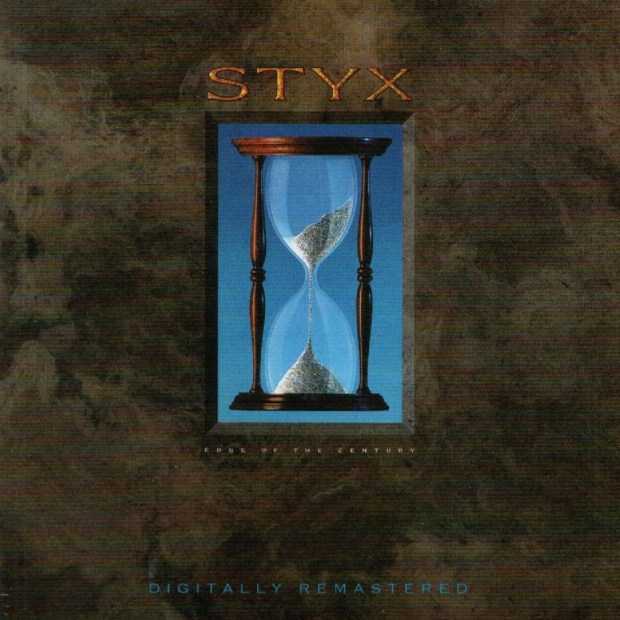
STYX – Edge of the Century (1990 A&M, 2019 BGO remaster)

Kilroy Was Here seemed to be the end of Styx.  Although the album went platinum, it was also divisive.  The band were fractured and the tour was difficult.  Members did not enjoy playing characters on stage.  Was this a rock band or was it Broadway?  Styx split up in ’84, with members embarking on new projects.  Dennis DeYoung did moderately well with his solo debut Desert Moon, and Tommy Shaw had a fairly big hit with Girls With Guns.  James “JY” Young went in another direction on his own City Slicker album with Jan Hammer.  For all intents and purposes, Styx spent the second half of the 80s completely defunct.

In 1990 two interesting things occurred.  First, Tommy Shaw formed a supergroup with Jack Blades (Night Ranger) and Ted Nugent called Damn Yankees.  They came out of the gates with a surprising self-titled hit album that didn’t particularly sound like Styx, Night Ranger or Ted Nugent.  But it spawned a couple hit singles and went double platinum.  When Styx reunited at the same time, it was without Tommy Shaw.  Styx would never record with the classic lineup again.

The Styx reunion we got in 1990 was, frankly, not the Styx reunion we deserved.  A new guitarist, songwriter and singer would be needed and he arrived in the form of solo artist Glen Burtnik.  He was only slightly younger than Shaw, but brought in a modern edge.  He was able to sing Tommy’s high parts, and could write.  The first single, “Love is the Ritual”, was written by Burtnik and partner Plinky Giglio with no other members of Styx contributing.  Clearly, they were trying to turn a page and appeal to a new younger generation, and make people forget all about “Mr. Roboto”, or that dreaded “progressive rock” tag.

The new album was titled Edge of the Century and produced by Dennis, now in control of Styx.  Even so, “Love is the Ritual” sounds like a Winger reject, with full-on Beau Hill production.  You’d never guess it was Styx, and one suspects this is why it was chosen as the lead single.  It was also the first track on the album.

Leading the new album with a song featuring a new unfamiliar singer was a risky move.  The turgid track is a clone of Winger’s “Can’t Get Enuff” and features some stinky synth bass.  The faux-funk of the rhythm track is unpalatable, and only a hint of Dennis DeYoung on backing vocals indicates that this song has anything to do with Styx.  They’re barely in their own music video.  Almost as bad are the cringey lyrics.

The song that should have opened the album, “Show Me the Way”, was a legitimate hit.  A church-like ballad with soaring chorus, it struck a chord with Americans during the first Gulf War.  It has the sound of a true Styx classic and fits well with past ballads.  Dennis is a remarkable songwriter and the chorus on this track is just legendary.

Edge of the Century tends to be remembered for “Show Me the Way”, but good Styx-like material is still buried within.  Burtnik’s back on the title track, but this infectious hard rocker does sound more like Styx.  It fits that slot like a classic Tommy Shaw rocker.  The wicked riff is as memorable as the catchy chorus.

The songs alternate from Glen to Dennis, and DeYoung’s ballad “Love At First Sight” is a traditional 80s power ballad with chiming keyboards.  It sounds exactly like every other power ballad from 1990, but at least it is a good one.  It was the third single and did OK on the charts.

One mark of a good Styx album is a decent acoustic song, and Glen Burtnik has “All In a Day’s Work” for that necessity.  It’s just acoustic guitar, vocals, some keyboards and Dennis’ accordion.  Very Styxian, especially when they sing together.

The second side opens with a traditional rock n’ roller, “Not Dead Yet”, which is a song by a chicago artist named Ralph Covert, sung by Dennis.  It’s DeYoung’s first rocker on the album, and it’s leather jacket cool.  Burtnik’s back on “World Tonite”, the cheesiest song on the album.  This generic rocker with it’s “Girls wanna dance, boys wanna fight” lyric is pretty awful.  Parts of it verge on rap.  Its only saving grace is the harmonica that periodically blasts through.  In no universe would anybody say “That sounds like Styx to me.”

Dennis is really good at ballads, and “Carrie Ann” is surprisingly strong.  Like another “Babe”, it has a strong chorus and memorable hooks.  Did “Babe” need a sequel?  It matters not; “Carrie Ann” is pretty good for what it is.  We’ve had a few ballads now, and an acoustic song, but have you noticed what is missing so far?  James “JY” Young.  He does not check in until the second-to-last tune, “Homewrecker”.  It is a Quiet Riot-like rocker (similar to “Run For Cover”), and unsurprisingly the hardest rocker on the album.  JY was overdue.  That fact that you can really only feel his presence on this one track is one of the major weaknesses to Edge of the Century.  However, they try to make up for it with with a smokin’ guitar solo, and a killer keyboard break from Dennis too.  “Homewrecker” may be derivative but JY hasn’t rocked out this hard on a Styx album since “Half-Penny, Two-Penny” back in ’81.  It’s over all too soon.

Edge of the Century is still missing one key Styx ingredient, and they save it for last:  something big and pompous and overblown.  That is “Back to Chicago”.  Air-shaking blasts of horns and clarinet accompany a huge broadway-ready chorus.  It’s hard to imagine when you start this album on “Love is the Ritual” that you will end it on something as different as “Back to Chicago”.  Styx albums albums are often diverse, with heavy riff rockers butting up against pretentious set pieces.  But they’ve always been cohesive.  By the end of Edge of the Century, any thought of cohesiveness are out the window.  Although the same five guys plays on all 10 songs, it sounds like two or three separate bands.

Edge of the Century is like a lost Styx album.  The band split after a short tour, with the album going Gold but no further.  Due to the sad passing of drummer John Panozzo, this lineup could never exist again.  Styx reunited in 1995 (with Shaw), but they stopped playing “Show Me the Way” when Dennis was let go in 1999.  “Love is the Ritual” continued to be played live when Burtnik was in the band again (on bass filling in for Chuck Panozzo) from 1999-2003.

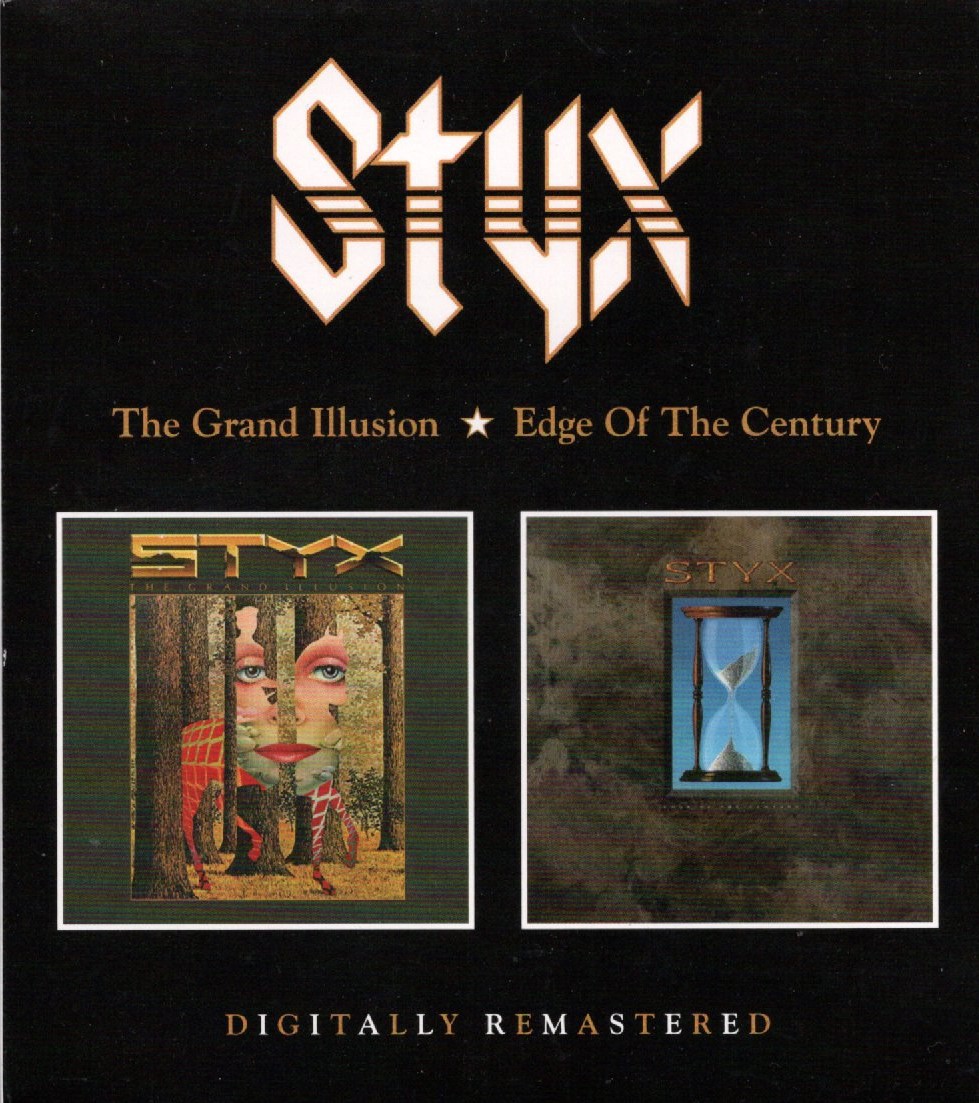
Fortunately, the album can be acquired remastered in a fine reissue on BGO Records, paired in a 2 CD set with The Grand Illusion.  The reissue includes the original lyrics and liner notes, along with an essay detailing Styx history.

3/5 stars

REVIEW: Triumph – Allied Forces (40th Anniversary Box Set)

TRIUMPH – Allied Forces 40th Anniversary Box Set (Originally 1981, 2021 Round Hill Records RSD set)

Triumph is under-celebrated.  That’s a fact.  To the unknowing, they were “the other Canadian power trio with the high voice”.  To the Allied Forces, they were Rik, Mike and Gil:  Triumph!  And really incomparable to Rush except in superficial ways.  Finally, some of their back catalogue has received the treatment it deserves and that is Allied Forces, for its 40th anniversary.  Overseen by Andy Curran,* this vinyl box set (no CD) features some exclusive music and a wealth of goodies packed within.  The usual content like booklets and reprints, but also a little surprise awaits you inside.  Released for Record Store Day back in May, limited quantities were later made available for the schmucks like us who couldn’t snag one in time.


Allied Forces itself is pressed on a picture disc.  The brilliant yellow A-side shows bullet belts and a Spitfire.  Vibrant imagery that only serves to enhance the tunes you’re about to hear.  Opening with “Fool For Your Love”, the beautiful picture disc sounds great with low surface noise.  Rik Emmett goes deep with some wicked slide guitars, on a good time rocker sung by Gil Moore.  In the luxurious liner notes, Rik explains that there are four tracks of guitar layered.  Indeed, Canada’s greatest guitarist sounds nice and thick with a delectable crunch.  With a nice tasty riff to bite down on, this opener stands as one of Triumph’s most enjoyable pure rockers.

The iconic #8 single “Magic Power” introduces Rik’s acoustic contemplative side.  Triumph succeeded in marrying all their facets on Allied Forces, and “Magic Power” is a fine example of this.  It has a quaint folksy vibe, but when the electric guitar kicks in, it becomes a pop rock classic.  With lyrics about drawing a “magic power” from music on the radio, what could be fitting?  Mike Levine’s big Hammond B3 is the ultimate accoutrement.

“Air Raid” is an interlude, a sonic experiment honed at the band’s new home studio, Metalworks.  It serves as a war-like intro to “Allied Forces”, one of Triumph’s heaviest.  A rallying cry for the live setting.  According to Uncle Rikky, it’s Triumph letting out their Deep Purple side, and you can certainly hear “Speed King” and “Highway Star” in its DNA.  Gil Moore rips it up on drums and vocals.  Triumph at their most Purple, and powerful.  But to end the side properly, they go for a good-time party rocker in “Hot Time (In This City Tonight)”.  Of course in the live setting, this enabled Triumph to honour their host city every night.  Just change the words to “Hot time in Cleveland tonight,” as we’ll see!  With a hot boogie behind him, Rik Emmett sings some ongodly high notes and wails away a fresh solo laden with wicked licks.

Flipping the record over, Side B depicts a triumphant B-17 bomber dropping its massive payload.  A strong graphic statement.  “Fight the Good Fight” is the clear album centerpiece.  Built upon Rik’s 12-string depth, it boasts many strengths.  Gil Moore’s complex beat and Mike Levine’s keyboards accent the song and build upon its heart.  Emmett’s solo is a sub-composition until itself, as they often are with him.  It has peaks, valleys and hooks of its own.  Adding to the true weight of “Fight the Good Fight”, the liner notes add the wrinkle that the song was inspired by a battle with cancer.

“Ordinary Man” is one likely to split opinions.  Fans of the progressive side will love the choir and acoustic arrangement.  Rawkers will say, “bah, pombous prog bullshit!”  Gil expresses regret that they didn’t play it live; it certainly would have been a challenge.  Queen-like vocals and guitar layers would be hard to perform by a power trio.  Speaking of power, that kicks in around the three-minute mark.  That’s when the riffing starts; full-on metal mode.

In the penultimate position, Rik’s classical instrumental (a Triumph institution) is “Petite Etude”, which also boasts some jazzy chords if you listen carefully.  Finally Rik ushers in the album closer “Say Goodbye” with more of that juicy slide guitar.  A pop rocker in the truest sense, and a Rik construction.  Mike and Gil seem a little cool on it in the liner notes.  It might not seem like the kind of song that fits on Allied Forces, but it does close the album on a really bright note, which is not a bad thing.  Mike’s Hammond B3 returns to add some integrity.

And that’s Allied Forces, a great album with no weak songs.  A solid 4.5/5 on a bad day.  But this box set has so much more to go.


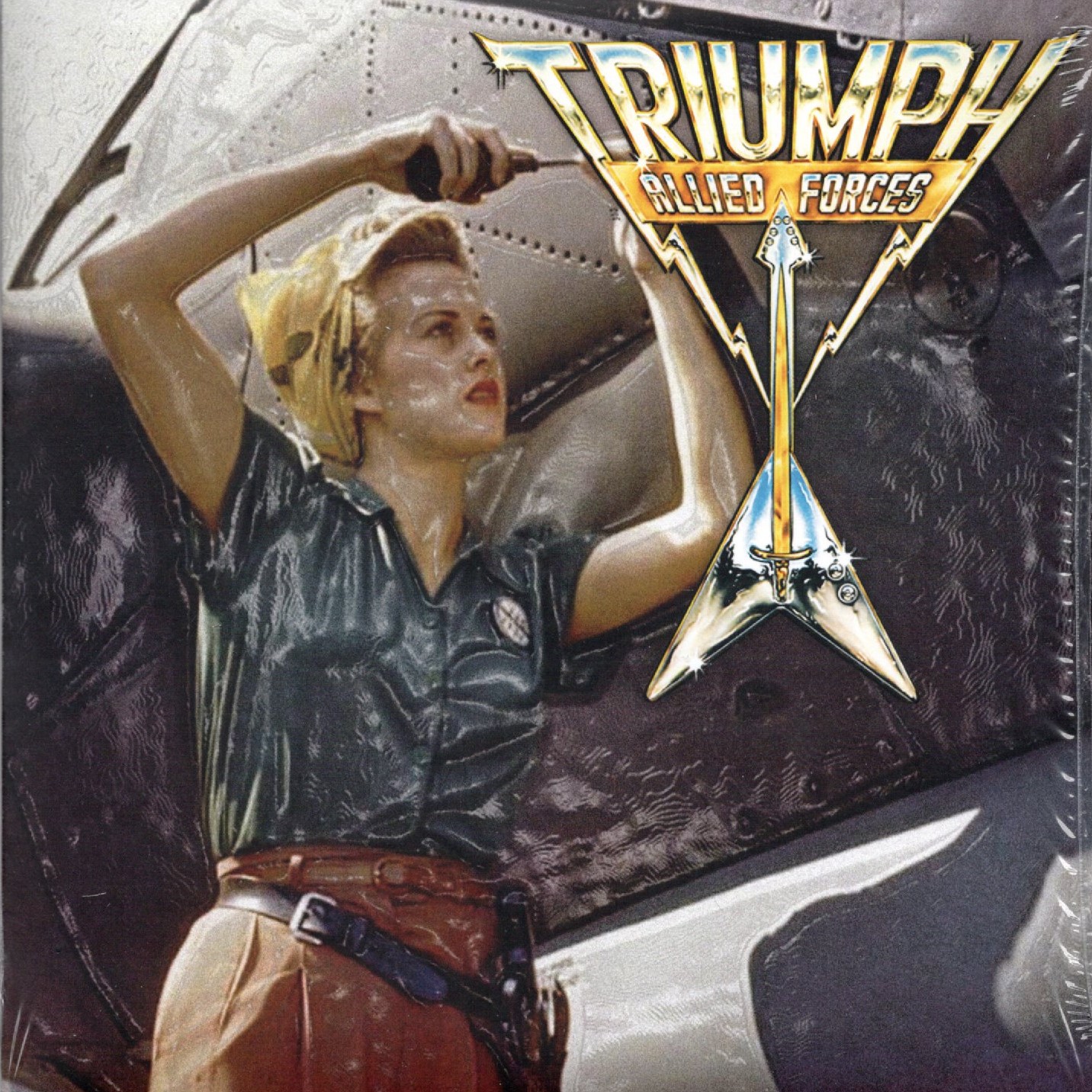
“Magic Power” (Live in Ottawa 1982) is an exclusive 7″ single.  The A-side is the live version of the Triumph classic, unavailable elsewhere.  With the Triumph logo emblazoned on the right, a female mechanic services a World War II-era warplane on the sleeve.  As for the track, it’s a brilliantly energetic performance although you sure do miss that Hammond B3.  Still you can’t beat it for the electricity in the air.

The B-side was a bit of a mystery until we did a little digging.  “Allied Forces 2021” is not a re-recorded version by Triumph.  It is a new version by former Triumph guitarist Phil X, reportedly for an upcoming tribute album that’s in the works.  Phil’s version is way heavier, but he sings it pretty good and the solo work is absolutely wicked.  It doesn’t seem to say anywhere in the box that this version is by Phil X, but the RSD site credits the Bon Jovi guitarist properly.  It’s certainly far heavier than anything coming out of Jon’s camp these days.

A nice little bonus single here, and a nod to Phil X who helped keep Triumph going in the early 90s.


Live In Cleveland – 1981 will be the serious bonus here for many fans.  Although this concert was released on CD in 1996 as King Biscuit Flower Hour (In Concert), this is its first vinyl release and remastered at Metalworks.  By the time Triumph hit Cleveland, they were on their fifth studio album and had plenty of great material to play; all now classics.  Only a few tracks from Allied Forces had worked themselves into the set, the bulk of which is still made up of earlier material and long instrumental stretches.

From the previous album Progressions of Power, “Tear the Roof Off Tonight” opens on a Zeppelin-y party rock note.  Before you can say “Rock and Roll”, they’re into the second track “American Girls” from 1979’s Just A Game.  A nice tasty riff with bite, and two Gil Moore tunes in a row, the drummer working extra hard.  Dig that break into “The Star-Spangled Banner” right before the incendiary solo.

Rik’s up with the first epic of the night, “Lay It On the Line”, 12-string majesty ringing clear and true.

“Same old story, all over again.  Turn a lover into just another friend.  I wanna love you, I wanna make you mine…won’t you lay it on the line.”

Then Rik misses the mark and there are a couple extra power chords before he picks up the vocal where he left off.  Things that only happen on true untampered live recordings.  This passionate version of “Lay It On the Line” has some of Rik’s most incredible singing ever captured.  Period.

First new song of the night is “Allied Forces”, Gil going in extra hard on the lead vocals.  Rik screamin’ in the back.  Triumph were frickin’ hot in 1981.  “Allied Forces” is a work-out before Triumph lets loose some more serious epic material.  “Fight the Good Fight”, impressive itself, is followed by “Blinding Light Show / Moonchild”.  This is just a solid 15 minutes of compositional and instrumental brilliance.  Not to mention a lead vocal tour-de-force from Rik.  Serious drum thunder from Moore on “Moonchild”, and Mike Levine relentlessly laying down a melodic rhythm the whole time.

Gil demonstrations his ability to scat out a wicked song intro on “Rock ‘N’ Roll Machine”.  It ain’t easy to front a band from behind the drum kit but here he does a song intro to rival Paul Stanley.  They blast through that tune, complete with Rik’s signature solo, and then “I Live For the Weekend”.  It’s Triumph at their most Van Halen, boogying and soloing with the big boys.  Then it’s “Nature’s Child”, a drum solo, and an instrumental jam.  They exit on “Rocky Mountain Way” and “Hot Time (In Cleveland Tonight)”, two live standards.

Live In Cleveland is not the definitive live Triumph album.  That will remain to be Stages, which had a better song/solo ratio.  This is however the heaviest live Triumph album and its rawness and unpolished veridity make it the perfect one to accompany this box set.  Listen to the whole thing in one sitting, is my recommendation.


There is a treasure trove of relevant Triumph goodies included inside.  Box sets sold in Canada included an exclusive replica poster for Triumph live at Maple Leaf Gardens, New Year’s Eve 1981.  For a show at the Gardens, it’s pretty ballsy for them to use a picture of Rik Emmett wearing a Habs shirt.  This box set is loaded with Rik in the Habs shirt!

Deke and I also received a Rik Emmett 2021 guitar pick taped to the front shrinkwrap of our sets.  Picks are the kind of added bonus we really appreciate.  Something material.  The included replica backstage pass is also cool, as it looks better than just a piece of paper.

There are lots of paper goods inside too including:  a massive 24″ x 36″ poster, three lyric sheets, three sketches, the booklet and Allied Forces replica tour book.  Plenty of photos and text to sift through.  There are interviews with Rik, Mike and Gil, and a song-by-song breakdown.  Everything about the making of Allied Forces from to the music to the iconic cover.

Hopefully the powers that be continue to honour Triumph’s history as it deserves to be.  Allied Forces is a triumph indeed but it’s ridiculous that it was released in such limited numbers.  Let all the fans have a chance to get one.

5/5 stars

Personal note:  This box set was released June 12 2021, for Record Store Day.  Deke and I tried mightily but were interviewing Andy Curran at the exact moment the box was released.  Having failed to buy the box, Curran advised us not to pay inflated second-hand market prices to get it.  “Something special is planned,” he hinted.  A few weeks ago, the remainder of stock was made available via Rock Paper Merch.  A kind viewer left a comment here with the link to buy, and both Deke and I managed to get one.  Thank you Andy, and thank you viewer!  It goes great with my official Triumph hockey jersey.
#928: Rockin’ the Computer From Then to Now

RECORD STORE TALES #928: Rockin’ the Computer From Then to Now

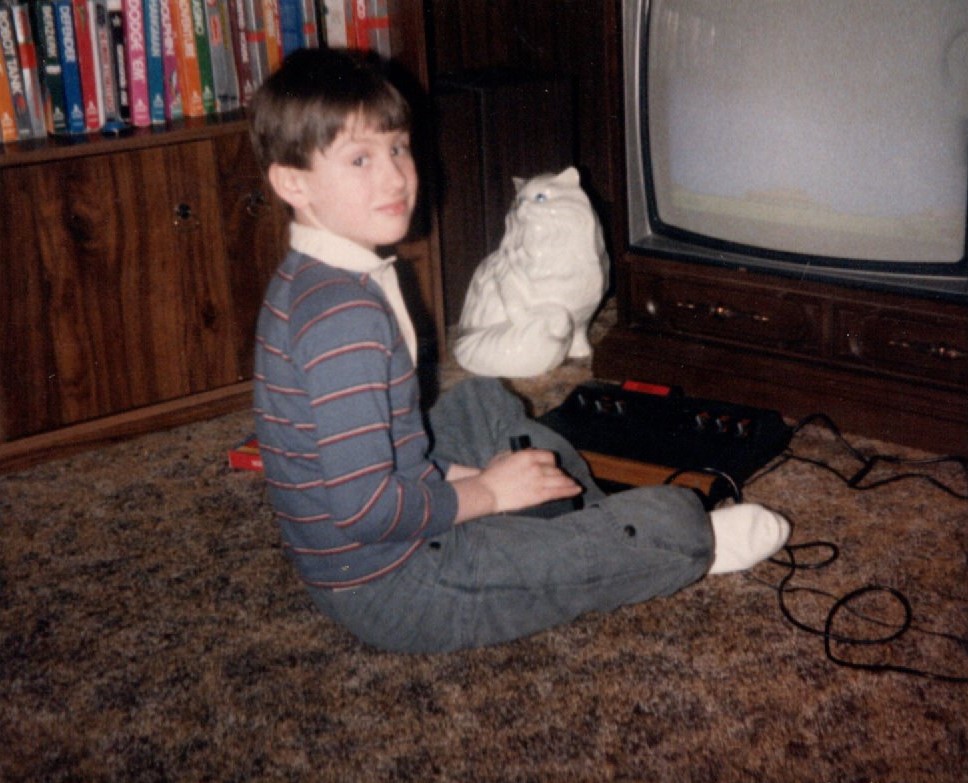
It’s funny to think about my parents being on the cutting edge of technology, but back in the day, we had all the cool stuff.  In my earliest memories we had a Lloyd’s Pong machine.  It came with two paddles and a really cool light gun assembly that you could customise with a stock or silencer.  It was primitive but very few people had video games in the home back then.

You wouldn’t call the Lloyd’s a “computer”, but our next device was specifically marketed as a “video computer system”. The Atari 2600 console was beloved by our family for many years.  There was a big sale.  You could get the console with two games (Combat and Space Invaders), two joysticks, and two paddles.  Our family grabbed one as did everyone else in the neighbourhood.  While the games were not as sophisticated as those in the arcade (or any other home entertainment system), they were the most popular.  And then one day in 1984, in front of that Atari 2600, I had the musical epiphany that changed the course of my life.  Iron Maiden and Snoopy & the Red Baron collided in such a way that my life would never be the same.  From that point forward, computers and music would be intertwined in my life.  Music enhances everything from gaming to homework.

Cousin Geoff “Captain Destructo” wrecking our Atari joysticks while playing Snoopy & the Red Baron on the 2600

I had always been into soundtrack music, but when I was given a Fisher Price mono tape recorder as a young kid, I was able to record whatever I wanted.  I made a compilation of all my favourite Atari 2600 musical themes.  My sister and I would walk around the house humming those game tunes, so I recorded them for us to enjoy.  Ms. Pac Man in particular had a good musical theme.

The next evolution in our computing lives was when my dad got an IBM PC through work.  Not one but two 5 1/4″ floppy disc drives.  Monochrome monitor.  The ability to copy games from friends.   That computer kept us going for many years until the early 90s when I wanted something new that could handle modern word processing for school.  Not a very good computer, but a new one at least.  It was regular upgrades from there:  a modem, and finally the near-mythical CD-ROM drive.

Dad at the original PC

The first thing I did as soon as we got a CD-ROM drive was to buy something that truly combined the world of computers and music.  In a way, CD-ROM was a new format in music, an upgrade from simple CD.  Having a drive on the computer opened up my world to things I couldn’t play before, such as Queensryche’s Promised Land.  (I first bought Alice In Chains’ Jar of Flies CD-ROM but couldn’t get it to work, so I exchanged it for another Seattle band.)  There I sat at the keyboard, clicking on my mouse and virtually touring Big Log, the island studio that Queensryche recorded the album in.  The CD-ROM also included a video game, and the prize for winning the video game was a brand new song.  Queensryche specially recorded “Two Mile High”, an acoustic song, for the game.  I never won the game, but I figured out what file the song was, and recorded it to a tape deck via the PC’s audio-out jack.  And let me tell you, I thought it was pretty cool to gain an exclusive song by expanding my tech to play a new format.  Collectors are kind of nuts that way.

When I started working at the Record Store, Trevor and I would check out CDs that had exclusive CD-ROM content, such as Tales from the Punchbowl by Primus.  There was a special “enhanced” reissue that included visual content for your computer.  This became common practice in the 1990s.  And so, it became important to always have a computer able to keep up with the newest releases.

Ozzy had screen savers.  The Tea Party had exclusive videos.  I never found out what Alice In Chains had.  We learned quickly at the Record Store that these “enhanced” CDs gave some people problems with playback, especially if they tried to play the album on an older computer.  We had many returns.  The alternative was to exchange the disc for a version manufactured by Columbia House.  They usually lacked the enhanced content for your computer, which was causing some customers the playback issues.  The feedback we received was that the Columbia House versions played fine!

With the advent of cheaper memory and better computers, my collection began the ongoing migration to digital copy.  Having a decent computer is more important than ever.  In fact now I do most of my listening right here in front of the screen.  The subwoofer gives me plenty of depth.  This is something I could never have imagined, even back in the early CD-ROM days.  Only in the last 10 years has listening to music on the computer been smooth and decent sounding.  Tech got faster and cheaper and now the computer is my main station.

I’ve had so many computers over the years that I’ve lost track of them all.  The new laptop I bought doesn’t have an optical media drive at all, which alarmed me.  I will always need the ability to have my CD collection interact with my digital machine.  Will my future be external drives that play increasingly obsolete formats?  Kang only knows, as this ride has been unpredictable so far.  I guess we’ll see what changes in the next 10 years.  I just know that it will change.

REVIEW: Polychuck – Shadows Exposed (2021 EP)

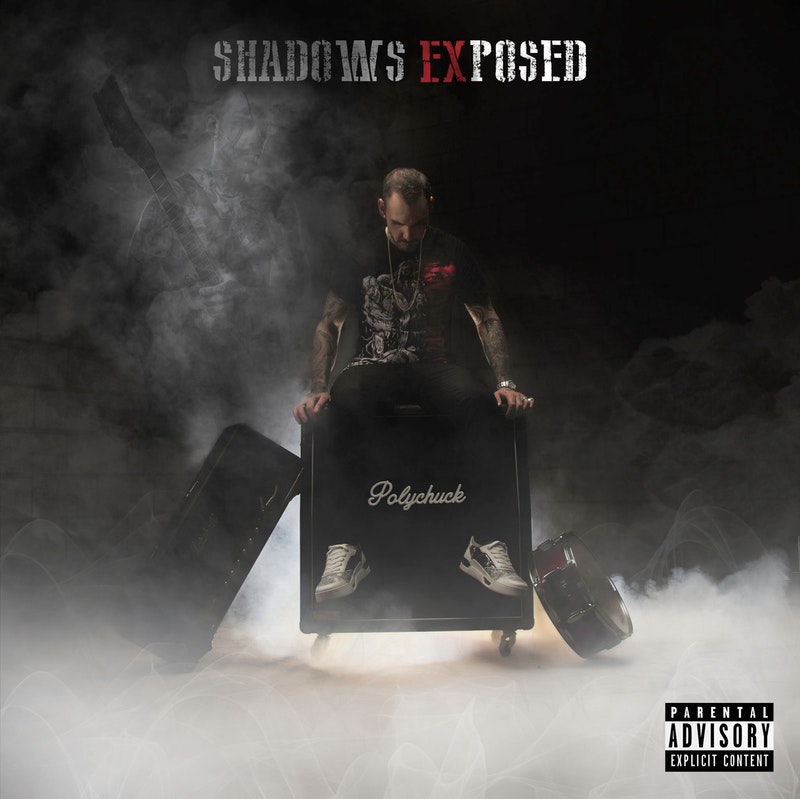
POLYCHUCK – Shadows Exposed (2021 EP)

Who’s Polychuck?  He’s just getting started.

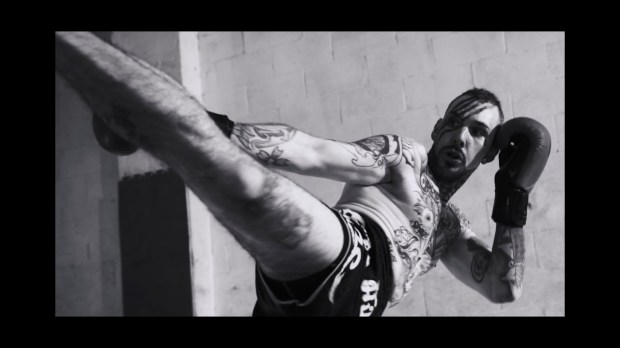
From Montreal, with a do-it-yourself attitude and all the know-how, Polychuck is ready to be heard.  His new EP Shadows Exposed has something for everyone, and that’s not just a cliche this time.  Five deeply personal songs, from the wellspring of modern popular music, heavy metal, progressive rock, and all the classics.  Polychuck is a musically intelligent individual who pulls no punches on guitar, lyrically, or in the ring.  He’s also an MMA fighter!

Lead track “Beating Myself Down” has the vintage piano bop vibe, complete with scratchy vinyl playback.  Before you mistake it for a Billy Joel record, Polychuck brings in the modern influences and blunt lyrics.  Synth horns give you an idea of where Polychuck is coming from.  Performed on keyboards this time, he wants to use a real horn section on his next album.  Creative use of vocoder, and a smoking guitar solo with some insane sounds are the icing on a very sweet cake.

“Exposure” has a modern urban feel, before the heavy metal drum beats kick in.  This is augmented by some pretty awesome record scratching.  The Styx-like keyboard solo reveals Polychuck’s progressive side, which he also wishes to explore further next time out.

Another strong tune, “In the Dark”, binds the heavy beats, some creative keyboard construction, and a solid guitar riff.  This riff transforms into a wailing solo.  Fans of Linkin Park will find something to love here.

Light beach-ready guitar plucks away on “Driving Me Mad”, a song for the summer that sounds like a holdover hit from ages past.  What sets it apart is, again, the guitar.  At one point Polychuck hits upon a melody something like “Rough Boy” by ZZ Top, and it’s the perfect fixture for the song.

The last song “Lights Out” tackles a number of subjects:  the inner critic, nostalgia, old friendships,  and more.  Light 80s keyboard is paired with heavy drums and guitar, ending the EP on a positive note.

When Deke and I talked to Polychuck, he told us he was very much looking forward to making everything bigger next time out, with more real instruments and much more prog.  We look forward to what he has in store, but check out the EP for a taste.  It’s available on iTunes and all the usual streaming platforms.  Shadows Exposed makes a splash but it’s just the inception.  More to come from this gifted artist.

4/5 stars

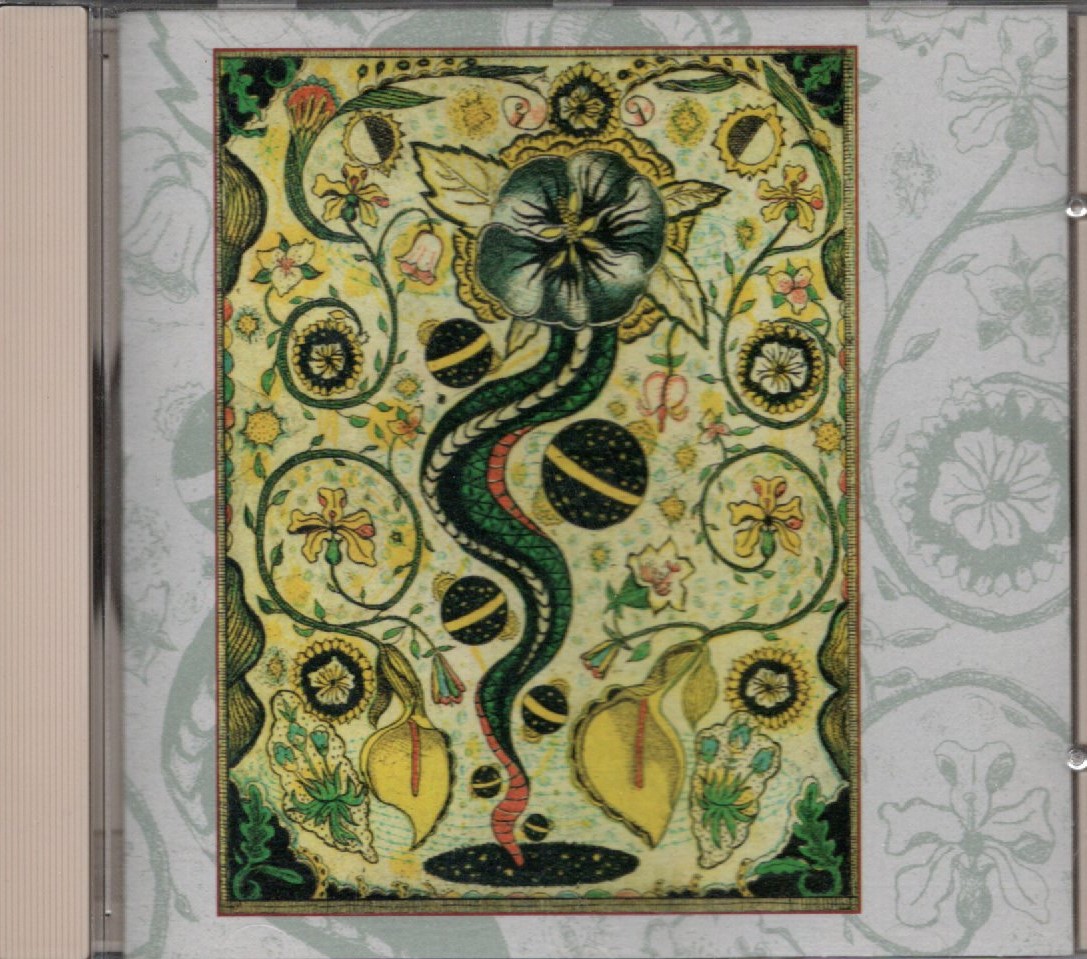
REVIEW: Steve Earle – I Feel Alright (1996)

STEVE EARLE – I Feel Alright (1996 Warner)

One of the greatest albums of the 90s might never have happened if Steve Earle didn’t get addicted, go to jail, and finally clean up.  Earle was always a formidable songwriter.  “Ain’t Ever Satisfied”, “Someday”, and “The Other Kind” (to name only three) dripped with emotion and a certain perfection, insofar as art goes.  Steve’s songs were always about life, but in the 90s, life got intense.  I Feel Alright is the resultant album, a masterpiece that serves as the prototype for several more of Earle’s later works.

I Feel Alright was actually preceded by an acoustic album called Train A Comin’, made up of songs written from 1974 to 1995  In the liner notes, Steve tells the story.

“When I was locked up, I was getting ready to go off on this boy that stole my radio.  My partner Paul asked me where I was going.  I said, ‘To get my radio, and then go to the hole for a little while.’  He looked at me like I look at my 13 year old sometimes and said, ‘No, you ain’t.  You’re gonna sit your little white ass down and do your little time and then you’re gonna get out of here and make me a nice record.’  SO, I MADE TWO.”

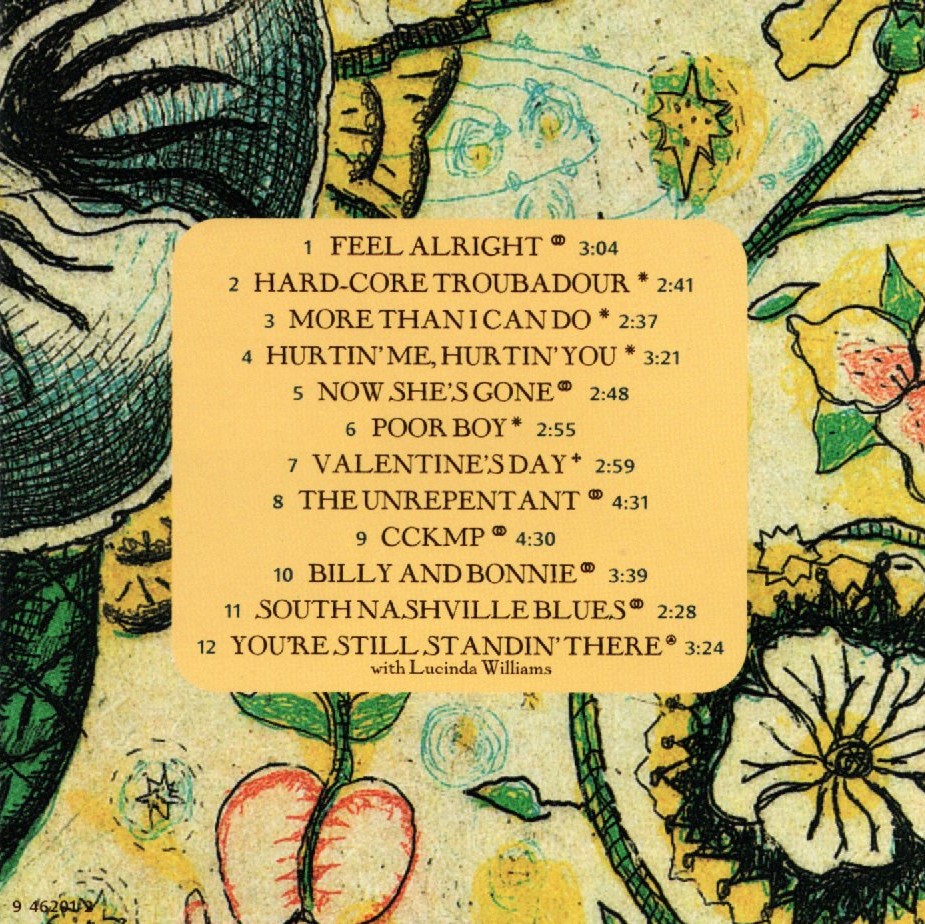
“I Feel Alright” opens with defiant chords, hands hitting the strings unrelentingly, and then Steve opens his mouth.  It’s the same voice but somehow, now it feels like he really means it.   “I feel alright tonight,” he sings reassuringly.  Because we were worried about him!  The worldly lyrics are backed by shimmering layers of guitar.

Fun hits hard on “Hard Core Troubadour”, classic guitars chiming away.  Singing about a girl who’s seeing another guy on the side, Steve threatens him with the epic line:  “Wherefore art thou Romeo, you son of a bitch?”  It’s over and out in under three minutes, but the enduring adventure will be worth a repeat spin.

A blast of harmonica enters for the sentimental “More Than I Can Do”.  Upbeat and unforgettable.   Simple, impeccably constructed, and effective.  Three perfect songs in a row.

The first ballad, “Hurtin’ Me, Hurtin’ You”, is the kind of song Steven Tyler has been trying to write since about 1993, except done right.  This is what he’s been trying to write — the bluesy country heartbroken ballad with punch.  Sorry Tyler, Steve’s got you beat.  This song has “Crazy” beat by a country mile.

Upbeat harmonica enters the fray once again on “Now She’s Gone”, the story of a wild child.  Something Steve probably knows a thing or two about.  Vivid storytelling.  “She met a boy up in Kentucky, Charlie was his name. Just when he thought he got lucky, she stole his watch and chain.”  Most of I Feel Alright is short and sweet and this is no exception.  With rough and weathered voice, Earle sings it with intent.

Side one closes on “Poor Boy”, traditional country a-la Johnny (Cash or Horton).  Strong beat, light twang, and seasoned singing.  This is the kind of country Steve would have grown up on.

Opening side two, “Valentine’s Day” is a somber apology.  It sounds like Earle has made quite a few apologies in his day, and this represents them all.  Gentle, with subtle country backing vocals and light strings.

The clouds give way to a fiery blaze in “The Unrepentant”.  Steve’s hunting the devil himself this time, with a “bad attitude and a loaded .44.”  He concludes his threat with, “You got your pitchfork and I got my gun…somebody’s gotta do it.”  Fans of “Copperhead Road” will enjoy this song cut from a similar electrified cloth, though at a slower, more deliberate pace.

The only track on I Feel Alright that might be out of step is the blunt blues “CCKMP” (“Cocaine Cannot Kill My Pain”).  It’s obviously dark, raw, and intense.  Clearly born from Steve’s own experiences, and completely relevant to the journey.  Will you enjoy listening to it?  Difficult to say.  What can be said is “CCKMP” is the dark point of this ride, the scary part in the tunnel.  It has its place.  It would have been wrong to leave out this crucial part of Steve’s journey.

“Billy and Bonnie” is a classic outlaw story, mandolin singing away while a driving beat takes us on down a dusty dirt road.  A Cadillac, a gas station robbery, and a day in court make for a killer story (literally)!  Then it’s a little bit of traditional country bluegrass on “South Nashville Blues”.  Looking for a little company, with money in pocket.

Ending as strongly as it began, I Feel Alright goes out on a duet with Lucinda Williams.  “You’re Still Standing There” is the love letter at the end of the story, the happy ending.  More blasts of harmonica, backed by impeccable melodic construction.  When you filter those melodies through the very human voices of Steve Earle and Lucinda Williams, you get a raw celebration of a closer that just makes you wanna smile.

The celebration is just that Steve survived.  That he came back truly a stronger singer/songwriter is the remarkable part.  Though he came close to perfection on followup albums like El Corazón and Trancendental Blues, song for song, Steve has never touched the level of I Feel Alright again.  It’s one of those magical albums that’s composed of classic after classic after classic; songs you want to keep hearing over and over again.  Very real performances, communicating human emotion efficaciously.  A perfect record.

5/5 stars

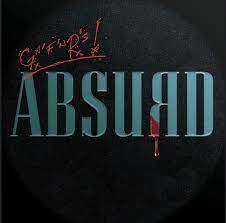
REVIEW: Guns N’ Roses – “ABSUЯD” (2021 single)

GUNS N’ ROSES – “ABSUЯD” (2021 single)

“Listen motherfuckers to the song that should be heard!” bellows W. Axl Rose, cocky as ever.

Guns N’ Roses like to drop bombshells and they did this week when “Silkworms” returned to the setlist after an absence of almost two decades.  It had been reworked and retitled “Absurd”, now augmented with Slash n’ Duff’s involvement.  In another surprise bombshell, they just released a studio version.  The first new Guns N’ Roses music since Chinese Democracy and first with Slash and Duff since 1994.

“Silkworms” is am interesting choice to release as the first new song with the old legends back in the band.  It’s always going to be associated with the Chi-Dem era.  The version I knew had Robin Finck and Buckethead on guitar.  Brain on drums.  Tommy Stinson on bass.  A lot has changed!  Slash is audible but more Slash-y sounds would be have appreciated.  Duff sounds brilliant.  Why not an actual new song?  I don’t know…but at the same time, I’m glad “Silkworms” finally got a release as “Absurd”.  It was always deserving of a proper studio release.

Axl sings in that punky “Down on the Farm” character, and the lyrics are as venomous as they were in 2001.  “Parasitic demons sucking acid through your heart!”  He sounds quite good; better than the concert versions we’ve heard thus far.  The vocal is mixed to sound like a megaphone because, hey, it was the Chi-Dem era.  There’s a disorienting quiet section in the middle that also hearkens back to that quaint time.

Good tune, but those of us who have craved “Silkworms” for 20 years are biased to a good impression.  Those who didn’t like it won’t be turned, and those who want something more like Appetite and Illusions won’t get it this time.  If you love Chinese Democracy, add a mark to my score.  If you hate it, subtract one or two based on your level of venom.

4/5 stars

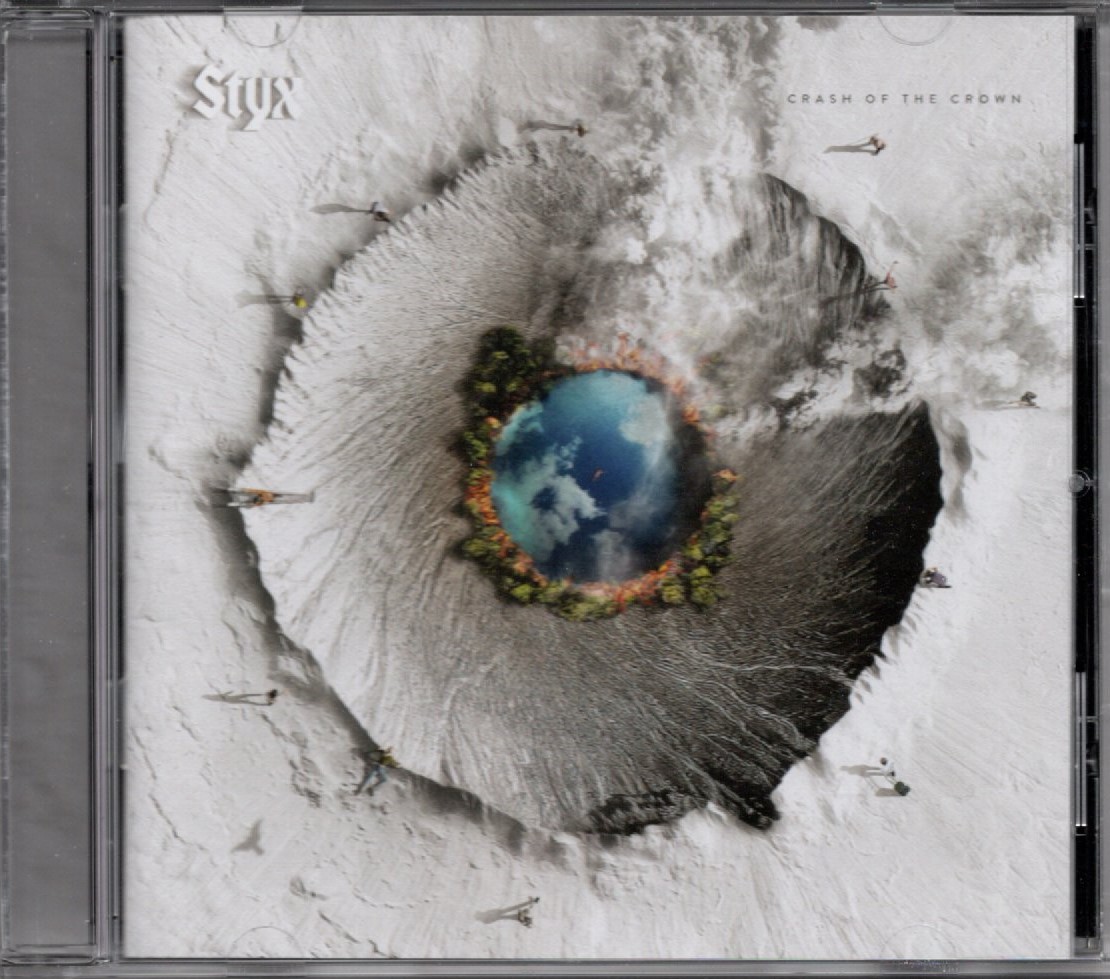
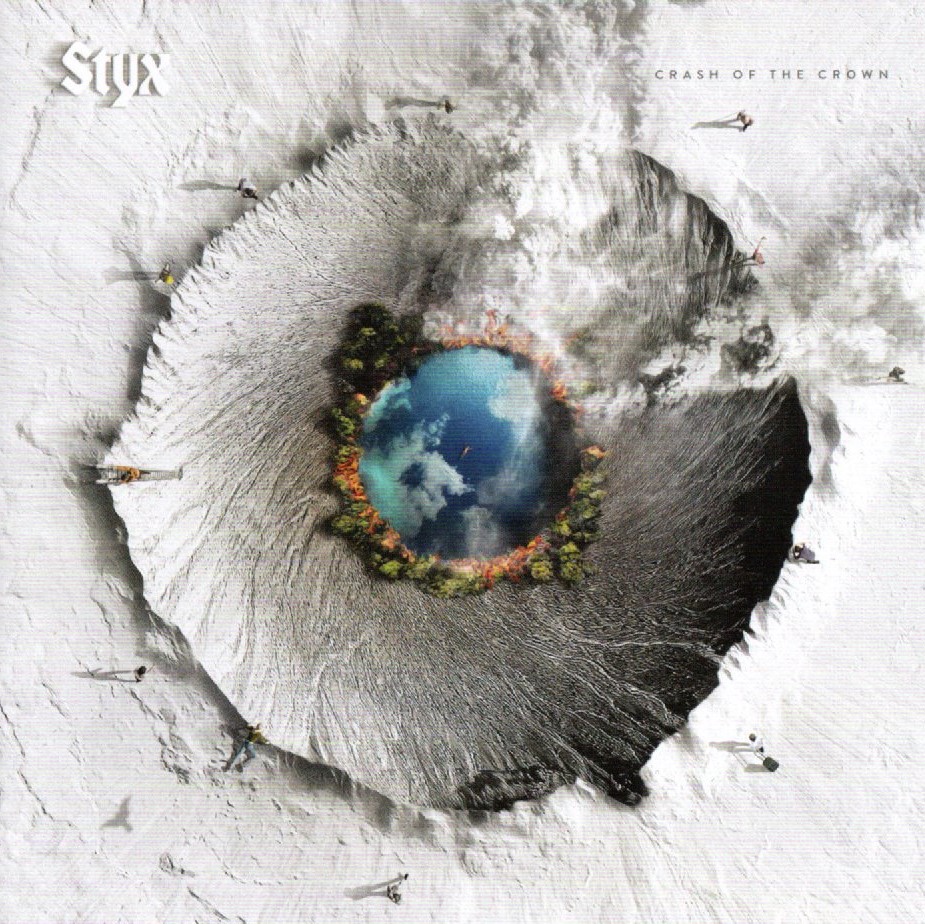
REVIEW: Styx – Crash of the Crown (2021)

“I don’t think Styx will ever top The Mission.” — Me

“I think Styx just topped The Mission.” — Also me

STYX – Crash of the Crown (2021 Universal)

Remarkable!  49 years old, and still putting out some truly superlative records.  What’s the secret?

Like their contemporaries Journey and Whitesnake, Styx have expanded to a seven-member band including new guitarist/songwriter/producer Will Evankovich.  With just as many songwriting credits on the new album Crash of the Crown as Tommy Shaw has, this addition feels appropriate.  James “JY” Young and Chuck Panozzo (original bassist, now part time) are the only links to the distant past.  Styx have not always been the most focused on new music (14 year gap between Cyclorama and The Mission) but it seems like Evankovich has sparked their creativity.  Two albums in a row, Styx have risen to high-water marks, pleasing fans and stunning critics.

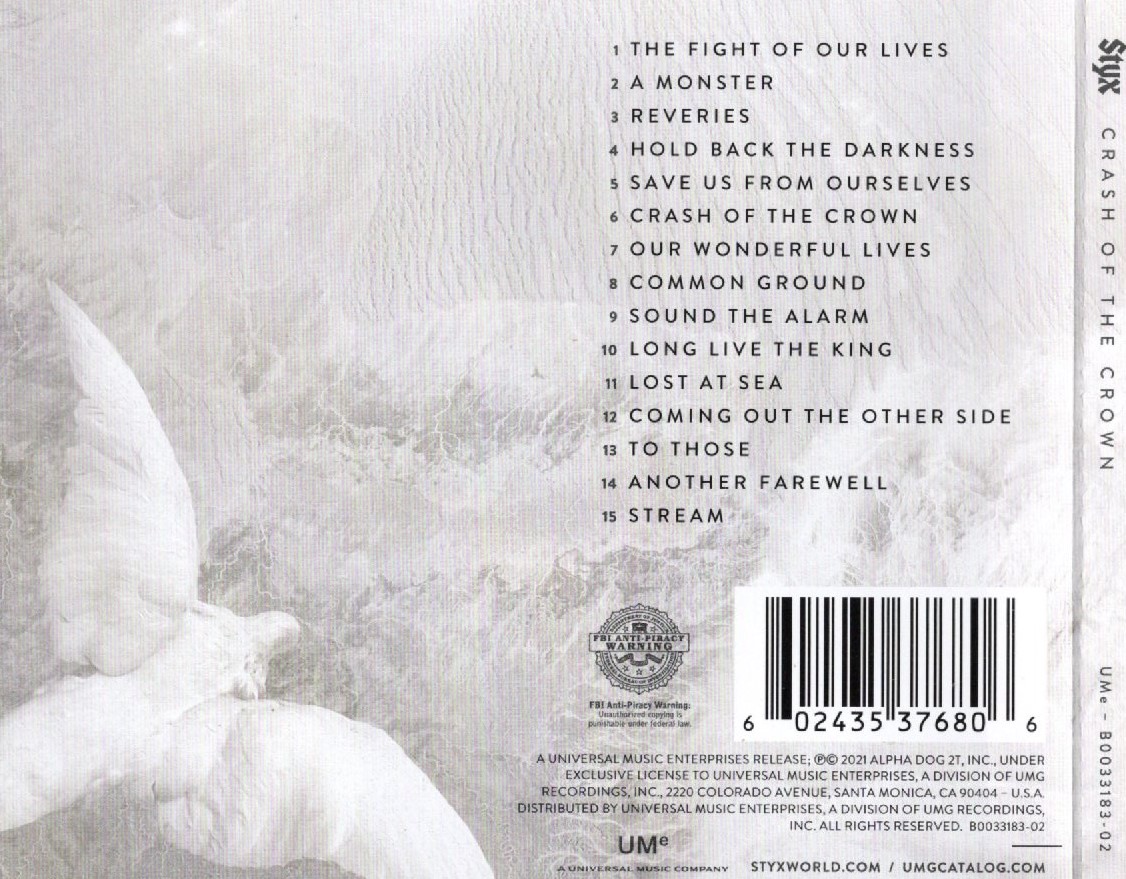
If there’s a blatant concept this time it’s not as obvious, but recurring musical themes hint that there might be more going on than just 15 new tracks.  Crash of the Crown is assembled from smaller chunks of music that flow together in one seamless whole, but the individual songs are all under four minutes, including two brief interludes.

Opening with a wicked Lawrence Gowan keyboard bit, “The Fight of Our Lives” is a powerful and catchy intro to this distinguished album.  Tommy Shaw: lead vocals, backed by the increasingly thick Styx choir.  Pay attention to the main guitar theme as it’ll be back.  Beatles-y chords are another recurring affair.  (The Fab Four sound like a major influence on both Crash of the Crown, and the new Dennis DeYoung album 26 East Vol. 2.)

A progressive guitar/keyboard riff brings us to “A Monster”.  If anything it’s a song about the last two years.  “Here’s to the prisoners trapped in their cages,” could certainly be about the current time, “a monster chasing its tail”.  Big guitar solos and hooks make this an unorthodox and complex little winner.

Acoustics ring on “Reveries”, the first Gowan lead vocal.  It has a big powerful chorus and the acoustic base is reminiscent of classic 70s Styx.  But before too long, Tommy Shaw and JY rise up for a massive tandem electric guitar break.  Stuff like this is why they need a third guitarist now, so the rhythm doesn’t drop out live.  “Reveries” flows seamlessly into the dull rain of “Hold Back the Darkness”.  The foreboding tune, like clouds warning to stay ashore, is spare with piano and acoustics forming the basis.

Winston Churchill’s words form a part of “Save Us From Ourselves”, always a nice touch in a rock song.  It possesses a more upbeat pulse, but no less powerful.  The Tommy Shaw refrain in the chorus is typically bright and rhapsodic.  It builds into something stageworthy, and leads into the title track and single “Crash of the Crown”.  Individually, this song impresses less on the radio.  It belongs on the album, flowing in and out.  It’s a component of a larger piece.  Incidentally it’s the first Styx song with three lead singers.  In order:  JY, Shaw and Gowan, each with completely unique sections.  Stick with it, and a riff from “Fight Of Our Lives” returns to knock you back in your seat.  Then there’s some instrumental wickedness and robot vocoder madness.   It is like three or four songs crammed into one and it’s boggling why it was chosen as a single.  Except to impress the fact that Styx aren’t playing around.

You need a bit of a break after a workout like “Crash of the Crown” and so the folksy “Our Wonderful Lives” is the ideal tonic.  A huge singalong chorus is backed by simple kick drums, acoustics, and accordion.  It’s a beam of hope on an album born from dark times.  Sounding a bit like “39” by Queen, and completed with a blast of Beatles-y horns.

The dark growl of a Hammond B3 transitions into “Common Ground”, slower and thick with the modern Styx harmonies.  It has some very different parts, one pounding with heavy drums and one light and flighty.  While it stands as a song to itself, it also works to transition into “Sound the Alarm”, an RSD single and album highlight.  This handsome Shaw ballad is reminiscent of some of his past best and serves as a bit of a hippy-like anthem.  “There is no future in the way it was,” Shaw sings correctly.  All at once, it has ingredients similar to “Show Me with Way”, “Mr. Roboto”, “High Enough” and “Fooling Yourself (The Angry Young Man)”.  There’s sorrow, there’s hope, there’s bombast and a digital pulse.

The digital pulse leads directly into the drum-heavy “Long Live the King”.  It’s also the most Queen-like, with an absolutely May-ish solo.  Imagine if you tried to build a Queen song on top of the drum beat from Guns N’ Roses’ “You Could Be Mine”.

Gowan has a brief piano segue called “Lost At Sea” before the proper song “Coming Out the Other Side”.  This calm ballad has a taste of India with the tabla, but manages not to sound like the Beatles this time.  It recalls rebirth, and there’s a killer solo to go on top.  “To Those” goes full-blown upbeat triumphant Styx, a brilliant refrain brimming with adrenaline.  “For those who do survive, find beauty in your lives.  Don’t be afraid of love, stand up and rise above.”

Instrumental segue “Another Farewell” steers into the final track “Stream”, which sounds and reads like an ending to a story.  Whether the band intended to or not, it seems they’ve made another concept album in Crash of the Crown.  “We’ve never been a protest band,” insists Shaw, “We’re more like a gospel caravan trying to send out positive messages wherever we go.”  If that’s the case, then “Stream” must be the happy musical ending, an upbeat drift into the fade.

Perhaps there’s a clue to Styx’s meaning in the packaging.  Morse code hidden in the CD tray reveals the words “WHOS GONNA SAVE US FROM OURSELVES”.

According to the lengthy liner notes, Styx went into Crash of the Crown with no compromises and came out of it with the album they wanted.  With a diverse set of instruments at hand, they clearly had no inhibitions.  The end result is an album less direct the The Mission, but dense with ideas compacted into mere minutes of songs.  Fortunately most of those ideas were really excellent.  Any time a band like Styx makes an album, there’s a fear it will be the last one.  It sounds like this band has plenty more fuel left in the solid rocket boosters.  Whatever the future holds, Crash of the Crown is the kind of triumph any young band would hold as their magnum opus.  With Styx, there is so much history it’s futile to compare.

5/5 stars

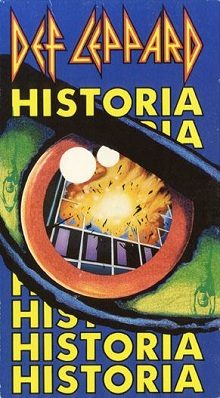
REVIEW: Def Leppard – Historia (1988 VHS)

DEF LEPPARD – Historia (1988 Polygram VHS)

When I was a kid, I wanted to collect “all” the Def Leppard music videos.  Hysteria was pretty much my favourite album for two years.  Their videos were ubiquitous.  Any time MuchMusic had a new one to debut, you could count on it being a hit.  “Pour Some Sugar On Me” was the anthem of the summer of ’88 and the video was on all the time.  But some Def Leppard videos were played far less frequently.

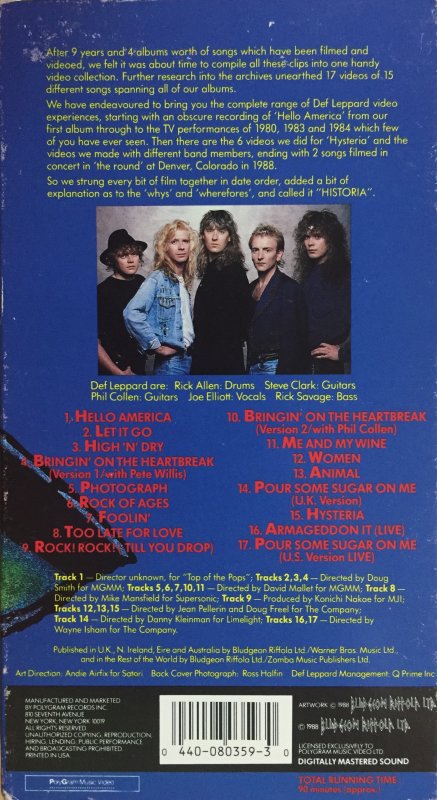
The 1988 VHS Historia collected all Def Leppard’s music videos up to “Love Bites”, along with some rare television performances that never aired over here.  They were introduced by quaint title cards, and each video was presented in full — no edits.

“Hello America” with Pete Willis was the first one we’d never seen before.  Why was the drum kit out front?  Nobody knew, but this cool song sounded like a lost hit.  The “fake live” trio of “Let It Go”, “High ‘N’ Dry”, and “Bringing on the Heartbreak” ended the Willis era of music videos.  These three were seen on TV here, but only rarely.  “Heartbreak” was the original album mix.

The big three Pyromania videos by David Mallet were up next, “Photograph” in its uncensored version.  Then there’s a TV performance (lip syncing of course) of “Too Late For Love”.  This includes a neat set up with Steve Clark and Phil Collen coming down these hydraulic staircases. When spending the money to buy a VHS tape of music videos you can see on TV, it’s nice to get real rarities like this.

“Rock! Rock! (Till You Drop)” is another serious rarity from Japanese TV. With Union Jacks draped behind, Leppard rarely looked this cool. It’s no shirt required for Rick Allen, and a mop-topped Joe Elliot screams behind his hair into the microphone cupped in his hands. Unfortunately, during the guitar solo the director chose to focus everywhere but on Phil for most of it.

After Pyromania blew up all over the world, Leppard reissued Hign ‘N’ Dry with two bonus tracks.  Music videos were made for each:  The remixed versions of “Bringing on the Heartbreak” and “Me and My Wine”.  The DVD release is mucked up and includes the wrong audio instead of the remix of “Heartbreak” but the VHS has everything right.  These two videos are exact opposites.  “Heartbreak” is a high budget extravaganza with the two guitarists playing on massive silos, smoke all around.  Then there’s Joe crucified on a barge for some reason.  The performance stuff is pretty cool at least.  But “Me and My Wine” is a total contrast, just Leppard jamming it up in a cheap flat, wrecking stuff and playing in the showing.

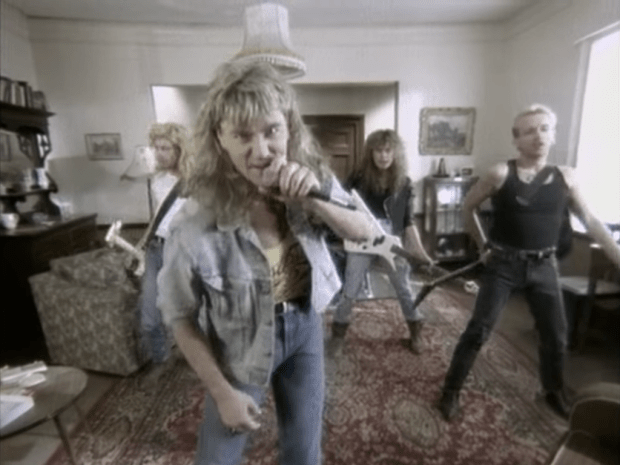
And then finally it’s the Hysteria era, the big big hits with the million dollar videos.  “Women” was cool, with that Def Leppard comic book theme.  “Animal” and “Hysteria” had a lot of mainstream play.  There’s also the original UK version of “Pour Some Sugar On Me”, with Leppard playing in a house in the midst of demolition.  The “fake live” US version is also included, with the familiar extended remixed intro that was actually unreleased in audio form at that time.  It is paired with “Armageddon It”, made from the same batch of concert footage.

Finally, in the days before hidden CD tracks were all that common, Leppard hit you with an unlisted bonus video.  It’s “Love Bites”, the brand new video that shortly took over the world for them once more.

Videos weren’t cheap to buy — they were $25 to $30 for something like Historia.  What you wanted was value for your money (stuff you didn’t see on TV) and rewatchability.  Historia was constantly in our VCR, often for a full play-through.  It more than earned its share of my allowance.

5/5 stars

#923: The Dead 90s (A Nigel Tufnel Top Ten list)

RECORD STORE TALES #923: The Dead 90s (A Nigel Tufnel Top Ten list)

I think it was around 1995 that I really gave up into the ’90s.

What do I mean by this?  It’s simple.  In late 1991, there was a sea change in rock music.  The old guard was suddenly unhip, while a new unkept kind of rock was surfacing in Seattle.  Within three years, classic rock bands such as Motley Crue, Iron Maiden, Judas Priest, Poison, Ratt, Whitesnake, and even the once-bulletproof Guns N’ Roses were in some sort of decline, losing key band members or just breaking up completely.  They were replaced on the charts with a swath of new bands, from Nirvana, to Alice in Chains, Pearl Jam and Soundgarden.  Rock had been on such a high in mid-91 with #1 albums by Skid Row, Metallica, Van Halen and more.  It only took months for the landscape to darken.  But really, the warnings were in place well back in ’89.

It was a disorienting change and it got to a point in the middle of the decade where my favourite bands were dropped, broken up, or transformed.  Bon Jovi survived this period unscathed, losing only the inconsequential Alec John Such.  They were one of the few exceptions.  Motley Crue put out a killer record with their new singer that was criminally panned at the time by its critics and many longtime fans.  Winger couldn’t catch a break.  Some of the bands that did put out records in the 90s released sub-par trash.  Quiet Riot:  guilty with Down to the Bone.  Judas Priest:  Jugulator.  Dokken:  Shadowlife.  Unless your name ended with Jovi, it seems like every old guard rock band put out albums that were crap, sold like shit, or both.  Then, half of ’em broke up.

What was a metal head to do?  Still buy the old bands’ records and hope for the best, yes, but when you’re buying so much shit on a wing and a prayer, you start looking for something else.  I had to open my heart to some newer bands that, I felt, had something in common with the old.

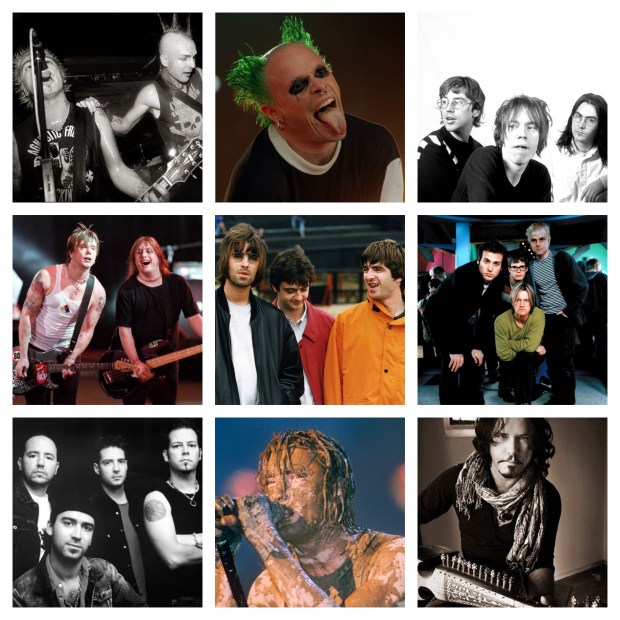
Here is a list of 11 bands that made their way in.


1. OASIS.  I still love those first three records, and all the B-sides that came along with the tide.  My mom got me into the Beatles, and while I never bought into that “the new Beatles” crap, I did like that Oasis brought back some of what I liked about the fab four.  They were the only Brit Pop band I could put my heart behind.  Not metal at all, but Lars liked ’em.  They had guitar solos at least.


2. GOO GOO DOLLS.  Right around the time of “Slide” and “Broadway”, I let the Goo Goo Dolls into my life.  They reminded me of Bon Jovi without the bombast (and the solos).  They would have to do during the time when I needed a surrogate Jovi, which happened in the late part of the 90s when Jon released the stinker Destination Anywhere.  Goo Goo Dolls nailed the lovestruck acoustic/electric vibe that was once a Bon Jovi strength.


3. THE BARSTOOL PROPHETS.  Amazing Canadian band that could have been the next Tragically Hip.  The Prophets might have been a little more hard edged, and I identified with their lyrics more than the labyrinthic words of Saint Downie.  T-Trev was a fan and he recommended I give ’em a try, and I have loved them since.


4. sandbox.  A band that did not win me through a friend or a music video, but through the live experience.  Opening for the Barenaked Ladies, sandbox (all lower case) were a bit gloomier and heavier.  But there was also something magical about their songs “Curious” and “Lustre”.  They soothed my soul when I was lonely.  Later on, I found out that guitarist Mike Smith was on a television show called Trailer Park Boys…


5. THE PRODIGY.  Who didn’t buy Fat of the Land in ’97?  It was a good album and Crispian Miller from Kula Shaker had lead vocals on one track.  This new heavy brand of electronica had hooks and a rock-like vibe.  It was like dance-y industrial rock.  I could dig it.  They even had a guitar player named — no word of a lie — Gizz Butt.


6. THE TEA PARTY.  I couldn’t get into Splendor Solis; I foolishly dismissed the band as a Zep clone.  I came to my senses on their third album The Edges of Twilight.  The Zeppelin comparisons were obvious (and I didn’t care about the Doors), but who else was making music like this anymore?  Nobody.  The Tea Party would do!


7. SLOAN.  It was not until their fourth album Navy Blues that Sloan scratched the itch.  Yes, I was a late comer.  Yes, I got into them during their commercial peak.  But the truth is it was really their double live 4 Nights at the Palais Royale that really nailed it.  One of the best live albums since the mighty Kiss Alive.  The comparisons don’t end there, as both bands feature four lead singers — a configuration I always enjoy.  (Hello, Goodbye, Beatles!)


8. RANCID.  Incredible band, two lead singers, and one great album that just slayed me.  Many of the rock bands I liked, such as Guns and Motley, extolled the merits of their punk rock backgrounds.  Just as Zeppelin and ZZ Top encouraged me to check out Robert Johnson and Muddy Waters, Nikki Sixx pushed the Pistols on me.  Rancid were much better than the Pistols, but they had the same snot in their noses.  Rancid brought with them the ska and reggae side, which appealed to me immediately.


9. OUR LADY PEACE.  For one album, anyway.  Maybe it was Arnold Lanni that made this band buzz for me, but they were really a single album group.  Naveed is a monster.  Jeremy Taggart was a good enough drummer for Geddy Lee!  It had some things in common with hard rock, like loud guitars.  I could build them a bridge into my heart.


10. LIVE.  I maintain that everybody bought Throwing Copper in 1995.  This band just had tremendously broad appeal.  Unusually, every song was up to the same lofty level of quality; no duds, all keepers.  A number of strong singles led to massive radio and video play, but no followup album of the same stature ever emerged.


11. NINE INCH NAILS.  I was just starting to get into Nine Inch Nails.  The Downward Spiral is my album when it comes to this band.  They took such a long break after it that I lost interest.  What I liked were the riffs built from noise, the layered approach, the angst, the self-loathing, and the anger.  The album is still is trip to play, but I have never liked “Piggy” or “Closer” and think them a bit contrived.  Admirable though that the video for “March of the Pigs” is 100% live, music included.


Although there were many good albums made by metal bands in the 1990s that I have not mentioned, it was not enough for a music addict.  I needed to expand my horizons or remain stuck in the past.  There were more — Ben Folds Five, Steve Earle, Robbie Williams, Mel C. (yes that Mel C.) and Tonic to name a few.  Anything that had some kind of integrity of connection to the rock music I loved.  Ben Folds didn’t even have a guitar player, but his music rocked nonetheless.  These were all great picks to sample some of the best of the 90s.  Have a listen.