What are your “musical firsts”? Here are mine! Let’s start with concerts.
First concert: Johnny Cash (1983)
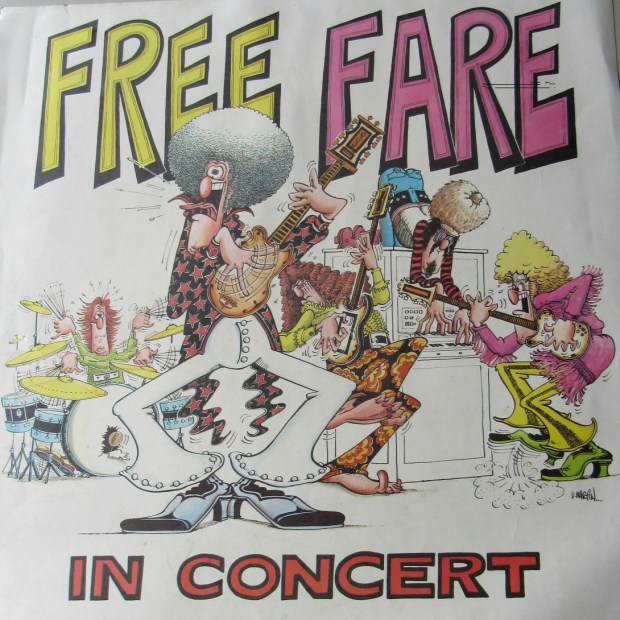
First highschool concert: Free Fare (1986)
First rock concert: Helix (1987)
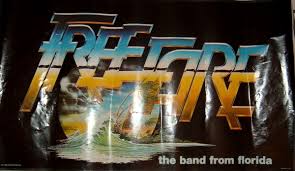
Who remembers Free Fare? They billed themselves as “the band from Florida” (there was only one?) and toured highschools all over the US and Canada. They played Grand River Collegiate in my grade nine year, performing popular covers and giving away Free Fare bandanas.
How about your first musical instruments?
First instrument played – bass guitar
First instrument bought – electric guitar
First instrument smashed – the same electric guitar, smashed by my sister
Finally I’m sure you all remember your first albums. Here are mine:
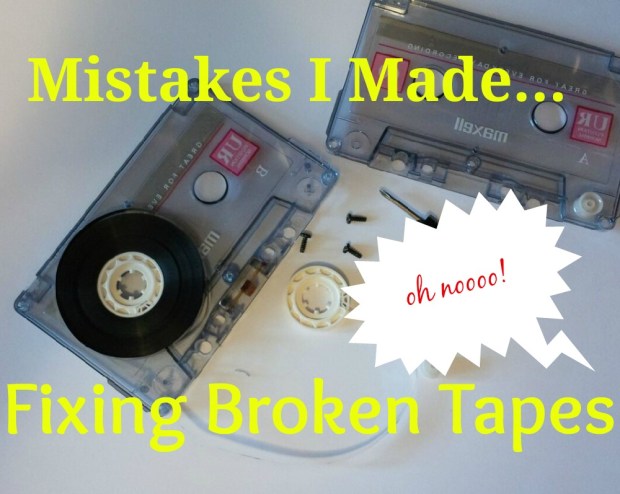
GETTING MORE TALE #519: Mistakes I Made Fixing Broken Tapes
I used to play cassette tapes almost exclusively. Even when I had started growing a CD collection, my cassettes dominated. Why? They were portable. I could record a CD or LP on them, put them in my Walkman, or play them in the car. I didn’t have a good way of doing that with CDs. Plus, you could record a CD to a good quality blank tape, and make a better copy than if you bought it on a pre-recorded manufactured release.
But tapes break. They wear. They get old. There were ways of fixing them, which I sometimes screwed up gloriously. What mistakes did I make?
MISTAKE #1:Dirty hands
You shouldn’t even try to fix a tape with dirty hands. Any time I opened one up to splice or carefully wind the tape on the spools, I was touching them with my unclean, ungloved hands. This deposited dirt and oil on the tape, deteriorating the sound and then transferring that dirt and oil to my tape heads.
MISTAKE #2: Magnetized screwdriver
Here’s another no-brainer that I missed. I had a cool little screwdriver that was magnetized. It was hard to lose those little screws with one of those, since they stuck to the screwdriver. Brilliant way to keep all those little screws from disappearing, but not good for tapes!
I wondered why a lot of my tapes had drop-outs in the sound. Many could have been caused by my favourite screwdriver while trying to fix them. This is common sense but I didn’t think my little screwdriver could possibly do any harm!
MISTAKE #3: Incorrect reassembly
Putting the tape back together is sometimes harder than it looks. Small parts pop out and sometimes it’s tricky to get them back in correctly. The slip sheet – a little piece of plastic inside the tape shell – helps reduce friction and squeal, but only if you put it back in with the slippery side facing the tape spool. When hastily reassembling tapes, I sometimes put the sheet in the wrong way causing slowdowns and noise.
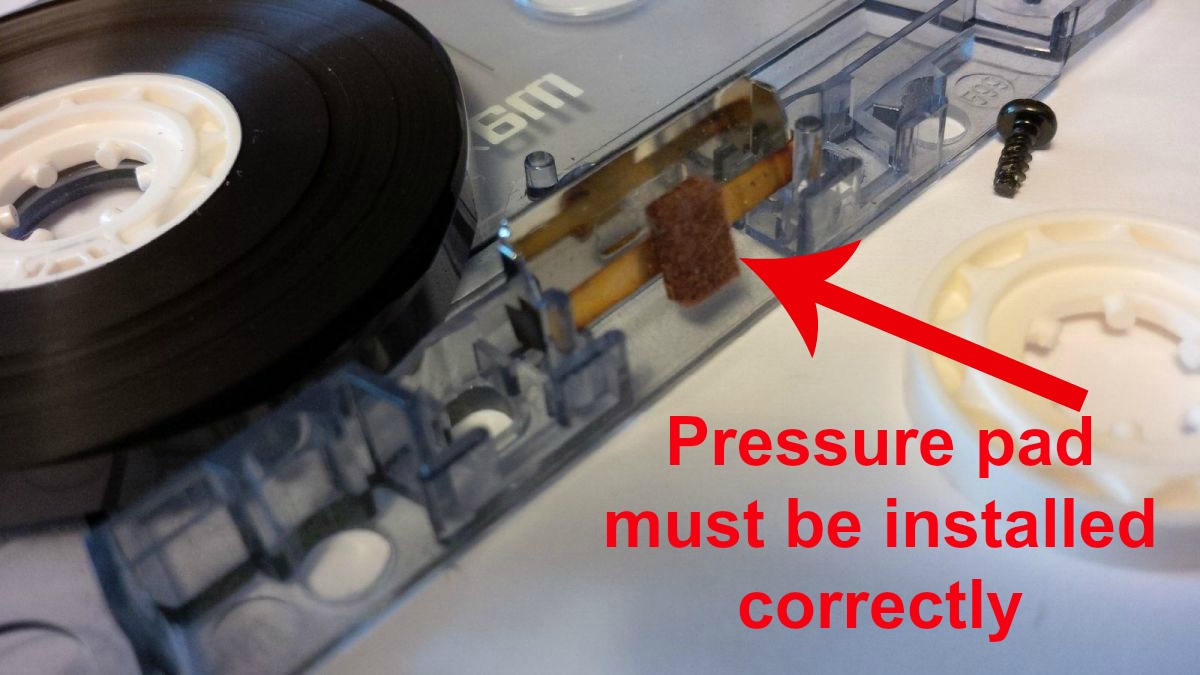
Another critical part is the pressure pad. This applies light pressure on the tape to keep it against the player’s tape head. These pieces were tiny and sometimes popped out of place. There were some tapes I put back together with this piece improperly inserted. The lack of pressure on the tape reduced the sound quality greatly.
MISTAKE #4: Splicing with Scotch tape
I spliced successfully with Scotch tape…but only in the short term. As the Scotch tape ages, the stickiness reduces and becomes slimy. This means in time and with a few plays, a careful splice would break. You don’t want to get any of that stinky gunk in your tape deck, so use proper splicing tape. They used to sell it commonly at places like Radio Shack, but I came from a cheap family that used whatever was available. Hence my tapes were spliced with Scotch.
MISTAKE #5: Butter fingers
It’s tricky getting all the tape wound around the right spools and ready to screw back together. Sometimes – quite often actually – I would struggle with this and inevitably crunch the tape between parts of the shell. Once you crunch or crease the magnetic tape, you’re going to hear an audio problem.
I didn’t wreck every tape that I tried to fix, but I did make these mistakes periodically. No wonder my tapes sounded like crap.
Welcome to another week-long series at mikeladano.com! We’re doing another week of Getting More Getting More Tale: five brand new instalments from the Getting More Tale series. Hope you enjoy these blasts from the past.
GETTING MORE TALE #518: Read-Along Adventures
When I was a child in the late 1970’s, the average household did not have a VCR. There was no such thing as video rentals. Most homes had a record player, but as the 70’s turned into the 80’s, the VHS and Betamax formats battled it out for home domination. In the Ladano home, we rented a VCR and movies until 1984, when my dad finally bought our first VHS recorder. It was hi-tech and lasted many years. All but impossible to program recordings on, but you could do it. In the meantime, there was a family stereo system, and I also had a heavy duty kid’s mono turntable put out by Fisher-Price. It was built like a tank and folded up into a case.
Until the VCR became a household staple, kids only had two ways of enjoying a favourite movie: Going to see it in the theatre, or wait until it was on TV. Certain movies would return to theatres periodically, such as old Disney classics. Other movies, such as The Wizard of Oz, were a big family event when they were on TV. Popcorn and treats! Yes, the movie would be chopped up with commercials and often edited down*, but we didn’t know any different. To this day, with certain movies, I can remember where the commercial breaks used to go.**
Yet there was a way to let youngsters enjoy their favourites at home, after a fashion. Story records had always been around, but when Buena Vista released 7″ story records with a book that kids could follow, they tapped into a void and struck gold. Star Wars became an obvious winner. We had the story of Star Wars on a 7″, and we would read along and enjoy the vibrant pictures from the film. Another I enjoyed was Disney’s The Black Hole. A narrator would read along with you, and when you heard R2-D2 beep, it was time to turn the page! These records played at 33 1/3 rpm, to facilitate a longer running time. There were music cues and sound effects to go with the story, and I’m sure our parents would tell you these records kept us occupied! Sometimes, original actors even did the voices. I distinctly remember having the story of E.T., narrated by Drew Barrymore who was also on the cover. As time went on, these releases began to come out on cassette. Fisher-Price was there with another heavy duty product, a tape recorder that I used for years to play and record just about everything. By the time the story of Return of the Jedi came out in 1983, I was on to cassettes. Thankfully they continued to make story records for kids in my now-older age bracket.
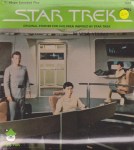
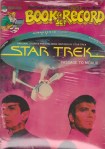
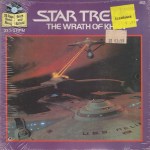
The 80’s wore on and cassettes replaced records all but completely. Between Star Wars and Jedi, we had graduated to things a little more challenging, such as the full-length movie soundtracks by John Williams. Without the cheesy narration, we were free to create our own adventures to the classic music. The old story records got tucked away…but they can still be found. Last Christmas, my buddy Rob Daniels from Visions in Sound received some old classic Star Trek read-along records. I have some too, also Christmas gifts, from my sister. She found four sealed Star Trek story records on 7″ vinyl and had to get them for me. They include the stories for The Motion Picture, The Wrath of Khan, and two original stories on a different label called Peter Pan records.
I’ve never opened these records, but I know inside I would find some glorious full colour pictures of space-scapes from the big screen, along with a pristine 7″ record. It’s tempting but they’ve been sealed this long, it would a shame to open them now.
*Not Superman: The Movie! It had some really cool deleted scenes added to the TV version, to stretch it over two nights!
**I can also hear, clearly in my head, the terrible TV dubbing done for Jackie Gleason’s character in Smokey and the Bandit. It was not Gleason, and it was obvious every time. Unintentionally funny!
“Science is a tool of the mind. With it one can open more doors than with the bare hands alone.” – Mr. Branday, Grand River High School, 1986
Getting More Tale #517: Science!
Never underestimate the power of science. Without science, we would not have the electric guitar. Science allows us to analyse wavelengths and wires and figure out why a piano sounds so good. With the tools of science, we can examine how music effects the human brain. With science, we can battle ignorance!
That in mind, here are some interesting science facts that we gleaned from the September 2015 issue of Discover magazine, in an article by Jim Sullivan.
You might wonder how singers like Paul Stanley or Freddie Mercury managed to sound as incredible as they did. It was the result of many factors, but both Paul and Freddie had strong vocal cords. The muscles in the vocal tissues do the work. Great singers have incredible control over these muscles, and take good care of them. They work by increasing and decreasing air resistance, by opening and closing. The compression and decompression of air creates waves…sound waves! Now think about the range of sound that the human voice can produce. It’s a very wide spectrum of sounds. Think about the complexity of those muscles and the nerves that control them! Get this — there are a few throat singers who are able to create up to four notes simultaneously!
Freddie Mercury was also probably dominated by the right side of his brain. Current theories state that singing is mostly controlled by the right, while language is in the left. Possible evidence of this can be found in some stroke victims. Some cannot speak, but can still sing. Another example that I remember from my childhood is country singer Mel Tillis. He was in a Burt Reynolds comedy, Cannonball Run. A young 10 year old me liked his character because he talked funny: he had a stutter. My dad told me, “He has that stutter in real life. He has a really hard time speaking, but he can sing like a bird.” I couldn’t believe it. My dad told me an old story, that Mel Tillis was talking on the phone with somebody and just couldn’t speak. His stutter was so bad that he couldn’t finish a sentence. So instead he began singing. Isn’t that a fascinating story?
How about volume? Well, it turns out that the average human speaking voice is about 60 decibels. According to the Guinness Book, there’s a lady in England named Jill Drake who can scream at 129 decibels. That’s about the same levels measured at an AC/DC concert. Perhaps Jill Drake should consider auditioning for the lead singer job in that band!
Singing is a special talent, and I’m not very good. I have poor control and I’m constantly flat or sharp. Why is this? Is it my vocal cords? According to another Discover article by James Dziezynski from July 2014, not really. A study showed that it’s probably the brain. The condition is called imitative deficit, and if you’re a bad singer like me, you probably have it. Essentially, our brains can hear and identify a note correctly. When we try to move our vocal cords to hit that same note, we can’t. The brain’s signals get scrambled. It consistently commands the vocal cords to hit a different note, no matter how hard we struggle with it. However, all is not lost. Like anything else, you can re-wire your brain with practice. Lots of practice, preferably with guidance.
This is heartening to know. There is hope, even for a talentless schmuck like me! Thank you, science.
25 years ago on this day, millions of fans used their illusions.
1991: First year of university, and I was hard at work on some reading. My sister and my mom were out shopping at the mall. The record store I eventually worked at opened up just that summer. Unbeknownst to me, they popped in on my behalf and returned with a present.
“Mike!” yelled my sister excitedly as they returned home. The dog barked loudly in shrill Schnauzer barks as she talked. “Did you know Guns N’ Roses have TWO NEW ALBUMS OUT?”
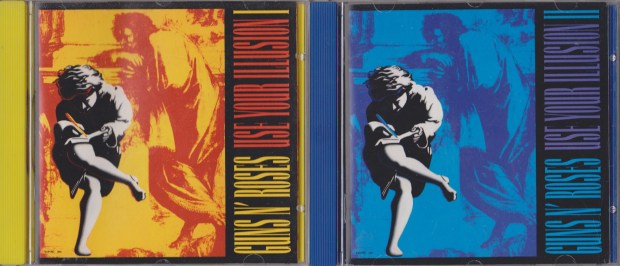
I sure did! Use Your Illusion I and II were the long-awaited true followups to Appetite for Destruction. With 30 brand new songs, Guns released the music as two separate but complimentary albums. My sister eagerly handed me a gift: a new cassette copy of Use Your Illusion II!
Why she chose II, I don’t know and it doesn’t matter. For this fan, II was the first. I had it a whole week before I caught up and bought Illusion I (again, at the same store I would work at only three years later). It was $10.99. Perhaps because I had the second album a week ahead of the first, I still really prefer II over I. Songs such as “Breakdown”, “Pretty Tied Up”, and “Locomotive” are three of the strongest and most ambitious rock songs on an already strong set. They stand up today as my personal favourites.
The Use Your Illusion albums spawned a combined eight singles: “Knockin’ On Heaven’s Door”, “Civil War”, “You Could Be Mine”, “Don’t Cry”, “Live and Let Die”, “November Rain”, “Yesterdays” and “Estranged”. Additionally, music videos were made for the tracks “Garden of Eden”, “The Garden”, and “Dead Horse”. Guns N’ Roses assaulted all formats as they trounced the world in a two year long world tour, with acts such as Skid Row, Metallica and Faith No More. They even suffered their most devastating lineup change right at the very start of it. Chief songwriter Izzy Stradlin departed in November of 1991, to be replaced shortly after by Gilby Clarke. Although he has made numerous guest appearances since, Izzy has never rejoined Guns N’ Roses.
Did you buy Use Your Illusion I and II 25 years ago today? Do you have a favourite?
It’s quite complicated actually, but the basic idea is that data is encoded in binary “pits” and “land”. If you recall your grade 10 math, binary allows you to record any data in ones and zeros. In the CD world, this translates to “pits” and “land”. Think of the pits as zeros, and the land as ones. When you burn a CD at home, musical data is encoded with a laser. The laser doesn’t actually etch the plastic or metal layers of a disc. Instead, it burns the data into a layer of dye. It is this dye that gives a blank CD its typical colours. Once this information is properly encoded onto the blank CD, you can then play it on most household disc players. But they don’t last forever. The colour of the disc can be a clue how much life it has. It can help indicate what dye was used in manufacturing.
Cyanine dye (green)
These are the earliest blanks made, with a layer of dye that was also UV sensitive. Unfortunately this meant that your CD could be destroyed by exposing it to direct sunlight. The dyes were improved to make them more stable, but many people had their data destroyed simply by leaving the disc out, playing side up, where sunlight could get to it.
Phthalocyanine (gold, silver, light green)
A more stable form of dye. You’d have to leave your CD out in sunlight for two weeks to destroy it. Unfortunately phthalocyanine dyes are more sensitive to the writing laser, and these discs required some technical advances to make for a good recording.
Azo (dark blue)
Rated for a storage lifetime of decades. More stable than the other two dyes. It would take a month of sunlight to destroy an azo-based disc. Also capable of faster writing speeds than other dyes.
Because it would have been easy to look at a green CD and say, “Nope, I’m not buying this one,” disc manufacturers tricked you by adding other colours to the dyes. But the type of dye is only one factor in how good your CD sounds and how long it lasts. A CD is like a sandwich made of plastic with layers in between where the data is stored. Poorly manufactured CD-Rs allow moisture to seep in between the layers and destroy the disc. And of course the quality of the burner is also critical to a good sounding CD-R. And be careful if you’re labelling your disc with a marker. Sometimes solvents from markers can react with the dyes.
In very rare cases, CDs and even DVDs have been known to explode during burning, according to a New York Times article from 2004. It happened when a disc was spun too quickly, probably as a result of heat from the burning laser combined with centrifugal force. This is why the upper limit for burning a CD is 56x. Go faster than that and your music could go BOOM (and not in a good way).
A re-writable CD is different still from a dye-based CD-R. A CD-RW (which can be re-written thousands of times) uses a metal alloy layer that is physically liquefied by the laser. It’s crystalline before burning, but less reflective after burning. Therefore a CD-RW has pits and lands made of more and less reflective spots on the disc. And if you don’t like it, you can start all over again. The laser re-heats the alloy, restoring it to its crystalline reflective state.
It’s all very technical and interesting, but how often do you record a CD today? Though burning a CD will always be a pastime for many music fans, the majority have happily moved on to easier and quicker flash storage. Is that as fascinating as a laser etching your music onto a disc? No, but however you handle your music collection is up to you.
I sure do, like they’re going out of style – always have. I used to, and still have, a number of the classic Freudian recurring dreams: Teeth falling out, being unable to speak, or even see. They were usually quite upsetting. Freud believed that many of these recurring dreams are expressions of neurosis and compulsive behaviour and I think when it came to me, he was right! Anxiety is suspected as a major cause of recurring dreams. When I finally graduated school and had seen the last of essays, homework, exams and marks, I continued having anxious school dreams in a big way. They would usually involve an exam that I had forgotten was occurring, or an essay due that day that I hadn’t started yet. These dreams happened for years after graduation.
I thought I had “outgrown” recurring dreams, but they started again not long after quitting the Record Store. Usually they would involve me starting there again, except as a part time employee without the responsibilities I had before. In the dreams, I would show up at the store, except it wasn’t my old store. In fact it wasn’t a store that existed in real life at all. The most common dream featured a store in the mall, much larger than any I’d actually worked in. I wouldn’t know any of the people I worked with in the dream, and they didn’t know me.
In some of the dreams, the Boss man would pop into the store, and in some, the office bully would show up, but be nice as pie, as if nothing ever happened.
If Freud was right and that all dreams are rooted in some kind of wish fulfillment, it’s clear that I missed working at the Record Store, but in an idealized way of not having responsibility or an office bully. However, Freud also stated that in adults, dreams are self-censored and distorted and impossible to interpret alone. Carl Jung believed that dreams were symbolic scenes and much more complex.
It’s interesting to look at these recurring dreams and try to remember the details, but ultimately it’s impossible to “figure them out” looking for some deep truth or hidden meaning. Within these dreams, I had never forgotten how to do the job. I jumped behind the dream-counter, helming the dream-computer and bought dream-CDs from dream-sellers. It was exactly like the old days, with all the problems and excitement that happen when you buy used music from the public: the anticipation of seeing something so rare that the store just had to acquire it, and then the tension of buying it from the customer who wanted more for it. It was all there, clearly remembered.
It is very interesting that these recurring dreams all but ceased after writing Record Store Tales. Perhaps Freud’s wish fulfillment has something to do with this. By re-living all the memories in print form, perhaps my unconscious mind realized that what my dream wishes were not at all what I wanted?
Never had a dream where I showed up at work wearing no pants, though!
From August 29 to September 2, writers were challenged to write music reviews by the same length rules as old print magazines: 200 words. No more no less. One of us even took it upon himself to take the challenge further with the old “Hit & Run” review style — a hard 80 words! Thanks to rock journalist Mitch Lafon for the impetus for this adventure.
The end result was 30 posts by six writers! Speaking for myself, I enjoyed the experiment. Mitch was right: forcing yourself to adhere to a hard 200 words does sharpen your skills. In addition, the challenge succeeded in bringing Vinyl Connection out of retirement (for now?) so no matter how you slice it, the #200wordchallenge has brought some good to the world. Each writer who participated even contributed more than they originally estimated they would! Perhaps the #200wordchallenge injected a shot of inspiration.
Be sure to visit our friends below, and check out their work. Thanks to each of these talented folks, we had a fun week. And a big thanks again to Mitch Lafon, a rock star in his own right. Click below for the posts, and give them all a hand (or 200 hands)!
GETTING MORE TALE #513: The #200wordchallenge (hosted by mikeladano.com)
Writing is a process of continual improvement. This challenge started a couple weeks ago when I posted my epic Def Leppard review for Hysteria, at approximately 2400 words.
One benefit this writing journey has done for me is put me in contact with some great professionals. Rock journalist Mitch Lafon (from One on One with Mitch Lafon) is one such professional, always willing to offer advice and encouragement. Mitch has a decades-long history with writing, having done many reviews for the print medium before embarking on his current journey interviewing the stars.
“Anyone can fill a page,” he said, “but it’s much harder to come up with a sharp 200 word review.”
Back in his print days, they used to have to adhere to a strict 200 word limit: no more, no less. Not 199, not 202. Mitch encouraged me to try this exercise. “It hones the mind and sharpens the skills,” said Mitch. That’s all I needed to give it a try! “Pithy is king,” he says. Sharp, concise and expressive. (Mitch also told me about the old “Hit & Run” review format – a hard 80 words!)
A few of the budding writers here have taken up the #200wordchallenge, and you will see our work next week. I will post links to all of the #200wordchallenge reviews from the writers taking part. Would you like to participate? Are you up for it? Leave a comment below.
Interestingly, WordPress and Microsoft Word seem to count words differently. My first #200wordchallenge review came up to 194 words on WordPress, but 200 words in Microsoft. My manual count was closer to Microsoft’s, so that’s what I’m using for my word counts. You may use whatever method you like as long as you’re consistent. Title and score do not contribute to the word count.
There will always be a big place in my life for an epic-style review. I don’t think I could have done Hysteria any other way. (I mean, I could have, but I wouldn’t be happy with it.) What’s your attention span like? Can you make it past 200 words when reading a music review? Comment below and let us know your take.
You up for it?
Look for reviews from the #200wordchallenge from Aug 29 – Sept 2. This page will be updated with links.
As readers here know, when I can get away with putting the minimum amount of effort into a story, I’m going to go for it. This one is lifted directly from my Facebook posts, a couple months after Jen and I got married. Her ongoing education in rock was just beginning. I can proudly say that today, Mrs. LeBrain knows the difference between Van Halen and Van Hagar. But in 2008?
Oct 9 2008:
TOP TWO QUOTES FROM JENNIFER TODAY:
#2Some background, I was playing the track “Me Wise Magic” by Van Halen, an obscure song with David Lee Roth singing. I said to Jen, do you know who this is? And she responded:
“Yeah…is this Van Hagar?”
#1“Wow is your beard ever grey!”
But I’m still gonna stay married to her anyway.
It’s even more grey today.
Jen likes both Van Halen and Van Hagar now, and she’s perfectly capable of telling the difference. She counts “Jump” and “Why Can’t This Be Love” as her favourite VH songs, tied for the #1 position. Considering that in my dating days, girls used to insist on listening to MuchDance95 in the car, I’m a very lucky man. I dodged some musical bullets, and somehow ended up with the best girl in the world.














 mikeladano.com