RSTs Mk II: Getting More Tale

#529: Demanufacture

GETTING MORE TALE #529: Demanufacture

When a store buys and sells used CDs, theft is an ongoing problem.  It’s not the left of your own stock that is the issue.  Used CDs are usually kept safely behind the counter in 99% of stores.  The theft headache is more a problem of people selling stolen goods to you.

We have discussed these issues here in the past [click the links for the full stories].  In order to combat theft, all customers selling used goods had to be 18 years or older, with valid government issued photo ID.  No photo ID, no sell.  People would get pissy about it (“I have to show you ID to sell one CD?”) but that was the law in the province of Ontario.  We didn’t make it, we just followed it.  To a “T”.  That was our responsibility and how we protected ourselves.

Stolen CDs are not easy to identify at a glance.  They don’t come in with glowing security dye on them.  They look like any other CD.  Sometimes they are sealed, but what does that prove?  Only that the disc was never opened.  I have lots of CDs here that have not been opened yet.  The best clue might be if a young Korn-looking kid came in selling a well-stocked jazz collection.  (Yes, that’s profiling.)  It was often an indicator that a kid may have ripped off mom or dad’s CD collection.  Sadly this happened a handful of times in my 12 years at the store, and once to a customer that I knew.  He was ripped off by his own son.

We did our part by taking the ID.  We also diligently recorded every single disc bought from customers.  Every single one.  Whether you sold one CD or 150 CDs, we had to write down every last title.  (Before we had computers to do it with, anyway — the cops hated our penmanship.)  This helped police track possible stolen property…but only if the victims reported it stolen.  If they said, “I lost 150 discs,” that doesn’t help.  If they instead reported, “I lost 150 discs, mostly jazz.  There was a Miles Davis Bitches Brew, Sketches of Spain, Kind of Blue, Milestones, and Tutu…” then they might have a chance.  Those titles were less common and should stand out among the fodder.

When T-Rev and I were working at the first store in the chain, at a small mall, we used to get unfortunate calls about stolen property infrequently.  The guy who worked at Dr. Disc downtown was one such victim, who put an A.P.B. out for his lost collection.  He lost a number of Beatles discs, but he marked them with a piece of tinfoil under the CD tray.  It was rare that we’d see the stolen items, but on one occasion in 1995, we were able to save the day for one particular customer.

stencil-guyPeter the Rocker was a regular.  The legend goes that he painted the Metallica “stencil guy” on the hood of his car.  His Austrian accent made him sound more “metal”.  He once announced loudly, “Hey, someone shit their fucking pants in this store!”  (Everybody could smell it, apparently, except the perpetrator who approached the counter to ask questions.  We backed up as far as we could and tried not to breathe.)

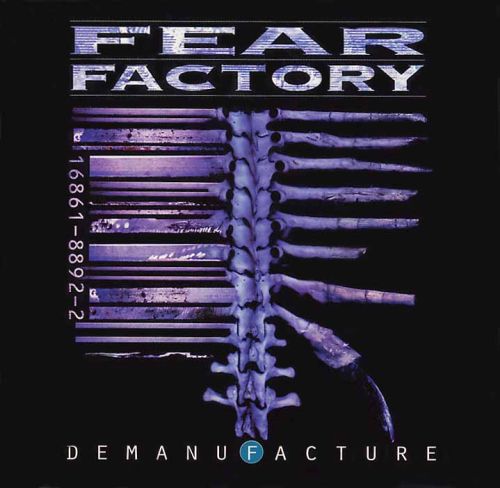
He came in to see T-Rev one afternoon, quite upset because a number of his CDs were stolen.  He gave Trevor a list.  As mentioned, it would be helpful when a list like this contained at least one “rare” or “uncommon” title.  Peter the Rocker’s rare title was the latest Fear Factory album, Demanufacture.  It was the new imported limited edition digipack with three bonus tracks.

Lo and behold, a kid came in later and sold the Demanufacture digipack with bonus tracks.  The police and Peter were alerted.

The police came in, got our records, and tracked down the young seller.  “You sold these CDs.  Which of these is the one that you can only get on special import?”  The kid couldn’t answer.  He didn’t know because they weren’t his.  They were Peter’s.

This is a fine example of the customer, the store, and law enforcement working together to get results.  Peter got his CDs back, happily so.  The kid got busted, and we got to be the good guys by helping to get this done.

Crime doesn’t pay!

#528.5: Klassik Kwote of the day – “Side Project”

The Foo Fighters took a break in 2001.  Their new album, to come later as One By One, was not going well.  The band were infighting, and the album was put on hold.  Around that time, Josh Homme hooked up with his old buddy Dave Grohl and invited him to play on the new Queens of the Stone Age album.  Dave was growing wearing of frontman duties in his own band and was happy to just be a drummer again for a little while.

The resultant QOTSA album, Songs for the Deaf, was a smash hit.  Dave Grohl’s presence brought them a higher profile than before, but it was also just a flat-out kick ass record.

One of our store managers, Joe “Big Nose” was a Queens of the Stone Age fan going back to Kyuss.  Though I was not there personally when this happened, Joe likely had an internal meltdown when a customer asked:

“Hey, do you have that new side project of Dave Grohl from Foo Fighters?”

I bet there was steam coming out of Joe’s ears!

#528: The Ratings System

GETTING MORE TALE #528: The Ratings System

You like reading music reviews. You read them for information and entertainment. You can’t get enough music reviews!

But what formats do you like? Perhaps you enjoy a meaty, detailed review with all the nitty gritty details. Some get bored with length, and just want a quick n’ dirty summary. This is why we tried the #200wordchallenge, and why Aaron at KeepsMeAlive enjoys the old-fashioned 80 word “hit and run” style from time to time. And others, such as our friends at 1001AlbumsIn10Years, are skilled at metaphors, and have added innovative graphics and charts to album reviews.

All of these techniques are valid, and the more unique and individual reviews certainly deserve praise for breathing fresh life into an ages-old format. But what about a numeric ratings system?

Some kind of rating is pretty standard for music reviews. Rolling Stone magazine uses a five-star system. So does Allmusic and NME, but Spin magazine uses a 10 point system. These allow a reader to very quickly see if a writer thought an album was any good, without having to actually read anything!

Here at mikeladano.com, we use a loose 5 star system. This originated at Amazon, where products must always be rated from 1-5 stars. Most of our earliest reviews here began life at Amazon, before they were expanded and modified for your edification. Because of this, we imported and have continued with an Amazon-like 5 star system.

Even this is limiting, so we have allowed fractions – you will see many 3.5/5 star reviews here. This essentially makes it a 10 point system like Spin’s.

But it’s not an exact science and that’s where we get into trouble.

It’s fairly easy to listen to an album a few times and decide on a number rating that feels right. A 5/5 feels like a near-perfect listening experience. A 4.5/5 might have some perceived flaws. But when you get into seriously comparing and stacking albums up against each other, the differences can be felt.  It’s also worth noting that a 5/5 star jazz album and a 5/5 star Kiss album are going to be wildly different from each other.  It’s all in the ear of the beholder.

Taken individually, ratings usually hold up. When compared amongst a band’s entire discography, things get dicey. Our series of Iron Maiden reviews was one such example. They have so many great albums – amazing albums, in fact – that it is quite easy to lay down 5/5 stars to much of their discography. But this ignores minor different degrees of rock excellence. Iron Maiden’s Rock In Rio is excellent. It is a rollicking heavy metal journey exploring Maiden’s history up to 2001. But is it as good as Live After Death? No. Very few things are. Both could easily have received a 5/5 rating, but we chose to lower Rock In Rio to 4.5/5 stars to keep everything in perspective.

Down these roads lead madness. We have even done a 4.999/5 star review.

If you review 1000 albums on a scale out of 5, you could quickly build up enough fractional ratings to necessitate three decimal places. But that complicates things needlessly. Wasn’t the numerical rating system supposed to be a quick and easy way to say if it’s good or not?  We have done 6/5 star reviews, reviews in negative numbers; we’ve done everything imaginable to try to keep ratings in scale.  Ultimately it is simply not possible.  Like finding an electron in a cloud, you just cannot pinpoint album ratings to that degree of precision.

A numerical rating can also paint you into a corner. There was some Facebook controversy recently over our assertion that Motley Crue’s self titled 1994 was one of the best albums of the 90’s, killing much of the competition. This led to challenges and comparisons with other albums of the period, all great records. How do you rate something “the best” over a bunch of other 5/5 star albums? And how do you know that you will still feel that something is “the best” when you think about it again next month? Putting a numerical rating on an album is like putting it into stone, and that can be limiting, especially when comparing.

We’ve been utilizing the 5 star system (with fractions) for close to five years now. We could stop, but at this point I don’t think it would help. For better or for worse, our bed is now made. And it’s 5/5 stars.

#527: Get Glasses

A double feature in cooperation with BoppinsBlog!

GETTING MORE TALE #527: Get Glasses

In 1989, two things happened to me that changed everything.

Upon entering the 12th grade, I realized I was having trouble seeing distance.  I was taking an OAC level Geography class, but I couldn’t see the text on the overheads.  A checkup at the eye doctor revealed that I needed glasses.  At roughly the same time, I got my first real job at a grocery store, and had to cut my long hair.  Within a matter of months, I had transformed from a long haired rocker to a short haired geek with huge glasses that I dubbed my “welding goggles”.

None of my favourite rock stars looked like me!

There is however a huge precedent for rock and rollers with glasses.  Most people immediately think of John Lennon, but think back to Rubber Soul.  Lennon wasn’t wearing his glasses in 1965.  He could be seen wearing prescription sunglasses, but not until 1967 was he wearing his normal glasses on a regular basis in public.  The first album cover with a bespectacled Lennon was Sgt. Peppers.

Lennon was inspired to wear his glasses by the original icon, Buddy Holly.  Buddy’s black rimmed glasses began a trend in America, and that style of frames became known as “Buddy Holly glasses”.  A young Elton John, who didn’t even need glasses yet, began wearing them just to look like Holly.

Today, there are countless more stars who wear glasses on stage, although many use custom shades.  Elvis Costello, Lisa Loeb, Robert Fripp, Ozzy Osbourne, Rivers Cuomo, Peelander Yellow, Weird Al Yankovic, and so on…the list is endless.*  But who wore them best?  Certainly not Bono, who could make even the simplest pair of glasses look pompous.  It’s tempting to say Jerry Garcia, since the glasses just make him look even more like a big teddy bear.

But there can only be one winner, and this is actually an easy choice.

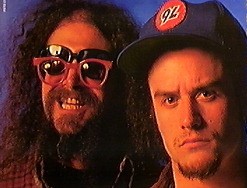
The one artist that wears glasses best is Sir James Martin, ex-of Faith No More.  For the simple reason that he is the only one who wears two pairs of glasses simultaneously.  Take that, Bono!

jim

*Keith Richards does not wear glasses.  Science has shown his eyesight lives forever. 


#526: Location, Location, Location

GETTING MORE TALE #526: Location, Location, Location

I worked at many Record Store locations over the years, often temporarily for training and managing.  Some of them I spent a few days at, others were several weeks or months in total.  Each one had its own flavour and clientele.  While experiences and mileage may vary, here are some memories of some favourite locations (all in Ontario, Canada).


cambridge1. Cambridge

The store in Cambridge was our first to carry movies, initially in VHS format.  It was a lot of fun working there from time to time, buying and selling used movies.  There was always something I wanted for my collection, and it broke up the monotony of seeing nothing but CDs every day.

Cambridge was also interesting because we used to get a number of people coming in just to ask where the strip club was.  “It used to be around here!”  I don’t know why the dudes looking for the strip club kept stopping in the Record Store (as opposed to the Tim Hortons or a gas station or anywhere else), but they did indeed used to ask.

Some of the customers in Cambridge were…well, let’s just say they were not all our best and brightest.  T-Rev managed that store, and I took over temporarily when he was on road trips elsewhere setting up new stores.  The customers there wore me down more than anywhere else.  Especially when they came in to sell, which was frequently.  Cambridge bought a lot of stock.  If the customer wasn’t happy with my offer, they’d ask when the “regular guy” would be back.  Maddening since I was more generous than a lot of other folks.

There was one customer in Cambridge who hated selling to me, he always asked where “the regular guy” was.  He asked my name and I told him it was Sanchez.  When T-Rev came back, we had a laugh over the employee named “Sanchez” who was apparently low-balling this customer for his dance CDs.


hamilton2. Hamilton

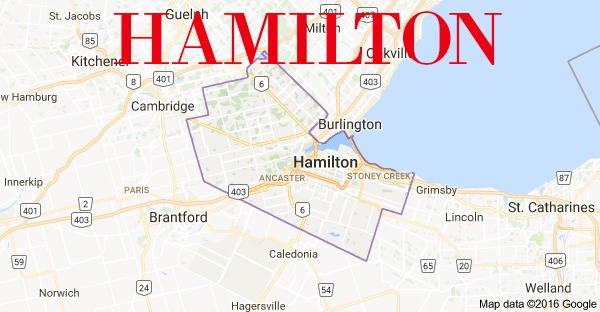
The store I worked at in Hamilton was pretty quiet most of the time.  There was a lunch time rush when kids from the nearby highschool would come in to listen to and occasionally buy CDs.  Given Steeltown’s reputation, I was pleasantly surprised to find the kids I dealt with to be polite and friendly, more than I was used to seeing.  The adults weren’t always so friendly, but no more or less than any of the other stores I worked in.  Hamilton was a shitty place to drive (confusing one-way streets), but I didn’t mind working there at all.


kitchener3. Kitchener

I worked in three different stores in the Kitchener area.  One of the other guys there used to refer to Kitchener as a “ham & egger” town, a phrase I never heard before.  A lot of blue collar customers.  It was still a step up from Cambridge, depending on which Kitchener location I was working in.

I’ve said many times that my favourite store was the original one, in a small mall in Kitchener.  It was our only mall store ever.  It was a special place to work.  It was tiny and compact.  It could get really busy on the weekends.  There were a lot of regular customers, more than I remember elsewhere, probably due to the fact we were in a mall.  There was a familiarity – I knew them, and they knew me.  When I was eventually given a larger store elsewhere to manager, I missed the faces I would see on a regular basis at the mall.

I also missed the “unique” individuals you’d meet at the mall store.  Malls have a whole ecosystem of life forms, unlike others in the outside world.  There was Johnny Walker, so named because every day he would walk the circuit around the mall, talking to himself, all day.  One day, something peculiar happened.  He came in, stopped talking to himself, and bought a tape.  He paid for his cassette and then resumed walking and talking to himself again.  I only saw that happen once.  There was Butts, the guy who would dig through ashtrays looking for cigarette butts.  Let’s not forget Trevor the Security Guard, and the drunks at the restaurant next door.  It was a blast!  I didn’t care for the mallrats, but they were a minor annoyance.


oakville4. Oakville

I did not like working on Oakville, as was discussed in Record Store Tales Part 16: Travelling Man.  Many of those customers were snooty; just too good for you.  They felt entitled to park in the fire lane, because they were more important than you.  Read the Oakville tale for the misery that was working there.


mississauga

5. Mississauga

More than any other location, I may have resented Mississauga the most.  It was a shit location.  There was nothing of any value around.  There was a health products store, but nowhere to buy a snack or a lunch.  There was no foot traffic.  Across the street was an empty field.  It was a dead store from the day it opened.  I invested myself deeply in my work.  There are many things in life that can crush your soul.  One of them is working hard at something (training employees, helping set up a store) and seeing it come up to nothing.  That was Mississauga.  In the used CD business, you depend on customers bringing in good stuff for you to re-sell.  Mississauga provided very little good stuff.


There were more, all with tales of their own.   These however were five of the most memorable, each for its own reasons.  While a change of scenery is nice once in a while, there is nothing better than working in a location you love.


#525: Best Hats in Rock

GETTING MORE TALE #525: Best Hats in Rock

With all the head-banging going on, it’s no surprise that the majority of rockers do not wear hats on stage.  The flailing around in musical ecstasy means that hats don’t stay on top for long.  Also, with those hot stage lights beating down, nobody needs to preserve their body heat with a hat.

Yet some rockers have managed to make hats a trademark.  Let’s have a look at five of the best.*


ament

5. Jeff Ament’s whatever hat

During the Ten period, Pearl Jam bassist Jeff Ament used to sport some cool, huge hats.  We have no idea what you call these hats, but there is no denying their 90’s cool-ness.  If I had long hair again, I’d want one of these hats.

blackmore

4. Ritchie Blackmore’s pilgrim hat

Blackmore is well known for his anachronistic mixture of time periods.  Playing medieval music with electric guitars?  Sure, why not.  We don’t know why Blackmore wants to look like a passenger on the Mayflower, but it does not matter.  The hat has become iconic, though not as iconic as…

lemmy

3. Lemmy Kilmister’s assortment of Motorhats

God bless Lemmy, for he had a fine collection of headgear, usually emblazoned with skulls, crossbones, and World War II symbology.  Lemmy may not have been a fashion icon, but he did own some pretty cool hats.

johnson

2. Brian Johnson’s newsboy hat

This one is near and dear to my heart.  Brian’s hat was to cover a receding hairline, but I had one just like it.  It was perfect for keeping a tangled mess of hair under cover.  Best of all, I could use it as a “hair mold”.  I would comb my hair in the morning, tuck it under the hat to “set” it, and an hour later it would come out looking perfect!

slash

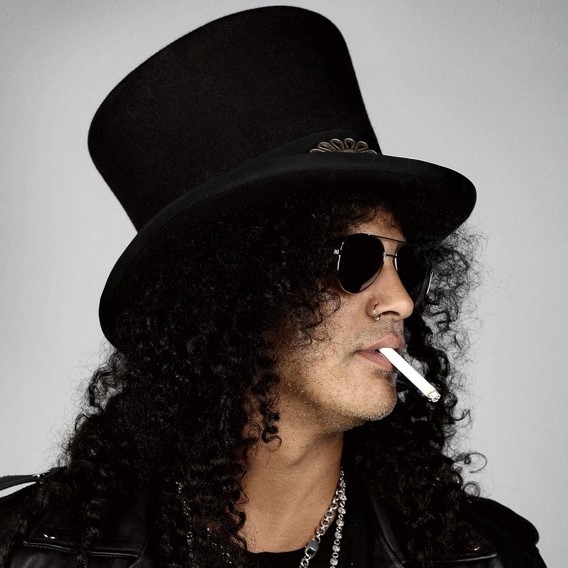
1. Slash’s top hat

At LeBrain HQ, we think Slash’s hat has become the most iconic rock and roll piece of headgear.  One look at that hat, and you automatically know who is underneath it.  The fact that Slash hid his face behind curtains of hair meant that fans had to recognize him in other ways.  That’s where the hat comes in!  Even if you wouldn’t recognize Slash’s face in a crowd, it’s a guarantee that you know his hat.


Honorable mentions:

Kim Mitchell’s OPP hat

Tom Morello’s assorted baseball hats

Mick Mars’ skull hat


What are your favourite hats in rock?


*Not including bandanas or hair pieces

#524: Hockey Night in Canada (Video – thanks to Geoff from 1001AlbumsIn10Years)

In Getting More Tale #521, we discussed the pros and cons of DVD recorders, a now-outdated technology. In short the cons were the price, but the pros were the ability to keep a television recording virtually forever.  DVD recorders were meant to replace VCRs.  A VCR and a decent quality tape could enable you to keep a recording for a couple decades, at least.

I lamented that one recording that we lost on our old PVR was a vintage re-run of Hockey Night in Canada, May 8, 1994.  My wife, Mrs. LeBrain, had the honour of meeting Don Cherry that night, and got to be on Canada’s most popular television show.  Periodically, Leafs TV would re-run the old games, and we recorded it the last time it was on. However this was lost when the PVR bit the dust.

If only we had a working VCR…

Well, as it turns out, Geoff from 1001AlbumsIn10Years has a working VCR.  Not only that, but he also possesses an original recording of that night’s hockey game from over 22 years ago!  He dug it out, and sent the below video to me.

That’s Jen with her Dougie Gilmore sign, and Canada’s national treasure Don Cherry.

The story goes, Jen’s dad won a radio contest to see the Maple Leafs wherever the next round of the playoffs were being held.  That happened to be San Jose, California.  This happened to fall on Mother’s Day.  Jen’s dad intended to take her mom on a nice vacation.  This however was not to be, not after a young crying Jennifer bellowed “But mom doesn’t even LIKE hockey!”  It was true, and Jen got to go with her dad.

Thanks Geoff — you have no idea how much this video means to us!

Mike + Jen


#523: Columbia House

GETTING MORE TALE #523: Columbia House

How many of you were members of the Columbia House music club?  Tapes or CDs?

The concept was simple.  Get 12 tapes or records for one penny.  Then agree to buy “X” more at “regular club prices” within a year.  They would usually offer all sorts of incentives, such as getting your first regularly priced item for half price.  Their “regular club prices” were fairly high, but if you played your cards right you could make joining the club worthwhile.

Every few weeks after signing up, Columbia House would send you a catalogue and an order form.  The order system was controversial, because it required a negative response if you didn’t want to buy something.  When you signed up, you could pick your favourite genre of music (I chose “metal”).  Each time a catalogue came out, your selected genre would have a “selection of the month”, usually a new release but not always.   If you did not respond with an order form expressing that you didn’t want it, they would automatically mail you the “selection of the month” and bill you for it too.  (The Columbia Record Club system was worked into a sub-plot of the movie A Serious Man by the Coen Brothers.)

For many people this wasn’t a problem.  Our parents let my sister and I sign up when I was in grade 11.  We split the membership and free tapes 50/50.  We paid for everything ourselves and diligently sent in our order forms each time.  We were both already massive music fans, so we poured over every single page.  Most times, one of us ended up buying something, if not the selection of the month itself.

I can still remember every album I received in that first shipment. Seven tapes.  These tapes went into immediate and constant rotation, which is why I remember them all so well today.

  1. Leatherwolf – Leatherwolf
  2. Motley Crue – Girls, Girls, Girls
  3. Hurricane – Over the Edge
  4. Stryper – To Hell With the Devil
  5. Stryper – In God We Trust
  6. White Lion – Pride
  7. Sammy Hagar – VOA

Our musical world opened up in a massive way, and not just because of the new music we were listening to.  The catalogues introduced us to names and album covers that we’d not experienced yet.  What is this Bitches Brew thing?  Why did Deep Purple albums have so few songs?  Did Iron Maiden copy their Maiden Japan from Purple’s Made In Japan?  Holy crap, Hank Williams Jr. has three greatest hits albums?

Everything was absorbed.  Five years later, when I started at the Record Store, my boss was surprised that I knew who most of the artists were, what sections they should go in, and even what record labels they were on.

“I read the Columbia House catalogue cover to cover every month,” was my answer!

The catalogue provided knowledge, and pictures to cut out for locker or wall.  We made the most of that catalogue every time.  It was rare when pictures were not cut out!

I was even able to acquire things that might have been considered rarities back then.  I had never seen Leatherwolf stocked in a store, but Columbia House had it.  When vinyl was being discontinued, I was still able to get Skid Row’s Slave to the Grind (1991) on LP.  They had most of the Savatage albums.

It all sounds wonderful, but Columbia House had flaws too.  The biggest one was horrendous quality control.  They licensed and manufactured the tapes themselves, which were simply not as good quality wise as the ones you could find in a store.  They would be warbling within weeks (if not right out of the case) and the J-cards were sometimes shoddy, with printing not lining up with fold lines, or just they’d just start falling apart along perforations.  They also didn’t carry certain record labels.  While they had everything Warner Bros and Columbia Records, they had nothing from EMI.  Finally, bands made next to nothing on albums that were sold through Columbia House.  Some bands such as the Tragically Hip refused to sell their music via Columbia House.  We didn’t know all of this as kids, of course.  I started to pick up on the quality issues when they seemed to take a serious dive around 1991.

The key to not getting ripped off by Columbia House was to order smart.  The 12 free tapes sounds like a great deal, but when you balance in buying the rest of your selections at full price, most people ended up on the losing side.  Get in and get out, buying the bare minimum.  That was the way to do it.  Of course, we didn’t.  We just enjoyed the convenience and stayed members for years!  No regrets since this led directly to a 12 year career in the Record Store!

#522: Smells Like Tim McGraw

GETTING MORE TALE #522: Smells Like Tim McGraw

Music fans can buy just about anything with their favourite band’s name on it.  While Elvis merchandise and the onslaught of Beatlemania stuff makes for fun collectibles, Kiss really blasted things into overdrive, for better or for worse.  Growing up in the late 70s and early 80s, we were inundated with Kiss.  Neighbors on our street had Kiss cards, the Kiss remote control van,  Kiss comics, Kiss posters, books about Kiss and more.  You could buy Kiss dolls.  Kiss Your Face makeup.  Everything!  At the time Kiss were heavily criticized for their merchandising.  Paul and Gene defended it by saying, ‘if our fans want to buy a Kiss hat, then why shouldn’t they be able to buy one?’  Turns out their fans wanted to buy a lot more including cars and coffins!

Now the merchandise door is wide open.  Everybody has dolls; my sister had some wretched New Kids on the Block dolls.  I have a friend who owns the Spice Girls.  I myself own Johnny Cash, Alice Cooper and Ozzy Osbourne.  Today, music celebrities have their own alcohol, such as Motley Brue or The Trooper beer.  Rock stars even have their own hot sauces.  I was a proud owner of Joe Perry’s Boneyard Brew.  (I’ve never been able to find Michael Anthony’s Mad Anthony sauce.)  I often like to picture Joe Perry hard at work over a boiling pot, mixing specially selected peppers and spices until he finally came up with his own Boneyard Brew.  It’s not impossible, although it is unlikely.

What is very highly unlikely is that Justin Bieber studied perfume chemistry to come up with his own scent, “Girlfriend”.

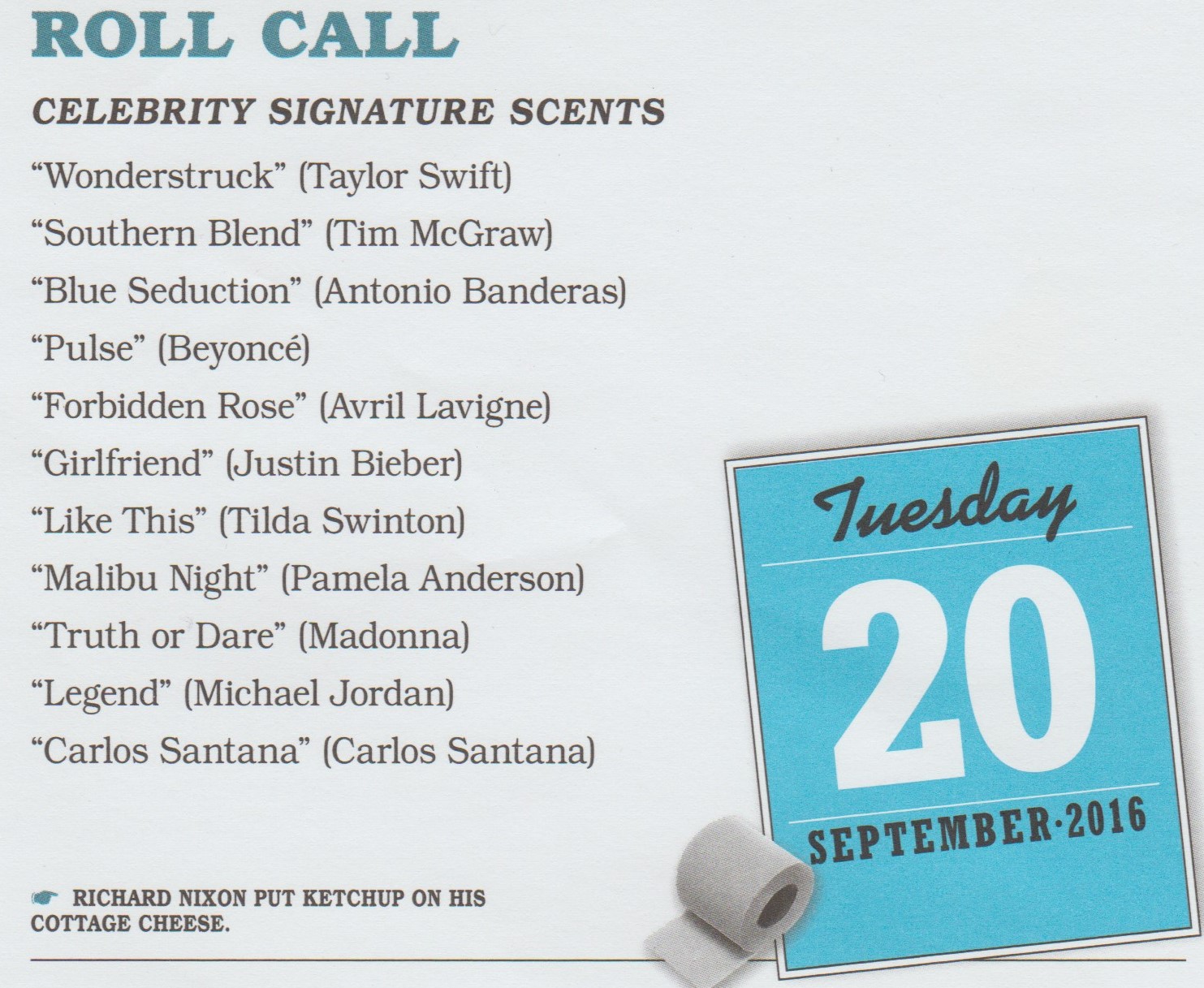
It seems perfumes and colognes are the latest hot trend in celebrity endorsements.    We are not so naive to think that the stars have anything to all to do with their own perfumes, but look at the list below.  (Courtesy once again of Uncle John’s calendar.)  Taylor Swift and Beyoncé don’t surprise me, but I didn’t know Tim McGraw had his own scent (“Southern Blend”).  Check out some of the interesting names below.

scan_20160922

Who knew Carlos Santana had a scent called “Carlos Santana”?  I wonder who came up with that clever name?  (Whoever they are, they probably make more money than us.) Even Kiss have a cologne, called “KISS Him for Men”. Kiss sell aftershaves and deodorants too. But we can’t blame Kiss for this trend, can we?  This one is on the shoulders of Hollywood.

The first celebrity scent was “Sophia” by Sophia Lauren, in 1981. The Italian film icon’s perfume was released by Coty who work with just about every major celebrity today. That’s not the interesting part. What is interesting is that we might be able to blame Gene Simmons just a little bit for the first music celebrity scent. After all, it was his ex-girlfriend Cher who was the first music star to enter the perfume world. Her scent “Uninhibited” was the first for a music performer. Did her ex-boyfriend’s merchandising ways have anything to do with this? The truth is, probably not — but it’s fun to blame Gene anyway.

With the reigning queens of pop like Katy (“Killer Queen” and “Purr”) and Gaga (“Fame for Women”), not to mention the boy-throbs like One Direction (“Our Moment for Women”), it is likely that music perfumes and colognes will remain big business for years to come.

#521: DVD Recorders


GETTING MORE TALE #521: DVD Recorders

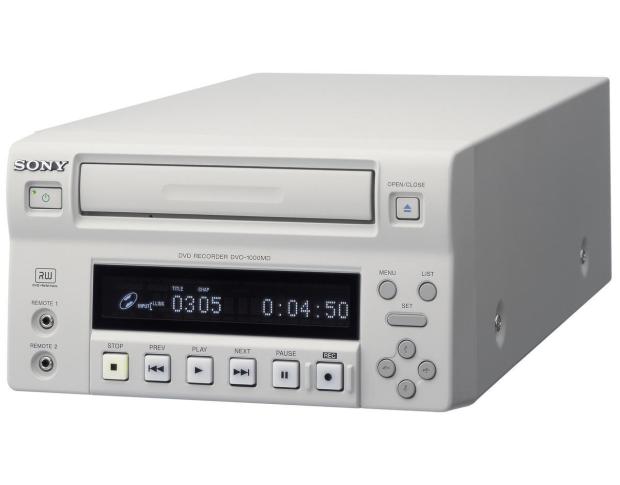
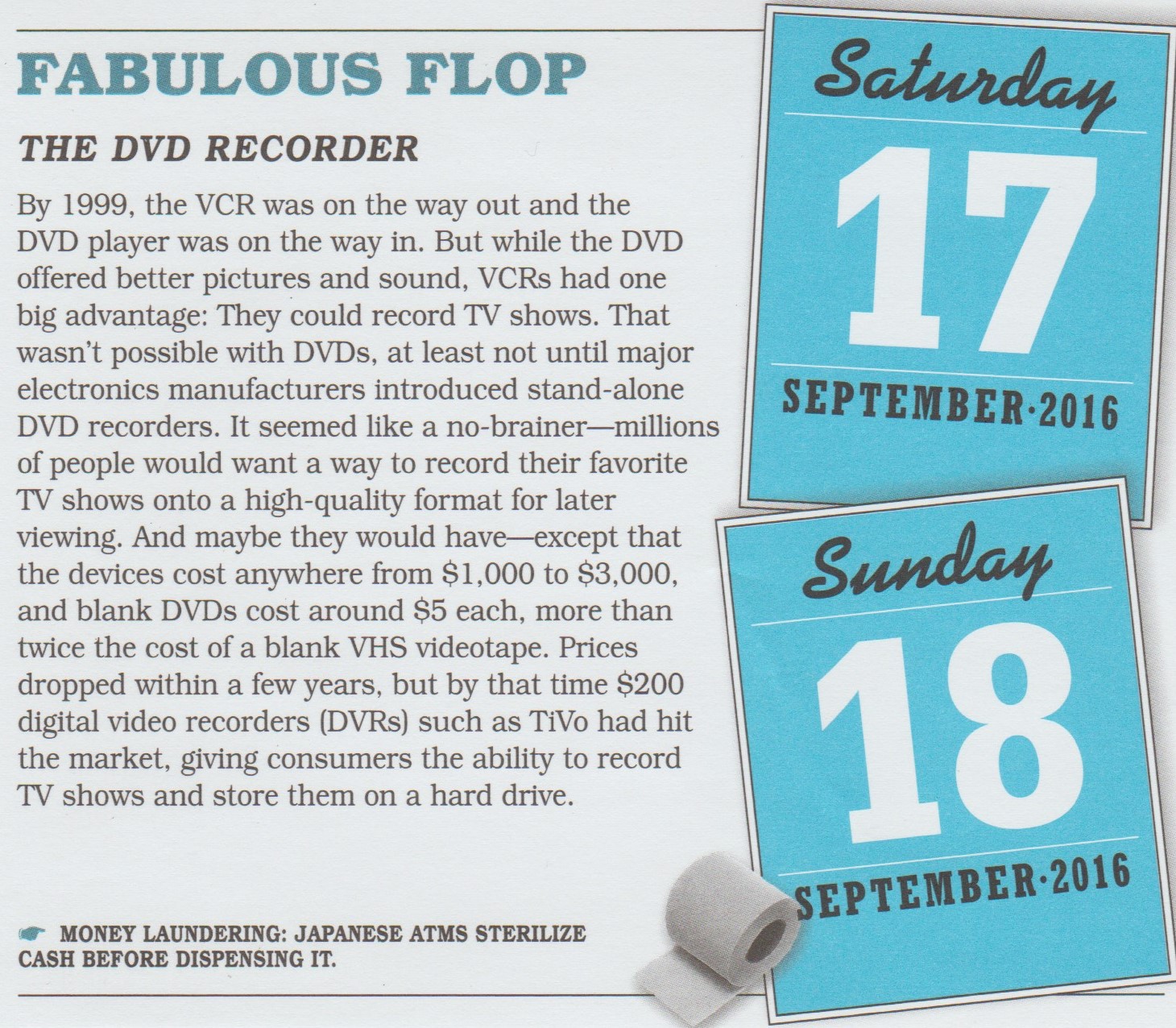
Obsolete and outdated technology can be fascinating to look at. For a long while, it looked like everything was going to go DVD.  Even music.  There was talk of box sets by bands such as Led Zeppelin or the Beatles that could fit the entire catalogue on one disc.  The Digital Versatile Disc all but completely took over from the VHS tape for viewing, so why not for simple household TV recording too? Enter the DVD recorder. This was not the same as a DVD burner for your computer.  It was a standalone unit for your home entertainment system, connected to your cable box and ready to go.  As you can guess, it failed gloriously. Why? Uncle John’s daily calendar tells us it came down to cost:

scan_20160920-2

While it is considered obsolete now, the DVD recorder had one slight advantage over the typical PVR that you can rent today from Rogers Cable. That is keeping a recording permanently. I’ll give you a great example.

In 1994, my future father-in-law won tickets to go see the Toronto Maple Leafs during the playoffs facing off against the Sharks in San Jose. My future wife came with him, bearing a sign that said “DOUGIE G. FOR PRIME MINISTER”. This is of course a reference to legendary Toronto Maple Leaf center Doug Gilmour. Then my wife saw the unmistakable Canadian hockey broadcaster Don “Grapes” Cherry in the lobby, with his colourful suit and camera crew.  She shouted out “GRAPES!”  Nobody else in California would have known him as “Grapes” so he knew it was a fellow Canuck.  He saw the Dougie G. sign — his favourite player from Kingston, Ontario.  He asked her to come on down. That’s how my wife got on Hockey Night in Canada back in 1994. We have a copy of this on video tape, but when the game was re-run a couple years ago, we recorded it including the part with my wife on our Rogers PVR.

It was nice to have it digitally but we always knew we’d lose it if the PVR busted. There’s no way to retrieve a recording from it, according to Rogers. So when it finally kicked the bucket, we lost the hockey recording. No matter; we’ll just wait for the next re-run.

If we only had an old-fashioned DVD recorder, however, we’d have a hard copy that we could have kept safe and sound forever!