The photo below is from a visit with Jen’s cousins. Little Roman was a whirlwind of energy. He really liked my Transformers books — throwing them, that is! He was also excited that the hotel had free apples for everyone.
Needless to say, a child like that cannot be monitored at every second. It was no surprise when I found an apple with one tiny child-sized bite out of it hidden in our hotel room!
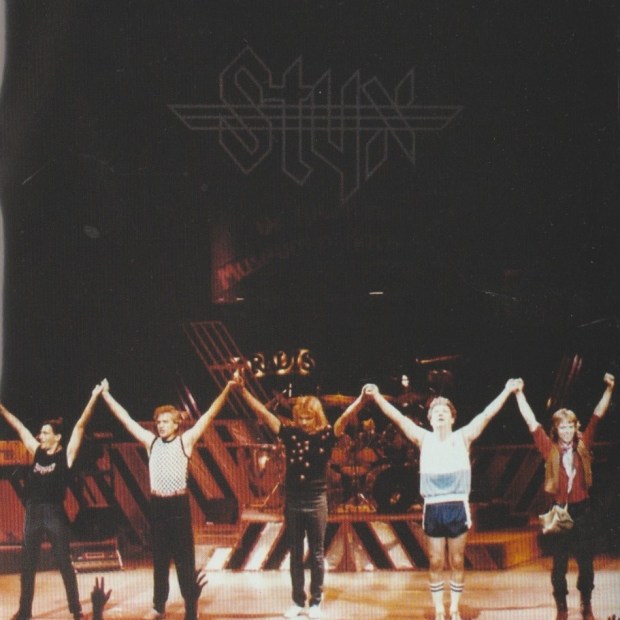
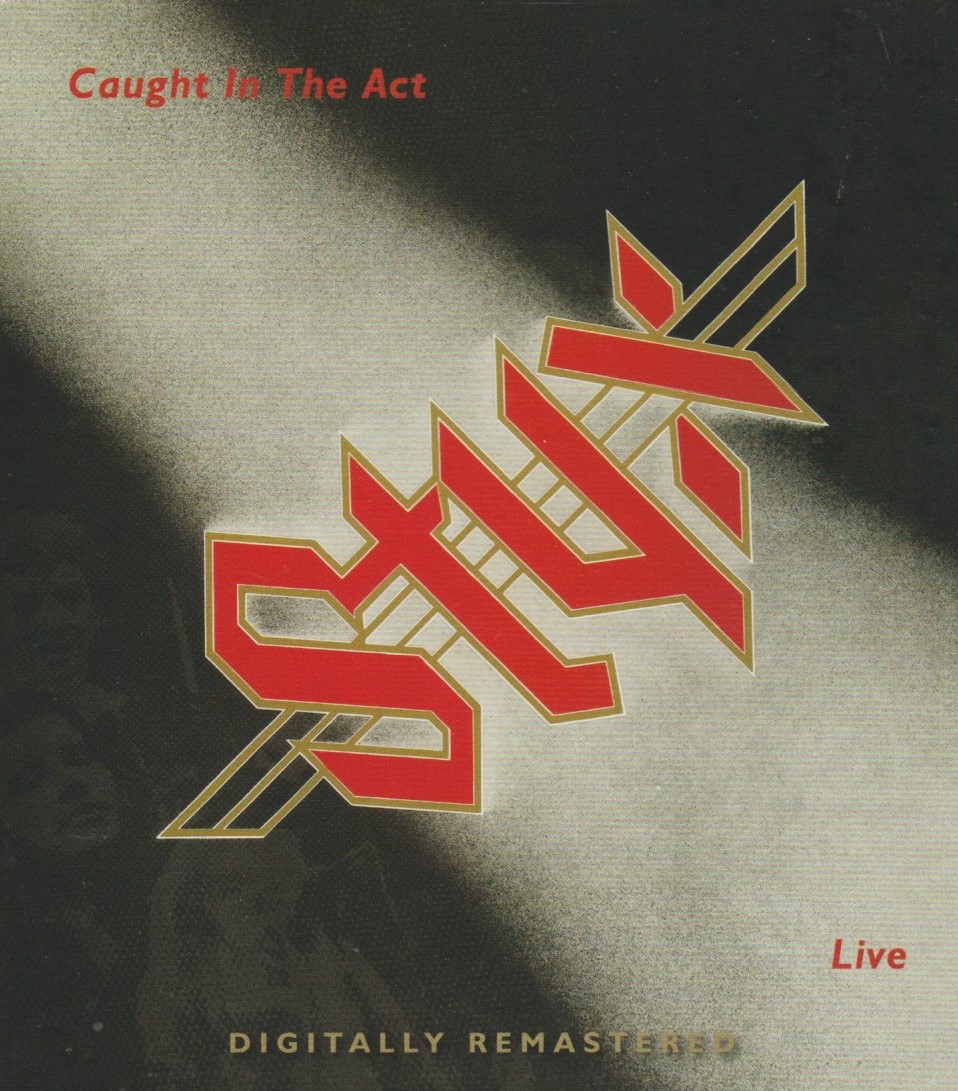
STYX – Caught in the Act – Live (1984 A&M, 2018 BGO reissue)
“Hey everybody it’s Music Time!”
Sorta, anyway! Styx were just about toast after “Mr. Roboto“, and Tommy Shaw didn’t want to sing any more songs about androids. (Mars, however, was fine.) He departed to check out some Girls With Guns, but not before Styx put out one more product before hiatus. That would be the traditional double live album, which was actually Styx’s first.
Styx have lots of live albums now, but only two with Dennis DeYoung. Caught in the Act is essential for a few key reasons. It sounds great although there are clearly overdubs in places. It is the only one with the classic lineup of DeYoung/Shaw/James “JY” Young/Chuck Panozzo/John Panozzo. And it has plenty of classic Styx songs that still shake the radio waves today.
Like many live albums, Caught in the Act contained one new song. Dennis DeYoung wrote the uppity “Music Time”, a very New Wave single without much of the punch of old Styx. Shaw was so nauseated that he barely participated in the music video. “Music Time” isn’t one of Styx’s finest songs. It’s passable but clearly a misstep. No wonder it was a final straw of sorts for Tommy Shaw.
With that out of the way, on with the show. Styx opened the set with “Mr. Roboto”, a mega hit that got a bad rap over the years until nostalgia made it OK to like it again. Fortunately only two songs from Kilroy Was Here were included, the ballad “Don’t Let It End” being the other. Live, “Roboto” pulses with energy, far more than you would expect. The disco-like synthetic beats complement the techno-themed lyrics. Every hook is delivered with precision. With the human factor that comes out in a live recording, “Roboto” could be one of those songs that is actually better live.
Styx have always been a diverse act, and this album demonstrates a few sides of the band. Shaw and Young tended to write rockers, and “Too Much Time On My Hands”, “Miss America”, “Snowblind”, “Rockin’ the Paradise” and especially “Blue Collar Man” are prime examples of the best kind. Long nights, impossible odds…yet a killer set of rock tunes. Then there are the ballads. “Babe” is a slow dancing classic, and “The Best of Times” is even better. Finally, the tunes that verge on progressive epics: “Suite Madame Blue”, “Crystal Ball” and “Come Sail Away” have the pompous complexity that punk rockers hated so much. This album is a shining live recreation of some of rock’s most beloved music.
The 2018 CD reissue on BGO Records sounds brilliant with depth, and has a nice outer slipcase. You’ll also get a nice thick full colour booklet with photos and an essay that goes right up to 2017’s The Mission. BGO is a well known, respected label. This reissue is a must.
I’ve seen Alice Cooper twice. Unfortunately, I didn’t write a review either time. I certainly should have. Both shows were special and perhaps unique in unexpected ways. I have a couple stories to tell you.
The first time I witnessed the Alice Cooper show was on his Rock N’ Roll Carnival tour (no opening act), August 28 1998. We were lucky enough to get the lineup with Reb Beach (Winger) and Eric Singer (Kiss), who had recently rejoined the band. It was the now legendary Lulu’s Roadhouse featuring the world’s longest bar. Thanks to the internet, we know the entire setlist.
Hello Hooray
Sideshow
Billion Dollar Babies
No More Mr. Nice Guy
Public Animal #9
Be My Lover
Lost in America
I’m Eighteen
From the Inside
Only Women Bleed
Steven
Halo of Flies
Nothing’s Free
Cleansed by Fire
Poison
Cold Ethyl
Unfinished Sweet
School’s Out
Encore:
Jailhouse Rock
Under My Wheels
I went with Lyne (one of our store managers) and her husband. A little while later Lyne was bullied right out of the organisation and went to work for HMV instead. (I used to call her “Lynie Lynie Boing Boing” for some reason.) We had an amazing time and I remember being impressed that Alice was still playing material from 1994’s The Last Temptation. “Sideshow”, “Nothing’s Free” and “Cleansed By Fire” were unexpected treats. It was also a pleasure to hear so many Nightmare-era songs.
At the end, as per usual, Alice introduced his band, and then himself. He tore open the front of his jacket to reveal a T-shirt that said “Alice Spice”. Yes, 1998 was the time of Girl Power and Spice Girls were the biggest thing in the world. It got the required laughs.
One weird memory stands out. A few tables ahead of us was a girl who was missing an arm below the elbow. But that didn’t stop her from getting into the show, air guitar and all. The missing arm was her strumming arm and she was just pumping it and going for it. It was an unusual thing to see but she had a great time and that’s all that matters. An unforgettable night.
The thing about the late 90s period of Alice Cooper: It was a remarkably unproductive time as far as new material. From 1994’s The Last Temptation to 1999’s A Fistful of Alice (a live album), there was nothing new. In 2000, Alice cranked the machine again for a rapid-fire series of new albums starting with Brutal Planet. The live setlist had changed dramatically too. When I saw Cooper in 2006 with my new girlfriend (now known as Mrs. LeBrain), we got a very different show.
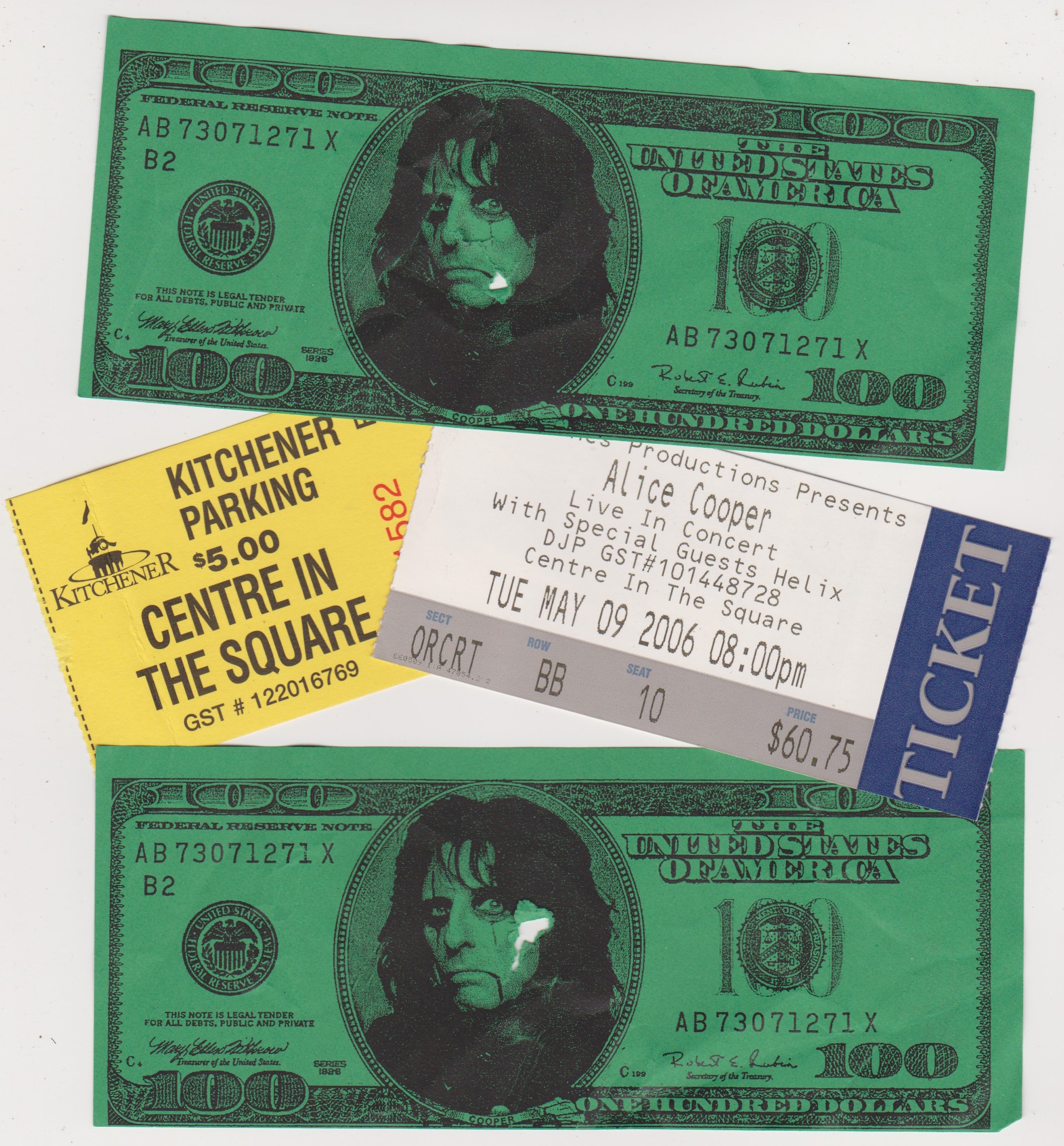
My mom had early access to tickets at the Center in the Square and surprised us with second row seats. On May 9, Alice rolled into town with his new band and new show. On drums once more: Eric Singer of Kiss. Opening act: Helix! Another favourite of mine in a hometown setting! Alice’s latest album was the excellent Dirty Diamonds and we got to hear the title track plus “Woman of Mass Distraction”. In addition Alice rolled out a few forgotten oldies like “You Drive Me Nervous”, and “Wish I Were Born in Beverly Hills” which was dedicated to Paris Hilton.
Department of Youth
No More Mr. Nice Guy
Dirty Diamonds
Billion Dollar Babies
Be My Lover
Lost in America
I Never Cry
Woman of Mass Distraction
I’m Eighteen
You Drive Me Nervous
Is It My Body
Go to Hell
Black Widow Jam
Feed My Frankenstein
Welcome to My Nightmare
Medley:
The Awakening
Steven
Only Women Bleed (with Steven reprise)
Ballad of Dwight Fry
Killer
I Love the Dead
School’s Out
Encore:
Poison
Wish I Were Born in Beverly Hills
Under My Wheels
There’s no record of Helix’s setlist, but they were able to play a number of songs including a brand new one: “Get Up“. I was sad to see that a few people in the front row didn’t bother coming early enough to see Helix, but that made it easier for Brian Vollmer to see me in the second. I pumped my first and sang along to every song — including the new one, once I got the hang of the chorus. Vollmer obviously noticed the one guy singing every song, and came down to shake my hand. Vollmer is one of the most fan-friendly artists in rock, bar none. This was only the first of several times he’d shake my hand.
(Back) Brent “Ned” Niemi, Alice Cooper, Brian Vollmer, Rainer Wiechmann (Front) Jim Lawson, Jeff “Stan” Fountain, Cindy Wiechmann – May 9 2006
From Planet Helix
As good as Helix were that night, nobody puts on a show like Alice Cooper. Kitchener was no exception. Mrs. LeBrain found herself swooning over guitarist Damon Johnson. (I thought bassist Chuck Garric would be more her style, based on a previous Tommy Lee crush.) Guitarist Eric Dover and the aforementioned Eric Singer rounded out the band, with Alice’s daughter Calico playing numerous roles as stage dancer! (“Put some clothes on!” said her dad after introducing her.)
I remember two things about the show very clearly. At one point, right in the middle of a song, a woman walked up to the front of the stage and held up a CD for Alice to sign. I didn’t get it…you expect him to sign your CD while he’s performing? While he’s in character as Alice Cooper? Who did she think she was?
Alice ignored her until he was obviously fed up. Swinging his cane in the air, he smashed the CD out of her hands. The sour looking woman returned to her seat dejected. You don’t interrupt Alice when he’s doing his show. “What a self-centered idiot,” was all I could think.
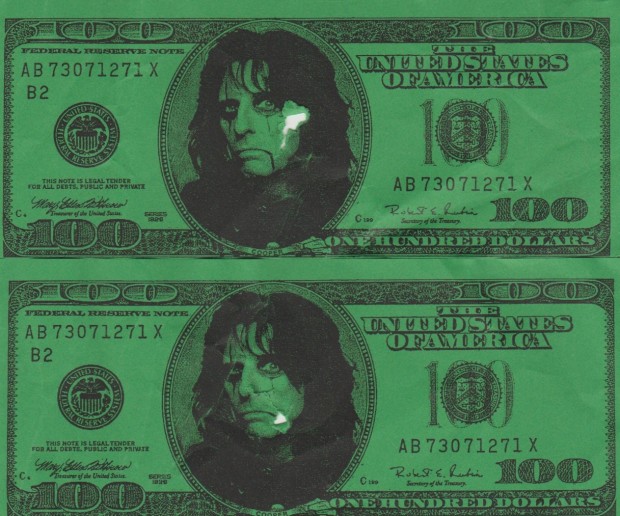
Alice’s action with the autograph seeker was made all the more noteworthy later in the show. Contrasting his attitude towards the previous woman, Alice paid special attention to a young girl in the front row. Wearing proper ear protection, the young girl was with her dad, possibly seeing her first ever rock concert. Recognising this, Alice personally handed her some of the fake Alice money lying on stage after “Billion Dollar Babies”, and some of the plastic pearls from “Dirty Diamonds”. The little girl was the only person in the audience who got special attention from the performer. Cooper, the consummate showman, plays for everyone not just the front row. That girl will never forget Alice Cooper as long as she lives, and he made sure of it. I couldn’t help but think Alice was also making a statement. “Treat my show with respect and this kind of stuff happens. Don’t interrupt me mid-song for an autograph.”
Whether I’m right or not, that’s one outsider’s impression of the events of the night.
Whatever I happen to think, there would be no argument that Alice Cooper puts on some of the best concerts in rock, and you should try to see him. Make it a bucket list goal. The lineups change, and the setlists evolve. You’ll always get “School’s Out” but chances are you will also hear a smattering of special classics that don’t get rolled out very often.
Go see Cooper and come back with your own stories to tell.
It may be considered a childish holiday, but it’s not about candy! Here’s HOLEN MaGROIN with the next in his series of Halloween themed reviews. For the last, Soundgarden’s Screaming Life/Fopp EPs, click here.
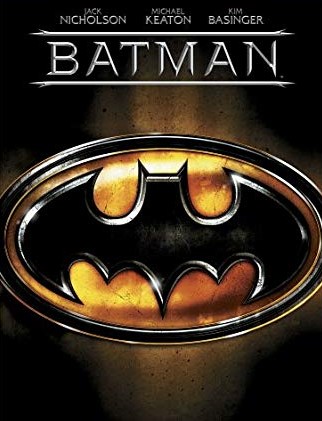
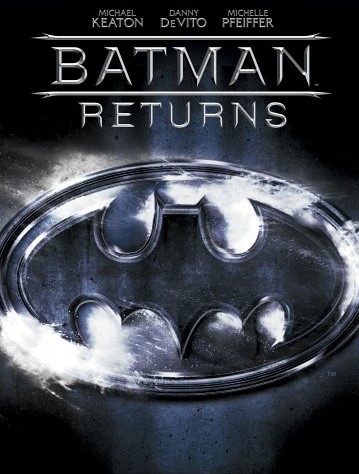
BATMAN(1989 Warner Bros.) BATMAN RETURNS (1992 Warner Bros.)
Directed by Tim Burton
Given the influx of homogenized yet generally consistent MCU movies, and the equally homogenized yet generally inconsistent DCU movies, it’s almost hard to remember a time when superhero films were not guaranteed billion dollar investments, or when they had a shred of character and individuality. The first film that truly hinted at the superhero genre’s potential to be taken seriously was Richard Donner’s Superman. It was a huge financial and critical success, with Gene Hackman giving the movie a professional actor that legitimized the comic book superhero film as an art form, and not just a niche market for children. However, DC was unable to sustain the quality of the Superman franchise, and it slowly fizzled out until crashing and burning with the critically mauled fourth installment The Quest for Peace. The future of comic book movies looked grim. That is until Warner Bros. handed the keys to the Batmobile over to the artsy and dark visionary Tim Burton, who created two acclaimed and commercially successful Gothic Batman films that work great as Halloween viewing.
At this point in his career, Tim Burton had only made two films, the eccentric road comedy Pee Wee’s Big Adventure and the twisted paranormal comedy Beetlejuice. It’s not evident what Warner Bros. saw in those two comedic movies to make them think Tim Burton would be the proper choice to direct a Batman movie, but choosing him to helm the franchise would turn out to be one of the least controversial moves. The much more derided decision would be the casting of Michael Keaton as Batman, an actor primarily known for his comedies. Because of his credentials, physique, and height, many believed that Keaton was the wrong choice to portray the Dark Knight. Thankfully, these fears were unfounded as Keaton would go on to become one of the most beloved actors to don the cape and cowl. Fears were also alleviated by the casting of Jack Nicholson as the Joker, a man who does what Gene Hackman did for Superman in granting the movie a certain ethos just by being present.
To say that Batman was a success would be an understatement; it was a cultural phenomenon. People were getting the bat logo shaved into their head, before anyone had even seen the movie. It became the highest grossing movie of the year in North America in 1989, being beat out internationally by the third Indiana Jones picture.*
The film opens at night as a family of three leaves the theatre, and I’m pretty sure anyone seeing this movie for the first time assumed that they were the Wayne family. No, the movie was playing a trick on you. It’s just a normal family in the present time being mugged, with Batman running to apprehend the criminals as they make their way up to a rooftop to count their loot. As one criminal discusses his fear of being on the roof because of mysterious bat rumors, the other tells him that it’s all hogwash and that he needs to shut his mouth. That’s when Batman glides in behind them, ready to strike. The two criminals look up at a creature that they can’t fully identify. One opens fire and they see the bat creature fall to the ground. The fear reignites in their eyes as they see it menacingly rise off of the ground, presumably from the dead. After incapacitating one of them with a kick to the chest, he grabs the other and holds him above a ledge, as the bat creature asks him to tell all his criminal friends about him, and to be very afraid. “What are you?!” the criminal asks. The creature simply replies, “I’m Batman.” He sees Batman walk off the building, and the criminal scrambles to look over the ledge to see the Batman nowhere in sight.
This opening scene sets the tone for the film, and illustrates the brilliance of Michael Keaton’s Batman. This is a far cry from the campy ‘60s movie. While Adam West was a public servant, and Christian Bale was a ninja, Keaton is a creature that no criminal understands. No one even knows if he’s human, and by allowing himself to get shot, he creates the illusion that he can’t be killed when he rises from the ground. This iteration of Batman is fully committed to theatricality and mystery. Keaton’s portrayal is very effective at representing the tortured soul of Batman, how he feels completely obligated to fight crime because no one else can. He feels the need to avenge his parents, and his dedication to fighting crime has left him lonely and obsessive over his one goal. His motives had never been clearer, and the film also makes the wise call of making Bruce Wayne more of a recluse in this film than a playboy. While it is ridiculous writing that a man as famous as Wayne does not even have a picture on file at the newspaper for reporters to find, the idea of Wayne’s isolation as a character makes perfect sense in this movie. He is a man driven to fight crime no matter the personal sacrifice or threat to his own mental health, which happens to be pretty unstable throughout the movie.
More unstable is main villain Jack Napier, a nasty gangster that is sold out by mob boss Carl Grissom after Grissom learns that Napier is boning his girlfriend. Grissom sends Napier to clean out a front company, and then calls a Lieutenant that happens to be on his payroll to kill Jack. However, Batman turns up and ruins the operation. Napier opens fire at the Batman, who deflects the bullet sending it straight through Napier’s face. Napier then stumbles over a rail above a vat of chemicals. Batman extends his hand in an attempt to save him. In this scene you see a close up of Batman’s eyes. This creates ambiguity. It’s almost as if he recognizes the man that killed his parents, leaving the audience to decide whether he lost his grip or intentionally let the man go as Napier takes the plunge into the chemicals that will turn him from Jack to Joker. This is another point in which Keaton’s acting deserves praise. He’s able to convey so much emotion with only his eyes visible, something that he’d carry over to the next film.**
The film proceeds with a dark atmosphere, reminiscent of a noir story from the 1940s based on the clothing and set design. Gotham City is a very repressive setting because of all the Gothic architecture. The movie is grim. Napier transforms from a nasty gangster into a full on “homicidal artist”. Nicholson sells the material with great conviction, and manages to be simultaneously hilarious and absolutely terrifying. He strikes this crucial balance arguably better than even the late Heath Ledger, a tribute to the ethos Nicholson lends the picture. We see the Joker proceed with his plans of anarchy and death as the world’s greatest detective does all he can to stop him, culminating in a final steeple confrontation.
Since the Batman creates the Joker in this film, and Burton decides to make the flimsy and misguided creative decision to make the Joker the murderer of Wayne’s parents, a fundamental aspect of the movie is how these two characters are connected. They are two sides of the coin as Ace Frehley would say. They’re both highly motivated and highly intelligent characters set on achieving their own goals without any regard for the law, and they’re both a little crazy. Even after all Joker has done to him, after Batman knocks him off the bell tower, he still tries to save him by looking over the ledge, only to be surprised by the Joker and put into a precarious situation. While Joker does end up getting killed, it’s more of his own fault for not telling his chopper to land on the roof so he could detach the rope from his leg.
By no means is it a perfect film, there are some pacing issues with the third act dragging on too long, the Prince songs don’t work particularly well,*** the issue of Batman killing in this movie, and the fact that the cops don’t just arrest the Joker when he held the bicentennial in the streets after he announced it. Main love interest Vicki Vale is also completely disposable, as is proven by her absence in the second film with only a few sentences explaining where she went. Many of the secondary characters in this movie aren’t needed or even interesting, something remedied in the second film. The main draw of these pictures is the adversarial relationship between Batman and the Joker, good and evil. The first two Nolan Batman movies are ultimately better, but this movie has a 1980s charm and a personal directing style that makes it feel uniquely enjoyable, and it still holds up remarkably well today.
The film itself is highly stylized thanks to Tim Burton’s direction. It also has a camp factor that would disappear from superhero movies altogether after Sam Raimi’s very personal and excellent Spider-Man trilogy. Camp isn’t necessarily bad, it’s actually very pleasing to see a movie acknowledge its own ridiculousness, and bask in it. Relish the goofiness in order to make a more entertaining picture. This actually feels like a Tim Burton movie, whereas many superhero movies today are devoid of any style or originality. They take themselves way too seriously, and sacrifice being fun. This movie manages to blend serious story telling while still acknowledging the inherent silliness of a man that fights crime dressed up like a bat.
When the time came for a follow up picture, Burton was initially not interested. He felt he had done all he could with Batman, until the studio offered him total creative control, something that he hadn’t had the first time around. If the first movie felt like a Tim Burton film, this one ups the ante by a factor of 100. This was an improvement in some areas, and a detriment in others. Tim Burton has never been overly concerned about a coherent plot, or the quality of the plot, tending to focus more on characterization and style. Batman Returns is arguably the most polarizing film in the Batman cannon, and it’s really easy to see why. Burton has little regard for the comic book origins of the characters, and decides to make the film in his own way more so than the first one. Because of this fact, both Michael Keaton and Tim Burton have expressed their preference for this sequel over the original.
A creative move like this would never be allowed today. There is no way that a studio would agree to a film so warped, dark and sexually charged. It takes place at Christmas time, to provide an interesting contrast to all the dark mayhem. Burton loves monsters, and his love of freaks is the engine of this second film. Danny DeVito plays the penguin, who is not the sleek slimy opportunist of the comics, but an actual deformed baby with flippers abandoned by his parents and raised by penguins in the sewers under Gotham City. Now, if that sounds absolutely ridiculous it’s because it is. The suspension of disbelief in this movie is very high. As a matter of fact, to enjoy this movie you have to give in and let it all happen. The movie is absolutely absurd, but the imagination and the character development that went into making it is breathtaking and deserves appreciation.
The plot of the movie is ridiculous, and a little dumb. Cobblepot runs for mayor at the suggestion of corporate tycoon Max Shreck (played by Christopher Walken) because Shreck knows he can control the Cobblepot in order to get his power plant built, that will ultimately suck power from Gotham so he can store it and sell it for a higher price. The citizens of Gotham line up behind the Penguin as a serious candidate after his gang creates chaos to make the current mayor look bad. He becomes a heartwarming story around Christmas time as he creates a public image of goodness by forgiving his deceased parents for abandoning him. Batman reveals Cobblepot for the sleazebag he is in public, and the city immediately turns on him. He responds by trying to kidnap their first born sons as he feels betrayed by his fellow humans and has abandonment issues from his parents. This movie isn’t really about the plot; few Tim Burton movies actually are. This movie succeeds in its own way because of the strength of the characters, and the affection with which Burton treats them. Penguin elicits great sympathy despite being an absolutely grotesque monster, because he was never given a chance. Businessman Shreck is the true monster, as the movie makes the point that not all monsters are disfigured, ugly, or even hated by their fellow man. As the Penguin himself puts it to Shreck “We’re both monsters, but you’re a well respected monster, and I am to date…not.” Shreck is the real monster, it is impossible to feel sympathy for him at all. The first time I saw this movie, I disliked it because of the outrageous plot and the high campiness factor despite being an even darker and more Gothic film that its predecessor. However, on subsequent viewings it became clear to me that the story in this movie is really just sandbox for the characters to play in, and they’re the main reason to watch the movie because they’re so damaged and complex. The movie is like a fairytale, ungrounded and not obeying the normal laws that govern reality. While the first Batman movie seemed to be a studio compromise with Burton’s vision, for better and worse Batman Returns is a true Burton piece of work.
Michelle Pfeiffer plays Catwoman, who is licked back to life by alley cats (just go with it) after sifting through confidential files by her boss Max Shreck. There really is no competition, Pfeiffer is the definitive live action Catwoman, and the movie should have focused on her character more in the movie. Her suit in this movie is intimidating, and at the same time strangely alluring. Her antagonistic relationship with Batman is one of the most interesting parts of the movie, and her life as Selina Kyle with Bruce Wayne represents how uncomfortable the two are as themselves. Before becoming Catwoman, Kyle was a ditzy, timid, awkward secretary. Bruce Wayne, when not being Batman, looks uncomfortable in his own skin and the two together seem to sense there’s more to each other than a lonely secretary and a reclusive billionaire. This tension in the relationship comes to a head in the scene where they both show up to a costume party being the only two people seemingly not wearing costumes, because their day personas are their costumes. They both feel more comfortable as Batman and Catwoman than as Bruce Wayne and Selina Kyle. You can see it in Keaton’s face as he stumbles around as Bruce Wayne, but looks right at home in the Batcave. It’s apparent in Pfeiffer when Batman implores her to spare Shreck’s life at the end in order to come and live with him. He rips off his cowl and tries to appeal to Selina Kyle as Bruce Wayne to live a normal life, but Kyle ultimately decides that she has to be Catwoman and “couldn’t live with myself” if she settled down again as the pushover Selina Kyle. The Penguin’s attempts to fit in and be accepted as mayor under his Cobblepot name are also thwarted, and he ultimately only reacts in anger because of the rejection, crying “I am not a human being, I am an animal!” This statement could be equally true for any of them. The three characters find different ways to handle their isolation, and they are all essentially animals that cannot be tamed. Catwoman knows that both she and Batman could never be content living together as Selina Kyle and Bruce Wayne.
Possibly one of the best aspects of this movie I have yet to mention is the score. Danny Elfman brought his absolute best to the first movie, creating the definitive Batman theme and a fantastic score. He ups his game even more for this sequel, creating the perfectly dark and enchanting soundtrack to match the movie that elevates each scene to that surreal fairytale level that Burton seems to be operating on throughout the movie. The soundtrack is absolutely perfect, especially the sections that deal with the Penguin. They generate actual sympathy, and the theme that connects to him is melancholic. It achieves Burton’s goal of making you sympathize with the monster, because even as he commits all these egregious acts of violence and hate, the theme calls back to early in the movie where he was ostracized by his own parents at birth near Christmas time. The theme of the movie seems to be that people can only act in their own nature, and that society’s view of monsters is only skin deep. That is why Penguin can never truly be accepted, and Max Shreck can.
Despite the blatant disregard for the source material, I find both of Burton’s Batman pictures to be thoroughly enjoyable entertainment that contain enough thought provoking content to merit repeated viewings. Some people say that these movies are all style and no substance because of the stunning atmosphere yet underdeveloped plots, but those people fail to realize that the substance in these movies aren’t found in the plot, they lie in the complex characters, their motivations, and the superb acting that goes into portraying them. While I consider the first Batman to be the superior film in a traditional sense, Batman Returns is more enchanting, captivating, visually stunning, personal, and unrestrained. They both have their own merits that make ranking them a tough call. If I’m being objective I’d say…
Batman – 3.5/5 stars
Batman Returns – 3.25/5 stars
If I was to state my personal feelings and attachments to the movies…
Batman – 4/5 stars
Batman Returns – 3.75/5 stars
* The Last Crusade, which ironically LeBrain reviewed for his Grade 11 Film Class essay, comparing and contrasting it with Steven Speilberg’s first film Duel. And I lost a mark for using the word “picture” instead of “film”, which is why I applaud Holen MaGroin for describing it as a “picture”.
** Holen MaGroin has convinced LeBrain to watch these again soon, to pick up on all these things I apparently missed when I was a kid.
*** Before Prince fans get all medieval on Holen, let me point out: he’s right. Every time a Prince song comes on, it causes a mental “skip” in the brain. Like, “Hey, it’s one of those Prince songs from the album.”
I used to tell the store owner and his second-in-command, “We are only using about 10% of what these computers are capable of doing.” They were great for inventory and point of sale. We eventually started using them to print out header cards for CDs. It seemed like the owner and those beneath him weren’t interested in getting the most out of our computers. I think they saw potential abuse as “toys” — gaming and chatting etc.
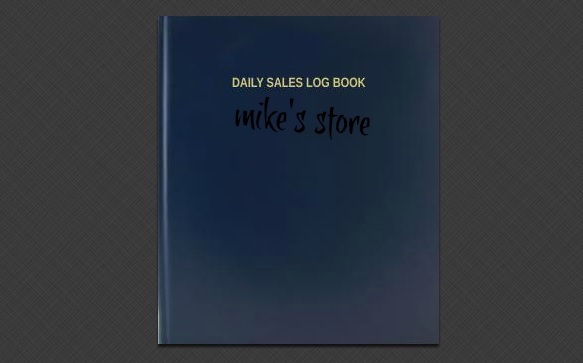
That wasn’t what I was driving at. I used to have to maintain a sales log. It was a big blue book full of pages for bookkeeping. It was handy because the boss could open it up and have a quick look at what sales were last night, last week, last year, and so on. We kept track of our purchases and free CD giveaways in the log book. At various points in time, I was maintaining multiple log books. I had one when I was in charge of the store website. Whenever there was a staffing issue, and I had to cover at another branch for an extended period, there was another log book.
It always irked me that we were not permitted to use Microsoft Excel instead of (or even in addition to) the sales log. There is one thing I have always sucked at, and continue to suck at: adding up a large column of numbers. The reasons for this are two:
My big stupid fingers are always mashing the wrong buttons on a calculator, and
When I stare at numbers too long they all start to jump around. 2112 looks like 2121, and so on.
My suggestions to use Excel for the log book were always shot down. For all I know, 12 years later they could still be using the big blue log books exclusively. We did use Excel to calculate the values of our inventory, so I didn’t get what the big deal was.
It really pissed me off one afternoon in the store, when I was struggling to add up the numbers for month end. The weekly totals were off, so I had to find where. I had a system for finding these kinds of problems and part of it was manually adding up all the days’ sales. Every time you start adding a large series of numbers and the phone rings or someone asks a question, I tended to lose my place. So it took a while. And every time I added the numbers, I was getting different results. I’d been at it forever and couldn’t figure it out.
They’d just given me another staffer who would be helping in the afternoons when I used to be alone. I asked him if he wouldn’t mind checking the sum, to see what total he would get. He did and that’s exactly when the Store Bully walked in.
“Mike, why are you getting Dave to do the books for you?!” she yelled. Of course, out of context, it probably looked that way. But she wouldn’t even let me finish a sentence, and when I finally did, she said my story was “bull”. She made her comment that the new guy wasn’t to be my personal servant. Is that what she thought of me? And of course this went on my annual review. I protested it again, but she didn’t want to listen.
Dave didn’t get to finish adding that column, so I never found out what total he would have got. Imagine how easy it would have been if it was just Microsoft Excel.
Some of the people at the Record Store who were in positions of power were, unfortunately, troglodytes. They didn’t use computers regularly and were closed to ideas that didn’t come from preferential personnel. It was a rock and a hard place for me. They didn’t want to use computers to do the books, but I got “caught” getting someone to check my math. As if it’s highschool.
Actually, it was a lot like a highschool. And I wasn’t in the popular clique.
It’s funny. You can know someone your whole life, and still find new stories about them. Such is the case with Mrs. LeBrain and her mom.
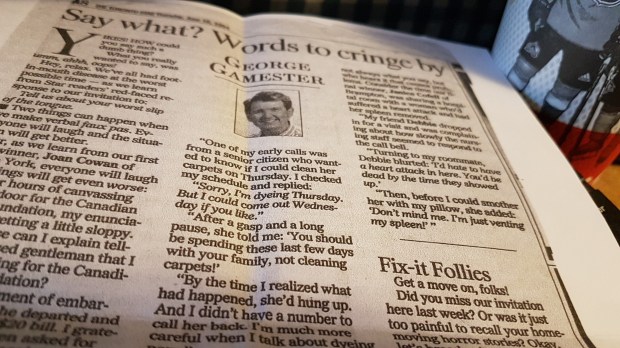
“Mum”, also known as Debbie, passed away last month but one of the joys has been the journey of discovery. One of Debbie’s best friends sent us a newspaper clipping from the Toronto Star, June 16 1994. The article was called “Say what? Words to cringe by”. It had a story about her mom that we’ve never heard before. It’s hilarious and it reminds us so much of the way she was. These are exactly the kind of things she would say!
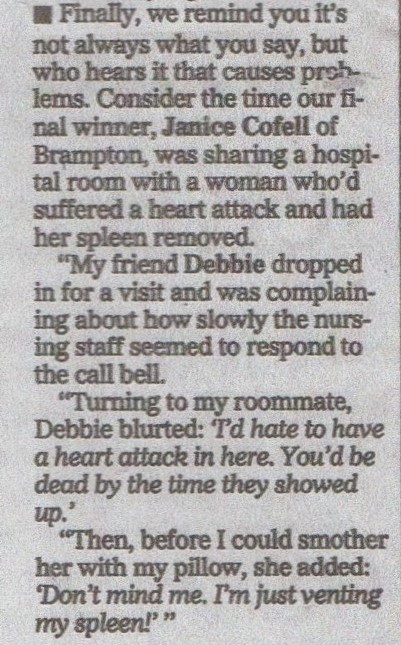
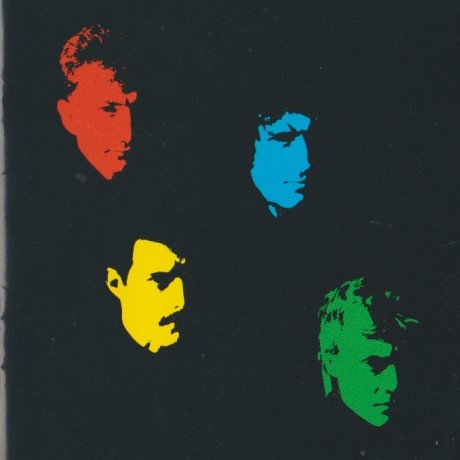
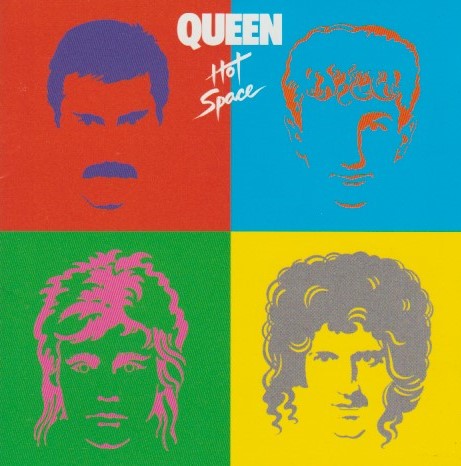
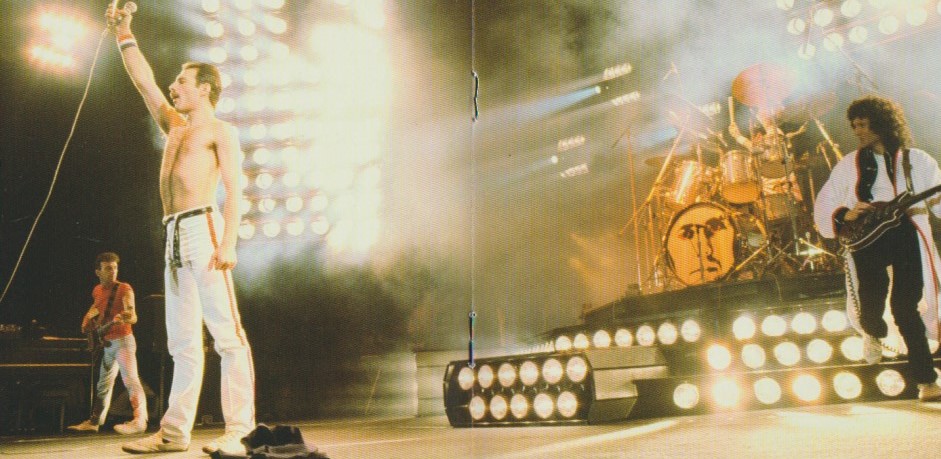
QUEEN – Hot Space (Originally 1982, 2011 Hollywood 2 CD set)
Once upon a time, a band called Queen put a note in the credits of their first album: “And nobody played synthesizer”.
By 1982’s Hot Space, this credo was long gone. In its place, a slick new sounding Queen that did not resonate with Americans the same way old Queen did. Hot Space still bore a fair share of hits, though very different sounding ones from the olden days.
“Staying Power” opens the album with blasts of horns and funky synths. On tracks like this, without any bass guitar, John Deacon played rhythm. “Staying Power” represents the shape of Queen to come. It wouldn’t have sounded out of place on 1989’s The Miracle. The horns give it the needed punch. Then Brian May’s “Dancer” slinks over, a disco rock tune with some (just some) trademark layers of Queen guitars.
If you feel like gettin’ down on the dancefloor, then “Back Chat” is the song for you. It’s in the same vein as disco Kiss, but with the kind of funky authenticity that Queen can bring to the party. “Back Chat” is the album’s first completely memorable song, provided by John Deacon. Fortunately it has real bass, to keep that groove dirty. As a single, it didn’t perform as well as “Body Language ↑⬱”, though it’s a superior song. “Body Language ↑⬱” is all synth with no meat.
Roger Taylor’s funk rocker “Action This Day” boasts a cool sax solo, but the synth drums are lifeless. It’s much better live (find this version on CD 2) with real instruments. Brian May’s “Put Out the Fire” is a welcome return to traditional Queen instrumentation. “Put Out the Fire” is the only song that sounds like “classic” Queen. If you heard it for the first time, you sure wouldn’t assume it was from Hot Space. It’s what you would call a “stock” Queen rocker. No embellishment, no quarter.
Going topical, Freddie tackled the difficult subject of the recently murdered John Lennon. “Life is Real (Song for Lennon)” is composed like a John song, with piano being the main musical support. May’s solo is one of his most tender and warm, but the song is not their most memorable. Taylor’s “Calling All Girls” is far catchier, and would probably be considered a classic if it were better known.
Brian’s ballad “Las Palabras de Amor (The Words of Love)” received worldwide attention at the Freddie Mercury tribute concert in 1992, performed with Zucchero Fornaciari. In this case, the synths work with the song and not against it. They create a dreamy landscape, perfect for Freddie’s plaintive singing. This fantastic ballad is up there with the more famous Queen classics.
“Cool Cat” was recorded as a duet with David Bowie, who was unsatisfied. Although the Bowie mix made it to a test pressing, it was removed from the album and has yet to see a re-release. A dusky, slinky tune like “Cool Cat” would sound neat with Bowie aboard. David’s there for “Under Pressure” (obviously), which doesn’t need discussing because everybody knows that song. Or should. Immediately. It is rock magic, born of a jam between the five musicians. When magic happens, it can create songs as perfect as “Under Pressure”.
Hot Space is a bit wobbly, but the bonus disc evens things out a bit. A soul ballad B-side called “Soul Brother” might have worked better on the album than some of the songs that made it. The single remix of “Back Chat” gives us a chance to revisit the album’s most addictive song. Check out the fast, very dexterous live version of “Staying Power”. It is pretty impressive even if it’s not one of Queen’s greatest songs. The performance on the live take is a lesson by the masters on playing live, so listen up. Similarly, live versions of “Action This Day” and “Calling All Girls” get an injection of life on the stage.
Hot Space shouldn’t be too high on anyone’s Queen want lists, but it shouldn’t be ignored either. Check out the 2 CD version for the worthwhile additions.
Readers here may think that my sister Dr. Kathryn and I have lots in common. We both love music, schnauzers, and Star Wars. That’s everything, right? You’d certainly think so. We disagree more often than we agree.
Some spans are simply too far to bridge. This is one of them.
Here is the controversy. Don’t judge until you’ve heard us out.
My sister and I disagree, strongly, when action figures come packaged with extra hands.
Say what? I’ll explain.
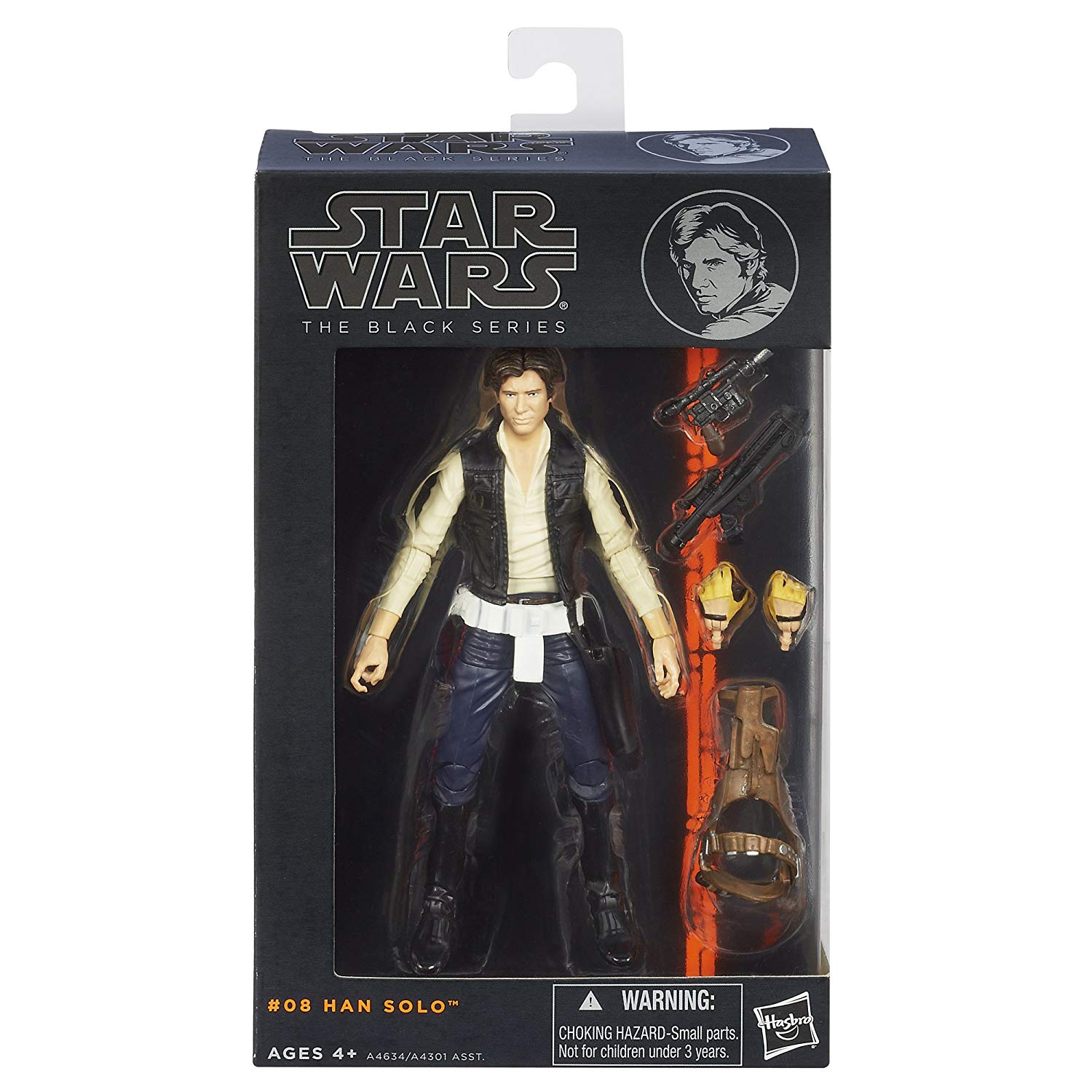
This issue first arose in 2012 when the Star Wars 6″ Black Series was launched. This was a series aimed at collectors, packaged to display. Many increased in value quickly. Each character was numbered. The larger size (standard Star Wars figures were 3 1/4″) enabled more detail, better facial sculpting and way more articulation. Some of these figures look like the actual actors for the first time. Though quite a few are less than perfect (#03 Luke Skywalker has weirdly bright blue eyes) they were, by and large, exactly what nostalgic fans wanted. Eventually just about every major character was released (though we are still missing a Padme) with lots of the minor ones too (bounty hunters, Jabba’s minions). Fans were peeved that it took until now to get an original Lando Calrissian figure, while we already had such dubious characters as “Constable Zuvio”, plus about a dozen Rey variations! From Star Wars ’77 to Solo, most of your favourites are now available in the Black Series line.
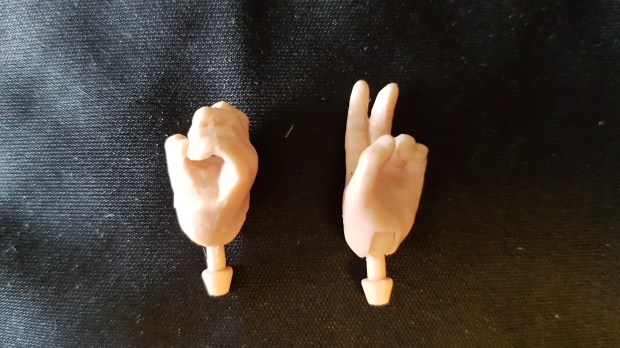
The figure that sparked the controversy is #08, the excellent Han Solo in his 1977 getup: Black vest, white shirt, cool holster and blaster! The Black Series also occasionally threw in some bonus accessories. #08 Han has some of the best. He comes with his regular gun and holster, plus a Stormtrooper’s gun and belt so you can duplicate the look he had when he was running around the Death Star after escaping the trash compactor. He also comes with an extra set of gloved hands, so you can have Han as he looked when he was fleeing TIE Fighters aboard the Millenium Falcon. The hands snap in and out easily with no fear of breakage, still maintaining full wrist articulation. One of the gloved hands has fingers outstretched, as if Han were hitting buttons on the Falcon’s dashboard.
So what’s the problem?
My sister likes to keep her figures sealed. She displays them around her desk in her music room at home. I, on the other hand, put my sealed figures in storage, and sometimes buy a second one to open up and display. #08 Han is one such figure that I opened. (My sealed one is in a Cantina two-pack with Greedo!)
I’ve displayed Han in all sorts of ways: With and without vest, with and without Stormtrooper gear, and sometimes with the gloved hands. Meanwhile my sister’s boxed figure gets quizzical looks when she has friends over.
“Why does Han have two dismembered hands in the box?”
My sister finds the hands to be an eyesore she’d rather do without. For me, they are just another display option. I’ll bag up whatever accessories Han isn’t using right now. (Currently, my #08 Han is put away, while I have “Old Han” from The Force Awakens on display with Chewie.)
To me, a bigger offender is actually R2-D2. R2 is loaded with accessories (which is good since he’s half the size of a regular figure but still the same price). R2 is packed with a sensor scope, an antenna, and a Luke lightsaber that he packs in his dome. There are also blue dome covers for when you want R2 all closed up looking normal. But he also comes with jetpacks for his legs. Many fans consider the “flying R2” scenes to be among the worst in the prequel trilogy. I’d rather pretend it never happened.
“Those are stupid too,” says my sister of the leg rockets.
Han isn’t the only figure in the series with alternate body parts. Qui-Gon Jinn has a bonus hand doing a Force movement. Anakin Skywalker came with two heads so you can do him with two looks: mopey or angry. My sister considers all of these to be very poor display pieces.
I guess we will never agree on this issue. I think the extra hands are a bonus. If her friends can’t figure out that sometimes action figures come with alternate parts, then maybe she needs new friends.
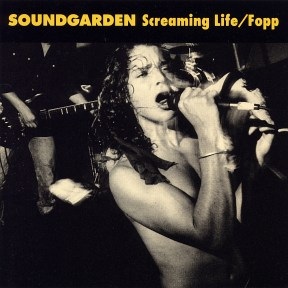
SOUNDGARDEN – Screaming Life/Fopp(1987 & 88 EPs, released combined on Sub Pop CD 1990)
I love Halloween. I love autumn. I love horror films. I love metal. When you combine the four of those things that complement each other so well, it adds up to be one of my favourite times of the year. It may be considered a childish holiday, but to me it’s not about the candy. The entire atmosphere of the world seems to change around and on a holiday. The world almost seems to become more surreal, taking on aspects of life that only seem normal in films. There’s no reason Christmas should feel any lighter or peaceful than a regular day, but it does. Halloween has a certain feel too, an eerie one that goes perfect with metal and horror films, the cooling weather, and the waning sunlight. It’s about the deception, the masquerade, the vaudeville, the showmanship that keeps me intrigued by Halloween. Throughout the month on Wednesday’s I’ll be writing reviews of albums that are important Halloween albums to me, finally culminating on the big day (10/31). I hope you enjoy reading them as much as I do writing them.
1987 was the peak year for mainstream metal*, but it was also the starting point for an underground movement that would upset the entire genre of rock for good. Some call it grunge, but I think that term is as disrespectful as “hair metal”, especially given that the so called ‘big four’ of grunge didn’t sound alike at all. My favourite of those four bands was always Soundgarden. Chris Cornell was easily the best singer out of the bunch, and the group’s songwriting was also superior to the other bands from the same town. None of the other bands came close to writing an album as undeniably badass as Badmotorfinger. They were also the most metal out of the Seattle scene, and Chris Cornell didn’t seem to be a whiny punk like Kurt Cobain or Eddie Vedder. Cornell didn’t shy away from success and intentionally sabotage himself like the other two guys, at least not publically. His passing was one of the few times that a ‘celebrity’ death had actually impacted me, and was a horrible loss to the music world.
In the aftermath of his passing, it makes sense to start back at the beginning to see how he progressed throughout his career. Soundgarden made their debut on Sub Pop with an EP called Screaming Life. They followed it up the next year with the Fopp EP, and they were eventually packaged together on CD in 1990 by Sub Pop under the clever title Screaming Life/Fopp. I bought this CD, and Lynch Mob’s Wicked Sensation at the same time in mid October, so both of these albums have a strong mental link to Halloween for me, but the Soundgarden EPs have more than an emotional attachment to the holiday. This is some evil sounding stuff that fits absolutely perfectly with the time of the year. This is partially because Kim Thayil exhibits a much stronger influence on the band’s music than he would on the last few Soundgarden albums. While on later Soundgarden albums, Chris Cornell wrote a substantial amount of the group’s music as well as its lyrics, here a good share of these early songs were written by guitarist Kim Thayil and original bass player Hiro Yamamoto. All the music on Screaming Life was written by one of the two, with Cornell handling only the lyrics. This is a different sounding band than the group that wrote “Black Hole Sun”. There are some punk roots showing with the obvious Black Sabbath and Led Zeppelin influences.
The aforementioned Black Sabbath influences are blended seamlessly with the brevity and relentlessness of punk in the album opener “Hunted Down”. This is the group’s first of many classics, and was also their first single. It’s an absolutely evil sounding number, with a hypnotic riff that sounds like the band are summoning demons themselves. The lyrics tell the story of a convict escaping prison and being hunted by the authority figures. He copes by changing his face permanently to avoid detection. The band follows the “Paranoid” single mold by making the song less than three minutes, which gives it a lethal efficiency. The melody is somber, and compliments the music accordingly. Chris Cornell was not yet the consummate vocalist that he would become, but his chops here are impressive for a youngster starting out on his first recording. The song was so good that Sub Pop chose it to be their hold music when people would call the label, prompting the group to call them up just to hear their song on the phone.
That Soundgarden classic is followed up by the much more obscure “Entering”, a four minute song that is so doomy that you think it goes on much longer (before checking the CD again, I had originally typed in the review that it was a seven minute epic!). It begins with slow ringing guitar notes that are enchanting in a dark way. It’s unsettling, yet you’re intrigued by it. This is one instance in which the song perfectly mixes with the stark visuals of the black and white cover. The beginning of this song is actually reminiscent of early 20th century horror films. It wouldn’t sound out of place being played on a grand piano in Dracula, Nosferatu, or Frankenstein, that’s how ominous it is. The song then goes through a dynamic shift and is kicked into high gear by the frantic drumming of the great Matt Cameron as Chris Cornell begins to wail with a slap back delay on his vocals that gives the song an energetic live feeling. The production is rough, but the muddiness only helps enhance the songs.
Following a throwaway screeching punk number, the band turns in one of the best songs in the gloomy and slow drop D tuned “Nothing to Say”. This song can only be described as “Electric Funeral” with better vocals updated for the late ‘80s. The group would never again sound this evil excepting their debut album Ultramega OK, which was actually released on Halloween. Perhaps to break up this seriousness, the band included many joke songs on their early albums. “Little Joe” is one of these, a funked up strange number about a Hispanic kid crossing the border. It’s totally disposable, just like all of their joke songs they just take up space and distract from the better music (except “Big Dumb Sex” from Louder Than Love). It’s still slightly demented in a off-putting way, which keeps it from ruining the mood of the EP.
The Fopp section is much lighter, in content and in mood. It contains just three songs and a remix, with only one original Soundgarden tune. The Chris Cornell’s first sole songwriting credit is with “Kingdom of Come”, a fun little tune, that doesn’t amount to much, but sounds good enough when you’re listening to it. The production on this half of the compilation is much clearer than on Screaming Life. The guitars have much more midrange energy, and the most of the muddiness has been cleaned up. If the first EP sounded like a cult ritual, this seems like the light-hearted after party. The set is rounded off by the covers of “Swallow My Pride” and “Fopp”. These are a couple of tunes just like “Kingdom of Come”, in that they’re enjoyable in a fun way, but there’s not a lot of substance underneath them.
Overall, the Screaming Life section is the superior EP, but together the shades of light and dark are an interesting insight into Soundgarden’s later, more developed sound. This is an absolutely wicked sounding release that most be listened to on headphones at night at least once around the Halloween season. While it’s not perfect and still shows a band in development, it is haunting and helps to scratch that horror metal itch if you’ve already exhausted Welcome to My Nightmareand your Black Sabbath collection.
3.25/5 stars
* LeBrain respectfully disagrees and remembers 1989 as the peak year for mainstream metal.
Poor George. He really wanted to be in a band. Rob Szabo had a band. He was just starting out with one of the neighbour kids. He even had two original tunes (I remember one was called “The Stroll” and I can still hum it). George really wanted to be in Rob’s band. He hung out at their basement rehearsals and watched them play. Rob would teach him things. They needed a bass player.
George secretly saved his money, and eventually bought a bass. Rob was horrified. He didn’t want George in his band, he wanted a musician who already knew how to play music. He didn’t want to have to teach the bass player how to play bass. He also felt terribly guilty, because George bought the bass specifically because Rob needed a bass player!
I can remember George playing Rob’s tape to the girl he liked. “That’s us!” he said. “That’s my band.” He wasn’t on the recording at all.
Like a kid who didn’t know how to break up with his girlfriend, Rob took a while to tell George he was “out” of the band. When he did, George was not deterred. He just went it alone. He taught himself how to play by playing along to records. He studied Steve Harris and Gene Simmons who quickly became his favourite bassist. He practiced all the time. I know, because we could hear him from our house. We laughed about it, because George also attempted to sing.
He eventually got pretty good at bass; good enough anyway for the bar band scene. He would never be any good at singing, although that hardly stopped him, and you have to respect that.
In the summer time, George took his amp outside and played for anybody who happened to be around. He loved to play, “Guess this song from the bassline!” Not an easy game when I didn’t know many songs yet myself. I had a few albums, but I’d only been into rock and roll for a couple years. Every bassline sounded the same to me.
George finished highschool, but I was just beginning. It was there I saw my first Battle of the Bands. I sat with Bob Schipper, Rob Daniels and the gang at lunch watching the bands play. Rob Szabo had a band called Under 550 — the total body weight of the four members. Even in highschool, it was obvious Rob had real talent. There were all the other bands, and then there was Under 550. He was levels above the others. He could play “YYZ”. I’d never even heard of “YYZ” (though I’d seen those letters on my parents’ luggage tags). There was only one clear winner and that was Under 550. It was obvious to everyone. They would be going to the regionals at the Humanities Theatre.
Rob Szabo on the left
Bob and I got our tickets. We went with neighborhood friends Scott Peddle and Todd Meyer. The four of us sat together and waited giddily. Not only was Rob Szabo playing, but so was George. He joined a band called Zephyr (no relation to the other Zephyr), and they were on the bill. I planned my catcalls.
George always told me he wanted to play “I Love It Loud”, and introduce it by saying to the crowd: “How do you like your music? Well I love it loud!” I hoped and prayed he was going to do that.
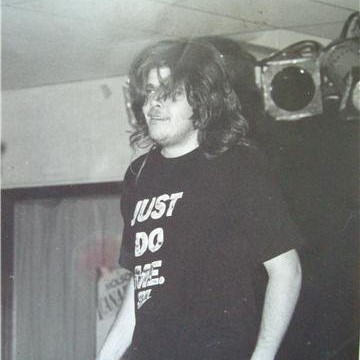
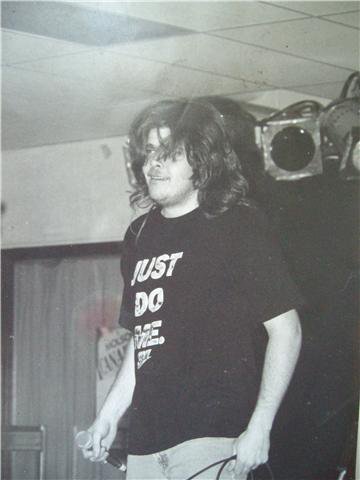
Each band got two songs. We waited through noise bands like Stomach Acid and F.U.H.Q., who had the plug pulled early for swearing. We waited through boring acoustic and pop crapola. There was one group that rocked really fucking hard. I wasn’t into thrash, and these guys were heavy. A group of bangers came down to the front row and started banging their heads to the thrash! You could see the long hair flailing. I didn’t know the singer, but many years later I found out his name was Eric. But nobody calls him Eric. Today they just call him Uncle Meat. The Legendary Uncle Meat.
Meat
Truth is, his band was too scary for a 14 year old me!
On came Zephyr. “You suck George!” I yelled, with Scott joining me. He ignored us, or couldn’t hear us. It didn’t matter, Scott and I were laughing so hard!
Sadly, George did not play “I Love It Loud”. Zephyr disbanded a little after, with George again going solo.
Rob stacked the deck for the regionals. Under 550 added a lead singer, and became Over 550 for this one night. Though they didn’t win, they ranked high. Uncle Meat and George went home empty-handed, but with memories etched forever.
The winners of that event? The now-somewhat-but-not-really-legendary Gordie Gordo and the G Men, featuring Sausagefester Scottie G, on the not-very-well played guitar! $100 dollar first prize which went promptly towards a mic stand.
We laughed on the way home at our witty catcalls like “Don’t fall over George!”
And that, friends, is why my highschool years were better than yours.















 mikeladano.com
