REVIEW: Rogue One – A Star Wars Story soundtrack (2016)

I will be going LIVE at 12:30 AM (ET) Saturday morning with Robert Daniels on VISIONS IN SOUND. Tune in on your dial to 98.5 or internet to CKWR!  You folks in the UK can tune in as you enjoy some morning coffee.

Rob says:  “Star Wars For A New Generation – May is Star Wars month on Visions In Sound and we will be celebrating the 40th Anniversary with a slew of special shows. Joining me this week will be special guests Jason Drury, Michael Ladano & Erik Woods to help with the celebration. Featured music will be from Star Wars – The Force Awakens (John Williams), Star Wars – Rebels (Kevin Kiner) and Rogue One – A Star Wars Story (Michael Giacchino). Join Us THIS Saturday 12:30-2:30am (ET)”
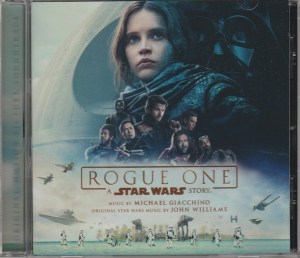
ROGUE ONE: A Star Wars Story original motion picture soundtrack (2015 Lucasfilm/Disney)

A Star Wars soundtrack without John Williams?  Blasphemy!  Right?  Right guys and girls?  No John = No Star Wars, right?

Wrong!

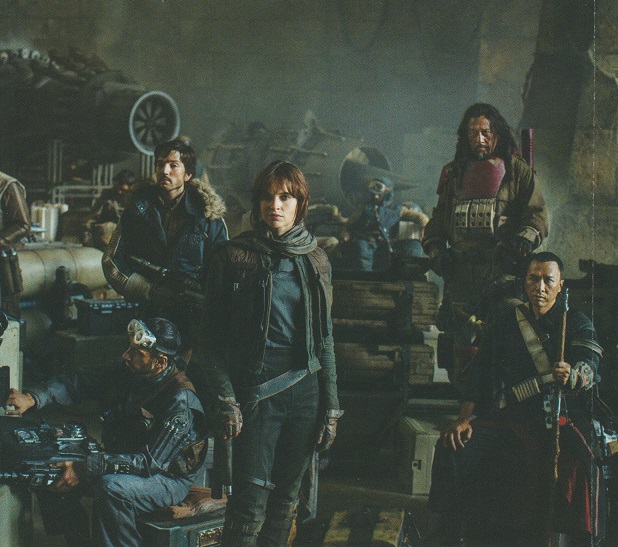
It’s not like Rogue One is even the first!  20 years before, Joel McNeely composed Shadows of the Empire, the soundtrack to a massive multi-media Star Wars story.  It accompanied a novel, a comic, a video game and action figure line.  The only thing missing was a movie.  Since Disney’s $4 billion acquisition of Star Wars, Shadows of the Empire is now considered “legends”, or non-canon, so if you’re not aware of it, that’s OK.  The point is, a non-Williams Star Wars soundtrack is nothing new to long time fans.  And Rogue One is the perfect vehicle for such a soundtrack.  Rogue One: A Star Wars Story is the first non-episodic, non-Skywalker-saga Star Wars film ever.  There are two very obvious ways that it differentiates from the main line of films.  One is that there was no opening crawl (nor should there have been).  The second is that Williams didn’t do the music.  Michael Giacchino did, a man who has plenty of credits on his resume including a large number of J.J. Abrams productions.

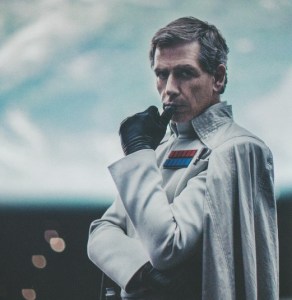
Giacchino wisely didn’t overuse established Star Wars music.  You won’t hear the fanfare.  The sudden crash opening music of “He’s Here For Us” was actually a pretty cool moment of shock, and it’s right there at the start.  The music feels like the storyline.  When Director Kennic suddenly pays a surprise visit to his “friend” Galen Erso, you couldn’t ask for more abrupt and appropriate music.  The threat has arrived.  Better hide.

Though Giacchino borrows music only sparingly from John Williams, he seems to embody that classic style.  While unfamiliar, these new pieces sound like part of that universe.  There are memorable parts; not so many as the classic films, but they are there.  “He’s Here For Us” introduces one such theme, and there are more, such as the main theme contained within “A Long Ride Ahead” (and again in “The Master Switch”).  You’ll notice the Rogue One theme music in “A Long Ride Ahead” is very similar to the Star Wars main theme, in particular the first two notes.  It’s the same interval, transposed down to a different key.   That’s why the Rogue One and Star Wars themes sound similar, but different.

Other tracks like “When Has Become Now” have bits and pieces that recall prior Star Wars music without copying.  Another fantastic theme is “Jedha Arrival” which really captures the vibe.  You will get to hear the legendary “Imperial March” in “Krennic’s Aspirations”, in which he meets the Dark Lord Darth Vader in his castle on Mustafar.
For action scenes, “Jedha City Ambush” hits a double:  It’s different from past Williams work, but really gets the adrenaline running.  “Star-Dust” is more contemplative, and very unique.  The drama of “Confrontation on Eadu” has that awe-inspiring mix of ingredients that good Star Wars music always has.  Then, for sheer terror, the ironically titled “Hope” gives you all you need in pure musical form.  The solo violin on “Jyn Erso & Hope Suite” will make you weep.

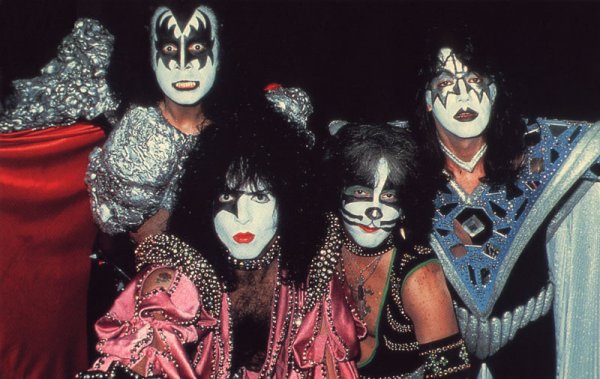
The crux of the soundtrack is this:  It’s nearly impossible to listen to it without consciously or unconsciously comparing it.  That’s natural.  No matter who composed it, fans would notice it’s not John Williams.  Just like fans can tell the Kiss band of today is not the Kiss band of 1978.  What else could Disney do?  John Williams is 85 years old, and they plan on making these movies for years and years to come.  It’s reasonable to think John Williams will be able to complete the third trilogy of Star Wars, as we hope.  It’s not realistic to think he’ll be around as long as Disney plan on making Star Wars movies, as sad as that is.

We’ll leave this review with just some fun speculation.  It is widely known that, at some point in the late 1970s, George Lucas mentioned there would be 12 films.  Not 3, 6 or 9.  12 films.  He later backtracked and said, “Yeah, no, I meant 6.”  And of course he also used to deny he’d even make the prequel trilogy at all.  Then we found out he was already writing Episode I.  And recently, we learned he was actually planning to do the sequel trilogy after all, meaning you can’t trust anything Lucas backtracks on.  Fans always assumed 12 films meant 4 trilogies.  A fourth trilogy (probably focusing on Rey, Finn, Poe or Kylo’s children) does not seem impossible any more.   As long as these movies make money, it’s feasible that Disney could continue the actual saga beyond just these anthology films.  If we imagine that one day we’ll get Episodes X, XI and XII then who could compose the music?  Certainly not John Williams, since this could not happen until the mid-2020s at the soonest.  If it ever comes to pass, the fourth trilogy would have to be composed by somebody new, be it Giacchino or someone else.   Giacchino established himself as a real contender on Rogue One.  Well done.

3.5/5 stars

REVIEW: Deep Purple – When We Rock, We Rock and When We Roll, We Roll (1978)

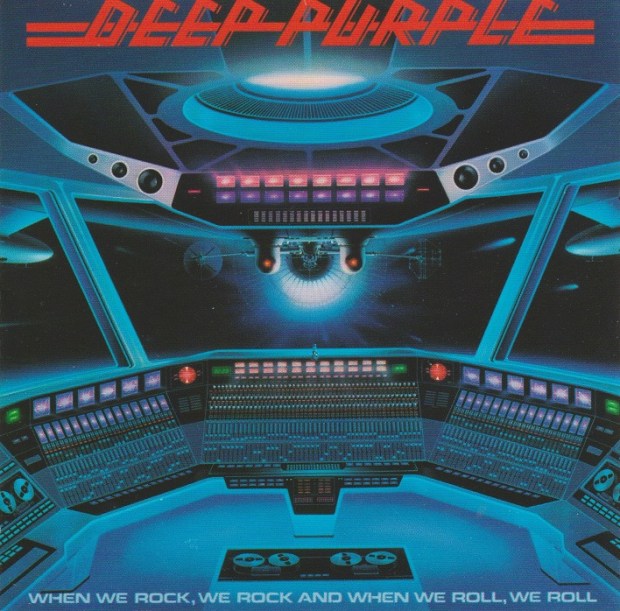
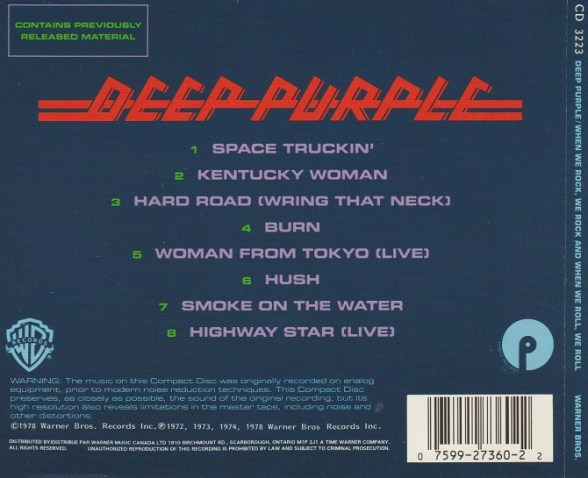
DEEP PURPLE – When We Rock, We Rock and When We Roll, We Roll (1978 Warner)

When Deep Purple broke up in 1976, their back catalog was ripe for exploitation for compilation by record labels.  One by one, out trickled Deepest Purple, Singles A’s and B’s, and When We Rock, We Rock and When We Roll, We Roll.  1978’s When We Rock is the least necessary of them all.

The only thing that When We Rock really has going for it is that did feature all the Deep Purple singers to date.  Ian Gillan sings the majority of tracks, Rod Evans has two (“Hush” and “Kentucky Woman”) and Coverdale/Hughes have one (“Burn”).  The shoddy package had no involvement from any ex-members of the band, and even has an incorrect track listing on the back.  “Woman From Tokyo” isn’t live, but “Smoke on the Water” is (from Made in Japan).

If music shoppers in 1978 were just looking for a handy-dandy single record set of all Purple’s radio hits, then When We Rock almost fits the bill.  “Hard Road (Wring That Neck)” is conspicuous by its inclusion, being a semi-obscure instrumental from 1969’s The Book of Taliesyn.  Swap that one out for “Strange King of Woman” and you could have had a serviceable hits set, even considering the live tracks.  After all, Made in Japan helped establish the live album as a viable hitmaker.

The only reason to own When We Rock, We Rock and When We Roll, We Roll is the cover art, which admittedly is pretty nifty.

1/5 stars

REVIEW: Queen – The Game (1980, all bonus tracks)

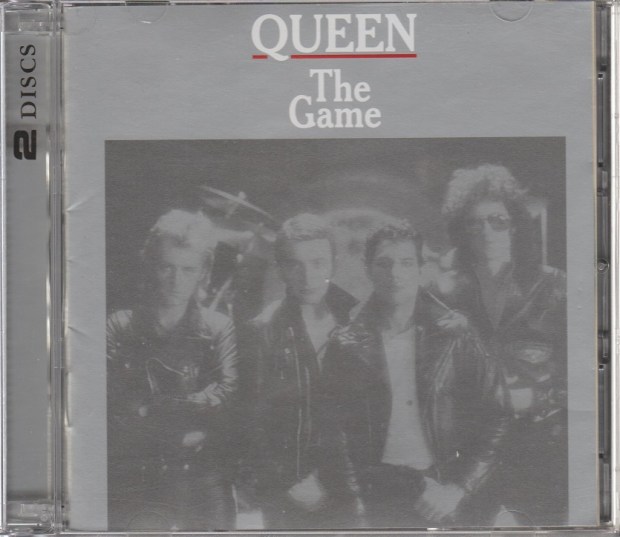
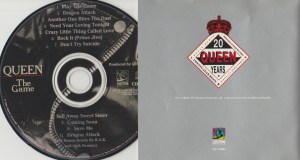
QUEEN – The Game (Originally 1980, 1991 & 2011 Hollywood recorded reissues)

When Queen released their devastating debut album Queen in 1973, the liner notes proudly stated “And nobody played synthesizer”.  A mere seven years later, Queen introduced the electronic instrument to their sound on 1980’s The Game. This did not in any way hinder the album from becoming a massive success, nor weaken the Queen sound.  The synth was just another colour in the Queen pallette.  It would be fair to argue that The Game contains no clunkers, no songs that should have been discarded.

All you have to do is fall in love.  Everybody play The Game.

The Game eventually spawned five brilliant singles:  “Play the Game”, “Another One Bites the Dust”, “Crazy Little Thing Called Love”, “Need Your Loving Tonight” and the grandiose “Save Me”.  Anybody who has some decent Queen “hits” albums should know at least four of those songs.  But that’s not all, of course.  Funky bass and sharp danceable beats make “Dragon Attack” one not to miss.  The production of Mack and bass of the incredible and underrated John Deacon really cut through.  Rock albums that sound as good as The Game do not come around often, and “Dragon Attack” must be considered a prime example of why The Game is tops.    On album, it’s followed by Queen’s best known funk jam “Another One Bites the Dust”.  Dancefloor overload, baby!

Speaking of John Deacon, not only did he write “Another One Bites the Dust”, but also “Need Your Loving Tonight” which is good and hard rock and roll.  It could have been a Paul Stanley track.  As far as “rock and roll” goes, “Crazy Little Thing Called Long” is definitive.  The walking bassline and black leather jacket vibe are perfect.

The Game‘s second side has the deep tracks.  “Rock It (Prime Jive)” combines the synths with a scorching Roger Taylor hard rocker.  This cut is well worth getting acquainted with.  You’ll want some “Prime Jive”!  Then there’s the track I vaguely remember hearing on a radio as a kid, “Don’t Try Suicide”.  Good advice, and a strange and snappy little bopper to singalong to.  “Don’t try suicide, you’re just going to hate it,” was the line I found strangely amusing as a child.  “Isn’t that obvious?” a nine or ten year old me wondered.

Then there’s a song I first became acquainted with via Guns N’ Roses.  Axl, an unabashed Queen fan, used to do a bit of “Sail Away Sweet Sister” on piano in concert.  In my mind, it doesn’t matter how you first heard a song, as long as you eventually hear it.  The Queen original is a somber ballad sung by Brian May and featuring stunningly beautiful guitar work.  Another winning combo that sounds a bit Kiss-like is the rhythmic “Coming Soon”.   Don’t be surprised that Taylor penned it.

That is a tight ten songs, half of which were singles.  A damn perfect album.  Of course today there are expanded experiences to choose from.

When this album was reissued in 1991 by Hollywood records for their Queen “Twenty-Year Reign” series, they added a remix of “Dragon Attack”, now deleted.  Adding unnecessary loops, samples and raps brings nothing to the song.  Only collectors need seek this out.   Instead, you should search for the 2011 double CD remastered edition.  This one adds five bonus tracks.  “Save Me” and “Dragon Attack” are live, and the liner notes state that “Save Me” from 1981 could be the “ultimate” rendition of that song.  (It certainly is impressive.)  Then there is a first take of “Sail Away Sweet Sister” before all the words were in place.  The most fascinating demo is a spontaneous recording of what would later become “It’s a Beautiful Day”, finished for 1995’s Made in Heaven, the final Queen album.  History buffs will be delighted to discover a B-side written by Roger Taylor called “A Human Body”.  This unusual song is about the doomed Scott expedition to the South Pole in 1912.

They were talking in whispers,
In bear skins and fur,
Captain Scott and his heroes-to-be,
To have laboured so long,
To have made it this far,
Ooh it’s been such a long ride,
Ooh you know it’s been a long way,
For a human…human…human,
For a human body you see.

Indeed, Robert Falcon Scott was considered a hero of the British Empire, though he was beaten to the pole by Roald Amundsen of Norway and died on the way home.  Scott’s story is a tragedy of human error, ego, Imperialism, and the sheer deadly ability of the south pole to render a man lifeless in minutes.  Taylor’s quirky track does not convey this, and so it remains an odd curiosity.

However you get The Game, you will be delighted by the core 10 tracks.  The 2011 bonus CD is highly recommended.  All hail John Deacon, the boss of the bass.

5/5 stars

REVIEW: Helix – Live at the Marquee (1985 promo EP)

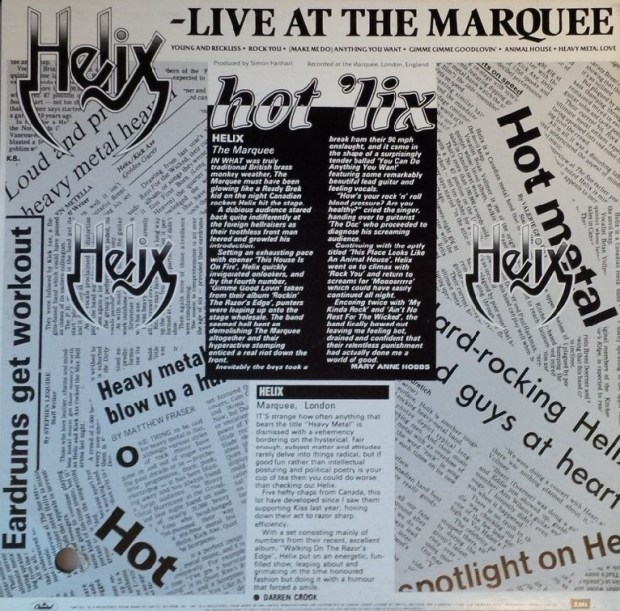
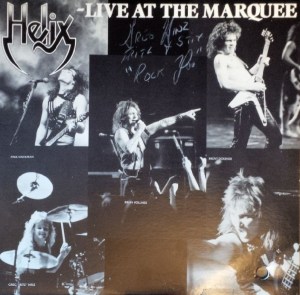
HELIX – Live at the Marquee (1985 Capitol promo exclusive EP)

Gratuity goes to two people:  Helix associate John Hockey who initially hooked me up with an mp3 rip of his copy of this Holy Grail rarity, and to Boppin for finding this original copy on vinyl!  Helix’s Live at the Marquee EP is one of those releases that lots of people have heard of, but few have heard.  First of all, it’s a promo, which means it was only distributed within the industry and never made available for sale to the public.  Promos can be very desirable collectibles, especially when they contain exclusive music.  Live at the Marquee was nothing but!  In 1985, Helix had released nothing in terms of live product, not even a live single B-side.  Live at the Marquee was the only one, and before the internet, few fans even knew about it.

For full disclosure, there is a rare Rock Candy reissue of 1984’s Walkin’ the Razor’s Edge, an unauthorized but valuable release that does contain three of the six Marquee tracks.  That 2009 release includes “Young & Wreckless”, “Rock You”, and “Animal House” from this EP.  The other three songs have yet to be reissued anywhere, so half of Live at the Marquee is still exclusive to the EP.

What you need to know about Live at the Marquee is that this is Helix at their prime.  The classic lineup was in full swing:  Brian Vollmer (vocals), Brent “Doctor” Doerner & Paul Hackman (guitars), Greg “Fritz” Hinz (drums), and Daryl Gray (bass).  They were performing their most popular tracks from the Razor’s Edge and No Rest for the Wicked LPs.  Starting with “Young & Reckless” and “Rock You”, it’s full octane in the tank and pedal to the metal.  Helix were and are known as a loud band, and this EP sure sounds like it.  They take a step back on the hit ballad “(Make Me Do) Anything You Want”.  Helix could do love songs like that without sounding wimpy.

Side two continues with the single “Gimme Gimme Good Lovin'” (Crazy Elephant cover) which sounds like a blast.  Helix do not get recognition for the dual guitar alliance of Doerner and Hackman as perhaps they should.  Check out “Animal House” for more of their stellar interplay including a bit of slide.  Finally “Heavy Metal Love” closes the record, an enduring favourite today that sounds fantastic performed by the classic band.

Over the years, fans became widely aware of the existence of this release.  It would be listed and pictured among official discographies, but never found in stores.  Until/unless those final three recordings become available on CD, this record should be sought after by every serious Helix fan.  I’m happy to have a copy signed by Fritz Hinz.  Also awesome?  John Hockley hooked me up with a CD copy of the Rock Candy release of Razor’s Edge, signed by all four surviving members of the classic Helix band.  Thank you John, and rest in peace Paul Hackman.

4.5/5 stars
#562.5: The Sunrise Returns

GETTING MORE TALE #562.5: The Sunrise Returns

I was very saddened when Sunrise records shuttered most of their stores nationwide, including my regular outlet at Fairview Mall.  Not so much when the HMVs started closing.  I haven’t spent any money at an HMV in years.  Recently, Sunrise announced they would be taking over several of the old HMV locations, including the one at Fairview mall.  Yes, Sunrise has finally returned to Fairview.

Sunrise re-opened a few days after Record Store Day in a case of bad timing, but they still had some RSD stock.  I set aside my Saturday morning to immerse myself in their inventory.  As expected they had plenty of vinyl, displayed front and center when you enter the store.  It’s a good selection of the usual suspects priced in the mid-$30s.  Their vinyl catalogue selection was much better than the same for CD.  Flipping through the Kiss LPs, they had 15 or so titles from the catalogue including some of the lesser known ones such as Carnival of Souls.  Then I flipped through Deep Purple on CD.  Disappointingly, they had five copies of the hits disc Icon, one copy of In Rock (standard edition) and one copy of The Very Best Of.  The same issue plagued many artists in the CD section:  five copies of Icon, but very few actual albums on CD.   This wasn’t the case across the board.  There was a healthy Metallica section and they had all the Oasis deluxe editions.  One deluxe that I was looking for was the four disc Black Sabbath Paranoid reissue, but all they had was the double CD (and 180 gram vinyl of course).

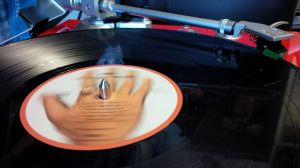
They staff were friendly and passed the test.  They approached me and asked if I needed help, I didn’t need to ask them, and they waited a reasonable amount of time.  Unfortunately their system isn’t quite up and running yet.  No inventory lookup.  But they tried.  You can’t judge a store too harshly a few days into their first week.  They had a promotional sale on:  Buy something on vinyl and get $5 off a T-shirt.  They had a lot of cool T-shirts, (a lot!) but if there is one thing I don’t need right now, it’s more T-shirts.  They even had brand new Star Wars turntables.  Star Wars turntables?

The one surprise I saw was in the Mr. Bungle section.  They had five copies of their legendary debut album, at a steal of $5.99 each.  Compare that with $21 on Amazon.

I hope Sunrise does well.  They made a few sales while I was there, and the store was never empty.  It was funny to listen to the people browsing.  “Is that a CD?”  “No, it’s a seven inch record.”  “NO WAY!”

Way indeed.  Welcome back Sunrise.

SUNRISE SCORES:

Four finds from four different genres.

Brant BjorkTao of the Devil CD – $18.99 (compared to $24.28 on Amazon.ca)

OasisBe Here Now 3 CD deluxe – $32.99 (compared to $31.45 on Amazon.ca)

KissMusic From the Elder 180 gram LP reissue – $32.99 (compared to $33.79 on Amazon.ca)

Steve Earle & the DukesThe Continental Club 7″ RSD 2017 single – $11.99 (not available on Amazon.ca)


#562: Adventure!

GETTING MORE TALE #562: Adventure!

I was at a funeral recently, for an old family friend.  Sandor was a neighbor since I was little.  I grew up playing with his three kids: Rob, Michelle and Steven.  It was sad but nice to see them again.  We chatted about games we used to play as kids.  Atari 2600, Lego, the Game of Life.  The best games we played were the ones we made up ourselves.

One game that I invented with my best buddy Bob was called “Double Bounce Volleyball”.  It was just a good way to play with a volleyball on the street with no net.  I wrote up some rules on WordPerfect.  What I wouldn’t give to see those again!  What was not in the rules, but happened frequently anyway, was me throwing down some street moves.  I tried to do the spinny-spinny-jump dance that Paul Stanley used to do in the “Thrills in the Night” music video.  I could do it, but it didn’t look right anyway without the tassels on the pants!  Personal acrobatics aside, it was a great game because all you needed was two people, a street, and a volleyball.

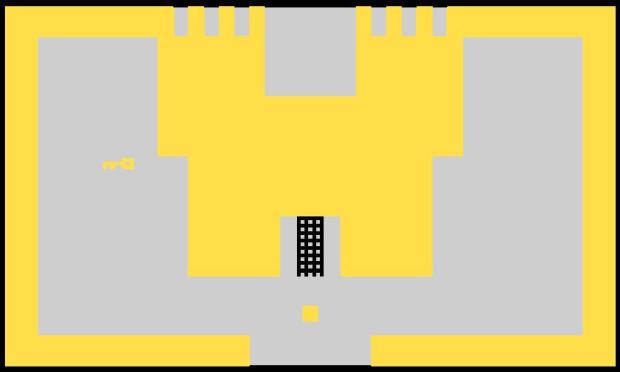
Another game we invented was a live action version of the 1979 Atari classic game, Adventure.   Due to its poor graphics, it was once considered one of the worst video games on the market.  Since then it has somehow become a cult classic, despite the fact that your little “man” was just a square floating around.  You had explore mazes and three castles, and eventually bring a chalice back to the yellow castle.  The random setting for the game placed objects everywhere on the field so no two games were the same.

Atari Adventure man with sword and yellow key

The main objects in the game were three keys (one for each of three castles), a sword, a magnet (useful for grasping objects out of reach) and a bridge (pretty useless).  There were also some creatures to avoid:  three dragons, and a bat who would steal whatever you are carrying, and sometimes replace it with something less useful.  For example, the bat can and will steal your sword and replace it with a dragon!

A group of kids would gather together in somebody’s back yard.  Depending on how many kids there were that day, we might have used multiple back yards.  Someone would hide the chalice (a drinking glass) and other objects.  I had a neat classic U-shaped magnet that was perfect to fill that role.  We’d usually use clothespins for the keys.  A plastic lightsaber was our sword.  Then we’d all become adventurers, dragons or the bat!  We’d run around the yard finding objects and generally having a blast for the whole afternoon.

I think our live action game was better than the real Adventure!

One afternoon, another kid from another neighborhood joined us.  I don’t know why Allan Runstedtler was wearing a cape, but it suited!  Another time, we couldn’t remember where my magnet was hidden, and I really wanted it back!  We eventually found it and decided not to hide actual valuable objects again.

Do kids even go outside and play anymore?  Almost everything we did was improvised.  A badminton racquet wasn’t just a badminton racquet.  It was also a guitar for “air bands”.  Bob turned a neck brace into a Texas Chainsaw Massacre mask.  We also did a live action version of the video game Berzerk.  We were all very lucky to grow up in a tightly knit and safe little neighborhood.  Everybody’s parents knew everybody else’s.  We played video games (everybody on the street had either an Atari 2600, or a Commodore Vic 20), but then we went outside when that got boring.  It wasn’t just a neighborhood with families.  It was an extended family of families that we were fortunate to experience.  And a hell of a lot of fun.


REVIEW: T.M. Stevens – Black Night: Deep Purple Tribute According to New York (1997)

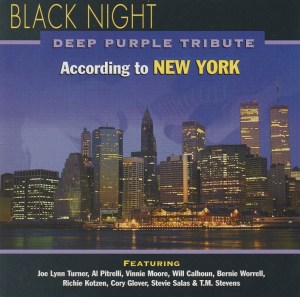
Black Night:  Deep Purple Tribute According to New York (1997 DeRock)
Produced and arranged by T.M. Stevens

This is one of the coolest and most different Deep Purple tributes you are likely to find.  It’s also by far the funkiest.

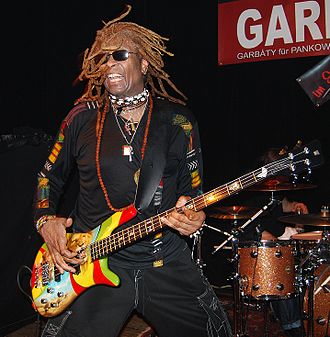
Bassist T.M. Stevens (aka Shocka Zooloo) might be best known for his work with Joe Cocker, James Brown, Billy Joel and many others…but he first came to the attention of hard rockers via Steve Vai.  He was a member of Vai’s Sex & Religion band, and immediately stood out on CD and on stage.  Although his name doesn’t appear prominently on the front cover for Black Night: Deep Purple Tribute According to New York, it’s clearly his project.  He produced it, arranged it, and is the only musician who appears on every track.  He has a pocket full of well known friends to fill out the instruments including:  Will Calhoun (Living Color, drums), Cory Glover (Living Color, vocals), Joe Lynn Turner (Deep Purple/Rainbow, vocals), Richie Kotzen (guitar, vocals), Al Pitrelli (Savatage, guitars), Vinnie Moore (UFO, guitars), Stevie Salas (guitars), Bernie Worrell (Parliament/Funkadelic, keys), Cindy Blackman (Lenny Kravitz, drums), and Tony Harnell (TNT, vocals).  What a team!

Black Night is not for everyone.  Each and every song is drastically changed.  “Black Night” itself is slowed down and turned into a metallic bluesy grind.  Dual lead guitars by Pitrelli and Moore ensure its metal credentials, and Joe Lynn Turner comes down with his raspy soul.  Another raspy soul singer, Richie Kotzen, handles “Strange Kind of Woman” on guitar and vocals.  This one turns the funk right up!  The rhythm section of Calhoun and Stevens generates a punchy funk that can’t be stopped.  A standout.  Living Color’s Cory Glover takes over on the even funkier “Fireball”.  The creative arrangement deconstructs the song.  “Fireball” was one of the few Purple songs to feature a bass solo, so Stevens takes the opportunity to slap some bass.  A Purple tribute without “Smoke on the Water” wouldn’t be a real Deep Purple tribute.  It’s a hard track to funk up, so it’s more of a steamroller with funky verses.  Kotzen turns in a hell of a soulful vocal, proving how versatile any music can be.  An original and refreshing slant on a tired classic.

The most interesting arrangement is by far “Child in Time”.  The epic soft/loud dynamic of Purple’s beloved classic has been replaced by reggae, and why not?  Bernie Worrell does his best with Jon Lord’s original outline to create his own organ parts.  T.M. and Tony Harnell share lead vocals: Tony singing the clean and high parts (with absolutely no difficulty!), while T.M. does his Rasta take on the rest.  Sacrilege?  Keep an open mind.

Keeping an open mind is the key for this entire album.  If you cannot do that, you will probably hate Deep Purple According to New York.  That title says it all.  This is Purple according to Stevens and friends, and they do their own thing.  The rest of the material — “Woman From Tokyo”, “Stormbringer”, “Speed King”, “Burn”, and “Space Truckin'” — are as different as the first five tunes.  “Woman From Tokyo” is funky soul vocal nirvana, featuring four lead singers (Kotzen, Stevens, Harnell and Turner)!

In case you’re wondering what the closing track “Deep Purple NY” is, it’s just a funky shout-out to all the players on the CD.  “New York is in the house, New Jersey, Bernie Worrell!”  That kind of thing.

I’ve heard a number of Deep Purple tribute albums over the years.  Yngwie did four Purple songs on his mediocre Inspiration album.  Thin Lizzy did a Purple tribute under the name Funky Junction.  There was the star-studded Re-Machined CD.  There was even a 1994 tribute album called Smoke on the Water that featured three of the same guys on this album!  (Joe Lynn Turner, Tony Harnell, Richie Kotzen, as well as another ex-Purple member, Glenn Hughes).  None of those albums, even with all that star power, are nearly as interesting as Black Night.  I chose that word “interesting” on purpose.  It’s a very neutral word.  Your reaction to this album could be wildly positive, violently negative, or simply passively unmoved.  The listening experience will be anything but dull.  Whether you like it or not, if you pick up this CD you’re going to hear some of the greatest rock and funk players on the planet, so get your dancing shoes on.

4/5 stars
 

RE-REVIEW: KISS – Dynasty (1979)

The KISS RE-REVIEW SERIES Part 17:  


  Dynasty (1979 Casablanca, 1997 Polygram Japan remaster)

“The Return of Kiss”.  It sounds quaint today, that after a two year absence they called it “The Return of Kiss”.  Two years today means nothing.  But for Kiss, who were doing two releases a year, it did actually mean something.  Their last project was their series of four solo albums, one for each member, and unified by cover art.  This project only reinforced the idea that the whole is greater than the sum of its parts.

The truth is, the original Kiss were already over.  Peter Criss returned from his solo album and a car accident as a changed man, and not in a good way.  Upon walking in the door he insisted upon seeing sheet music for the new tunes.  That was a first.  It was quickly apparent that Peter was not in a condition to perform.  The band had even hired his solo album producer, Vini Poncia, to helm the new Kiss.  Poncia deemed Criss’ current abilities inadequate and he was replaced for the album by Anton Fig.  Anton was Ace’s solo drummer, and more than capable of filling in.  Previously, when Bob Kulick was hired to replace Ace on side four of Alive II, he was instructed to “play like Ace”.  Anton Fig was given no such instruction and was free to drum as he pleased.  Some Kiss fans were able to pick up on that.  Ultimately Peter Criss played drums on only one song, his own called “Dirty Livin’”.  And that would be Peter’s final appearance on a Kiss studio album until 1998’s Psycho-Circus, on which he also played drums on only one track.  Kiss was indeed broken, but few on the outside knew it.  Peter would never play on a whole Kiss album again.

A lot had changed.  Kiss’ massive marketing campaigns paid off, but was that a good thing?  Little kids were now coming to Kiss concerts.  Paul Stanley was actively seeking hits.  Together with new songwriting friend Desmond Child, Paul wanted to write a dance single.  Inspired by the clubs of New York, the pair produced “I Was Made For Lovin’ You”, the song that gave Kiss the “disco” tag.  The single sold a million copies.  Needless to say, it was not the last Kiss single written with Desmond Child.

The album went platinum and became the hit it was designed to be.  Inside the sleeve, the music was streamlined and more commercial than before.  “I Was Made For Lovin’ You” led the way, demolishing the walls between dance and rock.  Frehley had a hot solo in the mix, and the bouncy bass was performed by Paul Stanley.  The song had all the right ingredients and though thin sounding by today’s standards, it’s still a great little dance rock number.

The real revelation about Dynasty wasn’t the turn towards slicker, highly compressed recordings.  It was Ace Frehley coming out of his shell.  Newly confident after his hit solo experience, Frehley had three songs to sing on Dynasty.  Ace covered the Stones on “2000 Man”, a version that may be more beloved than the original.  It certainly sounds at home.  Ace rocks it up significantly.  Ace also had lead vocals on “Hard Times”, a track about growing up as an aimless youth in New York.  “We’d go to school, then we’d cut out, go to the park, and space our heads out.”  “Hard Times” is not an exceptional song, but it’s interesting since it’s so autobiographical.  Ace’s last song was the more aggressive “Save Your Love”.  This track closes Dynasty with the kind of rock that people often forget is on the album.  Ace’s tracks are the only ones that can be classified purely as “rock”.  He has more guitar riffage on “Save Your Love” than the other songs combined.  Without the Space Ace, Dynasty would have been a much weaker album.

The increase in Ace’s participation was balanced by a decrease in that of Gene Simmons.  Gene only had two songs on the album, neither of which were singles.  “X-Ray Eyes” and “Charisma” inhabit the same kind of compressed audio landscape as the rest.  “Charisma” is the best, due to its unusual echoey vocals, fitting for the demon persona.  Gene’s prime interest was still the opposite sex, and both songs have the demon’s stamp.  The main hooks on both are delivered by the backing vocals during the choruses.

The dominant force on Dynasty — and as it turns out, for the coming decade – was Paul Stanley.  Not only was “I Was Made for Loving You” a massive hit, but the second single “Sure Know Something” was also one of his.  Paul wrote this dancey ballad with producer Vini Poncia.  It’s not all simply dance floor moves though, as the chorus has the power chords and lung power that Kiss fans expected.  Stanley also wrote “Magic Touch”, a lesser known album classic.  “Magic Touch” burns slow, but hot.  Paul’s falsetto was a sign of the times, but the power chords explode on the chorus.

And that leaves poor Peter.  “Dirty Livin’” was written with Stan Penridge and Vini Poncia, and it was written as something more R&B in direction.  It was Kiss-afied and included on the album as Peter’s only appearance.  You can hear that it’s not the same drummer and that it’s a very different vibe.

For all outside appearances, Kiss maintained an image of solidarity.  There was no mention of a session drummer, and Peter was there on tour for all 82 shows.  However there were some cracks visible.  Several shows had to be cancelled for poor ticket sales, in areas such as New York City and Pontiac Michigan.  With the toys, comics and merchandise, Kiss were beginning to be seen as a kids’ band.  Dynasty was the hit it needed to be, but the situation was not sustainable.

Today’s rating:

4/5 stars


Uncle Meat’s rating:

4/5 steaks 

Meat’s slice:  The first of the two supposed “Disco Era” Kiss records LeBrain referred to in the introduction of this series, Dynasty really just is a pretty solid rock and roll record other than the mega-hit, “I Was Made For Lovin’ You”.  There really is not another song on the record that could be classified as Disco.  But more on that when I talk about Unmasked.

This album sees the beginning of a couple new eras in Kisstory. The first being the band’s writing collaboration with Desmond Child.  “I Was Made For Lovin’ You” was the first hit of many for Desmond Child.  He has “songwriter” credits (and yes I am using that term loosely) on such deplorable pap as “Livin’ La Vida Loca”, “She Bangs”, and upcoming Kiss dung like “Let’s Put the X in Sex” and “Uh! All Night”.  Basically when a band gets shittier, they go to Desmond Child.  When Ratt got shittier, in came Desmond.  When the Scorpions got shittier, he pops up again.  When Aerosmith started becoming a glossy joke, here comes Desmond Child and “Dude (Looks Like a Lady)”. Yes, as good as this album is, Kiss was starting to get shittier.

As George Costanza would say, worlds collide for me on this album.  For years I had no idea Peter Criss only played drums on his own song on Dynasty.  His phantom replacement turned out to be Mr. Anton Fig, who played drums in one of my favorite bands ever, Paul Shaffer and the World’s Most Dangerous Band.  Even Anton’s dry humor on the show was a high point in Late Night with David Letterman for me.  I am a true Letterman head and always will be.  Anton Fig went on to be Ace’s drummer in Frehley’s Comet, so maybe Fig’s presence somehow inspired the Space man, since he is a high point of Dynasty.  The Rolling Stones cover “2000 Man” is a fucking great tune.  “Hard Times” is just as good and a personal favorite of many Kiss fans.
There are a few weaker-ish songs on the album but nothing egregious here.  Very good rock album with ONE disco song.  Thank you Desmond Child for injecting Kiss with your “Bad Medicine”.  (Yes, he wrote that too.  As well as writing songs for such wonderful artists like Hanson, The Jonas Brothers, Lindsay Lohan and Clay Aiken.)  Hey Desmond…in the words of Ricky…you are truly a FuckGoof.

Favorite Tracks:  “Sure Know Something”, “Hard Times”, “2000 Man”, “Save Your Love”, “Magic Touch”

Forgettable Tracks:  “Dirty Livin'”


To be continued…

Original mikeladano.com review:  2012/07/24

#561: (What’s the Story) Morning Glory?

GETTING MORE TALE #561: (What’s the Story) Morning Glory?

In November 1995 I was going through another breakup.   A big one — my first really serious girlfriend.  After some soul-searching, I thought this would be a good time to expand my horizons a bit, including musically.  By 1995, heavy metal music was not doing well.  It was on life support.  I wanted to check out other forms of rock and roll.

Working at the Record Store was the perfect environment for exploration.  Christmas 1995 featured a lot of store play for Oasis, who my co-working buddy T-Rev was a huge fan of.  Their new album (What’s the Story) Morning Glory? was beginning to take off.  It also appealed to a metal head like me.  It had a bit of everything:  rockers, ballads, and hooks.  It was a breath of fresh air, and loud as fuck.  Grunge bands had dominated and carried with them cloudy skies for the early 90s.  Oasis brought back fun aspects of rock and roll, and were right in synch with the Beatles resurgence happening at the same time with the Anthology series.  Oasis were almost a poor man’s Beatles.

I mean, they really wanted to be The Beatles, didn’t they?

I got to listen to the CD a lot in store, but we had a long waiting list for used copies. Because of that it would be a few months before I was able to get my own copy of Morning Glory.  T-Rev was on top of things, and had been collecting Oasis singles.  Oasis had a knack for B-sides, and often saved their best tunes for singles.  This was rare; in 1995 it was unheard of to save good songs for single B-sides.  Oasis didn’t care and did it anyway.  My first Oasis purchase was actually the CD single for “Don’t Look Back in Anger”.  T-Rev made sure it was stocked, even though we rarely stocked any singles.

So “Don’t Look Back in Anger” was my first Oasis purchase ever.  Buying a new copy of the single was more expensive than buying a used copy of the album, but that’s just the way it goes sometimes.  I dug the piano part ripped from John Lennon, and the bright melody with a hint of shade.  It really felt like an homage to the Beatles.  And the B-sides weren’t half bad either.  “Step Out” and “Underneath the Sky” were both top notch songs each with their own flavour.

The track that really sold the single for me was “Cum on Feel the Noize”.  T-Rev asked, “Why would they cover that song?”  I explained it was originally by Slade, not Quiet Riot.  Oasis’ version is more authentic to the Slade original.  The song was a perfect bridge between my heavy metal past and my Oasis present.

Oasis quickly became my favourite “new” band in 1996.  That was the year that we opened up the branch of the Record Store that I managed.  I thought Oasis would be a good band for store play, and while some customers enjoyed that, no staff members did.

Oasis did their part to keep the single alive in the 1990s.  They issued box set after box set, re-releasing their old singles to those who missed them the first time.  The coolest of these were the “silver” and “gold” boxes.  They were plastic hard-shell box sets, one for the Definitely Maybe singles and one for Morning Glory.  They included an interview disc (same one in both boxes) and made it easy to get caught up on Oasis’ CD singles.

These were good times.  Though a breakup with a girl was the trigger, Oasis was the remedy.  Some songs, like “Cast No Shadow” had me wallowing in my own pity, but it was hard not to feel good things with “She’s Electric” and “Roll With It”.  For that reason, although there may be better Oasis albums, What’s the Story remains the most personal to me.

TOP FIVE REASONS TO LIKE OASIS:

5) Lars says it’s OK .

4) They had a member (Paul “Guigsy” McGuigan) who looked like Mr. Bean.

3) Noel frequently refers to Liam derisively as “our kid”.

2) Wibbling Rivalry

1) Liam Gallagher’s unibrow.