

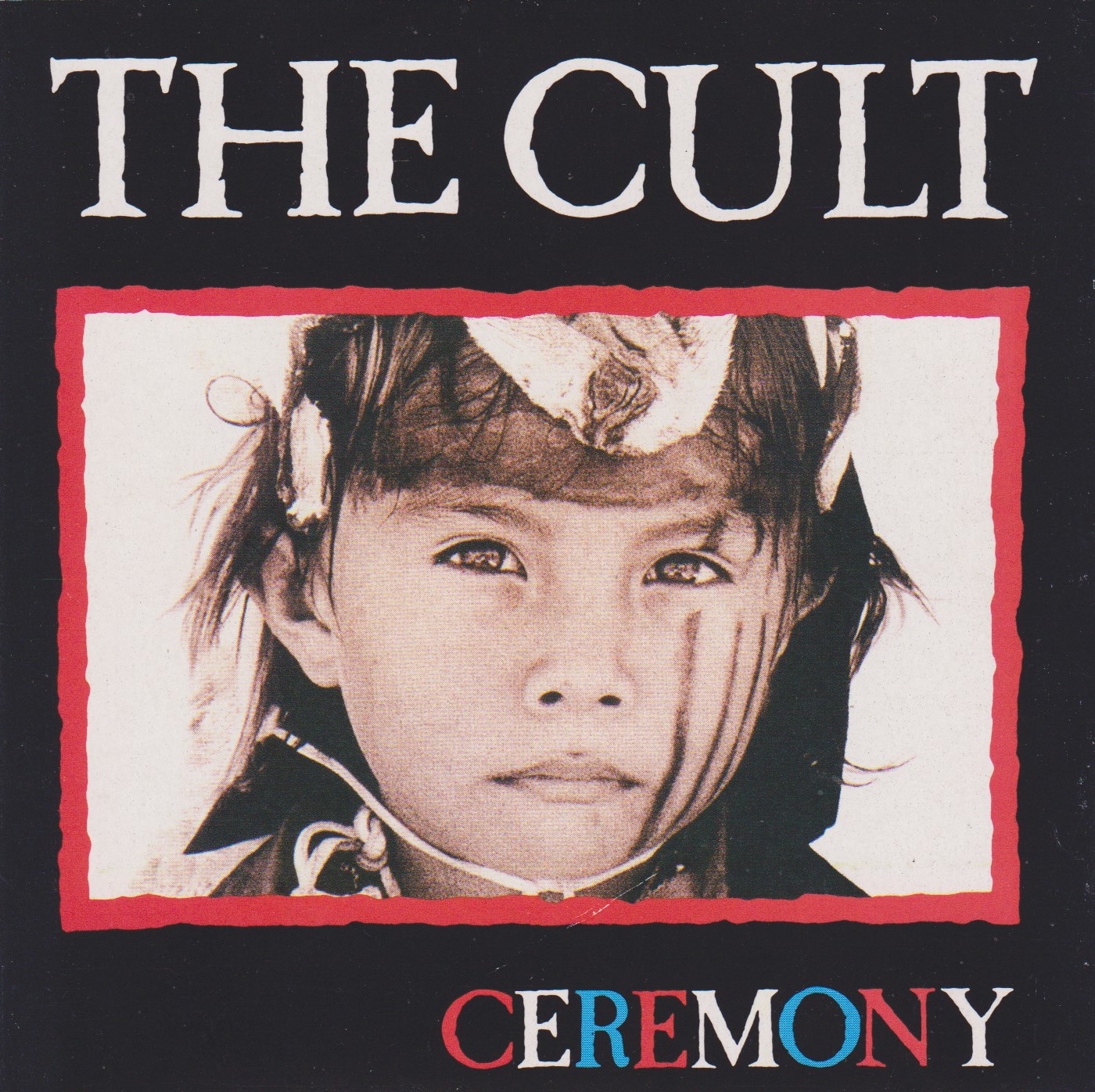
 THE CULT – Ceremony (1991 Beggars Banquet)
Only 25 years late, I have finally acquired the Cult’s Ceremony CD, thanks to my kind and generous reader Wardy. I somehow missed this album all those years, even though I own all the singles. There are some songs here that are completely new to me. Ceremony received mixed reviews when it was released, as it represented the band’s furthest move away from their roots, into commercial radio rock. Let’s see how accurate that is.
It starts sounding more like some lost Deep Purple album, with big organ and jammy sounds. Richie Zito co-produced this disc, and the band got a sharper sound out of the studio than they did with Bob Rock last time. Sonically, Ceremony has more impact, more heft, more oomph than the big and echoey Sonic Temple. The “Ceremony” in question on the title track is the rock arena, as the Cult had definitely become arena rock. They had also been reduced to a core duo. Jamie Stewart and Matt Sorum were gone, and the Cult used session musicians during this period. Charlie Drayton (bass) and Mickey Curry (drums) helped the band achieve what sounds like a very sincere crack at this kind of rock. Accessible it is, but the Cult didn’t really sell out. Check out the frantic “Wild Hearted Son”. Like the sound of a stampede of horses across the plains, “Wild Hearted Son” does not let up. I think I lot of fans were disappointed that the new Cult sound wasn’t more esoteric, but that doesn’t make it bad.
Just as relentless as “Wild Hearted Son” comes the “Earth Mofo”. One thing I had never really paid attention to before was the bass. Drayton’s get some great bass chops. The production of Ceremony leaves a lot of space between the instruments, so you can hear them. Those who find Sonic Temple overproduced may dig on this, so give “Earth Mofo” a spin. That’s nothing though compared to the powerful “White”. Epic in scope, “White” is a massive groove with layers of acoustic instruments a-la Zep.
I didn’t see the tender sound of “If” coming, just piano and Ian’s crooning. Not after all that heavy hitting rock. But then “If” also explodes into something bigger, anthemic and memorable. I’m starting to think that if Ceremony got a bad rap back in ’91, it’s because people weren’t paying proper attention.
“Full Tilt” is a great name for a rock song. Riffed out with generous helpings of rock sauce, “Full Tilt” was reported to have knocked a picture of at least one journalist’s wall.* Just wait until the afterburners ignite in the last minute of the song. Strangely, the very next track is the acoustic ballad “Heart of Soul”; a good song indeed but not as great as “Edie (Ciao Baby)” was. Back to the rock, “Bankok Rain” lacks the charisma that the rest of the tunes seem to have in common, though there is certainly nothing wrong with it’s staggering riff. By the end you won’t care, because the whole thing burns like fire and gasoline until all the fuel is spent.
A fascinating Cult song is “Indian”, a basic acoustic song with cello accompaniment. As Cult ballads go, this is definitely a peak moment. Ian infuses more passion into one line than most singers can do in a whole song. Unexpectedly, the album moves right on to another ballad, “Sweet Salvation”, which is actually less a ballad and more a soul song. It’s powerful, as are all these songs in their own ways. Ian Astbury breaks out the Morrison poetry jams to kick off the ending track, “Wonderland”, a riff driven slow broil.
That’s the album, and it’s hard to gauge where it sits among the whole Cult catalogue. Certainly, this and Sonic Temple are brother records. They are stylistically more similar than Cult albums tend to be. Ceremony possesses track after track of scorching rock music. Does it make as strong an impression as the bombastic Sonic Temple? Not quite. By stripping the production to a more sparse and live sound, perhaps the Cult sacrificed the nuances. Ceremony gleams shiny with amped up guitars and drums aplenty. It is hard to find fault. It is still a fine album.
3.5/5 stars


* That’s a true story, but I can’t remember what magazine I read it in. The reviewer said, quote “‘Full Tilt’ knocked a picture off my wall.”
Note: This tale is from 1996 and does not reflect current tech.
GETTING MORE TALE #504: Waiting
The store that I managed for the longest period of time was opened in April of 1996. The format was 95% used stock, about 5% new. It was fun being a part of the cutting edge in retail.
When we opened that store, we were inundated by customers who had never heard of us before. Every day for months, somebody would wander in who had never been in one of our stores before. It was cool. We were different, and we wanted people to know it. We were eager to promote our special features and strengths, such as our listening stations and reservation lists.
The reservation list caused a lot of confusion among new customers.
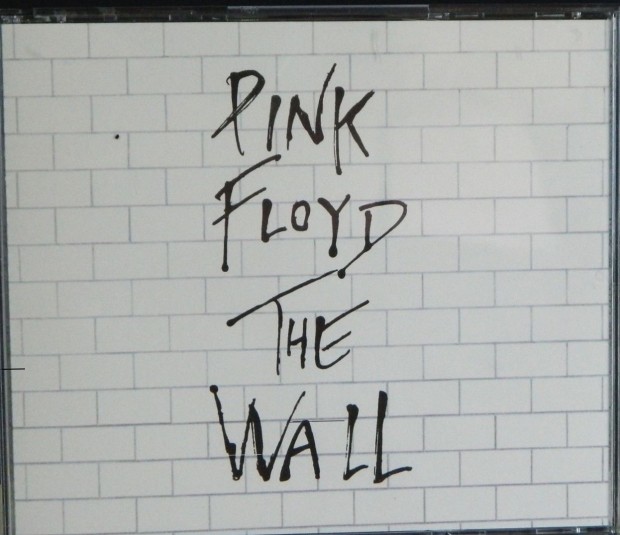
Here’s how it worked. Let’s say you’re looking for a CD that is hard to find used – Pink Floyd’s The Wall. That one was expensive brand new. Usually it ran for about $33.99. Customers would much rather pay less, so they put themselves on our waiting list. At the time we opened, the waiting lists were for that store only. We didn’t have the ability to share our waiting lists with other branches yet. This was still a massive improvement over the old system: a notebook with phone numbers and titles written in it. (There were lots of names and numbers with the title “any Beatles”.)
The list operated on a first-come, first-served basis. If you were the very first customer to put their name in for The Wall back in April ’96, then you would get dibs on the very first used copy that came in. If you were second, you’d get the next shot at it, and so on and so forth. What seemed to confuse my early customers the most was “Where do these used CDs actually come from?”
There was no magical land of used CDs. There was no massive warehouse from which to pick and choose copies of The Wall in various conditions. There was no place from which to order used CD stock like you could with new. If there was a Used CD Magic Wonderland, then it was in your basement, because the only way we received our stock in those days was via the customer. If a customer came in and traded a great condition copy of The Wall, then congratulations – the first person on the waiting list received the first call.
On down the list we went. If the first person no longer wanted The Wall (a frequent occurrence) then we’d go down the list to the second person. We would phone each customer and give them a week to pick up their CD. Unfortunately most customers who no longer wanted the CD never bothered to tell us, so it would sit there for a whole week before we could put it back in the hopper. We wiped out our entire waiting list for Last of the Mohicans (Soundtrack) with just one copy, because none of the reserved customers wanted it anymore. There were five names on that list, and then suddenly none!
So: reserve a CD, and we would let you know when one was traded in. This doesn’t seem like it should be hard to understand, but apparently for some it was.
One upset customer came in about two weeks after reserving a rare CD. “Is it in yet?”
I checked. “No, it’s not in stock, but since you have a reserve for it, we’ll call you when it does show up.”
“When’s that going to be?” he asked.
“Hard to say,” I responded, trying to answer his question. “Whenever someone trades one in, which could be tomorrow or it could be next year.”
Then he bellowed, “What do I have to do to get this thing to come in?!”
Sometimes, I just didn’t know what else to say.
“You don’t have to do anything,” I said, not sure how to explain this further. “Somebody will get tired of their copy, or just need the money. If they sell it to me, you’ll get a phone call right away.” Then, feeling a little snarky, I added, “Unless you know somebody with a copy that you can talk into trading it in to us.”
There was actually one nearly-surefire way to guarantee a used CD would come into stock. T-Rev discovered this, inadvertently. Somehow, any time either of us bought a new CD that we’d been hunting for, suddenly a used copy would show up in store. Sometimes on the same day. This happened more than once! I was there when it happened with a Primus CD he was looking for. (Wish I could remember which one.) It was eerie.
Everything has changed today, obviously, and now you have access to the world’s inventory from your PC. It’s hard to imagine there was once a time when you (gasp!) had to actually wait to find a used copy of The Wall!

GETTING MORE TALE #503.5: Reader Mail
There are a few rituals that I look forward to every day. I love waking up in the morning and checking to see if there are any new comments here. I look forward to coming home from work and spending time with Mrs. LeBrain. I also enjoy checking the mail box. I never know what surprises I might find each day. Sometimes it’s bills, or flyers from the local Church of Scientology. Today, it was a present from a reader!
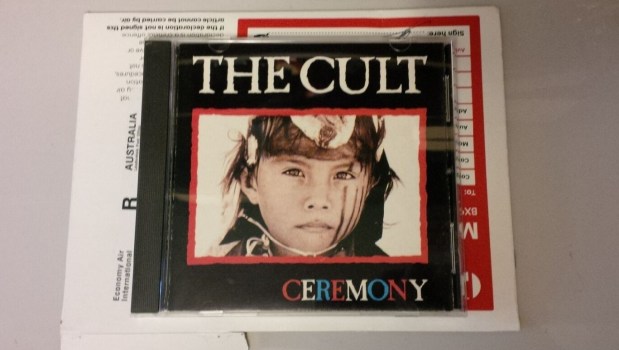
You may have seen Wardy around in the comments section, and you also may have read some reviews that were requested by him. Wardy likes The Cult, among many bands, and requested a review for their Ceremony album. Problem: I didn’t have Ceremony. I had all the singles, but not the album. In fact I think it is (somehow) the only Cult album I never bought.
Not any more! All the way from Australia, here is Ceremony! (And not just Australia, but Tasmania, which to me makes it that much cooler!) I guess I could say I got it on Australian import. Now I don’t have a choice; I have to review it! How could I say no, now?
As I press “play” for the first time, I leave you with this.
When you eventually see a review for the Cult’s Ceremony up here, thank Wardy. THANK YOU WARDY!

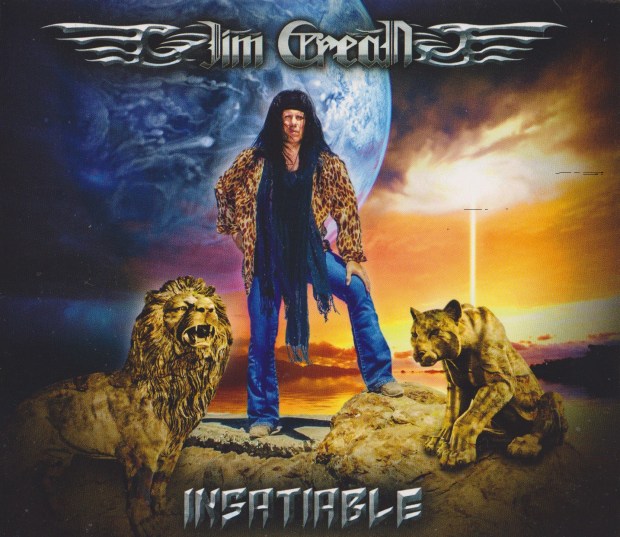


JIM CREAN – Insatiable (2016 Rocker Records)
If you’re not familiar with Jim Crean, that’s OK. You probably know of his famous friends. Crean sings lead with the Appice Brothers (Carmine and Vinny) for their Drum Wars live shows. Both brothers appear on his solo CD, Insatiable, along with other stars such as Phil Lewis (LA Guns), Mike Tramp (White Lion), Tony Franklin (The Firm/Blue Murder), Phil Naro and more. But it doesn’t matter how many guests you fill your album with if you don’t have the tunes. Crean has not only the tunes, but also the voice.
In a way the weirdest track is the intro by Don Jamieson from That Metal Show. He pronounces “Appice” differently for each brother. Carmine is “Appeece” and Vinny is “Appicee”. Very odd. The title track “Insatiable” features Vinny, but the song does not address the pronunciation controversy! If you’re a fan of 80’s sunset strip rock, then “Insatiable” is for you, like Faster Pussycat but fed a steady diet of heavy metal. Crean has range and rasp, and the result is the kind of rock that people miss today.
Vinny might be best known for his stint in Dio and Black Sabbath with Ronnie James. With the late Jimmy Bain on bass, Appice and Crean re-created Dio’s “Caught in the Middle”. Having original players and writers on it lends it a credibility that most covers can’t match. Best of all, Crean can pull it off! Singing Dio is, to put it mildly, not easy. Crean pulls it off with confidence and ability, just as he does with his own original tune “Touch”. Not to exaggerate, but “Touch” has to be one of the best songs to come out in 2016: killer mid-paced rock, besides the riffs and that voice! Another fine cover, L.A. Guns’ “Over the Edge” is performed with assistance from Philip Lewis. A more obscure choice from 1991’s Hollywood Vampires, it’s a powerful slow rock track with a Zeppelin-y groove. Guitarist Steve Major also needs to be singled out for a fine performance on this one (and all the tracks).
The most star-studded song is the lead single, “Can’t Find My Way”, a Mike Tramp cover. Mike sings on it, as does Phil Naro, with Tony Franklin on bass and Carmine on drums. (Tony and Carmine make it 2/3rds of the original Blue Murder, minus only John Sykes.) This ballad is a bit slow, a bit long, but kicks in for the chorus. I actually prefer Jim’s original material. “Follow Your Heart” is one such original, this one featuring ex-Dio guitarist Rowan Robertson. It has a distinct Dio-ish vibe, aided and abetted by Vinny’s incomparable drum sound. The final three originals (“Shut Your Mouth”, “Turn it Around”, and “Miss Me”) are all very strong hard rock songs. Crean wrote all his originals himself. What a talent. Such a voice, with sharp songwriting chops. This guy has more talent in his pinky than CC Deville has in his entire body.
Two bonus tracks close it out, both covers: Mr. Big’s rockin’ “The Whole World’s Gonna Know”, and “Magic Touch” by Kiss. Sharp fans will recall that Crean contributed “Magic Touch” to Mitch Lafon’s Kiss tribute CD, A World With Heroes. If you missed that now sold-out CD, you can at least get Jim’s version of the song here. “Magic Touch” is, of course, great. It always was, but now here’s a chance to hear it without the disco (Kissco?) trappings. As for “The Whole World’s Gonna Know”, Jim’s version may surpass the original.
Added Can-Con bonus: Much of the album was recorded in Toronto, just a stone’s throw away from Jim’s base in Buffalo, New York.
Added extra bonus: My copy included a DVD with the “Can’t Find My Way” music video.
If you like hard rock with integrity the way they used to make it, then this album is for you. If you buy one new release this week, make it Jim Crean’s Insatiable.
5/5 stars


GETTING MORE TALE #503: 22 Acacia Avenue
Everything started with Iron Maiden. At least for me. Way way waaaay back in Record Store Tales Part 1: Run to the Hills, we revealed that pivotal moment when everything changed. The album was Masters of Metal Volume 2, and regarding hearing “Run to the Hills” for the first time I wrote, “Some people speak of moments of clarity: That was my moment.” Everything I was focused on and passionate about now took a back seat to rock and roll. The year was 1984.
I taped some Iron Maiden albums off friends, and bought the double Live After Death as my first Maiden LP. I memorised the names of the members, and made sure to include Martin “Black Knight” Birch and Derek “Dr. Death” Riggs in my memory banks. Maiden had the best album covers, the best videos, and the best lyrics. They had songs about World War II and the Crimea. It was more intelligent music than the other heavy metal bands I’d heard. I stared for hours at my Live After Death LP, so loaded was it with photos and facts. In grade 8, I was the only kid in my school who liked Iron Maiden, and that was fine by me.
Figuring out exactly what Maiden were saying, that was another story. Live After Death had a lyric sheet, but before that we were just guessing. In a case of mis-heard lyrics, I assumed that the lyrics to “Number of the Beast” went, “Hell and fire are born to be the least”. Bruce was actually singing “Hell and fire are spawned to be released.” “To be the least” went over better with teachers and parents, but when I got Live After Death, I kept the real lyrics for myself. I did learn a new word from that song, “spawned”.

Maybe it was Bruce’s accent, but I really struggled to hear what he was saying, even just when he was speaking on stage. “Scream for me, Long Beach!”, he repeated throughout the album. I could not figure out at all what he was saying, and neither could my best buddy Bob. It sounded like “Scream for me, lambiens!” So we assumed “lambiens” was British slang for “my friends”. That made sense to us. Bob had Live After Death on cassette and there were no liner notes. Not until I got it on LP many months later did I see that the album was recorded at Long Beach Arena, and put two and two together. Until then, it was “lambiens”! “Speak to me, Hammersmith!” was another Bruce phrase that we couldn’t decipher. Until I noticed that side four of the LP was recorded at Hammersmith Odeon did it click. Until then, I thought Bruce was talking to his bandmates on stage. “Speak to me, Harris Smith!”
Both of us played that live album plenty. Thanks to “Powerslave”, I was way ahead on my Egyptology. By the time we started taking Egyptian history in grade 11, I was already well familiar with the eye of Horus. All knew all about Alexander the Great and the Gordian Knot. Iron Maiden brought all that stuff right to our stereos, but I don’t think they got enough credit for it.
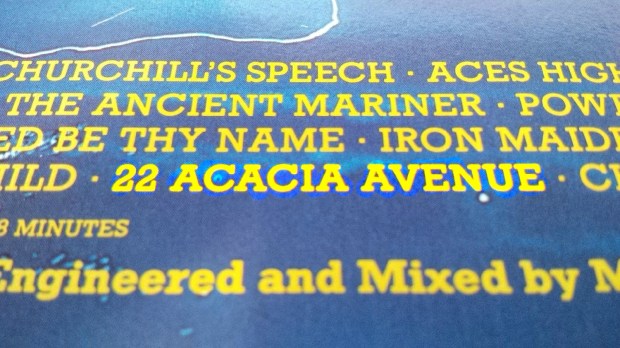
Maiden had other subject matter as well. Though seldom, they would sometimes write songs regarding the “fairer sex” such as “Charlotte the Harlot”. As a young kid first getting into the band, I had no idea what that was about. Even foggier to me was “22 Acacia Avenue”. It was a great tune, but the lyrics were a total mystery to me. It’s not complicated: Charlotte sells herself for money in both tunes. In the second, someone is trying to talk her out of this lifestyle. “You’re packing your bags, you’re coming with me.” Right over my head.
In art class at school, we had to draw a scary scene for Halloween. I chose a bunch of imagery I lifted from Maiden covers: streetlamps, grave stones, fire, dark alleys, a grim reaper and…a house with the address “22 Acacia Avenue”. I liked how Maiden’s artist Derek Riggs hid symbols and clues in his covers, so I was trying to do the same, but just randomly. The teacher walked up and observed my artwork, and asked me a couple questions. “22 Acacia Avenue, is that where you live?” No, but how the hell do I explain this to the Catholic teacher at a very Catholic school? Scrambling for an answer I said, “No, that’s the address of an actual real haunted house.” The teacher “Oooh’ed” excitedly and went to the next student. An actual haunted house? Boy did I have that wrong. Not that I could have given the real answer!

Playing Live After Death again today as I’m writing this is very much a time capsule. It’s 1985 again, and Bob and I are playing air guitars to “22 Acacia Avenue” in my basement. How badly we so wanted to BE Iron Maiden. Hell I made a birthday card for Bob one year that had his face in Iron Maiden over Dave Murray’s! Of 22 Acacia Avenue, Bruce sang “That’s the place where we all go.” Good enough for us, so we wanted to go too. If we knew what Bruce was actually singing about, I think we would have (wait for it) run to the hills instead!
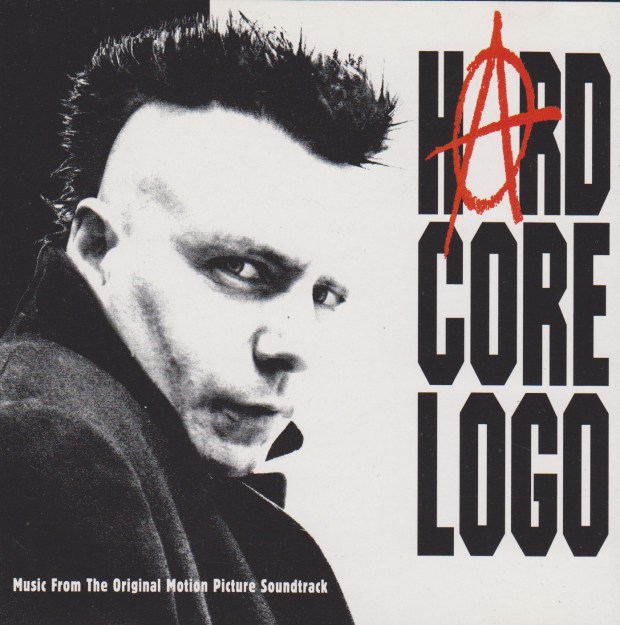
Ending Movie Soundtrack Week #2 with a bang — here’s Hard Core Logo.


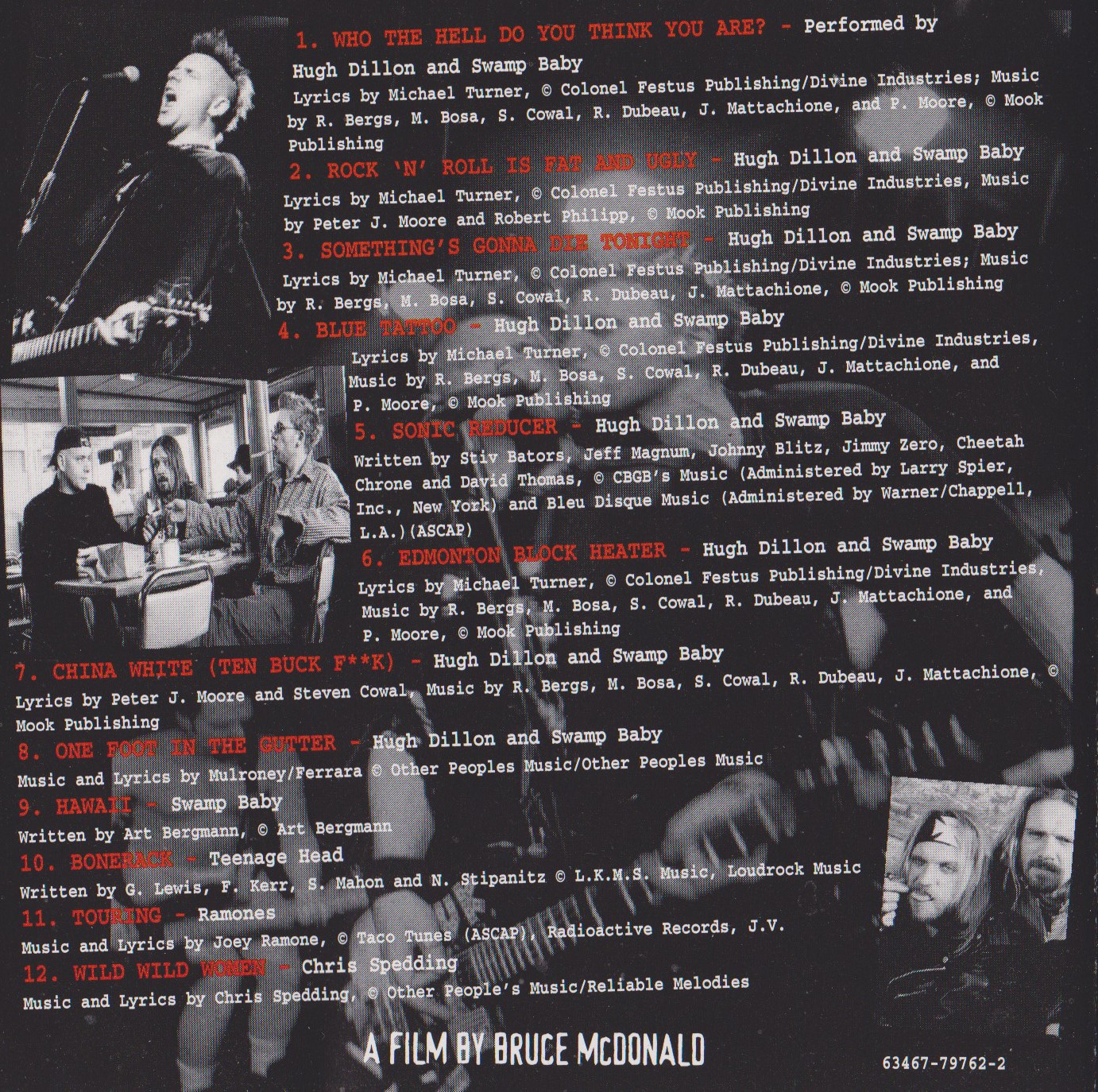
HARD CORE LOGO – Music from the Original Motion Picture Soundtrack (1998 BMG)
Hard Core Logo are one of the greatest fictional bands of all time. Right up there with Spinal Tap, Strange Fruit and Wyld Stallions, Hard Core Logo are legendary. Fronted by Joe Dick (Hugh Dillon of the Headstones), Hard Core Logo are so fucking good that you only wish they were real. This soundtrack CD is the one to get. There is a much more common “Tribute” to Hard Core Logo CD out there, and it’s even included with the DVD of the film. For some reason, the actual songs from the movie as performed by Dillon (and Swamp Baby) were much harder to find. It was Aaron at the KMA who pointed me in the direction of this CD on the Discogs.
(By the way, there were two Hard Core Logo alumni who later moved on to Battlestar Galactica — Callum Keith Rennie, and John Pyper-Ferguson*.)
The guy on the far left is a Cylon.
Hard Core Logo’s material is a mixture of originals and covers. The monster riff of “Who the Hell Do You Think You Are?” commences the soundtrack with Hard Core Logo’s signature tune. Dillon’s snotty vocals perfectly nail the vibe of the movie. It’s dangerous sounding punk rock, pissed off but simultaneously fun. Equally dangerous is “Rock and Roll is Fat and Ugly”, and let’s not forget the Canadiana of “Edmonton Block Heater”. For some serious pain and heart, check out “China White”. Headstones fans are automatically going to want this whole soundtrack, because Dillon’s voice and the sound of Headstones are so closely associated. Dillon is 100% genuinely the real deal. Always has been.
While the original songs are all strong throughout, there are two tracks in particular that stand out. These are “Blue Tattoo” and a cover of the Dead Boys’ “Sonic Reducer”. I’ve heard the original, Pearl Jam’s version, and Hard Core Logo’s. It’s damn hard to pick a favourite. Dillon absolutely owns it. It’s like he put his foot down and said, “This one’s mine now, fuckers.” The anger is palpable. But it is “Blue Tattoo” that is forever inked on my brain. This punk ballad bleeds heart and soul. All the ingredients mix just so, and it becomes the consummate combination of sentiment and edginess.
Most people are going to buy this CD just for the Hard Core Logo tracks, but there is some excellent additional music after that. Swamp Baby without Hugh Dillon provide a cover of “Hawaii” by the Young Canadians. Short n’ sweet, and then on to some actual punk classics: Teenage Head (“Bonerack”), the Ramones (“Touring”), and Chris Spedding (“Wild Wild Women”). I can always go for some Teenage Head, and you can hear a lot of Teenage Head in Hard Core Logo’s tunes. As for the Ramones, Joey had a brief cameo in the film, lending it some extra authenticity sauce. Although I find many Ramones tunes to have a sound-alike quality, “Touring” just makes me smile.
It’s rare to find a soundtrack so perfectly composed of original music and classic tunage. It’s one of the things that made Hard Core Logo, the movie, such a triumph. See it, and get this CD.
4.5/5 stars
*Oh all right, I’ll go on. Rennie played guitarist Billy Tallent in Hard Core Logo, and Number Two in Galactica. Pyper-Ferguson nailed the role of John Oxenberger in Hard Core Logo, and played the asshole-ish Captain Cole ‘Stinger’ Taylor on Galactica. He returned to the franchise on the prequel series Caprica, playing the villain Tomas Vergis.
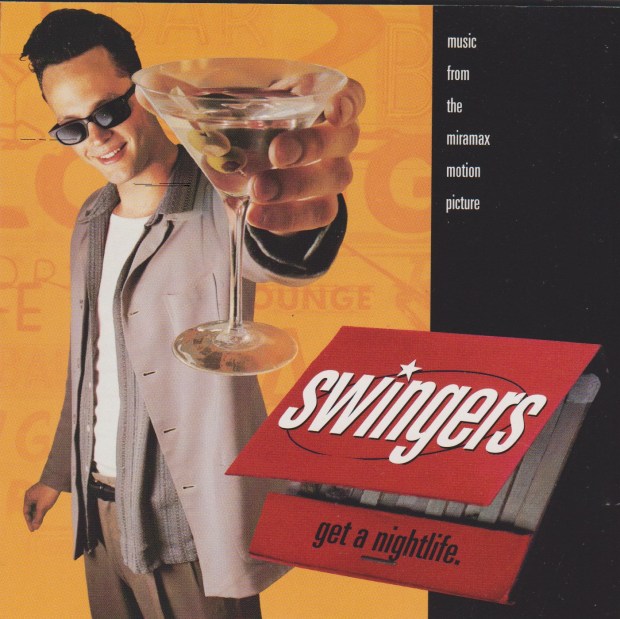
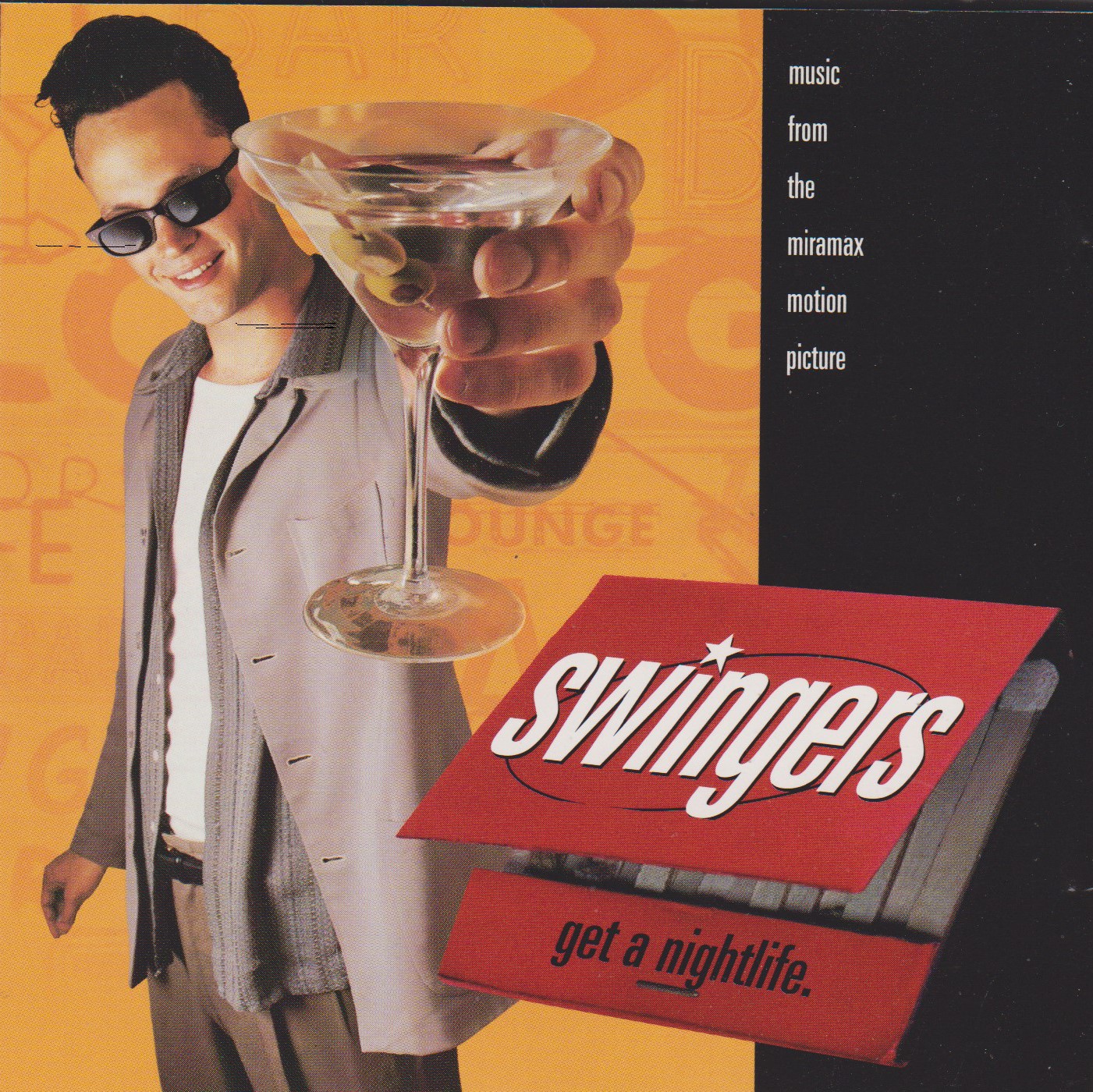 SWINGERS – Music from the Miramax Motion Picture (1996 A&M)
Now here…now here is a soundtrack! Every track is a keeper. With a mixture of oldies and newer songs, Swingers had a peerless balance. If you’re down to swing, dance, or just get dirty, this soundtrack has what you need. Bonus points for the uber-thin and young Vince Vaughn on the front cover too. Jon Favreau executive produced the soundtrack, and it’s clear the guy has good taste in music.
I love it when a soundtrack puts scenes from a movie right in your head. Dean Martin’s “You’re Nobody ‘Til Somebody Loves You” kicks off both the CD and the movie, and all I can think is “Vegas baby, Vegas.” That slow jazz just sets the mood for the adventures ahead. The horns pop! It’s money, baby. Talk about setting the bar high for an opening track; thankfully there’s lots more to come.
“Paid for Loving” by Love Jones brings me right into the film’s setting again, but it’s Tony Bennett’s “With Plenty of Money and You” that has me seeing the bright lights of Vegas before me. Remember Mikey and T rolling up in their suits? You’d feel like a high roller too, with a song like this playing. Tony is followed by Big Bad Voodoo Daddy (who appeared in the film). Now, I do kinda wish it was the live version of “You & Me & the Bottle Makes 3 Tonight (Baby)”. In the film, Big Bad Voodoo Daddy play it live, but this is a studio version. I think including the live version would have been an extra treat for fans, but I’m not complaining. If you don’t find yourself tapping your toes to it, call the coroner, because you may be dead.
Mixing new and old, Scotty and the guys from Big Bad Voodoo Daddy are chased by Louis Jordan, from way way back in 1941. If you love muted trumpet solos, then dig right in. A song you should recognise is the oft-played “Groove Me” by King Floyd (1970). It’s a soul classic that found itself used on TV ads over the years. More jazz (a couple cool instrumentals), and more Big Bad Voodoo Daddy are to be found as the CD progresses. Daddy have three tracks on the CD, all of which were in the movie. “Go Daddy-O” has to be a favourite for sure, but “I Wan’na Be Like You” has a tropical salsa beat.
Roger Miller’s “King of the Road” isn’t jazz and doesn’t swing, but it has the same golden oldie feel. It’s not the only country song: George Jones himself honours the CD with his presence. The melancholy ballad “She Thinks I Still Care” is one of the…saddest, I guess…lyrics I’ve ever heard. It’s a great song from a great scene in the film.
“Pick up the Pieces” by the Average White Band is the kind of song everybody needs. “Need” isn’t too strong a word either. You know the song, you love the song. You have to. It’s required. Finally, “I’m Beginning to See the Light” by Bobby Darin completes the journey, and it’s back to the same kind of sound that Dean Martin started the album with. And what a journey it is! You just…feel BETTER after listening. When I bought this CD, I felt like this line of dialogue directly applied to me:
“You’re a big winner. I’m gonna ask you a simple question and I want you to listen to me: who’s the big winner here tonight at the casino? Huh? Mikey! That’s who! Mikey’s the big winner. Mikey wins.”
5/5 stars


O BROTHER, WHERE ART THOU? – Music from a film by Joel Coen and Ethan Coen (2000 Universal)
Hot damn! It’s the Soggy Bottom Boys!
Even if you hated the film (have a doctor check to see if you still have taste left), you can’t deny the fun and authentic roots music on its soundtrack.
A bizarre re-telling of Homer’s The Odyssey set in the 1930’s depression-era south, O Brother was nothing if not unique. It mixes a liberal interpretation of Greek mythology, with Americana and the mythology of the blues era. Some people don’t get it, some people do but don’t like it, and others have long been swept away by its charms. Those with an allergy to George Clooney, fear not: he does not actually sing on this soundtrack, although his co-star Tim Blake Nelson certainly does (on “I’m in the Jailhouse Now”). Dan Tyminski from Alison Krauss & Union Station sings for Clooney’s character Ulysses Everett McGill on the signature hit, “Man of Constant Sorrow” though many people assume it’s George.
The soundtrack CD is a mixture of light and dark. The first two songs are the perfect example: “Po Lazarus” is a chain-gang work song, just before Ulysses Everett McGill and his two companions break free and embark on their Odyssey. It’s followed by a 1928 recording by Harry McClintock, “The Big Rock Candy Mountain”, a joyful nonsense song about a hobo finding paradise on the rails.
“Where the boxcars all are empty,
And the sun shines every day,
On the birds and the bees,
And the cigarette trees,
The lemonade springs,
Where the bluebird sings,
In the Big Rock Candy Mountains.”
The composite of light and dark reflects the movie itself, but makes for a fairly inconsistent listen. The soundtrack follows the progress of the film, but without the story backing it up, it’s harder to go with the flow from song to song. The a capella “O Death” (Ralph Stanley) for example is squeezed between the popular songs “Man of Constant Sorrow” and “I’m in the Jailhouse Now”, so most people will typically skip it.
I look at this soundtrack CD as a great “starter kit” for exploring more genres of music. The dominant ones are folk and bluegrass, but there are also blues tracks and hymns. Norman Blake’s “You Are My Sunshine” sounds wonderful sitting in the shade on a summer day. Immediately after that, you get the velvet tones of Alison Krauss, from the baptism scene with “Down to the River to Pray”. You have never heard a more perfect version, serene, still and deep as the water. And, yes, the Soggy Bottom Boys! In the film, Ulysses Everett McGill and his companions Pete, Delmar and Tommy Johnson (loosely based on Robert) wind up cutting a record. There are four versions of “I Am a Man of Constant Sorrow” on the album. The first is the acoustic track shown being recorded in the film. The version that became a hit single in the real world is from the climax, a fully augmented mix with fiddles and slides. That is included closer to the end of the disc. There is an instrumental version on acoustic guitar by Norman Blake, a fine take indeed. The fourth is an instrumental version on fiddle by John Hartford, barely recognisable. All four are quite different but valuable.
Blues singer and guitarist Chris Thomas King was cast in the film as Tommy Johnson, and his solo track “Hard Time Killing Floor Blues” is a fine example of acoustic blues. There is plenty of sunny and gleeful folk, such as “Keep on the Sunny Side”, “I’ll Fly Away”, “In the Highways” and of course “In the Jailhouse Now”. Tim Blake Nelson is certainly a multi-talented guy, but the yodelling part is not performed by John Turturro as it appears in the film. Still Pat Enright’s yodel part is one of the highlights of the entire album. It’s important to note that producer T Bone Burnett captured authetic sounding performances here. Close your eyes, mix some scratchy vinyl sounds over it, and you can imagine these are vintage recordings from the 1930’s.
Emmylou Harris, Gillian Welch, the Fairfield Four, the Cox Family and more…this CD is a great way to both enjoy an hour of music from the film, and kickstart a collection of folk, bluegrass and more. Dig in!
4.5/5 stars
Final bonus: Sh*t LeBrain’s Grandma Says!
I love my grandma with all my heart, but sometimes she gets the names of movies wrong. We took her to the theater to see “There’s Mail Waiting for You” (You’ve Got Mail), and she also really enjoyed this movie, which she calls “Brother Can You Spare a Dime?”


 mikeladano.com