By a weird coincidence, I wrote up this review on the exact same night that Aaron wrote uphis for the KMA. Weeeeeeird.
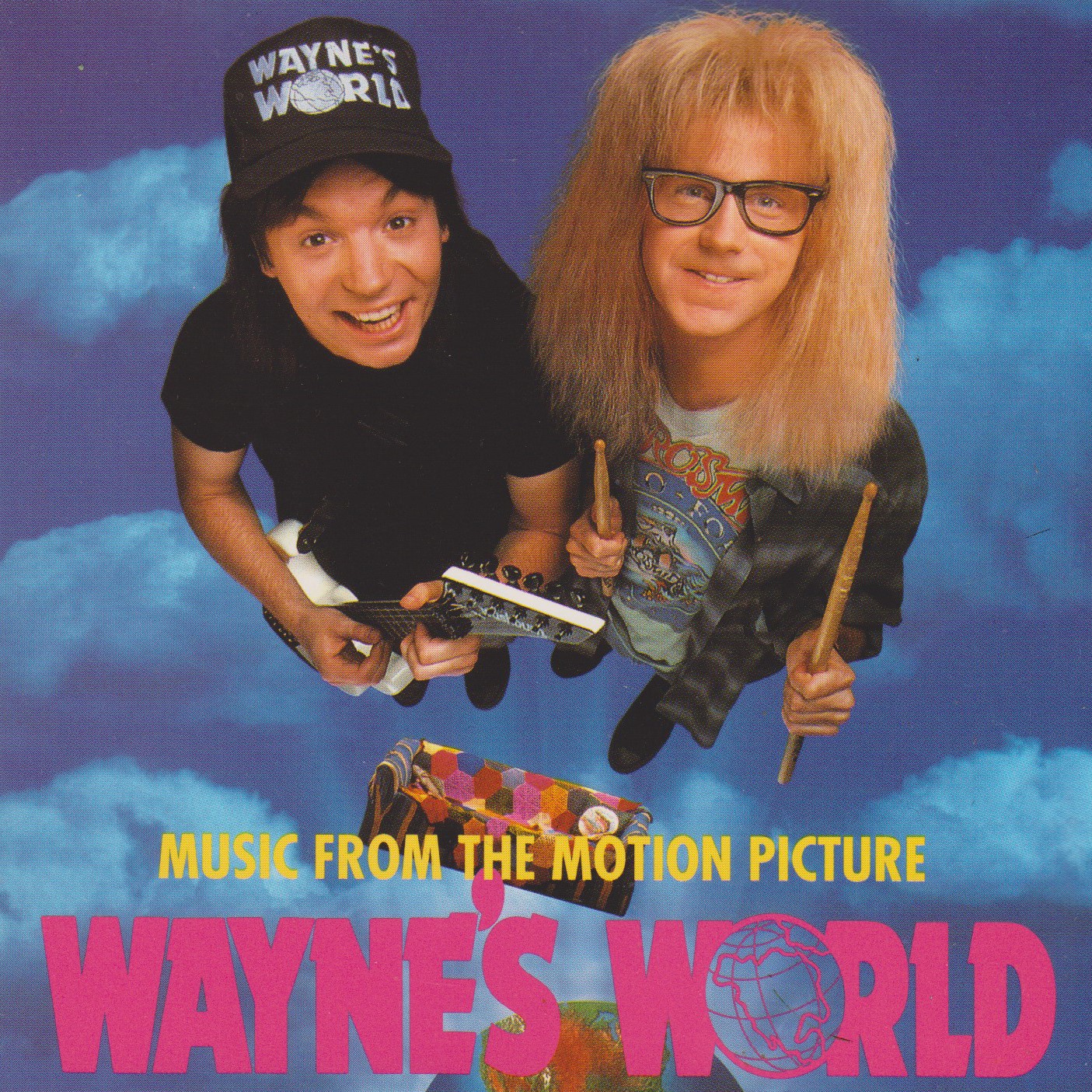
WAYNE’S WORLD – Music from the Motion Picture (1992 Warner)
Today we’ll take an extreme close up look at Wayne Campbell, Garth Algar, and the movie soundtrack that returned Queen to the top of the charts.
Wayne’s World was a phenomenon. Not only did it put Queen back on their throne, but it also kickstarted a whole wave of Saturday Night Live movie spinoffs, including the Coneheads and Pat. The soundtrack was one that “everybody” had to have. While I had started my Queen collection well before the movie came out, this soundtrack was the first place that I acquired “Bohemian Rhapsody”. In many regards, you can almost regard “Bohemian” as a brand new song in 1992. It charted as if it was brand new, and it became a cultural cornerstone only after the movie. I know I can’t be the only one who head-banged to it in the car on weekend nights during the summer of ’92. As one of the most campy yet brilliant tracks ever recorded in the history of rock, “Bohemian” deserved everything that came its way.
The soundtrack CD was made up of new and old material like “Bohemian”. Also dusted off: “Dream Weaver” by Gary Wright. Though not to the same degree as Queen, Gary Wright experienced a bit of a renaissance thanks to the prominent usage of the song in the film. The 1975 soft rock ballad is still cheesey fun today. Then, Jimi Hendrix’s “Foxy Lady” was given a fresh release in one of the most memorable Garth scenes. Admit it: If you are over a certain age, you make the little “fox ears” on your head just like Garth Did when Jimi sings “Foxy”! I know you do — don’t try to lie. Although I can’t recall the song being in the movie at all, a mediocre Eric Clapton outtake from 1985 is included on the CD, in “Loving Your Lovin'”. It’s about as memorable as you would expect a mid-80’s Clapton outtake to be; its just “OK”. Of course, everyone knows that Alice Cooper’s “Feed My Frankenstein” was used during the Cooper cameo in the movie. It introduced Alice to a whole new generation who still remember and love that song.
New tracks included the zippy Red Hot Chili Peppers funk blitzkrieg “Sikamikanico”. Bass pulsing in time with the racing beats, this is the kind of Chili Peppers I love. Meanwhile, Black Sabbath unveiled their first new material with Dio since 1981, on “Time Machine”. This Wayne’s World version of the song is completely different from the one that was recorded for Dehumanizer, although both are included on the Sabbath remaster. The Wayne’s World version feels faster and more frantic. It was quite a thrill for fans to hear a brand new Black Sabbath song in a mainstream comedy movie. (Cool scene too, with Robert Patrick of Terminator 2 fame.) Although the soundtrack couldn’t resurrect their careers, both Cinderella and Bulletboys had new tunes on the CD. Bulletboys tackled a cover of Montrose’s “Rock Candy”, perfect for their Van Halen worshipping vibe. Cinderella had a new rocker to show off, a soul-infused vintage song called “Hot and Bothered”, which was a fine return to form but had no impact. Finally, Rhino Bucket who were considered heirs to the throne of AC/DC included a new song called “Ride With Yourself” from their 1992 album Get Used to It. It’s cleaner sounding than AC/DC but it’s in that ballpark.
Finally there are the throw away tracks. At the time, Tia Carrere was being hyped up for a music career. They hooked her up with Ted Templeman and recorded a cover of “Ballroom Blitz” (you know the scene in the movie) and a ballad called “Why You Wanna Break My Heart”. Both are fine in the movie, but not really necessary for rock fans in general to own on CD. Still, here they are! (Tia’s version of Hendrix’s “Fire”, also in the movie, was included on the B-side of the “Ballroom Blitz” single.) Then there is a throw-away version of the Wayne’s World theme song with Wayne and Garth singing. I’ll take the Aerosmith version any day!
Not on the soundtrack CD, but prominently featured in the film, was Ugly Kid Joe’s hit “Everything About You”. No big loss; you should be able to find their Ugly As They Wanna Be EP for under $5. Party on!
The first big hit movie soundtrack LP in history was 1951’s A Streetcar Named Desire. That may seem like a long time ago, but it was only 26 years later (a small blink in terms of history) that John Williams composed one of the most popular scores of all time: Star Wars. That was the first soundtrack I owned. Today, soundtracks are still an integral part of any record store.
In my own days as a Record Store Guy, movie soundtracks were a dicey product to stock. Aside from some specific timeless examples, they seemed to have a limited shelf-life.
There was always a demand for certain classics: Saturday Night Fever, Last of the Mohicans, Heavy Metal. On the other hand, other discs were bargain bin perennials: Titanic, More Music from Titanic, The Bodyguard, City of Angels, Phenomenon, Romeo + Juliet…my God there were so many. Once a movie had run its course, often its soundtrack did too.
Classic.
Much of the time, people bought a soundtrack CD for one song. Once that song was available elsewhere, the soundtrack sales usually dropped off completely. When Goo Goo Dolls released “Iris” on their album Dizzy Up the Girl, nobody wanted the City of Angels soundtrack anymore. Celine Dion put “My Heart Will Go On” on a bunch of different CDs, meaning almost everybody who bought Titanic on CD tried to sell it later. Good luck – I’ve seen bargain bins with a dozen or more copies in it. At one point we were so desperate to get rid of the soundtracks that we were bundling them up with the movie at a cut rate price.
There were certain soundtracks that were so unpopular that we weren’t even supposed to buy them used. Operation Dumbo Drop comes to mind. Now that was a CD that sat on my shelf for years and years. When it finally sold, it was like a celebration. We had long “Do Not Buy – Ever!” lists. I’m sure many of them were soundtracks.
There are always customers on the lookout for obscure soundtracks. My buddy Rob Daniels, for example, has a radio show specialising in movie soundtracks. He has an extensive library of soundtracks, carefully curated over the past 16 years or more. Unfortunately for soundtrack fans, guys like Rob are in the minority. Most people simply didn’t care. They wanted the couple songs from the movie they liked and that was pretty much it. People looking for obscure scores were few and far between. Once a song is available on an artist’s album, the soundtrack can look forward to a long life in somebody’s bargain bin.
This week, we will be looking at different movie soundtracks every day! I have a weird knack for remembering the first time I bought an album in great detail. To lead into the first soundtrack review, I’ll set the scene.
The year was 1992. I wasn’t working at the Record Store yet, but I was a customer. The boss there used to have a saying (well he had many sayings but only one applies to this story): “Do as I say, not as I do.” He didn’t exactly set the best example on that one visit in ’92, which I liked to painfully rib him when I got hired on in July 1994.
I was looking for a specific soundtrack, a new release, and I wanted it on cassette. Like the majority, I’m often buying a soundtrack only for a few songs. I didn’t want to pay CD prices ($20 roughly) when the tape would be much cheaper. So, I went to the local Record Store, the one at which I’d start working in two years, and looked. They had to have it. I made a special trip to the mall just to get that one tape.
When I walked in, the owner was chatting it up with some hot girl. From the conversation it looked like they knew each other from highschool. I looked for the tape, looked and looked, but couldn’t find it. It wasn’t in the new releases and it wasn’t in the soundtracks. But they had to have it! I wanted to ask, but the owner and the girl were deep into whatever they were talking about. I wanted to get his attention and ask about the tape, but I was a shy guy back then and didn’t want to interrupt. I thought I could maybe jump into their conversation and say, “I went to that highschool too! Include me! Include me!”
I hovered nearby and waited for a break in their conversation to ask my question. As I flipped tapes nearby, I thought I heard him ask if I needed help finding anything? So I said the name of the soundtrack I was looking for. He turned to me and said, “Pardon me?” I answered, “Oh, sorry, I thought you were talking to me. I’m looking for a soundtrack.” He said, “Sorry, no I’m sold out of that one but I’ll have more in next week.”
I wanted it that day, so I skipped across the mall over to Zellers and bought the tape for $10.99.
“Do as I say! Not as I do.” Pay attention to customers! When I told him that story a couple years later he didn’t believe me. It’s true though; my friends will testify that 99% of the time I can tell them exactly when and where I first bought my albums. Normally he was great at customer service, but that morning in ’92 was an epic fail!
Can you guess which soundtrack I was looking for? Find out tomorrow.
Joe Varga and crew started off as a Toronto-area thrash metal band. There was a thriving thrash scene in the late 80’s and early 90’s, and Varga’s contribution were songs like “Mad Scientist” and “Shark Attack”. They released an indi album (cassette only) called Multiple Wargasms. As the 90’s progressed, Varga established a prototypical industrial metal direction, something perfectly mundane today, but new for the time. Like some bizarre cross between thrash metal and ZZ Top, Varga attempted to bridge the gap between machine and man. They signed to BMG and got David Bendeth to produce them, who had just worked his magic with Sven Gali.
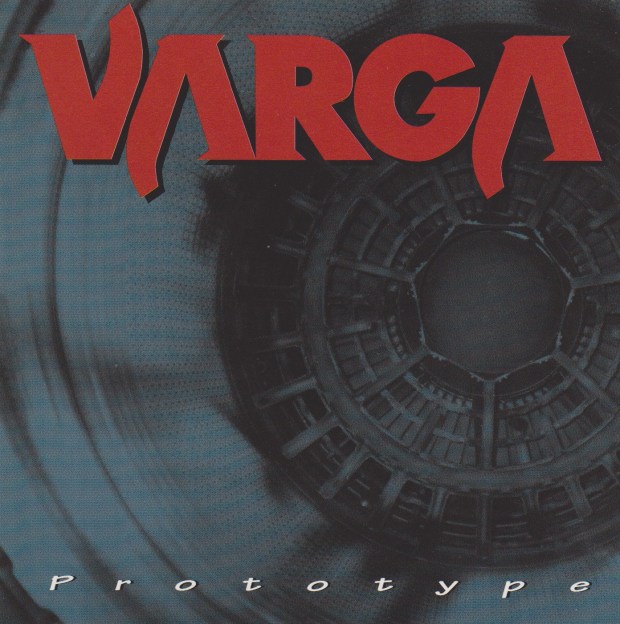
Varga’s major label debut was called Prototype. As promised, it boasts a mixture of metal and industrial. Live drums, guitars and bass mix are augmented with samples and loops. While Varga embraced technology, it didn’t seem fully incorporated into the music. The songs are, for the most part, metal tracks with samples and effects added for embellishment. Varga took the unusual step of listing everybody that inspired them in the credits. Metal outnumbers industrial bands by 12-2. Pornography had more influence on Varga than Nine Inch Nails and Ministry, according to this!
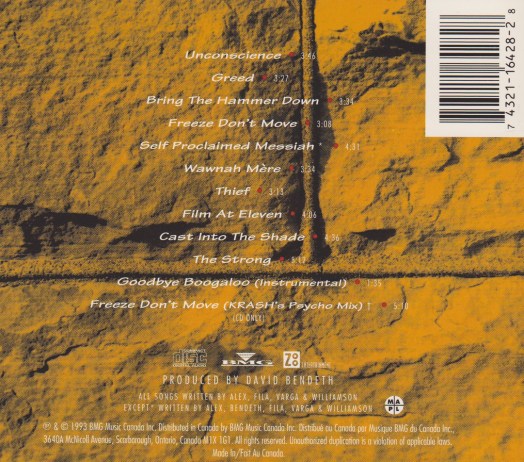
When it works, it works. “Greed” is a prime example. Had it been a typical fast-forward thrash metal song, it still would have been good. The electronics and looped rhythms turbo-charge the whole thing. “Freeze Don’t Move” seems built around the loops, and features rapping and a sung chorus. Hearing it today, I think “Hello, Linkin Park!” But there was no Linkin Park in 1993. These two tracks were the singles, and they are easily the best two songs on the album. Additionally, “Freeze Don’t Move” was remixed and extended by somebody called “KRASH” (all caps). The original is all you need, but the remix is included as a CD-only bonus track. (Quaint concept today!)
Prototype chugs along, like a finely tuned streamlined machine. The musicianship is fine and dandy; Varga did not forsake guitar solos and there are several hot ones to choose from, not to mention diverse moments of instrumental brilliance. “The Strong”, “Unconscience”, “Thief”, “Self Proclaimed Messiah” and “Wawnah Mère” are pretty good, and “Bring The Hammer Down” is galvanized metallic. Recommended for metal historians and fans of the industrial metal sound.
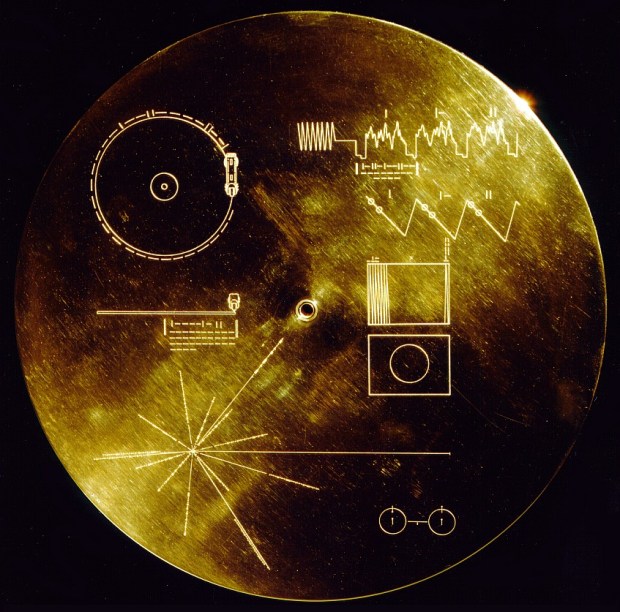
In 1977, two unique records were pressed that are literally out of this world.
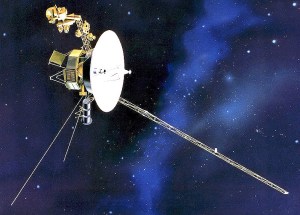
The Voyager space probes (1 and 2) were designed for exploration of our outer solar system. Never to return, the probes were built for the “Grand Planetary Tour”: a rare alignment of the outer planets that allowed the probes to use gravity to slingshot around and visit them all. The Voyager spacecraft transmitted to Earth some of the most breathtaking images ever taken. For the first time, Saturn’s rings could be seen up close, and surprised us with more layers and complexity (including the ‘F’ ring that is kinked) than anyone anticipated. Jupiter’s Great Red Spot was discovered to be a gargantuan storm, three Earths wide!
Although the probes were not really intended for long term scientific observations beyond their initial missions, their plutonium generators will continue to provide power for another decade. Clever scientists have managed to use the probes’ limited sensors to observe what goes on at the edge of the solar system. Both probes are now well on their way out of our home system, and into interstellar space. Once their generators die, they will go silent forever. They are now the furthest man-made objects from the Earth and will remain so forever, unless we find the money to invest further in deep space exploration.
Even when the Voyager probes finally go dark forever, their mission will still be ongoing. Both Voyagers were equipped with special antiquated technology that can tell alien civilizations a little bit about the troubled species that launched these probes in the first place. If an alien race ever finds our probes (the fictional Voyager 6 was found by a machine race in Star Trek I) then they will find the Golden Records.
The Golden Records, surely the most priceless LPs in the universe, contain a wealth of information selected by a committee headed by the late Dr. Carl Sagan. Each record is encased in a gold sleeve. Included is a visual depiction of how to play the record, an easy task for an advanced race. Extracting sound from the grooves should be a simple process given the instructions. The needle and cartridge are already included. The records are made copper, plated in gold, one of the most corrosion resistant materials known to man.
What is included on the records? A variety of audio for one, designed to give a glimpse into human culture. First is a greeting in 55 Earth languages. Then, there are “Sounds of Earth”: birds, dogs, frogs, cars and trains, and more. Most interesting to music fans is the selection of compositions from around the world. There are 90 minutes of different pieces, including Chuck Berry’s “Johnny B. Goode” (USA), Bach’s Brandenburg Concerto (Germany), jazz and blues, and many kinds of world music. (The records are designed to be played at 16⅔ revolutions per minutes, enabling a longer play time.) In a classic example of record company stupidity, the Beatles were excluded from the golden LPs, because EMI wouldn’t let NASA use “Here Comes the Sun”. Perhaps they were afraid aliens would bootleg it without paying for it. (This serves as a fine case of EMI standing for “Every Mistake Imaginable”, as some artists refer to them.) After the music is an hour of brain wave recordings, of Carl Sagan’s wife Ann Druyan.
There are even 116 images encoded on the disc. Some of these are intended to help with calibration and interpretation. The rest are images of Earth: DNA strings, children, families, landscapes, animals, houses, cities, spacecraft and more. Tellingly, there are no images of one of human-kind’s most popular activities: warfare. Only good impressions were wanted, meaning the Voyager Records contain much false advertising. The images are encoded in the form of 512 vertical lines, in colour and black and white.
What if one wanted to listen to the rarest records in the universe? What to do then? Last year, NASA uploaded the audio contents of the records to SoundCloud. Now anyone on Earth with an internet connection and speakers can hear the greetings that we sent to the stars in 1977. Hopefully one day, someone else from another world will be able to listen as well.
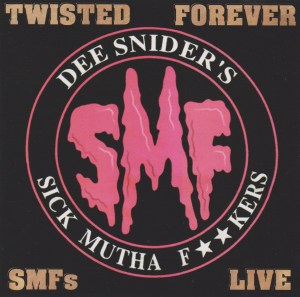
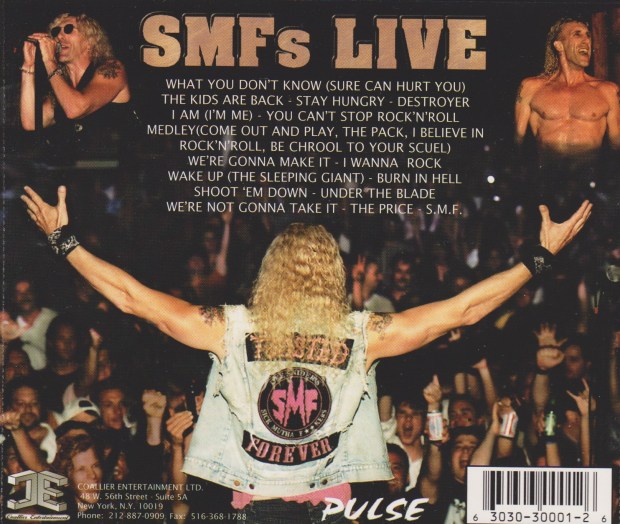
DEE SNIDER’S S.M.F.s – Live / Twisted Forever (1997 Pulse)
When Twisted Sister split in 1987, I don’t think anybody ever really expected there to be enough demand for a reunion. How wrong we were! During the downtime when the band was acrimoniously separated, Dee Snider carried on with a low-key solo career. Widowmaker’s Blood & Bullets (featuring Al Pitrelli and Joey Franco) was heavy as fuck even compared to early Twisted Sister, but failed to make any sales impact.
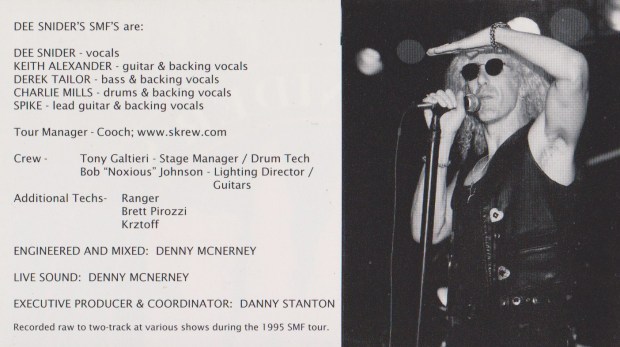
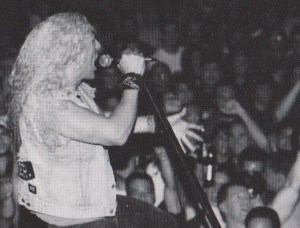
A few years later (1995), Dee went on the road with the S.M.F.s (Sick Mutha Fuckers, of course) playing nothing but classic Twisted Sister. It went almost completely unnoticed, but a live album (recorded raw, straight to two track tape) was recorded and released as Twisted Forever. This hard to find disc is well worth having. Dee played a variety of Twisted material, some of which you’ll probably never hear live again. It was a surprisingly good album on some fly by night label, and an easy must-have for any Twisted fan that finds it in good shape.
Just like the good old days at the Marquee in England, Dee opened with “What You Don’t Know (Sure Can Hurt You)”, one of the fastest tunes in the Twisted catalogue. Only the true fan will realize by listening alone that the band is not Twisted Sister. I don’t know any of these guys, but they are more than up to the task. As for Dee, the year may as well be 1981 for all the ferocity he pours into every shriek and every scream. With a double shot of early Sister, “The Kids Are Back” lives up to its name, and the crowd are behind Dee 100 fucking percent. “Stay Hungry” only gets them going more and more. The audio quality is good enough for rock n’ roll. Think of it as a great bootleg, a desk mix. You can hear the bass clearly, not always true for bootlegs, and the vocals are clear as a bell. What is also clear is that this is 100% live.
Dee Snider never changes and there is plenty of time for lightning-fast stage rants! “Am I in your way? Oh that’s OK, now the fucking BEER comes through here! NO! This is my fucking stage, do me a favour, and get the fuckin’ beer off the stage!” Then, “Yes, but I’ve mellowed with fuckin’ age. No I haven’t!” It’s true, though his schtick is probably at least partly done because it’s expected of him. (Later, he does a Cornholio impression, and rips into Al Gore. Ah, the 1990’s!) Dee even does some of the same song intros, such as “Destroyer”. “You got hands! Use ’em!” screams Dee as the riff begins. Now you can bring that tough New York street vibe into your living room.
Hit after hit, and fan favourites galore, Twisted Forever is especially desirable for some more obscure songs. 1985’s Come Out and Play was the album that more or less did Sister in. Dee can’t seem to remember when he recorded it (1987 he says). The Come Out and Play medley is an eight minute stream of tunes includes parts of the title track, “Leader of the Pack”, “I Believe in Rock ‘N’ Roll” and “Be Chrool to Your Scuel”. A little bit later in the set is the awesome “Wake Up (The Sleeping Giant)” from 1987’s controversial Love is For Suckers. Dee says they do those tunes due to relentless demand from the fans. I believe it: “Sleeping Giant” is one of those hard rock songs that should have been a classic. All these tunes are heavier than the somewhat limp album versions, and Dee could still hit all the notes.
I think Twisted Sister is a band that were always better than people assumed they were. Their new film, We Are Twisted Fucking Sister, demonstrated just how driven they actually were, with care and craft put into their reckless music. These are songs that might not be known to the masses, but should be. I’d rather hear “You Can’t Stop Rock ‘N’ Roll” on the radio than the oft-played “We’re Not Gonna Take It”. There is so much emotion on this album. At one point, Dee stops to tell the crowd, “I’d appreciate it, if everybody would stop smiling for the next 30 minutes or so. You’re making it very hard for me to act mean on stage.” This particular moment is from a home gig in Long Island, and it sounds like a family reunion of the twisted kind. The climax of the CD is Twisted’s signature ballad “The Price”, and Dee didn’t even need to sing, the crowd could have done it all for him. All that’s left after a song like that is “S.M.F.”, over and out!
For my money you can’t beat a good raw live album recorded in a small club. Twisted Forever delivers. It might not be Twisted Sister…but when I listen to it I honestly don’t care!
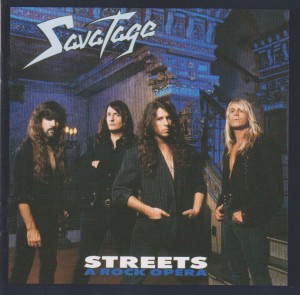
I haven’t reviewed much of my Savatage collection, and the reason for this is actually their fault. There are so many different versions with different bonus tracks that I cannot keep any of it straight. I have no idea what I have or what I’m missing at this point concerning bonus tracks. I like to be thorough when reviewing an album, providing some commentary on all the different tracks available. In Savatage’s case, I give up. I can’t keep up with the bonus tracks, but I’m going to review the albums anyway. Streets: A Rock Opera is the Savatage album closest to my metal heart. And that means it’s Epic Review Time!
SAVATAGE – Streets: A Rock Opera (1991, 2002 Steamhammer remaster)
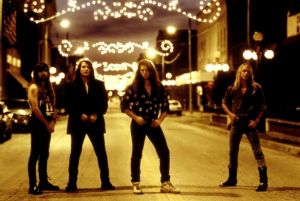
The origins of Savatage did little to hint at what they could become. Little more than a thrash band with remarkable riffs and throat, Savatage truly began to grow when they hooked up with producer/co-writer Paul O’Neill. He had already been working on an idea for a musical called Gutter Ballet. Savatage liked his ideas; singer Jon Olivia used the title for his song “Gutter Ballet” (unrelated), after being inspired by Phantom of the Opera. Their next project was determined to be the O’Neill musical, which now needed a new title: Streets (with Ghost in the Ruins being O’Neill’s preferred, un-used title). One song was already used: “When the Crowds are Gone” was recorded by Savatage for their 1989 LP. Other songs would also have to be trimmed, such as “Desirée”, and “This is Where We Should Be” which later emerged as bonus tracks elsewhere.
A children’s choir opens the title track “Streets”, before the tinkling of creepy piano. “Streets” acts as introduction to the story, setting the scene with Jon Olivia as your narrator. The song turns very metal to let us know this story is going to be a heavy one. “These streets never sleep, still they never wake,” goes the ominous tune. Jon’s brother, guitarist Criss Oliva, rips up and down the neck for a solo section that evokes hope instead of fear. I feel chills on my arms.
Streets contains very little dialogue. A man begging for a quarter introduces himself. “I ain’t no bum or nothin’. I used to live uptown once before too you know.” He lights up a cigarette. Lots of characters down here. But there was one character who made it out of here: D.T. Jesus. He was a drug dealer, “Downtown Jesus”, or “Detox” to his friends. Streets is his story, and this is the intro to “Jesus Saves”.
“Jesus Saves”…
The interesting thing about “Jesus Saves” is that there is an alternate version out there that wasn’t used, called “DT Jesus”. Lyrically it’s identical, but musically it’s gospel rock. Don’t ask me to choose a favourite; I can’t. The gospel version has an incredible power that the album version, “Jesus Saves”, does not. However Savatage are a metal band, and even if this is a rock opera, “Jesus Saves” works better for a metal album. It’s exactly what is needed for the start of this album: a short, hard shot right in the face, guitars exotically dancing and Jon Oliva shrieking the best he can. D.T. Jesus may have been a low-life, but that wasn’t his future. “Bought himself a cheap guitar, started playing bars, kids came in their cars.”
…and “DT Jesus”. Which do you prefer?
Fame comes. T-shirts, radio interviews, headline concerts. It was not to last for D.T. Jesus. “He started missing shows, the band came down to blows, but Jesus just didn’t care.” Even when he quits the band, his fame won’t disappear. The story of the musician who could not kick his demons resonated with Jon Oliva who went through his fair share of powders and pills before Streets. There are probably several kernals of truth within his vocals and that is one thing that makes Streets so unforgettable.
“Tonight He Grins Again” refers to the monkey on his back: addiction. “Still he is my only friend, and tonight he grins again.” The power in this piano/metal hybrid is undeniable. During the quiet passages, Oliva’s voice quavers; then he shouts hauntingly on the choruses. Mid-tempo guitars kick in for “Strange Reality”, and the story begans to turn. Jesus sees a filthy man on the streets. “That could be me,” he begins to think to himself. Is it a sign or a warning? D.T. comes to this realization and then begins a confessional on “A Little Too Far”. A pretty piano ballad like “A Little Too Far” may seem out of place, but it is only the first of several. “A Little Too Far” is very special, raw and penetrating. Towards the end it lightens up, and this is my favourite verse on the whole album:
“And who’s to say what it’s about, When John Wayne caught the last train out? And Spock and Kirk have had enough, And no-one’s left to beam me up?…”
Drummer Steve “Doc” Wacholz used to play with a United Federation of Planets banner on his bass drum.
The mood lightened, D.T. Jesus goes for a comeback. “You’re Alive” is the most “pop-metal” of all the songs, like Sava-Journey, indicating this is it: this is D.T.’s moment. “The crowd they came in just to see a man back from the dead.” Triumphant hard rock it is, victorious and fist-pounding. But it’s too soon for a happy ending. “You’re Alive” ends abruptly. Enter: Sammy.
“Sammy and Tex” is old-school Motor-metal. The heavy chug interrupts the celebration. Oliva screams rapid-fire from the left speaker, as the character of Sammy, an old acquaintance from the drug days. He’s come looking for an old drug debt: $30,000, plus interest: “Now I would have said duck it, but with the money by the bucket, I hear you’re raking in…” A struggle ensues, but D.T.’s manager Tex hears the commotion and enters the room. Sammy pulls a knife, and Tex is dead.
Musically, “Sammy and Tex” is the most hard core Savatage metal on the album. Shreddery and riffs collide with the kind of speed metal tempos that they mastered on their earliest albums. Relentless and without pause, “Sammy and Tex” perfectly accompanies the words. The struggle is over in a blur. Sammy makes a run for it leaving D.T. with Tex’s dead body.
The first side of the album closes with the sorrowful “St. Patrick’s”. Not knowing where to turn, D.T. enters St. Patrick’s church, begging for answers. The statues and paintings provide no answers. “Surely, you must care, or are you only air?” asks D.T. in frustration. The music turns dramatic, and then explodes as D.T. breaks down. He then apologizes for his outburst: “Didn’t mean to doubt what it’s all about, seems I forgot my place. But if you find the time, please change the storyline.”
Side two opens in a different mood, a dreamy landscape of echoey drum bursts and light guitars. “Can You Hear Me Now” drops a heavy Criss Oliva riff at the halfway mark and then it starts to rip. D.T. Jesus seems haunted by people from his past as he tries to fall asleep. Hitting the streets again, “New York City Don’t Mean Nothing” begins as an out-of-place acoustic song. Here we meet some other unsavoury street characters, as the song begins to accelerate. First a fast bass beat, then chunky electric guitars join in and the song blasts off. All sorts of advice is offered to our lead character, but none is really useful.
It sounds like Savatage ripped off the opening guitars from Def Leppard’s “Die Hard the Hunter” on the next track, “Ghost in the Ruins”. I all but expect Joe Elliot’s voice next. It goes heavy instead, painting a picture of the bad side of town at night. D.T. then begins to question what the world would be like if he didn’t exist anymore. Would anybody care? “If I Go Away” goes full-on power ballad mode. It is one of the most powerful songs on the album, anthemic and beautiful, but sad. It has become a bit of a classic to Savatage fans today, often considered among their best ballads.
D.T.’s demons will not die, and the urge to go back to the drugs once again speaks on “Agony and Ecstasy”, the last of the heavy tracks on the album. With a chugging Criss riff, this one blasts like a train fueled by Van Halen (not Van Hagar) albums! “Just remember, if you ever need me…I’m here,” ends the song. Then the story gets a little fuzzy, but thankfully the band included a narrative that helps explain events. The album closes with a trio of piano ballads, each building upon the other to a satisfying climax.
Fair warning here: Much of Savatage’s conceptual music has Christian overtones, but none more obvious than on these three tracks. According to the story, D.T. finds a homeless man in the streets who is dying. D.T. feeds him and clothes him. This would be during the ballad, “Heal My Soul”, the first of the ballad trio. It is based on a Welch lullaby called “Suo Gân”. With just piano and the voice of Oliva, you can imagine D.T. singing this to comfort the man as he passes away. The children’s choir then returns, adding a pretty but haunting quality.
“Believe”
According to the story, D.T. witnesses a luminous spirit emerge from the homeless man, who he follows up several flights of stairs to a roof of a building. On “Somewhere In Time”, D.T. seems to have come to a spiritual realization and confesses all his regrets and mistakes. “I’ve been grasping at rainbows, holding on to the end, but the rain is so real lord, and the rainbows pretend.” The music goes upbeat with a hard rocking middle section, guitars squealing as if possessed by St. Halen himself. Then, finally D.T. opens his heart and gets his answers: “Believe” is the perfect ending to an epic emotional journey. With all the power that Savatage can muster, overblown, dramatic, and pompous, “Believe” ends a rock opera properly. Interestingly, it retains a simply epic section that was lifted directly from “When the Crowds are Gone”, excised from the story when it was used on the Gullet Ballet album. So epic is this segment, that Savatage had to re-use it. Then later, on another Savatage album later in 1994 called Handful of Rain, part of it was re-used again, along with other parts of “Believe”. Its positioning on that album was the same: it was part of the closing track. Only on Handful of Rain, it was on a song called “Alone You Breathe” that was a tribute to Criss Oliva, who was killed by a drunk driver.
“Believe” ends the album on the bright up-note that you want a story to end with, your soul awash with light and musically uplifted. Reading the story and words, it’s really hard to avoid the obvious message. Listening to the music purely as an album, you can probably live life completely ignorant of the story. But as soon as they put A Rock Opera in the title, that makes the listener try to follow along. I think it’s pretty obvious, in the final song “Believe”: “I am the way, I am the light, I am the dark inside the night…” Paul O’Neill, who wrote the musical on which this album was based, is openly Catholic, and there’s nothing wrong with that. There’s nothing wrong with writing what you know and what interests you and what makes you feel something. But some…probably a minority of listeners…just flat out won’t like it. They will consider the call of “I’ll be right there, I’ll never leave, and all I ask is believe,” to be heavy-handed preaching, and fair enough. That’s why I’m putting it out there — for readers to make up their own minds.
A later, Zak Stevens-sung version of “Believe” done acoustically.
So, on to this lovely Steamhammer remaster…with “bonus tracks”.
Two bonus tracks are listed: “Jesus Saves” and “Ghost in the Ruins” live. One issue: There are no bonus tracks on this CD. None. Nada.
There is a recent release with narration between all the songs, and a previously unreleased track called “Larry Elbows”. That’s probably a good one to have. There is a 2011 remaster with unreleased acoustic songs. There was a 1997 release with a Zak Stevens-sung version of the outtake “Desirée”. Or you could go with the original 1991 release if you’re so inclined, because there are more flaws with this Steamhammer package.
One is that all the artwork is blurry in comparison to an original release. The other is that the narrative story isn’t included in the booklet. It was in the original, along with the lyrics. Steamhammer only brought over the lyrics. In compensation, they do include an 11 page (very small print) segment detailing every aspect of the making of this album and the tour that followed. In the end, Jon Oliva resigned from the band, citing exhaustion. His replacement was the young and able Zak Stevens for 1993’s followup Edge of Thorns.
Savatage’s Streets: A Rock Opera was their first full-length concept album, the first of many: Dead Winter Dead, The Wake of Magellan, and Poets and Madman all followed after a brief period of non-conceptual work. That’s some heavy competition, but Streets remains their most passionate.
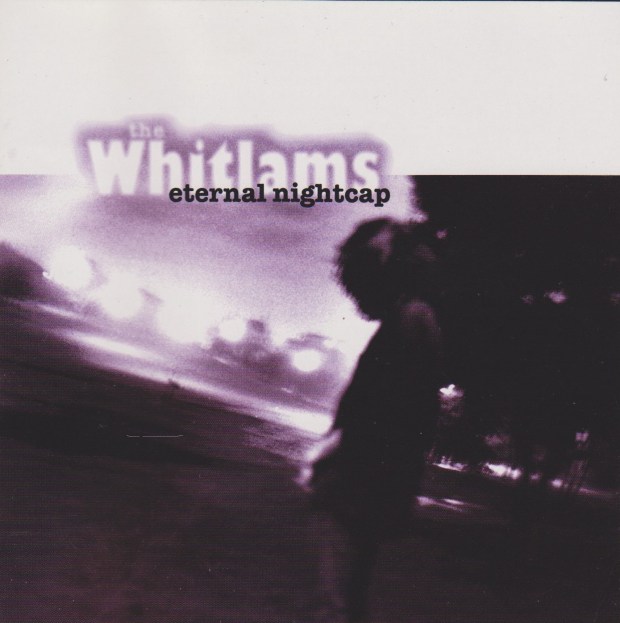
THE WHITLAMS – Eternal Nightcap (2000 Black Yak Canadian version)
I honestly can’t remember who I saw the Whitlams opening for in 2000. I know it was the Center in the Square in Kitchener, so by process of elimination, they were probably opening for Blue Rodeo on their Days In Between tour.* I actually expected a country band, because I confused the Whitlams with the Wilkinsons. What I got, much to my delight, was an Australian piano-based pop rock band with witty lyrics and a couple absolutely unforgettable songs. I like piano rock: Ben Folds, or Elton John for example. You can see similarities with both in the Whitlams.
At that time the Whitlams were in Canada promoting Eternal Nightcap, essentially a compilation of selections from their Australian releases. Having never heard those albums, I don’t know if you would consider this a “best of” or not, but upon listening for the first time, I was clueless that these songs weren’t all from one album. They sound cohesive.
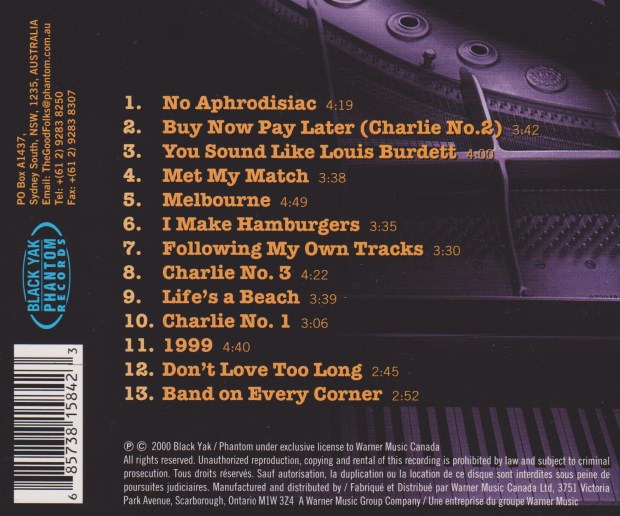
The opening track “No Aphrodisiac” showcases Tim Freedman on vocals and piano with a melancholy opener. One of the most impressive things about the Whitlams is their lyrical prowess. “There’s no aphrodisiac like loneliness,” sings Freedman. Ain’t it the truth? It’s “I Make Hamburgers” that has perhaps the wittiest words. “I make hamburgers, I get all the girls,” sings Freedman, and somehow I believe him in this amusing tale.
Jazz pervades “You Sound Like Louis Burdett” until the pure pop chorus. “All my friends are fuck-ups, but they’re fun to have around.” Eternal Nightcap is a diverse album, and the “Charlie” suite (three songs) has a quieter, more serious tone. I have wondered if these songs are at least partly based on the Whitlams’ late guitarist, Stevie Plunder. “You’re killing your soul with an audience looking on.” Plunder died of a suspected suicide. These are beautiful songs, but lyrically very heavy. Plunder himself sings “Following My Own Tracks”, a great rock tune that actually reminds me a lot of early Blue Rodeo — the Greg Keelor songs. Then there is some Beatles-y mellotron on “Melbourne”, a mid-tempo track that I remember them opening with at the Kitchener show.
With such a strong mixture of soft and rocking material, coupled with hard to forget melodies and skilled wordmanship, Eternal Nightcap (the Canadian version anyway) is a pretty easy CD to justify adding to your collection. Now, to be transparent and honest, I will say that I did own a copy of their next album Torch the Moon, given to me by a co-worker. I didn’t keep it because there was nothing on it that struck me as memorable like Eternal Nightcap. Whether or not this CD is all the Whitlams you need, I cannot say.
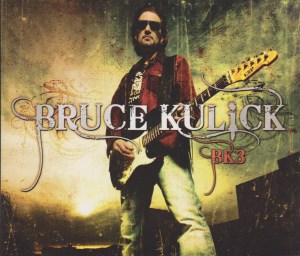
There is so much more to Kiss than just the original members. Sure, you may think Ace Frehley rules, and that his solo albums are awesome. You’d be right — I’ve reviewed every single Ace Frehley album. But let’s not forget about Bruce Kulick, who humbly held down the fort from 1984-1996. Today, Kulick’s rocking the house with Grand Funk, and doing a fine job of it. But just as there is more to Kiss than just the original members, there is more to Bruce than just Kiss or Grand Funk. Bruce has always treated Kiss with respect, and his solo music shows the same care and love put into it. BK3 is my favourite of his solo albums, including Audio Dog and Transformer.
Surely one of the draws to this Kulick record has to be the big name guest appearances. The best of these is the late Doug Fieger (The Knack) on “Dirty Girl”, an incredibly catchy radio rocker. So good is it, Classic Rock magazine listed it as the 29th best tune of 2010. Hey, that’s a proud moment! If I didn’t know it was Fieger singing, I wouldn’t have guessed. I figured it was some young unknown with a great voice. As great as this song is, and how hit-worthy it could have been, I don’t think it would have suited Kiss. It’s too pop for Kiss, I think, but it’s not sell-out in any way, because Kulick makes sure the guitars are sweet, crunchy and loud. Other guest shots include Steve Lukather, dueling with Bruce on the only instrumental “Between the Lines”. Tobias Sammet shows up to sing the grinding “I’m an Animal”, and on drums is Kiss drummer Eric Singer. As if that’s not enough, there are not one but two Simmons on this album. The old man sings “Ain’t Gonna Die”, a heavy Kiss-like armor plated beast. Then the Son of Simmons, young Nicholas, sings on the even better “Hand of the King”. Almost a dead ringer for his old man, Nick lends the song a demon-like aura.
There is one more cool guest shot that needs to be highlighted. There are 3/4 of Bruce’s old late-90’s band Union, on a great tune called “No Friend of Mine”. John Corabi lends his unmistable gravel to this melancholy rocker. With shades of acoustics and ripping lead vocals, this as good as anything in the original Union catalogue. I still think their debut album was incredible. Canuck Brent Fitz is on drums, also from the Union days but probably on a break from Slash. Only bassist Jamie Hunting is missing, but it’s safe to say that this song could easily fall under the Union umbrella. Kulick’s shredding on this one is insane, used sparingly but effectively.
BK3 is also diverse. Bruce sings the rest of the material, but the most interesting is the closing ballad “Life”. It sounds like a King’s X track circa Faith Hope Love, augmented with violins and the flute! This is truly is an outstanding ballad. Bruce would be the first one to say “I’m not a singer”, so it takes courage to do the lead vocal on a track like this. Bruce’s voice has his personality in it: it sounds like the Bruce Kulick we know and love. It’s a very human sound, and he does a great job. His voice is similar to Steve Vai’s, another artist who is not afraid to sing lead.
If you appreciate great rock music, meticulously and lovingly assembled, then give BK3 a shot. There are so many great songs on here. If you’re a fan of Kiss, The Knack, Motley Crue, or any of the other guests, then this purchase is somewhat of a no-brainer!
GETTING MORE TALE #491: My First Tragically Hip Experience, by Scotty G
As fans know, Gordon Downie of the Tragically Hip was recently diagnosed with terminal brain cancer. It is devastating news. Downie, living his life as an artist, has decided to go out as an artist and do a farewell tour in support of the new album Man Machine Poem. As writers, we have been trying to come up with a way to honour the man without dwelling on the negative. With that in mind, in a multi-site event, we have several posts for you today to honour the man and the legend, Mr. Gord Downie. Mikeladano.com’s contribution is this guest shot by the King of Rock Knowledge, and fellow ‘Fester, Scott. He is what I like to refer to as a “Jedi Master of rock”, the kind of man that can pass down stories and legends to the next generation. Scotty had the chance to see The Hip back in the early, early days and…well see for yourself! Please welcome Mr. Scotty G!
My first Hip experience was around 1988 or so, just prior to the release of Up To Here (1989). Somewhere after the Spoons and Rough Trade, and possibly prior to Sass Jordan, (I cant remember) at a Canada Day concert at Molson Park in Barrie, the Tragically Hip hit the stage.
Obviously young and lacking a whole lot of support, they carried their amps on stage themselves, placed them on chairs and started to play. I was kind of familiar with “Last American Exit” from the video, but that was it. They hit the stage and I was BLOWN AWAY. Mid-set, after really rocking one out, Gord called out to the crowd and asked if anyone had a dime? Literally, the crowd pelted the stage with change. Gord grabbed the coin of choice and proceeded to tighten a screw in his mic stand. He thanked the crowd for the help, and they blasted into another tune.
Months later, with this show still in the forefront of my mind, Up To Here was released and with it came more opportunities to see the Hip in many small venues. One in particular, the Highlands in Cambridge*, always offered up good opportunities to meet bands and in this case a couple of us were welcomed into the dressing room where Gord very politely obliged our fan talk. Joint after joint flew from Johnny Fay’s expert rolling fingers. Although it’s a long time ago, I have a good memory of it. I have to add that I am still amazed that he gave us the time of day, and seemed cool with having two 17 or 18-year-olds sitting in the dressing room asking silly questions while the band got stoned….
I got to see the Hip many times after that, and look back on those early performances with fondness. I never saw them live after the Road Apples tour, but will always recall the welcome that Gord and the band gave two young fans after a great show in Cambridge. He is a cool shit….
SCOTTY G
* I saw the London Quireboys at Highlands in Cambridge in December 1990
While the Apatow Company’s best films are behind them now, in 2007 they were coming off the dual hits 40 Year old Virgin, and Knocked Up. Those films featured a core of recurring actors, including Bill Hader, Seth Rogen, Jonah Hill, James Franco and the whole gang that we are all familiar with today. Then, this kind of comedy was fresh. Today, Superbad is the only Apatow I can still watch regularly and laugh like it’s the first time.
I love a movie with a great rock soundtrack, and Superbad features Van Halen (“Panama”), Motorhead (“Ace of Spades”), and Ted Nugent (“Stranglehold”). There’s even The Roots! Even better, and incorporated into the comedy, is the Guess Who’s “These Eyes” as performed by Michael Cera. It is a case 0f mistaken identity and Cera’s character Evan is in a spot. I’m cracking up thinking about it. “He’s Jimmy’s brother, the guy! The singer! He’s the guy with the beautiful voice that I was telling you about!” And then, “My brother came all the way from Scottsdale Arizona to be here tonight. And you’re not going to sing for him? You sing, and sing good!” The last song I would have chosen to sing under such circumstances would have been “These Eyes”, but that’s why this is a comedy movie.
Seth (Jonah Hill) and Evan (Michael Cera) are highschool versions of Seth Rogen and Evan Goldberg, who wrote this movie, but were too old to play the parts. It’s the end of highschool, and together with their friend Fogell aka “McLovin” (Christopher Mintz-Plasse, who absolutely nails it in his film debut), they aim to score some liquor for a party. Once they have booze, they will be like heroes to Jules (Emma Stone) and Becca (Martha MacIsaac) at the party, and possibly score some coitus. McLovin has the fake ID, but acquiring the alcohol is only the first of many stumbling blocks.
Seth Rogen and Bill Hader play incompetent cops, but their intentionally stupid scenes will make you groan rather than laugh. Bad decisions by all the characters may have you shaking your head asking “why?”, but you have to put your mind in the hormones of a highschool kid aiming to get his first touchy feely. Guys do stupid things not unlike the people in this movie. I know guys who’ve done things like this when they were kids. I’ve made plenty of stupid decisions while chasing someone of the fairer sex. Granted, I’ve never been hit by a car and then talked into not calling the cops in exchange for going to a badass party where I can steal some booze. That exact situation has never happened to me or anyone I know. But it’s fucking hilarious.
The most enjoyable comedy usually comes from the banter between Hill and Cera. Their blunt vulgarity has a certain art to it. I can still quote lines from this movie, and people know which ones I’m talking about. “Something like 8% of kids do it, but whatever.”
In this film, Seth and Evan are going to different colleges and there is a tension between the two characters over this. Both of them feel differently about it, and this is the most relateable part of the movie. The end of highschool feels like the top of the world for a brief moment, but then in the fall friendships split up, sometimes forever (until Facebook came along anyway). Superbad is basically a movie about two guys trying to get some, but the tension in the friendship is ultimately what drives the story to its conclusion. Cera and Hill are funny indeed, but the friendship they portray seems real.
The unrated edition is loaded to the gills with bonus features, and honestly a good chunk of them are worth checking out. You can skip the “Cop Car Confessions”, but definitely watch “Everyone Hates Michael Cera – The Unfortunate True Story”. And of course, don’t miss “The Music of Superbad” either. Bootsy Collins and Lyle Workman put together an unexpectedly cool soundtrack.

 WAYNE’S WORLD – Music from the Motion Picture (1992 Warner)























 mikeladano.com