Rock Daydream Nation: The Best Australian Rock Songs of the 1980s? Featuring Harrison Kopp (VIDEO)

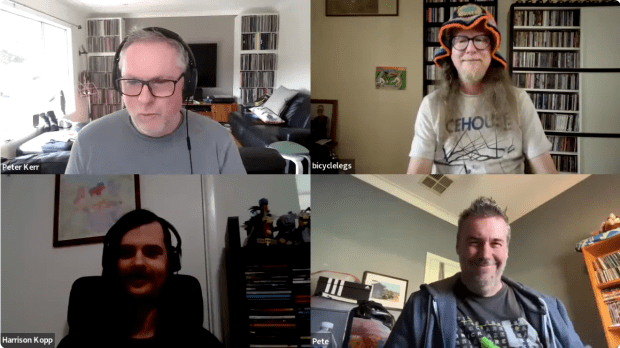
The Mad Metal Man has spread his wings!  I am proud to present below, Harrison’s first appearance on a show that isn’t our own!

Harrison wanted to do an Australia-centric topic with Peter Kerr for some time.  Peter has been wanting to put together an all-Australia panel.  This week on Rock Daydream Nation, that’s exactly what we got!  With Peter Wicks, and Bicyclelegs himself.

It was enjoyable for me to hear about familiar Australian bands, and those I’d never heard of before.  Harrison stirred the pot with some questions and comments, like a good lad!  (Do the Bee Gees count as an Australian band?)  Really proud of the “resident contrarian” Mad Metal Man.  Check out the show!

REVIEW: Deep Purple – =1 (2024) [Part One – The Album]

Part One of a Three Part Series

Part 1:  =1 (the album)
Part 2:  =1 (the live album)
Part 3: =1 Access All Areas (DVD)


DEEP PURPLE – =1 (2024 Edel)

“It all adds up to one…”  Would that have made a better title?  Deep Purple don’t always come out with the greatest album titles or covers, but they have produced consistently good music during the Morse era, and now beyond.  In their first lineup change since Don Airey joined the band in 2003, Steve Morse has stepped down for important personal reasons, and new kid Simon McBride has picked up the plectrum.

When Mr. McBride was born in Belfast in 1979, Deep Purple weren’t even a band anymore.  They were in the middle of an eight-year hiatus.  The last Deep Purple compilation released was 1979’s Mk II Purple Singles when he was an infant.  Deepest Purple wasn’t even out yet.  Rainbow was about to release Down to Earth with Graham Bonnet.  Gillan were working on the second album as a band, Mr. Universe.  Into that world sprang Simon McBride.  He would grow to become a solo artist who would work with Purple members Don Airey and Ian Gillan, before being asked to join temporarily and then permanently.

Retaining Bob Ezrin the producer’s chair, Deep Purple wound up with something familiar, yet slightly different.  There is less double tracking on Ian’s voice, which gives it a fresher sound.  The songs are slightly harder edged, and there are more of them.  =1 is the first first Deep Purple without bonus tracks since InFinite, and like Whoosh, feels conceptual on some tracks.  According to the band, the world is “growing ever more complex, everything eventually simplifies down to a single, unified essence. Everything equals one.”  I don’t know about that, but that’s what =1 means to them.

At 13 songs, the album could be trimmed down to a tidy ten.  Let’s break them down.

Simon gets to show off some new sounds at the start of “Show me”, a relentless groove, unlike anything from the Morse era.  Ian’s speak-sing storytelling vocal is familiar and fun, a perfect way to adapt to singing in your 70s. The groove is different from past works.  Wonderful solo work from Don and Simon here, with Don on synth.  The back and forth is very tasteful.  It’s more playing for the song, and less trying to outplay each other like Jon Lord and Ritchie Blackmore in the 1970s.

Track two continues that hard grooves.  “A Bit on the Side” boasts a great chugging guitar part, very different for Deep Purple of any era.  The chugging is almost Slash-like, circa “Locomotive”.   The chug-riff is the main feature, but once again Simon’s solo is stratospheric with loads of technique.  Don’s is equally cool, with a spacey vibe.

“Sharp Shooter” is one song on which Ian doesn’t sing the name in the chorus. Instead there is a memorable refrain of “Shot in the dark”.  The vocals are pushing the upper limit a bit, and the song has a vibe very much like the Morse era of Deep Purple.  Nice soulful female backing vocals here, which is rare in Deep Purple.  Once again, Don is focusing on the synth for solos.  Not a highlight, but a decent tune with a modern Purple groove.

The first video/single was “Portable Door”.  Ian Gillan weaves his traditional “English as a second language” lyrical whimsy.  Some favourite lines:

When it came to me one day in Jerksville
Man, I was right on the edge
And that jacket’s too small for a man of your size
And those socks are too big for your head

I love that.  Socks are too big for your head?  Why not.  The lyrics seem to be about tedious conversations that go in one ear and out the other.

I was trapped in a dire situation
Between reason and someone-in-law

“Between reason and someone-in-law” is just brilliance.  Only Ian Gillan could write that.  Meanwhile, Simon hits you with a cool chord that swooshes through.  “Portable Door” has a stamp like the last few albums, but the one Simon chord really sets it apart.  One chord:  huge impact.

“Old-Fangled Thing” has a nice lyrical reference back to “Living Wreck” from In Rock, but is not the most memorable of songs.  Is “old-fangled” another Gillan-ism?  This song is a little tricky, like much of the Morse era was.  In the end, it’s possible that this song could have been axed, but its speed is impressive.

There are two “ballads” (or slow blues) on this album.  The dramatic one is “If I Were You”.   There is a memorable chorus and a mournful guitar melody that might recall things like “When A Blind Man Cries”.  Either way, Purple have done some impressive ballads and slow songs during the Morse era, and now the Simon era too.  His solo is a little Bonamassa at times.  Also take note:  there’s an orchestra on this track!

The second single “Pictures of You” is immensely memorable.  A fantastic song, with a focus on vocal melody.  Purple play it simpler here and the dividends pay off.  There’s a bit of multi-tracked vocals on the chorus, which is essentially what this song is about:  the chorus!  Until we get to the outro that is, which is more Marillion than Purple.

On the single for “Pictures of You”, the song went right into “Portable Door” without a break.  The effect was an exciting transition.  It’s less exciting on album, leading into “I’m Saying Nothin'”.   This has that herky-jerky feel of the Morse era, but is otherwise not particularly memorable.  Another one that could have been cut.

What’s the story with “Lazy Sod”?  Ian Gillan was asked how many songs he’d written in his life.  He estimated about 500.  He was then informed that Dolly Parton wrote over 5000…”you lazy sod”.  Can’t argue with that, so Ian turned it into a lyric. “That’s alright because I’m a lazy sod, and I’m hot.”  It’s the third single and the most “rock” of them. Very old-school Deep Purple.  Could have been on Who Do We Think We Are!

“Now You’re Talkin'” is the second song with an abbreviated “in'” title instead of “ing”.  (David Coverdale, were you in the room?)  Very similar to “Bananas” from 21 years ago.  Almost a re-write of that prior song, but with a really fun screamed part in one of the verses.  Really great riff, and always a pleasure to hear Ian do a scream, whether he sounds like a 70+ year old or not!  Wait til you get to the solos!

Back in the Rapture of the Deep era, Ian told us that “Money Talks” to him.  Now, he has “No Money to Burn”!  There is an organ-based riff, which is a nice change of pace for this album, but the song is otherwise unremarkable.  The third of three songs we could cut to get down to ten.

Deep Purple are not overkilling it on ballads.  “I’ll Catch You” (maybe a slow blues) is a lovely ballad, soft and bluesy like a smokey club.  It is placed perfectly near the end as an ear-cleanse, before we get into one of the best Deep Purple closers in years with the very English title, “Bleeding Obvious”.

If “Bleeding Obvious” isn’t the best closer since “Bludsucker” on Abandon, then let’s hear your picks!  It could also be the most progressive tune?  Could that opening figure work for Dream Theater or Marillion?  Or even Rush?  This is an absolutely brilliant tune, mostly down to that tricky riff and melody.

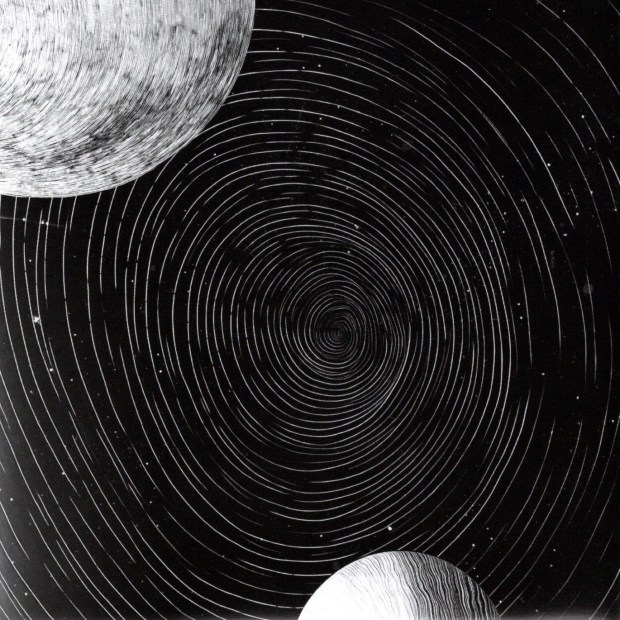
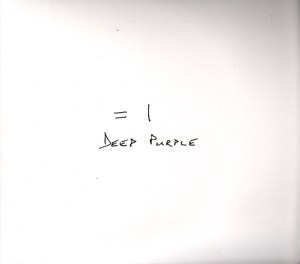
And so that’s it with =1; no bonus tracks this time.  There is a deluxe box set with the first official release of a concert with Simon McBride, which we’ll get into on a separate review.  Aside from the length, the only real complaint here is the minimalist artwork.  The inner sleeve art is far more engaging.

4/5 stars

Tim’s Vinyl Confessions: Ep. 551: Deep Purple (=1 review) [VIDEO]

Deep Purple albums take time to absorb, especially in the current “Ezrin era”.  The records are not lazy with simple songs (puns intended)!  Tim and I attempted to break down the new album =1, track by track.  We tended to agree on a lot of the songs.

What’s with the artwork?  Is Simon a new Blackmore?  What the heck is Ian Gillan singing about?  Find out in this excellent episode of Tim’s Vinyl Confessions, out today.

My written review of the album will follow tomorrow morning, with the deluxe edition live discs getting the written review treatment in the coming weeks.

VIDEO: Unboxing Music and Lego from Perth, Australia!

They don’t call Harrison the Mad Metal Man for nothin’.  It must be because he keeps sending me all these amazing parcels!

  1. Unboxing from Harrison – Feb 2023
  2. Unboxing from Harrison – Feb 2024

And now, Harrison has sent me a third parcel, with heavy metal, soundtracks, Lego and more.

Harrison has acquired some “upgrades” to some albums it seems, and has passed his original copies on to me.  These are bands I have never checked out before, so let’s see if Harrison can win me over.  There were also some cool soundtrack-y CDs for Robert Daniels (Visions In Sound) and, of course, some Lego.  The saga of the Marvel Lego blindboxes continues!

Of note:  I popped some bubble wrap for ya.

Please check out the video, like and subscribe!

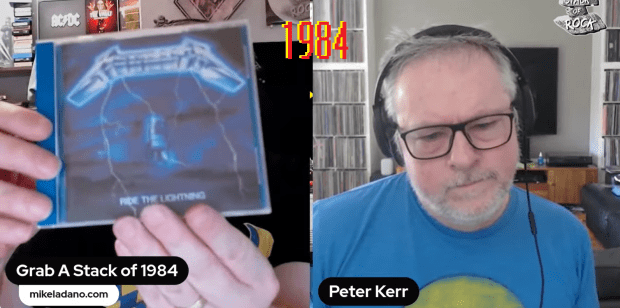
Was 1984 the best year ever for rock music? Peter Kerr, Mike Ladano & viewers list off some great tunes

Peter Kerr was back with a vengeance, and some great songs!  Representing Rock Daydream Nation, Peter listed off a whole lot of great songs from the year 1984, ranging from rock to metal to pop rock.  He also listed the greatest movies he saw from that year, with a handful of video games and TV shows.  I couldn’t resist mentioning a toyline/cartoon/comic book that transformed our young lives that year.

We had awesome guest lists from the Mad Metal Man (who is sick and could not attend) and Uncle Meat.  In the comments, Pete Jones, Henry Wright, Johnny Metal, Ash Geisler, and others listed off some great tunes.  Ash had about 30!  I tried to put all the comments on the screen.

There were some albums and artists to kept coming up over and over again.  Whitesnake, Metallica, Mercyful Fate, Deep Purple, Iron Maiden, Judas Priest, and many more were well represented on this show.

This was a wonderful hour-plus and I hope you enjoy watching it on Youtube if you missed it live!

Top 10 Rock Songs from the year 1984! With Peter Kerr of Rock Daydream Nation on Grab A Stack of Rock

GRAB A STACK OF ROCK With Mike and the Mad Metal Man
Episode 67: Top 10 Rock Songs from the year 1984 with Peter Kerr

We are back!  Following three weeks of chilling at the cottage, Grab A Stack of Rock returns with a roar, and a familiar face!

Peter Kerr of Rock Daydream Nation suggested this topic for his return to the show.  1984 was the year I got into rock music.  That coincided with MuchMusic’s premier in Canada.  All of a sudden, there were all these videos!  Kiss, Van Halen, Iron Maiden, Helix…and I was there with my VCR, recording everything.  For me personally, this will be a list of nostalgia…but not entirely.  After all, it was Peter who got me into Prince in 2023It was Tim Durling and John the Music Nut who got me buying Y&T albums recently.  It remains to be see what will make my final list, because 1984 was a completely epic year for rock music.

Peter Kerr was last on the show back in May when we unboxed the new Arkells album.  An album on which they covered “Dancing in the Dark” by Springsteen…a song released in 1984.  (It’s like poetry; it rhymes!)  Who knows what will be picked?

If you join the show from the start, you will also catch some unboxings.  Don’t miss this show, live, as we always respond to your comments!

Friday August 16 at 7:00 P.M. E.S.T. / 8:00 P.M. Atlantic.   Enjoy on YouTube or on Facebook!

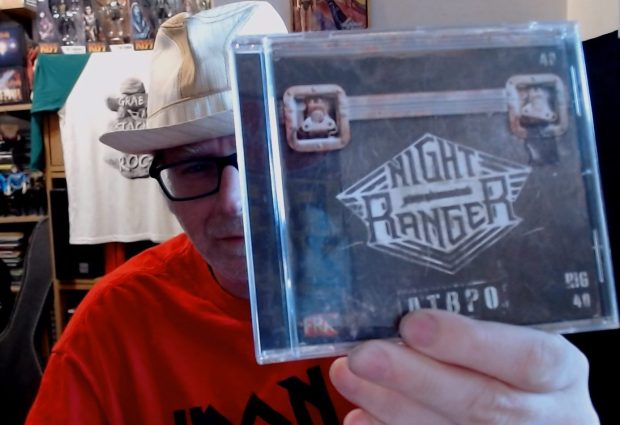
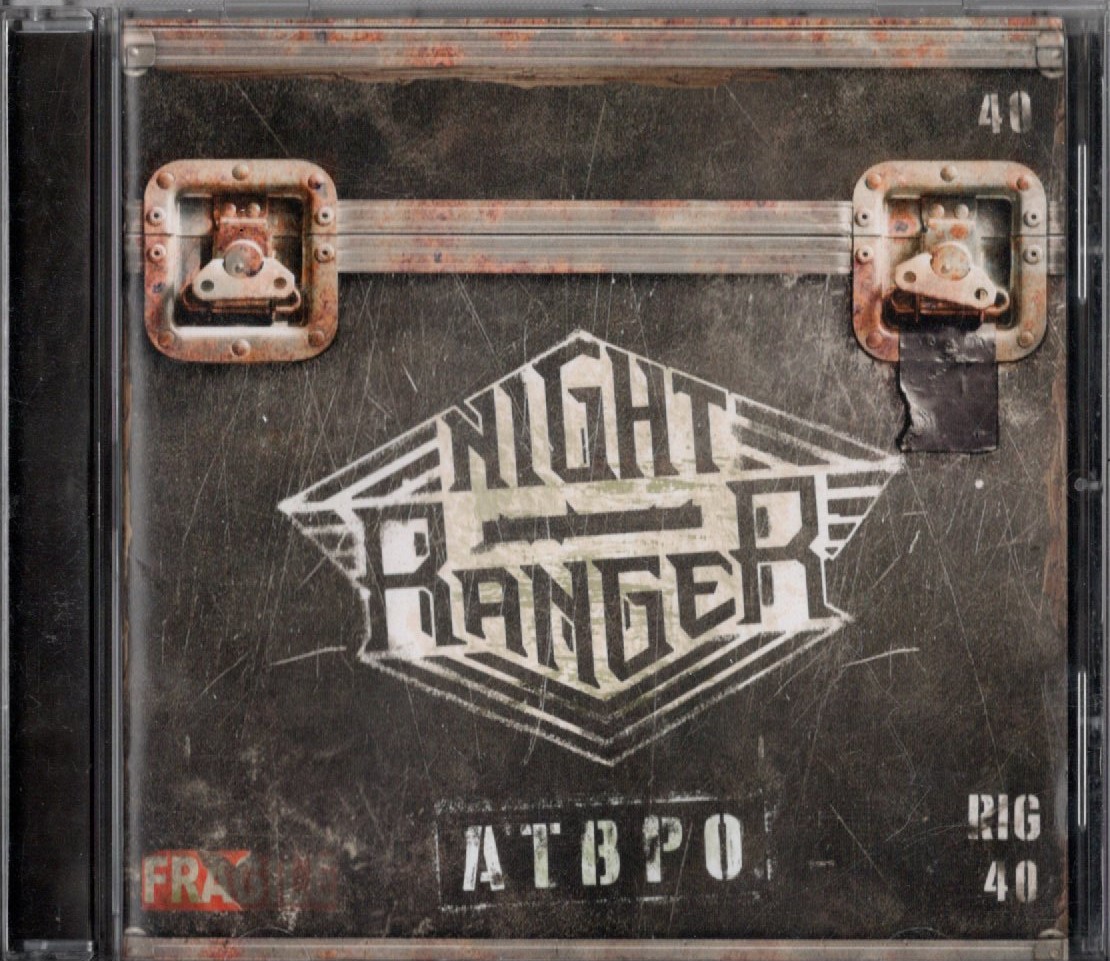
REVIEW: Night Ranger – ATBPO (2021)

NIGHT RANGER – ATBPO (2021 Frontiers)

Here we go with the third and final (to date) Night Ranger album gifted to me by Tim Durling.  ATBPO stands for And the Band Played On.  And play on they did, now with Keri Kelli on guitar after the departure of Joel Hoekstra, currently in Whitesnake.  Tim praises this album highly, so let’s find out why.

Some of the heaviest, slamming guitar I’ve heard from Night Ranger opens up the menacingly fun “Coming For You”.  For some reason I’m thinking of “Lost In America” by Alice Cooper.  This one is a grower.  It jumps out more listen after listen.  There are poker metaphors and a killer multi-part guitar solo!  Sounds absolutely wicked, modern and technical, like Steve Stevens on adrenaline.  It is quite possible that Brad Gillis is from outer space.

Second is “Bring It All Home To Me”, slowing the pace to a hard rock summer groove.  I mentioned to Tim, I was hearing some twang in Night Ranger on the High Road album.  I hear a teensy bit of that on the “baby, baby, baby” part of “Bring It All Home To Me”.  Tim will argue that I am hearing that because nu-country appropriated a lot of 80s hard rock, and there’s an association there.  Another bonkers solo here, making it two in a row for songs that fans of original guitar shred will want to hear.

More Gillis madness on the progressive sounding “Breakout”, bringing back the speed, but with a technical edge that few bands can really match.  Kelly Keagy’s nuts on the drums, and fretboards are burning on the solo.  This has to be one of the hardest Night Ranger songs to date.  Then, a boogie piano and a surprising cocaine reference opens “Hard to Make it Easy”, and I’m resisting saying the word ” country” again…but there it is.  This has line-dancing qualities.  Now I’m not meaning this in a bad way.  Night Ranger are allowed to stretch out and play stuff like this, and I won’t complain.  The chorus sounds like Shania…just sayin’…but the dual guitar solo is more Lizzy.

We go somewhere down the crazy river with the snaky opening guitars of “Can’t Afford a Hero”, which soon transitions to a standard acoustic ballad.  It would make a good Shaw-Blades track.  Good tune with, again, great solo work.  One of the more adventurous tunes.

“Cold As December” is a standout, with a powerful quality you can just pound your fist to.  It’s just all riff and all beef!  The guitar and vocals melodies are its strength.  Despite its edge, the melodies and hooks shine through.

An unfortunate “We Will Rock You” drum beat soon gives way to another good song, “Dance”, a power ballad with more power than ballad.  Really nice song.  “The Hardest Road” is also ballady, but Kelly Keagy’s lead vocal adds a ragged raspy edge that enhances it beyond.  Then the surprising “Monkey” kicks in with a serious beat.  This is the song that would sound best in the car when you’re on the highway.  Just non-stop stomp.

“A Lucky Man” is an album highlight, upbeat and bright, with a hint of that twang I keep hearing.  This would definitely sound great at camp or cottage in the summertime.  The keyboard and guitar solos are from the moon, which offsets the twang.  Another personal favourite, easy peasy.  Some tasty sweet guitar harmonies open up “Tomorrow”, another nice upbeat rocker with classy keyboard accents.

The closer is a “bonus track” (I ask why?) called “Savior”.  It’s a little…goofy?  I don’t know.  Everybody’s looking for a good time?  Sure.  I’ll agree with that.  Not sure about the song though.

Solid album, if a bit long:  3.5/5 stars.


#1150: “867-5309 / Jenny”

RECORD STORE TALES #1150: “867-5309 / Jenny”

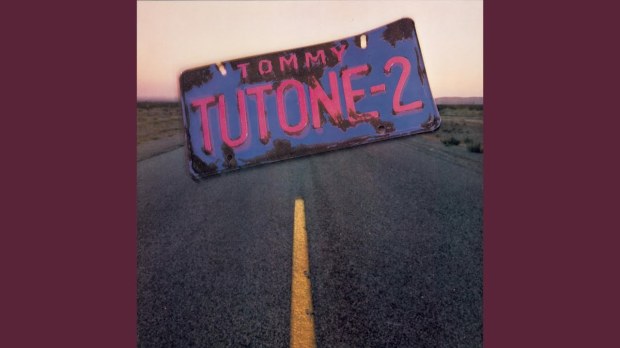
In 1981, rock band Tommy Tutone released their second album, 2.  The lead track and single was a song called “867-5309/Jenny”.  As you can imagine, placing an actual phone number in a song was, while catchy, also problematic.   Lorene Burns from Alabama, who unfortunately had that very phone number, had to change it in 1982.  “When we’d first get calls at 2:00 or 3:00 in the morning, my husband would answer the phone. He can’t hear too well. They’d ask for Jenny, and he’d say ‘Jimmy doesn’t live here any more.’  Tommy Tutone was the one who had the record. I’d like to get hold of his neck and choke him.”

Tommy Tutone was in fact a “them” and the song was written by guitarist Jim Keller, with Alex Call from the band Clover.  The song soared to #2 in Canada, and #1 on the US Mainstream Rock chart.  It’s a great tune.  David Lee Roth recently covered it, but in its original incarnation, it’s a guitar driven rock classic with a plaintive chorus and memorable lyrics.

Jenny Jenny who can I turn to?
You give me something I can hold on to,
I know you’ll think I’m like the others before,
Who saw your name and number on the wall.
Jenny I’ve got your number,
I need to make you mine,
Jenny don’t change your number,
Eight six seven five three oh nine.

Many Jennys were teased worldwide (my wife included) by boys singing the song to them; an anthem of calling a number found on a bathroom wall.  The origins of the song are unclear.  “There was no Jenny,” claimed Alex Call in 2009.  The number, he said, just sounded right when sung.  Tommy Tutone lead singer Tommy Heath claimed in 2008 that Jenny was a real girl, and they wrote her telephone number on a wall just for laughs.  The Alex Call account sounds more believable.

Whatever the origins, many people with that phone number were prank called year after year after year.  One day in 1998, I heard “867-5309” for the first time.  Although I was not involved, a prank call ensued.

It was at the old Heuther Hotel in Waterloo (now, sadly, destined to become new condos).  I had a bad day (girl trouble), and was taken out by friends to get over it.  I sat enjoying a rum and coke (Captain Morgan’s spiced rum, always) with my co-workers Neil and Trevor.  In fact, it could have been my first ever spiced rum.  Tommy Tutone came on, and I liked the song, which I was unfamiliar with.  “It’s Tommy Tutone!” enthused Trevor.  “You don’t know this song?  Come on!”

We rocked along to the tune for a bit before Trevor realized that 867 was a local number.

“Should I call and ask for Jenny?  I’m gonna call and ask for Jenny!”

We laughed and I said no, but the drinks were flowing and Trevor dialed up 867-5309.

“Hello?” went the female voice on the other end.

“Hi, is Jenny there?” asked T-Rev with total innocence.

“Jenny’s not home,” went the answer.

“There’s actually a Jenny there?  COOL!” said T-Rev.  He was assured there was indeed a Jenny there.

“No way!  Really?  A Jenny really lives there?”  Once again, he was told yes.  “Do you know there’s a song called ‘Jenny’ with this phone number?”  The person feigned ignorance and reiterated that Jenny was not home.

“Cool!  Can you tell her Trevor called?  Thanks!”

And that was it!  We laughed all night about there being an actual Jenny at 867-5309, but I think the girl who answered the phone was just so used to getting this call that she called Trevor’s bluff.

We may never know.  Please don’t call 867-5309 and ask.

#1149: Eddie’s Story – The Narrative of Derek Riggs’ Iron Maiden Art

RECORD STORE TALES #1149: Eddie’s Story – The Narrative of Derek Riggs’ Iron Maiden Art

Edward T. Head, better known as “Eddie”, has been Iron Maiden’s mascot since the late 1970s.  He was just a mask then, made by roadie Dave Lights, to hang on the band’s live backdrop.  Why “Eddie”?   Because the mask was essentially just a head, or “‘ead” in British slang.  Therefore:  Eddie the Head!  When Iron Maiden were signed to Capitol Records, manager Rod Smallwood wisely surmised that the band would do well with an identifiable “stamp”…like a mascot.  He contacted artist Derek Riggs, and before too long, Eddie made his painted debut on the cover of Iron Maiden’s 1980 single “Running Free”.

Eddie’s impact cannot be overstated.  He is more recognizable than any single member of the band.  He is seen on T-shirts worn by diehards, casual fans, and even those who have never heard an Iron Maiden song in their lives.  He is ubiquitous.  Needless to say, Rod Smallwood was very wise, and Derek Riggs very talented.  Riggs did the cover art for every Maiden album from 1980 to 1990, and almost every single and EP in the same time frame.

As young impressionable kids growing up in suburban Ontario, we certainly knew who Eddie was.  My friends and I collected not just the albums and singles, but also the buttons.  We were intimately familiar with Eddie, his different outfits, settings, and crimes!  We attempted to draw our own Eddies.  I took a shot at a single cover for “The Duelists”, a favourite song.  It featured Eddie and the Devil fencing at the edge of a cliff.  The Devil was a foe of Eddie’s going back to the “Purgatory” single cover.  Derek Riggs eventually built an extensive mythology for Eddie and associated characters.  He focused on “Easter Eggs”, hiding characters and symbols within the artwork.  Powerslave and Somewhere In Time were chock full of such goodies.  References to the bars Maiden played, the Reaper, and even a TARDIS can be found on those albums.  One of the great pleasures of being an Iron Maiden fan was opening up an album and looking for all the secret images and messages while you played the records.

By 1986, some of us had noticed that the album covers, not including the singles, seemed to a tell a continuing story.  There was a continuity to the cover art, and Eddie in particular, that made us think there was an actual story unfolding with each album release.  This story seemed to run through Derek Riggs’ entire tenure as Iron Maiden’s cover artist, from 1980 to 1990.  While I am certain that this is entirely something made up in our heads, it does seem to hold water.

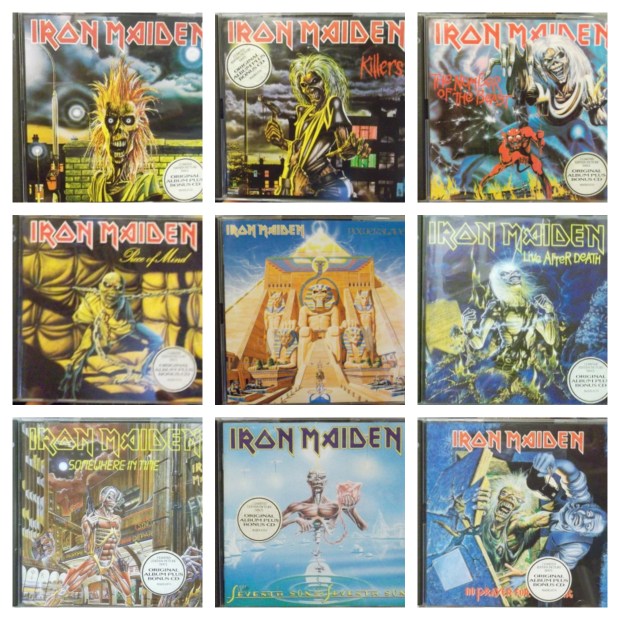
Let’s have a look at the album covers, and the story they may tell.
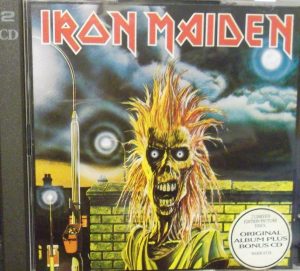
IRON MAIDEN -1980

Just an introduction to the character.  Eddie is a street punk, in a loose T-shirt, standing on a London street at night.  Behind him is a lit doorway, and a window with a red light – a reference to “Charlotte the Harlot”.  You can also see two of the streetlamps behind Eddie form an arc, with the moon.  Eddie’s eyes are just black sockets with light behind.  Later artists would change Eddie’s eyes, but Riggs always painted them black with some kind of illumination.  Eddie’s skin appears yellowed and stretched, like that of a mummy.  His hair is pure punk rock.

The story has yet to begin, but Eddie is clearly someone you don’t want to mess with on a London street at night.
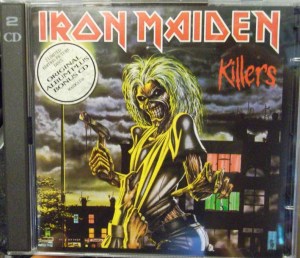
KILLERS – 1981

Eddie appears much more refined in this image.  You get a better look at the character, including a belt and blue jeans.  The punk rock hair is gone, though Eddie remains on the streets.  It could be the same neighborhood as the first album.  The black clouds in the sky are similar.  This time, Eddie has a bloody hatchet in hand, while his victim grips his shirt in dying desperation.  Eddie seems to have no mercy.  He even seems to relish killing.  Fitting, for an album called Killers.  Our interpreted story begins here, with a murder.
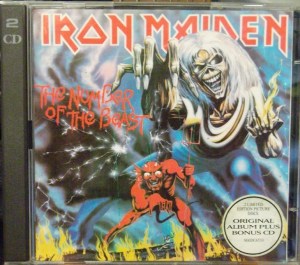
 THE NUMBER OF THE BEAST – 1982

The plot thickens.  In Riggs’ best album art to date, Eddie appears a giant over a scorched, hellish background.  The rear cover had more of this scenery, indicating we were indeed in hell.  Eddie’s eyes are now lit by flames, matching the ground below.  He also has a fire in his hand, a reference perhaps to Montrose’s “I’ve Got the Fire” which was an earlier B-side.  The most striking feature here though is the appearance of the red Devil himself!  Eddie appears in control, manipulating the evil one with green puppet strings.

This was the first cover that really had us squinting at the details, on our little cassette J-cards.  For if you look closer, you will see Eddie is not in control at all.  Satan himself has his own puppet, and it is Eddie!  Our minds were boggled.  What could this mean?  We began pulling together the threads that seemed to be telling a story.  Derek Riggs had outdone himself, but he was only getting started.

 PIECE OF MIND – 1983

Imprisoned!  Captured, chained in an asylum, and lobotomized to boot!  Now bald, Eddie bore a scar across his head!  He had been cut open like an egg, and this scar would remain for the next several album covers.  Two more details were added:  a stream of blood going down his nose (always his right side), and a metal bracket holding his head together.  The screws in the bracket would always be in the same orientation.

Clearly, Eddie was in trouble.  We saw this as the punishment for his crime of murder.  The Devil came to take his due, and now Eddie is stuck in a cell.  Would he escape?  The next album told us no.

Of course, the real life inspiration for the artwork was the title Piece of Mind.  On the inner sleeve, the band members are preparing to dine upon a brain!  It doesn’t look tasty, and Adrian Smith in particular doesn’t look hungry.  In our childhood fantasy world, the Devil had served up a particularly brutal punishment for our favourite Metal mascot.
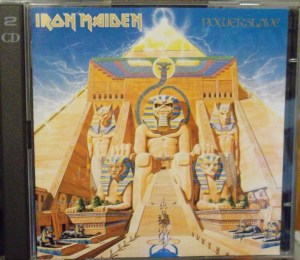
 POWERSLAVE – 1984

It appears that Eddie did not survive his brain surgery and imprisonment, for here he was being laid to rest in an ancient Egyptian setting.  In Riggs’ best artwork to date (again), a multitude of Easter eggs were hidden on the front, back and inner sleeves.  The Great Pyramid appears as it once did in antiquity, smooth and topped by a golden capstone.  Eddie’s sarcophagus can be seen, carried up the stairs, to his eternal resting place.

Or was it?

It seems pre-destined that Maiden’s next album would be called Live After Death.  It was really at this point that we started to put together that there was a story unfolding here.  Live After Death, and Eddie was buried on the previous album?  It all made sense!
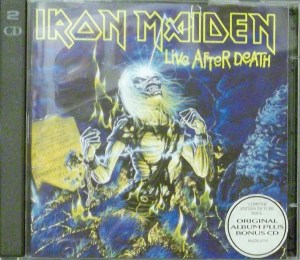
 LIVE AFTER DEATH – 1985

Now this was an album that simply had to be owned on vinyl.  There was text to be read on the tombstones (“Let It RIP”), and so many Easter eggs on the back cover, including a black cat, the Reaper, and a visible “Edward T. H…” on his tombstone.  For many of us, this was the first indication that Eddie did have a last name!

With a bolt of lightning re-animating the already dead corpse, Eddie was back!  Still wearing his chains from the Piece of Mind album cover, Eddie’s hair had grown back while his T-shirt has seen better days.  Flames can be seen bursting from the ground, hinting at his hellish past.  On the rear cover, a city can be seen, surrounding the pyramid from the last album.  The continuity seemed clear.  The only issue here was that on the prior album, Eddie was laid to rest inside the pyramid.  Here, he is seen bursting out of a normal grave.  It would seem that Eddie’s remains were re-located between albums.  A minor issue easily explained away.

The city on the back cover calls to Eddie!  He was back, and up to his old ways again…
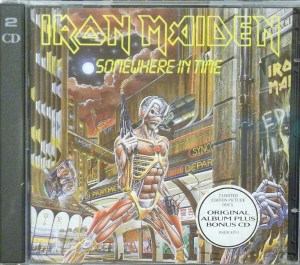
 SOMEWHERE IN TIME – 1986

Riggs outdid himself again, with the Blade Runner inspired Somewhere In Time.  Owning this album on vinyl is simply a must, for there is so much going on.

Still lobotomized, but bearing a new brain of circuitry, Eddie was technologically enhanced.  The blood, scar and bolts holding his head together are still visible despite the modifications.  On his chest, Derek Riggs’ signature emblem can be seen clearly.  It was always hidden somewhere on his albums, but here it was plainly visible.  A poster that reads “EDDIE LIVES” can be seen on the right, with the dying hand of a victim that he has just exterminated.  Back to his old killing ways from the Killers album!  Instead of a blade, Eddie now wields a pair of blasters.  Eddie seems to have arrived in a “Spinner” vehicle, similar to Blade Runner.

The same familiar moon from previous albums blazes behind, but there is so much on the back cover to discover too.  A reaper, red-lighted windows, and the names of things important to Iron Maiden’s lore are present.  As far as our story went, we imagined that Eddie emerged from his tomb centuries in the future.  This time, the Devil would not stop him!  But despite the cybernetic enhancements he underwent, his body was not whole…and soon it would be time to be reborn.
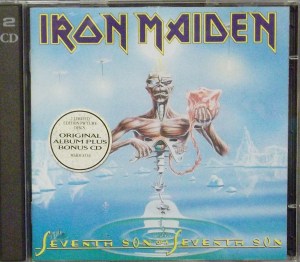
 SEVENTH SON OF A SEVENTH SON – 1988

This is where things got weird.  Really weird.  Not content to keep drawing Eddies with axes through people’s heads, Riggs went abstract on Seventh Son of a Seventh Son.  Eddie was now little more than a torso, with his skull ripped open and aflame!  The scar, bolts and blood are still present (though the blood would be replaced by a mustard-like substance on the single cover for “Can I Play With Madness”).  The remnants of his cybernetic enhancements are still present, with one eye replaced by a robotic one.  He also still has a metal throat.  An apple can be seen within his ribcage, but most striking is the Eddie-infant he’s holding in some kind of embryonic sac!  This sac is attached to his ribcage with an umbilical cord.  An arc of lamps recalls the first album.  A “book of life” is present on the back cover, tying into the album’s concept.  There are also ice statues of past Eddies on the back cover, for a total of seven Eddies.

Look closely and you can see that the surface below is both solid and liquid, and the icebergs do not touch the surface.  In our story, this represented Eddie on another plane, as he gave birth to his successor – a new Eddie.
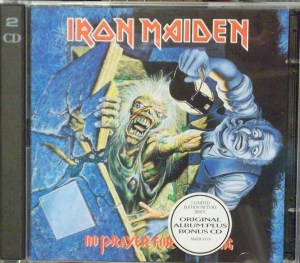
 NO PRAYER FOR THE DYING – 1990

For the first time, we felt disappointed by an Iron Maiden cover.  Gone were the layers of Easter eggs.  The art felt unfinished, and indeed, Derek Riggs would remake it for a 90s reissue.  The album was sonically a “back to basics” affair for Iron Maiden, with simpler lyrics and shorter, harder songs.  The artwork reflected this, with a simple Eddie just back to killing again.

Reborn, and without scars, bolts or lobotomies, Eddie emerges from a stone coffin.  Because why not?  The undead should surely be reborn in a grave!  Grasping the poor gravekeeper by the throat, Eddie is seconds away from his first killing in his new body!  Looking at his coffin, the name plate is unfinished, with no clever names or puns.  The fragments of the shattered coffin don’t even fit together properly.  The blue and yellow colour scheme definitely links the album to Seventh Son, Live After Death, Powerslave and The Number of the Beast, but there is far less to keep you looking at the cover.

And this is the end of our Eddie story, for Derek Riggs would not do another Maiden cover for years, and by then there was no point in any continuity.  The next time we see Eddie, he has red bug-eyes and is half-tree.

Iron Maiden would continue to produce fascinating album covers in the future, always featuring Eddie in some way.  Notable artists included Mark Wilkinson, Melvyn Grant, and Hugh Syme.  For most fans, the original run of Derek Riggs covers will remain the pinnacle of Maiden artwork, primarily the period of 1981 to 1988.

Did Riggs have a story that he was telling with his covers?  Probably not; he probably just liked keeping Eddie consistent from cover to cover.  He would probably appreciate the fact that a bunch of Canadian kids in the suburbs had interpreted this entire saga from his artwork.  I think he’d like that a lot.



#1148: No Drone Movies

RECORD STORE TALES #1148: No Drone Movies

With my mom and sister visiting Japan in August, my dad didn’t want to spend his weekends at the cottage.  By that stroke of luck, Jen and I had the cottage for three weekends in a row.  I can’t remember the last time I was at the cottage for three weekends in a row.  I was probably a teenager.

I spoke to my mom after she got back from Japan, jet-lagged by about 12 hours.  My sister managed to catch a case of Covid, but my mom was luckier.  Even so, she was too worn out to use the cottage on the weekend of August 9.  At the last minute, they decided to stay home that weekend.  Therefore, Jen and I could go if we wanted to.

It’s a shame to let the cottage stay empty on a summer weekend.  We had planned on staying home and working on organizing the music collection, but at the last minute, we got out of town and hit the road.

I went with Iron Maiden’s Piece of Mind on the way up, followed by War Within Me by Blaze Bayley.  I had been immersed in an Iron Maiden writing project and decided to keep the vibe going on the road.  It was fascinating to hear how recording and production had changed between the two albums.  Piece of Mind was an organic sounding listen, with natural drums and lots of room sound.  War Within Me was modern, clean and technical.  While I prefer the analog, organic sounds, I realize that it is of the past.  A good double bill for the road.

Upon arrival on Friday night, I got the drone out, which is a good thing, because the theme for the rest of the weekend would be “No Drone Movies”!

Editing to the music of “80 Days” by Marillion, it was incredibly hard to fly at sunset with the sun in my eyes.  I could not see my drone from the ground.  I was flying by camera the whole time.  It was a good flight, with great visuals, but it was to be the only flight of the weekend, for within an hour, the gale-force winds rose!  The winds would last all weekend, and would not let up at all.  The drone was boxed for all Saturday and Sunday.

And this is when things got weird for me.

With the air cool, the wind high, and the skies dark, my seasonal affective disorder kicked in.  Big time.  It felt exactly like fall at the cottage.  Even though it was early August, and the previous week had a beach packed with kids and tourists, this was a cold deserted weekend.  All the feelings came rushing back, from years of “back to school” ads and activities.  The memories came back too:  listening to White Lion on a cold wet day on my Walkman by the river, wondering what the next school year would bring.  All back like a Polaroid picture.

My counselor told me specifically it’s too early to worry about fall, but here I am.  Unable to get it off my mind.

I am glad we went to the lake this weekend.  It’s wasteful to leave it empty on an August weekend.  My mental health is better there, than home.  But I can’t shake this foreboding feeling of fall.