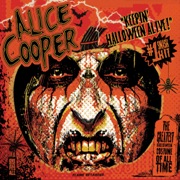
ALICE COOPER – “Keepin’ Halloween Alive” (2009 iTunes exclusive single)
In 2009, Alice took the cool step of releasing a special Halloween single. It was a cool rock song called “Keepin’ Halloween Alive” (baby 3-6-5!) . It was a basic four piece rock song, completely unlike the previous album, Along Came A Spider. I wasn’t big on that album, and I’ve never been into any of Alice’s late period alterna-industrial-post grunge albums very much. I was much more into Dirty Diamonds. “Keepin’ Halloween Alive” is more polished and produced than that, with keyboards and overdubs, but at least it’s back to the rock sounds that I prefer.
The song was written by Cooper and Piggy D. from Rob Zombie’s band. The B-side was a “Cooperoke” (instrumental) version. It’s cool, nice to have as a bonus, but otherwise not terribly interesting.
“Keepin’ Halloween Alive”, was only available on iTunes (blech), with a very very limited release as a 7″ single. The iTunes download did come with a pdf file and a “digital booklet”, whoop de do I guess. Nice artwork, Zombie-esque, with lyrics and humour. I just don’t know who sits at their computer going through a “digital booklet” the way you sit on your coach leafing through the real thing.
Part 17 of my series of Iron Maiden reviews! NOTE: This album was later reissued as part of A Real Live Dead One.
IRON MAIDEN – A Real Dead One (1993)
When Maiden hit the road for what was to be Bruce’s farewell tour, it did not go as the band intended. There were some positives: Because this was Bruce’s farewell, the band decided to pull certain older tracks out of the box, and record them for the next live album, A Real Dead One. But three of the four other Iron Maiden members (Janick Gers being the sole holdout) have accused Bruce of sabotaging that last tour. I’m sure this is all water under the bridge now, but Maiden were furious that Bruce seemingly stopped trying, barely sang, and underperformed on certain stops on the tour. Only the big gigs, with the cameras and the press, did Bruce put any effort into singing, claimed the band.
Whatever the case may be, Bruce did turn up for the tracks on A Real Dead One. And Maiden stacked the deck with great tracks, stretching from the first album to Powerslave. And those older seldom heard tracks that Maiden pulled out of the box? Yeah! You get classics like “Remember Tomorrow”, “Where Eagles Dare”, and “Prowler”. None of those songs were on the immortal Live After Death (neither was “Transylvania” or “Sanctuary”!) so that brings added value to this album, as a companion piece of sorts.
But it could never live up to the legacy set by Live After Death, and although it’s certainly better than A Real Live One, I can’t say I play this too frequently. The band are on fire and playing as furiously as ever. The solos are nothing if not sublime. Steve and Nicko gallop forward driving the whole thing. That’s all well and good. The vocals don’t seem mixed high enough to me. Bruce’s voice is also obviously wearing with age. It happens. I think the album has a better overall sound than A Real Live One however.
I don’t think “Remember Tomorrow” needed backing keyboards, although Dave and Janick’s guitar work is beautiful. I love Janick’s noisy chaotic solo that still somehow fits the song. I also love Nicko’s drum work and fills.
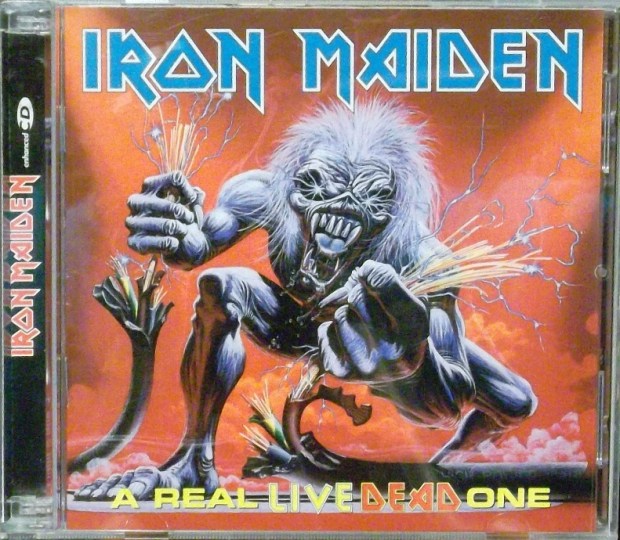
“Hallowed By Thy Name” appropriately closes the album, and was also the album’s single. The fantastic cover art shows Bruce being killed by Eddie, a trick they would try live for their final gig (and more on that when I get to it). “Hallowed” had two unique live B-sides: “Wasted Years” and “Wrathchild”! Both are worth having. “Wrathchild” probably could have been on this album, and “Wasted Years” definitely should have been on A Real Live One.
Derek Riggs came back for the cover art. DJ Eddie seems to be spinning discs in hell, at 666 FM!
Even though this was Maiden’s second live album of 1993, it was not their last! Stay tuned…
3.5/5 stars
Below: Note Bruce promoting his cousin Rob Dickinson’s new band, Catherine Wheel! Also seen, the CD for the combined A Real Live Dead One release.
This is one of the last Sabbath albums I got, because it was pretty scarce in the mid-90’s. I paid about $25 for a US import, thanks to Orange Monkey Music in Kitchener, the only store that was able to get it. (They were not, however, able to get me Seventh Star, then only available from Japan.)
While Headless Cross is lopsided to keyboard-heavy melodic numbers, I consider it a really underrated album. I like it a lot better than the previous one, Tony Martin’s debut as Sabbath singer, The Eternal Idol. I can’t say I adore it as much as Born Again, my favourite album of all time by anybody. I can’t say I prefer it to Seventh Star, but it’s pretty close.
It’s a short one, a mere 7 tracks plus intro “The Gates of Hell”, but most of the songs are in the 5-6 minute range. The intro then segues into one of the most powerful Sabbath songs of the entire catalog: “Headless Cross” itself. Cozy Powell kicks this one in the nuts. If you love Cozy’s drumming, you will love “Headless Cross”. It pulsates before it explodes in the chorus with Tony’s youthful scream. In the 1980’s most bands needed a singer who could shatter glass and Tony M delivered. If that’s not your thing, then just walk away, because you won’t like the rest of this review.
Another riffy number shows up next, “Devil & Daughter”, which also showcases Tony Iommi’s underrated soloing. Martin scorches through the song with bravado and lung power to spare. Its only flaw is that Geoff Nicholls’ keys are mixed way too high, as they are on almost every song on Headless Cross.
“When Death Calls” is a slow burner that I witnessed Sabbath perform live in 1995 on the Forbidden tour. It has three distinct sections: the mellow verses featuring Lawrence Cottle’s chiming fretless bass, the heavy choruses, and the scorching “Don’t look in those sunken eyes…” section. This one section, as far as I’m concerned, makes the song. Take it out and you don’t have enough to keep it interesting. And best of all, who shows up to play the guitar solo? Does he sound familiar to you?
I should hope so. It’s Iommi’s mate Brian May! A heavier Brian May than you were hearing at that period of the 1980’s, and his solo totally makes the song that much more special. By the time Martin proclaims that there’s no tomorrow, “just an evil shadow” at the end, you’re probably exhausted from rocking so hard.
And that’s side one, a decidedly dark affair. The mood brightens a little on side two. The hard rock song “Kill In The Spirit World” boasts song damn strong verses before it melds with a spooky chorus. Then Tony nails it with a hauntingly bluesy solo. I’m sure this song was derided by skeptics at the time for its pop tendencies; meanwhile Dio got away with songs like “Mystery”. I think there was definitely a double standard in how fans treated Sabbath in the late 80’s. Their albums were a lot better than given credit.
Another hard rock song follows: “Call of the Wild”. It’s not as good as “Kill In The Spirit World”, but it has a good pulse and it’s pretty decent. Reportedly this song was to be called “Hero” until Ozzy released one with the same title a few months prior. The lyrics are pretty lame:
In this last macabre hour, witches cry
And turn to dust before the moon
Many spirits are lost forever but one survives
To call the tune of Lucifer
There’s one pretty-much universal criticism of Headless Cross, and that’s the lyrics. The above is a glaring example of Martin specifically trying to write “Satanic” lyrics, something he admitted to. It feels contrived because it was, and in fact it loaned Sabbath less credibility than when Ronnie was singing about neon knights, and Ian was singing about getting trashed.
“Black Moon” is next, actually a re-recorded B-side from The Eternal Idol. As such, it’s not that remarkable. The riff is cool, as Tony wrings out something bluesy while Cozy pounds out a passable groove.
The album closes with the haunting, acoustic “Night Wing”. This is where Cottle’s fretless bass really plays a role. I love fretless and this song has some strong sections with great bass. It’s odd to hear fretless bass on a Sabbath album, but I like different. Tony’s guitar solo is a scorcher, as he seemingly loses control and then reels it back in. And then as if to make a point, he composes a simple but appropriate acoustic solo. And then another electric one.
You know, looking back, 1989, it was the era of the guitar hero. And nothing wrong with that. I love Van Halen, I love Satriani, Vai, Morse, all those guys. But it truly is a shame that in the 80’s, the guitar kids ignored Tony Iommi. A guitar hero — nay! legend! — was playing better than ever and the kids didn’t buy Headless Cross.
‘Tis a shame.
Lawrence Cottle was a studio cat, and arguably never an official member of Black Sabbath, but Joe Siegler’s got him listed and that’s good enough for me. You could hardly see him in the music video for “Headless Cross” as he is always in the background, blurry. But Sabbath fans were soon in for a treat that many did not appreciate: the arrival of Neil Murray on bass. Neil and Cozy had become a formidable rhythm section in Whitesnake, and now they were back together, the two guys who did Slide It In (the US version anyway).
The Black Sabbath lineup of Iommi/Martin/Powell/Murray/Nicholls bears the dubious distinction of being the third-longest lived behind the classic Ozzy and Dio (with Appice) lineups. They did three tours and two albums (Tyr and Forbidden). The hiring of these musicians was hoped to bring the credibility back. Unfortunately, that didn’t happen.
As mentioned, this lineup recorded the next album, Tyr, before breaking up in the face of the first reunion with Ronnie James Dio, and it was this lineup that I saw in 1995, thus far the only time I’ve seen the band.
If Headless Cross were remixed today, to just tone down the keyboards a tad, I think it would help a lot. But I do like this album. Sabbath had written some great songs (all songs are credited to the band), and Tony Martin was at the absolute peak of his voice.
Late weekend night and I’m at the Bojar Grill,
I got decisions to be made between lager and ale
KIM MITCHELL – Akimbo Alogo (Alert, 1984)
Some Max Webster fans were disappointed in this, Kim Mitchell’s first full-length solo album. I guess I could see why, because Akimbo Alogo is pretty straight-forward rock. There’s not a trace of that prog or experimentation that made Max Webster such a unique creature. However, those fans were too quick to judge, as this is simply a great sincere album loaded with stellar playing and hooky songs.
Akimbo Alogo(great title) still stands up on its own as Kim’s finest solo album. Back in that hazy summer of 1984 it spawned four hit videos: “Lager & Ale”, “That’s A Man”, the fantastic ballad “All We Are” and of course, the immortal “Go For Soda”. Although the album cut “Rumour Has It” is no slouch, “Lager & Ale” is one of the hardest driving tunes Kim’s done. The video was one of those great 80’s ones that was just a live performance — but then that live performance becomes so ingrained into your head, that it’s your default version!
But Kim’s always been tender too, and his excellent feel on the six string assures us that the few ballads are still memorable. There’s the hit “All We Are” (still gets airplay today!), but “Caroline” and “Called Off” are both excellent songs. “Called Off” in fact scorches with Kim’s fiery guitar work.
The only holdover from the Max days is lyricist Pye Dubois, spinning words as only he could, with humour and poetry. “All We Are” was written during the tail end of Max, but Kim knew nobody in that band could sing the high notes in the chorus. Along comes Peter Fredette, a talented musician and singer in his own right. His vocal made this song something truly special. (Live, Fredette also sings Geddy Lee’s high part in “Battle Scar” as well as “All We Are”.)
Of course, Kim’s guitar playing is among some of the best he’s ever laid down on vinyl, and that includes the Max stuff. His soloing here is vibrant and warm, loaded with feeling. Kim makes it sound easy — if only!
There’s also a minimum of synth programming going on here, compared to the albums that followed. I think Kim got a little too carried away with it on Shakin’ Like A Human Being. I’m not sure why Kim thought it was a good idea to start doing stuff like that anyway, but at this point he hadn’t gotten too carried away with it…yet. There’s a little programmed percussion in “Love Ties” and elsewhere.
I wish the CD had been digitally remastered. My vinyl sounds better than the CD. The only B-side I’m aware of is the “Syphon Remix” of “Go For Soda”.
One of the perks to working at a record store was taking first crack at anything that came into the store. Frequently, people who worked other record stores would sell us their promos, and often we’d happily buy them, especially when they preceded the actual album.
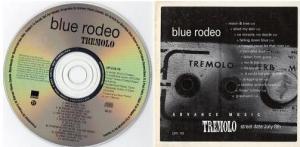
In spring 1997, Blue Rodeo released their next album, Tremolo. Some guy from another chain sold us a promo copy several weeks before its release date. Me being a big Blue Rodeo fan, I made sure we snagged it. We couldn’t really sell promos on the shelves, but I knew several people who’d want a copy, if I didn’t take it myself. It was just a simple black and white sleeve, so I didn’t offer much for it.
I eaglerly put it into the player. Their last album, the experimental Nowhere To Here, was a hard one to love but it became one of my favourites. I was surprised to hear that Tremolo was nothing like it. I gave it a couple spins in store but it wasn’t doing anything for me. Nah, I could live without it, I thought, at least until the original release. Then I’ll try ‘er again.
I called up Bethany, one of our best customers, and massive Blue Rodeo fan. She came in immediately to pick it up. Even though us record store guys usually prefer an official release to a promo, Bethany preferred the promo. Not only was it weeks in advance and cheaper, she considered it to be a collector’s item, so it worked out for everyone!
Eventually the real thing came out, and when a cheap used one came in, I bought it and took it home. It still didn’t click. It took several months to really grow on me, but by winter it finally had. Like an onion, I had peeled the layers and uncovered the beauty within. Tremolo, like Nowhere To Here, was far from immediate for me. Its acoustics and almost complete lack of anything electric or uptempo had thrown me for a loop. But somehow during that laid back winter of ’98, Tremolo and I saw I to eye, and we have been companions ever since.
Lesson: Albums must always be listened to over time, in different contexts, before abandoning!
First of my reviews from Record Store Excursion 2012! Check out the video below if you missed it. This one bought at Sonic Boom Kensington.
MIKE AND AARON GO TO TORONTO
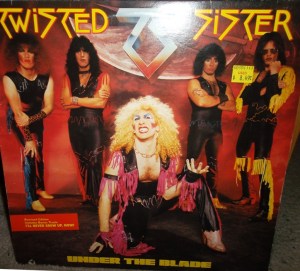
TWISTED SISTER – Under The Blade (1985 remix)
The original 1982 Secret Records mix of this album was raw and heavy, like a bulldozer with a singer and sense of rhythm. Secret folded and Atlantic re-released the album in ’85 with a remix helmed by Mark Mendoza. For added measure they added Twisted’s first single, “I’ll Never Grow Up, Now!” as a bonus track.
Although less so in its remixed for, Under the Blade served as a brutal reminder that Twisted Sister were and are a heavy metal band, before the MTV hits happened. No ballads, the only slow moment is the intro to “Run For Your Life” which soon hits the gas and takes off at breakneck speed. Like a cross between early Kiss, Cooper, Sabbath and Priest, Under the Blade was an aural assault. The assault was assisted by a brutally ragtag heavy production and mix, frayed at the edges and certainly way too heavy for kiddies weaned on autotune today. Elsewhere, more melodic fare like “Bad Boys (of Rock and Roll)” and “Shoot ‘Em Down” plot the way for the more commercial years about to unfold.
But then they did that remix, and toned everything down. The drums aren’t as loud, the guitars less cutting. In short, it sounds like they were trying to make Under the Blade fit in more with the Stay Hungry sound. I did like that they included “I’ll Never Grow Up, Now!”, one of my favourite TS tracks of all time.
Production is by Pete Way (UFO), and Fast Eddie Clarke (Motorhead) takes a guest guitar solo.
Part 16 of my series of Iron Maiden reviews! NOTE: This album was later reissued as part of A Real Live Dead One.
IRON MAIDEN – A Real Live One (1993)
And then the bombshell hit. Just as Iron Maiden were releasing their next live album, Bruce Dickinson was leaving the band.
It was another in a string of major metal singer departures: Vince Neil and Rob Halford in 1992, and now Bruce Dickinson. Not to mention Dio splitting with Sabbath, again. It was a very demoralizing time to be a metal fan.
Tattooed Millionaire was a big enough success to warrant a sequel. On the advice of Maiden manager Rod Smallwood, Bruce was encouraged not to just do a half-assed sequel, but to really throw himself into the creative process. What he came up with was very different and intriguing; Bruce likened it to early Peter Gabriel. This triggered some soul searching. What if this direction was to pursued? What then?
Bruce approached Smallwood. “As you can see, the music is very different, that’s the good news,” he started. “The bad news is I’ve decided to leave the band.”
As a compromise, Bruce agreed to do the next tour, promoting the live album A Real Live One. A Real Live One was a document of the Fear of the Dark tour, and after it was mixed the band planned to hit the road again for a second leg. Bruce did not want to jeopardize the tour, and Steve Harris agreed to do it as a farewell. This was a decision that all parties would regret, but more on that later. In the meantime, Maiden had a live album to promote, with a distinct black cloud over it.
Maiden had chosen to do two live albums. First came A Real Live One, which covered music from 1986-1992. Then, post-tour, A Real Dead One covering the early years was scheduled. Splitting the live album into two may have proven to be a mistake, as it meant A Real Live One was lopsided and full of songs that many in North America did not care about: “Heaven Can Wait”, “From Here To Eternity”, “Bring Your Daughter”, but nothing of the beloved earlier period previously covered on Live After Death.
And how do you top an album like Live After Death? You can’t, so A Real Live One was doomed to be deemed inferior from the start.
Making matters worse, not only were Maiden releasing a live album that summer, but so did Kiss, Ozzy, and Van Halen.
The production seemed a little muddier (the first without Martin Birch since the early days). The performances were fine, as expected, Maiden are nothing but professionals. I don’t listen to this album often. Later live albums that cover this material are superior, and it would have helped if the album had pre-1986 classics on it. Although A Real Live One had four albums to draw upon, that period of Maiden is not the golden era, and the albums are undeniably less classic than the pre-’86 period.
I can understand their reasoning of doing the release like this. I’m sure they felt that a live album without overlap with Live After Death was better value for the money. And if you wanted those songs, you could get A Real Dead One later on. But still, a Maiden live set without “The Trooper” or “Hallowed” or “Number” was a lopsided Beast indeed.
Worthy: “Fear of the Dark”, “Afraid to Shoot Strangers”, “The Evil That Men Do”, “The Clairvoyant”.
Ugh: a flat “Can I Play With Madness” & “From Here To Eternity”.
Missing: “Wasted Years”. That would have been a worthy addition to the set.
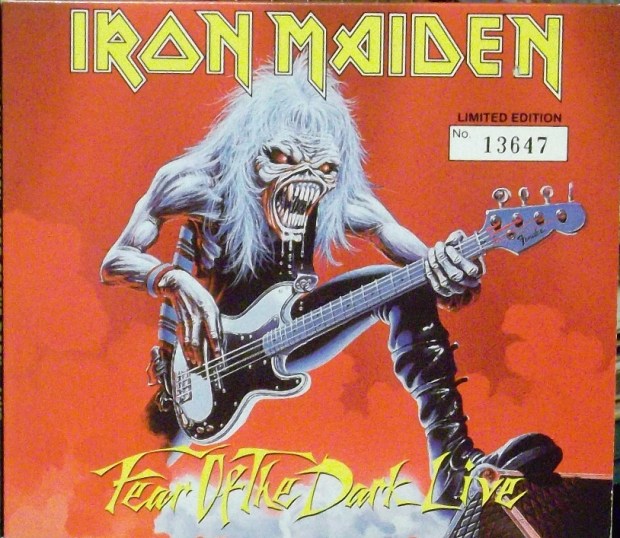
Derek Riggs returned to do the cover art for this and it’s a fun striking painting. Nothing special, just another cool Eddie.
The single was the awesome “Fear Of The Dark”, live (which had a better cover than the album). This had become a concert classic already, with a massive fan singalong. The B-side was “Hooks In You” from the No Prayer album and tour. I’ve never been a fan of this song, but I have no problem with Maiden issuing live B-sides of songs that are rarely aired live. It’s good for documenting history. It’s also available on the Fear of the Dark bonus disc edition.
Most people know the story by now: Turbo wasn’t supposed to be so lite. It was originally supposed to be a double album called Twin Turbos, featuring a mix of styles from ballads to hard rock to heavy metal. When the record company balked, they put the most commercial stuff out as Turbo, saving the rest of the songs for later use. Some, such as the awesome “Heart of a Lion” (later covered by Scott Travis’ band Racer X) and “Red White & Blue” ended up on Priest box sets and remasters. Other songs such as “Ram It Down” were re-recorded with a heavier sound and put out on the next album.
If you’re one of the many who considers Turbo one of the worst (if not the worst) Judas Priest album, I get it. It was their “sell out” album. It’s cold, it’s synthetic, it’s somewhat soulless. I understand. However, I tend to look at the Judas Priest back catalog, the complete gestalt, if you will, as one whole. Looking at this album in context, it is clear that Turbo is a unique record in Judas Priest’s canon, and indeed the whole of heavy metal in general. There’s never been an album that sounds quite like Turbo and it’s likely that there never will be again.
Turbo came in ’86 while Priest decided to experiment with guitar synthesizers. These are not keyboards on this album, but guitars played through a synth. Priest have done it since (Ram It Down, Nostradamus) but never again to this degree. Some of the sounds on this album are really cool. That weird vacuum cleaner combined with a jet engine sound in the opening of “Turbo Lover”, for example? Cool.
The songs are also good, albeit commercia hard rock. Priest had been increasing the commercial tendencies ever since British Steel, but on Turbo it veered heavily into MTV territory. “Turbo Lover” is an example of this. There’s not much in terms of a riff, which used to be the bedrock of a Priest song. The melody is the framework on which you hang the cool sounds and robotic groove. But it works, and the song is often brought out into the setlist, still — the only song from Turbo to make the setlist post-1987.
“Locked In” is a bit more rockin’, not a great song, but at least it ups the tempo a bit. The shout-chorus of “Private Property” is catchy as hell and this could easily have been a single. It sounded great live with the crowd joining in.
“Parental Guidance”, was probably my favourite Priest song in ’86-87. It’s just really catchy. It’s not heavy metal, but it’s really well-written pop metal. And as kids, we dug the words, even though Halford was 35 years old when he wrote them!
“Rock You All Around The World” closed side one, a fast number designed to get the crowd going nuts in concert. Sounds like Scorpions to me.
Side two started off with the long, dramatic epic, “Out in the Cold”. Man, what a great song. This one opened the live show in 1986 (and the following live album, Priest Live). I guess this would technically be the ballad of the album!
A pair of so-so songs follow, “Wild Nights, Hot And Crazy Days” (sounds like Van Hagar) and “Hot For Love” (another fast one that could have been covered by Scorpions). Not great songs, but at least they’re rockers. “Wild Nights” is kind of one of those 80’s party rockers. Nothing special, but it suited the times.
The final song is a total winner, “Reckless”, written for the Top Gun soundtrack but held back for this album. Awesome tune, “coming at galeforce ten.” This is just a perfect rock song for Judas Priest. Not a metal song, a rock song. It’s as aggressive as it gets on this album and it has a great solo, too.
There are two bonus tracks on the current remastered edition, “All Fired Up” (a lacklustre outtake) and a live version of “Locked In”. Since “Locked In” didn’t make 1987’s Priest Live album, it makes good sense to include it here. It was a single/video, released at the exact same time as “Turbo Lover” but always remained in that song’s shadow. Good to finally have a live version.
Liner notes and pictures are included. This album also contains the infamous “lead break credits”! While I don’t know if Glenn and Ken are interesting enough guitar players to warrant lead break credits for every song, it was a feature I enjoyed at the time and helped me identify the individual styles of the two players.
We used to have piles and piles of CDs, stacked on a unit behind the counter. Due to lack of space, this is where we put stock that was:
1. on hold for staff
2. on hold for customers
3. being sent elsewhere for customer orders
Unfortunately these stacks were visible to customers, although not available for sale to the general public. Sometimes you’d have a situation like this:
“Cool! I can see OK Computer by Radiohead! Is that for sale?”
And it wasn’t, which you’d explain. If the CD was on hold for someone, they’d often ask how long it was on hold for so they could be next in line, provided the other person didn’t pick it up.
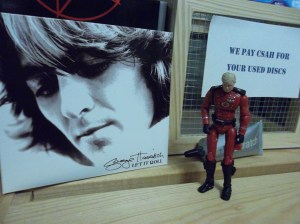
When stuff was on hold for staff (who usualy snagged the best stuff and held it for longer periods of time) I didn’t like the customers seeing it. But we didn’t really have anywhere better to put it. I proposed putting it in the back room but that didn’t last long. So what we’d do is disguise it in some way. Instead of having a pile labeled “Mike”, we’d change the name. It sometimes threw the customers off the scent.
At one point, I had all the staff hold piles named after Canadian cities. That way looked like stuff that was ordered by other stores. So for example, we’d have a pile labeled “London” which would be a pile of stuff destined for that store. Next to it was a pile labeled “Saskatoon”. We didn’t have a store in Saskatoon, Saskatoon was a staff member’s pile. We didn’t have stores in Yellowknife or Winnipeg either, but those labels threw customers off the scent. They’d assume the stock was there for another store.
I liked this system, but the staff often preferred nicknames on the labels. Some people liked their nicknames, some people didn’t. There was a girl named Meredith — she really hated being caled Megadeth, for example (I assume that’s true of most Merediths out there). I hated being called Cheeser — so named because I liked what other people refer to as “cheese metal” (although I think Zakk Wylde would be happy to punch somebody in the face for calling his music cheese metal).
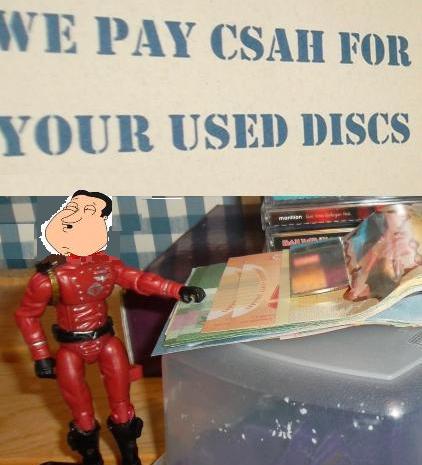
Later on, someone had all the piles named after Family Guy characters. At the time, I’d never seen an episode in my life, and I didn’t know it was a bad thing that my nickname was Quagmire! Joke was on me I guess!












You must be logged in to post a comment.