billy sheehan

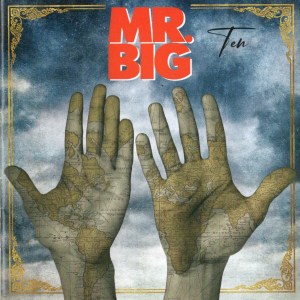
REVIEW: Mr. Big – Ten (2024 Canadian CD version)

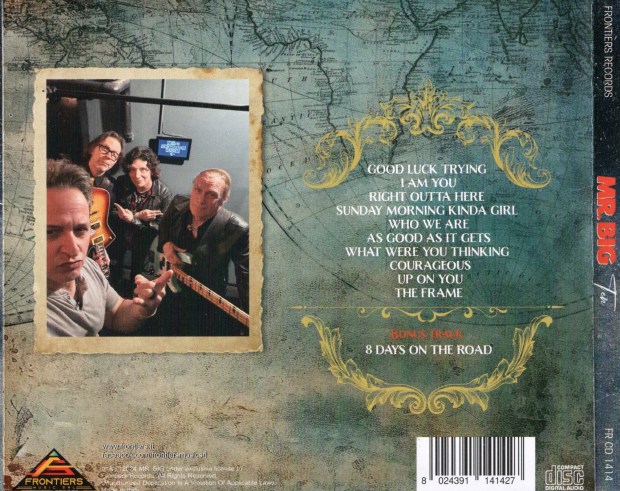
MR. BIG – Ten (2024 Frontiers)

Pat Torpey was such an important part of Mr. Big.  Drumming, singing, writing: Pat did it all, and that’s why Mr. Big have found him so difficult to replace.  His death from Parkinson’s disease was shattering to the band.  They carried on with Matt Starr for a while, but they needed someone who could sing.  Enter:  Nick D’Virgilio from Spock’s Beard.  Not just a legendary progressive rock drummer, but also a singer in his own right, Nick was an unexpected but appropriate choice for Mr. Big to record their final (?) album Ten.

Though some fans seem unwilling to allow bands to age and change, Mr. Big has done so without missing a beat.  Sure, Eric Martin doesn’t sound 28 years old anymore (because he’s 63), but there is nothing wrong with his voice here.  Just a little rasp, and a little less range.  He has aged better than most 63 year olds you can name in the rock biz.  He is still top notch, first class, and also a key songwriter here, along with Paul Gilbert and Andre Pessis.  Absent from the credits is Billy Sheehan.  That might explain why this album is less bass-y.  Even so, in 2024 Mr. Big have come up with one of their best albums, up there with Hey Man.

The Gilbert-penned first track “Good Luck Trying” has a definite “Manic Depression” vibe.  It’s a blues-rock classic, authentically rocking as if it came from another decade.  It’s like a time machine, and the Hendrix inspiration is undeniable.  A solid start.

Much like Hey Man and “Take Cover”, the best track is the second one.  “I Am You” will be in your head for days.  There’s a subtle acoustic guitar part, which is something of a recurring feature on this album.  “I Am You” boasts a powerful chorus, but with an anthemic meloncholy vibe.  Too bad a lyric sheet is not included, as this one has cool soul-baring words.  Everything about this song is perfect, from impassioned vocals to mighty chorus.  Sometimes it’s worth buying an album for one song.  This is one of those songs, no hyperbole.  It’s just a little different for this band, but it’s also a total pop rock anthem, and one of best Big songs in years.

We get a Zeppelin vibe on “Right Outta Here”, with bluesy verses and exotic choruses.  Anytime you hear chords that we might refer to as “exotic”, Zeppelin comes to mind.  Expect those Middle Eastern melodies on the guitar, and more acoustic backing.  Nick doesn’t necessarily play like John Bonham, but there are the odd big hits that recall him.

In a fun twist, “Sunday Morning Kinda Girl” contains the lyric “big finish”, the name of their current tour.  This song has a hard rock vibe mixed with 60s melodic sensibility.  Definite Beatles vibes in the melodies, though the song is far harder than the Fab Four.  Their green-tinted sixties minds must have been in tune for this song.  Again, acoustic guitars can be heard in the background, but check out Paul’s very Queen-like guitar solo.

There are a few ballads on Ten.  Ballads have been a thing with Mr. Big since the first album, but obviously “To Be With You” made them far more important.  “Who We Are” is an electric ballad, with a bluesy style.  Not as memorable as some past Big ballads, but a good song regardless.  Great chorus here, and superb drum fills.

“As Good As It Gets” is uptempo acoustic/electric fun.  Like “I Am You”, very different for this band and an easy album highlight.  Once again, the drum work and fills here are stunning.  It’s almost Rush-like.  Paul brings in a very sweet guitar melody, with layers of guitar tracks thickening up the soup.  This song also has one of the few Billy Sheehan bass solos on the album.

The boogie of “What Were You Thinking” has some wicked slide guitar by Paul Gilbert, housed within an uptempo rocker.  Maybe the fastest tune on the album, but it’s not to be compared to old Big like “Addicted to that Rush”.  This is just rock and roll.  The lyrics reference Star Trek with “phasers on stun”, and you just have to love that.  Another possible album highlight.

If there is a weak link, it’s “Courageous”.  It’s a mid-tempo song, but not a ballad.  It has some wonderful guitar, but doesn’t move the Earth.  What does shake the Earth is the opening drum beat on “Up On You”.  A hard rock party rocker, this features the return of the slide!  Just because it’s a hard rock song with slide guitar, there is a slight Motley vibe (circa Dr. Feelgood), but only slight.  Some boogie piano also helps keep things moving, but this is the most 80s rocker on the album.

Closing an album (sort of) with another ballad is daring.  Yet “The Frame” is the softest of them, and a totally appropriate closer.  It’s not “To Be With You”; there is no campfire rock on this album.  There is plenty of music with an emotional weight, and “The Frame” has that and more.  It takes a few listens to sink in, but it’s not really goodbye.  There is a bonus track on all versions of the album.

Some countries got an instrumental track (to be reviewed later), but the bonus track in Canada is different from the one in the US and Japan.  Here we get a blues cover, “8 Days on the Road”.  Easily another album highlight, with someone else (Paul Gilbert?) singing lead on a bluesy drawl.  Brilliant track and playing.  Talk about going out with a bang!  If this really is the end, then “8 Days on the Road” is a brilliant capstone.  It showcases the kind of playing that Mr. Big built their reputation on.

Though Mr. Big albums have been spotty through their career, Ten is among the better records.  It may go down with albums such as Hey Man as a cult classic.

4.5/5 stars
 

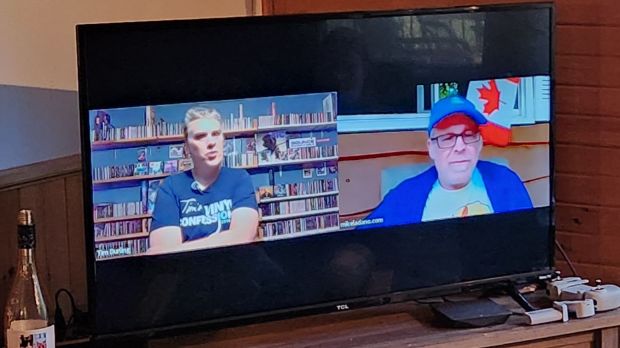
Tim’s Vinyl Confessions: Ep. 548: Mr. Big (Ten review) [VIDEO]

Today on Tim’s Vinyl Confessions, we deep dive into the new (final?) Mr. Big album called Ten.  Shockingly, it’s their tenth studio album.  I know, right?  It’s also a few firsts:  the first album with no songwriting from bassist Billy Sheehan, and debut Mr. Big album for new drummer Nick D’Virgilio.  It has been eight long years since their last album, Defying Gravity, which wasn’t bad at all.  Did they top it?  Did they go out on a good note?

My written review will go up tomorrow.

REVIEW: Tony MacAlpine – Edge of Insanity (1985 Shrapnel)

TONY MacALPINE – Edge of Insanity (1985 Shrapel)

Tony MacAlpine seemed to be in every guitar magazine when I was a kid, but I never got to hear his music. He looked cool, and he was highly praised as a shredder, but his music (on Shrapnel records) was impossible to find unless you ordered it from a specialty shop.  Like most of Shrapnel’s output, it was produced by Mike Varney.

His 1985 solo album Edge of Insanity features an impressive band:  Journey’s Steve Smith on drums, and of course it’s common knowledge that Billy Sheehan played bass.  The album is instrumental.

Opener “Wheel of Fortune” has a neoclassical vibe, with the rapid fire bassline enabling MacAlpine to focus on the melody rather than shred his way throughout.  There is certainly a commonality in terms of musical direction with Yngwie, but Tony’s approach is more easily digested.  Tony’s music has an actual bottom end thanks to Billy, and of course Steve Smith’s technique speaks for itself.  He’s more than capable of heavy metal hammering as he does on “Wheel”, but listen carefully and you will hear his signature cymbal work, so unique to me.

“The Stranger” discards some of the neoclassical robes, and rocks a more straight-ahead blitz.  Tony has a wicked keyboard solo mid-song, showing the breadth of his abilities.  The pulse of the song is all Sheehan, and Smith’s fills sound a lot like a certain band that started with a “J”.

A live solo called “Quarter to Midnight” is unaccompanied.  It reminds me of a Randy Rhoads solo.  There’s some nice whammy work near the end, which was so popular in the era.

A ballady song called “Angrionia” (mis-printed on the back cover, but correctly in the booklet) follows; quite a nice little tune with the occasional bursts of neoclassical guitar speed.  Billy has a couple nice rips as well.  MacAlpine multitracks his guitars for effect.

“Empire in the Sky” has a very cool keyboard intro, that leads into a gallopy metal number.  This has a mid-tempo vibe like Maiden circa Seventh Son when keyboards were happening.  You could imagine this coming from that era, though of course Tony was three years ahead.  His doubletracked leads set it apart from that, and there are some chunky riff chords happening beneath, though this is not a riff album.  There’s also some outro guitar twangin’ that is absolutely freakin’ rib-shattering.

An Yngwie vibe pervades “The Witch and the Priest”.  You hate to make comparisons, and it seems lazy, but when you hear a vibe there might be something to it.  Of course, Billy Sheehan and Steve Smith help make it sound less Yngwie.  Tony’s tone is warmer than the Swedish shredder’s as well.

“The Taker” is the only song with Tony playing bass and it’s less prominent for that reason.  This tune is a full-speed blaze, with Tony deftly weaving melody through all his playing, and then suddenly taking a left turn with harpsichord-like keys and then some organ for good measure!  “The Taker” keeps you on your toes.

Tony treats us to actual classical music next:  his spin on Chopin.  “Prelude 16, Opus 28” is performed on piano, and you’d never guess it wasn’t from a professional classical pianist.  This prelude leads into Tony’s “Edge of Insanity”, a deep cut title track and one that allows the chug-chug-chug of the metal to come through.  There’s still a soaring melody and flying bassline to absorb.  Smith’s drum parts are smashing – literally.  A great tune and a little easier to digest than the speedier stuff.

“The Raven” has classical keys opening a speedy metal rollercoaster ride.  Once again, Smith is classing up the place several notches with his signature fills.  Tony rarely lets up, constantly treating the listener to impressive shred.  He switches tones (and probably guitars) at some points, giving the lead work different voices.

The closing track, “No Place in Time” has some slinky Billy bass, and really allows him to have some of the spotlight.  His playing here is all about the groove he’s laying down, and how he complements Tony’s lead.  MacAlpine uses doubletracked guitars and plays a slow melody.  It’s not the most memorable track, and not the most effective closer.

Edge of Insanity is more accessible than a lot of instrumental guitar albums of the era.  If some of those other artists seem daunting but you’d still like a taste of neoclassic rock, then go for some Tony MacAlpine.

3.5/5 stars


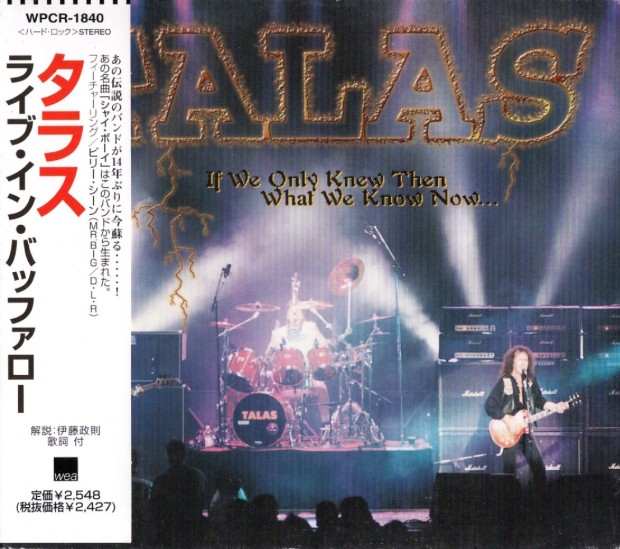
REVIEW: Talas – If We Only Knew Then What We Know Now… (1998 Japanese/bonus track)

TALAS – If We Only Knew Then What We Know Now… (1998 Warner Music Japan)

The Japanese edition of this Talas live album is something to behold.  It comes with lots of extras:

  • Beefy cardboard slipcase to house the jewel case beneath, plus…
  • A beautiful bonus 22 page photo booklet,
  • Japanese lyric sheet,
  • Two bonus tracks!

The first bonus track is just a shorty, a message from Billy Sheehan.  He briefly explains the history of the band, as much as one can in 34 seconds anyway.  The second bonus track is more interesting and valuable.  It is a vintage studio track called “Doin’ It Right”.  Very pop, but also paradoxically pounding.  It’s not available anywhere else, and it’s not bad at all!  It recalls other early poppy rock tunes by metal bands, such as Quiet Riot and Kick Axe’s obscurities.  One of those Japanese bonus tracks that is worth shelling out for.  But that’s just Common Knowledge!


(The rest of this review was previously publish in 2016)

The Talas story did not end with the breakup of the band.  Of course not; bands both famous and obscure like to reunite for nostalgia shows.  Talas did that in 1997 with the original power trio lineup:  Billy Sheehan on bass, Paul Varga on drums, and Dave Constantino on electric guitar.  With classic material (from the first two Talas albums) and a few unreleased songs, they memorialized their reunion with a brand new live CD.  Billy even pulled his old platform boots out of the closet for this one.

As usual the set opens with “Sink Your Teeth Into That” and an enthusiastic home town crowd.  Talas only sounded better with age.  The original voices are there and just as strong as they were in 1982.  It actually sounds like everyone has improved over the years.  A speedy “High Speed on Ice” is in the second spot ensuring no loss of momentum.  Material from the first self-titled Talas album is included too (unlike the last live album Live Speed on Ice).  “Expert on Me” is very pop in construction, but clearly not as great as the songs from album #2, Sink Your Teeth Into That.  Speaking of which, the slow rumbler “Never See Me Cry” is brilliantly adapted to the stage.

“Power to Break Away” is one of the previously unrecorded songs, and it kicks it just as hot as anything from Sink Your Teeth Into That.  It’s taut with hooks and the prerequisite bass workouts.  “Tell Me True” is the second unreleased song, a slow non-descript dirge ballad that takes a while to get going.

Imagine Billy Sheehan plowing his bass right through a funky Led Zeppelin riff.  That’s “Thick Head”, an awesome track from Talas (1979).  “You” has a cool vibe, almost like an unheard Aerosmith demo from the Done With Mirrors era.  A few other tunes from the first Talas (“Most People”, “Any Other Day” and “See Saw”) are adequately entertaining.  Back to Sink Your Teeth Into That, “King of the World” is still one of the best Talas tunes, overshadowed by only a few like “Shy Boy”.  Here, “Shy Boy” is preceded by a Paul Varga drum solo.  The sheer velocity of “Shy Boy” itself makes me wonder how Varga did it.  It’s just pedal to the metal, blurring the lines and smoking the minds.

Nothing like a good cover to help draw a live album to a close.  Talas did two:  “21st Century Schizoid Man” and “Battle Scar”.  The King Crimson cover is a daring one to attempt.  They somehow manage to strip it down and pull it off with integrity.  As for “Battle Scar”?  Total surprise there!  Max Webster were just across the border from Buffalo, and Billy Sheehan nearly joined Max at one point late in their career.  Introduced by a Billy Sheehan bass solo, this Max/Rush cover is the set closer.  As a final addition, “Battle Scar” surely makes this one hell of an album for the history books.

Since this is a more recent release on a well known label (Metal Blade), it turns out that If We Knew Then What We Know Now is an easy CD to find in the shops.  Fortunately this is a good first Talas album to add to any collection.

4/5 battle scars


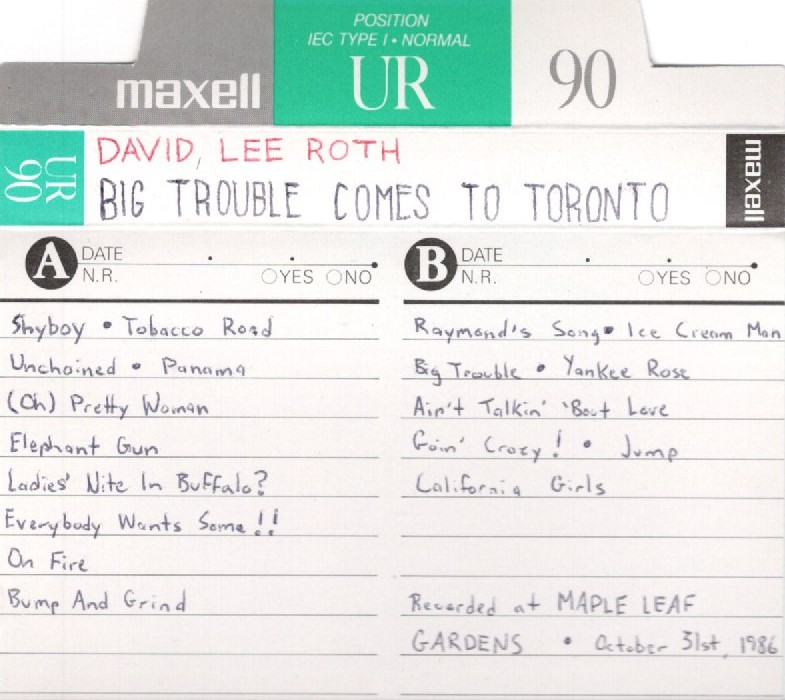
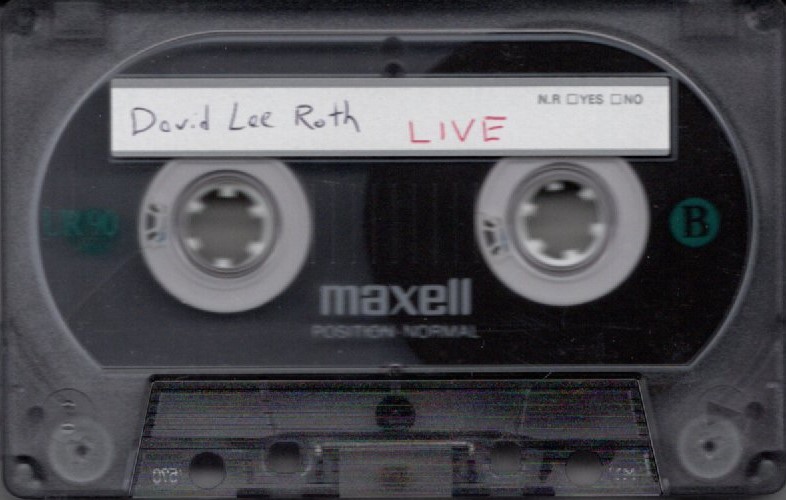
REVIEW: David Lee Roth – Big Trouble Comes to Toronto – Maple Leaf Gardens 10/31/86 (bootleg cassette)

DAVID LEE ROTH – Big Trouble Comes to Toronto – Maple Leaf Gardens 10/31/86 (bootleg cassette)

This cassette is a second generation, recorded from a buddy (with good equipment at least) in 1992.  My first bootleg.  It opens with a Van Halen-era interview with David Lee Roth about “precision rock”.  The crackle of original vinyl is audible.

A nice fade-in brings Steve Vai’s guitar to the fore, and then it’s wide open into “Shyboy”.  High octane, even though it’s just an audience recorded cassette with not enough volume on the guitar.  Without pause they rock into “Tobacco Road”. Gregg Bissonette’s toms a-thunderin’.  Vai certainly needs no help in hitting all the guitar hooks that he baked into the vinyl, just with more flair and energy.

Dave has never shied away from Van Halen hits or deep cuts.  “Unchained”, “Panama” and “Pretty Woman” are the first three.  The bass rumblings are unlike anything Michael Anthony played on the original.  The backing vocals are far more elaborate.  Like in Van Halen, “Unchained” is interrupted part way, but this time it’s so Dave can ask what you think of his new band!  Pretty hot.  After “Unchained” he stops to talk to a “pretty Canadian girl”.  “Panama” sounds a little odd with Brett Tuggle’s keyboards so prominent in the mix.  And it’s also way way way too long, with Dave trying to figure out who is reaching down between whose legs, but that’s Dave.  You don’t go to the show just to hear the music.  You go to see the whole schtick.  You put in the quarter, you gotta let the jukebox play the whole thing out.

“Pretty Woman” is zipped through fairly quickly (with one audience participation stop), going into Dave’s rabid “Elephant Gun” and the slick “Ladies’ Night in Buffalo?”  “Elephant Gun” features solos galore that would have been pretty awesome to see up close.  It sounds like there’s a vinyl side break before heading into “Buffalo”.  Vai’s guitar is the star here, in an extended solo backed only by Tuggle.  This turns into a dual bass/guitar call-and-answer.

When Bissonette starts on those tribal beats, you know it’s Van Halen’s “Everybody Wants Some!!”  This great version includes a drum solo.  Next it’s “On Fire” from the Van Halen debut.  Dave asks for the guitars to be turned up – we agree.  “On Fire” with keyboards and Vai noodling is a different animal.  After Dave’s original “Bump and Grind”, it’s time to flip the tape.

Side two opens with some of Dave’s acoustic strummin’, and a story called “Raymond’s Song”.  It’s just an excuse for him to say “Toronto” a whole lotsa times before introducing “Ice Cream Man”.  Which completely smokes.  Vai puts his own space-age spin on it, and Tuggle adds boogie piano, but this is one wicked version!

Dave’s solo track “Big Trouble” has plenty of atmosphere and fireworks for the Toronto crowd, but “Yankee Rose” is just nuts.  Nothing but the hits from here on in:  “Ain’t Talkin’ ‘Bout Love”, “Goin’ Crazy!”, “Jump” and “California Girls”.  The heavy riff of “Ain’t Talkin’ ‘Bout Love” sounds great in Steve’s hands, who doesn’t go too crazy with it.  Of course there has to be another long break in the middle (too many breaks at this point now).  This time it’s so Dave can get Stevie to make his guitar say “Toronto kicks ass, because the chicks are so fine”.  The rest of the songs are somewhat fluffy, the pop stuff, and rendered a little sweet with the added shimmer of Brett Tuggle.  “Jump” misses the deeper tone of Eddie’s Oberheim OBXA.

It’s worth noting that Roth closes with “California Girls”, not “Jump”.  His solo career is the point, not Van Halen, he seems to be saying.  This is the cherry on top.  Roth hands it to his new band several times in the show — he knew they had to deliver, and they did.  And he wants people to know that he has a band that can compete with his old group.

The show is complete,  and apparently Dave didn’t play “Just a Gigolo” on this tour.  The opening act in Toronto was Cinderella, supporting Night Songs.

Sometimes you wish Dave would get on with it and play the next song, but that’s only because this is a cassette bootleg being played on a Technics RS-TR272.  If you were there in Toronto on the Eat ‘Em and Smile tour, you’d be eating up every word Dave laid down.  He is the master of the stage.  Sure, it doesn’t always translate to tape but that’s the nature of Dave’s live show, isn’t it?  It’s precision rock — visually and audibly combined.

4.5/5 stars (for what the show must have been in person)


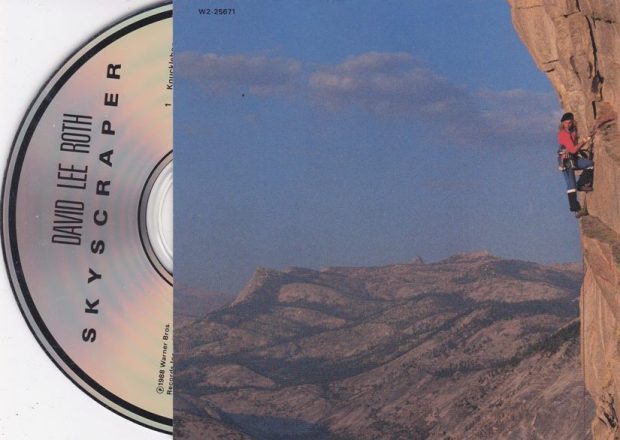
Just Listening to…David Lee Roth – Skyscraper

Just Listening to…David Lee Roth – Skyscraper

This is the first Just Listening post for an album I’ve already reviewed in full.  I tackled David Lee Roth’s Skyscraper back in 2013, rating it 4/5 stars.  However a recent conversation with singer/songwriter Derek Kortepeter led me to try to listen with new ears.

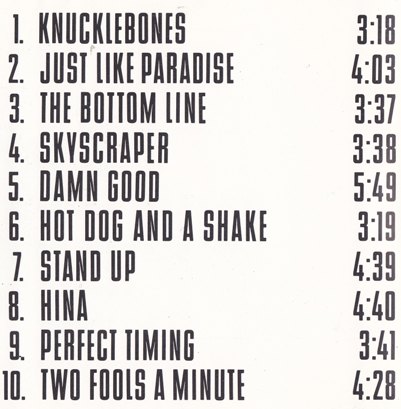
It started with Derek’s message to me.  “Unpopular opinion:  Skyscraper is better than Eat ‘Em and Smile,” he said.  “Better songs, better guitar, tons of awesome synth…when you have tracks like ‘Perfect Timing’ and ‘Knucklebones’ how can you go wrong?”  Derek says “Perfect Timing” might be his favourite song on the album.

Derek definitely has some good points.  It’s easily arguable that Skyscraper has better guitars.  Steve Vai was in the co-producer’s chair, and he layered his guitar parts as if he was building one of his own solo albums.  They’re very dense, yet melodically intertwined.  As for the synth, he has a valid observation with some songs like “Skyscraper”.  That song verges on progressive rock; it’s got so much going on, including synth and layered Roth vocals.  However I think the synth was overdone on tracks like “Stand Up“, which doesn’t even have Billy Sheehan on bass.

Skyscraper is an almost absurd album in some respects, with Dave pouring on that “charasma” to the nth degree.  There are so many “woo’s” “wow’s” and “oh’s” that you could make an entire song of just that.  Steve Vai was the star on Skyscraper, and as I said in my original review, how much you like Skyscraper will depend on how much you like Steve Vai.  I like Steve; I think his music and playing is fascinating.  Rock fans often don’t want “fascinating”, they just want the riffs and the choruses.  Eat ‘Em and Smile was much more about the big guitars and choruses, but it’s also just a fabulous record.  Skyscraper is colder sounding by comparison, and often drifts into experimental pop rock excursions.  It also suffers for the lack of Billy Sheehan, who wasn’t given a lot of creative freedom.  Where there should be bass, often you will hear synth.

Sorry Derek, you have made some really great points, and Skyscraper really is a great album.  It’s brave and fun and experimental, but it’s also cold with little bit of filler (“Stand Up”).   I’ll always rate it high…but not as high as Eat ‘Em and Smile.

REVIEW: Jim Crean – Greatest Hits (2018)

In a surprising turn of events, Jim Crean has been named the new singer for Vinnie Vincent! So it is a perfect time to review Jim Crean’s Greatest Hits.

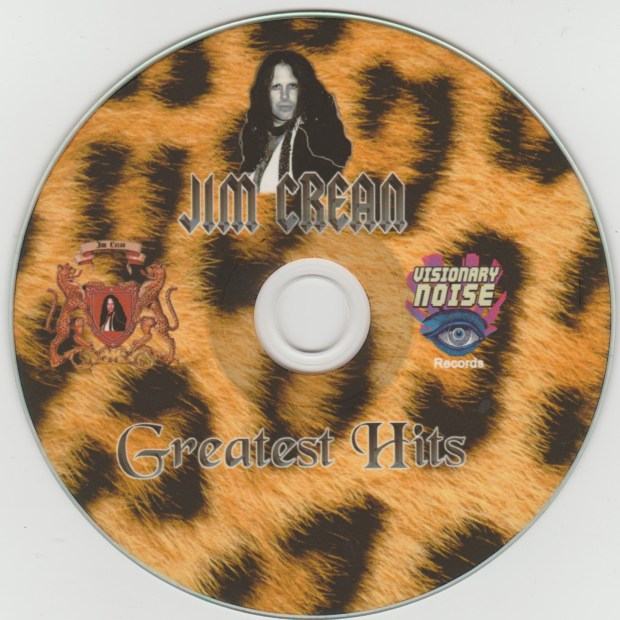
JIM CREAN – Greatest Hits (2018 Visionary Noise)

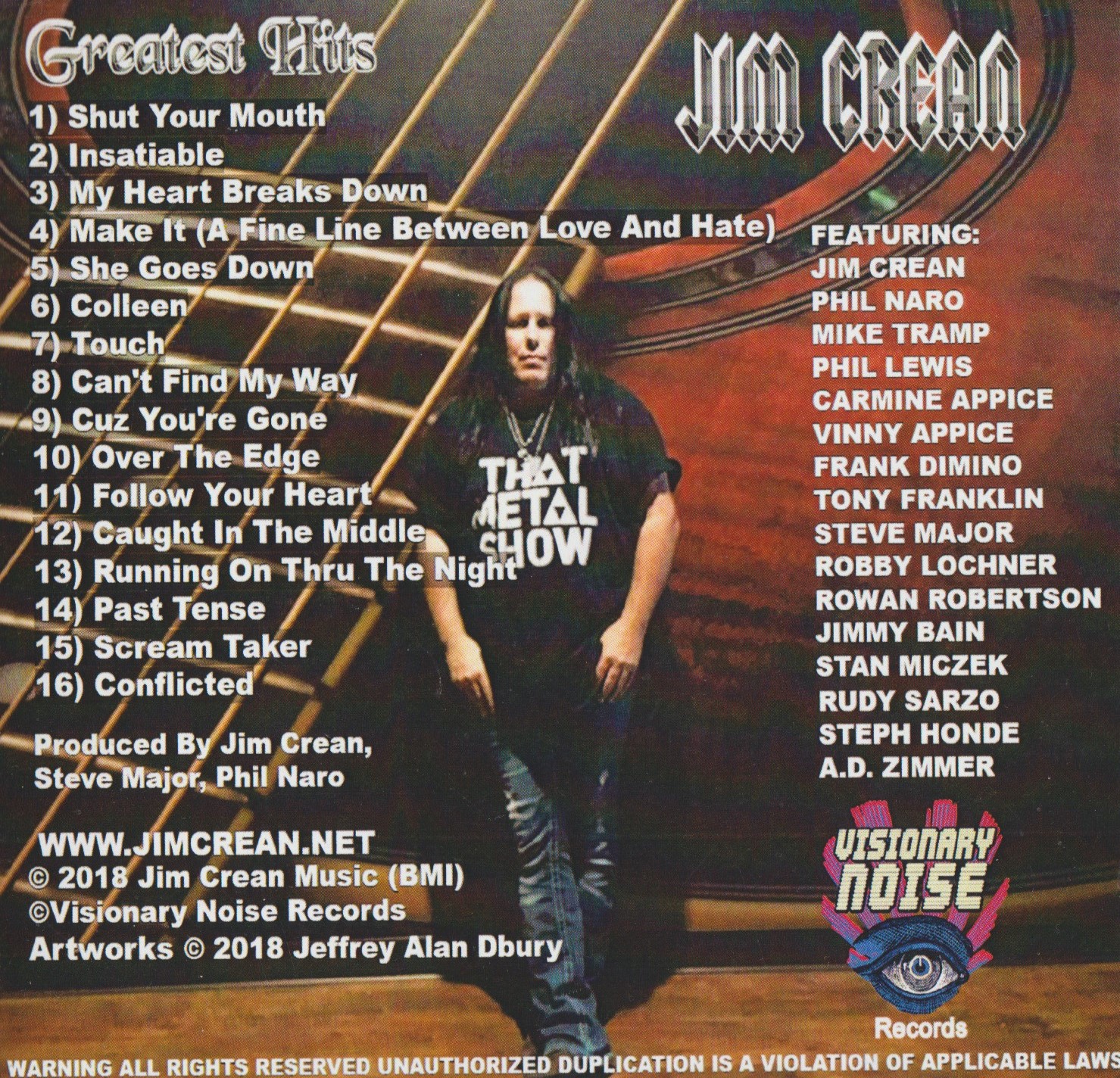
Buffalo’s Jim Crean has four solo albums under his belt.   That’s a good minimum before you release a greatest hits.  There is enough material here for a solid listen, including two new songs from Crean’s forthcoming fifth album.

Several of the best tracks are hard rockers from Crean’s Insatiable. “Touch” remains a standout, a great song any rock songwriter would be envious of.  Not to mention Crean’s power-pipes lay waste to the chorus.  Check out the metal riffing on “Follow Your Heart”, too.  These taffy-sweet tracks claw into your cranium via your ear canal.  All you can do is surrender to it.

Crean’s also capable of standout ballads.  “Make It” and “Can’t Find My Way” (a duet with Mike Tramp) are fantastic.  Then he goes vintage Aerosmith on “She Goes Down”, a song that could have fit nicely on an album like Toys in the Attic.

There are a handful of covers on the 16 track album, and interesting choices too.  “Caught in the Middle” is, of course, Dio, performed with Jimmy Bain and Vinny Appice.  “Over the Edge” is early 90s L.A. Guns, an excellent groove.  Crean also covered fellow Buffalo band the Goo Goo Dolls with the acoustic “Cuz You’re Gone”, one of the Goo’s finest ballads.

What about the new songs?  “Scream Taker” sounds like a Ronnie Dio tribute, with the lyrics cut and pasted from Rainbow, Black Sabbath and Dio songs.  “Scream Taker” indicates that Crean has gone heavier on his fifth record.  The other new song, “Conflicted” has a strong traditional metal riffy vibe.  (Is that Billy Sheehan on bass?)  Both these new songs hint at a great album to come.  Guitarist Steph Honde, who plays on both new songs says that while the new Crean album will be a bit heavier, there will also be some great ballads.

Don’t have any Jim Crean yet?  Pick up his Greatest Hits to catch up.

4.5/5 stars
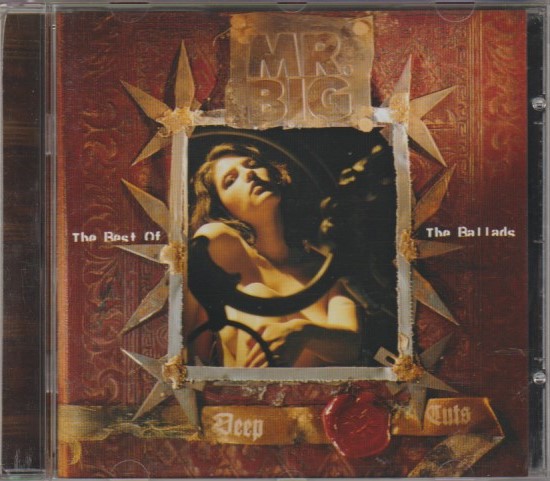
REVIEW: Mr. Big – Deep Cuts: The Best of the Ballads (2000)

MR. BIG – Deep Cuts: The Best of the Ballads (2000 Atlantic)

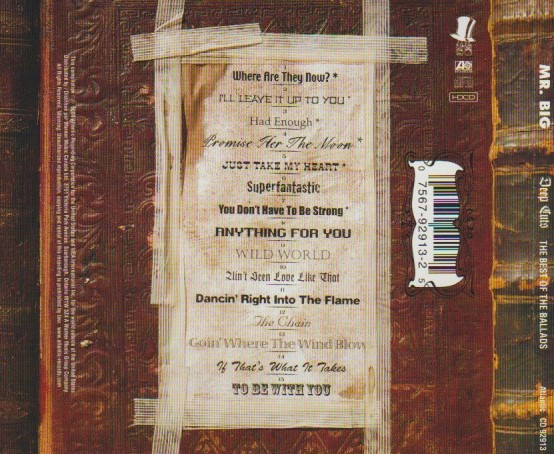
Although 15 tracks of ballads is more than enough for anyone, Mr. Big’s compilation Deep Cuts has value to collectors.  A number of these songs are rare or previously unreleased versions.

Most of Mr. Big’s hits are ballads, so that’s why this thing exists.  All the important ones are present:  “To Be With You”, “Wild World” (Cat Stevens cover), “Just Take My Heart”, and lots of deeper cuts too.  The selling point of this album is the rare stuff, and there’s more than average.  “Had Enough”, “Promise Her the Moon” and “Just Take My Heart” are all re-recorded with Richie Kotzen on guitar (who was in Mr. Big at the time).  That’s fine; at least they had a reason to do it.  “Promise Her the Moon” isn’t vastly different, but “Had Enough” and “Just Take My Heart” have slightly new arrangements.  “Had Enough” is much more fleshed out, and sometimes even a little funky. That’s the Kotzen influence.

There are also two “new” songs, one amusingly called “Where Are They Now?”  It’s a cool song with a decent chorus, though it certainly can’t compete with the big hits.  It could have used more Kotzen.  The other newbie, “I’ll Leave It Up to You” sounds more like Richie, and more like a laid back blues.  Finally, there is a B-side from the Kotzen era:  “You Don’t Have to Be Strong”.  This one (from “Superfantastic”, which is also on this CD)  is the best of the bunch, not least because it’s a duet with Eric Martin and Richie Kotzen.  This is the kind of stuff that is nice to have.  It beats hunting down an obscure CD single to get it.

Deep Cuts is rounded out by a whole bunch of classic ballads from the Paul Gilbert albums.  And yes, “To Be With You” is the original version, so if you’re buying the CD for one song (shame on you!) then at least you get what you wanted.

Still…it’s a CD with 15 ballads in a row.  Not the kind of thing that gets played all the way through in a single sitting.

2/5 stars

REVIEW: Mr. Big – Get Over It (1999)

MR. BIG – Get Over It (1999 Atlantic)

Mr. Big broke up in 1996, and reformed in 1999 without Paul Gilbert.  It wasn’t personal; he just wasn’t available.  He was working with a revamped Racer X, and his solo albums were popular in Japan.  In a stroke of genius, Mr. Big tapped a contemporary of Gilbert from his Shrapnel records days — Richie Kotzen.  Kotzen, like Mr. Big, was popular, could shred, and could write commercial music.  Kotzen has a distinct soul/blues vibe that he introduced to Mr. Big along with his own vocals.

The resultant Mr. Big album, Get Over It, was an amalgam of the two artists.  Different, but still a good fit.  Leadoff track “Electrified” is almost like a new band, based on the quality of the old.  Kotzen, like Gilbert, can shred – check out “Hiding Place”.  He just does it with more blues.  He also sings co-lead vocals on “Static”, the only Kotzen solo writing credit.  With him and Eric Martin in the same band, you get two of the most soulful hard rockers on Earth in one place at one time!

The song that, in past days, would have been the “bit hit” is a track called “Superfantastic”.  This campfire rock track recalls the good old days, but the bluesy stuff is more interesting.  Kotzen pours on the slide for “A Rose Alone”, which sounds like an old Shaw/Blades tune.  “Try to Do Without It” is a delightful confection of soul and bluesy guitar.

Get Over It lacks in one way.  Mr. Big albums are usually peppered with many unforgettable standout tracks throughout.  Get Over It only has a handful of those, stacked near the beginning.  It’s an enjoyable listen throughout, with no dull or skipable moments, but it’s missing those high points.  The songs you remember for days after.  Instead, Get Over It plays like cool bluesy (and sometimes funky) background CD.

3.25/5 stars

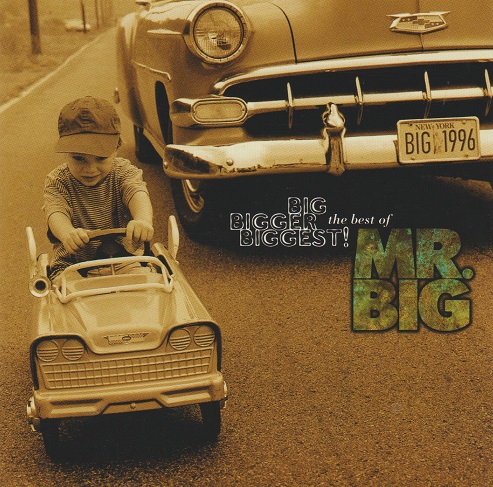
REVIEW: Mr. Big – Big, Bigger, Biggest! The Best Of (1996)

MR. BIG – Big, Bigger, Biggest! The Best Of (1996 Atlantic)

The mid-90s were the time that every hard rock band in the world released a greatest hits.  Why?  Most of them either split, got dropped by the label, or both.  Tesla, King’s X, Slaughter, Extreme, and Mr. Big are among the sidelined bands whose labels released a greatest hits mid-decade.

Big’s at least had four unreleased tracks, topping off 12 familiar cuts from their first four albums.  Three of the songs were newly recorded.  Unfortunately, the label stacked a bunch of ballads and made this disc really hard to finish in one sitting.  The running order and track selection is a little wonky.

“Addicted to that Rush” is the jet-speed opener, as it should be.  Big’s 1989 debut was instrumentally thrilling but light on hits.  A so-so album track, “Rock & Roll Over” should probably have been left off.  Lean Into It (1991) was the big one.  “To Be With You” sits at track 4, because the CD is chronological, but the song has always worked better in the closing position.  Placing it at track 4 is anticlimactic.  Lean Into It spawned three more singles, all present:  “Green Tinted Sixties Mind“, “Just Take My Heart”, and “Daddy, Brother, Lover, Little Boy”.  This spurt of songs is a bit too soft.  Two are ballads, one a pop track, leaving only one to instrumentally smoke you.  That’s unfortunate because their cover of Cat Stevens’ “Wild World” is next in the pack.  Though it is a fabulous and underappreciated cover, it’s too much mush at the start of the CD.

A buyer who picks this CD up as their first and only Mr. Big purchase will assume they are just another pop rock band.  Another Bon Jovi, another Warrant.  Though there are some serious moments of instrumental shreddery, that side of the band is too overlooked.  “Colorado Bulldog” from 1993’s Bump Ahead is about the only remaining song with that kind of force.  This is why suits shouldn’t compile CDs.  Their studio albums are more balanced.

Unfortunately, none of the four unreleased songs are spectacular.  The acoustic ballad “Seven Impossible Days” is from a Japanese EP called Japandemonium.  The other three are new recordings.  “Not One Night” is another acoustic ballad.  Sonically beautiful, but it’s too much saccharine.  “Unnatural” isn’t a ballad per se, but it is mostly acoustic (and features the lead vocals of guitarist Paul Gilbert).  “Stay Together”, which is a dead ringer for vintage Van Hagar, is probably the best of these four songs.

Big, Bigger, Biggest! The Best Of Mr. Big does not represent the Mr. Big that fans have known all these years.  Their favourite songs are rarely the ballads.  Too many killer deep cuts are missing, and, I hate to sound like a broken record, there are too many ballads!

2.5/5 stars