DVD

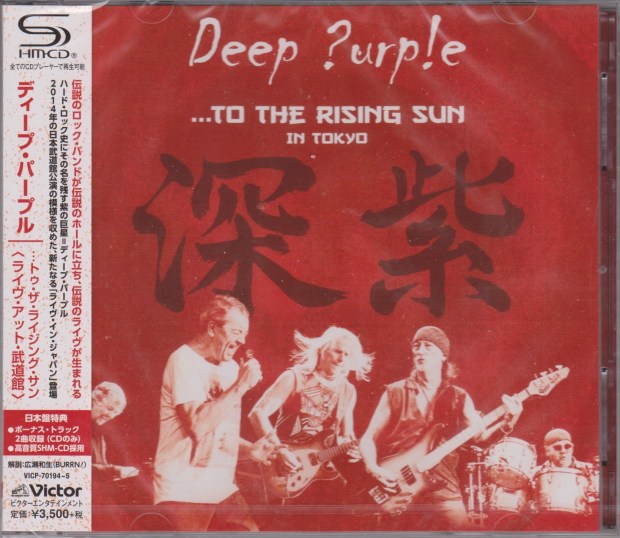
REVIEW: Deep Purple – To the Rising Sun…in Tokyo (2 CD/1 DVD + Japanese bonus tracks)

The Deep Purple Project is a massive, ongoing series of in-depth reviews.  This is the last for now as we take a break, but Purple will return.  

DEEP PURPLE – To the Rising Sun…in Tokyo (2015 Edel 2 CD/1DVD set, Japanese CD with 2 bonus tracks)

Purple live releases have been in strong supply lately.  Last year, Purple released a matching set of double live albums, each with a complete DVD of the show in one package.  The first set, In Wacken, was reviewed yesterday.  Today, we look at In Tokyo.  In order to “get it all”, I added the Japanese 2 CD set with bonus tracks to my collection.  The bonus tracks are on the CD portion of the package.  As we did yesterday, we’ll get the bonus material out of the way first.

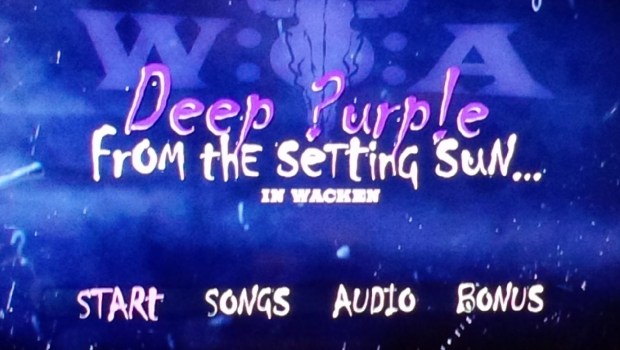
The two Japanese extras are instrumental versions of “Hell to Pay” and “Apres Vous”, newer songs from Now What?!  I am happy to report that these instrumentals are not live.  Since both songs are complete and live on the album proper, I was pleased to find these two are instrumental mixes of the studio cuts.  This makes sense, since the instrumental “Hell to Pay” is used as the main menu backing music on the live DVD.  As with any instrumental mix, it is interesting to pay attention to the musical interplay.  Since it’s Deep Purple we’re speaking about, it’s that much more enjoyable.

IMG_20160214_074958

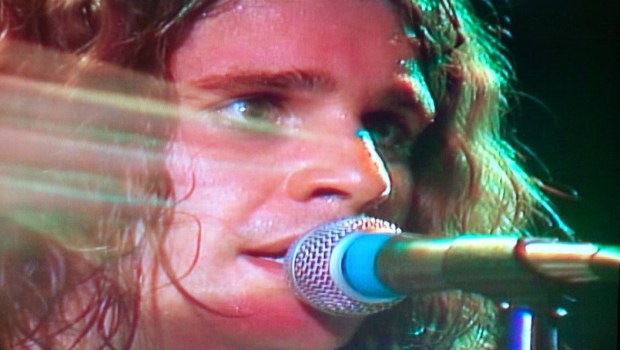
Moving on to the live part of the set, the recorded intro of Holst’s “Mars: Bringer of War” has the Budokan crowd in Tokyo excited for the return of Deep Purple.  The band bravely opened with “Apres Vous”, the new cut from Now What?!  It works surprisingly well by setting a mood.  Ian Gillan keeps it from getting too serious by wearing one of those tuxedo-printed shirts.  I want one of those.

Gillan’s hoarse on “Into the Fire”, but overall he’s stronger than he was in Wacken.  The added grit makes the song tougher and closer to the 1969 original.  Also from way back then is “Hard Lovin’ Man”, a pairing that always works well.  Don Airey takes an extended Hammond solo, and the song gallops in a way that set the basis for Iron Maiden’s career.  Thrills and chills abound, but Morse is smiling so much that you know we’re all in for a good time.  What a contrast with the moody and unpredictable Ritchie Blackmore!  This breathtaking assault of a song absolutely needs to be played live.  It’s no surprise that they need to lay back with something slower after that.  “Strange Kind of Woman” does the trick with that unforgettable groove.  Morse pulls off a jazzy solo that just kills.  This is a far better version than the one in Wacken.  Speaking of women and strangeness, it’s odd that “Woman From Tokyo” wasn’t played this time.

“That was the end of the jazz part of the show,” says Ian.  Back to new songs, “Vincent Price” is rolled out next.  Brought to life on the stage, “Vincent Price” is heavier and chunky.  The spooky keyboards are intact and Gillan injects the song with extra terror.  Steve Morse is on a roll now, and it’s time for his solo.  It’s chopped up a bit compared to how they played it earlier in the year.  “Contact Lost” is still first, but this time that goes into “Uncommon Man”.  I love watching Steve Morse playing volume swells with his pinky on the knob, while hammering out a complex melody.  There are plenty of hand close-ups here.  Copy if you can!  (I can’t.)  When “Uncommon Man” begins, Ian Gillan whispers in Steve’s ear.  I like to think he just said, “That was incredible.”

“Uncommon Man” is powerful live, by the way.  Steve goes again with his playful “The Well-Dressed Guitar”.  The dexterity here is quite unbelievable, but you knew that already.  Once again I’m grateful for plenty of hand close-ups.  I have no prayer of being able to play this but I love to watch and see how it’s done, and just marvel.  During a break in the keyboard part, Don Airey claps and dances along; quite amusing!

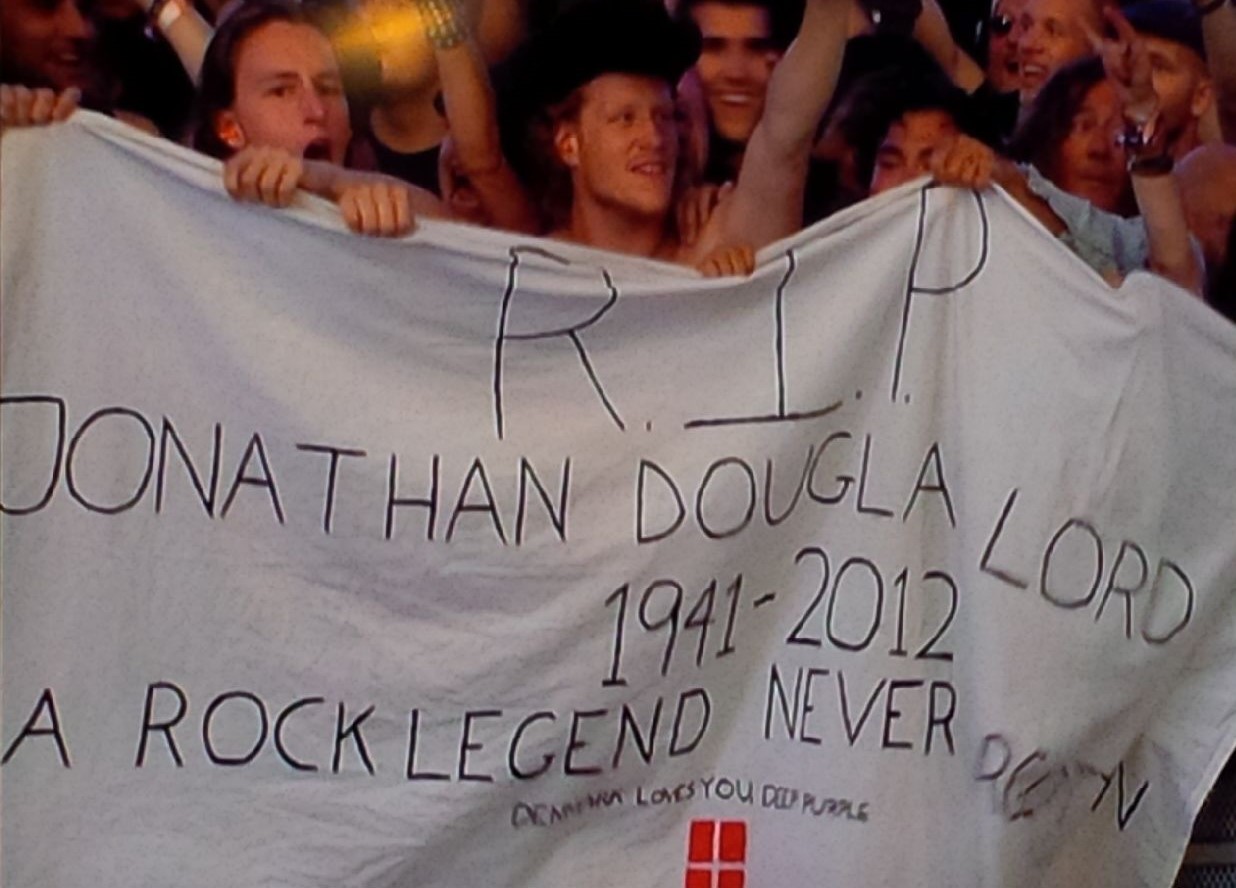
The Fireball oldie “The Mule” is always welcome out of the mothballs.  A drum workout, Ian Paice is given a chance to show that time has not lessened his abilities one iota.  It’s a busy drum song, and quickly descends into a mad solo.  At one point, the lights go out and Ian plays with glowing sticks, Sheila E style.  He gets to slow down a little on the Jon Lord tribute “Above and Beyond”.  Jon’s image behind them on the big screens of the Budokan, you can sense the emotion of the moment.  His successor Don Airey plays a Hammond tribute to Jon, before the band return to the sound of “Lazy”.  It’s just a seamless blur of one incredible piece of music after another.

“Hell to Pay” continues to prove its worth as a stage-ready, fun rocker.  You can tell that the formalities are over now, because Gillan has changed out of his tuxedo print shirt!  Don Airey dominates on the Hammond.  He gets a spotlight solo next, a chance to do his own thing.  Like his solo in Wacken, this includes a snippet of “Mr. Crowley”, a song that Don played on way back in 1980, and the ensuing Ozzy Osbourne tours.  His solo runs the gamut from tender piano, to classical passages, to spacey synth.  He quotes the melody of “Woman From Tokyo” which the crowd clearly appreciated.

It’s all business from here.  “Perfect Strangers”, as usual the only song from the 80’s, is as timeless as always.  Back to Machine Head for “Space Truckin'”, Roger Glover seems to be having a great time rocking it for the crowd in Japan.  Gillan’s sounding a bit knackered, but he’s still going for it.  No retreat, no surrender.  The classic riff, “Smoke on the Water” explodes in the Budokan, as we draw close to the end.  You can tell they still have fun playing this song, loose and never the same twice.  Two encores are still to be had:  the medley of “Green Onions”/”Hush”, and “Black Night”.  “Hush” is given a neat slinky jam section, because they’re Deep Purple and why the hell not?  After a brief Glover bass jam, “Black Night” commences as the final song of the night.  Gillan’s sounding tired, but that’s rock and roll.  They’re finally done, Roger lingering to make sure he’s thrown out every last pick.  That too is rock and roll.

These two sets were time consuming but very entertaining.  I think they are both worth having, but if you are not the Purple diehard that needs as much as you can consume, be aware that these are men in their late 60’s.  They are not spring chickens, so don’t expect To the Rising Sun…in Tokyo to be the equal of Made in Japan.

3.5/5 stars

REVIEW: Deep Purple – From the Setting Sun…in Wacken (2 CD/1DVD)

The Deep Purple Project must continue!  Their most recent live releases are next up.

DEEP PURPLE – From the Setting Sun…in Wacken (2015 Edel 2 CD/1DVD set)

“This record is the first of a double release,” says Roger Glover in the liner notes.  The second is called To the Rising Sun…in Tokyo which we’ll examine in a separate review (including the Japanese bonus tracks).  This nicely assembled three disc set has the entire show on both CD and DVD, a 2013 concert at the legendary Wacken Open Air festival.

Our friend of ours, Jessie David at 107.5 Dave Rocks, went to Wacken in 2015. “I can say that going to Wacken is truly life-changing. It is an experience like no other: Where every single person there is part of a family.” Roger Glover says the real stars of this show are the audience.

There is one small bonus feature on this DVD to get out of the way before we start the show.  It was surprising to see Deep Purple release a new music video in 2013!  “Vincent Price” was a fun music clip, featuring plenty of band shots.  The horror movie storyline is entertaining and make for a fun video.  Perhaps the actor in the video playing the titular character should also play Governor Tarkin in an upcoming Star Wars anthology film?  This video is not really appropriate for kids, so be forewarned!

Purple’s Wacken set was filmed and recorded for posterity quite well. I don’t know if I have ever seen Deep Purple captured so clearly.  Taking the stage in daylight, we begin with “Highway Star”.

Ian Gillan’s voice is quite thin; this is one of the poorest live Deep Purple releases as far as vocals go.  That’s unfortunate but at least they didnt’ “fix it in the mix” as they say.  Roger Glover seems to be having a blast, pulling faces and poses over on the bass station.  Bathed in the setting sun (hence the album title), the lighting is quite dramatic.  The old In Rock classic “Into the Fire”, rarely played, is up next.  Ian really struggles with his voice, having to affect a nasal tone, but he’s starting to warm up a bit now.  Hey; the man is 70 years old!  Then, directly into “Hard Lovin’ Man” from the same album, another rarely played smoker.  Ian’s on track now!  Organist Don Airey is brilliant on this.

Newish single “Vincent Price”, the same song as the music video, is next in the set.  Because of the spooky keyboards, it does not sound like any of the prior songs, which is great as the sun goes lower on the horizon.  I think new material works best sprinkled in the set at the right times, and that’s the approach Purple took here.  This corker moves directly into “Strange Kind of Woman” somehow, but this oldie is starting to sound a bit tired.  The first solo spot of the show is Steve Morse’s dual guitar solo, “Contact Lost” and “The Well-Dressed Guitar”.  This dramatic scene is a show highlight, as thousands of people wave their hands in the air to the music.  The two musical pieces are brilliant in composition and execution.  Another new single, “Hell to Pay” has to follow this smoke show.  The song always struck me as custom-written for the stage, and this appears to be true in Wacken.

IMG_20160213_105700

Don Airey’s keyboard spotlight on “Lazy” is impressive.  It’s hard to forget the man he replaced in Deep Purple (Jon Lord).  In many ways his solo is a tribute to Lord, as he plays a few cues that Jon wrote.  The band never seems to tire of playing it.  However they stall a bit on “Above and Beyond”, perhaps a song less well adapted to the stage.  “No One Came” on the other hand always kicks ass live.  With Don Airey on keyboards it has some new flavours to it, and then he gets a full-fledged keyboard solo of his own.  He plays all over the musical map, and even hints at “Mr. Crowley”, a song he used to play with Ozzy Osbourne.

“Perfect Strangers” is usually the only song from the 1980’s that Deep Purple still play.  The drama builds as we get closer to the end of the show.  It is dark out now in Wacken but the crowd still bounce along to the music.  I have long felt that “Perfect Strangers” works very well with Steve Morse on guitar, and that was true in Wacken in 2015.  Then we’re off “Space Truckin'”, another song boasting many jawdropping musical moments.

The biggest surprise is the appearance of a wisened Uli Jon Roth on “Smoke on the Water”.  He and Steve Morse have a blast playing off each other.  Think of it:  Two of the most unique and  incredible guitarists in the world on one stage, playing back and forth.  I say this often in my Deep Purple reviews, but what more could you want?  Uli’s solo is pure magic.  He is a force of nature, but so is Steve Morse.  If Uli is wind, then Morse is fire.

Encore time:  Purple started playing “Green Onions” as a prelude to “Hush” a couple years ago.  This is one of the most magical moments in the set.  The energy is palpable.  “Black Night”, which also has a brief segue into Zeppelin’s “How Many More Times”, is the final tune of the night, an otherwise standard take with amazing playing regardless.

It’s a fair bet that Purple won over Wacken in 2013.  Pick up this live set for a taste.

3.5/5 stars

DVD REVIEW: Black Sabbath – Never Say Die (live 1978)


BLACK SABBATH – Never Say Die (Live in 1978, 2003 Sanctuary DVD)

Recorded in 1978 at the Hammersmith, the DVD Never Say Die was recorded for TV, and not badly either.  The video part, anyway!  Great live angles and decent editing lead to a very watchable concert, albeit chopped down for length.  The audio leaves something to be desired.

The muffled riff of “Symptom of the Universe” commences the set, Iommi sounding as if powered through a crappy battery powered transistor amp, such is the horrible sound captured.  A blazed Ozzy growls through it, and Bearded Bill is in the back wearing braids and looking like a complete dirt bag.  As for Geezer?  He’s mixed too low to have any significant impact.  Tony Iommi stands guard at center stage, while Ozzy claps along next to him.

The close-up shots are nice and vivid, Ozzy waving the peace sign during the start of “War Pigs”.  He then commands the crowd to put their hands together, and they soon oblige singing along with him.  There is something about a live version of this song with the full original lineup including Bill Ward.  Bill was always a jazzy drummer, and that’s the vibe he loaned Black Sabbath.  It’s especially necessary on tracks like “War Pigs” which require a certain swing on the traps.  With Bill here still in vintage mode, the song has all the right heft and movement.

It’s hard to tell that this was a group of guys who couldn’t bear each other anymore.  While they mostly keep to themselves on the large stage (as they always have), Ozzy acts as Tony’s cheering section during the guitar solos, and you can even see a hint of a smile in Tony’s eyes.  Then Ozzy claps and screeches his way through the monolithic “Snow Blind”.

IMG_20160123_163908

The only track from the new album, Never Say Die, is the title track.  Its upbeat attitude and fast tempo allude to where Ozzy was going to go as a solo artist.  For Sabbath, it’s one of their most unappreciated tracks.  This live version is pretty sloppy but very rock and roll (including an old-tymey rock and roll riff that wasn’t in the original).  Then, Ozzy introduces the all-time classic, “Black Sabbath”, with an interesting statement.  “Thanks for the last 10 years, and we hope we’re around for another 10 years, and another 10 years.”  It’s interesting because at this point, Ozzy had already left the band once, been replaced by Dave Walker (Savoy Brown) for one TV performance (“Junior’s Eyes”), and then returned to the band to do the Never Say Die album, refusing to sing anything they wrote for Walker.  Not exactly the kind of environment to encourage longevity!  Of course the amazing thing is that three of these guys are still together, winding up the band that they formed.

It’s worth noting that nobody can (or will) capture the vibe of “Black Sabbath” like the original four.

Detouring to Technical Ecstasy, Sabbath pour into the underrated prowl, “Dirty Women”.  After this, uncredited, is a brief Bill Ward drum solo.  That melds into “Rock and Roll Doctor”, another obscurity.  Ward’s cowbell and Tony’s rock and roll riff give it a retro vibe.  Bill plays it busy compared to the album version; that’s fine by me.  Tony takes a guitar solo before the scary oldie-goldie, “Electric Funeral”.   Always a treat to hear this rarely played Paranoid classic, but unfortunately this one is noticeably edited down.

Closing out the disc, “Children of the Grave” is an obvious highlight.  Once again there is no drummer on Earth who can play it properly, except for Bill Ward.   Some come close, but none capture the reckless engine that drives it.  For the encore, Ozzy asks the audience “What do you wanna hear?” to which they are supposed to respond “Paranoid!”  I don’t know if they do; the audio here is really not good.  They trot out “Paranoid”, the flaw of which is that it always sounds by rote.  Ozzy couldn’t sound less interested in singing it again for the millionth time.

You have to consider the sound quality on a DVD like this and if you’re the kind of person who will care or even be able to tell the difference.  I don’t care.  This is a great though imperfect glimpse at a rare period in Black Sabbath’s history.  A short while later Ozzy would be solo, and Sabbath would go to Heaven and Hell with Ronnie James Dio.

3.5/5 stars


DVD REVIEW: Taylor Swift & Def Leppard – CMT Crossroads (2009)

TAYLOR SWIFT & DEF LEPPARD – CMT Crossroads (2009 Walmart exclusive DVD)


“There’s always a first day when you discover a band, be it the Beatles or Taylor Swift, when you hear the name for the first time and then you go and check it out. So we just Googled her, iTuned her, listened to it all and said, ‘Wow’!” — Joe Elliott

“I like to write songs about what’s going on in my life.” — Taylor Swift, stating the obvious

IMG_20160116_192039

Before the Swifties come and tear us apart for what you’re about to read, let’s be perfectly clear. Taylor Swift is very talented and has a genuine love for Def Leppard’s music. She is also an incredibly bright individual, and she has written more hits than Def Leppard in a fraction of the time. Both of them started in their teens, and are guilty of using outside writers. In the included interview footage, she and Def Lep seem like a mutual admiration society. We have nothing against Taylor Swift here, though her brand of pop music is never heard around LeBrain HQ…save this Walmart exclusive DVD release.

How did they hook up? Taylor was on tour with “Tim and Faith” (McGraw and Hill) who’s tour manager was Rick Allen’s brother. She expressed interest in doing an episode of CMT Crossroads with them, and then the phone rang.

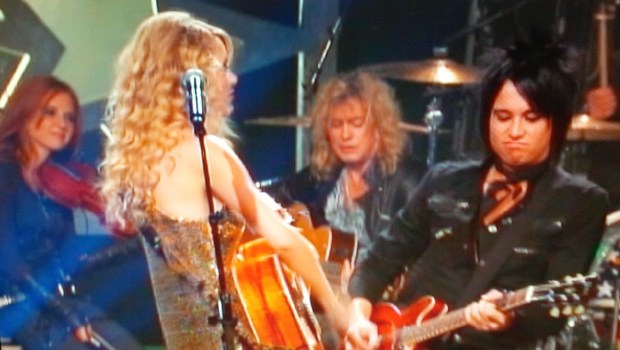
Leppard and the Swift’s band share the stage, dual drummers, umpteen guitar players, and fiddle…but on a heavier track like “Photograph” you can’t really hear her group. Taylor gets the first line (she says she felt like a kid in a candy store to do so); then she and Joe swap. It’s clear that she doesn’t have the power nor the control that Joe Elliot has. Her voice is whispy by comparison. It’s also weird to see a girl in a gold mini-dress and cowboy boots fronting Def Leppard, but talk about dreams come true! I’m sure Def Leppard didn’t mind the national exposure either.

“Picture to Burn” is the kind of candy-coated pop country that irritates so many fans of the old fashioned stuff. Taylor is more at home on her own songs, but Joe has never sounded more awkward. Taylor’s band dominates on this song, with only a few Phil Collen guitar squeals to remind you he’s there. Tellingly, Joe Elliot says of her music, “You take the banjos and fiddles off, and you’ve got pop.” The next Taylor number, “Love Story” is one I’ve heard on pop radio many times, but it’s hard to suffer through. It brings back bad memories of Leppard’s pop disaster, X.

Taylor butchers my favourite Def Leppard ballad, “Hysteria”. The song successfully absorbs the twang, but again, Swift just lacks the vocal power to blast it the way Joe can. Her own ballad “Teardrops on my Guitar” is so laid back that most of the Leppard guys are sitting down for it. The bands mesh well and the song is pretty good, although she has a guitar player who kind of looks like a goth country emo Russell Brand. She’s at home on Leppard’s “When Love and Hate Collide”. Once again the meshing of the two bands works well here. There’s a full string section, plus backing vocalists crowding the already overloaded stage, but that’s what the song calls for and it’s genuinely great version of the well-worn hit. “Should’ve Said No” is a Swift song I don’t know, but it’s one of those pop tracks that just feels like it was written by a computer. It transforms directly into the show closer “Pour Some Sugar on Me”, but…damn. Taylor’s out of breath. She is audibly gasping (a big no-no) between lines and unable to deliver the goods. With the fiddle and extra accouterments added, this one’s a write-off.

IMG_20160116_194451

There are three bonus tracks that weren’t broadcast as part of the show: One Swift, two Leppard. Taylor says she wrote “Our Song” in ninth grade (“three years ago, actually”). That’s exactly what it sounds like, ninth grade pop, but obviously there is a need in the world for that kind of kid-friendly music. Leppard fans won’t find any appeal here. They will however appreciate “Love”, the only new Leppard song in the set. Interestingly it starts with only Taylor and two of her guitarists on stage, then Leppard emerge from the shadows. As a duet, it’s enjoyable, and it’s overall probably the heaviest thing all night. The much-overplayed “Two Steps Behind” is the final bonus track. The fun thing here is trying to count the number of people playing guitar on stage. (Eight plus fiddle and Rick Savage on acoustic five-string.)

Phil Collen gets bonus points for wearing a jacket on stage, dressing up a bit for the television, but he sticks to tradition by having no shirt on underneath.

2.5/5 stars

REVIEW: Deep Purple – Live in Stockholm 1970 (2 CD/1 DVD)

EPIC REVIEW TIME!


DEEP PURPLE – Live in Stockholm 1970 (2014 Edel, 2 CD 1 DVD set)

This is the second time I’ve bought this live album.  Hopefully, this edition from the Official Deep Purple (Overseas) Live Series, with its bonus tracks and DVD represents the last time I need to shell out.  The first was a cheap looking 2 CD set called Live and Rare (1992).  There was also a more official version called Scandinavian Nights.  They’re all pretty much the same, a set of early long long bombers by Deep Purple recorded for radio in 1970.  This remixed (from the master tapes) edition has the set list restored to the correct order, and two bonus tracks from Paris the same year.  It also has a Jon Lord interview and a DVD for a TV special called Doing Their Thing.

The TV broadcast weirdly begins right in the middle of “Speed King”.  Full colour and in stereo, this is some fantastic footage.   It’s shot and edited for excitement.  Ritchie Blackmore assaults his weapon, but with precision.  For a guy who is so technically capable, it’s amazing how physical and visual he gets.  “Child in Time” gives Ian Gillan a chance to both sing and scream.  Strangely there are two small bored looking boys in the audience, right by Roger Glover, and they couldn’t look any less thrilled to be at this taping.  Who are they?  Why are they there?   Who knows!  This is the full unedited “Child in Time” complete with solos.

You get ample closeups on Jon, Ritchie and Roger and it’s amazing to see them play so fast, so perfectly.  You can study Jon’s hands and try to figure out what he’s doing.  Ian Paice is in the back, tiny frame creating a huge sound.  The instrumental “Wring that Neck” is soloriffic, and Blackmore is surprisingly friendly with the cameras.  This is very rare for the man in black.  The audience politely clap at his playful solo, and he keeps them guessing to the end.  A rare delight, to see him in such a good mood on stage.  The final track on the DVD is “Mandrake Root”, another song that was really only in the set for them to jam to.   They are in sync, and being able to watch Deep Purple at their peak jamming in this clarity, well that’s really something.  Too bad most of the songs are edited down.

As for the 2 CD set, it has always been a bit of a slog to get to the end.   There are two tracks at 30 minutes a piece.  There is one at 18.  There are three in the 10-12 minute range.  Of all the Deep Purple live albums out there, Stockholm is probably the one that requires the most patience.  This is, however, my first time hearing it freshly mixed and restored for today.

Set commencing with “Speed King” again, this time it’s the full-on 12 minute jam.  Barely hanging together, Purple blast it out with extra heavy energy.  Gillan sounds as if he’s about to burst a blood vessel in his neck.  The audio has more depth than previously releases, but Ian’s voice sounds a bit too low in the mix.  “Do you know what a Speed King is?  A Speed King is somebody who sing at a hundred miles an hour,” sings Ian, not really enlightening us.  “Everybody’s a Speed King when you wanna be,” he adds, confusing things more.  Things quiet down, turn jazzy, and then explode once more.  Not the greatest version of “Speed King” ever recorded, but definitely one of the most frantic.

“Into the Fire” is a rare shot of brevity.   Assailing the skull nonetheless, after “Into the Fire” the band take it back a bit with “Child in Time”.  This full-on 18 minute version is far longer than the better known one from Made in Japan.  The cool thing about Purple is that no two versions of any song are exactly the same, and if you’ve heard “Child in Time” before…you still haven’t heard the 18 minute version from Stockholm.  With all due respect to the Japan version, this one has its own diamonds of brilliance.  How the hell do they keep playing with that rapidity?

Better pee now, because a jazzy “Wring that Neck” is next, over 30 minutes.  Loaded with playing that’ll stop your heart, but not as interesting as the definitive version on Concerto for Group and Orchestra.  This contains a showcase for Jon Lord’s keyboard solos.  Ritchie’s playing is always sublime, and so is Jon’s, but…30 minutes…that’s a lot of jamming.  Like too much crème brûlée.  Ritchie again plays with the audience, teasing out melodies from songs such as “Jingle Bells” and “I’m Looking Over a Four Leaf Clover”. If that wasn’t enough, Deep Purple’s 10 minute cover of the Stones’ “Paint it, Black” is really just an excuse for a long drum solo by Ian Paice!  Gillan took off, making the song an instrumental, which they only stick to for a minute before letting Paice go nuts.

Scan_20160110 (3)

Flip over to CD 2, and get ready for another 30 minute long bomber.  “A thing you can jump around to,” says Ian.  It’s “Mandrake Root” and it’s bouncy.  This is a well-known version of the song, and it even appears on Deep Purple comprehensive box set Listen, Learn, Read On in its complete length.  You can clearly hear Gillan on the congas during the long instrumental break.  You can also hear them quoting the Kinks’ “You Really Got Me Now”.  This jam generates more interest than “Wring that Neck”, but it’s still a chore to finish.  And you get to hear “Mandrake Root” and “Wring that Neck” three times each in this package.

The final song (of a mere seven!) for Stockholm is a reasonably brief one:  “Black Night”.  After so much jammin’ it’s nice to have a single, with a set structure, and more than just occasional lead vocals!  It raises the energy a bit after a very draining concert set.  But you’d better refuel with some coffee, because you’re not finished yet.

The two bonus tracks from Paris sound as if they were recorded in a smaller venue.  They are sonically superior to the Stockholm recordings, but damn, I am all jammed out!  Thankfully, this version of “Wring that Neck” is delightful and unique.  It’s hotter and way, way jazzier.  Blackmore also teases out a bit of a preview of a forthcoming song.  You can hear a teeny bit of the guitar melody to 1971’s “The Mule” in his solo.  He even plays a bit of “God Saves the Queen”, in Paris!  Then on to “Mandrake Root” again, 14 minutes this time, half the length of the last one.  Jon’s solo is incredible, but aren’t they all?  This one has some nice rhythmic choppy bits that are so fun to air-keyboard along to.  The track eventually descends into chaos and noise, as all good Deep Purple jams do.

Finally we have the 1971 Jon Lord interview.  This 11 minute track discusses how Jon joined the band, the early days, the Concerto, and In Rock. The title is misleading however, since the track also contains a few bits with Ian Gillan.  Fun stuff but ultimately nothing here that the fan doesn’t already know.

3/5 stars, simply because I know from experience that this set won’t get much repeat play in your home.

3.5/5 stars when you take the bonus DVD into consideration.

REVIEW: Jethro Tull – Too Old to Rock ‘n’ Roll: Too Young to Die! (TV special edition – 2CD/2DVD set)

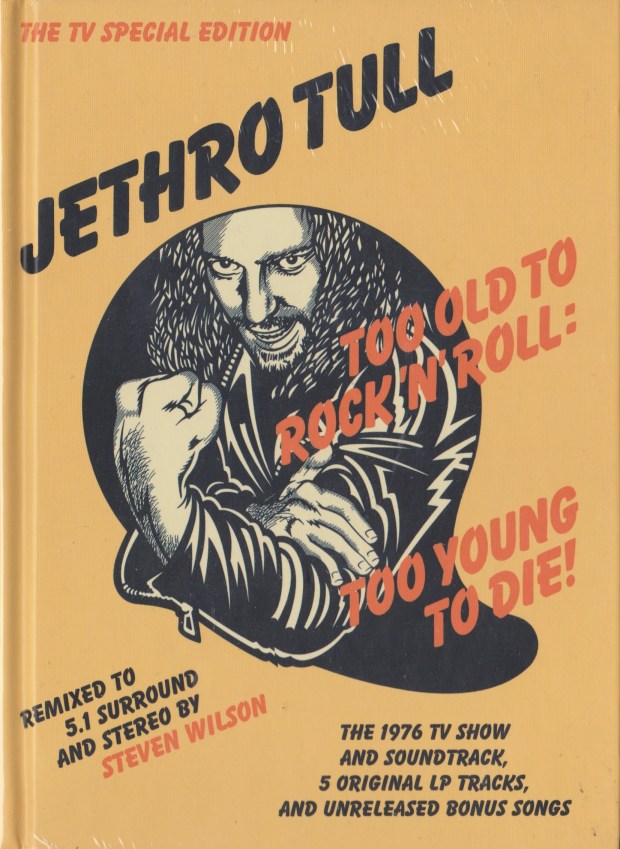
JETHRO TULL – Too Old to Rock ‘n’ Roll: Too Young to Die! (1976, 2015 Chrysalis TV Special edition 2CD/2DVD)

I foresee a future time, when every man woman and child will be able to buy deluxe multi-disc box sets of just about every album ever made.  While old geezers with greying beards will sit back in a rocking chair (a hovering one, no doubt) listening to multi-track backing tapes for every single Poison CD, our children will be able to do the same with a comprehensive book-box version of the NSync debut album.  It’s going to happen eventually, so we may as well get good albums like Tull’s Too Old to Rock ‘n’ Roll: Too Young to Die! in box set form while the concept still has validity.

Of course this isn’t the first Jethro Tull album to get this kind of treatment.  A super deluxe Aqualung was a fairly recent release, and I received Benefit myself for Christmas last year.  The bold four-colour album cover for Too Old to Rock ‘n’ Roll makes for a splendid book-form box with plastic CD trays inside.  An absolutely massive (80 page) full colour booklet awaits you inside.  Rare photos are the norm of course, but a features such as “From Carmen to Tullman” about the late John Glascock are valuable reads.  Detailed liner notes will help you make sense of the track listing, and the multiple versions of each song included.  Almost all of this material is rare, previously unreleased, or newly mixed material by studio wizard Steve Wilson.

IMG_20151227_162750

Scan_20151229First of all, I was not aware that all of Too Old to Rock ‘n’ Roll was re-recorded for a UK television special, included here on DVD.  Anderson had a theatrical presentation in mind, so playing live wasn’t of interest to him.  But, apparently due to British law, the LP Too Old to Rock ‘n’ Roll could not be used for backing music on a “live” TV special.  Anderson’s vision seemed to involve the band miming to the album while pulling amusing faces and occasionally acting out the lyrics.  In order to mime and do it legally, brand new recordings of every song had to be made!  In fact the band painstakingly took great care in recreating the album, although there are also obvious differences.  For the DVD and CD, these tracks been newly mixed and are available for the first time.  CD 1 contains the standard stereo mix of the re-recorded album.  DVD 1 has the special in both stereo and 5.1 surround.

The original album was also meant to be remixed top to bottom in 5.1 by Wilson.   This was not possible, because the original multi-track tapes survived for only five songs, almost the whole second side:  “From a Dead Beat to an Old Greaser”, “Bad Eyed and Loveless”, “Big Dipper”, “Too Old to Rock ‘n’ Roll”, and “The Chequered Flag”.  Tull’s semi-acoustic nature lends itself well to a good 5.1 mix.  The audio field is filled out, but not to excess.  It’s a good balance and the tracks included in 5.1 shine with fresh light.  Do not be surprised to hear parts you didn’t hear before.

The bonus associated tracks are a light collection of rare Tull.  The two bonus tracks from the prior 2002 remaster, “One Brown Mouse” and “A Small Cigar” are included here unaltered on CD 2, or on lossless 96/24 stereo PCM on DVD 2.  The unreleased tracks are excellent.  “Salamander’s Rag Time” sounds like the Jethro Tull collaborating with the Beatles via “A Day in the Life”.  Meanwhile, “Commercial Traveller” is a lushly arranged and recorded ode to the road with full strings and Martin Barre guitar blazes.  “Strip Cartoon” also has quaint Beatles-isms though it is really just a bright Tull acoustic jaunt.  An incredible instrumental take of “Salamander” is pure delight, hearing it ring in live perfection.  There is also a bare acoustic version of “A Small Cigar”, and earlier versions of “Quiz Kid” and the title track.  As always, these are available on both the CDs and DVDs.  Four of these (“Salamander’s Rag Time”, “Commercial Traveller”, “Strip Cartoon” and the acoustic “Small Cigar”) can be heard in 5.1, again mixed by Wilson.  Expect the same level of lushness and quality as the album tracks, although with the acoustic arrangements, it’s more about the spaces between.

One of the great advantages of the DVD format is the ability to re-release classic Quadrophonic mixes for modern audio systems.  Like many rock bands (and especially progressive rock bands) of the early 1970’s, Jethro Tull released Too Old to Rock ‘n’ Roll in Quad.  That long unavailable version is right here in 4.0, on DVD 2.  It’s certainly an interesting animal.  Where Steven Wilson’s 5.1 mixes envelope the listener in clouds of Tull music, the Quad mixes things hard into individual channels.  It’s an interesting experience.  The vocals are mostly on the right, the flute behind, and the other instruments tucked into their corners.  If you want to hear it as if the music is coming from four separate corners of the room, then this Quad mix is that exactly.  There is something to be said for this, because you can clearly hear each instrument isolated, and easy to study.  You can easily lose yourself in a particular part of the mix, which is the benefit and weakness of the format.  Regardless, the classic 1976 Quad mix has parts you won’t hear elsewhere, and it’s available again, and that is a good thing.

With all this talk of extras and remixes and surround sound, the original album is almost overlooked!  Fear not.  A bit like an afterthought, the original, stereo, classic Too Old to Rock ‘n’ Roll: Too Young to Die! is here, as the final 11 songs on CD 2.  Even the Benefit super deluxe box set didn’t include the original album on CD.  If you prefer lossless stereo, it’s there on DVD, too.

What of the original album, then?  Well, I reviewed that in 2012, and you can read all about it here.   A brief summary:


SAM_1882Like many Tull albums from the mid-70’s, there’s plenty of acoustics to go around accompanied by lovely flute passages and complex drum patterns.  There’s also some horns and orchestration courtesy of David Palmer (not yet a full member of the band).  Personal highlights:

  • “Salamander”, a folksy number with intricate acoustics.
  • The harmonica riffing of “Taxi Grab”, reminiscent of an earlier bluesier Jethro Tull.  The guitar soloing (both electric and acoustic) is also divine.
  • “Big Dipper”, a playful yet complex number with plenty of flute and a fun chorus.
  • The masterpiece title track (obviously), lush with ochestration.
  • “Pied Piper”, one of the most obviously catchy songs on the whole album, albeit still complex with multiple parts and section.
  • The final track of the album, a slow but dramatic grandiose number called “The Chequered Flag (Dead or Alive)”.


Too old to rock ‘n’ roll?  Never.  Buy this for the grandpa on your lists.

4/5 stars

#457: Making the Best Buy (Or, making lemonade from lemons)

SOUTH PARK

GETTING MORE TALE #457: Making the Best Buy
(Or, making lemonade from lemons)

In Getting More Tale #326, we lamented that the once-mighty retail chain Best Buy isn’t what it used to be.  This time, we’ll take a look back at the store’s history.

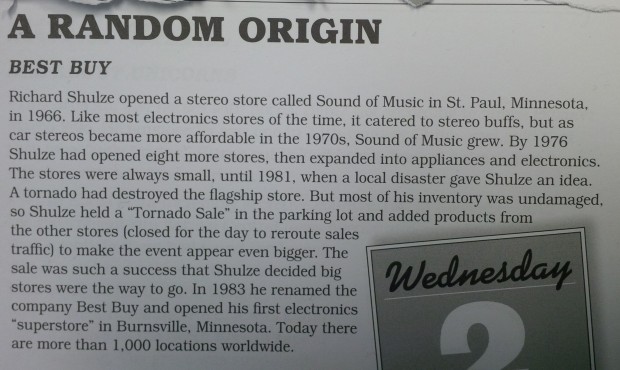
Who doesn’t love those fact-filled Uncle John’s books and calendars?  Here’s the entry for December 2 2015.  Before reading this I had no idea, nor did I really care how Best Buy started.  Uncle John changed my tune:

IMG_20151202_115759

Scan from the Uncle John’s 2015 desk calendar.

Back at the Record Store days in the early 2000’s, the Boss was bracing for a new Best Buy store to open nearby.  He figured that we’d probably feel some short term pain, but in the long term the store should draw more customers to the area and we’d benefit from their presence.  He also strongly encouraged us not to shop there, a big US chain edging into our turf.

I tried to avoid shopping there at first, but the convenience was too much to resist.  When I needed printer ink, computer supplies, or a new movie release, they were right there, and they usually had everything I came in for.  That made it hard to avoid.  I still tried to shop locally — I remember making special trips to Steve’s TV in Frederick Mall to buy the Star Wars trilogy on DVD.  Between big items like TV sets, and small ones like candy, I know I have easily spent thousands of dollars at our local Best Buy stores.   They also had hard to find items, such as the rare ZZ Top box set that came in a little box shaped like a barbecue shack (Chrome, Smoke & BBQ).  The guilt felt for shopping a big US conglomerate was tempered by the savings and convenience.

That was then.  As mentioned in chapter #326, Best Buy took a serious dump a few years ago.  Still, a few weeks back, I had the chance to stop by one with my friend and sometimes contributor, Thussy.  We had an hour to kill before a work dinner, so we popped into Best Buy, prepared to spend money if they had something we wanted.  We spent an hour in the store, but no dollars.

The one thing I would have bought would have been the new Adele CD, 25, for my mom.  (Yes, it’s for my mom.)  I know Best Buy pretty much cut audio CDs from their stores completely, but hey, it’s Adele.  Worth a try, right?  Even my grocery store has the new Adele.  Best Buy did not have the new Adele.  I wasn’t really surprised.

We were tempted by some of their blu-ray deals.  We saw a reissue of Monty Python and the Holy Grail, which I have already bought thrice, no more no less, over the years: VHS, DVD, and special edition DVD.  This new version was a blu-ray, with the same features as the DVD, but a neat little castle set and plastic animals to catapult over it.  Very tempting indeed.  But both of us said no.  We survived their $7.99 cheapie blu-ray bin without spending a penny.   The only thing that was almost a serious temptation was that new remote controlled Star Wars Sphero BB-8 toy. It was $180, and it is definitely a neat little toy. But what the hell was I going to do with it? With a big record shopping excursion in Toronto on my horizon, the $180 would be better saved.

It was a pleasant trip to Best Buy, and we marvelled at all the new televisions and gadgets.  We were asked by one pleasant employee if we needed any help, and only once, which is exactly how you want it.

Best Buy, what happened to you?  Obviously, their story didn’t end with opening 1000 superstores.  They continued to grow, by acquiring other electronics and music retail chains, such as Sam Goody.  Their presence in Canada was felt in 2001, when they bought out our own, similar chain:  Future Shop.  That’s when they began horning in on our territory, and freaking out the Boss.  They continued to expand and acquire, and their services such as the Geek Squad became household names.  It seems this is where Best Buy and I parted ways, as they focused more and more on electronics, and less on the media that I often came in for.  They bought mobile phone stores and services, and became the first non-Apple distributor of the iPhone in 2008.   Phones, game consoles and tech support took over the spaces once designated for music.  Meanwhile online, Best Buy’s on-demand movies, improved web sales services, and quick delivery began to dominate.  I bought my laptop online, and it was at my door to me a few days later in the post.  Around 2010 however their sales began to dip, but Best Buy shed some weight in order to continue to survive.

It just hasn’t happened with much of my help.

This year, Best Buy’s Canadian acquisition Future Shop bit the dust.  I hadn’t done much shopping there lately either, for the same reasons as above.  The two stores were all but identical, and sometimes existed side by side!  It was no wonder they shut their doors.  Others re-opened under the Best Buy banner, but it was a major hit for the company.

I think Best Buy will continue to exist, but as online ordering and home delivery becomes the norm, I think the stores will be able to shrink in size and survive.  Large items like televisions might remain in-store for customers to try out, or to pick up after ordering online.  Small items like movies might be phased out altogether, since Amazon’s own home delivery is the king of convenience.

I will continue to watch Best Buy, and sure, I’ll be cheering from the sidelines.  I would very much like to buy something cool at a great price from them again, some day.


SEAN BEAN MEME


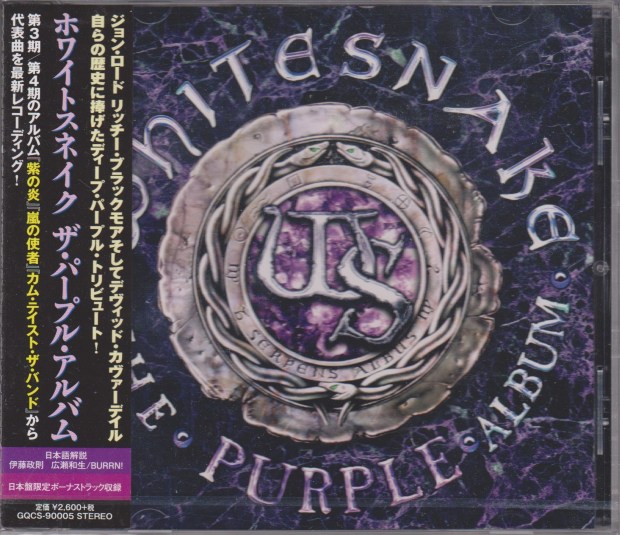
REVIEW: Whitesnake – The Purple Album (2015 Japanese & deluxe editions)

WHITESNAKE – The Purple Album (2015 Frontiers,  Japanese & deluxe editions)

One old school buddy of mine, Rob Vuckovich, was a huge David Coverdale fan back in the 1980’s, but mostly a Deep Purple fan. He took great pride in telling me that he went to see Whitesnake on the 1987 tour. He held aloft a sign that said “PLAY PURPLE”. David reportedly acknowledged his sign by saying, “We’re not doing any of that!” What changed?

Jon Lord’s dying wish to his friend David Coverdale was to somehow reform Deep Purple MkIII. “Life’s too short and too precious to hold any animosities,” learned David after Lord’s passing. He reached out to Candace Night, wife of Ritchie Blackmore, and eventually spoke to the Man in Black about a Lord-less reunion. Blackmore was intrigued and David started working on updated arrangements for the tunes. He didn’t want to sing them in the same way that he did in his 20’s. The situation with Ritchie didn’t work out, but David did not want the work he had gone to on the new arrangements to go to waste. He approached his band and asked them what they thought about a Deep Purple covers album. The response was instant. Joel Hoekstra (guitar) in particular was pumped.

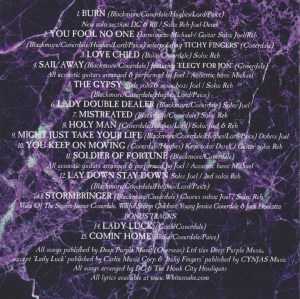
The result is The Purple Album. Sourced from Coverdale’s three albums with Deep Purple (Burn, Stormbringer, and Comes Taste the Band), 15 songs were selected. It’s hard to argue with the selection, either. There are chances taken. “Holy Man” is a damn hard song to sing, and it was originally performed by Glenn Hughes, not David. And four, count ’em, four songs (on the deluxe) from Come Taste the Band, perhaps the most underrated album in the Purple canon.

Scan_20151007 (6)

The sound is “Snaked up” as David says, which means modern guitars and technical shredding. To his credit, David really let his band play instead of copying Deep Purple. Joel Hoekstra is a hell of a guitarist, able to shred. He has brought some soul back to Whitesnake that I felt was missing from their two studio albums with Doug Aldrich. Other songs are stripped down, such as the now-acoustic “Sail Away”. This song is dedicated to Jon Lord and it’s certainly among the best songs on The Purple Album. It’s very “live” in the studio.

Is it necessary? Hell no, but David’s entitled to do what he wants. Nobody else is keeping these songs alive except for Glenn Hughes now and then. Jon Lord would be delighted with the quality of it, but he would surely be saddened that Deep Purple MkIII has never reunited. Since that was indeed the case, David and Whitesnake worked very hard on plenty of new parts and licks for their own arrangements. Reb Beach sings many of the Glenn Hughes lead vocal parts (quite well), and finally Whitesnake feels like a real band again. It’s odd that it happened on a Deep Purple cover album, but the band sound like a real band, on album for the first time in ages. Hopefully the injection of passionate young blood in Hoekstra and new bassist Michael Devin will result in new music some day.

The deluxe edition of The Purple Album comes with two bonus tracks and a loaded DVD. “Lady Luck” and “Comin’ Home” from Come Taste the Band are actually two of the best selections. It’s rare that bonus tracks are album highlights, but just because these songs are not as world-renowned as “Burn” does not mean they are not as good. They’re awesome. “Comin’ Home” is very different from the original, having a new and very Whitesnake (circa Slide It In) riff installed.

Japan usually get exclusive bonus tracks and this time it’s a different mix of “Soldier of Fortune”. The reason for the alternate mix (according to the documentary DVD, which we’ll get to) is that David was somewhat torn on which version he liked best. The original concept was a straight acoustic version, with just David’s voice and an acoustic guitar — one guitar, like in Deep Purple. That version didn’t make the album. In a last minute decision, David chose to record bass and other embellishments, and that is what you hear on the standard album. The lucky fans in Japan (or those who wish to shell out for an import!) get the original concept as a bonus track. Delightful.

The bonus DVD is a nice treat, for the 30-minute “Behind the Scenes” feature. It’s great to see the band get so much face time, talking about their love of Deep Purple. Things like this aid in your appreciation of the final album. Observations: Reb Beach does a hilarious Coverdale impression. Tommy Aldridge is still an unstoppable beast of a drummer, even today. Indeed, the new Whitesnake lineup comes across as an inspired band. It is a brand new era for Whitesnake, according to David. He is happier with their sound than he has been in years.

Then there’s the fluff, the Whitesnake EPK (electronic press kit) which is just a condensed version of the main feature. Added to this are four music videos. It’s almost amusing that Whitesnake made music videos today, but again the band get a lot of face time and that’s cool. In the music videos, it really seems like Whitesnake are a band regardless of the lineup changes. The videos are glossy, a little cheesy, but a nice little add-on.

The original rating for this album was going to be 3/5 stars. Cover albums just can’t be judged by the same yardstick as an album of original material. Having seen and heard how much passion and work Whitesnake put into The Purple Album, I’ve grown to appreciate it more. Therefore:

3.5/5 stars
REVIEW: Bon Jovi – New Jersey (Super Deluxe, part 2)

Concluding an in-depth review of the Bon Jovi New Jersey Super Deluxe edition. Previous reading:

BON JOVI – New Jersey (2014 Universal Super Deluxe edition, part 2)

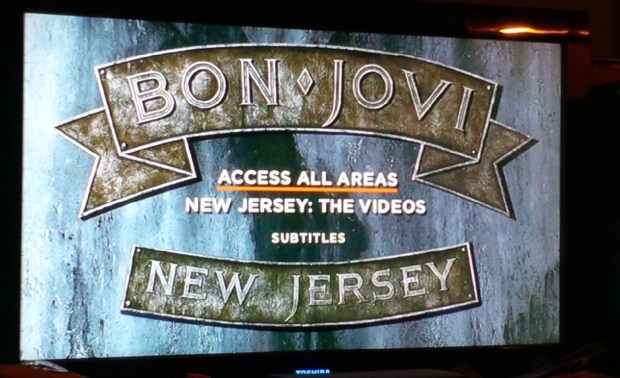
Of all the Bon Jovi albums, New Jersey certainly deserved the Super Deluxe treatment.  New Jersey‘s promotional cycle included two VHS releases, both present on this DVD: The old Wayne Isham tour documentary Access All Area, and New Jersey: The Videos.  Isham was responsible for virtually every cool larger-than-life video Bon Jovi made.  In 1988, trendy grainy black and white footage was all the rage, and so Access All Areas, where we will begin, has an over-abundance of it.

In a piece of incidental pre-show rehearsal footage, Richie Sambora sings “Purple Rain”, proving who the talent in the band always was.  It is nice though to see everybody in the band hanging out, having a good time, and seeming like genuine friends.  As for the audience, it’s amusing to see the giant hair from the perspective of today.

The sound of “Bang” by Russian metal band Gorky Park indicates we’re off to the Soviet Union.  Bon Jovi were pioneering in being one of the only hard rock bands to play behind the Iron Curtain (they were officially sanctioned by the government), and this part of the show is certainly the most interesting.  Bon Jovi even have a ten-man blues jam with the Russian band, building bridges at the end of the Cold War.  The blues is universal.  This visit leads to the massive Moscow Music Peace Festival, which I had on tape from MTV, and wore completely out.  (Not shown: the backstage moment when Tommy Lee rips the shirt off Bon Jovi manager Doc McGhee’s back, for allegedly upstaging Motley Crue by using fireworks in Bon Jovi’s show, against prior agreement.  It’s a long he-said she-said story involving McGhee who was managing both Motley and Bon Jovi at the time.  Motley felt McGhee had prioritized Bon Jovi, and fired him immediately after.)

The boys have a blast in the warmth of Rio de Janeiro, quite a contrast with snowy Moscow.   In Tokyo they are chased by a swarm of screaming girls.  Through it all, even though they’ve been on the road forever and can’t wait to get home, they maintain themselves with a lot of joking around.  Fortunately Isham captured this endearing footage.  The live rehearsal stuff is also excellent, up close and in the faces of the band.

In a very cool moment backstage at Wembley, Bon Jovi, Cinderella and the Scorpions work on covers together for a big jam.  “Travelling Band”…holy shit, is that Elton John on piano?  Sure looks like it.  Rick Allen, Brian May, Lita Ford!  “I am the happiest kid on Earth!” shouts an excited David Bryan.  Another gig features Bon Jovi with the late comedian Sam Kinison on “Wild Thing”.  At Tower Records, they are threatened with arrest by the riot squad if they perform, so naturally Jon and Richie break out the acoustics and do “Ride Cowboy Ride”.  In swoop the fuzz, who had nothing to worry about.  Alec John Such’s birthday is celebrated in West Berlin, where they visit the wall.  (In a shivery moment, Jon is eyeballed by an East German soldier on the other side.)  Their cover of “The Boys Are Back in Town” is performed, and Jon takes a chip out of the wall.

Jimmy Page is present at a three hour charity gig at Hammersmith, and they jam on “Train Kept a Rolling”.  (Best moment: when Jon sings a Steven Tyler “wha-ga-ga-ga” in it near the end, just like Tyler did in Aerosmith’s version.)  It’s clear that even then Jon was the boss — he alone makes the setlist, and says if something goes wrong he’ll call the shots.  He comments he has “never been so nervous.”  Bad Company’s “Shooting Star” is a duet with Richie Sambora, who had been playing it long before Bon Jovi formed.  It’s a stunning version and it’s hard to imagine Bon Jovi ever doing anything this big again, both in terms of success and quality.

Australia!  “Bon Jovi: We go everywhere, but we live nowhere!” says Sambora.  “Love For Sale” is played at HMV for swarms of long-hairs both male and female (but mostly female).  Sam Cooke’s “Having a Party” is another incredible cover selection, and you have to give Jon credit for that.  The final show is a big multi-gig stand in Guadalajara, Mexico that almost never happened due to “politics” (money) and a riot!  The first gig is postponed to the next day forcing Bon Jovi to play a double-header starting at 11 am!  “We should go on stage in riot gear,” jokes (?) Jon.  (They don’t.)

Access All Areas was a good rock doc for the time.  It feels whitewashed and scrubbed clean of blemishes, but that was music in general in the late 80’s.  The real pleasure is getting to see the other band members hanging out.  Alec John Such seems a funny, talented guy with a great voice.  David Bryan is clearly a lot more gifted than he gets to show off in the band.

The music videos (only mixed in stereo, unfortunately) are all you remember them to be: more mixtures of black & white, and colour footage, golly!  Both versions of “Bad Medicine” are included.  (More Sam Kinison!)  There are funny interludes with the band in between the songs, joking around back stage.  (Special guest: Skip Rope Skid Row’s Dave “Snake” Sabo.)  “Me, if I wasn’t a musician, I’d be a drummer!” says Jon. Of the music videos, “I’ll Be There For You” and “Lay Your Hands On Me” are the coolest, just no-nonsense stage performance clips.  “Blood on Blood”, which I’d never seen before, is a live version.

The DVD portion of this box set is a nice supplement, but you won’t be in a hurry to sit down and watch again.  The black & white/colour back and forth is very tiring.  Fortunately Bon Jovi seem(ed) like a nice bunch of guys from the neighborhood that have loads of talent, and fun to watch in any setting.

DVD: 3/5 stars
Bonus tracks: 4.5/5 stars
Album: 4.5/5 stars

Overall rating:  4/5 stars

Thanks for joining us for this massive review! Back to something else tomorrow.

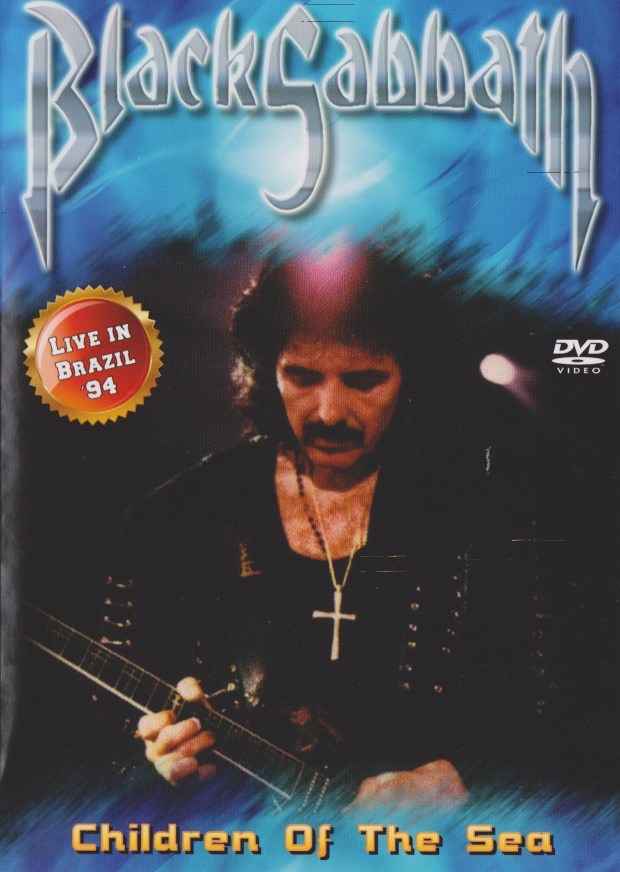
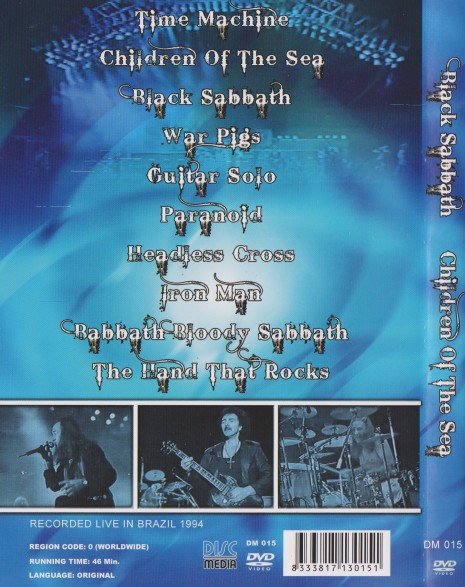
DVD REVIEW: Black Sabbath – Children of the Sea – Live in Brazil ’94

Scan_20150927BLACK SABBATH – Children of the Sea – Live in Brazil ’94 (Disc Media)

The Cross Purposes tour was not a happy time in Black Sabbath.  Geezer Butler had felt that this band (featuring himself, Tony Iommi, Tony Martin, and new drummer Bobby Rondinelli) should have had a new name and not been billed as Black Sabbath.  Rondinelli left mid-tour, so Tony and Geezer called up the original Sabbath skinsman Bill Ward.  With this historic lineup, 3/4 of the original band were intact (the same ratio as today’s Sabbath).  They went to South America to play five shows.  Then Butler quit after a furious standoff with Iommi.

This broadcast footage is all that remains of this very short-lived lineup of Black Sabbath.

The set opens with “Time Machine”, a Dio-era song that neither Tony Martin nor Bill Ward originally appeared on.  The sound is pretty horrendous, coming in slightly better than bootleg quality.  The crowd noise is too high, and the backing keyboards of Geoff Nicholls actually drown out the lead guitar.  Nicholls’ backing vocals are also more audible than they should be.  As a frontman, Martin does his best, which involves spreading his arms wide and shaking his hair.  A long haired Ward has a completely different rhythm on this track than Vinnie Appice gave it.  Another Dio number is next, “Children of the Sea”.  Ward at least played on this Heaven and Hell classic.  Haters would be critical of Martin’s version of Dio songs, but Dio quit. Ozzy wasn’t ready to come back.  Iommi carried on, and that’s how it went down.  Martin had to sing the old songs to the best of his talents and he helped keep the ship afloat during these difficult years.  Having Bill Ward on this track lends it a required authenticity.

There are certain songs that Sabbath has never dropped from the set, that are very difficult for most singers to perform.  “Black Sabbath” is top of the list.  Ozzy’s possessed original can never be duplicated or imitated.  A big part of that, however, is that Bill Ward’s primitive drum fills were such a big part of it, and Bill’s back on this one.  With 3/4 of the original Sabbath there, this version actually works out.  It’s one of the most true to the original of the versions released by any post-Ozzy lineup of Black Sabbath…except it is edited!  It halts abruptly at the half-way point, to awkwardly go into “War Pigs”.  This concert was clearly cut down to fit into a one hour (with commercials) time slot.  Why half of “Black Sabbath” was sacrificed instead of something else, I don’t know.  Shoddy.  At least “War Pigs” is intact, with Bill (shirtless now) providing the loose backbone it always had on album.  It acquires a jazzy feel during the slow outro.

Iommi gets a guitar solo (could have edited this out instead of “Black Sabbath”, but what do I know?) which has shades of “Too Late” from Dehumanizer.  Then it’s “Paranoid”, with Bill behind the beat as it should be.  Martin bites into every word, doing a fantastic job of it.  I have several live versions of Martin doing “Paranoid”, but this one is the best and most true.

When it’s time for “Headless Cross”, the rhythm section are not the ones who recorded it (Lawrence Cottle on bass and Cozy Powell on drums).  It’s weird to think of Bill Ward playing drum parts that Cozy Powell wrote.  Geezer sounds more at home, and is able too bring his trademark slink to the bass.  Offstage, Geoff Nicholls quite obviously provides the high notes in the chorus that Tony Martin can no longer hit, whether by voice or sample I do not know.  There’s another awkward edit into “Iron Man”, a song most singers except Ozzy struggle with.  This could have been excised.  We finally blast into “Sabbath Bloody Sabbath”: better, even though nobody can hit the unholy notes that Ozzy did on the studio version.

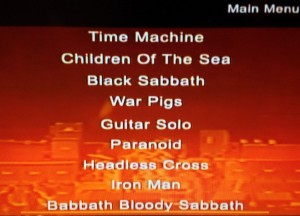
That’s the last track..  The back cover claims that “The Hand that Rocks the Cradle” is next, but there is no such track.  Bastards!  To compound the error, they got the song title wrong by just having “The Hand that Rocks”.  Not that this is the only mistake on the track list.   “Babbath Bloody Sabbath” is pretty funny, especially since this title carried over to the song menu on the DVD!

SABBATH COTS

Wardrobe wise, I like Geezer’s sweater with the crosses on it; that’s nice.  Tony Martin has a cool, steel plated leather jacket, which looks as if raided from Rob Halford’s closet.  Iommi sports silver cross center-chest, while Bill Ward is right out of 1975 with the long hair and track pants.

There are issues with the audio sync on this DVD, probably originating from the broadcast but carried over even though it would be easily fixed.  Sloppy release.  I’m sure that this is ripped from a VHS recording of the broadcast, due to the obvious spots where commercial breaks are edited out.

Maybe the original uncut tapes are out there somewhere. If so, somebody should release them.  This concert could have been a great little DVD release, but the various audio and editing flaws make it a difficult viewing.

2/5 stars

Scan_20150927 (2)