Epic

REVIEW: Pretty Maids – Red, Hot and Heavy (1984)

Thank you to Thor Blackmore for this CD!

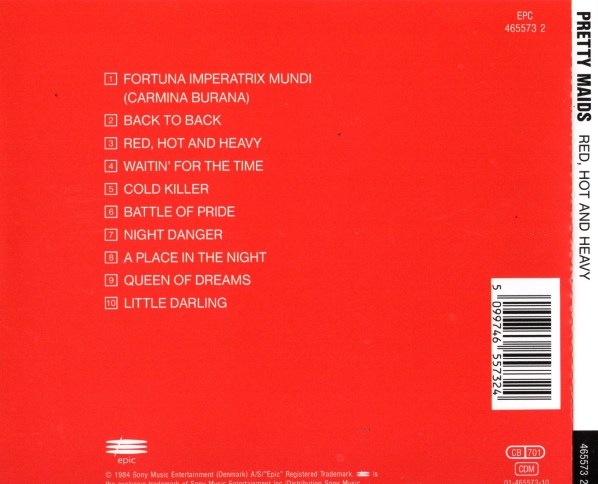
PRETTY MAIDS – Red, Hot and Heavy (1984 Sony)

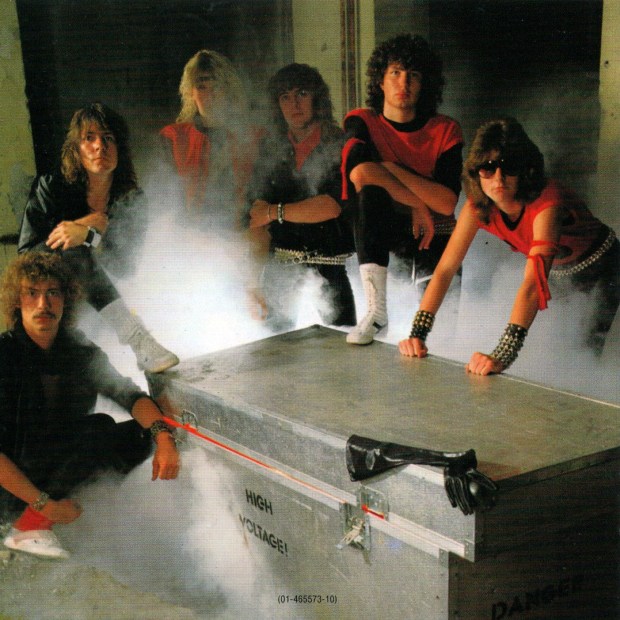
I ignored Pretty Maids when I first heard of the band.  “Pretty Maids?  What kind of name is that?”  Shallow kid stuff, but impactful, because now in 2024 this is my first real listen to Pretty Maids with intent.  Red, Hot and Heavy was the debut album for the Danish hard rock band, after a self-titled EP in ’83.  The six-piece band had some moderate success with the album, so let’s have a listen.

Opener “Fortuna Imperatrix Mundi” is actually an excerpt from Carl Orf’s “Carmina Burana”, and is credited as such on the back.  It’s just a few seconds.  The real opener is “Back to Black”, a scorching metal number with tempo and riffs sharpened and at the ready.  The raspy vocals of Ronnie Atkins differentiate the song from the works of other metal groups such as Iron Maiden and Judas Priest.  The keyboards give a highbrow neo-classical vibe.  It’s heavier and fuller than Dio, but with all the drama and guitar solo shenanigans.

The title track is slower and nastier.  A rallying cry for metal heads, “Red, Hot and Heavy” doesn’t pretend at being anything more than it is.  A slow metal banger, perfect for fist-pounding and shouting along with at the concert hall.  The shout chorus is custom made for the stage.  The duel guitar solo is pretty cool.  A stock metal chugger, but there is a need for a drum-bashing, stompy riff-rocking concoction such as this.

The highbrow keyboards return on “Waitin’ for the Time”, a very European sounding song which builds from a ballady opening to an upbeat pounder.  Sounds a bit like the Swedish band Europe during their Wings of Tomorrow era, with a hint of Def Leppard in the riff.  It’s an excellent song with light and shade, and a complete musical journey without exceeding five minutes.

“Cold Killer” begins with news broadcast dialogue, and then goes in a fast and ominous music unlike the other songs.  The rather clunky lyrics are about the weaponization of space, a hot topic in 1984 with Reagan’s “Star Wars” program in the nightly news.  But…clunky.  “There should have been a paradise, instead there’s a killer out in space.”  We’ll give them credit for trying at least, which is more than could be said for many bands of the 80s.  Musically it’s a terrifically fun ride through sweet guitar riff and solo action.  The keyboards add a progressive vibe, though some might say pretentious.

The anti-war theme flips over onto side two, with “Battle of Pride”.  Again, it’s not poetry, but the lyrical theme was very popular in metal at the time.  Musically it’s a fast Dio-like rocker with the keyboard accents giving it a different flavour.  Ronnie Atkins’ rasp continues to separate Pretty Maids from other bands, but by the time we hit side two, the ear is craving more variety in the voice.

“Night Danger” is a pure blitzkrieg, now more in the wheelhouse of a band like Accept.  These guys are not slouches when it comes to riffs over 80 mph in speed.  The irony is that, even at that speed, the song doesn’t really go anywhere.  It’s speed for its own sake, and that’s actually fine, because it’s plenty fun and doesn’t need to be anything else.

Acoustics join the electric guitars on “A Place in the Night”, one of the most impressive songs on the album.  Mid-tempo melodic rock, and dialing down on the vocal growls, is exactly what the album needed at this point.  The chorus explodes with passion and power at the right moment.  The keyboards add to the mixture by thickening up the melodic accents.  Brilliant deep cut late in the album.

“Queen of Dreams” has an Yngwie vibe again, though Malmsteen wouldn’t put as much emphasis on the other instruments.  The keyboards add a regal synth-trumpet sound over the guitars, but when the drums kick in, there’s no nonsense.  It’s that kind of metal that is obviously influenced by Deep Purple and Blackmore’s Rainbow, but amped up for the 80s.

The surprise is the closer:  a cover of Thin Lizzy’s single “Little Darling”.  Formerly a horn-laden rock classic, Pretty Maids heavy it up a bit and increase the tempo.  Though “Little Darling” will always be a personal favourite, I don’t think Pretty Maids did it any favours.  Their backing vocals are too shrill for the chorus, and without the horns, it loses that something special.  A swing and a miss for Pretty Maids, which is terribly unfortunate.

Red, Hot and Heavy is a strong debut.  Obviously the band grew and expanded their sound, and still continue today.  This is the foundation.

3.5/5 stars
REVIEW: Joe Satriani – Surfing With the Alien (1987, 1999 remaster, 2017 RSD 2 LP reissue)

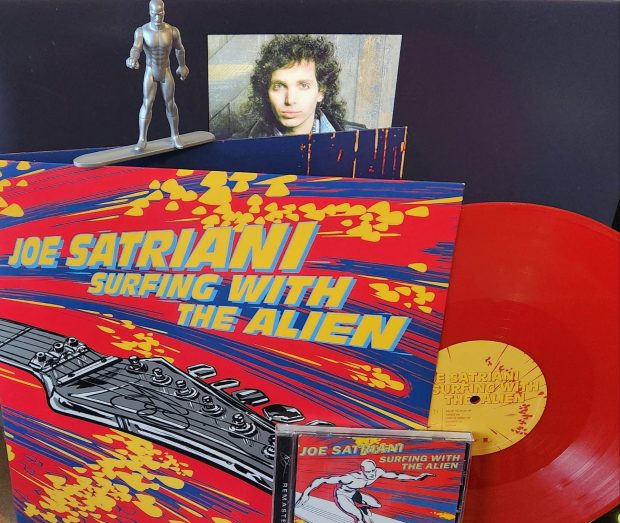
JOE SATRIANI  – Surfing With the Alien (1987, 1999 Sony remaster, 2017 RSD Epic 2 LP reissue)

On October 15 1987, the face of rock music was  shaken when a little instrumental album called Surfing With the Alien started making waves.  The record eventually went platinum, and its songs found itself used on radio and TV for decades to come.  Why?  Possibly because of Joe’s impeccable attention to songwriting.  Though his guitar playing put him on the map, it was his knack for writing catchy rock songs that made this album so special.  Satriani’s songs are written as if the lead guitar is the lead singer.  There are verses and choruses, and attention to structure and melody.  That must be why Surfing With the Alien was nominated for two Grammys in 1988.

Opening with the title track, a striking little chugging riff starts the show.  But then Joe’s melodic lead guitar kicks in, and you realize it’s exactly like if a singer was leading the show!  You can literally sing along to Joe’s guitar and a little wah-wah effect doesn’t hurt.  And then the shred begins, and you feel like, “OK, I get it now.  This guy is an actual genius.”

Yet it’s all accessible.  He may throw in licks as fast as greased lightning, but you can still follow.  Your brain still picks out notes and melodies that satisfy those musical needs.

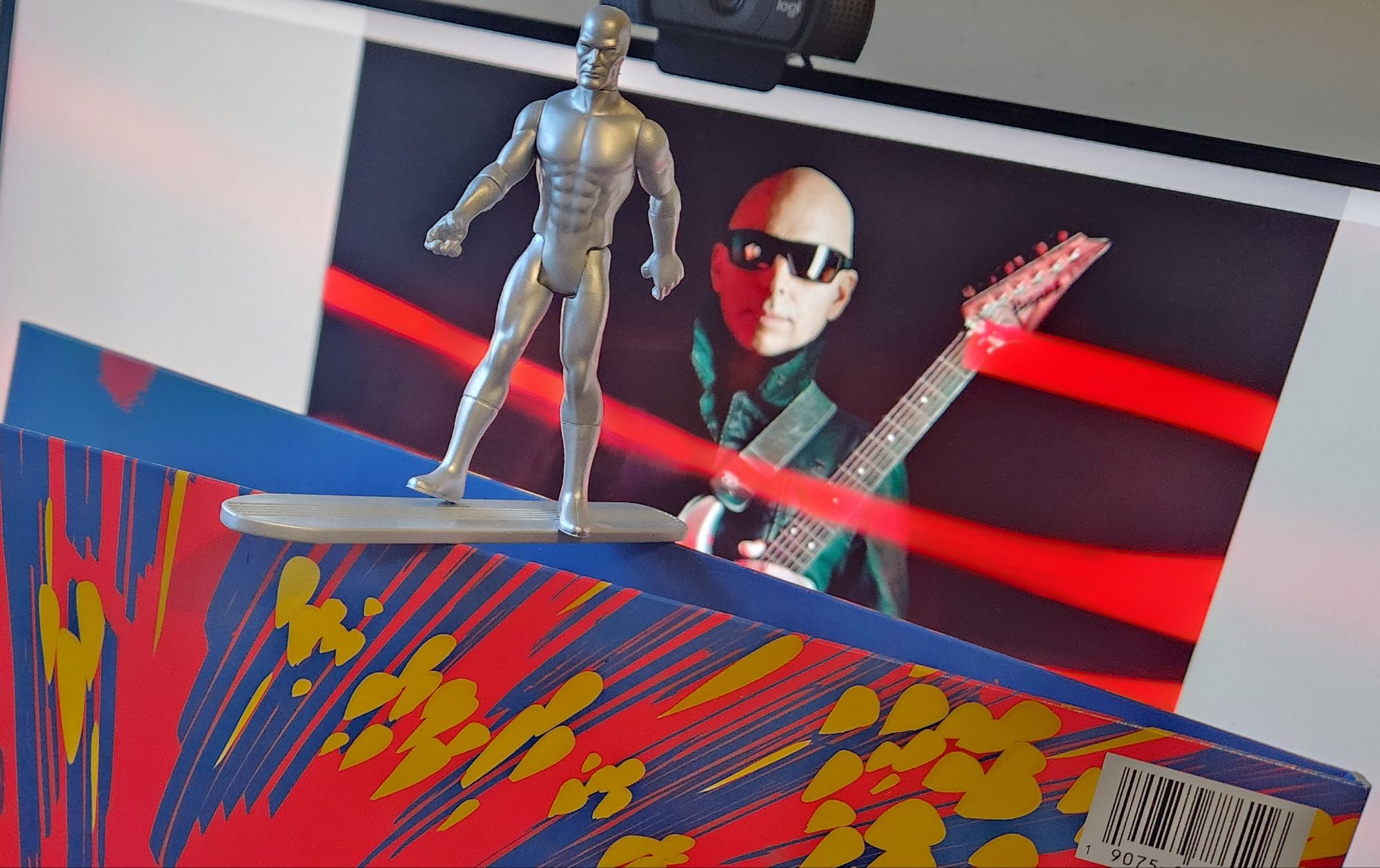
The cool “Ice 9” is a funky groove (Joe on bass) with a slick melody on top.  Joe can work with mid-tempo grooves just as well as high-speed blazes.  Solos with different sounds and guitar tones add diversity.  A fun tune, but the third song “Crushing Day” has more tension and urgency as the tempo is turned up once again.  The variety of solos, melodies and riffs in one short song is quite remarkable.  Joe’s guitar tone is bright and shimmery, like the Silver Surfer himself.

Incidentally, regarding the striking album cover featuring the titular Marvel character from Silver Surfer #1 (1982), Joe lost the licensing for him at some point in the 2000’s.  This is why the 2017 RSD reissue has different artwork, without him.  (Look carefully at the new art, and you will see that they replaced the yellow streaks with yellow guitar picks!)  Hopefully Joe doesn’t feel too badly about losing the Surfer art.  Marvel comics repaid him for the popularisation of the character outside the comic world by naming a planet after him.

The beautiful ballad “Always With Me, Always With You” might be considered the most famous song.  It received three Grammy nominations in three separate years (live versions, you see) and was prominently featured in an American Dad episode.  It is hard to describe exactly what makes it so special, without you listening for yourself.  The guitar is lyrical and memorable, and it worked so much better than it would have with a lead vocal.  This is an instrumental ballad, made magical.

“Satch Boogie” is arguably just as popular.  Deep Purple played it during the brief period when Joe Satriani was in the band post-Blackmore and pre-Morse.  It has been used on TV, radio and video games.  It is indeed a boogie!  It taps into the Van Halen vibe a-la “Hot For Teacher”, but burns straight through without stopping to talk.  Mid-song, there’s a jaw-dropping solo that is pure tapping nirvana.

An ominous and brief interlude (“Hill of the Skull”) paints an apocalyptic picture.  The programmed drums don’t detract, as it is all about the tale that the guitar is telling, with layered wails.  This serves to set up “Circles”, one of the most interesting tracks.  Echo is employed to great effect on this mellow but dark ballad.  Without pause, the striking chimes of “Lords of Karma” enter the picture, a pounding guitar rocker with drums by Jeff Campitelli.  (Drums on this album are a mix of live and programmed.)  Much like “Crushing Day”, “Lords of Karma” is a bit faster and more intense.

A lovely classical sounding interlude called “Midnight” sets up the final track.  “Midnight” features techniques that an expert will have to identify, except to say it sounds remarkable and innovative.  The spotlight is never really on Joe’s fingers though – just on the notes and sounds he magically produces with them (and an array of effects).  Then the thud of bass opens “Echo”, the last song on this important album.  It’s unlike the previous ones, with the bass so prominent.  The song sounds as if it’s always just bubbling under.  Perhaps it would come as a surprise that the final song on this album of guitar showcases is so much about feel and restraint.

That’s one thing about Surfing that does make it special.  Like any good album, it is sequenced as a full listen, not as a collection of shreds.  Even without the shreds, it’s still not bad.

That’s what the 2017 Record Store Day deluxe vinyl edition is all about.  A bonus LP is included, with all the lead guitar stripped off.  This allows you, the ambitious home player, to try to solo over the bed tracks.  For the rest of us, it just allows us to listen a little bit differently to an album that is very familiar.

The drums seem more prominent on the title track, allowing us to better hear Jeff Campitelli’s fills.  Mostly though, you can still bang your head, and maybe sing along to an imaginary vocal melody.  “Ice 9” is particularly fun in this guise, sounding a bit like an “80s dance remix” even though it’s not.  “Always With Me, Always With You” is still delicate and beautiful.  You get the picture.  These tracks, though needing the lead guitar to be whole, are perfectly listenable without.  Only “Circles” and “Midnight” seem completely barren.  You don’t have to be a guitar player to enjoy this bonus record.  You just have to be interested in music, and how it is constructed in the mix.  You can hear melodies and accents, even on “Always With Me”, that you might have missed on the album version all these years!

There are many ways to acquire copies of this impactful album, that opened the charts to Steve Vai and others a few years later.  There is a 1999 Sony remaster with liner notes and nice packaging.  There is a deluxe edition with a live DVD from the 1988 Montreux Jazz Festival.  The version with the most actual audio tracks, however, is the limited 2017 Record Store Day reissue.  You don’t get the lovely Silver Surfer artwork, but you do get the bonus record of stripped tracks, and red & yellow coloured vinyl.

No matter what choice you make, Surfing With the Alien in any form is an essential addition to a serious rock fan’s collection.  Some may argue it’s the best rock instrumental guitar album ever made.

5/5 stars


REVIEW: Judas Priest – Invincible Shield (2024 Deluxe with bonus tracks)

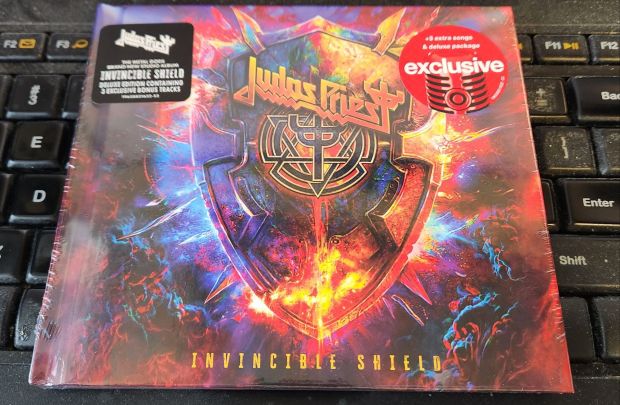
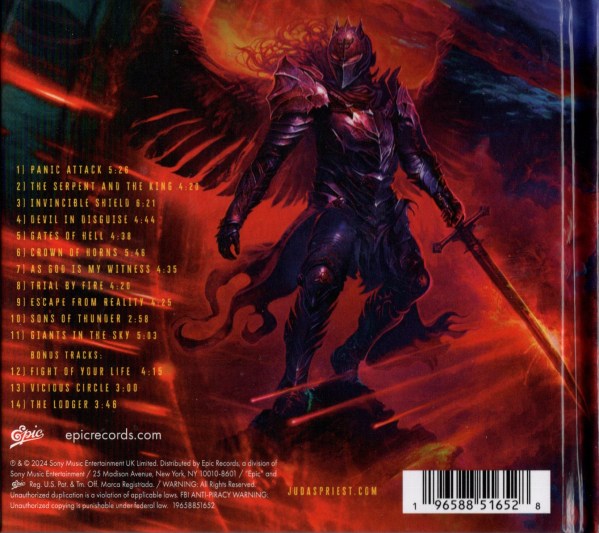
JUDAS PRIEST – Invincible Shield (2024 Epic Deluxe with bonus tracks)

I don’t usually write “first impressions” reviews, because I like the albums to have time to sink in, and to consider my opinions.

I’ll break some rules this time.

Invincible Shield tops Firepower and could be the best Priest album since Defenders.  Or maybe even before that…

The highlights are many and the riffs are strong.  Rob’s voice has not changed in 20 years and he is still of the same power and range as Angel as Retribution.  As one goes deeper in, the songs continue to gain strength.  “Invincible Shield” didn’t really jump out at first, but does now with a very Maiden-y outro.  “Devil In Disguise” is another early highlight.  “Crown of Horns”, “Escape From Reality”, “As God is My Witness” are instantly likeable, with hooks aplenty and the odd adventurous lick or detour.  Richie Faulkner has been a godsend to this band, injecting them with new songwriting life, metallic riffs and speedy leads.  Meanwhile, you can hear Glenn Tipton too, illness be damned!  He trades off with Faulkner just as is Priest’s trademark.  The classical guitar solo on “Giants In the Sky” is something completely new for this band and a surprising delight.

Invincible Shield has most of the longer material stacked to the top of the album, with the short songs going on side two.  Even with 14 songs, the album is only just over an hour with bonus tracks, not overstaying its welcome, and inviting to repeated listens.  There’s no point in getting a version of this album without the bonus tracks.  You’d be missing out.  You can get them at Target, Sunrise, or Amazon in Canada.  They are “Fight Of Your Life”, “Vicious Circle” and “The Lodger”.  “Fight Of Your Life” might be the most necessary song of the album, as it really hearkens back to the early 70s albums like Sin After Sin.  It could be the deep cut of the record.

Lyrics have always been a shaky point in Priest history, and there are some cringey ones on Invincible Shield, but I doubt they will impede anyone’s enjoyment of this album.  It has summer written all over it, as we await the coming of the sun and the highway months.

Production by Andy Sneap sounds great to these ears, with Ian Hill’s bass rich and deep, and Scott Travis’ drums livelier than ever.  There are flashes back to the 70s and 80s, and some of Priest’s highest peaks of the past.

Martin Popoff may be right, but I’m not going as far as he did.  Still…

Album of the year.

5/5 stars

REVIEW: Ozzy Osbourne – Patient Number 9 (2022)

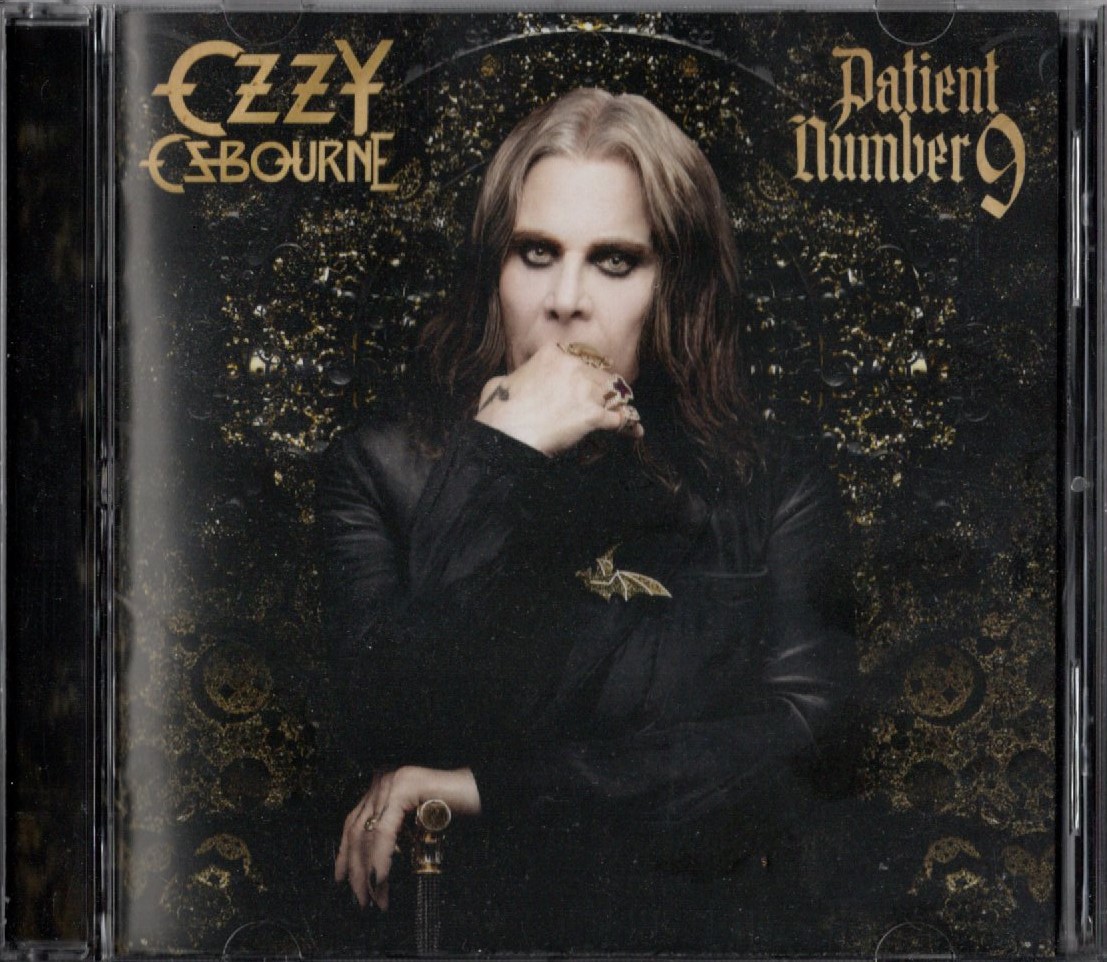
OZZY OSBOURNE – Patient Number 9 (2022 Epic)

It’s very easy to be cynical about any new Ozzy album since about Down To Earth and onwards.  Corporate constructions.  Special guest writers and performers. “Here Ozzy, sing these new songs we wrote for you.”  Prior to that, it felt like Ozzy had a band, and that band took different directions on each album.  Now Ozzy has Andrew Watt and a slate of big-namers.  It’s been this way a while.  This time the difference is, the process resulted in a pretty decent album.  Sure it’s still Watt at the helm, with special guests in big letters on the back cover and front stick.  Jeff Beck!  Eric Clapton!  Tony Iommi!  Zakk Wylde!  Of course without a real band, you don’t get that cohesive band sound, but what you do get ain’t bad indeed.

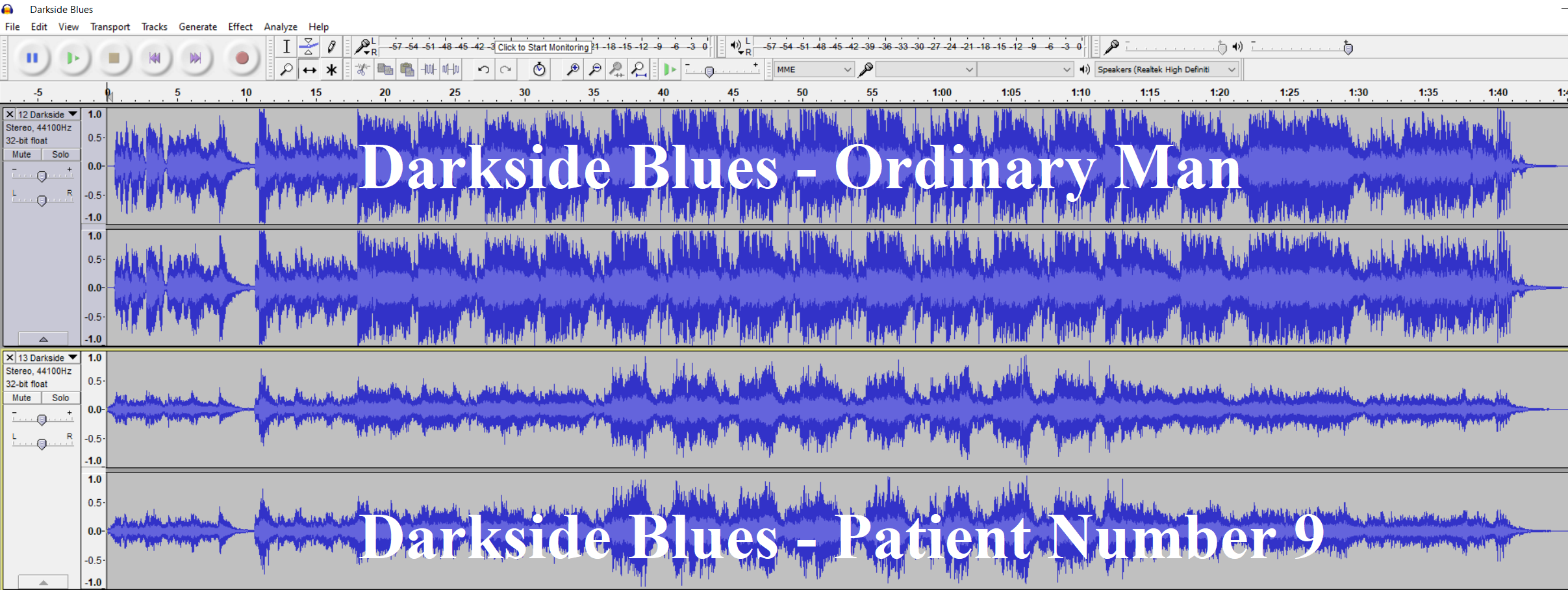
Each track (except for “Darkside Blues” which is either a new version or a new mix of the Japanese bonus track from Ordinary Man) has credits by Andrew Watt and professional songsmith Ali Tamposi.  She’s more known for Kelly Clarkson, Nickelback, and a slew of Justin Bieber and Miley Cyrus hits.  She also co-wrote most of Ordinary Man so there’s a formula at work here.  Other co-writers include Ryan Tedder, Duff McKagan, Chad Smith, Robert Trujillo, Tony Iommi, Chris Chaney, and the late great Taylor Hawkins.

Ozzy falls into his comic horror persona a bit too much.  There was once a time when he was trying to shed that “crazy madman” image but he’s really leaned into it again for the last couple decades.  As such the album opens with silly “insane asylum” sound effects that only delay us getting to the good stuff.  The opening title track is over seven minutes long with that nonsense attached.  It’s also one of the poorer of the new songs, overly formulaic and modern with robotic hooks.  Jeff Beck’s unconventional and slippery solo work makes it worth a listen (Watt and Wylde play the rhythm and fills).

Things really get moving on track two, “Immortal” featuring Mike McCready of Pearl Jam and Duff on bass.  Good riffing and grooving going on here, and the first memorable chorus.  The Hawkins co-penned “Parasite” is another grooving highlight, featuring the Foo Fighter on drums.  The chorus is really solid and just moves like a ‘Vette on the highway.  That’s Zakk on lead guitar, but he’s instantly recognizable.  Former Ozzy bassist and currently Metallicer Rob Trujillo on bass.

What’s really amazing is that with the help of Tony Iommi, this hodge-podge of creators managed to write a seriously Sabbathy dirge called “No Escape From Now”.  You’d swear it’s Geezer Butler on bass, but it’s not.  It’s actually Watt.  It’s as Sabbathy, if not more so, than most of the 13 album.  It feels a bit “token”, like, “Oh hey Sabbath fans, here’s a song with the riffs and time changes that you like.”  Yet it’s one of the songs you’ll keep returning to, and probably for those reasons.  Of note, this is the only song without Andrew Watt on rhythm guitar.  It’s all Tony and only Tony which is the reason it feels heavy as a bloody brick.

In a throwback to Ozzmosis, “One of Those Days” with Eric Clapton really sounds a bit like “I Just Want You”.  Clapton really adds a touch of class.  One could imagine that the chorus will upset certain people with it’s refrain of “I don’t believe in Jesus”, but it is one hell of a chorus – pun intended.  Unfortunately the ballad that follows, “A Thousand Shades”, is a throwaway, aside from the brilliant Jeff Beck guitar solo.  One of the Hawkins co-penned tracks called “Mr. Darkness” takes a minute to get going, seemingly a song about fan letters that Ozzy once received.  It and the next two songs all feature Zakk Wylde on guitar.  Dull verses, but awesome chorus, with an awesome Sabbathy change towards the end.  The only dumb part is the silly ending where Ozzy speaks, “You don’t even know my name you asshole.”  Just…no.

“Nothing Feels Right” is another ballad, very Ozzmosis-y.  Decent song, good chorus, with all the production bells and whistles.  It really smokes during the solo section.  Another Sabbathy sounding riff emerges on “Evil Shuffle” and it really seems clear that Andrew Watt is trying to channel Geezer Butler’s bass playing on this album.  Not that it’s a bad thing.  Then it’s the much-hyped “Degradation Rules” with Tony Iommi, a song about masturbation, but not as good as the prior Iommi song.  The main hook here is Ozzy’s harmonica playing, a great throwback to “The Wizard”.

“Dead and Gone” is a deep cut highlight, with a latter-day Priest-like groove and lots of Zakk Wylde chunk.  An album highlight buried way in the back end.  Finally, “God Only Knows” is the last proper song, but unfortunately sort of a last gasp rather than a late highlight.  Kind of a ballad, with lush backing vocals, but not a “Road to Nowhere” kind of late album winner.

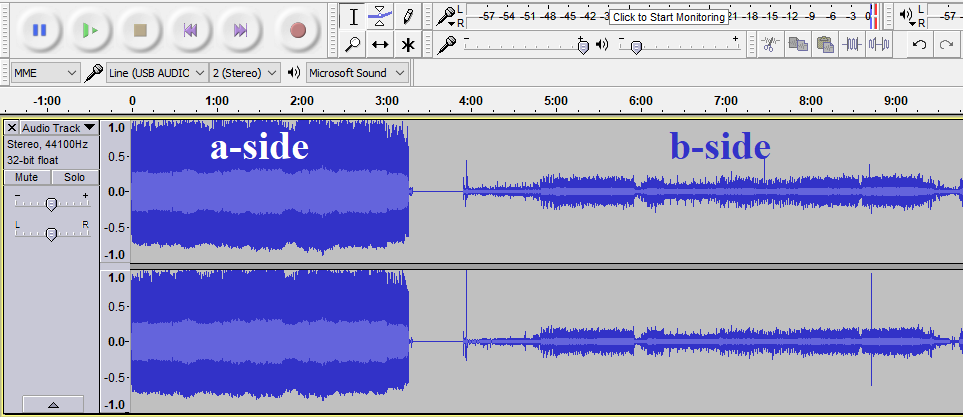
The outro music, “Darkside Blues”, appears to be a remix of the original version from Ordinary Man‘s Japanese release.  You can compare the waveforms below.  It’s a swampy track with more of Ozzy’s harmonica, just a coda to the album.

It’s pretty amazing at this stage of the game that Ozzy is still cranking out new music, but of course he has a huge support team behind him.  This time, the team produced an album better than the last one by a pretty fair margin.  They could have cut two tracks and made it a more engaging and concise listen.  It’s always a balancing act between giving the listener added value, or a streamlined experience.  A minor quibble at the end of the day.

3.5/5 stars

REVIEW: Faith No More – “From Out of Nowhere” (1990 UK 3 track 7″ single)

FAITH NO MORE – “From Out of Nowhere” (1990 Slash records 3 track 7″ single)

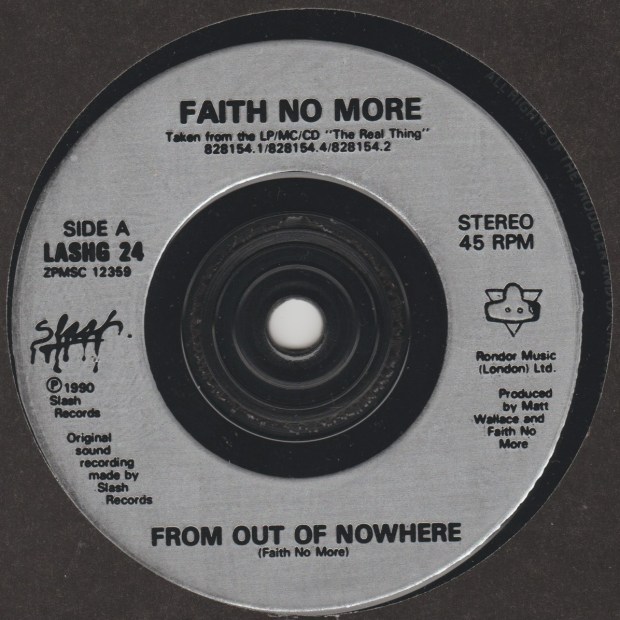
When I was beginning to seriously collect Faith No More in 1991 onwards, I had no idea what was out there.  I found the UK 7″ single for “From Out of Nowhere” at a record show in Guelph.  There are different versions of this single out there with “Cowboy Song” on the B-side, but that track can also be found on Live at the Brixton Academy.  The UK single on Slash/London has two live tracks you can’t find anywhere else, recorded by the BBC on March 2 1990.  Shortly after “Epic” was released as a single, but before it went mega.

The problem is, with 10 minutes of music squeezed onto the B-side, this single sounds horribly thin and is ridiculously quiet.  Tons of surface noise too.  The A-side, which spins at 45 rpm, is better.  Have a look at the unaltered waveform in Audacity for comparison.

Faith No More didn’t truly make it big until the end of the (first) vinyl age.  The album version of “From Out of Nowhere” was always an excellent song; one of their most “mainstream” if you can call it that.  The keyboard hook is the main angle, and Patton’s notable for using that clean nasal voice he discontinued not long after.  An excellent song, and a cornerstone of any nutritious Faith No More collection.

The B-side, the exclusive live recordings, rotates at 33 1/3 rpm.  Captured in Norwich, “Woodpecker From Mars” is Faith No More’s instrumental classic led by a keyboard violin voice by Roddy Bottum.  There is a different performance on a home video called You Fat Bastards (which is the complete Brixton set) but nothing else on audio.  “Epic” is disappointingly edited by the BBC.  They obscure the line where Mike Patton naughtily sings “get down on it and fuck it some more.”  The band sound fresh and almost green with enthusiasm for the song, playing it a bit more straight than they would later on.

On the plus side, this single comes packaged in a gatefold sleeve, a rarity for 7″ release.  Inside Mike Patton is givin’ ‘er live on stage.  Some kids probably taped this to the wall as-is.

In short, the music is great.  The vinyl is not.

2.5/5 stars

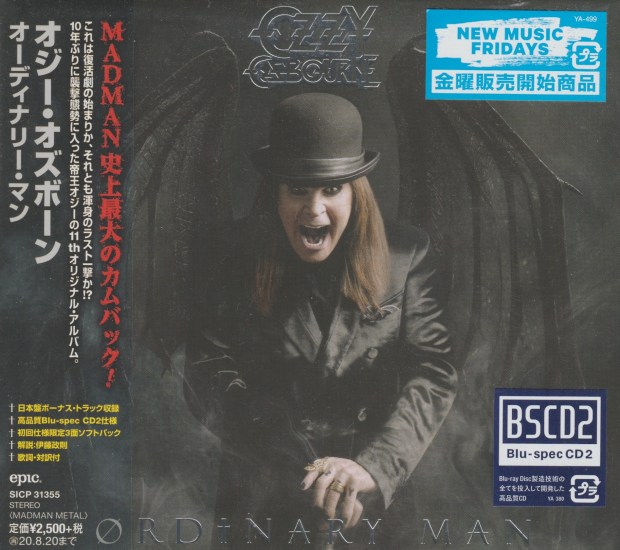
REVIEW: Ozzy Osbourne – Ordinary Man (2020 Japanese import)

OZZY OSBOURNE – Ordinary Man (2020 Epic Japanese import)

Expectations were low at LeBrain HQ for a new album by Ozzy Osbourne.  In that regard, Ozzy delivered.  Ordinary Man is an ordinary album.  It is Hard Rock 2020 distilled down to 50 minutes.  Nothing on this album comes close to challenging anything from the first six Ozzy albums.  It’s most comparable to 2001’s Down to Earth, an overly-modern affair put together by suits.

This time out, the suits assembled a band consisting of Duff McKagan (GN’R) on bass, Chad Smith (RHCP) on drums, and Andrew Watt (California Breed) on guitar.   These guys, plus a smattering of strangers, are responsible for the songwriting.  The melodies are very deliberate and calculated rather than natural sounding.  While things with Zakk Wylde were getting stale, at least Zakk tried to keep Ozzy on track.  I’m not sure Ozzy is on track here.  “I’ll make you scream, I’ll make you defecate.”  Who wrote that?

The glossy production covers up some pretty stellar playing.  Watt is fantastic when soloing, but sounds a bit like he’s trying to ape the Zakk vibe.  In the vocals department, you can hear some telltale signs of autotune, which I guess is OK now in 2020.  If Paul Stanley can lipsynch live and get away with it, then Ozzy can autotune his albums.  I suppose.

Some of the better tracks include the ballads, and the surprising “Scary Little Green Men”.  This one features some awesome lickity-licks from Tom Morello.  Slash appears elsewhere, not sounding at all like Slash.  The single “Under the Graveyard” is not bad.  The worst track has to be “It’s a Raid”, possibly an outtake from Blink 182’s Neighborhoods CD.

Elton John sings on one track, and it’s not bad at all, sounding like a classic Ozzy ballad from the 1990s.  I didn’t recognise Reginald Dwight’s voice at first.  It’s deeper these days.  Regarding Post Malone, he’s fine, has a decent voice albeit also autotuned.  I don’t know what the guy sounds like without enhancement, but he sounds like he’s probably a better singer than Ozzy recently.  I could do without his song “Take What You Want”, but at least the Japanese edition of the album ends on a better note.  A blues track called “Darkside Blues” is brief, but actually sounds like something more real, more genuine.

Think about your favourite Ozzy albums.  How often to do you spin Blizzard, Diary, or Tears?  Now think about how often you play Down to Earth, Black Rain, and Scream.  In two years’ time, you’ll be spinning Ordinary Man about as often as Black Rain, but you won’t be getting Wylde.

2/5 stars

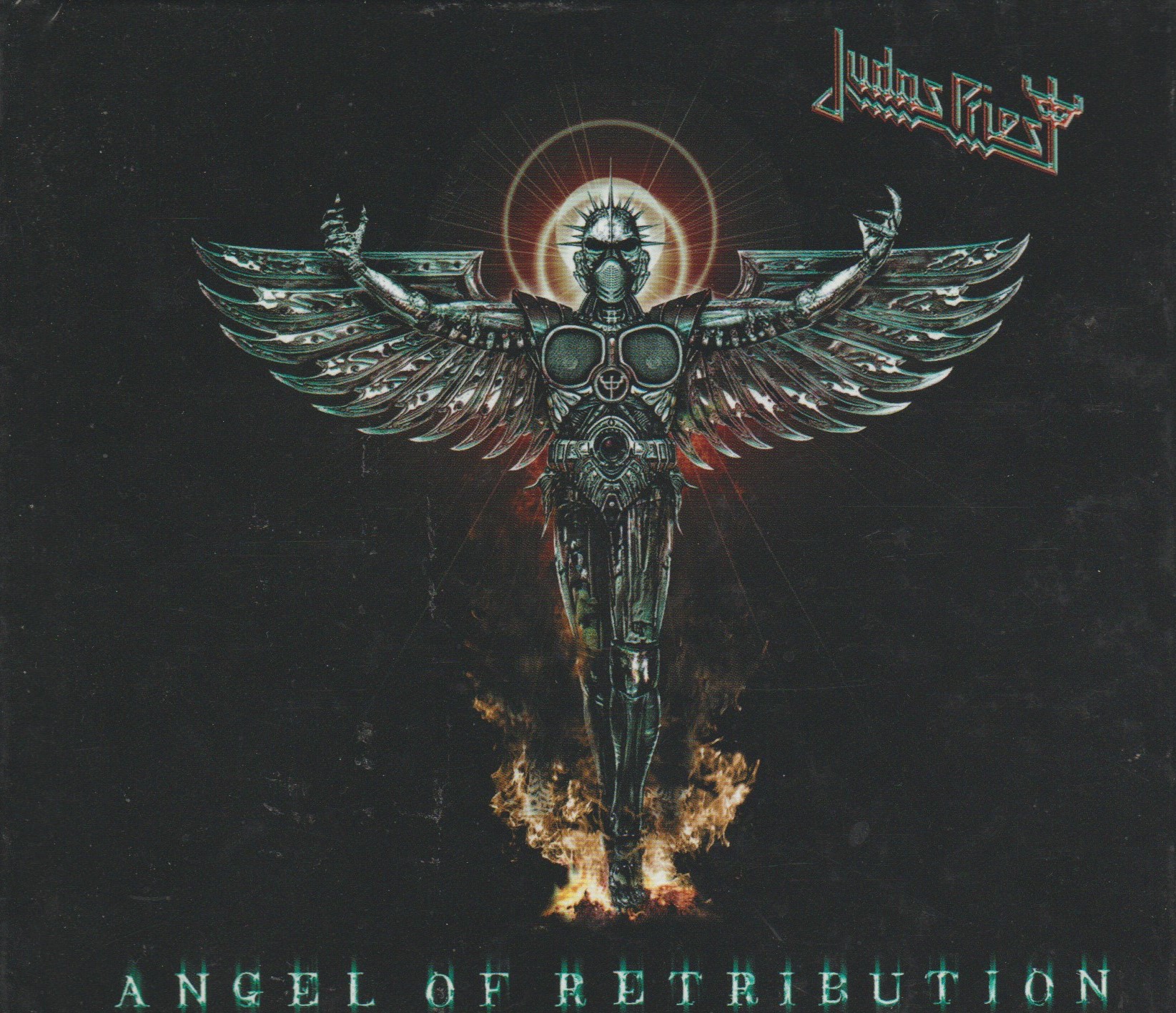
REVIEW: Judas Priest – Angel of Retribution (2004 CD/DVD)

“Sabbath are heavy, but Priest are metal.” – K.K. Downing

JUDAS PRIEST – Angel of Retribution (2004  Sony CD/DVD deluxe set)

Like Iron Maiden before them, Judas Priest pulled off a successful reunion tour before venturing into the studio to record a new album.  When the new music finally came, a deluxe package was made available featuring live videos from the reunion tour.  In this deluxe-sized review, we’ll take a close look at both the CD and DVD content.


The CD

Pure anticipation preceded the arrival of the Angel of Retribution.  Two underwhelming albums with Tim “Ripper” Owens on lead vocals caused Judas Priest’s star to diminish in the 90s and 2000s.  The return of the Metal God, Rob Halford, meant a reunion of the successful 1990-1991 Painkiller lineup.  The new album cover even featured the return of the Painkiller character, now the Angel of Retribution.  But a long time had passed.  Could Priest hope to live up to the hype, and their legacy?

The answer is mixed.  While Angel of Retribution contains enough classic Judas Priest metal to consider it a success, it also has some truly legendary filler, of sub-Ram It Down quality.  Instead of running through the album track by track, let’s break it down in terms of song integrity.

Priest wrote a natural sounding album, with elements from virtually all eras of Priest past.  They say it came about organically, and it does sound that way.  Some of the best material are the songs that sound like variations of classic Priest.

The opening song “Judas Rising” brings it back to 1976’s Sad Wings of Destiny with that fade-in opener inspired by “Victim of Changes”.  Then it transforms right into the Painkiller era, with something that sounds like a far more intense “Hell Patrol”.  Solid 5/5.

The slightly psychedelic first single “Revolution” ranks among the better songs, although perhaps it’s actually most similar to “Little Crazy” by Rob Halford’s Fight.  It has flavours of Rocka Rolla and Killing Machine, and is far from what anyone expected Priest to put out for a first single.  Dig that slide guitar bit in the solo!  Solid 5/5.

Worth Fighting For” isn’t a ballad; it’s a little harder edged than that.  It’s the one song that is unique in the Priest catalogue, and remarkably strong.  The riff has a nice chug to it, while Rob ably carries the melody to a higher place.  A special song, and a 5/5.

Demonizer” is Jugulator meets Painkiller, faster than a hellriding devil dog (whatever that is), but “the Painkiller rises again!”   So testifies Halford.  It’s so ridiculously over the top that it can only be worth a solid 5/5.  Likewise the similar “Hellrider” on side two.  Both feature double bass so fast that it’s almost a parody of itself, but both rock so hard you’ll break your neck keeping up.  “Hellrider” is also notable as the song where Rob Halford inexplicably name drops “Megatron”.  Similar songs, both solid 5/5’s.

The ballad “Angel” is a little soft, unexpectedly so on an album with so much heavy metal.  Yet, Priest can do anything.  The acoustic “Angel” could be the quietest ballad since the early days.  “Put sad wings around me now,” sings Rob to the angel, an appropriate callback.  As his voice aged it acquired more depth.  That helps make “Angel” a respectable 4/5.

Deal With the Devil” and “Wheels of Fire” fall in a netherworld of pedestrian Priest.  These both feel like filler from Point of Entry or Ram it Down.  Less explosive, less memorable.  The autobiographical “Deal With the Devil” is amusing for its many lyrical callbacks: “Under blood red skies”, “Took on all the world”, references to razor blades.  Likewise the short one, “Eulogy“, which is really an intro for another song that we’ll get to.  “They remain still as stained class”, “Guarded by the Sentinel”, and so on.  3/5 each.

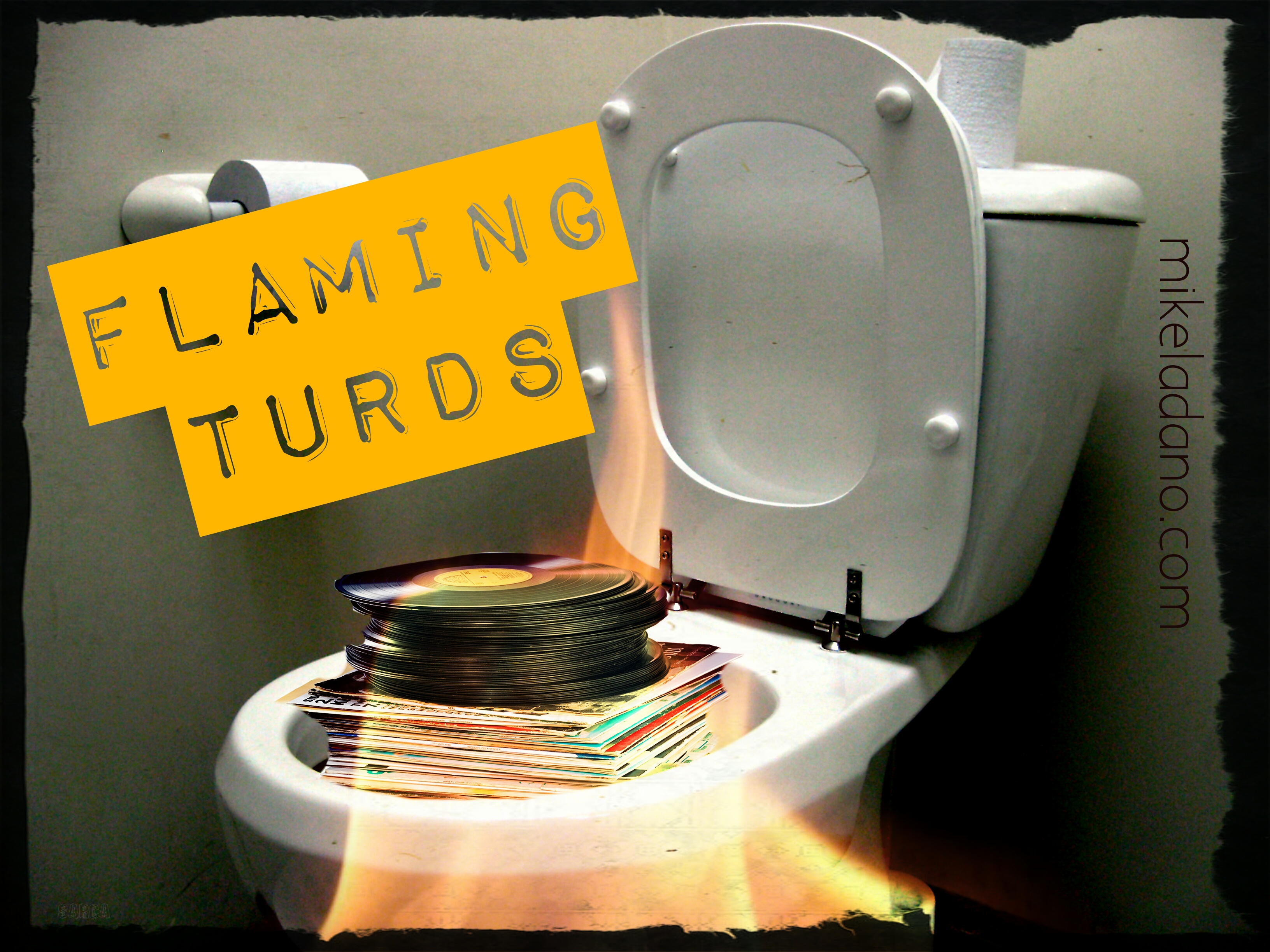
The worst of all songs is “Loch Ness“, a mess so atrocious that we had to devote an entire entry just to that one song.  Combined with its intro “Eulogy”, it’s over 15 minutes of mire that has no reason to exist.  Many people simply stop the album after “Hellrider” and leave this foul turd to rot unheard.  “Loch Ness” could very well be the worst Judas Priest song of all time.  A flaming turd to extinguish all flaming turds.  The worst of all putrid, rancid filler songs ever foisted upon the faithful.  0/5.


“Reunited” DVD

It’s worth getting a copy of this album with the bonus DVD.  For one, there’s a documentary from the Priest Reunited tour.  Secondly, there are seven uncut live songs here for you to enjoy, and it’s the only official video release from the Reunited tour.  The live footage is something to see, especially if you own the robotic Rising in the East DVD.  In that concert, Rob Halford was a stiff mannequin instead of a frontman.  Here, he comfortably in charge and engaged.  The entire lineup is energized.  “Breaking the Law” sees them powered up and working hard.

But how did the seemingly unlikely reunion begin?  According to the documentary, the band and Halford met to discuss the forthcoming Metalogy box set.  Glenn Tipton states that they decided to reunite later the same day.  It was like they’d never been apart.  Terribly British, says Rob.  “Have a cup of tea, see you later.”  Rob does express regret for his actions (reportedly he gave Judas Priest his notice in 1992 by fax), but it seems all was forgiven over time.

Beware which version you buy.  This CD/DVD combo set contains the documentary plus the full live songs:  “Breaking the Law”, “Metal Gods”, “A Touch of Evil”, “Hell Bent for Leather”, “Eletric Eye:”, “Diamonds & Rust”, and “Living After Midnight”.  The DualDisc version does not; it only includes edited fragments of those tracks.  Which is a shame, because the band sounded fantastic and Rob was in full-lunged form.  This is probably the best live version of “A Touch of Evil” available, for example.  Not everyone likes the acoustic version of “Diamonds & Rust”, but it’s certainly different. The only bonus to DualDisc is that you also get the album in “enhanced stereo”.  Avoid that; get this.


Although Angel of Retribution is overall a very strong Judas Priest album, “Loch Ness” is impossible to ignore.  It does serious damage to an album that was otherwise an impressive listen.  In the included DVD, K.K. Downing says they had to pick and choose from an overabundance of songs.  Can you imagine how bad the leftovers are if “Loch Ness” made the album?

3.5/5 stars
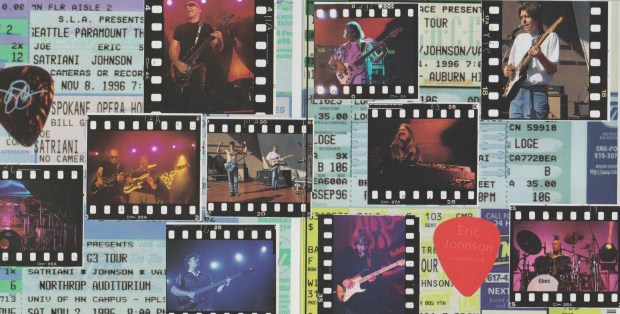
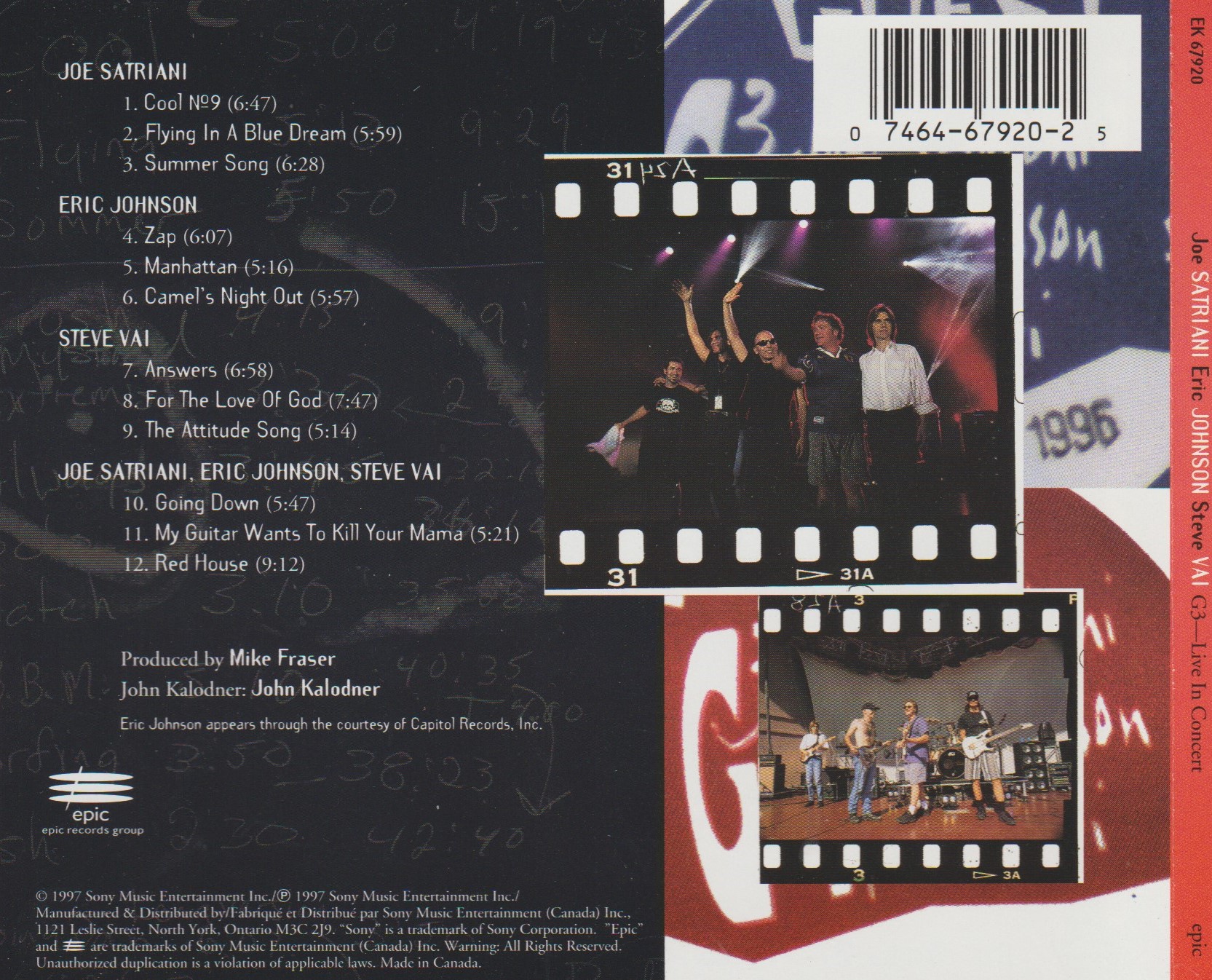
REVIEW: Joe Satriani, Eric Johnson, Steve Vai – G3 Live in Concert (1997)

JOE SATRIANI, ERIC JOHNSON, STEVE VAI – G3 Live in Concert (1997 Epic)

It took me 21 years to finally buy this CD.  Why?  It was hard to get excited about three live Satch songs, three live Vai songs, and so on.  But a collector needs to catch ’em all, and it’s actually a pretty fabulous listen throughout.

Joe Satriani opens the set with “Cool No. 9” from his self-titled blues album.  Blues to Joe Satriani is a different kind of animal.  It’s trick-laden and thick with notes, although this doesn’t mean light on feel.  His landmark classic “Flying in a Blue Dream” is more what people expect from Joe.  I like to describe his albums as regular vocal rock records, just with the lead guitar singing the melody instead of a person.  I think I stole that description from Joe himself.  You can’t really call “Flying” a ballad but it sure is epic.  Finally it’s “Summer Song”, Joe’s big 1992 hit from The Extemist.  It doesn’t get more accessible for instrumental guitar rock.  Joe’s actually the perfect artist to open this CD for that reason.  His music, more than most instrumentalists, is door-opening for listeners.

The sublime Eric Johnson is in the middle position.  “Zap” is a tour-de-force of instrumental prowess, built into the framework of a nice shuffle.  Though you can certainly bop along if you like, the musicianship here is not for the timid.  “Camel’s Night Out” is a busy groover.  One of Johnson’s best tunes ever has to be “Manhattan”, which goes down unbelievably smooth live.  The playing is lyrical and warm.

Steve Vai’s threesome includes “Answers” and “For the Love of God” from Passion & Warfare.  “Answers” is one of Vai’s more challenging songs, fast and funky with weird tones and melodies.  This is probably the most blistering song on the whole disc, including a solo that isn’t in the studio version.  For all that, “For the Love of God” is the most awe-inspiring.  This ballad puts the passion in Passion and Warfare.  This is the one with Steve’s soul in it, every bend and every beat.  “The Attitude Song” is an oldie from the first Vai album Flex-able, just a solid rocker with some shredding.  Live it is much heavier than the tinny studio cut.

Finally, there is a trio of tunes with the three maestros playing together, as is the G3 tradition.  The blues standard “Going Down” is a typical jam, with Joe on vocals.  Then a tribute to Steve’s mentor, Frank Zappa, on “My Guitar Wants to Kill Your Mama” with everyone singing…and shredding.  Finally, Jimi Hendrix’s “Red House” finishes the CD with Eric Johnson on lead vocals.  Of these three tracks, “My Guitar Wants to Kill Your Mama” smokes the other two.

May as well pick up the original G3 CD if you find it in the wild.  It’s good stuff.

3.5/5 stars

REVIEW: AC/DC – The Razors Edge (1990)

AC/DC – The Razors Edge (1988, 2003 Epic remaster)

The 80s were bumpy for AC/DC.  Back In Black was massive.  For Those About to Rock was almost as big.  Flick of the Switch was a solid ball of rock, but things were uneven and some songs were filler.  Fly on the Wall has its detractors for its muddy sound, and Blow Up Your Video was mostly a snooze.  For their 1990 comeback, AC/DC got Canadian mega-producer Bruce Fairbairn involved.*  He had a huge run of hit albums most notably by Bon Jovi and Aerosmith.  Could he work his magic with AC/DC?

Bruce was one of the biggest names around, but having a hitmaker like him working with AC/DC was bound to affect their sound.  Not too much of course; this was AC/DC after all.  But Bruce did offer a cleaner sound, and there is no question it worked. To the tune of five million copies!  Another change was bringing in ex-The Firm drummer Chris Slade after the departure of Simon Wright, who joined Dio.  The bald-headed beat keeper became a fan favourite very quickly.  (Slade is once again the drummer of AC/DC today after replacing Phil Rudd.)

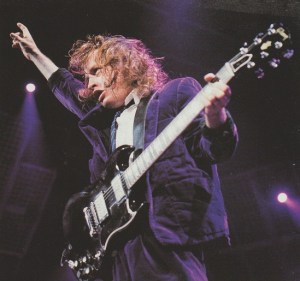
Debut single “Thunderstruck” has deservedly become a classic in the pantheon of AC/DC classics.  It was immediately obvious that AC/DC toned down the bluesy leanings of Blow Up Your Video in favour of rock and even arguably metal.  “Thunderstruck” is heavy metal, especially with that fluttery Angus Young lick that dominates the song.

Chris Slade’s hyper-caffeinated drum stylings really impact “Fire Your Guns”, one of the fastest and most fun AC/DC tracks in recorded history.  Any AC/DC song that involves them yelling “fire!” is guaranteed to thrill.  Not to be ignored is bassist Cliff Williams who is effortlessly locked in with Slade.  And sonically this is the best sounding AC/DC stuff since Back in Black.  Singer Brian Johnson said at the time that Bruce Fairbairn encouraged him to scream more like the old days.

Another huge single was the plucky “Moneytalks”, bringing the groove down to a perfect mid-tempo.  The main thing is the hook of the chorus.  Though all songs were written solely by the Brothers Young, you can hear Bruce Fairbairn’s impact.  It’s tight and focused more than AC/DC had been last time out.  No doubt Bruce acted as a brutal editor in the studio when necessary, and must have had a role in shaping the songs to their final form.  Listen to the layers of vocals on the chorus and tell me that’s not Bruce’s doing.

Some of the best AC/DC tracks in history have been deeper album cuts.  The title track is one such song, an ominous almost-epic.  “The Razors Edge” refers to a storm front on the horizon, and the song has that kind of foreboding feel.  Unfortunately this friggin’ incredible construction of guitars and screams is followed by a novelty track.  A seasonal novelty track.  “Jingle bells, jingle bells, jingle all day the day.  I can’t wait til’ Christmas time when I roll you in the hay.”  This song should have been axed and saved for a compilation or single, where it actually could have had some impact.  Not that it’s not fun; it is!  But who wants to listen to jingle bells on track five of an AC/DC album?  “Rock Your Heart Out” closed the side with the dubious distinction of being the first obvious filler song.

The third single “Are You Ready” was the opening track for side two.  Good tune, nothing particularly special, but good enough for an AC/DC album.  “Got You By the Balls” is an amusing title, but not a memorable song.  It has a menacing bite, but not enough hooks.  There’s a definite “side two slump” as none of these songs are as good as the first batch on side one.  “Shot of Love” is OK.  Things get back on track with “Let’s Make It” which might have made a great single itself.  It has an old-timey rock and roll feel, and a slow groove.  That classic rock and roll sound isn’t heard frequently on The Razors Edge.  “Goodbye and Good Riddance to Bad Luck” isn’t shabby but veers close to that filler territory.  Finally The Razors Edge comes to a campy end with the unusual “If You Dare”.  Fortunately it’s a great, hooky little closer.

As it turns out, The Razors Edge was a one-off of sorts.  It spun off a successful live album, also produced by Bruce Fairbairn, but that was the end of their partnership.  A 1993 single called “Big Gun” sported a ballsier sound provided by Rick Rubin who went on to do their next album as well.  The Razors Edge is also the only studio album with Chris Slade.  Phil Rudd returned, reuniting the classic Back In Black lineup.  No one will question that Rudd is the best fitting drummer that AC/DC have ever had, but that doesn’t negate Chris Slade’s contribution.  Slade and Rudd do not sound alike, and therefore AC/DC acquires a different flavour with him in the band.  His cymbal work is enviable and nobody can play “Thunderstruck” like Chris Slade, period.

3.5/5 stars
*Much to the upset of the Scorpions who had tapped Bruce to do their next album Crazy World.  That didn’t happen because of the AC/DC job.

RE-REVIEW: KISS – Wicked Lester & Eddie Kramer demos (1972 & 1973)

The KISS RE-REVIEW SERIES Part 1:  

For once, it did not all start with a kiss-logo.

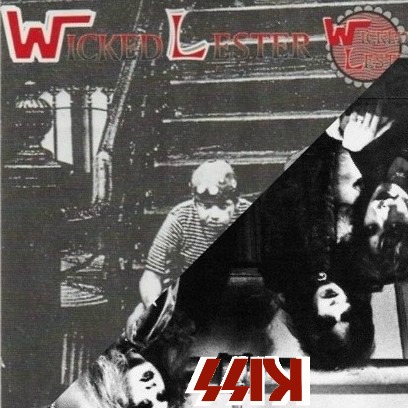
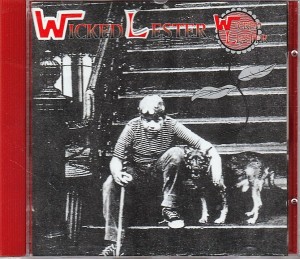
scan_20170220-4Wicked Lester (1972 unreleased album) & the Eddie Kramer demos (1973) (CD bootleg “promo” with “Epic” logo)

Stanley Eisen and Chaim Witz were two young New York musicians who didn’t particularly care for one another.  They met via guitarist Stephen Coronel, a mutual friend and bandmate of Witz.  Chaim, who came to the United States from Israel at the age of eight, changed his name to Gene Klein.  Stephen Coronel told Gene that young Stanley wrote songs too.  Unimpressed, Gene commanded, “Oh yeah?  Play one.”  Stanley played a prototype called “Sunday Driver”, but the encounter left a foul taste in his mouth.

Coronel eventually succeeded in bringing his two friends together, when Stanley Eisen joined their band Rainbow.  In was 1971, and Ritchie Blackmore had yet to form the most famous Rainbow of them all, but even so they needed a more unique name.  They already knew of one other band using the name Rainbow.  Both Paul and Gene had their sights set on bigger things than just New York City.  They wanted something original, and settled upon Wicked Lester.  They’d also drop their “ethnic sounding” real names in favour of the handles “Paul Stanley” and “Gene Simmons”.  They collected together some material they’d written and focused on their originals.  The lineup consisted of Stanley and Coronel on guitars, Simmons on bass, Brooke Ostrander (RIP, FYC) on piano and horns, and Tony Zarella on drums.

Wicked Lester performed only two gigs before an opportunity was offered by Ron Johnsen, a resident sound engineer at Electric Lady studios.  He saw something in the band, and put up the funds for some demo recordings.  Eventually, Epic had their curiosity piqued enough to buy the demos and agree to do make an album.  They had only one condition:  Get rid of Stephen Coronel.  Thus, the man that brought Gene Simmons and Paul Stanley together was fired from the band he shared with them.

Coronel was replaced by a player named Ron Leejack, and recording of the album commenced.  The majority of tracks were Simmons/Stanley (and sometimes Coronel) originals, with a handful of covers.  To cut a long story short, upon completion, Epic shelved the album and deemed it not good enough to release.

They were right to do so.

Only three tracks have ever been released officially, on the 2001 Kiss Box Set:  “Keep Me Waiting”, “She”, and “Love Her All I Can”.  The rest are only available on very poor sounding bootleg discs.  Even without the full fidelity of a proper release, one can tell from the available bootlegs that the album Wicked Lester was best left in the shadows.  When Kiss seemed to emerge fully-formed in 1974, nobody had witnessed their growing pains.

The running order of various bootlegs differ.  The red-packaged “Epic promo CD” (surely not) begins with the familiar “Love Her All I Can”, best known as one of Kiss’ early classics from 1975’s Dressed To Kill.  The unfocused Wicked Lester original sounds like a hippie commune on speed. Simmons today describes their sound as “like a cross between Three Dog Night and the Doobie Brothers.”  Throw in a healthy dose of acid.  Who knows where that came from, Simmons being so proudly anti-drug.

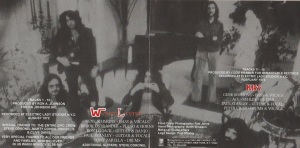
scan_20170220-3

An obscure cover “Sweet Ophelia” (Barry Mann/Gerry Goffin) really demonstrates how far out in left field everybody was.  It’s mildly disconcerting how well Paul Stanley fits the hippie vibe, far removed from his future Starchild persona.  A Stanley original “Keep Me Waiting” bears little resemblance to the style his is known for.  Though one could imagine the guitar solo section as part of a Kiss song, “Keep Me Waiting” is a delirious concoction of congas and horns.  Simmons’ “Simple Type” is more straightforward.  No annoying extra accoutrements.  No hooks either, or any balls, but it’s one of the earliest examples of Gene Simmons and Paul Stanley sharing lead vocals on a song.  Even at this early stage, it was clear that Paul Stanley possessed a mighty throat.

“Simple Type” merges with the flutes and tambourines of “She”.  Flutes and tambourines, on “She”?!  Yes, this future Kiss grinder is set to the sultry sounds of more hippie instrumentation, to go with the organ and shakers.  As the song fades out, you can just hear the potential it had.  This potential is nowhere to be found on “Too Many Mondays” (Barry Mann/Cynthia Weil), light and flaky.  “What Happens in the Darkness” (Tamy Lester Smith) is all but indescribable.  Deep Purple Mk I gone terribly wrong,  but with Paul Stanley leading the choir instead of Rod Evans going it alone.  Tougher and better is “When the Bell Rings” (Austin Roberts/Christopher Welch) which again features Paul and Gene singing together.  This time, Gene utilizes his early high rasp, also heard on Kiss tracks like “Goin’ Blind” and “Let Me Go, Rock and Roll”.  Sounding a bit more like our beloved demon, “When the Bell Rings” is actually listenable.  Paul Stanley’s dainty “Molly” brings the flutes back into the picture, and the sooner it’s over the better.  A cover of The Hollies’ “(We Want To) Shout it Out Loud” is not bad.  And it lent its title to something much better later on.

The “Epic promo” CD has terrible tape bleed-through.  It’s clearly a copy of a copy, generations down.  The cheap paper cover belies its actual bootleg manufacture.  It’s also missing a song called “Long, Long Road”, a soft country track that was recorded but perhaps cut from the intended album. That’s right — soft country.

Epic passed on the Wicked Lester album, which was mixed and even had cover art selected.  The boy was their mascot, “Wicked Lester”.  The cover art was originally intended for another band called Laughing Dogs.  Now that the album was shelved (and since Simmons and Stanley were the clear leaders of the group) the fates of the others were pre-determined.  Paul and Gene began looking for new members, and experimenting with makeup.  They wanted a strong, singular image, not five guys who looked like the line at the local soup kitchen.  They also wanted a focused direction, and that was to be hard rock a-la The Who, Cream and Led Zeppelin.

An experienced drummer (his band Lips had an album) named Peter Criscoula was first to heed the call.  The new Wicked Lester was a power trio consisting of Peter, Gene and Paul, who rehearsed in a loft located at 10 East 23rd Street in Manhattan.  The sound was incomplete:  a lead guitarist was needed.  Auditions were held at the same loft.  Legend has it that Bob Kulick (who features into the story much later) was about to get the gig, when they were rudely interrupted.  A spaced out guy with one red and one orange sneaker had plugged in and started wailing away.  Paul Frehley snatched the gig at the last minute, and Kiss was born.

The loft where Kiss was born.   10 East 23rd Street, photos by Mike Lukas.

The new focus became apparent when the re-named band entered Electric Lady one more time, in March of 1973, with legendary producer Eddie Kramer.  The band cut five new originals:  “Deuce” (Simmons), “Strutter” (Stanley/Simmons), “Cold Gin” (Frehley), “Watching You” (Simmons), “Black Diamond” (Stanley).  Each of these songs later made it onto Kiss albums in 1974.  They had the goods.

The Kramer demos sound better on this CD than the Wicked Lester tracks.  A different, younger tape generation would be the probable source.  Only two of these demos (“Strutter” and “Deuce”) have been released officially, on the Kiss Box Set.  These ferocious tracks are almost completely faithful to the final album arrangements.  A few extended solos here, and some longer bits there.  Tracks such as “Deuce” are faster than they were later recorded, and more akin to what Kiss sounded like live.  Playing to their strengths, keeping things simple, and with Eddie goddamn Kramer at the boards, the band laid down one hell of a demo.  This is something that bands today would release officially as their first EP, to build buzz for an album.  That wasn’t the strategy in 1973, so the band instead stuck to a regular regimen of songwriting, rehearsals and unforgettable club gigs.

Nine months after their debut gig as Kiss at the Coventry, they signed with Neil Bogart’s Casablanca Records.  They had built up a repertoire of roughly 18 originals, including some holdovers from the shelved Wicked Lester: “She”, “Simple Type”, “Keep Me Waiting”, and “Love Her All I Can”.  These four songs were whittled out again in the process of coming up with the tracks to record for their first LP.

The Eddie Kramer demos and Wicked Lester album alike are important historical documents.  They are pieces of the puzzle coming together, and by the time they got with Kramer, the outline was in place.  The only way to go was up.

Today’s rating:

Wicked Lester 1/5 stars
Eddie Kramer demos – 3.25/5 stars


Original mikeladano.com Wicked Lester review:  2012/08/14